

- Market Size (2026)
- USD 2.8 Bn
- Forecast (2036)
- USD 4.8 Bn
- CAGR (2026 to 2036)
- 5.8%
How big is Automotive Driver Feedback Displays Market in 2026?
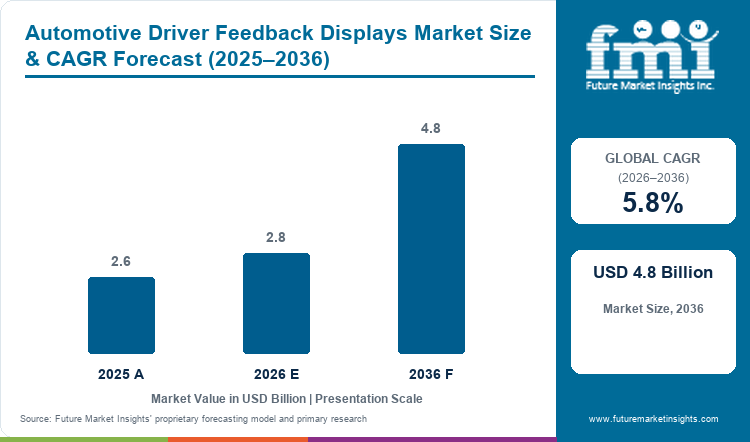
USD 2.8 billion in 2026 and USD 4.8 billion by 2036 at a 5.8% CAGR.
Sales of automotive driver feedback displays are projected to rise from USD 2.8 billion in 2026 to USD 4.8 billion by 2036 at a 5.8% CAGR. Factory programs specify feedback inside clusters and center displays that already share cockpit compute with navigation, ADAS visualization and driver-state logic. Visteon disclosed in October 2025 that it launched 28 products during the third quarter, including dual- and multi-display modules. Those launches place feedback qualification inside vehicle development instead of a later retrofit decision.
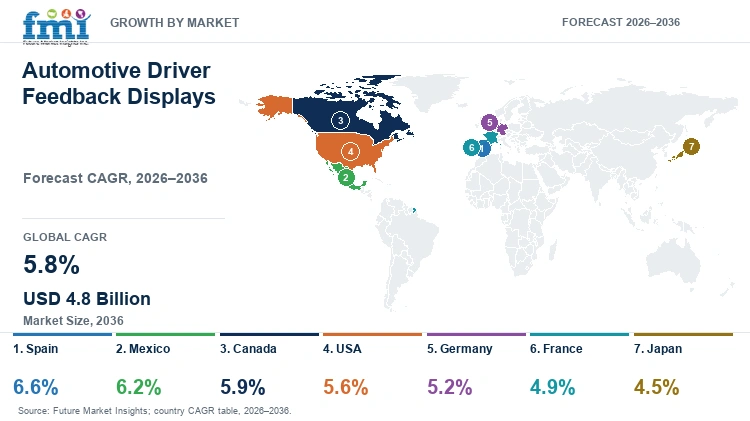
Spain is expected to rise at 6.6% CAGR which exceeds Germany's CAGR of 5.2%, but the difference is better read through program mix than vehicle volume. Eurostat's February 2026 transport release found battery-only vehicles represented 13.9% of new registrations in 20 EU countries during 2024. Electrified model lines give range and efficiency cues more display value, while safety warnings remain relevant regardless of powertrain and still depend on local vehicle HMI approval timing.
Key Takeaways
- Demand rises as automakers place safety, energy and behavior feedback inside cockpit systems already qualified for routine driver use.
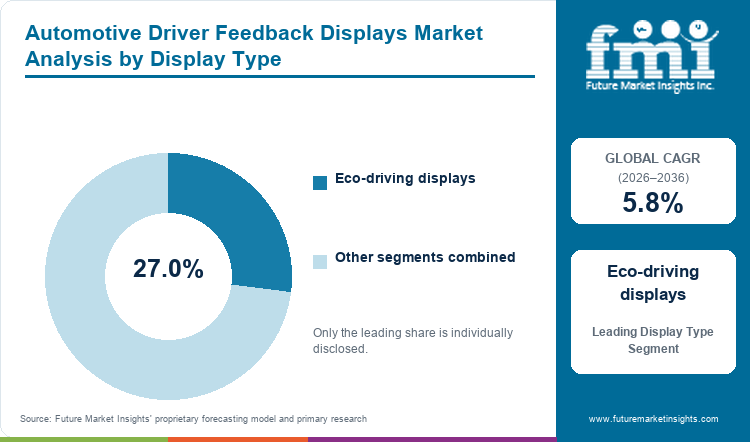
- Based on display type, eco-driving displays are projected to account for 27.0% in 2026 due to simple fuel and energy guidance during normal trips.
- By vehicle type, passenger cars are estimated to hold 34.0% in 2026 owing to high-volume OEM programs that spread feedback through factory cockpit architectures.
- In 2026, dashboard display is expected to lead interface with 27.0% share because automakers control prompt priority, timing and legibility in the primary HMI.
- HMI validation and alert overload can delay approval if a new prompt competes with essential driving information or produces distracting interaction.
- Key players in the automotive driver feedback displays market include AUMOVIO SE, Bosch, Denso, Visteon, Marelli, Panasonic Automotive, Garmin, Geotab, Samsara, and Aptiv.
Analyst Perspective
"OEM programs gain more from driver feedback when safety alerts and efficiency cues share one tested information hierarchy. Fleet platforms need a different proof point because coaching software must reduce risky behavior or operating cost before subscriptions survive renewal."
- Nikhil Kaitwade, Principal Consultant, Future Market Insights
How is the automotive driver feedback displays market segmented?
The market is analyzed by display type, vehicle type, interface, sales channel and function.
The automotive driver feedback displays market is segmented by display type, vehicle type, interface, sales channel and function. Display types cover eco-driving, driver coaching, fleet feedback, HUD feedback and instrument-cluster prompts. Vehicle types include passenger cars, commercial fleets, buses - coaches, delivery vans and hybrid - EV platforms. Interfaces span dashboard, head-up, mobile-connected, telematics-terminal and cluster-integrated formats. Sales channels include OEM infotainment - instrumentation, fleet telematics, aftermarket retrofit and software subscription. Functions cover eco-driving scoring, fuel-efficiency prompts, safety alerts and route - behavior feedback.
What makes eco-driving displays central to the display type category?
Eco-driving displays translate energy use and speed into cues drivers can act on during the trip. Geotab reported in May 2026 that a USA Vitality pilot improved fuel efficiency by 2.7%, giving fleets a repeatable test of whether feedback changes behavior.
- By display type, eco-driving displays are estimated to hold 27.0% in 2026 owing to routine fuel and energy guidance in conventional and electrified vehicles.
- Fleets can reinforce the same cue after a trip through app-based goals and coaching, turning one visible signal into repeated behavior review without changing installed vehicle hardware.
Why do passenger cars lead the vehicle type category?
Passenger-car programs specify clusters, center displays and cockpit controllers during vehicle development, which lets feedback undergo HMI validation before production alongside other cockpit software releases on shared vehicle platforms. Visteon reported in February 2026 that it launched 86 products during 2025, with display and cluster business supporting cockpit sales.
- In 2026, passenger cars are expected to lead vehicle type with 34.0% share because high-volume programs spread common feedback graphics over several model lines.
- Automakers reuse vehicle signals and graphic assets. Each extra display path requires more software tests, readability checks and lifecycle support during model updates.
How does dashboard display influence selection within the interface category?
Dashboard displays occupy the driver's forward viewing zone, giving OEM teams direct control over prompt timing. Marelli presented ProDisplay in April 2025 with a concealed surface that appears on demand, allowing display placement and feedback visibility to change without a separate terminal or added hardware.
- Dashboard display is set to lead the interface category with 27.0% share in 2026 due to integrated cockpit surfaces carrying safety and efficiency prompts under one HMI approval process.
- Approval depends on critical messages staying legible under changing light without forcing drivers to search infotainment menus for routine feedback.
What supports OEM infotainment - instrumentation within the sales channel category?
OEM infotainment - instrumentation gives automakers control over display hardware, vehicle-network access and software release timing from the first production build onward. Visteon and Qualcomm announced an April 2025 cockpit collaboration using shared high-performance compute for new driver-facing in-vehicle functions and updates.
- Based on sales channel, OEM infotainment - instrumentation is projected to account for 43.0% in 2026 due to factory validation of feedback with clusters, displays and vehicle software.
- The factory route also supports controlled updates after launch, provided each change preserves latency, graphic priority and compatibility with the approved HMI during the program life cycle.
What drives eco-driving scoring within the function category?
Eco-driving scoring converts repeated driving events into a result a driver can review and a fleet can compare over time. Geotab introduced Driver Risk Insights in February 2025 to expose individual risk factors in Safety Center, letting managers link specific behaviors to a score.
- Eco-driving scoring is projected to hold 31.0% share in 2026 owing to one normalized measure supporting self-correction, manager review and progress tracking without new vehicle hardware.
- Commercial value improves if the score explains which behaviors changed it, since opaque ratings weaken driver acceptance and make coaching harder to defend during routine reviews.
What are the drivers, restraints and opportunities in the Automotive Driver Feedback Displays Market?
Safety requirements increase demand, interface qualification slows deployment, and adaptive coaching extends software revenue beyond fixed dashboard prompts.
- Driver: OEM safety and driver-state functions require clear feedback paths inside the validated cockpit.
- Restraint: Distraction controls and HMI testing narrow acceptable message timing, placement and interaction.
- Opportunity: Configurable coaching software can turn vehicle events into timely prompts and post-trip review.
Safety requirements place driver feedback inside cockpit architecture
Driver feedback gains purchasing weight as safety assessment gives more weight to driver interaction. Euro NCAP stated in July 2026 that revised tests place greater emphasis on safe-driving performance and driver monitoring. OEM teams therefore need display paths that present speed, assistance and attention inside an approved information hierarchy.
Distraction controls raise the HMI approval burden
More visual information can weaken driver support because every prompt competes for limited attention. Euro NCAP's May 2025 driver-engagement protocol assigns 20 points to driver monitoring and places essential driving information in the driver's direct line of sight. Automakers must prove message priority and interaction quality before adding feedback to vehicle programs.
Adaptive coaching extends feedback beyond the trip
Fleet platforms can earn subscription revenue by turning a static score into timely feedback. Geotab confirmed an August 2025 partnership with Predictive Coach for real-time coaching based on telematics events. Operators still need thresholds that reduce risky behavior without flooding drivers with repeated prompts.
Which country CAGRs are profiled in the Automotive Driver Feedback Displays Market?
| Country | CAGR |
|---|---|
| Spain | 6.6% |
| Mexico | 6.2% |
| Canada | 5.9% |
| USA | 5.6% |
| Germany | 5.2% |
| France | 4.9% |
| Japan | 4.5% |
How do country-level CAGRs compare in the Automotive Driver Feedback Displays Market?
Country growth spans 2.1 percentage points from Spain at 6.6% to Japan at 4.5%. Spain and Mexico form the upper group, Canada and the USA occupy the middle, and Germany, France and Japan advance more slowly. The spacing reflects program timing, software adoption and HMI qualification rather than market size.
- Spain's faster rate favors shorter cockpit software refresh cycles.
- Mexico's export-oriented factory programs support earlier cockpit design wins.
- Canada's mixed fleet base gives configurable software a wider deployment route.
- USA programs can monetize analytics after vehicle delivery.
- Germany rewards regional engineering coverage during OEM qualification.
- France's embedded OEM channels favor factory-integrated feedback programs.
- Japan rewards incumbent electronics relationships and disciplined releases.
Comparable CAGRs produce different order cycles under local conditions. The full report provides country-level CAGR analysis across North America, Latin America, Western Europe, Eastern Europe, East Asia, South Asia and Pacific, and Middle East and Africa.
Country-wise Analysis
- Spanish OEM programs integrate ADAS and driver warnings into factory cockpits that must satisfy EU safety rules and local type-approval workflows, and DGT reported in August 2026 that 86% of vehicles registered in third-quarter 2025 carried at least one ADAS function. Demand for automotive driver feedback displays in Spain is forecast to rise at 6.6% CAGR through 2036, owing to factory programs that need concise speed and assistance messages. The installed ADAS base favors feedback tied to existing assistance systems, though added visual content must fit cluster or HUD validation without raising distraction risk in current passenger and commercial programs.
- Mexico's high-volume vehicle assembly base and federal freight fleet give cockpit integrators factory and retrofit routes into the same national market. SICT reported in February 2025 that the federal freight fleet reached 1,435,884 units at December 2024, giving telematics programs a large installed pool but leaving regional installation and service coverage decisive outside the largest fleets. Automotive driver feedback display sales in Mexico are forecast to expand at 6.2% CAGR by 2036, supported by fleet scale and new-vehicle cockpit integration although fragmented ownership keeps price tiers central to order conversion for smaller and regionally dispersed operators outside national fleet networks.
- Canadian programs split between factory displays and commercial telematics because passenger vehicles, delivery fleets and long-haul operators replace hardware and service plans on different schedules. Statistics Canada reported in March 2025 that zero-emission vehicles accounted for 14.6% of new registrations in 2024, expanding the addressable base for range and efficiency feedback without standardizing fleet hardware. Canada's automotive driver feedback displays outlook is anticipated to advance at 5.9% CAGR over the assessment period, aided by configurable software, yet provincial operating conditions and mixed terminals complicate one national interface design for fleet operators serving several provinces and mixed commercial vehicle classes nationwide.
- American purchasing divides between OEM cockpit programs and commercial fleets that already budget for telematics, cameras and driver coaching as operating safety tools. NHTSA stated in April 2026 that distraction-related crashes killed 3,208 people during 2024, raising the proof burden for visual prompts because their safety value must outweigh added screen interaction during active driving. In the USA, automotive driver feedback display demand is predicted to advance at 5.6% CAGR through 2036, tied to factory safety integration and measurable fleet coaching, whereas weak behavior evidence can reduce renewal appetite after initial deployment and at later contract renewals for large fleets.
- German vehicle programs from major domestic OEM groups emphasize platform reuse and HMI validation as premium and volume models increasingly share centralized cockpit compute. The German automotive driver feedback displays sector is projected to record 5.2% CAGR during the assessment period because reusable software architectures can spread approved warning logic over several vehicle lines. Destatis reported in July 2025 that excessive or inappropriate speed was associated with 30% of road deaths during 2024, giving speed feedback a defined safety use case, and entrants still need readable graphics and interfaces that survive HMI approval without separate validation for every individual model.
- French cockpit teams have to prioritize messages for dense urban driving and long motorway trips because extra alerts can compete for driver attention. ONISR's September 2025 road-safety report found attention failure or technology distraction in 24% of injury crashes during 2024, raising the bar for prompts that ask drivers to look away from the primary task. France is estimated to post 4.9% CAGR over the forecast period, attributable to mature passenger-car programs and safety-oriented HMI work, as short warnings fit immediate risks better than long coaching sequences and nonurgent behavior feedback shifts to post-trip review for structured later coaching sessions.
- Japanese OEM programs favor interface clarity and long validation cycles, which raises the value of feedback that fits proven cluster and HUD layouts on high-volume domestic model lines. The National Police Agency reported in February 2025 that road deaths fell to 2,663 in 2024, keeping safety attention on warning quality instead of adding more display content. Adoption of automotive driver feedback displays in Japan is estimated to expand at 4.5% CAGR through 2036, given integrated safety functions and incumbent electronics expertise, although disruptive interface changes still face a higher qualification burden within local OEM programs and domestic HMI engineering teams.
Who are the notable companies in the Automotive Driver Feedback Displays Market?
AUMOVIO SE, Bosch, Denso, Visteon, Marelli, Panasonic Automotive, Garmin, Geotab, Samsara and Aptiv are the notable companies serving this market.
Competition separates factory-integrated cockpit suppliers from software-defined HMI specialists and fleet coaching platforms. Vehicle-program qualification, validated driver interaction, data access and update support determine where each group can convert design wins or subscriptions.
- AUMOVIO SE, Bosch, Denso and Visteon cover embedded clusters, cockpit compute and driver-assistance integration.
- Marelli, Panasonic Automotive, Garmin and Aptiv focus on cockpit controllers, multi-display HMI and vehicle integration.
- Geotab and Samsara sell driver scoring, in-cab feedback and coaching through fleet subscriptions.
Competitive Benchmarking: Automotive Driver Feedback Displays Market
| Company | Embedded HMI Coverage | Feedback Intelligence | Software Deployment Flexibility | Geographic Reach |
|---|---|---|---|---|
| AUMOVIO SE | High | High | High | Global |
| Bosch | High | High | High | Global |
| Denso | High | High | Medium | Global |
| Visteon | High | Medium | High | Global |
| Marelli | High | Medium | High | Global |
| Panasonic Automotive | High | Medium | High | Asia, North America and Europe |
| Garmin | High | High | High | North America, Europe and Asia |
| Geotab | Medium | High | High | Global fleet coverage |
| Samsara | Medium | High | High | North America and Europe |
| Aptiv | High | High | High | Global |
Scoring basis: High embedded HMI coverage requires multiple documented driver-facing surfaces or a cross-domain cockpit platform. Medium requires one established route, and Low identifies a narrower implementation. High feedback intelligence requires at least two documented alert, monitoring, scoring or coaching functions. Medium requires one function, and Low indicates limited verified coverage. High software deployment flexibility requires an updateable cockpit or cloud platform plus multiple delivery routes. Medium identifies one controlled route, and Low identifies a fixed implementation. Geographic reach describes documented coverage and is not scored.
Key Developments in the Automotive Driver Feedback Displays Market
- In May 2025, Samsara launched Recognition globally, letting fleet managers use live driver-performance data to acknowledge safe behavior and fuel-efficient driving inside the Driver App.
- In January 2025, AUMOVIO SE presented its Emotional Cockpit with a 1.30-meter E Ink dashboard display that can also present driving information such as remaining range.
- In January 2025, Panasonic Automotive Systems and Qualcomm expanded their Snapdragon Cockpit Elite collaboration to develop cockpit domain and high-performance computing systems for in-vehicle experiences.
Key Players in the Automotive Driver Feedback Displays Market
Embedded Cockpit and Driver-Display Platforms
- AUMOVIO SE
- Bosch
- Denso
- Visteon
Software-Defined Cockpit and HMI Platforms
- Marelli
- Panasonic Automotive
- Garmin
Fleet Coaching and Driver-Feedback Software
- Geotab
- Samsara
Cockpit Compute and Vehicle Integration Platforms
- Aptiv
Automotive Driver Feedback Displays Market - Report Scope
| Coverage field | Report scope |
|---|---|
| Market breakdown | By display type, vehicle type, interface, sales channel, function and region. |
| Quantitative Units | USD billion. |
| Market Definition | Driver-facing automotive display hardware and software that presents efficiency, safety, route or behavior feedback through factory or fleet interfaces. |
| Regions Covered | North America, Latin America, Western Europe, Eastern Europe, East Asia, South Asia and Pacific, Middle East and Africa. |
| Countries Covered | Spain, Mexico, Canada, USA, Germany, France, Japan, and 20+ countries included in the full report. |
| Key Companies Profiled | AUMOVIO SE, Bosch, Denso, Visteon, Marelli, Panasonic Automotive, Garmin, Geotab, Samsara, Aptiv. |
| Forecast Period | 2026 to 2036. |
| Approach | Primary and secondary research with market triangulation. |
Automotive Driver Feedback Displays Market - Research Methodology
| Method | Approach |
|---|---|
| Primary Research | FMI analysts gathered input from manufacturers, service providers, technology developers, distributors, end users, procurement teams, and subject-matter experts. Interviews examined purchasing decisions, product or service evaluation, adoption barriers, approval requirements, pricing considerations, and expectations for technical or commercial support. Respondents were also asked what evidence is required before a trial, pilot, or initial order develops into regular purchasing. |
| Desk Research | Desk research covered government statistics, regulatory publications, trade data, industry associations, technical literature, standards, company filings, product information, and official corporate announcements. Sources were reviewed for relevance, publication date, geographic coverage, and consistency with the defined market scope. Claims relating to performance, applications, approvals, capacity, investment, and commercial activity were retained only when supported by credible public evidence. |
| Market Sizing and Forecasting | The market model combined the baseline value with historical performance, segment structure, pricing and volume indicators, adoption levels, company participation, and country-level demand conditions. Forecast assumptions considered economic activity, investment trends, regulatory developments, technology adoption, purchasing cycles, supply availability, and barriers to wider market use. Segment and regional estimates were reconciled before the final market total was calculated. |
| Data Validation | Estimates were checked against multiple independent indicators, including public data, company activity, trade patterns, industry developments, and findings from primary interviews. Validation also tested whether products, services, applications, and company revenues fell within the defined market boundaries. Adjacent categories, unsupported claims, overlapping revenues, and activities without direct market relevance were excluded to reduce double counting and maintain consistency across segments and countries. |
Automotive Driver Feedback Displays Market by Segments
Automotive Driver Feedback Displays Market segmented by Display Type:
- Eco-driving displays
- Driver coaching displays
- Fleet feedback screens
- HUD feedback modules
- Instrument cluster prompts
Automotive Driver Feedback Displays Market segmented by Vehicle Type:
- Passenger cars
- Commercial fleets
- Buses - coaches
- Delivery vans
- Hybrid - EV platforms
Automotive Driver Feedback Displays Market segmented by Interface:
- Dashboard display
- Head-up display
- Mobile-connected display
- Telematics terminal
- Cluster-integrated
Automotive Driver Feedback Displays Market segmented by Sales Channel:
- OEM infotainment - instrumentation
- Fleet telematics providers
- Aftermarket retrofit
- Software subscription
Automotive Driver Feedback Displays Market segmented by Function:
- Eco-driving scoring
- Fuel efficiency prompts
- Safety alerts
- Route - behavior feedback
Automotive Driver Feedback Displays Market by Region:
- North America
- United States
- Canada
- Latin America
- Brazil
- Mexico
- Argentina
- Chile
- Western Europe
- Germany
- France
- United Kingdom
- Italy
- Spain
- Benelux
- Nordics
- Eastern Europe
- Poland
- Czech Republic
- Romania
- Hungary
- East Asia
- China
- Japan
- South Korea
- South Asia and Pacific
- India
- ASEAN
- Australia and New Zealand
- Middle East and Africa
- GCC Countries
- South Africa
- Türkiye
- Israel
Research Sources and Bibliography
- Visteon Corporation. (2025, October 23). Visteon Delivers Strong Third Quarter 2025 Margin Expansion and Cash Generation
- Eurostat. (2026, February 20). Key figures on transport - passenger car registrations
- Geotab. (2026, May 27). Geotab Vitality Demonstrates Behavioral Science Works Across Borders and Industry Segments
- Visteon Corporation. (2026, February 19). Visteon Delivers Record Gross Margin and Adjusted EBITDA in 2025
- Marelli. (2025, April 17). Auto Shanghai 2025: Marelli highlights its Platform Approach to simplify product development for different vehicle segments
- Visteon Corporation. (2025, April 24). Visteon and Qualcomm Redefine Next-Generation AI-based Intelligent Cockpit Experience
- Geotab. (2025, February 26). Driver Risk Insights in Geotab Safety Center Help Fleets Prevent Collisions
- Euro NCAP. (2026, July 8). A New Benchmark for Vehicle Safety: BMW and ZEEKR Secure Five Stars Under Euro NCAP’s New Tests
- Euro NCAP. (2025, May). Commercial Van Protocol - Safe Driving - Driver Engagement, Version 1.0
- Geotab. (2025, October 14). Geotab and Predictive Coach Transform Fleet Safety with Real-Time Driver Coaching
- Dirección General de Tráfico. (2026, August 10). Vehículos automatizados en el Registro Nacional de Vehículos
- Secretaría de Infraestructura, Comunicaciones y Transportes. (2025, February 18). Realizó SICT 174 mil 862 verificaciones de peso y dimensiones al Autotransporte Federal en 2024
- Statistics Canada. (2025, March 13). New motor vehicle registrations, fourth quarter 2024
- National Highway Traffic Safety Administration. (2026, April 19). NHTSA Announces Pathways to Safer Streets at Lifesavers Conference
- Federal Statistical Office of Germany. (2025, July 9). Durchschnittlich 8 Tote und fast 1 000 Verletzte pro Tag bei Verkehrsunfällen im Jahr 2024
- Observatoire national interministériel de la sécurité routière. (2025, September 12). Bilan 2024 de la sécurité routière
- National Police Agency of Japan. (2025, February 27).
- Samsara. (2025, May 13). Samsara Launches Recognition for Drivers to Help Fleets Build Safer, More Engaged Driver Cultures
- Continental. (2025, January 8). As Printed: Continental Presents Customizable Emotional Cockpit with E Ink Prism Display
- Panasonic Automotive Systems. (2025, January 7). Panasonic Automotive Systems and Qualcomm Expand Collaboration to Transform In-Vehicle Experiences with Snapdragon Cockpit Elite Platform
- Visteon Corporation. (2025, July 24). Visteon Announces Second Quarter 2025 Financial Results, Initiates Quarterly Dividend and Reinstates and Raises Full Year Guidance
- Marelli. (2026, March 25). Marelli to unveil more than 20 innovations at Auto China 2026
- Bosch. (2026, April 10). Bosch and Qualcomm expand collaboration to strategic ADAS solutions
- Garmin. (2026, January 6). Garmin and Meta announce automotive OEM proof of concept with Garmin Unified Cabin and Meta Neural Band
- Geotab. (2026, June 1). Geotab Launches Video Coaching Updates to Deliver Faster Safety Outcomes and Improve Operational Efficiency
- Continental (AUMOVIO SE). (2025, March 26). Continental (AUMOVIO SE) Introduces a Display You Can Hear: Ac2ated Sound Turns Vehicle Display into a Speaker
- Bosch. (2026, May 7). Road hazard service: Bosch hazard warnings in BMW Group vehicles
- DENSO. (2025, December 26). DENSO Signs Joint Development Agreement with MediaTek for Automotive SoC
- Visteon Corporation. (2026, January 7). Visteon and Mahindra Unveil Next-Generation SmartCore Pro Technology for India’s Best-Selling SUV
- Marelli. (2026, September 3). Marelli and Microchip pioneer open-standard display connectivity solution for software-defined vehicles
- Panasonic Automotive Systems. (2026, July 7). Mazda Selects Panasonic Automotive Systems’ Cockpit Domain Controller for All-New CX-5
- Garmin. (2026, January 6). Garmin teams up with Qualcomm to deliver Nexus automotive-grade multi-domain computing platform
- Geotab. (2025, September 15). Geotab’s New AI Dash Cam Slashes Risky Driving Behaviors by Up to 95% with In Cab Verbal Alerts
- Samsara. (2026, March 10). Samsara Announces New AI Coaching Features to Transform Fleet Safety at Scale
- Aptiv. (2026, June 8). Aptiv Introduces Advanced Occupancy Classification, The Industry’s First Camera-Only Occupant Detection System
This bibliography is provided for reader reference and is not exhaustive. The full report contains the complete reference list and detailed citations.
This Report Answers
- How large is the automotive driver feedback displays market in 2026 and 2036?
- What increases demand for driver-facing feedback in current cockpit systems?
- Which display type holds 27.0% share in 2026?
- Why do passenger cars represent 34.0% of vehicle type?
- Why does OEM infotainment - instrumentation hold 43.0% of sales channel?
- How do country growth rates differ from Spain to Japan?
- Which companies supply cockpit HMI and fleet-coaching systems?
- What limits deployment during HMI and distraction validation?
Frequently Asked Questions
How big is the automotive driver feedback displays market in 2026?
The automotive driver feedback displays market is valued at USD 2.8 billion in 2026 and projected to reach USD 4.8 billion by 2036. Factory cockpit programs carry safety and efficiency feedback.
What is the CAGR of the automotive driver feedback displays market from 2026 to 2036?
The automotive driver feedback displays market is projected to grow at 5.8% CAGR between 2026 and 2036. Cockpit software and fleet coaching reuse vehicle data.
Which display type leads the automotive driver feedback displays market?
The eco-driving displays segment is expected to hold 27.0% of the automotive driver feedback displays market in 2026, attributable to direct fuel and energy guidance. Both powertrains use simple efficiency cues.
Which vehicle type leads the automotive driver feedback displays market?
The passenger cars segment is expected to hold 34.0% of the automotive driver feedback displays market in 2026, driven by high-volume factory cockpit programs. Shared displays spread validated feedback over model lines.
Which countries are projected to record the highest growth in the automotive driver feedback displays market?
Spain is projected to grow at 6.6% CAGR, followed by Mexico at 6.2% and Canada at 5.9% through 2036. Factory programs and freight telematics shape the difference.
Which companies are active in the automotive driver feedback displays market?
Key companies in the automotive driver feedback displays market include Continental, Bosch, Denso, Visteon, Marelli, Panasonic Automotive, Garmin, Geotab, Samsara and Aptiv. Roles split between cockpit integration and fleet coaching.
Preview the report firsthand - request a free sample
Get SampleGet the brochure for pricing and purchase details.
Get PDFTable of Content
- Key Takeaways
- Market Size and CAGR
- Top Growth Driver
- Fastest Growing Segment
- Leading Region
- Key Companies
- Emerging Opportunities
- Executive Summary
- Global Market Outlook
- Demand-side Trends
- Supply-side Trends
- Technology Roadmap Analysis
- Analysis and Recommendations
- Analyst Perspective (What is happening? Why now? What should investors know?)
- Key Questions Answered
- How large is the market?
- What is the CAGR?
- What are key trends?
- Which region dominates?
- Who are the leaders?
- Market Overview
- Market Coverage / Taxonomy
- Market Definition / Scope / Limitations
- Research Methodology
- Chapter Orientation
- Analytical Lens and Working Hypotheses
- Market Structure, Signals, and Trend Drivers
- Benchmarking and Cross-market Comparability
- Market Sizing, Forecasting, and Opportunity Mapping
- Research Design and Evidence Framework
- Desk Research Programme (Secondary Evidence)
- Expert Input and Fieldwork (Primary Evidence)
- Tooling, Models, and Reference Databases
- Data Engineering and Model Build
- Quality Assurance and Audit Trail
- Market Background
- Market Dynamics (Drivers, Restraints, Opportunity, Trends)
- Scenario Forecast (Optimistic, Likely, Conservative)
- Impact Analysis
- AI Impact
- Sustainability Impact
- Regulatory Impact
- Technology Impact
- Consumer / Buyer Analysis
- Purchase Drivers
- Adoption Barriers
- Buyer Journey
- Opportunity Map Analysis
- Product Life Cycle Analysis
- Supply Chain Analysis
- Investment Feasibility Matrix
- Value Chain Analysis
- PESTLE and Porter's Analysis
- Regulatory Landscape
- Regional Parent Market Outlook
- Production and Consumption Statistics
- Import and Export Statistics
- Global Market Analysis and Forecast, 2021 to 2036
- Historical Market Size Value (USD Billion) Analysis, 2021 to 2025
- Current and Future Market Size Value (USD Billion) Projections, 2026 to 2036
- Y-o-Y Growth Trend Analysis
- Absolute $ Opportunity Analysis
- Global Market Pricing Analysis, 2021 to 2036
- Global Market Analysis and Forecast, By Display Type, 2021 to 2036
- Introduction / Key Findings
- Historical Market Size Value (USD Billion) Analysis By Display Type, 2021 to 2025
- Current and Future Market Size Value (USD Billion) Analysis and Forecast By Display Type, 2026 to 2036
- Eco-driving displays
- Driver coaching displays
- Fleet feedback screens
- HUD feedback modules
- Instrument cluster prompts
- Y-o-Y Growth Trend Analysis By Display Type, 2021 to 2025
- Absolute $ Opportunity Analysis By Display Type, 2026 to 2036
- Global Market Analysis and Forecast, By Vehicle Type, 2021 to 2036
- Introduction / Key Findings
- Historical Market Size Value (USD Billion) Analysis By Vehicle Type, 2021 to 2025
- Current and Future Market Size Value (USD Billion) Analysis and Forecast By Vehicle Type, 2026 to 2036
- Passenger cars
- Commercial fleets
- Buses - coaches
- Delivery vans
- Hybrid - EV platforms
- Y-o-Y Growth Trend Analysis By Vehicle Type, 2021 to 2025
- Absolute $ Opportunity Analysis By Vehicle Type, 2026 to 2036
- Global Market Analysis and Forecast, By Interface, 2021 to 2036
- Introduction / Key Findings
- Historical Market Size Value (USD Billion) Analysis By Interface, 2021 to 2025
- Current and Future Market Size Value (USD Billion) Analysis and Forecast By Interface, 2026 to 2036
- Dashboard display
- Head-up display
- Mobile-connected display
- Telematics terminal
- Cluster-integrated
- Y-o-Y Growth Trend Analysis By Interface, 2021 to 2025
- Absolute $ Opportunity Analysis By Interface, 2026 to 2036
- Global Market Analysis and Forecast, By Sales Channel, 2021 to 2036
- Introduction / Key Findings
- Historical Market Size Value (USD Billion) Analysis By Sales Channel, 2021 to 2025
- Current and Future Market Size Value (USD Billion) Analysis and Forecast By Sales Channel, 2026 to 2036
- OEM infotainment - instrumentation
- Fleet telematics providers
- Aftermarket retrofit
- Software subscription
- Y-o-Y Growth Trend Analysis By Sales Channel, 2021 to 2025
- Absolute $ Opportunity Analysis By Sales Channel, 2026 to 2036
- Global Market Analysis and Forecast, By Function, 2021 to 2036
- Introduction / Key Findings
- Historical Market Size Value (USD Billion) Analysis By Function, 2021 to 2025
- Current and Future Market Size Value (USD Billion) Analysis and Forecast By Function, 2026 to 2036
- Eco-driving scoring
- Fuel efficiency prompts
- Safety alerts
- Route - behavior feedback
- Y-o-Y Growth Trend Analysis By Function, 2021 to 2025
- Absolute $ Opportunity Analysis By Function, 2026 to 2036
- Global Market Analysis and Forecast, By Region, 2021 to 2036
- Introduction
- Historical Market Size Value (USD Billion) Analysis By Region, 2021 to 2025
- Current Market Size Value (USD Billion) Analysis and Forecast By Region, 2026 to 2036
- North America
- Latin America
- Western Europe
- Eastern Europe
- East Asia
- South Asia and Pacific
- Middle East and Africa
- Market Attractiveness Analysis By Region
- North America Market Analysis and Forecast, By Country, 2021 to 2036
- Historical Market Size Value (USD Billion) Trend Analysis By Market Taxonomy, 2021 to 2025
- Market Size Value (USD Billion) Forecast By Market Taxonomy, 2026 to 2036
- By Country
- United States
- Canada
- By Display Type
- By Vehicle Type
- By Interface
- By Sales Channel
- By Function
- By Country
- Market Attractiveness Analysis
- By Country
- By Display Type
- By Vehicle Type
- By Interface
- By Sales Channel
- By Function
- Key Takeaways
- Latin America Market Analysis and Forecast, By Country
- Historical Market Size Value (USD Billion) Trend Analysis By Market Taxonomy, 2021 to 2025
- Market Size Value (USD Billion) Forecast By Market Taxonomy, 2026 to 2036
- By Country
- Brazil
- Mexico
- Argentina
- Chile
- By Display Type
- By Vehicle Type
- By Interface
- By Sales Channel
- By Function
- By Country
- Market Attractiveness Analysis
- By Country
- By Display Type
- By Vehicle Type
- By Interface
- By Sales Channel
- By Function
- Key Takeaways
- Western Europe Market Analysis and Forecast, By Country
- Historical Market Size Value (USD Billion) Trend Analysis By Market Taxonomy, 2021 to 2025
- Market Size Value (USD Billion) Forecast By Market Taxonomy, 2026 to 2036
- By Country
- Germany
- France
- United Kingdom
- Italy
- Spain
- Benelux
- Nordics
- By Display Type
- By Vehicle Type
- By Interface
- By Sales Channel
- By Function
- By Country
- Market Attractiveness Analysis
- By Country
- By Display Type
- By Vehicle Type
- By Interface
- By Sales Channel
- By Function
- Key Takeaways
- Eastern Europe Market Analysis and Forecast, By Country
- Historical Market Size Value (USD Billion) Trend Analysis By Market Taxonomy, 2021 to 2025
- Market Size Value (USD Billion) Forecast By Market Taxonomy, 2026 to 2036
- By Country
- Poland
- Czech Republic
- Romania
- Hungary
- By Display Type
- By Vehicle Type
- By Interface
- By Sales Channel
- By Function
- By Country
- Market Attractiveness Analysis
- By Country
- By Display Type
- By Vehicle Type
- By Interface
- By Sales Channel
- By Function
- Key Takeaways
- East Asia Market Analysis and Forecast, By Country
- Historical Market Size Value (USD Billion) Trend Analysis By Market Taxonomy, 2021 to 2025
- Market Size Value (USD Billion) Forecast By Market Taxonomy, 2026 to 2036
- By Country
- China
- Japan
- South Korea
- By Display Type
- By Vehicle Type
- By Interface
- By Sales Channel
- By Function
- By Country
- Market Attractiveness Analysis
- By Country
- By Display Type
- By Vehicle Type
- By Interface
- By Sales Channel
- By Function
- Key Takeaways
- South Asia and Pacific Market Analysis and Forecast, By Country
- Historical Market Size Value (USD Billion) Trend Analysis By Market Taxonomy, 2021 to 2025
- Market Size Value (USD Billion) Forecast By Market Taxonomy, 2026 to 2036
- By Country
- India
- ASEAN
- Australia and New Zealand
- By Display Type
- By Vehicle Type
- By Interface
- By Sales Channel
- By Function
- By Country
- Market Attractiveness Analysis
- By Country
- By Display Type
- By Vehicle Type
- By Interface
- By Sales Channel
- By Function
- Key Takeaways
- Middle East and Africa Market Analysis and Forecast, By Country
- Historical Market Size Value (USD Billion) Trend Analysis By Market Taxonomy, 2021 to 2025
- Market Size Value (USD Billion) Forecast By Market Taxonomy, 2026 to 2036
- By Country
- GCC Countries
- South Africa
- Türkiye
- Israel
- By Display Type
- By Vehicle Type
- By Interface
- By Sales Channel
- By Function
- By Country
- Market Attractiveness Analysis
- By Country
- By Display Type
- By Vehicle Type
- By Interface
- By Sales Channel
- By Function
- Key Takeaways
- Key Countries Market Analysis
- United States
- Pricing Analysis
- Market Share Analysis, 2025
- By Display Type
- By Vehicle Type
- By Interface
- By Sales Channel
- By Function
- Canada
- Pricing Analysis
- Market Share Analysis, 2025
- By Display Type
- By Vehicle Type
- By Interface
- By Sales Channel
- By Function
- Mexico
- Pricing Analysis
- Market Share Analysis, 2025
- By Display Type
- By Vehicle Type
- By Interface
- By Sales Channel
- By Function
- Brazil
- Pricing Analysis
- Market Share Analysis, 2025
- By Display Type
- By Vehicle Type
- By Interface
- By Sales Channel
- By Function
- Chile
- Pricing Analysis
- Market Share Analysis, 2025
- By Display Type
- By Vehicle Type
- By Interface
- By Sales Channel
- By Function
- Germany
- Pricing Analysis
- Market Share Analysis, 2025
- By Display Type
- By Vehicle Type
- By Interface
- By Sales Channel
- By Function
- United Kingdom
- Pricing Analysis
- Market Share Analysis, 2025
- By Display Type
- By Vehicle Type
- By Interface
- By Sales Channel
- By Function
- Italy
- Pricing Analysis
- Market Share Analysis, 2025
- By Display Type
- By Vehicle Type
- By Interface
- By Sales Channel
- By Function
- Spain
- Pricing Analysis
- Market Share Analysis, 2025
- By Display Type
- By Vehicle Type
- By Interface
- By Sales Channel
- By Function
- France
- Pricing Analysis
- Market Share Analysis, 2025
- By Display Type
- By Vehicle Type
- By Interface
- By Sales Channel
- By Function
- India
- Pricing Analysis
- Market Share Analysis, 2025
- By Display Type
- By Vehicle Type
- By Interface
- By Sales Channel
- By Function
- ASEAN
- Pricing Analysis
- Market Share Analysis, 2025
- By Display Type
- By Vehicle Type
- By Interface
- By Sales Channel
- By Function
- Australia and New Zealand
- Pricing Analysis
- Market Share Analysis, 2025
- By Display Type
- By Vehicle Type
- By Interface
- By Sales Channel
- By Function
- China
- Pricing Analysis
- Market Share Analysis, 2025
- By Display Type
- By Vehicle Type
- By Interface
- By Sales Channel
- By Function
- Japan
- Pricing Analysis
- Market Share Analysis, 2025
- By Display Type
- By Vehicle Type
- By Interface
- By Sales Channel
- By Function
- South Korea
- Pricing Analysis
- Market Share Analysis, 2025
- By Display Type
- By Vehicle Type
- By Interface
- By Sales Channel
- By Function
- Poland
- Pricing Analysis
- Market Share Analysis, 2025
- By Display Type
- By Vehicle Type
- By Interface
- By Sales Channel
- By Function
- Hungary
- Pricing Analysis
- Market Share Analysis, 2025
- By Display Type
- By Vehicle Type
- By Interface
- By Sales Channel
- By Function
- Türkiye
- Pricing Analysis
- Market Share Analysis, 2025
- By Display Type
- By Vehicle Type
- By Interface
- By Sales Channel
- By Function
- South Africa
- Pricing Analysis
- Market Share Analysis, 2025
- By Display Type
- By Vehicle Type
- By Interface
- By Sales Channel
- By Function
- United States
- Market Structure Analysis
- Competition Dashboard
- Competition Benchmarking
- Market Share Analysis of Top Players
- By Regional
- By Display Type
- By Vehicle Type
- By Interface
- By Sales Channel
- By Function
- Emerging Startups
- Innovation Benchmarking
- Competition Analysis
- Competition Deep Dive
- AUMOVIO SE
- Overview
- Product Portfolio
- Profitability by Market Segments
- Sales Footprint
- Strategy Overview
- Marketing Strategy
- Product Strategy
- Channel Strategy
- Bosch
- Denso
- Visteon
- Marelli
- Panasonic Automotive
- Garmin
- Geotab
- Samsara
- Aptiv
- AUMOVIO SE
- Case Studies
- Success Stories
- Recent Developments
- Competition Deep Dive
- Assumptions & Acronyms Used


