

- Market Size (2026)
- USD 7.7 Bn
- Forecast (2036)
- USD 15.1 Bn
- CAGR (2026 to 2036)
- 7.0%
How big is Automotive Integrated Corner Modules Market in 2026?
USD 7.7 billion in 2026 and USD 15.1 billion by 2036 at a 7.0% CAGR.
Sales of automotive integrated corner modules are projected to rise from USD 7.7 billion in 2026 to USD 15.1 billion by 2036 at a 7.0% CAGR. OEMs gain more corner content when braking and steering share one motion-control layer. In September 2025 Bosch said more than two dozen automakers had adopted Vehicle Motion Management. The software coordinates braking and steering with chassis functions.
South Korea illustrates the electrified-vehicle base behind local corner-module engineering. The climate ministry reported in January 2026 that registered electric vehicles reached 899,101 in 2025. That count measures vehicle adoption instead of integrated-corner use. Local chassis teams can still evaluate software-controlled functions against a large electrified fleet. Serial revenue depends on redundant control and repeatable vehicle-dynamics calibration.
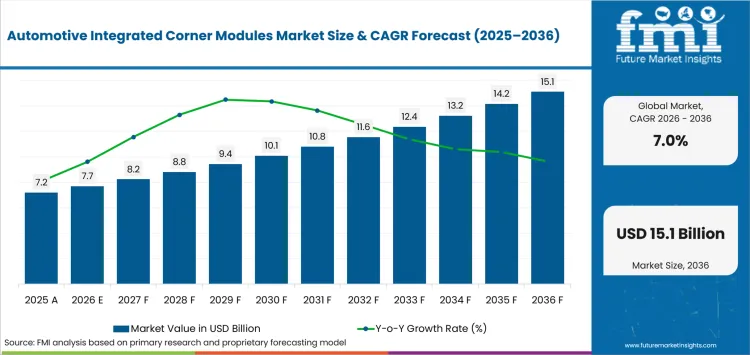
Key Takeaways
- Demand rises as OEM chassis teams shift braking and steering from separate mechanical interfaces toward electronic vehicle-motion control.
- Based on module type, brake-corner modules are projected to account for 24.0% in 2026 due to universal braking and a direct path to electronic actuation.
- By vehicle type, battery electric cars are estimated to hold 34.0% in 2026 owing to electrical architectures that simplify by-wire packaging during platform development.
- In 2026, brake actuators are expected to lead the component category with 24.0% share because they execute software-controlled braking at wheel level.
- Safety redundancy and cross-domain calibration can extend OEM release cycles because one corner assembly carries several safety-critical functions.
- Key players in the automotive integrated corner modules market include Hyundai Mobis, ZF Friedrichshafen AG, AUMOVIO SE, Bosch, Schaeffler AG, Magna International, Brembo, Astemo, Ltd., HL Mando, and REE Automotive.
Analyst Perspective
"Integrated corner programs should be judged by how much separate brake and steering integration they remove from a vehicle program. Commercial value rises when the release package covers redundant actuation plus repeatable vehicle-dynamics calibration for serial production."
- Nikhil Kaitwade, Principal Consultant, Future Market Insights
How is the automotive integrated corner modules market segmented?
The automotive integrated corner modules market is segmented by module type, vehicle type, component, architecture, sales channel and region.
Module type covers brake-corner modules, suspension-corner modules, steer-by-wire corner modules, e-corner modules and integrated chassis corner assemblies. Vehicle type includes battery electric cars, autonomous shuttles, SUVs - crossovers, commercial EVs and premium vehicles. Component includes brake actuator, steering actuator, suspension linkages, hub - bearing unit and control electronics. Architecture covers modular corner assembly, e-corner with in-wheel motor, brake-by-wire integrated and steer-by-wire integrated. Sales channel covers OEM co-development, Tier-1 chassis suppliers, EV platform suppliers and technology licensing.
Why do brake-corner modules lead demand within the module type category?
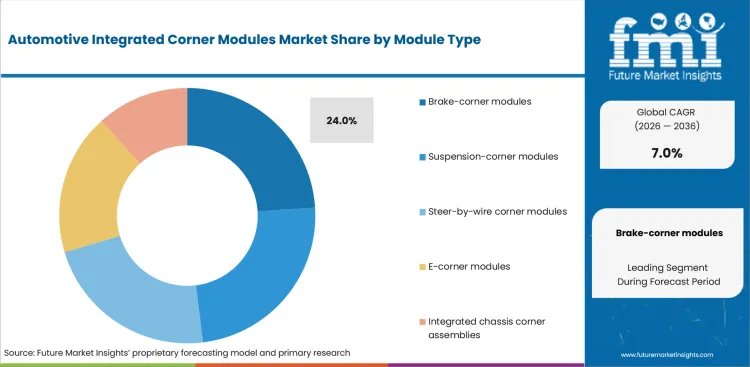
Braking is a practical first integration step because every road vehicle needs controlled wheel-level deceleration. In April 2025 Continental presented an integrated brake-by-wire unit that integrates master-cylinder and booster functions.
- Based on module type, brake-corner modules are projected to account for 24.0% in 2026 due to a mature safety function moving toward electronic actuation.
- OEMs can qualify braking first and extend the package later toward steering or suspension. That staged route also keeps automotive brake systems familiar to validation teams during early corner-module programs.
Why do battery electric cars lead demand within the vehicle type category?
Battery electric cars let engineers plan wheel-corner electronics inside the base architecture. Hyundai Mobis said in January 2025 that its e-Corner system integrates steering and braking with suspension. The system can turn a wheel by 90 degrees.
- By vehicle type, battery electric cars are estimated to hold 34.0% in 2026 owing to electrical architectures that accommodate higher actuator and control content.
- The clean-sheet package also makes in-wheel motor architectures easier to evaluate beside conventional e-axle layouts. OEMs still need a clear cost case to carry the extra hardware into volume programs.
How does the brake actuator lead demand within the component category?
The brake actuator turns a software command into wheel force and carries a direct safety obligation. Astemo described Smart Brake in June 2025 as an electro-mechanical brake-by-wire actuator for autonomous driving.
- In 2026, the brake actuator segment is expected to lead the component category with 24.0% share because software-controlled braking reaches the wheel through this actuator.
- Actuator selection now extends beyond force output to response consistency and fault behavior. Brake-by-wire controllers need predictable execution before OEMs can coordinate braking with steering at the same corner.
Why does modular corner assembly lead demand within the architecture category?
Modular corner assemblies let OEMs add functions without converting the full platform to a consolidated e-corner. AUMOVIO presented a compact corner module in July 2025 that packaged drive and braking with steering and suspension.
- Modular corner assembly is set to lead the architecture category with 34.0% share in 2026 due to staged integration that limits simultaneous validation work.
- A modular release plan lets chassis teams preserve approved interfaces as new functions enter later programs. Automotive suspension systems can remain an independent validation stream until the corner package reaches deeper integration.
Why does OEM co-development lead demand within the sales channel category?
Corner modules change safety logic and vehicle behavior together, so OEM co-development starts earlier than normal component sourcing. Magna expanded its Mercedes-Benz relationship in February 2025 to include chassis work and complete-vehicle integration for a new electric off-roader.
- The sales channel category is forecast to be led by OEM co-development at 46.0% share in 2026 due to platform-specific tuning and early safety-release decisions.
- Direct engineering access gives the supplier time to reconcile actuator interfaces with the vehicle controller before tooling freezes. Automotive steer-by-wire actuators require that same early coordination because steering feel and fault response are calibrated at vehicle level.
What are the drivers, restraints and opportunities in the Automotive Integrated Corner Modules Market?
Software-controlled chassis functions increase integrated corner content. Safety validation lengthens release cycles, while modular co-development offers a lower-risk path into serial programs.
- Driver: OEM chassis engineers are coordinating braking, steering and suspension with software as by-wire functions enter production.
- Restraint: Redundant actuation and vehicle-level fault testing extend qualification for corner systems that remove mechanical or hydraulic links.
- Opportunity: Modular corner packages let OEMs add functions in stages while keeping approved interfaces available for later vehicle programs.
A significant demand driver is the shift from independent chassis hardware toward coordinated electronic motion control. ZF began series production of steer-by-wire on the NIO ET9 in February 2025 and reported further orders in Europe and North America. Those programs give software-defined vehicle platforms a production route for steering commands that no longer need a mechanical column. Corner-module suppliers gain content only if braking or damping can join that control architecture without adding separate validation work.
Safety qualification is the binding constraint because a failed actuator or communication path cannot leave the vehicle without controlled braking or steering. REE Automotive brought the P7-C to Work Truck Week in February 2025 as the first USA-certified full-by-wire vehicle. Certification clears one entry gate but platform-specific fault testing and vehicle-dynamics calibration still precede serial release. Each vehicle program then repeats those checks for its own mass, tire package and control software.
A modular commercial model can separate wheel-corner hardware from the timing of a complete vehicle redesign. REE Automotive signed a December 2025 MOU with Cascadia Motion for an electric drive unit that integrates REEcorner technology into global OEM programs. The planned commercial model includes royalties plus access to assembly assets. REE can monetize corner technology without supplying the complete vehicle platform.
Which country CAGRs are profiled in the Automotive Integrated Corner Modules Market?
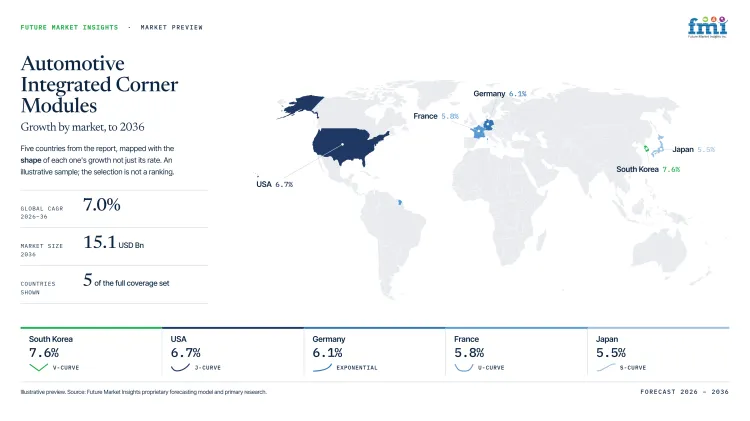
| Country | CAGR |
|---|---|
| South Korea | 7.6% |
| Mexico | 7.1% |
| USA | 6.7% |
| Canada | 6.4% |
| Germany | 6.1% |
| France | 5.8% |
| Japan | 5.5% |
How do country-level CAGRs compare in the Automotive Integrated Corner Modules Market?
Profiled CAGRs span 2.1 percentage points from South Korea at 7.6% to Japan at 5.5%. South Korea and Mexico form the upper group above 7.0%. Germany separates them from France and Japan. Differences mainly reflect program timing, certification intensity and domestic engineering depth. The spread is narrow.
- South Korea pairs domestic chassis engineering with major OEM programs.
- Mexico's assembly clusters give module suppliers a local engineering base for new vehicle programs.
- USA programs place greater weight on vehicle certification and fleet proof before production.
- Canada usually follows cross-border North American platforms rather than creating separate module programs.
- Germany favors serial-production depth because premium OEM teams work close to suppliers.
- French OEMs favor reusable module architectures that can serve several vehicle trims.
- Japan prioritizes stable interfaces and long platform cycles before approving new module suppliers.
Rate differences do not rank absolute country revenue. The full report provides country-level CAGR analysis across North America, Latin America, Western Europe, Eastern Europe, East Asia, South Asia and Pacific and the Middle East and Africa.
Country-wise Analysis
- In South Korea's domestic OEM base, chassis electronics develop beside electrified platforms in the same engineering network. Demand for automotive integrated corner modules in South Korea is forecast to rise at 7.6% CAGR over the forecast period driven by fast electrified-vehicle uptake. MOTIE reported in May 2025 that electric-vehicle unit sales increased 50.3% year on year in April. Road-wheel actuator modules can enter early co-development talks and domestic program access is the main enabler for new entrants. Serial awards still require production-ready redundancy and calibration support while resident calibration teams follow each OEM release cadence through prototype and plant validation.
- Mexico offers deep vehicle-assembly capacity but less domestic control over vehicle architecture. INEGI reported in January 2026 that light trucks represented 77.2% of national light-vehicle production during 2025. The country's automotive integrated corner modules sector is projected to record 7.1% CAGR during the assessment period supported by high-volume assembly programs that can justify local application engineering. Assembly clusters in northern and central Mexico shorten launch support but safety-critical electronics still require local supplier development and North American cost discipline. Entry depends on a clear path from imported actuator technology to repeatable local production with teams supporting North American vehicle software calibration.
- Vehicle-level certification evidence carries unusual weight in USA commercial fleet programs that remove mechanical steering or braking links. Automotive integrated corner module demand in the USA is predicted to advance at 6.7% CAGR through 2036 attributable to software-defined commercial platforms. USA Department of Energy data updated in June 2026 show electric light-duty vehicle registrations grew 21.0% from 2024 to 2025. Autonomous vehicle platforms widen the addressable use case for by-wire corners but entry still requires fail-operational proof over varied duty cycles and field service after deployment. Early fleet trial data must support later vehicle-line release decisions across multiple serial programs.
- Despite local engineering and assembly work in Ontario, Canadian vehicle programs follow USA platform allocation. The Government of Canada reported in February 2026 that more than 90% of Canadian-made vehicles and 60% of Canadian-made auto parts were exported to the USA. Adoption of automotive integrated corner modules in Canada is estimated to expand at 6.4% CAGR through 2036 driven by shared North American programs. Brake pedal simulators become one calibration issue as by-wire content rises and cross-border launch delays can defer Canadian module volume. Local value depends on platform compatibility and fast engineering support because Ontario teams must match USA release schedules.
- Serial-production maturity is a sourcing test for German OEM chassis teams alongside vehicle-dynamics performance. Sales of automotive integrated corner modules in Germany are forecast to expand at 6.1% CAGR by 2036 supported by a large premium-vehicle production base. VDA reported in February 2025 that one in three passenger cars built in Germany during 2024 was electric and BEV output reached 1.06 million units. Wheel hubs and hub bearings still impose familiar packaging tolerances on deeper corner integration. Qualification spans safety and manufacturing gates, so engineering capacity near OEM development centers reduces handoff time between chassis tuning and plant validation for high-volume serial programs.
- French OEM groups spread new chassis technology over shared vehicle architectures to protect cost between brands and trims. SDES reported in July 2026 that electric cars represented 3.5% of France's 40.0 million passenger-car fleet at the start of the year. Automotive integrated corner module demand in France is forecast to rise at 5.8% CAGR over the forecast period attributable to gradual electrification and common platform interfaces. The slower fleet transition makes a full-corner redesign harder to justify on every program. Modular offers need a clear content step-up that can move between platforms without restarting the complete validation plan during serial programs.
- Japanese automakers sequence chassis changes under long platform plans with strict interface ownership between hardware and vehicle software teams. Japan's automotive integrated corner module outlook is anticipated to advance at 5.5% CAGR over the assessment period owing to software-defined vehicle investment. METI and MLIT updated the Mobility DX Strategy in June 2025 with a national goal for Japanese companies to reach 30% of global SDV unit sales in 2030 and 2035. The program promotes common vehicle requirements and digital development processes. Existing software ownership rules constrain interface changes, so new corner content must fit that governance before broader vehicle programs can adopt it.
Who are the notable companies in the Automotive Integrated Corner Modules Market?
Hyundai Mobis, ZF Friedrichshafen AG, AUMOVIO SE, Bosch, Schaeffler AG, Magna International, Brembo, Astemo, Ltd., HL Mando and REE Automotive are the notable companies serving this market.
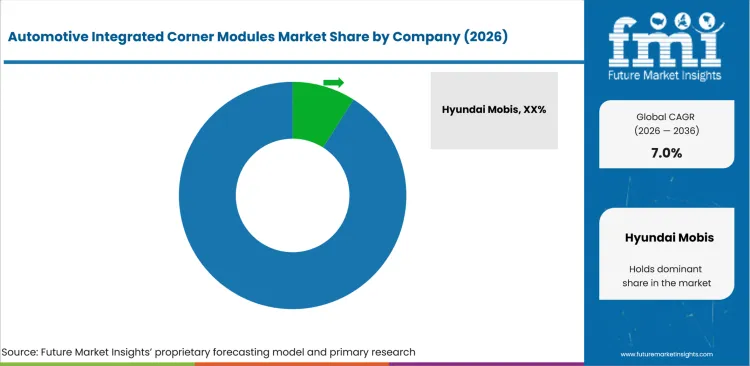
Competition separates multi-function corner developers from companies focused on one safety-critical actuator. Entry depends on early OEM access plus redundant actuation and serial validation.
- Hyundai Mobis and REE Automotive develop integrated corner platforms. ZF Friedrichshafen AG and AUMOVIO SE span several motion-control domains.
- Bosch and Brembo focus on braking control. Astemo, Ltd. and HL Mando extend by-wire actuation with Schaeffler AG.
- Complete-vehicle integration: Magna International supports OEM programs in which corner hardware must fit the wider vehicle package.
Competitive Benchmarking: Automotive Integrated Corner Modules Market
| Company | Corner Function Breadth | Electronic Control Depth | Serial Program Access | Geographic Reach |
|---|---|---|---|---|
| Hyundai Mobis | High | High | High | Asia, Europe and North America |
| ZF Friedrichshafen AG | High | High | High | Global |
| AUMOVIO SE | High | High | High | Global |
| Bosch | Medium | High | High | Global |
| Schaeffler AG | High | Medium | High | Global |
| Magna International | Low | Low | High | Global |
| Brembo | Low | High | High | Global |
| Astemo, Ltd. | High | High | Medium | Global |
| HL Mando | Medium | High | High | Asia, Europe and North America |
| REE Automotive | High | High | Medium | North America, Europe and Asia |
Corner-function breadth is High with three or more documented functions and Medium with two. Low means one. Electronic-control depth is High with multiple by-wire functions or by-wire plus domain control. Medium requires one by-wire function and Low covers electronic integration without actuator-level by-wire. Serial-program access is High with multiple production or customer programs. Medium requires one active customer integration or certified program. Low is limited to verified demonstration-stage participation.
Key Developments in the Automotive Integrated Corner Modules Market
- In May 2026, Brembo moved SENSIFY into production for a global vehicle manufacturer and gave OEM teams a serial reference for software-defined wheel-level braking.
- In November 2025, REE Automotive signed an MOU with Mitsubishi Fuso and began integrating zonal SDV plus x-by-wire technology into an eCanter electric truck for fleet evaluation.
- In July 2025, Schaeffler AG reported volume production of rear-wheel steering for a German automaker and further nominations that extend its serial chassis program base.
Key Players in the Automotive Integrated Corner Modules Market
Integrated Corner and Motion-Control Platforms
- Hyundai Mobis
- ZF Friedrichshafen AG
- AUMOVIO SE
- REE Automotive
By-Wire Braking and Steering
- Bosch
- Brembo
- Astemo, Ltd.
- HL Mando
- Schaeffler AG
Vehicle and Chassis Integration
- Magna International
Automotive Integrated Corner Modules Market - Report Scope
| Coverage field | Report scope |
|---|---|
| Market breakdown | By module type, vehicle type, component, architecture, sales channel and region. |
| Quantitative Units | USD billion. |
| Market Definition | Integrated automotive wheel-corner systems and directly supporting by-wire chassis actuation that consolidate braking, steering, suspension, propulsion or control functions at or near the wheel. |
| Regions Covered | North America, Latin America, Western Europe, Eastern Europe, East Asia, South Asia and Pacific and Middle East and Africa. |
| Countries Covered | South Korea, Mexico, USA, Canada, Germany, France, Japan and 30+ countries included in the full report. |
| Key Companies Profiled | Hyundai Mobis, ZF Friedrichshafen AG, AUMOVIO SE, Bosch, Schaeffler AG, Magna International, Brembo, Astemo, Ltd., HL Mando, REE Automotive. |
| Forecast Period | 2026 to 2036. |
| Approach | Primary and secondary research with market triangulation. |
Automotive Integrated Corner Modules Market - Research Methodology
| Method | Approach |
|---|---|
| Primary Research | FMI analysts gathered input from manufacturers, service providers, technology developers, distributors, end users, procurement teams, and subject-matter experts. Interviews examined purchasing decisions, product or service evaluation, adoption barriers, approval requirements, pricing considerations, and expectations for technical or commercial support. Respondents were also asked what evidence is required before a trial, pilot, or initial order develops into regular purchasing. |
| Desk Research | Desk research covered government statistics, regulatory publications, trade data, industry associations, technical literature, standards, company filings, product information, and official corporate announcements. Sources were reviewed for relevance, publication date, geographic coverage, and consistency with the defined market scope. Claims relating to performance, applications, approvals, capacity, investment, and commercial activity were retained only when supported by credible public evidence. |
| Market Sizing and Forecasting | The market model combined the baseline value with historical performance, segment structure, pricing and volume indicators, adoption levels, company participation, and country-level demand conditions. Forecast assumptions considered economic activity, investment trends, regulatory developments, technology adoption, purchasing cycles, supply availability, and barriers to wider market use. Segment and regional estimates were reconciled before the final market total was calculated. |
| Data Validation | Estimates were checked against multiple independent indicators, including public data, company activity, trade patterns, industry developments, and findings from primary interviews. Validation also tested whether products, services, applications, and company revenues fell within the defined market boundaries. Adjacent categories, unsupported claims, overlapping revenues, and activities without direct market relevance were excluded to reduce double counting and maintain consistency across segments and countries. |
Automotive Integrated Corner Modules Market by Segments
Automotive Integrated Corner Modules Market segmented by Module Type:
- Brake-corner modules
- Suspension-corner modules
- Steer-by-wire corner modules
- E-corner modules
- Integrated chassis corner assemblies
Automotive Integrated Corner Modules Market segmented by Vehicle Type:
- Battery electric cars
- Autonomous shuttles
- SUVs - crossovers
- Commercial EVs
- Premium vehicles
Automotive Integrated Corner Modules Market segmented by Component:
- Brake actuator
- Steering actuator
- Suspension linkages
- Hub - bearing unit
- Control electronics
Automotive Integrated Corner Modules Market segmented by Architecture:
- Modular corner assembly
- E-corner with in-wheel motor
- Brake-by-wire integrated
- Steer-by-wire integrated
Automotive Integrated Corner Modules Market segmented by Sales Channel:
- OEM co-development
- Tier-1 chassis suppliers
- EV platform suppliers
- Technology licensing
Automotive Integrated Corner Modules Market by Region:
- North America
- United States
- Canada
- Latin America
- Brazil
- Mexico
- Chile
- Rest of Latin America
- Western Europe
- Germany
- United Kingdom
- Italy
- Spain
- France
- Nordics
- Benelux
- Rest of Western Europe
- Eastern Europe
- Russia
- Poland
- Hungary
- Balkan and Baltic States
- Rest of Eastern Europe
- East Asia
- China
- Japan
- South Korea
- South Asia and Pacific
- India
- ASEAN
- Australia and New Zealand
- Rest of South Asia and Pacific
- Middle East and Africa
- Kingdom of Saudi Arabia
- Other GCC Countries
- Türkiye
- South Africa
- Other African Union Countries
- Rest of Middle East and Africa
Research Sources and Bibliography
- Bosch. (2025, September 8). IAA Mobility 2025: Bosch is shaping the new vehicle world with intelligent hardware and software solutions.
- Ministry of Climate, Energy and Environment, Republic of Korea. (2026, January 30). 2025년 무공해차 등록 통계.
- Continental AG. (2025, April 15). Safe, Exciting, Autonomous: Solutions for Automated Driving and Light Projection Debut at Auto Shanghai.
- Hyundai Mobis. (2025, January 24). Hyundai MOBIS moves forward with its new ‘Move Improved’ campaign.
- Astemo, Ltd. (2025, June 11). Astemo sponsors Automotive Summit 2025, showcasing intelligent advanced mobility technologies for SDV age.
- AUMOVIO SE. (2025, July 31). IAA Mobility 2025.
- Magna International. (2025, February 11). Magna Expands Long-Term Innovation Partnership with Mercedes-Benz.
- ZF Friedrichshafen AG. (2025, February 17). Start of series production for Steer-by-Wire steering at Chinese car manufacturer NIO.
- REE Automotive. (2025, February 25). REE Automotive to Host Ride & Drive of P7-C Software Defined Electric Truck at NTEA Work Truck Week 2025.
- REE Automotive. (2025, December 29). REE Automotive Expected to Supply Cascadia Motion with Corner Technology Used in Electric Drive Units for Global OEM Market.
- Ministry of Trade, Industry and Energy, Republic of Korea. (2025, May 20). Korea’s automobile exports record $6.5 billion in April.
- Instituto Nacional de Estadística y Geografía. (2026, January 9). Registro administrativo de la industria automotriz de vehículos ligeros. Diciembre de 2025.
- USA Department of Energy, Alternative Fuels Data Center. (2026, June). Change in USA Light-Duty Vehicle Registration Counts.
- Government of Canada. (2026, February 18). Government of Canada’s new auto strategy.
- German Association of the Automotive Industry. (2025, February 4). Double-digit rise in passenger car production in January - new electric vehicle registrations get off to a flying start.
- Service des données et études statistiques. (2026, July 10). 40 millions de voitures en circulation en France au 1er janvier 2026.
- Ministry of Economy, Trade and Industry, Japan. (2025, June 9). Mobility Digital Transformation (DX) Strategy Updated.
- Brembo. (2026, May 4). The New Standard Begins: SENSIFY by Brembo Enters Production.
- REE Automotive. (2025, November 18). REE Automotive and Mitsubishi Fuso Truck and Bus Corporation Sign MOU for Software-Defined Vehicle Technology.
- Schaeffler AG. (2025, July 9). Rear-wheel steering: Successful production launch for German OEM and new volume production orders with greater vertical integration.
- Astemo, Ltd. (2025, February 20). Hitachi Astemo to change company name.
- AUMOVIO SE. (2025, September 18). AUMOVIO makes successful stock market debut.
- HL Group. (2025, April 16). HL Mando Named GM Supplier of the Year for Fifth Consecutive Year.
- REE Automotive. (2026, May 15). REE Automotive Announces Fiscal Year 2025 Financial Results.
- Hyundai Mobis. (2026, March 10). Hyundai Mobis Now Operates Hungarian Plant to Supply Chassis Modules to a German Premium Carmaker.
- Schaeffler AG. (2026, May 22). Improved comfort, convenience, safety, and road handling in modern vehicles: Schaeffler drives product innovations in chassis and body domain.
- Astemo, Ltd. (2025, October 15). Astemo introduces advanced technologies for the SDV age at JAPAN MOBILITY SHOW 2025.
- AUMOVIO SE. (2026, July 30). AUMOVIO and BMW Group expand partnership in electronics and brake technologies.
- Brembo. (2026, May 22). Brembo and Ningbo Huaxiang Join Forces to Advance a New Era of Braking Technology.
- Hyundai Mobis. (2026, April 17). Hyundai Mobis Develops Data-Driven Validation System to Dramatically Cut Testing Time for SDVs.
- ZF Friedrichshafen AG. (2025, July 10). ZF Steer-by-Wire: Driving Innovation in a New Direction.
- AUMOVIO SE. (2026, January 6). AUMOVIO presents the latest version of its central high-performance computer with NXP’s newest vehicle processor.
- Brembo. (2026, February 9). JAC Group and Brembo Sign Strategic Partnership to Drive Innovation for Future Mobility.
- Magna International. (2026, January 5). Magna to Offer Drive Hyperion-Compatible ECUs and Tier-1 Integration Services for NVIDIA DRIVE AV.
- ZF Friedrichshafen AG. (2026, January 6). ZF Brings the Chassis into the Digital Age: CES Premiere of AI Road Sense, Active Noise Reduction.
This bibliography is provided for reader reference and is not exhaustive. The full report contains the complete reference list and detailed citations.
This Report Answers
- What are the global Automotive Integrated Corner Modules market values in 2026 and 2036?
- What factors are increasing demand for electronically integrated chassis and corner module systems?
- Why do brake-corner modules hold the largest share of the Automotive Integrated Corner Modules market?
- Why do battery electric vehicles (BEVs) account for the leading share of market demand?
- Why do brake actuators represent the dominant component segment within integrated corner modules?
- Why does modular corner assembly lead adoption among vehicle manufacturers and platform developers?
- How do market growth rates and commercialization trends differ across the countries profiled in the report?
- What technical, validation, and regulatory challenges can delay serial-production safety approvals?
- Which leading companies are developing and supplying integrated corner module solutions for next-generation vehicle programs?
Frequently Asked Questions
How big is the automotive integrated corner modules market in 2026?
The automotive integrated corner modules market is valued at USD 7.7 billion in 2026 and projected to reach USD 15.1 billion by 2036. Growth is driven by electronic chassis control.
What is the CAGR of the automotive integrated corner modules market from 2026 to 2036?
The automotive integrated corner modules market is projected to grow at a 7.0% CAGR between 2026 and 2036. Expansion is supported by by-wire programs and motion software.
Which module type leads the automotive integrated corner modules market?
The brake-corner modules segment is expected to hold 24.0% of the automotive integrated corner modules market in 2026, driven by universal braking. Electronic actuation brings braking into software control.
Which vehicle type leads the automotive integrated corner modules market?
The battery electric cars segment is expected to hold 34.0% of the automotive integrated corner modules market in 2026, attributable to EV electrical architectures. Clean-sheet packaging also suits by-wire systems.
Which component leads the automotive integrated corner modules market?
The brake actuator segment is forecast to represent 24.0% of the automotive integrated corner modules market in 2026, supported by wheel-level execution. Actuators convert software commands into wheel force.
Which countries are projected to record the highest growth in the automotive integrated corner modules market?
South Korea is projected to grow at 7.6% CAGR through 2036, followed by Mexico at 7.1% and the USA at 6.7%. Domestic engineering and assembly scale separate their conditions.
Which companies are active in the automotive integrated corner modules market?
Key companies operating in the market include Hyundai Mobis, ZF Friedrichshafen AG, AUMOVIO SE, Bosch, Schaeffler AG, Magna International, Brembo, Astemo, Ltd., HL Mando, and REE Automotive. Their roles span integrated corners, by-wire actuation and vehicle engineering.
Preview the report firsthand - request a free sample
Get SampleGet the brochure for pricing and purchase details.
Get PDFTable of Content
- Key Takeaways
- Market Size and CAGR
- Top Growth Driver
- Fastest Growing Segment
- Leading Region
- Key Companies
- Emerging Opportunities
- Executive Summary
- Global Market Outlook
- Demand-side Trends
- Supply-side Trends
- Technology Roadmap Analysis
- Analysis and Recommendations
- Analyst Perspective (What is happening? Why now? What should investors know?)
- Key Questions Answered
- How large is the market?
- What is the CAGR?
- What are key trends?
- Which region dominates?
- Who are the leaders?
- Market Overview
- Market Coverage / Taxonomy
- Market Definition / Scope / Limitations
- Research Methodology
- Chapter Orientation
- Analytical Lens and Working Hypotheses
- Market Structure, Signals, and Trend Drivers
- Benchmarking and Cross-market Comparability
- Market Sizing, Forecasting, and Opportunity Mapping
- Research Design and Evidence Framework
- Desk Research Programme (Secondary Evidence)
- Expert Input and Fieldwork (Primary Evidence)
- Tooling, Models, and Reference Databases
- Data Engineering and Model Build
- Quality Assurance and Audit Trail
- Market Background
- Market Dynamics (Drivers, Restraints, Opportunity, Trends)
- Scenario Forecast (Optimistic, Likely, Conservative)
- Impact Analysis
- AI Impact
- Sustainability Impact
- Regulatory Impact
- Technology Impact
- Consumer / Buyer Analysis
- Purchase Drivers
- Adoption Barriers
- Buyer Journey
- Opportunity Map Analysis
- Product Life Cycle Analysis
- Supply Chain Analysis
- Investment Feasibility Matrix
- Value Chain Analysis
- PESTLE and Porter's Analysis
- Regulatory Landscape
- Regional Parent Market Outlook
- Production and Consumption Statistics
- Import and Export Statistics
- Global Market Analysis and Forecast, 2021 to 2036
- Historical Market Size Value (USD Billion) Analysis, 2021 to 2025
- Current and Future Market Size Value (USD Billion) Projections, 2026 to 2036
- Y-o-Y Growth Trend Analysis
- Absolute $ Opportunity Analysis
- Global Market Pricing Analysis, 2021 to 2036
- Global Market Analysis and Forecast, By Module Type, 2021 to 2036
- Introduction / Key Findings
- Historical Market Size Value (USD Billion) Analysis By Module Type, 2021 to 2025
- Current and Future Market Size Value (USD Billion) Analysis and Forecast By Module Type, 2026 to 2036
- Brake-corner modules
- Suspension-corner modules
- Steer-by-wire corner modules
- E-corner modules
- Integrated chassis corner assemblies
- Brake-corner modules
- Y-o-Y Growth Trend Analysis By Module Type, 2021 to 2025
- Absolute $ Opportunity Analysis By Module Type, 2026 to 2036
- Global Market Analysis and Forecast, By Vehicle Type, 2021 to 2036
- Introduction / Key Findings
- Historical Market Size Value (USD Billion) Analysis By Vehicle Type, 2021 to 2025
- Current and Future Market Size Value (USD Billion) Analysis and Forecast By Vehicle Type, 2026 to 2036
- Battery electric cars
- Autonomous shuttles
- SUVs/crossovers
- Commercial EVs
- Premium vehicles
- Battery electric cars
- Y-o-Y Growth Trend Analysis By Vehicle Type, 2021 to 2025
- Absolute $ Opportunity Analysis By Vehicle Type, 2026 to 2036
- Global Market Analysis and Forecast, By Component, 2021 to 2036
- Introduction / Key Findings
- Historical Market Size Value (USD Billion) Analysis By Component, 2021 to 2025
- Current and Future Market Size Value (USD Billion) Analysis and Forecast By Component, 2026 to 2036
- Brake actuator
- Steering actuator
- Suspension linkages
- Hub/bearing unit
- Control electronics
- Brake actuator
- Y-o-Y Growth Trend Analysis By Component, 2021 to 2025
- Absolute $ Opportunity Analysis By Component, 2026 to 2036
- Global Market Analysis and Forecast, By Architecture, 2021 to 2036
- Introduction / Key Findings
- Historical Market Size Value (USD Billion) Analysis By Architecture, 2021 to 2025
- Current and Future Market Size Value (USD Billion) Analysis and Forecast By Architecture, 2026 to 2036
- Modular corner assembly
- E-corner with in-wheel motor
- Brake-by-wire integrated
- Steer-by-wire integrated
- Modular corner assembly
- Y-o-Y Growth Trend Analysis By Architecture, 2021 to 2025
- Absolute $ Opportunity Analysis By Architecture, 2026 to 2036
- Global Market Analysis and Forecast, By Sales Channel, 2021 to 2036
- Introduction / Key Findings
- Historical Market Size Value (USD Billion) Analysis By Sales Channel, 2021 to 2025
- Current and Future Market Size Value (USD Billion) Analysis and Forecast By Sales Channel, 2026 to 2036
- OEM co-development
- Tier-1 chassis suppliers
- EV platform suppliers
- Technology licensing
- OEM co-development
- Y-o-Y Growth Trend Analysis By Sales Channel, 2021 to 2025
- Absolute $ Opportunity Analysis By Sales Channel, 2026 to 2036
- Global Market Analysis and Forecast, By Region, 2021 to 2036
- Introduction
- Historical Market Size Value (USD Billion) Analysis By Region, 2021 to 2025
- Current Market Size Value (USD Billion) Analysis and Forecast By Region, 2026 to 2036
- North America
- Latin America
- Western Europe
- Eastern Europe
- East Asia
- South Asia and Pacific
- Middle East & Africa
- Market Attractiveness Analysis By Region
- North America Market Analysis and Forecast, By Country, 2021 to 2036
- Historical Market Size Value (USD Billion) Trend Analysis By Market Taxonomy, 2021 to 2025
- Market Size Value (USD Billion) Forecast By Market Taxonomy, 2026 to 2036
- By Country
- USA
- Canada
- By Module Type
- By Vehicle Type
- By Component
- By Architecture
- By Sales Channel
- By Country
- Market Attractiveness Analysis
- By Country
- By Module Type
- By Vehicle Type
- By Component
- By Architecture
- By Sales Channel
- Key Takeaways
- Latin America Market Analysis and Forecast, By Country
- Historical Market Size Value (USD Billion) Trend Analysis By Market Taxonomy, 2021 to 2025
- Market Size Value (USD Billion) Forecast By Market Taxonomy, 2026 to 2036
- By Country
- Brazil
- Mexico
- Chile
- Rest of Latin America
- By Module Type
- By Vehicle Type
- By Component
- By Architecture
- By Sales Channel
- By Country
- Market Attractiveness Analysis
- By Country
- By Module Type
- By Vehicle Type
- By Component
- By Architecture
- By Sales Channel
- Key Takeaways
- Western Europe Market Analysis and Forecast, By Country
- Historical Market Size Value (USD Billion) Trend Analysis By Market Taxonomy, 2021 to 2025
- Market Size Value (USD Billion) Forecast By Market Taxonomy, 2026 to 2036
- By Country
- Germany
- UK
- Italy
- Spain
- France
- Nordic
- BENELUX
- Rest of Western Europe
- By Module Type
- By Vehicle Type
- By Component
- By Architecture
- By Sales Channel
- By Country
- Market Attractiveness Analysis
- By Country
- By Module Type
- By Vehicle Type
- By Component
- By Architecture
- By Sales Channel
- Key Takeaways
- Eastern Europe Market Analysis and Forecast, By Country
- Historical Market Size Value (USD Billion) Trend Analysis By Market Taxonomy, 2021 to 2025
- Market Size Value (USD Billion) Forecast By Market Taxonomy, 2026 to 2036
- By Country
- Russia
- Poland
- Hungary
- Balkan & Baltic
- Rest of Eastern Europe
- By Module Type
- By Vehicle Type
- By Component
- By Architecture
- By Sales Channel
- By Country
- Market Attractiveness Analysis
- By Country
- By Module Type
- By Vehicle Type
- By Component
- By Architecture
- By Sales Channel
- Key Takeaways
- East Asia Market Analysis and Forecast, By Country
- Historical Market Size Value (USD Billion) Trend Analysis By Market Taxonomy, 2021 to 2025
- Market Size Value (USD Billion) Forecast By Market Taxonomy, 2026 to 2036
- By Country
- China
- Japan
- South Korea
- By Module Type
- By Vehicle Type
- By Component
- By Architecture
- By Sales Channel
- By Country
- Market Attractiveness Analysis
- By Country
- By Module Type
- By Vehicle Type
- By Component
- By Architecture
- By Sales Channel
- Key Takeaways
- South Asia and Pacific Market Analysis and Forecast, By Country
- Historical Market Size Value (USD Billion) Trend Analysis By Market Taxonomy, 2021 to 2025
- Market Size Value (USD Billion) Forecast By Market Taxonomy, 2026 to 2036
- By Country
- India
- ASEAN
- Australia & New Zealand
- Rest of South Asia and Pacific
- By Module Type
- By Vehicle Type
- By Component
- By Architecture
- By Sales Channel
- By Country
- Market Attractiveness Analysis
- By Country
- By Module Type
- By Vehicle Type
- By Component
- By Architecture
- By Sales Channel
- Key Takeaways
- Middle East & Africa Market Analysis and Forecast, By Country
- Historical Market Size Value (USD Billion) Trend Analysis By Market Taxonomy, 2021 to 2025
- Market Size Value (USD Billion) Forecast By Market Taxonomy, 2026 to 2036
- By Country
- Kingdom of Saudi Arabia
- Other GCC Countries
- Türkiye
- South Africa
- Other African Union
- Rest of Middle East & Africa
- By Module Type
- By Vehicle Type
- By Component
- By Architecture
- By Sales Channel
- By Country
- Market Attractiveness Analysis
- By Country
- By Module Type
- By Vehicle Type
- By Component
- By Architecture
- By Sales Channel
- Key Takeaways
- Key Countries Market Analysis
- USA
- Pricing Analysis
- Market Share Analysis, 2025
- By Module Type
- By Vehicle Type
- By Component
- By Architecture
- By Sales Channel
- Canada
- Pricing Analysis
- Market Share Analysis, 2025
- By Module Type
- By Vehicle Type
- By Component
- By Architecture
- By Sales Channel
- Mexico
- Pricing Analysis
- Market Share Analysis, 2025
- By Module Type
- By Vehicle Type
- By Component
- By Architecture
- By Sales Channel
- Brazil
- Pricing Analysis
- Market Share Analysis, 2025
- By Module Type
- By Vehicle Type
- By Component
- By Architecture
- By Sales Channel
- Chile
- Pricing Analysis
- Market Share Analysis, 2025
- By Module Type
- By Vehicle Type
- By Component
- By Architecture
- By Sales Channel
- Germany
- Pricing Analysis
- Market Share Analysis, 2025
- By Module Type
- By Vehicle Type
- By Component
- By Architecture
- By Sales Channel
- UK
- Pricing Analysis
- Market Share Analysis, 2025
- By Module Type
- By Vehicle Type
- By Component
- By Architecture
- By Sales Channel
- Italy
- Pricing Analysis
- Market Share Analysis, 2025
- By Module Type
- By Vehicle Type
- By Component
- By Architecture
- By Sales Channel
- Spain
- Pricing Analysis
- Market Share Analysis, 2025
- By Module Type
- By Vehicle Type
- By Component
- By Architecture
- By Sales Channel
- France
- Pricing Analysis
- Market Share Analysis, 2025
- By Module Type
- By Vehicle Type
- By Component
- By Architecture
- By Sales Channel
- India
- Pricing Analysis
- Market Share Analysis, 2025
- By Module Type
- By Vehicle Type
- By Component
- By Architecture
- By Sales Channel
- ASEAN
- Pricing Analysis
- Market Share Analysis, 2025
- By Module Type
- By Vehicle Type
- By Component
- By Architecture
- By Sales Channel
- Australia & New Zealand
- Pricing Analysis
- Market Share Analysis, 2025
- By Module Type
- By Vehicle Type
- By Component
- By Architecture
- By Sales Channel
- China
- Pricing Analysis
- Market Share Analysis, 2025
- By Module Type
- By Vehicle Type
- By Component
- By Architecture
- By Sales Channel
- Japan
- Pricing Analysis
- Market Share Analysis, 2025
- By Module Type
- By Vehicle Type
- By Component
- By Architecture
- By Sales Channel
- South Korea
- Pricing Analysis
- Market Share Analysis, 2025
- By Module Type
- By Vehicle Type
- By Component
- By Architecture
- By Sales Channel
- Russia
- Pricing Analysis
- Market Share Analysis, 2025
- By Module Type
- By Vehicle Type
- By Component
- By Architecture
- By Sales Channel
- Poland
- Pricing Analysis
- Market Share Analysis, 2025
- By Module Type
- By Vehicle Type
- By Component
- By Architecture
- By Sales Channel
- Hungary
- Pricing Analysis
- Market Share Analysis, 2025
- By Module Type
- By Vehicle Type
- By Component
- By Architecture
- By Sales Channel
- Kingdom of Saudi Arabia
- Pricing Analysis
- Market Share Analysis, 2025
- By Module Type
- By Vehicle Type
- By Component
- By Architecture
- By Sales Channel
- Türkiye
- Pricing Analysis
- Market Share Analysis, 2025
- By Module Type
- By Vehicle Type
- By Component
- By Architecture
- By Sales Channel
- South Africa
- Pricing Analysis
- Market Share Analysis, 2025
- By Module Type
- By Vehicle Type
- By Component
- By Architecture
- By Sales Channel
- USA
- Market Structure Analysis
- Competition Dashboard
- Competition Benchmarking
- Market Share Analysis of Top Players
- By Regional
- By Module Type
- By Vehicle Type
- By Component
- By Architecture
- By Sales Channel
- Emerging Startups
- Innovation Benchmarking
- Competition Analysis
- Competition Deep Dive
- Hyundai Mobis
- Overview
- Product Portfolio
- Profitability by Market Segments
- Sales Footprint
- Strategy Overview
- Marketing Strategy
- Product Strategy
- Channel Strategy
- ZF Friedrichshafen
- Continental
- Bosch
- Schaeffler
- Magna International
- Brembo
- Hitachi Astemo
- Mando
- REE Automotive
- Hyundai Mobis
- Case Studies
- Success Stories
- Recent Developments
- Competition Deep Dive
- Assumptions & Acronyms Used


