

- Market Size (2026)
- USD 5.1 Bn
- Forecast (2036)
- USD 8.2 Bn
- CAGR (2026 to 2036)
- 4.8%
How big is Automotive Hydro Bush Modules Market in 2026?
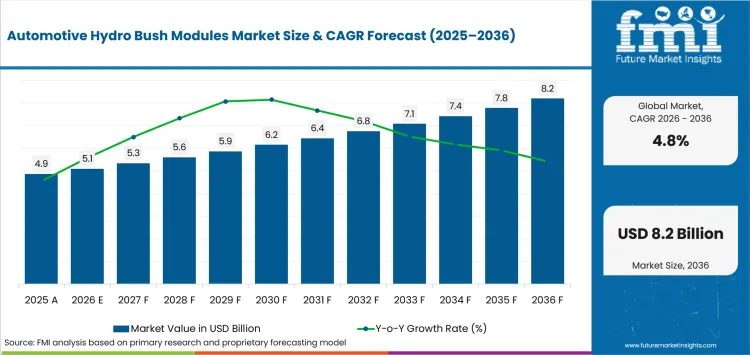
USD 5.1 billion in 2026 and USD 8.2 billion by 2036 at a 4.8% CAGR.
Demand for automotive hydro bush modules is projected to expand at 4.8% CAGR between 2026 and 2036, pushing valuation from USD 5.1 billion in 2026 to USD 8.2 billion by 2036. Quieter electrified drivetrains expose road excitation. EIA placed electrified models at 24% of USA light-duty sales in Q2 2026. More platforms therefore require frequency-selective damping studies.
Vehicle mix changes the load case a hydro bushing must survive. INEGI reported in September 2026 that light trucks represented 79.3% of Mexican light-vehicle production during the first eight months. High truck content favors load-tolerant designs. Serial fitment still requires sealed life and repeatable stiffness within approved suspension geometry.
Key Takeaways
- Higher vehicle mass and lower propulsion noise increase the value of frequency-selective damping at chassis joints.
- In 2026, control arm hydro bushes are expected to lead module type with 32.0% share due to their direct effect on wheel guidance and compliance.
- Glycol-filled modules are projected to hold 35.0% share in 2026 owing to stable damping behavior within established elastomer systems.
- Based on vehicle type, passenger cars are projected to account for 36.0% in 2026 due to high platform volumes and demanding comfort targets.
- Sealing integrity and vehicle-specific durability testing can lengthen nomination cycles compared with conventional rubber bushings.
- Some of the key players in this market include Vibracoustic, Trelleborg, Continental, Hutchinson, Sumitomo Riko, Boge Rubber & Plastics, Freudenberg, Cooper Standard, Mubea, and Yamashita Rubber.
Analyst Perspective
"Hydro bush programs earn value once the approved damping curve survives production variation and vehicle life. Engineers should compare sealed durability and repeatable stiffness ahead of unit price because failed calibration forces another validation cycle."
- Nikhil Kaitwade, Principal Consultant, Future Market Insights
How is the automotive hydro bush modules market segmented?
Segmented by module type, fluid type, vehicle type, function, sales channel and region.
The automotive hydro bush modules market is segmented by module type, fluid type, vehicle type, function and sales channel. Module types include control arm, subframe, engine mount, suspension link and integrated NVH bush modules. Fluid types cover glycol-filled, silicone-filled, hydraulic oil-filled and frequency-tuned chambers. Vehicle types span passenger cars, SUVs - crossovers, light commercial vehicles, premium vehicles and EV platforms. Functions include NVH isolation, ride comfort, powertrain vibration control and chassis compliance tuning. Sales channels cover OEM direct, suspension Tier-1s, aftermarket replacement and service kits.
Why does glycol-filled lead the Fluid Type category?
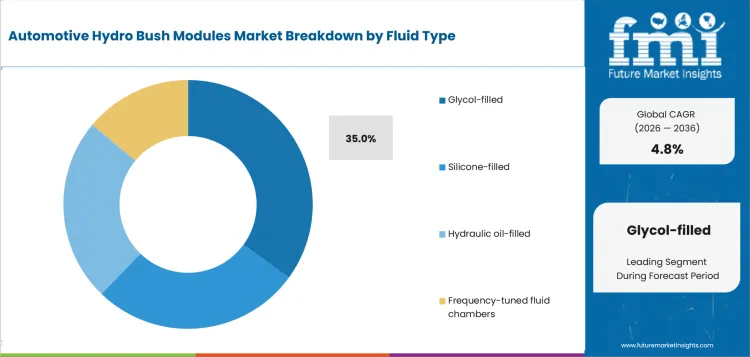
Fluid choice changes viscosity behavior and the damping response available to the calibration team. Glycol-filled designs suit programs that need stable hydraulic action over normal road temperatures. The wider performance elastomers supply base also affects compatibility at the rubber-fluid interface.
- Glycol-filled modules are set to lead fluid type with 35.0% share in 2026 due to tunable viscosity and compatibility with rubber-metal architectures.
- In May 2025 Sumitomo Riko reported vibration-control mounts for the Lexus LX that improved low-frequency isolation while retaining durability. The program shows why fluid and rubber behavior must hold under demanding vehicle loads.
Why do control arm hydro bushes lead the Module Type category?
Control-arm locations carry wheel-guidance loads and set compliance under braking or cornering. Hydro chambers tune that response without forcing one static rubber rate to handle every excitation. Related suspension control arms show why the bushing interface remains central to the assembly decision.
- By module type, control arm hydro bushes are forecast to represent 32.0% in 2026 driven by direct influence on wheel guidance and road-noise transfer.
- NHTSA listed rear lower arm and bush assemblies in recall 26V200 submitted in March 2026. Aston Martin introduced tighter suspension-arm tolerance targets and 100% supplier measurement to control joint variation.
Why do passenger cars lead the Vehicle Type category?
Passenger-car platforms provide the broadest repeat nomination base as one chassis architecture spans several trims and powertrains. Hybridisation requires additional calibration work for ride and isolation without removing familiar automotive suspension systems used on high-volume models.
- By vehicle type, passenger cars are estimated to hold 36.0% in 2026 owing to high build volumes and repeated use of tuned chassis isolators.
- ACEA reported in February 2025 that hybrid-electric cars represented 34.9% of January EU registrations. A mixed powertrain fleet keeps chassis isolation relevant as propulsion architectures change.
Why does NVH isolation lead the Function category?
NVH isolation justifies the added hydraulic chamber for applications where a solid elastomer misses stiffness or vibration targets. The chamber damps a defined frequency band while rubber carries static load. The design therefore competes with choices covered by automotive NVH materials instead of generic comfort equipment.
- The function category is forecast to be led by NVH isolation at 38.0% share in 2026 due to selective vibration control without excessive static stiffness.
- Hutchinson presented E-drive anti-vibration products at the Shanghai Auto Show in April 2025. The event tied vibration control directly to electrified powertrains where lower propulsion noise exposes chassis inputs.
Why does OEM direct lead the Sales Channel category?
Hydro bush geometry and fluid tuning are fixed early in vehicle development. OEM and Tier-1 engineers therefore work from the same load cases before serial nomination. Comparable control arm assemblies also depend on platform geometry instead of catalog fit alone.
- In 2026, OEM direct is expected to lead sales channel with 56.0% share due to vehicle-specific validation and early serial nomination.
- Hutchinson and TotalEnergies held a Chery Tech Day in March 2025 at the OEM research center. Hutchinson presented anti-vibration systems during direct engineering engagement with Chery teams.
What are the drivers, restraints and opportunities in the Automotive Hydro Bush Modules Market?
Higher chassis loads raise damping needs. Sealing and validation slow nomination. Regional engineering and replacement coverage extend revenue.
- Driver: Electrified and heavier vehicle platforms expose chassis noise and place greater load on suspension isolation.
- Restraint: Dimensional error or seal failure can invalidate the tuned response and force another qualification cycle.
- Opportunity: Regional engineering support and OE-equivalent replacement coverage can extend revenue beyond original production.
Electrified vehicles expose more road excitation as their propulsion systems mask less chassis noise. ACEA recorded a 20.7% battery-electric share of EU registrations in the first half of 2026. The figure does not prove hydro-bush fitment. It does increase the number of programs that compare anti-vibration mounts and tuned bushings against quieter cabin targets. Engineers then test whether selective damping justifies the added hydraulic content.
Hydraulic performance depends on tight dimensional control. NHTSA recorded 275 ZF aftermarket control arms in a March 2025 recall after a short bush inner sleeve left excessive compression clearance. ZF revised the bush to OEM specifications and changed assembly controls. Hydro-bush programs face the same discipline at the sealed joint. Small deviations can alter stiffness or fluid response enough to invalidate the approved calibration and force another test cycle.
Regional manufacturing can shorten response time after an OEM changes volume or platform timing. Sumitomo Riko reported in September 2025 that anti-vibration rubber production at its Querétaro plant had surged following large orders. The event shows why local plants compete on launch discipline as well as unit cost. The same requirement applies to rubber molding capacity for vehicle-specific elastomer parts. Faster local engineering response can protect serial schedules during program changes.
Which country CAGRs are profiled in the Automotive Hydro Bush Modules Market?
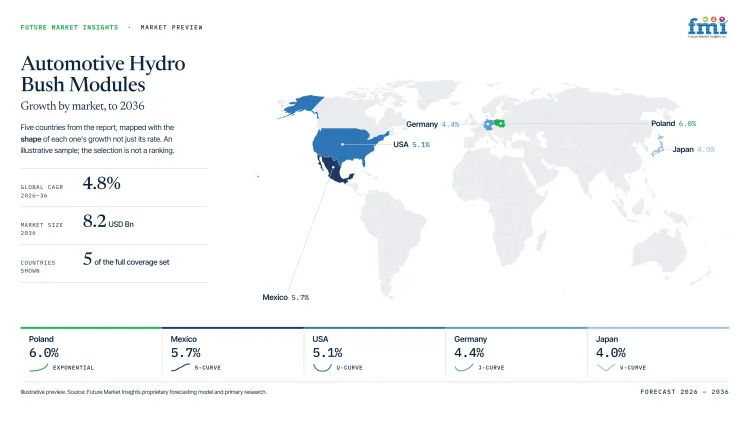
| Country | CAGR (2026 to 2036) |
|---|---|
| Poland | 6.0% |
| Mexico | 5.7% |
| Brazil | 5.4% |
| USA | 5.1% |
| France | 4.8% |
| Germany | 4.4% |
| Japan | 4.0% |
How do country-level CAGRs compare in the Automotive Hydro Bush Modules Market?
A 2.0-point spread separates Poland at 6.0% CAGR from Japan at 4.0%. Poland and Mexico form the upper band through export programs and fresh nomination windows. Germany and Japan advance more slowly within mature engineering systems with qualification economics.
- Poland pairs export-oriented component plants with a growing electrified fleet.
- Mexico ranks near the top as light trucks dominate production for North American programs.
- Brazil gains from recovering vehicle exports and higher serial-production exposure.
- USA demand spans pickups and hybrids plus a large repair base.
- France converts its used-car channel into a deep replacement pool.
- Germany puts more weight on premium chassis calibration and release testing.
- Japan favors long platform cycles and careful changes within a hybrid-led fleet.
The full report provides country-level CAGR analysis across North America, Latin America, Western Europe, Eastern Europe, East Asia, South Asia and Pacific, and Middle East and Africa.
Country-wise Analysis
- Poland has a vehicle-parts base tied to Western European assembly and a growing electrified fleet. Automotive hydro bush module demand is projected to grow at 6.0% CAGR through 2036 driven by new platform content and local engineering access. Poland’s Mój elektryk program recorded 24,276 paid applications by September 2026. The program expands the future base of heavier electrified vehicles without proving hydro-bush fitment. Local technical teams can respond quickly during chassis changes without extending serial launch schedules. Program concentration is the main friction since one missed nomination can remove years of volume. Verified car bushing replacement coverage provides a second revenue path as original fitments reach service age.
- The USA has high pickup and SUV volumes beside a growing hybrid fleet. Hydro bush sales in the USA are forecast to expand at 5.1% CAGR over the forecast period driven by higher axle loads and quieter electrified drivetrains. EIA estimated hybrids at 16% of new light-duty sales in Q2 2026. Vehicle variety makes one calibration impractical across pickups, SUVs, hybrids, and passenger cars. OEM programs favor teams that can retune stiffness and damping within fixed package geometry. Platform-specific temperature and durability evidence raises qualification cost before serial production approval. A deep repair channel supports later replacement as original-fit bushings reach service age. Serial production remains the larger revenue pool for direct hydro-bush programs.
- Japan’s vehicle programs use long validation cycles and close coordination between component makers and OEM engineers. Demand for automotive hydro bush modules in Japan is predicted to advance at 4.0% CAGR through 2036 attributable to gradual electrification in a mature passenger-car base. JAMA’s April 2026 survey found 46% purchase intention for electrified powertrains from HEV through FCEV. Vehicle-size preference also stayed stable across the surveyed Japanese passenger-car population. That continuity favors controlled chassis recalibration across long-running vehicle platform programs. Deep vibration-control engineering is the local enabler for repeat platform nominations. Slow nomination turnover remains the main friction for suppliers seeking platform entry. Companies tied to suspension joint bearings and bushing validation therefore win through repeatable test evidence instead of launch speed.
- Germany’s premium vehicle programs put ride isolation under tighter scrutiny as electrified models gain weight. The German automotive hydro bush modules sector is projected to record 4.4% CAGR during the assessment period driven by continued BEV renewal. ACEA reported that German battery-electric registrations increased 43.2% in 2025. More BEV programs expose road noise inside quieter cabins during vehicle-level NVH validation. Local engineering capacity supports multi-axis validation for chassis isolation and durability requirements. A mature supply base is the main friction since incumbents already hold platform knowledge. New entrants need local application engineering and proven durability records. OEMs rarely displace an established bushing source without clear performance or cost evidence.
- Mexico is built around export assembly and a light-truck-heavy production mix. Adoption of automotive hydro bush modules in Mexico is estimated to expand at 5.7% CAGR through 2036 supported by platform localisation and nearby Tier-1 capacity. INEGI recorded 3,953,494 light vehicles produced during 2025. Export programs reward fast engineering response since changes must reach serial plants without delaying North American launches. Local manufacturing is the main enabler for rapid engineering changes and serial supply. Cost pressure on high-volume platforms is the friction during supplier nomination and redesign. Plants must hold dimensional control and protect the sealed hydraulic circuit. Relevant car bushing service coverage gains value later as exported platform volumes feed a large regional repair base.
- France has a large replacement pool with used vehicles dominating household transactions. Automotive hydro bush module sales in France are anticipated to rise at 4.8% CAGR over the assessment period as OEM fitment feeds a mature service channel. French government statistics published in February 2026 show used cars represented 77% of passenger-car purchases in 2025. Broad workshop access supports control-arm and subframe replacement across France’s mature service network. Price sensitivity is the main friction when workshops compare hydraulic and conventional rubber replacements. Older vehicles often receive conventional rubber parts if hydraulic performance is not essential. Clear application coverage and fit information therefore determine whether workshops retain the higher-value hydraulic option at repair age.
- Brazil has domestic vehicle production and a renewed export role. Automotive hydro bush module demand in Brazil is forecast to rise at 5.4% CAGR over the forecast period driven by local assembly and utility-vehicle operating conditions. Anfavea recorded a 32.1% increase in vehicle exports during 2025. Export growth raises the need for components that hold consistent chassis response under different road and temperature conditions. Local rubber-metal production is the direct enabler for serial supply and engineering changes. Cost discipline on mass-market vehicles remains the main friction on high-volume vehicle programs. Uneven service conditions raise durability expectations after sale across varied road and temperature conditions. Nearby chassis support carries value for engineering changes that must reach serial programs without long import lead times.
Who are the notable companies in the Automotive Hydro Bush Modules Market?
Vibracoustic, Trelleborg, Continental, Hutchinson, Sumitomo Riko, Boge Rubber & Plastics, Freudenberg, Cooper Standard, Mubea, and Yamashita Rubber are the notable companies profiled in this market.
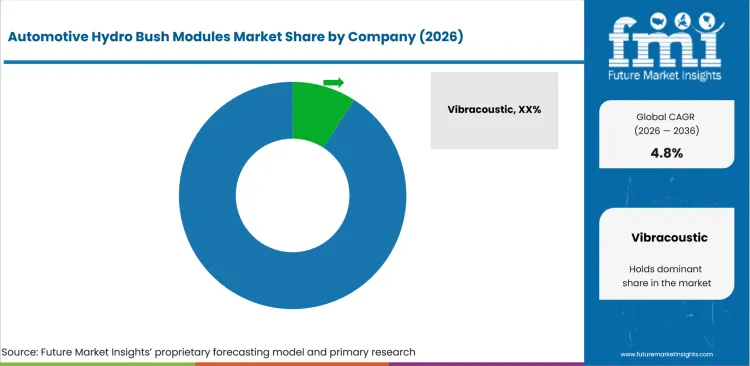
Competition separates direct hydro-bush engineering from chassis access and replacement coverage. Vibracoustic and Hutchinson publish direct vibration-control roles. Sumitomo Riko, Boge Rubber & Plastics and Yamashita Rubber also document bushing activity. Continental covers hydraulic-bushing replacement. Mubea participates through chassis systems. Trelleborg, Freudenberg and Cooper Standard hold adjacent positions.
- Direct hydro-bush and automotive NVH specialists include Vibracoustic and Hutchinson. Sumitomo Riko, Boge Rubber & Plastics and Yamashita Rubber complete this group.
- Chassis integration and replacement-channel participants are Continental and Mubea.
- Ownership-linked and adjacent participants include Trelleborg and Freudenberg. Cooper Standard is included through its current automotive portfolio and legacy AVS history.
Competitive Benchmarking: Automotive Hydro Bush Modules Market
| Company | Hydraulic Bush Evidence | Chassis Application Breadth | Electrified-Platform NVH Evidence | Geographic Reach |
|---|---|---|---|---|
| Vibracoustic | High | High | High | Global |
| Trelleborg | Low | Low | Low | Global |
| Continental | Medium | Medium | Medium | Europe with global group reach |
| Hutchinson | High | High | Medium | Asia and Europe |
| Sumitomo Riko | High | High | High | Global |
| Boge Rubber & Plastics | High | High | High | Europe, Americas and China |
| Freudenberg | Low | Low | Medium | Global |
| Cooper Standard | Low | Low | Low | Global |
| Mubea | Low | High | Medium | Global |
| Yamashita Rubber | Medium | High | Medium | Japan, Americas, Asia and Europe |
Scoring uses current official evidence. High hydraulic-bush evidence requires a documented fluid-filled suspension bushing. Medium marks narrower bushing evidence and Low marks an adjacent role. Chassis breadth follows documented suspension positions. Electrified-platform evidence is High for an EV-specific program and Medium for broader electrified mobility activity.
Key Developments in the Automotive Hydro Bush Modules Market
- In August 2026, Sumitomo Riko committed about USD 4.6 million to anti-vibration rubber equipment at its Ohio plant for a pickup order. The line is expected to raise capacity by about 15%.
- In October 2025, Continental said it would add 27 hydraulic bushings to its European chassis and steering portfolio at the start of 2026. The action widened OE-style replacement coverage.
- In April 2025, Vibracoustic supplied fluid-filled hydro bushings for a premium electric pickup steering gear. The design tunes dynamic properties and limits displacement under heavy loads.
Key Players in the Automotive Hydro Bush Modules Market
Direct Hydro-Bush and Automotive NVH Specialists
- Vibracoustic
- Hutchinson
- Sumitomo Riko
- Boge Rubber & Plastics
- Yamashita Rubber
Chassis Integration and Replacement-Channel Participants
- Continental
- Mubea
Ownership-Linked, Adjacent and Legacy Participants
- Trelleborg
- Freudenberg
- Cooper Standard
Automotive Hydro Bush Modules Market - Report Scope
| Coverage field | Report scope |
|---|---|
| Market breakdown | module type; fluid type; vehicle type; function; sales channel |
| Quantitative Units | USD billion. |
| Market Definition | Revenue includes complete automotive hydro bush modules and hydro-integrated elastomeric bush assemblies sold within the named segmentation universe. Conventional non-hydraulic bushings, complete vehicles, finished suspension assemblies, shock absorbers and unrelated NVH products are excluded. |
| Regions Covered | North America; Latin America; Western Europe; Eastern Europe; East Asia; South Asia and Pacific; Middle East and Africa |
| Countries Covered | Poland, Mexico, Brazil, USA, France, Germany, Japan, and more than twenty-five additional countries in the full report |
| Key Companies Profiled | Vibracoustic; Trelleborg; Continental; Hutchinson; Sumitomo Riko; Boge Rubber & Plastics; Freudenberg; Cooper Standard; Mubea; Yamashita Rubber |
| Forecast Period | 2026 to 2036. |
| Approach | Primary and secondary research with market triangulation based on platform fitment, module value, vehicle production, installed-base indicators, replacement cycles and channel mix. |
Automotive Hydro Bush Modules Market - Research Methodology
| Method | Approach |
|---|---|
| Primary Research | FMI analysts gathered input from manufacturers, service providers, technology developers, distributors, end users, procurement teams, and subject-matter experts. Interviews examined purchasing decisions, product or service evaluation, adoption barriers, approval requirements, pricing considerations, and expectations for technical or commercial support. Respondents were also asked what evidence is required before a trial, pilot, or initial order develops into regular purchasing. |
| Desk Research | Desk research covered government statistics, regulatory publications, trade data, industry associations, technical literature, standards, company filings, product information, and official corporate announcements. Sources were reviewed for relevance, publication date, geographic coverage, and consistency with the defined market scope. Claims relating to performance, applications, approvals, capacity, investment, and commercial activity were retained only when supported by credible public evidence. |
| Market Sizing and Forecasting | The market model combined the baseline value with historical performance, segment structure, pricing and volume indicators, adoption levels, company participation, and country-level demand conditions. Forecast assumptions considered economic activity, investment trends, regulatory developments, technology adoption, purchasing cycles, supply availability, and barriers to wider market use. Segment and regional estimates were reconciled before the final market total was calculated. |
| Data Validation | Estimates were checked against multiple independent indicators, including public data, company activity, trade patterns, industry developments, and findings from primary interviews. Validation also tested whether products, services, applications, and company revenues fell within the defined market boundaries. Adjacent categories, unsupported claims, overlapping revenues, and activities without direct market relevance were excluded to reduce double counting and maintain consistency across segments and countries. |
Automotive Hydro Bush Modules Market by Segments
Automotive Hydro Bush Modules Market segmented by Module Type:
- Control arm hydro bushes
- Subframe hydro bushes
- Engine mount hydro bushes
- Suspension link hydro bushes
- Integrated NVH bush modules
Automotive Hydro Bush Modules Market segmented by Fluid Type:
- Glycol-filled
- Silicone-filled
- Hydraulic oil-filled
- Frequency-tuned fluid chambers
Automotive Hydro Bush Modules Market segmented by Vehicle Type:
- Passenger cars
- SUVs - crossovers
- Light commercial vehicles
- Premium vehicles
- EV platforms
Automotive Hydro Bush Modules Market segmented by Function:
- NVH isolation
- Ride comfort
- Powertrain vibration control
- Chassis compliance tuning
Automotive Hydro Bush Modules Market segmented by Sales Channel:
- OEM direct
- Suspension Tier-1s
- Aftermarket replacement
- Service kits
Automotive Hydro Bush Modules Market by Region:
- North America
- United States
- Canada
- Latin America
- Brazil
- Mexico
- Argentina
- Chile
- Western Europe
- Germany
- France
- United Kingdom
- Italy
- Spain
- Benelux
- Nordics
- Eastern Europe
- Poland
- Czech Republic
- Romania
- Hungary
- East Asia
- China
- Japan
- South Korea
- South Asia and Pacific
- India
- ASEAN
- Australia and New Zealand
- Middle East and Africa
- GCC Countries
- South Africa
- Türkiye
- Israel
Research Sources and Bibliography
- USA Energy Information Administration. (2026, July 27). Hybrid sales rise while battery electric sales remain lower after tax credit expiration.
- Instituto Nacional de Estadística y Geografía. (2026, September 7). Administrative record of the light vehicle automotive industry. August 2026.
- Vibracoustic SE. (2025, April 10). Vibracoustic air springs for enhanced driving comfort and performance of a premium electric pickup truck.
- Sumitomo Riko Company Limited. (2025, May 20). Sumitomo Riko anti-vibration rubber adopted for Toyota Lexus LX.
- European Automobile Manufacturers’ Association. (2025, February 25). New car registrations: -2.6% in January 2025; battery-electric 15% market share.
- Mubea. (2025, April 16). Adaptive stabilizer bar system: Mechanical - Adaptive - Roll - Damping (MARD).
- Hutchinson. (2025, March 28). Chery Tech Day: committed to building a sustainable future.
- European Automobile Manufacturers’ Association. (2026, July). New car registrations: +5.7% in H1 2026; battery-electric 20.7% market share.
- National Highway Traffic Safety Administration. (2025, March 19). Part 573 Safety Recall Report 25E-020.
- Sumitomo Riko Company Limited. (2025, September 17). Mexico bases inspection report: Employee-led safety initiatives.
- National Fund for Environmental Protection and Water Management. (2026, September 2). Mój elektryk statistics.
- Japan Automobile Manufacturers Association. (2026, April 14). 2025 passenger car market trend survey.
- European Automobile Manufacturers’ Association. (2026, January 27). New car registrations: +1.8% in 2025; battery-electric 17.4% market share.
- Instituto Nacional de Estadística y Geografía. (2026, January 9). Administrative record of the light vehicle automotive industry. December 2025.
- Service des données et études statistiques. (2026, February 11). Vehicle registrations in 2025: new-car market falls while used-car market holds.
- ANFAVEA. (2026, January 15). Vehicle production and sales grew in 2025 and ANFAVEA projects another increase in 2026.
- Sumitomo Riko Company Limited. (2026, August 5). Strengthening USA plant to establish a stable supply system for the North American market.
- Continental AG. (2025, October 28). A thousand new parts: Continental continues to expand its spare parts portfolio for chassis and steering.
- Hutchinson. (2025, March 14). Open Day in Chennai: a successful presentation of Hutchinson’s new site in India!
- Trelleborg AB. (2026, February 27). Annual Report 2025.
- Freudenberg SE. (2026, March 20). Annual Report 2025.
- Cooper-Standard Holdings Inc. (2026, February 13). Annual Report on Form 10-K for the year ended December 31, 2025.
- BOGE Rubber & Plastics. (accessed 2026, September 8). Locations.
- Yamashita Rubber Co., Ltd. (accessed 2026, September 8). Company profile.
- Sumitomo Riko Company Limited. (2025). Company Profile 2025.
- Mubea. (accessed 2026, September 8). Certification.
- National Highway Traffic Safety Administration. (2026, March 29). Part 573 Safety Recall Report 26V200.
- Hutchinson. (2025, May 12). Hutchinson unveils electrification innovations at Shanghai Auto Show 2025.
- Sumitomo Riko Company Limited. (2026, June 25). New R&D Base Established in India to Address Stricter Environmental Regulations.
- Cooper Standard. (2026, March 3). Global Manufacturing Excellence Recognized: 2025 Plant of the Year and Most Improved Plant Announced.
- Trelleborg AB. (2025, February 11). Sustainable shims
- AutoData. (2025, June 24). BOGE está presente no VW Tera
- Cooper Standard. (2025, April 25). Cooper Standard Receives 2025 Automotive News PACE Pilot Recognition
- Japan International Cooperation Agency. (2025, March 28). Industry-academia technical cooperation at Y-TEC Vietnam
This bibliography is provided for reader reference and is not exhaustive. The full report contains the complete reference list and detailed citations.
This Report Answers
- How big is the automotive hydro bush modules market in 2026 and what value is forecast by 2036?
- Why do heavier and quieter vehicle platforms increase the value of frequency-selective chassis damping?
- Why do control arm hydro bushes lead module type demand?
- How does fluid selection change hydro-bush damping response?
- Why do passenger cars lead vehicle type demand?
- How do growth rates differ among the seven profiled countries?
- Which companies provide direct hydro-bush capability and which hold adjacent chassis roles?
- Why do sealing integrity and dimensional control govern hydro-bush qualification?
- How does replacement demand extend revenue after original production?
Frequently Asked Questions
How big is the automotive hydro bush modules market in 2026?
The automotive hydro bush modules market is valued at USD 5.1 billion in 2026 and is projected to reach USD 8.2 billion by 2036. Higher chassis loads and quieter vehicle platforms support growth.
What is the CAGR of the automotive hydro bush modules market from 2026 to 2036?
The automotive hydro bush modules market is projected to grow at a CAGR of 4.8% between 2026 and 2036. Vehicle-specific damping requirements and installed-fleet replacement support expansion.
Which module type leads the automotive hydro bush modules market?
The control arm hydro bushes segment is expected to hold 32.0% of the automotive hydro bush modules market in 2026 driven by wheel-guidance and compliance duties. Hydraulic damping also controls selected chassis excitations.
Which fluid type holds the largest share in the automotive hydro bush modules market?
The glycol-filled segment is projected to account for 35.0% of fluid type demand in 2026. Its position follows tunable hydraulic behavior and compatibility with the surrounding elastomer architecture.
Which vehicle type leads the automotive hydro bush modules market?
The passenger cars segment is anticipated to represent 36.0% of vehicle type demand in 2026. High platform volumes and repeated use of tuned chassis isolators support leadership.
Which countries are projected to record the highest growth in the automotive hydro bush modules market?
Poland is projected to grow at 6.0% CAGR followed by Mexico at 5.7% and Brazil at 5.4% through 2036. New platform nominations and expanding production exposure support their higher rates.
Which companies are active in the automotive hydro bush modules market?
Key companies include Vibracoustic, Trelleborg and Continental alongside Hutchinson and Sumitomo Riko. Boge Rubber & Plastics, Freudenberg and Cooper Standard also participate with Mubea and Yamashita Rubber.
Preview the report firsthand - request a free sample
Get SampleGet the brochure for pricing and purchase details.
Get PDFTable of Content
- Key Takeaways
- Market Size and CAGR
- Top Growth Driver
- Fastest Growing Segment
- Leading Region
- Key Companies
- Emerging Opportunities
- Executive Summary
- Global Market Outlook
- Demand-side Trends
- Supply-side Trends
- Technology Roadmap Analysis
- Analysis and Recommendations
- Analyst Perspective (What is happening? Why now? What should investors know?)
- Key Questions Answered
- How large is the market?
- What is the CAGR?
- What are key trends?
- Which region dominates?
- Who are the leaders?
- Market Overview
- Market Coverage / Taxonomy
- Market Definition / Scope / Limitations
- Research Methodology
- Chapter Orientation
- Analytical Lens and Working Hypotheses
- Market Structure, Signals, and Trend Drivers
- Benchmarking and Cross-market Comparability
- Market Sizing, Forecasting, and Opportunity Mapping
- Research Design and Evidence Framework
- Desk Research Programme (Secondary Evidence)
- Expert Input and Fieldwork (Primary Evidence)
- Tooling, Models, and Reference Databases
- Data Engineering and Model Build
- Quality Assurance and Audit Trail
- Market Background
- Market Dynamics (Drivers, Restraints, Opportunity, Trends)
- Scenario Forecast (Optimistic, Likely, Conservative)
- Impact Analysis
- AI Impact
- Sustainability Impact
- Regulatory Impact
- Technology Impact
- Consumer / Buyer Analysis
- Purchase Drivers
- Adoption Barriers
- Buyer Journey
- Opportunity Map Analysis
- Product Life Cycle Analysis
- Supply Chain Analysis
- Investment Feasibility Matrix
- Value Chain Analysis
- PESTLE and Porter's Analysis
- Regulatory Landscape
- Regional Parent Market Outlook
- Production and Consumption Statistics
- Import and Export Statistics
- Global Market Analysis and Forecast, 2021 to 2036
- Historical Market Size Value (USD Billion) Analysis, 2021 to 2025
- Current and Future Market Size Value (USD Billion) Projections, 2026 to 2036
- Y-o-Y Growth Trend Analysis
- Absolute $ Opportunity Analysis
- Global Market Pricing Analysis, 2021 to 2036
- Global Market Analysis and Forecast, By Module Type, 2021 to 2036
- Introduction / Key Findings
- Historical Market Size Value (USD Billion) Analysis By Module Type, 2021 to 2025
- Current and Future Market Size Value (USD Billion) Analysis and Forecast By Module Type, 2026 to 2036
- Control arm hydro bushes
- Subframe hydro bushes
- Engine mount hydro bushes
- Suspension link hydro bushes
- Integrated NVH bush modules
- Control arm hydro bushes
- Y-o-Y Growth Trend Analysis By Module Type, 2021 to 2025
- Absolute $ Opportunity Analysis By Module Type, 2026 to 2036
- Global Market Analysis and Forecast, By Fluid Type, 2021 to 2036
- Introduction / Key Findings
- Historical Market Size Value (USD Billion) Analysis By Fluid Type, 2021 to 2025
- Current and Future Market Size Value (USD Billion) Analysis and Forecast By Fluid Type, 2026 to 2036
- Glycol-filled
- Silicone-filled
- Hydraulic oil-filled
- Frequency-tuned fluid chambers
- Glycol-filled
- Y-o-Y Growth Trend Analysis By Fluid Type, 2021 to 2025
- Absolute $ Opportunity Analysis By Fluid Type, 2026 to 2036
- Global Market Analysis and Forecast, By Vehicle Type, 2021 to 2036
- Introduction / Key Findings
- Historical Market Size Value (USD Billion) Analysis By Vehicle Type, 2021 to 2025
- Current and Future Market Size Value (USD Billion) Analysis and Forecast By Vehicle Type, 2026 to 2036
- Passenger cars
- SUVs/crossovers
- Light commercial vehicles
- Premium vehicles
- EV platforms
- Passenger cars
- Y-o-Y Growth Trend Analysis By Vehicle Type, 2021 to 2025
- Absolute $ Opportunity Analysis By Vehicle Type, 2026 to 2036
- Global Market Analysis and Forecast, By Function, 2021 to 2036
- Introduction / Key Findings
- Historical Market Size Value (USD Billion) Analysis By Function, 2021 to 2025
- Current and Future Market Size Value (USD Billion) Analysis and Forecast By Function, 2026 to 2036
- NVH isolation
- Ride comfort
- Powertrain vibration control
- Chassis compliance tuning
- NVH isolation
- Y-o-Y Growth Trend Analysis By Function, 2021 to 2025
- Absolute $ Opportunity Analysis By Function, 2026 to 2036
- Global Market Analysis and Forecast, By Sales Channel, 2021 to 2036
- Introduction / Key Findings
- Historical Market Size Value (USD Billion) Analysis By Sales Channel, 2021 to 2025
- Current and Future Market Size Value (USD Billion) Analysis and Forecast By Sales Channel, 2026 to 2036
- OEM direct
- Suspension Tier-1s
- Aftermarket replacement
- Service kits
- OEM direct
- Y-o-Y Growth Trend Analysis By Sales Channel, 2021 to 2025
- Absolute $ Opportunity Analysis By Sales Channel, 2026 to 2036
- Global Market Analysis and Forecast, By Region, 2021 to 2036
- Introduction
- Historical Market Size Value (USD Billion) Analysis By Region, 2021 to 2025
- Current Market Size Value (USD Billion) Analysis and Forecast By Region, 2026 to 2036
- North America
- Latin America
- Western Europe
- Eastern Europe
- East Asia
- South Asia and Pacific
- Middle East & Africa
- Market Attractiveness Analysis By Region
- North America Market Analysis and Forecast, By Country, 2021 to 2036
- Historical Market Size Value (USD Billion) Trend Analysis By Market Taxonomy, 2021 to 2025
- Market Size Value (USD Billion) Forecast By Market Taxonomy, 2026 to 2036
- By Country
- USA
- Canada
- By Module Type
- By Fluid Type
- By Vehicle Type
- By Function
- By Sales Channel
- By Country
- Market Attractiveness Analysis
- By Country
- By Module Type
- By Fluid Type
- By Vehicle Type
- By Function
- By Sales Channel
- Key Takeaways
- Latin America Market Analysis and Forecast, By Country
- Historical Market Size Value (USD Billion) Trend Analysis By Market Taxonomy, 2021 to 2025
- Market Size Value (USD Billion) Forecast By Market Taxonomy, 2026 to 2036
- By Country
- Brazil
- Mexico
- Chile
- Rest of Latin America
- By Module Type
- By Fluid Type
- By Vehicle Type
- By Function
- By Sales Channel
- By Country
- Market Attractiveness Analysis
- By Country
- By Module Type
- By Fluid Type
- By Vehicle Type
- By Function
- By Sales Channel
- Key Takeaways
- Western Europe Market Analysis and Forecast, By Country
- Historical Market Size Value (USD Billion) Trend Analysis By Market Taxonomy, 2021 to 2025
- Market Size Value (USD Billion) Forecast By Market Taxonomy, 2026 to 2036
- By Country
- Germany
- UK
- Italy
- Spain
- France
- Nordic
- BENELUX
- Rest of Western Europe
- By Module Type
- By Fluid Type
- By Vehicle Type
- By Function
- By Sales Channel
- By Country
- Market Attractiveness Analysis
- By Country
- By Module Type
- By Fluid Type
- By Vehicle Type
- By Function
- By Sales Channel
- Key Takeaways
- Eastern Europe Market Analysis and Forecast, By Country
- Historical Market Size Value (USD Billion) Trend Analysis By Market Taxonomy, 2021 to 2025
- Market Size Value (USD Billion) Forecast By Market Taxonomy, 2026 to 2036
- By Country
- Russia
- Poland
- Hungary
- Balkan & Baltic
- Rest of Eastern Europe
- By Module Type
- By Fluid Type
- By Vehicle Type
- By Function
- By Sales Channel
- By Country
- Market Attractiveness Analysis
- By Country
- By Module Type
- By Fluid Type
- By Vehicle Type
- By Function
- By Sales Channel
- Key Takeaways
- East Asia Market Analysis and Forecast, By Country
- Historical Market Size Value (USD Billion) Trend Analysis By Market Taxonomy, 2021 to 2025
- Market Size Value (USD Billion) Forecast By Market Taxonomy, 2026 to 2036
- By Country
- China
- Japan
- South Korea
- By Module Type
- By Fluid Type
- By Vehicle Type
- By Function
- By Sales Channel
- By Country
- Market Attractiveness Analysis
- By Country
- By Module Type
- By Fluid Type
- By Vehicle Type
- By Function
- By Sales Channel
- Key Takeaways
- South Asia and Pacific Market Analysis and Forecast, By Country
- Historical Market Size Value (USD Billion) Trend Analysis By Market Taxonomy, 2021 to 2025
- Market Size Value (USD Billion) Forecast By Market Taxonomy, 2026 to 2036
- By Country
- India
- ASEAN
- Australia & New Zealand
- Rest of South Asia and Pacific
- By Module Type
- By Fluid Type
- By Vehicle Type
- By Function
- By Sales Channel
- By Country
- Market Attractiveness Analysis
- By Country
- By Module Type
- By Fluid Type
- By Vehicle Type
- By Function
- By Sales Channel
- Key Takeaways
- Middle East & Africa Market Analysis and Forecast, By Country
- Historical Market Size Value (USD Billion) Trend Analysis By Market Taxonomy, 2021 to 2025
- Market Size Value (USD Billion) Forecast By Market Taxonomy, 2026 to 2036
- By Country
- Kingdom of Saudi Arabia
- Other GCC Countries
- Türkiye
- South Africa
- Other African Union
- Rest of Middle East & Africa
- By Module Type
- By Fluid Type
- By Vehicle Type
- By Function
- By Sales Channel
- By Country
- Market Attractiveness Analysis
- By Country
- By Module Type
- By Fluid Type
- By Vehicle Type
- By Function
- By Sales Channel
- Key Takeaways
- Key Countries Market Analysis
- USA
- Pricing Analysis
- Market Share Analysis, 2025
- By Module Type
- By Fluid Type
- By Vehicle Type
- By Function
- By Sales Channel
- Canada
- Pricing Analysis
- Market Share Analysis, 2025
- By Module Type
- By Fluid Type
- By Vehicle Type
- By Function
- By Sales Channel
- Mexico
- Pricing Analysis
- Market Share Analysis, 2025
- By Module Type
- By Fluid Type
- By Vehicle Type
- By Function
- By Sales Channel
- Brazil
- Pricing Analysis
- Market Share Analysis, 2025
- By Module Type
- By Fluid Type
- By Vehicle Type
- By Function
- By Sales Channel
- Chile
- Pricing Analysis
- Market Share Analysis, 2025
- By Module Type
- By Fluid Type
- By Vehicle Type
- By Function
- By Sales Channel
- Germany
- Pricing Analysis
- Market Share Analysis, 2025
- By Module Type
- By Fluid Type
- By Vehicle Type
- By Function
- By Sales Channel
- UK
- Pricing Analysis
- Market Share Analysis, 2025
- By Module Type
- By Fluid Type
- By Vehicle Type
- By Function
- By Sales Channel
- Italy
- Pricing Analysis
- Market Share Analysis, 2025
- By Module Type
- By Fluid Type
- By Vehicle Type
- By Function
- By Sales Channel
- Spain
- Pricing Analysis
- Market Share Analysis, 2025
- By Module Type
- By Fluid Type
- By Vehicle Type
- By Function
- By Sales Channel
- France
- Pricing Analysis
- Market Share Analysis, 2025
- By Module Type
- By Fluid Type
- By Vehicle Type
- By Function
- By Sales Channel
- India
- Pricing Analysis
- Market Share Analysis, 2025
- By Module Type
- By Fluid Type
- By Vehicle Type
- By Function
- By Sales Channel
- ASEAN
- Pricing Analysis
- Market Share Analysis, 2025
- By Module Type
- By Fluid Type
- By Vehicle Type
- By Function
- By Sales Channel
- Australia & New Zealand
- Pricing Analysis
- Market Share Analysis, 2025
- By Module Type
- By Fluid Type
- By Vehicle Type
- By Function
- By Sales Channel
- China
- Pricing Analysis
- Market Share Analysis, 2025
- By Module Type
- By Fluid Type
- By Vehicle Type
- By Function
- By Sales Channel
- Japan
- Pricing Analysis
- Market Share Analysis, 2025
- By Module Type
- By Fluid Type
- By Vehicle Type
- By Function
- By Sales Channel
- South Korea
- Pricing Analysis
- Market Share Analysis, 2025
- By Module Type
- By Fluid Type
- By Vehicle Type
- By Function
- By Sales Channel
- Russia
- Pricing Analysis
- Market Share Analysis, 2025
- By Module Type
- By Fluid Type
- By Vehicle Type
- By Function
- By Sales Channel
- Poland
- Pricing Analysis
- Market Share Analysis, 2025
- By Module Type
- By Fluid Type
- By Vehicle Type
- By Function
- By Sales Channel
- Hungary
- Pricing Analysis
- Market Share Analysis, 2025
- By Module Type
- By Fluid Type
- By Vehicle Type
- By Function
- By Sales Channel
- Kingdom of Saudi Arabia
- Pricing Analysis
- Market Share Analysis, 2025
- By Module Type
- By Fluid Type
- By Vehicle Type
- By Function
- By Sales Channel
- Türkiye
- Pricing Analysis
- Market Share Analysis, 2025
- By Module Type
- By Fluid Type
- By Vehicle Type
- By Function
- By Sales Channel
- South Africa
- Pricing Analysis
- Market Share Analysis, 2025
- By Module Type
- By Fluid Type
- By Vehicle Type
- By Function
- By Sales Channel
- USA
- Market Structure Analysis
- Competition Dashboard
- Competition Benchmarking
- Market Share Analysis of Top Players
- By Regional
- By Module Type
- By Fluid Type
- By Vehicle Type
- By Function
- By Sales Channel
- Emerging Startups
- Innovation Benchmarking
- Competition Analysis
- Competition Deep Dive
- Vibracoustic
- Overview
- Product Portfolio
- Profitability by Market Segments
- Sales Footprint
- Strategy Overview
- Marketing Strategy
- Product Strategy
- Channel Strategy
- Trelleborg
- Continental
- Hutchinson
- Sumitomo Riko
- Boge Rubber & Plastics
- Freudenberg
- Cooper Standard
- Mubea
- Yamashita Rubber
- Vibracoustic
- Case Studies
- Success Stories
- Recent Developments
- Competition Deep Dive
- Assumptions & Acronyms Used


