

- Market Size (2026)
- USD 5.8 Bn
- Forecast (2036)
- USD 9.4 Bn
- CAGR (2026 to 2036)
- 5.0%
How big is Automotive Carrier Housings Market in 2026?
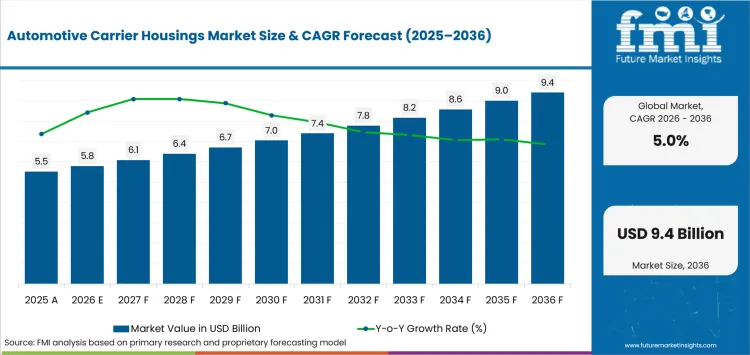
USD 5.8 billion in 2026 and USD 9.4 billion by 2036 at a 5.0% CAGR.
Demand for automotive carrier housings is projected to expand at 5.0% CAGR between 2026 and 2036, increasing valuation from USD 5.8 billion in 2026 to USD 9.4 billion by 2036. Electric-driveline production continues to increase the number of reducer assemblies entering vehicle programs. The IEA recorded more than 20 million electric-car sales in 2025. The expanding EV base increases demand for reducer housings and the associated casting, tooling, and machining work required before serial production begins.
Vehicle mix changes the duty placed on a carrier housing and therefore changes material, stiffness and machining requirements. INEGI recorded 1,642,083 light vehicles produced in Mexico during January-May 2026, with light trucks at 80.0% of output. Truck-heavy plants consume more axle and differential housings, while compact electrified platforms place more value on reducer packaging.
Key Takeaways
- Vehicle-platform renewal raises carrier-housing demand because each new axle, transmission or reducer program requires validated geometry before tooling release.
- Based on housing type, differential carrier housings are projected to account for 32.0% in 2026 due to their role in driven-axle alignment.
- By material, cast iron is estimated to hold 38.0% in 2026 owing to mature foundry economics and stiffness in high-load designs.
- In 2026, passenger cars are expected to lead vehicle type with 32.0% share because platform volumes keep several driveline housing families active.
- Program-specific tooling and requalification slow source changes because housing geometry can alter gear alignment, sealing and final assembly performance.
- Some of the key players in this market include American Axle & Manufacturing, Dana, Magna International, GKN Automotive, Linamar, Nemak, Aisin, Schaeffler, JTEKT, and Musashi Seimitsu.
Analyst Perspective
"Carrier-housing economics are set by the interfaces that force revalidation: bearing bores, gear alignment, sealing faces and the machining sequence. A low casting quote loses value if the source change requires new fixtures or axle-level proof, while an incumbent can defend margin by carrying geometry changes from tooling release into launch."
- Nikhil Kaitwade, Principal Consultant, Future Market Insights
How is the automotive carrier housings market segmented?
The automotive carrier housings market is segmented by housing type, material, vehicle type, manufacturing, sales channel and region.
Housing types include differential carrier housings, axle carrier housings, transmission carrier housings, EV reducer housings and lightweight aluminum housings. Materials cover cast iron, aluminum, magnesium alloy, ductile iron and high-strength steel. Vehicle types include passenger cars, SUVs/crossovers, light commercial vehicles, pickup trucks and electric vehicles. Manufacturing covers casting, die casting, machining and forging / hybrid. Sales channels include OEM direct, driveline Tier-1s, aftermarket replacement and precision foundries.
How do passenger cars sustain leadership in the Vehicle Type category?
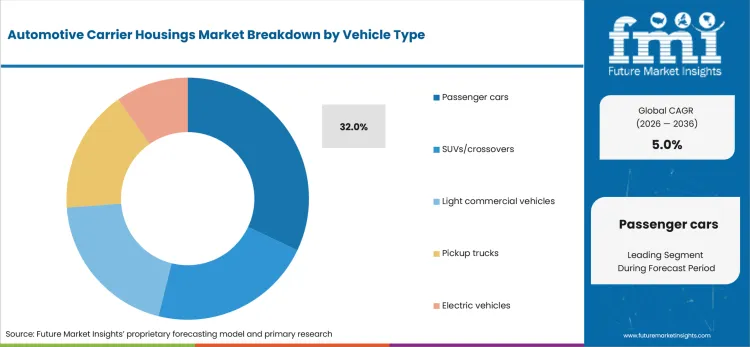
Passenger-car volume keeps several housing families active in conventional transmissions, hybrids and battery-electric reducers. VDA documented 4.15 million passenger cars produced in Germany during 2025, showing how one mature production base can sustain several propulsion routes at once. Each route changes torque, package space and noise targets without removing the need for machined structural interfaces.
- In 2026, passenger cars are expected to lead vehicle type with 32.0% share because large platforms carry several driveline architectures.
- Automakers reuse proven machining and material routes where possible, then revalidate only the interfaces changed by each transmission or reducer program.
What makes differential carrier housings central to the Housing Type category?
Differential carrier housings locate bearing bores and mounting faces that preserve ring-gear and pinion alignment under torque. GKN Automotive presented asymmetric limited-slip differential technology at Dritev in July 2025, confirming continued engineering work around differential control in current driveline programs. The housing therefore stays tied to gear position and axle stiffness instead of disappearing with propulsion change.
- Based on housing type, differential carrier housings are projected to account for 32.0% in 2026 due to broad use in driven-axle programs.
- Axle engineers approve bore position, sealing faces and mounting stiffness on the intended assembly before serial tooling is released.
Why does cast iron remain the leading Material segment?
Cast iron keeps a strong position where stiffness, vibration control and established foundry economics outweigh aggressive mass reduction. Linamar completed the Aludyne North America asset acquisition in November 2025, adding aluminum casting and precision-machining capacity that broadens its light-metal options. The transaction also illustrates the extra process depth required before aluminum can displace iron on high-load carrier programs.
- By material, cast iron is estimated to hold 38.0% in 2026 owing to mature production routes and stiffness in high-load housings.
- Aluminum wins weight-sensitive nominations only after casting quality, machining stability and durability justify new tooling against a proven iron route.
What supports casting as the leading Manufacturing segment?
Casting forms complex ribs, bearing surrounds and mounting features near final shape before machining establishes functional surfaces. Nemak completed the GF Casting Solutions automotive acquisition in February 2026, expanding its aluminum and magnesium casting network with additional production sites and engineering capacity. That scale matters because porosity, distortion and dimensional variation determine how much correction machining must absorb before production approval.
- Casting is set to lead manufacturing with 43.0% share in 2026 due to near-net geometry that limits material removal on complex housings.
- Die casting gains work in lighter housings, while forging or hybrid routes serve local strength demands that justify higher forming cost.
What drives OEM direct leadership in the Sales Channel category?
Carrier housings are released against vehicle drawings and validation plans, so commercial responsibility stays close to the automaker or its driveline integrator. Aisin announced in October 2025 that its newly developed eAxle had been adopted for Toyota’s bZ4X, with gear precision and casing shape optimized for the application. Program-specific geometry therefore ties tooling decisions directly to the vehicle nomination.
- OEM direct is forecast to represent 55.0% of sales-channel demand in 2026 driven by platform-specific geometry and launch accountability.
- Driveline Tier-1 sourcing stays relevant where one integrator controls the axle or e-drive bill of material and validates the complete assembly.
What are the drivers, restraints and opportunities in the Automotive Carrier Housings Market?
Platform renewal increases housing programs, qualification limits rapid source changes, and compact electrified drivetrains expand demand for lightweight and integrated housing designs.
- Driver: Mixed propulsion investment forces automakers to qualify new axle, transmission and reducer housing geometries on overlapping vehicle programs.
- Restraint: Automotive quality audits and program-specific dimensional validation raise the time and cost required to approve a new housing source.
- Opportunity: High-voltage e-drive programs reward producers that industrialize compact housings near the customer and carry machining responsibility into launch.
Propulsion mix keeps several housing families active at the same time. ACEA reported in June 2026 that hybrids held 37.8% of EU registrations through May, with battery-electric cars at 20.0% and plug-in hybrids at 9.7%. Each route changes torque paths and package space, so new platform nominations pull casting tools and machining fixtures into separate validation cycles.
Source changes carry formal quality work before an automaker considers program-level dimensional risk. The IATF issued Rules 6th Edition SI updates in May 2025, changing audit requirements inside certified automotive schemes. A housing producer must keep audit controls aligned with casting and machining records, which lengthens requalification if tooling or axle-level evidence changes.
High-voltage e-drive programs favor housing manufacturers that enter before package interfaces are fixed. Magna secured a 250 kW 800 V two-speed eDrive program with Chery in July 2026 and assigned production to a new Wuhu facility. Early local casting and machining involvement can shape bearing seats, heat paths and assembly faces before production validation closes.
Which country CAGRs are profiled in the Automotive Carrier Housings Market?
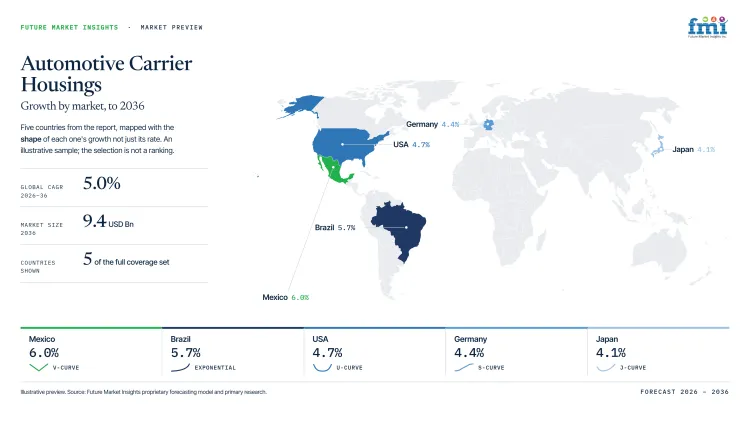
| Country | CAGR |
|---|---|
| Mexico | 6.0% |
| Brazil | 5.7% |
| South Korea | 5.4% |
| Canada | 5.1% |
| USA | 4.7% |
| Germany | 4.4% |
| Japan | 4.1% |
How do country-level CAGRs compare in the Automotive Carrier Housings Market?
The seven forecasts span 1.9 percentage points, with Mexico and Brazil forming the upper band and Japan defining the lower boundary. South Korea and Canada form a second growth tier, while USA and Germany occupy the middle. The spacing points to different launch cycles and production structures rather than a ranking of current country revenue.
- Mexico gains from border-adjacent capacity that can follow North American truck-platform timing without long inbound logistics.
- Brazil gives local foundries an advantage because heavy castings become costly to move over long import routes.
- South Korea rewards machining lines that can absorb export-program schedule changes without rebuilding the complete process route.
- Canada concentrates carrier-housing exposure in a small number of assembly corridors and vehicle allocations.
- USA combines a deep installed tooling base with replacement demand for high-load axle families.
- Germany places more weight on retooling evidence and system-level NVH proof during new material qualification.
- Japan uses long nomination cycles that favor early engineering involvement and stable process records.
Comparable CAGRs can therefore produce different order patterns because tooling reuse, vehicle duty and launch concentration differ by country. The full report provides country-level CAGR analysis across North America, Latin America, Western Europe, Eastern Europe, East Asia, South Asia and Pacific, and Middle East and Africa.
Country-wise Analysis
- Mexico's export plants run pickup and crossover programs that place sustained torque loads on axle and differential housings, making nearby machining valuable during rapid launch changes and frequent model transfers. Mexico is projected to expand at 6.0% CAGR through 2036 because local casting can follow North American assembly schedules; INEGI recorded 3,953,494 light vehicles in 2025 and light trucks represented 77.2% of output. Trade-rule changes can alter program timing quickly, so plants with nearby PPAP support can adjust tooling and machining schedules faster than distant sources while preserving dimensional records required for every vehicle nomination and customer change.
- Brazilian vehicle programs keep tight cost limits on heavy cast components, which gives local foundries an advantage whenever freight and replenishment time become material to sourcing decisions and program economics. ANFAVEA recorded 2.644 million vehicles produced in 2025 and projected 2026 output to rise 3.7%, giving iron and aluminum housing producers a visible volume base without removing qualification costs for lightweight routes. Brazil is forecast to advance at 5.7% CAGR over the assessment period provided local producers prove that lower mass offsets new tooling expense, while mixed conventional and electrified programs keep durability, price and local service equally important during vehicle nomination.
- South Korea's export plants run high-volume launch schedules that require machining capacity to follow rapid changes in hybrid and electric driveline mix, especially where one factory serves several destination markets and nameplates. South Korea is projected to record 5.4% CAGR through 2036 tied to export programs; the Ministry of Trade, Industry and Energy recorded 35,701 hybrid exports in January 2025, up 35.5% year over year. Tariffs and destination demand can disrupt schedules, so producers with flexible fixtures can shift capacity between differential and reducer programs while preserving launch discipline and the machining records required by large domestic automakers and export customers.
- Canada's automotive corridor depends on a limited number of assembly plants, so carrier-housing volume can change sharply whenever cross-border vehicle allocations or launch schedules move between facilities and customers. Statistics Canada recorded 43,113 new zero-emission vehicle registrations in the first quarter of 2026, equal to 10.8% of registrations and 15.8% above a year earlier, giving Ontario plants a clearer electrified-program pipeline. Canada is projected to progress at 5.1% CAGR through 2036 aided by North American sourcing, while flexible casting and machining lines reduce the customer-concentration risk created by a small number of assembly corridors and major vehicle programs.
- USA carrier-housing programs serve a large mix of pickups, SUVs and medium-duty applications that require broad torque coverage, durable axle interfaces and production assets capable of serving several driveline types efficiently. The market is forecast to grow at 4.7% CAGR through 2036 as architecture changes raise housing content; the EPA's February 2026 Automotive Trends Report found truck SUVs represented half of model-year 2024 new vehicle production. Policy shifts can alter electric-program timing, so multi-process plants can protect utilization by serving conventional, hybrid and electric programs from shared machining assets while keeping axle housing capacity aligned with high-load vehicle demand and replacement needs.
- German carrier-housing programs place heavy weight on NVH proof, high-speed durability and package efficiency before a new material or integrated housing reaches serial production at domestic vehicle plants and engineering centers. VDA documented 1.67 million electric passenger cars produced in Germany during 2025, equal to 40% of passenger-car output, which keeps reducer and hybrid housing work close to engineering centers with established validation routines. Germany is anticipated to deliver 4.4% CAGR through 2036 propelled by mixed electrified production, while entrants must prove measurable system-level weight or assembly gains before automakers justify fresh tools, new process records and requalification expense.
- Japan's vehicle programs favor compact packaging, low noise and long qualification cycles that leave little room for late carrier-housing changes once a driveline reaches design release with established engineering partners. Japan is expected to register 4.1% CAGR during the assessment period reflecting steady platform renewal; in May 2026 the Agency for Natural Resources and Energy detailed clean-energy vehicle support while retaining multiple propulsion routes. Parallel conventional, hybrid and battery-electric programs give machining specialists repeat work, but producers must prove gear alignment, reducer noise control and material consistency early because mature customer relationships penalize unqualified design changes near launch and favor stable process records.
Who are the notable companies in the Automotive Carrier Housings Market?
American Axle & Manufacturing, Dana, Magna International, GKN Automotive, Linamar, Nemak, Aisin, Schaeffler, JTEKT, and Musashi Seimitsu are the notable companies profiled in this market.
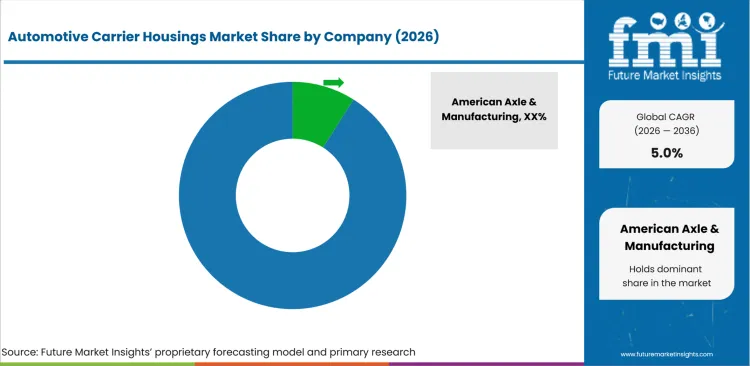
Competition splits between integrated driveline groups, metal-forming specialists and companies that engineer the differential or electrified system around the housing. Entry depends on controlling dimensional interfaces and launch evidence, not company scale alone. Dauch now owns the American Axle & Manufacturing and GKN Automotive businesses, while the remaining companies retain distinct casting, transmission, axle or bearing positions.
- American Axle & Manufacturing, Dana, Magna International and GKN Automotive: integrated driveline positions with direct axle or e-drive interfaces.
- Linamar and Nemak: casting and machining positions tied to material selection, forming control and production scale.
- Aisin, Schaeffler, JTEKT and Musashi Seimitsu: transmission, differential, reducer and bearing positions that shape housing loads and package geometry.
Competitive Benchmarking: Automotive Carrier Housings Market
| Company | Housing Casting & Machining | Axle / Differential Integration | Electrified Reducer / eDrive | Geographic Reach |
|---|---|---|---|---|
| American Axle & Manufacturing | High | High | High | Global |
| Dana | Medium | High | High | Global |
| Magna International | Medium | High | High | Global |
| GKN Automotive | Low | High | High | Global |
| Linamar | High | Medium | Medium | Global |
| Nemak | High | Low | Medium | Global |
| Aisin | Low | High | High | Global |
| Schaeffler | Low | Medium | High | Global |
| JTEKT | Low | High | Medium | Global |
| Musashi Seimitsu | Medium | Medium | Medium | Japan, Asia, Europe and the Americas |
Scoring basis: High requires verified capability in multiple relevant production or system stages. Medium requires documented capability in a narrower set of carrier-housing applications. Low identifies a documented limited fit for the stated criterion and never substitutes for missing evidence. Geographic reach follows current company filings and official disclosures. Ratings compare verified capability only and do not represent market share.
Key Developments in the Automotive Carrier Housings Market
- In June 2026, Dana entered a definitive agreement to combine with Eaton's Mobility business. The proposed transaction broadens light- and commercial-vehicle powertrain coverage but remains subject to approvals before the expected first-quarter 2027 close.
- In April 2026, Schaeffler detailed the 2026 production launch of its MultiMode hybrid transmission. The compact module keeps transmission housing, gear and bearing interfaces active in full and plug-in hybrid programs.
- In January 2025, Linamar announced an Ontario automotive technology program covering eAxle propulsion and lightweight structural casting. The plan adds manufacturing equipment and engineering capacity for launches that require local forming and machining support.
Key Players in the Automotive Carrier Housings Market
Integrated Axle and Driveline System Suppliers
- American Axle & Manufacturing
- Dana
- GKN Automotive
- Magna International
Casting and Precision Manufacturing Specialists
- Linamar
- Nemak
Transmission, Differential and Electrified Drive Specialists
- Aisin
- Schaeffler
- JTEKT
- Musashi Seimitsu
Automotive Carrier Housings Market - Report Scope
| Coverage field | Report scope |
|---|---|
| Market breakdown | By housing type, material, vehicle type, manufacturing, sales channel and region. |
| Quantitative Units | USD billion. |
| Market Definition | Revenue from differential, axle, transmission, EV reducer and lightweight aluminum carrier housings. Complete axles, transmissions, gears, bearings and seals are excluded. |
| Regions Covered | North America, Latin America, Western Europe, Eastern Europe, East Asia, South Asia and Pacific, and Middle East and Africa. |
| Countries Covered | Mexico, Brazil, South Korea, Canada, USA, Germany, Japan, and 20+ countries included in the full report. |
| Key Companies Profiled | American Axle & Manufacturing, Dana, Magna International, GKN Automotive, Linamar, Nemak, Aisin, Schaeffler, JTEKT, and Musashi Seimitsu. |
| Forecast Period | 2026 to 2036. |
| Approach | Primary and secondary research with market triangulation. |
Automotive Carrier Housings Market - Research Methodology
| Method | Approach |
|---|---|
| Primary Research | FMI analysts gathered input from manufacturers, service providers, technology developers, distributors, end users, procurement teams, and subject-matter experts. Interviews examined purchasing decisions, product or service evaluation, adoption barriers, approval requirements, pricing considerations, and expectations for technical or commercial support. Respondents were also asked what evidence is required before a trial, pilot, or initial order develops into regular purchasing. |
| Desk Research | Desk research covered government statistics, regulatory publications, trade data, industry associations, technical literature, standards, company filings, product information, and official corporate announcements. Sources were reviewed for relevance, publication date, geographic coverage, and consistency with the defined market scope. Claims relating to performance, applications, approvals, capacity, investment, and commercial activity were retained only when supported by credible public evidence. |
| Market Sizing and Forecasting | The market model combined the baseline value with historical performance, segment structure, pricing and volume indicators, adoption levels, company participation, and country-level demand conditions. Forecast assumptions considered economic activity, investment trends, regulatory developments, technology adoption, purchasing cycles, supply availability, and barriers to wider market use. Segment and regional estimates were reconciled before the final market total was calculated. |
| Data Validation | Estimates were checked against multiple independent indicators, including public data, company activity, trade patterns, industry developments, and findings from primary interviews. Validation also tested whether products, services, applications, and company revenues fell within the defined market boundaries. Adjacent categories, unsupported claims, overlapping revenues, and activities without direct market relevance were excluded to reduce double counting and maintain consistency across segments and countries. |
Automotive Carrier Housings Market by Segments
Automotive Carrier Housings Market segmented by Housing Type:
- Differential carrier housings
- Axle carrier housings
- Transmission carrier housings
- EV reducer housings
- Lightweight aluminum housings
Automotive Carrier Housings Market segmented by Material:
- Cast iron
- Aluminum
- Magnesium alloy
- Ductile iron
- High-strength steel
Automotive Carrier Housings Market segmented by Vehicle Type:
- Passenger cars
- SUVs/crossovers
- Light commercial vehicles
- Pickup trucks
- Electric vehicles
Automotive Carrier Housings Market segmented by Manufacturing:
- Casting
- Die casting
- Machining
- Forging / hybrid
Automotive Carrier Housings Market segmented by Sales Channel:
- OEM direct
- Driveline Tier-1s
- Aftermarket replacement
- Precision foundries
Automotive Carrier Housings Market by Region:
- North America
- United States
- Canada
- Latin America
- Brazil
- Mexico
- Argentina
- Chile
- Western Europe
- Germany
- France
- United Kingdom
- Italy
- Spain
- Benelux
- Nordics
- Eastern Europe
- Poland
- Czech Republic
- Romania
- Hungary
- East Asia
- China
- Japan
- South Korea
- South Asia and Pacific
- India
- ASEAN
- Australia and New Zealand
- Middle East and Africa
- GCC Countries
- South Africa
- Türkiye
- Israel
Research Sources and Bibliography
- International Energy Agency. (2026). Trends in electric cars - Global EV Outlook 2026 - Analysis.
- Instituto Nacional de Estadística y Geografía. (2026, June 8). Registro administrativo de la industria automotriz de vehículos ligeros. Mayo de 2026.
- GKN Automotive. (2025, July 14). GKN Automotive at Dritev 2025.
- Linamar Corporation. (2025, November 14). Linamar Completes Acquisition of Aludyne North America Assets.
- German Association of the Automotive Industry. (2026, January 5). Passenger car production in 2025 slightly above previous year's level.
- Nemak. (2026, March 9). Nemak completes the acquisition of GF Casting Solutions’ automotive business.
- AISIN Corporation. (2025, October 10). Newly developed eAxle adopted for TOYOTA's new “bZ4X”.
- European Automobile Manufacturers’ Association. (2026, June 23). New car registrations: +4% in May 2026 year-to-date; battery-electric 20% market share.
- International Automotive Task Force. (2025, May 5). Rules 6th Sanctioned Interpretations (SIs) Updates.
- Magna International. (2026, July 28). Magna Secures 800V eDrive Program Award with Chery.
- Instituto Nacional de Estadística y Geografía. (2026, January 9). Registro administrativo de la industria automotriz de vehículos ligeros. Diciembre de 2025.
- Associação Nacional dos Fabricantes de Veículos Automotores. (2026, January). Projeções | 2026.
- Ministry of Trade, Industry and Energy, Republic of Korea. (2025, February 18). Korea’s automobile exports record 2nd highest for January.
- Statistics Canada. (2026, June 11). New motor vehicle registrations, first quarter 2026.
- USA Environmental Protection Agency. (2026, February). The 2025 EPA Automotive Trends Report: Greenhouse Gas Emissions, Fuel Economy, and Technology since 1975, Executive Summary.
- German Association of the Automotive Industry. (2026, February 3). New record: 40% electric share of passenger car production in 2025.
- Agency for Natural Resources and Energy, Japan. (2026, May 8). 自動車分野のGXへ、さまざまな支援策~購入補助から次世代燃料開発支援まで.
- Dana Incorporated. (2026, June 11). Dana Incorporated Announces Agreement to Combine with Eaton's Mobility Business, Strengthens Dana's Position as a Leading Global Powertrain Systems Provider.
- Schaeffler Group. (2026, April 27). Not just a bridging technology: Schaeffler offers extensive range from components to systems for all hybrid powertrains.
- Linamar Corporation. (2025, January 28). Linamar Announces Investments in Automotive Technologies Supported by the Canadian Federal and Ontario Provincial Governments.
- American Axle & Manufacturing. (2026, April 9). 2025 AAM Sustainability Report.
- Dana Incorporated. (2026, February 27). Annual Report on Form 10-K for the year ended December 31, 2025.
- Magna International. (2026, March 27). Magna Posts 2025 Annual Report.
- GKN Automotive. (2026, April 9). American Axle & Manufacturing and GKN Automotive issue 2025 Sustainability Reports, achieving key progress against goals.
- Linamar Corporation. (2026). 2025 Annual Report.
- Nemak. (2026). Annual Reports - 2025 Annual Report.
- AISIN Corporation. (2025, October 31). Notice of Publication: “Integrated Report 2025”.
- Schaeffler Group. (2026, March 3). Schaeffler reports solid results for 2025.
- JTEKT Corporation. (2025). JTEKT Report 2025.
- Musashi Seimitsu Industry Co., Ltd.. (2025, October 21). 2025年度版 統合報告書発行のお知らせ.
- Magna International. (2026, March 24). Magna Unveils DHD REX Hybrid Drive for Enhanced EV Range.
- Linamar Corporation. (2026, April 30). Linamar Corporation Completes Previously Announced Acquisition of WinningBLW’s Remscheid and Penzberg Facilities.
- AISIN Corporation. (2026, February 4). AISIN to Strengthen Production System to Expand Business in India.
- Schaeffler Group. (2025, December 2). Schaeffler presents new products from its electrification range at the CTI in Berlin.
- American Axle & Manufacturing. (2026, February 3). Dauch Corporation (formerly AAM) and Dowlais Group (GKN) Combination Complete.
- Dana Incorporated. (2026, April 29). Dana Incorporated Reports Strong First-Quarter Results; Maintains Full-Year Guidance; Announces New Business Win.
- Magna International. (2025, November 19). Magna Deepens China Footprint to Meet Growing EV Demand.
- GKN Automotive. (2025, September 8). GKN Automotive Achieves ISO 21434 Certification.
- Linamar Corporation. (2025, December 31). Linamar Corporation Completes Acquisition of Georg Fischer’s Leipzig Facility.
- Nemak. (2025, December 12). Nemak and Hydro strengthen collaboration to decarbonize the automotive industry.
- AISIN Corporation. (2025, April 24). AISIN Begins Contract Production of Hybrid Units for Guangzhou Automobile Group.
- Schaeffler Group. (2025, April 4). Schaeffler starts production of successful ball screw drive for Chinese EV manufacturer.
- JTEKT Corporation. (2026, June 12). Development of Grease-Lubricated Ceramic Ball Bearings for eAxles in High-Performance Electric Vehicles.
- Musashi Seimitsu Industry Co., Ltd.. (2025, November 10). Consolidated Financial Results for the Six Months Ended September 30, 2025.
This bibliography is provided for reader reference and is not exhaustive. The full report contains the complete reference list and detailed citations
This Report Answers
- How large is the automotive carrier housings market in 2026 and 2036?
- Which driveline changes raise carrier-housing demand during the forecast period?
- Why do differential carrier housings hold the leading housing-type share?
- Why does cast iron retain the leading material position in high-load programs?
- How do passenger-car programs keep several housing families active?
- What slows approval of a new carrier-housing source?
- How do country growth conditions differ between the seven profiled markets?
- Which companies cover integrated driveline, casting and differential engineering roles?
- What evidence should an automa
Frequently Asked Questions
How big is the Automotive Carrier Housings Market in 2026?
The automotive carrier housings market is valued at USD 5.8 billion in 2026 and is projected to reach USD 9.4 billion by 2036. Vehicle-platform renewal keeps new housing geometry and tooling work active.
What is the CAGR of the Automotive Carrier Housings Market from 2026 to 2036?
The automotive carrier housings market is projected to grow at a CAGR of 5.0% between 2026 and 2036. Mixed propulsion programs require separate axle, transmission and reducer housing validation routes.
Which housing type leads the Automotive Carrier Housings Market?
The differential carrier housings segment is expected to hold 32.0% of the automotive carrier housings market in 2026, attributable to broad driven-axle use. Bearing bores and mounting faces still control gear alignment under torque.
Which material leads the Automotive Carrier Housings Market?
The cast iron segment is estimated to hold 38.0% of the automotive carrier housings market in 2026, supported by mature foundry economics and stiffness. Aluminum gains work where lower mass justifies fresh tooling and qualification.
Which countries are projected to record the highest growth in the Automotive Carrier Housings Market?
Mexico is projected to grow at 6.0% CAGR, followed by Brazil at 5.7% and South Korea at 5.4% through 2036. Their growth routes differ because vehicle mix, export exposure and local production depth shape carrier-housing orders.
Which companies are active in the Automotive Carrier Housings Market?
Key companies operating in the automotive carrier housings market include American Axle & Manufacturing, Dana, Magna International, GKN Automotive, Linamar, Nemak, Aisin, Schaeffler, JTEKT, and Musashi Seimitsu. Their positions span driveline integration, casting, machining and differential engineering.
Preview the report firsthand - request a free sample
Get SampleGet the brochure for pricing and purchase details.
Get PDFTable of Content
- Key Takeaways
- Market Size and CAGR
- Top Growth Driver
- Fastest Growing Segment
- Leading Region
- Key Companies
- Emerging Opportunities
- Executive Summary
- Global Market Outlook
- Demand-side Trends
- Supply-side Trends
- Technology Roadmap Analysis
- Analysis and Recommendations
- Analyst Perspective (What is happening? Why now? What should investors know?)
- Key Questions Answered
- How large is the market?
- What is the CAGR?
- What are key trends?
- Which region dominates?
- Who are the leaders?
- Market Overview
- Market Coverage / Taxonomy
- Market Definition / Scope / Limitations
- Research Methodology
- Chapter Orientation
- Analytical Lens and Working Hypotheses
- Market Structure, Signals, and Trend Drivers
- Benchmarking and Cross-market Comparability
- Market Sizing, Forecasting, and Opportunity Mapping
- Research Design and Evidence Framework
- Desk Research Programme (Secondary Evidence)
- Expert Input and Fieldwork (Primary Evidence)
- Tooling, Models, and Reference Databases
- Data Engineering and Model Build
- Quality Assurance and Audit Trail
- Market Background
- Market Dynamics (Drivers, Restraints, Opportunity, Trends)
- Scenario Forecast (Optimistic, Likely, Conservative)
- Impact Analysis
- AI Impact
- Sustainability Impact
- Regulatory Impact
- Technology Impact
- Consumer / Buyer Analysis
- Purchase Drivers
- Adoption Barriers
- Buyer Journey
- Opportunity Map Analysis
- Product Life Cycle Analysis
- Supply Chain Analysis
- Investment Feasibility Matrix
- Value Chain Analysis
- PESTLE and Porter's Analysis
- Regulatory Landscape
- Regional Parent Market Outlook
- Production and Consumption Statistics
- Import and Export Statistics
- Global Market Analysis and Forecast, 2021 to 2036
- Historical Market Size Value (USD Billion) Analysis, 2021 to 2025
- Current and Future Market Size Value (USD Billion) Projections, 2026 to 2036
- Y-o-Y Growth Trend Analysis
- Absolute $ Opportunity Analysis
- Global Market Pricing Analysis, 2021 to 2036
- Global Market Analysis and Forecast, By Housing Type, 2021 to 2036
- Introduction / Key Findings
- Historical Market Size Value (USD Billion) Analysis By Housing Type, 2021 to 2025
- Current and Future Market Size Value (USD Billion) Analysis and Forecast By Housing Type, 2026 to 2036
- Differential carrier housings
- Axle carrier housings
- Transmission carrier housings
- EV reducer housings
- Lightweight aluminum housings
- Differential carrier housings
- Y-o-Y Growth Trend Analysis By Housing Type, 2021 to 2025
- Absolute $ Opportunity Analysis By Housing Type, 2026 to 2036
- Global Market Analysis and Forecast, By Material, 2021 to 2036
- Introduction / Key Findings
- Historical Market Size Value (USD Billion) Analysis By Material, 2021 to 2025
- Current and Future Market Size Value (USD Billion) Analysis and Forecast By Material, 2026 to 2036
- Cast iron
- Aluminum
- Magnesium alloy
- Ductile iron
- High-strength steel
- Cast iron
- Y-o-Y Growth Trend Analysis By Material, 2021 to 2025
- Absolute $ Opportunity Analysis By Material, 2026 to 2036
- Global Market Analysis and Forecast, By Vehicle Type, 2021 to 2036
- Introduction / Key Findings
- Historical Market Size Value (USD Billion) Analysis By Vehicle Type, 2021 to 2025
- Current and Future Market Size Value (USD Billion) Analysis and Forecast By Vehicle Type, 2026 to 2036
- Passenger cars
- SUVs/crossovers
- Light commercial vehicles
- Pickup trucks
- Electric vehicles
- Passenger cars
- Y-o-Y Growth Trend Analysis By Vehicle Type, 2021 to 2025
- Absolute $ Opportunity Analysis By Vehicle Type, 2026 to 2036
- Global Market Analysis and Forecast, By Manufacturing, 2021 to 2036
- Introduction / Key Findings
- Historical Market Size Value (USD Billion) Analysis By Manufacturing, 2021 to 2025
- Current and Future Market Size Value (USD Billion) Analysis and Forecast By Manufacturing, 2026 to 2036
- Casting
- Die casting
- Machining
- Forging / hybrid
- Casting
- Y-o-Y Growth Trend Analysis By Manufacturing, 2021 to 2025
- Absolute $ Opportunity Analysis By Manufacturing, 2026 to 2036
- Global Market Analysis and Forecast, By Sales Channel, 2021 to 2036
- Introduction / Key Findings
- Historical Market Size Value (USD Billion) Analysis By Sales Channel, 2021 to 2025
- Current and Future Market Size Value (USD Billion) Analysis and Forecast By Sales Channel, 2026 to 2036
- OEM direct
- Driveline Tier-1s
- Aftermarket replacement
- Precision foundries
- OEM direct
- Y-o-Y Growth Trend Analysis By Sales Channel, 2021 to 2025
- Absolute $ Opportunity Analysis By Sales Channel, 2026 to 2036
- Global Market Analysis and Forecast, By Region, 2021 to 2036
- Introduction
- Historical Market Size Value (USD Billion) Analysis By Region, 2021 to 2025
- Current Market Size Value (USD Billion) Analysis and Forecast By Region, 2026 to 2036
- North America
- Latin America
- Western Europe
- Eastern Europe
- East Asia
- South Asia and Pacific
- Middle East & Africa
- Market Attractiveness Analysis By Region
- North America Market Analysis and Forecast, By Country, 2021 to 2036
- Historical Market Size Value (USD Billion) Trend Analysis By Market Taxonomy, 2021 to 2025
- Market Size Value (USD Billion) Forecast By Market Taxonomy, 2026 to 2036
- By Country
- USA
- Canada
- By Housing Type
- By Material
- By Vehicle Type
- By Manufacturing
- By Sales Channel
- By Country
- Market Attractiveness Analysis
- By Country
- By Housing Type
- By Material
- By Vehicle Type
- By Manufacturing
- By Sales Channel
- Key Takeaways
- Latin America Market Analysis and Forecast, By Country
- Historical Market Size Value (USD Billion) Trend Analysis By Market Taxonomy, 2021 to 2025
- Market Size Value (USD Billion) Forecast By Market Taxonomy, 2026 to 2036
- By Country
- Brazil
- Mexico
- Chile
- Rest of Latin America
- By Housing Type
- By Material
- By Vehicle Type
- By Manufacturing
- By Sales Channel
- By Country
- Market Attractiveness Analysis
- By Country
- By Housing Type
- By Material
- By Vehicle Type
- By Manufacturing
- By Sales Channel
- Key Takeaways
- Western Europe Market Analysis and Forecast, By Country
- Historical Market Size Value (USD Billion) Trend Analysis By Market Taxonomy, 2021 to 2025
- Market Size Value (USD Billion) Forecast By Market Taxonomy, 2026 to 2036
- By Country
- Germany
- UK
- Italy
- Spain
- France
- Nordic
- BENELUX
- Rest of Western Europe
- By Housing Type
- By Material
- By Vehicle Type
- By Manufacturing
- By Sales Channel
- By Country
- Market Attractiveness Analysis
- By Country
- By Housing Type
- By Material
- By Vehicle Type
- By Manufacturing
- By Sales Channel
- Key Takeaways
- Eastern Europe Market Analysis and Forecast, By Country
- Historical Market Size Value (USD Billion) Trend Analysis By Market Taxonomy, 2021 to 2025
- Market Size Value (USD Billion) Forecast By Market Taxonomy, 2026 to 2036
- By Country
- Russia
- Poland
- Hungary
- Balkan & Baltic
- Rest of Eastern Europe
- By Housing Type
- By Material
- By Vehicle Type
- By Manufacturing
- By Sales Channel
- By Country
- Market Attractiveness Analysis
- By Country
- By Housing Type
- By Material
- By Vehicle Type
- By Manufacturing
- By Sales Channel
- Key Takeaways
- East Asia Market Analysis and Forecast, By Country
- Historical Market Size Value (USD Billion) Trend Analysis By Market Taxonomy, 2021 to 2025
- Market Size Value (USD Billion) Forecast By Market Taxonomy, 2026 to 2036
- By Country
- China
- Japan
- South Korea
- By Housing Type
- By Material
- By Vehicle Type
- By Manufacturing
- By Sales Channel
- By Country
- Market Attractiveness Analysis
- By Country
- By Housing Type
- By Material
- By Vehicle Type
- By Manufacturing
- By Sales Channel
- Key Takeaways
- South Asia and Pacific Market Analysis and Forecast, By Country
- Historical Market Size Value (USD Billion) Trend Analysis By Market Taxonomy, 2021 to 2025
- Market Size Value (USD Billion) Forecast By Market Taxonomy, 2026 to 2036
- By Country
- India
- ASEAN
- Australia & New Zealand
- Rest of South Asia and Pacific
- By Housing Type
- By Material
- By Vehicle Type
- By Manufacturing
- By Sales Channel
- By Country
- Market Attractiveness Analysis
- By Country
- By Housing Type
- By Material
- By Vehicle Type
- By Manufacturing
- By Sales Channel
- Key Takeaways
- Middle East & Africa Market Analysis and Forecast, By Country
- Historical Market Size Value (USD Billion) Trend Analysis By Market Taxonomy, 2021 to 2025
- Market Size Value (USD Billion) Forecast By Market Taxonomy, 2026 to 2036
- By Country
- Kingdom of Saudi Arabia
- Other GCC Countries
- Türkiye
- South Africa
- Other African Union
- Rest of Middle East & Africa
- By Housing Type
- By Material
- By Vehicle Type
- By Manufacturing
- By Sales Channel
- By Country
- Market Attractiveness Analysis
- By Country
- By Housing Type
- By Material
- By Vehicle Type
- By Manufacturing
- By Sales Channel
- Key Takeaways
- Key Countries Market Analysis
- USA
- Pricing Analysis
- Market Share Analysis, 2025
- By Housing Type
- By Material
- By Vehicle Type
- By Manufacturing
- By Sales Channel
- Canada
- Pricing Analysis
- Market Share Analysis, 2025
- By Housing Type
- By Material
- By Vehicle Type
- By Manufacturing
- By Sales Channel
- Mexico
- Pricing Analysis
- Market Share Analysis, 2025
- By Housing Type
- By Material
- By Vehicle Type
- By Manufacturing
- By Sales Channel
- Brazil
- Pricing Analysis
- Market Share Analysis, 2025
- By Housing Type
- By Material
- By Vehicle Type
- By Manufacturing
- By Sales Channel
- Chile
- Pricing Analysis
- Market Share Analysis, 2025
- By Housing Type
- By Material
- By Vehicle Type
- By Manufacturing
- By Sales Channel
- Germany
- Pricing Analysis
- Market Share Analysis, 2025
- By Housing Type
- By Material
- By Vehicle Type
- By Manufacturing
- By Sales Channel
- UK
- Pricing Analysis
- Market Share Analysis, 2025
- By Housing Type
- By Material
- By Vehicle Type
- By Manufacturing
- By Sales Channel
- Italy
- Pricing Analysis
- Market Share Analysis, 2025
- By Housing Type
- By Material
- By Vehicle Type
- By Manufacturing
- By Sales Channel
- Spain
- Pricing Analysis
- Market Share Analysis, 2025
- By Housing Type
- By Material
- By Vehicle Type
- By Manufacturing
- By Sales Channel
- France
- Pricing Analysis
- Market Share Analysis, 2025
- By Housing Type
- By Material
- By Vehicle Type
- By Manufacturing
- By Sales Channel
- India
- Pricing Analysis
- Market Share Analysis, 2025
- By Housing Type
- By Material
- By Vehicle Type
- By Manufacturing
- By Sales Channel
- ASEAN
- Pricing Analysis
- Market Share Analysis, 2025
- By Housing Type
- By Material
- By Vehicle Type
- By Manufacturing
- By Sales Channel
- Australia & New Zealand
- Pricing Analysis
- Market Share Analysis, 2025
- By Housing Type
- By Material
- By Vehicle Type
- By Manufacturing
- By Sales Channel
- China
- Pricing Analysis
- Market Share Analysis, 2025
- By Housing Type
- By Material
- By Vehicle Type
- By Manufacturing
- By Sales Channel
- Japan
- Pricing Analysis
- Market Share Analysis, 2025
- By Housing Type
- By Material
- By Vehicle Type
- By Manufacturing
- By Sales Channel
- South Korea
- Pricing Analysis
- Market Share Analysis, 2025
- By Housing Type
- By Material
- By Vehicle Type
- By Manufacturing
- By Sales Channel
- Russia
- Pricing Analysis
- Market Share Analysis, 2025
- By Housing Type
- By Material
- By Vehicle Type
- By Manufacturing
- By Sales Channel
- Poland
- Pricing Analysis
- Market Share Analysis, 2025
- By Housing Type
- By Material
- By Vehicle Type
- By Manufacturing
- By Sales Channel
- Hungary
- Pricing Analysis
- Market Share Analysis, 2025
- By Housing Type
- By Material
- By Vehicle Type
- By Manufacturing
- By Sales Channel
- Kingdom of Saudi Arabia
- Pricing Analysis
- Market Share Analysis, 2025
- By Housing Type
- By Material
- By Vehicle Type
- By Manufacturing
- By Sales Channel
- Türkiye
- Pricing Analysis
- Market Share Analysis, 2025
- By Housing Type
- By Material
- By Vehicle Type
- By Manufacturing
- By Sales Channel
- South Africa
- Pricing Analysis
- Market Share Analysis, 2025
- By Housing Type
- By Material
- By Vehicle Type
- By Manufacturing
- By Sales Channel
- USA
- Market Structure Analysis
- Competition Dashboard
- Competition Benchmarking
- Market Share Analysis of Top Players
- By Regional
- By Housing Type
- By Material
- By Vehicle Type
- By Manufacturing
- By Sales Channel
- Emerging Startups
- Innovation Benchmarking
- Competition Analysis
- Competition Deep Dive
- American Axle & Manufacturing
- Overview
- Product Portfolio
- Profitability by Market Segments
- Sales Footprint
- Strategy Overview
- Marketing Strategy
- Product Strategy
- Channel Strategy
- Dana
- Magna International
- GKN Automotive
- Linamar
- Nemak
- Aisin
- Schaeffler
- JTEKT
- Musashi Seimitsu
- American Axle & Manufacturing
- Case Studies
- Success Stories
- Recent Developments
- Competition Deep Dive
- Assumptions & Acronyms Used


