

- Industry Size (2026):
- USD 2.4 Bn
- Forecast (2036)
- USD 3.9 Bn
- CAGR (2026 to 2036)
- 5.10%
Automotive Synchronizer Ring Market Forecast and Outlook 2026 to 2036
The automotive synchronizer ring market is projected to grow from USD 2.4 billion in 2026 to USD 3.9 billion by 2036, reflecting a CAGR of 5.10%. Market dominance is primarily driven by key players such as ZF Friedrichshafen AG and BorgWarner Inc., who leverage advanced manufacturing capabilities, robust supply chains, and established relationships with OEMs and Tier 1 suppliers to maintain pricing power. These leaders defend their position through technological innovation, custom solutions, and superior product performance, which command premium pricing.
Entry barriers remain significant due to the high precision required in manufacturing and the need for specialized materials, which often result in higher production costs. Although the market has seen steady consolidation, fragmentation persists, particularly in the commercial vehicle segment, where regional players continue to offer competitive pricing. However, ongoing advancements in lightweight materials and energy-efficient solutions are expected to narrow the fragmentation, as smaller companies adopt innovative technologies to remain relevant.
Quick Stats for Automotive Synchronizer Ring Market
- Automotive Synchronizer Ring Market Value (2026): USD 2.4 Billion
- Automotive Synchronizer Ring Market Forecast Value (2036): USD 3.9 Billion
- Automotive Synchronizer Ring Market Forecast CAGR 2026 to 2036: 5.10%
- Leading Type in Automotive Synchronizer Ring Market: Copper Base Alloy Rings (35% share)
- Leading Application in Automotive Synchronizer Ring Market: Passenger Vehicles (55% share)
- Key Growth Regions in Automotive Synchronizer Ring Market: Asia Pacific, Europe, North America
- Top Key Players in Automotive Synchronizer Ring Market: ZF Friedrichshafen AG, BorgWarner Inc., NSK Ltd., Allison Transmission Holdings Inc., Eaton Corporation
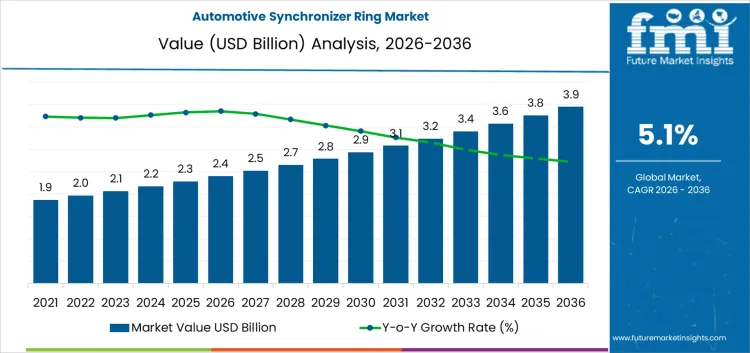
Automotive Synchronizer Ring Market Key Takeaways
| Metric | Value |
|---|---|
| Automotive Synchronizer Ring Market Value (2026) | USD 2.4 Billion |
| Automotive Synchronizer Ring Market Forecast Value (2036) | USD 3.9 Billion |
| Automotive Synchronizer Ring Market Forecast CAGR 2026 to 2036 | 5.10% |
Why Is the Automotive Synchronizer Ring Market Growing at a Steady Pace?
The automotive synchronizer ring market is experiencing steady growth due to the increasing demand for enhanced transmission systems in vehicles. Synchronizer rings are critical components in manual and automated transmissions, helping to synchronize gear engagement and ensure smooth shifting. The rising production of vehicles, especially those equipped with manual or semi-automatic transmissions, is fueling the demand for high-quality synchronizer rings.
Technological advancements in materials and manufacturing processes are supporting growth in the automotive synchronizer ring market. New materials that offer better wear resistance, durability, and thermal stability are improving the performance of synchronizer rings in modern transmissions. The shift toward more efficient and durable transmission systems is encouraging vehicle manufacturers to integrate advanced synchronizer ring technologies into their vehicles.
The growing trend of vehicle electrification and the rise in demand for automatic transmissions are further contributing to the market’s expansion. As electric and hybrid vehicles often require complex transmission systems, the demand for advanced synchronizer rings is expected to continue to rise. Along with increasing vehicle production and the ongoing evolution of transmission technologies, these factors are driving sustained growth in the automotive synchronizer ring market over the forecast period.
What Does The Segment Overview Indicate About The Automotive Synchronizer Ring Market?
The automotive synchronizer ring market is segmented by type and application, reflecting material suitability and usage in various vehicle segments. Copper base alloy rings lead the type segment with 35% share, offering high wear resistance and excellent thermal conductivity for smooth gear shifting. Steel and brass synchronizer rings serve specific needs in durability and cost-effectiveness. On the application side, passenger vehicles account for the largest share at 55%, driven by the mass adoption of manual and semi-automatic transmission systems. Commercial vehicles, including light and heavy-duty models, follow as secondary demand segments with specialized material requirements.
Why Do Copper Base Alloy Rings Hold The Leading Type Share In The Automotive Synchronizer Ring Market?
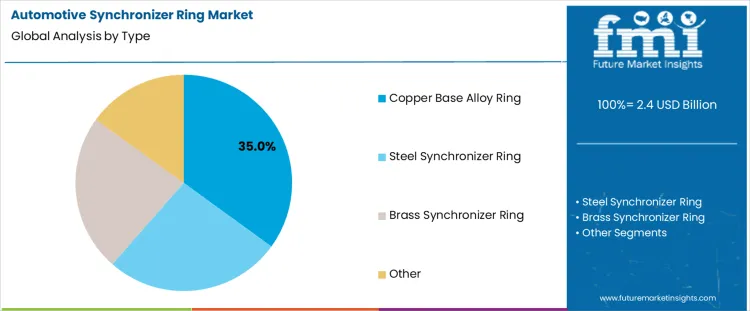
Copper base alloy rings hold the largest 35% share in the automotive synchronizer ring market due to their superior wear resistance, low friction, and high thermal conductivity, making them ideal for automotive gear systems. These alloys help in smoother shifting by reducing heat generation during gear engagement, which is crucial for both performance and longevity. They are widely used in passenger vehicles, where precision, durability, and reliability are required for frequent gear changes. Copper base alloys also support the long-term efficiency of transmission systems, which continues to position them as the preferred material choice in this market.
How Does Passenger Vehicles Drive Application Demand In The Automotive Synchronizer Ring Market?
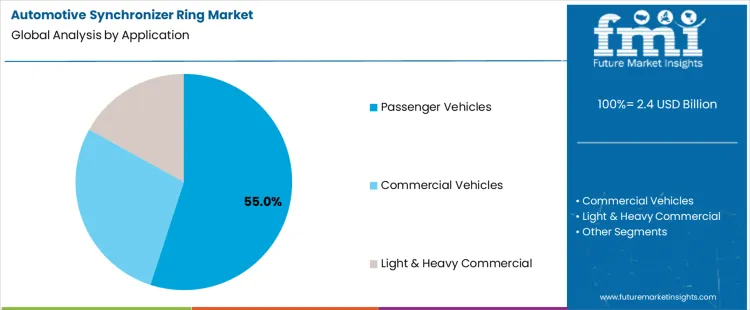
Passenger vehicles represent the largest application segment in the automotive synchronizer ring market, accounting for 55% share, as they are the primary user of manual and semi-automatic transmissions in both economy and luxury vehicles. Synchronizer rings in these vehicles play a critical role in ensuring smooth gear shifting and preventing wear during operation, especially in high-performance models. The ongoing shift towards more fuel-efficient and performance-oriented cars, coupled with the growth in manual transmission adoption in emerging markets, sustains demand for high-quality synchronizer rings. The continued production of hybrids and electric vehicles that integrate manual gear mechanisms further strengthens this segment’s growth.
What Are the Key Dynamics for the Automotive Synchronizer Ring Market?
The automotive synchronizer ring market is being shaped by increasing vehicle production, evolving transmission technologies, and growing demand for high-performance components. As vehicle manufacturers push for smoother gear transitions, better fuel efficiency, and improved driving experiences, the demand for advanced synchronizer rings is on the rise. While challenges such as high costs, material sourcing, and competition from alternative technologies exist, technological advancements in materials, design, and manufacturing processes are helping overcome these barriers. The rise in hybrid and electric vehicles, along with innovations in transmission systems, is also influencing the demand for automotive synchronizer rings, ensuring continued growth in the sector.
What Is Driving Growth in the Automotive Synchronizer Ring Market?
The automotive synchronizer ring market is expanding due to the increasing demand for efficient and durable transmission systems in both manual and automatic vehicles. Synchronizer rings play a crucial role in ensuring smooth gear shifts by enabling equal rotational speed between gears during engagement. As vehicle manufacturers focus on improving driving performance, fuel efficiency, and shift quality, the demand for high-performance synchronizer rings is growing. The shift towards electric vehicles (EVs) and hybrid vehicles is increasing the need for advanced transmission components, driving market growth. Moreover, the growing trend of vehicle electrification and the rise in global vehicle production are contributing to the market's expansion.
Why Are Automotive OEMs and Tier 1 Suppliers Leading the Demand for Synchronizer Rings?
Automotive OEMs and Tier 1 suppliers are leading the demand for synchronizer rings due to the critical role these components play in ensuring smooth transmission operations and superior driving experience. In manual transmission vehicles, synchronizer rings help in engaging gears without grinding, contributing to better performance and durability. As vehicles become more technologically advanced, the need for high-quality synchronizer rings that can handle higher torque and pressure in hybrid and electric powertrains is increasing. Stricter emission standards and performance expectations are prompting OEMs to invest in components that optimize vehicle efficiency and enhance transmission system longevity, driving the demand for advanced synchronizer ring technologies.
What Challenges Are Affecting Growth in the Automotive Synchronizer Ring Market?
The automotive synchronizer ring market faces several challenges, including high manufacturing costs, material sourcing, and competition from alternative technologies. The production of synchronizer rings requires precision engineering and high-quality materials such as brass, steel, and carbon composites, which increases production costs. With the rise of automated and continuously variable transmissions (CVTs) in passenger vehicles, the demand for traditional synchronizer rings in some segments may decrease. Moreover, the ongoing shift towards electric vehicles, which often use single-speed transmissions, presents a challenge for the market as traditional manual transmission components, including synchronizer rings, become less relevant in some vehicle models.
What Is the Country-Wise Growth Outlook for the Automotive Synchronizer Ring Market?
The automotive synchronizer ring market is witnessing moderate growth globally, driven by the increasing demand for vehicle transmission systems and the expanding automotive industry. China leads with a CAGR of 6.0%, supported by its strong automotive manufacturing sector and growing domestic vehicle production. India follows with a CAGR of 5.5%, driven by the rapid expansion of the automotive sector and the increasing demand for manual and automatic transmission systems.
Germany, with a CAGR of 4.8%, is supported by its well-established automotive industry, which demands high-quality transmission components for its premium and performance vehicles. The USA shows a CAGR of 4.3%, driven by the continued demand for transmission components in light vehicles, while Brazil grows at 4.1% CAGR, fueled by the rising automotive manufacturing base and demand for durable transmission systems.
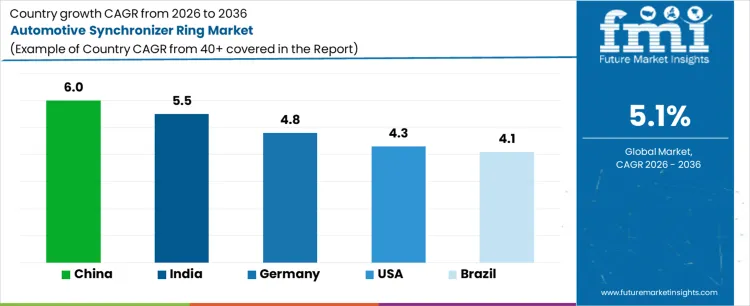
| Country | CAGR |
|---|---|
| China | 6.0% |
| India | 5.5% |
| Germany | 4.8% |
| USA | 4.3% |
| Brazil | 4.1% |
Why Is China Leading in the Automotive Synchronizer Ring Market?
Demand for automotive synchronizer rings in China is growing at a CAGR of 6.0%, driven by the country’s strong automotive manufacturing sector and increasing vehicle production. China remains the largest automotive market globally, with rising demand for both passenger vehicles and commercial trucks, which require high-performance transmission systems. The rapid development of electric vehicles (EVs) and hybrid models in China also requires advanced transmission components, further boosting the demand for synchronizer rings.
Local and international automotive OEMs are focusing on improving vehicle performance and fuel efficiency, which has led to a higher demand for synchronized gear systems. Moreover, China’s investment in research and development of lightweight, durable transmission components further supports the growth of this market. Domestic manufacturers of synchronizer rings in China are benefiting from cost-effective production capabilities, making the country a key global player in the automotive synchronizer ring market.
What Is Driving India’s Growth in the Automotive Synchronizer Ring Market?
Sales for automotive synchronizer rings in India are growing at a CAGR of 5.5%, supported by the rapid expansion of the country’s automotive sector and the increasing demand for manual and automatic transmission systems. India’s automotive industry is experiencing significant growth, with both local and global manufacturers increasing production capacity. As vehicle production rises, the need for high-quality transmission components, including synchronizer rings, is also increasing.
India is witnessing a shift in consumer preference toward performance vehicles, further driving demand for advanced transmission systems. India’s growing automotive export market, particularly for small and mid-sized cars, contributes to the increased demand for automotive synchronizer rings. Domestic manufacturers are focusing on improving production quality to meet international standards, making India an important player in the global automotive synchronizer ring market. Government initiatives to promote the automotive industry and infrastructure development further contribute to the market's expansion.
Why Is Germany a Strong Player in the Automotive Synchronizer Ring Market?
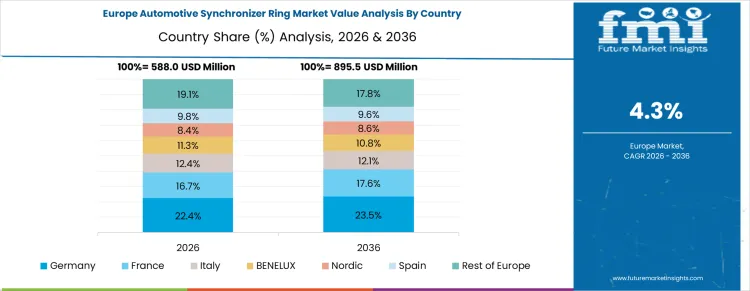
Demand for automotive synchronizer rings in Germany is growing at a CAGR of 4.8%, supported by the country’s well-established automotive industry and its emphasis on high-performance vehicles. Germany is home to some of the world’s largest and most renowned automotive manufacturers, such as Volkswagen, BMW, and Mercedes-Benz, which are known for their high-quality, precision-engineered vehicles.
The demand for synchronizer rings in Germany is driven by the need for advanced transmission systems in both luxury and performance vehicles. German automotive manufacturers place a high priority on producing vehicles with smooth gear shifting, improved fuel efficiency, and optimized driving experience, which has resulted in a higher demand for synchronizer rings. The country’s strong focus on innovation and research in automotive technology also drives the market for advanced transmission components. The presence of a well-developed automotive supply chain further supports the growth of the synchronizer ring market in Germany.
What Is Contributing to the Growth of the Automotive Synchronizer Ring Market in the USA?
Sales for automotive synchronizer rings in the USA are growing at a CAGR of 4.3%, driven by the continued demand for transmission components in light vehicles and the growth of the domestic automotive manufacturing industry. The U.S. automotive sector remains one of the largest in the world, with robust demand for vehicles equipped with advanced manual and automatic transmission systems. Synchronizer rings are integral to the performance and durability of these systems, making them essential components for the USA automotive market.
The growing trend toward vehicle performance upgrades and the increasing adoption of electric and hybrid vehicles have led to the need for more advanced transmission systems. Manufacturers are focusing on improving the quality, longevity, and cost-effectiveness of synchronizer rings to meet these evolving needs. As USA automakers continue to innovate and improve vehicle performance, the demand for high-performance transmission components, including synchronizer rings, is expected to remain strong.
Why Is Brazil Showing Growth in the Automotive Synchronizer Ring Market?
Demand for automotive synchronizer rings in Brazil is growing at a CAGR of 4.1%, supported by the country’s expanding automotive manufacturing base and increasing demand for durable transmission systems. Brazil’s automotive industry has been steadily growing, with a focus on both domestic production and exports, particularly in the small and mid-size vehicle segments. As vehicle production rises, so does the demand for reliable and high-performance components like synchronizer rings, which are essential for smooth gear shifting and overall transmission efficiency.
Brazil’s growing automotive sector is also influenced by the increase in consumer preference for automatic and semi-automatic transmissions, which require more advanced synchronization systems. The country’s automotive supply chain continues to develop, with both local and global manufacturers increasing their presence in Brazil. This expanding market, along with Brazil’s strategic location as a manufacturing hub for Latin America, supports the continued demand for automotive synchronizer rings.
How Are Leading Companies Competing And Differentiating In The Automotive Synchronizer Ring Market?
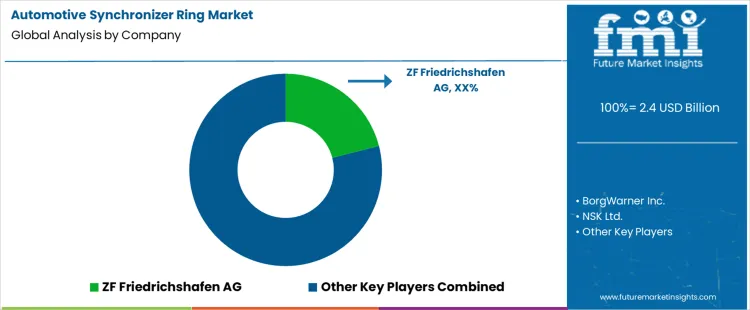
Competition in the automotive synchronizer ring market is shaped by performance, durability, and technological innovation. ZF Friedrichshafen AG is being positioned around high-precision synchronizer rings for both manual and automatic transmissions, with product brochures emphasizing optimized performance, high wear resistance, and low friction for smoother gear shifting. BorgWarner Inc. differentiates itself through advanced friction materials and coatings that enhance synchronizer ring lifespan, highlighting its ability to offer custom solutions for high-performance and electric vehicle (EV) applications. NSK Ltd. focuses on providing synchronizer rings with superior surface finishes, promoting reliability and reduced maintenance costs across a wide range of transmission types.
Technological advancements and system integration are being leveraged by Allison Transmission Holdings Inc. and Eaton Corporation. Allison Transmission offers synchronizer rings designed to meet the demands of commercial vehicle transmissions, emphasizing high torque handling and system integration for enhanced shifting precision. Eaton Corporation is differentiating through lightweight, high-strength synchronizer rings for both conventional and electric vehicles, promoting energy efficiency, durability, and ease of integration into advanced transmission systems. Both companies focus on offering innovative solutions to meet the evolving needs of the automotive and commercial vehicle markets.
Schaeffler Group (LuK) and Aisin Seiki Co., Ltd. take a slightly different approach by focusing on complete transmission systems. Schaeffler promotes its synchronizer rings as part of integrated, modular solutions that enhance shifting dynamics, reduce noise, and improve fuel efficiency. Aisin Seiki offers synchronizer rings for a wide range of passenger and commercial vehicle transmissions, emphasizing the use of advanced materials for increased performance and lifespan. Across the market, differentiation is driven by material innovation, friction reduction, and system compatibility, with companies focusing on delivering reliable, long-lasting solutions to meet the demands of the evolving automotive industry.
Key Players in Automotive Synchronizer Ring Market
- ZF Friedrichshafen AG
- BorgWarner Inc.
- NSK Ltd.
- Allison Transmission Holdings Inc.
- Eaton Corporation
- Schaeffler Group (LuK)
- Aisin Seiki Co., Ltd.
Scope of Report
| Attributes | Description |
|---|---|
| Quantitative Unit | USD Billion |
| Type | Copper Base Alloy Ring, Steel Synchronizer Ring, Brass Synchronizer Ring, Other |
| Application | Passenger Vehicles, Commercial Vehicles, Light & Heavy Commercial |
| Regions Covered | Asia Pacific, Europe, North America, Latin America, Middle East & Africa |
| Countries Covered | China, Japan, South Korea, India, Australia & New Zealand, ASEAN, Rest of Asia Pacific, Germany, United Kingdom, France, Italy, Spain, Nordic, BENELUX, Rest of Europe, United States, Canada, Mexico, Brazil, Chile, Rest of Latin America, Kingdom of Saudi Arabia, Other GCC Countries, Turkey, South Africa, Other African Union, Rest of Middle East & Africa |
| Key Companies Profiled | ZF Friedrichshafen AG, BorgWarner Inc., NSK Ltd., Allison Transmission Holdings Inc., Eaton Corporation, Schaeffler Group (LuK), Aisin Seiki Co., Ltd. |
| Additional Attributes | Market size and CAGR projections from 2026 to 2036 by type, application, and region; detailed analysis of demand by vehicle type, technological advancements in synchronizer ring materials, competitive landscape with company strategies and product offerings, key market drivers and challenges, adoption rates across regions and applications, emerging trends in lightweight materials and energy efficiency. |
Automotive Synchronizer Ring Market by Key Segments
Type:
- Copper Base Alloy Ring
- Steel Synchronizer Ring
- Brass Synchronizer Ring
- Other
Application:
- Passenger Vehicles
- Commercial Vehicles
- Light & Heavy Commercial
Region:
- Asia Pacific
- China
- Japan
- South Korea
- India
- Australia & New Zealand
- ASEAN
- Rest of Asia Pacific
- Europe
- Germany
- United Kingdom
- France
- Italy
- Spain
- Nordic
- BENELUX
- Rest of Europe
- North America
- United States
- Canada
- Mexico
- Latin America
- Brazil
- Chile
- Rest of Latin America
- Middle East & Africa
- Kingdom of Saudi Arabia
- Other GCC Countries
- Turkey
- South Africa
- Other African Union
- Rest of Middle East & Africa
Bibliography
- International Organization for Standardization. (2025). Lubricants—Determination of the coefficient of friction of synchronizer lubricated by manual transmission fluids (MTF)—High-frequency, linear-oscillation (SRV) test machine (ISO 20120:2025). ISO.
- SAE International. (2024). Development of an assessment methodology for synchronizer ring (CuZn alloy) wear durability (SAE Technical Paper 2024-28-0185). SAE International.
- U.S. Environmental Protection Agency. (2024). Final rule: Multi-pollutant emissions standards for model years 2027 and later light-duty and medium-duty vehicles. U.S. Environmental Protection Agency.
Frequently Asked Questions
How big is the automotive synchronizer ring market in 2026?
The global automotive synchronizer ring market is estimated to be valued at USD 2.4 billion in 2026.
What will be the size of automotive synchronizer ring market in 2036?
The market size for the automotive synchronizer ring market is projected to reach USD 3.9 billion by 2036.
How much will be the automotive synchronizer ring market growth between 2026 and 2036?
The automotive synchronizer ring market is expected to grow at a 5.1% CAGR between 2026 and 2036.
What are the key product types in the automotive synchronizer ring market?
The key product types in automotive synchronizer ring market are copper base alloy ring , steel synchronizer ring, brass synchronizer ring and other.
Which application segment to contribute significant share in the automotive synchronizer ring market in 2026?
In terms of application, passenger vehicles segment to command 55.0% share in the automotive synchronizer ring market in 2026.
Preview the report firsthand - request a free sample
Get SampleGet the brochure for pricing and purchase details.
Get PDFTable of Content
- Executive Summary
- Global Market Outlook
- Demand-side Trends
- Supply-side Trends
- Technology Roadmap Analysis
- Analysis and Recommendations
- Market Overview
- Market Coverage / Taxonomy
- Market Definition / Scope / Limitations
- Market Background
- Market Dynamics
- Drivers
- Restraints
- Opportunity
- Trends
- Scenario Forecast
- Demand in Optimistic Scenario
- Demand in Likely Scenario
- Demand in Conservative Scenario
- Opportunity Map Analysis
- Product Life Cycle Analysis
- Supply Chain Analysis
- Investment Feasibility Matrix
- Value Chain Analysis
- PESTLE and Porter’s Analysis
- Regulatory Landscape
- Regional Parent Market Outlook
- Production and Consumption Statistics
- Import and Export Statistics
- Market Dynamics
- Global Market Analysis 2021 to 2025 and Forecast, 2026 to 2036
- Historical Market Size Value (USD Million) Analysis, 2021 to 2025
- Current and Future Market Size Value (USD Million) Projections, 2026 to 2036
- Y-o-Y Growth Trend Analysis
- Absolute $ Opportunity Analysis
- Global Market Pricing Analysis 2021 to 2025 and Forecast 2026 to 2036
- Global Market Analysis 2021 to 2025 and Forecast 2026 to 2036, By Type
- Introduction / Key Findings
- Historical Market Size Value (USD Million) Analysis By Type, 2021 to 2025
- Current and Future Market Size Value (USD Million) Analysis and Forecast By Type, 2026 to 2036
- Copper Base Alloy Ring
- Steel Synchronizer Ring
- Brass Synchronizer Ring
- Other
- Copper Base Alloy Ring
- Y-o-Y Growth Trend Analysis By Type, 2021 to 2025
- Absolute $ Opportunity Analysis By Type, 2026 to 2036
- Global Market Analysis 2021 to 2025 and Forecast 2026 to 2036, By Application
- Introduction / Key Findings
- Historical Market Size Value (USD Million) Analysis By Application, 2021 to 2025
- Current and Future Market Size Value (USD Million) Analysis and Forecast By Application, 2026 to 2036
- Passenger Vehicles
- Commercial Vehicles
- Light & Heavy Commercial
- Passenger Vehicles
- Y-o-Y Growth Trend Analysis By Application, 2021 to 2025
- Absolute $ Opportunity Analysis By Application, 2026 to 2036
- Global Market Analysis 2021 to 2025 and Forecast 2026 to 2036, By Region
- Introduction
- Historical Market Size Value (USD Million) Analysis By Region, 2021 to 2025
- Current Market Size Value (USD Million) Analysis and Forecast By Region, 2026 to 2036
- North America
- Latin America
- Western Europe
- Eastern Europe
- East Asia
- South Asia and Pacific
- Middle East & Africa
- Market Attractiveness Analysis By Region
- North America Market Analysis 2021 to 2025 and Forecast 2026 to 2036, By Country
- Historical Market Size Value (USD Million) Trend Analysis By Market Taxonomy, 2021 to 2025
- Market Size Value (USD Million) Forecast By Market Taxonomy, 2026 to 2036
- By Country
- USA
- Canada
- Mexico
- By Type
- By Application
- By Country
- Market Attractiveness Analysis
- By Country
- By Type
- By Application
- Key Takeaways
- Latin America Market Analysis 2021 to 2025 and Forecast 2026 to 2036, By Country
- Historical Market Size Value (USD Million) Trend Analysis By Market Taxonomy, 2021 to 2025
- Market Size Value (USD Million) Forecast By Market Taxonomy, 2026 to 2036
- By Country
- Brazil
- Chile
- Rest of Latin America
- By Type
- By Application
- By Country
- Market Attractiveness Analysis
- By Country
- By Type
- By Application
- Key Takeaways
- Western Europe Market Analysis 2021 to 2025 and Forecast 2026 to 2036, By Country
- Historical Market Size Value (USD Million) Trend Analysis By Market Taxonomy, 2021 to 2025
- Market Size Value (USD Million) Forecast By Market Taxonomy, 2026 to 2036
- By Country
- Germany
- UK
- Italy
- Spain
- France
- Nordic
- BENELUX
- Rest of Western Europe
- By Type
- By Application
- By Country
- Market Attractiveness Analysis
- By Country
- By Type
- By Application
- Key Takeaways
- Eastern Europe Market Analysis 2021 to 2025 and Forecast 2026 to 2036, By Country
- Historical Market Size Value (USD Million) Trend Analysis By Market Taxonomy, 2021 to 2025
- Market Size Value (USD Million) Forecast By Market Taxonomy, 2026 to 2036
- By Country
- Russia
- Poland
- Hungary
- Balkan & Baltic
- Rest of Eastern Europe
- By Type
- By Application
- By Country
- Market Attractiveness Analysis
- By Country
- By Type
- By Application
- Key Takeaways
- East Asia Market Analysis 2021 to 2025 and Forecast 2026 to 2036, By Country
- Historical Market Size Value (USD Million) Trend Analysis By Market Taxonomy, 2021 to 2025
- Market Size Value (USD Million) Forecast By Market Taxonomy, 2026 to 2036
- By Country
- China
- Japan
- South Korea
- By Type
- By Application
- By Country
- Market Attractiveness Analysis
- By Country
- By Type
- By Application
- Key Takeaways
- South Asia and Pacific Market Analysis 2021 to 2025 and Forecast 2026 to 2036, By Country
- Historical Market Size Value (USD Million) Trend Analysis By Market Taxonomy, 2021 to 2025
- Market Size Value (USD Million) Forecast By Market Taxonomy, 2026 to 2036
- By Country
- India
- ASEAN
- Australia & New Zealand
- Rest of South Asia and Pacific
- By Type
- By Application
- By Country
- Market Attractiveness Analysis
- By Country
- By Type
- By Application
- Key Takeaways
- Middle East & Africa Market Analysis 2021 to 2025 and Forecast 2026 to 2036, By Country
- Historical Market Size Value (USD Million) Trend Analysis By Market Taxonomy, 2021 to 2025
- Market Size Value (USD Million) Forecast By Market Taxonomy, 2026 to 2036
- By Country
- Kingdom of Saudi Arabia
- Other GCC Countries
- Turkiye
- South Africa
- Other African Union
- Rest of Middle East & Africa
- By Type
- By Application
- By Country
- Market Attractiveness Analysis
- By Country
- By Type
- By Application
- Key Takeaways
- Key Countries Market Analysis
- USA
- Pricing Analysis
- Market Share Analysis, 2025
- By Type
- By Application
- Canada
- Pricing Analysis
- Market Share Analysis, 2025
- By Type
- By Application
- Mexico
- Pricing Analysis
- Market Share Analysis, 2025
- By Type
- By Application
- Brazil
- Pricing Analysis
- Market Share Analysis, 2025
- By Type
- By Application
- Chile
- Pricing Analysis
- Market Share Analysis, 2025
- By Type
- By Application
- Germany
- Pricing Analysis
- Market Share Analysis, 2025
- By Type
- By Application
- UK
- Pricing Analysis
- Market Share Analysis, 2025
- By Type
- By Application
- Italy
- Pricing Analysis
- Market Share Analysis, 2025
- By Type
- By Application
- Spain
- Pricing Analysis
- Market Share Analysis, 2025
- By Type
- By Application
- France
- Pricing Analysis
- Market Share Analysis, 2025
- By Type
- By Application
- India
- Pricing Analysis
- Market Share Analysis, 2025
- By Type
- By Application
- ASEAN
- Pricing Analysis
- Market Share Analysis, 2025
- By Type
- By Application
- Australia & New Zealand
- Pricing Analysis
- Market Share Analysis, 2025
- By Type
- By Application
- China
- Pricing Analysis
- Market Share Analysis, 2025
- By Type
- By Application
- Japan
- Pricing Analysis
- Market Share Analysis, 2025
- By Type
- By Application
- South Korea
- Pricing Analysis
- Market Share Analysis, 2025
- By Type
- By Application
- Russia
- Pricing Analysis
- Market Share Analysis, 2025
- By Type
- By Application
- Poland
- Pricing Analysis
- Market Share Analysis, 2025
- By Type
- By Application
- Hungary
- Pricing Analysis
- Market Share Analysis, 2025
- By Type
- By Application
- Kingdom of Saudi Arabia
- Pricing Analysis
- Market Share Analysis, 2025
- By Type
- By Application
- Turkiye
- Pricing Analysis
- Market Share Analysis, 2025
- By Type
- By Application
- South Africa
- Pricing Analysis
- Market Share Analysis, 2025
- By Type
- By Application
- USA
- Market Structure Analysis
- Competition Dashboard
- Competition Benchmarking
- Market Share Analysis of Top Players
- By Regional
- By Type
- By Application
- Competition Analysis
- Competition Deep Dive
- ZF Friedrichshafen AG
- Overview
- Product Portfolio
- Profitability by Market Segments (Product/Age /Sales Channel/Region)
- Sales Footprint
- Strategy Overview
- Marketing Strategy
- Product Strategy
- Channel Strategy
- BorgWarner Inc.
- NSK Ltd.
- Allison Transmission Holdings Inc.
- Eaton Corporation
- Schaeffler Group (LuK)
- Aisin Seiki Co., Ltd.
- ZF Friedrichshafen AG
- Competition Deep Dive
- Assumptions & Acronyms Used
- Research Methodology


