

- Market Size (2026)
- USD 460.0 Mn
- Forecast (2036)
- USD 1011.7 Mn
- CAGR (2026 to 2036)
- 8.2%
How big is the automotive weld seam vision inspection market in 2026?
USD 460.0 million in 2026 and USD 1,011.7 million by 2036 at an 8.2% CAGR.
The automotive weld seam vision inspection industry value is forecast to grow from USD 425.1 million in 2025 to USD 1,011.7 million by 2036 at 8.2% CAGR as body shops move weld checks from offline sampling into inline production control. Automotive OEMs are forecast to represent 68.0% share in 2026 because body-in-white welding drives the most inspection spending. Inline systems are expected to secure 52.0% share in 2026, led by faster defect capture before painted body and final assembly stages.
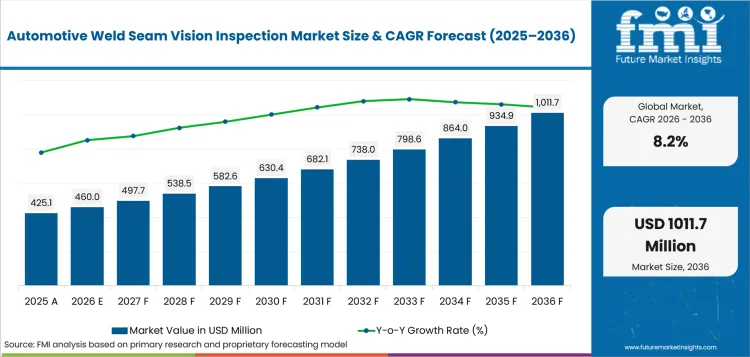
Automotive Weld Seam Vision Inspection Market Overview: Size and Forecast
- 2026 Market Size: USD 460.0 million
- 2036 Market Size: USD 1,011.7 million
- Forecast CAGR: 8.2% from 2026 to 2036
- Leading End-use Industry: Automotive OEMs
- Automotive OEMs Share in 2026: 68.0%
- Leading Deployment: Inline Systems
- Inline Systems Share in 2026: 52.0%
- Fastest-growing Country: China
- China CAGR: 9.4% by 2036
Summary of the Automotive Weld Seam Vision Inspection Market
- Demand and Growth Drivers
- Body shops are adding weld inspection closer to the welding sequence to reduce late-stage scrap and manual rechecks.
- Robot-cell integrators are supporting wider use of camera, lighting, and software packages that work inside production timing limits.
- EV structures are increasing demand for inspection recipes that handle aluminum, coated steel, and battery-adjacent assemblies.
- Product and Segment View
- Automotive OEMs are forecast to represent 68.0% share in 2026, led by body-in-white welding and plant-level quality accountability.
- Inline systems are projected to hold 52.0% share in 2026, influenced by the need to flag weld defects before downstream work begins.
- 3D laser profiling is expected to secure 44.0% share in 2026, supported by seam geometry measurement and bead-volume analysis.
- Geography and Competitive Outlook
- China is projected to record 9.4% CAGR by 2036, backed by vehicle scale and high robot installations.
- India is expected to expand at 9.2% CAGR by 2036 as passenger vehicle and EV programs add automated quality controls.
- Cognex, KEYENCE, OMRON, Basler, SICK, Balluff, Datalogic, Coherix, and SERVO-ROBOT shape global competition.
- Specialist suppliers compete through 3D weld profiling, defect libraries, edge AI controllers, and body shop service depth.
- Analyst Opinion
- Nikhil Kaitwade, Principal Consultant at Future Market Insights for the automotive domain, says, "This market is moving from simple camera placement decisions toward weld accountability decisions. Buyers need systems that prove weld quality at line speed and keep inspection records that plant teams trust. Body shops using steel and aluminum need tools that separate surface noise from real defects. Suppliers with 3D profiling, AI defect classification, robot-cell integration, and plant-floor support should win larger programs."
Production automation and electrification are setting a stronger outlook for weld seam inspection. IFR reported 542,000 industrial robot installations in 2024 and an operational stock of 4,664,000 robots, creating a wider factory base for automated weld quality checks. IEA projected global electric car sales at 23 million units in 2026, representing 28% of total car sales. Coherix stated in June 2025 that it serves 51 carmakers and 75 Tier 1 auto suppliers with more than 5,000 3D laser-based inspection systems, showing that weld-adjacent quality control is becoming a measurable supplier capability.
The automotive weld seam vision inspection market is expected to witness steady expansion through 2036, driven by robotic welding cells, EV body programs, and stronger quality traceability needs in high-volume vehicle production. Factory automation and industrial controls demand also frames the buying context for connected weld cells.
Which factors support expansion in the automotive weld seam vision inspection market?
Finished weld inspection system revenue and service support are rising as automated body shops need traceable inline quality control.
- Market value is supported by installed vision hardware, software licenses, integration work, and calibration services used around welding cells.
- Supplier pricing reflects camera count, 3D profiling depth, lighting design, software complexity, and line-speed integration requirements.
- Revenue improves when OEMs convert manual weld sampling into inline inspection programs across multiple vehicle platforms.
- Buyer trust rises when inspection records connect with MES, PLC, and supplier quality systems without manual data handling.
Why is the automotive weld seam vision inspection market growing?
Automotive plants need faster weld defect capture as robotic joining increases the number of seams checked per shift. IFR reported that automotive robot installations reached 126,088 units in 2024, giving inspection vendors a larger automation layer into which cameras, 3D profilers, and industrial vision gateways can be connected. This supports a shift from quality-lab sampling into live production-control functions. Buyers also value software ownership, data export, and service response before plant rollout because weld inspection now affects rework routing and supplier quality records.
How is the automotive weld seam vision inspection market segmented?
The automotive weld seam vision inspection industry is segmented by component, inspection type, deployment, sensing technology, and end-use industry.
- Vision Software is projected to secure 31.5% share in 2026, led by buyers needing defect classification rules, alarm routing, and traceable pass or fail records across welding cells.
- Defect Detection is anticipated to hold 41.0% share in 2026 since cracks, pores, undercut, and incomplete fusion create the highest rejection risk for body-in-white production.
- Inline systems are expected to capture 52.0% share in 2026 due to body shops placing checks directly inside the welding sequence before downstream rework costs rise.
- 3D Laser Profiling is forecast to represent 44.0% share in 2026, guided by stronger demand for bead height, gap, underfill, and offset measurement across complex seams.
- Automotive OEMs are projected to account for 68.0% share in 2026, reflected by body-in-white programs forming the largest revenue pool for weld seam inspection systems.
Which component leads the automotive weld seam vision inspection market?
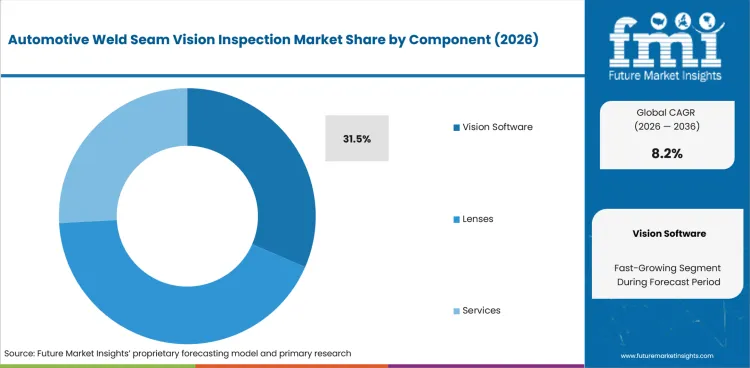
- Vision Software is projected to account for 31.5% share in 2026, influenced by weld judgment shifting from image capture toward defect classes and audit-ready production records.
- Cameras, lighting, frame grabbers, and services gain value when software reduces false rejects while connecting inspection results to plant quality systems.
Which inspection type leads the automotive weld seam vision inspection market?
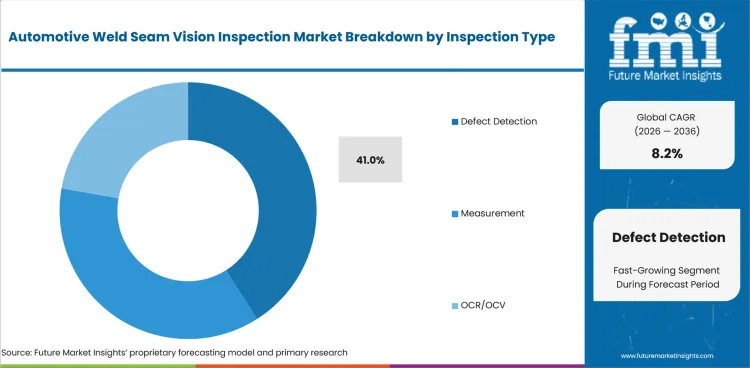
- Defect Detection is expected to account for 41.0% share in 2026, shaped by crack, porosity, undercut, and incomplete-fusion risks that create scrap and warranty exposure.
- Measurement inspection gains importance where bead geometry and seam width need repeatable checks before welded assemblies move to downstream stations.
Which deployment leads the automotive weld seam vision inspection market?
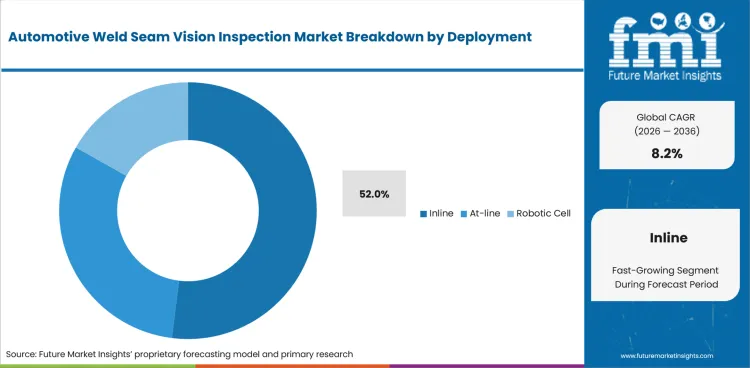
- Inline systems are anticipated to account for 52.0% share in 2026, supported by the need to flag weld failures before painted body and final assembly work begins.
- At-line and portable systems remain useful for audits and troubleshooting, although high-volume plants prefer inspection inside the welding sequence.
Which sensing technology leads the automotive weld seam vision inspection market?
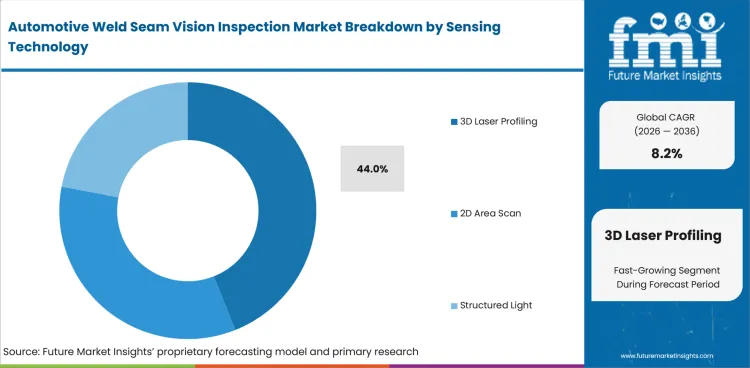
- 3D Laser Profiling is forecast to account for 44.0% share in 2026, reflected by stronger demand for bead height, gap, volume, and surface offset measurement.
- AI-enabled imaging gains use as plants train models on weld glare, spatter, and surface texture variation across different material sets.
Which end-use industry leads the automotive weld seam vision inspection market?
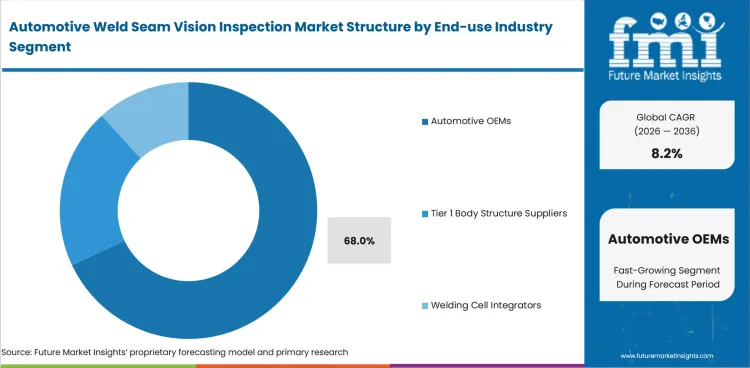
- Automotive OEMs are estimated to account for 68.0% share in 2026, led by body-in-white lines where weld quality directly affects throughput and vehicle integrity.
- Tier 1 body structure suppliers create added demand when OEM programs require documented weld evidence before parts reach final assembly.
What are the driver, restraints, and opportunities in the automotive weld seam vision inspection market?
Robot-cell weld density and EV body programs support adoption while false rejects and integration complexity restrain wider rollout.
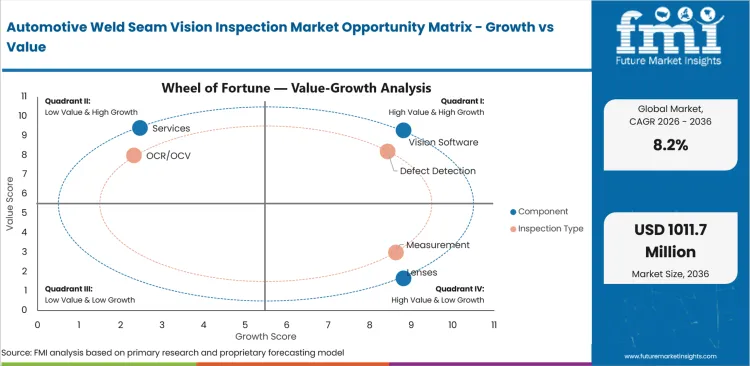
- Driver: Automated welding lines create more inspection points that must be checked without slowing production.
- Restraint: Poorly tuned lighting or algorithms can send acceptable assemblies into avoidable rework.
- Opportunity: Mixed-material EV structures create stronger demand for 3D profiling and AI-assisted seam analysis.
Robot-Cell Weld Density Demand Outlook
Weld inspection spending follows the number of robotic weld points that must be verified at production speed. IEA projected global electric car sales at 23 million units in 2026, representing 28% of total car sales. More EV programs create new body structures and battery-adjacent assemblies that require documented weld quality. This makes inline weld inspection more relevant to inspection vendors because higher joining complexity raises the value of production proof.
False-Reject Exposure and Integration Restraint
False rejects remain a major restraint because every rejected body component needs handling, review, and possible rework. NHTSA reported 997 recalls and more than 29 million recalled vehicles in the United States during 2025, showing how quality evidence can affect downstream risk. Buyers therefore test whether inspection tools detect real defects without creating avoidable line stops. Systems that fail under glare, spatter, or mixed surface finishes will face slower approval.
Mixed-Material EV Body Opportunity
Mixed-material bodies create an opportunity for 3D laser profiling and AI-based inspection models that can read weld shape and surface signals together. IEA reported nearly 22 million electric cars produced globally in 2025, up more than 25% from the previous year. This increases demand for inspection recipes that can evaluate aluminum joints, coated steel seams, and battery enclosure welds. Suppliers with reusable weld libraries can reduce launch risk across vehicle programs
Which countries are growing fastest in the automotive weld seam vision inspection market?
China 9.4% CAGR, India 9.2% CAGR, South Korea 8.5% CAGR, United States 8.1% CAGR, Germany 7.9% CAGR, Japan 7.4% CAGR, France 7.2% CAGR, and United Kingdom 6.9% CAGR through 2036.
.webp "Top Country Growth Comparison Automotive Weld Seam Vision Inspection Market Cagr (2026 2036)")
| Country | CAGR |
|---|---|
| China | 9.4% |
| India | 9.2% |
| South Korea | 8.5% |
| United States | 8.1% |
| Germany | 7.9% |
| Japan | 7.4% |
| France | 7.2% |
| United Kingdom | 6.9% |
| Source | Future Market Insights, 2026. |
How do country-level CAGRs compare in the automotive weld seam vision inspection market?
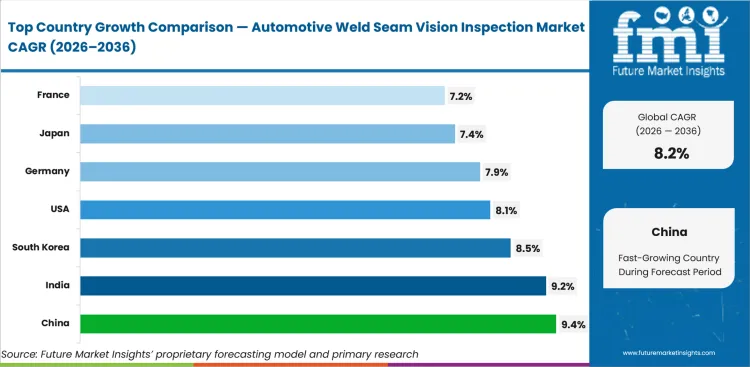
China leads country expansion while the United Kingdom records the most cautious outlook among profiled markets.
- China is forecast to record 9.4% CAGR by 2036 as vehicle scale and automation depth support faster inline inspection adoption.
- India is expected to expand at 9.2% CAGR from 2026 to 2036 due to passenger vehicle growth and EV-linked automation programs.
- South Korea is projected to grow at 8.5% CAGR through 2036 as dense automation supports inspection upgrades in export-focused plants.
- The United States is estimated to rise at 8.1% CAGR by 2036 with pickup, SUV, and EV programs requiring better weld traceability.
- Germany is expected to advance at 7.9% CAGR over the forecast period as premium OEM validation standards support advanced inspection systems.
- Japan is forecast to grow at 7.4% CAGR through 2036 as mature automation and export quality needs support replacement demand.
- France is projected to post 7.2% CAGR by 2036 as selective plant modernization supports weld quality upgrades.
- The United Kingdom is projected to post 6.9% CAGR by 2036 as compact production networks create selective retrofit opportunities.
How fast is the automotive weld seam vision inspection market growing in China?
A 9.4% CAGR through 2036 reflects large vehicle output, EV body programs, and high robot installations across automated welding lines.
Country Market Snapshot Table
| Parameter | Value |
|---|---|
| Market Size in 2025 (Value) | USD 75.0 million |
| Market Size in 2026 (Value) | USD 82.0 million |
| Market Forecast in 2036 (Value) | USD 201.4 million |
| CAGR (2026 to 2036) | 9.4% |
| Years Considered | 2021 to 2036 |
| Base Year | 2025 |
| Forecast Period | 2026 to 2036 |
| Units Considered | Value (USD million) |
| Leading Sub-Region | Yangtze River Delta and Pearl River Delta body shop corridors |
China Automotive Weld Seam Vision Inspection Market Outlook
- China demand is shaped by high-volume body shops and fast model turnover in electric vehicle platforms. Inspection suppliers must handle mixed body materials, short launch windows, and frequent weld recipe updates across large plants.
- Local integration support is expected to influence purchase decisions as OEMs seek inline proof without delaying production. Suppliers with 3D profiling, Chinese-language service teams, and fast algorithm tuning should gain better access to new welding cells.
Key Growth Drivers
- Vehicle production scale gives weld inspection vendors a large installation base. The State Council reported China auto output of 31.282 million units in 2024.
- Robot-cell expansion increases the number of seams requiring automated checks. IFR recorded 295,045 industrial robot installations in China during 2024.
- EV body structures create more inspection recipes as aluminum, coated steel, and battery-adjacent assemblies move through welding cells.
- Local integrator networks help global camera and 3D suppliers adapt systems to plant-specific welding standards.
Key Restraints
- Export variant complexity can raise validation work for inspection programs. China SCIO reported new energy vehicle exports doubled to 2.615 million units in 2025.
- Price competition limits premium system adoption when mid-tier plants compare vision tools mainly on installed cost.
- Rapid platform changeovers can compress testing time before inspection models are fully trained on new weld appearances.
What makes China unique
China is unique due to unmatched vehicle scale and fast EV launch cycles across automated body shops.
Key Companies
- Hikrobot
- OPT Machine Vision
- Cognex China
- KEYENCE China
- SICK China
- Basler China
- Datalogic China
Sales & Marketing Channels
- Direct OEM automation teams
- Local robot-cell integrators
- EV body shop pilot projects
- Tier 1 structure suppliers
- Distributor-led camera sales
- After-sales calibration support
Country Segment Breakdown Table
| Segment | Sub-Segments |
|---|---|
| By Component | Cameras · Lenses · Lighting · Frame Grabbers · Vision Software · Services |
| By Inspection Type | Defect Detection · Measurement · OCR/OCV · Presence/Absence · Guidance |
| By Deployment | Inline · At-line · Robotic Cell · Portable |
| By Sensing Technology | 2D Area Scan · 3D Laser Profiling · Structured Light · AI-enabled Imaging · Multispectral Imaging |
| By End-use Industry | Automotive OEMs · Tier 1 Body Structure Suppliers · EV Battery Pack Assemblers · Welding Cell Integrators · Aftermarket Audit Service |
| Key Sub-Regions Covered, Automotive Manufacturing Clusters | Shanghai · Guangzhou · Shenzhen · Chongqing · Wuhan · Changchun |
Frequently Asked Questions
How fast is China automotive weld seam vision inspection market growing?
Demand in China is projected to rise at 9.4% CAGR from 2026 to 2036 as weld automation and quality traceability improve.
Who leads China automotive weld seam vision inspection market?
Hikrobot, OPT Machine Vision, Cognex China, and KEYENCE China compete through machine vision products and integration support.
What is driving adoption in China automotive weld seam vision inspection market?
Automated welding, EV body changes, and stronger quality documentation are moving plants in China toward inline seam inspection.
What is driving automotive weld seam vision inspection growth in India?
A 9.2% CAGR through 2036 is supported by expanding vehicle output, EV policy support, and rising automation across body shops.
Country Market Snapshot Table
| Parameter | Value |
|---|---|
| Market Size in 2025 (Value) | USD 44.0 million |
| Market Size in 2026 (Value) | USD 48.0 million |
| Market Forecast in 2036 (Value) | USD 115.7 million |
| CAGR (2026 to 2036) | 9.2% |
| Years Considered | 2021 to 2036 |
| Base Year | 2025 |
| Forecast Period | 2026 to 2036 |
| Units Considered | Value (USD million) |
| Leading Sub-Region | Pune, Chennai, Sanand, and Gurugram-Manesar automotive corridors |
India Automotive Weld Seam Vision Inspection Market Outlook
- India demand is influenced by expanding passenger vehicle output and the gradual modernization of welding cells. Inspection systems are gaining relevance as OEMs and Tier 1 suppliers seek repeatable quality across larger production programs.
- Plant-level adoption is expected to rise when inspection packages are cost-effective and easy to maintain. Suppliers with local service, training support, and retrofit capability should gain stronger access to Indian body shops.
Key Growth Drivers
- Passenger vehicle output supports wider weld inspection needs. SIAM reported passenger vehicle sales of 4.3 million units in FY 2024-25.
- EV policy support encourages automation upgrades. India’s PM E-DRIVE scheme has an outlay of INR 10,900 crore for electric mobility support.
- Tier 1 body structure suppliers are investing in better defect records as OEM customers raise documentation expectations.
- Local retrofit projects help plants add camera and lighting packages without waiting for full greenfield body shop programs.
Key Restraints
- Supplier investment capacity can limit rapid adoption. India’s capital goods sector reported machinery and equipment production at INR 4,75,000 crore in FY 2024-25, showing a large but cost-sensitive industrial base.
- Price-sensitive procurement can reduce adoption of advanced 3D systems when 2D checks appear cheaper at the purchase stage.
- Skills gaps can slow system tuning when plant teams need frequent recipe updates across multiple vehicle programs.
What makes India unique
India is unique due to rising vehicle scale, cost-sensitive automation, and growing EV-linked manufacturing corridors.
Key Companies
- Cognex India
- KEYENCE India
- OMRON Automation India
- SICK India
- Basler India
- Datalogic India
- Local automation integrators
Sales & Marketing Channels
- OEM plant engineering teams
- Tier 1 body supplier programs
- Automation integrator networks
- Distributor demonstrations
- Retrofit service providers
- Training-led sales support
Country Segment Breakdown Table
| Segment | Sub-Segments |
|---|---|
| By Component | Cameras · Lenses · Lighting · Frame Grabbers · Vision Software · Services |
| By Inspection Type | Defect Detection · Measurement · OCR/OCV · Presence/Absence · Guidance |
| By Deployment | Inline · At-line · Robotic Cell · Portable |
| By Sensing Technology | 2D Area Scan · 3D Laser Profiling · Structured Light · AI-enabled Imaging · Multispectral Imaging |
| By End-use Industry | Automotive OEMs · Tier 1 Body Structure Suppliers · EV Battery Pack Assemblers · Welding Cell Integrators · Aftermarket Audit Services |
| Key Sub-Regions Covered, Automotive Manufacturing Clusters | Pune · Chennai · Sanand · Gurugram-Manesar · Bengaluru · Hosur |
Frequently Asked Questions
How fast is India automotive weld seam vision inspection market growing?
Demand in India is projected to rise at 9.2% CAGR from 2026 to 2036 as weld automation and quality traceability improve.
Who leads India automotive weld seam vision inspection market?
Cognex India, KEYENCE India, OMRON Automation India, and SICK India compete through machine vision products and plant support.
What is driving adoption in India automotive weld seam vision inspection market?
Passenger vehicle scale, EV policy support, and Tier 1 quality requirements are moving Indian plants toward weld inspection upgrades.
How is the automotive weld seam vision inspection market developing in South Korea?
An 8.5% CAGR through 2036 reflects dense automation, export-focused production, and strong local vehicle manufacturing discipline.
Country Market Snapshot Table
| Parameter | Value |
|---|---|
| Market Size in 2025 (Value) | USD 31.3 million |
| Market Size in 2026 (Value) | USD 34.0 million |
| Market Forecast in 2036 (Value) | USD 76.9 million |
| CAGR (2026 to 2036) | 8.5% |
| Years Considered | 2021 to 2036 |
| Base Year | 2025 |
| Forecast Period | 2026 to 2036 |
| Units Considered | Value (USD million) |
| Leading Sub-Region | Ulsan, Gyeonggi, and Gwangju automotive manufacturing clusters |
South Korea Automotive Weld Seam Vision Inspection Market Outlook
South Korea demand is shaped by advanced OEM body shops and supplier plants that already use automated welding. Inspection upgrades are expected where EV platforms and export programs require stronger seam traceability.
Suppliers must prove speed, repeatability, and integration with existing robot systems. Local service and fast response are likely to decide adoption in plants with tight production schedules.
Key Growth Drivers
- Automotive scale sustains demand for production inspection. OICA data showed South Korea produced 4.127 million vehicles in 2024.
- High robot density supports advanced inline inspection. IFR reported South Korea had 1,220 robots per 10,000 employees in manufacturing during 2024.
- EV and battery-adjacent body programs increase need for seam geometry checks across structural assemblies.
- Export quality expectations support inspection records that can be shared with global OEM and supplier teams.
Key Restraints
- Export concentration can tighten project validation and commercial risk. AMRO reported automobiles and automotive parts accounted for approximately 15% of South Korea's total exports as of August 2024.
- Concentrated OEM purchasing can make supplier entry difficult when approved-vendor lists are already established.
- High expectations for cycle-time stability can lengthen testing for new AI inspection models.
What makes South Korea unique
South Korea is unique due to very high robot density and quality-driven export manufacturing in compact industrial clusters.
Key Companies
- Cognex Korea
- KEYENCE Korea
- OMRON Korea
- SICK Korea
- Basler Korea
- Hyundai Robotics
- Datalogic Korea
Sales & Marketing Channels
- OEM manufacturing engineering
- Approved robot integrators
- Tier 1 module suppliers
- EV body program trials
- Local distributor support
- Predictive maintenance service teams
Country Segment Breakdown Table
| Segment | Sub-Segments |
|---|---|
| By Component | Cameras · Lenses · Lighting · Frame Grabbers · Vision Software · Services |
| By Inspection Type | Defect Detection · Measurement · OCR/OCV · Presence/Absence · Guidance |
| By Deployment | Inline · At-line · Robotic Cell · Portable |
| By Sensing Technology | 2D Area Scan · 3D Laser Profiling · Structured Light · AI-enabled Imaging · Multispectral Imaging |
| By End-use Industry | Automotive OEMs · Tier 1 Body Structure Suppliers · EV Battery Pack Assemblers · Welding Cell Integrators · Aftermarket Audit Services |
| Key Sub-Regions Covered, Automotive Manufacturing Clusters | Ulsan · Hwaseong · Gwangju · Asan · Incheon · Changwon |
Frequently Asked Questions
How fast is South Korea automotive weld seam vision inspection market growing?
Demand in South Korea is projected to rise at 8.5% CAGR from 2026 to 2036 as weld automation and quality traceability improve.
Who leads South Korea automotive weld seam vision inspection market?
Cognex Korea, KEYENCE Korea, OMRON Korea, and SICK Korea compete through machine vision products and integration support.
What is driving adoption in South Korea automotive weld seam vision inspection market?
Dense automation, EV body changes, and stronger export quality documentation are moving South Korea toward inline seam inspection.
What is the automotive weld seam vision inspection market outlook in the United States?
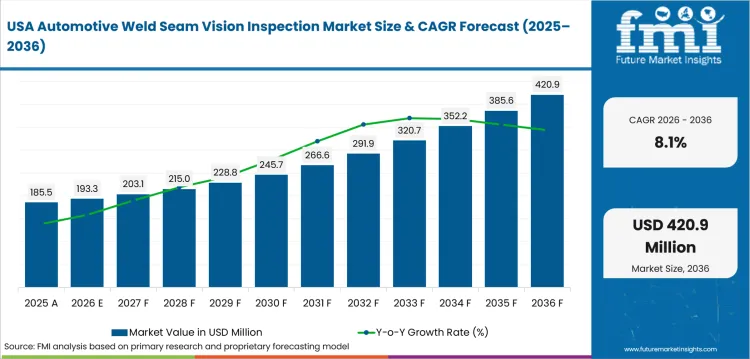
An 8.1% CAGR through 2036 is supported by pickup, SUV, and EV body programs that need documented weld quality at line speed.
Country Market Snapshot Table
| Parameter | Value |
|---|---|
| Market Size in 2025 (Value) | USD 94.4 million |
| Market Size in 2026 (Value) | USD 102.0 million |
| Market Forecast in 2036 (Value) | USD 222.3 million |
| CAGR (2026 to 2036) | 8.1% |
| Years Considered | 2021 to 2036 |
| Base Year | 2025 |
| Forecast Period | 2026 to 2036 |
| Units Considered | Value (USD million) |
| Leading Sub-Region | Midwest and South Atlantic automotive body shop networks |
United States Automotive Weld Seam Vision Inspection Market Outlook
- United States demand is tied to launch programs and body shop retooling rather than broad factory replacement. Suppliers must win early with OEM automation teams, plant quality leaders, and approved integrators.
- The strongest purchase case is built around missed-defect cost and audit readiness. Systems that export clean quality records while fitting existing PLC standards should gain wider rollout opportunities.
Key Growth Drivers
- Vehicle production gives vendors a broad addressable base. OICA data placed United States motor vehicle production at 10.562 million units in 2024.
- Automation investment creates more inspection endpoints. IFR reported 34,164 industrial robot installations in the United States during 2024.
- High-value truck and SUV programs support spending on inspection tools that protect throughput and warranty evidence.
- Domestic vision suppliers improve access to demonstrations, pilot validation, and service support near major plants.
Key Restraints
- Recall exposure keeps quality scrutiny high. NHTSA reported 997 recalls and more than 29 million vehicles recalled in the United States during 2025.
- Capital approvals can shift when OEMs delay plant retooling or adjust launch timing for EV programs.
- Integration risk remains high where plants use different robot brands, PLC standards, and legacy quality systems.
What makes United States unique
The United States is a validation-driven market where plant pilots and quality records often decide supplier selection.
Key Companies
- Cognex Corporation
- Coherix
- Teledyne DALSA
- KEYENCE America
- SICK Inc.
- Balluff Inc.
- Datalogic USA
- SERVO-ROBOT Inc.
Sales & Marketing Channels
- Direct OEM account sales
- Robot integrator partnerships
- Tier 1 supplier quality programs
- Plant pilot projects
- Retrofit service providers
- Software and data-export support
Country Segment Breakdown Table
| Segment | Sub-Segments |
|---|---|
| By Component | Cameras · Lenses · Lighting · Frame Grabbers · Vision Software · Services |
| By Inspection Type | Defect Detection · Measurement · OCR/OCV · Presence/Absence · Guidance |
| By Deployment | Inline · At-line · Robotic Cell · Portable |
| By Sensing Technology | 2D Area Scan · 3D Laser Profiling · Structured Light · AI-enabled Imaging · Multispectral Imaging |
| By End-use Industry | Automotive OEMs · Tier 1 Body Structure Suppliers · EV Battery Pack Assemblers · Welding Cell Integrators · Aftermarket Audit Services |
| Key Sub-Regions Covered, Automotive Manufacturing Clusters | Michigan · Ohio · Kentucky · Tennessee · Texas · South Carolina |
Frequently Asked Questions
How fast is United States automotive weld seam vision inspection market growing?
Demand in the United States is projected to rise at 8.1% CAGR from 2026 to 2036 as weld automation and quality traceability improve.
Who leads United States automotive weld seam vision inspection market?
Cognex Corporation, Coherix, Teledyne DALSA, and KEYENCE America compete through machine vision products and weld quality workflows.
What is driving adoption in United States automotive weld seam vision inspection market?
Automated welding, EV body changes, and stronger quality documentation are moving plants in the United States toward inline seam inspection.
How fast is Germany automotive weld seam vision inspection demand rising?
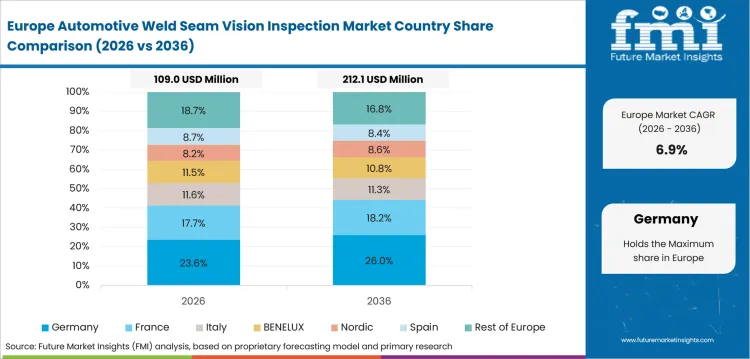
A 7.9% CAGR through 2036 reflects premium vehicle body programs and demanding validation standards for weld inspection systems.
Country Market Snapshot Table
| Parameter | Value |
|---|---|
| Market Size in 2025 (Value) | USD 50.0 million |
| Market Size in 2026 (Value) | USD 54.0 million |
| Market Forecast in 2036 (Value) | USD 115.5 million |
| CAGR (2026 to 2036) | 7.9% |
| Years Considered | 2021 to 2036 |
| Base Year | 2025 |
| Forecast Period | 2026 to 2036 |
| Units Considered | Value (USD million) |
| Leading Sub-Region | Bavaria, Baden-Wurttemberg, and Lower Saxony OEM corridors |
Germany Automotive Weld Seam Vision Inspection Market Outlook
- Germany is a demanding market for weld seam inspection because buyers test precision, repeatability, and service depth before approving plant standards. Premium vehicle bodies create strong demand for seam geometry control and surface defect measurement.
- The local supplier ecosystem gives buyers access to optics, sensors, and automation engineering support. This raises the competitive bar for smaller entrants seeking approval in OEM body shop standards.
Key Growth Drivers
- Germany has a large automotive base for weld inspection. Germany Trade & Invest reported 51 automotive assembly and production sites at the end of 2024.
- Automation maturity supports premium inspection use. IFR reported Germany had 449 robots per 10,000 manufacturing employees in 2024.
- Premium body programs support investment in 3D seam geometry and surface defect measurement.
- Strong local sensor suppliers improve access to engineering support and fast troubleshooting.
Key Restraints
- EV cost pressure can slow discretionary upgrades. ACEA reported EU battery electric car registrations reached 15.7% market share in 2025.
- OEM approval cycles can slow new supplier entry into body shop standards.
- High expectations for uptime and calibration raise service costs for smaller suppliers.
What makes Germany unique
Germany combines demanding OEM validation with a deep local supplier base for optics, sensors, and automation engineering.
Key Companies
- Basler AG
- SICK AG
- Balluff GmbH
- Siemens AG
- Cognex Germany
- KEYENCE Germany
- VITRONIC Machine Vision
Sales & Marketing Channels
- OEM engineering approvals
- German automation integrators
- Tier 1 body structure suppliers
- Factory acceptance testing routes
- Long-term service contracts
- Distributor-led sensor demonstrations
Country Segment Breakdown Table
| Segment | Sub-Segments |
|---|---|
| By Component | Cameras · Lenses · Lighting · Frame Grabbers · Vision Software · Services |
| By Inspection Type | Defect Detection · Measurement · OCR/OCV · Presence/Absence · Guidance |
| By Deployment | Inline · At-line · Robotic Cell · Portable |
| By Sensing Technology | 2D Area Scan · 3D Laser Profiling · Structured Light · AI-enabled Imaging · Multispectral Imaging |
| By End-use Industry | Automotive OEMs · Tier 1 Body Structure Suppliers · EV Battery Pack Assemblers · Welding Cell Integrators · Aftermarket Audit Services |
| Key Sub-Regions Covered, Automotive Manufacturing Clusters | Bavaria · Baden-Wurttemberg · Lower Saxony · Saxony · North Rhine-Westphalia · Hesse |
Frequently Asked Questions
How fast is Germany automotive weld seam vision inspection market growing?
Demand in Germany is projected to rise at 7.9% CAGR from 2026 to 2036 as weld automation and quality traceability improve.
Who leads Germany automotive weld seam vision inspection market?
Basler, SICK, Balluff, Siemens, Cognex Germany, and VITRONIC support machine vision and automation-led inspection workflows.
What is driving adoption in Germany automotive weld seam vision inspection market?
Premium vehicle quality rules, local sensor depth, and advanced body shop standards are supporting weld inspection adoption in Germany.
What is the automotive weld seam vision inspection market forecast for Japan?
A 7.4% CAGR through 2036 reflects mature automation, local vision suppliers, and export-quality manufacturing needs.
Country Market Snapshot Table
| Parameter | Value |
|---|---|
| Market Size in 2025 (Value) | USD 37.2 million |
| Market Size in 2026 (Value) | USD 40.0 million |
| Market Forecast in 2036 (Value) | USD 81.7 million |
| CAGR (2026 to 2036) | 7.4% |
| Years Considered | 2021 to 2036 |
| Base Year | 2025 |
| Forecast Period | 2026 to 2036 |
| Units Considered | Value (USD million) |
| Leading Sub-Region | Aichi, Shizuoka, and Kyushu automotive manufacturing corridors |
Japan Automotive Weld Seam Vision Inspection Market Outlook
- Japan is a mature but technically demanding market for weld seam vision inspection. Buyers often prioritize stability, compact hardware, and supplier engineering depth over the lowest installed price.
- Local suppliers have an advantage because plant teams expect fast technical support and proven factory reliability. Replacement cycles and EV body programs should refresh inspection demand through high-value plant projects.
Key Growth Drivers
- Vehicle output supports a sizable inspection base. OICA reported Japan vehicle production of 8.235 million units in 2024.
- Automation strength supports inspection upgrades. IFR reported 44,487 industrial robot installations in Japan during 2024.
- Local vision suppliers reduce technical risk for body shop engineering teams.
- EV and hybrid body changes create new weld inspection recipes and measurement needs.
Key Restraints
- Export exposure raises inspection proof requirements. JAMA reported Japanese motor vehicle exports of 4.22 million units in 2024.
- Mature automation slows greenfield demand compared with China and India.
- Conservative supplier qualification can lengthen approval for new inspection vendors.
What makes Japan unique
Japan is a supplier-depth market where local engineering confidence can decide adoption as much as system specification.
Key Companies
- KEYENCE Corporation
- OMRON Corporation
- Cognex Japan
- SICK Japan
- Basler Japan
- Datalogic Japan
- Panasonic Industry
Sales & Marketing Channels
- Direct supplier engineering visits
- OEM approved-vendor processes
- Robot-cell integrator routes
- Tier 1 supplier trials
- Factory reliability demonstrations
- Distributor-led training sessions
Country Segment Breakdown Table
| Segment | Sub-Segments |
|---|---|
| By Component | Cameras · Lenses · Lighting · Frame Grabbers · Vision Software · Services |
| By Inspection Type | Defect Detection · Measurement · OCR/OCV · Presence/Absence · Guidance |
| By Deployment | Inline · At-line · Robotic Cell · Portable |
| By Sensing Technology | 2D Area Scan · 3D Laser Profiling · Structured Light · AI-enabled Imaging · Multispectral Imaging |
| By End-use Industry | Automotive OEMs · Tier 1 Body Structure Suppliers · EV Battery Pack Assemblers · Welding Cell Integrators · Aftermarket Audit Services |
| Key Sub-Regions Covered, Automotive Manufacturing Clusters | Aichi · Shizuoka · Kanagawa · Fukuoka · Hiroshima · Tochigi |
Frequently Asked Questions
How fast is Japan automotive weld seam vision inspection market growing?
Demand in Japan is projected to rise at 7.4% CAGR from 2026 to 2036 as mature automation and EV body programs refresh inspection demand.
Who leads Japan automotive weld seam vision inspection market?
KEYENCE, OMRON, Cognex Japan, SICK Japan, and Basler Japan compete through machine vision and plant support.
What is driving adoption in Japan automotive weld seam vision inspection market?
Mature automation, local supplier depth, and export quality requirements are moving Japan toward advanced weld seam inspection.
What is the automotive weld seam vision inspection market outlook in France?
A 7.2% CAGR through 2036 reflects selective plant modernization, vehicle production recovery, and defined platform programs.
Country Market Snapshot Table
| Parameter | Value |
|---|---|
| Market Size in 2025 (Value) | USD 22.0 million |
| Market Size in 2026 (Value) | USD 23.6 million |
| Market Forecast in 2036 (Value) | USD 47.2 million |
| CAGR (2026 to 2036) | 7.2% |
| Years Considered | 2021 to 2036 |
| Base Year | 2025 |
| Forecast Period | 2026 to 2036 |
| Units Considered | Value (USD million) |
| Leading Sub-Region | Hauts-de-France, Grand Est, and Auvergne-Rhone-Alpes automotive corridors |
France Automotive Weld Seam Vision Inspection Market Outlook
- France is a selective demand market where inspection projects follow plant modernization and vehicle platform decisions. Buyers link weld inspection to quality assurance for defined vehicle programs.
- Vendors need to work through automation integrators and plant engineering teams that understand welding-cell constraints. Systems that reduce rework and document seam quality have the clearest value case.
Key Growth Drivers
- Vehicle output recovery supports inspection upgrades. PFA reported French vehicle production increased to 1.464 million units in 2025.
- EV demand supports body shop modernization. ACEA reported France battery electric car registrations of 303,567 units in 2025.
- Electrified vehicle bodies create inspection needs around structural welds and battery-adjacent assemblies.
- Integrator-led modernization gives suppliers access to body shop quality budgets.
Key Restraints
- Robot project scale remains narrower than larger automation hubs. IFR reported France installed 4,900 industrial robots in 2024.
- Platform allocation can shift inspection budgets between plants and delay new system purchases.
- Imported vision systems may face price pressure from local integration and service costs.
What makes France unique
France offers program-specific opportunities where suppliers must align weld inspection with OEM quality rules and plant upgrade windows.
Key Companies
- Cognex France
- KEYENCE France
- SICK France
- OMRON France
- Basler France
- Datalogic France
- Local automation integrators
Sales & Marketing Channels
- OEM plant engineering teams
- French automation integrators
- Tier 1 component suppliers
- Retrofit project bids
- Demonstration cells near launch programs
- Aftermarket calibration services
Country Segment Breakdown Table
| Segment | Sub-Segments |
|---|---|
| By Component | Cameras · Lenses · Lighting · Frame Grabbers · Vision Software · Services |
| By Inspection Type | Defect Detection · Measurement · OCR/OCV · Presence/Absence · Guidance |
| By Deployment | Inline · At-line · Robotic Cell · Portable |
| By Sensing Technology | 2D Area Scan · 3D Laser Profiling · Structured Light · AI-enabled Imaging · Multispectral Imaging |
| By End-use Industry | Automotive OEMs · Tier 1 Body Structure Suppliers · EV Battery Pack Assemblers · Welding Cell Integrators · Aftermarket Audit Services |
| Key Sub-Regions Covered, Automotive Manufacturing Clusters | Paris region · Hauts-de-France · Grand Est · Normandy · Rennes · Auvergne-Rhone-Alpes |
Frequently Asked Questions
How fast is France automotive weld seam vision inspection market growing?
Demand in France is projected to rise at 7.2% CAGR from 2026 to 2036 as weld automation and quality traceability improve.
Who leads France automotive weld seam vision inspection market?
Cognex France, SICK France, KEYENCE France, and OMRON France compete through machine vision products and integration support.
What is driving adoption in France automotive weld seam vision inspection market?
Vehicle production recovery, electrified body programs, and integrator-led modernization are driving weld inspection adoption in France.
What is the automotive weld seam vision inspection market outlook in the United Kingdom?
A 6.9% CAGR through 2036 reflects selective retrofit demand and launch-linked inspection needs in compact production networks.
Country Market Snapshot Table
| Parameter | Value |
|---|---|
| Market Size in 2025 (Value) | USD 26.2 million |
| Market Size in 2026 (Value) | USD 28.0 million |
| Market Forecast in 2036 (Value) | USD 54.6 million |
| CAGR (2026 to 2036) | 6.9% |
| Years Considered | 2021 to 2036 |
| Base Year | 2025 |
| Forecast Period | 2026 to 2036 |
| Units Considered | Value (USD million) |
| Leading Sub-Region | West Midlands and North East automotive manufacturing corridors |
United Kingdom Automotive Weld Seam Vision Inspection Market Outlook
- United Kingdom demand is smaller but selective, with projects often linked to model launches and export quality requirements. Buyers focus on systems that reduce rework without adding production bottlenecks.
- Vendors need access to OEM engineering teams, body shop integrators, and Tier 1 suppliers rather than broad catalog sales. Service availability and proof of rework reduction should shape purchase decisions.
Key Growth Drivers
- Production scale remains selective but relevant. SMMT reported more than 717,000 cars built in the United Kingdom during 2025.
- EV policy creates body shop pressure. IEA reported electric cars represented 30% of United Kingdom car sales in the first quarter of 2025.
- Model refresh programs create windows to install inspection tools during welding-cell changes.
- Export quality expectations encourage better weld records for global OEM platforms.
Key Restraints
- Automation scale is narrower than major continental hubs. IFR reported United Kingdom robot installations fell 35% to 2,500 units in 2024.
- Lower production scale limits the number of large multi-line inspection projects compared with Germany and China.
- Investment timing can shift when OEMs delay platform allocation or adjust UK plant schedules.
What makes United Kingdom unique
The United Kingdom is a focused retrofit and launch-support market rather than a volume-led new-line market.
Key Companies
- Cognex UK
- SICK UK
- KEYENCE UK
- OMRON UK
- Basler UK
- Balluff UK
- Teledyne UK
- Bytronic Automation
Sales & Marketing Channels
- OEM launch-program engagement
- UK automation integrators
- Tier 1 welding-cell suppliers
- Distributor-led demonstrations
- Plant maintenance upgrade routes
- Quality audit service providers
Country Segment Breakdown Table
| Segment | Sub-Segments |
|---|---|
| By Component | Cameras · Lenses · Lighting · Frame Grabbers · Vision Software · Services |
| By Inspection Type | Defect Detection · Measurement · OCR/OCV · Presence/Absence · Guidance |
| By Deployment | Inline · At-line · Robotic Cell · Portable |
| By Sensing Technology | 2D Area Scan · 3D Laser Profiling · Structured Light · AI-enabled Imaging · Multispectral Imaging |
| By End-use Industry | Automotive OEMs · Tier 1 Body Structure Suppliers · EV Battery Pack Assemblers · Welding Cell Integrators · Aftermarket Audit Services |
| Key Sub-Regions Covered, Automotive Manufacturing Clusters | West Midlands · Sunderland · Oxford · Derbyshire · Merseyside · South Wales |
Frequently Asked Questions
How fast is United Kingdom automotive weld seam vision inspection market growing?
Demand in the United Kingdom is projected to rise at 6.9% CAGR from 2026 to 2036 as weld automation and quality traceability improve.
Who leads United Kingdom automotive weld seam vision inspection market?
Cognex UK, SICK UK, KEYENCE UK, and OMRON UK compete through machine vision products and integration support.
What is driving adoption in United Kingdom automotive weld seam vision inspection market?
Model refresh activity, export-quality requirements, and retrofit modernization are moving UK body shops toward weld inspection.
Who are the leading companies in the automotive weld seam vision inspection market?
Cognex, KEYENCE, OMRON, Basler, SICK, Balluff, Datalogic, Coherix, SERVO-ROBOT, and VITRONIC.
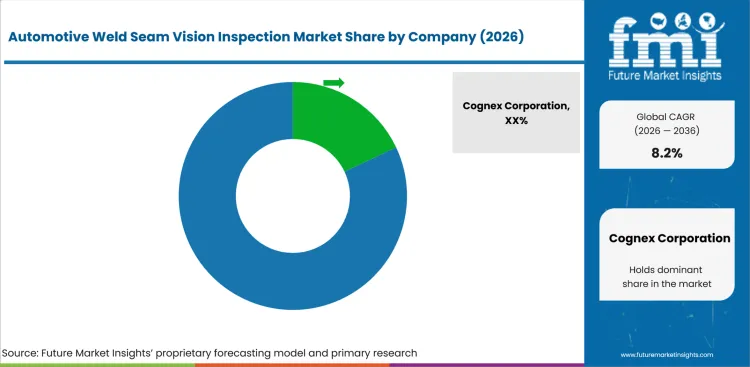
- Established machine vision companies hold an advantage through broad camera, optics, lighting, software, and service portfolios.
- Weld-specific inspection specialists gain preference when buyers need 3D seam geometry analysis rather than basic image capture.
- Automation ecosystem suppliers gain acceptance by connecting sensors and inspection records with robot cells and plant control systems.
- Service-ready suppliers support trial through calibration support, software updates, and rapid troubleshooting during model launches.
Machine vision companies in the market compete by combining inspection hardware with software that can classify weld defects at production speed. Cognex and KEYENCE gain visibility through broad industrial vision portfolios and strong customer support networks. OMRON, SICK, Basler, Balluff, and Datalogic compete by combining camera, sensor, and automation capabilities for plant-floor inspection tasks. Buyers assess whether each supplier can support body shop environments with stable lighting, rugged housings, and usable data export.
Weld-specific expertise has become a competitive separator as body shops move from simple visual checks to seam geometry proof. Coherix and SERVO-ROBOT gain relevance where buyers need 3D laser inspection for bead volume, gap, height, and surface continuity. VITRONIC also supports automated optical inspection in factory environments where precision and repeatability are important. Specialist suppliers can win projects when a seam problem requires deeper process knowledge than a standard camera catalog provides.
Smaller and regional players can win through local integration knowledge and faster plant support. Country-level service depth matters because weld inspection downtime can stop body framing cells and delay whole-vehicle output. Suppliers with proven defect libraries, flexible software ownership, and trusted integrator partnerships should gain more durable listing decisions. Companies relying only on hardware price are expected to face weaker acceptance in regulated and high-volume automotive plants.
How do top automotive weld seam vision inspection companies compare?
Cognex and KEYENCE score strongest on broad machine vision reach while Coherix and SERVO-ROBOT score highly on weld-adjacent 3D inspection depth.
| Company | Relevance to Market Title | Vision Portfolio | 3D/Weld Inspection Depth | Channel Reach | Geographic Footprint |
|---|---|---|---|---|---|
| Cognex Corporation | Very High | Very Strong | Strong | Very Strong | Global |
| KEYENCE Corporation | Very High | Very Strong | Strong | Very Strong | Global |
| OMRON Corporation | High | Strong | Moderate to Strong | Strong | Global |
| Basler AG | High | Very Strong | Moderate | Strong | Global |
| SICK AG | High | Strong | Moderate to Strong | Strong | Global |
| Balluff GmbH | Moderate to High | Strong | Moderate | Strong | Europe and Americas |
| Datalogic S.p.A. | Moderate to High | Strong | Moderate | Strong | Global |
| Coherix Inc. | Very High | Moderate | Very Strong | Strong | Automotive clusters |
| SERVO-ROBOT Inc. | High | Moderate | Very Strong | Moderate | North America and Europe |
| VITRONIC Machine Vision | High | Strong | Strong | Moderate | Europe and global projects |
| Source | Future Market Insights competitive analysis, 2026. |
Who are the key players in the automotive weld seam vision inspection market?
Cognex, KEYENCE, OMRON, Basler, SICK, Balluff, Datalogic, Coherix, SERVO-ROBOT, and VITRONIC are listed among relevant suppliers.
Key global companies leading the automotive weld seam vision inspection market include:
- Cognex Corporation
- KEYENCE Corporation
- OMRON Corporation
- Basler AG
- SICK AG
- Balluff GmbH
- Datalogic S.p.A.
- Coherix Inc.
- SERVO-ROBOT Inc.
- VITRONIC Machine Vision
Key Developments in Automotive Weld Seam Vision Inspection Market
- In May 2026, Cognex launched the In-Sight 3900 high-performance AI vision system for high-speed and high-accuracy inspection at the edge.
- In July 2024, Basler presented racer 2 line scan cameras with resolutions of up to 16k and line rates of up to 200 kHz for high-performance inspection tasks.
- In June 2025, Coherix introduced a service program for adhesive dispensing systems and stated support for more than 5,000 3D laser-based inspection systems across automotive customers.
Key Players in the Automotive Weld Seam Vision Inspection Market
Global Machine Vision Companies
- Cognex Corporation
- KEYENCE Corporation
- OMRON Corporation
- Basler AG
- SICK AG
Weld and 3D Inspection Specialists
- Coherix Inc.
- SERVO-ROBOT Inc.
- VITRONIC Machine Vision
- LMI Technologies
Automation and Sensor Ecosystem Companies
- Balluff GmbH
- Datalogic S.p.A.
- Teledyne DALSA
- Siemens AG
- Panasonic Industry
Automotive Weld Seam Vision Inspection Market - Scope & Definition
| Attribute | Detail |
|---|---|
| Market Definition | Vision hardware, software, and services used to inspect weld seams and weld-adjacent joints in vehicle production, including inline and at-line inspection systems for body shops and welding cells |
| Functions Covered | Defect detection, bead measurement, seam geometry analysis, robot guidance, presence confirmation, OCR/OCV support, quality record creation |
| Applications Covered | Spot weld inspection, seam weld inspection, laser weld inspection, brazed joint inspection, battery-adjacent weld checks, body-in-white weld quality control |
| End-Use Industries | Automotive OEMs, Tier 1 body structure suppliers, EV battery pack assemblers, welding cell integrators, aftermarket audit services |
| Technologies Covered | 2D area scan, 3D laser profiling, structured light, AI-enabled imaging, multispectral imaging |
| Inclusions | Cameras, lenses, lighting, frame grabbers, vision software, 3D laser profilers, AI inspection tools, integration services, calibration services, and inspection support packages used for automotive weld seam inspection |
| Exclusions | Destructive weld testing, manual visual inspection labor, generic factory cameras without weld analytics, standalone robot controllers, arc welding machines, and non-vision nondestructive testing systems |
Automotive Weld Seam Vision Inspection Market - Research Methodology
| Method | Description |
|---|---|
| Primary Research | FMI analyst interviews with automotive quality managers, welding engineers, robot-cell integrators, machine vision distributors, and plant automation teams across key automotive markets |
| Desk Research | Review of official vehicle production data, robot installation data, EV production statistics, supplier disclosures, product launches, and standards-related manufacturing references |
| Market Sizing & Forecasting | Bottom-up system-boundary approach using vehicle production exposure, robot-cell penetration, inspection use rates, average system pricing, software share, service share, and country-level adoption factors |
| Data Validation | Cross-verification using automotive production scale, robot installation intensity, visible product portfolios, company developments, country manufacturing clusters, and supplier capability checks |
Automotive Weld Seam Vision Inspection Market - Report Scope
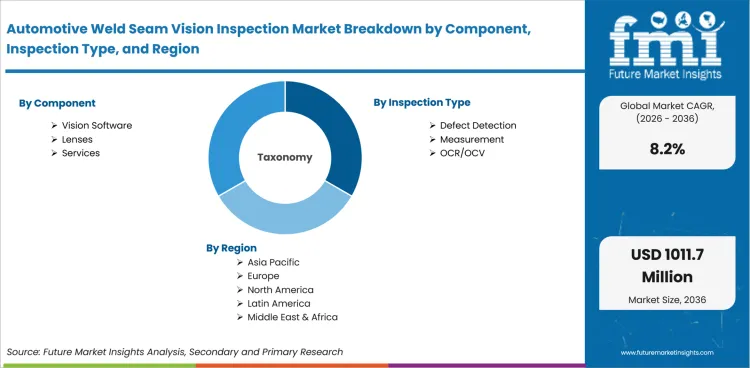
| Parameter | Details |
|---|---|
| Forecast period | 2026 to 2036 |
| Historical period | 2021 to 2025 |
| Quantitative unit | Revenue in USD million |
| By component | Cameras, lenses, lighting, frame grabbers, vision software, services |
| By inspection type | Defect detection, measurement, OCR/OCV, presence/absence, guidance |
| By deployment | Inline, at-line, robotic cell, portable |
| By sensing technology | 2D area scan, 3D laser profiling, structured light, AI-enabled imaging, multispectral imaging |
| By end-use industry | Automotive OEMs, Tier 1 body structure suppliers, EV battery pack assemblers, welding cell integrators, aftermarket audit services |
| Regions covered | North America, Europe, East Asia, South Asia and Pacific, Middle East and Africa |
| Countries covered | China, India, South Korea, United States, Germany, Japan, France, United Kingdom |
| Key companies profiled | Cognex, KEYENCE, OMRON, Basler, SICK, Balluff, Datalogic, Coherix, SERVO-ROBOT, VITRONIC |
| Approach | Bottom-up system-boundary approach using eligible inspection system revenue, channel presence, supplier evidence, vehicle production exposure, robot density, and country-level adoption |
| Source | Future Market Insights, 2026. |
Automotive Weld Seam Vision Inspection Market Breakdown by Component, Inspection Type, Deployment, Sensing Technology, End-use Industry, and Region
Automotive Weld Seam Vision Inspection Market Segmented by Component
- Cameras
- Lenses
- Lighting
- Frame Grabbers
- Vision Software
- Services
Automotive Weld Seam Vision Inspection Market Segmented by Inspection Type
- Defect Detection
- Measurement
- OCR/OCV
- Presence/Absence
- Guidance
Automotive Weld Seam Vision Inspection Market Segmented by Deployment
- Inline
- At-line
- Robotic Cell
- Portable
Automotive Weld Seam Vision Inspection Market Segmented by Sensing Technology
- 2D Area Scan
- 3D Laser Profiling
- Structured Light
- AI-enabled Imaging
- Multispectral Imaging
Automotive Weld Seam Vision Inspection Market Segmented by End-use Industry
- Automotive OEMs
- Tier 1 Body Structure Suppliers
- EV Battery Pack Assemblers
- Welding Cell Integrators
- Aftermarket Audit Services
Automotive Weld Seam Vision Inspection Market by Region
- North America
- Europe
- East Asia
- South Asia and Pacific
- Middle East and Africa
Research Sources and Bibliography
- ACEA. (2026, April 1). Economic and market report: Global and EU auto industry - full-year 2025. European Automobile Manufacturers Association.
- Basler AG. (2024, July 2). Racer 2 L line scan cameras with 8k and 16k resolution. Basler AG.
- Basler AG. (2024, July 30). VISION 2024. Basler AG.
- Cognex Corporation. (2026, May 5). Cognex launches In-Sight 3900 high-performance AI vision system. Cognex Corporation.
- Cognex Corporation. (2026). In-Sight 3900 Vision System. Cognex Corporation.
- Coherix. (2025, June 12). Coherix service program for adhesive dispensing systems. Coherix.
- Germany Trade & Invest. (2025, May 20). The automotive industry in Germany. Germany Trade & Invest.
- International Energy Agency. (2026, May 20). Global EV Outlook 2026: Executive summary. International Energy Agency.
- International Energy Agency. (2026, May 20). Global EV Outlook 2026: Trends in electric cars. International Energy Agency.
- International Federation of Robotics. (2025, September 25). World Robotics 2025 report - industrial robots. International Federation of Robotics.
- International Federation of Robotics. (2025, October 22). Automation is a cornerstone of modern manufacturing. International Federation of Robotics.
- International Federation of Robotics. (2026, April 8). Robot density surges in Europe, Asia, and Americas. International Federation of Robotics.
- International Organization of Motor Vehicle Manufacturers. (2025). 2024 production statistics. International Organization of Motor Vehicle Manufacturers.
- ASEAN+3 Macroeconomic Research Office. (2025, May 14). Korea's automobile exports: Sustaining momentum amid emerging challenges. ASEAN+3 Macroeconomic Research Office.
- Japan Automobile Manufacturers Association. (2025, September 26). The motor industry of Japan 2025. Japan Automobile Manufacturers Association.
- National Highway Traffic Safety Administration. (2026). Vehicle Safety Recalls Week. USA Department of Transportation.
- Plateforme Automobile. (2026). Market analysis letter: France automotive production. Plateforme Automobile.
- Ministry of Heavy Industries. (2026, January 13). Year End Review 2025: Ministry of Heavy Industries. Press Information Bureau. Government of India.
- Press Information Bureau. (2025, February 11). PM E-DRIVE scheme for electric vehicle adoption. Government of India.
- Society of Indian Automobile Manufacturers. (2025, April 15). Performance of the automobile industry in FY 2024-25. Society of Indian Automobile Manufacturers.
- Society of Motor Manufacturers and Traders. (2026). UK car manufacturing and production data. Society of Motor Manufacturers and Traders.
- The State Council of the People’s Republic of China. (2025, January 13). China’s auto output, sales both reach new heights in 2024. The State Council of the People’s Republic of China.
- The State Council Information Office of the People’s Republic of China. (2026, January 15). China’s auto output, sales reach new highs in 2025. The State Council Information Office of the People’s Republic of China.
This bibliography is provided for reader reference and is not exhaustive. The full report contains the complete reference list and detailed citations.
This Report Answers
- Market size estimates for 2026 and forecasts through 2036 for the automotive weld seam vision inspection market.
- Insights across key regional and country-level markets with automotive welding and automation relevance.
- Analysis of demand drivers, robotic welding adoption, inspection traceability, and weld quality requirements.
- Evaluation of key parent segments, including component, inspection type, deployment, sensing technology, and end-use industry.
- Assessment of inline inspection, at-line inspection, robotic cell inspection, and portable inspection demand patterns.
- Identification of growth opportunities across 3D laser profiling, AI-enabled imaging, defect detection, and software-led inspection records.
- Evaluation of supply chain dynamics, system integration routes, calibration services, and plant-level buying behavior.
- Country-level growth analysis covering China, India, South Korea, the United States, Germany, Japan, France, and the United Kingdom.
- Assessment of the competitive landscape, including leading machine vision suppliers and weld-specific inspection specialists.
- Analysis of automation maturity, vehicle production exposure, EV body programs, and quality documentation requirements.
- Regional outlooks across North America, Europe, East Asia, South Asia and Pacific, and Middle East and Africa.
- Delivery of market data, forecasts, and supporting analysis in PDF and Excel formats.
Frequently Asked Questions
What is the growth prospect for automotive weld seam vision inspection?
Demand for automotive weld seam vision inspection is expected to rise at a considerable pace as body shops shift toward inline quality control.
Which companies are expected to shape the automotive weld seam vision inspection market?
Cognex, KEYENCE, OMRON, Basler, SICK, Balluff, Datalogic, Coherix, SERVO-ROBOT, and VITRONIC are expected to shape market competition.
Why are automotive OEMs investing in weld seam vision inspection?
Automotive OEMs are investing in weld seam vision inspection to reduce rework, improve weld traceability, and protect launch quality in automated body shops.
Why are inline systems important in the automotive weld seam vision inspection market?
Inline systems are important because they detect weld defects during production before assemblies move into higher-cost downstream stages.
Which inspection type is gaining the strongest attention in automotive weld seam vision inspection?
Defect detection is gaining the strongest attention because weld cracks, porosity, undercut, and incomplete fusion carry high quality risk.
How do EV platforms influence automotive weld seam vision inspection demand?
EV platforms increase inspection demand by adding mixed-material structures, battery-adjacent welds, and stricter requirements for documented seam quality.
Why is software important for automotive weld seam vision inspection?
Software is important because it classifies defects, stores inspection records, supports line alarms, and links weld quality data to plant systems.
What role does 3D laser profiling play in automotive weld seam vision inspection?
3D laser profiling helps measure bead height, gap, underfill, offset, and seam geometry where standard camera inspection may not be enough.
How do country-level production trends affect this market?
Country-level production trends affect the market because vehicle output, robot installations, and EV programs shape the number of welds requiring automated inspection.
Preview the report firsthand - request a free sample
Get SampleGet the brochure for pricing and purchase details.
Get PDFTable of Content
- Key Takeaways
- Market Size and CAGR
- Top Growth Driver
- Fastest Growing Segment
- Leading Region
- Key Companies
- Emerging Opportunities
- Executive Summary
- Global Market Outlook
- Demand-side Trends
- Supply-side Trends
- Technology Roadmap Analysis
- Analysis and Recommendations
- Analyst Perspective (What is happening? Why now? What should investors know?)
- Key Questions Answered
- How large is the market?
- What is the CAGR?
- What are key trends?
- Which region dominates?
- Who are the leaders?
- Market Overview
- Market Coverage / Taxonomy
- Market Definition / Scope / Limitations
- Research Methodology
- Chapter Orientation
- Analytical Lens and Working Hypotheses
- Market Structure, Signals, and Trend Drivers
- Benchmarking and Cross-market Comparability
- Market Sizing, Forecasting, and Opportunity Mapping
- Research Design and Evidence Framework
- Desk Research Programme (Secondary Evidence)
- Expert Input and Fieldwork (Primary Evidence)
- Tooling, Models, and Reference Databases
- Data Engineering and Model Build
- Quality Assurance and Audit Trail
- Market Background
- Market Dynamics (Drivers, Restraints, Opportunity, Trends)
- Scenario Forecast (Optimistic, Likely, Conservative)
- Impact Analysis
- AI Impact
- Sustainability Impact
- Regulatory Impact
- Technology Impact
- Consumer / Buyer Analysis
- Purchase Drivers
- Adoption Barriers
- Buyer Journey
- Opportunity Map Analysis
- Product Life Cycle Analysis
- Supply Chain Analysis
- Investment Feasibility Matrix
- Value Chain Analysis
- PESTLE and Porter's Analysis
- Regulatory Landscape
- Regional Parent Market Outlook
- Production and Consumption Statistics
- Import and Export Statistics
- Global Market Analysis and Forecast, 2021 to 2036
- Historical Market Size Value (USD Million) Analysis, 2021 to 2025
- Current and Future Market Size Value (USD Million) Projections, 2026 to 2036
- Y-o-Y Growth Trend Analysis
- Absolute $ Opportunity Analysis
- Global Market Pricing Analysis, 2021 to 2036
- Global Market Analysis and Forecast, By Component, 2021 to 2036
- Introduction / Key Findings
- Historical Market Size Value (USD Million) Analysis By Component, 2021 to 2025
- Current and Future Market Size Value (USD Million) Analysis and Forecast By Component, 2026 to 2036
- Vision Software
- Lenses
- Services
- Vision Software
- Y-o-Y Growth Trend Analysis By Component, 2021 to 2025
- Absolute $ Opportunity Analysis By Component, 2026 to 2036
- Global Market Analysis and Forecast, By Inspection Type, 2021 to 2036
- Introduction / Key Findings
- Historical Market Size Value (USD Million) Analysis By Inspection Type, 2021 to 2025
- Current and Future Market Size Value (USD Million) Analysis and Forecast By Inspection Type, 2026 to 2036
- Defect Detection
- Measurement
- OCR/OCV
- Defect Detection
- Y-o-Y Growth Trend Analysis By Inspection Type, 2021 to 2025
- Absolute $ Opportunity Analysis By Inspection Type, 2026 to 2036
- Global Market Analysis and Forecast, By Deployment, 2021 to 2036
- Introduction / Key Findings
- Historical Market Size Value (USD Million) Analysis By Deployment, 2021 to 2025
- Current and Future Market Size Value (USD Million) Analysis and Forecast By Deployment, 2026 to 2036
- Inline
- At-line
- Robotic Cell
- Inline
- Y-o-Y Growth Trend Analysis By Deployment, 2021 to 2025
- Absolute $ Opportunity Analysis By Deployment, 2026 to 2036
- Global Market Analysis and Forecast, By Sensing Technology, 2021 to 2036
- Introduction / Key Findings
- Historical Market Size Value (USD Million) Analysis By Sensing Technology, 2021 to 2025
- Current and Future Market Size Value (USD Million) Analysis and Forecast By Sensing Technology, 2026 to 2036
- 3D Laser Profiling
- 2D Area Scan
- Structured Light
- 3D Laser Profiling
- Y-o-Y Growth Trend Analysis By Sensing Technology, 2021 to 2025
- Absolute $ Opportunity Analysis By Sensing Technology, 2026 to 2036
- Global Market Analysis and Forecast, By End-use Industry, 2021 to 2036
- Introduction / Key Findings
- Historical Market Size Value (USD Million) Analysis By End-use Industry, 2021 to 2025
- Current and Future Market Size Value (USD Million) Analysis and Forecast By End-use Industry, 2026 to 2036
- Automotive OEMs
- Tier 1 Body Structure Suppliers
- Welding Cell Integrators
- Automotive OEMs
- Y-o-Y Growth Trend Analysis By End-use Industry, 2021 to 2025
- Absolute $ Opportunity Analysis By End-use Industry, 2026 to 2036
- Global Market Analysis and Forecast, By Region, 2021 to 2036
- Introduction
- Historical Market Size Value (USD Million) Analysis By Region, 2021 to 2025
- Current Market Size Value (USD Million) Analysis and Forecast By Region, 2026 to 2036
- North America
- Latin America
- Western Europe
- Eastern Europe
- East Asia
- South Asia and Pacific
- Middle East & Africa
- Market Attractiveness Analysis By Region
- North America Market Analysis and Forecast, By Country, 2021 to 2036
- Historical Market Size Value (USD Million) Trend Analysis By Market Taxonomy, 2021 to 2025
- Market Size Value (USD Million) Forecast By Market Taxonomy, 2026 to 2036
- By Country
- USA
- Canada
- Mexico
- By Component
- By Inspection Type
- By Deployment
- By Sensing Technology
- By End-use Industry
- By Country
- Market Attractiveness Analysis
- By Country
- By Component
- By Inspection Type
- By Deployment
- By Sensing Technology
- By End-use Industry
- Key Takeaways
- Latin America Market Analysis and Forecast, By Country
- Historical Market Size Value (USD Million) Trend Analysis By Market Taxonomy, 2021 to 2025
- Market Size Value (USD Million) Forecast By Market Taxonomy, 2026 to 2036
- By Country
- Brazil
- Chile
- Rest of Latin America
- By Component
- By Inspection Type
- By Deployment
- By Sensing Technology
- By End-use Industry
- By Country
- Market Attractiveness Analysis
- By Country
- By Component
- By Inspection Type
- By Deployment
- By Sensing Technology
- By End-use Industry
- Key Takeaways
- Western Europe Market Analysis and Forecast, By Country
- Historical Market Size Value (USD Million) Trend Analysis By Market Taxonomy, 2021 to 2025
- Market Size Value (USD Million) Forecast By Market Taxonomy, 2026 to 2036
- By Country
- Germany
- UK
- Italy
- Spain
- France
- Nordic
- BENELUX
- Rest of Western Europe
- By Component
- By Inspection Type
- By Deployment
- By Sensing Technology
- By End-use Industry
- By Country
- Market Attractiveness Analysis
- By Country
- By Component
- By Inspection Type
- By Deployment
- By Sensing Technology
- By End-use Industry
- Key Takeaways
- Eastern Europe Market Analysis and Forecast, By Country
- Historical Market Size Value (USD Million) Trend Analysis By Market Taxonomy, 2021 to 2025
- Market Size Value (USD Million) Forecast By Market Taxonomy, 2026 to 2036
- By Country
- Russia
- Poland
- Hungary
- Balkan & Baltic
- Rest of Eastern Europe
- By Component
- By Inspection Type
- By Deployment
- By Sensing Technology
- By End-use Industry
- By Country
- Market Attractiveness Analysis
- By Country
- By Component
- By Inspection Type
- By Deployment
- By Sensing Technology
- By End-use Industry
- Key Takeaways
- East Asia Market Analysis and Forecast, By Country
- Historical Market Size Value (USD Million) Trend Analysis By Market Taxonomy, 2021 to 2025
- Market Size Value (USD Million) Forecast By Market Taxonomy, 2026 to 2036
- By Country
- China
- Japan
- South Korea
- By Component
- By Inspection Type
- By Deployment
- By Sensing Technology
- By End-use Industry
- By Country
- Market Attractiveness Analysis
- By Country
- By Component
- By Inspection Type
- By Deployment
- By Sensing Technology
- By End-use Industry
- Key Takeaways
- South Asia and Pacific Market Analysis and Forecast, By Country
- Historical Market Size Value (USD Million) Trend Analysis By Market Taxonomy, 2021 to 2025
- Market Size Value (USD Million) Forecast By Market Taxonomy, 2026 to 2036
- By Country
- India
- ASEAN
- Australia & New Zealand
- Rest of South Asia and Pacific
- By Component
- By Inspection Type
- By Deployment
- By Sensing Technology
- By End-use Industry
- By Country
- Market Attractiveness Analysis
- By Country
- By Component
- By Inspection Type
- By Deployment
- By Sensing Technology
- By End-use Industry
- Key Takeaways
- Middle East & Africa Market Analysis and Forecast, By Country
- Historical Market Size Value (USD Million) Trend Analysis By Market Taxonomy, 2021 to 2025
- Market Size Value (USD Million) Forecast By Market Taxonomy, 2026 to 2036
- By Country
- Kingdom of Saudi Arabia
- Other GCC Countries
- Türkiye
- South Africa
- Other African Union
- Rest of Middle East & Africa
- By Component
- By Inspection Type
- By Deployment
- By Sensing Technology
- By End-use Industry
- By Country
- Market Attractiveness Analysis
- By Country
- By Component
- By Inspection Type
- By Deployment
- By Sensing Technology
- By End-use Industry
- Key Takeaways
- Key Countries Market Analysis
- USA
- Pricing Analysis
- Market Share Analysis, 2025
- By Component
- By Inspection Type
- By Deployment
- By Sensing Technology
- By End-use Industry
- Canada
- Pricing Analysis
- Market Share Analysis, 2025
- By Component
- By Inspection Type
- By Deployment
- By Sensing Technology
- By End-use Industry
- Mexico
- Pricing Analysis
- Market Share Analysis, 2025
- By Component
- By Inspection Type
- By Deployment
- By Sensing Technology
- By End-use Industry
- Brazil
- Pricing Analysis
- Market Share Analysis, 2025
- By Component
- By Inspection Type
- By Deployment
- By Sensing Technology
- By End-use Industry
- Chile
- Pricing Analysis
- Market Share Analysis, 2025
- By Component
- By Inspection Type
- By Deployment
- By Sensing Technology
- By End-use Industry
- Germany
- Pricing Analysis
- Market Share Analysis, 2025
- By Component
- By Inspection Type
- By Deployment
- By Sensing Technology
- By End-use Industry
- UK
- Pricing Analysis
- Market Share Analysis, 2025
- By Component
- By Inspection Type
- By Deployment
- By Sensing Technology
- By End-use Industry
- Italy
- Pricing Analysis
- Market Share Analysis, 2025
- By Component
- By Inspection Type
- By Deployment
- By Sensing Technology
- By End-use Industry
- Spain
- Pricing Analysis
- Market Share Analysis, 2025
- By Component
- By Inspection Type
- By Deployment
- By Sensing Technology
- By End-use Industry
- France
- Pricing Analysis
- Market Share Analysis, 2025
- By Component
- By Inspection Type
- By Deployment
- By Sensing Technology
- By End-use Industry
- India
- Pricing Analysis
- Market Share Analysis, 2025
- By Component
- By Inspection Type
- By Deployment
- By Sensing Technology
- By End-use Industry
- ASEAN
- Pricing Analysis
- Market Share Analysis, 2025
- By Component
- By Inspection Type
- By Deployment
- By Sensing Technology
- By End-use Industry
- Australia & New Zealand
- Pricing Analysis
- Market Share Analysis, 2025
- By Component
- By Inspection Type
- By Deployment
- By Sensing Technology
- By End-use Industry
- China
- Pricing Analysis
- Market Share Analysis, 2025
- By Component
- By Inspection Type
- By Deployment
- By Sensing Technology
- By End-use Industry
- Japan
- Pricing Analysis
- Market Share Analysis, 2025
- By Component
- By Inspection Type
- By Deployment
- By Sensing Technology
- By End-use Industry
- South Korea
- Pricing Analysis
- Market Share Analysis, 2025
- By Component
- By Inspection Type
- By Deployment
- By Sensing Technology
- By End-use Industry
- Russia
- Pricing Analysis
- Market Share Analysis, 2025
- By Component
- By Inspection Type
- By Deployment
- By Sensing Technology
- By End-use Industry
- Poland
- Pricing Analysis
- Market Share Analysis, 2025
- By Component
- By Inspection Type
- By Deployment
- By Sensing Technology
- By End-use Industry
- Hungary
- Pricing Analysis
- Market Share Analysis, 2025
- By Component
- By Inspection Type
- By Deployment
- By Sensing Technology
- By End-use Industry
- Kingdom of Saudi Arabia
- Pricing Analysis
- Market Share Analysis, 2025
- By Component
- By Inspection Type
- By Deployment
- By Sensing Technology
- By End-use Industry
- Türkiye
- Pricing Analysis
- Market Share Analysis, 2025
- By Component
- By Inspection Type
- By Deployment
- By Sensing Technology
- By End-use Industry
- South Africa
- Pricing Analysis
- Market Share Analysis, 2025
- By Component
- By Inspection Type
- By Deployment
- By Sensing Technology
- By End-use Industry
- USA
- Market Structure Analysis
- Competition Dashboard
- Competition Benchmarking
- Market Share Analysis of Top Players
- By Regional
- By Component
- By Inspection Type
- By Deployment
- By Sensing Technology
- By End-use Industry
- Emerging Startups
- Innovation Benchmarking
- Competition Analysis
- Competition Deep Dive
- Cognex Corporation
- Overview
- Product Portfolio
- Profitability by Market Segments (Product/Region/Sales Channel)
- Sales Footprint
- Strategy Overview
- Marketing Strategy
- Product Strategy
- Channel Strategy
- KEYENCE Corporation
- OMRON Corporation
- Basler AG
- SICK AG
- Balluff GmbH
- Cognex Corporation
- Case Studies
- Success Stories
- Recent Developments
- Competition Deep Dive
- Assumptions & Acronyms Used


