

- Market Size (2026)
- USD 853.1 Mn
- Forecast (2036)
- USD 1858.9 Mn
- CAGR (2026 to 2036)
- 8.1%
How big is Aircraft Surface Inspection Systems Market in 2026?
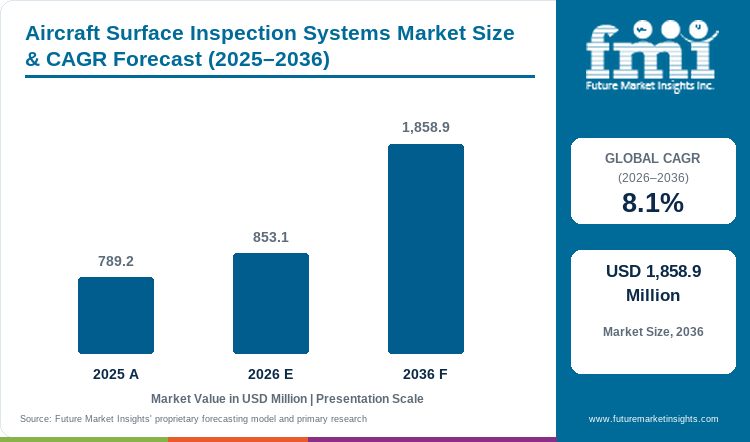
The aircraft surface inspection systems market is valued at USD 853.1 million in 2026 and is projected to reach USD 1,858.9 million by 2036, growing at an 8.1% CAGR.
Demand for aircraft surface inspection systems is projected to expand at 8.1% CAGR from 2026 to 2036. Valuation grows from USD 789.2 million in 2025 to USD 853.1 million in 2026 and reaches USD 1,858.9 million by 2036. Airlines want faster checks because long ground time raises costs. In February 2026, 8tree said British Airways added dentCHECK tools at Glasgow and Heathrow. The airline uses these tools in line and base maintenance.
Country growth depends on how each maintenance network operates and serves aircraft. The USA has a large commercial aircraft MRO base while the UAE and Singapore are adding service space. In May 2026, the FAA said 529 towered airports handled more than 24 million commercial flights in fiscal 2025. That traffic supports steady US inspection work across a large network. New Gulf and Singapore sites need trained staff plus local service and fast technical support. Engineers need traceable records because a stopped inspection cell can delay maintenance work.
Key Takeaways of Aircraft Surface Inspection Systems Market
- Routine checks and surface damage raise demand for fast records that engineers can review without extending aircraft ground time.
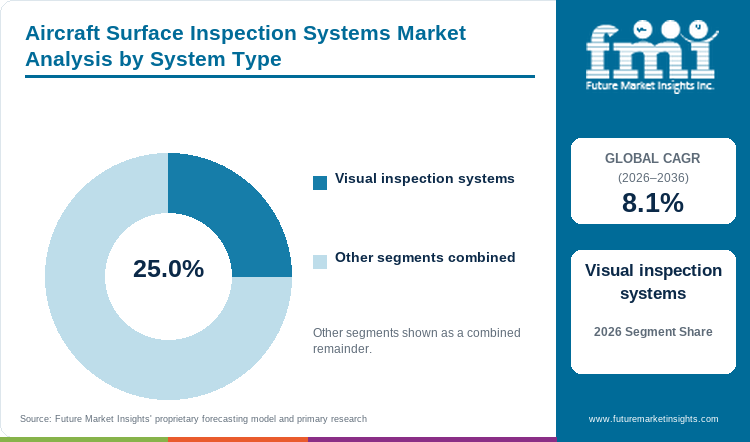
- Visual inspection systems are estimated to hold 25.0% of system type demand in 2026 through broad use in routine exterior screening.
- Machine vision is forecast to represent 29.0% of technology demand in 2026 with stable image capture and clear digital records supporting use.
- Fuselage is projected to hold 26.0% of inspection-area demand in 2026, influenced by frequent damage checks across large skin areas.
- Qualification can slow a new method because teams need approved procedures plus training and traceable records for engineering review.
- Some of the key players in this market include Waygate Technologies, FARO CREAFORM, Evident Inspection Technologies, Zetec, Donecle, 8tree, Testia, Automated Precision Inc., and LMI Technologies.
Analyst Perspective
“The opportunity lies in digital surface inspection workflows that shorten aircraft checks while keeping repair records traceable across maintenance sites. Adoption depends on stable calibration and approved procedures plus training that lets crews trust each result before return-to-service decisions.”
- Nikhil Kaitwade, Principal Consultant, Future Market Insights
How is the Aircraft Surface Inspection Systems Market segmented?
The aircraft surface inspection systems market is segmented by System Type, Technology, Inspection Area, End Use, Sales Channel, and Region.
The aircraft surface inspection systems market uses five segment axes with region as the geographic split.
System type covers visual inspection systems, 3D scanning systems, thermography systems, robotic inspection systems, and AI defect detection platforms.
Technology covers machine vision, laser scanning, infrared thermography, ultrasonic testing, and eddy-current testing.
Inspection area covers fuselage, wings, engine-nacelle, composite structures, and paint-coating surfaces.
End use covers MRO providers, aircraft OEMs, airlines, defense depots, and test labs.
Sales channel covers direct system OEMs, NDT distributors, MRO service bundles, and automation integrators.
How do visual inspection systems shape demand within the system type category?
Crews use visual tools for initial checks of aircraft skin damage. Marked areas move to 3D measurement or NDT for closer review. Drone inspection tools scan large exterior areas without extra camera setup. In September 2026, Donecle and JAL began hangar tests in Japan. Mechanics retain final review control as the project compares drone images with standard checks.
- Visual inspection systems are projected to account for 25.0% of system type demand in 2026 through broad exterior screening.
- Digital image records help engineers compare each damage location and track its condition during later repair decisions.
What supports machine vision within the technology category?
Machine vision turns stable images into data that software can sort. Crews compare repeated views with less camera movement during inspection work.
- Machine vision is estimated to hold 29.0% of technology demand in 2026 with stable image capture and digital records supporting adoption.
- Aircraft use also requires tested defect rules and stable capture conditions plus a review path that keeps the inspector in control.
How does fuselage inspection shape the inspection area category?
Fuselage checks cover broad curved skin that can show dents, cracks, rust, or paint damage. Portable 3D scanning systems reduce hand measurement during shape checks. In July 2025, Vueling adopted 8tree dentCHECK for digital damage checks and SRM-compliant records.
- In 2026, fuselage is expected to lead inspection-area demand with 26.0% share through recurring damage mapping across large skin areas.
- Teams gain more value because one tool can find a defect and create the record needed for repair.
What supports MRO providers within the end use category?
MRO providers handle planned checks and sudden damage across many aircraft types. Their teams need trained staff and approved steps before return to service. In June 2026, Testia announced an Airbus Helicopters contract covering France, Germany, and Spain. The work uses several non-destructive testing equipment methods in plant and maintenance tasks.
- MRO providers are forecast to represent 34.0% of end-use demand in 2026 through recurring checks and direct maintenance work.
- Service teams compare tools through training needs and calibration plus report quality and the time required for engineering decisions.
Why do direct system OEM relationships matter within the sales channel category?
Direct system OEM relationships matter because inspection tools need support beyond delivery. Calibration and software updates shape long-term use alongside training across maintenance sites. In September 2026, FARO CREAFORM launched CAM2 updates with handheld scanner support and automated reports. The release connects capture and review through one supported flow built around 3D metrology tools.
- Direct system OEM is set to lead the sales channel with 42.0% share in 2026 through calibration support, software updates and training.
- Direct support reduces handoff risk because crews can keep one measurement method valid across sites and software versions.
What are the drivers, restraints and opportunities in the Aircraft Surface Inspection Systems Market?
In the aircraft surface inspection systems market, the key driver is more service work raising the value of inspection methods that cut capture time and reduce duplicate work, since a growing global commercial fleet increases planned checks and damage calls that fast, traceable tools help maintenance teams manage. The key restraint is that qualification and approved maintenance data can slow adoption, because new methods need clear procedures, training, and tool guidance before NDT staff can use them under rules like EASA's Part-145, leaving vendors facing longer trials when they cannot support qualification. The key opportunity is suppliers pairing broad screening with measured follow-up checks in one engineering workflow, letting shared defect locations and inspection histories support recurring maintenance decisions so crews can inspect one location once and reuse the record across several repair and paint-care decisions.
- Driver: More service work raises the value of inspection methods that cut capture time and reduce duplicate work.
- Restraint: Qualification and approved maintenance data can slow adoption because crews also need training for each new inspection method.
- Opportunity: Suppliers can pair broad screening with measured follow-up checks and keep both records in one engineering workflow.
Service workload raises the value of faster surface inspection
Airlines and MRO shops need surface checks that do not extend aircraft ground time. Airbus said in October 2025 that the global commercial fleet will pass 49,000 aircraft by 2044. More aircraft increase planned checks and damage calls during routine service. Providers of aircraft maintenance services gain from tools that cut capture time and duplicate work. Faster checks improve the purchase case because they remove work instead of shifting it to review. Busy fleets face hail, bird strikes, and paint damage between scheduled visits. Each event can trigger another surface check before return to service. Fast and traceable tools help maintenance teams manage this added workload.
Qualification and technician competence can slow deployment
Speed alone does not turn a new sensor into an approved MRO method. EASA updated its airworthiness rules in September 2025 and kept NDT staff qualification rules under Part-145. New methods need clear procedures, training, and tool guidance if older standards do not cover the method. MRO shops test calibration, use limits, and report quality before routine work begins. Vendors that cannot support qualification face longer trials and slower site rollouts. Engineers need clear limits for each result before they approve a repair. A tool that produces new data without strong control can increase review work. Qualification remains a practical barrier to faster deployment across maintenance sites.
Multimethod digital workflows create a practical expansion route
Broad visual screening speeds surface checks by sending flagged areas to measured follow-up. Donecle and AkzoNobel introduced Iris CMX in September 2026 for paint thickness and color checks. The tool measures gloss, while Iris GVI supplies full-surface images in the same paint care flow. Airlines can link those findings with aircraft topcoats work and later 3D or NDT checks. Shared defect locations and inspection histories support recurring maintenance and repair decisions across sites. The same data guide planned paint work and reduce duplicate capture. MRO teams can inspect one location once and use the record in several decisions. That workflow creates a practical route for multimethod digital services.
Which country CAGRs are profiled in the Aircraft Surface Inspection Systems Market?
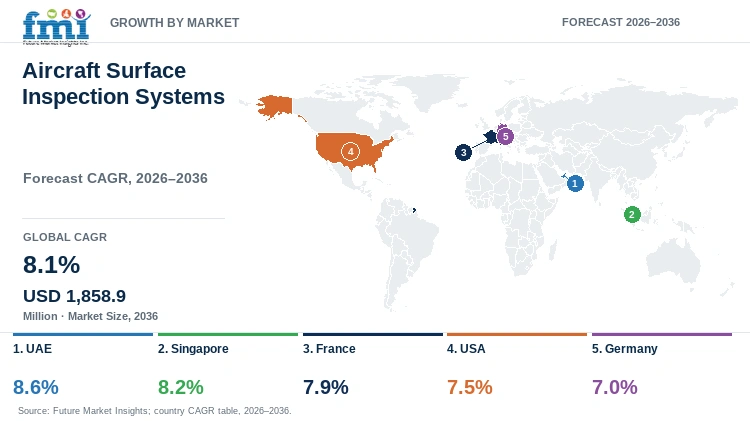
| Country | CAGR |
|---|---|
| UAE | 8.6% |
| Singapore | 8.2% |
| France | 7.9% |
| USA | 7.5% |
| Germany | 7.0% |
How do country-level CAGRs compare in the Aircraft Surface Inspection Systems Market?
The five profiled countries follow different maintenance and approval conditions even when their growth rates remain within a relatively narrow range. The UAE and Singapore add capacity while established service and qualification networks shape conditions across France, the USA and Germany.
- UAE heavy-maintenance expansion increases demand for inspection systems that can support wide-body checks without slowing approved engineering workflows.
- Singapore’s dense MRO base favors inspection systems that combine short setup times with local service and dependable support under SAR-145 controls.
- France’s aerospace skill base supports advanced NDT use but also raises qualification and training expectations for new inspection methods.
- The USA’s large commercial flight network supports recurring surface checks and favors consistent inspection records across many maintenance locations.
- Germany’s mature approval network favors inspection systems with stable calibration and clear workflow gains before shops replace accepted methods.
The full report provides country-level CAGR analysis across North America, Latin America, Western Europe, Eastern Europe, East Asia, South Asia and Pacific, and the Middle East and Africa.
Country-wise Analysis
- UAE demand for aircraft surface inspection systems is forecast to rise at 8.6% CAGR through 2036 as heavy-check capacity expands. Airlines and MRO providers are adding wide-body service space under CAR-145 rules. In May 2026, Emirates broke ground on an engineering site designed to handle 28 wide-body aircraft at one time. GCAA rules require approved maintenance shops and include visual checks in line maintenance. New tools must cover more aircraft without weakening approved work steps or traceable records. Vendors need sound calibration and fast reports plus trained staff and local service. Those services support adoption as new hangars increase the number of complex exterior checks. High-volume checks also make dependable tool support important for routine maintenance work.
- Singapore demand is estimated to expand at 8.2% CAGR through 2036 as dense MRO work increases the need for dependable inspection capacity. Singapore MRO providers work in a hub that values aircraft uptime and approved maintenance steps. In March 2025, CAAS listed 163 approved MRO organizations across the national aviation system. CAAS requires shops maintaining Singapore-registered aircraft to meet SAR-145 rules during approved work. Aircraft sensors and inspection cells need tested steps before crews use them across maintenance programs. High-throughput sites also need short setup times plus local service and spare parts. Reliable support lowers rollout risk and prevents one stalled cell from delaying a maintenance line. These needs favor tools that crews can keep working during busy service periods.
- Sales of surface inspection systems in France are forecast to expand at 7.9% CAGR through 2036 as aerospace work supports demand. French factories and MRO providers use NDT methods in routine quality control and maintenance work. In May 2026, GIFAS said the national aerospace sector employed 230,500 people during 2025. GIFAS linked those jobs to production plus maintenance and support work. That large skills base helps sites use advanced tools but also raises training and proof needs. Vendors need inspection systems that fit accepted NDT steps and existing quality plans. Local technical support can shorten qualification work while keeping engineering teams in control of adoption decisions.
- US surface inspection demand is forecast to rise at 7.5% CAGR through 2036 as a large MRO network supports recurring work. MRO providers operate across a broad national air system under strict FAA maintenance requirements. In May 2026, the FAA said 529 towered airports handled more than 24 million commercial flights during fiscal 2025. That traffic creates steady repair and inspection needs across many maintenance locations. Large networks require similar results from different crews and sites before engineers approve repairs. Vendors need clear setup guidance plus local service and training to expand trials across those operations. Buyers can then select inspection tools according to aircraft mix and maintenance workload.
- Sales of surface inspection systems in Germany are forecast at 7.0% CAGR through 2036 as mature approval paths shape replacement choices. German MRO providers work within a national network of approved technical organizations. In September 2026, the Luftfahrt-Bundesamt maintained a live national list of valid technical approvals. The national list includes Part-145 shops and other approved technical sites. New tools compete with methods already written into quality plans and maintenance steps. Buyers need proof that a replacement tool saves time without adding engineering review work. Vendors must provide stable calibration and clear data transfer before shops change an accepted method. These needs favor proven workflow gains over less tested process changes.
Who are the notable companies in the Aircraft Surface Inspection Systems Market?
Waygate Technologies, FARO CREAFORM, Evident Inspection Technologies, Zetec, Donecle, 8tree, Testia, Automated Precision Inc., and LMI Technologies are active within the defined aircraft surface inspection systems boundary.
Vendors compete across several aircraft inspection tasks and service needs. Waygate Technologies and Evident Inspection Technologies cover several NDT methods, while FARO CREAFORM and 8tree focus on surface measurement. Donecle uses drones for aircraft imaging, while LMI Technologies supplies machine vision systems. Testia provides inspection equipment and services, while software links and field support shape use across maintenance sites.
- Broad NDT and remote visual inspection: Waygate Technologies, Evident Inspection Technologies, Zetec, and Testia.
- Surface geometry and digital metrology: FARO CREAFORM, 8tree, and Automated Precision Inc.
- Automated vision and robotic inspection platforms include Donecle and LMI Technologies.
Competitive Benchmarking: Aircraft Surface Inspection Systems Market
| Company | Airframe Surface Metrology | NDT Modality Breadth | Automation and Digital Workflow | Geographic Reach |
|---|---|---|---|---|
| Waygate Technologies | Medium | High | High | Global |
| FARO CREAFORM | High | Medium | High | Global |
| Evident Inspection Technologies | Medium | High | High | Global |
| Zetec | Medium | High | Medium | Multi-region |
| Donecle | High | Low | High | Airline and MRO deployments |
| 8tree | High | Low | High | Global aviation users |
| Testia | High | High | High | Europe and international sites |
| Automated Precision Inc. | High | Low | High | Global metrology reach |
| LMI Technologies | Medium | Low | High | Global vision channels |
Ratings follow documented work and verified capabilities for each company. A High surface-metrology rating requires solid proof from aircraft or large-part measurement, while Medium marks a narrower proven role. Low marks limited fit, and a High NDT rating requires proof across several inspection methods. Automation ratings consider robotic capture and software review through linked reports, while geographic reach records proven coverage without a score.
Key Developments in the Aircraft Surface Inspection Systems Market
- In November 2025, Creaform launched Integrity Suite with a dedicated aircraft surface-assessment module for scanning and reporting.
- In April 2025, 8tree said Transavia integrated dentCHECK into line maintenance for SRM-compliant aircraft surface damage inspection.
- In April 2025, Automated Precision Inc. launched its sixth-generation Integrated Laser Tracker for portable dimensional measurement.
Key Players in the Aircraft Surface Inspection Systems Market
Broad NDT and Remote Visual Inspection Platforms
- Waygate Technologies
- Evident Inspection Technologies
- Zetec
- Testia
3D Metrology and Surface Geometry Platforms
- FARO CREAFORM
- 8tree
- Automated Precision Inc.
Automated Vision and Robotic Inspection Platforms
- Donecle
- LMI Technologies
Aircraft Surface Inspection Systems Market - Report Scope
| Coverage field | Report scope |
|---|---|
| Market breakdown | By system type, technology, inspection area, end use, sales channel, and region. |
| Quantitative Units | USD million. |
| Market Definition | Systems and supporting software used to visually or dimensionally inspect aircraft exterior surfaces and near-surface structures for maintenance or manufacturing decisions. |
| Regions Covered | North America, Latin America, Western Europe, Eastern Europe, East Asia, South Asia and Pacific, and Middle East and Africa. |
| Countries Covered | UAE, Singapore, France, USA, Germany, and 20+ countries included in the full report. |
| Key Companies Profiled | Waygate Technologies, FARO CREAFORM, Evident Inspection Technologies, Zetec, Donecle, 8tree, Testia, Automated Precision Inc., and LMI Technologies. |
| Forecast Period | 2026 to 2036. |
| Approach | Primary and secondary research with market triangulation. |
Aircraft Surface Inspection Systems Market - Research Methodology
| Method | Approach |
|---|---|
| Primary Research | FMI analysts gathered input from manufacturers, service providers, technology developers, distributors, end users, procurement teams, and subject-matter experts. Interviews examined purchasing decisions, product or service evaluation, adoption barriers, approval requirements, pricing considerations, and expectations for technical or commercial support. Respondents were also asked what evidence is required before a trial, pilot, or initial order develops into regular purchasing. |
| Desk Research | Desk research covered government statistics, regulatory publications, trade data, industry associations, technical literature, standards, company filings, product information, and official corporate announcements. Sources were reviewed for relevance, publication date, geographic coverage, and consistency with the defined market scope. Claims relating to performance, applications, approvals, capacity, investment, and commercial activity were retained only when supported by credible public evidence. |
| Market Sizing and Forecasting | The market model combined the baseline value with historical performance, segment structure, pricing and volume indicators, adoption levels, company participation, and country-level demand conditions. Forecast assumptions considered economic activity, investment trends, regulatory developments, technology adoption, purchasing cycles, supply availability, and barriers to wider market use. Segment and regional estimates were reconciled before the final market total was calculated. |
| Data Validation | Estimates were checked against multiple independent indicators, including public data, company activity, trade patterns, industry developments, and findings from primary interviews. Validation also tested whether products, services, applications, and company revenues fell within the defined market boundaries. Adjacent categories, unsupported claims, overlapping revenues, and activities without direct market relevance were excluded to reduce double counting and maintain consistency across segments and countries. |
Aircraft Surface Inspection Systems Market by Segments
Aircraft Surface Inspection Systems Market segmented by System Type:
- Visual inspection systems
- 3D scanning systems
- Thermography systems
- Robotic inspection systems
- AI defect detection platforms
Aircraft Surface Inspection Systems Market segmented by Technology:
- Machine vision
- Laser scanning
- Infrared thermography
- Ultrasonic testing
- Eddy-current testing
Aircraft Surface Inspection Systems Market segmented by Inspection Area:
- Fuselage
- Wings
- Engine - nacelle
- Composite structures
- Paint - coating surface
Aircraft Surface Inspection Systems Market segmented by End Use:
- MRO providers
- Aircraft OEMs
- Airlines
- Defense depots
- Test labs
Aircraft Surface Inspection Systems Market segmented by Sales Channel:
- Direct system OEM
- NDT distributors
- MRO service bundled
- Automation integrators
Aircraft Surface Inspection Systems Market by Region:
- North America
- United States
- Canada
- Latin America
- Brazil
- Mexico
- Argentina
- Chile
- Rest of Latin America
- Western Europe
- Germany
- France
- United Kingdom
- Italy
- Spain
- Benelux
- Nordics
- Rest of Western Europe
- Eastern Europe
- Poland
- Czech Republic
- Romania
- Hungary
- Rest of Eastern Europe
- East Asia
- China
- Japan
- South Korea
- South Asia and Pacific
- India
- ASEAN
- Australia and New Zealand
- Rest of South Asia and Pacific
- Middle East and Africa
- Kingdom of Saudi Arabia
- Other GCC Countries
- Türkiye
- South Africa
- Other African Union Countries
- Rest of Middle East and Africa
Research Sources and Bibliography
- 8tree. (2026, February 26). British Airways strengthens commitment to digital MRO efficiency with 8tree’s dentCHECK technology.
- Federal Aviation Administration. (2026, May). FAA Aerospace Forecast Fiscal Years 2026-2046.
- Donecle. (2026, September 11). Japan’s first: JAL and Donecle launch joint verification for fully autonomous drone aircraft exterior inspections.
- LMI Technologies. (2026, January 29). LMI Technologies launches Gocator 2D smart cameras.
- 8tree. (2025, July 14). Vueling improves efficiency of aircraft damage inspections using 8tree’s dentCHECK technology.
- Testia. (2026, June 8). Testia expands its international operations with Airbus Helicopters.
- FARO CREAFORM. (2026, September 16). FARO CREAFORM brings handheld 3D scanner compatibility & casting inspection to CAM2.
- Airbus. (2025, October 9). Airbus projects resilient growth of services market in the next 20 years.
- European Union Aviation Safety Agency. (2025, September). Easy Access Rules for Continuing Airworthiness.
- Donecle. (2026, September 4). Donecle and AkzoNobel take aircraft coating inspections to a new level with Iris CMX.
- Groupement des Industries Françaises Aéronautiques et Spatiales. (2026, May 11). 2025 results: The French aerospace industry remains strongly positioned for the future.
- Luftfahrt-Bundesamt. (2026). Technical organizations: Current valid approvals. Retrieved September 22, 2026.
- Civil Aviation Authority of Singapore. (2025). CAAS Annual Report 2024/2025.
- Civil Aviation Authority of Singapore. (2026, September 8). Maintenance, repair and overhaul approval.
- Emirates. (2026, May 18). Emirates breaks ground on ultra-modern engineering facility at Dubai South.
- General Civil Aviation Authority. (2025). CAR-145 approved maintenance organisation, Issue 09.
- Creaform. (2025, November 4). Launching Creaform Integrity Suite for surface damage assessment.
- 8tree. (2025, April 4). Transavia integrates 8tree’s dentCHECK to elevate aircraft maintenance efficiency.
- Automated Precision Inc. (2025, April 1). API announces integrated laser tracker.
- FARO. (2026, January 13). FARO and Creaform combine to form two new business units.
- Wabtec Corporation. (2025, July 1). Wabtec finalizes acquisition of Evident’s Inspection Technologies division.
- Testia. (2026, March 23). Testia expands its global portfolio with Maintenance in Operational Condition services.
- 8tree. (2025, July 7). Velocity Maintenance Solutions adopts 8tree’s dentCHECK to elevate aircraft damage inspection efficiency.
- LMI Technologies. (2025, January 23). LMI Technologies introduces new AI-powered GoPxL Anomaly Detector.
- Hexagon. (2026, April 13). Hexagon to acquire Waygate Technologies, expanding into non-destructive testing.
- AMETEK. (2025, July 21). AMETEK completes acquisition of FARO Technologies.
- Evident Scientific. (2025, October 1). New IPLEX One videoscope solution redefines remote visual inspection.
- ESAB Corporation. (2026, June 2). ESAB completes acquisition of Eddyfi Technologies.
- Donecle. (2026, April 15). Donecle raises financing to scale drone and AI-based aircraft inspection.
- 8tree. (2025, January 10). Piedmont Airlines chooses dentCHECK for digital dent-mapping workflows.
- Testia. (2026, January 7). Testia hands over robotized ultrasonic cobot inspection system to Airbus R&D.
- API Metrology. (2026, July 5). Your API Metrology Support Hub is now live.
- LMI Technologies. (2025, March 26). LMI Technologies launches new smart 3D laser line profilers.
This bibliography is provided for reader reference and is not exhaustive. The full report contains the complete reference list and detailed citations.
This Report Answers
- How large is the aircraft surface inspection systems market in 2026 and what value is forecast for 2036?
- Which maintenance workload and digital-record conditions support aircraft surface inspection system demand?
- Why do visual inspection systems hold a significant share within the system type category?
- How does machine vision change image capture and downstream engineering review?
- Why does fuselage inspection create recurring demand for digital damage mapping?
- How do UAE, Singapore, France, USA, and Germany differ in forecast growth and entry conditions?
- Which supplier capabilities matter to MRO teams comparing NDT, metrology, and automated inspection platforms?
- How do qualification and technician requirements change deployment timing for new inspection systems?
- Which companies supply aircraft-specific inspection, metrology, NDT, or machine-vision capabilities?
Frequently Asked Questions
How big is the Aircraft Surface Inspection Systems Market in 2026?
The market is expected to reach USD 853.1 million in 2026. Routine checks and surface damage keep demand active because engineers need fast records that limit aircraft ground time during engineering repair decisions.
What is the CAGR of the Aircraft Surface Inspection Systems Market from 2026 to 2036?
The aircraft surface inspection systems market is projected to grow at 8.1% CAGR through 2036. Digital records link visual findings to repair decisions and cut duplicate capture because crews can reuse the same inspection data during maintenance.
Which inspection area holds a significant share in the Aircraft Surface Inspection Systems Market?
Fuselage inspection is forecast to hold 26.0% of inspection-area demand in 2026 because large skin areas need regular checks. Crews inspect dents, cracks, rust, and paint damage during planned maintenance and sudden damage reviews before repair decisions.
How much value will the Aircraft Surface Inspection Systems Market add between 2026 and 2036?
The market is expected to add USD 1005.8 million in value between 2026 and 2036. Linked visual and 3D checks save inspection time and cut duplicate capture because engineers can use one record across several maintenance decisions.
Which countries are projected to record higher growth in the Aircraft Surface Inspection Systems Market?
The UAE is projected at 8.6% CAGR through 2036, followed by Singapore at 8.2% and France at 7.9% CAGR. Each country uses a different MRO service model, while approval rules and local support shape the pace of adoption.
Which companies are active in the Aircraft Surface Inspection Systems Market?
Key companies include Waygate Technologies, FARO CREAFORM, Evident Inspection Technologies, Zetec, Donecle, 8tree, Testia, Automated Precision Inc., and LMI Technologies. Their roles cover NDT and 3D measurement plus aircraft drone inspection and machine vision. Some companies focus on one inspection task while others combine equipment and software with training and field service.
Preview the report firsthand - request a free sample
Get SampleGet the brochure for pricing and purchase details.
Get PDFTable of Content
- Key Takeaways
- Market Size and CAGR
- Top Growth Driver
- Fastest Growing Segment
- Leading Region
- Key Companies
- Emerging Opportunities
- Executive Summary
- Global Market Outlook
- Demand-side Trends
- Supply-side Trends
- Technology Roadmap Analysis
- Analysis and Recommendations
- Analyst Perspective (What is happening? Why now? What should investors know?)
- Key Questions Answered
- How large is the market?
- What is the CAGR?
- What are key trends?
- Which region dominates?
- Who are the leaders?
- Market Overview
- Market Coverage / Taxonomy
- Market Definition / Scope / Limitations
- Research Methodology
- Chapter Orientation
- Analytical Lens and Working Hypotheses
- Market Structure, Signals, and Trend Drivers
- Benchmarking and Cross-market Comparability
- Market Sizing, Forecasting, and Opportunity Mapping
- Research Design and Evidence Framework
- Desk Research Programme (Secondary Evidence)
- Expert Input and Fieldwork (Primary Evidence)
- Tooling, Models, and Reference Databases
- Data Engineering and Model Build
- Quality Assurance and Audit Trail
- Market Background
- Market Dynamics (Drivers, Restraints, Opportunity, Trends)
- Scenario Forecast (Optimistic, Likely, Conservative)
- Impact Analysis
- AI Impact
- Sustainability Impact
- Regulatory Impact
- Technology Impact
- Consumer / Buyer Analysis
- Purchase Drivers
- Adoption Barriers
- Buyer Journey
- Opportunity Map Analysis
- Product Life Cycle Analysis
- Supply Chain Analysis
- Investment Feasibility Matrix
- Value Chain Analysis
- PESTLE and Porter's Analysis
- Regulatory Landscape
- Regional Parent Market Outlook
- Production and Consumption Statistics
- Import and Export Statistics
- Global Market Analysis and Forecast, 2021 to 2036
- Historical Market Size Value (USD Million) Analysis, 2021 to 2025
- Current and Future Market Size Value (USD Million) Projections, 2026 to 2036
- Y-o-Y Growth Trend Analysis
- Absolute $ Opportunity Analysis
- Global Market Pricing Analysis, 2021 to 2036
- Global Market Analysis and Forecast, By System Type, 2021 to 2036
- Introduction / Key Findings
- Historical Market Size Value (USD Million) Analysis By System Type, 2021 to 2025
- Current and Future Market Size Value (USD Million) Analysis and Forecast By System Type, 2026 to 2036
- Visual inspection systems
- 3D scanning systems
- Thermography systems
- Robotic inspection systems
- AI defect detection platforms
- Y-o-Y Growth Trend Analysis By System Type, 2021 to 2025
- Absolute $ Opportunity Analysis By System Type, 2026 to 2036
- Global Market Analysis and Forecast, By Technology, 2021 to 2036
- Introduction / Key Findings
- Historical Market Size Value (USD Million) Analysis By Technology, 2021 to 2025
- Current and Future Market Size Value (USD Million) Analysis and Forecast By Technology, 2026 to 2036
- Machine vision
- Laser scanning
- Infrared thermography
- Ultrasonic testing
- Eddy-current testing
- Y-o-Y Growth Trend Analysis By Technology, 2021 to 2025
- Absolute $ Opportunity Analysis By Technology, 2026 to 2036
- Global Market Analysis and Forecast, By Inspection Area, 2021 to 2036
- Introduction / Key Findings
- Historical Market Size Value (USD Million) Analysis By Inspection Area, 2021 to 2025
- Current and Future Market Size Value (USD Million) Analysis and Forecast By Inspection Area, 2026 to 2036
- Fuselage
- Wings
- Engine - nacelle
- Composite structures
- Paint - coating surface
- Y-o-Y Growth Trend Analysis By Inspection Area, 2021 to 2025
- Absolute $ Opportunity Analysis By Inspection Area, 2026 to 2036
- Global Market Analysis and Forecast, By End Use, 2021 to 2036
- Introduction / Key Findings
- Historical Market Size Value (USD Million) Analysis By End Use, 2021 to 2025
- Current and Future Market Size Value (USD Million) Analysis and Forecast By End Use, 2026 to 2036
- MRO providers
- Aircraft OEMs
- Airlines
- Defense depots
- Test labs
- Y-o-Y Growth Trend Analysis By End Use, 2021 to 2025
- Absolute $ Opportunity Analysis By End Use, 2026 to 2036
- Global Market Analysis and Forecast, By Sales Channel, 2021 to 2036
- Introduction / Key Findings
- Historical Market Size Value (USD Million) Analysis By Sales Channel, 2021 to 2025
- Current and Future Market Size Value (USD Million) Analysis and Forecast By Sales Channel, 2026 to 2036
- Direct system OEM
- NDT distributors
- MRO service bundled
- Automation integrators
- Y-o-Y Growth Trend Analysis By Sales Channel, 2021 to 2025
- Absolute $ Opportunity Analysis By Sales Channel, 2026 to 2036
- Global Market Analysis and Forecast, By Region, 2021 to 2036
- Introduction
- Historical Market Size Value (USD Million) Analysis By Region, 2021 to 2025
- Current Market Size Value (USD Million) Analysis and Forecast By Region, 2026 to 2036
- North America
- Latin America
- Western Europe
- Eastern Europe
- East Asia
- South Asia and Pacific
- Middle East and Africa
- Market Attractiveness Analysis By Region
- North America Market Analysis and Forecast, By Country, 2021 to 2036
- Historical Market Size Value (USD Million) Trend Analysis By Market Taxonomy, 2021 to 2025
- Market Size Value (USD Million) Forecast By Market Taxonomy, 2026 to 2036
- By Country
- United States
- Canada
- By System Type
- By Technology
- By Inspection Area
- By End Use
- By Sales Channel
- By Country
- Market Attractiveness Analysis
- By Country
- By System Type
- By Technology
- By Inspection Area
- By End Use
- By Sales Channel
- Key Takeaways
- Latin America Market Analysis and Forecast, By Country
- Historical Market Size Value (USD Million) Trend Analysis By Market Taxonomy, 2021 to 2025
- Market Size Value (USD Million) Forecast By Market Taxonomy, 2026 to 2036
- By Country
- Brazil
- Mexico
- Argentina
- Chile
- Rest of Latin America
- By System Type
- By Technology
- By Inspection Area
- By End Use
- By Sales Channel
- By Country
- Market Attractiveness Analysis
- By Country
- By System Type
- By Technology
- By Inspection Area
- By End Use
- By Sales Channel
- Key Takeaways
- Western Europe Market Analysis and Forecast, By Country
- Historical Market Size Value (USD Million) Trend Analysis By Market Taxonomy, 2021 to 2025
- Market Size Value (USD Million) Forecast By Market Taxonomy, 2026 to 2036
- By Country
- Germany
- France
- United Kingdom
- Italy
- Spain
- Benelux
- Nordics
- Rest of Western Europe
- By System Type
- By Technology
- By Inspection Area
- By End Use
- By Sales Channel
- By Country
- Market Attractiveness Analysis
- By Country
- By System Type
- By Technology
- By Inspection Area
- By End Use
- By Sales Channel
- Key Takeaways
- Eastern Europe Market Analysis and Forecast, By Country
- Historical Market Size Value (USD Million) Trend Analysis By Market Taxonomy, 2021 to 2025
- Market Size Value (USD Million) Forecast By Market Taxonomy, 2026 to 2036
- By Country
- Poland
- Czech Republic
- Romania
- Hungary
- Rest of Eastern Europe
- By System Type
- By Technology
- By Inspection Area
- By End Use
- By Sales Channel
- By Country
- Market Attractiveness Analysis
- By Country
- By System Type
- By Technology
- By Inspection Area
- By End Use
- By Sales Channel
- Key Takeaways
- East Asia Market Analysis and Forecast, By Country
- Historical Market Size Value (USD Million) Trend Analysis By Market Taxonomy, 2021 to 2025
- Market Size Value (USD Million) Forecast By Market Taxonomy, 2026 to 2036
- By Country
- China
- Japan
- South Korea
- By System Type
- By Technology
- By Inspection Area
- By End Use
- By Sales Channel
- By Country
- Market Attractiveness Analysis
- By Country
- By System Type
- By Technology
- By Inspection Area
- By End Use
- By Sales Channel
- Key Takeaways
- South Asia and Pacific Market Analysis and Forecast, By Country
- Historical Market Size Value (USD Million) Trend Analysis By Market Taxonomy, 2021 to 2025
- Market Size Value (USD Million) Forecast By Market Taxonomy, 2026 to 2036
- By Country
- India
- ASEAN
- Australia and New Zealand
- Rest of South Asia and Pacific
- By System Type
- By Technology
- By Inspection Area
- By End Use
- By Sales Channel
- By Country
- Market Attractiveness Analysis
- By Country
- By System Type
- By Technology
- By Inspection Area
- By End Use
- By Sales Channel
- Key Takeaways
- Middle East and Africa Market Analysis and Forecast, By Country
- Historical Market Size Value (USD Million) Trend Analysis By Market Taxonomy, 2021 to 2025
- Market Size Value (USD Million) Forecast By Market Taxonomy, 2026 to 2036
- By Country
- Kingdom of Saudi Arabia
- Other GCC Countries
- Türkiye
- South Africa
- Other African Union Countries
- Rest of Middle East and Africa
- By System Type
- By Technology
- By Inspection Area
- By End Use
- By Sales Channel
- By Country
- Market Attractiveness Analysis
- By Country
- By System Type
- By Technology
- By Inspection Area
- By End Use
- By Sales Channel
- Key Takeaways
- Key Countries Market Analysis
- United States
- Pricing Analysis
- Market Share Analysis, 2025
- By System Type
- By Technology
- By Inspection Area
- By End Use
- By Sales Channel
- Canada
- Pricing Analysis
- Market Share Analysis, 2025
- By System Type
- By Technology
- By Inspection Area
- By End Use
- By Sales Channel
- Mexico
- Pricing Analysis
- Market Share Analysis, 2025
- By System Type
- By Technology
- By Inspection Area
- By End Use
- By Sales Channel
- Brazil
- Pricing Analysis
- Market Share Analysis, 2025
- By System Type
- By Technology
- By Inspection Area
- By End Use
- By Sales Channel
- Chile
- Pricing Analysis
- Market Share Analysis, 2025
- By System Type
- By Technology
- By Inspection Area
- By End Use
- By Sales Channel
- Germany
- Pricing Analysis
- Market Share Analysis, 2025
- By System Type
- By Technology
- By Inspection Area
- By End Use
- By Sales Channel
- United Kingdom
- Pricing Analysis
- Market Share Analysis, 2025
- By System Type
- By Technology
- By Inspection Area
- By End Use
- By Sales Channel
- Italy
- Pricing Analysis
- Market Share Analysis, 2025
- By System Type
- By Technology
- By Inspection Area
- By End Use
- By Sales Channel
- Spain
- Pricing Analysis
- Market Share Analysis, 2025
- By System Type
- By Technology
- By Inspection Area
- By End Use
- By Sales Channel
- France
- Pricing Analysis
- Market Share Analysis, 2025
- By System Type
- By Technology
- By Inspection Area
- By End Use
- By Sales Channel
- India
- Pricing Analysis
- Market Share Analysis, 2025
- By System Type
- By Technology
- By Inspection Area
- By End Use
- By Sales Channel
- ASEAN
- Pricing Analysis
- Market Share Analysis, 2025
- By System Type
- By Technology
- By Inspection Area
- By End Use
- By Sales Channel
- Australia and New Zealand
- Pricing Analysis
- Market Share Analysis, 2025
- By System Type
- By Technology
- By Inspection Area
- By End Use
- By Sales Channel
- China
- Pricing Analysis
- Market Share Analysis, 2025
- By System Type
- By Technology
- By Inspection Area
- By End Use
- By Sales Channel
- Japan
- Pricing Analysis
- Market Share Analysis, 2025
- By System Type
- By Technology
- By Inspection Area
- By End Use
- By Sales Channel
- South Korea
- Pricing Analysis
- Market Share Analysis, 2025
- By System Type
- By Technology
- By Inspection Area
- By End Use
- By Sales Channel
- Poland
- Pricing Analysis
- Market Share Analysis, 2025
- By System Type
- By Technology
- By Inspection Area
- By End Use
- By Sales Channel
- Hungary
- Pricing Analysis
- Market Share Analysis, 2025
- By System Type
- By Technology
- By Inspection Area
- By End Use
- By Sales Channel
- Kingdom of Saudi Arabia
- Pricing Analysis
- Market Share Analysis, 2025
- By System Type
- By Technology
- By Inspection Area
- By End Use
- By Sales Channel
- Türkiye
- Pricing Analysis
- Market Share Analysis, 2025
- By System Type
- By Technology
- By Inspection Area
- By End Use
- By Sales Channel
- South Africa
- Pricing Analysis
- Market Share Analysis, 2025
- By System Type
- By Technology
- By Inspection Area
- By End Use
- By Sales Channel
- UAE
- Pricing Analysis
- Market Share Analysis, 2025
- By System Type
- By Technology
- By Inspection Area
- By End Use
- By Sales Channel
- Singapore
- Pricing Analysis
- Market Share Analysis, 2025
- By System Type
- By Technology
- By Inspection Area
- By End Use
- By Sales Channel
- United States
- Market Structure Analysis
- Competition Dashboard
- Competition Benchmarking
- Market Share Analysis of Top Players
- By Regional
- By System Type
- By Technology
- By Inspection Area
- By End Use
- By Sales Channel
- Emerging Startups
- Innovation Benchmarking
- Competition Analysis
- Competition Deep Dive
- Waygate Technologies
- Overview
- Product Portfolio
- Profitability by Market Segments
- Sales Footprint
- Strategy Overview
- Marketing Strategy
- Product Strategy
- Channel Strategy
- FARO CREAFORM
- Evident Inspection Technologies
- Zetec
- Donecle
- 8tree
- Testia
- Automated Precision Inc.
- LMI Technologies
- Waygate Technologies
- Case Studies
- Success Stories
- Recent Developments
- Competition Deep Dive
- Assumptions & Acronyms Used


