

- Market Size (2026)
- USD 860.6 Mn
- Forecast (2036)
- USD 1526.7 Mn
- CAGR (2026 to 2036)
- 5.9%
How big is Backfill Machine Market size?
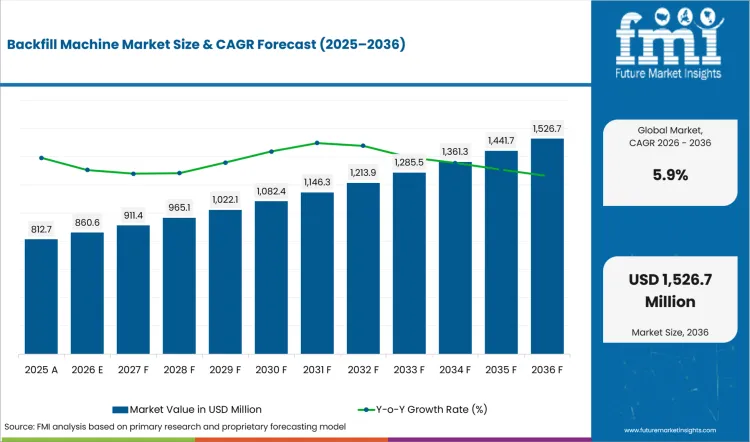
USD 860.6 million in 2026 and USD 1526.7 million by 2036 at a 5.9% CAGR.
Demand for backfill machine is projected to expand at 5.9% CAGR between 2026 and 2036, increasing valuation from USD 860.6 million in 2026 to USD 1526.7 million by 2036. Utility companies are increasingly turning to mechanized grading systems driven by the need to speed up project handovers and lower long-term site repair expenses. This shift is highlighted by Vermeer's May 2026 launch of the MTR726 microtrencher attachment, being able to dig pavement trenches down to 27 inches. Since deeper excavations demand extensive backfilling machinery to properly plug underground gaps, these specialized earthmoving tools have become essential for crews looking to rebuild critical roadways safely and dependably.
Buyers in the United States and Germany place a specialized strict validation records and attachment compatibility. Customers in China and India focus significantly on quick machinery delivery and reliable local dealer networks. The USA Census Bureau reported in June 2026 stating for the April total construction spending as estimated at an adjusted annual rate of nearly USD 2.2 trillion. Such sustained financial commitment directly influences the ongoing purchase of heavy equipment by regional infrastructure developers.
Key Takeaways for the Backfill Machine Market
- Demand for backfill machine is guided by strict municipal restoration timelines, with civil engineering firms favoring platforms returning soil quickly within defined regulatory compliance limits.
- Rental fleet is projected to garner 39.0% share of sales channel in 2026, influenced by contractors requiring short-term access for specific trenching jobs without permanent capital expenditure.
- Utility contractors are estimated to lead end use with 35.0% share in 2026, aided by continuous subsurface maintenance operations across aging urban service grids.
- Equipment mismatch and restricted urban access represent primary barriers limiting dependable material placement and efficient site-level implementation.
- Competition focusses on Vermeer, Ditch Witch, Caterpillar, Bobcat, Toro, Barreto Manufacturing, Astec, Mastenbroek, Inter-Drain, and Auger Torque, with providers differentiating based on attachment compatibility and equipment durability.
Analyst Perspective
“Mechanized trench backfill equipment delivers tangible financial returns by eliminating costly bottleneck delays during final utility restoration phases. Civil infrastructure contractors systematically evaluate compaction density targets and lateral side-discharge reach during equipment fleet sourcing audits. Long-term market expansion depends on integrating multi-functional attachment units with existing hydraulic carrier inventory to reduce jobsite congestion.”
- Nikhil Kaitwade, Principal Analyst for Industrial Equipment at Future Market Insights
How is Backfill Machine Market segmented?
The backfill machine industry is segmented by machine type, power - platform, application, end use, sales channel, and region.
The backfill machine sector is segmented by machine type, power - platform, application, end use, sales channel, and region. Machine type coverage includes trench backfillers and bedding sand spreaders serving distinct grading requirements. Power - platform coverage addresses self-propelled machines together with excavator attachments. Skid steer attachments and tractor-mounted units complete platform coverage across equipment fleets. Application coverage spans cable trench backfill, pipeline trench backfill, and utility duct works. End use coverage includes utility contractors, pipeline contractors, and municipal works. Sales channel assessment features rental fleet, direct equipment sale, and dealer network options. Regional coverage includes North America and Latin America together with Western Europe. Eastern Europe and East Asia extend analysis across established infrastructure industries. South Asia and Pacific with Middle East and Africa complete geographic assessment.
Why do trench backfillers lead machine type demand?
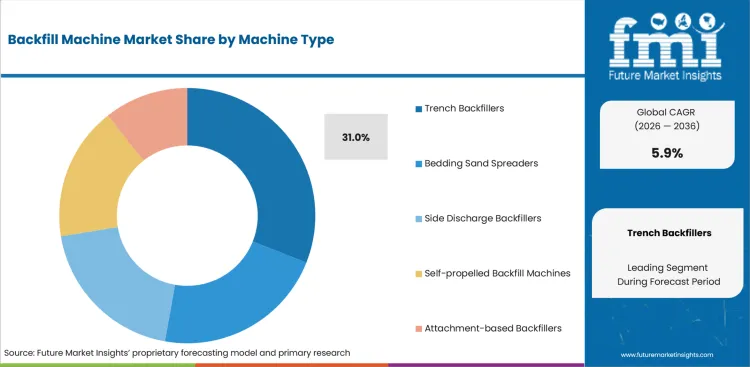
Trench backfillers are manufactured for primary tasks remaining following cable or civil work component placement underground. Contractors value selected units as a single machine keeps pace with excavation crews minimizing final closeout steps. Common Ground Alliance reported 221,717 unique damage reports to buried utilities during 2025 in its July 2026 release. Accurate soil return limits severe subsurface disruptions associated with blind equipment operation. Operators successfully move excavated material back into shape surface profiles and consistently refine work areas using fewer manual grading passes.
- In 2026, trench backfillers are anticipated to account for 31.0% share owing to capacity accelerating site restoration. Construction teams depend on specialized models minimizing hand labor during project handover.
- Self-propelled backfill machines provide contractors with independent mobility along extensive project routes. Operating without separate carrier vehicles maintains steady placement progress across long distances.
Why does the self-propelled platform stand out?
Self-propelled units work without depending on additional carrier vehicles, releasing other heavy machinery for parallel tasks. Independent operation proves highly useful for crews requiring quick lateral movement along lengthy trenches paired with steady material placement capabilities. USA Census Bureau estimated total construction spending at a seasonally adjusted annual rate of USD 2,210.2 billion during May 2026. Sustained capital allocation toward underground infrastructure demands standalone platforms maintaining consistent productivity across extensive job sites. Specific configurations assist jobsites facing attachment changeover delays or limited primary carrier availability.
- By power - platform, self-propelled platforms are set to garner 31.0% share in 2026 due to dedicated operational control during final restoration. Dedicated locomotion allows operators to maintain consistent speeds distributing soil evenly over buried utilities.
- Excavator attachments convert existing digging fleet assets into capable restoration tools upon underground pipe placement conclusion. Utilizing available prime movers lowers total capital expenditure for smaller contractors managing intermittent or localized repair assignments.
Where does cable trench backfill create repeat use?
Consistent repeat equipment usage originates from extensive power and telecommunication infrastructure installations. Work crews routinely open consecutive narrow pavement sections and require highly reliable surface restoration following duct or conduit placement. National Telecommunications and Information Administration allocated USD 42.45 billion in federal grants for high-speed internet infrastructure through its Broadband Equity Access and Deployment Program in March 2026. Federal financial injection promotes continuous equipment utilization across new fiber optic network expansions. Employing dedicated restoration machines helps precisely place bedding material, safely cover exposed underground lines, and leaving ground ready for final paving operations.
- Cable trench backfill is estimated to lead application with 31.0% share in 2026, guided by continuous global investments in fiber optic network expansions. Municipal guidelines compel utility providers to restore road surfaces rapidly minimizing traffic disruption.
- Pipeline trench backfill requires heavier equipment capable of moving larger volumes of excavated earth over deep transmission mains. Restoring expansive civil engineering cuts demands heavy pushing power properly compacting soil around large-diameter water or gas infrastructure.
Why do utility contractors lead end-use demand?
Commercial work for specialized firms inherently involves continuous pavement breaking and subsurface restoration across electric, water, gas, and communication projects. Firms require heavy equipment capable of spreading soil, grading surfaces accurately, and compacting material requiring fewer total labor hours. Associated Builders and Contractors projected construction industry needs to attract 349,000 net new workers in 2026 meeting anticipated service demand. Severe labor shortages force specialized utility firms to rely heavily on mechanized earthmoving machinery avoiding severe project delays. Versatile machines matching daily underground repair needs quickly become standard indispensable assets within active regional fleets.
- Based on end user, utility contractors are likely to hold 35.0% share in 2026 since being driven by continuous maintenance schedules across aging municipal service grids. Reliable restoration machinery enables specialized companies to meet strict municipal deadlines avoiding penalty fees.
- Pipeline contractors manage extensive cross-country transmission lines requiring heavy soil replacement volumes upon installation completion. Large-scale operators deploy heavy-duty mechanized solutions processing vast quantities of excavated earth efficiently across remote geographic stretches.
Why does rental fleet lead the sales channel?
Construction firms require specialized surface restoration machinery solely for specific jobs or extremely short municipal work windows. Renting allows operators to temporarily access side discharge models, attachment-based options, or dedicated standalone units without purchasing capital equipment sitting idle between active contracts. American Rental Association forecasted combined United States equipment rental industry reaching USD 83.5 billion in 2026. Contractors prioritize financial flexibility during uncertain economic periods favoring temporary leasing arrangements over permanent capital expenditure. Purchasing strategies permit site managers to precisely match machine specifications with exact trench dimensions and jobsite access constraints.
- Rental fleet is expected to secure 39.0% share, aided by contractors prioritizing financial flexibility during uncertain economic periods. Temporary leasing arrangements eliminate long-term maintenance burdens providing immediate access to modern machinery.
- Direct equipment sale appeals to large-scale civil engineering organizations managing continuous infrastructure development programs. Purchasing heavy machinery outright delivers superior long-term return on investment under consistently high utilization rates across all operating quarters.
What are drivers, restraints, and opportunities in Backfill Machine Market?
Cycle compression supports adoption across utility teams and restricted jobsite access slows enterprise conversion. Flexible leasing programs create expansion potential across changing infrastructure projects.
- Driver: Expanding underground utility installations and civil infrastructure upgrades compel contractors to minimize open-trench durations to satisfy strict municipal restoration deadlines. Dedicated earthmoving machinery accelerates soil return and surface leveling, helping construction crews restore active thoroughfares rapidly and reduce manual labor expenses.
- Restraint: Mismatched backfill attachments and primary carrier vehicles hinder material handling efficiency across restricted site footprints. Urban right-of-way boundaries and unforeseen subsurface obstacles limit heavy equipment movement, compelling site operators to adopt manual grading alternatives.
- Opportunity: Equipment rental fleets create substantial growth opportunities by offering flexible leasing options on side-discharge units and compact attachments. Commercial distribution networks gain competitive advantages through stocking multi-functional backfilling machinery tailored for distinct municipal trench dimensions.
Construction contractors must compress equipment schedules accommodating growing work volumes without expanding headcount. Associated Builders and Contractors reported in February 2026 stating for the United States construction employers requiring 349,000 net new workers to meet the current demand, pushing companies toward automated or highly mechanized alternatives. Machinery filling trenches and grading final surfaces helps crews compensate for severe labor shortages while maintaining required jobsite closeout speeds. Mechanized trench closure eliminates slower hand shoveling routines across critical utility assignments.
Unexpected site constraints restrict heavy machine movement across dense utility corridors. Common Ground Alliance analyzed over 221,000 unique damage reports in its July 2026 release of 2025 Damage Information Reporting Tool summary, highlighting how complex urban layouts cause frequent subsurface disruptions when heavy equipment operates blindly. Contractors often struggle maneuvering large self-propelled backfillers across tight streets, forcing operators to revert toward slower manual placement or mismatched small attachments delaying overall trench closure. Proper fleet sizing remains essential maintaining safe operations.
Contractors face shifting project scopes making permanent equipment purchases financially risky, prompting firms to optimize capital expenditure. The American Rental Association reported in its March 2026 economic forecast projecting United States construction and industrial equipment rental industry reaching USD 82.9 billion in 2026, demonstrating strong contractor reliance on leased machinery maintaining financial flexibility. Expanding rental fleet inventory gives contractors access to specialized side discharge units precisely when needed, creating versatile supply models supporting diverse infrastructure jobs without demanding full ownership.
How are country CAGRs aligned in Backfill Machine Market?
| Country or Market | CAGR |
|---|---|
| India | 7.8% |
| China | 7.0% |
| Australia | 5.6% |
| United Kingdom | 5.3% |
| United States | 5.0% |
| Germany | 4.6% |
| Japan | 4.3% |
Source: Future Market Insights analysis, 2026.
How do country-level CAGRs compare in Backfill Machine Market?
Country comparison shows a gradual step-down across the markets covered. India occupies the upper end of the range, followed by China. Australia and United Kingdom form the middle position across the disclosed comparison. United States, Germany, and Japan complete the lower forecast band. A 3.5 percentage-point spread separates India from Japan. Profiled rates reflect comparable expansion prospects under distinct implementation conditions.
- India is anticipated to lead the comparison and place South Asia at the upper forecast position.
- China is likely to follow India and maintain a limited difference from the leading rate.
- Australia and United Kingdom are expected to occupy the middle band under established enterprise equipment review practices.
- United States, Germany, and Japan are projected to complete the comparison under documentation-intensive approval systems.
- Profiled rates create a gradual downward slope without sharp national separation.
Markets carrying similar CAGRs are expected to present distinct entry conditions based on regulatory maintenance and supplier-record quality. Full report coverage includes North America, Latin America, Europe, East Asia, South Asia and Pacific, Middle East and Africa.
Country-wise Analysis
- Industry in India is forecast to rise at 7.8% CAGR between 2026 and 2036, backed by expansions in the municipal utility networks guiding demand for backfill machine. Ministry of Statistics and Programme Implementation reported tracking 1,847 central sector infrastructure projects in June 2026, creating continuous needs for soil placement machinery across major transport and logistics corridors.
- National Bureau of Statistics of China reported an 11.1% year-on-year decrease in investment in real estate development from January to February 2026, pushing contractors toward fleet optimization. Demand in China is estimated to increase at 7.0% CAGR during the study period, aided by municipal utility upgrades requiring efficient site restoration equipment.
- Sector in Australia is projected to record 5.6% CAGR from 2026 to 2036, guided by high-volume material placement requirements. Infrastructure Australia published its market capacity report in 2025 detailing a public infrastructure pipeline worth AUD 242 billion, compelling contractors to procure mechanized earthmoving assets.
- Office for National Statistics reported that total market sector investment in infrastructure increased 12.1% from 2024, guaranteeing continuous contractor activity across power and water networks. Sales in the United Kingdom are anticipated to scale at 5.3% CAGR during the forecast period, underpinned by ongoing utility grid upgrades requiring specialized backfill platforms.
- Adoption in the United States is set to scale at 5.0% CAGR during the study period as contractors prioritize faster jobsite closeouts and sustained infrastructure spending. USA Census Bureau reported in April 2026 noting for the total annual engineering and construction spending as forecast to remain near USD 2.2 trillion in 2026, maintaining stable baseline demand for trench restoration machinery.
- Industry in Germany is predicted to grow at 4.6% CAGR during the assessment period, backed by formal focus on reducing rework through mechanized attachments. German Federal Statistical Office recorded a 10.0% year-on-year rise in enterprise insolvency proceedings in November 2025, forcing civil engineering firms to maximize labor productivity on site.
- Civil works demand in Japan is forecast to scale at 4.3% CAGR during the study period, constrained by tight urban work areas requiring compact backfill attachments. Ministry of Land, Infrastructure, Transport and Tourism detailed automated machinery adoption in its July 2026 for White Paper to offset severe construction labor shortages.
Who are notable companies in Backfill Machine Market?
Vermeer, Ditch Witch, Caterpillar, Bobcat, Toro, Barreto Manufacturing, Astec, Mastenbroek, Inter-Drain, and Auger Torque are the key companies contributing to this market.
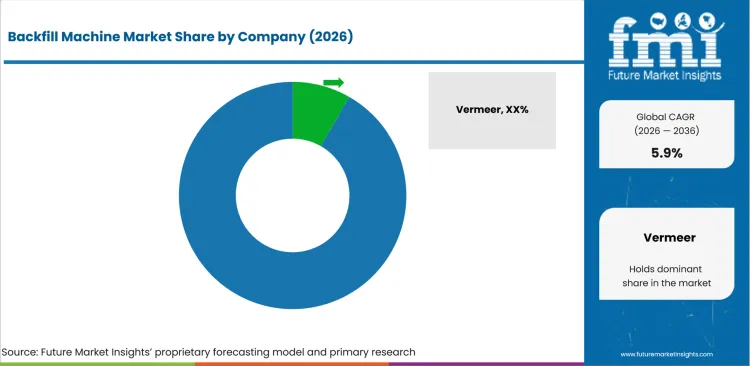
Competition in the sector centers on equipment durability and attachment flexibility across enterprise programs. Construction groups use application laboratories and proprietary technical content during customer development. Model-led specialists focus on candidate comparison across recipe constraints and sensory requirements. Discovery providers connect computational screening with physical validation and ingredient development. Buyer review covers data ownership and specialist access during implementation and renewal.
- Vermeer and Ditch Witch compete by application knowledge connected with customer formulation services. Product teams assess response quality across reformulation work and technical problem resolution.
- Caterpillar and Bobcat focus on sensory expertise connected with controlled development tools. Food companies assess evidence depth across taste and texture decisions during candidate review.
- Toro competes by model-led formulation across product briefs and technical constraints. Customer teams assess output transparency and physical test handoff during platform review.
- Astec and Mastenbroek are working on computational ingredient discovery across health and food applications. Inter-Drain adds peptide discovery supported by clinical development and formulation guidance.
Competitive Benchmarking: Backfill Machine Market
| Company | Trench Closure Speed | Platform Fit | Material Placement Control | Service Reach |
|---|---|---|---|---|
| Vermeer | High | High | Medium | Global |
| Ditch Witch | High | High | Medium | Global |
| Caterpillar | High | High | High | Global |
| Bobcat | High | High | Medium | Global |
| Toro | High | Medium | High | Selected global programs |
| Barreto Manufacturing | Medium | High | High | International partnerships |
| Astec | Medium | High | High | International partnerships |
| Mastenbroek | Medium | High | High | International partnerships |
Source: Future Market Insights competitive analysis, 2026.
Key Developments in Backfill Machine Market
- In January 2026, Toro announced the eDingo 500 electric ultra buggy and Dingo TX 1300 compact loaders model. Company information connected battery-powered units with reduced jobsite emissions across material handling and trench closure tasks.
- In March 2026, Bobcat unveiled the Loader Evolution compact loader series. Company information connected machinery updates with an artificial intelligence support system delivering real-time operational intelligence during grading work.
- In May 2026, Vermeer introduced the MTR726 microtrencher attachment. Company information connected deeper-cutting capabilities with faster fiber optic installation and subsequent soil placement requirements.
Backfill Machine Market Report Scope
| Coverage field | Report scope |
|---|---|
| Market breakdown | Machine type, power - platform, application, end use, sales channel, and region. |
| Market Definition | Backfill machines return material to open work areas, spread it along trenches, grade surfaces, compact where required, and assist crews in reaching cleaner jobsite finishes. Generic earthmoving equipment without specific trenching capabilities is excluded. |
| Regions Covered | North America, Latin America, Western Europe, Eastern Europe, East Asia, South Asia and Pacific, Middle East and Africa. |
| Countries Covered | India, China, United States, United Kingdom, Germany and more than 25 additional countries complete full report coverage. |
| Key Companies Profiled | Vermeer, Ditch Witch, Caterpillar, Bobcat, Toro, Barreto Manufacturing, Astec, Mastenbroek, Inter-Drain, and Auger Torque. |
| Forecast Period | 2026 to 2036 |
| Approach | Hybrid bottom-up and top-down methodology uses segment shares and country CAGRs. Company activity and buyer adoption support final market reconciliation. |
Source: Future Market Insights analysis, 2026.
Backfill Machine Market - Research Methodology
| Method | Approach |
|---|---|
| Primary Research | FMI analysts gathered input from manufacturers, service providers, technology developers, distributors, end users, procurement teams, and subject-matter experts. Interviews examined purchasing decisions, product or service evaluation, adoption barriers, approval requirements, pricing considerations, and expectations for technical or commercial support. Respondents were also asked what evidence is required before a trial, pilot, or initial order develops into regular purchasing. |
| Desk Research | Desk research covered government statistics, regulatory publications, trade data, industry associations, technical literature, standards, company filings, product information, and official corporate announcements. Sources were reviewed for relevance, publication date, geographic coverage, and consistency with the defined market scope. Claims relating to performance, applications, approvals, capacity, investment, and commercial activity were retained only when supported by credible public evidence. |
| Market Sizing and Forecasting | The market model combined the baseline value with historical performance, segment structure, pricing and volume indicators, adoption levels, company participation, and country-level demand conditions. Forecast assumptions considered economic activity, investment trends, regulatory developments, technology adoption, purchasing cycles, supply availability, and barriers to wider market use. Segment and regional estimates were reconciled before the final market total was calculated. |
| Data Validation | Estimates were checked against multiple independent indicators, including public data, company activity, trade patterns, industry developments, and findings from primary interviews. Validation also tested whether products, services, applications, and company revenues fell within the defined market boundaries. Adjacent categories, unsupported claims, overlapping revenues, and activities without direct market relevance were excluded to reduce double counting and maintain consistency across segments and countries. |
Source: Future Market Insights analysis, 2026.
Backfill Machine Market by Segments
Backfill Machine Market segmented by Machine Type:
- Trench Backfillers
- Self-propelled Backfill Machines
- Bedding Sand Spreaders
- Side Discharge Backfillers
- Attachment-based Backfillers
Backfill Machine Market segmented by Power - Platform:
- Self-propelled
- Excavator Attachment
- Skid Steer Attachment
- Tractor-mounted
Backfill Machine Market segmented by Application:
- Cable Trench Backfill
- Pipeline Trench Backfill
- Utility Duct Works
- Road - Rail Civil Works
Backfill Machine Market segmented by End Use:
- Utility Contractors
- Pipeline Contractors
- Civil Contractors
- Municipal Works
Backfill Machine Market segmented by Sales Channel:
- Rental Fleet
- Direct Equipment Sale
- Dealer Network
Backfill Machine Market segmented by Region:
- North America
- United States
- Canada
- Latin America
- Brazil
- Mexico
- Argentina
- Chile
- Western Europe
- Germany
- France
- United Kingdom
- Italy
- Spain
- Benelux
- Nordics
- Eastern Europe
- Poland
- Czech Republic
- Romania
- Hungary
- East Asia
- China
- Japan
- South Korea
- South Asia and Pacific
- India
- ASEAN
- Australia and New Zealand
- Middle East and Africa
- GCC Countries
- South Africa
- Türkiye
- Israel
Research Sources and Bibliography
- American Rental Association. (2026, March 2). ARA’s latest North American economic forecast released at The ARA Show.
- Associated Builders and Contractors. (2026, February 10). Addressing the construction industry labor shortage.
- Common Ground Alliance. (2026, July 21). CGA releases 2025 DIRT data summary, trends.
- German Federal Statistical Office. (2025, November). Enterprise insolvency proceedings statistics.
- Infrastructure Australia. (2025). Infrastructure Market Capacity 2025 Report.
- Ministry of Land, Infrastructure, Transport and Tourism. (2026, July 17). Overview of the 2026 White Paper on Land, Infrastructure, Transport and Tourism.
- Ministry of Statistics and Programme Implementation. (2026, July 28). Flash Report on Central Sector Infrastructure Projects.
- National Bureau of Statistics of China. (2026, March 17). Investment in Real Estate Development from January to February 2026.
- Office for National Statistics. (2026, July 1). Infrastructure in the UK, investment and net stocks: July 2026.
- USA Census Bureau. (2026, July 1). Monthly construction spending, May 2026.
- American Rental Association. (2026, May 8). ARA releases updated equipment, event economic forecasts for North America.
- Associated Builders and Contractors. (2026, February 10). Addressing the construction industry labor shortage.
- Common Ground Alliance. (2026, July 21). CGA releases 2025 DIRT data summary, trends.
- Office of Inspector General. (2026, March 19). NTIA broadband programs: Semiannual status report. USA Department of Commerce.
- USA Census Bureau. (2026, July 1). Monthly construction spending, May 2026.
- Vermeer Corporation. (2026, May 18). Vermeer expands microtrenching lineup with deeper-cutting MTR726 attachment.
- USA Census Bureau. (2026, June 1). Monthly construction spending, April 2026.
- Federal Register. (2024, January 22). The Infrastructure Investment and Jobs Act: Prevention and Elimination of Digital Discrimination.
This bibliography is provided for reader reference and is not exhaustive. The full report contains the complete reference list and detailed citations.
This Report Answers
- How do segments influence demand across machine type and application with end user coverage?
- What criteria guide construction crews evaluating mechanized grading machinery prior to site deployment?
- Why do country CAGRs differ across the key countries for the industry?
- What companies compete depending on trenching knowledge and attachment-led grading capabilities?
- How are forecasts validated through bottom-up and top-down analysis using independent indicators?
- What evidence supports civil contractor review prior to multi-site equipment procurement?
- Why do trench dimensions and jobsite access influence platform selection?
- How does poor site planning limit return across grading and restoration work?
- What company capabilities improve long-term confidence and recurring machinery rental?
- How do safety regulations influence approval across project management and operating teams?
Frequently Asked Questions
How big is the Backfill Machine Market in 2026?
The backfill machine market is valued at USD 860.6 million in 2026 and is forecast to reach USD 1526.7 million by 2036. Growth is supported by strict municipal restoration timelines that push utility companies toward mechanized grading systems for faster project handovers and reduced long-term site repair costs.
What is the CAGR of the Backfill Machine Market from 2026 to 2036?
The backfill machine market grows at a CAGR of 5.9% between 2026 and 2036, supported by expanding underground utility installations and civil infrastructure upgrades that compel contractors to minimize open-trench durations and meet strict municipal restoration deadlines across regional infrastructure programs.
Which end use leads the Backfill Machine Market?
Utility contractors account for 35.0% of the backfill machine market by end use in 2026, driven by continuous subsurface maintenance operations across aging urban service grids that require reliable restoration machinery to meet strict municipal deadlines and avoid penalty fees.
How much will the Backfill Machine Market add between 2026 and 2036?
The backfill machine market is set to add USD 666.1 million between 2026 and 2036, growing from USD 860.6 million to USD 1,526.7 million as expanding underground utility installations and civil infrastructure upgrades sustain demand for mechanized trench restoration equipment worldwide.
Who are the leading companies in the Backfill Machine Market?
Ten companies lead the backfill machine market, including Vermeer, Ditch Witch, Caterpillar, Bobcat, Toro, Barreto Manufacturing, Astec, Mastenbroek, Inter-Drain, and Auger Torque, competing through trench closure speed, platform fit, and material placement control across global service networks.
Preview the report firsthand - request a free sample
Get SampleGet the brochure for pricing and purchase details.
Get PDFTable of Content
- Key Takeaways
- Market Size and CAGR
- Top Growth Driver
- Fastest Growing Segment
- Leading Region
- Key Companies
- Emerging Opportunities
- Executive Summary
- Global Market Outlook
- Demand-side Trends
- Supply-side Trends
- Technology Roadmap Analysis
- Analysis and Recommendations
- Analyst Perspective (What is happening? Why now? What should investors know?)
- Key Questions Answered
- How large is the market?
- What is the CAGR?
- What are key trends?
- Which region dominates?
- Who are the leaders?
- Market Overview
- Market Coverage / Taxonomy
- Market Definition / Scope / Limitations
- Research Methodology
- Chapter Orientation
- Analytical Lens and Working Hypotheses
- Market Structure, Signals, and Trend Drivers
- Benchmarking and Cross-market Comparability
- Market Sizing, Forecasting, and Opportunity Mapping
- Research Design and Evidence Framework
- Desk Research Programme (Secondary Evidence)
- Expert Input and Fieldwork (Primary Evidence)
- Tooling, Models, and Reference Databases
- Data Engineering and Model Build
- Quality Assurance and Audit Trail
- Market Background
- Market Dynamics (Drivers, Restraints, Opportunity, Trends)
- Scenario Forecast (Optimistic, Likely, Conservative)
- Impact Analysis
- AI Impact
- Sustainability Impact
- Regulatory Impact
- Technology Impact
- Consumer / Buyer Analysis
- Purchase Drivers
- Adoption Barriers
- Buyer Journey
- Opportunity Map Analysis
- Product Life Cycle Analysis
- Supply Chain Analysis
- Investment Feasibility Matrix
- Value Chain Analysis
- PESTLE and Porter's Analysis
- Regulatory Landscape
- Regional Parent Market Outlook
- Production and Consumption Statistics
- Import and Export Statistics
- Global Market Analysis and Forecast, 2021 to 2036
- Historical Market Size Value (USD Million) & Volume (Unit) Analysis, 2021 to 2025
- Current and Future Market Size Value (USD Million) & Volume (Unit) Projections, 2026 to 2036
- Y-o-Y Growth Trend Analysis
- Absolute $ Opportunity Analysis
- Global Market Pricing Analysis, 2021 to 2036
- Global Market Analysis and Forecast, By Machine Type, 2021 to 2036
- Introduction / Key Findings
- Historical Market Size Value (USD Million) & Volume (Unit) Analysis By Machine Type, 2021 to 2025
- Current and Future Market Size Value (USD Million) & Volume (Unit) Analysis and Forecast By Machine Type, 2026 to 2036
- Trench Backfillers
- Bedding Sand Spreaders
- Side Discharge Backfillers
- Self-propelled Backfill Machines
- Attachment-based Backfillers
- Trench Backfillers
- Y-o-Y Growth Trend Analysis By Machine Type, 2021 to 2025
- Absolute $ Opportunity Analysis By Machine Type, 2026 to 2036
- Global Market Analysis and Forecast, By Power - Platform, 2021 to 2036
- Introduction / Key Findings
- Historical Market Size Value (USD Million) & Volume (Unit) Analysis By Power - Platform, 2021 to 2025
- Current and Future Market Size Value (USD Million) & Volume (Unit) Analysis and Forecast By Power - Platform, 2026 to 2036
- Self-propelled
- Skid Steer Attachment
- Excavator Attachment
- Tractor-mounted
- Self-propelled
- Y-o-Y Growth Trend Analysis By Power - Platform, 2021 to 2025
- Absolute $ Opportunity Analysis By Power - Platform, 2026 to 2036
- Global Market Analysis and Forecast, By Application, 2021 to 2036
- Introduction / Key Findings
- Historical Market Size Value (USD Million) & Volume (Unit) Analysis By Application, 2021 to 2025
- Current and Future Market Size Value (USD Million) & Volume (Unit) Analysis and Forecast By Application, 2026 to 2036
- Cable Trench Backfill
- Pipeline Trench Backfill
- Utility Duct Works
- Road / Rail Civil Works
- Cable Trench Backfill
- Y-o-Y Growth Trend Analysis By Application, 2021 to 2025
- Absolute $ Opportunity Analysis By Application, 2026 to 2036
- Global Market Analysis and Forecast, By End Use, 2021 to 2036
- Introduction / Key Findings
- Historical Market Size Value (USD Million) & Volume (Unit) Analysis By End Use, 2021 to 2025
- Current and Future Market Size Value (USD Million) & Volume (Unit) Analysis and Forecast By End Use, 2026 to 2036
- Utility Contractors
- Pipeline Contractors
- Civil Contractors
- Municipal Works
- Utility Contractors
- Y-o-Y Growth Trend Analysis By End Use, 2021 to 2025
- Absolute $ Opportunity Analysis By End Use, 2026 to 2036
- Global Market Analysis and Forecast, By Sales Channel, 2021 to 2036
- Introduction / Key Findings
- Historical Market Size Value (USD Million) & Volume (Unit) Analysis By Sales Channel, 2021 to 2025
- Current and Future Market Size Value (USD Million) & Volume (Unit) Analysis and Forecast By Sales Channel, 2026 to 2036
- Rental Fleet
- Direct Equipment Sale
- Dealer Network
- Rental Fleet
- Y-o-Y Growth Trend Analysis By Sales Channel, 2021 to 2025
- Absolute $ Opportunity Analysis By Sales Channel, 2026 to 2036
- Global Market Analysis and Forecast, By Region, 2021 to 2036
- Introduction
- Historical Market Size Value (USD Million) & Volume (Unit) Analysis By Region, 2021 to 2025
- Current Market Size Value (USD Million) & Volume (Unit) Analysis and Forecast By Region, 2026 to 2036
- North America
- Latin America
- Western Europe
- Eastern Europe
- East Asia
- South Asia and Pacific
- Middle East & Africa
- Market Attractiveness Analysis By Region
- North America Market Analysis and Forecast, By Country, 2021 to 2036
- Historical Market Size Value (USD Million) & Volume (Unit) Trend Analysis By Market Taxonomy, 2021 to 2025
- Market Size Value (USD Million) & Volume (Unit) Forecast By Market Taxonomy, 2026 to 2036
- By Country
- USA
- Canada
- By Machine Type
- By Power - Platform
- By Application
- By End Use
- By Sales Channel
- By Country
- Market Attractiveness Analysis
- By Country
- By Machine Type
- By Power - Platform
- By Application
- By End Use
- By Sales Channel
- Key Takeaways
- Latin America Market Analysis and Forecast, By Country
- Historical Market Size Value (USD Million) & Volume (Unit) Trend Analysis By Market Taxonomy, 2021 to 2025
- Market Size Value (USD Million) & Volume (Unit) Forecast By Market Taxonomy, 2026 to 2036
- By Country
- Brazil
- Mexico
- Chile
- Rest of Latin America
- By Machine Type
- By Power - Platform
- By Application
- By End Use
- By Sales Channel
- By Country
- Market Attractiveness Analysis
- By Country
- By Machine Type
- By Power - Platform
- By Application
- By End Use
- By Sales Channel
- Key Takeaways
- Western Europe Market Analysis and Forecast, By Country
- Historical Market Size Value (USD Million) & Volume (Unit) Trend Analysis By Market Taxonomy, 2021 to 2025
- Market Size Value (USD Million) & Volume (Unit) Forecast By Market Taxonomy, 2026 to 2036
- By Country
- Germany
- UK
- Italy
- Spain
- France
- Nordic
- BENELUX
- Rest of Western Europe
- By Machine Type
- By Power - Platform
- By Application
- By End Use
- By Sales Channel
- By Country
- Market Attractiveness Analysis
- By Country
- By Machine Type
- By Power - Platform
- By Application
- By End Use
- By Sales Channel
- Key Takeaways
- Eastern Europe Market Analysis and Forecast, By Country
- Historical Market Size Value (USD Million) & Volume (Unit) Trend Analysis By Market Taxonomy, 2021 to 2025
- Market Size Value (USD Million) & Volume (Unit) Forecast By Market Taxonomy, 2026 to 2036
- By Country
- Russia
- Poland
- Hungary
- Balkan & Baltic
- Rest of Eastern Europe
- By Machine Type
- By Power - Platform
- By Application
- By End Use
- By Sales Channel
- By Country
- Market Attractiveness Analysis
- By Country
- By Machine Type
- By Power - Platform
- By Application
- By End Use
- By Sales Channel
- Key Takeaways
- East Asia Market Analysis and Forecast, By Country
- Historical Market Size Value (USD Million) & Volume (Unit) Trend Analysis By Market Taxonomy, 2021 to 2025
- Market Size Value (USD Million) & Volume (Unit) Forecast By Market Taxonomy, 2026 to 2036
- By Country
- China
- Japan
- South Korea
- By Machine Type
- By Power - Platform
- By Application
- By End Use
- By Sales Channel
- By Country
- Market Attractiveness Analysis
- By Country
- By Machine Type
- By Power - Platform
- By Application
- By End Use
- By Sales Channel
- Key Takeaways
- South Asia and Pacific Market Analysis and Forecast, By Country
- Historical Market Size Value (USD Million) & Volume (Unit) Trend Analysis By Market Taxonomy, 2021 to 2025
- Market Size Value (USD Million) & Volume (Unit) Forecast By Market Taxonomy, 2026 to 2036
- By Country
- India
- ASEAN
- Australia & New Zealand
- Rest of South Asia and Pacific
- By Machine Type
- By Power - Platform
- By Application
- By End Use
- By Sales Channel
- By Country
- Market Attractiveness Analysis
- By Country
- By Machine Type
- By Power - Platform
- By Application
- By End Use
- By Sales Channel
- Key Takeaways
- Middle East & Africa Market Analysis and Forecast, By Country
- Historical Market Size Value (USD Million) & Volume (Unit) Trend Analysis By Market Taxonomy, 2021 to 2025
- Market Size Value (USD Million) & Volume (Unit) Forecast By Market Taxonomy, 2026 to 2036
- By Country
- Kingdom of Saudi Arabia
- Other GCC Countries
- Türkiye
- South Africa
- Other African Union
- Rest of Middle East & Africa
- By Machine Type
- By Power - Platform
- By Application
- By End Use
- By Sales Channel
- By Country
- Market Attractiveness Analysis
- By Country
- By Machine Type
- By Power - Platform
- By Application
- By End Use
- By Sales Channel
- Key Takeaways
- Key Countries Market Analysis
- USA
- Pricing Analysis
- Market Share Analysis, 2025
- By Machine Type
- By Power - Platform
- By Application
- By End Use
- By Sales Channel
- Canada
- Pricing Analysis
- Market Share Analysis, 2025
- By Machine Type
- By Power - Platform
- By Application
- By End Use
- By Sales Channel
- Mexico
- Pricing Analysis
- Market Share Analysis, 2025
- By Machine Type
- By Power - Platform
- By Application
- By End Use
- By Sales Channel
- Brazil
- Pricing Analysis
- Market Share Analysis, 2025
- By Machine Type
- By Power - Platform
- By Application
- By End Use
- By Sales Channel
- Chile
- Pricing Analysis
- Market Share Analysis, 2025
- By Machine Type
- By Power - Platform
- By Application
- By End Use
- By Sales Channel
- Germany
- Pricing Analysis
- Market Share Analysis, 2025
- By Machine Type
- By Power - Platform
- By Application
- By End Use
- By Sales Channel
- UK
- Pricing Analysis
- Market Share Analysis, 2025
- By Machine Type
- By Power - Platform
- By Application
- By End Use
- By Sales Channel
- Italy
- Pricing Analysis
- Market Share Analysis, 2025
- By Machine Type
- By Power - Platform
- By Application
- By End Use
- By Sales Channel
- Spain
- Pricing Analysis
- Market Share Analysis, 2025
- By Machine Type
- By Power - Platform
- By Application
- By End Use
- By Sales Channel
- France
- Pricing Analysis
- Market Share Analysis, 2025
- By Machine Type
- By Power - Platform
- By Application
- By End Use
- By Sales Channel
- India
- Pricing Analysis
- Market Share Analysis, 2025
- By Machine Type
- By Power - Platform
- By Application
- By End Use
- By Sales Channel
- ASEAN
- Pricing Analysis
- Market Share Analysis, 2025
- By Machine Type
- By Power - Platform
- By Application
- By End Use
- By Sales Channel
- Australia & New Zealand
- Pricing Analysis
- Market Share Analysis, 2025
- By Machine Type
- By Power - Platform
- By Application
- By End Use
- By Sales Channel
- China
- Pricing Analysis
- Market Share Analysis, 2025
- By Machine Type
- By Power - Platform
- By Application
- By End Use
- By Sales Channel
- Japan
- Pricing Analysis
- Market Share Analysis, 2025
- By Machine Type
- By Power - Platform
- By Application
- By End Use
- By Sales Channel
- South Korea
- Pricing Analysis
- Market Share Analysis, 2025
- By Machine Type
- By Power - Platform
- By Application
- By End Use
- By Sales Channel
- Russia
- Pricing Analysis
- Market Share Analysis, 2025
- By Machine Type
- By Power - Platform
- By Application
- By End Use
- By Sales Channel
- Poland
- Pricing Analysis
- Market Share Analysis, 2025
- By Machine Type
- By Power - Platform
- By Application
- By End Use
- By Sales Channel
- Hungary
- Pricing Analysis
- Market Share Analysis, 2025
- By Machine Type
- By Power - Platform
- By Application
- By End Use
- By Sales Channel
- Kingdom of Saudi Arabia
- Pricing Analysis
- Market Share Analysis, 2025
- By Machine Type
- By Power - Platform
- By Application
- By End Use
- By Sales Channel
- Türkiye
- Pricing Analysis
- Market Share Analysis, 2025
- By Machine Type
- By Power - Platform
- By Application
- By End Use
- By Sales Channel
- South Africa
- Pricing Analysis
- Market Share Analysis, 2025
- By Machine Type
- By Power - Platform
- By Application
- By End Use
- By Sales Channel
- USA
- Market Structure Analysis
- Competition Dashboard
- Competition Benchmarking
- Market Share Analysis of Top Players
- By Regional
- By Machine Type
- By Power - Platform
- By Application
- By End Use
- By Sales Channel
- Emerging Startups
- Innovation Benchmarking
- Competition Analysis
- Competition Deep Dive
- Vermeer
- Overview
- Product Portfolio
- Profitability by Market Segments
- Sales Footprint
- Strategy Overview
- Marketing Strategy
- Product Strategy
- Channel Strategy
- Ditch Witch
- Caterpillar
- Bobcat
- Toro
- Barreto Manufacturing
- Astec
- Mastenbroek
- Inter-Drain
- Auger Torque
- Vermeer
- Case Studies
- Success Stories
- Recent Developments
- Competition Deep Dive
- Assumptions & Acronyms Used


