- Market Size (2026)
- USD 3.24 Bn
- Forecast (2036)
- USD 5.68 Bn
- CAGR (2026 to 2036)
- 5.8%
How Big Is the Badminton Equipment Market in 2026?
The global badminton equipment market is valued at USD 3.24 billion in 2026, up from USD 3.07 billion in 2025, and is projected by Future Market Insights (FMI) to reach USD 5.68 billion by 2036, expanding at a 5.8% CAGR from 2026 to 2036 and generating USD 2.44 billion in incremental revenue over the 10-year forecast period.
| Market Metric | Valuation / Share / Forecast Benchmark |
|---|---|
| 2025 Market Size (Historical) | USD 3.07 billion |
| 2026 Market Size (Estimated) | USD 3.24 billion |
| 2036 Market Size (Projected) | USD 5.68 billion |
| Compound Annual Growth Rate (2026 to 2036) | 5.8% CAGR |
| Incremental Dollar Opportunity (2026 to 2036) | USD 2.44 billion |
| Dominant Product Type (2026 to 2036 Share) | Rackets (37.3% in 2026, easing to 35.6% by 2036) |
| Leading & Fastest-Growing Player Levels | Recreational and Social Players (52.8% share in 2026, 5.0% CAGR) │ School and Junior Programs (8.1% CAGR) |
| Leading & Fastest-Growing Channels | Specialty Racket Sports Stores (38.3% share in 2026) │ Online Retail (7.3% CAGR) |
| Largest Country Markets (2026 Global Share) | Japan (9.6%), Indonesia (5.6%), Malaysia (4.0%) |
| Fastest-Growing Country Markets (2026 to 2036) | Indonesia (7.2% CAGR), France (6.6% CAGR), Thailand (6.4% CAGR) |
| Leading Tier-1 Companies | Yonex, Victor Rackets Industrial, Li-Ning, Mizuno |
Source: Future Market Insights analysis of the badminton equipment market, 2026.
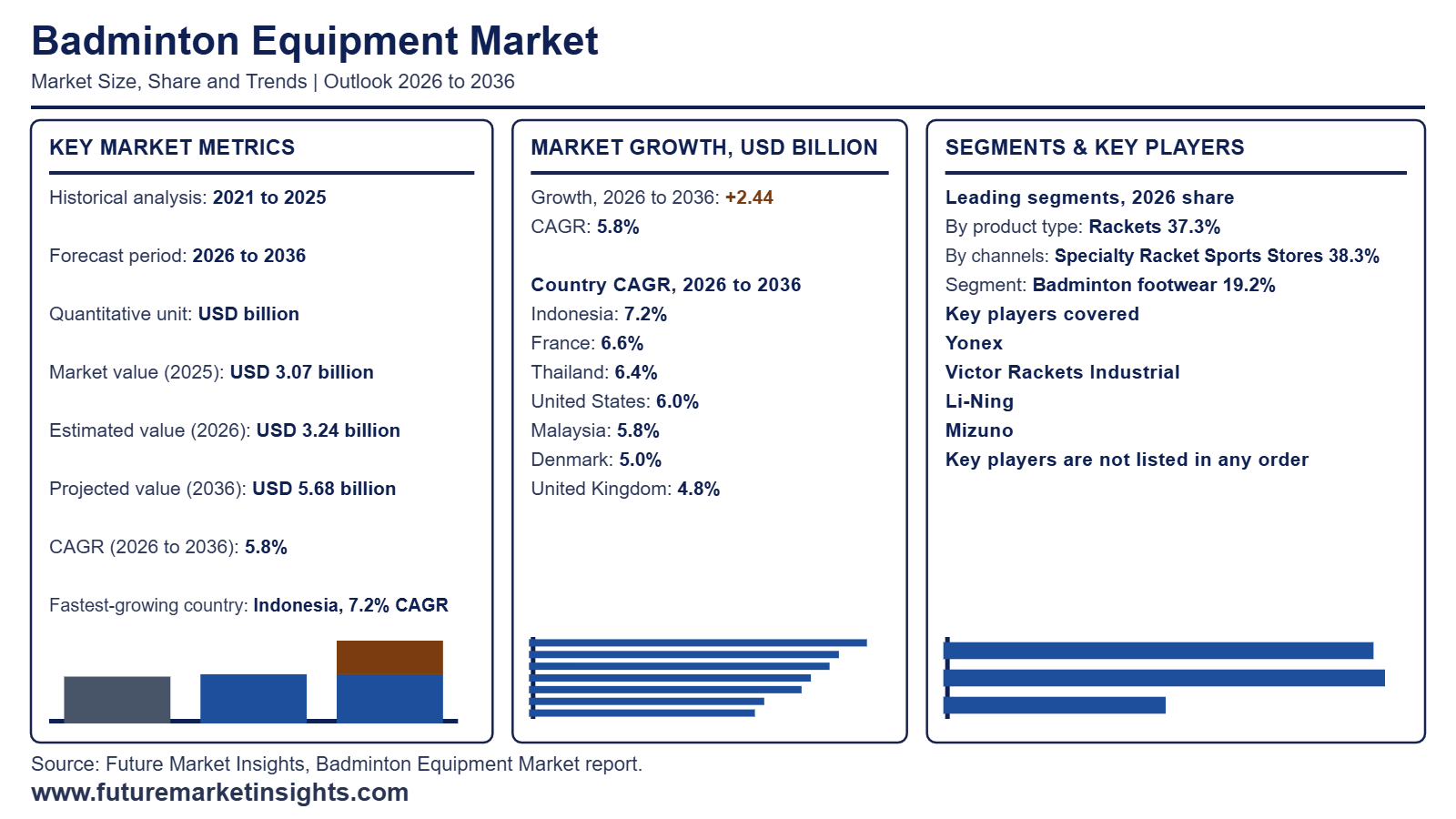
Executive Market Overview
Preference for badminton equipment is driven by wider international success in the sport along with growing school and junior programs. Japan is the largest of the ten core countries, with 9.6% of global sales in 2026 by FMI estimates, and Indonesia is next at 5.6%. Rackets represent 37.3% of sales, and specialty racket sports stores handle 38.3%. Yonex (November 2026) reported sales of badminton goods at JPY 56.10 billion (USD 352.0 million) for April to September 2026, up 14.8% from a year earlier. The company linked the gain to players from a wider range of countries reaching the top of the sport. Youth play is growing as well, as 483,000 children in England played badminton weekly in the latest Sport England survey, cited by the Lancashire Evening Post (January 2026).
Players buy rackets and shuttlecocks, along with court shoes, to match the level of play. Shuttles are a repeat purchase for every club session. Shuttle costs are rising sharply. One dozen Yonex Aerosensa 700 feather shuttles sells for JPY 9,020 (USD 56.6), per Chitose Sports (November 2026). The retailer cites a shortage of waterfowl feathers among the causes. FMI projects school and junior programs to expand at an 8.1% CAGR and online retail at 7.3%, both faster than the 5.8% overall market CAGR. Recreational and social players, the largest buyer group, are expected to grow at 5.0%. Market sizing covers badminton rackets and feather and synthetic shuttlecocks, along with badminton footwear, strings, grips, bags, nets and posts. General sports apparel is excluded, as are court flooring and lighting, shuttle launch machines, coaching services and tennis, squash or padel equipment.
Analyst Perspective
"Badminton brands are adding premium rackets and tournament-grade synthetic shuttles, so revenue is likely to grow faster than the number of active players. Feather supply is the clearest risk to sales, since higher duck and goose feather costs can push shuttle prices beyond what club players are willing to pay."
- Rahul Pandita, Principal Consultant, Future Market Insights (FMI)
Major Market Trends and Insights
Synthetic Shuttlecocks Move into Sanctioned Competition: Governing bodies are testing alternatives to feather shuttles. The Badminton World Federation (April 2026) approved the VICTOR New Carbon Sonic Max and YONEX CROSSWIND 70 synthetic shuttlecocks for BWF Grade 3 and Junior International tournaments. The trial collects performance data and feedback from players and officials to inform any future use at top-tier events. Advance sales of the VICTOR New Carbon Sonic Max in Germany were announced two months earlier, per Racket World (February 2026).
A New Scoring System Changes Match Formats: Badminton scoring rules are changing. BWF members approved the 3×15 scoring system at the 87th Annual General Meeting, according to the Badminton World Federation (April 2026). Under the new laws, each game is played to 15 points with a cap of 21, per a second Badminton World Federation (April 2026) release. Shorter games may change shuttle use per match, which matters for buyers in the sports event management market.
Brand Retail and Showrooms Expand Outside Japan: Equipment makers are opening direct channels to players. Yonex (November 2026) reports the opening of a Taipei showroom, the company's fourth such store globally, offering racket testing, foot measurement and stringing. Overseas markets made up 83.0% of sales of badminton goods at Yonex in the six months to September 2026, according to the same report.
What Are the Main Drivers, Restraints, and Opportunities?
Rising participation in Asia and Europe and new junior programs are lifting demand, but feather supply problems are raising shuttle prices and could slow casual play. Synthetic shuttles and online retail offer the clearest growth.
Driver: Wider International Success and Junior Programs
Top-level success is spreading to new countries. Yonex (November 2026) reports that 10 countries or regions reached the semifinals at the 2026 World Championships. The same report notes that Alex Lanier became the first French man to win the world title. Grassroots programs are adding new players. Badminton England launched Shuttle Stars for children aged 7 to 11 in January 2026, and the body's membership reached 35,427 in the 2025/26 season (Lancashire Evening Post, January 2026).
Restraint: Feather Shortages and Shuttle Price Inflation
Feather shuttles depend on duck and goose by-products, and supply has tightened. France 24 (August 2025) reported, citing AFP, that shuttlecock prices more than doubled in a few months and that one high-quality shuttle needs 16 feathers. BWF Secretary General Thomas Lund said in the same report that the federation was concerned about this barrier to participation. Price rises continued into 2026. Chitose Sports (November 2026) reports growing sales of lower-cost practice shuttles at JPY 4,290 to JPY 5,500 (USD 26.9 to USD 34.5) per dozen as buyers react to higher prices.
Opportunity: Synthetic Shuttles and Southeast Asian Growth
Synthetic shuttles give clubs a lower-cost and steadier supply. The BWF approved two synthetic models for selected tournaments in April 2026, and FMI expects clubs to test these shuttles in league play. FMI projects Indonesia to expand at a 7.2% CAGR and Thailand at 6.4%, two of the three fastest rates among the ten core countries. Online retail is expected to reach 37.1% of global sales by 2036, the largest share of any channel by then.
How Is the Badminton Equipment Market Segmented?
The global badminton equipment market is segmented by product type, player level, distribution channel, and region, with all products measured in sales units for volume comparison.
| Segmentation Axis | Sub-Segments Covered | 2026 Leading Segment & Share | Main Growth Benchmark (2026 to 2036) |
|---|---|---|---|
| Product Type | Rackets, Shuttlecocks, Badminton Footwear, Strings and Grips, Bags, Nets and Court Accessories | Rackets (37.3% share) | Shuttlecocks grow fastest at a 6.3% CAGR |
| Player Level | Recreational and Social Players, Club and League Players, Professional and Elite Players, School and Junior Programs | Recreational and Social Players (52.8% share) | School and Junior Programs grow fastest at an 8.1% CAGR |
| Distribution Channel | Specialty Racket Sports Stores, Online Retail, Sporting Goods and Mass Retail, Clubs, Academies and Institutional Supply | Specialty Racket Sports Stores (38.3% share) | Online Retail grows fastest at a 7.3% CAGR |
| Region | North America, Latin America, Europe, East Asia, South Asia & Pacific, Middle East & Africa | East Asia (52.5% global share in 2026) | Indonesia and France grow fastest at 7.2% and 6.6% CAGR |
Source: Future Market Insights analysis of the badminton equipment market, 2026.
Why Does the Racket Segment Lead by Product Type?
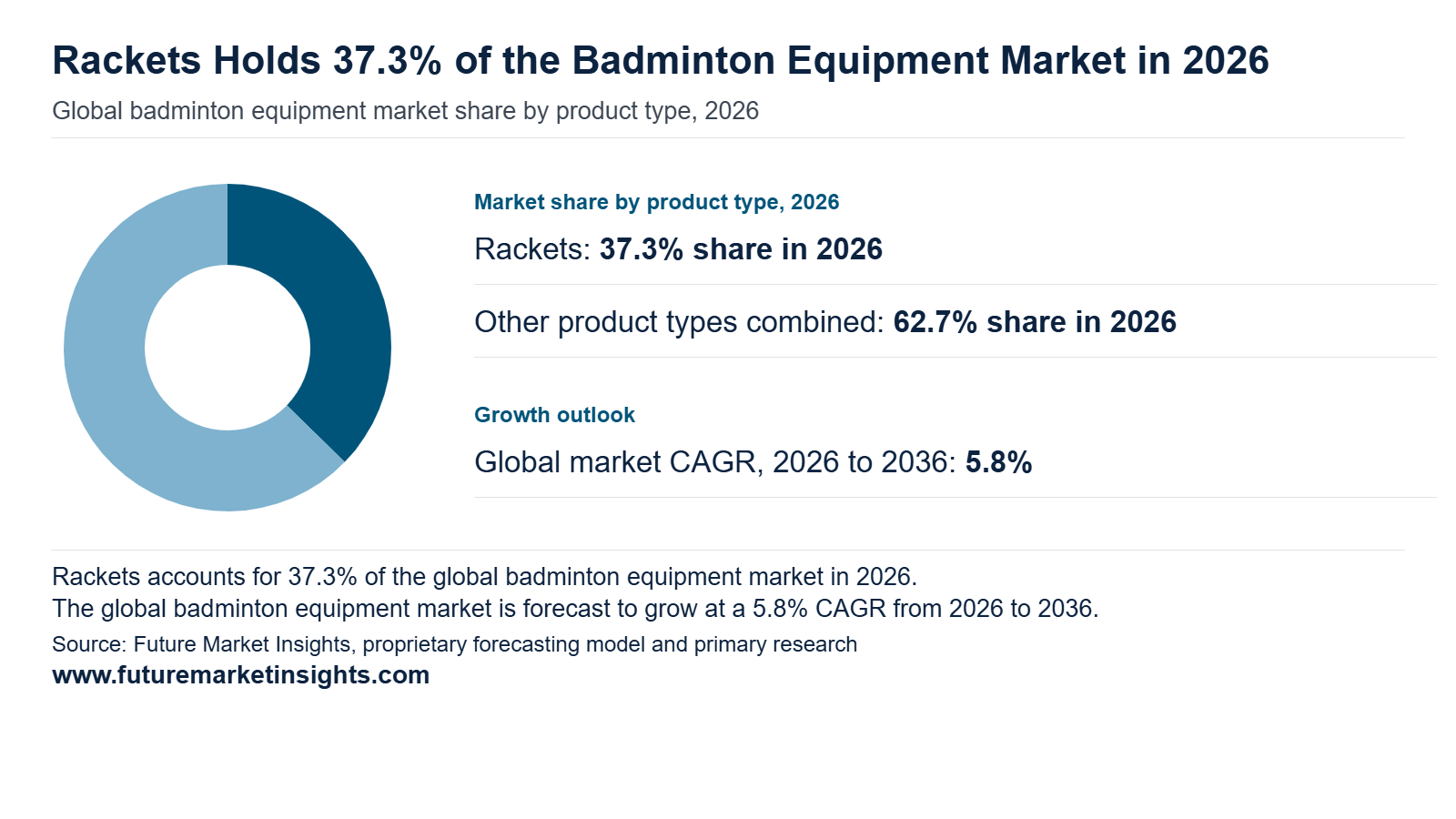
Rackets are the largest product type in the global badminton equipment market, with 37.3% of 2026 sales, easing to 35.6% by 2036. Rackets have the highest unit price, and premium carbon models are the main product that tournament players endorse. Shuttlecocks are set to grow fastest at a 6.3% CAGR, since club play uses many shuttles per session and feather shuttle prices are rising. Badminton footwear holds 19.2% of 2026 sales, drawing on designs from the indoor court shoe market.
Why Does the Recreational Player Segment Lead by Player Level?
Recreational and social players account for 52.8% of 2026 sales by player level and are likely to post a 5.0% CAGR through 2036. Players at this level use the sport for fitness and social play, buying entry and mid-priced rackets and nylon or feather shuttles. School and junior programs are projected to grow fastest, at an 8.1% CAGR, as national bodies such as Badminton England are adding junior programs. Club and league players hold 29.2% of 2026 sales and are the heaviest users of feather shuttles.
Why Does the Specialty Store Segment Lead by Distribution Channel?
Specialty racket sports stores account for 38.3% of global sales of badminton equipment in 2026, because many players test rackets and buy stringing services in store. Brands are adding showrooms with these services, as Yonex has done in Taipei. Online retail holds 32.1% and is projected to post the fastest channel growth, a 7.3% CAGR. Clubs, academies and institutional supply hold 7.4%, buying shuttles in bulk for training and leagues.
Badminton Equipment Market by Region and Country (2026 to 2036)
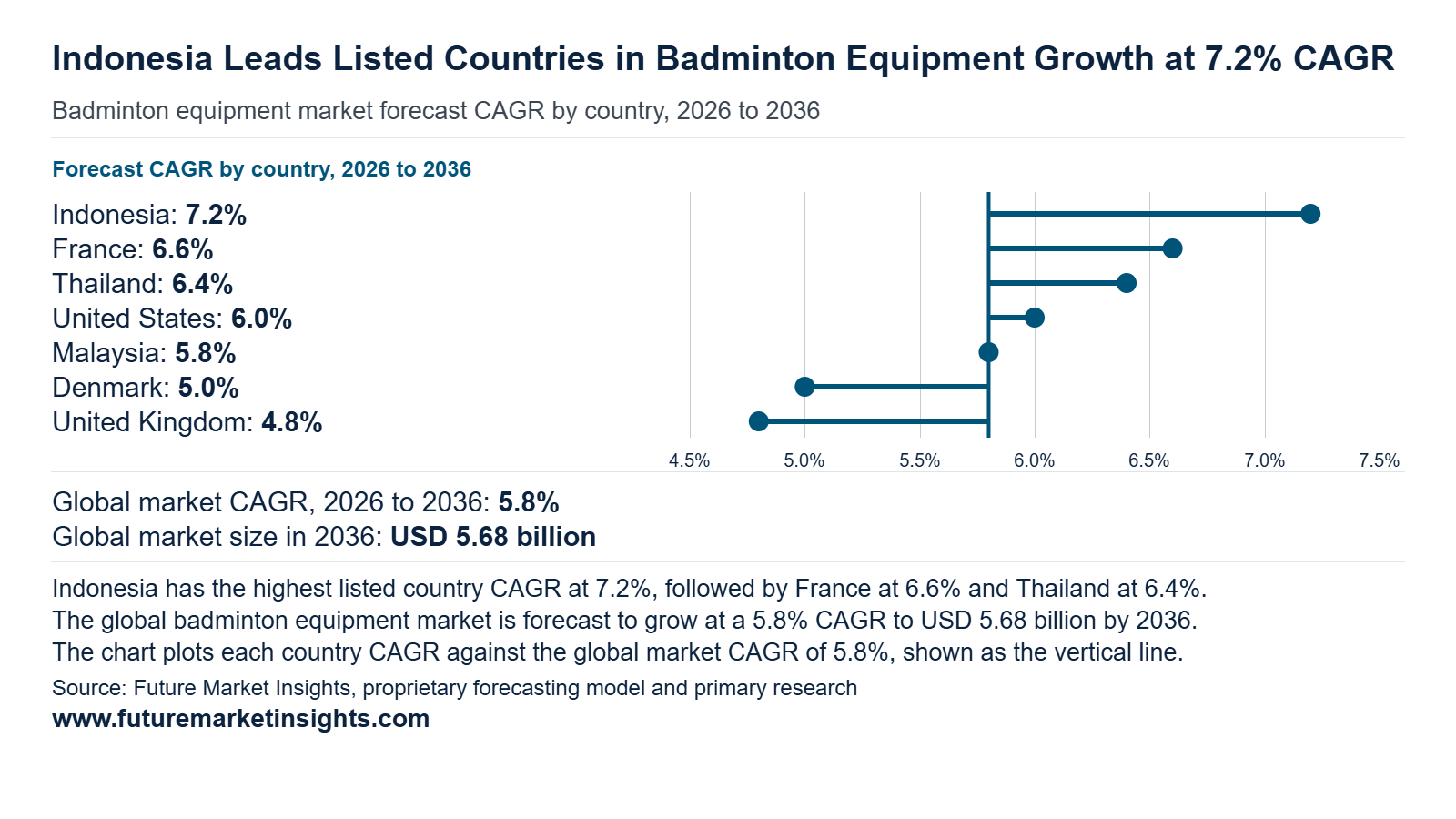
East Asia is the largest region for badminton equipment, with USD 1.70 billion in 2026, although the region's share eases from 52.5% to 49.8% by 2036. In FMI's forecast, the ten core countries generate 38.6% of 2026 sales and 37.4% of 2036 sales, with most remaining sales in other East and South Asian markets. South Asia & Pacific and Middle East & Africa are expected to be the fastest-growing regions, each at a 6.8% CAGR. Among the core countries, Indonesia adds USD 182.8 million, or 7.5% of total global growth.
| Country | 2026 Revenue | 2036 Revenue | 10-Year Addition | 2026 to 2036 CAGR | Global Share (2026 → 2036) |
|---|---|---|---|---|---|
| Indonesia | USD 182.0 million | USD 364.8 million | +USD 182.8 million | 7.2% | 5.6% → 6.4% |
| France | USD 78.0 million | USD 147.8 million | +USD 69.8 million | 6.6% | 2.4% → 2.6% |
| Thailand | USD 96.0 million | USD 178.5 million | +USD 82.5 million | 6.4% | 3.0% → 3.1% |
| United States | USD 104.0 million | USD 186.2 million | +USD 82.2 million | 6.0% | 3.2% → 3.3% |
| Malaysia | USD 128.0 million | USD 224.9 million | +USD 96.9 million | 5.8% | 4.0% → 4.0% |
| Taiwan | USD 92.0 million | USD 151.3 million | +USD 59.3 million | 5.1% | 2.8% → 2.7% |
| Denmark | USD 54.0 million | USD 88.0 million | +USD 34.0 million | 5.0% | 1.7% → 1.5% |
| United Kingdom | USD 86.0 million | USD 137.4 million | +USD 51.4 million | 4.8% | 2.7% → 2.4% |
| South Korea | USD 120.0 million | USD 188.1 million | +USD 68.1 million | 4.6% | 3.7% → 3.3% |
| Japan | USD 310.0 million | USD 454.5 million | +USD 144.5 million | 3.9% | 9.6% → 8.0% |
Source: Future Market Insights analysis of the badminton equipment market, 2026.
Japan
Japan leads the core country group in sales of badminton equipment, though growth is the slowest in the country table at 3.9%, from USD 310.0 million in 2026 to USD 454.5 million by 2036. The country's share of global sales eases from 9.6% to 8.0%. Yonex (November 2026) reports that domestic sales of badminton goods increased on steady demand over the April to September 2026 half. FMI expects higher shuttle prices to push school clubs toward lower-cost practice shuttles.
Indonesia
Indonesia posts the quickest growth of the ten countries, a 7.2% CAGR, with sales rising from USD 182.0 million in 2026 to USD 364.8 million by 2036. The country's share increases from 5.6% to 6.4%. FMI expects a large youth player base and dense club networks to keep shuttle and racket demand rising.
Malaysia
Malaysia is set to expand at a 5.8% CAGR from USD 128.0 million in 2026 to USD 224.9 million by 2036, adding USD 96.9 million. Club and league play support steady demand for feather shuttles, which leaves Malaysian clubs exposed to feather price rises.
South Korea
South Korea is projected to grow at a 4.6% CAGR from USD 120.0 million in 2026 to USD 188.1 million by 2036, with the national share easing from 3.7% to 3.3%. An Se-young, a Yonex-contracted player from South Korea, featured among the 2026 World Championships results highlighted by Yonex (November 2026).
United States
The United States is forecast to expand at a 6.0% CAGR from USD 104.0 million in 2026 to USD 186.2 million by 2036, adding USD 82.2 million. Yonex (November 2026) reports higher North American sales of badminton goods for January to June 2026, with total North American sales up 22.4% in yen terms. FMI expects community centers and school programs to bring in new players.
Thailand
Thailand is likely to grow at a 6.4% CAGR from USD 96.0 million in 2026 to USD 178.5 million by 2036, the third-fastest rate among the core countries. Yonex operates a manufacturing subsidiary in Thailand under the Yonex Tecnifibre name, according to the Yonex (November 2026) segment summary.
Taiwan
Taiwan is expected to rise at a 5.1% CAGR from USD 92.0 million in 2026 to USD 151.3 million by 2036, adding USD 59.3 million. Victor, headquartered in Taipei, competes with Yonex in the domestic market. Yonex (November 2026) states that Taiwanese sales of badminton goods grew significantly in January to June 2026 as the local market remained active.
United Kingdom
Demand in the United Kingdom is projected to rise at a 4.8% CAGR from USD 86.0 million in 2026 to USD 137.4 million by 2036, adding USD 51.4 million. Junior programs are expanding, and Badminton England launched Shuttle Stars at the Manchester Velodrome to bring children aged 7 to 11 into clubs and schools (Lancashire Evening Post, January 2026). Yonex (November 2026) reported flat sales of badminton goods at the company's UK and German subsidiaries for January to June 2026.
France
France is the second-fastest-growing core market, with sales rising from USD 78.0 million in 2026 to USD 147.8 million by 2036 at a 6.6% CAGR. The country's share increases from 2.4% to 2.6%. Alex Lanier won the 2026 world singles title, the first for a French man, per Yonex (November 2026). France won the mixed doubles title at the same event.
Denmark
Denmark is likely to rise at a 5.0% CAGR from USD 54.0 million in 2026 to USD 88.0 million by 2036, adding USD 34.0 million. FMI expects Danish clubs to be early adopters of synthetic shuttles in league play once BWF trials are complete.
Competitive Environment and Notable Companies
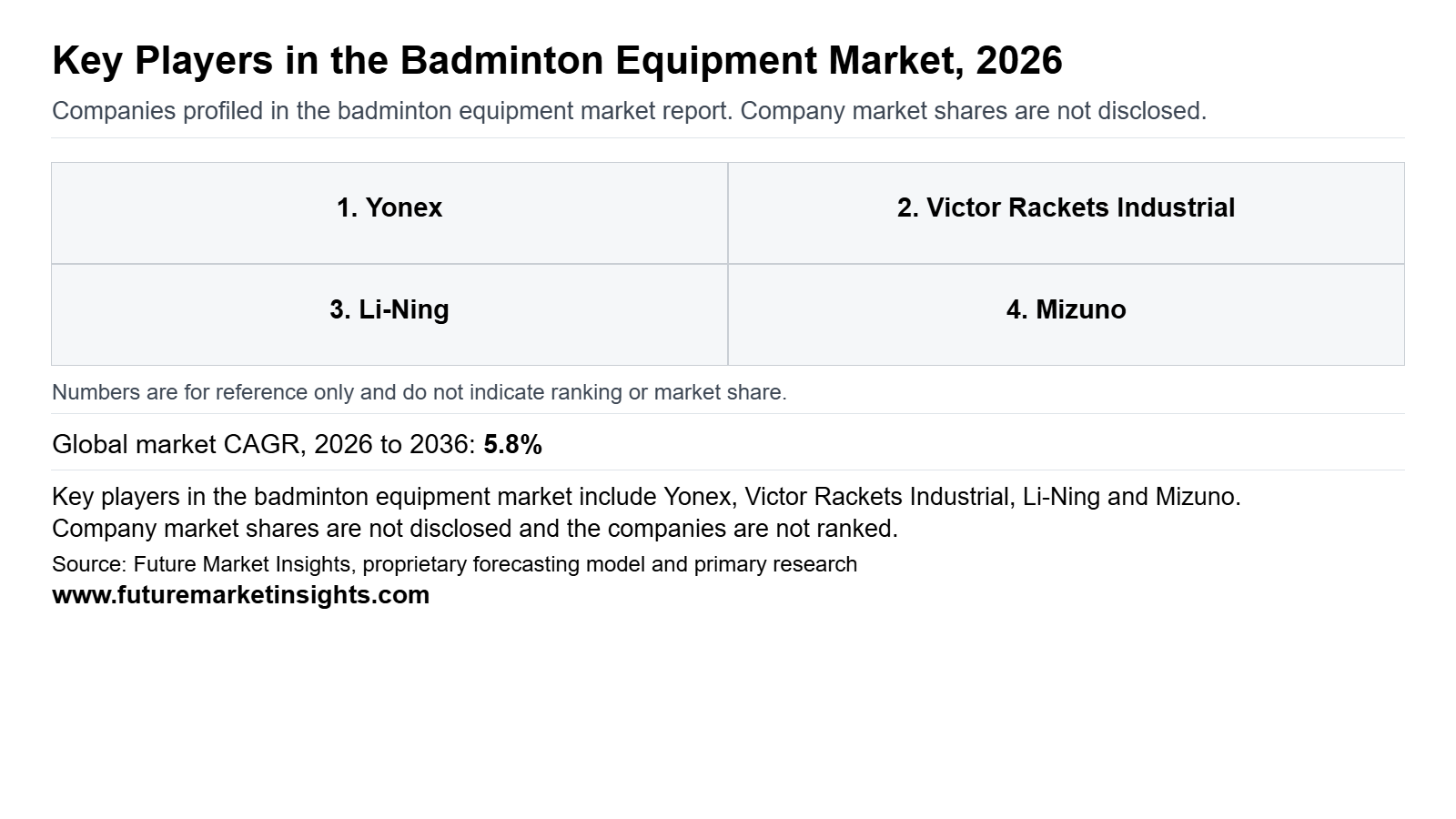
Notable companies in the badminton equipment market include Yonex and Victor Rackets Industrial, along with Li-Ning and Mizuno. European and value brands such as Babolat and Carlton, along with Apacs and Decathlon (Perfly), sell at mid and entry prices. Brands compete in two tiers. Leading brands sell on player sponsorship and racket technology, and value brands sell on price through mass and online channels. Shuttle supply has become a separate point of competition as feather costs rise.
How Are Companies Positioned in the Badminton Equipment Market?
Yonex (November 2026) forecasts total sales of JPY 181.0 billion (USD 1.14 billion) for the fiscal year ending March 2027, after JPY 163.64 billion (USD 1.03 billion) in the fiscal year ended March 2026. Badminton made up 61.1% of total sales at Yonex during the first fiscal half to September 2026. Victor and Yonex are the two brands with a synthetic shuttle approved for selected BWF tournaments, per the Badminton World Federation (April 2026).
What Matters When a Buyer Selects a Badminton Equipment Supplier?
Clubs and tournament organizers check BWF approval and flight consistency for shuttles, along with secure supply through the season. Players compare racket weight and balance, along with string tension and shoe grip. Retail buyers look for brand visibility, which is driven by sponsored players at major events.
Which Capabilities Distinguish Product Offers?
Brands differ by carbon racket technology and shuttle production, along with player sponsorship. Synthetic shuttle development is now a main difference, with the YONEX CROSSWIND 70 and VICTOR New Carbon Sonic Max approved for selected BWF events. In-store services such as stringing and foot measurement are adding value at brand showrooms.
How Does Geographic Reach Affect Competition?
Asia accounts for most global demand, and Yonex runs subsidiaries in Taiwan and Thailand, along with sales companies in North America, Germany and the United Kingdom. Overseas sales made up 75.9% of total sales at Yonex between April and September 2026, per Yonex (November 2026). Value brands reach smaller markets through online marketplaces.
| Verified Company Evidence (2026) | Commercial Effect | Buyer Action |
|---|---|---|
| 8 April 2026: BWF approved the VICTOR New Carbon Sonic Max and YONEX CROSSWIND 70 synthetic shuttlecocks for Grade 3 and Junior International tournaments (Badminton World Federation, April 2026). | Opens sanctioned competition to synthetic shuttles. | Test synthetic shuttles for club leagues and junior events. |
| 25 April 2026: BWF members approved the 3×15 scoring system, with games to 15 points and a cap of 21 (Badminton World Federation, April 2026). | Changes match length and event scheduling. | Review shuttle stock planning for shorter matches. |
| 5 February 2026: Advance sales in Germany were announced for the Victor New Carbon Sonic Max synthetic shuttle (Racket World, February 2026). | Brings a tournament-approved synthetic shuttle to European clubs. | Compare synthetic and feather shuttle cost per session. |
| 10 November 2026: Yonex reported April to September 2026 sales of JPY 91.85 billion (USD 576.2 million), up 15.5%, with badminton up 14.8% (Yonex, November 2026). | Confirms strong demand for leading-brand equipment. | Plan for continued premium racket demand. |
Source: Verified corporate disclosures and Future Market Insights analysis, 2026.
| Company | Core Positioning | Verified Activity & Source Attribution |
|---|---|---|
| Yonex | Rackets, shuttlecocks, strings and footwear | Sales of badminton goods at JPY 56.10 billion (USD 352.0 million) in April to September 2026, 61.1% of the group total (Yonex, November 2026). |
| Victor Rackets Industrial | Rackets, shuttlecocks and footwear | New Carbon Sonic Max synthetic shuttle approved for selected BWF tournaments (Badminton World Federation, April 2026). |
Source: Verified corporate disclosures and Future Market Insights analysis, 2026.
Badminton Equipment Market Report Scope and Research Methodology
FMI totals sales of badminton equipment from units of rackets, shuttle tubes, shoes and accessories and the prices paid by players and clubs in each country. FMI checks these totals against Yonex segment results and BWF rule changes, along with shuttle price reports. Japan is sized first because the country publishes detailed company and retail price information. All products are converted to sales units, with a tube of 12 shuttles treated as one unit. Demand is assigned to the country in which the equipment is bought, and product, player and channel splits reconcile with the global total each year. Company data confirm product launches and positioning only, and FMI does not estimate sales by brand from them.
| Coverage Field | Report Scope |
|---|---|
| Market definition | Equipment used to play badminton, including rackets, shuttlecocks, footwear, strings, grips, bags, nets and posts. |
| Product types | Rackets and shuttlecocks (feather and synthetic), along with badminton footwear, strings, grips, bags, nets and court accessories. |
| Player levels | Recreational and social players and club and league players, along with professional and elite players and school and junior programs. |
| Distribution channels | Specialty racket sports stores and online retail, along with sporting goods and mass retail and clubs, academies and institutional supply. |
| Shuttlecock types | Duck and goose feather shuttles and synthetic shuttles, along with nylon training shuttles. |
| Racket materials | Carbon fiber and graphite composites, along with aluminum and steel entry-level frames. |
| End users | Individual players and clubs, along with schools, academies and tournament organizers. |
| Exclusions | General sports apparel is excluded, as are court flooring and lighting, shuttle launch machines, coaching services, and tennis, squash and padel equipment. |
| Quantitative units | USD million for value, million units for volume. |
| Volume basis | Sales units, with a tube of 12 shuttles treated as one unit. |
| Value basis | Sales to buyers in each country, measured in the country of consumption. |
| Regions covered | East Asia and South Asia and Pacific, along with Europe and North America, as well as Latin America and Middle East and Africa. |
| National coverage | Japan, Indonesia, Malaysia, South Korea, United States, Thailand, Taiwan, United Kingdom, France and Denmark. |
| Companies covered | Yonex, Victor Rackets Industrial, Li-Ning and Mizuno, along with Babolat, Carlton, Apacs and Decathlon (Perfly). |
Source: Future Market Insights analysis of the badminton equipment market, 2026.
Research Sources and Bibliography
- Badminton World Federation. (2026, April 8). BWF approves use of synthetic shuttlecocks at selected tournaments.
- Badminton World Federation. (2026, April 25). BWF members approve 3×15 scoring system.
- Badminton World Federation. (2026, April 26). Key changes under the 3×15 scoring system.
- Chitose Sports. (2026, November 16). Practice shuttle options, how expensive will badminton shuttles get?
- France 24. (2025, August 28). Badminton federation smoothes feathers ruffled by shuttlecock shortage.
- Lancashire Evening Post. (2026, January 30). Badminton England launch Shuttle Stars junior programme to inspire kids in Lancashire to get active. https://www.lep.co.uk/sport/badminton-england-launch-shuttle-stars-junior-programme-to-inspire-kids-in-lancashire-to-get-active-5498870
- Racket World. (2026, February 5). Victor NEW Carbonsonic Max, the first BWF-approved synthetic shuttle from Victor. https://www.racket-world.de/Victor-NEW-Carbonsonic-Max-The-first-BWF-approved-synthetic-shuttle-from-Victor
- Yonex. (2026, November 10). Financial results briefing, first half of the current fiscal year (April to September 2026). https://www.nikkei.com/markets/ir/irftp/data/tdnr/tdnetg3/20261110/g81lb7/140120261109570019.pdf
Table of Content
- Key Takeaways
- Market Size and CAGR
- Top Growth Driver
- Fastest Growing Segment
- Leading Region
- Key Companies
- Emerging Opportunities
- Executive Summary
- Global Market Outlook
- Demand-side Trends
- Supply-side Trends
- Technology Roadmap Analysis
- Analysis and Recommendations
- Analyst Perspective (What is happening? Why now? What should investors know?)
Read More...
- Key Questions Answered
- How large is the market?
- What is the CAGR?
- What are key trends?
- Which region dominates?
- Who are the leaders?
- Market Overview
- Market Coverage / Taxonomy
- Market Definition / Scope / Limitations
- Research Methodology
- Chapter Orientation
- Analytical Lens and Working Hypotheses
- Market Structure, Signals, and Trend Drivers
- Benchmarking and Cross-market Comparability
- Market Sizing, Forecasting, and Opportunity Mapping
- Research Design and Evidence Framework
- Desk Research Program (Secondary Evidence)
- Expert Input and Fieldwork (Primary Evidence)
- Tooling, Models, and Reference Databases
- Data Engineering and Model Build
- Quality Assurance and Audit Trail
- Market Background
- Market Dynamics (Drivers, Restraints, Opportunity, Trends)
- Scenario Forecast (Optimistic, Likely, Conservative)
- Impact Analysis
- AI Impact
- Sustainability Impact
- Regulatory Impact
- Technology Impact
- Consumer / Buyer Analysis
- Purchase Drivers
- Adoption Barriers
- Buyer Journey
- Opportunity Map Analysis
- Product Life Cycle Analysis
- Supply Chain Analysis
- Investment Feasibility Matrix
- Value Chain Analysis
- PESTLE and Porter's Analysis
- Regulatory Landscape
- Regional Parent Market Outlook
- Production and Consumption Statistics
- Import and Export Statistics
- Global Market Analysis and Forecast, 2021 to 2036
- Historical Market Size Value (USD Million) Analysis, 2021 to 2025
- Current and Future Market Size Value (USD Million) Projections, 2026 to 2036
- Y-o-Y Growth Trend Analysis
- Absolute $ Opportunity Analysis
- Global Market Pricing Analysis, 2021 to 2036
- Global Market Analysis and Forecast, By Product Type, 2021 to 2036
- Introduction / Key Findings
- Historical Market Size Value (USD Million) Analysis By Product Type, 2021 to 2025
- Current and Future Market Size Value (USD Million) Analysis and Forecast By Product Type, 2026 to 2036
- Rackets
- Shuttlecocks
- Badminton Footwear
- Strings and Grips
- Bags, Nets and Court Accessories
- Y-o-Y Growth Trend Analysis By Product Type, 2021 to 2025
- Absolute $ Opportunity Analysis By Product Type, 2026 to 2036
- Global Market Analysis and Forecast, By Player Level, 2021 to 2036
- Introduction / Key Findings
- Historical Market Size Value (USD Million) Analysis By Player Level, 2021 to 2025
- Current and Future Market Size Value (USD Million) Analysis and Forecast By Player Level, 2026 to 2036
- Recreational and Social Players
- Club and League Players
- Professional and Elite Players
- School and Junior Programs
- Y-o-Y Growth Trend Analysis By Player Level, 2021 to 2025
- Absolute $ Opportunity Analysis By Player Level, 2026 to 2036
- Global Market Analysis and Forecast, By Distribution Channel, 2021 to 2036
- Introduction / Key Findings
- Historical Market Size Value (USD Million) Analysis By Distribution Channel, 2021 to 2025
- Current and Future Market Size Value (USD Million) Analysis and Forecast By Distribution Channel, 2026 to 2036
- Specialty Racket Sports Stores
- Online Retail
- Sporting Goods and Mass Retail
- Clubs, Academies and Institutional Supply
- Y-o-Y Growth Trend Analysis By Distribution Channel, 2021 to 2025
- Absolute $ Opportunity Analysis By Distribution Channel, 2026 to 2036
- Global Market Analysis and Forecast, By Region, 2021 to 2036
- Introduction
- Historical Market Size Value (USD Million) Analysis By Region, 2021 to 2025
- Current Market Size Value (USD Million) Analysis and Forecast By Region, 2026 to 2036
- East Asia
- South Asia and Pacific
- Europe
- North America
- Latin America
- Middle East and Africa
- Market Attractiveness Analysis By Region
- East Asia Market Analysis and Forecast, By Country, 2021 to 2036
- Historical Market Size Value (USD Million) Trend Analysis By Market Taxonomy, 2021 to 2025
- Market Size Value (USD Million) Forecast By Market Taxonomy, 2026 to 2036
- By Country
- Japan
- South Korea
- Taiwan
- Rest of East Asia
- By Product Type
- By Player Level
- By Distribution Channel
- By Country
- Market Attractiveness Analysis
- By Country
- By Product Type
- By Player Level
- By Distribution Channel
- Key Takeaways
- South Asia and Pacific Market Analysis and Forecast, By Country, 2021 to 2036
- Historical Market Size Value (USD Million) Trend Analysis By Market Taxonomy, 2021 to 2025
- Market Size Value (USD Million) Forecast By Market Taxonomy, 2026 to 2036
- By Country
- Indonesia
- Malaysia
- Thailand
- Rest of South Asia and Pacific
- By Product Type
- By Player Level
- By Distribution Channel
- By Country
- Market Attractiveness Analysis
- By Country
- By Product Type
- By Player Level
- By Distribution Channel
- Key Takeaways
- Europe Market Analysis and Forecast, By Country, 2021 to 2036
- Historical Market Size Value (USD Million) Trend Analysis By Market Taxonomy, 2021 to 2025
- Market Size Value (USD Million) Forecast By Market Taxonomy, 2026 to 2036
- By Country
- United Kingdom
- France
- Denmark
- Rest of Europe
- By Product Type
- By Player Level
- By Distribution Channel
- By Country
- Market Attractiveness Analysis
- By Country
- By Product Type
- By Player Level
- By Distribution Channel
- Key Takeaways
- North America Market Analysis and Forecast, By Country, 2021 to 2036
- Historical Market Size Value (USD Million) Trend Analysis By Market Taxonomy, 2021 to 2025
- Market Size Value (USD Million) Forecast By Market Taxonomy, 2026 to 2036
- By Country
- United States
- Canada
- By Product Type
- By Player Level
- By Distribution Channel
- By Country
- Market Attractiveness Analysis
- By Country
- By Product Type
- By Player Level
- By Distribution Channel
- Key Takeaways
- Key Countries Market Analysis
- Japan
- Pricing Analysis
- Market Share Analysis, 2025
- By Product Type
- By Player Level
- By Distribution Channel
- Indonesia
- Pricing Analysis
- Market Share Analysis, 2025
- By Product Type
- By Player Level
- By Distribution Channel
- Malaysia
- Pricing Analysis
- Market Share Analysis, 2025
- By Product Type
- By Player Level
- By Distribution Channel
- South Korea
- Pricing Analysis
- Market Share Analysis, 2025
- By Product Type
- By Player Level
- By Distribution Channel
- United States
- Pricing Analysis
- Market Share Analysis, 2025
- By Product Type
- By Player Level
- By Distribution Channel
- Thailand
- Pricing Analysis
- Market Share Analysis, 2025
- By Product Type
- By Player Level
- By Distribution Channel
- Taiwan
- Pricing Analysis
- Market Share Analysis, 2025
- By Product Type
- By Player Level
- By Distribution Channel
- United Kingdom
- Pricing Analysis
- Market Share Analysis, 2025
- By Product Type
- By Player Level
- By Distribution Channel
- France
- Pricing Analysis
- Market Share Analysis, 2025
- By Product Type
- By Player Level
- By Distribution Channel
- Denmark
- Pricing Analysis
- Market Share Analysis, 2025
- By Product Type
- By Player Level
- By Distribution Channel
- Japan
- Market Structure Analysis
- Competition Dashboard
- Competition Benchmarking
- Market Share Analysis of Top Players
- By Regional
- By Product Type
- By Player Level
- By Distribution Channel
- Emerging Startups
- Innovation Benchmarking
- Competition Analysis
- Competition Deep Dive
- Yonex
- Overview
- Product Portfolio
- Profitability by Market Segments
- Sales Footprint
- Strategy Overview
- Marketing Strategy
- Product Strategy
- Channel Strategy
- Victor Rackets Industrial
- Li-Ning
- Mizuno
- Babolat
- Carlton
- Apacs
- Decathlon (Perfly)
- Yonex
- Competition Deep Dive
- Case Studies
- Success Stories
- Recent Developments
- Assumptions & Acronyms Used
List of Tables
- Table 1: Global Market Value (USD Million) Forecast by Region, 2021 to 2036
- Table 2: Global Market Value (USD Million) Forecast by Product Type, 2021 to 2036
- Table 3: Global Market Value (USD Million) Forecast by Player Level, 2021 to 2036
- Table 4: Global Market Value (USD Million) Forecast by Distribution Channel, 2021 to 2036
- Table 5: Global Market Volume (Million Units) Forecast by Region, 2021 to 2036
- Table 6: East Asia Market Value (USD Million) Forecast by Country, 2021 to 2036
- Table 7: East Asia Market Value (USD Million) Forecast by Product Type, 2021 to 2036
- Table 8: East Asia Market Value (USD Million) Forecast by Player Level, 2021 to 2036
- Table 9: East Asia Market Value (USD Million) Forecast by Distribution Channel, 2021 to 2036
- Table 10: South Asia and Pacific Market Value (USD Million) Forecast by Country, 2021 to 2036
- Table 11: South Asia and Pacific Market Value (USD Million) Forecast by Product Type, 2021 to 2036
- Table 12: South Asia and Pacific Market Value (USD Million) Forecast by Player Level, 2021 to 2036
- Table 13: South Asia and Pacific Market Value (USD Million) Forecast by Distribution Channel, 2021 to 2036
- Table 14: Europe Market Value (USD Million) Forecast by Country, 2021 to 2036
- Table 15: Europe Market Value (USD Million) Forecast by Product Type, 2021 to 2036
- Table 16: Europe Market Value (USD Million) Forecast by Player Level, 2021 to 2036
- Table 17: Europe Market Value (USD Million) Forecast by Distribution Channel, 2021 to 2036
- Table 18: North America Market Value (USD Million) Forecast by Country, 2021 to 2036
- Table 19: North America Market Value (USD Million) Forecast by Product Type, 2021 to 2036
- Table 20: North America Market Value (USD Million) Forecast by Player Level, 2021 to 2036
- Table 21: North America Market Value (USD Million) Forecast by Distribution Channel, 2021 to 2036
List of Figures
- Figure 1: Global Market Pricing Analysis
- Figure 2: Global Market Value (USD Million) Forecast 2021-2036
- Figure 3: Global Market Value Share and BPS Analysis by Product Type, 2026 and 2036
- Figure 4: Global Market Y-o-Y Growth Comparison by Product Type, 2026-2036
- Figure 5: Global Market Attractiveness Analysis by Product Type
- Figure 6: Global Market Value Share and BPS Analysis by Player Level, 2026 and 2036
- Figure 7: Global Market Y-o-Y Growth Comparison by Player Level, 2026-2036
- Figure 8: Global Market Attractiveness Analysis by Player Level
- Figure 9: Global Market Value Share and BPS Analysis by Distribution Channel, 2026 and 2036
- Figure 10: Global Market Y-o-Y Growth Comparison by Distribution Channel, 2026-2036
- Figure 11: Global Market Attractiveness Analysis by Distribution Channel
- Figure 12: Global Market Value (USD Million) Share and BPS Analysis by Region, 2026 and 2036
- Figure 13: Global Market Y-o-Y Growth Comparison by Region, 2026-2036
- Figure 14: Global Market Attractiveness Analysis by Region
- Figure 15: East Asia Market Incremental Dollar Opportunity, 2026-2036
- Figure 16: South Asia and Pacific Market Incremental Dollar Opportunity, 2026-2036
- Figure 17: Europe Market Incremental Dollar Opportunity, 2026-2036
- Figure 18: North America Market Incremental Dollar Opportunity, 2026-2036
- Figure 19: East Asia Market Value Share and BPS Analysis by Country, 2026 and 2036
- Figure 20: East Asia Market Value Share and BPS Analysis by Product Type, 2026 and 2036
- Figure 21: East Asia Market Y-o-Y Growth Comparison by Product Type, 2026-2036
- Figure 22: East Asia Market Attractiveness Analysis by Product Type
- Figure 23: East Asia Market Value Share and BPS Analysis by Player Level, 2026 and 2036
- Figure 24: East Asia Market Y-o-Y Growth Comparison by Player Level, 2026-2036
- Figure 25: East Asia Market Attractiveness Analysis by Player Level
- Figure 26: East Asia Market Value Share and BPS Analysis by Distribution Channel, 2026 and 2036
- Figure 27: East Asia Market Y-o-Y Growth Comparison by Distribution Channel, 2026-2036
- Figure 28: East Asia Market Attractiveness Analysis by Distribution Channel
- Figure 29: South Asia and Pacific Market Value Share and BPS Analysis by Country, 2026 and 2036
- Figure 30: South Asia and Pacific Market Value Share and BPS Analysis by Product Type, 2026 and 2036
- Figure 31: South Asia and Pacific Market Y-o-Y Growth Comparison by Product Type, 2026-2036
- Figure 32: South Asia and Pacific Market Attractiveness Analysis by Product Type
- Figure 33: South Asia and Pacific Market Value Share and BPS Analysis by Player Level, 2026 and 2036
- Figure 34: South Asia and Pacific Market Y-o-Y Growth Comparison by Player Level, 2026-2036
- Figure 35: South Asia and Pacific Market Attractiveness Analysis by Player Level
- Figure 36: South Asia and Pacific Market Value Share and BPS Analysis by Distribution Channel, 2026 and 2036
- Figure 37: South Asia and Pacific Market Y-o-Y Growth Comparison by Distribution Channel, 2026-2036
- Figure 38: South Asia and Pacific Market Attractiveness Analysis by Distribution Channel
- Figure 39: Europe Market Value Share and BPS Analysis by Country, 2026 and 2036
- Figure 40: Europe Market Value Share and BPS Analysis by Product Type, 2026 and 2036
- Figure 41: Europe Market Y-o-Y Growth Comparison by Product Type, 2026-2036
- Figure 42: Europe Market Attractiveness Analysis by Product Type
- Figure 43: Europe Market Value Share and BPS Analysis by Player Level, 2026 and 2036
- Figure 44: Europe Market Y-o-Y Growth Comparison by Player Level, 2026-2036
- Figure 45: Europe Market Attractiveness Analysis by Player Level
- Figure 46: Europe Market Value Share and BPS Analysis by Distribution Channel, 2026 and 2036
- Figure 47: Europe Market Y-o-Y Growth Comparison by Distribution Channel, 2026-2036
- Figure 48: Europe Market Attractiveness Analysis by Distribution Channel
- Figure 49: North America Market Value Share and BPS Analysis by Country, 2026 and 2036
- Figure 50: North America Market Value Share and BPS Analysis by Product Type, 2026 and 2036
- Figure 51: North America Market Y-o-Y Growth Comparison by Product Type, 2026-2036
- Figure 52: North America Market Attractiveness Analysis by Product Type
- Figure 53: North America Market Value Share and BPS Analysis by Player Level, 2026 and 2036
- Figure 54: North America Market Y-o-Y Growth Comparison by Player Level, 2026-2036
- Figure 55: North America Market Attractiveness Analysis by Player Level
- Figure 56: North America Market Value Share and BPS Analysis by Distribution Channel, 2026 and 2036
- Figure 57: North America Market Y-o-Y Growth Comparison by Distribution Channel, 2026-2036
- Figure 58: North America Market Attractiveness Analysis by Distribution Channel
- Figure 59: Global Market - Tier Structure Analysis
- Figure 60: Global Market - Company Share Analysis
Frequently Asked Questions
How big is the badminton equipment market in 2026?
Future Market Insights estimates the global badminton equipment market at USD 3.24 billion in 2026, up from USD 3.07 billion in 2025.
How fast is the badminton equipment market expected to grow through 2036?
FMI projects a 5.8% CAGR from 2026 to 2036 for the badminton equipment market, taking global sales to USD 5.68 billion by 2036 and adding USD 2.44 billion over the period.
Which product type leads the badminton equipment market?
Rackets hold the largest share of the badminton equipment market by product type, 37.3% of 2026 sales, and shuttlecocks are projected to expand fastest, at a 6.3% CAGR through 2036.
Which player level leads the badminton equipment market?
Recreational and social players hold 52.8% of 2026 sales of badminton equipment and grow at a 5.0% CAGR, and school and junior programs grow fastest at 8.1% per year.
Which distribution channel leads the badminton equipment market?
Specialty racket sports stores hold 38.3% of 2026 sales of badminton equipment, and online retail is expected to grow fastest at 7.3% per year from 2026 to 2036.
Which country is the largest badminton equipment market?
Japan is the largest core market for badminton equipment, with 9.6% of global sales in 2026 (USD 310.0 million), followed by Indonesia at 5.6% (USD 182.0 million) and Malaysia at 4.0% (USD 128.0 million).
Which countries are expected to grow fastest in the badminton equipment market?
Indonesia is expected to expand at the quickest pace in the badminton equipment market, a 7.2% CAGR from 2026 to 2036, followed by France at 6.6% and Thailand at 6.4%.
What drives demand for badminton equipment?
Demand for badminton equipment comes mainly from regular club and social play along with growing junior programs. Shuttles need frequent replacement, and players are buying premium rackets as international success spreads to more countries.
Preview the report firsthand - request a free sample
Get SampleGet the brochure for pricing and purchase details.
Get PDF