

- Market Size (2026)
- USD 268.2 Mn
- Forecast (2036)
- USD 640.8 Mn
- CAGR (2026 to 2036)
- 9.1%
How big is the bakery oven belts & bands market in 2026?
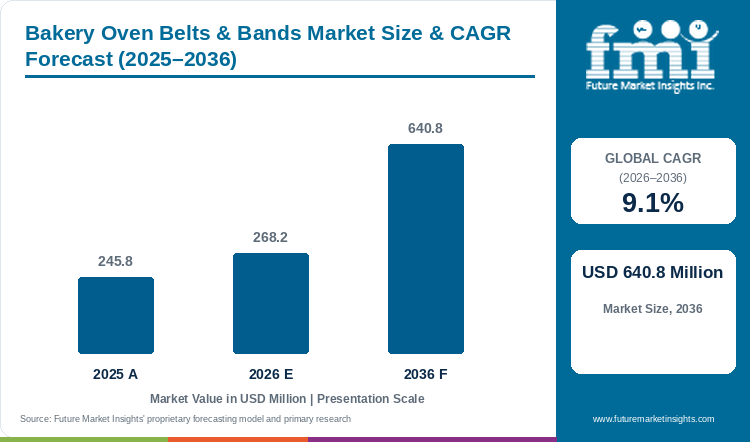
The market was valued at USD 245.8 million in 2025 and is expected to reach USD 268.2 million in 2026. It is projected to reach USD 640.8 million by 2036 at a CAGR of 9.1% from 2026 to 2036.
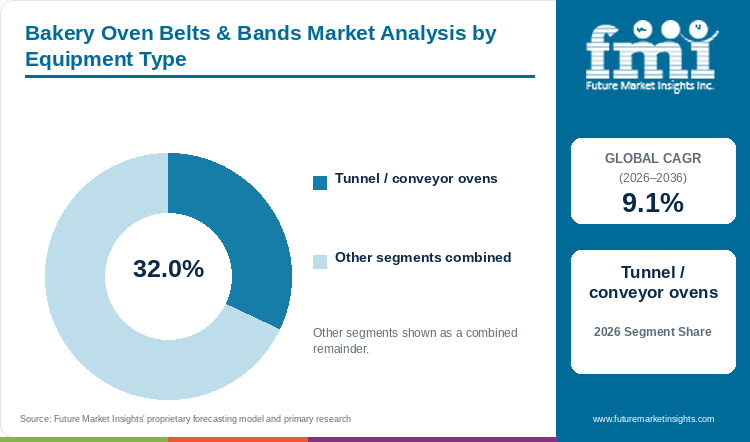
The bakery oven belts & bands market was valued at USD 245.8 million in 2025, is expected to reach USD 268.2 million in 2026, and is forecast to reach USD 640.8 million by 2036 at a 9.1% CAGR from 2026 to 2036. In 2026, Tunnel / conveyor ovens account for 32.0% by Equipment Type, 500-2,000 kg/hr accounts for 41.0% by Capacity, and Fully automatic / robotic accounts for 42.0% by Automation Level. Each represents a separate purchasing dimension. Band selection must be coordinated with heat transfer, line speed and maintenance access. Revenue accrues when bakeries specify a heat-resistant product-carrying band for a new oven or replace a worn band in an existing line. A May 2025 Reading Bakery Systems technical announcement illustrates how thermal-zone redesign can change oven specifications without removing the need for reliable conveyance.[11] Purchasers therefore assess material, tracking and cleaning requirements alongside the heating system.
Key Market Trends & Insights
- By Equipment Type: Tunnel / conveyor ovens lead Equipment Type with 32.0% in 2026 because the baking band forms the product-carrying surface through successive temperature zones.
- By Capacity: 500-2,000 kg/hr leads Capacity with 41.0% in 2026, balancing useful line throughput against floor space and changeover needs.
- By Automation Level: Fully automatic / robotic leads Automation Level with 42.0% in 2026 as synchronized loading and discharge make precise band speed and tracking commercially important.
Regional Highlights
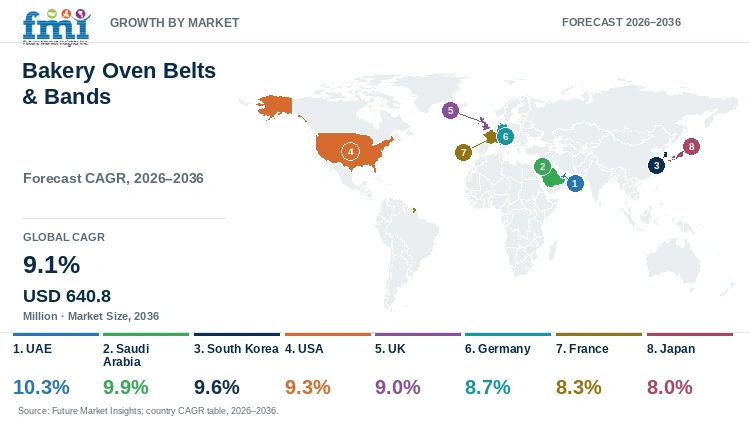
- At 10.3% CAGR through 2036, the UAE has the strongest bakery oven belt and band forecast among the eight profiled markets, where tracking and heat transfer determine operating fit.
- Saudi Arabia is forecast at 9.9% and South Korea at 9.6%, compared with 8.0% in Japan, the most measured outlook for new and replacement band demand.
Market Size & Forecast
Table 1: Bakery Oven Belts & Bands Market Size and Forecast (USD million), 2025 to 2036
| Market size and forecast | Value |
|---|---|
| 2025 Value (actual) | USD 245.8 million |
| Estimated market size in 2026 | USD 268.2 million |
| Projected market size by 2036 | USD 640.8 million |
| CAGR (2026-2036) | 9.1% |
Demand conditions differ by production model. Industrial bakeries in the USA and UK weigh line availability against labor and energy costs. European buyers also examine hygienic design and food-contact suitability. In Saudi Arabia and the UAE, food-sector industrial investment provides a broader context for capacity discussions but does not establish band orders on its own. A sale becomes practical only after the supplier verifies thermal compatibility, throughput and an installation window that the bakery can accept.
The market forecast covers 2026 to 2036 and is segmented by Equipment Type, Capacity, Automation Level, End User, Sales Channel, and Region. Coverage follows the associated oven belt or band rather than the total value of a bakery installation.
The profiled companies are AMF Bakery Systems, Buhler Group, Baker Perkins, Rademaker, FRITSCH Group, Rheon Automatic Machinery, Mecatherm, Middleby, Reading Bakery Systems, and Kaak Group.
Table 2: Supporting Industry Indicators for the Bakery Oven Belts & Bands Market
| Indicator | Data point | Why it matters | Source |
|---|---|---|---|
| Oven design, April 2025 | In April 2025, Mecatherm outlined its Vertical M-VT oven, energy-recovery equipment and controlled-humidity offering for iba 2025.[12] | The presentation shows suppliers redesigning the baking path and its thermal control rather than improving the band in isolation. Buyers evaluating the equipment must determine whether a vertical carrier layout fits their products and handling sequence. | [12] |
| Electric heating, May 2025 | In May 2025, Reading Bakery Systems detailed its Thomas L.[11] Green Emithermic XE oven configuration, using electric radiant panels and convective heating in place of traditional direct-fired ribbon burners.[11] | The development changes oven-zone servicing and energy-source choices. It also makes coordination between baking-band travel and product heating essential to cracker-line qualification. | [11] |
| Pilot bakery, June 2025 | In June 2025, AMF Bakery Systems and Puratos announced a joint pilot bakery facility in New Jersey.[13] | The facility was positioned for testing commercial baking approaches rather than evidence of a new band sale. For buyers, access to production-relevant trials can reduce uncertainty over band selection and the match between oven throughput and upstream dough processing. | [13] |
Demand Intensity Analysis
Continuous baking and planned band replacement support purchasing; a damaged or poorly tracked belt creates both quality variation and stoppage risk.
Retrofitting can be deferred when band grade, tensioning, width and oven downtime cannot be qualified before the planned maintenance shutdown.
The increase from USD 268.2 million in 2026 to USD 640.8 million in 2036 represents USD 372.6 million in additional market revenue over the forecast period.
Table 3: Demand Intensity Metrics for the Bakery Oven Belts & Bands Market, 2026 to 2036
| Demand intensity metric | Value | Basis |
|---|---|---|
| Bakery Oven Belts & Bands Market value CAGR | 9.1% | Global market value growth, 2026 to 2036 |
| Tunnel / conveyor ovens share in 2026 | 32.0% | Equipment Type classification |
| 500-2,000 kg/hr share in 2026 | 41.0% | Capacity classification |
| Fully automatic / robotic share in 2026 | 42.0% | Automation Level classification |
| Added revenue through 2036 | USD 372.6 million | Increase in market revenue from 2026 to 2036 |
Analyst Perspective
The market converts interest into orders when bakers can demonstrate that band geometry and heat-transfer performance remain stable at the target product mix, with predictable maintenance intervals and an acceptable changeover schedule.
- Nandini Roy Choudhury, Principal Consultant, FMI
How is the bakery oven belts & bands market segmented?
The market is segmented by Equipment Type, Capacity, Automation Level, End User, and Sales Channel.
Equipment Type comprises Tunnel / conveyor ovens, Rack ovens, Deck ovens, and Hybrid & specialty ovens. Capacity comprises 500-2,000 kg/hr, Below 500 kg/hr, and Above 2,000 kg/hr. Automation Level comprises Fully automatic / robotic, Semi-automatic, and Manual. End User comprises Industrial bakeries, In-store & retail bakeries, Artisan bakeries, and Foodservice / QSR central kitchens. Sales Channel comprises Direct OEM sales, Dealers & distributors, and Aftermarket & refurbished. Only revenue attributable to the belt or band is included when an oven architecture does not continuously convey product.
Why do Tunnel / conveyor ovens anchor Equipment Type demand?
Continuous tunnel baking places the belt directly in the baking process: it supports the product, moves it through heat zones and determines part of the contact-heating profile. Manufacturers select steel bands, mesh or alternative carriers according to dough properties and thermal requirements. Rack and deck ovens are often tray-based, so they contribute only where an identifiable oven band or conveying component is sold. Kaak Group specifies belt forms and cleaning options across its industrial ovens.
- Tunnel / conveyor ovens represent 32.0% of Equipment Type revenue in 2026, reflecting the continuous-baking interface that must be specified and maintained.
- In July 2020, AMF Bakery Systems introduced its Multibake VITA tunnel oven, demonstrating how fuel-system changes coexist with the need for a selected baking band.
How does 500-2,000 kg/hr set the main Capacity buying range?
In the 500-2,000 kg/hr range, bakeries can often justify purpose-built conveyor ovens while retaining product-mix flexibility. Band width, speed and oven length have to match proofing output and packaging flow. Below 500 kg/hr, intermittent baking and trays may reduce band expenditure. Above 2,000 kg/hr, longer runs and high-load conveyors require more complex engineering and planned replacement access. The capacity classification concerns the associated baking line, not the mass of the belt itself.
- 500-2,000 kg/hr accounts for 41.0% of Capacity revenue in 2026, where throughput and configuration economics support specified band systems.
- In May 2022, FRITSCH Group opened a North American World of Bakery application facility, illustrating why buyers test line interfaces and recipes before scaling equipment.
Why does Fully automatic / robotic lead Automation Level?
Automated plants coordinate depanning, oven infeed and downstream removal with the baking-band speed. Sensors and controlled drives help avoid uneven spacing or off-center loading, but they also increase the cost of a tracking fault. Manual operations can tolerate more intervention at lower utilization. The critical distinction is whether baking-band operating behavior is engineered into an integrated system rather than treated as a standalone spare part.
- Fully automatic / robotic captures 42.0% of Automation Level revenue in 2026, reflecting the value of synchronized loading, conveying and discharge.
- In April 2025, Mecatherm presented connected monitoring and oven-management solutions at iba, a dated example of greater integration around continuous baking.[12]
What gives Industrial bakeries their End User lead?
Industrial bakeries operate extended production runs in which unplanned oven-band stoppage can interrupt downstream cooling and packaging. Their purchasing teams specify belt life, cleanability and support for replacement scheduling. In-store and artisan facilities may favor flexible smaller ovens, while foodservice central kitchens use bands only where a conveyor oven is present. This difference in utilization gives industrial production a stronger recurring replacement rationale than occasional baking.
- Industrial bakeries lead End User at 44.0% in 2026 because production continuity and repeatable contact heating influence purchasing budgets.
- In January 2024, Mecatherm described a North American industrial artisan-bread installation with an FTM oven and M-UB handling system, demonstrating product-specific integration needs.
How do Direct OEM sales shape Sales Channel decisions?
An oven band may be specified with the oven because its surface, thermal response and tensioning arrangement depend on the original machine design. Direct OEM engagement also helps buyers establish acceptance testing and installation responsibilities. Dealers and distributors remain relevant for standardized parts, while aftermarket and refurbished routes address older installations when the original specification is unavailable. A cheaper replacement is not equivalent if its tracking or food-contact characteristics differ.
- Direct OEM sales account for 55.0% of Sales Channel revenue in 2026 as buyers seek a single specification and commissioning responsibility.
- In December 2019, Baker Perkins described oven airflow control across the band width. Its separate oven-parts documentation identifies tracking parts and band cleaners as maintenance items.
What are the drivers, restraints and opportunities in the bakery oven belts & bands market?
Continuous bakery utilization drives demand for durable baking bands, while exact-fit qualification and shutdown windows restrain replacement, and thermal-efficiency retrofits open opportunities for engineered belt upgrades.
- Driver: Higher utilization and more demanding product consistency make stable baking-band tracking and contact heating commercially important.
- Restraint: Engineering validation, food-contact suitability and lost production time can postpone a band change.
- Opportunity: Low-inertia and easily cleaned band options can be sold when thermal savings and maintenance benefits are verified in the specific oven.
Bakers have a direct incentive to maintain a uniform product path through their hottest equipment. The band governs product residence time and can change crust color when tracking or heat transfer varies. IPCO documents the use of solid and perforated steel bands in continuous baking. Baker Perkins also identifies tracking rollers and cleaners as parts affecting band life. A replacement purchase therefore responds to a measurable operating risk: rejected product, unscheduled repairs or throughput constraints. Long production runs raise the value of serviceable conveyors, provided the buyer can identify which components drive the fault.
A band is not a commodity purchase when dimensions and thermal cycling conditions are specific to an installed oven. Plant engineers must confirm expansion allowance, drive compatibility, weld or joint integrity and the cleaning regime. ISO 14159 addresses hygienic machinery design, while European food-contact rules constrain the materials used for relevant contact applications.[30] These requirements do not automatically establish that one replacement meets every local standard. They increase the value of documentation and trials. If a supplier cannot reproduce the existing tracking and hygiene performance, a bakery may prolong repairs instead of approving a new band.
Thermal optimization offers a separate route to replacement demand. In August 2023, Mecatherm described the energy consequences of conveyor-belt mass and heat escaping at oven openings. The engineering implication is conditional: a lighter or differently structured band can reduce heating load only if it maintains the necessary baking contact and mechanical life. OEMs and qualified aftermarket specialists can test alternative carrier materials during a planned overhaul. Buyers should compare oven energy use and product quality before committing to a change, rather than assume that a lower-mass band produces savings in every baking recipe.
Which country CAGRs are profiled in the bakery oven belts & bands market?
Country CAGR profiles cover 2026 to 2036. Each rate describes forecast growth rather than current market size.
Table 4: Country growth outlook for the Bakery Oven Belts & Bands Market
| Country | CAGR |
|---|---|
| UAE | 10.3% |
| Saudi Arabia | 9.9% |
| South Korea | 9.6% |
| USA | 9.3% |
| UK | 9.0% |
| Germany | 8.7% |
| France | 8.3% |
| Japan | 8.0% |
How do country-level CAGRs compare in the bakery oven belts & bands market?
The profiled rates range from 8.0% in Japan to 10.3% in the UAE, a spread of 2.3 percentage points. UAE and Saudi Arabia sit at the top of this profile, while Japan, France and Germany are at the lower end. These rates do not rank the countries by absolute sales or installed oven-band capacity. Differences in plant investment, labor conditions and oven replacement cycles offer more useful explanations than CAGR alone.
- UAE: Food-processing industrial investment makes imported oven-integration and documentation capabilities relevant to project screening.
- Saudi Arabia: New food-manufacturing licenses provide a potential pipeline, subject to capital approval and line specification.
- South Korea: Documented food-industry production activity favors repeatability and hygienic process verification.
- USA: Established food-manufacturing operations support a mix of retrofit work and continuous-line replacement schedules.
- UK: Food manufacturers face capital and labor pressures, increasing scrutiny of downtime and energy-return calculations.
- Germany: A broad base of baking enterprises creates distinct needs for industrial lines and smaller-system replacements.
- France: Industrial bread and fresh-pastry manufacturing requires careful distinction from bakery retail equipment.
- Japan: Labor-saving policies make controlled conveying attractive where automation can fit existing plant geometry.
The comparison covers the eight countries shown above, not the entirety of regional demand. It should be read with the broader geographic classification used later in the report.
Country-wise Analysis
UAE
The UAE has a profiled CAGR of 10.3% from 2026 to 2036. The UAE Ministry of Industry and Advanced Technology reported new industrial projects across several sectors at the May 2025 Make it in the Emirates event, with food among the strategic manufacturing priorities. That announcement is a measure of industrial interest rather than a tally of bakery-band orders. For projects involving imported continuous ovens, buyers need local commissioning support and documentation on band material and cleaning. Suppliers capable of synchronizing baking carriers with upstream make-up systems may gain access to new-line specifications, but confirmed purchase orders depend on facility-level budgets and product trials.
Saudi Arabia
Saudi Arabia is profiled to expand at 9.9% CAGR from 2026 to 2036. The Saudi Press Agency reported industrial licensing activity in April 2024 that included food manufacturing among the licensed sectors. This context is relevant to industrial bakery capacity decisions without proving that every licensed facility requires a conveyor oven. New plants can incorporate belt selection at initial design stage, reducing the compromises typical of a later retrofit. Vendors still need to establish that mesh, steel or other carriers suit local maintenance resources and the planned product range. Project phasing and acceptance testing are likely to decide when prospective demand converts into revenue.
South Korea
The 2026 to 2036 CAGR for South Korea is 9.6%. South Korea’s Ministry of Food and Drug Safety published 2024 food-industry production results in May 2025, showing a substantial national manufacturing base. Those data cover food processing broadly and do not isolate oven bands. For automated bakeries, the commercial case rests on repeatable baking conditions, traceable hygiene procedures and predictable equipment servicing. A buyer changing its band specification must verify dimensions and thermal response before switching suppliers. Established machinery maintenance practices can support aftermarket demand, while advanced automated lines may favor integrated OEM work where belt tracking and transfer speed are jointly controlled.
USA
USA revenue is forecast to grow at a CAGR of 9.3% from 2026 to 2036. The U.S. Census Bureau’s 2022 Economic Census documents the food-manufacturing establishment base, while the Bureau of Labor Statistics published updated information on bakers in August 2026. Neither series measures belt revenue, but both help describe operating exposure and labor-intensive bakery activity. Large continuous facilities evaluate replacement bands against line uptime and preventive maintenance plans. Older ovens can create demand for cleaning systems and tracking hardware along with a replacement surface. A supplier differentiator is the ability to confirm fit, schedule service and limit rejected products during restart.
UK
UK growth is profiled at 9.0% CAGR over 2026 to 2036. The Office for National Statistics reported the manufacturing sales mix for 2024 in its July 2025 release. The Food and Drink Federation’s May 2025 industry survey also highlighted investment and labor pressures across food manufacturing. These are conditions affecting buyer behavior, not independent measures of oven-band demand. Industrial bakeries may prefer an engineered replacement within an existing thermal system when funding an entire oven is difficult. They will still require defensible savings and maintenance evidence. OEM-compatible bands and dependable service windows could matter more than a low initial component price.
Germany
The Germany CAGR is 8.7% from 2026 to 2036. In April 2025, the German Bakers’ Confederation described a baking trade with declining establishment numbers but continued new business formation and apprenticeship activity. That pattern is relevant because smaller bakeries and industrial plants have different oven architectures. Continuous bands suit production lines where throughput justifies steady conveying. In rack or deck installations, a belt should be counted only if an actual oven-borne conveying element is purchased. Hygienic construction and reliable spares are important selection conditions. The commercial opportunity favors suppliers able to distinguish true band demand from the much broader bakery-equipment replacement cycle.
France
France is assigned an 8.3% CAGR for 2026 to 2036. INSEE’s March 2024 publication separately identifies industrial bread and fresh-pastry manufacture, underlining that factory baking is not interchangeable with retail oven demand. French industrial sites can evaluate continuous belts for bread and pastry lines while smaller outlets may rely on trays or deck surfaces. Mecatherm’s French engineering and customer demonstration activity offers one illustration of how product trials inform line selection. The principal purchasing test is not the carrier material alone but its interaction with baking profile and downstream handling. An unproven change in belt geometry can jeopardize yield even where the component price is attractive.
Japan
Japan has the lowest profiled rate at 8.0% CAGR from 2026 to 2036. In May 2025, the Hokkaido Bureau of Japan’s Ministry of Economy, Trade and Industry publicized labor-saving initiatives for food manufacturing. The policy context helps explain interest in line automation, but does not quantify bakery oven-band orders. Plants with constrained floor space may require precise synchronization across oven infeed and outfeed rather than wider conveyors. A replacement band also has to withstand recipe changeovers and repeated cleaning. The buying decision therefore centers on integration into the installed oven and demonstrable reliability, especially where scarce maintenance capacity makes prolonged stoppages expensive.
Who are the notable companies in the bakery oven belts & bands market?
AMF Bakery Systems, Buhler Group, Baker Perkins, Rademaker, FRITSCH Group, Rheon Automatic Machinery, Mecatherm, Middleby, Reading Bakery Systems, and Kaak Group are the notable companies profiled in this market.
Competitive participation follows the engineering boundary of the oven band. AMF Bakery Systems, Buhler Group, Baker Perkins, Mecatherm, Middleby, Reading Bakery Systems, and Kaak Group document ovens or continuous baking technology and are relevant to specification of the heating and conveying interface. Rademaker and FRITSCH Group focus mainly on dough-line equipment and integration, where their role is upstream coordination rather than substantiated direct manufacture of baking bands. Rheon Automatic Machinery describes forming and automated oven transfer. The distinction is important: a company may materially influence belt specification without selling a freestanding steel band. Documentation supports product and integration roles, not numerical company shares or a uniform ranking of market participation.
- Continuous-oven and baking-system integrators: AMF Bakery Systems; Buhler Group; Baker Perkins; Mecatherm; Middleby; Reading Bakery Systems; Kaak Group.
- Dough-line and oven-interface integrators: Rademaker; FRITSCH Group. Their documented scope concerns handoff and line design rather than a verified standalone band range.
- Forming-to-oven transfer specialists: Rheon Automatic Machinery. The KN Variety Line includes an automated transfer option onto oven belts.[10]
Competitive Benchmarking: Bakery Oven Belts & Bands Market
The comparative ratings describe documented capabilities associated with an oven-band purchase. Unscored cells denote insufficient direct evidence, not evidence of deficient performance.
Table 5: Company capabilities for the Bakery Oven Belts & Bands Market
| Company | Oven-band specification | Thermal-zone design | Transfer / line integration | Geographic Reach |
|---|---|---|---|---|
| AMF Bakery Systems | High | High | High | Europe and North America; project-oriented markets |
| Buhler Group | High | High | Medium | International bakery equipment customers |
| Baker Perkins | High | High | Medium | UK and USA; international installations |
| Rademaker | Unscored | Unscored | High | Europe; international line projects |
| FRITSCH Group | Unscored | Unscored | Medium | Germany and Canada; other markets not scored |
| Rheon Automatic Machinery | Unscored | Unscored | Medium | Japan and Europe through documented product activity |
| Mecatherm | Medium | High | High | France and North America; international projects |
| Middleby | Medium | High | High | USA and Germany through documented business activities |
| Reading Bakery Systems | High | High | High | USA and international snack-bakery customers |
| Kaak Group | High | High | High | Europe with international bakery delivery |
Scoring basis: Oven-band specification rates the disclosed range of carrier types and band-service knowledge. Thermal-zone design assesses documented control of heating around moving bakery products. Transfer / line integration measures direct evidence of equipment linking oven infeed, outfeed or complete-line operation. High denotes broad directly evidenced capability; Medium denotes credible but narrower scope. Low is reserved for a documented limitation and unavailable public information is left Unscored. Ratings are qualitative and do not represent market share.
Key Developments in the Bakery Oven Belts & Bands Market
In April 2025, Mecatherm outlined its Vertical M-VT oven, energy-recovery equipment and controlled-humidity offering for iba 2025.[12] The presentation shows suppliers redesigning the baking path and its thermal control rather than improving the band in isolation. Buyers evaluating the equipment must determine whether a vertical carrier layout fits their products and handling sequence.
In May 2025, Reading Bakery Systems detailed its Thomas L.[11] Green Emithermic XE oven configuration, using electric radiant panels and convective heating in place of traditional direct-fired ribbon burners.[11] The development changes oven-zone servicing and energy-source choices. It also makes coordination between baking-band travel and product heating essential to cracker-line qualification.
In June 2025, AMF Bakery Systems and Puratos announced a joint pilot bakery facility in New Jersey.[13] The facility was positioned for testing commercial baking approaches rather than evidence of a new band sale. For buyers, access to production-relevant trials can reduce uncertainty over band selection and the match between oven throughput and upstream dough processing.
Key Players in the Bakery Oven Belts & Bands Market
Continuous-oven and baking-system integrators
- AMF Bakery Systems
- Buhler Group
- Baker Perkins
- Mecatherm
- Middleby
- Reading Bakery Systems
- Kaak Group
Dough-line and oven-interface integrators
- Rademaker
- FRITSCH Group
Forming-to-oven transfer specialists
- Rheon Automatic Machinery
Bakery Oven Belts & Bands Market - Report Scope
Table 6: Report scope for the Bakery Oven Belts & Bands Market
| Coverage field | Report scope |
|---|---|
| Market breakdown | Equipment Type; Capacity; Automation Level; End User; Sales Channel |
| Quantitative Units | USD million |
| Market Definition | Revenue from bakery oven belts and bands, including identifiable new and replacement heat-resistant conveying surfaces and related oven-integrated band components. When bundled into complete ovens, count only the attributable band or conveying component value; exclude downstream baked goods, the remaining oven/system price, general plant conveyors and unrelated services. Tray-only rack or deck ovens contribute only where an actual qualifying band is sold. |
| Regions Covered | North America; Latin America; Western Europe; Eastern Europe; East Asia; South Asia and Pacific; Middle East and Africa |
| Countries Covered | UAE; Saudi Arabia; South Korea; USA; UK; Germany; France; Japan |
| Key Companies Profiled | AMF Bakery Systems; Buhler Group; Baker Perkins; Rademaker; FRITSCH Group; Rheon Automatic Machinery; Mecatherm; Middleby; Reading Bakery Systems; Kaak Group |
| Forecast Period | 2026 to 2036 |
| Approach | Primary and secondary research with market triangulation. |
Bakery Oven Belts & Bands Market - Research Methodology
Table 7: Research approach for the Bakery Oven Belts & Bands Market
| Method | Approach |
|---|---|
| Primary Research | FMI analysts gathered input from manufacturers, service providers, technology developers, distributors, end users, procurement teams and subject-matter experts. Interviews examined purchasing decisions, product or service evaluation, adoption barriers, approval requirements, pricing considerations and expectations for technical or commercial support. Respondents were also asked what evidence is required before a trial, pilot, or initial order develops into regular purchasing. |
| Desk Research | Desk research covered government statistics, regulatory publications, trade data, industry associations, technical literature, standards, company filings, product information and official corporate announcements. Sources were reviewed for relevance, publication date, geographic coverage and consistency with the defined market scope. Claims relating to performance, applications, approvals, capacity, investment and commercial activity were retained only when supported by credible public evidence. |
| Market Sizing and Forecasting | The market model combined the baseline value with historical performance, segment structure, pricing and volume indicators, adoption levels, company participation and country-level demand conditions. Forecast assumptions considered economic activity, investment trends, regulatory developments, technology adoption, purchasing cycles, supply availability and barriers to wider market use. Segment and regional estimates were reconciled before the final market total was calculated. |
| Data Validation | Estimates were checked against multiple independent indicators, including public data, company activity, trade patterns, industry developments and findings from primary interviews. Validation also tested whether products, services, applications and company revenues fell within the defined market boundaries. Adjacent categories, unsupported claims, overlapping revenues and activities without direct market relevance were excluded to reduce double counting and maintain consistency across segments and countries. |
Bakery Oven Belts & Bands Market by Segments
Equipment Type
- Tunnel / conveyor ovens
- Rack ovens
- Deck ovens
- Hybrid & specialty ovens
Capacity
- 500-2,000 kg/hr
- Below 500 kg/hr
- Above 2,000 kg/hr
Automation Level
- Fully automatic / robotic
- Semi-automatic
- Manual
End User
- Industrial bakeries
- In-store & retail bakeries
- Artisan bakeries
- Foodservice / QSR central kitchens
Sales Channel
- Direct OEM sales
- Dealers & distributors
- Aftermarket & refurbished
Bakery Oven Belts & Bands Market by Region
- North America
- United States
- Canada
- Latin America
- Brazil
- Mexico
- Argentina
- Chile
- Western Europe
- Germany
- France
- United Kingdom
- Italy
- Spain
- Benelux
- Nordics
- Eastern Europe
- Poland
- Czech Republic
- Romania
- Hungary
- East Asia
- China
- Japan
- South Korea
- South Asia and Pacific
- India
- ASEAN
- Australia and New Zealand
- Middle East and Africa
- GCC Countries
- South Africa
- Türkiye
- Israel
Research Sources and Bibliography
- [1] IPCO (n.d.). Bakery and biscuit baking systems.
- [2] Mecatherm (2023, August 2). Minimizing energy losses through the conveyor belt of an oven: 3 key parameters to act.
- [3] Royal Kaak (n.d.). Ovens.
- [4] AMF Bakery Systems (n.d.). Multibake VITA hydrogen oven.
- [5] Baker Perkins (n.d.). Ovens: specialised parts.
- [6] Baker Perkins (2019, December 9). Baker Perkins’ unique system ensures even baking.
- [7] Buhler Group (n.d.). Meincke Turbu 4.0 tunnel oven.
- [8] Rademaker (n.d.). System integration.
- [9] FRITSCH Group (n.d.). Our portfolio.
- [10] Rheon Automatic Machinery (n.d.). KN Variety Line.
- [11] Reading Bakery Systems (2025, May 14). RBS designs Emithermic XE oven to replace direct gas fired oven technology.
- [12] Mecatherm (2025, April 16). iba 2025: Mecatherm and ABI to present their solutions for addressing the challenges in the bakery, pastry, and sweet goods sector.
- [13] AMF Bakery Systems (2025, June 9). AMF and Puratos launch joint pilot bakery facility to accelerate commercial baking innovation.
- [14] Middleby (2025, August 13). Middleby acquires Oka-Spezialmaschinenfabrik GmbH & Co. KG.
- [15] Middleby (2024, February 7). Middleby acquires GBT GmbH Bakery Technology.
- [16] FRITSCH Group (2022, May 20). Opening of the first local FRITSCH World of Bakery in North America.
- [17] FRITSCH Group (2024, March 14). FRITSCH’s new company headquarters brings locations together.
- [18] Mecatherm (2024, January 11). Customer case: Overcoming the challenges of artisan bread manufacturing.
- [19] U.S. Census Bureau (n.d.). 2022 Economic Census: Manufacturing industry statistics.
- [20] U.S. Bureau of Labor Statistics (2026, August 27). Bakers: Occupational Outlook Handbook.
- [21] Office for National Statistics (2025, July 22). UK manufacturers’ sales by product: 2024.
- [22] Food and Drink Federation (2025, May 14). State of Industry report: Q1 2025.
- [23] German Bakers’ Confederation (2025, April 14). Bäckerhandwerk beweist Resilienz: Betriebsrückgang, aber stabile Zahl an Neugründungen und mehr Azubis.
- [24] INSEE (2024, March 11). Fabrication industrielle de pain et de pâtisserie fraîche.
- [25] Saudi Press Agency (2024, April 3). Ministry of Industry and Mineral Resources issues 118 industrial licenses.
- [26] UAE Ministry of Industry and Advanced Technology (2025, May 28). Make it in the Emirates concludes with new industrial projects valued over AED 11 billion.
- [27] Ministry of Food and Drug Safety, South Korea (2025, May 29). 2024 food industry production performance.
- [28] Hokkaido Bureau, Ministry of Economy, Trade and Industry (2025, May 27). Food manufacturing labor-saving initiatives.
- [29] European Parliament and Council (2004, October 27). Regulation (EC) No 1935/2004 on materials and articles intended to come into contact with food.
- [30] ISO (2002). ISO 14159:2002, Safety of machinery: Hygiene requirements for the design of machinery.
- [31] AMF Bakery Systems (2020, July 7). AMF Bakery Systems introduces the world’s first emission-free hydrogen tunnel oven.
- [32] Royal Kaak (n.d.). Kaak Ovens & Proofers.
This Report Answers
- What are the 2026 and 2036 values for the bakery oven belts & bands market?
- Which production and maintenance pressures support purchases of bakery oven belts and bands?
- Why do Tunnel / conveyor ovens lead the Equipment Type classification?
- Why does 500-2,000 kg/hr lead Capacity-related band expenditure?
- How do the profiled country growth rates differ from 2026 to 2036?
- Which profiled companies specify or integrate oven-band and conveyor systems?
- What limits switching to replacement bands or a different belt grade?
- What should buyers verify before purchasing a band or oven-integrated conveying surface?
Frequently Asked Questions
How big is the bakery oven belts & bands market in 2026, and what is forecast for 2036?
The market is valued at USD 268.2 million in 2026 and forecast at USD 640.8 million by 2036. These amounts refer to the defined oven-belt and band revenue boundary rather than all bakery oven sales.
What is the market CAGR from 2026 to 2036?
The overall CAGR is 9.1% from 2026 to 2036. It describes the market value forecast and should not be confused with a segment share.
Which Equipment Type segment leads in 2026?
Tunnel / conveyor ovens lead Equipment Type with 32.0% in 2026. Their continuous baking surface must be engineered for heat transfer and tracking.
Which Capacity segment leads in 2026?
500-2,000 kg/hr leads Capacity with 41.0% in 2026. This range supports engineered continuous handling without requiring the scale of the largest industrial lines.
Which profiled countries show the highest CAGRs?
UAE has the highest profiled CAGR at 10.3%, followed by Saudi Arabia at 9.9% and South Korea at 9.6%, each from 2026 to 2036. Their growth rates do not establish a ranking of current market size.
Which companies are active in this market?
The profiled companies are AMF Bakery Systems, Buhler Group, Baker Perkins, Rademaker, FRITSCH Group, Rheon Automatic Machinery, Mecatherm, Middleby, Reading Bakery Systems, and Kaak Group. Several influence oven-band specifications through complete baking systems or transfer equipment rather than verified standalone band production.
Preview the report firsthand - request a free sample
Get SampleGet the brochure for pricing and purchase details.
Get PDFTable of Content
- Key Takeaways
- Market Size and CAGR
- Top Growth Driver
- Fastest Growing Segment
- Leading Region
- Key Companies
- Emerging Opportunities
- Executive Summary
- Global Market Outlook
- Demand-side Trends
- Supply-side Trends
- Technology Roadmap Analysis
- Analysis and Recommendations
- Analyst Perspective (What is happening? Why now? What should investors know?)
- Key Questions Answered
- How large is the market?
- What is the CAGR?
- What are key trends?
- Which region dominates?
- Who are the leaders?
- Market Overview
- Market Coverage / Taxonomy
- Market Definition / Scope / Limitations
- Research Methodology
- Chapter Orientation
- Analytical Lens and Working Hypotheses
- Market Structure, Signals, and Trend Drivers
- Benchmarking and Cross-market Comparability
- Market Sizing, Forecasting, and Opportunity Mapping
- Research Design and Evidence Framework
- Desk Research Programme (Secondary Evidence)
- Expert Input and Fieldwork (Primary Evidence)
- Tooling, Models, and Reference Databases
- Data Engineering and Model Build
- Quality Assurance and Audit Trail
- Market Background
- Market Dynamics (Drivers, Restraints, Opportunity, Trends)
- Scenario Forecast (Optimistic, Likely, Conservative)
- Impact Analysis
- AI Impact
- Sustainability Impact
- Regulatory Impact
- Technology Impact
- Consumer / Buyer Analysis
- Purchase Drivers
- Adoption Barriers
- Buyer Journey
- Opportunity Map Analysis
- Product Life Cycle Analysis
- Supply Chain Analysis
- Investment Feasibility Matrix
- Value Chain Analysis
- PESTLE and Porter's Analysis
- Regulatory Landscape
- Regional Parent Market Outlook
- Production and Consumption Statistics
- Import and Export Statistics
- Global Market Analysis and Forecast, 2021 to 2036
- Historical Market Size Value (USD Million) Analysis, 2021 to 2025
- Current and Future Market Size Value (USD Million) Projections, 2026 to 2036
- Y-o-Y Growth Trend Analysis
- Absolute $ Opportunity Analysis
- Global Market Pricing Analysis, 2021 to 2036
- Global Market Analysis and Forecast, By Equipment Type, 2021 to 2036
- Introduction / Key Findings
- Historical Market Size Value (USD Million) Analysis By Equipment Type, 2021 to 2025
- Current and Future Market Size Value (USD Million) Analysis and Forecast By Equipment Type, 2026 to 2036
- Tunnel / conveyor ovens
- Rack ovens
- Deck ovens
- Hybrid & specialty ovens
- Y-o-Y Growth Trend Analysis By Equipment Type, 2021 to 2025
- Absolute $ Opportunity Analysis By Equipment Type, 2026 to 2036
- Global Market Analysis and Forecast, By Capacity, 2021 to 2036
- Introduction / Key Findings
- Historical Market Size Value (USD Million) Analysis By Capacity, 2021 to 2025
- Current and Future Market Size Value (USD Million) Analysis and Forecast By Capacity, 2026 to 2036
- 500-2,000 kg/hr
- Below 500 kg/hr
- Above 2,000 kg/hr
- Y-o-Y Growth Trend Analysis By Capacity, 2021 to 2025
- Absolute $ Opportunity Analysis By Capacity, 2026 to 2036
- Global Market Analysis and Forecast, By Automation Level, 2021 to 2036
- Introduction / Key Findings
- Historical Market Size Value (USD Million) Analysis By Automation Level, 2021 to 2025
- Current and Future Market Size Value (USD Million) Analysis and Forecast By Automation Level, 2026 to 2036
- Fully automatic / robotic
- Semi-automatic
- Manual
- Y-o-Y Growth Trend Analysis By Automation Level, 2021 to 2025
- Absolute $ Opportunity Analysis By Automation Level, 2026 to 2036
- Global Market Analysis and Forecast, By End User, 2021 to 2036
- Introduction / Key Findings
- Historical Market Size Value (USD Million) Analysis By End User, 2021 to 2025
- Current and Future Market Size Value (USD Million) Analysis and Forecast By End User, 2026 to 2036
- Industrial bakeries
- In-store & retail bakeries
- Artisan bakeries
- Foodservice / QSR central kitchens
- Y-o-Y Growth Trend Analysis By End User, 2021 to 2025
- Absolute $ Opportunity Analysis By End User, 2026 to 2036
- Global Market Analysis and Forecast, By Sales Channel, 2021 to 2036
- Introduction / Key Findings
- Historical Market Size Value (USD Million) Analysis By Sales Channel, 2021 to 2025
- Current and Future Market Size Value (USD Million) Analysis and Forecast By Sales Channel, 2026 to 2036
- Direct OEM sales
- Dealers & distributors
- Aftermarket & refurbished
- Y-o-Y Growth Trend Analysis By Sales Channel, 2021 to 2025
- Absolute $ Opportunity Analysis By Sales Channel, 2026 to 2036
- Global Market Analysis and Forecast, By Region, 2021 to 2036
- Introduction
- Historical Market Size Value (USD Million) Analysis By Region, 2021 to 2025
- Current Market Size Value (USD Million) Analysis and Forecast By Region, 2026 to 2036
- North America
- Latin America
- Western Europe
- Eastern Europe
- East Asia
- South Asia and Pacific
- Middle East and Africa
- Market Attractiveness Analysis By Region
- North America Market Analysis and Forecast, By Country, 2021 to 2036
- Historical Market Size Value (USD Million) Trend Analysis By Market Taxonomy, 2021 to 2025
- Market Size Value (USD Million) Forecast By Market Taxonomy, 2026 to 2036
- By Country
- United States
- Canada
- By Equipment Type
- By Capacity
- By Automation Level
- By End User
- By Sales Channel
- By Country
- Market Attractiveness Analysis
- By Country
- By Equipment Type
- By Capacity
- By Automation Level
- By End User
- By Sales Channel
- Key Takeaways
- Latin America Market Analysis and Forecast, By Country
- Historical Market Size Value (USD Million) Trend Analysis By Market Taxonomy, 2021 to 2025
- Market Size Value (USD Million) Forecast By Market Taxonomy, 2026 to 2036
- By Country
- Brazil
- Mexico
- Argentina
- Chile
- By Equipment Type
- By Capacity
- By Automation Level
- By End User
- By Sales Channel
- By Country
- Market Attractiveness Analysis
- By Country
- By Equipment Type
- By Capacity
- By Automation Level
- By End User
- By Sales Channel
- Key Takeaways
- Western Europe Market Analysis and Forecast, By Country
- Historical Market Size Value (USD Million) Trend Analysis By Market Taxonomy, 2021 to 2025
- Market Size Value (USD Million) Forecast By Market Taxonomy, 2026 to 2036
- By Country
- Germany
- France
- United Kingdom
- Italy
- Spain
- Benelux
- Nordics
- By Equipment Type
- By Capacity
- By Automation Level
- By End User
- By Sales Channel
- By Country
- Market Attractiveness Analysis
- By Country
- By Equipment Type
- By Capacity
- By Automation Level
- By End User
- By Sales Channel
- Key Takeaways
- Eastern Europe Market Analysis and Forecast, By Country
- Historical Market Size Value (USD Million) Trend Analysis By Market Taxonomy, 2021 to 2025
- Market Size Value (USD Million) Forecast By Market Taxonomy, 2026 to 2036
- By Country
- Poland
- Czech Republic
- Romania
- Hungary
- By Equipment Type
- By Capacity
- By Automation Level
- By End User
- By Sales Channel
- By Country
- Market Attractiveness Analysis
- By Country
- By Equipment Type
- By Capacity
- By Automation Level
- By End User
- By Sales Channel
- Key Takeaways
- East Asia Market Analysis and Forecast, By Country
- Historical Market Size Value (USD Million) Trend Analysis By Market Taxonomy, 2021 to 2025
- Market Size Value (USD Million) Forecast By Market Taxonomy, 2026 to 2036
- By Country
- China
- Japan
- South Korea
- By Equipment Type
- By Capacity
- By Automation Level
- By End User
- By Sales Channel
- By Country
- Market Attractiveness Analysis
- By Country
- By Equipment Type
- By Capacity
- By Automation Level
- By End User
- By Sales Channel
- Key Takeaways
- South Asia and Pacific Market Analysis and Forecast, By Country
- Historical Market Size Value (USD Million) Trend Analysis By Market Taxonomy, 2021 to 2025
- Market Size Value (USD Million) Forecast By Market Taxonomy, 2026 to 2036
- By Country
- India
- ASEAN
- Australia and New Zealand
- By Equipment Type
- By Capacity
- By Automation Level
- By End User
- By Sales Channel
- By Country
- Market Attractiveness Analysis
- By Country
- By Equipment Type
- By Capacity
- By Automation Level
- By End User
- By Sales Channel
- Key Takeaways
- Middle East and Africa Market Analysis and Forecast, By Country
- Historical Market Size Value (USD Million) Trend Analysis By Market Taxonomy, 2021 to 2025
- Market Size Value (USD Million) Forecast By Market Taxonomy, 2026 to 2036
- By Country
- GCC Countries
- South Africa
- Türkiye
- Israel
- By Equipment Type
- By Capacity
- By Automation Level
- By End User
- By Sales Channel
- By Country
- Market Attractiveness Analysis
- By Country
- By Equipment Type
- By Capacity
- By Automation Level
- By End User
- By Sales Channel
- Key Takeaways
- Key Countries Market Analysis
- United States
- Pricing Analysis
- Market Share Analysis, 2025
- By Equipment Type
- By Capacity
- By Automation Level
- By End User
- By Sales Channel
- Canada
- Pricing Analysis
- Market Share Analysis, 2025
- By Equipment Type
- By Capacity
- By Automation Level
- By End User
- By Sales Channel
- Mexico
- Pricing Analysis
- Market Share Analysis, 2025
- By Equipment Type
- By Capacity
- By Automation Level
- By End User
- By Sales Channel
- Brazil
- Pricing Analysis
- Market Share Analysis, 2025
- By Equipment Type
- By Capacity
- By Automation Level
- By End User
- By Sales Channel
- Chile
- Pricing Analysis
- Market Share Analysis, 2025
- By Equipment Type
- By Capacity
- By Automation Level
- By End User
- By Sales Channel
- Germany
- Pricing Analysis
- Market Share Analysis, 2025
- By Equipment Type
- By Capacity
- By Automation Level
- By End User
- By Sales Channel
- United Kingdom
- Pricing Analysis
- Market Share Analysis, 2025
- By Equipment Type
- By Capacity
- By Automation Level
- By End User
- By Sales Channel
- Italy
- Pricing Analysis
- Market Share Analysis, 2025
- By Equipment Type
- By Capacity
- By Automation Level
- By End User
- By Sales Channel
- Spain
- Pricing Analysis
- Market Share Analysis, 2025
- By Equipment Type
- By Capacity
- By Automation Level
- By End User
- By Sales Channel
- France
- Pricing Analysis
- Market Share Analysis, 2025
- By Equipment Type
- By Capacity
- By Automation Level
- By End User
- By Sales Channel
- India
- Pricing Analysis
- Market Share Analysis, 2025
- By Equipment Type
- By Capacity
- By Automation Level
- By End User
- By Sales Channel
- ASEAN
- Pricing Analysis
- Market Share Analysis, 2025
- By Equipment Type
- By Capacity
- By Automation Level
- By End User
- By Sales Channel
- Australia and New Zealand
- Pricing Analysis
- Market Share Analysis, 2025
- By Equipment Type
- By Capacity
- By Automation Level
- By End User
- By Sales Channel
- China
- Pricing Analysis
- Market Share Analysis, 2025
- By Equipment Type
- By Capacity
- By Automation Level
- By End User
- By Sales Channel
- Japan
- Pricing Analysis
- Market Share Analysis, 2025
- By Equipment Type
- By Capacity
- By Automation Level
- By End User
- By Sales Channel
- South Korea
- Pricing Analysis
- Market Share Analysis, 2025
- By Equipment Type
- By Capacity
- By Automation Level
- By End User
- By Sales Channel
- Poland
- Pricing Analysis
- Market Share Analysis, 2025
- By Equipment Type
- By Capacity
- By Automation Level
- By End User
- By Sales Channel
- Hungary
- Pricing Analysis
- Market Share Analysis, 2025
- By Equipment Type
- By Capacity
- By Automation Level
- By End User
- By Sales Channel
- Türkiye
- Pricing Analysis
- Market Share Analysis, 2025
- By Equipment Type
- By Capacity
- By Automation Level
- By End User
- By Sales Channel
- South Africa
- Pricing Analysis
- Market Share Analysis, 2025
- By Equipment Type
- By Capacity
- By Automation Level
- By End User
- By Sales Channel
- UAE
- Pricing Analysis
- Market Share Analysis, 2025
- By Equipment Type
- By Capacity
- By Automation Level
- By End User
- By Sales Channel
- Saudi Arabia
- Pricing Analysis
- Market Share Analysis, 2025
- By Equipment Type
- By Capacity
- By Automation Level
- By End User
- By Sales Channel
- United States
- Market Structure Analysis
- Competition Dashboard
- Competition Benchmarking
- Market Share Analysis of Top Players
- By Regional
- By Equipment Type
- By Capacity
- By Automation Level
- By End User
- By Sales Channel
- Emerging Startups
- Innovation Benchmarking
- Competition Analysis
- Competition Deep Dive
- AMF Bakery Systems
- Overview
- Product Portfolio
- Profitability by Market Segments
- Sales Footprint
- Strategy Overview
- Marketing Strategy
- Product Strategy
- Channel Strategy
- Buhler Group
- Baker Perkins
- Rademaker
- FRITSCH Group
- Rheon Automatic Machinery
- Mecatherm
- Middleby
- Reading Bakery Systems
- Kaak Group
- AMF Bakery Systems
- Case Studies
- Success Stories
- Recent Developments
- Competition Deep Dive
- Assumptions & Acronyms Used


