

- Market Size (2026)
- USD 587.4 Mn
- Forecast (2036)
- USD 1776.1 Mn
- CAGR (2026 to 2036)
- 11.7%
How big is the bakery vision inspection systems market in 2026?
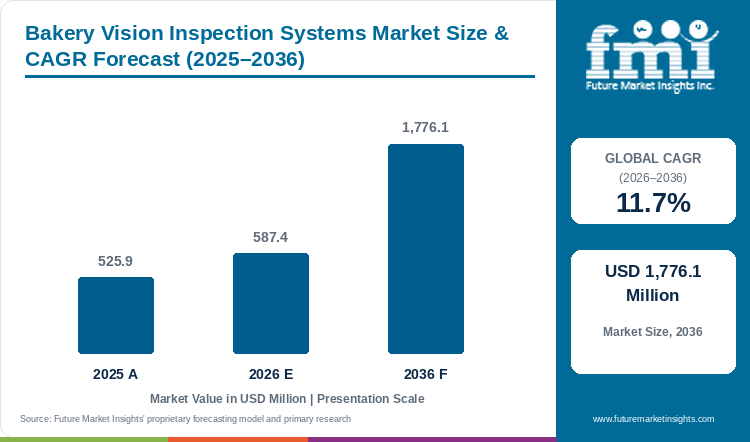
The market was valued at USD 525.9 million in 2025 and is expected to reach USD 587.4 million in 2026. It is projected to reach USD 1,776.1 million by 2036 at a CAGR of 11.7% from 2026 to 2036.
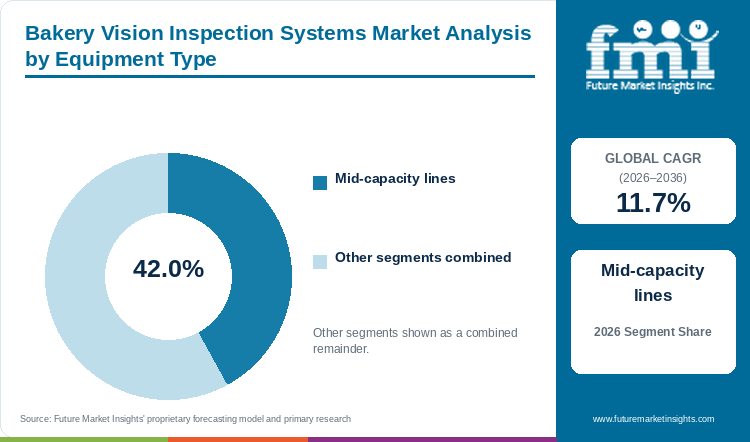
The bakery vision inspection systems market was valued at USD 525.9 million in 2025 and is expected to reach USD 587.4 million in 2026, before rising to USD 1,776.1 million by 2036 at an 11.7% CAGR from 2026 to 2036. In 2026, Mid-capacity lines account for 42.0% of Equipment Type, 500-2,000 kg/hr systems hold 43.0% of Capacity, and Fully automatic / robotic systems lead Automation Level with 44.0%. Those positions reflect the need to check every product at line speed without making reject rates or washdown burdens uneconomic. Growth is tied to machine-mounted cameras and classification software that check dough geometry, surface appearance and finished-product conformity during production. In May 2025, QING and AMF presented the STAQ quality-control system for inline assessment of bakery-product shape, size and surface characteristics.[1] That development makes the investment case tangible: production managers can move from intermittent sampling toward monitored acceptance decisions linked to their existing lines.
Key Market Trends & Insights
- By Equipment Type: Mid-capacity lines lead with 42.0% in 2026 because they can spread camera and control costs over sustained shifts without industrial-scale commissioning overhead.
- By Capacity: 500-2,000 kg/hr holds 43.0% in 2026; this band provides a workable inspection speed for multi-product commercial bakery operations.
- By Automation Level: Fully automatic / robotic systems hold 44.0% in 2026 as automated accept/reject decisions fit continuous conveyance and data capture.
Regional Highlights
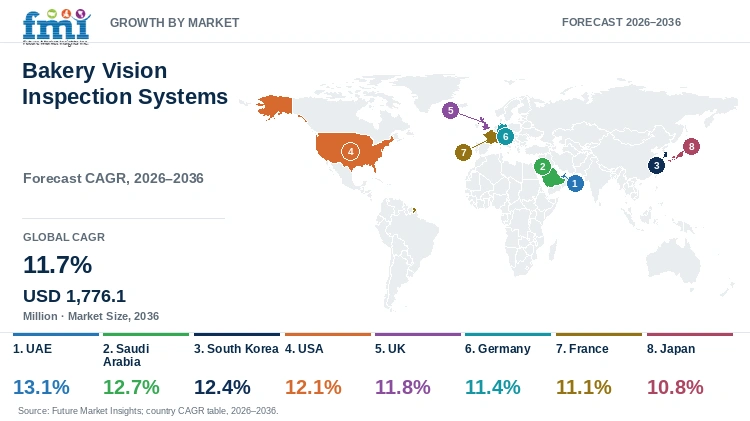
- The UAE is forecast to expand fastest in bakery vision inspection systems, at 13.1% CAGR through 2036, as producers seek dependable product checks at line speed.
- Saudi Arabia's 12.7% outlook and South Korea's 12.4% outlook also exceed the global rate, while Japan has the lowest profiled CAGR at 10.8%.
Market Size & Forecast
Table 1: Bakery Vision Inspection Systems Market Size and Forecast (USD million), 2025 to 2036
| Market size and forecast | Value |
|---|---|
| 2025 Value (actual) | USD 525.9 million |
| Estimated market size in 2026 | USD 587.4 million |
| Projected market size by 2036 | USD 1,776.1 million |
| CAGR (2026-2036) | 11.7% |
Adoption varies more by plant economics and controls architecture than by demand for bread itself. U.S. buyers must align inspection records with preventive-controls programs under FDA rules.[6] European bakeries face HACCP hygiene duties, while manufacturers in Saudi Arabia and the UAE are expanding within active food-safety oversight environments.[7] In South Korea, smarter HACCP recording is receiving regulatory support.[14] None of these policies mandates purchase of a specific camera system. Revenue depends on a successful line trial that demonstrates acceptable false rejects, reliable cleaning and enough recoverable waste or labor savings to justify integration.
The market is segmented by Equipment Type, Capacity, Automation Level, End User, Sales Channel, and Region, with a forecast from 2026 to 2036.
Profiled companies are AMF Bakery Systems, Buhler Group, Baker Perkins, Rademaker, FRITSCH Group, Rheon Automatic Machinery, Mecatherm, Middleby, Reading Bakery Systems, and Kaak Group.
Table 2: Supporting Industry Indicators for the Bakery Vision Inspection Systems Market
| Indicator | Data point | Why it matters | Source |
|---|---|---|---|
| Inline visual inspection | In May 2025, QING and AMF Bakery Systems presented the STAQ Quality Control System at iba.[1] | QING described AI-enabled inspection of bakery-product shape, size and surface attributes directly on AMF lines.[1] It is direct evidence of a vision inspection offering that integrates with existing bakery production, although the announcement did not establish a quantified installed base. | [1] |
| Bakery quality control | In April 2025, Mecatherm announced that it and sister company ABI would show ABI’s AI-powered EYE-Q quality-control solution at iba.[2] | The system sits alongside industrial baking and waste-reduction technologies. The dated disclosure supports a bakery-specific inspection proposition, not a claim about independently verified defect rates or widespread deployment. | [2] |
| Connected sheeting lines | In June 2026, Kaak Group described Royal Kaak upgrades to DrieM sheeting lines with smart sensors, automated controls and iBakeCare production monitoring.[3] | These improvements concern the upstream bakery-line environment rather than a separately verified vision-inspection launch. They matter because image-based inspection is easier to deploy where machines already expose usable process signals. | [3] |
Demand Intensity Analysis
Inline detection helps bakery operators identify visible product defects earlier and document corrective action without stopping production for manual sampling.
Flour dust, variable product appearance and new recipe validation can raise false-reject costs and slow return on capital.
The increase from USD 587.4 million in 2026 to USD 1,776.1 million in 2036 represents USD 1,188.7 million in additional market revenue over the forecast period.
Table 3: Demand Intensity Metrics for the Bakery Vision Inspection Systems Market, 2026 to 2036
| Demand intensity metric | Value | Basis |
|---|---|---|
| Bakery Vision Inspection Systems Market value CAGR | 11.7% | Global market value growth, 2026 to 2036 |
| Mid-capacity lines share in 2026 | 42.0% | Equipment Type classification |
| 500-2,000 kg/hr share in 2026 | 43.0% | Capacity classification |
| Fully automatic / robotic share in 2026 | 44.0% | Automation Level classification |
| Added revenue through 2036 | USD 1,188.7 million | Increase in market revenue from 2026 to 2036 |
Analyst Perspective
The decisive purchase threshold is repeatable detection accuracy under the buyer’s actual recipes and line speeds. A technically capable camera does not become a scalable installation until reject handling, sanitation and operator decisions have been validated together.
- Nandini Roy Choudhury, Principal Consultant, FMI
How is the bakery vision inspection systems market segmented?
The market is assessed across Equipment Type, Capacity, Automation Level, End User, and Sales Channel.
Equipment Type comprises Mid-capacity lines, Compact / entry systems, and High-capacity industrial lines. Capacity covers 500-2,000 kg/hr, Below 500 kg/hr, and Above 2,000 kg/hr. Automation Level includes Fully automatic / robotic, Semi-automatic, and Manual. End User distinguishes Industrial bakeries, In-store & retail bakeries, Artisan bakeries, and Foodservice / QSR central kitchens. Sales Channel comprises Direct OEM sales, Dealers & distributors, and Aftermarket & refurbished.
Why do Mid-capacity lines lead the Equipment Type category?
Mid-capacity lines can position camera checkpoints after dividing, forming or baking while retaining enough operating hours to spread software commissioning costs. Their modular conveyors are often easier to access for lighting and reject devices than densely packed high-output installations. At the other end, compact lines face tighter cash budgets and floor-space constraints. Large industrial lines require more extensive multi-lane calibration and cybersecurity review. The commercial sweet spot is a configured inspection cell rather than the largest possible platform.
- 2026 leading share: Mid-capacity lines represent 42.0%, supported by a balance between line utilization and integration complexity.
- FRITSCH introduced its hygienic PROGRESSA pastry line in May 2025, illustrating how cleanability and easy changeovers influence smaller industrial and retail-scale line specifications.
What sustains demand in the 500-2,000 kg/hr Capacity category?
At 500-2,000 kg/hr, product flow is substantial enough to make missed defects costly but does not always require dedicated vision engineering staff. A buyer can often trial a camera station on one conveyor before replicating it across similar lines. Below 500 kg/hr, manual checking or portable tools remain practical substitutes. Above 2,000 kg/hr, multi-camera synchronization and high-speed rejection raise the proof burden. Line throughput is an equipment-selection variable, not evidence that every bakery at that output has adopted vision inspection.
- 2026 leading share: 500-2,000 kg/hr accounts for 43.0%; buyers prioritize reliable detection at everyday commercial production speeds.
- In January 2025, FRITSCH described updated PROGRESSA machine controls for mid-sized businesses. Its throughput-oriented interface illustrates the need to coordinate inspection settings with recipe and line changes.
Why is Fully automatic / robotic the leading Automation Level?
Fully automatic / robotic configurations link the image decision to a physical response. A camera can flag an irregular bun, log the finding and trigger diversion without waiting for a manual operator to examine the same product. That chain becomes valuable where line speed or labor availability makes 100.0% manual inspection impractical. Semi-automatic solutions still suit mixed recipes with human exception handling. Manual approaches carry lower initial cost but tend to offer less consistent records and coverage across long shifts.
- 2026 leading share: Fully automatic / robotic holds 44.0% because continuous capture and linked rejection reduce dependence on spot checks.
- At iba in May 2025, QING and AMF showed STAQ inspection integrated with AMF bakery lines, demonstrating a direct route from machine vision to production-line quality decisions.[1]
How do Industrial bakeries anchor End User demand?
Industrial bakeries have the highest cost of an undetected repeated defect: one setting drift can affect a long sequence before an operator discovers it. They also tend to maintain formal quality records that make traceable exceptions more valuable. Retail and artisan bakers may judge premium appearance differently and rely on shorter runs. Foodservice / QSR central kitchens favor visual consistency across standardized batches. The industrial case is strongest when an inspection station is integrated with line controls and an actionable rejection protocol.
- 2026 leading share: Industrial bakeries account for 38.0%, reflecting recurring quality checks on sustained production runs.
- Mecatherm highlighted ABI’s AI-powered EYE-Q quality-control system in its August 2025 IBIE briefing.[2] It positioned inspection alongside industrial bakery processing and waste reduction.
Why is Direct OEM sales the preferred Sales Channel?
A bakery camera inspection system is rarely a stand-alone purchase decision. Lighting, conveyor geometry, reject timing and controls interfaces must be proven together. Direct OEM sales allow the buyer to hold one party accountable for commissioning and acceptance testing. Dealers & distributors remain useful for regional support and smaller installations. Aftermarket & refurbished solutions can lower acquisition costs but require renewed calibration and equipment-condition checks. The channel premium is justified only when integration support cuts qualification time or protects uptime.
- 2026 leading share: Direct OEM sales represent 58.0% because buyers value single-point responsibility for line integration and acceptance testing.
- In March 2025, Bühler and West-Link opened a California optical-sorting testing and support center. Although focused on broader food processors, it shows why hands-on trials and servicing shape equipment purchasing.
What are the drivers, restraints and opportunities in the bakery vision inspection systems market?
Visual-quality consistency and recorded process control support demand, while recipe-dependent calibration limits immediate deployment and modular retrofits create an opening for accessible inspection upgrades.
- Driver: Continuous visual-quality assurance reduces delay between an out-of-specification product and the operator’s corrective action.
- Restraint: Validation under changing crust colors, toppings and flour conditions complicates purchase approval and ongoing accuracy.
- Opportunity: Modular camera cells with product-specific models and interfaces to existing conveyors can serve mid-scale and retrofit buyers.
The driver comes from tighter control of visible nonconformity rather than a claim that cameras replace all food-safety measures. U.S. FDA preventive-controls guidance requires covered plants to analyze hazards and maintain suitable controls.[6] EU Regulation 852/2004 similarly establishes hygiene and HACCP obligations. Bakery operators can use optical measurements to support specific physical and appearance checks that their hazard and quality plans identify. The procurement consequence is demand for systems that retain time-stamped images and communicate events to line operators. Vision alone does not identify microbial contamination or satisfy every regulatory test.
Installation friction concentrates at validation. Dough proofing changes geometry within minutes; flour dust can obstruct lenses and toppings can make acceptable products look irregular. Lighting and reject mechanisms also must withstand cleaning without disrupting hygiene practice. The UK Food Standards Agency’s MyHACCP guidance emphasizes validation of chosen controls and records of verification. For a bakery, that translates into trials across recipes and shifts rather than a short demonstration on uniform samples. Failure to prove the false-reject rate increases ingredient waste and can push capital approval into a later budget cycle.
The opportunity lies in installations that connect visual observations to corrective action without forcing a full production-line replacement. Mecatherm described ABI’s EYE-Q in March 2026 as deployable at selected process points with defect classification and operator feedback.[2] FRITSCH describes Smart Production Insights as retrofittable to many existing lines, although this digital monitoring product is not itself a vision inspector. Suppliers that provide accessible image retraining and cleanable modules can address mid-sized buyers. The revenue opportunity materializes only when the inspection component is priced separately or its incremental value within a bundled line is clear.
Which country CAGRs are profiled in the bakery vision inspection systems market?
The following country-level CAGRs refer to 2026 to 2036. They are growth rates, not indications of absolute national market size.
Table 4: Country growth outlook for the Bakery Vision Inspection Systems Market
| Country | CAGR |
|---|---|
| UAE | 13.1% |
| Saudi Arabia | 12.7% |
| South Korea | 12.4% |
| USA | 12.1% |
| UK | 11.8% |
| Germany | 11.4% |
| France | 11.1% |
| Japan | 10.8% |
How do country-level CAGRs compare in the bakery vision inspection systems market?
The eight profiled rates range from 10.8% in Japan to 13.1% in the UAE, a 2.3 percentage-point spread. The UAE and Saudi Arabia occupy the upper band of the country profile, followed by South Korea and the USA. The UK, Germany, France and Japan show lower but still double-digit growth rates. A higher rate does not imply a larger installed equipment base or a stronger supplier position.
- UAE: Food-establishment expansion and municipal inspection activity create an audit-aware buyer environment.
- Saudi Arabia: Licensed food manufacturing expansion creates opportunities for new-line inspection specifications.
- South Korea: Smart HACCP provisions support interest in automated records and operator traceability.
- USA: Preventive-controls requirements and technical testing facilities favor validation-led buying.
- UK: Established bakery manufacturing makes retrofits and maintenance economics central to procurement.
- Germany: Consolidation in the baking trade raises the value of equipment that can run across multiple branches or shifts.
- France: Margin pressure makes avoidable rejects and demonstrable payback especially important.
- Japan: Food-manufacturing labor constraints motivate labor-saving technology, subject to hygienic integration.
These observations concern the surrounding food-manufacturing environment. None measures country-specific installed vision capacity or validates the forecast rates independently. Countries outside this profile remain within the broader report coverage.
Country-wise Analysis
UAE
Dubai’s rapid turnover of food premises creates both an opportunity and a qualification burden for equipment suppliers. The UAE is profiled at a 13.1% CAGR from 2026 to 2036. Dubai Municipality reported 34,700 food inspections and around 2,336 newly opened food establishments during the first half of 2025. Those figures cover food establishments broadly and should not be read as vision-system orders. Centralized bakeries supplying restaurants and retail chains may prioritize auditable visual checks to stabilize product appearance across outlets. Local service coverage, humidity-resistant installation and quick access to spare parts will affect whether quality requirements translate into equipment spending.
Saudi Arabia
New capacity is the relevant purchasing channel in Saudi Arabia. Its bakery vision inspection systems market has a 12.7% CAGR for 2026 to 2036. The Saudi Food and Drug Authority reported that 693 food factories received licenses during 2024, alongside substantial warehouse licensing. This was food-sector activity rather than a count of bakery facilities. When industrial bakeries specify new conveyors and packaging interfaces, it is easier to include cameras at design stage than to retrofit them later. Suppliers still need to validate product mix and local hygiene procedures. Projects can be delayed where the inspection station is treated as optional rather than part of the line acceptance scope.
South Korea
South Korea combines highly specified processing environments with a formal route toward automated safety records. A 12.4% CAGR is profiled from 2026 to 2036. In August 2025, the Ministry of Food and Drug Safety amended HACCP criteria and expanded incentives and labeling provisions linked to smart HACCP record systems. That action supports digital documentation but does not prescribe visual cameras. Bakery buyers can link image rejection logs to existing critical-control records where appropriate. Suppliers will need Korean-language interfaces and evidence that their model can distinguish legitimate shape variation from true defects. Traceable corrective actions may matter more than maximum theoretical detection speed.
USA
For the USA, the 2026 to 2036 CAGR is 12.1%. The acquisition decision is shaped by plant validation and by how an inspector fits into preventive-control documentation under FDA Part 117.[6] The FDA rules are risk based and do not require a branded vision platform. In June 2025, AMF and Puratos opened a pilot bakery in New Jersey for industrial-scale production testing. Such facilities can shorten the route from vendor demonstration to a recipe-specific factory acceptance test. Multi-plant operators may standardize camera recipes across lines after successful trials, but reject accuracy and controls interoperability remain central purchase gates.
UK
The UK is assessed at 11.8% CAGR from 2026 to 2036. A mature domestic bakery production base encourages equipment upgrades that maintain output without full-line replacement. The Office for National Statistics reported a bakery and farinaceous manufacturing output index of 98.8 in 2025 versus 96.2 in 2024, using its 2023 reference year. This is a sector production indicator, not a vision-inspection revenue measure. The Food Standards Agency’s HACCP guidance stresses review and verification of monitoring measures. Buyers therefore need practical evidence that a camera installation can be cleaned, recalibrated and maintained by shift personnel while preserving existing audit routines.
Germany
German bakeries face a distinct consolidation challenge rather than uniform factory expansion. Germany carries an 11.4% CAGR from 2026 to 2036. The national bakers’ association reported that the number of registered artisanal baking businesses declined to 8,912 in 2024, even as their revenue reached EUR 17.9 billion. This is contextual trade evidence and not an equipment market total. A shrinking number of operating companies with multi-branch networks can place greater emphasis on central production consistency. Camera systems must handle broad bread varieties and withstand bakery hygiene protocols. Integration partners that demonstrate savings without interrupting specialty production have a clearer case.
France
France is profiled at 11.1% CAGR for 2026 to 2036. Product diversity creates a demanding visual-classification problem: traditional breads and pastries may vary legitimately in surface finish, size and proofing. INSEE reported a 19.4% margin rate for the wider bakery, pastry and pasta manufacturing industry in 2022, in an October 2024 analysis. That statistic is not a current inspection buyer margin. It shows why payback claims should be tested against the economics of different food producers. Mecatherm’s industrial baking presence and ABI-linked EYE-Q system provide a domestic example of a line-integrated quality-control route.[2] Trial recipes must be agreed before installation.
Japan
Japan’s forecast CAGR is 10.8% from 2026 to 2036. Its main demand test is whether automation can relieve a persistent workforce constraint without compromising food-plant sanitation. In June 2025, the Ministry of Agriculture, Forestry and Fisheries outlined a five-year labor-saving investment plan for food manufacturing and maintained guidance for safe robotic adoption. That program targets food producers generally rather than bakery vision equipment specifically. Rheon Automatic Machinery illustrates the country’s modular dough-forming engineering capability, but the cited product material does not establish a dedicated Rheon camera-inspection offer. Buyers may favor systems with simplified model training and dependable local maintenance rather than complex custom projects.
Who are the notable companies in the bakery vision inspection systems market?
AMF Bakery Systems, Buhler Group, Baker Perkins, Rademaker, FRITSCH Group, Rheon Automatic Machinery, Mecatherm, Middleby, Reading Bakery Systems, and Kaak Group are the notable companies profiled in this market.
Competitive roles differ sharply by where image data enters the bakery process. AMF Bakery Systems has direct bakery-product inspection evidence through its STAQ collaboration. Mecatherm’s link with ABI provides another direct route through EYE-Q.[2] Buhler Group supplies camera-based optical sorting primarily for food materials. Its May 2025 SORTEX AI700 launch focused initially on oat processing, not finished-bakery inspection. Rademaker and Kaak Group document vision-guided robotics in dough handling or scoring. Their control functions must not be mistaken for independent quality-rejection products. Baker Perkins, FRITSCH Group, Rheon Automatic Machinery, Middleby and Reading Bakery Systems supply adjacent bakery line equipment or process platforms. The cited product material does not establish standalone camera-inspection products for those five companies; their relevance lies in integration opportunities and buyer relationships.
- Optical quality-control exposure: AMF Bakery Systems and Mecatherm have bakery-product inspection pathways; Buhler Group provides adjacent food-material optical sorting expertise.
- Vision-guided bakery-line functions: Rademaker and Kaak Group document camera-supported handling or scoring rather than verified finished-product reject inspection.
- Processing-line and retrofit interfaces: Baker Perkins, FRITSCH Group, Rheon Automatic Machinery, Middleby, and Reading Bakery Systems have documented bakery process or service capabilities; standalone vision offers were not verified.
Competitive Benchmarking: Bakery Vision Inspection Systems Market
Table 5: Company capabilities for the Bakery Vision Inspection Systems Market
| Company | Bakery-product visual QC | Vision-guided bakery robotics | Line data integration | Geographic Reach |
|---|---|---|---|---|
| AMF Bakery Systems | High | Medium | High | Americas and Europe; broader industrial bakery projects |
| Buhler Group | Unscored | Unscored | Medium | Global optical-sorting and food-processing support network |
| Baker Perkins | Unscored | Unscored | Unscored | UK and USA facilities; international processing customers |
| Rademaker | Unscored | High | High | Netherlands and USA technology/service presence; wider line customers |
| FRITSCH Group | Unscored | Unscored | Medium | Germany and Canada test centers; wider MULTIVAC network |
| Rheon Automatic Machinery | Unscored | Unscored | Unscored | Japan headquarters and documented German/European operations |
| Mecatherm | High | Unscored | High | France-based industrial lines; North American ABI activity |
| Middleby | Unscored | Unscored | Unscored | USA group with German and other European bakery brands |
| Reading Bakery Systems | Unscored | Unscored | Unscored | USA base; published EMEA and APAC sales coverage |
| Kaak Group | Unscored | High | High | Netherlands-based bakery lines and international projects |
Scoring basis: Bakery-product visual QC rates documented image-based classification of baked or dough products with actionable inspection feedback. Vision-guided bakery robotics measures camera-assisted product location or manipulation, which is distinct from defect rejection. Line data integration evaluates evidence of connections between machine functions and production-control or monitoring systems. High indicates broad or explicit bakery-specific capability; Medium indicates a documented narrower or adjacent function. Low denotes a documented limitation, while unavailable public information is left Unscored. Geographic Reach concerns the supplier’s evidenced equipment or service footprint and is not a map of installed inspection systems.
Key Developments in the Bakery Vision Inspection Systems Market
In May 2025, QING and AMF Bakery Systems presented the STAQ Quality Control System at iba.[1] QING described AI-enabled inspection of bakery-product shape, size and surface attributes directly on AMF lines.[1] It is direct evidence of a vision inspection offering that integrates with existing bakery production, although the announcement did not establish a quantified installed base.
In April 2025, Mecatherm announced that it and sister company ABI would show ABI’s AI-powered EYE-Q quality-control solution at iba.[2] The system sits alongside industrial baking and waste-reduction technologies. The dated disclosure supports a bakery-specific inspection proposition, not a claim about independently verified defect rates or widespread deployment.
In June 2026, Kaak Group described Royal Kaak upgrades to DrieM sheeting lines with smart sensors, automated controls and iBakeCare production monitoring.[3] These improvements concern the upstream bakery-line environment rather than a separately verified vision-inspection launch. They matter because image-based inspection is easier to deploy where machines already expose usable process signals.
Key Players in the Bakery Vision Inspection Systems Market
Optical quality-control and ingredient-sorting exposure
- AMF Bakery Systems
- Buhler Group
- Mecatherm
Vision-guided bakery robotics and product handling
- Rademaker
- Kaak Group
Bakery line, processing and retrofit interfaces
- Baker Perkins
- FRITSCH Group
- Rheon Automatic Machinery
- Middleby
- Reading Bakery Systems
Bakery Vision Inspection Systems Market - Report Scope
Table 6: Report scope for the Bakery Vision Inspection Systems Market
| Coverage field | Report scope |
|---|---|
| Market breakdown | Equipment Type; Capacity; Automation Level; End User; Sales Channel |
| Quantitative Units | USD million |
| Market Definition | Revenue from dedicated bakery-product vision inspection cameras, sensors, analysis software, control stations and defect-rejection interfaces sold within the stated segment categories. Count an attributable inspection component within bundled bakery lines and qualifying refurbished inspection systems; exclude finished baked goods, generic processing equipment, standalone metal detection or X-ray units, ingredient-only sorters and routine unrelated maintenance. |
| Regions Covered | North America; Latin America; Western Europe; Eastern Europe; East Asia; South Asia and Pacific; Middle East and Africa |
| Countries Covered | USA; Germany; France; UK; Saudi Arabia; UAE; Japan; South Korea |
| Key Companies Profiled | AMF Bakery Systems; Buhler Group; Baker Perkins; Rademaker; FRITSCH Group; Rheon Automatic Machinery; Mecatherm; Middleby; Reading Bakery Systems; Kaak Group |
| Forecast Period | 2026 to 2036 |
| Approach | Primary and secondary research with market triangulation. |
Bakery Vision Inspection Systems Market - Research Methodology
Table 7: Research approach for the Bakery Vision Inspection Systems Market
| Method | Approach |
|---|---|
| Primary Research | FMI analysts gathered input from manufacturers, service providers, technology developers, distributors, end users, procurement teams and subject-matter experts. Interviews examined purchasing decisions, product or service evaluation, adoption barriers, approval requirements, pricing considerations and expectations for technical or commercial support. Respondents were also asked what evidence is required before a trial, pilot, or initial order develops into regular purchasing. |
| Desk Research | Desk research covered government statistics, regulatory publications, trade data, industry associations, technical literature, standards, company filings, product information and official corporate announcements. Sources were reviewed for relevance, publication date, geographic coverage and consistency with the defined market scope. Claims relating to performance, applications, approvals, capacity, investment and commercial activity were retained only when supported by credible public evidence. |
| Market Sizing and Forecasting | The market model combined the baseline value with historical performance, segment structure, pricing and volume indicators, adoption levels, company participation and country-level demand conditions. Forecast assumptions considered economic activity, investment trends, regulatory developments, technology adoption, purchasing cycles, supply availability and barriers to wider market use. Segment and regional estimates were reconciled before the final market total was calculated. |
| Data Validation | Estimates were checked against multiple independent indicators, including public data, company activity, trade patterns, industry developments and findings from primary interviews. Validation also tested whether products, services, applications and company revenues fell within the defined market boundaries. Adjacent categories, unsupported claims, overlapping revenues and activities without direct market relevance were excluded to reduce double counting and maintain consistency across segments and countries. |
Bakery Vision Inspection Systems Market by Segments
Equipment Type
- Mid-capacity lines
- Compact / entry systems
- High-capacity industrial lines
Capacity
- 500-2,000 kg/hr
- Below 500 kg/hr
- Above 2,000 kg/hr
Automation Level
- Fully automatic / robotic
- Semi-automatic
- Manual
End User
- Industrial bakeries
- In-store & retail bakeries
- Artisan bakeries
- Foodservice / QSR central kitchens
Sales Channel
- Direct OEM sales
- Dealers & distributors
- Aftermarket & refurbished
Bakery Vision Inspection Systems Market by Region
- North America
- United States
- Canada
- Latin America
- Brazil
- Mexico
- Argentina
- Chile
- Western Europe
- Germany
- France
- United Kingdom
- Italy
- Spain
- Benelux
- Nordics
- Eastern Europe
- Poland
- Czech Republic
- Romania
- Hungary
- East Asia
- China
- Japan
- South Korea
- South Asia and Pacific
- India
- ASEAN
- Australia and New Zealand
- Middle East and Africa
- GCC Countries
- South Africa
- Türkiye
- Israel
Research Sources and Bibliography
- [1] QING (n.d.). QING and AMF raise quality standards in the bakery industry.
- [2] Mecatherm (2025, April 16). IBA 2025: Mecatherm and ABI to present their solutions for addressing the challenges in the bakery, pastry, and sweet goods sector.
- [3] Royal Kaak (2026, June 8). Royal Kaak introduces new innovations for DrieM sheeting lines.
- [4] Bühler Group (2025, May 15). Deep learning powers Bühler’s new SORTEX AI700.
- [5] Bühler Group (2025, March 13). Bühler partners with West-Link to strengthen optical sorting presence in Western US with new research and training center in California.
- [6] U.S. Food and Drug Administration (n.d.). Current Good Manufacturing Practices (CGMPs) for Food and Dietary Supplements.
- [7] European Union (2004, April 29). Regulation (EC) No 852/2004 on the hygiene of foodstuffs.
- [8] Zentralverband des Deutschen Bäckerhandwerks (2025, April 14). Bäckerhandwerk beweist Resilienz: Betriebsrückgang, aber stabile Zahl an Neugründungen und mehr Azubis.
- [9] INSEE (2024, October 2). Une hausse du taux de marge de l’industrie agroalimentaire de 2019 à 2022 concentrée dans les groupes.
- [10] UK Food Standards Agency (n.d.). Introduction to HACCP principles.
- [11] UK Office for National Statistics (2026, September 11). IOP: 10.7: Manufacture of bakery and farinaceous products: CVMNSA.
- [12] Saudi Press Agency / Saudi Food and Drug Authority (2025, March 28). SFDA Reports 82% Increase in Licensed Factories, Warehouses in 2024.
- [13] Dubai Municipality (2025, July 30). Over 34,000 food inspections conducted in first half of 2025.
- [14] Ministry of Food and Drug Safety, Republic of Korea (2025, August 4). 식품 및 축산물 안전관리인증기준 일부개정고시 (제2025-50호).
- [15] Japan Ministry of Agriculture, Forestry and Fisheries (n.d.). Improving Productivity in Food Manufacturing (食品製造業等の生産性向上).
- [16] AMF Bakery Systems (2025, June 9). AMF and Puratos launch joint pilot bakery facility to accelerate commercial baking innovation.
- [17] FRITSCH Group (2025, May 13). PROGRESSA pastry - the new pastry line for retail bakers.
- [18] Mecatherm (2025, May 18). Mecatherm facilitates production line operations with MyMecatherm Digital Platform.
- [19] The Middleby Corporation (2025, August 13). Middleby acquires Oka-Spezialmaschinenfabrik GmbH & Co. KG.
- [20] The Middleby Corporation (2024, February 7). Middleby acquires GBT GmbH Bakery Technology.
- [21] Reading Bakery Systems (2025, May 14). RBS designs Emithermic XE oven to replace direct gas fired oven technology.
- [22] Rademaker (n.d.). Bakery Robotics: Level Up Your Automation.
- [23] Royal Kaak (n.d.). Scoring systems.
- [24] Baker Perkins (n.d.). Food Processing Equipment & Production Lines.
- [25] Rheon Automatic Machinery (n.d.). V4 Line Series.
- [26] FRITSCH Group (2025, January 16). Digital progress for the PROGRESSA.
- [27] Bühler Group (n.d.). Optical Sorting Machines | SORTEX.
- [28] Reading Bakery Systems (n.d.). Commercial Bakery Equipment Servicing.
- [29] Mecatherm (2026, March 31). Join Mecatherm and ABI at Interpack 2026 to discover our latest solutions.
- [30] Mecatherm (2025, August 6). IBIE 2025: Comprehensive solutions to meet the challenges of the Bakery, Pastry, and Sweet Goods sector.
- [31] FRITSCH Group (2022, May 20). Opening of the first local FRITSCH World of Bakery in North America.
- [32] FRITSCH Group (n.d.). An overview of production data in real time.
This Report Answers
- What is the bakery vision inspection systems market worth in 2026 and by 2036?
- Which production-quality pressures support bakery vision inspection purchasing?
- Why do Mid-capacity lines hold the largest Equipment Type share?
- What gives the 500-2,000 kg/hr Capacity category its position?
- How do the profiled country growth rates and operating conditions differ?
- Which profiled companies have direct visual-QC evidence versus related bakery-line functions?
- Which accuracy, cleaning and switching requirements delay deployment?
- What should bakery buyers validate before placing an equipment order?
Frequently Asked Questions
How big is the bakery vision inspection systems market in 2026, and what is forecast for 2036?
The market stands at USD 587.4 million in 2026 and is forecast at USD 1,776.1 million in 2036. The figures refer to bakery vision inspection system revenue rather than revenue from finished baked goods.
What is the CAGR for bakery vision inspection systems from 2026 to 2036?
The forecast CAGR is 11.7% from 2026 to 2036. Realized purchases depend on validation and integration economics in each bakery.
Which Equipment Type segment leads in 2026?
Mid-capacity lines lead Equipment Type with 42.0% in 2026. They balance repeatable inspection throughput with manageable installation work.
Which Capacity category has the leading share?
The 500-2,000 kg/hr category leads Capacity with 43.0% in 2026. Its fit with commercial production lines supports cost recovery from reduced visual defects.
Which profiled countries show the highest forecast growth?
The UAE has the highest profiled CAGR at 13.1% from 2026 to 2036, followed by Saudi Arabia at 12.7%. The rate comparison does not establish which country has the greatest market value.
Which companies are active in bakery vision inspection and related lines?
The profiled companies are AMF Bakery Systems, Buhler Group, Baker Perkins, Rademaker, FRITSCH Group, Rheon Automatic Machinery, Mecatherm, Middleby, Reading Bakery Systems, and Kaak Group. Public evidence is strongest for direct bakery-product vision QC at AMF and the ABI-linked Mecatherm offering.
Preview the report firsthand - request a free sample
Get SampleGet the brochure for pricing and purchase details.
Get PDFTable of Content
- Key Takeaways
- Market Size and CAGR
- Top Growth Driver
- Fastest Growing Segment
- Leading Region
- Key Companies
- Emerging Opportunities
- Executive Summary
- Global Market Outlook
- Demand-side Trends
- Supply-side Trends
- Technology Roadmap Analysis
- Analysis and Recommendations
- Analyst Perspective (What is happening? Why now? What should investors know?)
- Key Questions Answered
- How large is the market?
- What is the CAGR?
- What are key trends?
- Which region dominates?
- Who are the leaders?
- Market Overview
- Market Coverage / Taxonomy
- Market Definition / Scope / Limitations
- Research Methodology
- Chapter Orientation
- Analytical Lens and Working Hypotheses
- Market Structure, Signals, and Trend Drivers
- Benchmarking and Cross-market Comparability
- Market Sizing, Forecasting, and Opportunity Mapping
- Research Design and Evidence Framework
- Desk Research Programme (Secondary Evidence)
- Expert Input and Fieldwork (Primary Evidence)
- Tooling, Models, and Reference Databases
- Data Engineering and Model Build
- Quality Assurance and Audit Trail
- Market Background
- Market Dynamics (Drivers, Restraints, Opportunity, Trends)
- Scenario Forecast (Optimistic, Likely, Conservative)
- Impact Analysis
- AI Impact
- Sustainability Impact
- Regulatory Impact
- Technology Impact
- Consumer / Buyer Analysis
- Purchase Drivers
- Adoption Barriers
- Buyer Journey
- Opportunity Map Analysis
- Product Life Cycle Analysis
- Supply Chain Analysis
- Investment Feasibility Matrix
- Value Chain Analysis
- PESTLE and Porter's Analysis
- Regulatory Landscape
- Regional Parent Market Outlook
- Production and Consumption Statistics
- Import and Export Statistics
- Global Market Analysis and Forecast, 2021 to 2036
- Historical Market Size Value (USD Million) Analysis, 2021 to 2025
- Current and Future Market Size Value (USD Million) Projections, 2026 to 2036
- Y-o-Y Growth Trend Analysis
- Absolute $ Opportunity Analysis
- Global Market Pricing Analysis, 2021 to 2036
- Global Market Analysis and Forecast, By Equipment Type, 2021 to 2036
- Introduction / Key Findings
- Historical Market Size Value (USD Million) Analysis By Equipment Type, 2021 to 2025
- Current and Future Market Size Value (USD Million) Analysis and Forecast By Equipment Type, 2026 to 2036
- Mid-capacity lines
- Compact / entry systems
- High-capacity industrial lines
- Y-o-Y Growth Trend Analysis By Equipment Type, 2021 to 2025
- Absolute $ Opportunity Analysis By Equipment Type, 2026 to 2036
- Global Market Analysis and Forecast, By Capacity, 2021 to 2036
- Introduction / Key Findings
- Historical Market Size Value (USD Million) Analysis By Capacity, 2021 to 2025
- Current and Future Market Size Value (USD Million) Analysis and Forecast By Capacity, 2026 to 2036
- 500-2,000 kg/hr
- Below 500 kg/hr
- Above 2,000 kg/hr
- Y-o-Y Growth Trend Analysis By Capacity, 2021 to 2025
- Absolute $ Opportunity Analysis By Capacity, 2026 to 2036
- Global Market Analysis and Forecast, By Automation Level, 2021 to 2036
- Introduction / Key Findings
- Historical Market Size Value (USD Million) Analysis By Automation Level, 2021 to 2025
- Current and Future Market Size Value (USD Million) Analysis and Forecast By Automation Level, 2026 to 2036
- Fully automatic / robotic
- Semi-automatic
- Manual
- Y-o-Y Growth Trend Analysis By Automation Level, 2021 to 2025
- Absolute $ Opportunity Analysis By Automation Level, 2026 to 2036
- Global Market Analysis and Forecast, By End User, 2021 to 2036
- Introduction / Key Findings
- Historical Market Size Value (USD Million) Analysis By End User, 2021 to 2025
- Current and Future Market Size Value (USD Million) Analysis and Forecast By End User, 2026 to 2036
- Industrial bakeries
- In-store & retail bakeries
- Artisan bakeries
- Foodservice / QSR central kitchens
- Y-o-Y Growth Trend Analysis By End User, 2021 to 2025
- Absolute $ Opportunity Analysis By End User, 2026 to 2036
- Global Market Analysis and Forecast, By Sales Channel, 2021 to 2036
- Introduction / Key Findings
- Historical Market Size Value (USD Million) Analysis By Sales Channel, 2021 to 2025
- Current and Future Market Size Value (USD Million) Analysis and Forecast By Sales Channel, 2026 to 2036
- Direct OEM sales
- Dealers & distributors
- Aftermarket & refurbished
- Y-o-Y Growth Trend Analysis By Sales Channel, 2021 to 2025
- Absolute $ Opportunity Analysis By Sales Channel, 2026 to 2036
- Global Market Analysis and Forecast, By Region, 2021 to 2036
- Introduction
- Historical Market Size Value (USD Million) Analysis By Region, 2021 to 2025
- Current Market Size Value (USD Million) Analysis and Forecast By Region, 2026 to 2036
- North America
- Latin America
- Western Europe
- Eastern Europe
- East Asia
- South Asia and Pacific
- Middle East and Africa
- Market Attractiveness Analysis By Region
- North America Market Analysis and Forecast, By Country, 2021 to 2036
- Historical Market Size Value (USD Million) Trend Analysis By Market Taxonomy, 2021 to 2025
- Market Size Value (USD Million) Forecast By Market Taxonomy, 2026 to 2036
- By Country
- United States
- Canada
- By Equipment Type
- By Capacity
- By Automation Level
- By End User
- By Sales Channel
- By Country
- Market Attractiveness Analysis
- By Country
- By Equipment Type
- By Capacity
- By Automation Level
- By End User
- By Sales Channel
- Key Takeaways
- Latin America Market Analysis and Forecast, By Country
- Historical Market Size Value (USD Million) Trend Analysis By Market Taxonomy, 2021 to 2025
- Market Size Value (USD Million) Forecast By Market Taxonomy, 2026 to 2036
- By Country
- Brazil
- Mexico
- Argentina
- Chile
- By Equipment Type
- By Capacity
- By Automation Level
- By End User
- By Sales Channel
- By Country
- Market Attractiveness Analysis
- By Country
- By Equipment Type
- By Capacity
- By Automation Level
- By End User
- By Sales Channel
- Key Takeaways
- Western Europe Market Analysis and Forecast, By Country
- Historical Market Size Value (USD Million) Trend Analysis By Market Taxonomy, 2021 to 2025
- Market Size Value (USD Million) Forecast By Market Taxonomy, 2026 to 2036
- By Country
- Germany
- France
- United Kingdom
- Italy
- Spain
- Benelux
- Nordics
- By Equipment Type
- By Capacity
- By Automation Level
- By End User
- By Sales Channel
- By Country
- Market Attractiveness Analysis
- By Country
- By Equipment Type
- By Capacity
- By Automation Level
- By End User
- By Sales Channel
- Key Takeaways
- Eastern Europe Market Analysis and Forecast, By Country
- Historical Market Size Value (USD Million) Trend Analysis By Market Taxonomy, 2021 to 2025
- Market Size Value (USD Million) Forecast By Market Taxonomy, 2026 to 2036
- By Country
- Poland
- Czech Republic
- Romania
- Hungary
- By Equipment Type
- By Capacity
- By Automation Level
- By End User
- By Sales Channel
- By Country
- Market Attractiveness Analysis
- By Country
- By Equipment Type
- By Capacity
- By Automation Level
- By End User
- By Sales Channel
- Key Takeaways
- East Asia Market Analysis and Forecast, By Country
- Historical Market Size Value (USD Million) Trend Analysis By Market Taxonomy, 2021 to 2025
- Market Size Value (USD Million) Forecast By Market Taxonomy, 2026 to 2036
- By Country
- China
- Japan
- South Korea
- By Equipment Type
- By Capacity
- By Automation Level
- By End User
- By Sales Channel
- By Country
- Market Attractiveness Analysis
- By Country
- By Equipment Type
- By Capacity
- By Automation Level
- By End User
- By Sales Channel
- Key Takeaways
- South Asia and Pacific Market Analysis and Forecast, By Country
- Historical Market Size Value (USD Million) Trend Analysis By Market Taxonomy, 2021 to 2025
- Market Size Value (USD Million) Forecast By Market Taxonomy, 2026 to 2036
- By Country
- India
- ASEAN
- Australia and New Zealand
- By Equipment Type
- By Capacity
- By Automation Level
- By End User
- By Sales Channel
- By Country
- Market Attractiveness Analysis
- By Country
- By Equipment Type
- By Capacity
- By Automation Level
- By End User
- By Sales Channel
- Key Takeaways
- Middle East and Africa Market Analysis and Forecast, By Country
- Historical Market Size Value (USD Million) Trend Analysis By Market Taxonomy, 2021 to 2025
- Market Size Value (USD Million) Forecast By Market Taxonomy, 2026 to 2036
- By Country
- GCC Countries
- South Africa
- Türkiye
- Israel
- By Equipment Type
- By Capacity
- By Automation Level
- By End User
- By Sales Channel
- By Country
- Market Attractiveness Analysis
- By Country
- By Equipment Type
- By Capacity
- By Automation Level
- By End User
- By Sales Channel
- Key Takeaways
- Key Countries Market Analysis
- United States
- Pricing Analysis
- Market Share Analysis, 2025
- By Equipment Type
- By Capacity
- By Automation Level
- By End User
- By Sales Channel
- Canada
- Pricing Analysis
- Market Share Analysis, 2025
- By Equipment Type
- By Capacity
- By Automation Level
- By End User
- By Sales Channel
- Mexico
- Pricing Analysis
- Market Share Analysis, 2025
- By Equipment Type
- By Capacity
- By Automation Level
- By End User
- By Sales Channel
- Brazil
- Pricing Analysis
- Market Share Analysis, 2025
- By Equipment Type
- By Capacity
- By Automation Level
- By End User
- By Sales Channel
- Chile
- Pricing Analysis
- Market Share Analysis, 2025
- By Equipment Type
- By Capacity
- By Automation Level
- By End User
- By Sales Channel
- Germany
- Pricing Analysis
- Market Share Analysis, 2025
- By Equipment Type
- By Capacity
- By Automation Level
- By End User
- By Sales Channel
- United Kingdom
- Pricing Analysis
- Market Share Analysis, 2025
- By Equipment Type
- By Capacity
- By Automation Level
- By End User
- By Sales Channel
- Italy
- Pricing Analysis
- Market Share Analysis, 2025
- By Equipment Type
- By Capacity
- By Automation Level
- By End User
- By Sales Channel
- Spain
- Pricing Analysis
- Market Share Analysis, 2025
- By Equipment Type
- By Capacity
- By Automation Level
- By End User
- By Sales Channel
- France
- Pricing Analysis
- Market Share Analysis, 2025
- By Equipment Type
- By Capacity
- By Automation Level
- By End User
- By Sales Channel
- India
- Pricing Analysis
- Market Share Analysis, 2025
- By Equipment Type
- By Capacity
- By Automation Level
- By End User
- By Sales Channel
- ASEAN
- Pricing Analysis
- Market Share Analysis, 2025
- By Equipment Type
- By Capacity
- By Automation Level
- By End User
- By Sales Channel
- Australia and New Zealand
- Pricing Analysis
- Market Share Analysis, 2025
- By Equipment Type
- By Capacity
- By Automation Level
- By End User
- By Sales Channel
- China
- Pricing Analysis
- Market Share Analysis, 2025
- By Equipment Type
- By Capacity
- By Automation Level
- By End User
- By Sales Channel
- Japan
- Pricing Analysis
- Market Share Analysis, 2025
- By Equipment Type
- By Capacity
- By Automation Level
- By End User
- By Sales Channel
- South Korea
- Pricing Analysis
- Market Share Analysis, 2025
- By Equipment Type
- By Capacity
- By Automation Level
- By End User
- By Sales Channel
- Poland
- Pricing Analysis
- Market Share Analysis, 2025
- By Equipment Type
- By Capacity
- By Automation Level
- By End User
- By Sales Channel
- Hungary
- Pricing Analysis
- Market Share Analysis, 2025
- By Equipment Type
- By Capacity
- By Automation Level
- By End User
- By Sales Channel
- Türkiye
- Pricing Analysis
- Market Share Analysis, 2025
- By Equipment Type
- By Capacity
- By Automation Level
- By End User
- By Sales Channel
- South Africa
- Pricing Analysis
- Market Share Analysis, 2025
- By Equipment Type
- By Capacity
- By Automation Level
- By End User
- By Sales Channel
- UAE
- Pricing Analysis
- Market Share Analysis, 2025
- By Equipment Type
- By Capacity
- By Automation Level
- By End User
- By Sales Channel
- Saudi Arabia
- Pricing Analysis
- Market Share Analysis, 2025
- By Equipment Type
- By Capacity
- By Automation Level
- By End User
- By Sales Channel
- United States
- Market Structure Analysis
- Competition Dashboard
- Competition Benchmarking
- Market Share Analysis of Top Players
- By Regional
- By Equipment Type
- By Capacity
- By Automation Level
- By End User
- By Sales Channel
- Emerging Startups
- Innovation Benchmarking
- Competition Analysis
- Competition Deep Dive
- AMF Bakery Systems
- Overview
- Product Portfolio
- Profitability by Market Segments
- Sales Footprint
- Strategy Overview
- Marketing Strategy
- Product Strategy
- Channel Strategy
- Buhler Group
- Baker Perkins
- Rademaker
- FRITSCH Group
- Rheon Automatic Machinery
- Mecatherm
- Middleby
- Reading Bakery Systems
- Kaak Group
- AMF Bakery Systems
- Case Studies
- Success Stories
- Recent Developments
- Competition Deep Dive
- Assumptions & Acronyms Used


