

- Market Size (2026)
- USD 255.9 Mn
- Forecast (2036)
- USD 688.3 Mn
- CAGR (2026 to 2036)
- 10.4%
How big is the wafer baking ovens market in 2026?
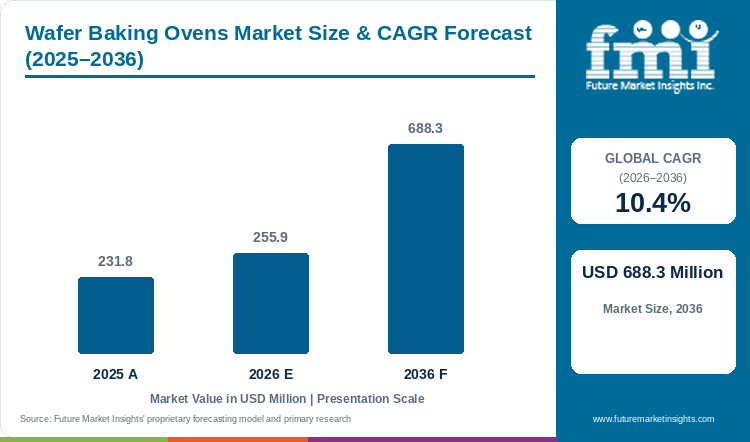
The market was valued at USD 231.8 million in 2025 and is expected to reach USD 255.9 million in 2026. It is projected to reach USD 688.3 million by 2036 at a CAGR of 10.4% from 2026 to 2036.
The wafer baking ovens market was valued at USD 231.8 million in 2025 and is estimated at USD 255.9 million in 2026. It is forecast to reach USD 688.3 million by 2036 at a CAGR of 10.4%, with cream-filled wafers accounting for 38.0% of product type demand in 2026. In Germany, confectionery and snack output fell 5.3% to 3.9 million tonnes in 2025 while production value rose 8.7%, according to the Bundesverband der Deutschen Süßwarenindustrie.[4] For wafer producers, an oven replacement can be justified by fuel use, temperature uniformity and the number of sheets lost before finishing, even when end-product tonnage is stable. Those operating gains require a system that fits existing batter preparation and downstream filling and packaging capacity. Trials should compare sheet quality throughout a production run, including warm-up and restart, because average fuel use alone does not capture the cost of losses in finishing.
Key Market Trends & Insights
- By product type: Cream-Filled Wafers represented 38.0% of 2026 product type demand. Layered construction means a weak sheet is lost after cream and handling have been added. The test is how many sheets survive spreading, stacking and cutting.
- By capacity: 500-2,000 kg/hr accounted for 39.0% of 2026 capacity demand. Oven output has to match cooling and finishing capacity. It's tested by whether a larger oven adds saleable wafers or only sheets waiting to be received.
- By automation level: Fully Automatic / Robotic held 43.0% of 2026 automation level demand. Linked deposition, plate movement and take-off repeat the same baking sequence. The test is how many sheets are lost before baking settles after a stop.
Regional Highlights
- The UAE heads the wafer baking oven country forecasts at 11.8% CAGR through 2036, where sheet losses and fuel efficiency can influence the timing of oven renewal.
- Saudi Arabia is projected at 11.5%, South Korea at 11.1% and the UK at 10.8%, while Japan's 9.5% outlook is the lowest of the eight country rates.
Market Size & Forecast
Table 1: Wafer Baking Ovens Market Size and Forecast (USD million), 2025 to 2036
| Market size and forecast | Value |
|---|---|
| 2025 Value (actual) | USD 231.8 million |
| Estimated market size in 2026 | USD 255.9 million |
| Projected market size by 2036 | USD 688.3 million |
| CAGR (2026-2036) | 10.4% |
The practical opportunity depends on whether a new oven lowers energy cost without raising the share of sheets lost in finishing. Bühler introduced OptiBake in May 2025 with induction heating and individual plate temperature control, and claims approximately 50.0% lower energy use than conventional gas-fired wafer ovens.[1] Hebenstreit offers WAQ equipment for flat or hollow wafer sheets.[2] The energy figure is the manufacturer’s own claim, and it does not show what a plant saves once the cost of changing its electrical connection is included. FDA manufacturing requirements add cleaning and upkeep obligations to every installation.[3] Consequently, actual demand will depend on whether induction heating cuts running cost at a given site while keeping the sheets that reach cream spreading and cutting intact.
Wafer Baking Ovens Market is segmented by Product Type, Capacity, Automation Level, End User, Sales Channel and Region. The forecast period runs from 2026 to 2036.
The wafer oven supplies a fragile intermediate product to the rest of the line. Sheets have to retain their thickness and integrity through cooling, cream spreading, stacking and cutting. Hebenstreit offers WAQ equipment for flat or hollow wafer sheets, with the configuration following the intended product.[2] This places wafer ovens in a specialised part of bakery processing equipment. A change in the product construction can require different plates or handling, even when baking capacity is adequate. The supplier’s commercial role therefore combines thermal performance with an understanding of what happens to the sheet after it leaves the oven.
OptiBake generates heat directly in the baking plates through induction and provides individual plate temperature control.[1] For a factory considering this technology, the electricity connection, tariff and hours of use become central to the investment case. Lower energy consumption has to translate into a financial saving after the cost of changing the site’s utility arrangement is included. Thermal control also affects the product: uneven sheets can create losses later in finishing, after further labour and ingredients have been committed. An oven proposal can consequently offer two linked sources of return, through the energy used in baking and the proportion of sheets that survive subsequent handling.
BDSI’s estimate of lower German confectionery and snack tonnage in 2025 provides a broader example of the pressure on downstream manufacturers.[4] In such conditions, renewal may be easier to justify through recurring savings than through additional output. The purchase still has to cover installation and the disruption to a line that depends on the oven’s sheets. Plate access, deposition and take-off components determine how readily the machine can be maintained. FDA’s manufacturing framework includes equipment condition and sanitary operations.[3] A design that simplifies that work can protect production time, making access and component service life part of the same economic decision as heating technology.
Table 2: Supporting Industry Indicators for the Wafer Baking Ovens Market, 2025 to 2026 and current product specifications
| Indicator | Data point | Why it matters | Source |
|---|---|---|---|
| Downstream production volume | BDSI estimates German confectionery and snack output at 3.9 million tonnes in 2025, down 5.3%. | Volume pressure favours clearly justified renewal and efficiency projects. | [4] |
| Downstream production value | BDSI estimates production value increased 8.7% in 2025. | A higher monetary result can accompany lower physical throughput. | [4] |
| Manufacturer energy claim | Bühler reports approximately 50.0% lower energy use for OptiBake than conventional gas-fired wafer ovens. | Energy savings can support replacement after local utility costs are considered. | [1] |
| Heating and control | OptiBake uses induction heating with individual plate temperature control. | Thermal consistency affects the sheets passed into finishing. | [1] |
| Wafer-form configuration | Hebenstreit WAQ is offered for flat or hollow wafer sheets. | Plate and oven choices depend on the product construction. | [2] |
| Factory maintenance requirement | FDA CGMP requirements include sanitary operations and equipment condition. | Accessible components reduce the work required between production runs. | [3] |
Demand Intensity Analysis
The wafer baking ovens market is forecast to generate an additional USD 432.4 million in annual revenue between 2026 and 2036, growing at a 10.4% value CAGR. Bühler’s May 2025 OptiBake, which uses induction heating, broadens the technology available for renewal, while the customer’s energy arrangement determines the financial benefit.[1] Replacement of ovens that are costly to run is one source of orders, and new wafer capacity is another where the finished product has sufficient demand, with the heating choice settled early in each case. Across both types of project, adoption depends on producing consistent sheets at a cost that supports the investment, including the expense of installing and maintaining the oven.
The 500-2,000 kg/hr category represents USD 99.8 million in 2026. Its commercial role lies in matching the oven to the throughput of a complete wafer line. Cooling, cream spreading and cutting must have enough capacity to receive the sheets, while the building must support the selected heating arrangement. German confectionery and snack output fell 5.3% in 2025 while production value rose 8.7%,[4] which favours replacement projects justified by recurring savings. An existing line may require a similar oven size with better thermal performance; an expansion may justify more plates and changes to finishing. The resulting equipment order follows that distinction, with factory space and utility work affecting the cost of each option.
Cream-filled wafer applications account for USD 97.2 million in 2026. A producer that counts sheets lost at spreading and cutting can see which oven change would repay first. Their layered construction places a premium on sheets that remain consistent through spreading and cutting. A break late in that process wastes more than the sheet alone, because cream and additional handling have already been added. Thermal uniformity can therefore influence the economics of the finished block. Equipment demand strengthens where a producer can connect better baking control with fewer such losses. The product’s dimensions, batter and finishing method determine the scale of that opportunity, giving application knowledge a significant place in the supplier’s offer.
Fully automatic / robotic equipment contributes USD 110.0 million in 2026. Automatic deposition, plate movement and take-off maintain a repeated baking sequence with less handling at the oven. A disturbance can still affect successive sheets until the process settles again, giving recovery controls economic value. The opportunity extends to plants that already have sufficient capacity but lose product during interruptions or the return from cleaning. Automation spending is defensible when the bakery can name the loss it removes. Direct OEM sales, at USD 135.6 million, bring plate design, heating and connections to finishing into one specification. Long-term sales are ultimately determined by whether an oven delivers consistent sheets at a running cost that supports the investment.
Table 3: Demand Intensity Metrics for the Wafer Baking Ovens Market, 2026 to 2036 with relevant industry comparisons
| Demand intensity metric | Value | Basis |
|---|---|---|
| Wafer baking ovens value CAGR | 10.4% | Global market value, 2026 to 2036. |
| German confectionery and snack output change | −5.3% | BDSI estimate for 2025; broader downstream sector.[4] |
| Manufacturer energy-use comparison | Approximately 50.0% lower | Bühler OptiBake versus conventional gas-fired wafer ovens; May 2025 claim.[1] |
| Cream-filled-wafer revenue, 2026 | USD 97.2 million | Product Type category. |
| 500-2,000 kg/hr revenue, 2026 | USD 99.8 million | Capacity category; baked-sheet or filled-product mass as specified. |
| Fully automatic / robotic revenue, 2026 | USD 110.0 million | Automation Level category. |
| Added revenue through 2036 | USD 432.4 million | Increase in market value between 2026 and 2036. |
Analyst Perspective
A wafer oven earns a lasting place when it lowers energy cost without raising the share of sheets lost in cutting. Suppliers that tie a heating change to sheet consistency win the replacement, while those selling plate count alone lose it.
- Nandini Roy Choudhury, Principal Consultant, FMI
How is the wafer baking ovens market segmented?
The wafer baking ovens market is segmented by Product Type (Cream-filled wafers, Chocolate-coated, Wafer rolls, Sugar-free), Capacity (500-2,000 kg/hr, Below 500 kg/hr, Above 2,000 kg/hr), Automation Level (Fully automatic / robotic, Semi-automatic, Manual), End User (Industrial bakeries, In-store & retail bakeries, Artisan bakeries, Foodservice / QSR central kitchens), and Sales Channel (Direct OEM sales, Dealers & distributors, Aftermarket & refurbished). Regionally, the market is segmented into North America, Latin America, Western Europe, Eastern Europe, East Asia, South Asia and Pacific, and Middle East and Africa.
Why do Cream-filled wafers lead the Product Type category?
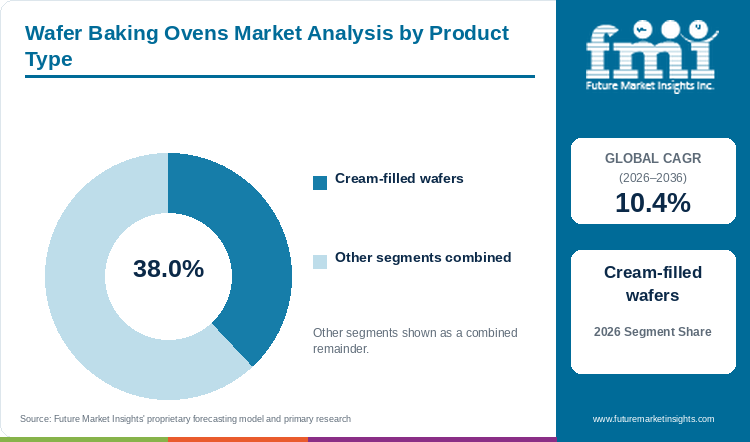
Cream-filled wafers lead with 38.0% of Product Type revenue in 2026.
Cream-filled products depend on sheets that form regular layers and withstand spreading, stacking and cutting. Baking variation appears as a loss only after cream and handling have added further cost. Chocolate-coated wafers add a stage involving confectionery coatings, while Wafer rolls and Sugar-free products can require different formulations or configurations. The oven’s suitability follows the product construction.
- Cream-filled wafers account for 38.0% of Product Type revenue in 2026.
- Sheets need to stay repeatable through cream spreading, stacking and cutting.
What sustains 500-2,000 kg/hr leadership in the Capacity category?
500-2,000 kg/hr leads with 39.0% of Capacity revenue in 2026.
The 500-2,000 kg/hr class serves installations in which oven output has to remain balanced with cooling and finishing. A replacement at the same scale can still be attractive if it reduces energy use or uneven baking. A larger oven creates a different project because the added sheets require more receiving capacity.
- 500-2,000 kg/hr holds 39.0% of Capacity revenue in 2026.
- Oven size needs to rise only with cooling and finishing capacity.
How does Fully automatic / robotic shape equipment selection?
Fully automatic / robotic leads with 43.0% of Automation Level revenue in 2026.
An automatic wafer oven repeats deposition, plate movement, baking and take-off in a controlled sequence. Hebenstreit’s WAQ is offered as an automatic machine for flat and hollow wafers.[2] Coordination reduces handling around the oven, but a disturbance can keep affecting sheets until the process recovers. Monitoring and recovery functions therefore have a financial purpose alongside continuous running.
- Fully automatic / robotic accounts for 43.0% of Automation Level revenue in 2026.
- Recovery from an interruption needs to limit the sheets lost before stable baking resumes.
Why do Industrial bakeries anchor the End User category?
Industrial bakeries lead with 41.0% of End User revenue in 2026.
Industrial wafer lines spread oven investment across recurring production campaigns, and their costs include energy, rejected sheets and maintenance time. Consistent recipes and handling support repetition, while a broader product range adds work between runs. Smaller end users can require a lower capacity or simpler configuration. At industrial scale, the strongest case connects thermal performance with the cost of the finished wafer.
- Industrial bakeries account for 41.0% of End User revenue in 2026.
- Energy use and finishing losses need to be weighed together in the return on an industrial oven.
Why is Direct OEM sales the principal Sales Channel?
Direct OEM sales hold 53.0% of Sales Channel revenue in 2026.
A wafer oven combines specialised plates, heating and product transfers, and the manufacturer can develop those elements together and coordinate a change in thermal technology with the site’s utilities. Dealers & distributors support access and local assistance, while Aftermarket & refurbished equipment can reduce the initial commitment where its condition suits the application.
- Direct OEM sales hold 53.0% of Sales Channel revenue in 2026, supporting specification of the plates, heating arrangement and line interfaces.
- Plate specification and heating arrangement need to define the engineering scope around the oven.
What are the drivers, restraints and opportunities in the wafer baking ovens market?
Driver: Consistent baking protects yield across the complete wafer line
Uneven baking can lead to breakage during cream spreading and cutting, after the wafer has absorbed additional production cost. Better thermal control therefore offers a source of return even at unchanged oven capacity. Bühler’s OptiBake introduction in May 2025 described induction heating and individual plate temperature control.[1] A supplier gains where a plant can trace its sheet losses to the baking stage and the new oven reduces them.
Restraint: Utility changes and production disruption raise the investment threshold
Changing the heating technology can require additional electrical capacity, fuel connections or ventilation work, and transfers may need alteration. BDSI’s January 2026 assessment reported lower production volumes and cost pressures in Germany’s wider confectionery sector.[4] The recurring savings then have to cover the installation expense and the output lost during commissioning. A supplier gains where it can state that cost clearly and show the saving exceeds it.
Opportunity: Measured thermal performance can differentiate replacement proposals
New heating arrangements allow suppliers to compete for renewal projects at plants whose existing ovens are costly to run. The opportunity within food processing equipment includes the engineering needed to connect an alternative heat source to a functioning wafer line. Compatible cooling and filling machinery can limit the extent of reconstruction. A supplier gains where it links the expected energy consumption with sheet consistency and a clear installation scope.
Which country CAGRs are profiled in the wafer baking ovens market?
Table 4: Country growth outlook for the wafer baking ovens market
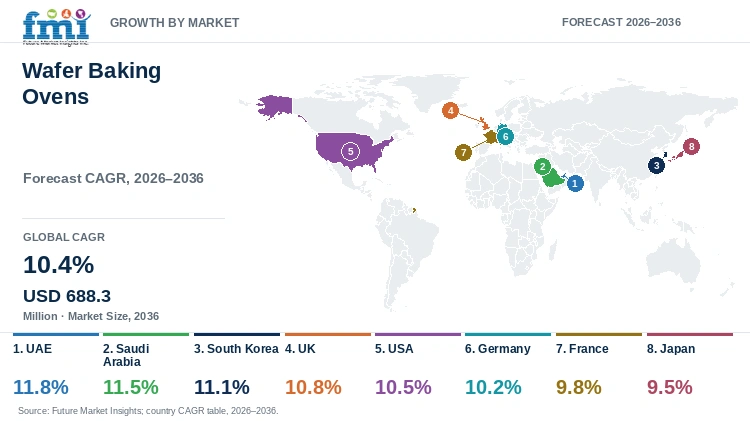
| Country | CAGR, 2026 to 2036 |
|---|---|
| UAE | 11.8% |
| Saudi Arabia | 11.5% |
| South Korea | 11.1% |
| UK | 10.8% |
| USA | 10.5% |
| Germany | 10.2% |
| France | 9.8% |
| Japan | 9.5% |
UAE
The UAE has the highest profiled CAGR at 11.8% for 2026 to 2036, above the global rate of 10.4%. The USDA Foreign Agricultural Service’s August 2026 report put chocolate and cocoa product imports at USD 821 million in 2025 and counted more than 570 food and beverage processing facilities. The figures show an import-reliant market with an existing processing base, not demand for ovens. A new wafer facility has an early choice between heating arrangements, before utilities and finishing equipment are fixed, and that choice is costly to reverse. However, a chocolate-coated range adds a coating stage that the oven choice must fit. Demand will depend on how many new facilities settle the heating arrangement before the finishing line is specified.
Saudi Arabia
Saudi Arabia has an 11.5% CAGR forecast from 2026 to 2036, above the global rate of 10.4%. The USDA Foreign Agricultural Service’s April 2026 report put industrial flour at USD 117.30 to USD 160 per tonne. A wafer sheet is mostly flour and water, so the baked sheet is a small part of the finished wafer’s cost, though the report does not cover confectionery. Cream, coating, handling and energy therefore carry more of the loss when a sheet breaks late. In an integrated project, baking and cream handling have to support the same product volume. However, a larger oven raises the demand placed on cooling and cutting. Demand will depend on how many projects specify baking and finishing as one line.
South Korea
South Korea is forecast at 11.1% CAGR over 2026 to 2036, above the global rate of 10.4%. Herald Business reported in June 2026 that industrial electricity rates rose about 80.0% from 2021 to January 2026, to 190.09 won per kWh. The report concerns tariffs, not wafer production or oven orders. A high power price raises the running cost of any electric heating arrangement, which changes the comparison between induction and gas-fired ovens. Where a line changes formats often, the time needed to restore baking conditions also affects each campaign. However, lower startup loss has to outweigh the electricity bill. Demand will depend on how many lines can show that trade against their own tariff and format mix.
UK
The UK is projected at 10.8% CAGR from 2026 to 2036, above the global rate of 10.4%. Restrictions on advertising less healthy food took effect on 5 January 2026, covering paid online advertising and television before 9pm, in categories that include cakes and biscuits. The rules shape marketing, not baking, but they give producers a reason to reformulate for fat and sugar. A reformulated batter or filling can change sheet thickness and plate behaviour, so an oven replacement can begin with inconsistent sheets as well as worn components or energy use. However, a heating conversion may require utility work that a quality fix does not. Demand will depend on whether reformulation projects are specified together with the oven.
USA
The USA has a 10.5% CAGR forecast for 2026 to 2036, above the global rate of 10.4%. The US Energy Information Administration put the average industrial natural gas price at USD 4.58 per thousand cubic feet in July 2026, down from USD 8.43 in February. The swing shows how exposed gas-fired baking is to the season, though the series does not describe wafer plants. FDA’s manufacturing framework covers equipment condition, sanitation and process controls.[3] In an industrial line, maintenance competes with baking time, so access to plates and contact parts matters. However, an easier-to-clean design protects availability only if it also holds sheet quality. Demand will depend on whether the savings case still holds when gas costs fall back toward summer levels.
Germany
Germany is forecast at 10.2% CAGR during 2026 to 2036, below the global rate of 10.4%. The Bundesverband der Deutschen Süßwarenindustrie estimated that export value of German confectionery and snacks rose 16.9% to about EUR 17.3 billion in 2025 while export volume fell 5.6%.[4] Exporters earned more from fewer tonnes, but the figures do not separate wafers or show oven orders. In that setting, an energy-saving replacement can offer a route to investment when volume is weak, provided the recurring benefit supports the utility conversion and installation expense. However, falling volume leaves spare oven capacity, which favours replacement at the same scale over expansion. Demand will depend on whether energy savings cover the conversion at current volumes.
France
France carries a 9.8% CAGR outlook from 2026 to 2036, below the global rate of 10.4%. Insee reported that French producer prices of food products were 0.6% lower in July 2026 than a year earlier, while energy, water and extractive products rose 2.7%. Selling prices that fall as energy costs rise squeeze margins, though the indices do not describe wafer plants. A cream-filled wafer producer may find that sheet variation creates its largest loss during block assembly or cutting. In that case, oven renewal has a clear product objective: supplying more uniform layers to finishing. However, the saving must exceed the cost of any utility change. Demand will depend on whether heat-control gains cut finishing losses enough to protect margin.
Japan
Japan is forecast at 9.5% CAGR over 2026 to 2036, the lowest profiled rate and below the global 10.4%. TEPCO Energy Partner reported that the Ministry of Economy, Trade and Industry set the renewable energy surcharge at 4.18 yen per kWh for fiscal 2026. The surcharge applies to every kilowatt-hour, so it adds to the running cost of electric heating. A new wafer format can create a requirement for different plates and handling even when the producer has sufficient baking capacity. Hebenstreit offers WAQ configurations for flat and hollow wafers.[2] That product distinction gives oven suppliers an opportunity tied to the construction of the wafer, not the heating choice. Demand will depend on whether new formats or energy cost drive the next oven purchase.
Who are the notable companies in the wafer baking ovens market?
Bühler Group; Hebenstreit; Gocmen Machinery; Nefamak; Forma Makina
Bühler Group, Hebenstreit, Gocmen Machinery, Nefamak and Forma Makina offer dedicated wafer-baking equipment. Bühler’s 2025 OptiBake introduction adds induction heating, while Hebenstreit’s WAQ covers flat and hollow wafers.[1][2] These offers demonstrate different routes to thermal control and product configuration. Their commercial fit depends on the wafer being made and the investment required around the oven.
A supplier with a wider wafer-line portfolio can coordinate baking with cooling and finishing. A specialist replacement can also succeed where the producer wants to change only the oven. The distinction affects engineering scope, installation time and the responsibility for sheet quality as it moves into the next stage.
Competitive Benchmarking: Wafer Baking Ovens Market
Table 5: Company capabilities in the wafer baking ovens market
| Company | Dedicated wafer equipment | Evaluation focus |
|---|---|---|
| Bühler Group | OptiBake and wafer baking systems | Heating control, sheet quality and utility requirements[1] |
| Hebenstreit | WAQ wafer baking machine | Automatic baking for flat and hollow wafers[2] |
| Gocmen Machinery | G-AWO automatic wafer baking oven | Plate configuration and connection to a wafer line |
| Nefamak | Automatic wafer baking ovens | Fit with the planned wafer process and output |
| Forma Makina | Wafer baking ovens within wafer production lines | Baking arrangement, controls and downstream coordination |
Key Developments in the Wafer Baking Ovens Market
- Bühler introduced induction-heated OptiBake in May 2025 with individual plate temperature control. The manufacturer claims approximately 50.0% lower energy consumption than conventional gas-fired wafer ovens, offering a new thermal option for replacement and expansion projects.[1]
- BDSI reported lower German confectionery and snack output in 2025 alongside increased production value. Its January 2026 assessment provides broader context for the pressure on manufacturers to justify capital expenditure through production economics.[4]
Key Players in the Wafer Baking Ovens Market
- Bühler Group
- Hebenstreit
- Gocmen Machinery
- Nefamak
- Forma Makina
Wafer Baking Ovens Market - Report Scope
Table 6: Report scope for the wafer baking ovens market
| Coverage field | Report scope |
|---|---|
| Market breakdown | Product Type, Capacity, Automation Level, End User, Sales Channel |
| Quantitative Units | USD Million |
| Market Definition | Revenue from new and refurbished dedicated wafer baking ovens and clearly attributable oven portions of integrated wafer-line sales. Includes direct oven-related replacement equipment within the defined channel scope. Excludes finished wafer sales, standalone filling or enrobing equipment, generic biscuit or bread ovens not qualified for wafer sheets, and unrelated service contracts. |
| Regions Covered | North America, Latin America, Western Europe, Eastern Europe, East Asia, South Asia and Pacific, Middle East and Africa |
| Countries Covered | UAE; Saudi Arabia; South Korea; UK; USA; Germany; France; Japan |
| Key Companies Profiled | Bühler Group; Hebenstreit; Gocmen Machinery; Nefamak; Forma Makina |
| Forecast Period | 2026 to 2036 |
| Approach | Market assessment supported by official technical and regulatory publications, company product information and country operating conditions. |
Wafer Baking Ovens Market - Research Methodology
Table 7: Research approach for the wafer baking ovens market
| Method | Approach |
|---|---|
| Market boundary | Dedicated wafer baking ovens and attributable oven equipment within wafer lines are distinguished from finished wafers, filling equipment and general bakery ovens. |
| Technical sources | Manufacturer documentation is reviewed for wafer format, heating arrangement, plate operation and integration with downstream processing. |
| Operating context | Official food manufacturing guidance and industry-association publications are used to assess sanitation requirements and the commercial conditions surrounding investment. |
| Comparative assessment | Supplier roles, dated developments and purchasing implications are reviewed alongside the forecast, segment shares and country growth rates. Manufacturer performance claims are kept specific to the equipment described. |
Wafer Baking Ovens Market by Segments
Product Type
- Cream-filled wafers
- Chocolate-coated
- Wafer rolls
- Sugar-free
Capacity
- 500-2,000 kg/hr
- Below 500 kg/hr
- Above 2,000 kg/hr
Automation Level
- Fully automatic / robotic
- Semi-automatic
- Manual
End User
- Industrial bakeries
- In-store & retail bakeries
- Artisan bakeries
- Foodservice / QSR central kitchens
Sales Channel
- Direct OEM sales
- Dealers & distributors
- Aftermarket & refurbished
Wafer Baking Ovens Market by Region
- North America
- United States
- Canada
- Latin America
- Brazil
- Mexico
- Argentina
- Chile
- Western Europe
- Germany
- France
- United Kingdom
- Italy
- Spain
- Benelux
- Nordics
- Eastern Europe
- Poland
- Czech Republic
- Romania
- Hungary
- East Asia
- China
- Japan
- South Korea
- South Asia and Pacific
- India
- ASEAN
- Australia and New Zealand
- Middle East and Africa
- GCC Countries
- South Africa
- Türkiye
- Israel
Research Sources and Bibliography
- [1] Bühler Group. (2025, May 7). Bühler introduces OptiBake, raising the bar in wafer production.
- [2] Hebenstreit. (n.d.). Wafer baking machine WAQ.
- [3] U.S. Food and Drug Administration. (n.d.). Current Good Manufacturing Practices for food and dietary supplements.
- [4] Bundesverband der Deutschen Süßwarenindustrie. (2026, January 28). Arbeitsplätze in der Süßwarenindustrie in Gefahr.
This Report Answers
- How large is the wafer baking ovens market in 2026 and 2036?
- What production and operating pressures support demand for wafer baking ovens?
- Why do Cream-filled wafers hold the leading Product Type position?
- Why does 500-2,000 kg/hr lead the Capacity category?
- How do growth rates differ across the eight profiled countries?
- Which companies supply dedicated wafer ovens and what should buyers test before ordering?
Frequently Asked Questions
How large is the wafer baking ovens market in 2026 and what value is projected for 2036?
The global market is valued at USD 255.9 Million in 2026 and is projected to reach USD 688.3 Million by 2036.
What is the forecast CAGR for wafer baking ovens from 2026 to 2036?
The forecast CAGR is 10.4% from 2026 to 2036.
Which Product Type is the largest user category for wafer baking ovens?
Cream-filled wafers lead with a 38.0% share in 2026. Their layered construction requires consistent sheet quality before cream spreading and cutting.
Which Capacity segment leads the wafer baking ovens market?
500-2,000 kg/hr leads Capacity with 39.0% in 2026. The oven’s scale is closely connected to the cooling and finishing stages it supplies.
Which profiled countries show the highest CAGR for wafer baking ovens?
The UAE is highest at 11.8% CAGR, followed by Saudi Arabia at 11.5%, from 2026 to 2036.
Which companies supply wafer baking ovens?
The report profiles Bühler Group, Hebenstreit, Gocmen Machinery, Nefamak and Forma Makina, each offering dedicated wafer-baking equipment.
Preview the report firsthand - request a free sample
Get SampleGet the brochure for pricing and purchase details.
Get PDFTable of Content
- Key Takeaways
- Market Size and CAGR
- Top Growth Driver
- Fastest Growing Segment
- Leading Region
- Key Companies
- Emerging Opportunities
- Executive Summary
- Global Market Outlook
- Demand-side Trends
- Supply-side Trends
- Technology Roadmap Analysis
- Analysis and Recommendations
- Analyst Perspective (What is happening? Why now? What should investors know?)
- Key Questions Answered
- How large is the market?
- What is the CAGR?
- What are key trends?
- Which region dominates?
- Who are the leaders?
- Market Overview
- Market Coverage / Taxonomy
- Market Definition / Scope / Limitations
- Research Methodology
- Chapter Orientation
- Analytical Lens and Working Hypotheses
- Market Structure, Signals, and Trend Drivers
- Benchmarking and Cross-market Comparability
- Market Sizing, Forecasting, and Opportunity Mapping
- Research Design and Evidence Framework
- Desk Research Programme (Secondary Evidence)
- Expert Input and Fieldwork (Primary Evidence)
- Tooling, Models, and Reference Databases
- Data Engineering and Model Build
- Quality Assurance and Audit Trail
- Market Background
- Market Dynamics (Drivers, Restraints, Opportunity, Trends)
- Scenario Forecast (Optimistic, Likely, Conservative)
- Impact Analysis
- AI Impact
- Sustainability Impact
- Regulatory Impact
- Technology Impact
- Consumer / Buyer Analysis
- Purchase Drivers
- Adoption Barriers
- Buyer Journey
- Opportunity Map Analysis
- Product Life Cycle Analysis
- Supply Chain Analysis
- Investment Feasibility Matrix
- Value Chain Analysis
- PESTLE and Porter's Analysis
- Regulatory Landscape
- Regional Parent Market Outlook
- Production and Consumption Statistics
- Import and Export Statistics
- Global Market Analysis and Forecast, 2021 to 2036
- Historical Market Size Value (USD Million) Analysis, 2021 to 2025
- Current and Future Market Size Value (USD Million) Projections, 2026 to 2036
- Y-o-Y Growth Trend Analysis
- Absolute $ Opportunity Analysis
- Global Market Pricing Analysis, 2021 to 2036
- Global Market Analysis and Forecast, By Product Type, 2021 to 2036
- Introduction / Key Findings
- Historical Market Size Value (USD Million) Analysis By Product Type, 2021 to 2025
- Current and Future Market Size Value (USD Million) Analysis and Forecast By Product Type, 2026 to 2036
- Cream-filled wafers
- Chocolate-coated
- Wafer rolls
- Sugar-free
- Y-o-Y Growth Trend Analysis By Product Type, 2021 to 2025
- Absolute $ Opportunity Analysis By Product Type, 2026 to 2036
- Global Market Analysis and Forecast, By Capacity, 2021 to 2036
- Introduction / Key Findings
- Historical Market Size Value (USD Million) Analysis By Capacity, 2021 to 2025
- Current and Future Market Size Value (USD Million) Analysis and Forecast By Capacity, 2026 to 2036
- 500-2,000 kg/hr
- Below 500 kg/hr
- Above 2,000 kg/hr
- Y-o-Y Growth Trend Analysis By Capacity, 2021 to 2025
- Absolute $ Opportunity Analysis By Capacity, 2026 to 2036
- Global Market Analysis and Forecast, By Automation Level, 2021 to 2036
- Introduction / Key Findings
- Historical Market Size Value (USD Million) Analysis By Automation Level, 2021 to 2025
- Current and Future Market Size Value (USD Million) Analysis and Forecast By Automation Level, 2026 to 2036
- Fully automatic / robotic
- Semi-automatic
- Manual
- Y-o-Y Growth Trend Analysis By Automation Level, 2021 to 2025
- Absolute $ Opportunity Analysis By Automation Level, 2026 to 2036
- Global Market Analysis and Forecast, By End User, 2021 to 2036
- Introduction / Key Findings
- Historical Market Size Value (USD Million) Analysis By End User, 2021 to 2025
- Current and Future Market Size Value (USD Million) Analysis and Forecast By End User, 2026 to 2036
- Industrial bakeries
- In-store & retail bakeries
- Artisan bakeries
- Foodservice / QSR central kitchens
- Y-o-Y Growth Trend Analysis By End User, 2021 to 2025
- Absolute $ Opportunity Analysis By End User, 2026 to 2036
- Global Market Analysis and Forecast, By Sales Channel, 2021 to 2036
- Introduction / Key Findings
- Historical Market Size Value (USD Million) Analysis By Sales Channel, 2021 to 2025
- Current and Future Market Size Value (USD Million) Analysis and Forecast By Sales Channel, 2026 to 2036
- Direct OEM sales
- Dealers & distributors
- Aftermarket & refurbished
- Y-o-Y Growth Trend Analysis By Sales Channel, 2021 to 2025
- Absolute $ Opportunity Analysis By Sales Channel, 2026 to 2036
- Global Market Analysis and Forecast, By Region, 2021 to 2036
- Introduction
- Historical Market Size Value (USD Million) Analysis By Region, 2021 to 2025
- Current Market Size Value (USD Million) Analysis and Forecast By Region, 2026 to 2036
- North America
- Latin America
- Western Europe
- Eastern Europe
- East Asia
- South Asia and Pacific
- Middle East and Africa
- Market Attractiveness Analysis By Region
- North America Market Analysis and Forecast, By Country, 2021 to 2036
- Historical Market Size Value (USD Million) Trend Analysis By Market Taxonomy, 2021 to 2025
- Market Size Value (USD Million) Forecast By Market Taxonomy, 2026 to 2036
- By Country
- United States
- Canada
- By Product Type
- By Capacity
- By Automation Level
- By End User
- By Sales Channel
- By Country
- Market Attractiveness Analysis
- By Country
- By Product Type
- By Capacity
- By Automation Level
- By End User
- By Sales Channel
- Key Takeaways
- Latin America Market Analysis and Forecast, By Country
- Historical Market Size Value (USD Million) Trend Analysis By Market Taxonomy, 2021 to 2025
- Market Size Value (USD Million) Forecast By Market Taxonomy, 2026 to 2036
- By Country
- Brazil
- Mexico
- Argentina
- Chile
- By Product Type
- By Capacity
- By Automation Level
- By End User
- By Sales Channel
- By Country
- Market Attractiveness Analysis
- By Country
- By Product Type
- By Capacity
- By Automation Level
- By End User
- By Sales Channel
- Key Takeaways
- Western Europe Market Analysis and Forecast, By Country
- Historical Market Size Value (USD Million) Trend Analysis By Market Taxonomy, 2021 to 2025
- Market Size Value (USD Million) Forecast By Market Taxonomy, 2026 to 2036
- By Country
- Germany
- France
- United Kingdom
- Italy
- Spain
- Benelux
- Nordics
- By Product Type
- By Capacity
- By Automation Level
- By End User
- By Sales Channel
- By Country
- Market Attractiveness Analysis
- By Country
- By Product Type
- By Capacity
- By Automation Level
- By End User
- By Sales Channel
- Key Takeaways
- Eastern Europe Market Analysis and Forecast, By Country
- Historical Market Size Value (USD Million) Trend Analysis By Market Taxonomy, 2021 to 2025
- Market Size Value (USD Million) Forecast By Market Taxonomy, 2026 to 2036
- By Country
- Poland
- Czech Republic
- Romania
- Hungary
- By Product Type
- By Capacity
- By Automation Level
- By End User
- By Sales Channel
- By Country
- Market Attractiveness Analysis
- By Country
- By Product Type
- By Capacity
- By Automation Level
- By End User
- By Sales Channel
- Key Takeaways
- East Asia Market Analysis and Forecast, By Country
- Historical Market Size Value (USD Million) Trend Analysis By Market Taxonomy, 2021 to 2025
- Market Size Value (USD Million) Forecast By Market Taxonomy, 2026 to 2036
- By Country
- China
- Japan
- South Korea
- By Product Type
- By Capacity
- By Automation Level
- By End User
- By Sales Channel
- By Country
- Market Attractiveness Analysis
- By Country
- By Product Type
- By Capacity
- By Automation Level
- By End User
- By Sales Channel
- Key Takeaways
- South Asia and Pacific Market Analysis and Forecast, By Country
- Historical Market Size Value (USD Million) Trend Analysis By Market Taxonomy, 2021 to 2025
- Market Size Value (USD Million) Forecast By Market Taxonomy, 2026 to 2036
- By Country
- India
- ASEAN
- Australia and New Zealand
- By Product Type
- By Capacity
- By Automation Level
- By End User
- By Sales Channel
- By Country
- Market Attractiveness Analysis
- By Country
- By Product Type
- By Capacity
- By Automation Level
- By End User
- By Sales Channel
- Key Takeaways
- Middle East and Africa Market Analysis and Forecast, By Country
- Historical Market Size Value (USD Million) Trend Analysis By Market Taxonomy, 2021 to 2025
- Market Size Value (USD Million) Forecast By Market Taxonomy, 2026 to 2036
- By Country
- GCC Countries
- South Africa
- Türkiye
- Israel
- By Product Type
- By Capacity
- By Automation Level
- By End User
- By Sales Channel
- By Country
- Market Attractiveness Analysis
- By Country
- By Product Type
- By Capacity
- By Automation Level
- By End User
- By Sales Channel
- Key Takeaways
- Key Countries Market Analysis
- United States
- Pricing Analysis
- Market Share Analysis, 2025
- By Product Type
- By Capacity
- By Automation Level
- By End User
- By Sales Channel
- Canada
- Pricing Analysis
- Market Share Analysis, 2025
- By Product Type
- By Capacity
- By Automation Level
- By End User
- By Sales Channel
- Mexico
- Pricing Analysis
- Market Share Analysis, 2025
- By Product Type
- By Capacity
- By Automation Level
- By End User
- By Sales Channel
- Brazil
- Pricing Analysis
- Market Share Analysis, 2025
- By Product Type
- By Capacity
- By Automation Level
- By End User
- By Sales Channel
- Chile
- Pricing Analysis
- Market Share Analysis, 2025
- By Product Type
- By Capacity
- By Automation Level
- By End User
- By Sales Channel
- Germany
- Pricing Analysis
- Market Share Analysis, 2025
- By Product Type
- By Capacity
- By Automation Level
- By End User
- By Sales Channel
- United Kingdom
- Pricing Analysis
- Market Share Analysis, 2025
- By Product Type
- By Capacity
- By Automation Level
- By End User
- By Sales Channel
- Italy
- Pricing Analysis
- Market Share Analysis, 2025
- By Product Type
- By Capacity
- By Automation Level
- By End User
- By Sales Channel
- Spain
- Pricing Analysis
- Market Share Analysis, 2025
- By Product Type
- By Capacity
- By Automation Level
- By End User
- By Sales Channel
- France
- Pricing Analysis
- Market Share Analysis, 2025
- By Product Type
- By Capacity
- By Automation Level
- By End User
- By Sales Channel
- India
- Pricing Analysis
- Market Share Analysis, 2025
- By Product Type
- By Capacity
- By Automation Level
- By End User
- By Sales Channel
- ASEAN
- Pricing Analysis
- Market Share Analysis, 2025
- By Product Type
- By Capacity
- By Automation Level
- By End User
- By Sales Channel
- Australia and New Zealand
- Pricing Analysis
- Market Share Analysis, 2025
- By Product Type
- By Capacity
- By Automation Level
- By End User
- By Sales Channel
- China
- Pricing Analysis
- Market Share Analysis, 2025
- By Product Type
- By Capacity
- By Automation Level
- By End User
- By Sales Channel
- Japan
- Pricing Analysis
- Market Share Analysis, 2025
- By Product Type
- By Capacity
- By Automation Level
- By End User
- By Sales Channel
- South Korea
- Pricing Analysis
- Market Share Analysis, 2025
- By Product Type
- By Capacity
- By Automation Level
- By End User
- By Sales Channel
- Poland
- Pricing Analysis
- Market Share Analysis, 2025
- By Product Type
- By Capacity
- By Automation Level
- By End User
- By Sales Channel
- Hungary
- Pricing Analysis
- Market Share Analysis, 2025
- By Product Type
- By Capacity
- By Automation Level
- By End User
- By Sales Channel
- Türkiye
- Pricing Analysis
- Market Share Analysis, 2025
- By Product Type
- By Capacity
- By Automation Level
- By End User
- By Sales Channel
- South Africa
- Pricing Analysis
- Market Share Analysis, 2025
- By Product Type
- By Capacity
- By Automation Level
- By End User
- By Sales Channel
- UAE
- Pricing Analysis
- Market Share Analysis, 2025
- By Product Type
- By Capacity
- By Automation Level
- By End User
- By Sales Channel
- Saudi Arabia
- Pricing Analysis
- Market Share Analysis, 2025
- By Product Type
- By Capacity
- By Automation Level
- By End User
- By Sales Channel
- United States
- Market Structure Analysis
- Competition Dashboard
- Competition Benchmarking
- Market Share Analysis of Top Players
- By Regional
- By Product Type
- By Capacity
- By Automation Level
- By End User
- By Sales Channel
- Emerging Startups
- Innovation Benchmarking
- Competition Analysis
- Competition Deep Dive
- Bühler Group
- Overview
- Product Portfolio
- Profitability by Market Segments
- Sales Footprint
- Strategy Overview
- Marketing Strategy
- Product Strategy
- Channel Strategy
- Hebenstreit
- Gocmen Machinery
- Nefamak
- Forma Makina
- Bühler Group
- Case Studies
- Success Stories
- Recent Developments
- Competition Deep Dive
- Assumptions & Acronyms Used


