

- Market Size (2026)
- USD 1860.7 Mn
- Forecast (2036)
- USD 3239.1 Mn
- CAGR (2026 to 2036)
- 5.7%
How big is the Bentonite Fluids Market size?
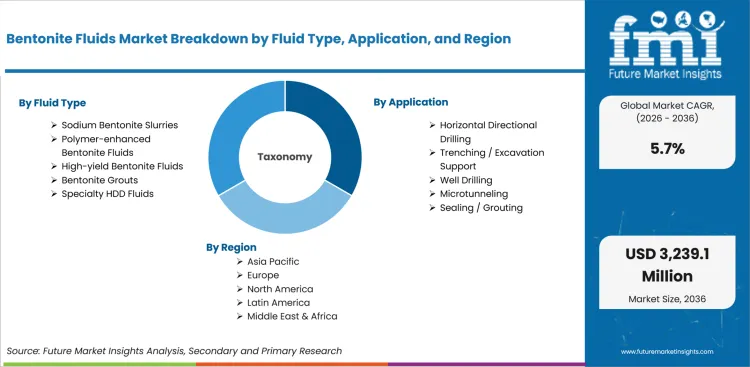
USD 1,860.7 million in 2026 and USD 3,239.1 million by 2036 at a 5.7% CAGR.
The bentonite fluids is projected to rise at 5.7% CAGR through 2036, driving industry valuation from USD 1,860.7 million in 2026 to USD 3,239.1 million during the assessment period. Digging utility crossings under roads and rivers is risky work due to unsupported tunnels being able to easily collapse. To prevent such cave-ins and keep drilling debris flowing out of the hole, crews rely on thick and hydrated clay slurry. Highlighting the scale of raw material needed for this work, the U.S. Geological Survey reported in February 2026 estimating USA clay production sold or used at 26 million tons in 2025. This massive mineral output provides the solid supply foundation required for continuous bentonite processing and on-site fluid mixing.
Field preparation routines vary depending on local construction logistics and infrastructure goals. Project managers in India prefer bulk delivery paired with worksite hydration support to keep fast-moving utility jobs on schedule. Contractors in China evaluate the sheer size of upcoming pipeline renewals to determine how to best utilize locally available clay deposits. In June 2026, China's State Council Information Office announced plans to build or upgrade 770,000 km of urban underground pipelines from 2026 to 2030. Such an extensive construction overhaul compels engineering teams to carefully scrutinize the quality of their drilling fluids throughout the utility renewal process.
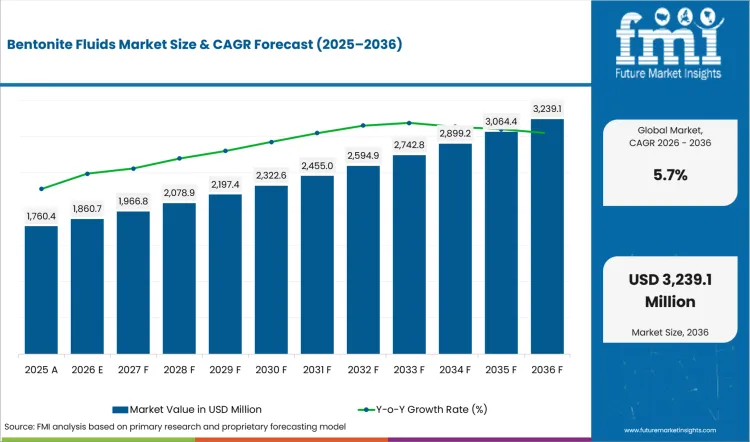
Key Takeaways of Bentonite Fluids Market
- Demand for bentonite fluids is driven by drilling crews connecting slurry behavior with bore stability and smoother cuttings return, with contractor decisions reflecting hydration consistency and jobsite dosing support.
- By form, powder is expected to lead with 53.0% share in 2026, driven by field mixing control and storage flexibility.
- Horizontal directional drilling is the dominant application segment, projected to hold 38.0% share in 2026, as utility crossings depend on slurry stability.
- Direct bulk supply is estimated to lead the sales channel category with 36.0% share in 2026, led by large jobsite volume planning and contractor scheduling.
- Gel strength and fluid-loss control remain critical to supplier evaluation, as civil contractors and well drilling teams need products that maintain viscosity under mixed ground conditions.
- India, China, and Brazil are expected to form the higher-growth country tier, advancing at 7.5%, 6.8%, and 5.4% CAGR respectively through 2036, supported by pipeline upgrading, urban infrastructure renewal, and sanitation expansion.
- Competition centers on Imerys, Minerals Technologies, Halliburton Baroid, Wyo-Ben, Bentonite Performance Minerals, and Black Hills Bentonite, with vendors differentiating through clay quality, field formulation support, and bentonite supply strength.
Analyst Perspective
"Performance in the bentonite fluids market is determined by how consistently drilling fluids perform under demanding field conditions rather than by raw material specifications alone. Contractors are selecting products that deliver reliable hydration, stable slurry properties, and predictable borehole performance across varying soil formations. Manufacturers that support customers with application expertise, dependable supply, and practical field guidance are expected to strengthen long-term relationships in well drilling, tunneling, and civil engineering projects."
- Nikhil Kaitwade, Principal Consultant for Chemicals & Materials at Future Market Insights
How is Bentonite Fluids Market Segmented?
The bentonite fluids industry is segmented by fluid type, application, form, end use, sales channel and region.
The bentonite fluids market covers six parent segments. Fluid type coverage includes sodium bentonite slurries alongside polymer-enhanced bentonite fluids, high-yield bentonite fluids, bentonite grouts and specialty HDD fluids. Application coverage includes horizontal directional drilling, trenching and excavation support, well drilling, microtunneling and sealing or grouting. Form coverage includes powder, granules, premixed fluid and liquid additive blend. End-use coverage includes utility installation, oil and gas, construction and civil works, water wells and mining. Sales channel coverage includes direct bulk supply, drilling fluid distributors, contractor supply and service bundled models. Regional coverage includes North America, Latin America, Western Europe, Eastern Europe, East Asia, South Asia and Pacific, and Middle East and Africa.
How do sodium bentonite slurries shape fluid type purchasing?
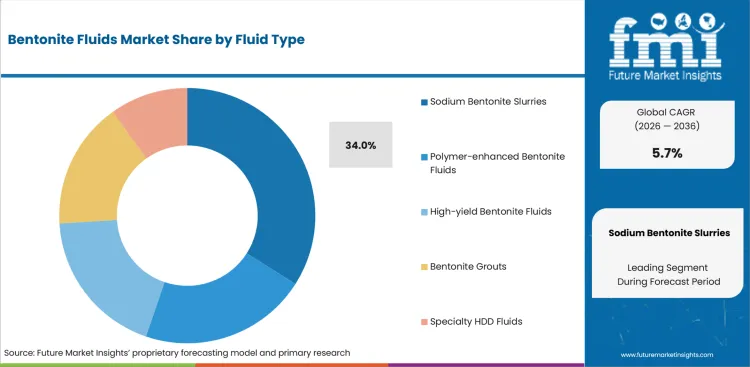
Sodium bentonite slurries are estimated to guide fluid type purchasing as drilling crews need basic swelling, viscosity and suspension behavior across routine bore conditions. Contractors value clay systems capable of forming a workable slurry before tooling advances through loose or mixed formations. U.S. Geological Survey reported in February 2026 stating bentonite accounted for 22.0% of drilling mud use among principal domestic uses, influencing slurry selection across borehole stabilization and cuttings transport needs.
- Based on fluid type, sodium bentonite slurries are anticipated to hold 34.0% share in 2026 due to dependable swelling and cuttings suspension. Contractors evaluate slurry grades through viscosity build and borehole support records before wider jobsite use.
- Polymer-enhanced bentonite fluids and high-yield bentonite fluids support longer bores and higher performance jobs. Sodium bentonite slurries retain selection strength as crews need a known clay base before adding polymers or specialty additives.
Why does horizontal directional drilling lead application demand?
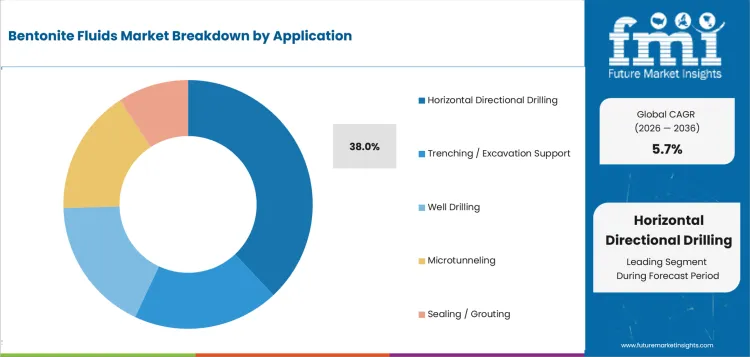
Common Ground Alliance reported in August 2025 noting 196,977 unique damage reports from 2024 were analyzed, reinforcing careful underground utility practice and fluid planning during excavation-adjacent work. Horizontal directional drilling is anticipated to support application since underground crossings require fluids able to lubricate tooling and protect bore walls during pullback. Field crews assess fluid stability before approving slurry programs across telecom and pipeline installations.
- Horizontal directional drilling is predicted to represent 38.0% share in 2026, helped by utility crossing work and long annulus flow paths. Contractors specify fluids through soil behavior and cuttings return evidence rather than basic clay availability.
- Trenching and excavation support and microtunneling add steady use across civil sites and groundwater projects. Horizontal directional drilling keeps account attention as every crossing needs fluid preparation matched to soil condition and tooling load.
Why does powder support form demand?
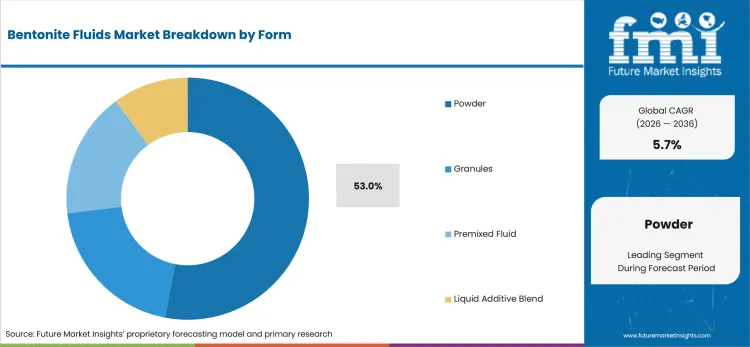
U.S. Geological Survey reported in February 2026 stating USA bentonite exports were estimated at 640,000 tons in 2025, ensuring availability of processed clay products used across drilling and industrial applications. Powder is expected to support form as contractors need jobsite control over hydration time and viscosity adjustment. Field preparation lets crews adapt slurry thickness across changing ground and bore length without carrying premixed material over long distances.
- Powder is estimated to secure 53.0% share of form demand in 2026, backed by storage practicality and controlled mixing at worksites. Contractors review powder grades through gel strength and packaging suitability for daily mud programs.
- Granules, premixed fluid and liquid additive blend formats support selected jobs needing easier handling or pre-adjusted formulation. Powder adoption remains central as crews need flexible preparation across horizontal directional drilling and water well projects.
How does utility installation shape end-use demand?
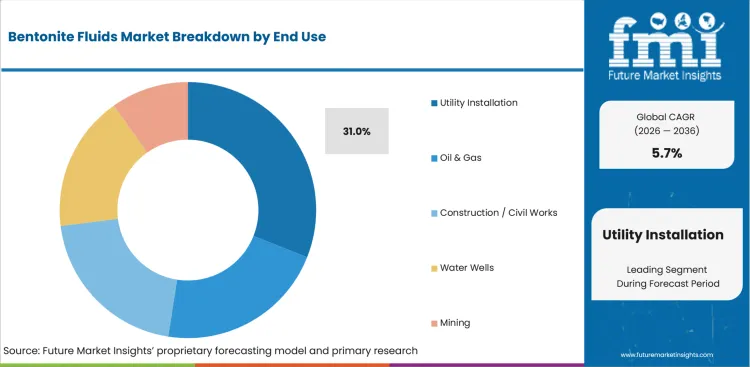
Utility installation is anticipated to shape end-use demand as underground telecom and gas networks require drilling fluids capable of keeping bores workable during line placement. Contractors assess bentonite slurry behavior before adopting products across trenchless and open-cut support tasks. Centers for Disease Control and Prevention reported in March 2025 noting EPA estimated approximately 4 million lead service lines remained in the United States as of 2025, reinforcing utility replacement activity needing careful service-line disturbance planning.
- Based on end-use, utility installation is set to garner 31.0% share in 2026 as underground network work creates repeated slurry requirements. Contractors approve bentonite fluids through bore wall stability and field mixing evidence across recurring projects.
- Construction and civil works, and mining generate additional use across drilling and grouting work. Utility installation keeps account focus as line replacement and network extension create regular fluid preparation needs.
How does direct bulk supply support sales channel demand?
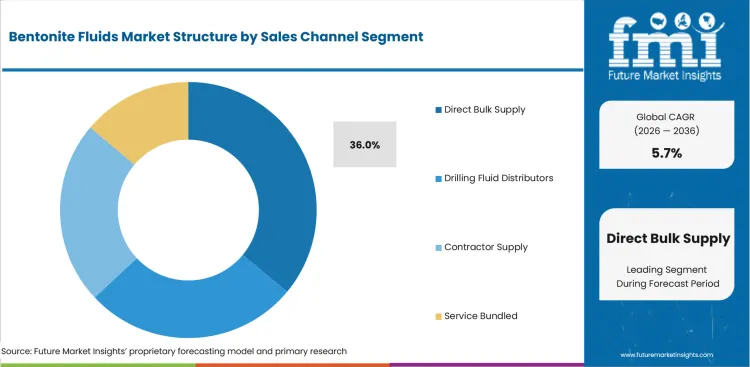
Prime Minister’s Office of India reported in March 2026 noting 15.80 crore rural households had tap water connections under Jal Jeevan Mission, highlighting large pipeline service programs needing dependable material delivery. Direct bulk supply is anticipated to influence sales channel as large HDD and civil projects require steady bentonite volumes aligned with project scheduling. Bulk purchasing reduces jobsite interruption risk once crews need predictable powder availability across several bore sections.
- By sales channel, direct bulk supply is projected to capture 36.0% share in 2026 since contractors plan repeat material movement. Account teams approve bulk channels driven by grade consistency and technical support during fluid preparation.
- Drilling fluid distributors and service bundled models propel specialist formulations and service-led jobs. Direct bulk supply attracts account attention due to bigger utility and civil projects needing predictable clay availability before drilling starts.
What are drivers, restraints, and opportunities in Bentonite Fluids Market?
Purchasing decisions are shaped by bore stability needs and jobsite preparation discipline as outlined below.
- Driver: Utility installation and HDD crews are increasing use of bentonite fluids to support bore wall control, cuttings suspension and return flow.
- Restraint: Poor water quality and weak hydration practice slow approval as crews need consistent viscosity before drilling advances.
- Opportunity: Polymer-enhanced bentonite fluids and specialty HDD fluids improve vendor prospects across longer bores and difficult formations.
Utility installation is expected to support bentonite fluid adoption as buried network work requires safer excavation discipline and consistent slurry programs. American Society of Civil Engineers reported in 2025 stating USA drinking water infrastructure includes more than 2 million miles of underground transmission and distribution lines, demonstrating sustained bore work and service-line rehabilitation planning.
Field preparation issues are likely to restrain adoption as bentonite performance changes with water chemistry, dosing accuracy and hydration time. American Society of Civil Engineers reported in 2025 noting only about 30.0% of utilities had fully implemented an asset management plan, reflecting planning gaps capable of slowing organized pipe renewal and drilling fluid scheduling.
Opportunities are anticipated to improve for producers offering higher-yield clay systems and technical dosing guidance for harder ground. Common Ground Alliance reported on August 28, 2025 stating top 10 damage root causes accounted for 85.0% of reported damages, highlighting the need for better underground work controls and fluid selection discipline.
What country CAGRs are profiled in Bentonite Fluids Market?
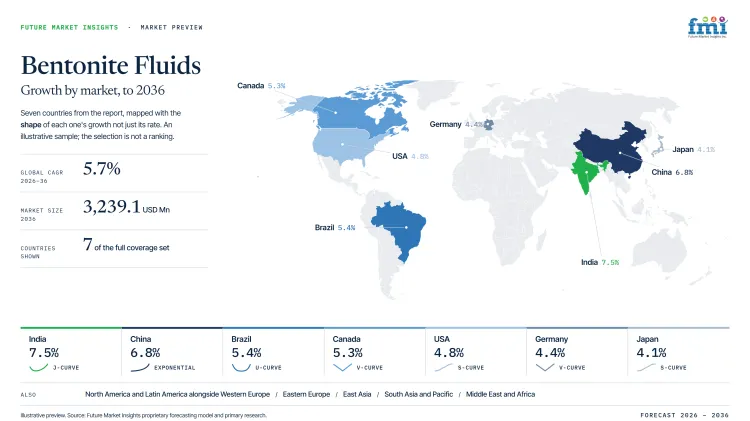
| Country | CAGR |
|---|---|
| India | 7.5% |
| China | 6.8% |
| Brazil | 5.4% |
| Canada | 5.3% |
| USA | 4.8% |
| Germany | 4.4% |
| Japan | 4.1% |
Source: Future Market Insights analysis, 2026.
How do country-level CAGRs compare in the Bentonite Fluids Market?
The country comparison spans 3.4 percentage points and reveals three distinct growth tiers across the bentonite fluids market. India and China lead the comparison with a difference of 0.7 percentage points. Brazil and Canada form a tightly grouped middle tier, separated by only 0.1 percentage points. The United States, Germany and Japan complete the comparison within a narrow 0.7-point range. The variation reflects differences in drilling activity, civil engineering investment and demand for drilling fluid formulations across major markets.
- India leads the comparison with a CAGR of 7.5%. Continued expansion of water well drilling, foundation engineering and infrastructure construction is increasing the use of bentonite fluids for bore stabilization, cuttings removal and slurry performance across diverse field applications.
- China follows at 6.8%, just 0.7 percentage points behind India. Large-scale tunneling, energy exploration and transportation infrastructure projects continue to reinforce demand for bentonite fluids that deliver consistent rheological properties under varying drilling conditions.
- Brazil records a CAGR of 5.4%, standing 1.4 percentage points below China. Market growth reflects ongoing mining activity, water resource development and drilling operations where bentonite-based fluids play an important role in maintaining borehole stability.
- Canada reaches 5.3%, only 0.1 percentage points behind Brazil. Demand is associated with mineral exploration, geotechnical investigations and energy drilling projects that require dependable fluid systems capable of performing under varied geological conditions.
- The United States posts a CAGR of 4.8%, trailing Canada by 0.5 percentage points. Adoption remains closely linked to horizontal directional drilling, oil and gas operations and utility installation projects where drilling fluid performance directly affects operational efficiency.
- Germany stands at 4.4%, placing it 0.4 percentage points below the United States. Opportunities are concentrated in specialized construction, geothermal drilling and underground infrastructure projects where high-quality bentonite fluids contribute to stable excavation and drilling performance.
- Japan completes the comparison with a CAGR of 4.1%, only 0.3 percentage points behind Germany. Demand is tied to geotechnical engineering, tunneling and foundation works that require reliable drilling fluids for controlled excavation in challenging ground conditions.
Comparable CAGRs can still produce different market entry conditions. Differences in drilling methods, infrastructure investment, geological conditions and project requirements influence product adoption, supplier positioning and long-term commercial opportunities. The full report provides country-level CAGR analysis across North America, Latin America, Europe, East Asia, South Asia, Oceania and the Middle East and Africa.
Country-wise Analysis
Country outlooks point to adoption shaped by drilling activity and material supply access. India and China show faster project pull linked to sanitation and water connection work. Brazil and Canada reflect utility construction and energy pipeline exposure. USA, Germany and Japan show steady use across underground utilities and controlled infrastructure renewal.
- Rural water and utility programs are expected to guide India, with demand anticipated to rise at 7.5% CAGR during the assessment period. Press Information Bureau reported in March 2025 stating 7,497 km of pipeline had been laid in Mau district and 7,750 km in Ballia district, influencing local use cases for drilling-fluid and bore-support materials.
- China State Council reported in June 2026 stating China already had about 3.9 million km of urban underground pipelines, supporting material needs for renewal and added network work. China’s bentonite fluids use is projected to advance at 6.8% CAGR by 2036, guided by large-scale urban pipeline programs.
- Sector in Brazil is expected to record 5.4% CAGR between 2026 and 2036, driven by sanitation expansion and water system upgrading. OECD reported in June 2024 stating nearly 100 million people in Brazil lacked sewage collection and treatment services, reinforcing long-term utility construction needs.
- Pipeline and utility work keep Canada positioned for a projected 5.3% CAGR during the forecast period as energy and municipal projects require controlled drilling support. Canada Energy Regulator confirmed the Trans Mountain Expanded System came online in May 2024, nearly tripling the pipeline's capacity to 890,000 barrels per day,highlighting large linear infrastructure exposure needing specialist drilling materials.
- American Society of Civil Engineers reported in 2025 noting lead service line replacement remained a key priority for drinking water utilities, strengthening service-line replacement activity using careful drilling practices. Industry in the United States is projected to rise at 4.8% CAGR during the study period, helped by utility replacement and underground line maintenance.
- Civil utility renewal keeps Germany on a measured path, with bentonite fluids demand predicted to scale at 4.4% CAGR between 2026 and 2036. VDE reported on February 9, 2026 noting around 24 million households had fiber optic cables laid up to property boundaries, influencing trenchless and installation work requiring bore control.
- The market in Japan is anticipated to expand at 4.1% CAGR between 2026 and 2036, aided by careful civil works and water pipe renewal needs. Institute for Sustainable Value Design reported on April 25, 2026 stating 23.6% of Japan’s water pipes had exceeded the 40-year statutory useful life, reflecting controlled renewal work needing predictable slurry support.
Who are notable companies in Bentonite Fluids Market?
Imerys and Minerals Technologies Inc. are expected to shape market direction. Halliburton Baroid and Wyo-Ben Inc. add drilling fluid knowledge. Bentonite Performance Minerals LLC and Black Hills Bentonite LLC support sodium bentonite supply depth. Clariant Ltd and Ashapura Minechem Ltd add mineral and specialty material reach. Kunimine Industries Co., Ltd. and Tolsa, S.A. support clay product breadth across industrial applications.
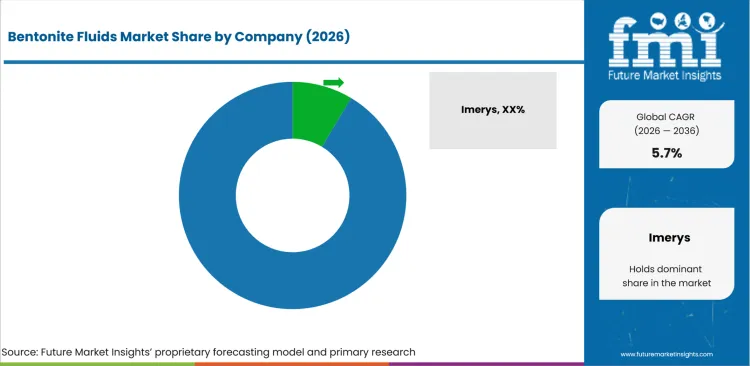
Competition in bentonite fluids is anticipated to depend on hydration speed and slurry consistency. Field support and delivery reliability guide final vendor review. Account teams are likely to compare vendors based on clay grade records and technical guidance for repeat drilling programs. Imerys is expected to receive review attention due to mineral processing scale. Minerals Technologies Inc. is anticipated to add specialty additives and infrastructure drilling exposure. Halliburton Baroid and Wyo-Ben Inc. are projected to compete led by drilling-fluid portfolios. Bentonite Performance Minerals LLC and Black Hills Bentonite LLC are estimated to compete through sodium bentonite supply. Clariant Ltd and Ashapura Minechem Ltd are likely to add regional and industrial material relationships. Kunimine Industries Co., Ltd. and Tolsa, S.A. are expected to support account review through clay processing knowledge.
- Imerys and Minerals Technologies Inc. are expected to gain account attention based on mineral processing experience and industrial customer coverage. Clay quality records are likely to support accounts needing repeatable swelling and viscosity behavior.
- Halliburton Baroid and Wyo-Ben Inc. are anticipated to compete through drilling fluid formulation depth. Bentonite Performance Minerals LLC is projected to improve vendor review as contractors assess sodium bentonite consistency before approval.
- Black Hills Bentonite LLC and Ashapura Minechem Ltd are forecast to support demand through bentonite sourcing and processing. Clariant Ltd is expected to help buyers compare specialty clay and additive knowledge across industrial applications.
- Kunimine Industries Co., Ltd. and Tolsa, S.A. are estimated to gain review strength through clay material portfolios and application support. Vendor attention is likely to improve as drilling buyers need steady product behavior across changing ground.
Competitive Benchmarking: Bentonite Fluids Market
| Company | Portfolio Depth | Fluid Match | Contractor Support | Supply Reach |
|---|---|---|---|---|
| Imerys | High | High | Medium | Global |
| Minerals Technologies Inc. | High | High | High | Global |
| Halliburton Baroid | High | High | High | Global |
| Bentonite Performance Minerals LLC | Medium | High | Medium | United States |
| Black Hills Bentonite LLC | Medium | High | Medium | United States |
| Clariant Ltd | High | Medium | High | Global |
| Ashapura Minechem Ltd | Medium | High | Medium | Asia |
| Wyo-Ben Inc. | Medium | High | High | North America |
| Kunimine Industries Co., Ltd. | Medium | Medium | Medium | East Asia |
| Tolsa, S.A. | Medium | Medium | Medium | Europe |
Source: Future Market Insights competitive analysis, 2026.
Key Developments in Bentonite Fluids Market
- In January 2026, Minerals Technologies Inc. announced 2025 full-year results and stated Environmental & Infrastructure product line sales increased to USD 270 million, driven partly by infrastructure drilling products. Minerals Technologies Inc. indicated infrastructure drilling strength supported engineered solutions exposure, influencing bentonite fluid producers serving utility and geotechnical drilling work.
- In March 2026, Halliburton filed its 2025 report stating Baroid provides drilling fluid systems, performance additives, specialized testing equipment and waste management services for drilling wells. Halliburton Baroid’s stated service scope strengthens account review around fluid formulation support and field testing for bore stability.
- In April 2026, Clariant released its 2025 integrated report and stated customer scores improved for product quality, technical support and customer service. Clariant’s service improvement record supports specialty material account confidence across clay and additive applications needing consistent technical assistance.
Key Players in Bentonite Fluids Market
Mineral processors and bentonite producers
- Imerys
- Minerals Technologies Inc.
- Bentonite Performance Minerals LLC
- Black Hills Bentonite LLC
- Ashapura Minechem Ltd
Drilling fluid and field formulation specialists
- Halliburton Baroid
- Wyo-Ben Inc.
Specialty clay and industrial material companies
- Clariant Ltd
- Kunimine Industries Co., Ltd.
- Tolsa, S.A.
Bentonite Fluids Market - Report Scope
| Coverage field | Report scope |
|---|---|
| Market breakdown | Bentonite Fluids Market breakdown by fluid type alongside application, form, end use, sales channel and region |
| Market Definition | Bentonite fluids include hydrated clay-based slurries, powders, grouts and specialty fluid systems used for HDD, well drilling, microtunneling, sealing and civil works. |
| Regions Covered | North America and Latin America alongside Western Europe, Eastern Europe, East Asia, South Asia and Pacific, Middle East and Africa |
| Countries Covered | United States and Canada alongside Brazil, Germany, Japan, China and India |
| Key Companies Profiled | Imerys and Minerals Technologies Inc. alongside Halliburton Baroid, Bentonite Performance Minerals LLC, Black Hills Bentonite LLC, Clariant Ltd, Ashapura Minechem Ltd, Wyo-Ben Inc., Kunimine Industries Co., Ltd. and Tolsa, S.A. |
| Forecast Period | 2026 to 2036 |
| Approach | Hybrid bottom-up and top-down methodology using segment share, country CAGR, drilling activity, utility installation needs, bentonite product behavior, company portfolio depth and field support exposure |
Source: Future Market Insights analysis, 2026.
Bentonite Fluids Market - Research Methodology
| Method | Approach |
|---|---|
| Primary Research | FMI analysts gathered input from manufacturers, service providers, technology developers, distributors, end users, procurement teams, and subject-matter experts. Interviews examined purchasing decisions, product or service evaluation, adoption barriers, approval requirements, pricing considerations, and expectations for technical or commercial support. Respondents were also asked what evidence is required before a trial, pilot, or initial order develops into regular purchasing. |
| Desk Research | Desk research covered government statistics, regulatory publications, trade data, industry associations, technical literature, standards, company filings, product information, and official corporate announcements. Sources were reviewed for relevance, publication date, geographic coverage, and consistency with the defined market scope. Claims relating to performance, applications, approvals, capacity, investment, and commercial activity were retained only when supported by credible public evidence. |
| Market Sizing and Forecasting | The market model combined the baseline value with historical performance, segment structure, pricing and volume indicators, adoption levels, company participation, and country-level demand conditions. Forecast assumptions considered economic activity, investment trends, regulatory developments, technology adoption, purchasing cycles, supply availability, and barriers to wider market use. Segment and regional estimates were reconciled before the final market total was calculated. |
| Data Validation | Estimates were checked against multiple independent indicators, including public data, company activity, trade patterns, industry developments, and findings from primary interviews. Validation also tested whether products, services, applications, and company revenues fell within the defined market boundaries. Adjacent categories, unsupported claims, overlapping revenues, and activities without direct market relevance were excluded to reduce double counting and maintain consistency across segments and countries. |
Bentonite Fluids Market by Segments
Bentonite Fluids Market segmented by Fluid Type:
- Sodium Bentonite Slurries
- Polymer-enhanced Bentonite Fluids
- High-yield Bentonite Fluids
- Bentonite Grouts
- Specialty HDD Fluids
Bentonite Fluids Market segmented by Application:
- Horizontal Directional Drilling
- Trenching / Excavation Support
- Well Drilling
- Microtunneling
- Sealing / Grouting
Bentonite Fluids Market segmented by Form:
- Powder
- Granules
- Premixed Fluid
- Liquid Additive Blend
Bentonite Fluids Market segmented by End Use:
- Utility Installation
- Oil & Gas
- Construction / Civil Works
- Water Wells
- Mining
Bentonite Fluids Market segmented by Sales Channel:
- Direct Bulk Supply
- Drilling Fluid Distributors
- Contractor Supply
- Service Bundled
Bentonite Fluids Market by Region:
- North America
- United States
- Canada
- Latin America
- Brazil
- Mexico
- Argentina
- Western Europe
- Germany
- United Kingdom
- France
- Italy
- Spain
- Eastern Europe
- Poland
- Russia
- Czech Republic
- Romania
- East Asia
- China
- Japan
- South Korea
- South Asia and Pacific
- India
- Thailand
- Indonesia
- Australia
- New Zealand
- Middle East and Africa
- GCC countries
- South Africa
- Türkiye
Research Sources and Bibliography
- American Society of Civil Engineers. (2025). Drinking water infrastructure: 2025 infrastructure report card.
- Canada Energy Regulator. (2024, May 1). Trans Mountain Expanded System pipeline profile.
- Centers for Disease Control and Prevention. (2025, March). Lead service line replacement.
- China State Council. (2026, June 8). China to build, upgrade 770,000 km of urban underground pipelines during 2026-2030.
- Clariant Ltd. (2026, April). Integrated report 2025.
- Common Ground Alliance. (2025, August 28). CGA DIRT Report highlights concerning levels of damages to buried utilities, signals need for industry-wide changes.
- Halliburton Company. (2026, March 31). 2026 proxy statement and 2025 Form 10-K.
- Institute for Sustainable Value Design. (2026, April 25). 20% of Japan’s water pipes are past their service life.
- Minerals Technologies Inc. (2026, January 29). Minerals Technologies Inc. announces 2025 fourth quarter and full year financial results.
- OECD. (2024, June). Driving performance at Brazil’s National Agency for Water and Basic Sanitation.
- Press Information Bureau. (2025, March 27). Households covered under Har Ghar Jal scheme in Uttar Pradesh.
- Prime Minister’s Office, India. (2026, March 10). Cabinet approves extension of Jal Jeevan Mission period up to December 2028.
- U.S. Geological Survey. (2026, February). Mineral Commodity Summaries 2026: Clays.
- VDE. (2026, February 9). New VDE guideline makes fiber optic expansion in buildings cheaper, faster, and easier.
This bibliography is provided for reader reference and is not exhaustive. The full report contains the complete reference list and detailed citations.
This Report Answers
- What segments shape demand across fluid type, application, form, end use and sales channel?
- How do drilling contractors evaluate bentonite fluids before recurring jobsite use?
- How do country CAGRs differ across profiled markets?
- What companies compete through clay quality and field formulation support?
- How are forecasts validated using a hybrid bottom-up and top-down approach?
- What factors do account teams address before larger account expansion?
- How do hydration records and gel strength affect vendor selection?
- What limits return on investment for teams adding higher-yield fluid systems?
- How do utility installation records and HDD needs influence account approval?
- What vendor capabilities improve long-term account confidence?
Frequently Asked Questions
What supports demand in bentonite fluids market?
Demand is likely to be supported by drilling crews needing hydrated clay slurry for cuttings suspension and return flow control. Accounts are expected to favor vendors combining consistent powder quality and field dosing support.
Who are key players in bentonite fluids market?
Key companies are anticipated to include Imerys and Minerals Technologies Inc. among others supporting competition. Competition is likely to be based on drilling fluid portfolios and supply reliability.
What restraint affects bentonite fluids market?
A major restraint is the proof burden created by variable water quality and weak hydration discipline across jobsite teams. Accounts slow adoption if slurry performance lacks repeatable viscosity evidence or field support needed for approval.
Why do executives track bentonite fluids market?
Executives are expected to track bentonite fluids as utility installation and drilling programs affect material planning and contractor service continuity. Factors such as hydration behavior and bulk delivery reliability shape buyer reviews.
What business problem does bentonite fluids market address?
Bentonite fluids market addresses the operational gap created by underground drilling work needing stable bores and dependable cuttings transport. Contractors need clay systems supporting repeatable slurry preparation and field-ready technical evidence.
What do account teams evaluate before selecting vendors?
Account teams are likely to evaluate hydration speed and repeat-mission slurry reliability before vendor approval. Gel strength and delivery support are expected to guide final vendor review.
What limits return on investment for purchasing teams?
Return on investment weakens if fluid performance or contractor acceptance is not proven before site deployment. Lost returns and delayed bores reduce expected margin gains.
How do vendors build long-term account confidence?
Vendors build account confidence by providing consistent bentonite quality and evidence specific to HDD and civil works. Technical documentation and responsive troubleshooting support are expected to influence repeat-order trust.
Preview the report firsthand - request a free sample
Get SampleGet the brochure for pricing and purchase details.
Get PDFTable of Content
- Key Takeaways
- Market Size and CAGR
- Top Growth Driver
- Fastest Growing Segment
- Leading Region
- Key Companies
- Emerging Opportunities
- Executive Summary
- Global Market Outlook
- Demand-side Trends
- Supply-side Trends
- Technology Roadmap Analysis
- Analysis and Recommendations
- Analyst Perspective (What is happening? Why now? What should investors know?)
- Key Questions Answered
- How large is the market?
- What is the CAGR?
- What are key trends?
- Which region dominates?
- Who are the leaders?
- Market Overview
- Market Coverage / Taxonomy
- Market Definition / Scope / Limitations
- Research Methodology
- Chapter Orientation
- Analytical Lens and Working Hypotheses
- Market Structure, Signals, and Trend Drivers
- Benchmarking and Cross-market Comparability
- Market Sizing, Forecasting, and Opportunity Mapping
- Research Design and Evidence Framework
- Desk Research Programme (Secondary Evidence)
- Expert Input and Fieldwork (Primary Evidence)
- Tooling, Models, and Reference Databases
- Data Engineering and Model Build
- Quality Assurance and Audit Trail
- Market Background
- Market Dynamics (Drivers, Restraints, Opportunity, Trends)
- Scenario Forecast (Optimistic, Likely, Conservative)
- Impact Analysis
- AI Impact
- Sustainability Impact
- Regulatory Impact
- Technology Impact
- Consumer / Buyer Analysis
- Purchase Drivers
- Adoption Barriers
- Buyer Journey
- Opportunity Map Analysis
- Product Life Cycle Analysis
- Supply Chain Analysis
- Investment Feasibility Matrix
- Value Chain Analysis
- PESTLE and Porter's Analysis
- Regulatory Landscape
- Regional Parent Market Outlook
- Production and Consumption Statistics
- Import and Export Statistics
- Global Market Analysis and Forecast, 2021 to 2036
- Historical Market Size Value (USD Million) & Volume (Unit) Analysis, 2021 to 2025
- Current and Future Market Size Value (USD Million) & Volume (Unit) Projections, 2026 to 2036
- Y-o-Y Growth Trend Analysis
- Absolute $ Opportunity Analysis
- Global Market Pricing Analysis, 2021 to 2036
- Global Market Analysis and Forecast, By Fluid Type, 2021 to 2036
- Introduction / Key Findings
- Historical Market Size Value (USD Million) & Volume (Unit) Analysis By Fluid Type, 2021 to 2025
- Current and Future Market Size Value (USD Million) & Volume (Unit) Analysis and Forecast By Fluid Type, 2026 to 2036
- Sodium Bentonite Slurries
- Polymer-enhanced Bentonite Fluids
- High-yield Bentonite Fluids
- Bentonite Grouts
- Specialty HDD Fluids
- Sodium Bentonite Slurries
- Y-o-Y Growth Trend Analysis By Fluid Type, 2021 to 2025
- Absolute $ Opportunity Analysis By Fluid Type, 2026 to 2036
- Global Market Analysis and Forecast, By Application, 2021 to 2036
- Introduction / Key Findings
- Historical Market Size Value (USD Million) & Volume (Unit) Analysis By Application, 2021 to 2025
- Current and Future Market Size Value (USD Million) & Volume (Unit) Analysis and Forecast By Application, 2026 to 2036
- Horizontal Directional Drilling
- Trenching / Excavation Support
- Well Drilling
- Microtunneling
- Sealing / Grouting
- Horizontal Directional Drilling
- Y-o-Y Growth Trend Analysis By Application, 2021 to 2025
- Absolute $ Opportunity Analysis By Application, 2026 to 2036
- Global Market Analysis and Forecast, By Form, 2021 to 2036
- Introduction / Key Findings
- Historical Market Size Value (USD Million) & Volume (Unit) Analysis By Form, 2021 to 2025
- Current and Future Market Size Value (USD Million) & Volume (Unit) Analysis and Forecast By Form, 2026 to 2036
- Powder
- Granules
- Premixed Fluid
- Liquid Additive Blend
- Powder
- Y-o-Y Growth Trend Analysis By Form, 2021 to 2025
- Absolute $ Opportunity Analysis By Form, 2026 to 2036
- Global Market Analysis and Forecast, By End Use, 2021 to 2036
- Introduction / Key Findings
- Historical Market Size Value (USD Million) & Volume (Unit) Analysis By End Use, 2021 to 2025
- Current and Future Market Size Value (USD Million) & Volume (Unit) Analysis and Forecast By End Use, 2026 to 2036
- Utility Installation
- Oil & Gas
- Construction / Civil Works
- Water Wells
- Mining
- Utility Installation
- Y-o-Y Growth Trend Analysis By End Use, 2021 to 2025
- Absolute $ Opportunity Analysis By End Use, 2026 to 2036
- Global Market Analysis and Forecast, By Sales Channel, 2021 to 2036
- Introduction / Key Findings
- Historical Market Size Value (USD Million) & Volume (Unit) Analysis By Sales Channel, 2021 to 2025
- Current and Future Market Size Value (USD Million) & Volume (Unit) Analysis and Forecast By Sales Channel, 2026 to 2036
- Direct Bulk Supply
- Drilling Fluid Distributors
- Contractor Supply
- Service Bundled
- Direct Bulk Supply
- Y-o-Y Growth Trend Analysis By Sales Channel, 2021 to 2025
- Absolute $ Opportunity Analysis By Sales Channel, 2026 to 2036
- Global Market Analysis and Forecast, By Region, 2021 to 2036
- Introduction
- Historical Market Size Value (USD Million) & Volume (Unit) Analysis By Region, 2021 to 2025
- Current Market Size Value (USD Million) & Volume (Unit) Analysis and Forecast By Region, 2026 to 2036
- North America
- Latin America
- Western Europe
- Eastern Europe
- East Asia
- South Asia and Pacific
- Middle East & Africa
- Market Attractiveness Analysis By Region
- North America Market Analysis and Forecast, By Country, 2021 to 2036
- Historical Market Size Value (USD Million) & Volume (Unit) Trend Analysis By Market Taxonomy, 2021 to 2025
- Market Size Value (USD Million) & Volume (Unit) Forecast By Market Taxonomy, 2026 to 2036
- By Country
- USA
- Canada
- By Fluid Type
- By Application
- By Form
- By End Use
- By Sales Channel
- By Country
- Market Attractiveness Analysis
- By Country
- By Fluid Type
- By Application
- By Form
- By End Use
- By Sales Channel
- Key Takeaways
- Latin America Market Analysis and Forecast, By Country
- Historical Market Size Value (USD Million) & Volume (Unit) Trend Analysis By Market Taxonomy, 2021 to 2025
- Market Size Value (USD Million) & Volume (Unit) Forecast By Market Taxonomy, 2026 to 2036
- By Country
- Brazil
- Mexico
- Chile
- Rest of Latin America
- By Fluid Type
- By Application
- By Form
- By End Use
- By Sales Channel
- By Country
- Market Attractiveness Analysis
- By Country
- By Fluid Type
- By Application
- By Form
- By End Use
- By Sales Channel
- Key Takeaways
- Western Europe Market Analysis and Forecast, By Country
- Historical Market Size Value (USD Million) & Volume (Unit) Trend Analysis By Market Taxonomy, 2021 to 2025
- Market Size Value (USD Million) & Volume (Unit) Forecast By Market Taxonomy, 2026 to 2036
- By Country
- Germany
- UK
- Italy
- Spain
- France
- Nordic
- BENELUX
- Rest of Western Europe
- By Fluid Type
- By Application
- By Form
- By End Use
- By Sales Channel
- By Country
- Market Attractiveness Analysis
- By Country
- By Fluid Type
- By Application
- By Form
- By End Use
- By Sales Channel
- Key Takeaways
- Eastern Europe Market Analysis and Forecast, By Country
- Historical Market Size Value (USD Million) & Volume (Unit) Trend Analysis By Market Taxonomy, 2021 to 2025
- Market Size Value (USD Million) & Volume (Unit) Forecast By Market Taxonomy, 2026 to 2036
- By Country
- Russia
- Poland
- Hungary
- Balkan & Baltic
- Rest of Eastern Europe
- By Fluid Type
- By Application
- By Form
- By End Use
- By Sales Channel
- By Country
- Market Attractiveness Analysis
- By Country
- By Fluid Type
- By Application
- By Form
- By End Use
- By Sales Channel
- Key Takeaways
- East Asia Market Analysis and Forecast, By Country
- Historical Market Size Value (USD Million) & Volume (Unit) Trend Analysis By Market Taxonomy, 2021 to 2025
- Market Size Value (USD Million) & Volume (Unit) Forecast By Market Taxonomy, 2026 to 2036
- By Country
- China
- Japan
- South Korea
- By Fluid Type
- By Application
- By Form
- By End Use
- By Sales Channel
- By Country
- Market Attractiveness Analysis
- By Country
- By Fluid Type
- By Application
- By Form
- By End Use
- By Sales Channel
- Key Takeaways
- South Asia and Pacific Market Analysis and Forecast, By Country
- Historical Market Size Value (USD Million) & Volume (Unit) Trend Analysis By Market Taxonomy, 2021 to 2025
- Market Size Value (USD Million) & Volume (Unit) Forecast By Market Taxonomy, 2026 to 2036
- By Country
- India
- ASEAN
- Australia & New Zealand
- Rest of South Asia and Pacific
- By Fluid Type
- By Application
- By Form
- By End Use
- By Sales Channel
- By Country
- Market Attractiveness Analysis
- By Country
- By Fluid Type
- By Application
- By Form
- By End Use
- By Sales Channel
- Key Takeaways
- Middle East & Africa Market Analysis and Forecast, By Country
- Historical Market Size Value (USD Million) & Volume (Unit) Trend Analysis By Market Taxonomy, 2021 to 2025
- Market Size Value (USD Million) & Volume (Unit) Forecast By Market Taxonomy, 2026 to 2036
- By Country
- Kingdom of Saudi Arabia
- Other GCC Countries
- Türkiye
- South Africa
- Other African Union
- Rest of Middle East & Africa
- By Fluid Type
- By Application
- By Form
- By End Use
- By Sales Channel
- By Country
- Market Attractiveness Analysis
- By Country
- By Fluid Type
- By Application
- By Form
- By End Use
- By Sales Channel
- Key Takeaways
- Key Countries Market Analysis
- USA
- Pricing Analysis
- Market Share Analysis, 2025
- By Fluid Type
- By Application
- By Form
- By End Use
- By Sales Channel
- Canada
- Pricing Analysis
- Market Share Analysis, 2025
- By Fluid Type
- By Application
- By Form
- By End Use
- By Sales Channel
- Mexico
- Pricing Analysis
- Market Share Analysis, 2025
- By Fluid Type
- By Application
- By Form
- By End Use
- By Sales Channel
- Brazil
- Pricing Analysis
- Market Share Analysis, 2025
- By Fluid Type
- By Application
- By Form
- By End Use
- By Sales Channel
- Chile
- Pricing Analysis
- Market Share Analysis, 2025
- By Fluid Type
- By Application
- By Form
- By End Use
- By Sales Channel
- Germany
- Pricing Analysis
- Market Share Analysis, 2025
- By Fluid Type
- By Application
- By Form
- By End Use
- By Sales Channel
- UK
- Pricing Analysis
- Market Share Analysis, 2025
- By Fluid Type
- By Application
- By Form
- By End Use
- By Sales Channel
- Italy
- Pricing Analysis
- Market Share Analysis, 2025
- By Fluid Type
- By Application
- By Form
- By End Use
- By Sales Channel
- Spain
- Pricing Analysis
- Market Share Analysis, 2025
- By Fluid Type
- By Application
- By Form
- By End Use
- By Sales Channel
- France
- Pricing Analysis
- Market Share Analysis, 2025
- By Fluid Type
- By Application
- By Form
- By End Use
- By Sales Channel
- India
- Pricing Analysis
- Market Share Analysis, 2025
- By Fluid Type
- By Application
- By Form
- By End Use
- By Sales Channel
- ASEAN
- Pricing Analysis
- Market Share Analysis, 2025
- By Fluid Type
- By Application
- By Form
- By End Use
- By Sales Channel
- Australia & New Zealand
- Pricing Analysis
- Market Share Analysis, 2025
- By Fluid Type
- By Application
- By Form
- By End Use
- By Sales Channel
- China
- Pricing Analysis
- Market Share Analysis, 2025
- By Fluid Type
- By Application
- By Form
- By End Use
- By Sales Channel
- Japan
- Pricing Analysis
- Market Share Analysis, 2025
- By Fluid Type
- By Application
- By Form
- By End Use
- By Sales Channel
- South Korea
- Pricing Analysis
- Market Share Analysis, 2025
- By Fluid Type
- By Application
- By Form
- By End Use
- By Sales Channel
- Russia
- Pricing Analysis
- Market Share Analysis, 2025
- By Fluid Type
- By Application
- By Form
- By End Use
- By Sales Channel
- Poland
- Pricing Analysis
- Market Share Analysis, 2025
- By Fluid Type
- By Application
- By Form
- By End Use
- By Sales Channel
- Hungary
- Pricing Analysis
- Market Share Analysis, 2025
- By Fluid Type
- By Application
- By Form
- By End Use
- By Sales Channel
- Kingdom of Saudi Arabia
- Pricing Analysis
- Market Share Analysis, 2025
- By Fluid Type
- By Application
- By Form
- By End Use
- By Sales Channel
- Türkiye
- Pricing Analysis
- Market Share Analysis, 2025
- By Fluid Type
- By Application
- By Form
- By End Use
- By Sales Channel
- South Africa
- Pricing Analysis
- Market Share Analysis, 2025
- By Fluid Type
- By Application
- By Form
- By End Use
- By Sales Channel
- USA
- Market Structure Analysis
- Competition Dashboard
- Competition Benchmarking
- Market Share Analysis of Top Players
- By Regional
- By Fluid Type
- By Application
- By Form
- By End Use
- By Sales Channel
- Emerging Startups
- Innovation Benchmarking
- Competition Analysis
- Competition Deep Dive
- Imerys
- Overview
- Product Portfolio
- Profitability by Market Segments
- Sales Footprint
- Strategy Overview
- Marketing Strategy
- Product Strategy
- Channel Strategy
- Minerals Technologies
- Halliburton Baroid
- Bentonite Performance Minerals
- Black Hills Bentonite
- Clariant
- Ashapura Group
- Wyo-Ben
- Kunimine Industries
- Tolsa
- Imerys
- Case Studies
- Success Stories
- Recent Developments
- Competition Deep Dive
- Assumptions & Acronyms Used


