

- Industry Size (2026):
- USD 677.2 Mn
- Forecast (2036):
- USD 1647.9 Mn
- CAGR (2026 to 2036)
- 9.3%
Bio-Based Deicers and Anti-Icing Chemicals for Roads Market Forecast and Outlook 2026 to 2036
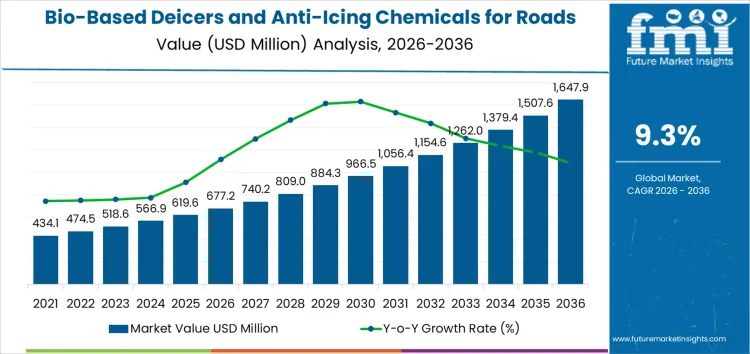
The bio-based deicers and anti-icing chemicals for roads market is expected to grow steadily from 2026 to 2036. In 2026, the market value is projected to be USD 677.2 million, with growth expected to reach USD 1,647.9 million by 2036. The compound annual growth rate (CAGR) for this market is forecasted at 9.3%, driven by the increasing adoption of eco-friendly alternatives to traditional deicing chemicals, particularly as governments and industries focus on reducing the environmental impact of road treatments. Bio-based deicers are biodegradable, less toxic to wildlife, and have a lower environmental footprint, making them an attractive choice for road maintenance.
The growth of the market is further supported by increasing environmental regulations and consumer demand for more sustainable solutions. As awareness of the environmental impact of conventional deicing chemicals grows, the shift towards bio-based alternatives will continue to accelerate. Additionally, advancements in the formulation of these chemicals, improving their effectiveness in extreme weather conditions, will drive further adoption. Over the forecast period, the market is expected to expand steadily, driven by these key trends and innovations in the bio-based chemical space.
Quick Stats of the Bio-Based Deicers and Anti-Icing Chemicals for Roads Market
- Bio-Based Deicers and Anti-Icing Chemicals for Roads Market Value (2026): USD 677.2 million
- Bio-Based Deicers and Anti-Icing Chemicals for Roads Market Forecast Value (2036): USD 1,647.9 million
- Bio-Based Deicers and Anti-Icing Chemicals for Roads Market Global Forecast CAGR (2026-2036): 9.3%
- Bio-Based Deicers and Anti-Icing Chemicals for Roads Market Leading Segment: End-User (Government & Municipal Authorities) 34%
- Key Growth Regions in Bio-Based Deicers and Anti-Icing Chemicals for Roads Market: Canada
- Top Players in Bio-Based Deicers and Anti-Icing Chemicals for Roads Market: Cargill, Envirotech Services, Compass Minerals, Dow Inc., K-Tech Specialty Coatings
What is the Growth Forecast for the Bio-Based Deicers and Anti-Icing Chemicals for Roads Market through 2036?
The growth forecast for the bio-based deicers and anti-icing chemicals for roads market shows steady growth with a projected CAGR of 9.3%. Starting at USD 677.2 million in 2026, the market will grow steadily, reaching USD 740 million in 2027, USD 809.9 million in 2028, and USD 887.6 million in 2029. By 2030, the market value is projected to rise to USD 974.2 million, continuing to grow at a steady pace throughout the forecast period.
From 2031 to 2036, the market will continue to experience expansion, reaching USD 1,070.4 million in 2031, USD 1,176.7 million in 2032, and USD 1,294.2 million in 2033. By 2034, the market will increase to USD 1,423.8 million, reaching USD 1,509 million in 2035. Finally, by 2036, the market is expected to reach USD 1,647.9 million. The inflection point mapping shows a gradual acceleration in market growth, particularly as bio-based deicers become more widely adopted and innovations in formulations continue to improve their performance and sustainability.
Bio-Based Deicers and Anti-Icing Chemicals for Roads Market Key Takeaways
| Metric | Value |
|---|---|
| Industry Sales Value (2026) | USD 677.2 million |
| Industry Forecast Value (2036) | USD 1,647.9 million |
| Industry Forecast CAGR (2026-2036) | 9.3% |
What Is Driving the Demand for the Bio Based Deicers and Anti Icing Chemicals for Roads Market Globally?
The global demand for bio based deicers and anti icing chemicals for roads is driven by heightened environmental concerns, regulatory restrictions on conventional chloride based products, and a growing emphasis on sustainable winter maintenance. Traditional deicing agents such as sodium chloride, calcium chloride, and magnesium chloride are effective at lowering the freezing point of ice and snow, but they can harm vegetation, corrode infrastructure, and contaminate soil and water systems. Regulatory frameworks in Europe, North America, and parts of Asia increasingly limit the use of environmentally problematic deicers, prompting municipal authorities, highway agencies, and airport operators to seek alternatives. Bio based deicers derived from agricultural by products (for example, beet juice, molasses, or other organic feedstocks) and environmentally benign additives offer reduced corrosivity and lower ecological impact while maintaining ice melting performance. Public pressure for cleaner infrastructure solutions and sustainability commitments by cities and regional governments further reinforce the shift toward alternatives that align with climate and water quality goals.
Future demand for bio based deicers and anti icing chemicals for roads is expected to grow as sustainability criteria and performance expectations continue to shape winter road treatment practices. Advances in formulation science are enhancing the effectiveness of bio based agents in a wider range of temperature conditions and improving adherence to pavement surfaces, which can reduce overall application rates and environmental loading. Broader adoption will be supported by improvements in supply chain logistics and cost competitiveness as production scales and raw material sourcing becomes more efficient. Policy measures that prioritise reduced chloride runoff, protection of freshwater resources, and minimisation of infrastructure corrosion will reinforce procurement of eco friendly deicing solutions. Investment in winter road maintenance infrastructure, including automated application systems and real time weather response tools, will further integrate bio based chemistries into operational routines. As governments and transport authorities align with circular economy principles, demand for bio based deicers and anti icing chemicals that balance performance with environmental stewardship is expected to expand steadily across global markets.
What are the Leading Segments in the Global Bio-Based Deicers and Anti-Icing Chemicals for Roads Market?
The global bio-based deicers and anti-icing chemicals for roads market is segmented by product type and end-user. Among product types, bio-based liquid deicers lead the market, capturing 32% of the share, followed by agricultural byproduct deicers (corn, beet, soy), acetate-based anti-icing agents, bioethanol & glycol blends, and other eco-friendly deicing chemicals. Bio-based liquid deicers are preferred due to their environmentally friendly composition and effective deicing performance. On the end-user side, government & municipal authorities dominate the market, holding 34% of the share, followed by airport & aviation authorities, highway maintenance contractors, commercial facility operators, and industrial & private property owners. Government and municipal authorities are the largest users of deicers due to their responsibility for road maintenance in urban and rural areas during winter conditions.
What Drives the Growth of Bio-Based Liquid Deicers in the Bio-Based Deicers and Anti-Icing Chemicals Market?
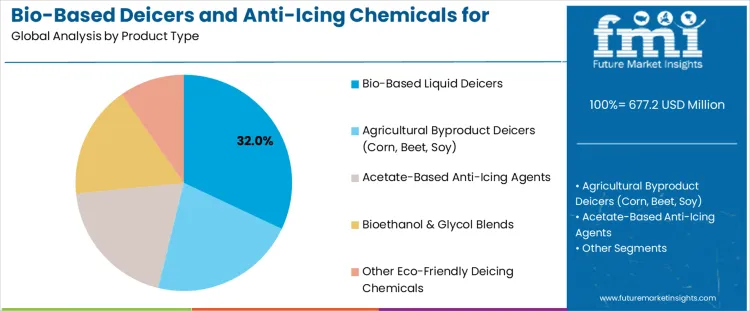
Bio-based liquid deicers are the leading product type in the bio-based deicers and anti-icing chemicals for roads market, capturing 32% of the share. These deicers are gaining popularity due to their environmentally friendly properties and effective performance in removing ice and preventing its formation on road surfaces. Bio-based liquid deicers, derived from renewable sources, provide a safer alternative to traditional chemical deicers, which can be harmful to vegetation, water sources, and infrastructure. The growing demand for eco-friendly solutions in public infrastructure and the increasing regulatory pressure to reduce the environmental impact of road maintenance practices are driving the adoption of bio-based liquid deicers. As municipalities and transportation agencies prioritize sustainable practices, the demand for bio-based liquid deicers is expected to continue growing, securing their position as a dominant product in the market.
What is Driving the Demand for Government & Municipal Authorities in the Bio-Based Deicers and Anti-Icing Chemicals Market?
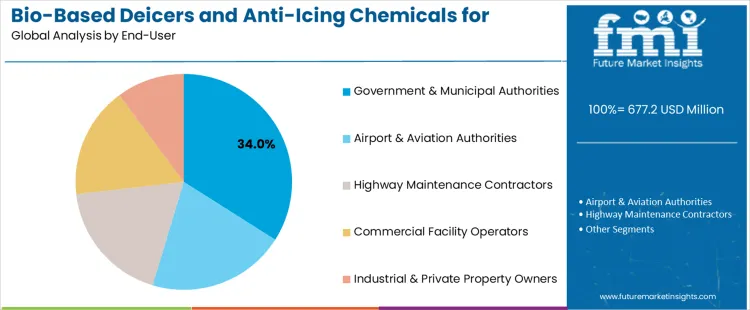
Government & municipal authorities are the leading end-user segment in the bio-based deicers and anti-icing chemicals for roads market, holding 34% of the share. This is primarily due to their responsibility for maintaining public roads and ensuring safe driving conditions during winter months. Government and municipal authorities are significant consumers of deicing chemicals, as they manage large-scale road networks in urban and rural areas, which require effective snow and ice management. The growing emphasis on sustainability and environmental responsibility, combined with the need for efficient deicing solutions, is driving the adoption of bio-based deicers in public infrastructure projects. Additionally, municipalities are increasingly adopting bio-based and eco-friendly deicing chemicals to comply with environmental regulations and reduce the impact of traditional deicing agents on the environment. As government authorities continue to prioritize both road safety and sustainability, the demand for bio-based deicers is expected to remain strong, making this segment a key driver in the market.
What are the Key Dynamics in the Global Bio Based Deicers and Anti Icing Chemicals for Roads Market?
The global bio based deicers and anti icing chemicals for roads market is expanding as governments, transportation agencies and private contractors prioritize safer, more sustainable winter maintenance solutions. Bio based products use renewable feedstocks such as agricultural by products, reducing reliance on rock salt and petroleum derived glycols. These alternatives help protect infrastructure, water quality and roadside vegetation while delivering effective ice control. Growth reflects increased winter weather variability, emphasis on environmental stewardship, and investment in greener materials that align with regulatory frameworks and sustainability commitments across regions worldwide.
What are the Key Drivers for the Global Bio Based Deicers and Anti Icing Chemicals for Roads Market?
Environmental regulation and public concern over waterway and soil contamination drive adoption of bio based deicers that minimize chloride and toxic runoff. Many municipalities and state/provincial agencies set sustainability goals that encourage use of renewable, biodegradable alternatives to conventional salts and chemicals. Advances in formulation technology have improved performance of bio based products in extreme cold, expanding their practical application. Increasing winter storm frequency and intensity heighten demand for effective anti icing strategies that reduce accidents and infrastructure damage. Procurement policies tied to green public works and infrastructure spending also support broader uptake of eco friendly deicing solutions.
What are the Restraints for the Global Bio Based Deicers and Anti Icing Chemicals for Roads Market?
One restraint is higher upfront cost compared with traditional rock salt and standard chemical deicers, which can make budget constrained agencies and contractors hesitant to switch. Performance perceptions persist in segments that question efficacy under severe freeze thaw conditions, requiring demonstration and validation in varied climates. Supply chain limitations for some bio based feedstocks can affect consistent availability and pricing stability. Compatibility with existing distribution and application equipment may require adjustment and training, adding operational considerations. Variable regulatory environments and reimbursement structures across regions create planning complexity for stakeholders evaluating long term adoption.
What are the Key Trends in the Global Bio Based Deicers and Anti Icing Chemicals for Roads Market?
A key trend is development of hybrid and optimized formulations that blend bio based components with performance enhancers to boost low temperature effectiveness and reduce corrosion impact on vehicles and infrastructure. Technology integration includes sensors and predictive weather analytics to tailor application timing and minimize material use. Manufacturers are investing in life cycle assessments and eco certifications to quantify environmental benefits and support procurement decisions. Partnerships between chemical developers, transportation authorities and research institutions are advancing field testing and specification standards. Interest in circular economy principles encourages use of agricultural residues and sustainable feedstocks as core ingredients in next generation deicing solutions.
What is the Country-Wise Analysis of the Bio-Based Deicers and Anti-Icing Chemicals for Roads Market?
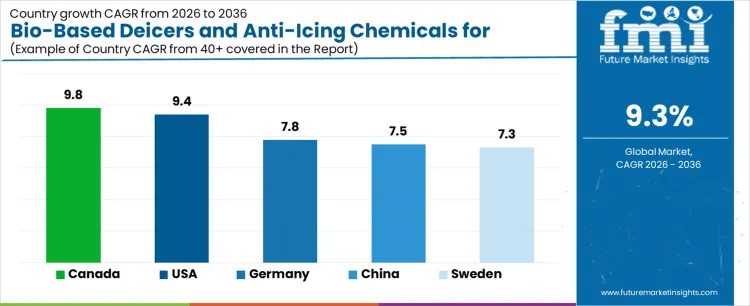
The bio-based deicers and anti-icing chemicals for roads market is experiencing steady growth, driven by the increasing demand for eco-friendly and sustainable solutions for road safety, particularly in cold weather regions. These chemicals are used to prevent ice formation on roads and improve safety during winter conditions, while minimizing environmental impact. High-growth markets such as Canada and the United States are seeing strong demand due to their cold climates, high frequency of snow and ice events, and growing regulatory focus on reducing the environmental footprint of traditional deicing chemicals. Developed markets such as Germany, Sweden, and China are also experiencing steady growth, supported by increasing regulations regarding environmental sustainability, growing awareness of the environmental impact of chemical deicers, and the adoption of eco-friendlier alternatives in road maintenance practices.
| Country | CAGR (2026-2036) |
|---|---|
| Canada | 9.8% |
| United States | 9.4% |
| Germany | 7.8% |
| China | 7.5% |
| Sweden | 7.3% |
What is the Growth Outlook for the Bio-Based Deicers and Anti-Icing Chemicals for Roads Market in Canada?
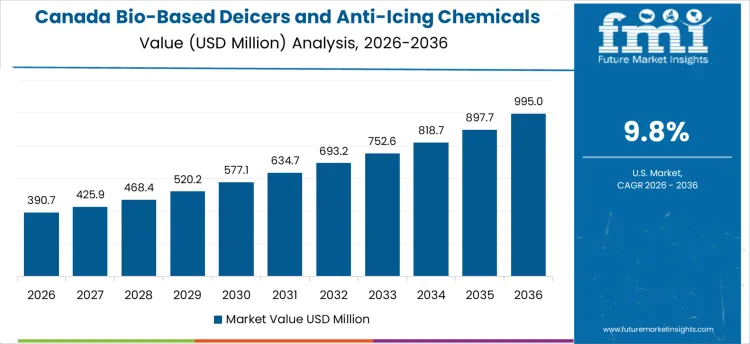
The bio-based deicers and anti-icing chemicals for roads market in Canada is expected to grow at the highest rate, with a projected CAGR of 9.8%. Canada’s cold climate and frequent winter storms create significant demand for effective road maintenance solutions, particularly those that are environmentally friendly. As traditional deicing chemicals, such as sodium chloride, have been shown to cause harm to the environment and surrounding infrastructure, there is increasing pressure to adopt more sustainable alternatives. The Canadian government’s focus on reducing environmental impact and improving road safety is further boosting demand for bio-based deicers. With the country’s large transportation network and ongoing efforts to improve infrastructure, the market for bio-based deicers and anti-icing chemicals is set to continue its strong growth in Canada.
What is the Market Outlook for the Bio-Based Deicers and Anti-Icing Chemicals for Roads Market in the United States?
The bio-based deicers and anti-icing chemicals for roads market in the United States is projected to grow steadily, with a projected CAGR of 9.4%. The USA experiences harsh winter weather in many regions, creating significant demand for deicing and anti-icing chemicals to maintain road safety. As concerns over the environmental and health impacts of traditional deicers grow, USA municipalities and transportation agencies are increasingly adopting bio-based alternatives that are less harmful to the environment. With increasing regulations on the use of harmful chemicals, such as chlorides, and a growing focus on sustainability, the market for bio-based deicers is expected to continue growing. Furthermore, the rising awareness among consumers and road maintenance authorities about the advantages of bio-based products in terms of safety, environmental protection, and cost-effectiveness is expected to drive steady market growth in the USA.
What is the Growth Forecast for the Bio-Based Deicers and Anti-Icing Chemicals for Roads Market in Germany?
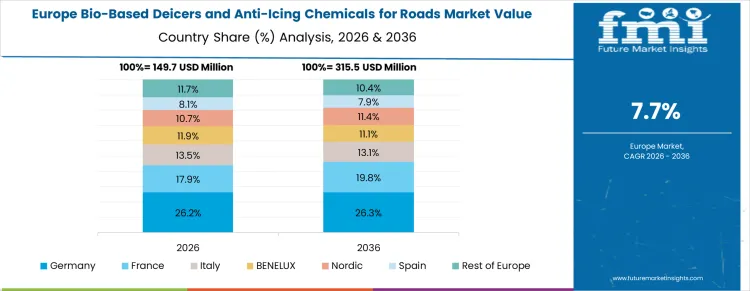
The bio-based deicers and anti-icing chemicals for roads market in Germany is expected to grow at a steady pace, with a projected CAGR of 7.8%. Germany’s strong commitment to sustainability and environmental protection is driving the demand for eco-friendly deicing solutions. As one of Europe’s leaders in adopting green technologies, Germany is increasingly focusing on reducing the use of harmful deicers, such as sodium chloride, in favor of more environmentally friendly alternatives. The country’s harsh winters and high volume of road traffic also create a constant need for effective road maintenance products. As the German government continues to push for environmental sustainability and stricter regulations on road maintenance chemicals, the demand for bio-based deicers and anti-icing chemicals is expected to grow steadily in the coming years.
What is the Market Outlook for the Bio-Based Deicers and Anti-Icing Chemicals for Roads Market in China?
The bio-based deicers and anti-icing chemicals for roads market in China is projected to grow at a moderate pace, with a projected CAGR of 7.5%. China experiences significant snow and ice events in various northern regions, creating a need for effective road safety solutions. As the country continues to industrialize and urbanize, there is increasing pressure to adopt more sustainable and eco-friendly products in industries such as transportation and infrastructure. The growing awareness of the environmental impact of traditional deicers, coupled with the Chinese government’s focus on sustainability and stricter environmental regulations, is driving the adoption of bio-based alternatives. As China seeks to balance economic growth with environmental responsibility, the market for bio-based deicers is expected to grow at a moderate rate, particularly in regions with harsh winter conditions.
What are the Growth Prospects for the Bio-Based Deicers and Anti-Icing Chemicals for Roads Market in Sweden?
The bio-based deicers and anti-icing chemicals for roads market in Sweden is expected to grow at a moderate pace, with a projected CAGR of 7.3%. Sweden’s cold climate and extensive winter road maintenance needs make it one of the key markets for deicing solutions. The country’s strong environmental policies, which emphasize the use of sustainable, non-toxic materials, are driving the adoption of bio-based deicers and anti-icing chemicals. As Sweden continues to prioritize sustainability and reduce the environmental impact of traditional road maintenance chemicals, the market for bio-based alternatives is set to grow steadily. Sweden’s commitment to reducing its carbon footprint and protecting its natural ecosystems is further fueling demand for eco-friendly road safety products. As both the public and private sectors in Sweden work to meet environmental goals, the adoption of bio-based deicers is expected to increase, contributing to steady market growth.
What is the Competitive Landscape for the Bio-Based Deicers and Anti-Icing Chemicals for Roads Market?
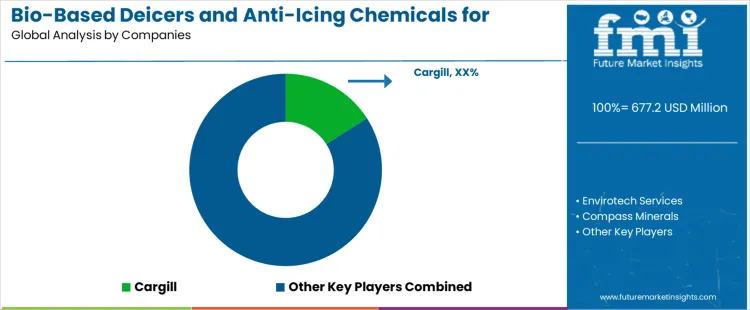
The bio-based deicers and anti-icing chemicals for roads market is growing rapidly as municipalities, industries, and organizations increasingly seek sustainable, eco-friendly alternatives to traditional salt and chemical-based deicers. These solutions offer effective ice and snow melting properties while minimizing environmental impact, including harm to surrounding vegetation, wildlife, and water resources. Cargill leads the market with its innovative bio-based deicing and anti-icing solutions, offering high-performance products that improve road safety during winter weather while ensuring environmental sustainability. Their advanced formulations are designed to perform well in various climate conditions, making them a dominant player in the bio-based deicer market. Envirotech Services, Compass Minerals, and Dow Inc. are key competitors, each providing specialized deicing and anti-icing chemicals that prioritize both performance and environmental responsibility. Envirotech Services focuses on providing biodegradable, non-toxic deicing products, while Compass Minerals and Dow Inc. offer highly effective, sustainable solutions that cater to the diverse needs of road maintenance across different regions.
K-Tech Specialty Coatings further strengthens the competitive landscape by offering eco-friendly, bio-based deicers specifically designed for road maintenance in environmentally sensitive areas, such as national parks or areas near water sources. These companies compete by focusing on product innovation, performance enhancement, and the reduction of environmental footprints. Many are developing advanced formulations that not only provide superior ice-melting capabilities but also promote better long-term sustainability by reducing the adverse effects traditionally caused by conventional deicing methods. The market is expected to continue evolving with a growing demand for greener, more efficient solutions to ensure safe winter road conditions without harming the environment. As climate change and environmental responsibility become increasingly critical concerns for governments and companies worldwide, the demand for bio-based alternatives will likely continue to increase.
Key Players of the Bio-Based Deicers and Anti-Icing Chemicals for Roads Market
- Cargill
- Envirotech Services
- Compass Minerals
- Dow Inc.
- K-Tech Specialty Coatings
Scope of the Report
| Items | Values |
|---|---|
| Quantitative Units (2026) | USD Million |
| Product Type | Bio-Based Liquid Deicers, Agricultural Byproduct Deicers (Corn, Beet, Soy), Acetate-Based Anti-Icing Agents, Bioethanol & Glycol Blends, Other Eco-Friendly Deicing Chemicals |
| Application Type | Airports & Runways, Highways & Municipal Roads, Residential & Commercial Pavements, Industrial & Logistics Facilities, Others |
| End-User | Government & Municipal Authorities, Airport & Aviation Authorities, Highway Maintenance Contractors, Commercial Facility Operators, Industrial & Private Property Owners |
| Companies | Cargill, Envirotech Services, Compass Minerals, Dow Inc., K-Tech Specialty Coatings |
| Regions Covered | North America, Latin America, Western Europe, Eastern Europe, South Asia and Pacific, East Asia, Middle East & Africa |
| Countries Covered | United States, Canada, Mexico, Brazil, Argentina, Germany, France, United Kingdom, Italy, Spain, Netherlands, China, India, Japan, South Korea, ANZ, GCC Countries, South Africa |
| Additional Attributes | Dollar by sales by product type, application type, end-user, and region. Includes market trends in bio-based deicers and anti-icing chemicals, focusing on liquid deicers, agricultural byproducts, and bioethanol blends. Highlights the role of airports, highways, and pavements in the winter maintenance market. Focus on sustainability, cost-effectiveness, performance, regulatory compliance, market share, and competitive positioning of key companies in the deicing and anti-icing chemicals market. |
Bio-Based Deicers and Anti-Icing Chemicals for Roads Market Segmentation
Product Type:
- Bio-Based Liquid Deicers
- Agricultural Byproduct Deicers (Corn, Beet, Soy)
- Acetate-Based Anti-Icing Agents
- Bioethanol & Glycol Blends
- Other Eco-Friendly Deicing Chemicals
Application Type:
- Airports & Runways
- Highways & Municipal Roads
- Residential & Commercial Pavements
- Industrial & Logistics Facilities
End-User:
- Government & Municipal Authorities
- Airport & Aviation Authorities
- Highway Maintenance Contractors
- Commercial Facility Operators
- Industrial & Private Property Owners
Region:
- Asia Pacific
- China
- Japan
- South Korea
- India
- Australia & New Zealand
- ASEAN
- Rest of Asia Pacific
- Europe
- Germany
- United Kingdom
- France
- Italy
- Spain
- Nordic
- BENELUX
- Rest of Europe
- North America
- United States
- Canada
- Mexico
- Latin America
- Brazil
- Chile
- Rest of Latin America
- Middle East & Africa
- Kingdom of Saudi Arabia
- Other GCC Countries
- Turkey
- South Africa
- Other African Union
- Rest of Middle East & Africa
Bibliography
- Cargill. (n.d.). Innovative bio-based deicing and anti-icing solutions for winter road maintenance.
- Envirotech Services. (n.d.). Sustainable, biodegradable, and non-toxic deicing products for road maintenance.
Frequently Asked Questions
How big is the bio-based deicers and anti-icing chemicals for roads market in 2026?
The global bio-based deicers and anti-icing chemicals for roads market is estimated to be valued at USD 677.2 million in 2026.
What will be the size of bio-based deicers and anti-icing chemicals for roads market in 2036?
The market size for the bio-based deicers and anti-icing chemicals for roads market is projected to reach USD 1,647.9 million by 2036.
How much will be the bio-based deicers and anti-icing chemicals for roads market growth between 2026 and 2036?
The bio-based deicers and anti-icing chemicals for roads market is expected to grow at a 9.3% CAGR between 2026 and 2036.
What are the key product types in the bio-based deicers and anti-icing chemicals for roads market?
The key product types in bio-based deicers and anti-icing chemicals for roads market are bio-based liquid deicers, agricultural byproduct deicers (corn, beet, soy), acetate-based anti-icing agents, bioethanol & glycol blends and other eco-friendly deicing chemicals.
Which product type leads the bio-based deicers and anti-icing chemicals for roads market in 2026?
Bio-based liquid deicers lead the market with a 32.0% share in 2026.
Preview the report firsthand - request a free sample
Get SampleGet the brochure for pricing and purchase details.
Get PDFTable of Content
- Executive Summary
- Global Market Outlook
- Demand-side Trends
- Supply-side Trends
- Technology Roadmap Analysis
- Analysis and Recommendations
- Market Overview
- Market Coverage / Taxonomy
- Market Definition / Scope / Limitations
- Market Background
- Market Dynamics
- Drivers
- Restraints
- Opportunity
- Trends
- Scenario Forecast
- Demand in Optimistic Scenario
- Demand in Likely Scenario
- Demand in Conservative Scenario
- Opportunity Map Analysis
- Product Life Cycle Analysis
- Supply Chain Analysis
- Investment Feasibility Matrix
- Value Chain Analysis
- PESTLE and Porter’s Analysis
- Regulatory Landscape
- Regional Parent Market Outlook
- Production and Consumption Statistics
- Import and Export Statistics
- Market Dynamics
- Global Market Analysis 2021 to 2025 and Forecast, 2026 to 2036
- Historical Market Size Value (USD Million) Analysis, 2021 to 2025
- Current and Future Market Size Value (USD Million) Projections, 2026 to 2036
- Y-o-Y Growth Trend Analysis
- Absolute $ Opportunity Analysis
- Global Market Pricing Analysis 2021 to 2025 and Forecast 2026 to 2036
- Global Market Analysis 2021 to 2025 and Forecast 2026 to 2036, By Product Type
- Introduction / Key Findings
- Historical Market Size Value (USD Million) Analysis By Product Type , 2021 to 2025
- Current and Future Market Size Value (USD Million) Analysis and Forecast By Product Type , 2026 to 2036
- Bio-Based Liquid Deicers
- Agricultural Byproduct Deicers (Corn, Beet, Soy)
- Acetate-Based Anti-Icing Agents
- Bioethanol & Glycol Blends
- Other Eco-Friendly Deicing Chemicals
- Bio-Based Liquid Deicers
- Y-o-Y Growth Trend Analysis By Product Type , 2021 to 2025
- Absolute $ Opportunity Analysis By Product Type , 2026 to 2036
- Global Market Analysis 2021 to 2025 and Forecast 2026 to 2036, By Application Type
- Introduction / Key Findings
- Historical Market Size Value (USD Million) Analysis By Application Type, 2021 to 2025
- Current and Future Market Size Value (USD Million) Analysis and Forecast By Application Type, 2026 to 2036
- Airports & Runways
- Highways & Municipal Roads
- Residential & Commercial Pavements
- Industrial & Logistics Facilities
- Airports & Runways
- Y-o-Y Growth Trend Analysis By Application Type, 2021 to 2025
- Absolute $ Opportunity Analysis By Application Type, 2026 to 2036
- Global Market Analysis 2021 to 2025 and Forecast 2026 to 2036, By End-User
- Introduction / Key Findings
- Historical Market Size Value (USD Million) Analysis By End-User, 2021 to 2025
- Current and Future Market Size Value (USD Million) Analysis and Forecast By End-User, 2026 to 2036
- Government & Municipal Authorities
- Airport & Aviation Authorities
- Highway Maintenance Contractors
- Commercial Facility Operators
- Industrial & Private Property Owners
- Government & Municipal Authorities
- Y-o-Y Growth Trend Analysis By End-User, 2021 to 2025
- Absolute $ Opportunity Analysis By End-User, 2026 to 2036
- Global Market Analysis 2021 to 2025 and Forecast 2026 to 2036, By Region
- Introduction
- Historical Market Size Value (USD Million) Analysis By Region, 2021 to 2025
- Current Market Size Value (USD Million) Analysis and Forecast By Region, 2026 to 2036
- North America
- Latin America
- Western Europe
- Eastern Europe
- East Asia
- South Asia and Pacific
- Middle East & Africa
- Market Attractiveness Analysis By Region
- North America Market Analysis 2021 to 2025 and Forecast 2026 to 2036, By Country
- Historical Market Size Value (USD Million) Trend Analysis By Market Taxonomy, 2021 to 2025
- Market Size Value (USD Million) Forecast By Market Taxonomy, 2026 to 2036
- By Country
- USA
- Canada
- Mexico
- By Product Type
- By Application Type
- By End-User
- By Country
- Market Attractiveness Analysis
- By Country
- By Product Type
- By Application Type
- By End-User
- Key Takeaways
- Latin America Market Analysis 2021 to 2025 and Forecast 2026 to 2036, By Country
- Historical Market Size Value (USD Million) Trend Analysis By Market Taxonomy, 2021 to 2025
- Market Size Value (USD Million) Forecast By Market Taxonomy, 2026 to 2036
- By Country
- Brazil
- Chile
- Rest of Latin America
- By Product Type
- By Application Type
- By End-User
- By Country
- Market Attractiveness Analysis
- By Country
- By Product Type
- By Application Type
- By End-User
- Key Takeaways
- Western Europe Market Analysis 2021 to 2025 and Forecast 2026 to 2036, By Country
- Historical Market Size Value (USD Million) Trend Analysis By Market Taxonomy, 2021 to 2025
- Market Size Value (USD Million) Forecast By Market Taxonomy, 2026 to 2036
- By Country
- Germany
- UK
- Italy
- Spain
- France
- Nordic
- BENELUX
- Rest of Western Europe
- By Product Type
- By Application Type
- By End-User
- By Country
- Market Attractiveness Analysis
- By Country
- By Product Type
- By Application Type
- By End-User
- Key Takeaways
- Eastern Europe Market Analysis 2021 to 2025 and Forecast 2026 to 2036, By Country
- Historical Market Size Value (USD Million) Trend Analysis By Market Taxonomy, 2021 to 2025
- Market Size Value (USD Million) Forecast By Market Taxonomy, 2026 to 2036
- By Country
- Russia
- Poland
- Hungary
- Balkan & Baltic
- Rest of Eastern Europe
- By Product Type
- By Application Type
- By End-User
- By Country
- Market Attractiveness Analysis
- By Country
- By Product Type
- By Application Type
- By End-User
- Key Takeaways
- East Asia Market Analysis 2021 to 2025 and Forecast 2026 to 2036, By Country
- Historical Market Size Value (USD Million) Trend Analysis By Market Taxonomy, 2021 to 2025
- Market Size Value (USD Million) Forecast By Market Taxonomy, 2026 to 2036
- By Country
- China
- Japan
- South Korea
- By Product Type
- By Application Type
- By End-User
- By Country
- Market Attractiveness Analysis
- By Country
- By Product Type
- By Application Type
- By End-User
- Key Takeaways
- South Asia and Pacific Market Analysis 2021 to 2025 and Forecast 2026 to 2036, By Country
- Historical Market Size Value (USD Million) Trend Analysis By Market Taxonomy, 2021 to 2025
- Market Size Value (USD Million) Forecast By Market Taxonomy, 2026 to 2036
- By Country
- India
- ASEAN
- Australia & New Zealand
- Rest of South Asia and Pacific
- By Product Type
- By Application Type
- By End-User
- By Country
- Market Attractiveness Analysis
- By Country
- By Product Type
- By Application Type
- By End-User
- Key Takeaways
- Middle East & Africa Market Analysis 2021 to 2025 and Forecast 2026 to 2036, By Country
- Historical Market Size Value (USD Million) Trend Analysis By Market Taxonomy, 2021 to 2025
- Market Size Value (USD Million) Forecast By Market Taxonomy, 2026 to 2036
- By Country
- Kingdom of Saudi Arabia
- Other GCC Countries
- Turkiye
- South Africa
- Other African Union
- Rest of Middle East & Africa
- By Product Type
- By Application Type
- By End-User
- By Country
- Market Attractiveness Analysis
- By Country
- By Product Type
- By Application Type
- By End-User
- Key Takeaways
- Key Countries Market Analysis
- USA
- Pricing Analysis
- Market Share Analysis, 2025
- By Product Type
- By Application Type
- By End-User
- Canada
- Pricing Analysis
- Market Share Analysis, 2025
- By Product Type
- By Application Type
- By End-User
- Mexico
- Pricing Analysis
- Market Share Analysis, 2025
- By Product Type
- By Application Type
- By End-User
- Brazil
- Pricing Analysis
- Market Share Analysis, 2025
- By Product Type
- By Application Type
- By End-User
- Chile
- Pricing Analysis
- Market Share Analysis, 2025
- By Product Type
- By Application Type
- By End-User
- Germany
- Pricing Analysis
- Market Share Analysis, 2025
- By Product Type
- By Application Type
- By End-User
- UK
- Pricing Analysis
- Market Share Analysis, 2025
- By Product Type
- By Application Type
- By End-User
- Italy
- Pricing Analysis
- Market Share Analysis, 2025
- By Product Type
- By Application Type
- By End-User
- Spain
- Pricing Analysis
- Market Share Analysis, 2025
- By Product Type
- By Application Type
- By End-User
- France
- Pricing Analysis
- Market Share Analysis, 2025
- By Product Type
- By Application Type
- By End-User
- India
- Pricing Analysis
- Market Share Analysis, 2025
- By Product Type
- By Application Type
- By End-User
- ASEAN
- Pricing Analysis
- Market Share Analysis, 2025
- By Product Type
- By Application Type
- By End-User
- Australia & New Zealand
- Pricing Analysis
- Market Share Analysis, 2025
- By Product Type
- By Application Type
- By End-User
- China
- Pricing Analysis
- Market Share Analysis, 2025
- By Product Type
- By Application Type
- By End-User
- Japan
- Pricing Analysis
- Market Share Analysis, 2025
- By Product Type
- By Application Type
- By End-User
- South Korea
- Pricing Analysis
- Market Share Analysis, 2025
- By Product Type
- By Application Type
- By End-User
- Russia
- Pricing Analysis
- Market Share Analysis, 2025
- By Product Type
- By Application Type
- By End-User
- Poland
- Pricing Analysis
- Market Share Analysis, 2025
- By Product Type
- By Application Type
- By End-User
- Hungary
- Pricing Analysis
- Market Share Analysis, 2025
- By Product Type
- By Application Type
- By End-User
- Kingdom of Saudi Arabia
- Pricing Analysis
- Market Share Analysis, 2025
- By Product Type
- By Application Type
- By End-User
- Turkiye
- Pricing Analysis
- Market Share Analysis, 2025
- By Product Type
- By Application Type
- By End-User
- South Africa
- Pricing Analysis
- Market Share Analysis, 2025
- By Product Type
- By Application Type
- By End-User
- USA
- Market Structure Analysis
- Competition Dashboard
- Competition Benchmarking
- Market Share Analysis of Top Players
- By Regional
- By Product Type
- By Application Type
- By End-User
- Competition Analysis
- Competition Deep Dive
- Cargill
- Overview
- Product Portfolio
- Profitability by Market Segments (Product/Age /Sales Channel/Region)
- Sales Footprint
- Strategy Overview
- Marketing Strategy
- Product Strategy
- Channel Strategy
- Envirotech Services
- Compass Minerals
- Dow Inc.
- K-Tech Specialty Coatings
- Cargill
- Competition Deep Dive
- Assumptions & Acronyms Used
- Research Methodology


