

- Industry Size (2026)
- USD 444.8 Mn
- Forecast (2036)
- USD 1005.8 Mn
- CAGR (2026 to 2036)
- 8.5%
Chromium VI Reduction Chemicals Market Forecast and Outlook 2026 to 2036
The chromium VI reduction chemicals market is valued at USD 444.8 million in 2026 and is projected to reach USD 1,005.8 million by 2036, expanding at a CAGR of 8.5%. Stringent discharge limits on hexavalent chromium, heightened enforcement across industrial zones, and rising remediation activity in legacy contamination sites drive growth. Industrial operators prioritize chemical reduction pathways to convert toxic Cr(VI) into less hazardous Cr(III), enabling precipitation and removal within existing wastewater treatment frameworks.
Sodium metabisulfite and bisulfite represent leading chemical-type demand due to rapid reduction kinetics, cost efficiency, and reliable performance across variable influent compositions. These reagents support continuous treatment in high-throughput effluent systems and integrate effectively with coagulation and sludge handling stages. Preference reflects operational simplicity, predictable reaction control, and compatibility with automated dosing systems. Segment structure indicates continued reliance on reductive chemistries for compliance-driven treatment, particularly where influent chromium loads fluctuate.
Industrial wastewater treatment across textiles, tanneries, and chemical processing represents leading end-use demand due to elevated chromium exposure and regulatory scrutiny. China, India, USA, Germany, and Brazil emerge as fastest-growing countries, supported by manufacturing scale and enforcement intensity. Competitive landscape includes Kemira, Solenis, Ecolab, Kurita Water Industries, and Aditya Birla Chemicals, focusing on optimized reductant formulations, safe handling systems, and integration with downstream chromium precipitation processes.
Quick Stats for Chromium VI Reduction Chemicals Market
- Chromium VI Reduction Chemicals Market Value (2026): USD 444.8 million
- Chromium VI Reduction Chemicals Market Forecast Value (2036): USD 1,005.8 million
- Chromium VI Reduction Chemicals Market Forecast CAGR (2026 to 2036): 8.5%
- Leading Chemical Type in Global Demand: Sodium Metabisulfite or Bisulfite
- Fastest-Growing Countries: China, India, USA, Germany, Brazil
- Top Players in Global Demand: Kemira, Solenis, Ecolab, Kurita Water Industries, Aditya Birla Chemicals
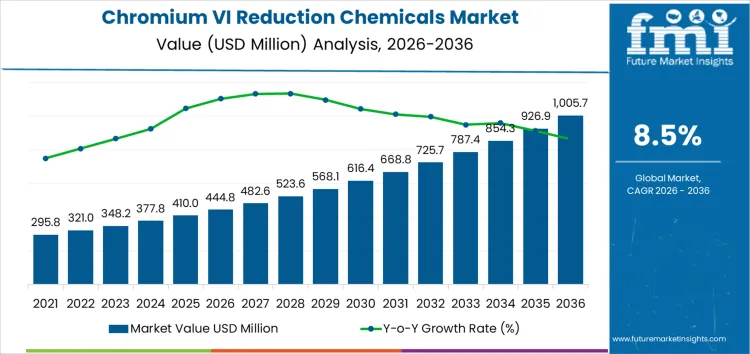
Chromium VI Reduction Chemicals Market Key Takeaways
| Metric | Value |
|---|---|
| Market Value (2026) | USD 444.8 million |
| Market Forecast Value (2036) | USD 1,005.8 million |
| Forecast CAGR (2026 to 2036) | 8.5% |
Why is the Demand for Chromium VI Reduction Chemicals Market Growing?
Demand for chromium VI reduction chemicals is growing globally due to increasing regulatory pressure and environmental concerns related to hexavalent chromium contamination in water, soil, and industrial effluent. Hexavalent chromium poses significant health risks, including carcinogenic and toxic effects, which prompts governments and regulatory agencies to enforce strict limits on permissible concentrations in drinking water and wastewater discharges. Water and wastewater treatment facilities adopt reduction chemicals that convert chromium VI to the less toxic trivalent chromium form, facilitating subsequent removal through precipitation, adsorption, or filtration.
Industrial sectors such as electroplating, leather tanning, chemical manufacturing, and metal finishing implement chromium VI reduction within on-site treatment systems to meet compliance requirements and minimize environmental liabilities. Expansion of potable reuse, remediation projects, and brownfield redevelopment increases use of reduction reagents as part of comprehensive contaminant control strategies. Research and innovation improve reagent efficiency, selectivity, and operational safety across diverse water matrices and redox conditions. Utilities and industrial operators integrate reduction chemicals into broader treatment trains alongside oxidants, coagulants, and adsorbents to achieve regulatory adherence and public health protection. Global mitigation efforts and sustainability commitments reinforce sustained demand for chromium VI reduction solutions across water quality applications.
How Are the Segments Classified in the Chromium VI Reduction Chemicals Market?
Demand for chromium VI reduction chemicals globally is shaped by occupational safety regulations, hazardous discharge limits, and remediation of legacy industrial contamination. Treatment operators evaluate reduction efficiency, reaction kinetics, sludge generation, and adaptability to batch and continuous systems. Adoption patterns reflect widespread use across industrial wastewater treatment, metal finishing operations, and remediation projects requiring conversion of hexavalent chromium into less toxic forms.
Which Chemical Type Accounts for the Largest Share of Global Demand?
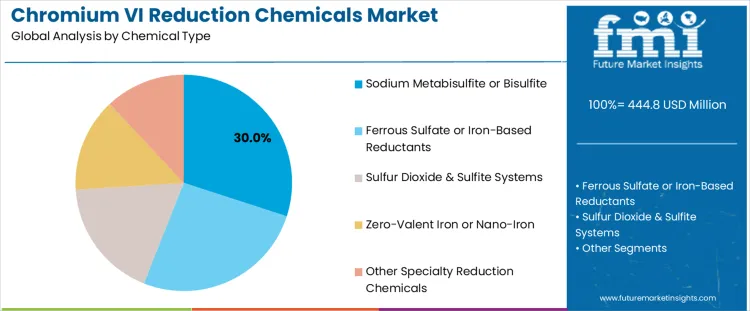
Sodium metabisulfite or bisulfite holds 30.0%, accounting for the largest share of global demand. These reductants provide rapid and predictable conversion of chromium VI under controlled pH conditions. Ferrous sulfate or iron-based reductants account for 26.0%, supporting cost-effective reduction with simultaneous precipitation benefits. Sulfur dioxide and sulfite systems hold 18.0%, enabling high-throughput treatment in industrial settings. Zero-valent iron or nano-iron accounts for 14.0%, supporting in-situ and permeable reactive barrier applications. Other specialty reduction chemicals hold 12.0%. Chemical-type distribution reflects preference for fast-acting and scalable reduction agents.
Key Points:
- Bisulfite systems lead due to rapid and controllable reduction.
- Iron-based reductants support cost and precipitation efficiency.
- Zero-valent iron addresses in-situ remediation needs.
Which End-Use Industry Drives the Highest Share of Global Adoption?
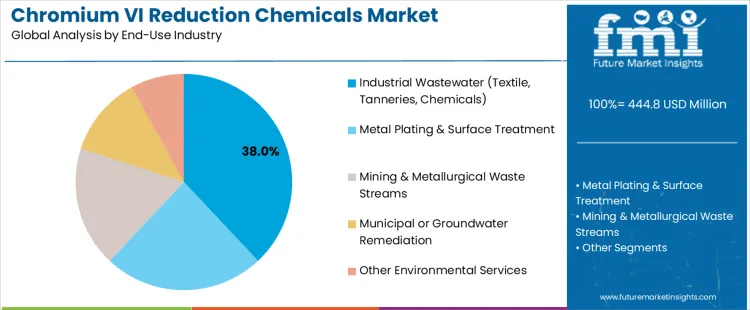
Industrial wastewater from textiles, tanneries, and chemical operations holds 38.0%, driving the highest share of global adoption. These sectors generate chromium-bearing effluents requiring mandatory reduction before discharge. Metal plating and surface treatment accounts for 24.0%, addressing chromium usage in coatings and finishes. Mining and metallurgical waste streams hold 18.0%, managing chromium release during ore processing. Municipal or groundwater remediation accounts for 12.0%, targeting legacy contamination. Other environmental services hold 8.0%. End-use distribution reflects concentration of chromium VI sources within industrial processes.
Key Points:
-
Industrial wastewater dominates due to regulated chromium discharge.
- Plating operations require consistent reduction performance.
- Mining streams contribute significant chromium loading.
Which Treatment Method Represents the Largest Share of Global Demand?
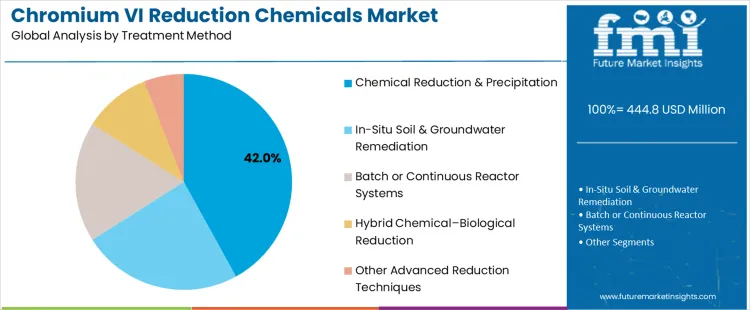
Chemical reduction and precipitation hold 42.0%, representing the largest share of global demand. This method provides reliable conversion and immobilization of chromium VI using established treatment infrastructure. In-situ soil and groundwater remediation accounts for 24.0%, supporting subsurface contamination control. Batch or continuous reactor systems hold 18.0%, enabling process optimization and scale control. Hybrid chemical–biological reduction accounts for 10.0%, reflecting emerging integration approaches. Other advanced reduction techniques hold 6.0%. Treatment-method distribution reflects dominance of proven reduction pathways for compliance-driven applications.
Key Points:
- Chemical reduction and precipitation lead due to reliability.
- In-situ remediation addresses subsurface contamination.
- Hybrid approaches support emerging treatment innovation.
What are the Key Dynamics in the Chromium VI Reduction Chemicals Market?
Global demand rises as water and wastewater treatment facilities, industrial processors, and environmental remediation programs adopt specialized reduction chemicals to convert toxic hexavalent chromium (Cr(VI)) into less mobile and less toxic trivalent chromium (Cr(III)) for subsequent removal. Adoption aligns with tightening regulatory limits on chromium discharge, increasing monitoring of groundwater and surface waters, and infrastructure investments to protect public health and ecosystems across regions. Usage spans municipal utilities, metal finishing plants, leather tanneries, and chemical manufacturers requiring robust contaminant control.
How do regulatory limits and public health priorities shape global demand?
Governments and environmental agencies in North America, Europe, Asia-Pacific, and other regions enforce stringent limits on Cr(VI) concentrations due to its carcinogenic and toxicological profile. Utilities and industrial facilities integrate reduction chemicals such as sulfite, ferrous sulfate, and alternative reducing agents into treatment trains ahead of precipitation and filtration to achieve required compliance thresholds. Mining and metal processing operations deploy reduction chemistries to lower Cr(VI) loads before dewatering or discharge. Enhanced monitoring triggers targeted mitigation strategies where Cr(VI) contamination risk is elevated. Public health objectives and ecosystem protection mandates reinforce investment in effective reduction solutions as part of broader contaminant management strategies.
How do source variability, cost pressures, and operational integration influence market scalability?
Effectiveness of reduction chemicals depends on water chemistry factors including pH, competing oxidants, and the presence of organic matter, requiring tailored dosing and process control for optimal conversion to Cr(III). Chemical costs and recurrent reagent consumption influence operating budgets for utilities and industrial users, particularly where high contaminant loads demand frequent treatment. Integration with downstream precipitation and solids capture systems adds operational complexity and monitoring requirements. Handling and disposal of resulting sludge containing trivalent chromium necessitate regulatory compliance and may incur additional cost burdens. Variability in regulatory frameworks and enforcement creates uneven urgency for adoption across jurisdictions. Long-term market growth depends on development of cost-effective, robust reduction chemistries and integrated treatment approaches that consistently achieve chromium compliance across diverse water quality conditions worldwide.
How Is Demand for Chromium VI Reduction Chemicals Evolving?
Demand for chromium VI reduction chemicals is increasing globally due to stringent occupational safety rules, hazardous waste regulation, and remediation of legacy industrial contamination. China leads with a 9.6% CAGR, supported by electroplating regulation and industrial wastewater upgrades. India follows at 9.2%, driven by metal finishing expansion and enforcement of discharge limits. USA records a 7.4% CAGR, reflecting compliance with hazardous waste and groundwater remediation standards. Germany posts 7.1%, shaped by precautionary chemical control and strict worker safety regulation. Brazil records 6.9%, supported by industrial wastewater treatment expansion and environmental compliance programs. Growth reflects sustained focus on detoxifying hexavalent chromium across industrial and remediation applications worldwide.
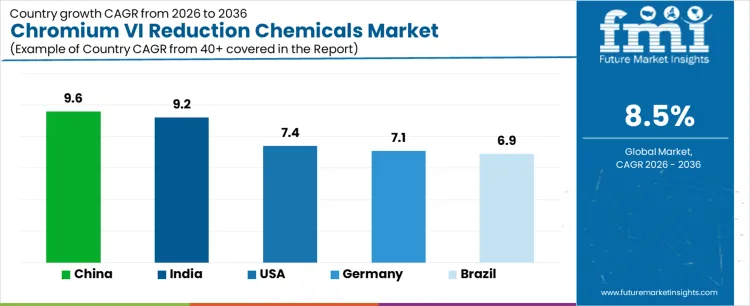
| Country | CAGR (%) |
|---|---|
| China | 9.6% |
| India | 9.2% |
| USA | 7.4% |
| Germany | 7.1% |
| Brazil | 6.9% |
What factors are driving strong demand growth for chromium VI reduction chemicals in China?
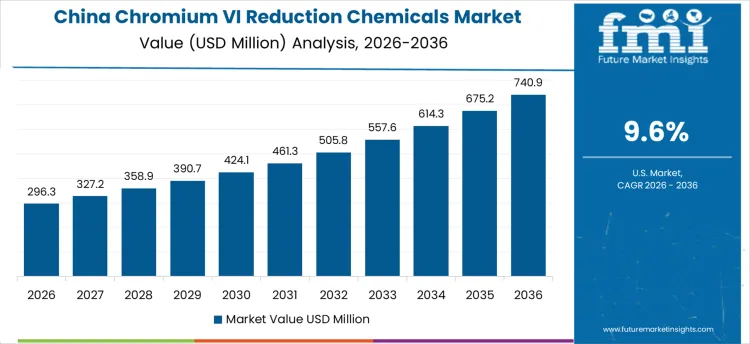
China demand is driven by extensive electroplating, metal finishing, and surface treatment activity. CAGR of 9.6% reflects increased use of reduction chemicals such as ferrous salts and sulfur-based agents to convert hexavalent chromium to less toxic trivalent forms. Industrial wastewater plants integrate reduction steps to meet discharge limits. Centralized regulatory enforcement accelerates adoption across manufacturing clusters. Remediation of contaminated soils and sludge further supports demand. Growth remains scale-driven and compliance-aligned, supported by industrial volume and tightening environmental oversight.
- Electroplating and surface treatment wastewater control
- Conversion of hexavalent to trivalent chromium
- Centralized enforcement across industrial clusters
- Soil and sludge remediation activity
How is India sustaining high growth in chromium VI reduction chemical usage?
India demand reflects expansion of metal finishing, leather processing, and chemical manufacturing. CAGR of 9.2% is supported by adoption of reduction chemicals to meet stricter effluent discharge standards. Industrial estates integrate chromium reduction units within common effluent treatment plants. River cleanup initiatives increase treatment requirements for upstream discharges. Regulatory scrutiny strengthens monitoring of chromium levels. Growth remains infrastructure-led and compliance-focused, aligned with reducing toxic metal exposure and improving surface water quality.
- Metal finishing and leather processing effluents
- Common effluent treatment plant upgrades
- River and surface water protection initiatives
- Strengthening regulatory monitoring
What regulatory drivers shape chromium VI reduction demand in the USA?
USA demand is shaped by hazardous waste regulation, occupational exposure limits, and groundwater cleanup requirements. CAGR of 7.4% reflects consistent use of reduction chemicals at industrial sites and remediation projects. Facilities apply reduction to meet Resource Conservation and Recovery Act obligations. Brownfield remediation sustains demand for in-situ treatment. Aging infrastructure favors chemical-based solutions without extensive reconstruction. Growth remains regulation-driven and risk-focused, aligned with worker safety and long-term liability reduction.
- Hazardous waste and worker safety regulation
- Brownfield and groundwater remediation projects
- In-situ chemical reduction applications
- Compliance-focused industrial treatment
Why does Germany show steady but controlled demand growth?
Germany demand reflects precautionary environmental regulation and strict occupational safety standards. CAGR of 7.1% is supported by targeted use of reduction chemicals within optimized industrial treatment systems. Manufacturers prioritize closed-loop processes and minimal secondary waste generation. Strong source control reduces excessive chromium discharge. Documentation and validation requirements guide chemical application. Growth remains efficiency-led and stability-focused, aligned with established environmental protection and industrial safety frameworks.
- Strict occupational and environmental regulation
- Closed-loop industrial treatment practices
- Reduction of secondary waste generation
- Emphasis on documentation and validation
What supports gradual demand expansion in Brazil?
Brazil demand is driven by industrial wastewater treatment growth and enforcement of metal discharge standards. CAGR of 6.9% reflects increased application of chromium VI reduction chemicals in electroplating, mining, and chemical processing effluents. Urban industrialization increases treatment volumes. Environmental licensing requirements strengthen compliance. Public investment supports wastewater infrastructure upgrades. Growth remains application-driven and infrastructure-aligned, supported by improving environmental oversight and water quality objectives.
- Industrial wastewater treatment expansion
- Electroplating and mining effluent management
- Environmental licensing enforcement
- Public investment in treatment upgrades
What is the competitive landscape of demand for chromium VI reduction chemicals?
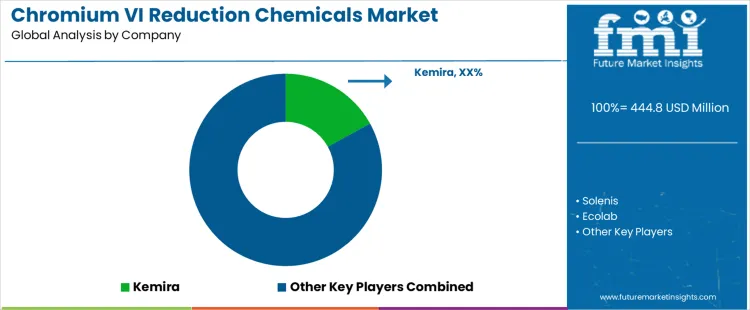
Demand for chromium VI reduction chemicals is driven by industrial wastewater regulations, occupational safety requirements, and remediation obligations across metal finishing, electroplating, leather tanning, and chemical manufacturing. Treatment programs focus on chemically reducing hexavalent chromium to trivalent chromium, followed by precipitation and solid separation. Buyers evaluate reduction efficiency, reaction speed, dosing control, compatibility with downstream treatment steps, and stability under variable pH and temperature conditions. Procurement teams prioritize chemicals with predictable performance, low secondary contamination risk, and compliance with global discharge and worker safety standards. Trend in the global market reflects stricter enforcement of chromium discharge limits, increased remediation of legacy contamination sites, and preference for integrated chemical programs supporting reliable compliance.
Kemira maintains strong positioning through reducing agents and supporting chemistries used widely in industrial chromium treatment applications. Solenis supplies specialty reduction chemicals integrated with broader wastewater treatment programs for metal-intensive industries. Ecolab supports global operators with chromium reduction solutions combined with monitoring, optimization, and compliance services. Kurita Water Industries contributes reduction agents and process expertise applied across industrial water and wastewater treatment systems. Aditya Birla Chemicals supplies chromium reduction chemicals serving global manufacturing regions with focus on consistency and regulatory alignment. Competitive differentiation depends on reduction reliability, integration with treatment processes, technical service depth, and ability to support long-term regulatory compliance across diverse industrial sectors.
Key Players in the Chromium VI Reduction Chemicals Market
- Kemira
- Solenis
- Ecolab
- Kurita Water Industries
- Aditya Birla Chemicals
Scope of the Report
| Items | Values |
|---|---|
| Quantitative Units | USD million |
| Chemical Type | Sodium Metabisulfite or Bisulfite; Ferrous Sulfate or Iron-Based Reductants; Sulfur Dioxide & Sulfite Systems; Zero-Valent Iron or Nano-Iron; Other Specialty Reduction Chemicals |
| End-Use Industry | Industrial Wastewater (Textile, Tanneries, Chemicals); Metal Plating & Surface Treatment; Mining & Metallurgical Waste Streams; Municipal or Groundwater Remediation; Other Environmental Services |
| Treatment Method | Chemical Reduction & Precipitation; In-Situ Soil & Groundwater Remediation; Batch or Continuous Reactor Systems; Hybrid Chemical–Biological Reduction; Other Advanced Reduction Techniques |
| Regions Covered | Asia Pacific, Europe, North America, Latin America, Middle East & Africa |
| Countries Covered | China, India, USA, Germany, Brazil, and 40+ countries |
| Key Companies Profiled | Kemira; Solenis; Ecolab; Kurita Water Industries; Aditya Birla Chemicals |
| Additional Attributes | Dollar sales by chemical type and treatment method; adoption trends for sulfite- and iron-based Cr(VI) reduction systems; reduction efficiency and precipitation performance metrics for hexavalent chromium; compatibility with industrial wastewater and in-situ remediation processes; sludge generation, handling, and disposal considerations; regulatory discharge limits and occupational safety standards influencing reducer selection. |
Chromium VI Reduction Chemicals Market by Segment
By Chemical Type:
- Sodium Metabisulfite or Bisulfite
- Ferrous Sulfate or Iron-Based Reductants
- Sulfur Dioxide & Sulfite Systems
- Zero-Valent Iron or Nano-Iron
- Other Specialty Reduction Chemicals
By End-Use Industry:
- Industrial Wastewater (Textile, Tanneries, Chemicals)
- Metal Plating & Surface Treatment
- Mining & Metallurgical Waste Streams
- Municipal or Groundwater Remediation
- Other Environmental Services
By Treatment Method:
- Chemical Reduction & Precipitation
- In-Situ Soil & Groundwater Remediation
- Batch or Continuous Reactor Systems
- Hybrid Chemical–Biological Reduction
- Other Advanced Reduction Techniques
By Region:
- Asia Pacific
- China
- Japan
- South Korea
- India
- Australia & New Zealand
- ASEAN
- Rest of Asia Pacific
- Europe
- Germany
- United Kingdom
- France
- Italy
- Spain
- Nordic
- BENELUX
- Rest of Europe
- North America
- United States
- Canada
- Mexico
- Latin America
- Brazil
- Chile
- Rest of Latin America
- Middle East & Africa
- Kingdom of Saudi Arabia
- Other GCC Countries
- Turkey
- South Africa
- Other African Union
- Rest of Middle East & Africa
Frequently Asked Questions
How big is the chromium VI reduction chemicals market in 2026?
The global chromium VI reduction chemicals market is estimated to be valued at USD 444.8 million in 2026.
What will be the size of chromium VI reduction chemicals market in 2036?
The market size for the chromium VI reduction chemicals market is projected to reach USD 1,005.7 million by 2036.
How much will be the chromium VI reduction chemicals market growth between 2026 and 2036?
The chromium VI reduction chemicals market is expected to grow at a 8.5% CAGR between 2026 and 2036.
What are the key product types in the chromium VI reduction chemicals market?
The key product types in chromium VI reduction chemicals market are sodium metabisulfite or bisulfite, ferrous sulfate or iron-based reductants, sulfur dioxide & sulfite systems, zero-valent iron or nano-iron and other specialty reduction chemicals.
Which end-use industry segment to contribute significant share in the chromium VI reduction chemicals market in 2026?
In terms of end-use industry, industrial wastewater (textile, tanneries, chemicals) segment to command 38.0% share in the chromium VI reduction chemicals market in 2026.
Preview the report firsthand - request a free sample
Get SampleGet the brochure for pricing and purchase details.
Get PDFTable of Content
- Executive Summary
- Global Market Outlook
- Demand-side Trends
- Supply-side Trends
- Technology Roadmap Analysis
- Analysis and Recommendations
- Market Overview
- Market Coverage / Taxonomy
- Market Definition / Scope / Limitations
- Market Background
- Market Dynamics
- Drivers
- Restraints
- Opportunity
- Trends
- Scenario Forecast
- Demand in Optimistic Scenario
- Demand in Likely Scenario
- Demand in Conservative Scenario
- Opportunity Map Analysis
- Product Life Cycle Analysis
- Supply Chain Analysis
- Investment Feasibility Matrix
- Value Chain Analysis
- PESTLE and Porter’s Analysis
- Regulatory Landscape
- Regional Parent Market Outlook
- Production and Consumption Statistics
- Import and Export Statistics
- Market Dynamics
- Global Market Analysis 2021 to 2025 and Forecast, 2026 to 2036
- Historical Market Size Value (USD Million) Analysis, 2021 to 2025
- Current and Future Market Size Value (USD Million) Projections, 2026 to 2036
- Y-o-Y Growth Trend Analysis
- Absolute $ Opportunity Analysis
- Global Market Pricing Analysis 2021 to 2025 and Forecast 2026 to 2036
- Global Market Analysis 2021 to 2025 and Forecast 2026 to 2036, By Chemical Type
- Introduction / Key Findings
- Historical Market Size Value (USD Million) Analysis By Chemical Type , 2021 to 2025
- Current and Future Market Size Value (USD Million) Analysis and Forecast By Chemical Type , 2026 to 2036
- Sodium Metabisulfite or Bisulfite
- Ferrous Sulfate or Iron-Based Reductants
- Sulfur Dioxide & Sulfite Systems
- Zero-Valent Iron or Nano-Iron
- Other Specialty Reduction Chemicals
- Sodium Metabisulfite or Bisulfite
- Y-o-Y Growth Trend Analysis By Chemical Type , 2021 to 2025
- Absolute $ Opportunity Analysis By Chemical Type , 2026 to 2036
- Global Market Analysis 2021 to 2025 and Forecast 2026 to 2036, By End-Use Industry
- Introduction / Key Findings
- Historical Market Size Value (USD Million) Analysis By End-Use Industry, 2021 to 2025
- Current and Future Market Size Value (USD Million) Analysis and Forecast By End-Use Industry, 2026 to 2036
- Industrial Wastewater (Textile, Tanneries, Chemicals)
- Metal Plating & Surface Treatment
- Mining & Metallurgical Waste Streams
- Municipal or Groundwater Remediation
- Other Environmental Services
- Industrial Wastewater (Textile, Tanneries, Chemicals)
- Y-o-Y Growth Trend Analysis By End-Use Industry, 2021 to 2025
- Absolute $ Opportunity Analysis By End-Use Industry, 2026 to 2036
- Global Market Analysis 2021 to 2025 and Forecast 2026 to 2036, By Treatment Method
- Introduction / Key Findings
- Historical Market Size Value (USD Million) Analysis By Treatment Method, 2021 to 2025
- Current and Future Market Size Value (USD Million) Analysis and Forecast By Treatment Method, 2026 to 2036
- Chemical Reduction & Precipitation
- In-Situ Soil & Groundwater Remediation
- Batch or Continuous Reactor Systems
- Hybrid Chemical–Biological Reduction
- Other Advanced Reduction Techniques
- Chemical Reduction & Precipitation
- Y-o-Y Growth Trend Analysis By Treatment Method, 2021 to 2025
- Absolute $ Opportunity Analysis By Treatment Method, 2026 to 2036
- Global Market Analysis 2021 to 2025 and Forecast 2026 to 2036, By Region
- Introduction
- Historical Market Size Value (USD Million) Analysis By Region, 2021 to 2025
- Current Market Size Value (USD Million) Analysis and Forecast By Region, 2026 to 2036
- North America
- Latin America
- Western Europe
- Eastern Europe
- East Asia
- South Asia and Pacific
- Middle East & Africa
- Market Attractiveness Analysis By Region
- North America Market Analysis 2021 to 2025 and Forecast 2026 to 2036, By Country
- Historical Market Size Value (USD Million) Trend Analysis By Market Taxonomy, 2021 to 2025
- Market Size Value (USD Million) Forecast By Market Taxonomy, 2026 to 2036
- By Country
- USA
- Canada
- Mexico
- By Chemical Type
- By End-Use Industry
- By Treatment Method
- By Country
- Market Attractiveness Analysis
- By Country
- By Chemical Type
- By End-Use Industry
- By Treatment Method
- Key Takeaways
- Latin America Market Analysis 2021 to 2025 and Forecast 2026 to 2036, By Country
- Historical Market Size Value (USD Million) Trend Analysis By Market Taxonomy, 2021 to 2025
- Market Size Value (USD Million) Forecast By Market Taxonomy, 2026 to 2036
- By Country
- Brazil
- Chile
- Rest of Latin America
- By Chemical Type
- By End-Use Industry
- By Treatment Method
- By Country
- Market Attractiveness Analysis
- By Country
- By Chemical Type
- By End-Use Industry
- By Treatment Method
- Key Takeaways
- Western Europe Market Analysis 2021 to 2025 and Forecast 2026 to 2036, By Country
- Historical Market Size Value (USD Million) Trend Analysis By Market Taxonomy, 2021 to 2025
- Market Size Value (USD Million) Forecast By Market Taxonomy, 2026 to 2036
- By Country
- Germany
- UK
- Italy
- Spain
- France
- Nordic
- BENELUX
- Rest of Western Europe
- By Chemical Type
- By End-Use Industry
- By Treatment Method
- By Country
- Market Attractiveness Analysis
- By Country
- By Chemical Type
- By End-Use Industry
- By Treatment Method
- Key Takeaways
- Eastern Europe Market Analysis 2021 to 2025 and Forecast 2026 to 2036, By Country
- Historical Market Size Value (USD Million) Trend Analysis By Market Taxonomy, 2021 to 2025
- Market Size Value (USD Million) Forecast By Market Taxonomy, 2026 to 2036
- By Country
- Russia
- Poland
- Hungary
- Balkan & Baltic
- Rest of Eastern Europe
- By Chemical Type
- By End-Use Industry
- By Treatment Method
- By Country
- Market Attractiveness Analysis
- By Country
- By Chemical Type
- By End-Use Industry
- By Treatment Method
- Key Takeaways
- East Asia Market Analysis 2021 to 2025 and Forecast 2026 to 2036, By Country
- Historical Market Size Value (USD Million) Trend Analysis By Market Taxonomy, 2021 to 2025
- Market Size Value (USD Million) Forecast By Market Taxonomy, 2026 to 2036
- By Country
- China
- Japan
- South Korea
- By Chemical Type
- By End-Use Industry
- By Treatment Method
- By Country
- Market Attractiveness Analysis
- By Country
- By Chemical Type
- By End-Use Industry
- By Treatment Method
- Key Takeaways
- South Asia and Pacific Market Analysis 2021 to 2025 and Forecast 2026 to 2036, By Country
- Historical Market Size Value (USD Million) Trend Analysis By Market Taxonomy, 2021 to 2025
- Market Size Value (USD Million) Forecast By Market Taxonomy, 2026 to 2036
- By Country
- India
- ASEAN
- Australia & New Zealand
- Rest of South Asia and Pacific
- By Chemical Type
- By End-Use Industry
- By Treatment Method
- By Country
- Market Attractiveness Analysis
- By Country
- By Chemical Type
- By End-Use Industry
- By Treatment Method
- Key Takeaways
- Middle East & Africa Market Analysis 2021 to 2025 and Forecast 2026 to 2036, By Country
- Historical Market Size Value (USD Million) Trend Analysis By Market Taxonomy, 2021 to 2025
- Market Size Value (USD Million) Forecast By Market Taxonomy, 2026 to 2036
- By Country
- Kingdom of Saudi Arabia
- Other GCC Countries
- Turkiye
- South Africa
- Other African Union
- Rest of Middle East & Africa
- By Chemical Type
- By End-Use Industry
- By Treatment Method
- By Country
- Market Attractiveness Analysis
- By Country
- By Chemical Type
- By End-Use Industry
- By Treatment Method
- Key Takeaways
- Key Countries Market Analysis
- USA
- Pricing Analysis
- Market Share Analysis, 2025
- By Chemical Type
- By End-Use Industry
- By Treatment Method
- Canada
- Pricing Analysis
- Market Share Analysis, 2025
- By Chemical Type
- By End-Use Industry
- By Treatment Method
- Mexico
- Pricing Analysis
- Market Share Analysis, 2025
- By Chemical Type
- By End-Use Industry
- By Treatment Method
- Brazil
- Pricing Analysis
- Market Share Analysis, 2025
- By Chemical Type
- By End-Use Industry
- By Treatment Method
- Chile
- Pricing Analysis
- Market Share Analysis, 2025
- By Chemical Type
- By End-Use Industry
- By Treatment Method
- Germany
- Pricing Analysis
- Market Share Analysis, 2025
- By Chemical Type
- By End-Use Industry
- By Treatment Method
- UK
- Pricing Analysis
- Market Share Analysis, 2025
- By Chemical Type
- By End-Use Industry
- By Treatment Method
- Italy
- Pricing Analysis
- Market Share Analysis, 2025
- By Chemical Type
- By End-Use Industry
- By Treatment Method
- Spain
- Pricing Analysis
- Market Share Analysis, 2025
- By Chemical Type
- By End-Use Industry
- By Treatment Method
- France
- Pricing Analysis
- Market Share Analysis, 2025
- By Chemical Type
- By End-Use Industry
- By Treatment Method
- India
- Pricing Analysis
- Market Share Analysis, 2025
- By Chemical Type
- By End-Use Industry
- By Treatment Method
- ASEAN
- Pricing Analysis
- Market Share Analysis, 2025
- By Chemical Type
- By End-Use Industry
- By Treatment Method
- Australia & New Zealand
- Pricing Analysis
- Market Share Analysis, 2025
- By Chemical Type
- By End-Use Industry
- By Treatment Method
- China
- Pricing Analysis
- Market Share Analysis, 2025
- By Chemical Type
- By End-Use Industry
- By Treatment Method
- Japan
- Pricing Analysis
- Market Share Analysis, 2025
- By Chemical Type
- By End-Use Industry
- By Treatment Method
- South Korea
- Pricing Analysis
- Market Share Analysis, 2025
- By Chemical Type
- By End-Use Industry
- By Treatment Method
- Russia
- Pricing Analysis
- Market Share Analysis, 2025
- By Chemical Type
- By End-Use Industry
- By Treatment Method
- Poland
- Pricing Analysis
- Market Share Analysis, 2025
- By Chemical Type
- By End-Use Industry
- By Treatment Method
- Hungary
- Pricing Analysis
- Market Share Analysis, 2025
- By Chemical Type
- By End-Use Industry
- By Treatment Method
- Kingdom of Saudi Arabia
- Pricing Analysis
- Market Share Analysis, 2025
- By Chemical Type
- By End-Use Industry
- By Treatment Method
- Turkiye
- Pricing Analysis
- Market Share Analysis, 2025
- By Chemical Type
- By End-Use Industry
- By Treatment Method
- South Africa
- Pricing Analysis
- Market Share Analysis, 2025
- By Chemical Type
- By End-Use Industry
- By Treatment Method
- USA
- Market Structure Analysis
- Competition Dashboard
- Competition Benchmarking
- Market Share Analysis of Top Players
- By Regional
- By Chemical Type
- By End-Use Industry
- By Treatment Method
- Competition Analysis
- Competition Deep Dive
- Kemira
- Overview
- Product Portfolio
- Profitability by Market Segments (Product/Age /Sales Channel/Region)
- Sales Footprint
- Strategy Overview
- Marketing Strategy
- Product Strategy
- Channel Strategy
- Solenis
- Ecolab
- Kurita Water Industries
- Aditya Birla Chemicals
- Kemira
- Competition Deep Dive
- Assumptions & Acronyms Used
- Research Methodology


