

- Industry Size (2026)
- USD 311 Mn
- Forecast (2036)
- USD 1360.2 Mn
- CAGR (2026 to 2036)
- 15.9%
Biochar-Integrated Granular Fertility Blend Market Forecast and Outlook 2026 to 2036
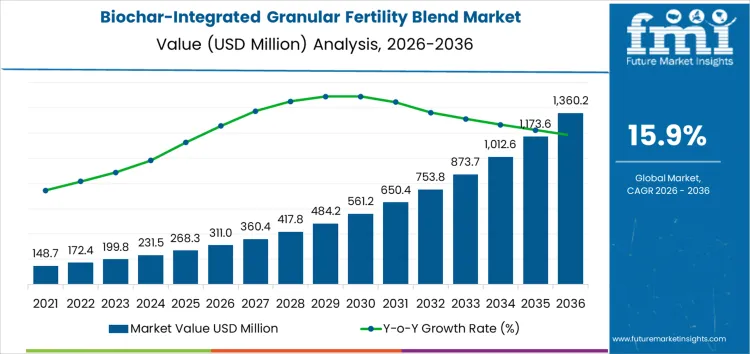
The biochar-integrated granular fertility blend market is valued at USD 311 million in 2026 and is projected to reach USD 1,360.2 million by 2036, reflecting a CAGR of 15.9%. Growth during this period is shaped by nutrient retention performance, granule integrity, and compatibility with conventional spreading equipment. Cost structures are influenced by biochar sourcing, particle size control, and blending uniformity at scale. Products are assessed on their ability to improve nutrient holding capacity without compromising application accuracy. Suppliers achieving consistent granulation and predictable field response gain stronger acceptance. Purchasing decisions emphasize reliability across soil conditions rather than incremental nutrient concentration advantages.
Between 2026 and 2036, outcomes are driven by grower risk management and long-term soil productivity planning. Adoption advances where blends demonstrate stable performance across multiple seasons and crop rotations.
Once incorporated into fertility programs, switching remains limited due to recalibration effort and the need for longitudinal field comparison. Sales channels providing agronomic interpretation and application guidance reinforce repeat use. Entry barriers persist through sourcing complexity and field validation requirements. Strategic trade offs arise between maximizing biochar inclusion and maintaining handling efficiency. Competitive positioning favors suppliers aligned with multi-season soil improvement strategies rather than short-term yield correction inputs.
Quick Stats for Biochar-Integrated Granular Fertility Blend Market
- Biochar-Integrated Granular Fertility Blend Market Value (2026): USD 311 million
- Biochar-Integrated Granular Fertility Blend Market Forecast Value (2036): USD 1,360.2 million
- Biochar-Integrated Granular Fertility Blend Market Forecast CAGR: 15.9%
- Leading Application in Biochar-Integrated Granular Fertility Blend Market: Standard
- Key Growth Regions in Biochar-Integrated Granular Fertility Blend Market: Asia Pacific, North America, Australia
- Top Players in Biochar-Integrated Granular Fertility Blend Market: Nutrien, Yara International, ICL Group, EuroChem, UPL, BASF
What Is the Growth Forecast for Biochar Integrated Granular Fertility Blend Market through 2036?
Between 2026 and 2031, the biochar integrated granular fertility blend market grows from USD 311 million in 2026 to USD 556 million by 2031, resulting in an absolute increase of USD 245 million. Year over year progression during this phase shows a steady upward trajectory, with annual values rising from USD 173 million in 2021 equivalent scaling to USD 311 million in 2026. Early adoption is driven by growers seeking improved nutrient retention, soil structure enhancement, and longer residence time of applied fertilizers. Growth in this period remains focused on targeted acreage and specific soil improvement programs, supported by distributor led trials and gradual inclusion alongside conventional granular fertilizers.
From 2031 to 2036, the market expands sharply from USD 556 million in 2031 to USD 1,360.2 million by 2036, adding USD 804.2 million and accounting for the dominant share of total forecast growth. Annual values increase from USD 642 million in 2032 to USD 1,360.2 million in 2036, indicating strong year over year momentum. This later phase reflects transition from supplemental soil conditioning to mainstream fertility blending. Wider agronomic validation, repeat yield response, and scaling of biochar supply enable broader adoption across commercial farming systems, positioning 2031–2036 as the primary growth acceleration period.
Biochar Integrated Granular Fertility Blend Market Key Takeaways
| Metric | Value |
|---|---|
| Market Value (2026) | USD 311 million |
| Forecast Value (2036) | USD 1,360.2 million |
| Forecast CAGR (2026–2036) | 15.9% |
What Is Driving Demand in the Biochar-Integrated Granular Fertility Blend Market?
Demand for biochar-integrated granular fertility blends arises from practical limitations in conventional fertiliser use rather than general nutrient application rates alone. Many soils, especially degraded or low-organic matter profiles, struggle to retain applied nutrients, leading to leaching, volatilisation, and poor crop uptake. Farmers and agronomists increasingly observe that nutrient efficiency and soil physical condition interact: soils with low structure and high sand content do not hold nutrients where roots are active. Incorporating biochar into granular blends improves soil porosity, increases cation exchange capacity, and enhances moisture retention. This supports sustained nutrient availability in the root zone, reducing losses and improving nutrient use efficiency. Early adoption occurred where soil property constraints were documented and growers needed measurable improvements in nutrient retention and water behaviour rather than broader fertiliser trends.
Future growth in this market will be shaped by soil health planning, documented agronomic outcomes, and environmental stewardship metrics rather than incremental product substitution alone. Biochar’s long residence in soil contributes to carbon sequestration goals, attracting interest from operations participating in carbon markets or sustainability programmes. Precision soil testing and field mapping allow targeted application of biochar blends where soil constraints are most limiting, aligning input costs with measurable benefits in crop response and soil condition. Advances in production methods improve consistency in biochar properties, aiding its integration with nutrient granules without impeding flow or application. Adoption will expand where farms evaluate fertiliser inputs on combined indicators of nutrient efficiency, soil structure improvement, and resource use outcomes rather than on nutrient content alone, embedding biochar-integrated solutions into systematic fertility and soil regeneration strategies.
What Factors Are Affecting the Demand for Biochar Integrated Granular Fertility Blend Market in Terms of Application and Form?
The biochar integrated granular fertility blend market is shaped by soil carbon restoration goals, nutrient retention challenges, and interest in long term soil health improvement. Demand focuses on blends that combine immediate nutrient availability with structural soil benefits from biochar. Adoption depends on application simplicity, cost justification, and compatibility with existing fertilizer programs. Market leadership reflects practical field performance and scalability rather than carbon content alone.
What Is Driving Leadership by Application in the Biochar Integrated Granular Fertility Blend Market?
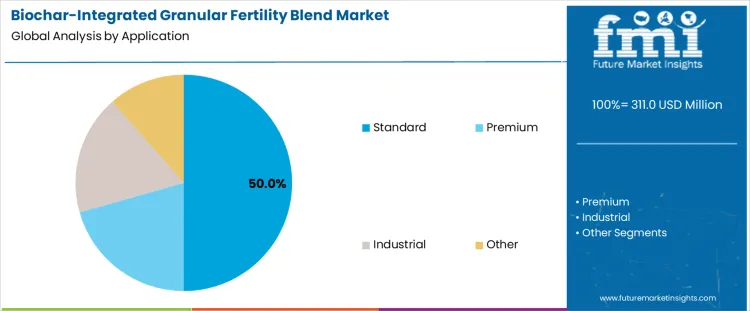
Standard applications account for about 50% of demand because they allow biochar blends to be introduced into routine fertility programs without altering management practices. Growers use standard applications to improve nutrient holding capacity, water retention, and microbial habitat while maintaining familiar fertilizer rates and timing. This approach lowers adoption risk and supports gradual soil improvement over multiple seasons. Standard programs are easier to evaluate through soil tests and yield response, reinforcing confidence among growers and advisors.
Standard applications also align with broadacre cropping systems where incremental efficiency gains across large acreage deliver measurable economic returns. Premium applications involve higher biochar loadings or tailored formulations but increase input costs and require longer payback periods. Industrial uses focus on land rehabilitation rather than crop production. Other applications address niche soil constraints. Application leadership therefore reflects ease of integration, repeatability, and economic viability at scale rather than maximum soil amendment intensity.
What Is Driving Leadership by Form in the Biochar Integrated Granular Fertility Blend Market?
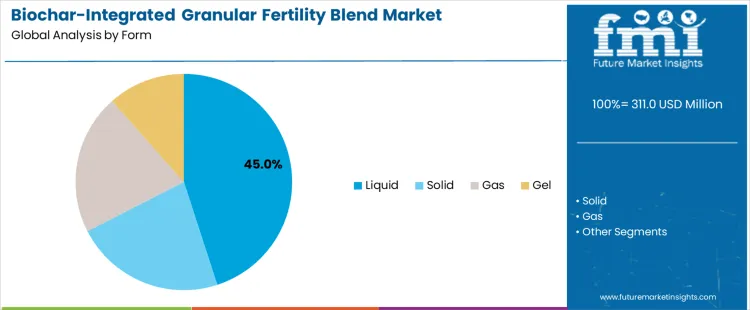
Liquid formulations account for about 45% of demand because they enable even distribution of biochar fines and nutrients when applied through spraying or fertigation systems. Liquids allow close contact between biochar particles, soil, and nutrients, supporting faster interaction at the root zone. Growers value liquids for reduced dust, flexible timing, and compatibility with existing application equipment. Liquid systems also support blending with biological additives, enhancing perceived soil health benefits.
Solid granular forms remain important for long term soil structure improvement but require careful handling to avoid segregation. Gas forms are not practical for biochar delivery. Gel formats offer controlled placement but face cost and handling constraints. Liquids therefore dominate because they balance ease of use, placement uniformity, and operational efficiency. Form leadership reflects practical deployment and consistency rather than persistence or carbon stability alone.
How Are Biochar-Integrated Granular Fertility Blends Being Applied Across Agriculture?
Use appears in row crops, orchards, and high-value horticulture where soil fertility, water retention, and nutrient efficiency are critical. Farmers adopt biochar-integrated granular blends to improve cation-exchange capacity, enhance microbial activity, and retain nutrients for longer periods. Application through soil incorporation, banding, or fertigation allows even distribution in the root zone. These applications reflect operational and soil health priorities rather than purely cost objectives, with adoption driven by improved nutrient use efficiency, soil structure enhancement, and crop yield optimization.
What Operational and Material Conditions Support Adoption of Biochar-Integrated Granular Fertility Blends?
Selection aligns with soil types requiring improved aeration, water-holding capacity, and nutrient retention. Fertility blends are optimized for nutrient composition, particle size, biochar content, and stability to ensure uniform performance. Farmers monitor soil moisture, texture, and nutrient levels to maximize effectiveness and avoid nutrient imbalance. Quality control evaluates nutrient content, biochar distribution, and crop response to comply with agronomic and environmental standards. These conditions emerge from operational reliability, soil fertility improvement, and sustainable nutrient management priorities in structured fertilization workflows.
Which Practical Considerations Limit Wider Use of Biochar-Integrated Granular Fertility Blends?
Higher material cost and incorporation requirements may restrict adoption in low-margin or small-scale farms. Effectiveness depends on soil type, irrigation, and crop species. Compatibility with existing fertilizers, amendments, and planting practices must be verified. Long-term performance and regulatory compliance require monitoring. These factors lead to selective deployment where soil fertility enhancement, nutrient retention, and crop productivity justify incremental cost, operational oversight, and careful application management in biochar-integrated fertilization programs.
What is the Demand for Biochar Integrated Granular Fertility Blends by Country?

| Country | CAGR (%) |
|---|---|
| USA | 12.9% |
| Australia | 13.6% |
| China | 14.1% |
| India | 14.8% |
The demand for biochar integrated granular fertility blends is expanding across major agricultural regions, driven by soil carbon enhancement goals, nutrient retention improvement, and long term soil productivity strategies. India leads with a 14.8% CAGR, supported by widespread soil degradation concerns, increasing focus on carbon positive farming inputs, and adoption of biochar enriched blends in intensive cropping systems. China follows at 14.1%, shaped by national soil health initiatives, large scale residue utilization, and integration of biochar to improve fertilizer efficiency. Australia records 13.6%, reflecting strong interest in soil water holding capacity improvement and carbon sequestration in dryland farming. The USA grows at 12.9%, driven by adoption in row crops and specialty crops where biochar is used to enhance nutrient use efficiency and soil resilience.
How are biochar-integrated granular fertility blends expanding adoption in the United States?
In the United States, the biochar-integrated granular fertility blend market is growing at a CAGR of 12.9% through 2036, driven by adoption of regenerative agriculture, precision nutrient management, and sustainable soil amendment practices. Farmers are using these blends to improve soil structure, enhance nutrient retention, and increase crop productivity while reducing carbon footprint. Demand is concentrated in irrigated row crop regions, high-value horticultural zones, and industrial farming hubs. Compared to China, adoption emphasizes regulatory compliance and integration with conventional fertilization systems. Domestic suppliers provide high-performance, chemically stable blends suitable for recurring seasonal applications.
- Irrigated row crop regions, horticultural zones, and industrial hubs drive adoption
- Blends improve soil structure, nutrient retention, and crop productivity
- Domestic suppliers provide high-performance, chemically stable solutions
- Recurring seasonal applications sustain adoption
How are sustainable agriculture practices and precision farming driving growth in Australia?
In Australia, revenue is growing at a CAGR of 13.6% through 2036, supported by adoption of irrigated high-value crops, soil carbon management programs, and precision nutrient technologies. Farmers are integrating biochar-enhanced blends to increase nutrient-use efficiency, improve soil water-holding capacity, and enhance early crop growth. Demand is concentrated in industrial crop regions, high-value horticultural zones, and mechanized farming clusters. Compared to the USA, adoption emphasizes adaptation to arid and saline soils for improved crop resilience. Domestic suppliers provide high-performance, eco-friendly blends suitable for recurring seasonal applications.
- Industrial crop regions, horticultural zones, and mechanized clusters drive adoption
- Blends increase nutrient efficiency and water-holding capacity
- Domestic suppliers provide high-performance, eco-friendly solutions
- Recurring seasonal applications sustain adoption
How are industrial agriculture and soil health initiatives driving adoption in China?
In China, the market is expanding at a CAGR of 14.1% through 2036, fueled by large-scale cereal and vegetable production, government incentives for nutrient-efficient fertilizers, and adoption of precision irrigation. Farmers are using biochar-integrated blends to enhance nutrient retention, improve root-zone health, and reduce greenhouse gas emissions. Demand is concentrated in irrigated grain regions, industrial crop zones, and high-intensity agricultural hubs. Compared to India, adoption emphasizes high-volume deployment and integration with mechanized fertilization systems. Domestic suppliers provide cost-effective, high-performance blends suitable for recurring seasonal applications.
- Irrigated grain regions, industrial crop zones, and high-intensity hubs drive adoption
- Blends enhance nutrient retention and root-zone health
- Domestic suppliers provide cost-effective, high-performance solutions
- Recurring seasonal applications sustain adoption
How are precision irrigation and high-value crop cultivation driving growth in India?
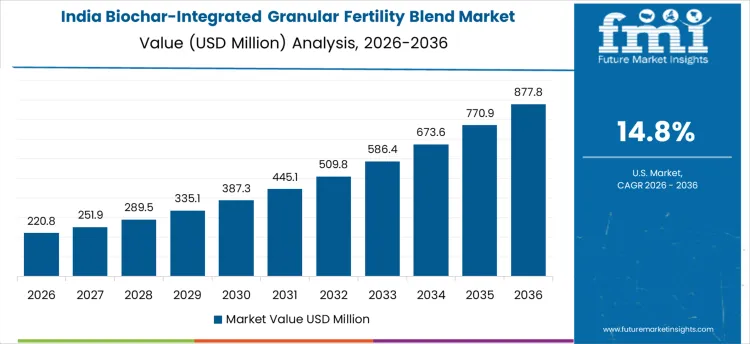
In India, the market is growing at a CAGR of 14.8% through 2036, supported by adoption of high-value horticultural crops, micro-irrigation systems, and government initiatives promoting sustainable fertilization. Farmers are integrating biochar-enhanced blends to improve soil carbon content, enhance nutrient efficiency, and increase crop yield and resilience. Demand is concentrated in irrigated horticultural regions, industrial crop zones, and precision farming hubs. Compared to China, adoption emphasizes rapid large-scale deployment across diverse crops. Domestic suppliers provide high-performance, safe blends suitable for recurring seasonal applications.
- Irrigated horticultural regions, industrial crop zones, and precision farming hubs drive adoption
- Blends improve soil carbon content, nutrient efficiency, and crop resilience
- Domestic suppliers provide high-performance, safe solutions
- Recurring seasonal applications sustain adoption
How Do Regional Feedstock Access and Program Economics Shape Competition in the Biochar Integrated Granular Fertility Blend Market?
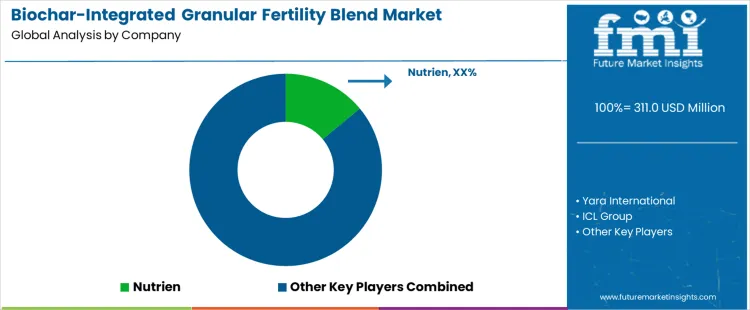
Competition in biochar integrated granular fertility blends is shaped by regional biochar availability and the economics of integrating carbon rich materials into conventional fertilizer production. Nutrien and Yara International show selective exposure in North America and parts of Europe, where certified biochar supply and carbon accounting frameworks are sufficiently mature. In these markets, biochar blends are deployed on targeted acreage, contributing a small but traceable share of specialty fertilizer revenues tied to soil carbon and nutrient retention programs. ICL Group demonstrates higher program concentration in intensive horticulture and controlled irrigation regions, where granular biochar blends support moisture retention and nutrient efficiency, resulting in clearer per hectare monetization.
Commercial structure and scalability further differentiate competitors. EuroChem focuses on standardized granular blends that can incorporate biochar without disrupting high volume production, prioritizing operational feasibility over customization. UPL positions biochar integrated fertility within broader soil health and biological programs, limiting standalone revenue visibility but increasing relevance in regenerative agriculture initiatives. BASF participates through enabling technologies and formulation support rather than finished blends, keeping direct exposure limited while influencing adoption pathways. Competitive advantage is defined by secure biochar sourcing, blending compatibility, and the ability to demonstrate agronomic benefit alongside carbon outcomes without materially increasing fertilizer cost or complexity.
Key Players in the Biochar-Integrated Granular Fertility Blend Market
- Nutrien
- Yara International
- ICL Group
- EuroChem
- UPL
- BASF
Scope of the Report
| Items | Values |
|---|---|
| Quantitative Units | USD Million |
| Application | Standard fertility programs, premium soil improvement programs, industrial land rehabilitation, other targeted soil enhancement uses |
| Form | Liquid, solid, gas, gel |
| Sales Channel | Direct, retail, online, distributor |
| Application Area | Row crops, orchards, high-value horticulture, nutrient retention and soil structure improvement |
| End Users | Commercial farmers, horticulture producers, soil improvement and regenerative farming operations |
| Regions Covered | Asia Pacific, Europe, North America, Latin America, Middle East & Africa |
| Countries Covered | India, China, United States, Australia, and other major biochar-adopting agricultural regions |
| Key Companies Profiled | Nutrien, Yara International, ICL Group, EuroChem, UPL, BASF |
| Additional Attributes | Dollar by sales across application and form categories, adoption trends linked to nutrient retention and soil carbon enhancement, competitive landscape shaped by biochar sourcing and blending scalability, granule integrity and handling efficiency requirements, multi-season field validation and longitudinal performance tracking |
Biochar-Integrated Granular Fertility Blend Market Segmentation
Application:
- Standard
- Premium
- Industrial
- Other
Form:
- Liquid
- Solid
- Gas
- Gel
Channel:
- Direct
- Retail
- Online
- Distributor
Region
Asia Pacific
- China
- Japan
- South Korea
- India
- Australia & New Zealand
- ASEAN
- Rest of Asia Pacific
Europe
- Germany
- United Kingdom
- France
- Italy
- Spain
- Nordic
- BENELUX
- Rest of Europe
North America
- United States
- Canada
- Mexico
Latin America
- Brazil
- Chile
- Rest of Latin America
Middle East & Africa
- Kingdom of Saudi Arabia
- Other GCC Countries
- Turkey
- South Africa
- Other African Union
- Rest of Middle East & Africa
Frequently Asked Questions
How big is the biochar-integrated granular fertility blend market in 2026?
The global biochar-integrated granular fertility blend market is estimated to be valued at USD 311.0 million in 2026.
What will be the size of biochar-integrated granular fertility blend market in 2036?
The market size for the biochar-integrated granular fertility blend market is projected to reach USD 1,360.2 million by 2036.
How much will be the biochar-integrated granular fertility blend market growth between 2026 and 2036?
The biochar-integrated granular fertility blend market is expected to grow at a 15.9% CAGR between 2026 and 2036.
What are the key application types in the biochar-integrated granular fertility blend market?
The key application types in biochar-integrated granular fertility blend market are standard, premium, industrial and other.
Which form segment to contribute significant share in the biochar-integrated granular fertility blend market in 2026?
In terms of form, liquid segment to command 45.0% share in the biochar-integrated granular fertility blend market in 2026.
Preview the report firsthand - request a free sample
Get SampleGet the brochure for pricing and purchase details.
Get PDFTable of Content
- Executive Summary
- Global Market Outlook
- Demand-side Trends
- Supply-side Trends
- Technology Roadmap Analysis
- Analysis and Recommendations
- Market Overview
- Market Coverage / Taxonomy
- Market Definition / Scope / Limitations
- Market Background
- Market Dynamics
- Drivers
- Restraints
- Opportunity
- Trends
- Scenario Forecast
- Demand in Optimistic Scenario
- Demand in Likely Scenario
- Demand in Conservative Scenario
- Opportunity Map Analysis
- Product Life Cycle Analysis
- Supply Chain Analysis
- Investment Feasibility Matrix
- Value Chain Analysis
- PESTLE and Porter’s Analysis
- Regulatory Landscape
- Regional Parent Market Outlook
- Production and Consumption Statistics
- Import and Export Statistics
- Market Dynamics
- Global Market Analysis 2021 to 2025 and Forecast, 2026 to 2036
- Historical Market Size Value (USD Million) Analysis, 2021 to 2025
- Current and Future Market Size Value (USD Million) Projections, 2026 to 2036
- Y-o-Y Growth Trend Analysis
- Absolute $ Opportunity Analysis
- Global Market Pricing Analysis 2021 to 2025 and Forecast 2026 to 2036
- Global Market Analysis 2021 to 2025 and Forecast 2026 to 2036, By Application
- Introduction / Key Findings
- Historical Market Size Value (USD Million) Analysis By Application , 2021 to 2025
- Current and Future Market Size Value (USD Million) Analysis and Forecast By Application , 2026 to 2036
- Standard
- Premium
- Industrial
- Other
- Standard
- Y-o-Y Growth Trend Analysis By Application , 2021 to 2025
- Absolute $ Opportunity Analysis By Application , 2026 to 2036
- Global Market Analysis 2021 to 2025 and Forecast 2026 to 2036, By Form
- Introduction / Key Findings
- Historical Market Size Value (USD Million) Analysis By Form, 2021 to 2025
- Current and Future Market Size Value (USD Million) Analysis and Forecast By Form, 2026 to 2036
- Liquid
- Solid
- Gas
- Gel
- Liquid
- Y-o-Y Growth Trend Analysis By Form, 2021 to 2025
- Absolute $ Opportunity Analysis By Form, 2026 to 2036
- Global Market Analysis 2021 to 2025 and Forecast 2026 to 2036, By Channel
- Introduction / Key Findings
- Historical Market Size Value (USD Million) Analysis By Channel, 2021 to 2025
- Current and Future Market Size Value (USD Million) Analysis and Forecast By Channel, 2026 to 2036
- Direct
- Retail
- Online
- Distributor
- Direct
- Y-o-Y Growth Trend Analysis By Channel, 2021 to 2025
- Absolute $ Opportunity Analysis By Channel, 2026 to 2036
- Global Market Analysis 2021 to 2025 and Forecast 2026 to 2036, By Region
- Introduction
- Historical Market Size Value (USD Million) Analysis By Region, 2021 to 2025
- Current Market Size Value (USD Million) Analysis and Forecast By Region, 2026 to 2036
- North America
- Latin America
- Western Europe
- Eastern Europe
- East Asia
- South Asia and Pacific
- Middle East & Africa
- Market Attractiveness Analysis By Region
- North America Market Analysis 2021 to 2025 and Forecast 2026 to 2036, By Country
- Historical Market Size Value (USD Million) Trend Analysis By Market Taxonomy, 2021 to 2025
- Market Size Value (USD Million) Forecast By Market Taxonomy, 2026 to 2036
- By Country
- USA
- Canada
- Mexico
- By Application
- By Form
- By Channel
- By Country
- Market Attractiveness Analysis
- By Country
- By Application
- By Form
- By Channel
- Key Takeaways
- Latin America Market Analysis 2021 to 2025 and Forecast 2026 to 2036, By Country
- Historical Market Size Value (USD Million) Trend Analysis By Market Taxonomy, 2021 to 2025
- Market Size Value (USD Million) Forecast By Market Taxonomy, 2026 to 2036
- By Country
- Brazil
- Chile
- Rest of Latin America
- By Application
- By Form
- By Channel
- By Country
- Market Attractiveness Analysis
- By Country
- By Application
- By Form
- By Channel
- Key Takeaways
- Western Europe Market Analysis 2021 to 2025 and Forecast 2026 to 2036, By Country
- Historical Market Size Value (USD Million) Trend Analysis By Market Taxonomy, 2021 to 2025
- Market Size Value (USD Million) Forecast By Market Taxonomy, 2026 to 2036
- By Country
- Germany
- UK
- Italy
- Spain
- France
- Nordic
- BENELUX
- Rest of Western Europe
- By Application
- By Form
- By Channel
- By Country
- Market Attractiveness Analysis
- By Country
- By Application
- By Form
- By Channel
- Key Takeaways
- Eastern Europe Market Analysis 2021 to 2025 and Forecast 2026 to 2036, By Country
- Historical Market Size Value (USD Million) Trend Analysis By Market Taxonomy, 2021 to 2025
- Market Size Value (USD Million) Forecast By Market Taxonomy, 2026 to 2036
- By Country
- Russia
- Poland
- Hungary
- Balkan & Baltic
- Rest of Eastern Europe
- By Application
- By Form
- By Channel
- By Country
- Market Attractiveness Analysis
- By Country
- By Application
- By Form
- By Channel
- Key Takeaways
- East Asia Market Analysis 2021 to 2025 and Forecast 2026 to 2036, By Country
- Historical Market Size Value (USD Million) Trend Analysis By Market Taxonomy, 2021 to 2025
- Market Size Value (USD Million) Forecast By Market Taxonomy, 2026 to 2036
- By Country
- China
- Japan
- South Korea
- By Application
- By Form
- By Channel
- By Country
- Market Attractiveness Analysis
- By Country
- By Application
- By Form
- By Channel
- Key Takeaways
- South Asia and Pacific Market Analysis 2021 to 2025 and Forecast 2026 to 2036, By Country
- Historical Market Size Value (USD Million) Trend Analysis By Market Taxonomy, 2021 to 2025
- Market Size Value (USD Million) Forecast By Market Taxonomy, 2026 to 2036
- By Country
- India
- ASEAN
- Australia & New Zealand
- Rest of South Asia and Pacific
- By Application
- By Form
- By Channel
- By Country
- Market Attractiveness Analysis
- By Country
- By Application
- By Form
- By Channel
- Key Takeaways
- Middle East & Africa Market Analysis 2021 to 2025 and Forecast 2026 to 2036, By Country
- Historical Market Size Value (USD Million) Trend Analysis By Market Taxonomy, 2021 to 2025
- Market Size Value (USD Million) Forecast By Market Taxonomy, 2026 to 2036
- By Country
- Kingdom of Saudi Arabia
- Other GCC Countries
- Turkiye
- South Africa
- Other African Union
- Rest of Middle East & Africa
- By Application
- By Form
- By Channel
- By Country
- Market Attractiveness Analysis
- By Country
- By Application
- By Form
- By Channel
- Key Takeaways
- Key Countries Market Analysis
- USA
- Pricing Analysis
- Market Share Analysis, 2025
- By Application
- By Form
- By Channel
- Canada
- Pricing Analysis
- Market Share Analysis, 2025
- By Application
- By Form
- By Channel
- Mexico
- Pricing Analysis
- Market Share Analysis, 2025
- By Application
- By Form
- By Channel
- Brazil
- Pricing Analysis
- Market Share Analysis, 2025
- By Application
- By Form
- By Channel
- Chile
- Pricing Analysis
- Market Share Analysis, 2025
- By Application
- By Form
- By Channel
- Germany
- Pricing Analysis
- Market Share Analysis, 2025
- By Application
- By Form
- By Channel
- UK
- Pricing Analysis
- Market Share Analysis, 2025
- By Application
- By Form
- By Channel
- Italy
- Pricing Analysis
- Market Share Analysis, 2025
- By Application
- By Form
- By Channel
- Spain
- Pricing Analysis
- Market Share Analysis, 2025
- By Application
- By Form
- By Channel
- France
- Pricing Analysis
- Market Share Analysis, 2025
- By Application
- By Form
- By Channel
- India
- Pricing Analysis
- Market Share Analysis, 2025
- By Application
- By Form
- By Channel
- ASEAN
- Pricing Analysis
- Market Share Analysis, 2025
- By Application
- By Form
- By Channel
- Australia & New Zealand
- Pricing Analysis
- Market Share Analysis, 2025
- By Application
- By Form
- By Channel
- China
- Pricing Analysis
- Market Share Analysis, 2025
- By Application
- By Form
- By Channel
- Japan
- Pricing Analysis
- Market Share Analysis, 2025
- By Application
- By Form
- By Channel
- South Korea
- Pricing Analysis
- Market Share Analysis, 2025
- By Application
- By Form
- By Channel
- Russia
- Pricing Analysis
- Market Share Analysis, 2025
- By Application
- By Form
- By Channel
- Poland
- Pricing Analysis
- Market Share Analysis, 2025
- By Application
- By Form
- By Channel
- Hungary
- Pricing Analysis
- Market Share Analysis, 2025
- By Application
- By Form
- By Channel
- Kingdom of Saudi Arabia
- Pricing Analysis
- Market Share Analysis, 2025
- By Application
- By Form
- By Channel
- Turkiye
- Pricing Analysis
- Market Share Analysis, 2025
- By Application
- By Form
- By Channel
- South Africa
- Pricing Analysis
- Market Share Analysis, 2025
- By Application
- By Form
- By Channel
- USA
- Market Structure Analysis
- Competition Dashboard
- Competition Benchmarking
- Market Share Analysis of Top Players
- By Regional
- By Application
- By Form
- By Channel
- Competition Analysis
- Competition Deep Dive
- Nutrien
- Overview
- Product Portfolio
- Profitability by Market Segments (Product/Age /Sales Channel/Region)
- Sales Footprint
- Strategy Overview
- Marketing Strategy
- Product Strategy
- Channel Strategy
- Yara International
- ICL Group
- EuroChem
- UPL
- BASF
- Nutrien
- Competition Deep Dive
- Assumptions & Acronyms Used
- Research Methodology


