

- Industry Size (2026)
- USD 239 Mn
- Forecast (2036)
- USD 550.4 Mn
- CAGR (2026 to 2036)
- 8.7%
High-Cation-Exchange-Capacity Enhancing Fertility Blend Market Forecast and Outlook 2026 to 2036
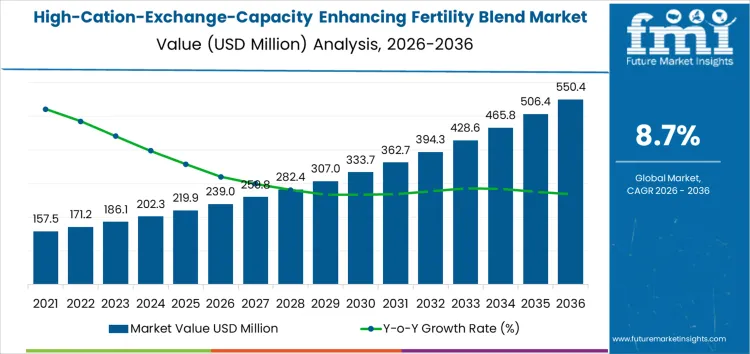
The high-cation-exchange-capacity enhancing fertility blend market is valued at USD 239 million in 2026 and is projected to reach USD 550.4 million by 2036, reflecting a CAGR of 8.7%. Growth during this period is shaped by soil nutrient retention needs, variability in base saturation levels, and demand for longer nutrient residence time in root zones. Cost structures are influenced by mineral sourcing, formulation uniformity, and blending precision across liquid and solid forms. Products are evaluated on their ability to improve exchange capacity without disrupting existing fertility programs. Suppliers delivering consistent performance across soil textures gain stronger acceptance. Purchasing decisions emphasize agronomic response stability rather than input volume intensity.
Between 2026 and 2036, outcomes are influenced by grower risk management and long-term soil productivity objectives. Adoption advances where blends support gradual improvement in nutrient efficiency rather than immediate yield response. Once integrated into fertility plans, switching remains limited due to recalibration effort and season-to-season continuity considerations. Sales channels providing technical interpretation and field support reinforce repeat use. Entry barriers persist through region-specific soil validation and performance benchmarking requirements. Strategic trade offs arise between formulation complexity and application flexibility. Competitive positioning favors suppliers aligned with multi-season soil management frameworks rather than short-term corrective treatments.
Quick Stats for High-Cation-Exchange-Capacity Enhancing Fertility Blend Market
- High-Cation-Exchange-Capacity Enhancing Fertility Blend Market Value (2026): USD 239 million
- High-Cation-Exchange-Capacity Enhancing Fertility Blend Market Forecast Value (2036): USD 550.4 million
- High-Cation-Exchange-Capacity Enhancing Fertility Blend Market Forecast CAGR (2026-2036): 8.7%
- Leading Application in High-Cation-Exchange-Capacity Enhancing Fertility Blend Market: Standard applications (about 50%)
- Key Growth Countries in High-Cation-Exchange-Capacity Enhancing Fertility Blend Market: India, China, United States, France
- Top Players in High-Cation-Exchange-Capacity Enhancing Fertility Blend Market: Nutrien, Yara International, ICL Group, EuroChem, BASF, UPL
What Is the Growth Forecast for High Cation Exchange Capacity Enhancing Fertility Blend Market through 2036?
Soil nutrient retention improvement and leaching control requirements define the early growth phase of the high cation exchange capacity enhancing fertility blend market between 2026 and 2031. During this period, the market expands from USD 239 million to USD 329 million, adding USD 90 million in value. Annual progression from USD 155 million to USD 239 million reflects increasing use of blends formulated to improve potassium, calcium, and magnesium holding capacity in light and degraded soils. Historical growth was constrained by limited field level understanding of CEC benefits and reliance on conventional nutrient programs. Forward expansion in this phase is supported by improved blend uniformity, compatibility with standard fertilizer applications, and growing adoption in crops sensitive to nutrient loss and soil structure limitations.
Soil performance validation and acreage penetration drive growth from 2031 to 2036. Over this period, the market increases from USD 329 million to USD 550.4 million, adding USD 239 million and representing the stronger expansion window. Annual values rise from USD 355 million to USD 550.4 million, indicating accelerating year over year momentum. Earlier demand focused on problem soils and progressive growers, while future growth reflects broader inclusion in mainstream fertility strategies. Increased emphasis on nutrient efficiency, repeat yield response, and distributor led education supports sustained expansion as high cation exchange capacity enhancing fertility blends become established tools in long term soil fertility management.
High Cation Exchange Capacity Enhancing Fertility Blend Market Key Takeaways
| Metric | Value |
|---|---|
| Market Value (2026) | USD 239 million |
| Forecast Value (2036) | USD 550.4 million |
| Forecast CAGR (2026–2036) | 8.7% |
What Is Driving Demand in the High-Cation-Exchange-Capacity Enhancing Fertility Blend Market?
Demand for fertility blends designed to enhance soil cation exchange capacity (CEC) arises from limitations in the ability of conventional fertilizers to sustain nutrient availability under diverse field conditions rather than from simple nutrient volume increases. Soils with low CEC, such as sandy loams and highly weathered profiles, hold fewer nutrient ions, causing applied nutrients to leach away from the root zone before plants can absorb them. Growers observed that standard NPK applications sometimes failed to translate into expected plant uptake on these soils, leading to nutrient inefficiency and repeated applications. High-CEC enhancing fertility blends incorporate materials such as humic substances, clay additives, and tailored organic components that increase the soil’s capacity to retain and exchange nutrient cations like calcium, magnesium, and potassium for plant roots. Early use occurred where soil test data documented rapid nutrient loss and growers sought measurable improvements in nutrient retention rather than broad fertilizer market trends.
Future growth will be shaped by integration with precision soil diagnostics, documented nutrient use efficiency outcomes, and sustainability planning rather than incremental product substitution alone. Advances in soil mapping and in-field sensing now allow producers to identify specific field zones with low exchange capacity and target blends accordingly, aligning chemistry intervention with spatial soil needs. This targeted approach reduces overall nutrient waste, enhances capture and retention of applied fertilizers, and improves consistency in crop response under variable moisture and cropping systems. Regulatory and sustainability frameworks that emphasize reduced nutrient runoff and groundwater protection further incentivize adoption of blends that demonstrably improve CEC and soil resilience. Demand will expand where agronomic decisions are evaluated on measurable soil property improvements and documented yield stability rather than on total fertilizer applied, embedding high-CEC enhancing fertility blends into structured soil health and nutrient management programs.
What Factors Are Affecting the Demand for High Cation Exchange Capacity Enhancing Fertility Blend Market in Terms of Application and Form?
The high cation exchange capacity enhancing fertility blend market is shaped by declining soil organic matter, rising fertilizer inefficiency, and the need to improve nutrient retention in intensive cropping systems. Demand centers on blends that increase soil ability to hold and exchange key nutrients near the root zone. Adoption depends on ease of integration into existing fertility programs and consistency of agronomic response. Market leadership reflects practical field performance rather than complexity of soil chemistry enhancement.
What Is Driving Leadership by Application in the High Cation Exchange Capacity Enhancing Fertility Blend Market?
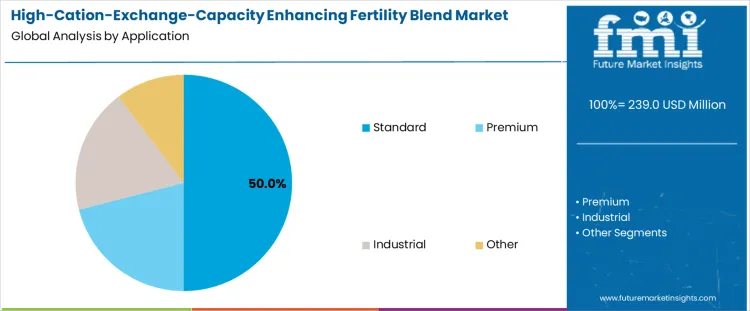
Standard applications account for about 50% of demand because they fit within routine soil fertility programs without requiring major management changes. These applications target incremental improvement in nutrient holding capacity across broad acreage, especially in soils with declining organic matter. Growers favor standard programs because they can be layered onto existing nitrogen, phosphorus, and potassium strategies with predictable outcomes. Enhancing cation exchange capacity helps reduce leaching of ammonium, potassium, calcium, and magnesium, improving nutrient use efficiency over the season. The benefits accumulate gradually, aligning well with standard soil management cycles and yield planning.
Standard applications are also supported by agronomy advisors because performance can be measured through soil testing and yield response over multiple seasons. Premium applications focus on higher rates or specialized blends but involve higher costs and narrower use cases. Industrial applications are linked to controlled environments or reclamation projects rather than commercial farming. Other applications address niche soil conditions. Application leadership therefore reflects scalability, cost justification, and compatibility with mainstream agronomic practices rather than maximum CEC improvement potential.
What Is Driving Leadership by Form in the High Cation Exchange Capacity Enhancing Fertility Blend Market?
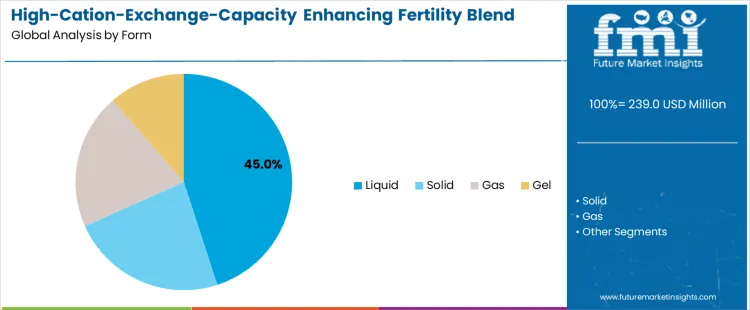
Liquid formulations account for about 45% of demand because they integrate easily with existing fertilizer application systems and allow uniform soil contact. Liquids enable precise placement through spraying, banding, or fertigation, improving interaction between CEC enhancing components and soil particles. Their compatibility with micronutrients and biological additives supports blended application strategies. Growers value liquids for reduced dust, simpler handling, and flexible timing during the season. Rapid soil contact also supports faster functional response compared with slower dissolving solids.
Solid formulations provide longer persistence but require separate application and incorporation. Gas forms are limited to specialized soil treatments and are rarely used for CEC enhancement. Gel formulations offer controlled release but face cost and handling constraints. Liquids therefore dominate because they balance ease of use, placement accuracy, and integration into existing nutrient programs. Form leadership reflects operational efficiency and field practicality rather than theoretical longevity or concentration of exchange enhancing compounds.
How Are High-Cation-Exchange-Capacity Enhancing Fertility Blends Being Applied Across Agriculture?
Use appears in row crops, vegetables, orchards, and high-value horticulture where soil nutrient retention and availability are critical for crop performance. Farmers adopt high-cation-exchange-capacity (CEC) fertility blends to improve soil’s ability to retain essential nutrients such as potassium, calcium, and magnesium, reducing leaching and enhancing uptake efficiency. Application through soil incorporation, fertigation, or banding ensures nutrients remain available in the root zone. These applications reflect operational and agronomic priorities rather than purely cost objectives, with adoption driven by soil fertility improvement, nutrient efficiency, and crop yield optimization.
What Operational and Material Conditions Support Adoption of High-Cation-Exchange-Capacity Enhancing Fertility Blends?
Selection aligns with soils exhibiting low natural CEC or high leaching potential, requiring additives compatible with existing fertilizers and crop systems. Blends are optimized for particle size, solubility, and chemical stability to enhance nutrient retention without negatively affecting pH or soil structure. Farmers monitor soil texture, moisture, and nutrient status to ensure effective incorporation and performance. Quality control evaluates CEC improvement, nutrient content, and crop response to comply with agronomic and environmental standards. These conditions emerge from operational reliability, soil fertility enhancement, and sustainability priorities in structured fertilization workflows.
Which Practical Considerations Limit Wider Use of High-Cation-Exchange-Capacity Enhancing Fertility Blends?
Higher material cost and integration complexity may restrict adoption in small-scale or low-margin farms. Effectiveness depends on soil type, organic matter content, and irrigation practices. Compatibility with other soil amendments and fertilizers must be validated. Long-term performance and environmental impact require monitoring. Regulatory approvals and certifications differ by region. These factors lead to selective deployment where soil nutrient retention, crop yield improvement, and sustainable soil management justify incremental cost, monitoring, and careful operational management in high-CEC fertility programs.
What is the Demand for High Cation Exchange Capacity Enhancing Fertility Blends by Country?
| Country | CAGR (%) |
|---|---|
| China | 12.8% |
| India | 13.6% |
| USA | 11.5% |
| France | 10.9% |
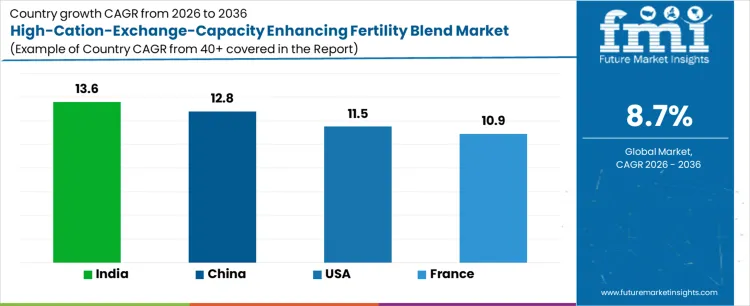
The demand for high cation exchange capacity enhancing fertility blends is increasing across major agricultural regions, driven by soil nutrient retention challenges, yield optimization goals, and adoption of advanced soil conditioning practices. India leads with a 13.6% CAGR, supported by widespread low CEC soils, intensive multi crop systems, and rising use of blended inputs to improve nutrient holding capacity and reduce leaching losses. China follows at 12.8%, shaped by large scale cultivation on variable soils and policy emphasis on improving fertilizer efficiency and soil health. The USA grows at 11.5%, reflecting adoption in row crops and specialty crops where enhanced CEC supports consistent nutrient availability. France records 10.9%, driven by precision agriculture practices, regulatory pressure to limit nutrient runoff, and increasing focus on long term soil fertility management.
How are high-cation-exchange-capacity enhancing fertility blends expanding adoption in China?
In China, the high-cation-exchange-capacity (CEC) enhancing fertility blend market is growing at a CAGR of 12.8% through 2036, driven by large-scale cereal and vegetable production, soil health optimization programs, and government incentives for nutrient-efficient farming. Farmers are applying these blends to improve soil nutrient retention, enhance plant uptake, and increase crop yield. Demand is concentrated in industrial agricultural zones, irrigated crop regions, and mechanized farming clusters. Compared to the USA, adoption emphasizes large-scale integration and operational efficiency. Domestic suppliers provide high-performance, chemically stable fertility blends suitable for recurring seasonal applications.
- Industrial agricultural zones, irrigated crop regions, and mechanized clusters drive adoption
- Blends enhance soil nutrient retention and plant uptake
- Domestic suppliers provide high-performance, chemically stable solutions
- Recurring seasonal applications sustain adoption
How are precision nutrient management and high-value crop production driving growth in India?
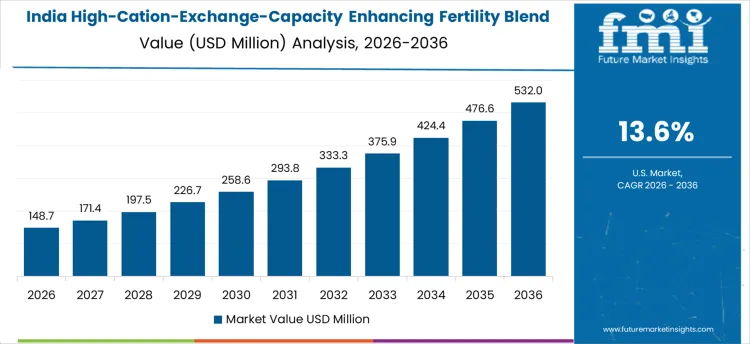
In India, the market is expanding at a CAGR of 13.6% through 2036, supported by adoption of high-value horticultural crops, precision irrigation systems, and government programs promoting soil fertility. Farmers are using high-CEC blends to improve nutrient retention, reduce fertilizer losses, and enhance early plant development. Demand is concentrated in irrigated horticultural zones, industrial crop regions, and precision farming hubs. Compared to China, adoption emphasizes rapid scalability across diverse crop types and high-volume deployment. Domestic suppliers provide high-performance, cost-effective fertility blends suitable for recurring seasonal fertilization.
- Irrigated horticultural zones, industrial crop regions, and precision farming hubs drive adoption
- Blends improve nutrient retention and reduce fertilizer losses
- Domestic suppliers provide high-performance, cost-effective solutions
- Recurring seasonal fertilization sustains adoption
How are sustainable soil management and row crop production driving adoption in the United States?
In the United States, the market is growing at a CAGR of 11.5% through 2036, fueled by large-scale row crop production, precision agriculture adoption, and demand for improved nutrient-use efficiency. Farmers are integrating high-CEC fertility blends to optimize soil nutrient availability, maintain long-term soil health, and increase yield potential. Demand is concentrated in irrigated corn, soybean, and wheat regions, high-value crop zones, and industrial farming hubs. Compared to India, adoption emphasizes regulatory compliance and integration with existing fertilization systems. Domestic suppliers provide high-performance, reliable blends suitable for recurring seasonal applications.
- Irrigated corn, soybean, and wheat regions drive adoption
- Blends optimize nutrient availability and soil health
- Domestic suppliers provide high-performance, reliable solutions
- Recurring seasonal applications sustain adoption
How are precision horticulture and European sustainability standards driving growth in France?
In France, the market is expanding at a CAGR of 10.9% through 2036, supported by high-value horticulture, EU environmental regulations, and adoption of sustainable soil fertility practices. Farmers are using high-CEC fertility blends to improve cation retention, reduce nutrient losses, and enhance crop performance in vineyards, vegetable fields, and orchards. Demand is concentrated in irrigated horticultural zones, high-tech farming hubs, and industrial agricultural regions. Compared to the USA, adoption emphasizes precision application, compliance, and environmental sustainability over large-scale industrial deployment. Domestic suppliers provide EU-certified, high-performance blends suitable for recurring seasonal applications.
- Irrigated horticultural zones, high-tech farming hubs, and industrial regions drive adoption
- Blends improve cation retention and reduce nutrient losses
- Domestic suppliers provide EU-certified, high-performance solutions
- Recurring seasonal applications sustain adoption
Which Strategic Factors Shape Competition in the High Cation Exchange Capacity Enhancing Fertility Blend Market under Nutrient Retention and Soil Interaction Demands?
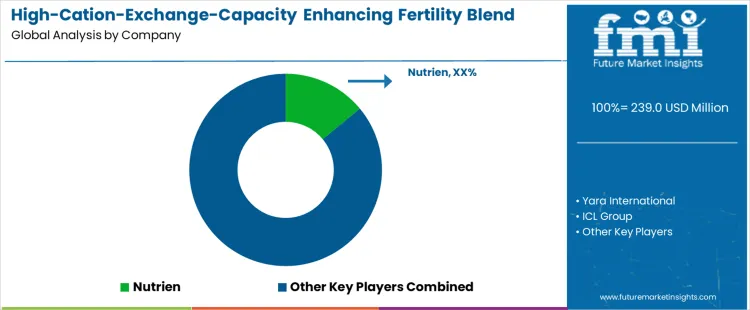
Competition in high cation exchange capacity enhancing fertility blends is shaped by how effectively products improve nutrient holding near roots without altering soil structure at scale. Nutrien and Yara International position these blends as tools to reduce leaching and improve potassium, calcium, and magnesium retention during peak uptake periods. Their strategies focus on consistent performance across textures where native exchange capacity is limited. ICL Group emphasizes formulation design that integrates mineral and organic components to enhance localized exchange behavior. Adoption depends on measurable yield response, compatibility with existing fertilizer programs, and confidence that improvements persist through variable moisture conditions across seasons.
Supply integration and agronomic positioning further shape competitive outcomes. EuroChem aligns cation exchange enhancement with standardized blend production, supporting large acreage deployment without added handling complexity. BASF contributes enabling chemistries that stabilize nutrient interactions at the soil interface, reinforcing retention effects during irrigation or rainfall events. UPL positions these blends within broader crop programs, linking nutrient retention to root development and stress tolerance. Across the market, competitive advantage is built through repeatable field performance, ease of integration into fertilizer workflows, and alignment with nutrient efficiency goals. Success depends on practical retention gains, agronomic credibility, and consistency under real field variability rather than on laboratory exchange capacity metrics alone.
Key Players in the High-Cation-Exchange-Capacity Enhancing Fertility Blend Market
- Nutrien
- Yara International
- ICL Group
- EuroChem
- BASF
- UPL
Scope of the Report
| Items | Values |
|---|---|
| Quantitative Units | USD million |
| Type | High-cation-exchange-capacity enhancing fertility blends, CEC-improving soil fertility formulations, nutrient retention enhancing blends |
| Application | Soil nutrient retention improvement, leaching reduction in low-CEC soils, long-term fertility program enhancement |
| End Users | Commercial row crop growers, horticulture and orchard producers, precision agriculture farms, intensive crop production systems |
| Regions Covered | Asia Pacific, Europe, North America, Latin America, Middle East & Africa |
| Countries Covered | India, China, United States, France, and other major agricultural regions |
| Key Companies Profiled | Nutrien, Yara International, ICL Group, EuroChem, BASF, UPL |
| Additional Attributes | Dollar sales by application and formulation form, adoption trends linked to soil nutrient retention and base saturation variability, competitive landscape shaped by blend uniformity and multi-season soil performance, mineral sourcing and formulation consistency requirements, integration with standard fertilizer programs, field benchmarking and soil validation protocols |
High-Cation-Exchange-Capacity Enhancing Fertility Blend Market Segmentation
Application:
- Standard
- Premium
- Industrial
- Other
Form:
- Liquid
- Solid
- Gas
- Gel
Channel:
- Direct
- Retail
- Online
- Distributor
Region
- Asia Pacific
- China
- Japan
- South Korea
- India
- Australia & New Zealand
- ASEAN
- Rest of Asia Pacific
- Europe
- Germany
- United Kingdom
- France
- Italy
- Spain
- Nordic
- BENELUX
- Rest of Europe
- North America
- United States
- Canada
- Mexico
- Latin America
- Brazil
- Chile
- Rest of Latin America
- Middle East & Africa
- Kingdom of Saudi Arabia
- Other GCC Countries
- Turkey
- South Africa
- Other African Union
- Rest of Middle East & Africa
Frequently Asked Questions
How big is the high-cation-exchange-capacity enhancing fertility blend market in 2026?
The global high-cation-exchange-capacity enhancing fertility blend market is estimated to be valued at USD 239.0 million in 2026.
What will be the size of high-cation-exchange-capacity enhancing fertility blend market in 2036?
The market size for the high-cation-exchange-capacity enhancing fertility blend market is projected to reach USD 550.4 million by 2036.
How much will be the high-cation-exchange-capacity enhancing fertility blend market growth between 2026 and 2036?
The high-cation-exchange-capacity enhancing fertility blend market is expected to grow at a 8.7% CAGR between 2026 and 2036.
What are the key application types in the high-cation-exchange-capacity enhancing fertility blend market?
The key application types in high-cation-exchange-capacity enhancing fertility blend market are standard, premium, industrial and other.
Which form segment to contribute significant share in the high-cation-exchange-capacity enhancing fertility blend market in 2026?
In terms of form, liquid segment to command 45.0% share in the high-cation-exchange-capacity enhancing fertility blend market in 2026.
Preview the report firsthand - request a free sample
Get SampleGet the brochure for pricing and purchase details.
Get PDFTable of Content
- Executive Summary
- Global Market Outlook
- Demand-side Trends
- Supply-side Trends
- Technology Roadmap Analysis
- Analysis and Recommendations
- Market Overview
- Market Coverage / Taxonomy
- Market Definition / Scope / Limitations
- Market Background
- Market Dynamics
- Drivers
- Restraints
- Opportunity
- Trends
- Scenario Forecast
- Demand in Optimistic Scenario
- Demand in Likely Scenario
- Demand in Conservative Scenario
- Opportunity Map Analysis
- Product Life Cycle Analysis
- Supply Chain Analysis
- Investment Feasibility Matrix
- Value Chain Analysis
- PESTLE and Porter’s Analysis
- Regulatory Landscape
- Regional Parent Market Outlook
- Production and Consumption Statistics
- Import and Export Statistics
- Market Dynamics
- Global Market Analysis 2021 to 2025 and Forecast, 2026 to 2036
- Historical Market Size Value (USD Million) Analysis, 2021 to 2025
- Current and Future Market Size Value (USD Million) Projections, 2026 to 2036
- Y-o-Y Growth Trend Analysis
- Absolute $ Opportunity Analysis
- Global Market Pricing Analysis 2021 to 2025 and Forecast 2026 to 2036
- Global Market Analysis 2021 to 2025 and Forecast 2026 to 2036, By Application
- Introduction / Key Findings
- Historical Market Size Value (USD Million) Analysis By Application , 2021 to 2025
- Current and Future Market Size Value (USD Million) Analysis and Forecast By Application , 2026 to 2036
- Standard
- Premium
- Industrial
- Other
- Standard
- Y-o-Y Growth Trend Analysis By Application , 2021 to 2025
- Absolute $ Opportunity Analysis By Application , 2026 to 2036
- Global Market Analysis 2021 to 2025 and Forecast 2026 to 2036, By Form
- Introduction / Key Findings
- Historical Market Size Value (USD Million) Analysis By Form, 2021 to 2025
- Current and Future Market Size Value (USD Million) Analysis and Forecast By Form, 2026 to 2036
- Liquid
- Solid
- Gas
- Gel
- Liquid
- Y-o-Y Growth Trend Analysis By Form, 2021 to 2025
- Absolute $ Opportunity Analysis By Form, 2026 to 2036
- Global Market Analysis 2021 to 2025 and Forecast 2026 to 2036, By Channel
- Introduction / Key Findings
- Historical Market Size Value (USD Million) Analysis By Channel, 2021 to 2025
- Current and Future Market Size Value (USD Million) Analysis and Forecast By Channel, 2026 to 2036
- Direct
- Retail
- Online
- Distributor
- Direct
- Y-o-Y Growth Trend Analysis By Channel, 2021 to 2025
- Absolute $ Opportunity Analysis By Channel, 2026 to 2036
- Global Market Analysis 2021 to 2025 and Forecast 2026 to 2036, By Region
- Introduction
- Historical Market Size Value (USD Million) Analysis By Region, 2021 to 2025
- Current Market Size Value (USD Million) Analysis and Forecast By Region, 2026 to 2036
- North America
- Latin America
- Western Europe
- Eastern Europe
- East Asia
- South Asia and Pacific
- Middle East & Africa
- Market Attractiveness Analysis By Region
- North America Market Analysis 2021 to 2025 and Forecast 2026 to 2036, By Country
- Historical Market Size Value (USD Million) Trend Analysis By Market Taxonomy, 2021 to 2025
- Market Size Value (USD Million) Forecast By Market Taxonomy, 2026 to 2036
- By Country
- USA
- Canada
- Mexico
- By Application
- By Form
- By Channel
- By Country
- Market Attractiveness Analysis
- By Country
- By Application
- By Form
- By Channel
- Key Takeaways
- Latin America Market Analysis 2021 to 2025 and Forecast 2026 to 2036, By Country
- Historical Market Size Value (USD Million) Trend Analysis By Market Taxonomy, 2021 to 2025
- Market Size Value (USD Million) Forecast By Market Taxonomy, 2026 to 2036
- By Country
- Brazil
- Chile
- Rest of Latin America
- By Application
- By Form
- By Channel
- By Country
- Market Attractiveness Analysis
- By Country
- By Application
- By Form
- By Channel
- Key Takeaways
- Western Europe Market Analysis 2021 to 2025 and Forecast 2026 to 2036, By Country
- Historical Market Size Value (USD Million) Trend Analysis By Market Taxonomy, 2021 to 2025
- Market Size Value (USD Million) Forecast By Market Taxonomy, 2026 to 2036
- By Country
- Germany
- UK
- Italy
- Spain
- France
- Nordic
- BENELUX
- Rest of Western Europe
- By Application
- By Form
- By Channel
- By Country
- Market Attractiveness Analysis
- By Country
- By Application
- By Form
- By Channel
- Key Takeaways
- Eastern Europe Market Analysis 2021 to 2025 and Forecast 2026 to 2036, By Country
- Historical Market Size Value (USD Million) Trend Analysis By Market Taxonomy, 2021 to 2025
- Market Size Value (USD Million) Forecast By Market Taxonomy, 2026 to 2036
- By Country
- Russia
- Poland
- Hungary
- Balkan & Baltic
- Rest of Eastern Europe
- By Application
- By Form
- By Channel
- By Country
- Market Attractiveness Analysis
- By Country
- By Application
- By Form
- By Channel
- Key Takeaways
- East Asia Market Analysis 2021 to 2025 and Forecast 2026 to 2036, By Country
- Historical Market Size Value (USD Million) Trend Analysis By Market Taxonomy, 2021 to 2025
- Market Size Value (USD Million) Forecast By Market Taxonomy, 2026 to 2036
- By Country
- China
- Japan
- South Korea
- By Application
- By Form
- By Channel
- By Country
- Market Attractiveness Analysis
- By Country
- By Application
- By Form
- By Channel
- Key Takeaways
- South Asia and Pacific Market Analysis 2021 to 2025 and Forecast 2026 to 2036, By Country
- Historical Market Size Value (USD Million) Trend Analysis By Market Taxonomy, 2021 to 2025
- Market Size Value (USD Million) Forecast By Market Taxonomy, 2026 to 2036
- By Country
- India
- ASEAN
- Australia & New Zealand
- Rest of South Asia and Pacific
- By Application
- By Form
- By Channel
- By Country
- Market Attractiveness Analysis
- By Country
- By Application
- By Form
- By Channel
- Key Takeaways
- Middle East & Africa Market Analysis 2021 to 2025 and Forecast 2026 to 2036, By Country
- Historical Market Size Value (USD Million) Trend Analysis By Market Taxonomy, 2021 to 2025
- Market Size Value (USD Million) Forecast By Market Taxonomy, 2026 to 2036
- By Country
- Kingdom of Saudi Arabia
- Other GCC Countries
- Turkiye
- South Africa
- Other African Union
- Rest of Middle East & Africa
- By Application
- By Form
- By Channel
- By Country
- Market Attractiveness Analysis
- By Country
- By Application
- By Form
- By Channel
- Key Takeaways
- Key Countries Market Analysis
- USA
- Pricing Analysis
- Market Share Analysis, 2025
- By Application
- By Form
- By Channel
- Canada
- Pricing Analysis
- Market Share Analysis, 2025
- By Application
- By Form
- By Channel
- Mexico
- Pricing Analysis
- Market Share Analysis, 2025
- By Application
- By Form
- By Channel
- Brazil
- Pricing Analysis
- Market Share Analysis, 2025
- By Application
- By Form
- By Channel
- Chile
- Pricing Analysis
- Market Share Analysis, 2025
- By Application
- By Form
- By Channel
- Germany
- Pricing Analysis
- Market Share Analysis, 2025
- By Application
- By Form
- By Channel
- UK
- Pricing Analysis
- Market Share Analysis, 2025
- By Application
- By Form
- By Channel
- Italy
- Pricing Analysis
- Market Share Analysis, 2025
- By Application
- By Form
- By Channel
- Spain
- Pricing Analysis
- Market Share Analysis, 2025
- By Application
- By Form
- By Channel
- France
- Pricing Analysis
- Market Share Analysis, 2025
- By Application
- By Form
- By Channel
- India
- Pricing Analysis
- Market Share Analysis, 2025
- By Application
- By Form
- By Channel
- ASEAN
- Pricing Analysis
- Market Share Analysis, 2025
- By Application
- By Form
- By Channel
- Australia & New Zealand
- Pricing Analysis
- Market Share Analysis, 2025
- By Application
- By Form
- By Channel
- China
- Pricing Analysis
- Market Share Analysis, 2025
- By Application
- By Form
- By Channel
- Japan
- Pricing Analysis
- Market Share Analysis, 2025
- By Application
- By Form
- By Channel
- South Korea
- Pricing Analysis
- Market Share Analysis, 2025
- By Application
- By Form
- By Channel
- Russia
- Pricing Analysis
- Market Share Analysis, 2025
- By Application
- By Form
- By Channel
- Poland
- Pricing Analysis
- Market Share Analysis, 2025
- By Application
- By Form
- By Channel
- Hungary
- Pricing Analysis
- Market Share Analysis, 2025
- By Application
- By Form
- By Channel
- Kingdom of Saudi Arabia
- Pricing Analysis
- Market Share Analysis, 2025
- By Application
- By Form
- By Channel
- Turkiye
- Pricing Analysis
- Market Share Analysis, 2025
- By Application
- By Form
- By Channel
- South Africa
- Pricing Analysis
- Market Share Analysis, 2025
- By Application
- By Form
- By Channel
- USA
- Market Structure Analysis
- Competition Dashboard
- Competition Benchmarking
- Market Share Analysis of Top Players
- By Regional
- By Application
- By Form
- By Channel
- Competition Analysis
- Competition Deep Dive
- Nutrien
- Overview
- Product Portfolio
- Profitability by Market Segments (Product/Age /Sales Channel/Region)
- Sales Footprint
- Strategy Overview
- Marketing Strategy
- Product Strategy
- Channel Strategy
- Yara International
- ICL Group
- EuroChem
- BASF
- UPL
- Nutrien
- Competition Deep Dive
- Assumptions & Acronyms Used
- Research Methodology


