

- Industry Size (2025)
- USD 11.23 Bn
- Forecast (2035)
- USD 26.93 Bn
- CAGR (2025 to 2035)
- 8.8%
Biopharmaceutical Contract Manufacturing Market Size, Market Forecast and Outlook By FMI
The biopharmaceutical contract manufacturing market was valued at USD 11.23 billion in 2025. It is projected at USD 26.93 billion by 2035, with 8.8% CAGR from 2025 to 2035. Mammalian-based systems are likely to lead with 72.3% share in 2025. Monoclonal antibodies are forecast to account for 44.0% of product type demand in 2025.
Summary of the Biopharmaceutical Contract Manufacturing Market
- Demand and Growth Drivers
- Complex biologic pipelines are set to raise reliance on specialist CDMOs.
- Sponsors are turning to outsourced capacity as internal facilities face scale limits.
- Cell and gene therapy pipelines are creating demand for flexible biomanufacturing capacity.
- Product and Segment View
- Mammalian-based platforms lead because complex biologics need proper folding and glycosylation.
- Monoclonal antibodies retain high share due to broad use in oncology treatments.
- Commercial applications are likely to expand as late-stage biologics move into larger production runs.
- Geography and Competitive Outlook
- Asia is set for faster expansion as China and India build biologics capacity.
- North America keeps strong value due to clinical pipelines and sponsor proximity.
- Europe continues to rely on GMP strength and high-trust manufacturing standards.
- Analyst Opinion
- Sabyasachi Ghosh, Principal Consultant for Healthcare at FMI, suggests, “The biopharmaceutical contract manufacturing market is moving toward CDMOs with flexible scale and strong quality systems. Mammalian platforms will remain central as sponsors outsource complex biologics and seek faster commercial readiness.”
- Biopharmaceutical Contract Manufacturing Market Value Analysis
- Biopharmaceutical contract manufacturing is shifting from capacity outsourcing toward end-to-end biologics partnerships.
- Sponsors are choosing CDMOs that can reduce scale-up risk and regulatory friction.
- Mammalian platforms hold high value because complex biologics need proven production systems.
- China and India are creating stronger outsourcing options through cost-efficient biologics infrastructure.
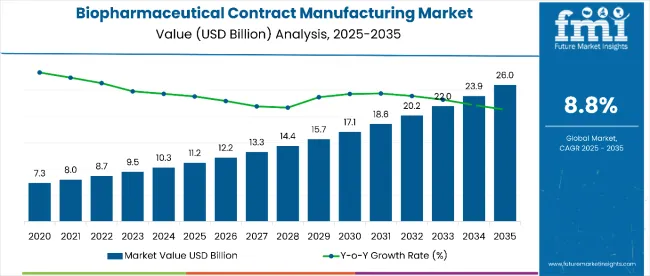
Key Takeaways, Market Size, and Forecast
| Metric | Value |
|---|---|
| Market Size (2025) | USD 11.23 Billion |
| Market Size (2035) | USD 26.93 Billion |
| CAGR (2025–2035) | 8.8% |
| Leading Platform (2025) | Mammalian-Based Systems |
| Mammalian-Based Systems Share (2025) | 72.3% |
| Leading Product Type (2025) | Monoclonal Antibodies |
| Monoclonal Antibodies Share (2025) | 44.0% |
| Fastest-Growing Segment | Oncology |
| Oncology CAGR | 10.7% |
| Fastest-Growing Country | China |
| China CAGR | 13.7% |
| Attributes | Details |
|---|---|
| Market Size, 2025 | USD 11.23 billion |
| Market Size, 2035 | USD 26.93 billion |
| Value CAGR (2025 to 2035) | 8.8% |
Biopharmaceutical Contract Manufacturing Market Analysis by Top Investment Segments
By Product Type, the Monoclonal Antibodies Segment Accounts for 44.0% of the Market Share
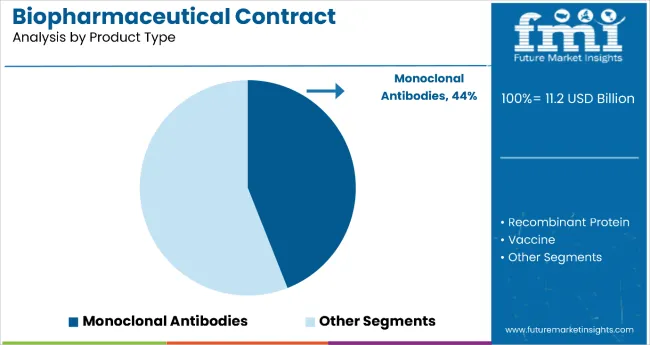
Monoclonal antibodies hold the dominant position with 44.0% of the market share in the product type category within the biopharmaceutical contract manufacturing market. This leadership is driven by monoclonal antibodies' exceptional therapeutic versatility and their widespread applications across oncology, autoimmune disorders, and infectious diseases.
mAbs offer superior specificity in targeting disease-causing proteins while minimizing off-target effects, making them highly effective therapeutic interventions that have revolutionized modern medicine.
The segment's dominance is reinforced by the increasing complexity of monoclonal antibody production, which requires specialized manufacturing expertise and advanced infrastructure that many pharmaceutical companies prefer to outsource.
The growing pipeline of mAb-based therapies and the expansion into biosimilar manufacturing following patent expirations further drive demand for contract manufacturing services. As precision medicine continues to advance and regulatory pathways for biologics become more streamlined, the monoclonal antibodies segment is positioned to maintain its market leadership through continued innovation in therapeutic applications and manufacturing optimization.
By Platform Type, the Mammalian Based Segment Accounts for 72.3% of the Market Share
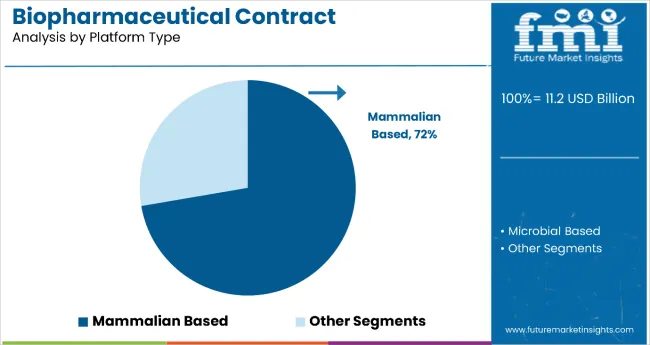
Mammalian-based platforms dominate the biopharmaceutical contract manufacturing market with 72.3% of the market share in the platform type category. This substantial leadership is attributed to mammalian expression systems' superior ability to produce complex biologics with proper protein folding, post-translational modifications, and glycosylation patterns that are essential for therapeutic efficacy.
Mammalian cell lines, particularly CHO (Chinese Hamster Ovary) cells, have become the gold standard for producing monoclonal antibodies and other complex biologics due to their similarity to human cellular machinery.
The segment's dominance is reinforced by mammalian systems' proven track record in regulatory approvals and their ability to produce biologics that closely mimic natural human proteins. While mammalian-based manufacturing requires higher capital investment and operational costs compared to microbial systems, the superior product quality and regulatory acceptance justify the premium pricing.
As the biopharmaceutical industry continues to focus on complex therapeutics including antibody-drug conjugates and advanced protein therapies, the mammalian-based platform segment is expected to maintain its dominant position through continued technological advances in cell line development and bioprocessing optimization.
Biopharmaceutical Contract Manufacturing by Top Countries
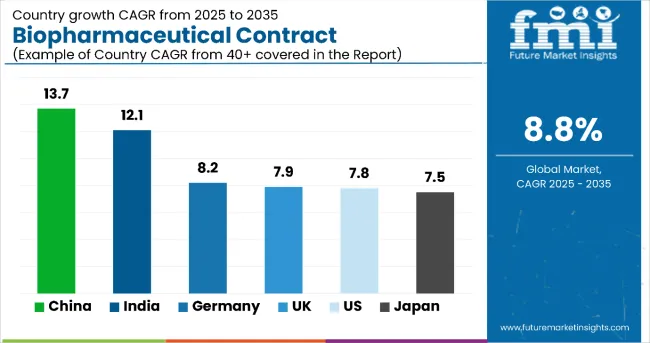
United States
The United States will retain its position as the dominant profit pool in the global biopharmaceutical contract manufacturing market, with revenue projected to rise from USD 3.95 billion in 2025 to USD 8.41 billion by 2035, reflecting a CAGR of 7.8%. The USA continues to house the most mature biologics innovation ecosystem globally, with over 45% of global late-stage biologic trials headquartered domestically. This fuels sustained clinical and commercial outsourcing demand, particularly in monoclonal antibodies, ADCs, and cell therapies. Further, regulatory alignment is strong: the USA.
FDA’s 2025 overhaul of CMC guidance reduced pre-approval inspection bottlenecks and incentivized sponsor-CDMO alignment early in the development lifecycle. Also, CDMOs operating within major biotech corridors-Massachusetts, California, and North Carolina-benefit from local talent density, proximity to sponsors, and favorable infrastructure. However, operational risks include rising wage inflation across biomanufacturing roles and regional variations in GMP audit standards. Additionally, ESG compliance costs may pressure EBITDA margins as California, in particular, enforces tighter environmental controls. Despite these headwinds, USA based CDMOs are expected to maintain high capacity utilization levels, benefiting from multi-year manufacturing agreements and lifecycle production of high-margin biologics.
| 2025 Value (USD billion) | CAGR 2025 to 2035 |
|---|---|
| 3.95 | 7.8% |
China
China is expected to be the fastest-expanding national market in the biopharmaceutical contract manufacturing landscape, scaling from USD 0.91 billion in 2025 to USD 3.32 billion by 2035, registering a CAGR of 13.7%. China’s government-backed “Biotech 2030” framework has made biomanufacturing a priority sector, offering tax relief, land access, and soft capital to CDMOs investing in GMP-compliant infrastructure. Regulatory transformation is proving pivotal. The National Medical Products Administration (NMPA) has aligned its technical review framework with ICH guidelines, creating cross-border trust in Chinese CDMO output.
Domestic biopharma demand is intensifying-China now leads globally in new IND filings for biosimilars and PD-1 inhibitors. Infrastructure in Suzhou, Shanghai, and Guangzhou is rapidly scaling, with regional CDMOs expanding their mammalian cell capacity and investing in single-use bioreactor lines. Risk factors include quality inconsistencies among smaller players and fragmented GMP audit standards between provinces. Nonetheless, foreign sponsors are increasingly sourcing early-stage and biosimilar manufacturing from China to benefit from 30-40% cost advantages. With regulatory credibility rising and internal biologics consumption booming, China is forecast to capture a growing share of global outsourcing mandates.
| 2025 Value (USD billion) | CAGR 2025 to 2035 |
|---|---|
| 0.91 | 13.7% |
Germany
Germany remains the cornerstone of biopharmaceutical contract manufacturing in Western Europe, with the market estimated to expand from USD 0.88 billion in 2025 to USD 1.94 billion by 2035, registering a steady CAGR of 8.2%. Three fundamentals underpin its trajectory. First, Germany hosts some of the EU’s most advanced biomanufacturing infrastructure, anchored by a strong legacy in chemical engineering and pharmaceutical scale-up. CDMOs in cities like Munich, Heidelberg, and Frankfurt are heavily invested in mammalian and microbial systems, positioning them to service monoclonal antibodies, vaccines, and biosimilars. Second, Germany benefits from an export-oriented biologics economy.
Over 60% of its CDMO output is destined for global supply chains, supported by mature logistics and stringent EU-GMP compliance. Third, regulatory stability and access to high-skill labor continue to enhance the investment climate. However, downside risks persist. Energy volatility, particularly since 2022, remains a cost-management challenge for temperature- and pressure-sensitive biomanufacturing processes. Additionally, wage inflation in Germany’s technical sectors may compress long-term margins. Even so, high trust in German GMP standards, combined with the country’s central location within EU pharma logistics, ensures it remains a preferred outsourcing destination for USA. and Japanese sponsors seeking access to EMA-aligned production pathways.
| 2025 Value (USD billion) | CAGR 2025 to 2035 |
|---|---|
| 0.88 | 8.2% |
Japan
Japan’s biopharmaceutical contract manufacturing market is poised for solid expansion, growing from USD 0.76 billion in 2025 to USD 1.56 billion by 2035, at a CAGR of 7.5%. The outlook is supported by several regulatory and structural levers. Japan’s Pharmaceuticals and Medical Devices Agency (PMDA) has increased alignment with ICH harmonization protocols, particularly in process validation and biologics licensing, making it easier for multinational sponsors to engage Japanese CDMOs. Japan’s aging population and corresponding biologics demand, especially in oncology and autoimmune disorders, are triggering more domestic outsourcing as local biotechs and pharma firms reduce capital expenditure on in-house facilities.
Japanese CDMOs enjoy a reputation for high precision and low deviation rates, particularly in aseptic fill-finish operations and microbial fermentation. Challenges remain. Japan faces acute labor shortages in biomanufacturing, particularly outside major hubs like Tokyo and Osaka, and cost competitiveness is often eclipsed by regional peers in South Korea and China. However, Japan’s CDMOs continue to win long-term contracts from global sponsors focused on quality-sensitive therapeutic segments. The overall growth trajectory is stable, with rising demand for complex biologics and steady investment in modular capacity enhancements.
| 2025 Value (USD billion) | CAGR 2025 to 2035 |
|---|---|
| 0.76 | 7.5% |
India
India is rapidly consolidating its position as a global cost-efficiency hub for biopharmaceutical contract manufacturing, with the market expected to grow from USD 0.72 billion in 2025 to USD 2.26 billion by 2035, reflecting a CAGR of 12.1%. Three strategic enablers shape this growth. India’s existing strength in generic drug manufacturing is being leveraged into biologics, with major CDMOs in Hyderabad, Bengaluru, and Pune investing heavily in bioreactor capacity and single-use systems. Regulatory reforms under the Central Drugs Standard Control Organization (CDSCO) have streamlined GMP certification and technology transfer processes, reducing onboarding time for international sponsors.
India's labor and utility cost advantages remain unparalleled, with 30-40% savings over Western CDMOs, enabling it to win early-stage, scale-up, and biosimilar mandates from global biotech firms. However, challenges remain: regulatory harmonization with ICH continues to lag in consistency, and perception risks around quality compliance persist-especially for sterile fill-finish operations. Nonetheless, several top-tier Indian CDMOs have secured USA FDA and EMA approvals, boosting global confidence. As biologics penetration rises in domestic therapy areas (oncology, autoimmune, diabetes), internal demand is also beginning to complement export-led growth, reinforcing India’s dual-role value in the outsourcing value chain.
| 2025 Value (USD billion) | CAGR 2025 to 2035 |
|---|---|
| 0.72 | 12.1% |
United Kingdom
The United Kingdom continues to deliver stable, innovation-led performance in the biopharmaceutical contract manufacturing sector, with the market forecast to grow from USD 0.69 billion in 2025 to USD 1.47 billion by 2035, representing a CAGR of 7.9%. The UK’s appeal rests on three foundational strengths. First, proximity to Oxford-Cambridge-London’s “Golden Triangle” offers CDMOs high-density access to early-stage biotech pipelines and translational medicine programs, enabling fast technology transfer and pilot-scale production.
Second, the UK Medicines and Healthcare products Regulatory Agency (MHRA) has proven agile post-Brexit, updating GMP frameworks to remain competitive with EMA and FDA pathways while offering localized regulatory support. Third, the government’s Life Sciences Vision (2021-2031) earmarked over GBP 1 billion in incentives for advanced therapy manufacturing, catalyzing investment in viral vector, plasmid DNA, and mRNA infrastructure. However, the post-Brexit operating environment still creates frictions, especially in cross-border clinical trial sourcing and batch release logistics. Wage inflation and energy costs are further pressuring margin structures. Despite this, the UK remains a high-trust environment for quality-sensitive manufacturing-particularly for oncology and cell therapies-making it an attractive destination for global sponsors seeking reliability over scale.
| 2025 Value (USD billion) | CAGR 2025 to 2035 |
|---|---|
| 0.69 | 7.9% |
South Korea
South Korea is emerging as a strategic biopharmaceutical manufacturing powerhouse in Asia, with its contract manufacturing market projected to grow from USD 0.61 billion in 2025 to USD 1.52 billion by 2035, registering a strong CAGR of 9.5%. South Korea is home to global CDMO giants-most notably Samsung Biologics and Celltrion-who have aggressively expanded their biomanufacturing campuses with ultra-large-scale capacity and advanced automation. These firms offer one of the lowest cost-per-gram benchmarks globally for mammalian-based biologics, making Korea highly competitive in high-volume, late-stage commercial manufacturing.
The Korean Ministry of Food and Drug Safety (MFDS) has consistently aligned its biologics regulations with ICH standards, giving international sponsors confidence in both product quality and regulatory predictability. The Korean government offers robust fiscal incentives and infrastructure grants under its “K-Bio” initiative, which targets biopharma as a strategic export industry. Challenges include rising labor costs in Incheon and Busan and increasing competition from China in early-stage manufacturing. Nonetheless, South Korea remains favored for complex biologic production, particularly by USA and EU sponsors who value its track record in scale, compliance, and time-to-market performance.
| 2025 Value (USD billion) | CAGR 2025 to 2035 |
|---|---|
| 0.61 | 9.5% |
France
France is steadily consolidating its position as a key node in the Western European biopharmaceutical outsourcing network, with the market expected to expand from USD 0.59 billion in 2025 to USD 1.18 billion by 2035, marking a CAGR of 7.2%. The outlook is supported by a triad of strategic factors. First, the French government’s Health Innovation 2030 plan includes EUR 7.5 billion in funding for life sciences R&D and manufacturing, which has enabled several mid-size CDMOs to modernize their facilities and expand mammalian cell culture capabilities.
Second, France's stringent adherence to EMA GMP protocols, combined with an experienced regulatory workforce, continues to make it a low-risk jurisdiction for European and global sponsors. Third, its central location within the EU allows seamless access to pan-European supply chains. However, challenges remain. France’s labor environment is tightly unionized, leading to higher wage rigidity and slower workforce scale-up compared to peers like Ireland or the Netherlands. Energy prices have also been volatile, particularly for temperature-sensitive bioproduction. Still, the combination of high trust, government backing, and strong pharma-academic linkages ensures that France will retain its relevance, particularly for high-value clinical production and technology transfer projects.
| 2025 Value (USD billion) | CAGR 2025 to 2035 |
|---|---|
| 0.59 | 7.2% |
Brazil
Brazil is steadily emerging as Latin America’s most promising biopharmaceutical contract manufacturing market, forecast to grow from USD 0.47 billion in 2025 to USD 1.13 billion by 2035, registering a CAGR of 9.1%. Three core factors underpin this trajectory. First, Brazil’s regulatory authority-ANVISA-has strengthened its biologics review and GMP inspection processes, accelerating alignment with global standards and boosting confidence among multinational sponsors. Second, demand for biologics in Brazil’s public healthcare system (SUS) is rising sharply, driven by national tenders for oncology, diabetes, and autoimmune treatments.
This has prompted local CDMOs to expand fill-finish capacity and invest in upstream mammalian cell culture infrastructure. Third, the Brazilian government offers fiscal incentives and import duty waivers for technology transfer and local manufacturing partnerships, making Brazil an attractive base for sponsors aiming to localize production for regional access. Key risks include currency volatility and occasional procurement delays in public sector contracts, which can affect short-term cash cycles. Additionally, Brazil’s logistics infrastructure-while improving-still lags behind global benchmarks in cold-chain resilience. Nonetheless, with a population of over 200 million and a deepening biologics pipeline, Brazil is becoming a strategic node for Latin American contract manufacturing scale-up.
| 2025 Value (USD billion) | CAGR 2025 to 2035 |
|---|---|
| 0.47 | 9.1% |
Mexico
Mexico is gaining traction as a secondary manufacturing hub in the Americas, with the biopharmaceutical contract manufacturing market expected to expand from USD 0.42 billion in 2025 to USD 0.95 billion by 2035, translating to a CAGR of 8.4%. Three structural drivers are fueling this growth. First, proximity to the United States and integration under USMCA trade protocols make Mexico an ideal nearshore option for North American sponsors seeking cost-effective GMP capacity without offshore regulatory complexity.
Second, COFEPRIS, Mexico’s health regulatory agency, has intensified its international collaboration and now participates in the Pan American Network for Drug Regulatory Harmonization, improving sponsor confidence in quality systems. Third, local CDMOs are moving up the value chain-from packaging and secondary processes to upstream biologics manufacturing-supported by investment from regional conglomerates and global firms. Constraints persist: while labor costs remain attractive, skills shortages in cell culture and analytical development are a known bottleneck. Infrastructure gaps in power reliability and specialized logistics infrastructure also temper rapid expansion. Even so, Mexico’s regulatory gains and geographic advantage are expected to solidify its role as a fast-growing biomanufacturing alternative within the Western Hemisphere.
| 2025 Value (USD billion) | CAGR 2025 to 2035 |
|---|---|
| 0.42 | 8.4% |
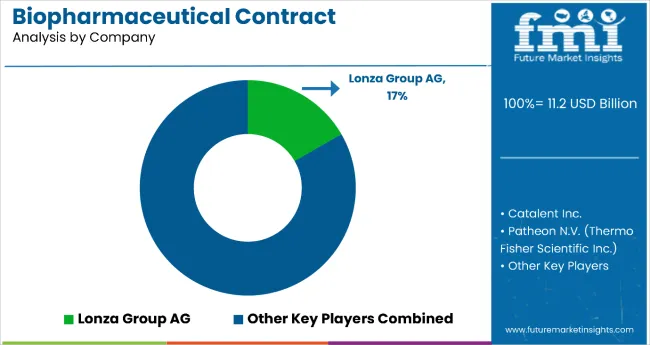
Leading Suppliers of Biopharmaceutical Contract Manufacturing Market
- Catalent Inc.
- Lonza Group AG
- Patheon N.V. (Thermo Fisher Scientific Inc.)
- Abzena Plc.
- Sandoz International GmbH (Novartis AG)
- Fujifilm Diosynth Biotechnologies (FUJIFILM Holdings)
- Baxter Pharmaceutical Solutions LLC (Baxter Inc.)
- AbbVie Contract Manufacturing (AbbVie Inc.)
- Samsung Biologics Co. Ltd.
- ProBioGen AG
Report Scope for Global Biopharmaceutical Contract Manufacturing Market
| Report Attributes | Details |
|---|---|
| Estimated Market Size (2025) | USD 11.23 billion |
| Projected Market Size (2035) | USD 26.93 billion |
| CAGR (2025 to 2035) | 8.9% |
| Base Year for Estimation | 2024 |
| Historical Period | 2019 to 2024 |
| Forecast Period | 2025 to 2035 |
| Report Parameter | Revenue in USD billion |
| By Platform Type | Mammalian-Based and Microbial-Based |
| By Product Type | Monoclonal Antibodies, Recombinant Protein, Vaccine, Insulin, Growth Factor, Interferons, Others |
| By Application Type | Clinical and Commercial |
| By Therapeutic Area Type | Autoimmune Diseases, Oncology, Metabolic Diseases, Ophthalmology, Cardiovascular Diseases, Infectious Diseases, Neurology, Respiratory Disorders |
| Regions Covered | North America, Latin America, Western Europe, Eastern Europe, East Asia, South Asia & Pacific, Middle East & Africa |
| Countries Covered | United States, China, Germany, Japan, India, United Kingdom, South Korea, France, Brazil, Mexico |
| Key Players | Samsung Biologics, Lonza Group, Thermo Fisher Scientific ( Patheon ), WuXi Biologics, Catalent Inc., Boehringer Ingelheim BioXcellence , Fujifilm Diosynth Biotechnologies, AGC Biologics, Avid Bioservices , Rentschler Biopharma |
| Additional Attributes | Dollar sales by value, market share analysis by region, and country-wise analysis |
Biopharmaceutical Contract Manufacturing Market Segmentation
By Platform Type:
The industry is segmented into Mammalian-Based and Microbial-Based manufacturing platforms.
By Product Type:
The industry is segmented into Monoclonal Antibodies, Recombinant Protein, Vaccine, Insulin, Growth Factor, Interferons, and Others.
By Application Type:
The industry is categorized into Clinical and Commercial applications.
By Therapeutic Area Type:
The industry is segmented into Autoimmune Diseases, Oncology, Metabolic Diseases, Ophthalmology, Cardiovascular Diseases, Infectious Diseases, Neurology, Respiratory Disorders, and Others.
By Region:
The industry is studied across North America, Latin America, Western Europe, Eastern Europe, South Asia and Pacific, East Asia, and the Middle East & Africa.
Frequently Asked Questions
How large is the biopharmaceutical contract manufacturing industry in 2025?
The biopharmaceutical contract manufacturing industry is expected to reach USD 11.23 billion in 2025.
2. What is the projected size of the biopharmaceutical contract manufacturing industry by 2035?
The biopharmaceutical contract manufacturing industry is projected to grow to USD 26.93 billion by 2035.
What is the expected growth rate of the biopharmaceutical contract manufacturing industry during the forecast period?
The biopharmaceutical contract manufacturing industry is anticipated to expand at a CAGR of 8.8% from 2025 to 2035.
What are the most common therapeutic areas outsourced to contract manufacturers?
Oncology, autoimmune diseases, and infectious diseases are among the leading therapeutic areas driving outsourcing demand.
Who are the leading companies involved in biopharmaceutical contract manufacturing?
Key companies include Samsung Biologics, Lonza Group, Thermo Fisher Scientific (Patheon), WuXi Biologics, Catalent Inc., and Fujifilm Diosynth Biotechnologies.
Preview the report firsthand - request a free sample
Get SampleGet the brochure for pricing and purchase details.
Get PDFTable of Content
- Executive Summary
- Market Overview
- Market Background
- Global Market Analysis 2020 to 2024 and Forecast, 2025 to 2035
- Global Market Analysis 2020 to 2024 and Forecast 2025 to 2035, By Platform Type
- Mammalian Based
- Microbial Based
- Global Market Analysis 2020 to 2024 and Forecast 2025 to 2035, By Product Type
- Monoclonal Antibodies
- Recombinant Protein
- Vaccine
- Insulin
- Growth Factor
- Interferons
- Others
- Global Market Analysis 2020 to 2024 and Forecast 2025 to 2035, By Application Type
- Clinical
- Commercial
- Global Market Analysis 2020 to 2024 and Forecast 2025 to 2035, By Therapeutic Area Type
- Autoimmune Diseases
- Oncology
- Metabolic Diseases
- Ophthalmology
- Cardiovascular Diseases
- Infectious Diseases
- Neurology
- Respiratory Disorders
- Others
- Global Market Analysis 2020 to 2024 and Forecast 2025 to 2035, By Region
- North America
- Latin America
- Western Europe
- Eastern Europe
- South Asia and Pacific
- East Asia
- Middle East and Africa
- North America Market Analysis 2020 to 2024 and Forecast 2025 to 2035, By Country
- Latin America Market Analysis 2020 to 2024 and Forecast 2025 to 2035, By Country
- Western Europe Market Analysis 2020 to 2024 and Forecast 2025 to 2035, By Country
- Eastern Europe Market Analysis 2020 to 2024 and Forecast 2025 to 2035, By Country
- South Asia and Pacific Market Analysis 2020 to 2024 and Forecast 2025 to 2035, By Country
- East Asia Market Analysis 2020 to 2024 and Forecast 2025 to 2035, By Country
- Middle East and Africa Market Analysis 2020 to 2024 and Forecast 2025 to 2035, By Country
- Key Countries Market Analysis
- Market Structure Analysis
- Competition Analysis
- Catalent Inc.
- Lonza Group AG
- Patheon N.V. (Thermo Fisher Scientific Inc.)
- Abzena Plc.
- Sandoz International GmbH (Novartis AG)
- Fujifilm Diosynth Biotechnologies (FUJIFILM Holdings)
- Baxter Pharmaceutical Solutions LLC (Baxter Inc.)
- AbbVie Contract Manufacturing (AbbVie Inc.)
- Samsung Biologics Co. Ltd.
- ProBioGen AG
- Assumptions & Acronyms Used
- Research Methodology


