
- Market Size (2026)
- USD 68.3 Mn
- Forecast (2036)
- USD 125.8 Mn
- CAGR (2026 to 2036)
- 6.3%
How big is the Borage Oil Market in 2026?
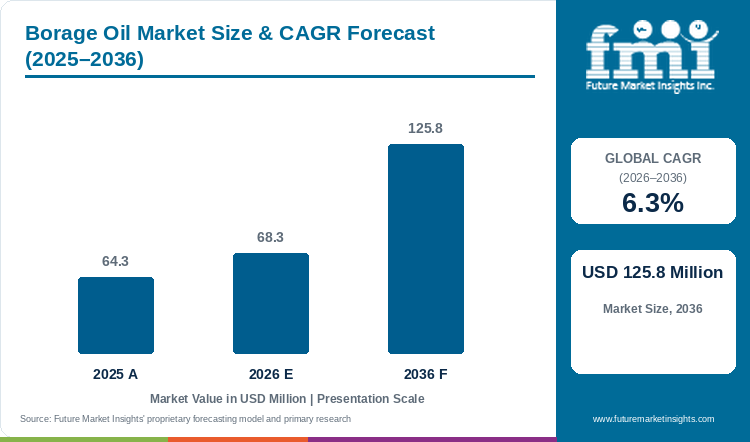
The Borage Oil Market is projected to reach USD 125.8 million by 2036, growing at a 6.3% CAGR from 2026 to 2036. The market is estimated at USD 68.3 million in 2026. The market was valued at USD 64.3 million in 2025. Bioriginal launched a cold-pressed borage oil with about 25% gamma-linolenic acid (GLA) on 7 May 2025 [1]. Trade press reported the launch on 14 May 2025, comparing it with evening primrose and black currant oils at 10% to 15% GLA [2]. The next Vitafoods Europe in Barcelona runs from 18 to 20 May 2027 [19].
Pricing and purchasing turn on how much GLA a lot carries. Suppliers list refined grades at 19% GLA [15], cold-pressed grades at 20% [14], blends of 20% to 25% [12] and a 25% grade from a bred variety [1]. Health Canada's monograph, dated 25 April 2025, allows standardised oil at 18% to 27% GLA, 23% to 37% linoleic acid and 0.2% to 10% alpha-linolenic acid [3]. One 2025 peer-reviewed study measured 17.2% GLA and 35.9% linoleic acid in a single commercial cold-pressed oil [6]. Buyers therefore pay for a certificate of analysis as well as the oil.
Key Market Trends & Insights
- Bioriginal aims its 25% GLA oil at beauty-from-within, women's health, joint health and pet nutrition [1].
- Regulators treat borage oil as a source of essential fatty acids, not as a treatment. Health Canada's 25 April 2025 monograph lists use as a source of essential fatty acids, omega-6 fatty acids and linoleic acid for the maintenance of good health in adults aged 18 and over [3]. The stated amount is 3.7 to 5 grams of oil a day [3].
- Europe sets contaminant limits for the borage plant, but borage seed oil is not among the named products [7][9]. Regulation (EU) 2023/915 of 25 April 2023 sets pyrrolizidine alkaloid limits of 750 micrograms per kilogram for fresh or frozen borage leaves sold to consumers. It sets 1,000 micrograms per kilogram for dried herbs made only of borage, lovage, marjoram or oregano [7].
Regional Highlights
- North America: Bioriginal, based in Saskatoon, grows borage on the Canadian prairies [1]. ConnOils supplies borage seed oil and oil powders made in the United States [10].
- Europe: De Wit Speciality Oils in the Netherlands lists a borage oil with 20% to 25% GLA [12] and started New Holland Extraction Ltd, a specialty oil extraction plant in the United Kingdom [13]. Bomar Aromatherapy in Ireland issues a product statement for a refined 19% GLA grade [15][16].
- Asia: O&3 lists China as the origin of its cold-pressed 20% GLA borage seed oil [14]. The Bomar statement for its refined 19% grade names China and the United Kingdom as origins [14][15].
Borage Oil Market Size and Forecast
Table 1: Borage Oil Market Size and Forecast
| Market size and forecast | Value |
|---|---|
| Market size in 2025 | USD 64.3 million |
| Estimated market size in 2026 | USD 68.3 million |
| Projected market size by 2036 | USD 125.8 million |
| CAGR from 2026 to 2036 | 6.3% |
Source: Future Market Insights analysis of the borage oil market, 2026.
Analyst Perspective
“Borage oil is a small market, and buyers choose it by a single number: the GLA percentage in the lot. The 25% grade shows what a breeding programme can do. Most buyers will still ask which grade fits their formula, and whether the supplier can document pyrrolizidine alkaloid status. Cosmetic users want a clean, stable emollient oil. Supplement brands want a dose they can state. Suppliers that serve both with traceable seed will keep their customers through price swings.”
- Nandini Roy Choudhury, Principal Consultant, FMI
How is the Borage Oil Market segmented?
- By application: Cosmetics, Functional Foods and Beverages, Dietary Supplements and Others
- By region: Worldwide, with North America, Europe and Asia Pacific as profiled regions
Why does Cosmetics lead by Application in the Borage Oil Market in 2026?
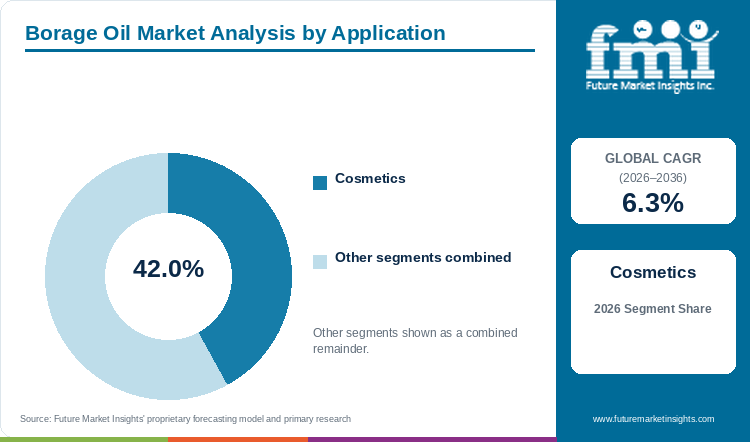
Cosmetics is estimated to account for 42.0% of the Borage Oil Market by application in 2026. Distributors sell the oil to cosmetic ingredients formulators under the INCI name Borago Officinalis Seed Oil. Parchem lists its borage oil in the emollient and skin conditioning class, shipped as a dark green clear liquid in 190 kilogram drums and 18 kilogram pails [11]. O&3 lists body care, body lotion, body oil, hair care, hair serum, moisturiser and scalp treatment as uses for its cold-pressed 20% GLA oil [14]. Regulatory entry is straightforward. The Bomar statement for its refined 19% GLA oil says the product is not on the list of substances prohibited in cosmetic products [15]. It also reports no parabens, restricted preservatives, colorants or UV filters from Annexes II to VI of Regulation (EC) No 1223/2009 [15]. Oral skin claims have weaker support. A Cochrane review published in April 2013 pooled 27 studies with 1,596 participants and found that neither oral evening primrose oil nor borage oil improved symptoms compared with placebo [4]. A 12-week randomised, placebo-controlled trial of 140 evaluable patients, including 69 children, found no advantage for borage oil on the SASSAD score [5]. Oral claims should therefore stay close to general wellbeing wording, while topical use rests on the oil's emollient role. Potency labels need care when a formulator specifies the oil. The Bomar statement describes high GLA content as typically 15% to 25% [15]. One 2025 analysis of a commercial oil found 17.2% GLA against a 20% to 26% range cited in the literature [6]. Cosmetic buyers who only need an emollient can accept a wider GLA range.
Table 2: Application, 2026 Share
| Leading Share | 2026 market share |
|---|---|
| Cosmetics | 42.0% |
| All Other Segments Combined Share | 58.0% |
Source: Future Market Insights analysis of the borage oil market, 2026.
What are the key drivers, restraints and opportunities?
Driver
Higher-potency grades. Producers compete on GLA content. Bioriginal introduced a 25% grade in May 2025 and says the higher level allows reduced dosage requirements and streamlined formulation [2]. De Wit Speciality Oils lists NEWmega Borage Oil at 20% to 25% GLA [12]. NOW Supplements sells a softgel with 1,000 milligrams of borage seed oil and 240 milligrams of GLA [17]. A supplier that states potency per dose gives brands a simple label claim.
Compendial and regulatory acceptance. Health Canada's monograph gives industry a defined route to product licences for borage oil as a source of essential fatty acids [3]. It sets an adult dose of 3.7 to 5 grams of oil a day and a standardisation range of 18% to 27% GLA [3]. The monograph excludes foods and food-like dosage forms, and requires no caution, contraindication or adverse reaction statement on the label [3]. Those conditions make supplement launches in Canada easier to plan, which helps the nutraceutical ingredients segment. Borage is native to the Mediterranean, and Rutgers research on the gamma-linolenic acid in its seed oil dates to the 1980s [18].
Restraint
Weak clinical case for skin conditions. The Cochrane review of April 2013 and the 2003 BMJ trial both found no benefit over placebo for eczema [4][5]. Eczema claims therefore lack support in that trial record. That narrows what supplement brands can say compared with cosmetic brands.
Pyrrolizidine alkaloid scrutiny. The borage plant carries pyrrolizidine alkaloids, and Regulation (EU) 2023/915 sets limits for fresh and dried borage and for food supplements containing plant preparations, at 400 micrograms per kilogram for the supplements [7]. Borage seed oil is not named among the products covered, but buyers still ask for a written statement. The Bomar statement for its refined 19% grade says the oil is free from pyrrolizidine alkaloids [15]. A 2023 study examined pyrrolizidine alkaloids in food on the Italian market [8]. Paperwork adds cost for small suppliers and slows qualification of new origins.
Opportunity
Pet and women's health formulas. Bioriginal names pet nutrition for skin, coat and mobility, women's health supplements and joint health as target uses for its 25% grade [1]. These categories can add volume without relying on the eczema indication that the trials do not support. Companion animal brands can describe the oil as a fatty acid source for skin and coat, without any disease claim.
Powders and capsule-ready forms. ConnOils lists borage oil, oil powders, capsules, softgels, bottles and emulsions, and describes its powders as high oil load and made with heatless drying [10]. Powders and emulsions let borage oil enter tablets, sachets and drinks, where liquid oil is awkward to handle. Brands that sell omega-3 supplements can apply the same powder and capsule formats to borage oil.
Borage Oil Market by Country (2026 to 2036)
Table 3: Borage Oil Market Country Growth Forecast
| Country | CAGR, 2026 to 2036 |
|---|---|
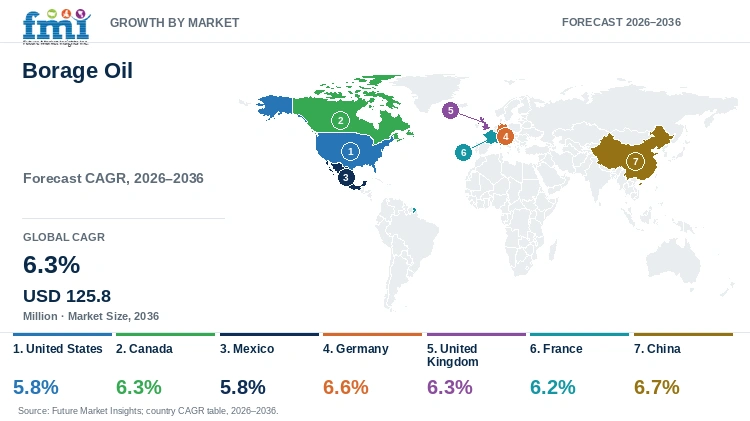
| United States | 5.8% |
| Canada | 6.3% |
| Mexico | 5.8% |
| Germany | 6.6% |
| United Kingdom | 6.3% |
| France | 6.2% |
| China | 6.7% |
Source: Future Market Insights analysis of the borage oil market, 2026.
United States
ConnOils describes itself as a maker of borage seed oil and oil powders to food, nutritional and drink grade standards, and labels its products as made in the USA [10]. It lists oil, oil powders, capsules, softgels, bottles and emulsions as available forms. Its sister company, Peterson Plant Products, plants or sources conventional, organic and biodynamic material with full traceability [10].
Parchem, based in New Rochelle, New York, lists borage oil under CAS number 225234-12-8 for emollient and skin conditioning uses [11]. It describes a dark green clear appearance and a bland odour, sold in 190 kilogram drums and 18 kilogram pails [11]. US personal care formulators can therefore buy the oil in drum quantities from a domestic distributor.
Evidence on oral use shapes positioning. The 2013 Cochrane review found that oral evening primrose oil and borage oil did not improve eczema compared with placebo [4]. American supplement brands therefore tend to sell borage oil as a GLA source, not as a skin treatment. Dietary supplements buyers can read the same product through its dose, which NOW Supplements states as 240 milligrams of GLA per softgel in a Canadian catalogue listing [17]. Bioriginal also lists pet nutrition among its target uses, which gives US pet brands a second outlet for the oil [1].
Canada
Bioriginal Food & Science Corp. announced its 25% GLA borage oil from Saskatoon on 7 May 2025. The seed variety was bred by selective breeding, the company says, and the crop is grown in a closed-loop system on the Canadian prairies, from seed development through final processing [1]. Chief executive Shannon Sears said borage has been central to the company since it was founded [1].
Health Canada's borage oil monograph is dated 25 April 2025. It names Borago officinalis seed as the source, lists the common names borage oil and borage seed oil, and allows standardised oil at 18% to 27% GLA, with a dose of 3.7 to 5 grams of oil a day for adults [3]. A 25% grade falls inside that range, which gives Canadian brands a reference point when they choose a supplier.
A NOW Supplements listing in the Canadian catalogue shows 1,000 milligrams of borage seed oil and 240 milligrams of GLA per softgel, with an adult dose of two softgels twice daily [17]. Four softgels carry 4,000 milligrams of oil, within the monograph's dose range. The listing notes the product is not available in the United States [17].
Mexico
North American producers named in this report are ConnOils, which makes oil and powders in the United States [10], and Bioriginal, which grows seed in Canada [1].
Cosmetics and personal care are the first outlet for a distributor. Parchem lists its borage oil for emollient and skin conditioning use in drums and pails [11], and O&3 lists body, hair and scalp products among uses for its cold-pressed oil [14].
Supplement claims should follow the evidence. The 2013 Cochrane review found no effect of oral borage oil on eczema compared with placebo [4]. Health Canada's monograph limits wording to a source of essential fatty acids, omega-6 fatty acids and linoleic acid for the maintenance of good health [3]. Importers that adopt that narrower wording avoid claims the trial record does not support.
Germany
Germany sits inside the European pyrrolizidine alkaloid framework. Regulation (EU) 2023/915 of 25 April 2023 sets limits of 750 micrograms per kilogram for fresh or frozen borage leaves sold to consumers. It sets 1,000 micrograms per kilogram for dried herbs made only of borage, lovage, marjoram or oregano [7]. Food supplements with plant preparations face 400 micrograms per kilogram, and pollen-based supplements 500 micrograms per kilogram, both as sums of pyrrolizidine alkaloids [7]. Borage seed oil is not named in that list [7][9].
German formulators who buy seed oil still look for supplier statements. The Bomar statement for refined 19% GLA oil says the oil is free from pyrrolizidine alkaloids [15]. It also says the oil is not on the list of substances prohibited in cosmetic products under Regulation (EC) No 1223/2009, and that it has no detectable pesticides [15]. The oil is sold in both personal care and nutrition [15].
Nearby sources include De Wit Speciality Oils in the Netherlands, which lists a 20% to 25% GLA borage oil [12]. The same company distributes marine omega-3 concentrates in Europe [13]. Short supply lines inside the EU suit buyers who want documentation in a common regulatory frame.
United Kingdom
De Wit Speciality Oils started New Holland Extraction Ltd, a specialty oil extraction plant in the United Kingdom, according to a trade feature of 29 May 2024 [13]. The feature describes borage, also called starflower, as native to the Mediterranean. It says the seed oil is rich in GLA and linoleic acid [13].
The Bomar statement for its refined 19% GLA oil names China and the United Kingdom as origins, and calls borage a widely grown crop in the United Kingdom [15]. It says the oil is expeller pressed, with the meal extracted and then refined into a transparent, odourless oil [15]. Bomar Aromatherapy, a family-owned wholesaler in County Wicklow, Ireland, established in 1993, supplies the cosmetic industry, hotels, salons and pharmacies [16].
Origin matters for buying because GLA content varies between lots. One published analysis of a commercial cold-pressed oil found 17.2% GLA, below the 20% to 26% range the authors cite as typical [6]. Buyers of UK-origin or imported lots should specify minimum GLA and test each delivery.
France
France applies the same European contaminant rules as Germany. Regulation (EU) 2023/915 sets pyrrolizidine alkaloid limits for borage leaves, borage-only dried herbs, teas and supplements containing plant preparations [7]. Borage seed oil is not among the named products [7][9]. French brands that sell borage oil capsules therefore work from the oil supplier's statement.
Refined grade suppliers also state that their oil meets cosmetic requirements. The Bomar statement says its refined 19% GLA oil has no animal origin, no genetic modification, no solvent or preservative use and no irradiation, and calls the oil vegan [15].
Named European suppliers include De Wit Speciality Oils, which lists its NEWmega Borage Oil at 20% to 25% GLA [12], and the Irish wholesaler Bomar, which lists a refined 19% oil [15][16]. Buyers compare the two on potency, refining and documentation.
China
China appears in the supply chain as an origin of seed and oil. O&3 lists China as the origin of its cold-pressed 20% GLA borage seed oil, product code K0073, with a gold-yellow colour and neutral aroma [14]. The Bomar statement gives China and the United Kingdom as origins for its refined 19% GLA grade [15].
Processing methods differ by grade. The Bomar statement describes the refined product as expeller pressed, with the meal extracted and then refined [15]. O&3 describes its Chinese-origin oil as cold pressed [14]. Buyers choose between a clear, odourless refined oil and a less processed grade with colour and aroma.
Importers need paperwork to qualify Chinese-origin lots. The Bomar statement lists a customs tariff code of 1515 9099 99, a CAS number of 225234-12-8, and GMO, irradiation and pyrrolizidine alkaloid declarations [15]. It also states compliance with European contaminant rules [15].
Chinese-origin oil competes on documentation and processing choice, not on novelty. A buyer comparing the cold-pressed 20% GLA grade with the refined 19% grade [14][15] chooses between colour and aroma on one side and a transparent, odourless oil on the other. The paperwork that comes with each lot can decide the choice.
Who are the notable companies in the Borage Oil Market?
Notable companies in the Borage Oil Market include ConnOils, Parchem, Bioriginal Food & Science Corp., De Wit Speciality Oils and O&3 Limited.
Control of the seed separates suppliers. Bioriginal says it controls the crop from seed development through final processing on the Canadian prairies, and sells a 25% GLA oil from its own variety [1]. ConnOils works with a sister company, Peterson Plant Products, which plants or sources conventional, organic and biodynamic material with traceability documents [10]. Distributors such as Parchem and Bomar Aromatherapy list the oil among many products and describe packaging and regulatory status, not seed [11][15][16].
Potency and processing separate the product offers. Grades run from 19% GLA refined [15] to 20% cold pressed [14], 20% to 25% [12] and 25% [1]. NOW Supplements sells the finished dose, 240 milligrams of GLA in a 1,000 milligram softgel, to consumers [17]. Because the Cochrane review found no effect on eczema [4], suppliers that provide fatty acid profile and contaminant data may carry more weight with buyers than suppliers that rely on health claims.
Form and documentation settle qualification. ConnOils supplies oil, oil powders, softgels and emulsions [10]. De Wit Speciality Oils positions its oil for European nutrition customers and distributes marine omega-3 concentrates [12][13]. Bomar publishes a product statement covering vegan status, GMO, irradiation, solvent use and pyrrolizidine alkaloids [15]. A buyer who needs a powder or softgel-ready oil has fewer options than one who needs bulk oil.
Channel decides which buyers a supplier reaches. Parchem, O&3 and Bomar Aromatherapy sell to formulators and wholesalers, and their product listings centre on drum and pail sizes and cosmetic status statements [11][14][15][16]. Bioriginal and ConnOils address nutrition and supplement manufacturers in food, nutritional and drink grade terms [1][10]. NOW Supplements sells to consumers [17]. A supplier that wants both groups needs two document packs: cosmetic compliance, and potency and contaminant data.
Key Developments in the Borage Oil Market
- On 7 May 2025, Bioriginal Food & Science Corp. launched a cold-pressed borage oil with about 25% GLA, bred without genetic modification and grown on the Canadian prairies. It said it would exhibit at Vitafoods Europe in Barcelona on 20 to 22 May 2025 [1].
- On 25 April 2025, Health Canada dated its natural health product monograph for borage oil, which gives a standardisation range of 18% to 27% GLA and a dose of 3.7 to 5 grams a day for adults [3].
- On 29 May 2024, a trade feature described De Wit Speciality Oils as a family firm that has grown seeds and produced oils since 1978 and that started New Holland Extraction Ltd in the United Kingdom [13].
- Vitafoods Europe 2027 is scheduled for 18 to 20 May 2027 at Fira Barcelona Gran Via [19]. Fi Europe 2026 is scheduled for 17 to 19 November 2026, according to a supplier page [12][19].
Key Players in the Borage Oil Market
- ConnOils
- Parchem
- Bioriginal Food & Science Corp.
- De Wit Speciality Oils
- O&3 Limited
- Bomar Aromatherapy
- NOW Supplements
Borage Oil Market Report Scope
Table 4: Borage Oil Market Report Scope
| Coverage field | Report scope |
|---|---|
| Market definition | Borage seed oil (Borago officinalis), measured by value at the first sale of bulk oil or oil powder to cosmetic, dietary supplement and food and beverage manufacturers. Oil sold inside finished doses is counted once, at its ingredient value |
| Application | Cosmetics, Functional Foods and Beverages, Dietary Supplements, Others |
| Regions and profiled countries | Worldwide market value. Profiled regions: North America, Europe and Asia Pacific, with the United States, Canada, Mexico, Germany, United Kingdom, France and China |
| Companies covered | ConnOils, Parchem, Bioriginal Food & Science Corp., De Wit Speciality Oils, O&3 Limited, Bomar Aromatherapy and NOW Supplements |
| Forecast period | 2026 to 2036, with 2025 as the historical base year |
| Quantitative Units | USD million |
Source: Future Market Insights analysis of the borage oil market, 2026.
Borage Oil Market by Segments
Borage Oil Market segmented by Application:
- Cosmetics
- Functional Foods and Beverages
- Dietary Supplements
- Others
Borage Oil Market by Region
- North America
- Europe
- Asia Pacific
- United States
- Canada
- Mexico
- Germany
- United Kingdom
- France
- China
Research Sources and Bibliography
- [1] Bioriginal Food & Science Corp. (2025, May 7). Bioriginal Launches Industry-First Non-GMO High GLA Borage Oil. https://www.bioriginal.com/bioriginal-launches-industry-first-non-gmo-high-gla-borage-oil/
- [2] Nutritional Outlook. (2025, May 14). Industry's first non-GMO high GLA borage oil announced by Bioriginal. https://www.nutritionaloutlook.com/view/industry-s-first-non-gmo-high-gla-borage-oil-announced-by-bioriginal
- [3] Health Canada. (2025, April 25). Natural Health Product Monograph: Borage Oil. https://webprod.hc-sc.gc.ca/nhpid-bdipsn/dbImages/mono_borage-oil_english.pdf
- [4] Cochrane Database of Systematic Reviews. (2013, April 30). Oral evening primrose oil and borage oil for eczema. https://doi.org/10.1002/14651858.cd004416.pub2
- [5] Takwale, A., et al. (2003, December). Efficacy and tolerability of borage oil in adults and children with atopic eczema: randomised, double blind, placebo controlled, parallel group trial. BMJ. https://doi.org/10.1136/bmj.327.7428.1385
- [6] Fratianni, F., et al. (2025, June). Fatty Acid Profile and Some Useful Biological Aspects of Borage, Calophyllum, and Prickly Pear Seed Oils: Implications for Health and Dietary Use. Antioxidants. https://pmc.ncbi.nlm.nih.gov/articles/PMC12189715/
- [7] AGES (Austrian Agency for Health and Food Safety). (n.d.). Pyrrolizidinalkaloide. https://www.ages.at/themen/rueckstaende-kontaminanten/pyrrolizidinalkaloide/
- [8] Peloso, M., et al. (2023, July). Pyrrolizidine Alkaloids in Food on the Italian Market. Molecules. https://pmc.ncbi.nlm.nih.gov/articles/PMC10385305
- [9] Eurofins. (n.d.). Maximum levels for pyrrolizidine alkaloids. https://www.eurofins.com/en-de/food-testing/news/maximum-levels-pyrrolizidine-alkaloids/
- [10] ConnOils. (n.d.). Borage oils and oil powders. https://www.connoils.com/OilsPowders/Borage
- [11] Parchem. (n.d.). Borage Oil. https://parchem.com/chemical-supplier-distributor/borage-oil-003856
- [12] De Wit Speciality Oils. (n.d.). NEWmega Borage Oil, Ingredients Network listing. https://ingredientsnetwork.com/borage-oil-prod1272248.html
- [13] Ingredients Insight. (2024, May 29). Quality Plant and Marine Oils. https://www.ingredients-insight.com/?p=7256
- [14] O&3 Limited. (n.d.). Borage Seed Oil 20% GLA, Cold Pressed. https://www.oand3.com/product/borage-seed-oil-20-gla-cold-pressed/
- [15] Bomar. (n.d.). Product Statement: Borage Seed Oil 19% GLA, Refined (K0075). https://cdn.shopify.com/s/files/1/0267/7263/5843/files/Bomar_Borage_Seed_Oil_Allergen_Product_Statement.pdf
- [16] Bomar Aromatherapy. (n.d.). About Bomar. https://www.bomar.ie/
- [17] Fullscript. (n.d.). NOW Supplements Borage Oil 240mg GLA, 120 softgels (Canada catalogue). https://fullscript.com/en-US/catalog/products/borage-oil-240mg-gla
- [18] Rutgers New Use Agriculture. (n.d.). Borage research project. https://newuseag.rutgers.edu/research/past-projects/borage
- [19] Informa Markets. (n.d.). Vitafoods Europe 2027. https://www.vitafoods.eu.com/en/home.html
Table of Content
Table of Content
- Key Takeaways
- Market Size and CAGR
- Top Growth Driver
- Fastest Growing Segment
- Leading Region
- Key Companies
- Emerging Opportunities
- Executive Summary
- Global Market Outlook
- Demand-side Trends
- Supply-side Trends
- Technology Roadmap Analysis
- Analysis and Recommendations
- Analyst Perspective (What is happening? Why now? What should investors know?)
- Key Questions Answered
- How large is the market?
- What is the CAGR?
- What are key trends?
- Which region dominates?
- Who are the leaders?
Read More...
- Market Overview
- Market Coverage / Taxonomy
- Market Definition / Scope / Limitations
- Research Methodology
- Chapter Orientation
- Analytical Lens and Working Hypotheses
- Market Structure, Signals, and Trend Drivers
- Benchmarking and Cross-market Comparability
- Market Sizing, Forecasting, and Opportunity Mapping
- Research Design and Evidence Framework
- Desk Research Programme (Secondary Evidence)
- Expert Input and Fieldwork (Primary Evidence)
- Tooling, Models, and Reference Databases
- Data Engineering and Model Build
- Quality Assurance and Audit Trail
- Market Background
- Market Dynamics (Drivers, Restraints, Opportunity, Trends)
- Scenario Forecast (Optimistic, Likely, Conservative)
- Impact Analysis
- AI Impact
- Sustainability Impact
- Regulatory Impact
- Technology Impact
- Consumer / Buyer Analysis
- Purchase Drivers
- Adoption Barriers
- Buyer Journey
- Opportunity Map Analysis
- Product Life Cycle Analysis
- Supply Chain Analysis
- Investment Feasibility Matrix
- Value Chain Analysis
- PESTLE and Porter's Analysis
- Regulatory Landscape
- Regional Parent Market Outlook
- Production and Consumption Statistics
- Import and Export Statistics
- Global Market Analysis and Forecast, 2021 to 2036
- Historical Market Size Value (USD Million) Analysis, 2021 to 2025
- Current and Future Market Size Value (USD Million) Projections, 2026 to 2036
- Y-o-Y Growth Trend Analysis
- Absolute $ Opportunity Analysis
- Global Market Pricing Analysis, 2021 to 2036
- Global Market Analysis and Forecast, By Application, 2021 to 2036
- Introduction / Key Findings
- Historical Market Size Value (USD Million) Analysis By Application, 2021 to 2025
- Current and Future Market Size Value (USD Million) Analysis and Forecast By Application, 2026 to 2036
- Cosmetics
- Functional Foods and Beverages
- Dietary Supplements
- Others
- Y-o-Y Growth Trend Analysis By Application, 2021 to 2025
- Absolute $ Opportunity Analysis By Application, 2026 to 2036
- Global Market Analysis and Forecast, By Region, 2021 to 2036
- Introduction
- Historical Market Size Value (USD Million) Analysis By Region, 2021 to 2025
- Current Market Size Value (USD Million) Analysis and Forecast By Region, 2026 to 2036
- North America
- Europe
- Asia Pacific
- Market Attractiveness Analysis By Region
- North America Market Analysis and Forecast, By Country, 2021 to 2036
- Historical Market Size Value (USD Million) Trend Analysis By Market Taxonomy, 2021 to 2025
- Market Size Value (USD Million) Forecast By Market Taxonomy, 2026 to 2036
- By Country
- By Application
- Market Attractiveness Analysis
- By Country
- By Application
- Key Takeaways
- Europe Market Analysis and Forecast, By Country
- Historical Market Size Value (USD Million) Trend Analysis By Market Taxonomy, 2021 to 2025
- Market Size Value (USD Million) Forecast By Market Taxonomy, 2026 to 2036
- By Country
- By Application
- Market Attractiveness Analysis
- By Country
- By Application
- Key Takeaways
- Asia Pacific Market Analysis and Forecast, By Country
- Historical Market Size Value (USD Million) Trend Analysis By Market Taxonomy, 2021 to 2025
- Market Size Value (USD Million) Forecast By Market Taxonomy, 2026 to 2036
- By Country
- United States
- Canada
- Mexico
- Germany
- United Kingdom
- France
- China
- By Application
- By Country
- Market Attractiveness Analysis
- By Country
- By Application
- Key Takeaways
- Key Countries Market Analysis
- United States
- Pricing Analysis
- Market Share Analysis, 2025
- By Application
- Canada
- Pricing Analysis
- Market Share Analysis, 2025
- By Application
- Mexico
- Pricing Analysis
- Market Share Analysis, 2025
- By Application
- Germany
- Pricing Analysis
- Market Share Analysis, 2025
- By Application
- United Kingdom
- Pricing Analysis
- Market Share Analysis, 2025
- By Application
- France
- Pricing Analysis
- Market Share Analysis, 2025
- By Application
- China
- Pricing Analysis
- Market Share Analysis, 2025
- By Application
- United States
- Market Structure Analysis
- Competition Dashboard
- Competition Benchmarking
- Market Share Analysis of Top Players
- By Regional
- By Application
- Emerging Startups
- Innovation Benchmarking
- Competition Analysis
- Competition Deep Dive
- ConnOils
- Overview
- Product Portfolio
- Profitability by Market Segments
- Sales Footprint
- Strategy Overview
- Marketing Strategy
- Product Strategy
- Channel Strategy
- Parchem
- Bioriginal Food & Science Corp.
- De Wit Speciality Oils
- O&3 Limited
- Bomar Aromatherapy
- NOW Supplements
- ConnOils
- Case Studies
- Success Stories
- Recent Developments
- Competition Deep Dive
- Assumptions & Acronyms Used
List of Tables
- Table 1: Global Market Value (USD Million) Forecast by Region, 2021 to 2036
- Table 2: Global Market Value (USD Million) Forecast by Application, 2021 to 2036
- Table 3: North America Market Value (USD Million) Forecast by Country, 2021 to 2036
- Table 4: North America Market Value (USD Million) Forecast by Application, 2021 to 2036
- Table 5: Europe Market Value (USD Million) Forecast by Country, 2021 to 2036
- Table 6: Europe Market Value (USD Million) Forecast by Application, 2021 to 2036
- Table 7: Asia Pacific Market Value (USD Million) Forecast by Country, 2021 to 2036
- Table 8: Asia Pacific Market Value (USD Million) Forecast by Application, 2021 to 2036
List of Figures
- Figure 1: Global Market Pricing Analysis
- Figure 2: Global Market Value (USD Million) Forecast 2021-2036
- Figure 3: Global Market Value Share and BPS Analysis by Application, 2026 and 2036
- Figure 4: Global Market Y-o-Y Growth Comparison by Application, 2026-2036
- Figure 5: Global Market Attractiveness Analysis by Application
- Figure 6: Global Market Value (USD Million) Share and BPS Analysis by Region, 2026 and 2036
- Figure 7: Global Market Y-o-Y Growth Comparison by Region, 2026-2036
- Figure 8: Global Market Attractiveness Analysis by Region
- Figure 9: North America Market Incremental Dollar Opportunity, 2026-2036
- Figure 10: Europe Market Incremental Dollar Opportunity, 2026-2036
- Figure 11: Asia Pacific Market Incremental Dollar Opportunity, 2026-2036
- Figure 12: North America Market Value Share and BPS Analysis by Country, 2026 and 2036
- Figure 13: North America Market Value Share and BPS Analysis by Application, 2026 and 2036
- Figure 14: North America Market Y-o-Y Growth Comparison by Application, 2026-2036
- Figure 15: North America Market Attractiveness Analysis by Application
- Figure 16: Europe Market Value Share and BPS Analysis by Country, 2026 and 2036
- Figure 17: Europe Market Value Share and BPS Analysis by Application, 2026 and 2036
- Figure 18: Europe Market Y-o-Y Growth Comparison by Application, 2026-2036
- Figure 19: Europe Market Attractiveness Analysis by Application
- Figure 20: Asia Pacific Market Value Share and BPS Analysis by Country, 2026 and 2036
- Figure 21: Asia Pacific Market Value Share and BPS Analysis by Application, 2026 and 2036
- Figure 22: Asia Pacific Market Y-o-Y Growth Comparison by Application, 2026-2036
- Figure 23: Asia Pacific Market Attractiveness Analysis by Application
- Figure 24: Global Market - Tier Structure Analysis
- Figure 25: Global Market - Company Share Analysis
Frequently Asked Questions
How big is the borage oil market in 2026?
The Borage Oil Market is estimated at USD 68.3 million in 2026, up from USD 64.3 million in 2025. It is projected to reach USD 125.8 million by 2036, a 6.3% CAGR from 2026 to 2036.
Which application leads the borage oil market?
Cosmetics leads with 42.0% of the market in 2026. Distributors list borage oil as an emollient and skin conditioning oil under the INCI name Borago Officinalis Seed Oil [11][14][15]. O&3 lists body care, hair care and scalp treatment among its uses [14]. Potency still varies, and one published analysis of a commercial oil found 17.2% GLA [6].
Which other applications matter?
Functional Foods and Beverages hold 25.0%, Dietary Supplements 18.0% and Others 15.0%. Health Canada's monograph lists borage oil as a source of essential fatty acids, omega-6 fatty acids and linoleic acid for the maintenance of good health at 3.7 to 5 grams a day for adults [3].
Which profiled country is forecast to grow fastest?
China has the highest forecast CAGR of the seven profiled countries, at 6.7% from 2026 to 2036. Germany follows at 6.6%, while Canada and the United Kingdom are at 6.3% each. Two named suppliers list China as an origin for borage seed oil [14][15].
Does oral borage oil treat eczema?
A Cochrane review published in April 2013 pooled 27 studies with 1,596 participants of oral evening primrose oil and borage oil for atopic eczema. It found that neither oil improved symptoms compared with placebo [4]. A 12-week trial of 140 evaluable patients with atopic eczema found no advantage for borage oil over placebo [5].
What should a buyer check when choosing a borage oil grade?
Check GLA content, processing and the pyrrolizidine alkaloid statement. Suppliers list refined 19% [15], cold-pressed 20% [14], 20% to 25% [12] and 25% grades [1]. Regulation (EU) 2023/915 of 25 April 2023 sets pyrrolizidine alkaloid limits for borage leaves and herbs. Borage seed oil is not among the named products [7][9].
Preview the report firsthand - request a free sample
Get SampleGet the brochure for pricing and purchase details.
Get PDF
