

- Market Size (2026)
- USD 2.2 Bn
- Forecast (2036)
- USD 4.1 Bn
- CAGR (2026 to 2036)
- 6.4%
How big is the Brewing & Fermentation Enzymes / Cultures Market in 2026?
USD 2.2 billion in 2026 and USD 4.1 billion by 2036 at a 6.4% CAGR.
Sales of brewing & fermentation enzymes / cultures are projected to expand at 6.4% CAGR from 2026 to 2036. Revenue is estimated at USD 2.2 billion in 2026 and is forecast to reach USD 4.1 billion by 2036. Demand is expected to be driven by mash conversion control and stable fermentation results.
Brewers and fermented-food processors are expected to compare ingredient systems through batch results and approved use conditions. IFF reported in May 2026 that barley quality changes affect mash performance and fermentation efficiency. The USA TTB derives beer statistics from brewer operating reports and quarterly brewer reports.
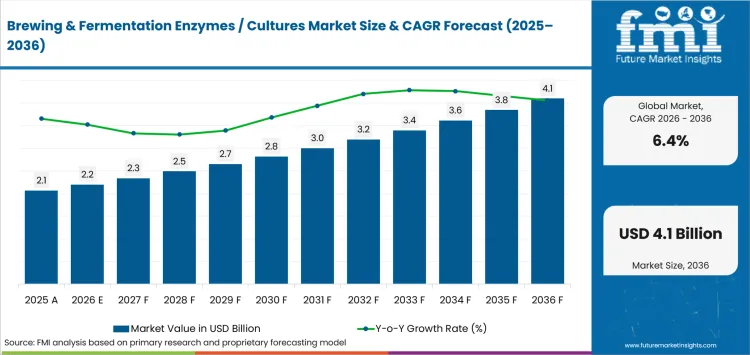
Key Takeaways of Brewing & Fermentation Enzymes / Cultures Market
- Demand for brewing and fermentation enzymes and cultures is shaped by the need to reduce batch inconsistency, manage starch conversion and filtration, and maintain repeatable flavor and fermentation outcomes across beer, dairy, and fermented food production.
- By product, Brewing Enzymes hold 45.9% share in 2026, while Beer accounts for 37.2% share in 2026 within application, reflecting measurable mash and filtration control alongside high-volume commercial brewing operations.
- China records the highest country CAGR at 8.4% through 2036, followed by Denmark at 8.0% and the United States at 7.6%, with differences shaped by brewing scale, fermentation expertise, grain supply, and regional enzyme approval pathways.
- Competition centers on IFF, Novonesis, Lallemand, Angel Yeast, AB Enzymes, DSM-Firmenich, and Kerry, with differentiation spanning brewing enzyme portfolios, yeast culture systems, fermentation knowledge, taste support, and plant-scale application and validation services.
- Regulatory documentation, side-by-side plant trial validation, strain stability, raw-material variability, and performance across storage and production conditions remain key considerations for wider adoption of brewing enzymes and fermentation cultures.
- Commercial success depends on whether ingredient systems improve routine production without increasing approval burden, with expansion expected to follow measured brewing enzyme performance before broader culture system adoption.
Analyst Perspective
"The brewing & fermentation enzymes / cultures market is increasingly defined by measurable process gains alongside consistent sensory performance. Brewers are evaluating yield, flavor stability, dosage requirements, and regulatory fit under routine production conditions. Suppliers that demonstrate repeatable results, provide clear application guidance, and support compliance requirements will be better positioned to expand across brewing and fermentation applications."
- Nandini Roy Choudhury, Principal Analyst at Future Market Insights
Source: FMI's proprietary forecasting model and primary research
How is the Brewing & Fermentation Enzymes / Cultures Market segmented?
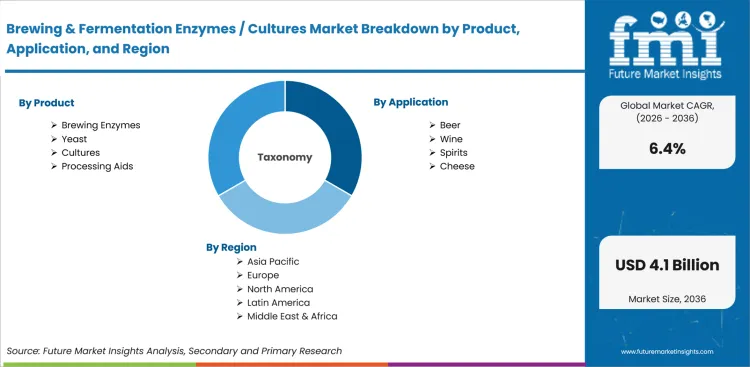
The brewing & fermentation enzymes / cultures industry is segmented by product, application and region.
The segmentation framework separates the ingredient type from the process where it is used. Product analysis covers brewing enzymes, yeast cultures and processing aids. Application analysis separates beer and wine from spirits and cheese. Regional analysis compares approval routes and production economics across countries with different brewing and fermented-food bases.
What supports demand for brewing enzymes within the product category?
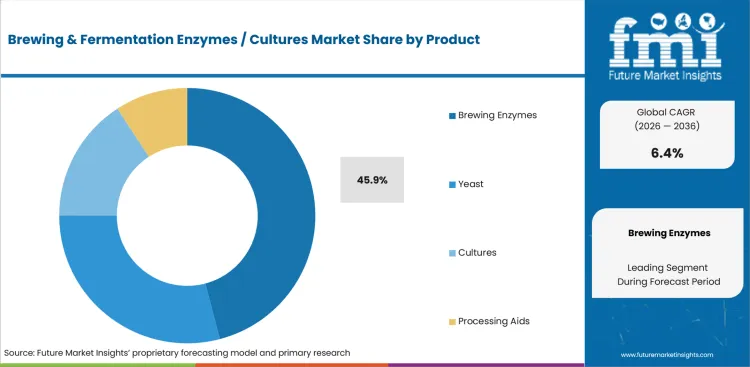
Brewing enzymes are expected to lead product demand. They influence conversion and filtration before fermentation results are locked in. Novonesis introduced Termamyl Prime in December 2025 for high-gravity brewing and difficult barley conditions. This figure support a practical demand case for fermented food enzymes where plants test performance inside the process.
- With an estimated 45.9% of product revenue in 2026, brewing enzymes are anticipated to lead Product demand through mash and filtration control.
- These enzymes help brewers convert starch more consistently when barley quality varies between crops or raw-material sources.
- Plant trials compare extract yield and final beer quality before regular use expands across production lines.
What makes beer central to the application category?
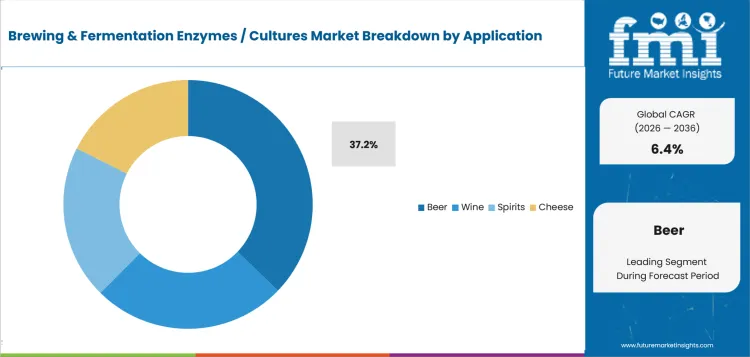
Beer remains the leading application, as commercial brewing turns enzyme and yeast performance into measurable plant records. Eurostat reported in August 2025 that EU countries produced 34.7 billion litres of beer in 2024. TTB beer reports rely on operating records in the USA. These reporting systems make beer a clear testing ground for enzymes and cultures before the same approach enters wider precision fermentation use.
- By application, beer is forecast to hold 37.2% share in 2026 through its direct testing role in mash performance and fermentation control.
- Low/no-alcohol beer is expected to add reformulation work since taste and mouthfeel are harder to protect after alcohol reduction.
- Commercial brewers are expected to approve ingredient changes when trial records show stable gravity and sensory outcomes.
What are the drivers, restraints and opportunities in the Brewing & Fermentation Enzymes / Cultures Market?
Demand is supported by brewing-process control, food-enzyme approval requirements and low/no-alcohol product development.
- Driver: Demand is expected to be driven by mash conversion control and stable fermentation quality during regular production.
- Restraint: Adoption slows when an enzyme or culture needs a country-specific technical file before routine use.
- Opportunity: Low/no-alcohol beer and high-gravity brewing create openings for ingredients that protect taste and reduce process loss.
The main driver is expected to come from controlled processing. Brewing enzymes support mash conversion and filtration before yeast performance shapes the finished product. Culture systems are expected to protect texture and flavor in cheese and fermented foods.
The main restraint is the cost of proving that a product is allowed and stable under local rules. EFSA states that Regulation EC 1332/2008 covers the EU list of approved food enzymes and labeling requirements. EFSA updated its administrative guidance for food-improvement applications on 27 January 2026. FDA closed GRN No. 1197 in March 2025 for a fructanase enzyme preparation at up to 12 mg TOS/kg raw material. Documentation remains a commercial barrier when plant trials move faster than regulatory files.
The primary opportunity is concentrated in beverage lines that require new sensory or process results without a brewery rebuild. IFF described no- and low-alcohol brewing as a bioscience use case in May 2026. These examples point to demand for alcohol dehydrogenase enzymes and other systems that protect beer quality during reformulation.
Which country CAGRs are profiled in the Brewing & Fermentation Enzymes / Cultures Market?
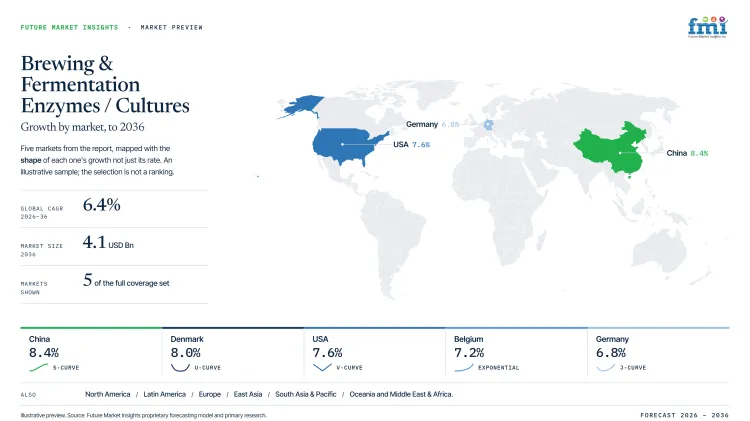
| Country | CAGR |
|---|---|
| China | 8.4% |
| Denmark | 8.0% |
| USA | 7.6% |
| Belgium | 7.2% |
| Germany | 6.8% |
How do country-level CAGRs compare in the Brewing & Fermentation Enzymes / Cultures Market?
A global growth rate represents the weighted average of all markets included in the analysis. It can remain below the growth rates of the five countries shown when other covered markets expand at more measured rates. This suggests that markets not shown here are growing at rates below 6.8%. The five countries presented are illustrative examples, and their comparison with the global figure makes this difference visible.
- The countries are distinguished less by their CAGRs, which remain within a range of 1.6 percentage points, and more by the market conditions supporting enzyme and culture adoption.
- China and Denmark form a closely aligned upper group. China benefits from large-scale food processing and grain availability. Denmark follows a different development model based on fermentation expertise and increasing alcohol-free beer production.
- The USA occupies the middle position through its established brewery base and structured ingredient-review pathways. Belgium and Germany form a closely spaced group. Belgium benefits from specialty brewing and export activity while Germany places greater emphasis on measurable cost savings and process improvements.
- Markets with broadly similar CAGRs can therefore follow substantially different development paths. These variations in regulatory documentation, plant validation and technical support become relevant when comparing potential entry points across the countries covered.
The full report examines these dynamics for every market included in the study. It provides country-level CAGR analysis across North America, Latin America, Europe, East Asia, South Asia, Oceania, and the Middle East and Africa.
Country-wise Analysis
- China combines food-processing scale with a large grain base that supports beer and fermented-food production. Demand in China is forecast to rise at 8.4% CAGR from 2026 to 2036 driven by industrial output and cereal supply security. The agency separately reported in December 2025 that grain output reached 714.88 million tons. Local application support is necessary given crop quality and plant conditions differ across provinces.
- Denmark brings fermentation know-how and a compact processing base that suits technical validation. Demand in Denmark is estimated to expand at 8.0% CAGR through 2036 supported by culture development and alcohol-free beer activity. Statistics Denmark reported in May 2026 that manufactured-goods sales reached DKK 1,156 billion in 2025. The figure gives context for local food and beverage input demand. The Danish Brewers’ Association reported in January 2026 that alcohol-free beer consumption rose 8% in 2025. Ingredient companies present taste and mouthfeel proof before processors switch from existing yeast or enzyme systems.
- United States breweries work under defined reporting and permit systems that shape ingredient approval timing. The USA is projected to post 7.6% CAGR over the forecast period aided by structured brewing records and established ingredient-review pathways. TTB reported in June 2026 that beer statistics come from the Brewer’s Report of Operations and the Quarterly Brewer’s Report of Operations. That reporting base raises the value of plant records when an enzyme change is tested. TTB data showed brewery permit processing took 46 median calendar days in May 2026. Both steps affect commercial approval, so ingredient companies separate performance claims from regulatory support.
- Belgium combines specialty beer depth with export exposure across European and overseas channels. Demand in Belgium is anticipated to advance at 7.2% CAGR through 2036 shaped by specialty brewing and low/no-alcohol reformulation. Belgian Brewers reported in June 2026 that low and no-alcohol beer rose 17% in 2025. Eurostat reported in August 2025 that Belgium exported 1.4 billion litres of beer in 2024. Export exposure makes flavor stability and clarity a larger issue during ingredient trials. Processors test cultures and enzymes under shipment conditions before wider use.
- Germany offers a large brewery base and mature process discipline across commercial and regional brewing. Demand in Germany is estimated to record 6.8% CAGR during the forecast period underpinned by repeat production and strict product expectations. Destatis reported in February 2026 that Germany had 1415 breweries in 2025. Eurostat reported in August 2025 that Germany produced 7.2 billion litres of beer in 2024. Destatis reported in February 2026 that German beer sales fell 6.0% in 2025. The sales backdrop means enzyme projects require a clear cost or yield case before wider purchasing.
Who are the notable companies in the Brewing & Fermentation Enzymes / Cultures Market?
IFF; Novonesis; Lallemand Inc.; AB Enzymes GmbH; DSM-Firmenich AG; Kerry Group plc; and Angel Yeast Co., Ltd. are the notable companies shaping this market.
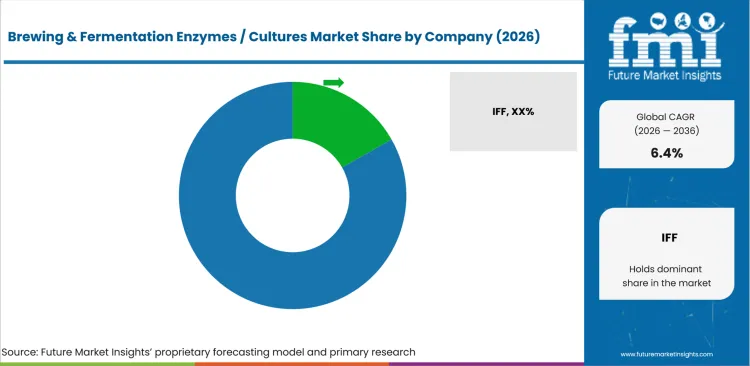
The competitive outlook combines enzyme makers with yeast and culture specialists that serve brewing and fermented-food processors. Enzyme companies compete through mash performance and process support. Yeast specialists compete through strain reliability and fermentation service. Culture and taste companies compete through formulation support when beverage or dairy processors change recipes.
- IFF and Novonesis compete through broad enzyme portfolios and technical support for brewing plants. Their commercial test is whether enzyme use improves mash performance under routine conditions.
- Lallemand Inc. and Angel Yeast Co., Ltd. focus on yeast and fermentation knowledge across beer and food applications. Their position depends on culture stability and plant-level support.
- AB Enzymes GmbH and DSM-Firmenich AG strengthen competition through food-enzyme and culture experience. Kerry Group plc adds taste and application support for beverage reformulation.
Competitive Benchmarking: Brewing & Fermentation Enzymes / Cultures Market
| Company | Brewing Enzymes | Yeast and Cultures | Application Support | Geographic Reach |
|---|---|---|---|---|
| IFF | High | Medium | High | Global |
| Novonesis | High | High | High | Global |
| Lallemand Inc. | Low | High | High | Global |
| AB Enzymes GmbH | High | Low | Medium | Global |
| DSM-Firmenich AG | Medium | High | High | Global |
| Kerry Group plc | Medium | Medium | High | Global |
| Angel Yeast Co., Ltd. | Low | High | Medium | Asia-led global reach |
Scoring basis: High indicates a documented core capability within the exact workflow and a dedicated commercial offer. Medium indicates direct support through an adjacent platform or application service. Low indicates limited public evidence for the named capability in brewing or fermentation operations.
Key Developments in the Brewing & Fermentation Enzymes / Cultures Market
- In December 2025, Novonesis introduced Termamyl Prime for high-gravity brewing and difficult barley conditions. The launch is relevant since starch conversion affects brewhouse capacity and production cost.
- In May 2026, IFF described brewing as a sector where barley quality affects mash performance and fermentation efficiency. The update supports demand for ingredient systems that reduce batch variation.
- In September 2025, Lallemand Brewing released LalBrew House Ale after benchmarking fermentation performance and yeast stability. The launch supports wider dry yeast choice for breweries seeking repeatable fermentation.
- In November 2025, Angel Yeast launched a Brewing Functional Microorganism Pilot Test Platform. The platform supports controlled testing of microbial behavior and flavor compounds for brewing applications.
Key Players in the Brewing & Fermentation Enzymes / Cultures Market
Brewing Enzyme Providers
- IFF
- Novonesis
- AB Enzymes GmbH
Yeast and Culture Specialists
- Lallemand Inc.
- Angel Yeast Co., Ltd.
- DSM-Firmenich AG
Application and Taste Support Providers
- Kerry Group plc
Brewing & Fermentation Enzymes / Cultures Market - Report Scope
| Coverage field | Report scope |
|---|---|
| Market breakdown | Product, application and region. |
| Quantitative Units | Revenue in USD Million, CAGR in %. |
| Market Definition | Enzymes, yeast cultures and related processing aids used to control brewing and fermentation performance in beverage and selected food applications. |
| Regions Covered | North America, Latin America, Europe, East Asia, South Asia & Pacific, Oceania and Middle East & Africa. |
| Countries Covered | China, Denmark, USA, Belgium and Germany. The full report covers 30+ countries. |
| Key Companies Profiled | IFF, Novonesis, Lallemand Inc., AB Enzymes GmbH, DSM-Firmenich AG, Kerry Group plc and Angel Yeast Co., Ltd. |
| Forecast Period | 2026 to 2036. |
| Approach | Hybrid bottom-up and top-down market sizing supported by primary interviews and official desk research. |
Brewing & Fermentation Enzymes / Cultures Market - Research Methodology
| Method | Approach |
|---|---|
| Primary Research | FMI analysts gathered input from ingredient companies, distributors, technical service teams, procurement staff and end-use processors. Interviews examined trial requirements, approval barriers, pricing pressure and technical support needs. |
| Desk Research | Desk research covered government beer statistics, national industrial data, food-enzyme rules, company product pages, official announcements and industry association releases. Sources were reviewed for date, relevance and market fit. |
| Market Sizing and Forecasting | The market model combined baseline value with segment structure, country production signals, application demand, ingredient pricing and approval burden. Segment and regional estimates were reconciled before the final total was calculated. |
| Data Validation | Estimates were checked against official data, company activity, trade patterns, industry releases and primary interview findings. Unsupported claims and activities outside the defined scope were excluded. |
Brewing & Fermentation Enzymes / Cultures Market by Segments
Brewing & Fermentation Enzymes / Cultures Market segmented by Product:
- Brewing Enzymes
- Yeast
- Cultures
- Processing Aids
Brewing & Fermentation Enzymes / Cultures Market segmented by Application:
- Beer
- Wine
- Spirits
- Cheese
Brewing & Fermentation Enzymes / Cultures Market by Region:
- North America
- United States
- Canada
- Latin America
- Brazil
- Mexico
- Argentina
- Chile
- Western Europe
- Germany
- France
- United Kingdom
- Italy
- Spain
- Benelux
- Nordics
- Eastern Europe
- Poland
- Czech Republic
- Romania
- Hungary
- East Asia
- China
- Japan
- South Korea
- South Asia and Pacific
- India
- ASEAN
- Australia and New Zealand
- Middle East and Africa
- GCC Countries
- South Africa
- Türkiye
- Israel
Research Sources and Bibliography
- Alcohol and Tobacco Tax and Trade Bureau. (2026, June 22). Processing times for original permit applications.
- Angel Yeast Co., Ltd. (2025, November 18). Angel Yeast commissions brewing functional microorganism pilot platform to accelerate industrial innovation.
- Eurostat. (2025, August 1). Beer production increases to 34.7 billion litres.
- Federal Statistical Office of Germany. (2026, February). Beer sales down in 2025.
- IFF. (2026, May 19). Why biosciences are becoming foundational to modern food & beverages production.
- Lallemand Brewing. (2025, September 15). LalBrew House Ale: A new standard in yeast performance.
- Novonesis. (2025, December 19). Novonesis introduces Termamyl Prime, a biosolution designed to boost brewers’ production efficiency and profitability. Novonesis.
This bibliography is provided for reader reference and is not exhaustive. The full report contains the complete reference list and detailed citations.
This Report Answers
- How large is the brewing & fermentation enzymes / cultures market in 2026 and 2036?
- Which product pressures support spending on brewing enzymes and fermentation cultures?
- Why do Brewing Enzymes hold the leading product share in 2026?
- How does Beer shape application demand through routine batch records?
- Which country markets show the highest forecast CAGRs through 2036?
- Which companies are active in brewing enzymes, yeast cultures and application support?
- What evidence supports the latest company and regulatory developments?
Frequently Asked Questions
How big is the Brewing and Fermentation Enzymes / Cultures Market in 2026?
The brewing and fermentation enzymes / cultures market is valued at USD 2.2 billion in 2026 and is forecast to reach USD 4.1 billion by 2036, reflecting growing demand from commercial breweries and fermented-food processors seeking consistent mash conversion control and stable fermentation results across routine production cycles.
What is the CAGR of the Brewing and Fermentation Enzymes / Cultures Market from 2026 to 2036?
The brewing and fermentation enzymes / cultures market is projected to grow at a CAGR of 6.4% between 2026 and 2036, supported by brewing-process control requirements and expanding low and no-alcohol beer production that creates demand for enzyme systems protecting taste and mouthfeel after alcohol reduction.
Which product leads the Brewing and Fermentation Enzymes / Cultures Market?
Brewing enzymes account for 45.9% of the brewing and fermentation enzymes / cultures market by product in 2026, driven by their role in controlling starch conversion and filtration performance before fermentation results are locked in across high-volume brewery and fermented-food production lines.
Which country is growing fastest in the Brewing and Fermentation Enzymes / Cultures Market?
The brewing and fermentation enzymes / cultures market in China is projected to expand at a CAGR of 8.4% through 2036, ahead of Denmark at 8.0%, the USA at 7.6%, Belgium at 7.2%, and Germany at 6.8%, reflecting large-scale food processing output and a substantial grain supply base supporting beer and fermented-food production.
Who are the leading companies in the Brewing and Fermentation Enzymes / Cultures Market?
Leading companies in the brewing and fermentation enzymes / cultures market include IFF, Novonesis, Lallemand Inc., AB Enzymes GmbH, DSM-Firmenich AG, Kerry Group plc, and Angel Yeast Co. Ltd., spanning broad brewing enzyme portfolios, yeast and culture systems, and application support for beverage reformulation and fermented-food processing globally.
Preview the report firsthand - request a free sample
Get SampleGet the brochure for pricing and purchase details.
Get PDFTable of Content
- Key Takeaways
- Market Size and CAGR
- Top Growth Driver
- Fastest Growing Segment
- Leading Region
- Key Companies
- Emerging Opportunities
- Executive Summary
- Global Market Outlook
- Demand-side Trends
- Supply-side Trends
- Technology Roadmap Analysis
- Analysis and Recommendations
- Analyst Perspective (What is happening? Why now? What should investors know?)
- Key Questions Answered
- How large is the market?
- What is the CAGR?
- What are key trends?
- Which region dominates?
- Who are the leaders?
- Market Overview
- Market Coverage / Taxonomy
- Market Definition / Scope / Limitations
- Research Methodology
- Chapter Orientation
- Analytical Lens and Working Hypotheses
- Market Structure, Signals, and Trend Drivers
- Benchmarking and Cross-market Comparability
- Market Sizing, Forecasting, and Opportunity Mapping
- Research Design and Evidence Framework
- Desk Research Programme (Secondary Evidence)
- Expert Input and Fieldwork (Primary Evidence)
- Tooling, Models, and Reference Databases
- Data Engineering and Model Build
- Quality Assurance and Audit Trail
- Market Background
- Market Dynamics (Drivers, Restraints, Opportunity, Trends)
- Scenario Forecast (Optimistic, Likely, Conservative)
- Impact Analysis
- AI Impact
- Sustainability Impact
- Regulatory Impact
- Technology Impact
- Consumer / Buyer Analysis
- Purchase Drivers
- Adoption Barriers
- Buyer Journey
- Opportunity Map Analysis
- Product Life Cycle Analysis
- Supply Chain Analysis
- Investment Feasibility Matrix
- Value Chain Analysis
- PESTLE and Porter's Analysis
- Regulatory Landscape
- Regional Parent Market Outlook
- Production and Consumption Statistics
- Import and Export Statistics
- Global Market Analysis and Forecast, 2021 to 2036
- Historical Market Size Value (USD Billion) Analysis, 2021 to 2025
- Current and Future Market Size Value (USD Billion) Projections, 2026 to 2036
- Y-o-Y Growth Trend Analysis
- Absolute $ Opportunity Analysis
- Global Market Pricing Analysis, 2021 to 2036
- Global Market Analysis and Forecast, By Product, 2021 to 2036
- Introduction / Key Findings
- Historical Market Size Value (USD Billion) Analysis By Product, 2021 to 2025
- Current and Future Market Size Value (USD Billion) Analysis and Forecast By Product, 2026 to 2036
- Brewing Enzymes
- Yeast
- Cultures
- Processing Aids
- Brewing Enzymes
- Y-o-Y Growth Trend Analysis By Product, 2021 to 2025
- Absolute $ Opportunity Analysis By Product, 2026 to 2036
- Global Market Analysis and Forecast, By Application, 2021 to 2036
- Introduction / Key Findings
- Historical Market Size Value (USD Billion) Analysis By Application, 2021 to 2025
- Current and Future Market Size Value (USD Billion) Analysis and Forecast By Application, 2026 to 2036
- Beer
- Wine
- Spirits
- Cheese
- Beer
- Y-o-Y Growth Trend Analysis By Application, 2021 to 2025
- Absolute $ Opportunity Analysis By Application, 2026 to 2036
- Global Market Analysis and Forecast, By Region, 2021 to 2036
- Introduction
- Historical Market Size Value (USD Billion) Analysis By Region, 2021 to 2025
- Current Market Size Value (USD Billion) Analysis and Forecast By Region, 2026 to 2036
- North America
- Latin America
- Western Europe
- Eastern Europe
- East Asia
- South Asia and Pacific
- Middle East & Africa
- Market Attractiveness Analysis By Region
- North America Market Analysis and Forecast, By Country, 2021 to 2036
- Historical Market Size Value (USD Billion) Trend Analysis By Market Taxonomy, 2021 to 2025
- Market Size Value (USD Billion) Forecast By Market Taxonomy, 2026 to 2036
- By Country
- USA
- Canada
- By Product
- By Application
- By Country
- Market Attractiveness Analysis
- By Country
- By Product
- By Application
- Key Takeaways
- Latin America Market Analysis and Forecast, By Country
- Historical Market Size Value (USD Billion) Trend Analysis By Market Taxonomy, 2021 to 2025
- Market Size Value (USD Billion) Forecast By Market Taxonomy, 2026 to 2036
- By Country
- Brazil
- Mexico
- Chile
- Rest of Latin America
- By Product
- By Application
- By Country
- Market Attractiveness Analysis
- By Country
- By Product
- By Application
- Key Takeaways
- Western Europe Market Analysis and Forecast, By Country
- Historical Market Size Value (USD Billion) Trend Analysis By Market Taxonomy, 2021 to 2025
- Market Size Value (USD Billion) Forecast By Market Taxonomy, 2026 to 2036
- By Country
- Germany
- UK
- Italy
- Spain
- France
- Nordic
- BENELUX
- Rest of Western Europe
- By Product
- By Application
- By Country
- Market Attractiveness Analysis
- By Country
- By Product
- By Application
- Key Takeaways
- Eastern Europe Market Analysis and Forecast, By Country
- Historical Market Size Value (USD Billion) Trend Analysis By Market Taxonomy, 2021 to 2025
- Market Size Value (USD Billion) Forecast By Market Taxonomy, 2026 to 2036
- By Country
- Russia
- Poland
- Hungary
- Balkan & Baltic
- Rest of Eastern Europe
- By Product
- By Application
- By Country
- Market Attractiveness Analysis
- By Country
- By Product
- By Application
- Key Takeaways
- East Asia Market Analysis and Forecast, By Country
- Historical Market Size Value (USD Billion) Trend Analysis By Market Taxonomy, 2021 to 2025
- Market Size Value (USD Billion) Forecast By Market Taxonomy, 2026 to 2036
- By Country
- China
- Japan
- South Korea
- By Product
- By Application
- By Country
- Market Attractiveness Analysis
- By Country
- By Product
- By Application
- Key Takeaways
- South Asia and Pacific Market Analysis and Forecast, By Country
- Historical Market Size Value (USD Billion) Trend Analysis By Market Taxonomy, 2021 to 2025
- Market Size Value (USD Billion) Forecast By Market Taxonomy, 2026 to 2036
- By Country
- India
- ASEAN
- Australia & New Zealand
- Rest of South Asia and Pacific
- By Product
- By Application
- By Country
- Market Attractiveness Analysis
- By Country
- By Product
- By Application
- Key Takeaways
- Middle East & Africa Market Analysis and Forecast, By Country
- Historical Market Size Value (USD Billion) Trend Analysis By Market Taxonomy, 2021 to 2025
- Market Size Value (USD Billion) Forecast By Market Taxonomy, 2026 to 2036
- By Country
- Kingdom of Saudi Arabia
- Other GCC Countries
- Türkiye
- South Africa
- Other African Union
- Rest of Middle East & Africa
- By Product
- By Application
- By Country
- Market Attractiveness Analysis
- By Country
- By Product
- By Application
- Key Takeaways
- Key Countries Market Analysis
- USA
- Pricing Analysis
- Market Share Analysis, 2025
- By Product
- By Application
- Canada
- Pricing Analysis
- Market Share Analysis, 2025
- By Product
- By Application
- Mexico
- Pricing Analysis
- Market Share Analysis, 2025
- By Product
- By Application
- Brazil
- Pricing Analysis
- Market Share Analysis, 2025
- By Product
- By Application
- Chile
- Pricing Analysis
- Market Share Analysis, 2025
- By Product
- By Application
- Germany
- Pricing Analysis
- Market Share Analysis, 2025
- By Product
- By Application
- UK
- Pricing Analysis
- Market Share Analysis, 2025
- By Product
- By Application
- Italy
- Pricing Analysis
- Market Share Analysis, 2025
- By Product
- By Application
- Spain
- Pricing Analysis
- Market Share Analysis, 2025
- By Product
- By Application
- France
- Pricing Analysis
- Market Share Analysis, 2025
- By Product
- By Application
- India
- Pricing Analysis
- Market Share Analysis, 2025
- By Product
- By Application
- ASEAN
- Pricing Analysis
- Market Share Analysis, 2025
- By Product
- By Application
- Australia & New Zealand
- Pricing Analysis
- Market Share Analysis, 2025
- By Product
- By Application
- China
- Pricing Analysis
- Market Share Analysis, 2025
- By Product
- By Application
- Japan
- Pricing Analysis
- Market Share Analysis, 2025
- By Product
- By Application
- South Korea
- Pricing Analysis
- Market Share Analysis, 2025
- By Product
- By Application
- Russia
- Pricing Analysis
- Market Share Analysis, 2025
- By Product
- By Application
- Poland
- Pricing Analysis
- Market Share Analysis, 2025
- By Product
- By Application
- Hungary
- Pricing Analysis
- Market Share Analysis, 2025
- By Product
- By Application
- Kingdom of Saudi Arabia
- Pricing Analysis
- Market Share Analysis, 2025
- By Product
- By Application
- Türkiye
- Pricing Analysis
- Market Share Analysis, 2025
- By Product
- By Application
- South Africa
- Pricing Analysis
- Market Share Analysis, 2025
- By Product
- By Application
- USA
- Market Structure Analysis
- Competition Dashboard
- Competition Benchmarking
- Market Share Analysis of Top Players
- By Regional
- By Product
- By Application
- Emerging Startups
- Innovation Benchmarking
- Competition Analysis
- Competition Deep Dive
- IFF
- Overview
- Product Portfolio
- Profitability by Market Segments
- Sales Footprint
- Strategy Overview
- Marketing Strategy
- Product Strategy
- Channel Strategy
- Novonesis (Novozymes/Chr. Hansen)
- Lallemand
- AB Enzymes
- DSM
- Kerry
- Angel Yeast
- IFF
- Case Studies
- Success Stories
- Recent Developments
- Competition Deep Dive
- Assumptions & Acronyms Used


