

- Market Size (2026)
- USD 645.2 Mn
- Forecast (2036)
- USD 2391.9 Mn
- CAGR (2026 to 2036)
- 14.0%
How big is the Fermentation-Derived Monk Fruit & Rare Sweetener Market in 2026?
USD 645.2 million in 2026 and USD 2,391.9 million by 2036 at a 14.0% CAGR.
Sales of fermentation-derived monk fruit and rare sweeteners are projected to expand at a 14.0% CAGR between 2026 and 2036. The industry valuation is forecast to rise from USD 645.2 million in 2026 to USD 2391.9 million by 2036. In September 2025, Cargill reported regulatory approvals for EverSweet across four major food markets worldwide. The announcement also confirmed adoption by major food and beverage brands that already use the precision-fermented stevia ingredient. Regulatory access and customer use must develop together for a new molecule to support recurring commercial programs. Commercial momentum for precision fermentation ingredients depends on consistent production and practical application support across each intended launch market.
International commercialization depends on route-specific approvals and complete technical files for each intended food category and production organism. In April 2025, the European Commission authorized steviol glycosides produced through Yarrowia lipolytica fermentation under Regulation (EU) 2025/652. The regulation defines permitted food categories and use conditions for E 960b throughout the European Union. Comparable rare sugar approvals remain national decisions and cannot transfer automatically across jurisdictions with different additive systems. Food manufacturers therefore need local labeling guidance and application testing for formulas planned across several countries. Commercial agreements should assign regulatory documentation and sensory validation to separate technical teams with clear responsibilities.
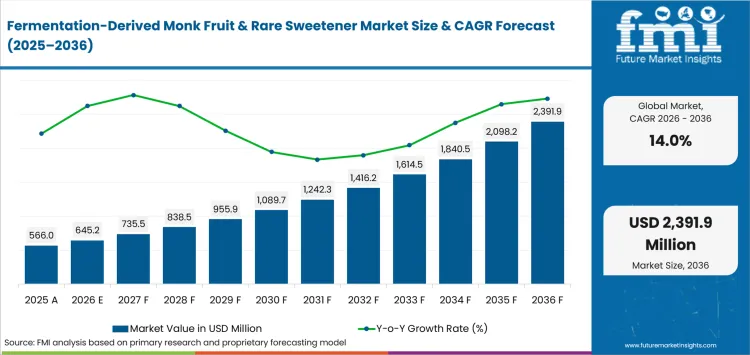
Key Takeaways of Fermentation-Derived Monk Fruit & Rare Sweetener Market
- Demand for fermentation-derived monk fruit and rare sweeteners is driven by controlled production separating supply from harvest volume and concentrated crop regions, reducing exposure to agricultural timing across long-term ingredient contracts.
- By product, fermented mogroside holds the leading share at 49.4% in 2026, attributable to demand for monk fruit sweetness beyond harvest-dependent extraction.
- Powder is the dominant form segment, holding 47.2% share in 2026, due to measured dosing and efficient storage across concentrated premixes.
- Beverages account for 41.3% application share in 2026, owing to clear sensory and stability testing during pilot production runs.
- Route-specific approvals remain critical to commercialization, determining whether a technically successful ingredient can enter recurring food-manufacturing programs under defined use conditions.
- China, Brazil, and the USA record CAGRs of 15.9%, 15.5%, and 15.1% respectively through 2036, though the narrow forecast range hides major differences in importer capability and technical documentation requirements.
- Competition centers on Manus, Bestzyme, Cargill, Sweegen, Tate & Lyle, and Ingredion, with vendors differentiating through commercial biomanufacturing scale-up, broader taste-system integration, and application laboratory support across regional distribution networks.
Analyst Perspective
The commercial test for fermented mogroside isn't sweetness intensity but whether a manufacturer can rebuild the bulk and browning functions sucrose provides, since high-potency sweeteners lower dose requirements while leaving a functional gap that fibers or polyols have to fill through a separate formulation route entirely. Manus's US-produced monk fruit launch matters less for its purity claims than for what it signals about supply diversification, since traceability beyond one agricultural region changes the risk profile for buyers who previously depended entirely on southern China cultivation. Beverages will likely remain the proving ground for these ingredients precisely because water offers no texture to mask sweetness onset or lingering notes, making it the format where a formulation's real sensory weaknesses surface before a company commits to solid-food applications with more forgiving matrices.
-Nandini Roy Choudhury, Principal Analyst at Future Market Insights
Source: FMI's proprietary forecasting model and primary research
How is the Fermentation-Derived Monk Fruit & Rare Sweetener Market segmented?
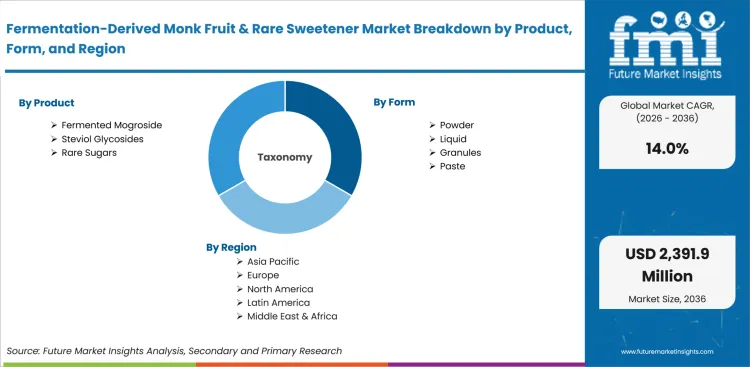
The fermentation-derived monk fruit and rare sweetener industry is segmented by product, form, application, and region.
The framework separates ingredient identity from physical handling and final food use across the complete commercialization route. Product analysis covers fermented mogroside and steviol glycosides together with rare sugars under distinct production routes. Form analysis compares powder with liquid formats and granules with paste through storage stability and dosing behavior. Application analysis compares beverages with dairy and bakery products through sweetness quality and texture or processing requirements. Regional analysis examines approval routes and application support across countries that use different food-additive systems. The structure links each molecule with the process that carries it into a finished food product. The comparison also separates regulatory barriers from formulation problems across the wider sweetener formulation market.
What supports demand for fermented mogroside within the product category?
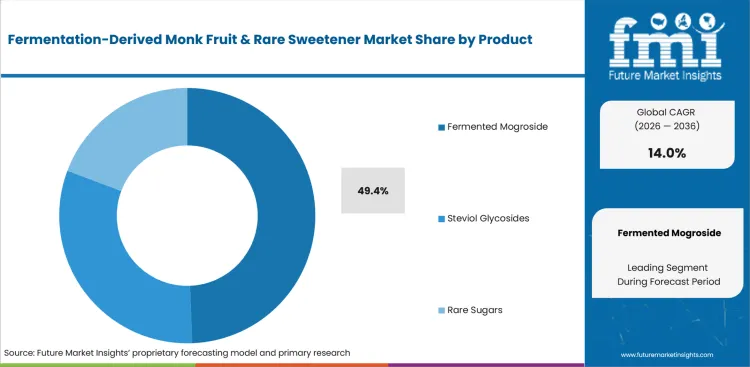
Fermented mogroside gives food manufacturers a second route to sweetness that has historically depended on monk fruit cultivation in southern China. In June 2026, Manus launched the first United States-produced monk fruit sweetener at commercial scale and began supplying formulation samples. The ingredient uses an optimized mogroside profile to support consistent purity and clean sweetness across repeated production batches. The launch diversifies supply for monk fruit ingredients that need traceability beyond one agricultural region.
- The fermented mogroside segment is likely to capture 49.4% share in 2026 attributable to demand for monk fruit sweetness beyond harvest-dependent extraction. The segment gives manufacturers a familiar taste target across monk fruit sugar programs that require stable batch profiles. Its position reflects demand for the specific mogroside rather than interest in fermentation-derived sweeteners as a whole.
- Food manufacturers should test fermented mogroside inside the complete flavor system under expected processing and storage conditions. High sweetness intensity lowers dose requirements but cannot replace the bulk and browning functions that sucrose provides. Fibers or polyols restore body across dairy and bakery formulas through a separate formulation mechanism. Adoption depends on sensory performance and complete regulatory documentation for every intended food category and production route.
How is powder positioned within the form category?
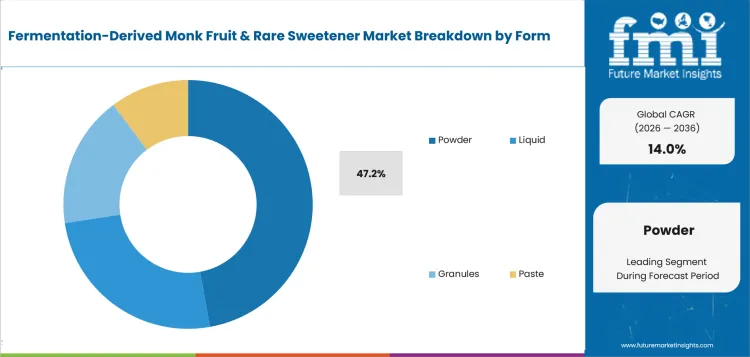
Powder suits dry premixes that require measured dosing and stable storage across concentrated sweetener systems. In April 2026, FDA closed GRN 1296 with no questions for erythritol produced through glucose fermentation by Yarrowia lipolytica. The notice permits sweetening and other formulation functions across specified food categories under FDA-reviewed conditions. The FDA record demonstrates how one fermentation-derived rare sugar can support several technical roles under a controlled specification. Production teams must control powder flow and moisture exposure together with dissolution so dosing remains stable during storage and mixing.
- The form category is forecast to be led by powder at 47.2% share in 2026 due to measured dosing and efficient storage across concentrated premixes. Comparable powdered stevia systems use moisture barriers to preserve flow properties during warehouse storage and repeated plant handling. Sealed packaging reduces agglomeration and dosing variation across routine production shifts and long inventory cycles.
- Plant operators should compare powder flow with dissolution speed and dust control across the intended production line. Humid handling creates agglomeration risks even if the active ingredient remains chemically stable throughout storage. Product specifications should define moisture limits and particle behavior together with packaging protection across storage and production. These controls preserve dosing accuracy during normal warehouse storage and repeated production cycles without disrupting output.
What makes beverages central to the application category?
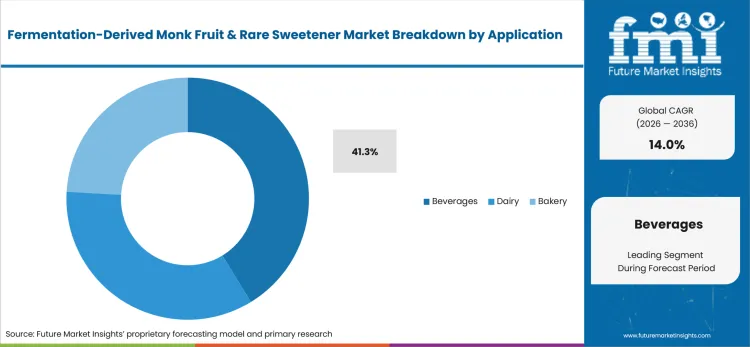
Beverages reveal sweetness onset and lingering notes more clearly than many solid foods due to limited texture masking in water. In March 2026, Oobli and SIG began joint development of protein-sweetened beverages for aseptic filling and shelf-stable packaging. The program covers beverage concepts and pilot runs together with consumer testing through SIG innovation centers. The partnership gives manufacturers a practical route for testing sweet protein systems across processing and ambient distribution.
- The beverages application is projected to hold 41.3% share in 2026 owing to clear sensory and stability testing during pilot production. Liquid trials expose acidity response and lingering sweetness during controlled runs that precede full commercial filling. Packaging trials also reveal whether the formula needs taste modulation or added bulk during shelf storage.
- Beverage manufacturers should validate the complete formula across processing temperature and the intended commercial shelf life. Acids and flavor systems change the finish of high-intensity ingredients during extended storage and distribution. Commercial acceptance depends on solubility and sensory targets together with stability limits under the actual filling process. Final packaging must preserve those results consistently through normal distribution and extended retail storage conditions.
What are the drivers, restraints, and opportunities in the Fermentation-Derived Monk Fruit & Rare Sweetener Market?
Commercial demand grows through consistent sweetener production and stronger sugar-reduction programs across several food categories. Route-specific approvals limit market entry even as new rare-sugar authorizations create focused formulation openings for qualified manufacturers.
- Driver: Food manufacturers need dependable sweetness and supply across repeated sugar-reduction programs in beverages and dairy or bakery products.
- Restraint: Each production route needs specific safety documentation and permitted-use conditions prior to legal commercial sale in every target country.
- Opportunity: Fermentation widens access to scarce molecules and supports blended systems that restore sweetness together with body and texture.
Food manufacturers are expanding sugar-reduction programs that need clean taste and repeatable supply across several product categories. In February 2025, Ingredion and Oobli formed a partnership that combines Oobli sweet proteins with Ingredion stevia solutions. The companies targeted beverages and other foods through established application support and regional commercial distribution networks. The arrangement gives naturally derived sweeteners a practical route for combining ingredients that address sweetness timing and mouthfeel. A complete system reduces reformulation work without relying on one high-intensity molecule for every sensory function.
Country-specific food rules slow entry by limiting each authorization to defined ingredients and permitted uses within a national system. In July 2025, Anvisa opened a public consultation on maximum levels and technological functions for additives across specific food categories. Brazilian food companies must secure an authorized use for each fermentation-derived ingredient prior to commercial production. Approval in another jurisdiction cannot replace the national safety assessment and labeling requirements for a Brazilian product. The additional work extends launch schedules through route-specific specifications and application files for each intended local use.
New rare-sugar authorizations create a practical opening for fermentation platforms that deliver consistent purity at commercial scale. In July 2025, China authorized D-allulose as a new food raw material and accepted microbial fermentation as a production route. The decision expands allulose applications for manufacturers that meet the stated quality and daily intake conditions. Formulators combine its bulk contribution with high-intensity sweeteners across beverages and other reduced-sugar foods and preserve product body during reformulation. Commercial success depends on production economics and complete local documentation for every finished application in the target country.
Which country CAGRs are profiled in the Fermentation-Derived Monk Fruit & Rare Sweetener Market?
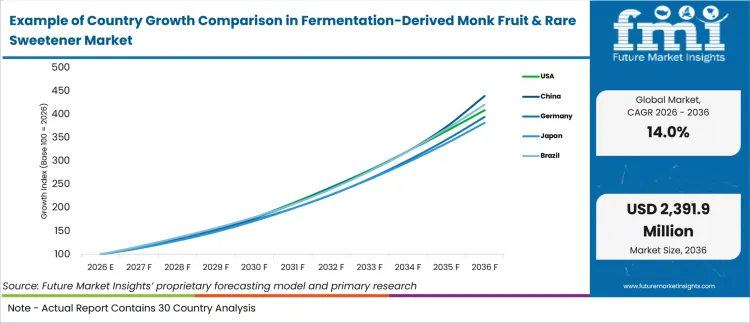
| Country | CAGR |
|---|---|
| USA | 15.1% |
| China | 15.9% |
| Germany | 14.7% |
| Japan | 14.3% |
| Brazil | 15.5% |
How do country-level CAGRs compare in the Fermentation-Derived Monk Fruit & Rare Sweetener Market?
The forecasts span 1.6 percentage points and therefore show similar momentum without identical national entry conditions. China and Brazil form the upper pair through a narrow 0.4-point separation that offers limited strategic distinction. The USA occupies the midpoint and remains equally distant from Germany within the displayed forecast sequence. Germany and Japan form the lower pair through another 0.4-point interval with different regulatory routes. Commercial planning should prioritize legal access and technical service rather than minor differences between neighboring forecast rates.
- China combines the upper forecast band with a national route that recognizes defined fermentation processes for approved sweetener ingredients. Foreign developers need Chinese technical files and local formulation support for customer trials to progress into routine production.
- Brazil tracks closely beside China but applies positive authorization rules that exclude ingredients accepted in several foreign markets. Regulatory counsel and prepared importers therefore carry greater commercial weight than the narrow forecast difference.
- The United States occupies the midpoint and offers a GRAS notification route for specific production organisms and intended food uses. Food brands also need category-level sensory work so a safety conclusion can support recurring commercial orders.
- Germany follows European Union additive rules and maintains national scrutiny of sweetener exposure across formulated food categories. Beverage manufacturers need permitted-use checks and application evidence designed for local reformulation programs and shelf-life targets.
- Japan closes the displayed range through a food-additive system built around approved specifications and formal use standards. Local importer knowledge and responsive technical service remain necessary for fermentation-derived ingredients entering customer qualification.
Country CAGRs should be assessed beside legal sale status and customer concentration rather than treated as absolute revenue rankings. A country with a narrower rate can support larger contracts through established ingredient groups serving major food manufacturers. The full report provides country-level CAGR analysis across North America and Latin America together with Europe and East Asia. Coverage also includes South Asia and Oceania together with the Middle East and Africa across distinct regional markets.
Country-wise Analysis
- United States food companies can use the GRAS notification route for defined fermentation-derived sweeteners and stated food uses. Fermentation-derived monk fruit and rare sweetener demand in the United States is forecast to rise at a 15.1% CAGR over the forecast period, reinforced by GRAS access and application support. In June 2026, FDA closed GRN 1293 from Sweegen with no questions for a fermentation-produced brazzein preparation used as a general-purpose sweetener. The FDA conclusion gives sweet protein developers a documented legal enabler across several food categories. Each notifier must support the exact production organism and final specifications through a complete technical dossier. Food manufacturers must restore sugar bulk and mouthfeel through application work inside the finished formula. Regional laboratories and established distributors reduce service distance across major United States food-manufacturing regions during customer qualification.
- China combines large fermentation capacity with a national review route for new food ingredients and additive production processes. In November 2025, the National Health Commission authorized fermentation-produced steviol glycosides within food categories already approved for steviol glycosides. The Chinese fermentation-derived monk fruit and rare sweetener sector is projected to record a 15.9% CAGR during the assessment period, driven by domestic fermentation capacity and new ingredient approvals. The authorization creates a direct enabler for companies that meet the stated quality specifications during commercial entry. Commercial friction comes from Chinese technical files and local labeling together with importer coordination during initial qualification. Foreign producers need regional technical staff and qualified distribution partners across long internal service distances. Local fermentation infrastructure shortens supply routes for approved products with completed documentation and application testing across national customers.
- Germany operates under European Union additive authorizations and national monitoring of sweetener exposure across processed foods. In September 2025, the German Federal Institute for Risk Assessment reported lower sugar content in soft drinks and greater use of drinks sweetened exclusively with sweeteners. The findings support active beverage reformulation but do not remove product-specific taste and exposure reviews. Germany's fermentation-derived monk fruit and rare sweetener outlook is anticipated to advance at a 14.7% CAGR over the assessment period, supported by established beverage manufacturing and application laboratories. Commercial friction includes permitted-use checks and sensory differences across several beverage categories during customer qualification. German application laboratories provide a direct enabler through acidity and flavor testing together with commercial shelf-life work. Commercial agreements should assign compliance records and sensory corrections to named regulatory and formulation specialists.
- Japan uses a positive food-additive system that combines safety review with detailed specifications and formal use standards. Adoption of fermentation-derived monk fruit and rare sweetener in Japan is estimated to expand at a 14.3% CAGR through 2036, linked to precise formulation practices and formal food-additive specifications. Local importer knowledge and complete production records help developers navigate national review and customer qualification requirements. In February 2025, the Consumer Affairs Agency added an English version of the tenth food-additive compendium covering composition and manufacturing together with use and labeling standards. Commercial friction includes Japanese specifications and application testing across each intended food category during qualification. Producers need local partners that resolve technical questions without delaying importer decisions or customer trials. Service coverage around major food-manufacturing clusters improves qualification support during initial commercial programs and product trials.
- Brazil applies a positive authorization system for food additives and requires safety evaluation for ingredients without local use history. In December 2025, Anvisa stated that allulose was not authorized as a sweetener or food ingredient and prohibited an affected product. Fermentation-derived monk fruit and rare sweetener sales in Brazil are forecast to expand at a 15.5% CAGR by 2036, shaped by beverage reformulation and strict local authorization. The action prevents companies from transferring foreign approvals into Brazil without a complete local review. Established beverage manufacturers and regional distributors create a direct enabler for ingredients that secure national authorization. Import documentation and application support remain material commercial frictions during customer qualification and initial production. Market entry requires regulatory counsel and dependable technical service across regional food-manufacturing programs and customer trials.
Who are the notable companies in the Fermentation-Derived Monk Fruit & Rare Sweetener Market?
Manus, Cargill, Tate & Lyle, Sweegen, Bestzyme, Oobli, Ingredion, and Amai Proteins are the notable companies shaping this market.
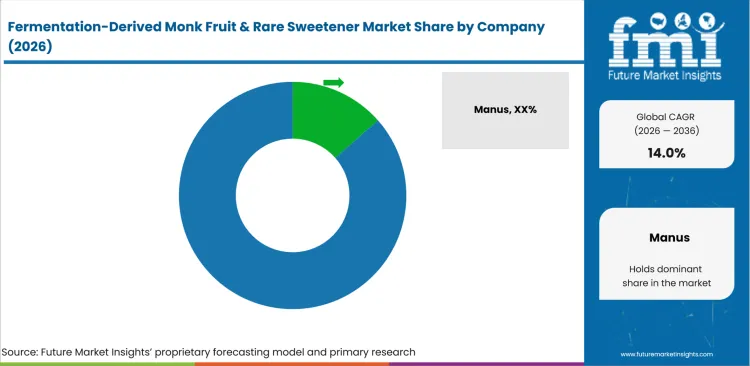
The competitive field combines fermentation developers with ingredient groups that scale supply and solve formulation problems across several food categories. In February 2026, Manus opened a purpose-built Singapore application hub for customers throughout the Asia-Pacific region. The hub provides hands-on formulation testing and regional technical service for sweeteners and other complex ingredients. The expansion demonstrates that commercial reach depends on application capability alongside molecule production and manufacturing scale. Comparable sugar substitute portfolios compete through regulatory files and taste systems together with dependable logistics. Specialists differentiate through novel molecules; larger ingredient groups reduce qualification risk through established distribution and application laboratories.
- Manus and Bestzyme develop fermentation platforms for mogrosides and sweet proteins across commercial production programs. Oobli and Amai Proteins focus on designed sweet proteins that require regulatory files and application testing. In July 2026, Bestzyme presented Mellia® beverage and confectionery prototypes during IFT FIRST in Chicago. Competition across this group centers on repeatable batch quality and route-specific files together with sensory performance.
- Cargill and Sweegen combine fermentation-derived sweeteners with broader taste systems and established commercial supply networks. Their scale supports multi-country programs that require dependable delivery and consistent application results across several food categories. Competition in this group centers on supply continuity and documentation together with control of off-notes during sugar reduction.
- Tate & Lyle and Ingredion connect emerging molecules with formulation laboratories and regional commercial networks across major food markets. Their application scientists test sweetness timing and mouthfeel together with stability across beverages and other foods. Their advantage comes from shorter reformulation cycles with use-specific documentation and production-route records retained for each program.
Competitive Benchmarking: Fermentation-Derived Monk Fruit & Rare Sweetener Market
| Company | Fermentation Portfolio | Scale and Supply | Formulation Support | Geographic Reach |
|---|---|---|---|---|
| Manus | High | High | High | North America and Asia-Pacific |
| Cargill | Medium | High | High | Global |
| Tate & Lyle | Medium | Medium | High | Global |
| Sweegen | High | Medium | High | Global |
| Bestzyme | Medium | Medium | High | China and international customer programs |
| Oobli | High | Medium | High | United States and Andean partner markets |
| Ingredion | Medium | Low | High | Global |
| Amai Proteins | Medium | Low | Medium | Israel and United States |
Key Developments in the Fermentation-Derived Monk Fruit & Rare Sweetener Market
- In February 2026, Manus and Tate & Lyle launched Yume™ under The Sweetener Alliance for commercial sugar-reduction programs. Manus produces Yume™ M Stevia at its Augusta biomanufacturing facility and Tate & Lyle provides formulation expertise with market access. The launch creates a regional stevia supply route with traceability from production through food and beverage application work. Regional production shortens supply lines and improves response times during formulation scale-up across North and South American programs.
- In February 2026, Amai Proteins received FDA closure of GRN 1269 with no questions for sweelin® as a general-purpose sweetener. The precision-fermented monellin preparation gained a defined United States route for product trials and commercial discussions with food manufacturers. The milestone adds another sweet protein family to the available sugar-reduction toolkit across several food categories. Each manufacturer must complete application testing for the intended beverage or food system during commercial qualification.
- In April 2026, Oobli and Magdalena's Biochem Unit formed an Andean manufacturing and development hub for commercial sweet proteins. The partnership combines Oobli's fermentation processes with Magdalena's industrial infrastructure and regional sugar-based feedstock for commercial production. Regional manufacturing shortens delivery routes and supports local regulatory work across Central and South American markets. The hub gives sweet protein programs a clearer path from formulation trials to scaled regional supply.
- In April 2025, Bestzyme received FDA closure of GRN 1207 with no questions for a fermentation-produced brazzein preparation. The regulator record establishes a defined United States route for use as a general-purpose sweetener under stated conditions. The milestone strengthens Bestzyme's commercial position across beverage and confectionery programs requiring clean sweetness at low use levels. Food manufacturers must confirm taste and stability inside each finished formula during customer qualification work.
Key Players in the Fermentation-Derived Monk Fruit & Rare Sweetener Market
Biomanufacturing and Molecule Developers
- Manus
- Bestzyme
- Oobli
- Amai Proteins
Scaled Sweetener Manufacturers
- Cargill
- Sweegen
Formulation and Commercialization Specialists
- Tate & Lyle
- Ingredion
Fermentation-Derived Monk Fruit & Rare Sweetener Market - Report Scope
| Coverage field | Report scope |
|---|---|
| Market breakdown | Product, form, application, and region. |
| Quantitative Units | Revenue in USD Million, CAGR in %. |
| Market Definition | Revenue from fermentation-derived monk fruit sweeteners and fermentation-produced rare sugars or sweet proteins sold for food and beverage use. The scope includes ingredient supply and directly related commercial services but excludes conventional crop extraction without a fermentation step. |
| Regions Covered | North America, Latin America, Western Europe, Eastern Europe, East Asia, South Asia and Pacific, and Middle East and Africa. |
| Countries Covered | USA, China, Germany, Japan, Brazil, plus more than twenty-five additional countries across the regions covered. |
| Key Companies Profiled | Manus, Cargill, Tate & Lyle, Sweegen, Bestzyme, Oobli, Ingredion, and Amai Proteins |
| Forecast Period | 2026 to 2036. |
| Approach | Hybrid bottom-up and top-down market sizing supported by primary interviews and authoritative desk research. |
Fermentation-Derived Monk Fruit & Rare Sweetener Market - Research Methodology
| Method | Approach |
|---|---|
| Primary Research | FMI analysts gathered input from manufacturers, service providers, technology developers, distributors, end users, procurement teams, and subject-matter experts. Interviews examined purchasing decisions, product or service evaluation, adoption barriers, approval requirements, pricing considerations, and expectations for technical or commercial support. Respondents were also asked what evidence is required before a trial, pilot, or initial order develops into regular purchasing. |
| Desk Research | Desk research covered government statistics, regulatory publications, trade data, industry associations, technical literature, standards, company filings, product information, and official corporate announcements. Sources were reviewed for relevance, publication date, geographic coverage, and consistency with the defined market scope. Claims relating to performance, applications, approvals, capacity, investment, and commercial activity were retained only when supported by credible public evidence. |
| Market Sizing and Forecasting | The market model combined the baseline value with historical performance, segment structure, pricing and volume indicators, adoption levels, company participation, and country-level demand conditions. Forecast assumptions considered economic activity, investment trends, regulatory developments, technology adoption, purchasing cycles, supply availability, and barriers to wider market use. Segment and regional estimates were reconciled before the final market total was calculated. |
| Data Validation | Estimates were checked against multiple independent indicators, including public data, company activity, trade patterns, industry developments, and findings from primary interviews. Validation also tested whether products, services, applications, and company revenues fell within the defined market boundaries. Adjacent categories, unsupported claims, overlapping revenues, and activities without direct market relevance were excluded to reduce double counting and maintain consistency across segments and countries. |
Fermentation-Derived Monk Fruit & Rare Sweetener Market by Segments
Fermentation-Derived Monk Fruit & Rare Sweetener Market segmented by Product:
- Fermented Mogroside
- Steviol Glycosides
- Rare Sugars
Fermentation-Derived Monk Fruit & Rare Sweetener Market segmented by Form:
- Powder
- Liquid
- Granules
- Paste
Fermentation-Derived Monk Fruit & Rare Sweetener Market segmented by Application:
- Beverages
- Dairy
- Bakery
Fermentation-Derived Monk Fruit & Rare Sweetener Market by Region:
- North America
- United States
- Canada
- Latin America
- Brazil
- Mexico
- Argentina
- Chile
- Western Europe
- Germany
- France
- United Kingdom
- Italy
- Spain
- Benelux
- Nordics
- Eastern Europe
- Poland
- Czech Republic
- Romania
- Hungary
- East Asia
- China
- Japan
- South Korea
- South Asia and Pacific
- India
- ASEAN
- Australia and New Zealand
- Middle East and Africa
- GCC Countries
- South Africa
- Türkiye
- Israel
Research Sources and Bibliography
- Agência Nacional de Vigilância Sanitária. (2025, July 9). Anvisa abre consulta pública sobre aditivos e coadjuvantes alimentares.
- Agência Nacional de Vigilância Sanitária. (2025, December 22). Anvisa proíbe alimento com ingrediente não autorizado.
- Bundesinstitut für Risikobewertung. (2025, September 26). Health risk assessment of the use of sweeteners in soft drinks.
- Cargill. (2025, September 26). Cargill’s EverSweet® stevia sweetener named a finalist in the 2025 Global Good Awards Game Changing Innovation of the Year.
- Consumer Affairs Agency. (2025, February 5). 第10版食品添加物公定書.
- Bestzyme. (2026, July 16). Successful Conclusion at IFT FIRST 2026 | Bestzyme's Mellia® Sweet Protein Reshapes the Global Sugar Reduction Trend.
- European Commission. (2025, April 2). Commission Regulation (EU) 2025/652 of 2 April 2025 amending Regulation (EC) No 1333/2008 of the European Parliament and the Council and Commission Regulation (EU) No 231/2012 as regards the use of Steviol glycosides produced by fermentation using Yarrowia lipolytica.
- USA Food and Drug Administration. (2025, April 10). GRN No. 1207: Brazzein preparation produced by Aspergillus oryzae 90402 expressing a gene encoding for brazzein from Pentadiplandra brazzeana.
- USA Food and Drug Administration. (2026, June 23). GRN No. 1293: Brazzein preparation produced by Komagataella phaffii RA-b expressing a gene encoding for brazzein from Pentadiplandra brazzeana.
- USA Food and Drug Administration. (2026, April 7). GRN No. 1296: Erythritol produced through fermentation of glucose by Yarrowia lipolytica.
- Ingredion. (2025, February 28). Ingredion y Oobli anuncian alianza ante la creciente demanda de proteínas dulces.
- Manus. (2026, February 5). Manus opens a purpose-built application hub in Singapore to serve Asia-Pacific.
- Manus. (2026, June 18). Made in America: Manus unveils the first monk fruit sweetener produced in the USA at commercial scale.
- National Health Commission of the People’s Republic of China. (2025, July 2). 解读《关于D-阿洛酮糖等20种“三新食品”的公告》(2025年第4号).
- National Health Commission of the People’s Republic of China. (2025, November 27). 解读《关于威尼斯镰刀菌蛋白等14种“三新食品”的公告》(2025年第7号).
- Oobli. (2026, March 18). SIG and Oobli Announce Strategic Partnership to Advance Protein-Sweetened Beverages in Aseptic Packaging Solutions.
- Oobli. (2026, April 15). Oobli Sweet Proteins Announces Andean Regional Manufacturing Partnership with Magdalena's New Biochem Unit.
- USA Food and Drug Administration. (2026, February 4). GRN No. 1269: Monellin preparation produced by Komagataella phaffii CBS 150005 expressing a gene encoding for a modified monellin.
- Tate & Lyle. (2026, February 23). Introducing Yume™: A new standard for sweetness.
This bibliography is provided for reader reference and is not exhaustive. The full report contains the complete reference list and detailed citations.
This Report Answers
- How large is the fermentation-derived monk fruit and rare sweetener market in 2026 and 2036?
- Which regulatory developments support commercial use of fermentation-derived sweeteners across major markets?
- Why does fermented mogroside account for a prominent product share in 2026?
- How does powder support handling and qualification across concentrated sweetener systems?
- Why do beverages account for a prominent application share in 2026?
- How do country growth rates differ across China, Brazil, the USA, Germany, and Japan?
- Which companies develop molecules or supply fermentation-derived sweetener systems?
- What limits commercialization across different regulatory and formulation environments?
- How should manufacturers compare scale with sensory performance and technical support?
Frequently Asked Questions
How big is the Fermentation-Derived Monk Fruit & Rare Sweetener Market in 2026?
The fermentation-derived monk fruit and rare sweetener market is valued at USD 645.2 million in 2026 and is forecast to reach USD 2391.9 million by 2036. Growth reflects controlled production separating supply from harvest volume and concentrated crop regions across long-term ingredient contracts worldwide.
What is the CAGR of the Fermentation-Derived Monk Fruit & Rare Sweetener Market from 2026 to 2036?
The fermentation-derived monk fruit and rare sweetener market grows at a CAGR of 14.0% between 2026 and 2036, supported by food manufacturers needing dependable sweetness and supply across repeated sugar-reduction programs in beverages, dairy, and bakery products.
Which product leads the Fermentation-Derived Monk Fruit & Rare Sweetener Market?
Fermented mogroside accounts for 49.4% of the fermentation-derived monk fruit and rare sweetener market by product in 2026, attributable to demand for monk fruit sweetness beyond harvest-dependent extraction across stable batch production programs.
Why should executives track the fermentation-derived monk fruit and rare sweetener market?
The fermentation-derived monk fruit and rare sweetener market is set to add USD 1746.7 million between 2026 and 2036, growing from USD 645.2 million to USD 2391.9 million as fermentation-derived sweeteners extend across a widening base of beverage, dairy, and bakery reformulation programs.
Who are the leading companies in the Fermentation-Derived Monk Fruit & Rare Sweetener Market?
Five companies lead the fermentation-derived monk fruit and rare sweetener market, including Manus, Bestzyme, Cargill, Sweegen, and Tate & Lyle, competing through commercial biomanufacturing scale-up, broader taste-system integration, and application laboratory support.
Preview the report firsthand - request a free sample
Get SampleGet the brochure for pricing and purchase details.
Get PDFTable of Content
- Key Takeaways
- Market Size and CAGR
- Top Growth Driver
- Fastest Growing Segment
- Leading Region
- Key Companies
- Emerging Opportunities
- Executive Summary
- Global Market Outlook
- Demand-side Trends
- Supply-side Trends
- Technology Roadmap Analysis
- Analysis and Recommendations
- Analyst Perspective (What is happening? Why now? What should investors know?)
- Key Questions Answered
- How large is the market?
- What is the CAGR?
- What are key trends?
- Which region dominates?
- Who are the leaders?
- Market Overview
- Market Coverage / Taxonomy
- Market Definition / Scope / Limitations
- Research Methodology
- Chapter Orientation
- Analytical Lens and Working Hypotheses
- Market Structure, Signals, and Trend Drivers
- Benchmarking and Cross-market Comparability
- Market Sizing, Forecasting, and Opportunity Mapping
- Research Design and Evidence Framework
- Desk Research Programme (Secondary Evidence)
- Expert Input and Fieldwork (Primary Evidence)
- Tooling, Models, and Reference Databases
- Data Engineering and Model Build
- Quality Assurance and Audit Trail
- Market Background
- Market Dynamics (Drivers, Restraints, Opportunity, Trends)
- Scenario Forecast (Optimistic, Likely, Conservative)
- Impact Analysis
- AI Impact
- Sustainability Impact
- Regulatory Impact
- Technology Impact
- Consumer / Buyer Analysis
- Purchase Drivers
- Adoption Barriers
- Buyer Journey
- Opportunity Map Analysis
- Product Life Cycle Analysis
- Supply Chain Analysis
- Investment Feasibility Matrix
- Value Chain Analysis
- PESTLE and Porter's Analysis
- Regulatory Landscape
- Regional Parent Market Outlook
- Production and Consumption Statistics
- Import and Export Statistics
- Global Market Analysis and Forecast, 2021 to 2036
- Historical Market Size Value (USD Million) Analysis, 2021 to 2025
- Current and Future Market Size Value (USD Million) Projections, 2026 to 2036
- Y-o-Y Growth Trend Analysis
- Absolute $ Opportunity Analysis
- Global Market Pricing Analysis, 2021 to 2036
- Global Market Analysis and Forecast, By Product, 2021 to 2036
- Introduction / Key Findings
- Historical Market Size Value (USD Million) Analysis By Product, 2021 to 2025
- Current and Future Market Size Value (USD Million) Analysis and Forecast By Product, 2026 to 2036
- Fermented Mogroside
- Steviol Glycosides
- Rare Sugars
- Fermented Mogroside
- Y-o-Y Growth Trend Analysis By Product, 2021 to 2025
- Absolute $ Opportunity Analysis By Product, 2026 to 2036
- Global Market Analysis and Forecast, By Form, 2021 to 2036
- Introduction / Key Findings
- Historical Market Size Value (USD Million) Analysis By Form, 2021 to 2025
- Current and Future Market Size Value (USD Million) Analysis and Forecast By Form, 2026 to 2036
- Powder
- Liquid
- Granules
- Paste
- Powder
- Y-o-Y Growth Trend Analysis By Form, 2021 to 2025
- Absolute $ Opportunity Analysis By Form, 2026 to 2036
- Global Market Analysis and Forecast, By Application, 2021 to 2036
- Introduction / Key Findings
- Historical Market Size Value (USD Million) Analysis By Application, 2021 to 2025
- Current and Future Market Size Value (USD Million) Analysis and Forecast By Application, 2026 to 2036
- Beverages
- Dairy
- Bakery
- Beverages
- Y-o-Y Growth Trend Analysis By Application, 2021 to 2025
- Absolute $ Opportunity Analysis By Application, 2026 to 2036
- Global Market Analysis and Forecast, By Region, 2021 to 2036
- Introduction
- Historical Market Size Value (USD Million) Analysis By Region, 2021 to 2025
- Current Market Size Value (USD Million) Analysis and Forecast By Region, 2026 to 2036
- North America
- Latin America
- Western Europe
- Eastern Europe
- East Asia
- South Asia and Pacific
- Middle East & Africa
- Market Attractiveness Analysis By Region
- North America Market Analysis and Forecast, By Country, 2021 to 2036
- Historical Market Size Value (USD Million) Trend Analysis By Market Taxonomy, 2021 to 2025
- Market Size Value (USD Million) Forecast By Market Taxonomy, 2026 to 2036
- By Country
- USA
- Canada
- By Product
- By Form
- By Application
- By Country
- Market Attractiveness Analysis
- By Country
- By Product
- By Form
- By Application
- Key Takeaways
- Latin America Market Analysis and Forecast, By Country
- Historical Market Size Value (USD Million) Trend Analysis By Market Taxonomy, 2021 to 2025
- Market Size Value (USD Million) Forecast By Market Taxonomy, 2026 to 2036
- By Country
- Brazil
- Mexico
- Chile
- Rest of Latin America
- By Product
- By Form
- By Application
- By Country
- Market Attractiveness Analysis
- By Country
- By Product
- By Form
- By Application
- Key Takeaways
- Western Europe Market Analysis and Forecast, By Country
- Historical Market Size Value (USD Million) Trend Analysis By Market Taxonomy, 2021 to 2025
- Market Size Value (USD Million) Forecast By Market Taxonomy, 2026 to 2036
- By Country
- Germany
- UK
- Italy
- Spain
- France
- Nordic
- BENELUX
- Rest of Western Europe
- By Product
- By Form
- By Application
- By Country
- Market Attractiveness Analysis
- By Country
- By Product
- By Form
- By Application
- Key Takeaways
- Eastern Europe Market Analysis and Forecast, By Country
- Historical Market Size Value (USD Million) Trend Analysis By Market Taxonomy, 2021 to 2025
- Market Size Value (USD Million) Forecast By Market Taxonomy, 2026 to 2036
- By Country
- Russia
- Poland
- Hungary
- Balkan & Baltic
- Rest of Eastern Europe
- By Product
- By Form
- By Application
- By Country
- Market Attractiveness Analysis
- By Country
- By Product
- By Form
- By Application
- Key Takeaways
- East Asia Market Analysis and Forecast, By Country
- Historical Market Size Value (USD Million) Trend Analysis By Market Taxonomy, 2021 to 2025
- Market Size Value (USD Million) Forecast By Market Taxonomy, 2026 to 2036
- By Country
- China
- Japan
- South Korea
- By Product
- By Form
- By Application
- By Country
- Market Attractiveness Analysis
- By Country
- By Product
- By Form
- By Application
- Key Takeaways
- South Asia and Pacific Market Analysis and Forecast, By Country
- Historical Market Size Value (USD Million) Trend Analysis By Market Taxonomy, 2021 to 2025
- Market Size Value (USD Million) Forecast By Market Taxonomy, 2026 to 2036
- By Country
- India
- ASEAN
- Australia & New Zealand
- Rest of South Asia and Pacific
- By Product
- By Form
- By Application
- By Country
- Market Attractiveness Analysis
- By Country
- By Product
- By Form
- By Application
- Key Takeaways
- Middle East & Africa Market Analysis and Forecast, By Country
- Historical Market Size Value (USD Million) Trend Analysis By Market Taxonomy, 2021 to 2025
- Market Size Value (USD Million) Forecast By Market Taxonomy, 2026 to 2036
- By Country
- Kingdom of Saudi Arabia
- Other GCC Countries
- Türkiye
- South Africa
- Other African Union
- Rest of Middle East & Africa
- By Product
- By Form
- By Application
- By Country
- Market Attractiveness Analysis
- By Country
- By Product
- By Form
- By Application
- Key Takeaways
- Key Countries Market Analysis
- USA
- Pricing Analysis
- Market Share Analysis, 2025
- By Product
- By Form
- By Application
- Canada
- Pricing Analysis
- Market Share Analysis, 2025
- By Product
- By Form
- By Application
- Mexico
- Pricing Analysis
- Market Share Analysis, 2025
- By Product
- By Form
- By Application
- Brazil
- Pricing Analysis
- Market Share Analysis, 2025
- By Product
- By Form
- By Application
- Chile
- Pricing Analysis
- Market Share Analysis, 2025
- By Product
- By Form
- By Application
- Germany
- Pricing Analysis
- Market Share Analysis, 2025
- By Product
- By Form
- By Application
- UK
- Pricing Analysis
- Market Share Analysis, 2025
- By Product
- By Form
- By Application
- Italy
- Pricing Analysis
- Market Share Analysis, 2025
- By Product
- By Form
- By Application
- Spain
- Pricing Analysis
- Market Share Analysis, 2025
- By Product
- By Form
- By Application
- France
- Pricing Analysis
- Market Share Analysis, 2025
- By Product
- By Form
- By Application
- India
- Pricing Analysis
- Market Share Analysis, 2025
- By Product
- By Form
- By Application
- ASEAN
- Pricing Analysis
- Market Share Analysis, 2025
- By Product
- By Form
- By Application
- Australia & New Zealand
- Pricing Analysis
- Market Share Analysis, 2025
- By Product
- By Form
- By Application
- China
- Pricing Analysis
- Market Share Analysis, 2025
- By Product
- By Form
- By Application
- Japan
- Pricing Analysis
- Market Share Analysis, 2025
- By Product
- By Form
- By Application
- South Korea
- Pricing Analysis
- Market Share Analysis, 2025
- By Product
- By Form
- By Application
- Russia
- Pricing Analysis
- Market Share Analysis, 2025
- By Product
- By Form
- By Application
- Poland
- Pricing Analysis
- Market Share Analysis, 2025
- By Product
- By Form
- By Application
- Hungary
- Pricing Analysis
- Market Share Analysis, 2025
- By Product
- By Form
- By Application
- Kingdom of Saudi Arabia
- Pricing Analysis
- Market Share Analysis, 2025
- By Product
- By Form
- By Application
- Türkiye
- Pricing Analysis
- Market Share Analysis, 2025
- By Product
- By Form
- By Application
- South Africa
- Pricing Analysis
- Market Share Analysis, 2025
- By Product
- By Form
- By Application
- USA
- Market Structure Analysis
- Competition Dashboard
- Competition Benchmarking
- Market Share Analysis of Top Players
- By Regional
- By Product
- By Form
- By Application
- Emerging Startups
- Innovation Benchmarking
- Competition Analysis
- Competition Deep Dive
- Manus
- Overview
- Product Portfolio
- Profitability by Market Segments
- Sales Footprint
- Strategy Overview
- Marketing Strategy
- Product Strategy
- Channel Strategy
- Conagen
- Sweegen
- Cargill
- Amyris
- Layn
- Ingredion
- Manus
- Case Studies
- Success Stories
- Recent Developments
- Competition Deep Dive
- Assumptions & Acronyms Used


