

- Market Size (2026)
- USD 0.6 Bn
- Forecast (2036)
- USD 1.2 Bn
- CAGR (2026 to 2036)
- 6.8%
How big is the briquetting machine market in 2026?
USD 0.6 billion in 2026, reaching USD 1.2 billion by 2036 at a 6.8% CAGR
The briquetting machine market was valued at USD 0.6 billion in 2025. The market is set to reach USD 0.6 billion by 2026-end and grow at a CAGR of 6.8% between 2026-2036 to reach USD 1.2 billion by 2036. Hydraulic Briquetting Machines will dominate with a 50.0% share, while Biomass Energy Production will lead with a 40.0% share.
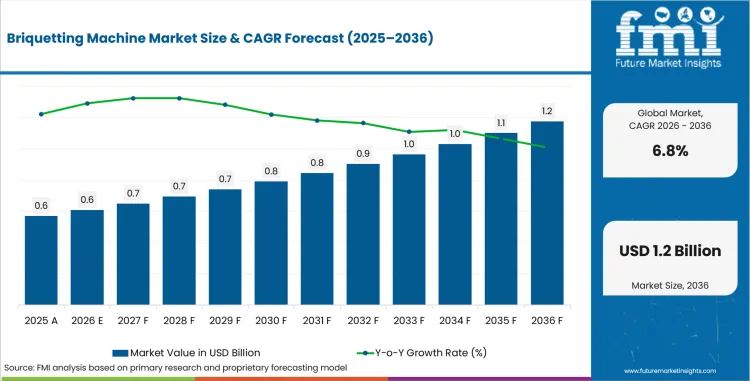
Key Takeaways, Market Size, and Forecast
- Briquetting Machine Market Value (2025): USD 0.6 Bn
- Briquetting Machine Market Forecast Value (2036): USD 1.2 Bn
- Briquetting Machine Market Forecast CAGR (2026 TO 2036): 6.8%
- Briquetting Machine Market Leading Product Segment: Hydraulic Briquetting Machines (50.0%)
- Briquetting Machine Market Key Growth Regions: USA, South Korea, EU, UK, Japan
- Briquetting Machine Market Key Players: RUF Maschinenbau GmbH & Co. KG, WEIMA Maschinenbau GmbH, CF Nielsen A/S, Biomass Briquette Systems LLC, GURU KIRPA Engineering Works, Other Companies & Regional Players (Combined)
| Parameter | Details |
|---|---|
| Years Considered | 2021 to 2036 |
| Base Year | 2025 |
| Forecast Period | 2026 to 2036 |
| Units Considered | Value (USD Bn) |
| Leading Sub-Region | USA |
Summary of the Briquetting Machine Market
- Demand and Growth Drivers
- Growing emphasis on waste-to-energy conversion and biomass utilization is driving demand for briquetting machines that compress loose materials into dense, transportable fuel products.
- Industrial waste management regulations requiring recycling and material recovery are creating procurement demand for briquetting equipment that processes metal chips, sawdust, and other factory waste streams.
- Expanding biomass energy programs in developing economies are creating demand for affordable briquetting technology that converts agricultural residues into clean-burning fuel briquettes.
- Product and Segment View
- Hydraulic briquetting machines account for 50.0% of product share, providing the compressive force needed to process diverse feedstocks including metal chips, biomass, and coal fines into dense briquettes.
- The largest application driving machine procurement with 40.0% application share in biomass energy production is the conversion of agricultural and forestry waste into fuel briquettes.
- End use share, 60.0% Industrial sector Manufacturing facilities use briquetting equipment for waste stream management and material recovery operations.
- Geography and Competitive Outlook
- The US leads with 7.1% CAGR, driven by investments in industrial waste management, interest in biomass energy and optimization of waste streams from manufacturing facilities.
- South Korea is projected to witness a CAGR of 7.0%, driven by industrial waste recycling mandates and metal chip briquetting equipment demand from the manufacturing sector.
- Companies with proven hydraulic and mechanical briquetting technologies and established distribution of industrial equipment are poised to meet growing demand for waste management and biomass energy.
- Analyst Opinion
- Nikhil Kaitwade, Principal Consultant at FMI says, 'Equipment manufacturers that can deliver reliable briquetting performance across diverse feedstock types while maintaining competitive total cost of ownership are likely to capture growing demand from industrial waste management and biomass energy applications over the forecast period.'
- The briquetting machine market is expanding as industrial waste management regulations and biomass energy programs create structured demand for material densification equipment.
- The economic value of turning loose waste materials into dense, transportable and marketable briquette products is driving increasing adoption.
- Demand is supported by waste stream optimization in manufacturing facilities where the briquetting of metal chip, sawdust and dust reduces disposal costs and recaptures material value.
- The growth is driven by the growth of biomass energy in developing economies where agricultural waste is being converted to cheap household and industrial fuel by briquetting.
What is a briquetting machine and what does the market cover?
Industrial machines that compress loose materials into dense briquettes for fuel, waste management and recycling
The briquetting machine market comprises industrial machines to compress loose materials into dense briquettes for fuel, waste management, and material recycling applications. The range of products includes hydraulic, mechanical and screw briquetting machines for processing biomass, industrial waste and coal/charcoal feedstocks in automatic and manual configurations powered by electric and fuel based systems.
What is included in the briquetting machine market scope?
Hydraulic, mechanical and screw briquetting machines, 2026 to 2036.
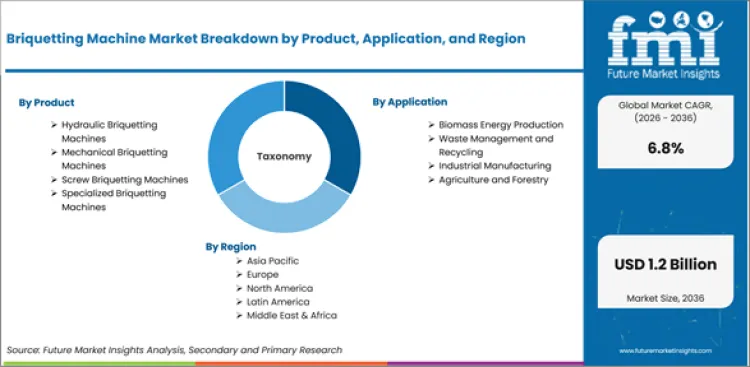
Market scope covers all commercially traded briquetting machines categorized by product (hydraulic briquetting machines, mechanical briquetting machines, screw briquetting machines), application (biomass energy production, waste management and recycling, industrial manufacturing), end use (industrial sector, commercial sector, residential sector), raw material (biomass raw material, industrial waste, coal and charcoal), automation (automatic machines, manual machines), and power source (electric powered machines, fuel powered machines). Revenue is tracked from 2026 to 2036.
What is excluded from the briquetting machine market scope?
Pelletizing equipment, general-purpose hydraulic presses, and briquette products themselves
The scope does not include pelletizing equipment designed for pellet rather than briquette production, general-purpose hydraulic presses not configured for briquetting, or briquette products themselves.
How was the briquetting machine market research conducted?
Primary interviews, desk research, bottom-up sizing, and quarterly validation
- Primary Research: FMI analysts conducted interviews with briquetting equipment manufacturers, industrial waste management specialists, biomass energy project developers, and manufacturing facility engineers across key markets.
- Desk research: Data from databases on industrial equipment, statistics from the waste management industry, and revenue disclosures from manufacturers were combined.
- Market Sizing and Forecasting: Bottom-up aggregation of machine sales by product type, applications and geographic markets with industrial waste and biomass energy growth projections.
- Data Validation: Quarterly cross-check against industrial equipment distribution data, tracking of waste management projects and manufacturer shipment records.
Why is the briquetting machine market growing?
Rising industrial-waste management and biomass energy conversion demand
- Industrial waste management and biomass energy conversion are driving the demand for briquetting machines, which convert loose materials into compact, marketable fuel and recyclable products.
- Briquetting of metal chip and sawdust optimizes waste streams in manufacturing, cutting disposal costs and reclaiming material value for recycling.
- The United States is at the forefront with a CAGR of 7.1%, driven by investment in industrial waste management and growing interest in biomass energy conversion technology.
Economics of waste material densification and growing regulatory and commercial drivers for waste-to-energy conversion are shaping demand for briquetting machines. 50.0% Product Share Hydraulic Briquetting Machines Hydraulic briquetting machines provide the high compressive force (usually 100 to 400 tons) required to convert various feedstocks such as metal turnings, wood chips, sawdust, and agricultural residues into dense briquettes. Some types of feedstock can be pressed mechanically or with screw presses, where lower cost or continuous operation equipment can provide sufficient compression.
Application share of biomass energy production is 40.0%. Conversion of agricultural waste, forestry residues and dedicated energy crop materials into fuel briquettes for industrial boilers, household heating and power generation. The second largest application is waste management and recycling. Metal chips from machining operations are briquetted to recover the cutting fluid and to produce dense, transportable blocks of metal for recycling. Industrial manufacturing applications include briquetting of dust, fines and process waste streams.
The industrial sector holds 60.0% of the end use share. The waste management in factories is the major buyer of the briquetting equipment manufacturing facilities. Commercial applications include biomass fuel production operations that convert feed stock into briquettes for sale to energy consumers. The development of equipment technology is led by European equipment manufacturers (RUF, WEIMA, CF Nielsen), while regional manufacturers are focusing on lower cost markets.
How is the briquetting machine market segmented?
By product, application, end use, raw material, automation and power source
- Hydraulic briquetting machines are the leading segment with 50.0% product share owing to high compressive force for processing metal chips, biomass and coal fines into dense briquettes.
- Biomass energy production finds application share of 40.0% with conversion of agricultural waste and forestry residue as the key machine procurement driver.
- The industrial segment accounts for 60.0% of the end use share wherein the manufacturing plants are buying the briquetting equipment to manage the waste streams and recover the materials.
Why do hydraulic briquetting machines lead the briquetting machine market?
They hold 50.0% share, led by high-tonnage hydraulic-cylinder densification
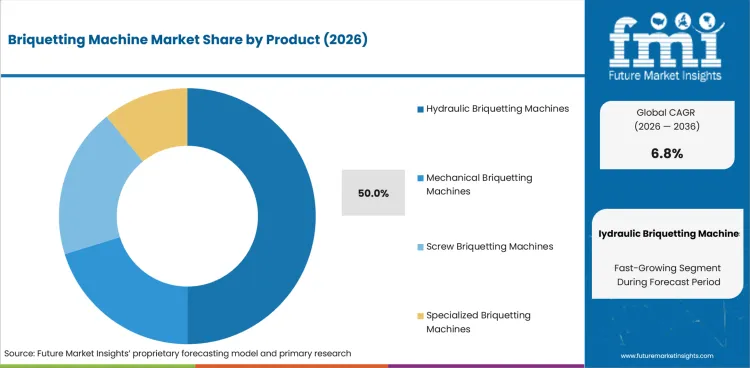
The product share of hydraulic briquetting machines is 50.0% in the year 2026. These machines create compressive forces of generally 50 to 400 tons through hydraulic cylinders allowing for the densification of many types of feedstock including aluminum and steel turnings, wood chips, paper, and agricultural waste. The hydraulic system provides a steady compression force regardless of fluctuations in the feedstock.
Automated hydraulic briquetting machines with programmable cycle times, material feed systems and briquette ejection mechanisms are used for high volume industrial applications. Manual and semi-automatic versions are available to serve smaller operations and developing market applications that require a lower capital investment. The machines range in size from small workshop units to large industrial machines with capacities of several tons per hour.
How big is the biomass energy production segment in the briquetting machine market?
About 40.0% share, led by conversion of agricultural and forestry residues
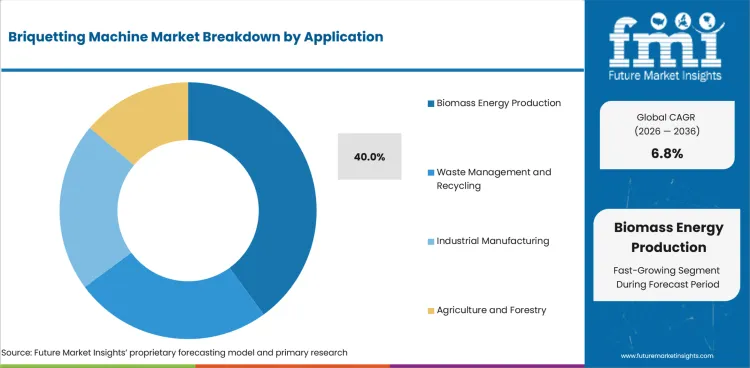
Biomass energy production will have a share of 40.0% of applications in 2026. Briquetting machines convert loose agricultural residues (rice husks, straw, coconut shells), forestry waste (sawdust, wood chips, bark) and dedicated energy crops into dense fuel briquettes of uniform size, density and moisture content. These briquettes burn more efficiently than loose biomass, lowering storage and transportation costs.
Biomass briquette production is suitable for industrial fuel consumers (replacing coal or supplementing boiler fuel) and for household cooking and heating applications in developing economies. Community scale briquetting businesses generate economic value from agricultural waste and secure low-cost fuel options.
What drives and restrains the briquetting machine market?
Driven by industrial-waste and biomass energy programs; restrained by high equipment capital costs and feedstock variability
- Industrial waste management and biomass energy programs norms are constantly demanding briquetting equipment for different manufacturing and energy applications.
- Procurement barriers for smaller operations and developing market applications include high equipment capital costs and variability in the supply of feedstock.
- Long term demand support for briquetting technology across industrial sectors is being driven by increasing emphasis on circular economy and waste-to-value conversion.
The demand for briquetting machines is driven by the need for waste management, growth in biomass energy and industrial recycling. Challenges include equipment costs and feedstock variability, but growth opportunities exist with circular economy trends and emerging market biomass programs.
What drives demand?
Manufacturing facilities needing to process and densify waste streams
Demand is driven by the waste stream processing requirements of manufacturing facilities. Briquettes of metal chips are very dense and recyclable, and the cutting fluid is recovered. Briquetting of wood waste reduces the volume of sawdust disposal. Dust and fines briquetting is an environmentally friendly solution for the handling of particulate material.
What constrains adoption?
High capital cost of hydraulic machines with automated feed and ejection
Industrial briquetting equipment, particularly hydraulic machines with automated feed and ejection systems, are capital intensive, and limit adoption. Payback period calculations depend on waste disposal cost savings, recovered material value, and briquette fuel sales revenue, all of which vary across applications and markets.
What opportunity do biomass programs create?
Government biomass energy programs in India, Southeast Asia and Africa
Growth is driven by government biomass energy programs in India, Southeast Asia and Africa encouraging conversion of agricultural waste into fuel briquettes. These programs develop a market for low-cost briquetting equipment that is appropriate for community scale and small industrial operations.
How do circular-economy trends help?
Corporate and regulatory focus on circular-economy and waste-to-value
Demand is supported by increasing corporate and regulatory focus on circular economy principles that favor densification and recycling of waste material over disposal. Briquetting can turn waste streams into value streams that would otherwise incur disposal costs.
Which countries are growing fastest in the briquetting machine market?
USA 7.1%, South Korea 7.0%, EU 6.8%, UK 6.6%, Japan 6.4% through 2036
.webp "Top Country Growth Comparison Briquetting Machine Market Cagr (2026 2036)")
| Country | CAGR |
|---|---|
| USA | 7.1% |
| UK | 6.6% |
| EU | 6.8% |
| Japan | 6.4% |
| South Korea | 7.0% |
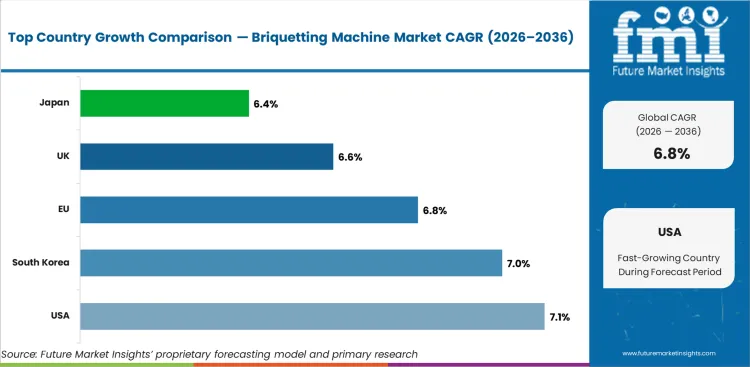
- USA leads at 7.1% CAGR, reflecting strong demand drivers.
- South Korea follows at 7.0%, supported by expanding market activity.
- EU (6.8%) and UK (6.6%) sustain growth.
The global briquetting machine market is estimated to grow at 6.8% CAGR from 2026 to 2036. The study covers more than 30 countries, and the key markets are listed below.
How fast is the briquetting machine market growing in the United States?
7.1% CAGR through 2036, the fastest country-level market in the study
The United States leads at 7.1% CAGR through 2036. Industrial waste management, metalworking waste recycling, and growing biomass fuel interest drive equipment demand.
- Manufacturing facilities invest in metal chip briquetting to recover cutting fluid value and reduce scrap metal disposal costs.
- Wood products industry procures briquetting equipment for sawdust and wood waste densification into fuel or landscaping products.
- Biomass energy interest is creating demand for agricultural waste briquetting equipment in rural and agricultural processing settings.
What is the briquetting machine market outlook in South Korea?
7.0% CAGR, driven by Industrial waste recycling mandates and manufacturing sector demand for waste management
South Korea is projected to register 7.0% CAGR through 2036. Industrial waste recycling mandates and manufacturing sector demand for waste management equipment drive growth.
- Korean industrial waste recycling regulations create compliance-driven demand for briquetting equipment in manufacturing facilities.
- Automotive and metalworking industries procure chip briquetting machines for machining waste management and material recovery.
- Government waste reduction programs support equipment investment that converts industrial waste into recyclable or fuel-grade briquettes.
What is driving briquetting machine growth in the European Union?
6.8% CAGR, driven by Circular economy mandates and established equipment manufacturing leadership
The European Union is projected to register 6.8% CAGR through 2036. Circular economy mandates and established equipment manufacturing leadership sustain market growth.
- EU circular economy regulations create structured demand for waste densification and recycling equipment across industrial sectors.
- German manufacturers including RUF and WEIMA maintain technology leadership in hydraulic and mechanical briquetting machine design and production.
- Biomass energy policies across EU member states support briquetting equipment procurement for agricultural and forestry waste fuel production.
How is the briquetting machine market performing in the United Kingdom?
6.6% CAGR, driven by Waste management requirements and biomass energy
The United Kingdom is projected to register 6.6% CAGR through 2036. Waste management requirements and biomass energy support equipment demand.
- UK waste regulations and landfill tax create economic incentives for industrial waste briquetting that reduces disposal costs.
- Biomass heating programs support procurement of briquetting equipment for wood waste and agricultural residue fuel production.
- Manufacturing sector waste stream management drives equipment purchases for metal chip and industrial waste briquetting.
What is the briquetting machine market forecast for Japan?
6.4% CAGR, driven by Precision manufacturing waste management and environmental compliance
Japan is projected to register 6.4% CAGR through 2036. Precision manufacturing waste management and environmental compliance drive equipment demand.
- Japanese manufacturing operations procure precision briquetting equipment for metal chip and industrial waste management.
- Environmental regulations governing industrial waste disposal create compliance-driven demand for densification equipment.
- Quality-focused equipment selection favors precision-engineered briquetting machines with documented performance specifications.
Who are the leading companies in the briquetting machine market?
RUF Maschinenbau GmbH & Co. KG, WEIMA Maschinenbau GmbH, CF Nielsen A/S, Biomass Briquette Systems LLC, and GURU KIRPA Engineering Works
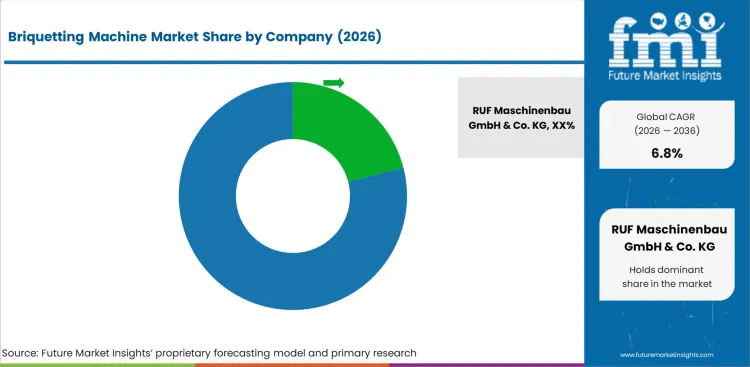
- RUF Maschinenbau leads through decades of hydraulic briquetting press engineering with over 6,000 installations worldwide across metal, wood, and industrial waste applications.
- WEIMA Maschinenbau provides integrated shredding and briquetting solutions that process diverse waste materials from initial size reduction through final briquette production.
- CF Nielsen specializes in mechanical briquetting presses for biomass and coal applications with established installations across European and Asian markets.
- Biomass Briquette Systems and GURU KIRPA serve emerging market biomass energy applications through affordable briquetting equipment designed for community-scale operations.
Who are the key players in the briquetting machine market?
RUF Maschinenbau GmbH & Co. KG, WEIMA Maschinenbau GmbH, CF Nielsen A/S, Biomass Briquette Systems LLC and GURU KIRPA Engineering Works, plus regional players
Key global companies leading the briquetting machine market include:
- RUF Maschinenbau GmbH and Co. KG (Germany), WEIMA Maschinenbau GmbH (Germany), CF Nielsen A/S (Denmark), and Biomass Briquette Systems LLC (USA) lead global briquetting machine markets through established technology platforms, extensive installation base, and industrial equipment distribution networks.
- GURU KIRPA Engineering Works (India) holds a strong position through affordable briquetting equipment designed for biomass fuel production in developing market applications.
- Additional briquetting equipment manufacturers in China, India, and Eastern Europe are expanding product offerings targeting cost-sensitive industrial waste management and biomass energy applications.
How do top briquetting machine companies compare?
RUF Maschinenbau GmbH & Co. KG and WEIMA Maschinenbau GmbH lead globally; CF Nielsen A/S, Biomass Briquette Systems LLC and GURU KIRPA Engineering Works are regional specialists
| Company | Technology Portfolio | Installation Base | Industrial Distribution | Geographic Footprint |
|---|---|---|---|---|
| RUF Maschinenbau | High | High | Strong | Global |
| WEIMA | High | High | Strong | Global |
| CF Nielsen | High | Medium | Moderate | Europe, Asia |
| Biomass Briquette Systems | Medium | Medium | Moderate | N. America |
| GURU KIRPA | Medium | Medium | Low | India, Asia |
Source: Future Market Insights competitive analysis, 2026.
Key Developments in Briquetting Machine Market
- In 2025, RUF Maschinenbau launched an updated hydraulic briquetting press with improved energy efficiency and automated feedstock detection for multi-material industrial waste processing.
- In 2025, CF Nielsen expanded its biomass briquetting machine product range with a new high-capacity model targeting large-scale agricultural waste fuel production operations.
Key Players in the Briquetting Machine Market
Major Global Players
- RUF Maschinenbau GmbH & Co. KG
- WEIMA Maschinenbau GmbH
- CF Nielsen A/S
- Biomass Briquette Systems LLC
- GURU KIRPA Engineering Works
- Other Companies & Regional Players (Combined)
Emerging Players/Startups
- Lehra Fuel Tech
- Jay Khodiyar Group
- Ronak Engineering
- Maxton Industrial
Briquetting Machine Market - Research Methodology
| Method | Description |
|---|---|
| Primary Research | FMI analysts conducted interviews with manufacturers, distributors, procurement specialists, and end-use operators across USA, UK, and EU to validate demand patterns and pricing structures for Hydraulic Briquetting Machines, and Mechanical Briquetting Machines and related product categories. |
| Desk Research | Combined trade statistics, regulatory filings, industry association data, and manufacturer disclosures to establish baseline parameters for Briquetting Machine across product, application, end use, raw material, automation, and power source segments. |
| Market Sizing & Forecasting | Bottom-up aggregation across Hydraulic Briquetting Machines, Mechanical Briquetting Machines, and Screw Briquetting Machines product categories and Biomass Energy Production, Waste Management and Recycling, and Industrial Manufacturing application segments, triangulated with top-down macro indicators and regional adoption curves. |
| Data Validation | Cross-checked quarterly against production statistics, trade flow data, and manufacturer revenue disclosures for Briquetting Machine products. |
What does the briquetting machine market report cover?
2016 to 2025 history and 2026 to 2036 forecasts across all segments and 30+ countries
| Parameter | Details |
|---|---|
| Forecast period | 2026 to 2036 |
| Key Segment Covered | Product, Application, End Use, Raw Material, Automation, Power Source |
| Regions covered | North America, Latin America, Eastern Europe, Western Europe, East Asia, South Asia and Pacific, Middle East and Africa |
| Countries covered | USA, UK, EU, Japan, South Korea, 30 plus countries |
| Key companies profiled | RUF Maschinenbau GmbH & Co. KG, WEIMA Maschinenbau GmbH, CF Nielsen A/S, Biomass Briquette Systems LLC, GURU KIRPA Engineering Works, Other Companies & Regional Players (Combined) |
| Approach | Hybrid bottom-up and top-down methodology starting with verified transaction data, projecting adoption velocity across segments and regions. |
Market Segmentation Analysis
Briquetting Machine Market Segmented by Product:
- Hydraulic Briquetting Machines
- Standard Hydraulic Machines
- Single Cylinder Systems
- Double Cylinder Systems
- Advanced Hydraulic Machines
- High Pressure Systems
- Energy Efficient Systems
- Standard Hydraulic Machines
- Mechanical Briquetting Machines
- Piston Briquetting Machines
- Single Piston Machines
- Double Piston Machines
- Roller Press Machines
- Double Roller Press
- High Capacity Roller Press
- Piston Briquetting Machines
- Screw Briquetting Machines
- Standard Screw Machines
- Biomass Processing
- Agricultural Waste Processing
- Heated Die Screw Machines
- High Density Output
- Continuous Operation
- Standard Screw Machines
- Specialized Briquetting Machines
- Biomass Briquetting Machines
- Agro Waste Machines
- Forestry Residue Machines
- Metal Briquetting Machines
- Metal Chip Machines
- Industrial Scrap Machines
- Biomass Briquetting Machines
Briquetting Machine Market Segmented by Application:
- Biomass Energy Production
- Industrial Fuel Production
- Boiler Fuel
- Thermal Energy
- Renewable Energy Generation
- Power Plants
- Co Firing Systems
- Industrial Fuel Production
- Waste Management and Recycling
- Industrial Waste Recycling
- Metal Scrap Processing
- Chemical Waste Processing
- Municipal Waste Processing
- Paper Waste
- Plastic Waste
- Industrial Waste Recycling
- Industrial Manufacturing
- Metal Processing
- Steel Industry
- Aluminum Industry
- Chemical Processing
- Fertilizer Industry
- Cement Industry
- Metal Processing
- Agriculture and Forestry
- Agricultural Waste Processing
- Rice Husk Processing
- Bagasse Processing
- Forestry Residue Processing
- Sawdust Processing
- Wood Chips Processing
- Agricultural Waste Processing
Briquetting Machine Market Segmented by End Use:
- Industrial Sector
- Metallurgy and Mining
- Steel Plants
- Mining Operations
- Energy and Power
- Power Plants
- Industrial Boilers
- Metallurgy and Mining
- Commercial Sector
- Small Scale Industries
- Brick Kilns
- Food Processing Units
- Commercial Fuel Use
- Hotels
- Restaurants
- Small Scale Industries
- Residential Sector
- Household Fuel Use
- Cooking Applications
- Heating Applications
- Rural Applications
- Off Grid Energy
- Traditional Use
- Household Fuel Use
Briquetting Machine Market Segmented by Raw Material:
- Biomass Raw Material
- Agricultural Residues
- Rice Husk
- Groundnut Shell
- Forestry Residues
- Sawdust
- Wood Chips
- Agricultural Residues
- Industrial Waste
- Metal Waste
- Iron Scrap
- Aluminum Scrap
- Chemical Waste
- Sludge
- Industrial Residue
- Metal Waste
- Coal and Charcoal
- Coal Fines
- High Carbon Content
- Industrial Use
- Charcoal Dust
- Fuel Applications
- Commercial Use
- Coal Fines
Briquetting Machine Market Segmented by Automation:
- Automatic Machines
- Fully Automatic Systems
- Continuous Operation
- High Output Systems
- Semi Automated Systems
- Partial Automation
- Operator Assisted
- Fully Automatic Systems
- Manual Machines
- Manual Operation
- Small Scale Use
- Low Cost Systems
- Semi Manual Systems
- Basic Automation
- Low Production
- Manual Operation
Briquetting Machine Market Segmented by Power Source:
- Electric Powered Machines
- Grid Powered
- Industrial Use
- Continuous Operation
- Renewable Powered
- Solar Integrated
- Hybrid Systems
- Grid Powered
- Fuel Powered Machines
- Diesel Powered
- Off Grid Use
- Remote Locations
- Hybrid Fuel Systems
- Dual Power Systems
- Backup Operation
- Diesel Powered
Briquetting Machine Market by Region:
- North America
- USA
- Canada
- Mexico
- Latin America
- Brazil
- Chile
- Rest of Latin America
- Western Europe
- Germany
- UK
- Italy
- Spain
- France
- Nordic
- BENELUX
- Rest of Western Europe
- Eastern Europe
- Russia
- Poland
- Hungary
- Balkan & Baltic
- Rest of Eastern Europe
- East Asia
- China
- Japan
- South Korea
- South Asia and Pacific
- India
- ASEAN
- Australia & New Zealand
- Rest of South Asia and Pacific
- Middle East & Africa
- Kingdom of Saudi Arabia
- Other GCC Countries
- Türkiye
- South Africa
- Other African Union
- Rest of Middle East & Africa
Research Sources and Bibliography
- European Committee for Standardization. (2025). CEN Standards for Solid Biofuels: Specifications and Classes. CEN.
- International Energy Agency. (2025). IEA Bioenergy Task Report on Biomass Densification. IEA.
- USA Department of Energy. (2025). DOE Biomass Energy Technologies Review. DOE.
- International Organization for Standardization. (2025). ISO Standards for Briquettes and Pellets. ISO.
- European Biomass Association. (2025). AEBIOM Statistical Report on European Bioenergy. AEBIOM.
This bibliography is provided for reader reference.
This Report Answers
- Estimating the size of the briquetting machine market and projected revenue from 2026 to 2036.
- Segmentation by product, application, end use, raw material, automation, power source.
- Insights about more than 30 regional markets.
- Analysis of key market dynamics including demand drivers, restraints, and emerging opportunities.
- Assessment of the competitive landscape and strategic positioning of leading companies.
- Identifying investment opportunities across key product segments and geographic markets.
- Supply chain and distribution channel analysis.
- Delivery of data in PDF and Excel formats.
Frequently Asked Questions
How big is the briquetting machine market in 2026?
The global briquetting machine market is estimated to be valued at USD 0.6 billion in 2026.
What will be the size of the briquetting machine market in 2036?
The market size for the briquetting machine market is projected to reach USD 1.2 billion by 2036.
How much will the briquetting machine market growth be between 2026 and 2036?
The briquetting machine market is expected to grow at a 6.8% CAGR between 2026 and 2036.
What are the key products in the briquetting machine market?
The key products in the briquetting machine market are Hydraulic Briquetting Machines, Mechanical Briquetting Machines, Screw Briquetting Machines and Specialized Briquetting Machines.
Which application segment is expected to contribute a significant share in the briquetting machine market in 2026?
In terms of application, the biomass energy production segment is expected to command 40.0% share in the briquetting machine market in 2026.
Preview the report firsthand - request a free sample
Get SampleGet the brochure for pricing and purchase details.
Get PDFTable of Content
- Key Takeaways
- Market Size and CAGR
- Top Growth Driver
- Fastest Growing Segment
- Leading Region
- Key Companies
- Emerging Opportunities
- Executive Summary
- Global Market Outlook
- Demand-side Trends
- Supply-side Trends
- Technology Roadmap Analysis
- Analysis and Recommendations
- Analyst Perspective (What is happening? Why now? What should investors know?)
- Key Questions Answered
- How large is the market?
- What is the CAGR?
- What are key trends?
- Which region dominates?
- Who are the leaders?
- Market Overview
- Market Coverage / Taxonomy
- Market Definition / Scope / Limitations
- Research Methodology
- Chapter Orientation
- Analytical Lens and Working Hypotheses
- Market Structure, Signals, and Trend Drivers
- Benchmarking and Cross-market Comparability
- Market Sizing, Forecasting, and Opportunity Mapping
- Research Design and Evidence Framework
- Desk Research Programme (Secondary Evidence)
- Expert Input and Fieldwork (Primary Evidence)
- Tooling, Models, and Reference Databases
- Data Engineering and Model Build
- Quality Assurance and Audit Trail
- Market Background
- Market Dynamics (Drivers, Restraints, Opportunity, Trends)
- Scenario Forecast (Optimistic, Likely, Conservative)
- Impact Analysis
- AI Impact
- Sustainability Impact
- Regulatory Impact
- Technology Impact
- Consumer / Buyer Analysis
- Purchase Drivers
- Adoption Barriers
- Buyer Journey
- Opportunity Map Analysis
- Product Life Cycle Analysis
- Supply Chain Analysis
- Investment Feasibility Matrix
- Value Chain Analysis
- PESTLE and Porter's Analysis
- Regulatory Landscape
- Regional Parent Market Outlook
- Production and Consumption Statistics
- Import and Export Statistics
- Global Market Analysis and Forecast, 2021 to 2036
- Historical Market Size Value (USD Million) Analysis, 2021 to 2025
- Current and Future Market Size Value (USD Million) Projections, 2026 to 2036
- Y-o-Y Growth Trend Analysis
- Absolute $ Opportunity Analysis
- Global Market Pricing Analysis, 2021 to 2036
- Global Market Analysis and Forecast, By Product, 2021 to 2036
- Introduction / Key Findings
- Historical Market Size Value (USD Million) Analysis By Product, 2021 to 2025
- Current and Future Market Size Value (USD Million) Analysis and Forecast By Product, 2026 to 2036
- Hydraulic Briquetting Machines
- Standard Hydraulic Machines
- Advanced Hydraulic Machines
- Mechanical Briquetting Machines
- Piston Briquetting Machines
- Roller Press Machines
- Screw Briquetting Machines
- Standard Screw Machines
- Heated Die Screw Machines
- Specialized Briquetting Machines
- Biomass Briquetting Machines
- Metal Briquetting Machines
- Hydraulic Briquetting Machines
- Y-o-Y Growth Trend Analysis By Product, 2021 to 2025
- Absolute $ Opportunity Analysis By Product, 2026 to 2036
- Global Market Analysis and Forecast, By Application, 2021 to 2036
- Introduction / Key Findings
- Historical Market Size Value (USD Million) Analysis By Application, 2021 to 2025
- Current and Future Market Size Value (USD Million) Analysis and Forecast By Application, 2026 to 2036
- Biomass Energy Production
- Industrial Fuel Production
- Renewable Energy Generation
- Waste Management and Recycling
- Industrial Waste Recycling
- Municipal Waste Processing
- Industrial Manufacturing
- Metal Processing
- Chemical Processing
- Agriculture and Forestry
- Agricultural Waste Processing
- Forestry Residue Processing
- Biomass Energy Production
- Y-o-Y Growth Trend Analysis By Application, 2021 to 2025
- Absolute $ Opportunity Analysis By Application, 2026 to 2036
- Global Market Analysis and Forecast, By End Use, 2021 to 2036
- Introduction / Key Findings
- Historical Market Size Value (USD Million) Analysis By End Use, 2021 to 2025
- Current and Future Market Size Value (USD Million) Analysis and Forecast By End Use, 2026 to 2036
- Industrial Sector
- Metallurgy and Mining
- Energy and Power
- Commercial Sector
- Small Scale Industries
- Commercial Fuel Use
- Residential Sector
- Household Fuel Use
- Rural Applications
- Industrial Sector
- Y-o-Y Growth Trend Analysis By End Use, 2021 to 2025
- Absolute $ Opportunity Analysis By End Use, 2026 to 2036
- Global Market Analysis and Forecast, By Raw Material, 2021 to 2036
- Introduction / Key Findings
- Historical Market Size Value (USD Million) Analysis By Raw Material, 2021 to 2025
- Current and Future Market Size Value (USD Million) Analysis and Forecast By Raw Material, 2026 to 2036
- Biomass Raw Material
- Agricultural Residues
- Forestry Residues
- Industrial Waste
- Metal Waste
- Chemical Waste
- Coal and Charcoal
- Coal Fines
- Charcoal Dust
- Biomass Raw Material
- Y-o-Y Growth Trend Analysis By Raw Material, 2021 to 2025
- Absolute $ Opportunity Analysis By Raw Material, 2026 to 2036
- Global Market Analysis and Forecast, By Automation, 2021 to 2036
- Introduction / Key Findings
- Historical Market Size Value (USD Million) Analysis By Automation, 2021 to 2025
- Current and Future Market Size Value (USD Million) Analysis and Forecast By Automation, 2026 to 2036
- Automatic Machines
- Fully Automatic Systems
- Semi Automated Systems
- Manual Machines
- Manual Operation
- Semi Manual Systems
- Automatic Machines
- Y-o-Y Growth Trend Analysis By Automation, 2021 to 2025
- Absolute $ Opportunity Analysis By Automation, 2026 to 2036
- Global Market Analysis and Forecast, By Power Source
- Introduction / Key Findings
- Historical Market Size Value (USD Million) Analysis By Power Source, 2021 to 2025
- Current and Future Market Size Value (USD Million) Analysis and Forecast By Power Source, 2026 to 2036
- Electric Powered Machines
- Grid Powered
- Renewable Powered
- Fuel Powered Machines
- Diesel Powered
- Hybrid Fuel Systems
- Y-o-Y Growth Trend Analysis By Power Source, 2021 to 2025
- Absolute $ Opportunity Analysis By Power Source, 2026 to 2036
- Electric Powered Machines
- Global Market Analysis and Forecast, By Region, 2021 to 2036
- Introduction
- Historical Market Size Value (USD Million) Analysis By Region, 2021 to 2025
- Current Market Size Value (USD Million) Analysis and Forecast By Region, 2026 to 2036
- North America
- Latin America
- Western Europe
- Eastern Europe
- East Asia
- South Asia and Pacific
- Middle East & Africa
- Market Attractiveness Analysis By Region
- North America Market Analysis and Forecast, By Country, 2021 to 2036
- Historical Market Size Value (USD Million) Trend Analysis By Market Taxonomy, 2021 to 2025
- Market Size Value (USD Million) Forecast By Market Taxonomy, 2026 to 2036
- By Country
- USA
- Canada
- Mexico
- By Product
- By Application
- By End Use
- By Raw Material
- By Automation
- By Power Source
- By Country
- Market Attractiveness Analysis
- By Country
- By Product
- By Application
- By End Use
- By Raw Material
- By Automation
- By Power Source
- Key Takeaways
- Latin America Market Analysis and Forecast, By Country
- Historical Market Size Value (USD Million) Trend Analysis By Market Taxonomy, 2021 to 2025
- Market Size Value (USD Million) Forecast By Market Taxonomy, 2026 to 2036
- By Country
- Brazil
- Chile
- Rest of Latin America
- By Product
- By Application
- By End Use
- By Raw Material
- By Automation
- By Power Source
- By Country
- Market Attractiveness Analysis
- By Country
- By Product
- By Application
- By End Use
- By Raw Material
- By Automation
- By Power Source
- Key Takeaways
- Western Europe Market Analysis and Forecast, By Country
- Historical Market Size Value (USD Million) Trend Analysis By Market Taxonomy, 2021 to 2025
- Market Size Value (USD Million) Forecast By Market Taxonomy, 2026 to 2036
- By Country
- Germany
- UK
- Italy
- Spain
- France
- Nordic
- BENELUX
- Rest of Western Europe
- By Product
- By Application
- By End Use
- By Raw Material
- By Automation
- By Power Source
- By Country
- Market Attractiveness Analysis
- By Country
- By Product
- By Application
- By End Use
- By Raw Material
- By Automation
- By Power Source
- Key Takeaways
- Eastern Europe Market Analysis and Forecast, By Country
- Historical Market Size Value (USD Million) Trend Analysis By Market Taxonomy, 2021 to 2025
- Market Size Value (USD Million) Forecast By Market Taxonomy, 2026 to 2036
- By Country
- Russia
- Poland
- Hungary
- Balkan & Baltic
- Rest of Eastern Europe
- By Product
- By Application
- By End Use
- By Raw Material
- By Automation
- By Power Source
- By Country
- Market Attractiveness Analysis
- By Country
- By Product
- By Application
- By End Use
- By Raw Material
- By Automation
- By Power Source
- Key Takeaways
- East Asia Market Analysis and Forecast, By Country
- Historical Market Size Value (USD Million) Trend Analysis By Market Taxonomy, 2021 to 2025
- Market Size Value (USD Million) Forecast By Market Taxonomy, 2026 to 2036
- By Country
- China
- Japan
- South Korea
- By Product
- By Application
- By End Use
- By Raw Material
- By Automation
- By Power Source
- By Country
- Market Attractiveness Analysis
- By Country
- By Product
- By Application
- By End Use
- By Raw Material
- By Automation
- By Power Source
- Key Takeaways
- South Asia and Pacific Market Analysis and Forecast, By Country
- Historical Market Size Value (USD Million) Trend Analysis By Market Taxonomy, 2021 to 2025
- Market Size Value (USD Million) Forecast By Market Taxonomy, 2026 to 2036
- By Country
- India
- ASEAN
- Australia & New Zealand
- Rest of South Asia and Pacific
- By Product
- By Application
- By End Use
- By Raw Material
- By Automation
- By Power Source
- By Country
- Market Attractiveness Analysis
- By Country
- By Product
- By Application
- By End Use
- By Raw Material
- By Automation
- By Power Source
- Key Takeaways
- Middle East & Africa Market Analysis and Forecast, By Country
- Historical Market Size Value (USD Million) Trend Analysis By Market Taxonomy, 2021 to 2025
- Market Size Value (USD Million) Forecast By Market Taxonomy, 2026 to 2036
- By Country
- Kingdom of Saudi Arabia
- Other GCC Countries
- Türkiye
- South Africa
- Other African Union
- Rest of Middle East & Africa
- By Product
- By Application
- By End Use
- By Raw Material
- By Automation
- By Power Source
- By Country
- Market Attractiveness Analysis
- By Country
- By Product
- By Application
- By End Use
- By Raw Material
- By Automation
- By Power Source
- Key Takeaways
- Key Countries Market Analysis
- USA
- Pricing Analysis
- Market Share Analysis, 2025
- By Product
- By Application
- By End Use
- By Raw Material
- By Automation
- By Power Source
- Canada
- Pricing Analysis
- Market Share Analysis, 2025
- By Product
- By Application
- By End Use
- By Raw Material
- By Automation
- By Power Source
- Mexico
- Pricing Analysis
- Market Share Analysis, 2025
- By Product
- By Application
- By End Use
- By Raw Material
- By Automation
- By Power Source
- Brazil
- Pricing Analysis
- Market Share Analysis, 2025
- By Product
- By Application
- By End Use
- By Raw Material
- By Automation
- By Power Source
- Chile
- Pricing Analysis
- Market Share Analysis, 2025
- By Product
- By Application
- By End Use
- By Raw Material
- By Automation
- By Power Source
- Germany
- Pricing Analysis
- Market Share Analysis, 2025
- By Product
- By Application
- By End Use
- By Raw Material
- By Automation
- By Power Source
- UK
- Pricing Analysis
- Market Share Analysis, 2025
- By Product
- By Application
- By End Use
- By Raw Material
- By Automation
- By Power Source
- Italy
- Pricing Analysis
- Market Share Analysis, 2025
- By Product
- By Application
- By End Use
- By Raw Material
- By Automation
- By Power Source
- Spain
- Pricing Analysis
- Market Share Analysis, 2025
- By Product
- By Application
- By End Use
- By Raw Material
- By Automation
- By Power Source
- France
- Pricing Analysis
- Market Share Analysis, 2025
- By Product
- By Application
- By End Use
- By Raw Material
- By Automation
- By Power Source
- India
- Pricing Analysis
- Market Share Analysis, 2025
- By Product
- By Application
- By End Use
- By Raw Material
- By Automation
- By Power Source
- ASEAN
- Pricing Analysis
- Market Share Analysis, 2025
- By Product
- By Application
- By End Use
- By Raw Material
- By Automation
- By Power Source
- Australia & New Zealand
- Pricing Analysis
- Market Share Analysis, 2025
- By Product
- By Application
- By End Use
- By Raw Material
- By Automation
- By Power Source
- China
- Pricing Analysis
- Market Share Analysis, 2025
- By Product
- By Application
- By End Use
- By Raw Material
- By Automation
- By Power Source
- Japan
- Pricing Analysis
- Market Share Analysis, 2025
- By Product
- By Application
- By End Use
- By Raw Material
- By Automation
- By Power Source
- South Korea
- Pricing Analysis
- Market Share Analysis, 2025
- By Product
- By Application
- By End Use
- By Raw Material
- By Automation
- By Power Source
- Russia
- Pricing Analysis
- Market Share Analysis, 2025
- By Product
- By Application
- By End Use
- By Raw Material
- By Automation
- By Power Source
- Poland
- Pricing Analysis
- Market Share Analysis, 2025
- By Product
- By Application
- By End Use
- By Raw Material
- By Automation
- By Power Source
- Hungary
- Pricing Analysis
- Market Share Analysis, 2025
- By Product
- By Application
- By End Use
- By Raw Material
- By Automation
- By Power Source
- Kingdom of Saudi Arabia
- Pricing Analysis
- Market Share Analysis, 2025
- By Product
- By Application
- By End Use
- By Raw Material
- By Automation
- By Power Source
- Türkiye
- Pricing Analysis
- Market Share Analysis, 2025
- By Product
- By Application
- By End Use
- By Raw Material
- By Automation
- By Power Source
- South Africa
- Pricing Analysis
- Market Share Analysis, 2025
- By Product
- By Application
- By End Use
- By Raw Material
- By Automation
- By Power Source
- USA
- Market Structure Analysis
- Competition Dashboard
- Competition Benchmarking
- Market Share Analysis of Top Players
- By Regional
- By Product
- By Application
- By End Use
- By Raw Material
- By Automation
- By Power Source
- Emerging Startups
- Innovation Benchmarking
- Competition Analysis
- Competition Deep Dive
- RUF Maschinenbau GmbH & Co. KG
- Overview
- Product Portfolio
- Profitability by Market Segments (Product/Region/Sales Channel)
- Sales Footprint
- Strategy Overview
- Marketing Strategy
- Product Strategy
- Channel Strategy
- WEIMA Maschinenbau GmbH
- CF Nielsen A/S
- Biomass Briquette Systems LLC
- GURU KIRPA Engineering Works
- Other Companies & Regional Players (Combined)
- RUF Maschinenbau GmbH & Co. KG
- Case Studies
- Success Stories
- Recent Developments
- Competition Deep Dive
- Assumptions & Acronyms Used


