

- Market Size (2026)
- USD 665.5 Mn
- Forecast (2036)
- USD 1033.5 Mn
- CAGR (2026 to 2036)
- 4.5%
How big is Brick Machine Pallets Market in 2026?
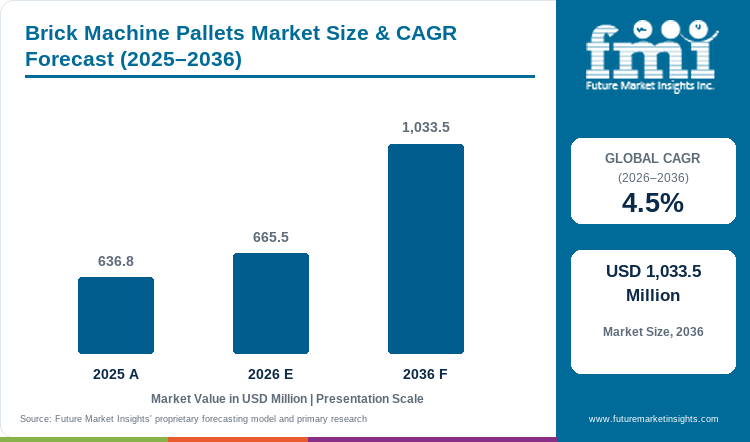
USD 665.5 million in 2026 and USD 1,033.5 million by 2036, expanding at 4.5% CAGR.
Sales of brick machine pallets are estimated to rise at 4.5% CAGR through 2036. Valuation rises from USD 636.8 million in 2025 to USD 665.5 million in 2026 and reaches USD 1,033.5 million by 2036. Production boards carry fresh blocks from molding through curing before returning to the forming line. In March 2026, WASA reported producing more than six million recycled solid-plastic boards over thirty years. Regular vibration and handling wear board surfaces and can interrupt the return cycle across heavily used lines. Plant engineers check flatness and machine fit before approving replacement boards for regular production.
Replacement patterns differ across mature plants that renew fleets and newer plants that commission additional machines. Turkey is projected to grow at 5.9% CAGR through 2036. The USA is projected at 4.5% CAGR over the same period. In September 2026, the U.S. Census Bureau reported 1,394,000 housing permits at an annual rate for August. Housing activity keeps concrete-products plants operating and sustains regular inspection and maintenance needs for production boards. Turkey's higher rate is linked to new capacity and shorter setup cycles for block-production lines. Both countries require boards that match fixed machine dimensions and material-handling systems before plants approve fleet purchases. Installed machine fleets sustain replacement demand alongside purchases for newly commissioned production lines.
Key Takeaways
- Molding and curing wear board fleets, so plants replace boards and equip newly commissioned machines.
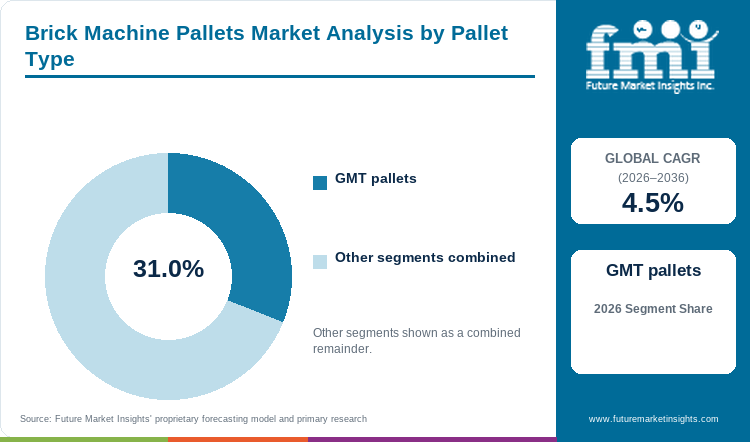
- GMT pallets are estimated to hold 31.0% of pallet type demand in 2026, supported by low water uptake.
- Concrete block machines are projected at 34.0% of compatibility demand, linked to strict board-to-machine fit requirements.
- Medium boards are forecast at 42.0% of size demand, enabled by balanced molding area and manageable handling weight.
- Fixed machine dimensions and vibration requirements constrain supplier changes by increasing qualification work for replacement boards.
- Key players include Rhino Composite Pallets, WASA AG, S.L Machinery, QGM Zenith, and Masa Group. The list also includes Columbia Machine, HESS Group, Besser Company, GMT Pallets, and ASSYX GmbH & Co. KG.
Analyst Perspective
"The commercial opportunity improves as pallet suppliers prove stable board fit across installed fleets and planned automated lines. Adoption depends on precise dimensions and vibration performance, with service support reducing qualification delays and costly stoppages."
- Nikhil Kaitwade, Principal Consultant, Future Market Insights
How is the brick machine pallets market segmented?
The brick machine pallets market is segmented by Pallet Type, Machine Compatibility, Size, End Use, Sales Channel, and Region.
The brick machine pallets market uses five primary segmentation axes plus region. Pallet type includes GMT, PVC, bamboo - wood, steel, and composite boards. Machine compatibility includes concrete block, clay brick, paver block, automatic brick, and vibration press machines. Size includes medium, small, large, and custom formats for different production lines. End use includes concrete block, clay brick, paver, precast, and small-producer plants. Sales channel includes aftermarket replacement, brick machine OEMs, direct suppliers, and distributors.
How does GMT pallet performance shape pallet type selection?
GMT boards combine glass-mat reinforcement with a durable molded polymer base that helps them remain flat during wet production. Stable dimensions matter on brick making machines that cycle the same boards through repeated vibration and transfer. Curing racks also depend on consistent board dimensions to prevent binding or misalignment during each return cycle. Untreated wood can change shape as moisture levels vary and reduce fit across fixed handling systems. In April 2025, HESS Group documented inline product inspection on production boards during concrete-products manufacturing. Plant engineers monitor surface wear so damaged areas do not mark fresh products or disrupt board return.
- GMT pallets are estimated to hold 31.0% of pallet type demand in 2026, supported by low water uptake and stable shape.
- Plant engineers compare surface wear and flatness with vibration transfer before approving boards for regular production.
Why do concrete block machines shape machine compatibility demand?
Concrete block machines use production boards during compaction and transfer before curing and return handling. Each board must match the press and conveyor path to prevent movement faults or damage to fresh blocks. Repeated vibration stresses the working surface and can change board flatness during extended service. Conveyors and curing racks impose fixed size limits that make board dimensions part of the machine interface. In March 2026, HESS Group reported commissioning an RH 500-C plant in Mexico with a defined handling setup. Compatible boards keep that setup moving steadily through forming and curing before returning to the press.
- Concrete block machines are projected to account for 34.0% of machine compatibility demand in 2026, linked to direct board-to-line fit requirements.
- Replacement orders depend on board length and thickness together with flatness matching forming machines and handling systems.
What supports medium format demand within the size category?
Medium boards combine useful molding area with manageable weight across common handling and curing systems. Plants use these formats for standard blocks and paver blocks without accepting the heavier loads of large boards. Familiar dimensions also limit changes across existing curing racks and transport equipment during fleet replacement. Plant teams check rack spacing before new boards enter service to prevent interference during curing. In March 2025, Masa announced an intelligent plant-control project focused on smoother production and lower machine wear. Stable board handling supports that operating goal by reducing setup changes during planned maintenance and regular line use.
- Medium format boards are forecast to represent 42.0% of size demand in 2026, enabled by balanced molding area and manageable weight.
- Plants use medium formats to limit changes across curing racks and transport systems during handling steps.
How do concrete block plants shape end-use demand?
Concrete block plants move large board fleets through molding and curing before stacking and return handling. Wet products add weight, and repeated vibration places continuing stress on every production board. Plants keep spare boards available during inspections and scheduled fleet replacement to avoid unplanned line interruptions. Precast concrete plants also depend on stable dimensions during fixed handling and storage steps. Consistent dimensions reduce stacking faults and help plants remove worn boards before output suffers. In June 2026, S.L Machinery commissioned an automated servo block line in the Middle East. Automated lines reinforce demand for boards that maintain the same fit across every handling station.
- Concrete block plants are expected to lead end use with 39.0% share in 2026, reinforced by repeated board use during molding and curing.
- Larger plants replace board fleets in batches as wear affects product quality and movement before reducing uptime.
What keeps aftermarket replacement important within the sales channel category?
Aftermarket orders rise as installed boards lose flatness or exceed the handling limits set by production equipment. Plants compare full fleet replacement with repair work and usable spare boards already held in stock. Wood pallets can lower initial costs on some lines, although moisture can alter board shape and machine fit. Any material change requires the replacement board to match the installed machine and handling path before approval. Clear size records simplify qualification for plant engineers during planned maintenance and fleet replacement. In January 2026, TOPWERK created a dedicated after-sales unit for building-material plants. Service support remains important as replacement work continues long after the original machine sale.
- Aftermarket replacement is likely to capture 39.0% share in 2026, attributable to recurring board wear across installed fleets.
- Board makers secure orders by matching dimensions and stocking common sizes with clear lead times.
What are the drivers, restraints and opportunities in the Brick Machine Pallets Market?
Higher machine utilization raises replacement need, interface-specific qualification slows switching, and regional service can shorten planned fleet changes.
- Driver: Automated lines raise board-failure costs and make planned fleet replacement more important.
- Restraint: New boards must match installed dimensions and vibration needs before plants approve substitutes.
- Opportunity: Local stock and engineering support shorten replacement delays for plants using fixed board sizes.
Automation raises the cost of board failure
Automated block plants move production boards through forming and curing with little idle time. Repeated vibration and handling stress board surfaces, making unnoticed wear more costly during continuous production. In April 2026, QGM reported shipping a ZN1000-2 concrete block line to the Middle East. The line uses coordinated board movement, so dimensional changes can interrupt transfer between connected stations. Material handling equipment can turn one warped board into a stoppage that affects several downstream steps. Plant teams inspect board condition before surface wear develops into a line fault. Maintenance records help schedule fleet changes and protect output as installed boards continue to age. Recurring replacement is driven by high operating intensity as board fleets accumulate vibration and handling wear.
Machine fit slows supplier switching
A replacement board must fit the forming machine before price can influence a purchasing decision. Conveyor width and curing racks impose fixed dimensions that limit which boards can enter the production line. In February 2025, Qunfeng documented a Sichuan block line that connected forming equipment with board movement. Plastic pallets resist moisture, yet each material requires machine-fit and vibration checks before plant approval. Engineers test flatness and response on the installed line before ordering a complete replacement fleet. Incomplete machine records slow supplier changes by forcing engineers to repeat measurements and trial work. A controlled plant trial confirms compatibility and creates evidence for later fleet purchases. Machine-specific qualification steps can constrain rapid switching between production-board suppliers.
Regional service shortens replacement cycles
Installed plants can need custom board sizes for many years after the original machine purchase. Regional service reduces measurement and approval work before a plant commits to a replacement fleet. In November 2025, Besser announced its 2026 Blockmakers workshop schedule for concrete-products producers. Training helps plant teams separate board wear from machine settings or concrete-mix problems. Poly pallets give moisture-sensitive lines another material option, although each board still needs verified machine fit. Local stock shortens planned replacement work and reduces delays when an urgent board order arises. Over the forecast period, nearby technical support can improve qualification speed for recurring fleet changes. Regional service creates an opportunity to win replacement orders through faster fit checks and supply response.
Which country CAGRs are profiled in the Brick Machine Pallets Market?
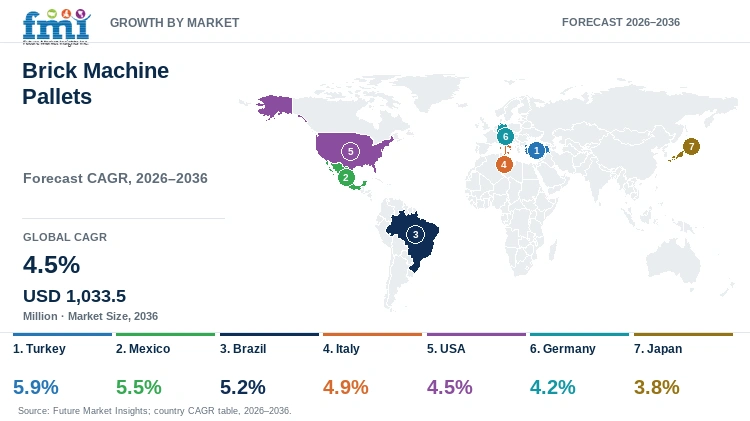
| Country | CAGR |
|---|---|
| Turkey | 5.9% |
| Mexico | 5.5% |
| Brazil | 5.2% |
| Italy | 4.9% |
| USA | 4.5% |
| Germany | 4.2% |
| Japan | 3.8% |
How do country-level CAGRs compare in the Brick Machine Pallets Market?
The countries span 2.1 percentage points from Turkey at 5.9% to Japan at 3.8%. Turkey and Mexico combine capacity additions with active service needs across expanding machine fleets. Brazil and Italy balance new plant activity with recurring board replacement across established concrete-products operations. The USA and Germany depend more heavily on installed equipment. Japan places greater emphasis on planned renewal across mature production lines.
- Turkey's local replacement-board networks reduce import lead times and help plants source compatible boards during scheduled maintenance.
- Nearby replacement stock helps Mexican concrete-products plants maintain precise board-to-machine compatibility during automated-line service and repairs.
- Brazil's housing programs favor distributors that keep compatible production boards near concrete plants serving active project areas.
- Italy's established equipment base rewards detailed board-life records that help plants compare replacement options before changing suppliers.
- Concrete-products plants in the USA rely on mature service networks for scheduled board replacement across fixed machine fleets.
- German plant engineers prioritize tolerance records as production boards must match fixed dimensions and vibration requirements across installed lines.
- Japan's maintenance-focused producers favor long-life boards that keep established lines operating without frequent handling or setup changes.
Similar CAGRs can produce different sales patterns because plant age and new-line timing vary. The full report provides country-level CAGR analysis across North America, Latin America, Western Europe, Eastern Europe, East Asia, South Asia and Pacific, and the Middle East and Africa.
Country-wise Analysis
- Housing activity keeps Turkish block producers planning added capacity during active construction cycles. Turkey's brick machine pallet demand is projected to grow at 5.9% CAGR through 2036, supported by housing activity and new-line commissioning. In May 2026, the Turkish Statistical Institute reported that first-quarter permit floor area rose 26.1% year over year. The same release said permitted home units increased 37.0% during the reporting period. Faster project starts can bring production-board qualification forward as plants prepare new block lines. Board makers must match each machine before plants approve a complete fleet order. Local stock cuts long import lead times during commissioning and planned maintenance. Reliable technical support resolves fit issues before installed lines move into full production.
- Mexico's concrete-products plants add automated lines under strict capital controls. Brick machine pallet demand in Mexico is forecast to rise at 5.5% CAGR, influenced by new equipment and replacement planning. In June 2026, INEGI reported that April construction-company production value rose 0.4% in real terms from the prior month and year. Employment fell 2.5% year over year during the same reporting period. These mixed indicators keep payback checks important before plants approve replacement-board spending. Plants using conventional palletizers also require close fit across forming and downstream handling equipment. Verified board sizes and nearby stock reduce setup risk across mixed equipment fleets. Capital discipline shapes replacement timing without removing recurring fit requirements.
- Brick machine pallet sales in Brazil are forecast to expand at 5.2% CAGR, linked to housing programs and block capacity. Concrete block plants serve projects that can concentrate equipment demand around active construction locations. In September 2026, the Ministry of Cities published MCMV-FAR proposal ordinances for subsidized urban housing. Program timing can move equipment orders between cities and individual production sites across Brazil. Board demand depends on which plants secure work and begin operating new machines. Local distributors match board dimensions and keep replacement stock close to active plants. Planned board changes support new lines without forcing changes to fixed machine settings. Installed fleets later create recurring replacement needs as boards wear through normal production cycles.
- Italy's brick machine pallet outlook is anticipated to advance at 4.9% CAGR, reinforced by construction output and planned maintenance. Italian block plants operate within mature supply chains and schedule board orders around established production cycles. In July 2026, Istat reported that May construction output rose 2.9% year over year. Output for the first five months of 2026 increased 2.0% from the prior year. Rising construction activity does not remove the cost of changing fixed machine interfaces. Plants need boards that match existing conveyors and curing systems throughout regular operation. Long board life supports planned replacement without forcing broader handling changes across the line. Clear service dates help plants align fleet changes with scheduled maintenance periods.
- Concrete-products plants in the USA buy boards through a mature equipment base with fixed operating requirements. The USA brick machine pallets sector is projected to record 4.5% CAGR, shaped by recurring fleet replacement across installed lines. In August 2026, the U.S. Census Bureau reported July new-home sales at an annual rate of 607,000 units. The same release listed 488,000 new houses for sale across the country. Housing activity keeps block and paver plants exposed to regular inspection and replacement needs. Plants weigh board cost against downtime risk before scheduled maintenance begins. Domestic service and planned stock reduce problems during fleet changes on fixed-size machines. That service network helps plants preserve machine settings while replacing worn boards.
- In Germany, brick machine pallet demand is predicted to advance at 4.2% CAGR, tied to permit activity and strict board tolerances. Plant engineers compare machine specifications with line efficiency before approving replacement fleets. In August 2026, Destatis reported 21,600 dwelling permits for June and said the total was 13.8% above the prior-year month. New buildings accounted for 17,800 permitted dwellings during June across Germany. Permit activity supports concrete-products work, but board changes still require exact machine-fit checks. Replacement boards must match fixed dimensions and vibration requirements across each installed line. Service histories help engineers compare board life before approving a different supplier. Reliable tolerance records shorten qualification without weakening machine compatibility controls.
- Japanese producers focus on steady output from established machine lines and controlled replacement schedules. Brick machine pallet adoption in Japan is estimated to expand at 3.8% CAGR, influenced by planned renewal across mature fleets. In July 2026, Japan's transport ministry reported that June housing starts rose 18.6% year over year. The ministry also said the annualized rate increased 3.9% from May during the same release. Plants keep current boards in service as long as dimensions and surface condition remain within tolerance. Replacement boards must match existing machine settings before plants approve a fleet change. Long-term local service helps engineers confirm fit without changing established line layouts. Careful qualification keeps replacement work compatible with mature production equipment.
Who are the notable companies in the Brick Machine Pallets Market?
Rhino Composite Pallets, WASA AG, S.L Machinery, QGM Zenith, Masa Group, Columbia Machine, HESS Group, Besser Company, GMT Pallets, and ASSYX GmbH & Co. KG.
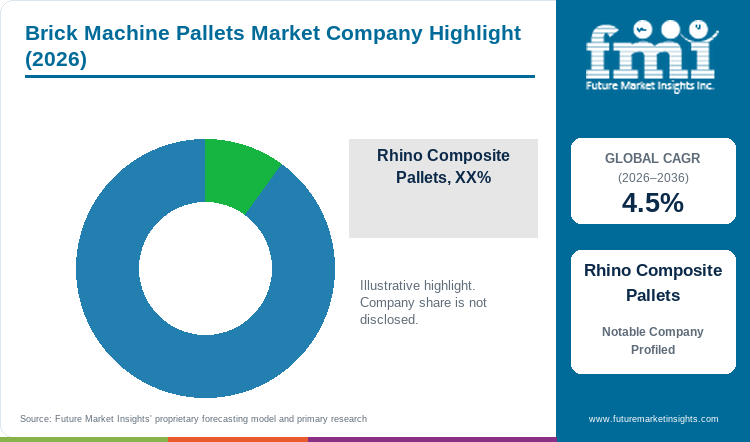
Board specialists compete with block-machine groups by proving long service life and stable dimensions with dependable machine fit. Machine groups shape board choice through palletizing systems and line design, which set size and movement requirements across each line. Each supplier must prove that its board or machine setup fits the plant before fleet purchases and later replacement work proceed.
- Rhino Composite Pallets, WASA AG, GMT Pallets, and ASSYX GmbH & Co. KG make production boards.
- S.L Machinery, QGM Zenith, Masa Group, and HESS Group combine block-forming machines with board movement.
- Columbia Machine and Besser Company link board needs with machines, parts, training, and plant service.
Competitive Benchmarking: Brick Machine Pallets Market
| Company | Production-board fit | Machine-line integration | Lifecycle support | Geographic Reach |
|---|---|---|---|---|
| Rhino Composite Pallets | High | Medium | High | International |
| WASA AG | High | Medium | Medium | Global |
| S.L Machinery | Medium | High | High | 100+ countries |
| QGM Zenith | Medium | High | High | Asia and Europe |
| Masa Group | Medium | High | High | Global |
| Columbia Machine | Medium | High | High | 100+ countries |
| HESS Group | Medium | High | High | Global |
| Besser Company | Medium | High | High | North America and international |
| GMT Pallets | High | Medium | Medium | 30+ countries |
| ASSYX GmbH & Co. KG | High | Medium | Medium | Worldwide |
Benchmark scores use four tests that describe each company's role in brick machine pallet supply. High board fit means the company directly makes production boards for this manufacturing use. Medium board fit means public records document relevant machine interfaces rather than direct board production. Low board fit means available public evidence does not establish a consistent interface capability. High integration connects forming equipment with board transport or production controls across the line. High lifecycle support covers parts and training together with refurbishment and service networks for installed equipment. Geographic reach describes the countries or regions that each company publicly serves.
Key Developments in the Brick Machine Pallets Market
- In April 2026, Besser Company hosted its first UK Blockmakers course for 27 people from 14 plants.
- In February 2026, Masa Group introduced optical quality control that links fresh-product measurements with digital production-board IDs.
- In January 2026, S.L Machinery reported commissioning its SLST1000 block-machine line in South China with automated handling.
Key Players in the Brick Machine Pallets Market
Production-board specialists
- Rhino Composite Pallets
- WASA AG
- GMT Pallets
- ASSYX GmbH & Co. KG
Integrated block-machine platforms
- S.L Machinery
- QGM Zenith
- Masa Group
- HESS Group
Concrete-products equipment platforms
- Columbia Machine
- Besser Company
Brick Machine Pallets Market - Report Scope
| Coverage field | Report scope |
|---|---|
| Market breakdown | Pallet type, machine compatibility, size, end use, sales channel, and region. |
| Quantitative Units | USD million. |
| Market Definition | Production boards used in block, brick, and paver forming, curing, and return handling. General shipping pallets and brick-making machine revenue are excluded. |
| Regions Covered | North America, Latin America, Western Europe, Eastern Europe, East Asia, South Asia and Pacific, and Middle East and Africa. |
| Countries Covered | Turkey, Mexico, Brazil, Italy, USA, Germany, Japan, and 30+ countries included in the full report. |
| Key Companies Profiled | Rhino Composite Pallets, WASA AG, S.L Machinery, QGM Zenith, Masa Group, Columbia Machine, HESS Group, Besser Company, GMT Pallets, ASSYX GmbH & Co. KG. |
| Forecast Period | 2026 to 2036. |
| Approach | Primary and secondary research with market triangulation. |
Brick Machine Pallets Market - Research Methodology
| Method | Approach |
|---|---|
| Primary Research | FMI analysts gathered input from manufacturers, service providers, technology developers, distributors, end users, procurement teams, and subject-matter experts. Interviews examined purchasing decisions, product or service evaluation, adoption barriers, approval requirements, pricing considerations, and expectations for technical or commercial support. Respondents were also asked what evidence is required before a trial, pilot, or initial order develops into regular purchasing. |
| Desk Research | Desk research covered government statistics, regulatory publications, trade data, industry associations, technical literature, standards, company filings, product information, and official corporate announcements. Sources were reviewed for relevance, publication date, geographic coverage, and consistency with the defined market scope. Claims relating to performance, applications, approvals, capacity, investment, and commercial activity were retained only when supported by credible public evidence. |
| Market Sizing and Forecasting | The market model combined the baseline value with historical performance, segment structure, pricing and volume indicators, adoption levels, company participation, and country-level demand conditions. Forecast assumptions considered economic activity, investment trends, regulatory developments, technology adoption, purchasing cycles, supply availability, and barriers to wider market use. Segment and regional estimates were reconciled before the final market total was calculated. |
| Data Validation | Estimates were checked against multiple independent indicators, including public data, company activity, trade patterns, industry developments, and findings from primary interviews. Validation also tested whether products, services, applications, and company revenues fell within the defined market boundaries. Adjacent categories, unsupported claims, overlapping revenues, and activities without direct market relevance were excluded to reduce double counting and maintain consistency across segments and countries. |
Brick Machine Pallets Market by Segments
Brick Machine Pallets Market segmented by Pallet Type:
- GMT pallets
- PVC pallets
- Bamboo - wood pallets
- Steel pallets
- Composite pallets
Brick Machine Pallets Market segmented by Machine Compatibility:
- Concrete block machines
- Clay brick machines
- Paver block machines
- Automatic brick lines
- Vibration press machines
Brick Machine Pallets Market segmented by Size:
- Medium format
- Small format
- Large format
- Custom size
Brick Machine Pallets Market segmented by End Use:
- Concrete block plants
- Clay brick plants
- Paver plants
- Precast units
- Small producers
Brick Machine Pallets Market segmented by Sales Channel:
- Aftermarket replacement
- Brick machine OEMs
- Direct pallet suppliers
- Distributor network
Brick Machine Pallets Market by Region:
- North America
- United States
- Canada
- Latin America
- Brazil
- Mexico
- Chile
- Rest of Latin America
- Western Europe
- Germany
- United Kingdom
- Italy
- Spain
- France
- Nordics
- Benelux
- Rest of Western Europe
- Eastern Europe
- Russia
- Poland
- Hungary
- Balkan and Baltic States
- Rest of Eastern Europe
- East Asia
- China
- Japan
- South Korea
- South Asia and Pacific
- India
- ASEAN
- Australia and New Zealand
- Rest of South Asia and Pacific
- Middle East and Africa
- Kingdom of Saudi Arabia
- Other GCC Countries
- Türkiye
- South Africa
- Other African Union Countries
- Rest of Middle East and Africa
Research Sources and Bibliography
- WASA AG. (2026, March 26). Solid plastic production board - timeless, sustainable and reliable.
- U.S. Census Bureau. (2026, September 17). New residential construction, August 2026.
- HESS Group. (2025, April 4). Automatic, non-contact quality control in concrete block and paver production.
- HESS Group. (2026, March 24). Successful commissioning of RH 500-C concrete block machine in Mexico.
- Masa Group. (2025, March 12). Masa at bauma - R&D project on intelligent plant control.
- S.L Machinery. (2026, June 11). SLST1300XL fully automatic servo production line commissioned in the Middle East.
- TOPWERK. (2026, January 6). TOPWERK establishes new business unit for after sales service.
- Quangong Machinery Co., Ltd. (2026, April). ZN1000-2 concrete block production line shipment to the Middle East.
- Fujian Qunfeng Machinery Co., Ltd. (2025, February). Automated concrete-products line installation in Sichuan.
- Besser Company. (2025, November 11). Industry professionals invited to expand expertise at 2026 Blockmakers workshops.
- Turkish Statistical Institute. (2026, May 22). Building permit statistics, first quarter 2026.
- National Institute of Statistics and Geography (INEGI). (2026, June 24). National Survey of Construction Companies: April 2026 indicators.
- Ministry of Cities, Brazil. (2026, September 2). MCMV-FAR proposal ordinances.
- Italian National Institute of Statistics (Istat). (2026, July 17). Production in the construction sector - May 2026.
- U.S. Census Bureau. (2026, August 25). New residential sales, July 2026.
- Federal Statistical Office of Germany (Destatis). (2026, August 18). Building permits for dwellings in June 2026: +13.8% year on year.
- Ministry of Land, Infrastructure, Transport and Tourism, Japan. (2026, July 31). Building starts statistics report, June 2026.
- Rhino Composite Pallets. (2025). Technology for production-board pallets in concrete block machines.
- WASA AG. (2025, May 26). Innovation on a solid foundation: Collaboration with Bloquera de Vallarta in Mexico.
- S.L Machinery. (2026, January 3). SLST1000 block machine production line commissioned in South China.
- Masa Group. (2026, February 25). Masa Optical Quality Control.
- Columbia Machine, Inc. (2026). Concrete products machines and pallet-size specifications. Retrieved September 22, 2026.
- ASSYX GmbH & Co. KG. (2026). DuroBOARD production pallet and company information. Retrieved September 22, 2026.
- GMT Pallets. (2026, August). GMT pallet product line for concrete block machines.
- Quangong Machinery Co., Ltd. (2026, August 24). ZPB KaczmareK continues 35-year Zenith cooperation with new production investment in Poland.
- S.L Machinery. (2026, May 20). Fully automatic servo brick production line commissioned in Muscat, Oman.
- HESS Group. (2025, October 21). Mehramat Concretes starts concrete block production - a plant with vision.
- Masa Group. (2025, September 4). Cleannox boosts production efficiency - Masa Cuboter ensures smooth packaging processes.
- ConSpare. (2026, March). ASSYX DuroBOARD production-board partnership launched for the United Kingdom and Ireland.
- S.L Machinery. (2026, April 14). Fully automatic servo wall and floor tile production line commissioned in Southeast Asia.
- Quangong Machinery Co., Ltd. (2026, January 28). ZN1200-2S block line shipped for East African capacity expansion.
- HESS Group. (2025, January 31). New concrete block and paver plant and value-adding line for Alomaier Trading and Contracting Company.
- GMT Pallets. (2025, August 26). Mexico customer purchases 3,500 steel-edged GMT brick machine pallets.
- Besser Company. (2025, May 27). Plant evaluations help concrete producers identify operational and maintenance needs.
- ConSpare. (2026, March). ASSYX DuroBOARD production boards launched at the UK Concrete Show.
This bibliography is provided for reader reference and is not exhaustive. The full report contains the complete reference list and detailed citations.
This Report Answers
- What value will the brick machine pallets market reach by 2036?
- Which plant conditions keep production-board replacement demand active over time?
- Why do GMT pallets hold 31.0% of pallet type demand?
- How do concrete block machines affect board fit and replacement needs?
- Why does medium format hold 42.0% of the size category?
- Why do growth conditions differ across the seven profiled countries?
- Which board requirements make supplier and material changes harder for plants?
- Which companies shape board supply, machine fit, and lifecycle service?
Frequently Asked Questions
How big is the brick machine pallets market in 2026?
The brick machine pallets market is valued at USD 665.5 million in 2026. The market is projected to reach USD 1,033.5 million by 2036. Normal board wear sustains replacement orders, and new machines require boards matched to their handling systems.
What is the CAGR of the brick machine pallets market from 2026 to 2036?
The brick machine pallets market is projected to grow at 4.5% CAGR from 2026 through 2036. Fleet replacement and new machine sales support recurring orders as installed boards wear through regular production cycles.
Which pallet type leads the brick machine pallets market in 2026?
GMT pallets are estimated to hold 31.0% of pallet type demand in 2026. Low water uptake and stable shape help these boards move reliably through repeated molding and curing cycles.
Which size segment leads the brick machine pallets market in 2026?
Medium format boards are forecast to hold 42.0% of size demand in 2026. Their dimensions balance useful molding area with manageable weight and limit changes to racks and board transport equipment.
Which companies are active in the brick machine pallets market?
Active companies include Rhino Composite Pallets, WASA AG, S.L Machinery, QGM Zenith, and Masa Group. Other profiled companies include Columbia Machine, HESS Group, Besser Company, GMT Pallets, and ASSYX GmbH & Co. KG. Together, these companies supply production boards, machine systems, parts, training, and lifecycle services. The combined roles cover board supply, machine fit, replacement support, and plant service across the production cycle.
Preview the report firsthand - request a free sample
Get SampleGet the brochure for pricing and purchase details.
Get PDFTable of Content
- Key Takeaways
- Market Size and CAGR
- Top Growth Driver
- Fastest Growing Segment
- Leading Region
- Key Companies
- Emerging Opportunities
- Executive Summary
- Global Market Outlook
- Demand-side Trends
- Supply-side Trends
- Technology Roadmap Analysis
- Analysis and Recommendations
- Analyst Perspective (What is happening? Why now? What should investors know?)
- Key Questions Answered
- How large is the market?
- What is the CAGR?
- What are key trends?
- Which region dominates?
- Who are the leaders?
- Market Overview
- Market Coverage / Taxonomy
- Market Definition / Scope / Limitations
- Research Methodology
- Chapter Orientation
- Analytical Lens and Working Hypotheses
- Market Structure, Signals, and Trend Drivers
- Benchmarking and Cross-market Comparability
- Market Sizing, Forecasting, and Opportunity Mapping
- Research Design and Evidence Framework
- Desk Research Programme (Secondary Evidence)
- Expert Input and Fieldwork (Primary Evidence)
- Tooling, Models, and Reference Databases
- Data Engineering and Model Build
- Quality Assurance and Audit Trail
- Market Background
- Market Dynamics (Drivers, Restraints, Opportunity, Trends)
- Scenario Forecast (Optimistic, Likely, Conservative)
- Impact Analysis
- AI Impact
- Sustainability Impact
- Regulatory Impact
- Technology Impact
- Consumer / Buyer Analysis
- Purchase Drivers
- Adoption Barriers
- Buyer Journey
- Opportunity Map Analysis
- Product Life Cycle Analysis
- Supply Chain Analysis
- Investment Feasibility Matrix
- Value Chain Analysis
- PESTLE and Porter's Analysis
- Regulatory Landscape
- Regional Parent Market Outlook
- Production and Consumption Statistics
- Import and Export Statistics
- Global Market Analysis and Forecast, 2021 to 2036
- Historical Market Size Value (USD Million) Analysis, 2021 to 2025
- Current and Future Market Size Value (USD Million) Projections, 2026 to 2036
- Y-o-Y Growth Trend Analysis
- Absolute $ Opportunity Analysis
- Global Market Pricing Analysis, 2021 to 2036
- Global Market Analysis and Forecast, By Pallet Type, 2021 to 2036
- Introduction / Key Findings
- Historical Market Size Value (USD Million) Analysis By Pallet Type, 2021 to 2025
- Current and Future Market Size Value (USD Million) Analysis and Forecast By Pallet Type, 2026 to 2036
- GMT pallets
- PVC pallets
- Bamboo - wood pallets
- Steel pallets
- Composite pallets
- Y-o-Y Growth Trend Analysis By Pallet Type, 2021 to 2025
- Absolute $ Opportunity Analysis By Pallet Type, 2026 to 2036
- Global Market Analysis and Forecast, By Machine Compatibility, 2021 to 2036
- Introduction / Key Findings
- Historical Market Size Value (USD Million) Analysis By Machine Compatibility, 2021 to 2025
- Current and Future Market Size Value (USD Million) Analysis and Forecast By Machine Compatibility, 2026 to 2036
- Concrete block machines
- Clay brick machines
- Paver block machines
- Automatic brick lines
- Vibration press machines
- Y-o-Y Growth Trend Analysis By Machine Compatibility, 2021 to 2025
- Absolute $ Opportunity Analysis By Machine Compatibility, 2026 to 2036
- Global Market Analysis and Forecast, By Size, 2021 to 2036
- Introduction / Key Findings
- Historical Market Size Value (USD Million) Analysis By Size, 2021 to 2025
- Current and Future Market Size Value (USD Million) Analysis and Forecast By Size, 2026 to 2036
- Medium format
- Small format
- Large format
- Custom size
- Y-o-Y Growth Trend Analysis By Size, 2021 to 2025
- Absolute $ Opportunity Analysis By Size, 2026 to 2036
- Global Market Analysis and Forecast, By End Use, 2021 to 2036
- Introduction / Key Findings
- Historical Market Size Value (USD Million) Analysis By End Use, 2021 to 2025
- Current and Future Market Size Value (USD Million) Analysis and Forecast By End Use, 2026 to 2036
- Concrete block plants
- Clay brick plants
- Paver plants
- Precast units
- Small producers
- Y-o-Y Growth Trend Analysis By End Use, 2021 to 2025
- Absolute $ Opportunity Analysis By End Use, 2026 to 2036
- Global Market Analysis and Forecast, By Sales Channel, 2021 to 2036
- Introduction / Key Findings
- Historical Market Size Value (USD Million) Analysis By Sales Channel, 2021 to 2025
- Current and Future Market Size Value (USD Million) Analysis and Forecast By Sales Channel, 2026 to 2036
- Aftermarket replacement
- Brick machine OEMs
- Direct pallet suppliers
- Distributor network
- Y-o-Y Growth Trend Analysis By Sales Channel, 2021 to 2025
- Absolute $ Opportunity Analysis By Sales Channel, 2026 to 2036
- Global Market Analysis and Forecast, By Region, 2021 to 2036
- Introduction
- Historical Market Size Value (USD Million) Analysis By Region, 2021 to 2025
- Current Market Size Value (USD Million) Analysis and Forecast By Region, 2026 to 2036
- North America
- Latin America
- Western Europe
- Eastern Europe
- East Asia
- South Asia and Pacific
- Middle East and Africa
- Market Attractiveness Analysis By Region
- North America Market Analysis and Forecast, By Country, 2021 to 2036
- Historical Market Size Value (USD Million) Trend Analysis By Market Taxonomy, 2021 to 2025
- Market Size Value (USD Million) Forecast By Market Taxonomy, 2026 to 2036
- By Country
- United States
- Canada
- By Pallet Type
- By Machine Compatibility
- By Size
- By End Use
- By Sales Channel
- By Country
- Market Attractiveness Analysis
- By Country
- By Pallet Type
- By Machine Compatibility
- By Size
- By End Use
- By Sales Channel
- Key Takeaways
- Latin America Market Analysis and Forecast, By Country
- Historical Market Size Value (USD Million) Trend Analysis By Market Taxonomy, 2021 to 2025
- Market Size Value (USD Million) Forecast By Market Taxonomy, 2026 to 2036
- By Country
- Brazil
- Mexico
- Chile
- Rest of Latin America
- By Pallet Type
- By Machine Compatibility
- By Size
- By End Use
- By Sales Channel
- By Country
- Market Attractiveness Analysis
- By Country
- By Pallet Type
- By Machine Compatibility
- By Size
- By End Use
- By Sales Channel
- Key Takeaways
- Western Europe Market Analysis and Forecast, By Country
- Historical Market Size Value (USD Million) Trend Analysis By Market Taxonomy, 2021 to 2025
- Market Size Value (USD Million) Forecast By Market Taxonomy, 2026 to 2036
- By Country
- Germany
- United Kingdom
- Italy
- Spain
- France
- Nordics
- Benelux
- Rest of Western Europe
- By Pallet Type
- By Machine Compatibility
- By Size
- By End Use
- By Sales Channel
- By Country
- Market Attractiveness Analysis
- By Country
- By Pallet Type
- By Machine Compatibility
- By Size
- By End Use
- By Sales Channel
- Key Takeaways
- Eastern Europe Market Analysis and Forecast, By Country
- Historical Market Size Value (USD Million) Trend Analysis By Market Taxonomy, 2021 to 2025
- Market Size Value (USD Million) Forecast By Market Taxonomy, 2026 to 2036
- By Country
- Russia
- Poland
- Hungary
- Balkan and Baltic States
- Rest of Eastern Europe
- By Pallet Type
- By Machine Compatibility
- By Size
- By End Use
- By Sales Channel
- By Country
- Market Attractiveness Analysis
- By Country
- By Pallet Type
- By Machine Compatibility
- By Size
- By End Use
- By Sales Channel
- Key Takeaways
- East Asia Market Analysis and Forecast, By Country
- Historical Market Size Value (USD Million) Trend Analysis By Market Taxonomy, 2021 to 2025
- Market Size Value (USD Million) Forecast By Market Taxonomy, 2026 to 2036
- By Country
- China
- Japan
- South Korea
- By Pallet Type
- By Machine Compatibility
- By Size
- By End Use
- By Sales Channel
- By Country
- Market Attractiveness Analysis
- By Country
- By Pallet Type
- By Machine Compatibility
- By Size
- By End Use
- By Sales Channel
- Key Takeaways
- South Asia and Pacific Market Analysis and Forecast, By Country
- Historical Market Size Value (USD Million) Trend Analysis By Market Taxonomy, 2021 to 2025
- Market Size Value (USD Million) Forecast By Market Taxonomy, 2026 to 2036
- By Country
- India
- ASEAN
- Australia and New Zealand
- Rest of South Asia and Pacific
- By Pallet Type
- By Machine Compatibility
- By Size
- By End Use
- By Sales Channel
- By Country
- Market Attractiveness Analysis
- By Country
- By Pallet Type
- By Machine Compatibility
- By Size
- By End Use
- By Sales Channel
- Key Takeaways
- Middle East and Africa Market Analysis and Forecast, By Country
- Historical Market Size Value (USD Million) Trend Analysis By Market Taxonomy, 2021 to 2025
- Market Size Value (USD Million) Forecast By Market Taxonomy, 2026 to 2036
- By Country
- Kingdom of Saudi Arabia
- Other GCC Countries
- Türkiye
- South Africa
- Other African Union Countries
- Rest of Middle East and Africa
- By Pallet Type
- By Machine Compatibility
- By Size
- By End Use
- By Sales Channel
- By Country
- Market Attractiveness Analysis
- By Country
- By Pallet Type
- By Machine Compatibility
- By Size
- By End Use
- By Sales Channel
- Key Takeaways
- Key Countries Market Analysis
- United States
- Pricing Analysis
- Market Share Analysis, 2025
- By Pallet Type
- By Machine Compatibility
- By Size
- By End Use
- By Sales Channel
- Canada
- Pricing Analysis
- Market Share Analysis, 2025
- By Pallet Type
- By Machine Compatibility
- By Size
- By End Use
- By Sales Channel
- Mexico
- Pricing Analysis
- Market Share Analysis, 2025
- By Pallet Type
- By Machine Compatibility
- By Size
- By End Use
- By Sales Channel
- Brazil
- Pricing Analysis
- Market Share Analysis, 2025
- By Pallet Type
- By Machine Compatibility
- By Size
- By End Use
- By Sales Channel
- Chile
- Pricing Analysis
- Market Share Analysis, 2025
- By Pallet Type
- By Machine Compatibility
- By Size
- By End Use
- By Sales Channel
- Germany
- Pricing Analysis
- Market Share Analysis, 2025
- By Pallet Type
- By Machine Compatibility
- By Size
- By End Use
- By Sales Channel
- United Kingdom
- Pricing Analysis
- Market Share Analysis, 2025
- By Pallet Type
- By Machine Compatibility
- By Size
- By End Use
- By Sales Channel
- Italy
- Pricing Analysis
- Market Share Analysis, 2025
- By Pallet Type
- By Machine Compatibility
- By Size
- By End Use
- By Sales Channel
- Spain
- Pricing Analysis
- Market Share Analysis, 2025
- By Pallet Type
- By Machine Compatibility
- By Size
- By End Use
- By Sales Channel
- France
- Pricing Analysis
- Market Share Analysis, 2025
- By Pallet Type
- By Machine Compatibility
- By Size
- By End Use
- By Sales Channel
- India
- Pricing Analysis
- Market Share Analysis, 2025
- By Pallet Type
- By Machine Compatibility
- By Size
- By End Use
- By Sales Channel
- ASEAN
- Pricing Analysis
- Market Share Analysis, 2025
- By Pallet Type
- By Machine Compatibility
- By Size
- By End Use
- By Sales Channel
- Australia and New Zealand
- Pricing Analysis
- Market Share Analysis, 2025
- By Pallet Type
- By Machine Compatibility
- By Size
- By End Use
- By Sales Channel
- China
- Pricing Analysis
- Market Share Analysis, 2025
- By Pallet Type
- By Machine Compatibility
- By Size
- By End Use
- By Sales Channel
- Japan
- Pricing Analysis
- Market Share Analysis, 2025
- By Pallet Type
- By Machine Compatibility
- By Size
- By End Use
- By Sales Channel
- South Korea
- Pricing Analysis
- Market Share Analysis, 2025
- By Pallet Type
- By Machine Compatibility
- By Size
- By End Use
- By Sales Channel
- Russia
- Pricing Analysis
- Market Share Analysis, 2025
- By Pallet Type
- By Machine Compatibility
- By Size
- By End Use
- By Sales Channel
- Poland
- Pricing Analysis
- Market Share Analysis, 2025
- By Pallet Type
- By Machine Compatibility
- By Size
- By End Use
- By Sales Channel
- Hungary
- Pricing Analysis
- Market Share Analysis, 2025
- By Pallet Type
- By Machine Compatibility
- By Size
- By End Use
- By Sales Channel
- Kingdom of Saudi Arabia
- Pricing Analysis
- Market Share Analysis, 2025
- By Pallet Type
- By Machine Compatibility
- By Size
- By End Use
- By Sales Channel
- Türkiye
- Pricing Analysis
- Market Share Analysis, 2025
- By Pallet Type
- By Machine Compatibility
- By Size
- By End Use
- By Sales Channel
- South Africa
- Pricing Analysis
- Market Share Analysis, 2025
- By Pallet Type
- By Machine Compatibility
- By Size
- By End Use
- By Sales Channel
- Turkey
- Pricing Analysis
- Market Share Analysis, 2025
- By Pallet Type
- By Machine Compatibility
- By Size
- By End Use
- By Sales Channel
- United States
- Market Structure Analysis
- Competition Dashboard
- Competition Benchmarking
- Market Share Analysis of Top Players
- By Regional
- By Pallet Type
- By Machine Compatibility
- By Size
- By End Use
- By Sales Channel
- Emerging Startups
- Innovation Benchmarking
- Competition Analysis
- Competition Deep Dive
- Rhino Composite Pallets
- Overview
- Product Portfolio
- Profitability by Market Segments
- Sales Footprint
- Strategy Overview
- Marketing Strategy
- Product Strategy
- Channel Strategy
- WASA AG
- S.L Machinery
- QGM Zenith
- Masa Group
- Columbia Machine
- HESS Group
- Besser Company
- GMT Pallets
- ASSYX GmbH & Co. KG
- Rhino Composite Pallets
- Case Studies
- Success Stories
- Recent Developments
- Competition Deep Dive
- Assumptions & Acronyms Used


