

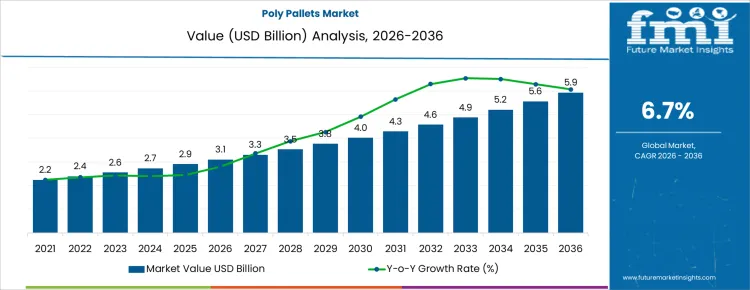
- Industry Size (2026)
- USD 3.1 Bn
- Forecast (2036)
- USD 5.9 Bn
- CAGR (2026 to 2036)
- 6.7%
Poly Pallets Market Forecast and Outlook 2026 to 2036
The global poly pallets market is steadily expanding, projected to reach USD 5.9 billion by 2036 from USD 3.1 billion in 2026, with a CAGR of 6.7%. The food, pharma & retail logistics sector leads with a 42% share, driven by the increasing demand for durable, hygienic, and efficient packaging for sensitive products. Poly pallets, primarily made from HDPE or polypropylene, provide superior benefits over wood pallets, including resistance to moisture, chemicals, pests, and easier sanitation, making them ideal for regulated industries like food and pharmaceuticals. In terms of pallet type, rackable & nestable pallets hold the largest market share of 45%, due to their space efficiency and versatility in both storage and transportation.
Quick Stats for Poly Pallets Market
- Poly Pallets Market Value (2026): USD 3.1 billion
- Poly Pallets Market Forecast Value (2036): USD 5.9 billion
- Poly Pallets Market Forecast CAGR: 6.7%
- Leading End-Use in Poly Pallets Market: Food, pharma & retail logistics
- Top Pallet Type in Poly Pallets Market: Rackable & nestable pallets
- Key Growth Regions in Poly Pallets Market: Asia Pacific
- Key Players in Poly Pallets Market: ORBIS, Rehrig Pacific, Schoeller Allibert, Qingdao Huading, Nilkamal, Mitsubishi Logistics
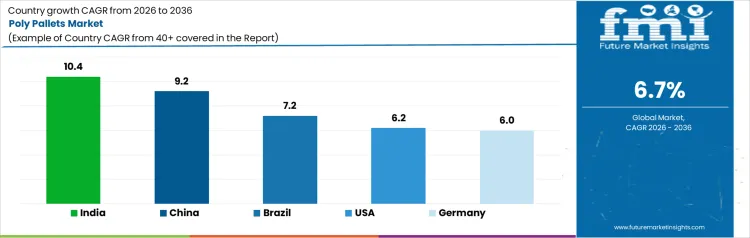
India leads the market with a 10.4% CAGR, driven by rapid industrial growth and increased demand for reliable, cost-effective storage solutions, particularly in chemicals, food, and pharmaceuticals. China follows with 9.2%, supported by the growing manufacturing sector and logistics infrastructure. The USA experiences a 6.2% growth rate, with an emphasis on sustainable and hygienic packaging solutions. Germany grows at 6%, spurred by stringent regulations and a focus on quality. Brazil sees steady growth at 7.2%, driven by expanding industrial activities and the need for high-performance pallets in sectors like agriculture and chemicals. The poly pallets market is poised for continued growth as industries focus on sustainability, efficiency, and safety.
Poly Pallets Market Key Takeaways
| Metric | Value |
|---|---|
| Industry Value (2026) | USD 3.1 billion |
| Forecast Value (2036) | USD 5.9 billion |
| Forecast CAGR (2026 to 2036) | 6.7% |
How is the Global Poly Pallets Sector Advancing?
The global poly pallets market is growing steadily as industries seek durable, lightweight, and long‑lasting material handling solutions. Poly pallets made from high‑density polymers such as HDPE or polypropylene offer advantages over traditional wood pallets, including resistance to moisture, chemicals, and pests, easier sanitation, and longer service life. These characteristics make them especially suitable for sectors with stringent hygiene requirements such as food and beverage, pharmaceuticals, and healthcare, as well as logistics, warehousing, and manufacturing where repeated load cycles and handling durability are critical.
Adoption of poly pallets is being driven by supply chain optimization trends, regulatory emphasis on food safety, and increased focus on reusable and recyclable packaging solutions. Advances in molding technologies and pallet design have improved load integrity, weight capacity, and safety features, enabling poly pallets to compete effectively with both wood and metal alternatives. The shift toward circular economy principles are supporting the use of pallets that can be cleaned, repaired, and reintegrated into reuse cycles, reducing total cost of ownership and environmental impact.
Challenges such as higher upfront costs compared with traditional wood pallets and limited recycling infrastructure in certain regions may influence adoption rates. Despite these factors, the emphasis on durability, hygiene, and lifecycle cost savings will sustain demand for poly pallets worldwide.
What is the Segment-Wise Analysis for the Global Poly Pallets Market?
The global poly pallets market is segmented by application and pallet type. Food, pharma & retail logistics hold a 42% share, driven by the need for efficient, hygienic, and durable pallets for sensitive products. In terms of pallet type, rackable & nestable pallets lead the market with a 45% share, offering versatile storage and transport solutions. Other pallet types include hygienic pallets, heavy-duty pallets, and lightweight pallets, all of which are used across various sectors like manufacturing, warehousing, FMCG, and food & beverage. This segmentation highlights the growing demand for reliable and adaptable poly pallets in diverse industries.
How Do Food, Pharma & Retail Logistics Lead the Global Poly Pallets Market?
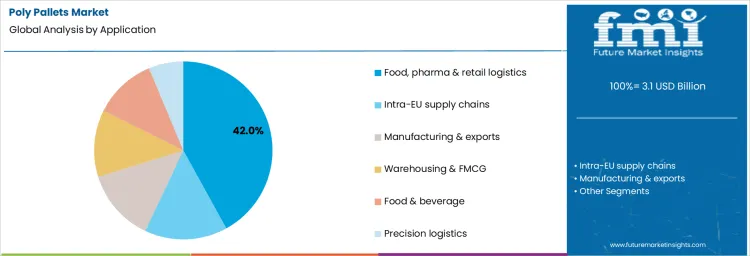
Food, pharma & retail logistics lead the global poly pallets market with a 42% share, driven by the essential need for secure, hygienic, and efficient transportation of sensitive goods. Poly pallets are particularly suited for industries handling perishable and regulated products such as food and pharmaceuticals, where maintaining product quality and safety is critical. These pallets provide excellent durability, resistance to contamination, and ease of handling, ensuring compliance with industry standards. As logistics solutions demand more cost-effective, reliable, and safe packaging, poly pallets are increasingly becoming the preferred choice for managing the complex needs of food, pharma, and retail logistics sectors, fueling their continued dominance in the market.
Why Do Rackable & Nestable Pallets Hold the Largest Market Share in the Global Poly Pallets Market?
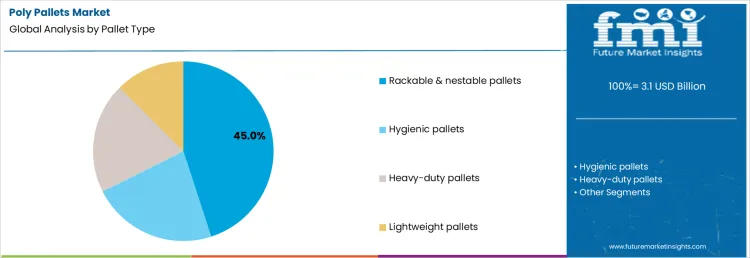
Rackable & nestable pallets hold the largest share of 45% in the global poly pallets market due to their high versatility and space efficiency. These pallets are ideal for both transport and storage, as they can be stacked securely and efficiently, optimizing warehouse and transportation space. The ability to nest these pallets when empty further enhances space savings, making them especially valuable in industries like food, pharma, and retail logistics, where managing space efficiently is critical. Their robustness, adaptability, and ability to save space during storage make rackable & nestable pallets the most widely used option, contributing to their dominance in the market.
What are Key Dynamics for Poly Pallets Market?
The poly pallets market is growing as industries shift toward durable, hygienic, and reusable load-handling solutions. Polyethylene and polypropylene pallets resist moisture, chemicals, and pests, making them well suited for food, pharmaceuticals, and export logistics. Demand is rising with global supply chain expansion and stricter sanitation standards, especially in cold chain and warehouse operations. Sustainability goals and regulations are encouraging reusable plastic pallets over single-use wood. Lightweight design also reduces transportation costs and emissions, strengthening interest in poly pallet adoption worldwide.
What Are the Key Drivers for the Poly Pallets Market?
The poly pallets market is driven by the need for durable and hygienic handling solutions that support diverse industry requirements. Poly pallets resist moisture, chemicals, and biological contamination, which is critical for sectors such as food and beverage, pharmaceuticals, and chemicals. They also provide consistent dimensions enabling automation and warehouse efficiency. Sustainability targets and corporate commitments to reduce carbon emissions encourage reusable plastic pallets over wood. Growth in global logistics, e-commerce fulfillment, and cold chain distribution further boosts demand, as lighter poly pallets reduce handling damage and transportation costs.
What Key Trends Are Shaping the Poly Pallets Market?
Key trends in the poly pallets market include the rise of closed-loop pallet pooling and rental programs that reduce total cost of ownership and support reuse. Manufacturers are advancing reinforced and lightweight designs that balance strength with lower material use. There’s also increased adoption of smart pallets equipped with RFID or IoT sensors for real-time tracking, inventory optimization, and condition monitoring in logistics networks. Sustainability initiatives are driving demand for pallets made from recycled polymers and for improved recycling infrastructure. Integration with automated material handling systems and industry standards for pallet dimensions further propels market evolution.
What is the Growth Outlook for the Poly Pallets Market by Country?
| Country | CAGR (%) |
|---|---|
| USA | 6.2% |
| Germany | 6% |
| China | 9.2% |
| India | 10.4% |
| Brazil | 7.2% |
The poly pallets market is experiencing steady growth, with India leading at a 10.4% CAGR, driven by the country’s expanding industrial sectors and increasing demand for durable, lightweight, and cost-effective storage solutions. China follows with 9.2%, supported by the continued growth of its manufacturing and logistics sectors. The USA’s market grows at 6.2%, driven by the need for sustainable and safe pallet solutions in various industries like food and pharmaceuticals. Germany’s market grows at 6%, supported by strong regulations and a focus on quality and efficiency. Brazil’s market grows at 7.2%, fueled by the growing industrial activity and the rising demand for high-performance storage solutions.
Why is India Leading in the Poly Pallets Market?
India’s poly pallets market is growing at 10.4%, driven by rapid industrialization and expanding sectors like logistics, manufacturing, and pharmaceuticals. The demand for durable, cost-effective, and efficient storage solutions has risen as India’s manufacturing base grows. Poly pallets are increasingly favored for their lightweight, high strength, and corrosion resistance compared to traditional wood and metal alternatives. These advantages make them suitable for a wide range of industries, including food, chemicals, and pharmaceuticals. There is a growing focus on sustainability, as businesses move away from wood pallets due to deforestation concerns. The government’s emphasis on improving infrastructure and meeting global standards for logistics and export further accelerates the market’s growth.
What is Driving the Growth of the Poly Pallets Market in China?
China’s poly pallets market is growing at 9.2%, driven by the country’s large-scale industrial production and expanding logistics infrastructure. As the world’s largest manufacturer, China requires efficient storage and transport solutions for raw materials, finished goods, and exports. Poly pallets, known for their strength, durability, and resistance to weather conditions, offer an ideal solution for China’s diverse industries. The continued growth of e-commerce and global trade is increasing the need for reliable, reusable, and sustainable packaging solutions. Poly pallets are also gaining traction due to their long lifespan, which offers cost savings in logistics. Government regulations and the push for environmental sustainability are also encouraging the shift from wood to plastic pallets.
How is the Poly Pallets Market Expanding in the USA?
The USA’s poly pallets market is growing at 6.2%, driven by the rising need for efficient, safe, and durable storage solutions across various industries, particularly in food, pharmaceuticals, and logistics. Poly pallets are becoming increasingly preferred due to their resistance to damage, corrosion, and wear, making them ideal for handling a wide range of materials. The growing demand for sustainable and reusable packaging solutions is another major factor, as businesses look to reduce their environmental impact and meet regulations around packaging waste. Poly pallets offer cost-effectiveness due to their longevity and lower maintenance compared to wooden alternatives. As industries in the USA continue to prioritize supply chain efficiency and sustainability, the demand for poly pallets is expected to increase.
What is Contributing to the Growth of the Poly Pallets Market in Germany?
Germany’s poly pallets market is growing at 6%, supported by its strong industrial sector and commitment to sustainability. As a global leader in industries such as automotive, chemicals, and food processing, Germany requires storage solutions that meet strict safety, quality, and environmental standards. Poly pallets are increasingly being adopted for their durability, ease of handling, and compliance with these high standards. They are also favored for their long service life and resistance to corrosion, reducing the need for frequent replacements. Germany’s focus on eco-friendly solutions and waste reduction has pushed companies to adopt sustainable alternatives, such as poly pallets, over traditional wooden options. The growing demand for efficient and reusable packaging solutions, combined with Germany’s regulatory framework, ensures the steady growth of the poly pallets market.
What is Driving the Growth of the Poly Pallets Market in Brazil?
Brazil’s poly pallets market is growing at 7.2%, fueled by the country’s expanding industrial and agricultural sectors. Brazil’s manufacturing industries, particularly in chemicals, food processing, and logistics, are increasingly adopting poly pallets due to their durability, strength, and ability to withstand harsh environments. The transition from wood to poly pallets is also driven by Brazil’s emphasis on sustainability and reducing the environmental impact of traditional wood pallets. Poly pallets offer long-term cost savings, as they are more durable and require less maintenance compared to their wooden counterparts. Brazil’s growing export activities, particularly in agriculture and mining, further boost the demand for reliable, reusable packaging solutions. As Brazil continues to modernize its logistics infrastructure and meet international environmental standards, the market for poly pallets is expected to expand steadily, supporting continued industrial growth and efficient supply chain management.
How Are Companies Competing in the Poly Pallets Market?
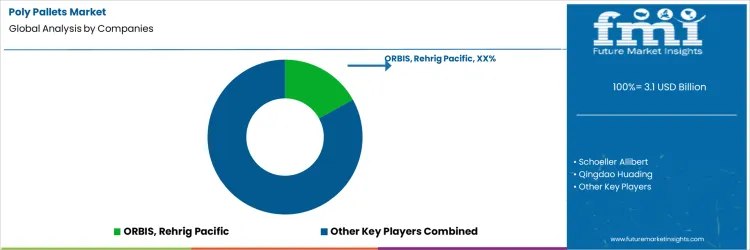
In the poly pallets market ORBIS / Rehrig Pacific, Schoeller Allibert, Qingdao Huading, Nilkamal, local pallet OEMs, and Mitsubishi Logistics are positioned with product brochures that emphasize durability, load capacity, and supply chain efficiency. ORBIS / Rehrig Pacific materials present nestable and rackable poly pallets engineered for high-throughput environments and reusable lifecycles. Technical data on load ratings and impact resistance is shown alongside application scenarios that help logistics planners match pallet types to warehouse and transport needs. Schoeller Allibert collateral focuses on modular, lightweight pallet platforms with consistent quality and global service support. Performance charts and configuration guides support decision making in automotive, food, and pharmaceutical supply chains.
Qingdao Huading brochures highlight cost-effective poly pallets designed for industrial and export use. Clear specifications on dimensions, load limits, and stacking behavior are included to aid specification. Nilkamal materials showcase durable pallet solutions tailored to regional markets, with emphasis on material quality, long service life, and compatibility with handling equipment. Product sheets include quick reference tables that simplify selection for material handlers. Local pallet OEMs are featured with customizable pallet designs, flexible production schedules, and rapid delivery options that appeal to nearby manufacturers and distributors requiring just-in-time supply. Mitsubishi Logistics literature positions its poly pallets within a broader logistics offering, stressing pallet strength, traceability, and integration with automated handling systems.
Key Players in Poly Pallets Market
- ORBIS, Rehrig Pacific
- Schoeller Allibert
- Qingdao Huading
- Nilkamal
- Local pallet OEMs
- Mitsubishi Logistics
Scope of Report
| Items | Values |
|---|---|
| Quantitative Units (2026) | USD billion |
| End-use Application | Food, pharma & retail logistics, Intra-EU supply chains, Manufacturing & exports, Warehousing & FMCG, Food & beverage, Precision logistics |
| Pallet Type | Rackable & nestable pallets, Hygienic pallets, Heavy-duty pallets, Lightweight pallets |
| Regions Covered | Asia Pacific, Europe, North America, Latin America, Middle East & Africa |
| Countries Covered | USA, China, Japan, South Korea, India, Australia & New Zealand, ASEAN, Germany, UK, France, Italy, Spain, Nordic, BENELUX, Brazil, Chile, Mexico, Saudi Arabia, Other GCC Countries, Turkey, South Africa, Other African Union |
| Key Companies Profiled | ORBIS, Rehrig Pacific, Schoeller Allibert, Qingdao Huading, Nilkamal, Mitsubishi Logistics |
| Additional Attributes | Dollar sales by end-use, pallet type, and region; regional CAGR and growth outlook; distribution channels including logistics providers; innovation trends in poly pallet design |
Poly Pallets Market by Segments
Application
- Food, pharma & retail logistics
- Intra-EU supply chains
- Manufacturing & exports
- Warehousing & FMCG
- Food & beverage
- Precision logistics
Pallet Type
- Rackable & nestable pallets
- Hygienic pallets
- Heavy-duty pallets
- Lightweight pallets
Region:
- Asia Pacific
- China
- Japan
- South Korea
- India
- Australia & New Zealand
- ASEAN
- Rest of Asia Pacific
- Europe
- Germany
- United Kingdom
- France
- Italy
- Spain
- Nordic
- BENELUX
- Rest of Europe
- North America
- United States
- Canada
- Mexico
- Latin America
- Brazil
- Chile
- Rest of Latin America
- Middle East & Africa
- Kingdom of Saudi Arabia
- Other GCC Countries
- Turkey
- South Africa
- Other African Union
- Rest of Middle East & Africa
Frequently Asked Questions
How big is the poly pallets market in 2026?
The global poly pallets market is estimated to be valued at USD 3.1 billion in 2026.
What will be the size of poly pallets market in 2036?
The market size for the poly pallets market is projected to reach USD 5.9 billion by 2036.
How much will be the poly pallets market growth between 2026 and 2036?
The poly pallets market is expected to grow at a 6.7% CAGR between 2026 and 2036.
What are the key product types in the poly pallets market?
The key product types in the poly pallets market are rackable & nestable pallets, hygienic pallets, heavy-duty pallets, and lightweight pallets.
Which pallet type segment to contribute significant share in the poly pallets market in 2026?
In terms of pallet type, rackable & nestable pallets segment to command 45.0% share in the poly pallets market in 2026.
Preview the report firsthand - request a free sample
Get SampleGet the brochure for pricing and purchase details.
Get PDFTable of Content
- Executive Summary
- Global Market Outlook
- Demand-side Trends
- Supply-side Trends
- Technology Roadmap Analysis
- Analysis and Recommendations
- Market Overview
- Market Coverage / Taxonomy
- Market Definition / Scope / Limitations
- Market Background
- Market Dynamics
- Drivers
- Restraints
- Opportunity
- Trends
- Scenario Forecast
- Demand in Optimistic Scenario
- Demand in Likely Scenario
- Demand in Conservative Scenario
- Opportunity Map Analysis
- Product Life Cycle Analysis
- Supply Chain Analysis
- Investment Feasibility Matrix
- Value Chain Analysis
- PESTLE and Porter’s Analysis
- Regulatory Landscape
- Regional Parent Market Outlook
- Production and Consumption Statistics
- Import and Export Statistics
- Market Dynamics
- Global Market Analysis 2021 to 2025 and Forecast, 2026 to 2036
- Historical Market Size Value (USD Million) Analysis, 2021 to 2025
- Current and Future Market Size Value (USD Million) Projections, 2026 to 2036
- Y-o-Y Growth Trend Analysis
- Absolute $ Opportunity Analysis
- Global Market Pricing Analysis 2021 to 2025 and Forecast 2026 to 2036
- Global Market Analysis 2021 to 2025 and Forecast 2026 to 2036, By Application
- Introduction / Key Findings
- Historical Market Size Value (USD Million) Analysis By Application , 2021 to 2025
- Current and Future Market Size Value (USD Million) Analysis and Forecast By Application , 2026 to 2036
- Food, pharma & retail logistics
- Intra-EU supply chains
- Manufacturing & exports
- Warehousing & FMCG
- Food & beverage
- Precision logistics
- Y-o-Y Growth Trend Analysis By Application , 2021 to 2025
- Absolute $ Opportunity Analysis By Application , 2026 to 2036
- Global Market Analysis 2021 to 2025 and Forecast 2026 to 2036, By Pallet Type
- Introduction / Key Findings
- Historical Market Size Value (USD Million) Analysis By Pallet Type, 2021 to 2025
- Current and Future Market Size Value (USD Million) Analysis and Forecast By Pallet Type, 2026 to 2036
- Rackable & nestable pallets
- Hygienic pallets
- Heavy-duty pallets
- Lightweight pallets
- Y-o-Y Growth Trend Analysis By Pallet Type, 2021 to 2025
- Absolute $ Opportunity Analysis By Pallet Type, 2026 to 2036
- Global Market Analysis 2021 to 2025 and Forecast 2026 to 2036, By Region
- Introduction
- Historical Market Size Value (USD Million) Analysis By Region, 2021 to 2025
- Current Market Size Value (USD Million) Analysis and Forecast By Region, 2026 to 2036
- North America
- Latin America
- Western Europe
- Eastern Europe
- East Asia
- South Asia and Pacific
- Middle East & Africa
- Market Attractiveness Analysis By Region
- North America Market Analysis 2021 to 2025 and Forecast 2026 to 2036, By Country
- Historical Market Size Value (USD Million) Trend Analysis By Market Taxonomy, 2021 to 2025
- Market Size Value (USD Million) Forecast By Market Taxonomy, 2026 to 2036
- By Country
- USA
- Canada
- Mexico
- By Application
- By Pallet Type
- By Country
- Market Attractiveness Analysis
- By Country
- By Application
- By Pallet Type
- Key Takeaways
- Latin America Market Analysis 2021 to 2025 and Forecast 2026 to 2036, By Country
- Historical Market Size Value (USD Million) Trend Analysis By Market Taxonomy, 2021 to 2025
- Market Size Value (USD Million) Forecast By Market Taxonomy, 2026 to 2036
- By Country
- Brazil
- Chile
- Rest of Latin America
- By Application
- By Pallet Type
- By Country
- Market Attractiveness Analysis
- By Country
- By Application
- By Pallet Type
- Key Takeaways
- Western Europe Market Analysis 2021 to 2025 and Forecast 2026 to 2036, By Country
- Historical Market Size Value (USD Million) Trend Analysis By Market Taxonomy, 2021 to 2025
- Market Size Value (USD Million) Forecast By Market Taxonomy, 2026 to 2036
- By Country
- Germany
- UK
- Italy
- Spain
- France
- Nordic
- BENELUX
- Rest of Western Europe
- By Application
- By Pallet Type
- By Country
- Market Attractiveness Analysis
- By Country
- By Application
- By Pallet Type
- Key Takeaways
- Eastern Europe Market Analysis 2021 to 2025 and Forecast 2026 to 2036, By Country
- Historical Market Size Value (USD Million) Trend Analysis By Market Taxonomy, 2021 to 2025
- Market Size Value (USD Million) Forecast By Market Taxonomy, 2026 to 2036
- By Country
- Russia
- Poland
- Hungary
- Balkan & Baltic
- Rest of Eastern Europe
- By Application
- By Pallet Type
- By Country
- Market Attractiveness Analysis
- By Country
- By Application
- By Pallet Type
- Key Takeaways
- East Asia Market Analysis 2021 to 2025 and Forecast 2026 to 2036, By Country
- Historical Market Size Value (USD Million) Trend Analysis By Market Taxonomy, 2021 to 2025
- Market Size Value (USD Million) Forecast By Market Taxonomy, 2026 to 2036
- By Country
- China
- Japan
- South Korea
- By Application
- By Pallet Type
- By Country
- Market Attractiveness Analysis
- By Country
- By Application
- By Pallet Type
- Key Takeaways
- South Asia and Pacific Market Analysis 2021 to 2025 and Forecast 2026 to 2036, By Country
- Historical Market Size Value (USD Million) Trend Analysis By Market Taxonomy, 2021 to 2025
- Market Size Value (USD Million) Forecast By Market Taxonomy, 2026 to 2036
- By Country
- India
- ASEAN
- Australia & New Zealand
- Rest of South Asia and Pacific
- By Application
- By Pallet Type
- By Country
- Market Attractiveness Analysis
- By Country
- By Application
- By Pallet Type
- Key Takeaways
- Middle East & Africa Market Analysis 2021 to 2025 and Forecast 2026 to 2036, By Country
- Historical Market Size Value (USD Million) Trend Analysis By Market Taxonomy, 2021 to 2025
- Market Size Value (USD Million) Forecast By Market Taxonomy, 2026 to 2036
- By Country
- Kingdom of Saudi Arabia
- Other GCC Countries
- Turkiye
- South Africa
- Other African Union
- Rest of Middle East & Africa
- By Application
- By Pallet Type
- By Country
- Market Attractiveness Analysis
- By Country
- By Application
- By Pallet Type
- Key Takeaways
- Key Countries Market Analysis
- USA
- Pricing Analysis
- Market Share Analysis, 2025
- By Application
- By Pallet Type
- Canada
- Pricing Analysis
- Market Share Analysis, 2025
- By Application
- By Pallet Type
- Mexico
- Pricing Analysis
- Market Share Analysis, 2025
- By Application
- By Pallet Type
- Brazil
- Pricing Analysis
- Market Share Analysis, 2025
- By Application
- By Pallet Type
- Chile
- Pricing Analysis
- Market Share Analysis, 2025
- By Application
- By Pallet Type
- Germany
- Pricing Analysis
- Market Share Analysis, 2025
- By Application
- By Pallet Type
- UK
- Pricing Analysis
- Market Share Analysis, 2025
- By Application
- By Pallet Type
- Italy
- Pricing Analysis
- Market Share Analysis, 2025
- By Application
- By Pallet Type
- Spain
- Pricing Analysis
- Market Share Analysis, 2025
- By Application
- By Pallet Type
- France
- Pricing Analysis
- Market Share Analysis, 2025
- By Application
- By Pallet Type
- India
- Pricing Analysis
- Market Share Analysis, 2025
- By Application
- By Pallet Type
- ASEAN
- Pricing Analysis
- Market Share Analysis, 2025
- By Application
- By Pallet Type
- Australia & New Zealand
- Pricing Analysis
- Market Share Analysis, 2025
- By Application
- By Pallet Type
- China
- Pricing Analysis
- Market Share Analysis, 2025
- By Application
- By Pallet Type
- Japan
- Pricing Analysis
- Market Share Analysis, 2025
- By Application
- By Pallet Type
- South Korea
- Pricing Analysis
- Market Share Analysis, 2025
- By Application
- By Pallet Type
- Russia
- Pricing Analysis
- Market Share Analysis, 2025
- By Application
- By Pallet Type
- Poland
- Pricing Analysis
- Market Share Analysis, 2025
- By Application
- By Pallet Type
- Hungary
- Pricing Analysis
- Market Share Analysis, 2025
- By Application
- By Pallet Type
- Kingdom of Saudi Arabia
- Pricing Analysis
- Market Share Analysis, 2025
- By Application
- By Pallet Type
- Turkiye
- Pricing Analysis
- Market Share Analysis, 2025
- By Application
- By Pallet Type
- South Africa
- Pricing Analysis
- Market Share Analysis, 2025
- By Application
- By Pallet Type
- USA
- Market Structure Analysis
- Competition Dashboard
- Competition Benchmarking
- Market Share Analysis of Top Players
- By Regional
- By Application
- By Pallet Type
- Competition Analysis
- Competition Deep Dive
- ORBIS, Rehrig Pacific
- Overview
- Product Portfolio
- Profitability by Market Segments (Product/Age /Sales Channel/Region)
- Sales Footprint
- Strategy Overview
- Marketing Strategy
- Product Strategy
- Channel Strategy
- Schoeller Allibert
- Qingdao Huading
- Nilkamal
- Local pallet OEMs
- Mitsubishi Logistics
- ORBIS, Rehrig Pacific
- Competition Deep Dive
- Assumptions & Acronyms Used
- Research Methodology


