

- Market Size (2026)
- USD 685.8 Mn
- Forecast (2036)
- USD 1085.5 Mn
- CAGR (2026 to 2036)
- 4.7%
How big is Brick Cutting Machines Market in 2026?
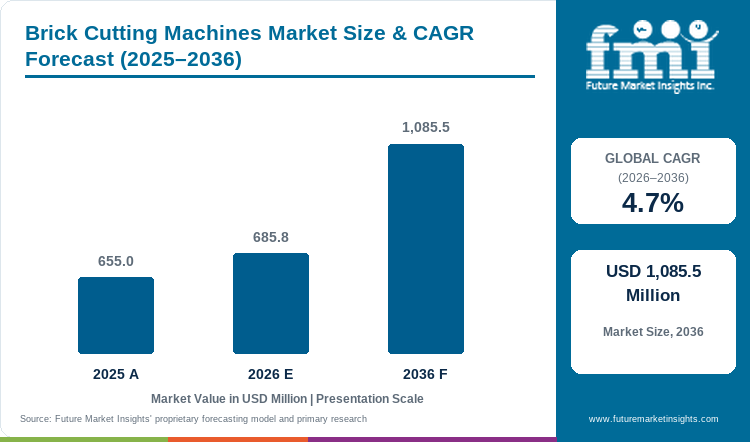
USD 685.8 million in 2026 and USD 1,085.5 million by 2036, expanding at 4.7% CAGR.
Sales of brick cutting machines are estimated to rise at 4.7% CAGR through 2036. Valuation rises from USD 655.0 million in 2025 to USD 685.8 million in 2026 and reaches USD 1,085.5 million by 2036. Wet-side bottlenecks reduce output when older cutters cannot keep pace with shaping and handling equipment. Plant managers are comparing replacement costs with lost production and manual handling across the wet side. In January 2026, the U.S. Geological Survey reported 13.0 million metric tons of common-clay output. The same report estimated that brick production used 43% of this clay. That production base keeps cutter demand tied to active brick output and targeted plant modernization.
German residential permits in 2026 make a stronger base for selective plant planning and equipment investment. Plant managers still require a clear operating case before approving new cutting equipment for established lines. In February 2026, Destatis reported 238,500 dwelling permits for 2025 and a 10.8% annual increase. Permit recovery supports targeted upgrades, but producers still avoid full-line replacement without a clear production benefit. Short shutdowns improve the retrofit case when controls match existing extrusion and setting equipment. Parts access also influences approval because cutter faults can interrupt several connected wet-side tasks. Local service protects production during startup and helps plants stabilize new equipment after installation.
Key Takeaways
- Wet-side bottlenecks encourage cutter replacement as slower cutting reduces output and keeps workers on manual transfer tasks.
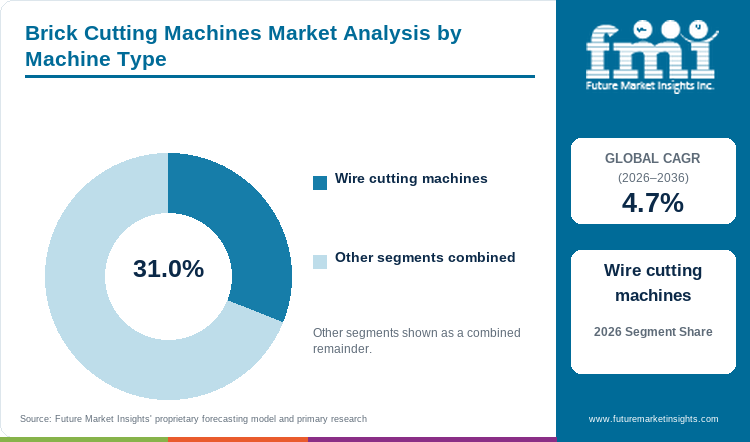
- Wire cutting machines are estimated to hold 31.0% of machine type revenue in 2026, supported by continuous extrusion and flexible format changes.
- Solid bricks are expected to hold 32.0% of brick type revenue in 2026, attributable to stable geometry during automated setting.
- Fully automatic systems are forecast to represent 41.0% of automation revenue in 2026, enabled by coordinated cutting and transfer motion.
- Retrofit downtime can delay equipment approval owing to control integration work across existing extrusion and handling systems.
- Some of the key players in this market include Verdés, Händle GmbH, Bedeschi S.p.A., J.C. Steele & Sons, Bongioanni Macchine S.p.A., Rieter Morando S.r.l., SABO S.A., CERIC Technologies, COSMEC S.r.l., and Bernini Impianti.
Analyst Perspective
"The opportunity lies in retrofit programs that improve cutting performance without forcing plants to replace useful line equipment. Wider adoption depends on proving controls compatibility and manageable shutdown time before plant managers approve larger upgrades with service support."
- Nikhil Kaitwade, Principal Consultant, Future Market Insights
How is the brick cutting machines market segmented?
The brick cutting machines market is segmented by Machine Type, Brick Type, Automation, End Use, and Sales Channel.
The brick cutting machines market uses five main axes for demand analysis. Machine Type covers wire, rotary, multi-wire, servo-controlled, and clay-column cutter designs. Brick Type separates solid, hollow, facing, paving, and refractory brick products. Automation identifies the control level applied across cutting and transfer operations. End Use distinguishes the plant setting that creates the purchase requirement. Sales Channel explains how plants obtain cutters, spare parts, and service support.
How does wire cutting support the machine type category?
Wire cutters divide a moving clay column without stopping continuous extrusion. Plants adjust wire spacing as brick length and product format change across production runs. Modern machine control systems keep cutter motion aligned with downstream product transfer. In January 2025, SABO completed a General Shale line rated at 32,000 king-size bricks per hour. Servo grippers controlled product spacing before bricks moved into the setting stage. The project illustrates how coordinated cutting and handling can sustain output across a high-throughput line.
- Wire cutting machines are forecast to represent 31.0% of machine type revenue in 2026, supported by steady extrusion and flexible format changes.
- Worn wires can interrupt cutting, so plants review service access and wire-change time before approving equipment purchases.
Why do solid bricks hold the brick type share?
Solid bricks require stable size and shape before automated setting can begin reliably. Their full body gives robotic grippers a consistent surface during transfer. Plants making clay construction products set cutters around body stiffness and weight while checking downstream handling needs. In April 2026, Bedeschi installed two robotic grippers for a major U.S. brick producer. The grippers handled solid bricks within the customer's stated weight limits during automated movement. Bedeschi's project links stable geometry with reliable gripping during downstream transfer.
- Solid bricks are estimated to hold 32.0% of brick type revenue in 2026, attributable to stable geometry across automated handling.
- Stable brick dimensions help downstream grippers hold each product securely during automated setting and transfer.
How does full automation shape the automation category?
Fully automatic cutters coordinate carriage travel with wire motion and product transfer across connected production steps. Plants use these systems for frequent format changes and higher line rates. Linked industrial automation systems keep cutting synchronized with nearby handling equipment. In December 2025, SABO added three robots to an existing Italian production line. The project handled several perforated brick formats within limited plant space. Coordinated robot movement helped the line manage format changes without disrupting product transfer.
- Fully automatic systems are expected to lead automation with 41.0% share in 2026, enabled by linked cutter and transfer motion.
- Semi-automatic systems suit plants that retain older controls and need a smaller upgrade before wider automation.
Why do brick plants lead the end-use category?
Brick plants place cutters between shaping and green-product handling along the main production line. A cutter fault can interrupt several connected steps and delay the next transfer. Connected material handling equipment requires steady product spacing at each handoff point. In February 2026, Bedeschi announced a Brazilian dry-product automation contract for Ceramica Cristovao. The project linked handling controls with other machines across the brick plant. Coordinated controls helped each machine pass green products forward at a steadier production rate.
- Brick plants are forecast to represent 45.0% of end-use revenue in 2026, linked to the cutter's role in the main production flow.
- Clay blocks and refractory products require different body control and cutting methods across their production lines.
Why do machinery OEMs influence the sales channel?
Ceramic machinery OEMs influence cutter choice during early plant design and equipment specification. Each cutter must match extrusion controls and downstream handling equipment before installation. Linked factory automation controls can reduce interface work during startup. In January 2026, J.C. Steele & Sons announced its Ceramitec brick program. The program combined shaping equipment with engineering support and service for heavy-clay plant projects. Early equipment planning helps brick plants reduce control conflicts when new cutters enter established production lines.
- Ceramic machinery OEMs are estimated to hold 42.0% of sales-channel revenue in 2026, shaped by early design work that reduces interface risk.
- Direct orders remain common for planned cutter replacements at established brick plants. Service channels provide wires, controls, spare parts, and maintenance support throughout equipment operation.
What are the drivers, restraints and opportunities in the Brick Cutting Machines Market?
Plant modernization supports cutter demand, brownfield integration slows approvals, and flexible automation gives installed plants a practical upgrade route.
- Driver: Wet-side bottlenecks encourage cutter replacement as slower cutting reduces output and keeps workers on manual transfer tasks.
- Restraint: Retrofit approvals are constrained by control integration requirements that can extend shutdown work across existing production lines.
- Opportunity: Modular servo and robot upgrades can improve format changes without requiring full production-line replacement.
Active brick output keeps cutter demand tied to plant production and wet-side performance. In January 2026, the U.S. Geological Survey reported 13.0 million metric tons of common-clay output. The same report estimated that brick production used 43% of this clay. Plant managers compare cutter upgrades with output lost through manual cutting and repeated stops. Industrial robot systems reduce manual handling as green bricks move from cutting into downstream handling. Clear line-rate data helps managers connect labor savings with recovered production time. Suppliers strengthen the purchase case through measurable throughput gains and a defined startup service plan. Replacement projects gain approval when those benefits can cover installation costs and planned shutdown time.
Shared line timing can slow cutter approval at established brick plants with connected equipment. In March 2026, SABO announced three North American projects that replaced older brick-handling equipment. The program included two new U.S. setting machines and one Canadian dehacker. Existing conveyor systems and transfer devices can restrict space during brownfield retrofits. Plant engineers test controls before installation so each shutdown follows a planned sequence. Shorter installation periods reduce lost output, although interface risk remains between old and new systems. Managers compare that integration risk with the expected improvement in line output. Clear controls testing and service coverage support approval by defining the production handoff. Each project must return the existing line to stable production.
Flexible controls give established plants a route to add capability without replacing the full production line. In December 2025, Bedeschi announced a tailored Axa Trans Construct project for prefabricated brick walls. The project used digital controls to read building files and adjust production settings. Servo drive systems let cutter designers change motion profiles with less mechanical work. Plants running several formats can shorten changeovers while keeping product spacing steady. Modular projects spread spending across one production step and keep other equipment operating. Suppliers can combine controls with startup support and staged installation services. Targeted retrofit packages create an opportunity to solve defined bottlenecks without forcing wider equipment replacement.
Which country CAGRs are profiled in the Brick Cutting Machines Market?
| Country | CAGR |
|---|---|
| Portugal | 5.9% |
| Mexico | 5.5% |
| Brazil | 5.2% |
| Italy | 4.9% |
| USA | 4.5% |
| Germany | 4.2% |
| Japan | 3.8% |
How do country-level CAGRs compare in the Brick Cutting Machines Market?
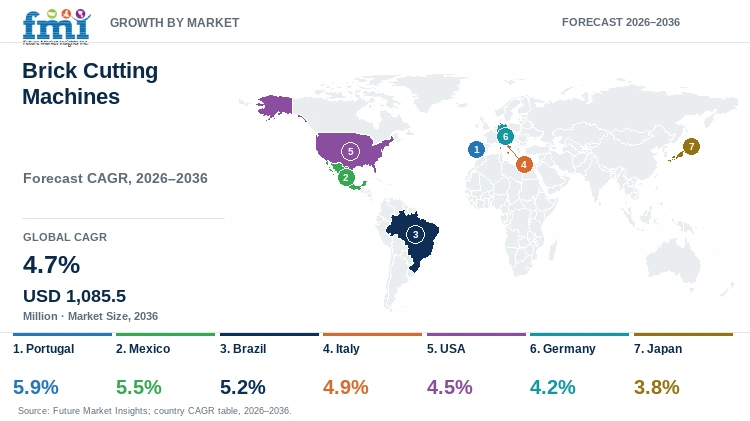
Portugal and Mexico show faster forecast expansion than several mature replacement markets in the profiled country set. Across the seven countries, labor pressure, construction cycles, plant maturity, and service access create different equipment-buying conditions.
- Portugal's rising labor costs improve the case for compact automation that reduces manual handling and supports faster format changes.
- Mexico's construction cycles favor staged machinery spending that lets brick plants test throughput before committing to wider line upgrades.
- Brazil's large red-ceramics production base creates many retrofit sites where phased automation can address one operating bottleneck at a time.
- Italy's mature ceramic machinery base favors maintenance-led retrofits that fit planned service windows and limit production downtime.
- Established U.S. brick plants support replacement demand through projects that prioritize line compatibility, short outages, and dependable local service.
- Germany's recovering permit activity supports selective plant upgrades while mature production lines keep parts access and retrofit fit important.
- Japan's mature factory base favors compact replacement projects that protect product quality while limiting floor-space and startup disruption.
The full report provides country-level CAGR analysis across North America, Latin America, Western Europe, Eastern Europe, East Asia, South Asia and Pacific, and the Middle East and Africa.
Country-wise Analysis
- U.S. brick plants operate within a large clay production base that keeps replacement demand active. The USA is estimated to post 4.5% CAGR through 2036, linked to replacement work at established plants. In January 2026, the U.S. Geological Survey reported 13.0 million metric tons of common-clay output. The same report estimated that brick production used 43% of this clay. Plant engineers protect output by matching new cutters with existing extrusion and setting equipment. Industrial robotics systems reduce manual handling between cutting and downstream setting operations. Short outage plans make replacement proposals easier to evaluate alongside clear line-rate data. Domestic service shortens startup response at plants with limited spare capacity. These operating conditions favor targeted upgrades over complete production-line replacement programs.
- Brick cutting machine sales in Germany are forecast to expand at 4.2% CAGR through 2036, supported by permit recovery and selective upgrades. Mature brick plants still approach equipment spending cautiously as building activity recovers. In February 2026, Destatis reported 238,500 dwelling permits for 2025 and a 10.8% annual increase. Permit recovery supports targeted investment but does not remove utilization risk at older plants. Service coverage and parts access remain important across mature production lines. Retrofit plans must protect extrusion timing while limiting shutdown work across connected processes. Clear spare-parts planning helps managers modernize critical cutting steps without replacing full lines. This approach supports selective investment while construction activity remains uneven.
- Japanese plants favor equipment upgrades that protect product quality across mature factory lines. Japan is estimated to post 3.8% CAGR through 2036, influenced by replacement work in older production facilities. In August 2026, Japan's transport ministry reported that July housing starts rose 8.2% from one year earlier. The same report said the seasonally adjusted annual rate fell 1.6% from June. Monthly construction swings make capacity spending harder for plant owners to justify. Slow format changes and downtime make older cutters stronger replacement candidates. Compact controls improve performance without requiring substantial new floor space. Local parts and service also reduce startup risk during retrofits. These operating conditions favor targeted replacement projects over broad capacity expansion.
- The Brazil brick cutting machines sector is projected to record 5.2% CAGR through 2036, reinforced by its red-ceramics production base. Many plants can adopt staged automation by targeting one production step at a time. In October 2025, ANICER listed 5,578 ceramic companies and potteries across the country. The association also reported annual ceramic-block output above 4.8 billion units in the same update. This broad plant base creates many sites for phased retrofit projects. Investment capacity varies by producer and makes local service important during approval. Smaller projects let operators improve one production step before wider line changes. Each completed stage can provide evidence for the next investment decision. This structure supports practical automation without requiring one large capital program.
- Italian brick and ceramic plants use mature machinery, so shutdown planning shapes retrofit decisions. Brick cutting machine demand in Italy is predicted to advance at 4.9% CAGR through 2036, shaped by maintenance-led upgrade cycles. In July 2026, Istat reported construction output rose 2.0% during the three months ending May. The first five months also rose 2.0% on a calendar-adjusted basis. Retrofit interruptions raise costs and make startup planning important for owners. Ceramic tile production supports shaping and firing skills within Italy's machinery base. Modular controls and local service reduce downtime during equipment faults. Planned service windows help teams arrange labor and spare parts before restart testing. These operating conditions favor maintenance-led upgrades that preserve useful equipment while improving cutting reliability.
- Brick cutting machine demand in Mexico is forecast to rise at 5.5% CAGR through 2036, supported by staged machinery spending. Mexican brick plants balance project timing with output needs across existing lines. In July 2026, INEGI reported that construction-company production value rose 2.7% from April to May. Construction cycles vary across regions and customer groups, making equipment commitments harder to schedule. Staged spending lets plants align upgrades with cash flow and service support. Local spares and controls assistance improve confidence before a cutter project begins. Operators can test throughput during one retrofit stage before wider line changes. Clear maintenance terms protect each investment step and reduce startup risk. These conditions favor phased upgrades that can expand as results become clearer.
- Portuguese ceramic producers face labor costs that make compact automation more useful. Brick cutting machine demand in Portugal is forecast to rise at 5.9% CAGR through 2036, driven by labor costs that improve automation payback. In August 2026, Statistics Portugal reported that new-housing construction costs rose 7.2% year over year in June. The same release reported an 8.0% increase in labor costs. Higher labor costs improve the payback case for automated cutting and handling. Smaller capital budgets can limit the size of a first equipment project. Compact cutters and faster format changes help plants target labor-intensive production steps. Clear service terms reduce concern about controls upgrades. These cost conditions favor focused projects with measurable operating savings for smaller producers.
Who are the notable companies in the Brick Cutting Machines Market?
Verdés, Händle GmbH, Bedeschi S.p.A., J.C. Steele & Sons, Bongioanni Macchine S.p.A., Rieter Morando S.r.l., SABO S.A., CERIC Technologies, COSMEC S.r.l., and Bernini Impianti are active in brick cutting machines and related heavy-clay equipment.
Competition includes cutter specialists and larger clay-equipment groups that enter projects through different equipment roles. SABO, COSMEC, and Bedeschi publish current work in cutting or automation across heavy-clay projects. Verdés, Händle, J.C. Steele & Sons, Bongioanni Macchine, and Rieter Morando focus on preparation and shaping equipment. CERIC Technologies and Bernini Impianti support plant engineering and kiln-system work. Service depth and line compatibility influence which equipment group enters each retrofit project.
- SABO S.A., COSMEC S.r.l., and Bedeschi S.p.A. provide cutting or automation equipment for heavy-clay production projects.
- Verdés, Händle GmbH, J.C. Steele & Sons, Bongioanni Macchine S.p.A., and Rieter Morando S.r.l. focus mainly on preparation and shaping equipment.
- CERIC Technologies and Bernini Impianti support plant engineering or thermal-system work across wider heavy-clay projects.
Competitive Benchmarking: Brick Cutting Machines Market
| Company | Dedicated Cutting Architecture | Servo/Automation Integration | Turnkey Heavy-Clay Integration | Geographic Reach |
|---|---|---|---|---|
| Verdés | Low | Medium | Medium | Europe; Latin America |
| Händle GmbH | Low | Medium | Medium | International |
| Bedeschi S.p.A. | High | High | High | International |
| J.C. Steele & Sons | Low | Medium | Medium | North America; exports |
| Bongioanni Macchine S.p.A. | Low | Medium | Medium | International |
| Rieter Morando S.r.l. | Low | Medium | Medium | International |
| SABO S.A. | High | High | High | 50+ countries |
| CERIC Technologies | Low | Medium | High | International |
| COSMEC S.r.l. | High | High | High | International |
| Bernini Impianti | Low | Low | Medium | International |
High cutting scores require direct evidence that a company supplies cutter equipment for heavy-clay production. Medium scores apply when controls or handling evidence exists but direct cutter proof remains limited. High turnkey scores require verified line engineering across multiple stages of the heavy-clay process.
Key Developments in the Brick Cutting Machines Market
- In April 2026, Bedeschi S.p.A. installed two robotic grippers for a U.S. brick producer that handled solid bricks.
- In March 2026, SABO S.A. announced three North American projects that replaced older setting or dehacking equipment.
- In January 2026, J.C. Steele & Sons announced its Ceramitec brick program combining shaping equipment with engineering service.
Key Players in the Brick Cutting Machines Market
Cutting and automation
- SABO S.A.
- COSMEC S.r.l.
- Bedeschi S.p.A.
Preparation and shaping
- Verdés
- Händle GmbH
- J.C. Steele & Sons
- Bongioanni Macchine S.p.A.
- Rieter Morando S.r.l.
Engineering and thermal systems
- CERIC Technologies
- Bernini Impianti
Brick Cutting Machines Market - Report Scope
| Coverage field | Report scope |
|---|---|
| Market breakdown | By machine type, brick type, automation, end use, sales channel, and region. |
| Quantitative Units | USD million. |
| Market Definition | Revenue includes brick cutting machines plus cutting-specific controls, spares, upgrades, and service. Finished bricks and unrelated ceramic machinery are excluded. |
| Regions Covered | North America, Latin America, Western Europe, Eastern Europe, East Asia, South Asia and Pacific, and Middle East and Africa. |
| Countries Covered | Portugal, Mexico, Brazil, Italy, USA, Germany, Japan, and 20+ countries included in the full report. |
| Key Companies Profiled | Verdés, Händle GmbH, Bedeschi S.p.A., J.C. Steele & Sons, Bongioanni Macchine S.p.A., Rieter Morando S.r.l., SABO S.A., CERIC Technologies, COSMEC S.r.l., and Bernini Impianti. |
| Forecast Period | 2026 to 2036. |
| Approach | Primary and secondary research with market triangulation. |
Brick Cutting Machines Market - Research Methodology
| Method | Approach |
|---|---|
| Primary Research | FMI analysts gathered input from manufacturers, service providers, technology developers, distributors, end users, procurement teams, and subject-matter experts. Interviews examined purchasing decisions, product or service evaluation, adoption barriers, approval requirements, pricing considerations, and expectations for technical or commercial support. Respondents were also asked what evidence is required before a trial, pilot, or initial order develops into regular purchasing. |
| Desk Research | Desk research covered government statistics, regulatory publications, trade data, industry associations, technical literature, standards, company filings, product information, and official corporate announcements. Sources were reviewed for relevance, publication date, geographic coverage, and consistency with the defined market scope. Claims relating to performance, applications, approvals, capacity, investment, and commercial activity were retained only when supported by credible public evidence. |
| Market Sizing and Forecasting | The market model combined the baseline value with historical performance, segment structure, pricing and volume indicators, adoption levels, company participation, and country-level demand conditions. Forecast assumptions considered economic activity, investment trends, regulatory developments, technology adoption, purchasing cycles, supply availability, and barriers to wider market use. Segment and regional estimates were reconciled before the final market total was calculated. |
| Data Validation | Estimates were checked against multiple independent indicators, including public data, company activity, trade patterns, industry developments, and findings from primary interviews. Validation also tested whether products, services, applications, and company revenues fell within the defined market boundaries. Adjacent categories, unsupported claims, overlapping revenues, and activities without direct market relevance were excluded to reduce double counting and maintain consistency across segments and countries. |
Brick Cutting Machines Market by Segments
Brick Cutting Machines Market segmented by Machine Type:
- Wire cutting machines
- Rotary brick cutters
- Multi-wire cutters
- Servo-controlled cutters
- Automatic clay column cutters
Brick Cutting Machines Market segmented by Brick Type:
- Solid bricks
- Hollow bricks
- Facing bricks
- Pavers
- Refractory bricks
Brick Cutting Machines Market segmented by Automation:
- Fully automatic
- Semi-automatic
- Manual
- PLC/CNC controlled
Brick Cutting Machines Market segmented by End Use:
- Brick plants
- Clay block plants
- Roof tile plants
- Refractory plants
- Small ceramic units
Brick Cutting Machines Market segmented by Sales Channel:
- Ceramic machinery OEMs
- Turnkey plant projects
- Direct equipment sales
- Aftermarket/service
Brick Cutting Machines Market by Region:
- North America
- United States
- Canada
- Latin America
- Brazil
- Mexico
- Chile
- Rest of Latin America
- Western Europe
- Germany
- United Kingdom
- Italy
- Spain
- France
- Nordics
- Benelux
- Rest of Western Europe
- Eastern Europe
- Russia
- Poland
- Hungary
- Balkan and Baltic States
- Rest of Eastern Europe
- East Asia
- China
- Japan
- South Korea
- South Asia and Pacific
- India
- ASEAN
- Australia and New Zealand
- Rest of South Asia and Pacific
- Middle East and Africa
- Kingdom of Saudi Arabia
- Other GCC Countries
- Türkiye
- South Africa
- Other African Union Countries
- Rest of Middle East and Africa
Research Sources and Bibliography
- U.S. Geological Survey. (2026, January). Mineral commodity summaries 2026: Clays.
- Federal Statistical Office of Germany (Destatis). (2026, February 18). Building permits for dwellings in 2025: 10.8% more than in the previous year.
- SABO S.A. (2025, January 10). New Cutting-Setting Line for General Shale!
- Bedeschi S.p.A. (2026, April 20). Bedeschi Robotic Grippers for US Client.
- SABO S.A. (2025, December 9). New Partnership Announcement: ALA S.R.L x SABO S.A.
- Bedeschi S.p.A. (2026, February). Bedeschi New Project in Brazil for the Brick Industry.
- J.C. Steele & Sons. (2026, January 12). See how we make brick better at Ceramitec, Munich, Germany.
- Statistics Portugal. (2026, August 10). New housing construction costs increased 7.2% in June 2026.
- SABO S.A. (2026, March). 3 new projects with Reymond Products and General Shale.
- Bedeschi S.p.A. (2025, December). Bedeschi New Project for Axa Trans Construct.
- Ministry of Land, Infrastructure, Transport and Tourism, Japan. (2026, August 31). Building Starts Statistics Report, July 2026.
- ANICER. (2025, October 6). Sector data: Brazilian red ceramics industry.
- Istat. (2026, July 17). Production in the construction sector, May 2026.
- INEGI. (2026, July 24). National Survey of Construction Companies, May 2026.
- Händle GmbH. (2026, March). Ceramitec 2026: Technologies for the ceramic industry.
- Rieter Morando S.r.l. (2026, March). Ceramitec 2026 company update.
- Verdés. (2026, March). Ceramitec 2026 company update.
- Bongioanni Macchine S.p.A. (2026, July). KERAMTEX 2026 company update.
- COSMEC S.r.l. (2026, September). Clemson Brick Plant Operator’s Forum 2026 company update.
This bibliography is provided for reader reference and is not exhaustive. The full report contains the complete reference list and detailed citations.
This Report Answers
- What are the verified brick cutting machine values for 2026 and 2036?
- Which plant conditions are creating demand for brick cutter replacement projects?
- Why do wire cutters hold 31.0% of machine type revenue?
- Why do solid bricks hold 32.0% of brick type revenue?
- Why do fully automatic systems hold 41.0% of automation revenue?
- How do forecast CAGRs differ across the seven profiled countries?
- Which companies are active across cutting, shaping, and heavy-clay automation?
- How do retrofit downtime and controls integration affect equipment approval decisions?
- Which factors should plant engineers review before approving cutter replacement projects?
Frequently Asked Questions
How large is the brick cutting machines market in 2026?
The brick cutting machines market is valued at USD 685.8 million in 2026 and remains tied to active plant modernization. The market is projected to reach USD 1,085.5 million by 2036 as plants replace cutters that restrict output and handling.
What CAGR is projected for brick cutting machines from 2026 to 2036?
The brick cutting machines market is projected to grow at 4.7% CAGR from 2026 through 2036. Replacement work supports this forecast as plants update controls while retaining useful equipment across existing production lines.
Which machine type leads the machine type category during 2026?
Wire cutters are estimated to hold 31.0% of machine type revenue in the brick cutting machines market during 2026. Plants can change wire layouts without replacing shaping equipment, which supports use on continuous extrusion lines.
Which automation segment leads the brick cutting machines category in 2026?
Fully automatic systems are projected to hold 41.0% of automation revenue in the brick cutting machines market during 2026. Linked cutter and transfer motion reduces manual timing during production changes and supports coordinated line operation.
Which companies are active across the brick cutting machines value chain?
Key companies include Verdés, Händle GmbH, Bedeschi S.p.A., J.C. Steele & Sons, and Bongioanni Macchine S.p.A. in core equipment roles. Rieter Morando S.r.l., SABO S.A., CERIC Technologies, COSMEC S.r.l., and Bernini Impianti cover related heavy-clay roles. Their published activity spans cutting, automation, shaping, plant engineering, and thermal-system work.
Preview the report firsthand - request a free sample
Get SampleGet the brochure for pricing and purchase details.
Get PDFTable of Content
- Key Takeaways
- Market Size and CAGR
- Top Growth Driver
- Fastest Growing Segment
- Leading Region
- Key Companies
- Emerging Opportunities
- Executive Summary
- Global Market Outlook
- Demand-side Trends
- Supply-side Trends
- Technology Roadmap Analysis
- Analysis and Recommendations
- Analyst Perspective (What is happening? Why now? What should investors know?)
- Key Questions Answered
- How large is the market?
- What is the CAGR?
- What are key trends?
- Which region dominates?
- Who are the leaders?
- Market Overview
- Market Coverage / Taxonomy
- Market Definition / Scope / Limitations
- Research Methodology
- Chapter Orientation
- Analytical Lens and Working Hypotheses
- Market Structure, Signals, and Trend Drivers
- Benchmarking and Cross-market Comparability
- Market Sizing, Forecasting, and Opportunity Mapping
- Research Design and Evidence Framework
- Desk Research Programme (Secondary Evidence)
- Expert Input and Fieldwork (Primary Evidence)
- Tooling, Models, and Reference Databases
- Data Engineering and Model Build
- Quality Assurance and Audit Trail
- Market Background
- Market Dynamics (Drivers, Restraints, Opportunity, Trends)
- Scenario Forecast (Optimistic, Likely, Conservative)
- Impact Analysis
- AI Impact
- Sustainability Impact
- Regulatory Impact
- Technology Impact
- Consumer / Buyer Analysis
- Purchase Drivers
- Adoption Barriers
- Buyer Journey
- Opportunity Map Analysis
- Product Life Cycle Analysis
- Supply Chain Analysis
- Investment Feasibility Matrix
- Value Chain Analysis
- PESTLE and Porter's Analysis
- Regulatory Landscape
- Regional Parent Market Outlook
- Production and Consumption Statistics
- Import and Export Statistics
- Global Market Analysis and Forecast, 2021 to 2036
- Historical Market Size Value (USD Million) Analysis, 2021 to 2025
- Current and Future Market Size Value (USD Million) Projections, 2026 to 2036
- Y-o-Y Growth Trend Analysis
- Absolute $ Opportunity Analysis
- Global Market Pricing Analysis, 2021 to 2036
- Global Market Analysis and Forecast, By Machine Type, 2021 to 2036
- Introduction / Key Findings
- Historical Market Size Value (USD Million) Analysis By Machine Type, 2021 to 2025
- Current and Future Market Size Value (USD Million) Analysis and Forecast By Machine Type, 2026 to 2036
- Wire cutting machines
- Rotary brick cutters
- Multi-wire cutters
- Servo-controlled cutters
- Automatic clay column cutters
- Y-o-Y Growth Trend Analysis By Machine Type, 2021 to 2025
- Absolute $ Opportunity Analysis By Machine Type, 2026 to 2036
- Global Market Analysis and Forecast, By Brick Type, 2021 to 2036
- Introduction / Key Findings
- Historical Market Size Value (USD Million) Analysis By Brick Type, 2021 to 2025
- Current and Future Market Size Value (USD Million) Analysis and Forecast By Brick Type, 2026 to 2036
- Solid bricks
- Hollow bricks
- Facing bricks
- Pavers
- Refractory bricks
- Y-o-Y Growth Trend Analysis By Brick Type, 2021 to 2025
- Absolute $ Opportunity Analysis By Brick Type, 2026 to 2036
- Global Market Analysis and Forecast, By Automation, 2021 to 2036
- Introduction / Key Findings
- Historical Market Size Value (USD Million) Analysis By Automation, 2021 to 2025
- Current and Future Market Size Value (USD Million) Analysis and Forecast By Automation, 2026 to 2036
- Fully automatic
- Semi-automatic
- Manual
- PLC/CNC controlled
- Y-o-Y Growth Trend Analysis By Automation, 2021 to 2025
- Absolute $ Opportunity Analysis By Automation, 2026 to 2036
- Global Market Analysis and Forecast, By End Use, 2021 to 2036
- Introduction / Key Findings
- Historical Market Size Value (USD Million) Analysis By End Use, 2021 to 2025
- Current and Future Market Size Value (USD Million) Analysis and Forecast By End Use, 2026 to 2036
- Brick plants
- Clay block plants
- Roof tile plants
- Refractory plants
- Small ceramic units
- Y-o-Y Growth Trend Analysis By End Use, 2021 to 2025
- Absolute $ Opportunity Analysis By End Use, 2026 to 2036
- Global Market Analysis and Forecast, By Sales Channel, 2021 to 2036
- Introduction / Key Findings
- Historical Market Size Value (USD Million) Analysis By Sales Channel, 2021 to 2025
- Current and Future Market Size Value (USD Million) Analysis and Forecast By Sales Channel, 2026 to 2036
- Ceramic machinery OEMs
- Turnkey plant projects
- Direct equipment sales
- Aftermarket/service
- Y-o-Y Growth Trend Analysis By Sales Channel, 2021 to 2025
- Absolute $ Opportunity Analysis By Sales Channel, 2026 to 2036
- Global Market Analysis and Forecast, By Region, 2021 to 2036
- Introduction
- Historical Market Size Value (USD Million) Analysis By Region, 2021 to 2025
- Current Market Size Value (USD Million) Analysis and Forecast By Region, 2026 to 2036
- North America
- Latin America
- Western Europe
- Eastern Europe
- East Asia
- South Asia and Pacific
- Middle East and Africa
- Market Attractiveness Analysis By Region
- North America Market Analysis and Forecast, By Country, 2021 to 2036
- Historical Market Size Value (USD Million) Trend Analysis By Market Taxonomy, 2021 to 2025
- Market Size Value (USD Million) Forecast By Market Taxonomy, 2026 to 2036
- By Country
- United States
- Canada
- By Machine Type
- By Brick Type
- By Automation
- By End Use
- By Sales Channel
- By Country
- Market Attractiveness Analysis
- By Country
- By Machine Type
- By Brick Type
- By Automation
- By End Use
- By Sales Channel
- Key Takeaways
- Latin America Market Analysis and Forecast, By Country
- Historical Market Size Value (USD Million) Trend Analysis By Market Taxonomy, 2021 to 2025
- Market Size Value (USD Million) Forecast By Market Taxonomy, 2026 to 2036
- By Country
- Brazil
- Mexico
- Chile
- Rest of Latin America
- By Machine Type
- By Brick Type
- By Automation
- By End Use
- By Sales Channel
- By Country
- Market Attractiveness Analysis
- By Country
- By Machine Type
- By Brick Type
- By Automation
- By End Use
- By Sales Channel
- Key Takeaways
- Western Europe Market Analysis and Forecast, By Country
- Historical Market Size Value (USD Million) Trend Analysis By Market Taxonomy, 2021 to 2025
- Market Size Value (USD Million) Forecast By Market Taxonomy, 2026 to 2036
- By Country
- Germany
- United Kingdom
- Italy
- Spain
- France
- Nordics
- Benelux
- Rest of Western Europe
- By Machine Type
- By Brick Type
- By Automation
- By End Use
- By Sales Channel
- By Country
- Market Attractiveness Analysis
- By Country
- By Machine Type
- By Brick Type
- By Automation
- By End Use
- By Sales Channel
- Key Takeaways
- Eastern Europe Market Analysis and Forecast, By Country
- Historical Market Size Value (USD Million) Trend Analysis By Market Taxonomy, 2021 to 2025
- Market Size Value (USD Million) Forecast By Market Taxonomy, 2026 to 2036
- By Country
- Russia
- Poland
- Hungary
- Balkan and Baltic States
- Rest of Eastern Europe
- By Machine Type
- By Brick Type
- By Automation
- By End Use
- By Sales Channel
- By Country
- Market Attractiveness Analysis
- By Country
- By Machine Type
- By Brick Type
- By Automation
- By End Use
- By Sales Channel
- Key Takeaways
- East Asia Market Analysis and Forecast, By Country
- Historical Market Size Value (USD Million) Trend Analysis By Market Taxonomy, 2021 to 2025
- Market Size Value (USD Million) Forecast By Market Taxonomy, 2026 to 2036
- By Country
- China
- Japan
- South Korea
- By Machine Type
- By Brick Type
- By Automation
- By End Use
- By Sales Channel
- By Country
- Market Attractiveness Analysis
- By Country
- By Machine Type
- By Brick Type
- By Automation
- By End Use
- By Sales Channel
- Key Takeaways
- South Asia and Pacific Market Analysis and Forecast, By Country
- Historical Market Size Value (USD Million) Trend Analysis By Market Taxonomy, 2021 to 2025
- Market Size Value (USD Million) Forecast By Market Taxonomy, 2026 to 2036
- By Country
- India
- ASEAN
- Australia and New Zealand
- Rest of South Asia and Pacific
- By Machine Type
- By Brick Type
- By Automation
- By End Use
- By Sales Channel
- By Country
- Market Attractiveness Analysis
- By Country
- By Machine Type
- By Brick Type
- By Automation
- By End Use
- By Sales Channel
- Key Takeaways
- Middle East and Africa Market Analysis and Forecast, By Country
- Historical Market Size Value (USD Million) Trend Analysis By Market Taxonomy, 2021 to 2025
- Market Size Value (USD Million) Forecast By Market Taxonomy, 2026 to 2036
- By Country
- Kingdom of Saudi Arabia
- Other GCC Countries
- Türkiye
- South Africa
- Other African Union Countries
- Rest of Middle East and Africa
- By Machine Type
- By Brick Type
- By Automation
- By End Use
- By Sales Channel
- By Country
- Market Attractiveness Analysis
- By Country
- By Machine Type
- By Brick Type
- By Automation
- By End Use
- By Sales Channel
- Key Takeaways
- Key Countries Market Analysis
- United States
- Pricing Analysis
- Market Share Analysis, 2025
- By Machine Type
- By Brick Type
- By Automation
- By End Use
- By Sales Channel
- Canada
- Pricing Analysis
- Market Share Analysis, 2025
- By Machine Type
- By Brick Type
- By Automation
- By End Use
- By Sales Channel
- Mexico
- Pricing Analysis
- Market Share Analysis, 2025
- By Machine Type
- By Brick Type
- By Automation
- By End Use
- By Sales Channel
- Brazil
- Pricing Analysis
- Market Share Analysis, 2025
- By Machine Type
- By Brick Type
- By Automation
- By End Use
- By Sales Channel
- Chile
- Pricing Analysis
- Market Share Analysis, 2025
- By Machine Type
- By Brick Type
- By Automation
- By End Use
- By Sales Channel
- Germany
- Pricing Analysis
- Market Share Analysis, 2025
- By Machine Type
- By Brick Type
- By Automation
- By End Use
- By Sales Channel
- United Kingdom
- Pricing Analysis
- Market Share Analysis, 2025
- By Machine Type
- By Brick Type
- By Automation
- By End Use
- By Sales Channel
- Italy
- Pricing Analysis
- Market Share Analysis, 2025
- By Machine Type
- By Brick Type
- By Automation
- By End Use
- By Sales Channel
- Spain
- Pricing Analysis
- Market Share Analysis, 2025
- By Machine Type
- By Brick Type
- By Automation
- By End Use
- By Sales Channel
- France
- Pricing Analysis
- Market Share Analysis, 2025
- By Machine Type
- By Brick Type
- By Automation
- By End Use
- By Sales Channel
- India
- Pricing Analysis
- Market Share Analysis, 2025
- By Machine Type
- By Brick Type
- By Automation
- By End Use
- By Sales Channel
- ASEAN
- Pricing Analysis
- Market Share Analysis, 2025
- By Machine Type
- By Brick Type
- By Automation
- By End Use
- By Sales Channel
- Australia and New Zealand
- Pricing Analysis
- Market Share Analysis, 2025
- By Machine Type
- By Brick Type
- By Automation
- By End Use
- By Sales Channel
- China
- Pricing Analysis
- Market Share Analysis, 2025
- By Machine Type
- By Brick Type
- By Automation
- By End Use
- By Sales Channel
- Japan
- Pricing Analysis
- Market Share Analysis, 2025
- By Machine Type
- By Brick Type
- By Automation
- By End Use
- By Sales Channel
- South Korea
- Pricing Analysis
- Market Share Analysis, 2025
- By Machine Type
- By Brick Type
- By Automation
- By End Use
- By Sales Channel
- Russia
- Pricing Analysis
- Market Share Analysis, 2025
- By Machine Type
- By Brick Type
- By Automation
- By End Use
- By Sales Channel
- Poland
- Pricing Analysis
- Market Share Analysis, 2025
- By Machine Type
- By Brick Type
- By Automation
- By End Use
- By Sales Channel
- Hungary
- Pricing Analysis
- Market Share Analysis, 2025
- By Machine Type
- By Brick Type
- By Automation
- By End Use
- By Sales Channel
- Kingdom of Saudi Arabia
- Pricing Analysis
- Market Share Analysis, 2025
- By Machine Type
- By Brick Type
- By Automation
- By End Use
- By Sales Channel
- Türkiye
- Pricing Analysis
- Market Share Analysis, 2025
- By Machine Type
- By Brick Type
- By Automation
- By End Use
- By Sales Channel
- South Africa
- Pricing Analysis
- Market Share Analysis, 2025
- By Machine Type
- By Brick Type
- By Automation
- By End Use
- By Sales Channel
- Portugal
- Pricing Analysis
- Market Share Analysis, 2025
- By Machine Type
- By Brick Type
- By Automation
- By End Use
- By Sales Channel
- United States
- Market Structure Analysis
- Competition Dashboard
- Competition Benchmarking
- Market Share Analysis of Top Players
- By Regional
- By Machine Type
- By Brick Type
- By Automation
- By End Use
- By Sales Channel
- Emerging Startups
- Innovation Benchmarking
- Competition Analysis
- Competition Deep Dive
- Verdés
- Overview
- Product Portfolio
- Profitability by Market Segments
- Sales Footprint
- Strategy Overview
- Marketing Strategy
- Product Strategy
- Channel Strategy
- Händle GmbH
- Bedeschi S.p.A.
- J.C. Steele & Sons
- Bongioanni Macchine S.p.A.
- Rieter Morando S.r.l.
- SABO S.A.
- CERIC Technologies
- COSMEC S.r.l.
- Bernini Impianti
- Verdés
- Case Studies
- Success Stories
- Recent Developments
- Competition Deep Dive
- Assumptions & Acronyms Used


