

- Market Size (2026)
- USD 3.2 Bn
- Forecast (2036)
- USD 5.7 Bn
- CAGR (2026 to 2036)
- 5.8%
How big is Machine Tool Spindles Market in 2026?
USD 3.2 billion in 2026 and USD 5.7 billion by 2036 at a 5.8% CAGR.
Demand for machine tool spindles is projected to expand at 5.8% CAGR between 2026 and 2036, increasing valuation from USD 3.2 billion in 2026 to USD 5.7 billion by 2036. More automation raises the specification burden on spindle cooling, sensing and tool-change control systems. AMT reported in June 2026 that April US metalworking machinery orders rose 33.2% year over year, with automation contributing to higher order values.
Country demand differs because new-machine investment and installed-base service cycles do not move together. VDW expected German machine-tool production to rise only 1% in 2026 after two years of decline. The association also identified service and retrofitting as more important during restrained capital spending. Mature markets can therefore support substantial spindle repair revenue even with slower forecast growth.
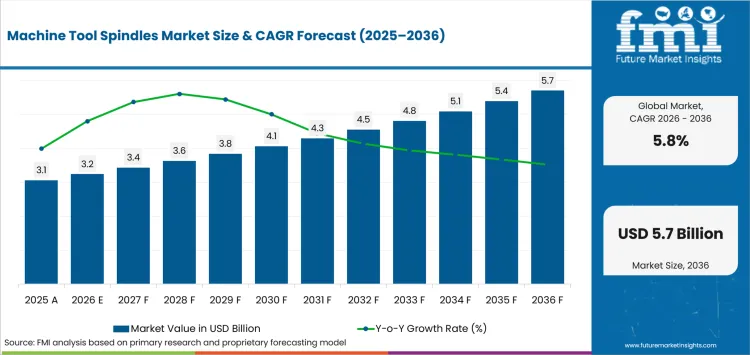
Key Takeaways of Machine Tool Spindles Market
- Machine builders are specifying spindle systems earlier because automation makes thermal control, tool-change behavior and sensor integration part of platform performance.
- By spindle type, belt-driven spindles are estimated to hold 22.0% in 2026 owing to serviceable external-drive architecture used in broad machine classes.
- In 2026, below 10,000 rpm is expected to lead speed range with 31.0% share because general machining prioritizes usable torque and rigidity.
- Angular contact ball bearings are projected to hold 44.0% share in 2026 owing to combined-load support and adjustable preload for spindle accuracy.
- Machine-level qualification slows switching because cooling, bearings, tool interfaces and controls must meet the acceptance limits of the complete machine.
- Some of the key players in this market include Fischer Spindle Group, GMN, Kessler, Setco, IBAG, HSD Mechatronics, Nakanishi, NSK, Jäger, and Franz Kessler.
Analyst Perspective
"Spindle revenue is won during machine design because speed alone does not establish process stability or serviceability. The stronger commercial position belongs to companies that can prove thermal behavior inside the customer machine and restore that performance after a rebuild."
- Nikhil Kaitwade, Principal Consultant, Future Market Insights
How is the Machine Tool Spindles Market segmented?
The machine tool spindles market is segmented by spindle type, speed range, bearing type, end use and sales channel.
The analysis covers belt-driven, direct-drive, motorized, high-speed and grinding spindles. Speed categories run from below 10,000 rpm to above 60,000 rpm. Bearing types include angular contact ball, ceramic hybrid, hydrostatic, air and magnetic designs. End use separates machine tool OEMs from machining sectors. Sales channels cover direct OEM supply, repair and rebuild, distributors and custom engineering.
What makes belt-driven spindles central to the spindle type category?
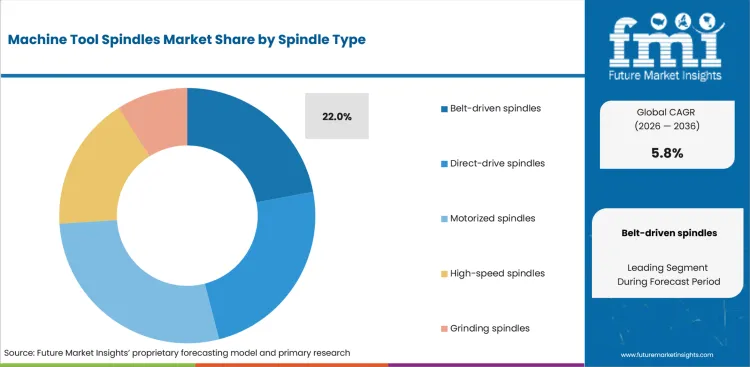
Belt-driven spindles keep the drive motor outside the cartridge, which eases motor replacement and pulley changes on conventional machines. The architecture also limits motor heat inside the spindle body.
- Based on spindle type, belt-driven spindles are projected to account for 22.0% in 2026 due to broad compatibility with conventional machine architectures.
- UCIMU reported in July 2026 that Italian deliveries to domestic machine-tool customers rose 28.1% during 2025. That equipment recovery favors serviceable spindle designs used with high-speed steel cutting tools in general machining.
Why does below 10,000 rpm lead the speed range category?
Below 10,000 rpm covers milling and turning duties that need torque under load more often than extreme rotational speed. Larger tools also put more weight on bearing stiffness and heat control.
- By speed range, below 10,000 rpm is estimated to hold 31.0% in 2026 owing to its fit with general-purpose machining and larger cutting tools.
- JMTBA documented 8.0% year-over-year growth in Japanese machine-tool orders during 2025. Orders spanned industrial machinery, vehicles and precision equipment, which sustains demand for moderate-speed spindle systems.
How do angular contact ball bearings support the bearing type category?
Angular contact ball bearings carry radial and axial loads in one arrangement while preload raises spindle rigidity. Contact angle and ball material determine the trade-off between load capacity and rotational speed.
- The angular contact ball segment is likely to capture 44.0% share in 2026 attributable to combined-load support and spindle-grade running accuracy.
- The precision bearing requirement also covers runout and heat generation. In September 2025, Schaeffler introduced PTB precision angular contact bearings for driven tool spindles, with P4 running accuracy and versions for original equipment or reconditioning.
What supports machine tool OEMs in the end use category?
Machine tool OEMs define the spindle envelope before serial production because headstock geometry, cooling and controls must pass as one machine. Machine vision and sensor interfaces then have to fit the same control architecture.
- Machine tool OEMs are set to lead the end use category with 37.0% share in 2026 due to their control over design-stage qualification.
- The spindle must also communicate cleanly with the CNC controller and machine safety logic. In January 2026, Nakanishi launched the NGS-3140-CTZ01 for CNC automatic lathes, tying speed increase directly to the host machine interface and available power.
What drives direct OEM supply in the sales channel category?
Direct OEM supply shortens the engineering loop between spindle design and machine acceptance. Builders resolve dimensions, cooling loads and tool-interface behavior before serial production begins.
- By sales channel, direct OEM supply is forecast to represent 42.0% in 2026 driven by design-stage interface control and repeat machine-platform demand.
- Machine acceptance often includes a machine tool touch probe before platform release. In June 2026, FISCHER and ROLLOMATIC GROUP assigned FISCHER responsibility for developing and producing high-precision tool-grinding spindles for ROLLOMATIC machines.
What are the drivers, restraints and opportunities in the Machine Tool Spindles Market?
Automation raises spindle content per machine, cautious capital cycles slow replacement, and connected service models expand lifecycle revenue from installed equipment.
- Driver: Automated machining cells need spindle systems that hold thermal and tool-change performance under longer unattended production cycles.
- Restraint: Long machine lives and weak capital cycles can delay spindle replacement even where newer architectures offer better nominal performance.
- Opportunity: Rebuild services and condition monitoring can extend revenue beyond the original spindle sale without replacing the complete machine.
Automated cells raise spindle requirements because unattended machining exposes tool-change and thermal instability for longer periods. AMT reported in August 2026 that first-half US manufacturing-technology orders were 36.0% above the same 2025 period. Industrial automation therefore increases the value of spindle systems that hold repeatable performance during long production runs.
Replacement slows when factories extend machine life instead of funding new platforms. VDW reported in March 2026 that German domestic machine-tool orders fell 16% during 2025. Spindle changes therefore compete with repair budgets and must justify commissioning risk before capital is released.
Service revenue follows installed machines once bearing wear becomes measurable before a spindle stops production. VDW reported in August 2025 that repair and maintenance activity was developing steadily despite weaker new-machine orders. Condition monitoring systems can move rebuild decisions toward bearing condition and vibration evidence before unplanned downtime.
Which country CAGRs are covered in the Machine Tool Spindles Market?
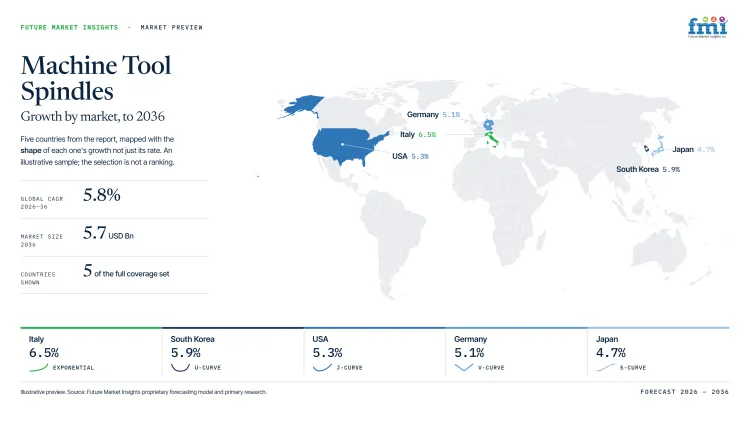
| Country | CAGR |
|---|---|
| Italy | 6.5% |
| South Korea | 5.9% |
| Mexico | 5.8% |
| USA | 5.3% |
| Germany | 5.1% |
| France | 4.9% |
| Japan | 4.7% |
How do country-level CAGRs compare in the Machine Tool Spindles Market?
The forecasts span 1.8 percentage points, with Italy above a compact South Korea-Mexico pair and Japan at the lower end. The distribution reflects machine-building density, export exposure and installed-equipment service needs instead of current market size. Similar growth rates can therefore produce different entry conditions for spindle companies.
- Italy offers dense OEM access as domestic machine-tool investment recovers from the previous capital downturn.
- South Korea links spindle selection to export manufacturing programs that demand fast machine integration and stable speed.
- Mexico gains machining projects from localization, although service distance can penalize unfamiliar spindle platforms during downtime.
- USA combines new automation spending with a deep installed base that keeps exchange programs commercially relevant.
- Germany carries substantial retrofit activity, so repair coverage can offset cautious spending on completely new machines.
- France concentrates spindle qualification in aerospace and transport machining where difficult materials raise process-proof requirements.
- Japan relies heavily on export-oriented machine builders that need compact spindle integration to travel with platforms.
Installed machines and OEM density still determine the revenue pool behind each CAGR. The full report provides country-level CAGR analysis across North America, Latin America, Western Europe, Eastern Europe, East Asia, South Asia and Pacific, and Middle East and Africa.
Country-wise Analysis
- Italian machine-tool clusters give spindle companies direct access to OEM engineering teams and regional repair networks. Demand for machine tool spindles in Italy is forecast to rise at 6.5% CAGR over the forecast period, supported by recovering domestic equipment consumption. UCIMU stated in December 2025 that 2026 machine-tool consumption was forecast to increase 5.9% and domestic deliveries by Italian manufacturers by 5.4%. Local engineering access shortens specification work, although export cyclicality can still change platform volumes quickly. Repair teams that pair rebuild coverage with AI-driven predictive maintenance can protect revenue during softer new-machine schedules without depending on a new platform order.
- US machining plants place heavy weight on uptime because spindle failure can idle automated cells carrying expensive work in process. The US machine tool spindles outlook is anticipated to advance at 5.3% CAGR over the assessment period, driven by machinery investment and automation content. AMT reported in July 2026 that May metalworking machinery orders were 47.8% above May 2025. The installed base gives repair companies a direct entry point, while long qualification cycles slow unfamiliar spindle designs. Robotic machining also raises interest in industrial robotics interfaces that carry precision spindle loads without sacrificing cell flexibility or service access.
- Japanese machine builders sell heavily into export markets, so spindle specifications must remain supportable after machines leave the domestic service network. Machine tool spindle sales in Japan are forecast to expand at 4.7% CAGR by 2036, attributable to precision machining and export-oriented equipment demand. METI reported in June 2026 that production machinery was the largest contributor to a planned 3.7% monthly industrial production increase for June. Export programs give spindle companies scale beyond domestic capital spending. Replacement work still faces disciplined investment screening because incumbent spindle designs carry established qualification records and known service procedures.
- German factories are extracting more production from existing machines while new-equipment budgets recover unevenly. The German machine tool spindles sector is projected to record 5.1% CAGR during the assessment period, supported by the machine-building base and retrofit demand. VDW reported in June 2026 that first-quarter machine-tool orders increased 15%, with domestic orders up 18%. Service and rebuild access gives spindle specialists a practical route into installed equipment, although automotive weakness keeps new-platform volumes uneven. Plants using vibration monitoring can time repair decisions to measured machine condition instead of fixed service intervals or emergency failure.
- South Korean spindle demand follows equipment spending in electronics and automotive manufacturing, where production schedules leave little room for commissioning delays. In South Korea, machine tool spindle demand is predicted to advance at 5.9% CAGR through 2036 owing to precision automation investment. The Ministry of Data and Statistics reported in May 2025 that April equipment investment was 8.4% higher year over year and domestic machinery orders were 8.6% higher. Local integrators can shorten commissioning, but cyclical electronics investment can compress project timing quickly. Spindle companies therefore need technical response capacity whenever machine builders revise tool interfaces or production schedules.
- Mexican machining investment increasingly follows localization programs in automotive, aerospace and electronics manufacturing. Adoption of machine tool spindles in Mexico is estimated to expand at 5.8% CAGR through 2036, supported by policies that favor new industrial fixed assets. In June 2025, the federal government launched the first 15 development poles in 14 states and offered immediate 100% tax deduction for qualifying new fixed-asset investment. New plants can pull spindle demand into localized machining capacity, though service gaps outside established industrial corridors raise downtime risk. Manufacturers with repair stock and application support inside Mexico can reduce dependence on long cross-border response times.
- French spindle demand is concentrated in precision industries where machining stability must be proved against part quality and cycle-time requirements. France is estimated to post 4.9% CAGR over the forecast period, driven by machinery investment in selected manufacturing branches. INSEE reported in June 2026 that the machinery and equipment turnover index reached 125.51 in April versus 118.83 in March. Aerospace and transport machining provide a qualified application base, but capital spending differs between industrial sectors. Local service access and application testing therefore carry more weight than broad portfolio claims during serial spindle evaluation and machine acceptance.
Who are the notable companies in the Machine Tool Spindles Market?
Fischer Spindle Group, GMN, Kessler, Setco, IBAG, HSD Mechatronics, Nakanishi, NSK, Jäger, and Franz Kessler are the notable companies in this market.
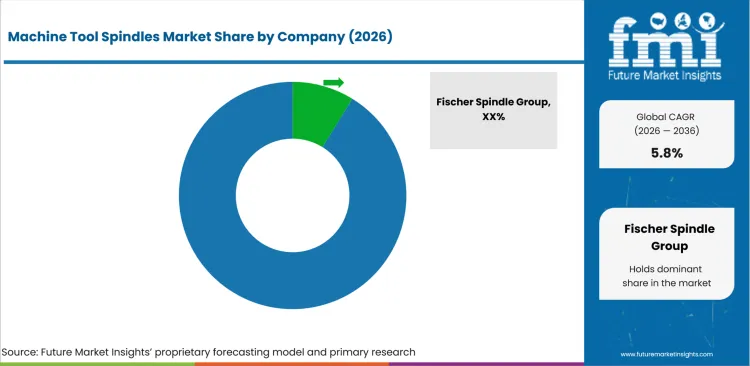
Competition separates integrated motor-spindle engineers from high-frequency specialists, rebuild companies and precision-bearing providers. Entry depends on proving the spindle inside a machine architecture and supporting it after installation.
- Integrated spindle engineering: Fischer Spindle Group, GMN, Kessler and Franz Kessler cover motor-spindle or machine-platform engineering with service support.
- High-frequency specialists: IBAG, HSD Mechatronics, Nakanishi and Jäger focus on compact motorized spindle systems for demanding machining applications.
- Lifecycle and bearing roles: Setco provides new spindle and rebuild services, while NSK supplies super-precision bearing technology used inside machine-tool spindles.
Competitive Benchmarking: Machine Tool Spindles Market
| Company | Spindle Architecture Breadth | High-Speed & Precision Capability | Lifecycle Service & Integration | Geographic Reach |
|---|---|---|---|---|
| Fischer Spindle Group | High | High | High | Europe, North America and Asia |
| GMN | High | High | High | Europe with international subsidiaries and partners |
| Kessler | High | High | High | Germany with international service coverage |
| Setco | High | Medium | High | North America and Asia with global service |
| IBAG | Medium | High | High | Switzerland, North America and international service |
| HSD Mechatronics | High | High | Medium | Europe with international commercial coverage |
| Nakanishi | Medium | High | Medium | Japan with networks in North America, Europe and Asia |
| NSK | Low | High | Medium | Global precision-bearing network |
| Jäger | Medium | High | Medium | Germany and North America with service partners |
| Franz Kessler | High | High | High | Germany with the wider KESSLER group footprint |
Key Developments in the Machine Tool Spindles Market
- In June 2026, Fischer Spindle Group introduced the MFW-2113/30 HSK-T63 spindle for machines that need high-speed milling and turning in one compact spindle body. The launch targets process consolidation without removing machine-level qualification requirements.
- In September 2025, HSD Mechatronics presented the enhanced ES1000 GO and new ES10 and ES6000 electric spindle series at EMO Hannover. The releases give machine builders application-specific options for milling and automotive machining under a broader electric-spindle platform.
- In May 2025, Nakanishi launched the E3000i series with one controller and four motor-spindle configurations for CNC machine tools. The release gives compact machine builders several spindle options under one control architecture while preserving application-level validation.
Key Players in the Machine Tool Spindles Market
Integrated Motor-Spindle and Machine-Platform Specialists
- Fischer Spindle Group
- GMN
- Kessler
- Franz Kessler
High-Speed and Application-Focused Spindle Specialists
- IBAG
- HSD Mechatronics
- Nakanishi
- Jäger
Lifecycle Service and Precision-Bearing Specialists
- Setco
- NSK
Machine Tool Spindles Market - Report Scope
| Coverage field | Report scope |
|---|---|
| Market breakdown | By spindle type, speed range, bearing type, end use, sales channel and region. |
| Quantitative Units | Revenue in USD billion and CAGR in %. |
| Market Definition | Commercial revenue from machine-tool spindle assemblies and directly associated spindle repair or rebuild transactions where the spindle is the core billable unit. |
| Regions Covered | North America, Latin America, Western Europe, Eastern Europe, East Asia, South Asia and Pacific, and Middle East and Africa. |
| Countries Covered | Italy, South Korea, Mexico, USA, Germany, France, Japan, and 20+ countries included in the full report. |
| Key Companies | Fischer Spindle Group, GMN, Kessler, Setco, IBAG, HSD Mechatronics, Nakanishi, NSK, Jäger, Franz Kessler. |
| Forecast Period | 2026 to 2036. |
| Approach | Primary and secondary research with market triangulation. |
Machine Tool Spindles Market - Research Methodology
| Method | Approach |
|---|---|
| Primary Research | FMI analysts gathered input from manufacturers, service providers, technology developers, distributors, end users, procurement teams, and subject-matter experts. Interviews examined purchasing decisions, product or service evaluation, adoption barriers, approval requirements, pricing considerations, and expectations for technical or commercial support. Respondents were also asked what evidence is required before a trial, pilot, or initial order develops into regular purchasing. |
| Desk Research | Desk research covered government statistics, regulatory publications, trade data, industry associations, technical literature, standards, company filings, product information, and official corporate announcements. Sources were reviewed for relevance, publication date, geographic coverage, and consistency with the defined market scope. Claims relating to performance, applications, approvals, capacity, investment, and commercial activity were retained only when supported by credible public evidence. |
| Market Sizing and Forecasting | The market model combined the baseline value with historical performance, segment structure, pricing and volume indicators, adoption levels, company participation, and country-level demand conditions. Forecast assumptions considered economic activity, investment trends, regulatory developments, technology adoption, purchasing cycles, supply availability, and barriers to wider market use. Segment and regional estimates were reconciled before the final market total was calculated. |
| Data Validation | Estimates were checked against multiple independent indicators, including public data, company activity, trade patterns, industry developments, and findings from primary interviews. Validation also tested whether products, services, applications, and company revenues fell within the defined market boundaries. Adjacent categories, unsupported claims, overlapping revenues, and activities without direct market relevance were excluded to reduce double counting and maintain consistency across segments and countries. |
Machine Tool Spindles Market by Segments
Machine Tool Spindles Market segmented by Spindle Type:
- Belt-driven spindles
- Direct-drive spindles
- Motorized spindles
- High-speed spindles
- Grinding spindles
Machine Tool Spindles Market segmented by Speed Range:
- Below 10,000 rpm
- 10,000-25,000 rpm
- 25,000-60,000 rpm
- Above 60,000 rpm
Machine Tool Spindles Market segmented by Bearing Type:
- Angular contact ball
- Ceramic hybrid
- Hydrostatic
- Air bearing
- Magnetic bearing
Machine Tool Spindles Market segmented by End Use:
- Machine tool OEMs
- Aerospace machining
- Automotive machining
- Mold & die
- Electronics and medical
Machine Tool Spindles Market segmented by Sales Channel:
- Direct OEM supply
- Spindle repair and rebuild
- Distributors
- Custom engineering
Machine Tool Spindles Market by Region:
- North America
- United States
- Canada
- Latin America
- Brazil
- Mexico
- Argentina
- Chile
- Western Europe
- Germany
- France
- United Kingdom
- Italy
- Spain
- Benelux
- Nordics
- Eastern Europe
- Poland
- Czech Republic
- Romania
- Hungary
- East Asia
- China
- Japan
- South Korea
- South Asia and Pacific
- India
- ASEAN
- Australia and New Zealand
- Middle East and Africa
- GCC Countries
- South Africa
- Türkiye
- Israel
Research Sources and Bibliography
- AMT - The Association For Manufacturing Technology. (2026, June 8). Automation Fuels Strong Start to 2026 Manufacturing Technology Orders
- German Machine Tool Builders’ Association VDW. (2026, January 19). German machine tool industry focuses on diversification and technological leadership
- UCIMU-SISTEMI PER PRODURRE. (2026, July). Italian Machines Tool Industry in 2025
- Japan Machine Tool Builders’ Association. (2026, February 3). The Current Condition of the Japanese Machine Tool Industry
- Schaeffler Technologies AG & Co. KG. (2025, September 10). Product premiere: Precision angular contact ball bearings for driven tools
- NAKANISHI INC.. (2026, January 19). New product is now on sale: Gear-Speed series NGS-3140-CTZ01
- FISCHER Spindle Group and ROLLOMATIC GROUP. (2026, June 25). Strategic partnership in spindle construction and acquisition of Robert Renaud SA
- AMT - The Association For Manufacturing Technology. (2026, August 10). 2026 Manufacturing Technology Orders Set Half-Year Record
- AMT - The Association For Manufacturing Technology. (2026, July 13). $583.4M in New Machinery Orders Highlight US Economic Strengths
- German Machine Tool Builders’ Association VDW. (2026, March 18). German machine tool industry leveling off - China further dominating production
- German Machine Tool Builders’ Association VDW. (2025, August 26). Key Figures of the German Machine Tool Industry: 1st-2nd Quarter 2025
- HSD Mechatronics. (2025, September 22). HSD at the EMO 2025
- UCIMU-SISTEMI PER PRODURRE. (2025, December). UCIMU-SISTEMI PER PRODURRE: the Italian machine tool industry to close a rather stagnant 2025. manufacturers expect moderate growth for 2026
- Republic of Korea Ministry of Data and Statistics. (2025, May 30). Monthly Industrial Statistics, April 2025
- Ministry of Economy, Trade and Industry, Japan. (2026, June 30). Indices of Industrial Production
- Presidency of Mexico. (2025, June 26). Plan México: Presidenta Claudia Sheinbaum pone en marcha los primeros 15 Polos de Desarrollo Económico para el Bienestar en 14 estados
- INSEE. (2026, June 30). In April 2026, manufacturing turnover accelerated (+2,5%)
- FISCHER USA. (2026, June 3). Introducing the FISCHER MFW-2113/30 HSK-T63
- FISCHER Spindle Group AG. (2025, October 17). FISCHER ACQUIRES BBN
- NAKANISHI INC.. (2025, May). New products are now on sale: E3000i series.
- NAKANISHI INC.. (2026, April). New product is now on sale: E3000 series [RAM-3014]
- NSK Ltd.. (2025, September 22). NSK to Exhibit at EMO Hannover 2025, a Machine Tool Exhibition in Europe
- SETCO. (2026, September). IMTS 2026 - new robotic spindle announcement
- GMN Paul Müller Industrie GmbH & Co. KG. (2026, accessed September 8). Spindles and spindle technology for machine tools
- IBAG Group. (2026, accessed September 8). News - IBAG Roadshow AMB 2026
- KESSLER Group. (2026, accessed September 8). KESSLER continues to invest in modern production technologies and digitalisation
- Nakanishi Jaeger GmbH. (2026, accessed September 8). High-frequency spindles - Made in Germany
This bibliography is provided for reader reference and is not exhaustive. The full report contains the complete reference list and detailed citations
This Report Answers
- What is the machine tool spindles market value in 2026 and 2036?
- Which machine requirements raise spindle value in automated machining?
- Why do belt-driven spindles account for 22.0% of spindle type demand?
- How does the below 10,000 rpm speed range shape spindle selection?
- Why do angular contact ball bearings hold 44.0% of bearing type demand?
- How do country growth rates differ among the seven covered markets?
- Which companies compete in integrated, high-frequency, rebuild and bearing roles?
- How do qualification and service access affect spindle replacement decisions?
Frequently Asked Questions
How big is the Machine Tool Spindles Market in 2026?
The machine tool spindles market is valued at USD 3.2 billion in 2026 and is projected to reach USD 5.7 billion by 2036. Growth follows machining investment that raises automation content and spindle integration requirements.
What is the CAGR of the Machine Tool Spindles Market from 2026 to 2036?
The machine tool spindles market is projected to grow at a CAGR of 5.8% between 2026 and 2036. Expansion is supported by new machine platforms, spindle replacement work and tighter specifications for automated machining.
Which spindle type leads the Machine Tool Spindles Market?
The belt-driven spindles segment is expected to hold 22.0% of the machine tool spindles market in 2026, attributable to familiar external-drive architecture and practical service access. The design also fits a broad installed base of conventional machines.
Which speed range holds the stated 2026 share in the Machine Tool Spindles Market?
The below 10,000 rpm segment is expected to hold 31.0% of the machine tool spindles market in 2026, driven by general machining duties that need usable torque and rigidity. Higher speed bands serve narrower precision and micro-machining applications.
Which countries are projected to record the country growth comparison in the Machine Tool Spindles Market?
Italy is projected to grow at 6.5% CAGR, followed by South Korea at 5.9% and Mexico at 5.8% through 2036. Their trajectories reflect different combinations of machine-building activity, equipment investment and manufacturing localization.
Which companies are active in the Machine Tool Spindles Market?
Key companies operating in the market include Fischer Spindle Group, GMN, Kessler, Setco, IBAG, HSD Mechatronics, Nakanishi, NSK, Jäger, and Franz Kessler. Their roles cover integrated spindles, high-frequency systems, rebuild services and precision-bearing technology.
Preview the report firsthand - request a free sample
Get SampleGet the brochure for pricing and purchase details.
Get PDFTable of Content
- Key Takeaways
- Market Size and CAGR
- Top Growth Driver
- Fastest Growing Segment
- Leading Region
- Key Companies
- Emerging Opportunities
- Executive Summary
- Global Market Outlook
- Demand-side Trends
- Supply-side Trends
- Technology Roadmap Analysis
- Analysis and Recommendations
- Analyst Perspective (What is happening? Why now? What should investors know?)
- Key Questions Answered
- How large is the market?
- What is the CAGR?
- What are key trends?
- Which region dominates?
- Who are the leaders?
- Market Overview
- Market Coverage / Taxonomy
- Market Definition / Scope / Limitations
- Research Methodology
- Chapter Orientation
- Analytical Lens and Working Hypotheses
- Market Structure, Signals, and Trend Drivers
- Benchmarking and Cross-market Comparability
- Market Sizing, Forecasting, and Opportunity Mapping
- Research Design and Evidence Framework
- Desk Research Programme (Secondary Evidence)
- Expert Input and Fieldwork (Primary Evidence)
- Tooling, Models, and Reference Databases
- Data Engineering and Model Build
- Quality Assurance and Audit Trail
- Market Background
- Market Dynamics (Drivers, Restraints, Opportunity, Trends)
- Scenario Forecast (Optimistic, Likely, Conservative)
- Impact Analysis
- AI Impact
- Sustainability Impact
- Regulatory Impact
- Technology Impact
- Consumer / Buyer Analysis
- Purchase Drivers
- Adoption Barriers
- Buyer Journey
- Opportunity Map Analysis
- Product Life Cycle Analysis
- Supply Chain Analysis
- Investment Feasibility Matrix
- Value Chain Analysis
- PESTLE and Porter's Analysis
- Regulatory Landscape
- Regional Parent Market Outlook
- Production and Consumption Statistics
- Import and Export Statistics
- Global Market Analysis and Forecast, 2021 to 2036
- Historical Market Size Value (USD Billion) Analysis, 2021 to 2025
- Current and Future Market Size Value (USD Billion) Projections, 2026 to 2036
- Y-o-Y Growth Trend Analysis
- Absolute $ Opportunity Analysis
- Global Market Pricing Analysis, 2021 to 2036
- Global Market Analysis and Forecast, By Spindle Type, 2021 to 2036
- Introduction / Key Findings
- Historical Market Size Value (USD Billion) Analysis By Spindle Type, 2021 to 2025
- Current and Future Market Size Value (USD Billion) Analysis and Forecast By Spindle Type, 2026 to 2036
- Belt-driven spindles
- Direct-drive spindles
- Motorized spindles
- High-speed spindles
- Grinding spindles
- Belt-driven spindles
- Y-o-Y Growth Trend Analysis By Spindle Type, 2021 to 2025
- Absolute $ Opportunity Analysis By Spindle Type, 2026 to 2036
- Global Market Analysis and Forecast, By Speed Range, 2021 to 2036
- Introduction / Key Findings
- Historical Market Size Value (USD Billion) Analysis By Speed Range, 2021 to 2025
- Current and Future Market Size Value (USD Billion) Analysis and Forecast By Speed Range, 2026 to 2036
- Below 10,000 rpm
- 10,000-25,000 rpm
- 25,000-60,000 rpm
- Above 60,000 rpm
- Below 10,000 rpm
- Y-o-Y Growth Trend Analysis By Speed Range, 2021 to 2025
- Absolute $ Opportunity Analysis By Speed Range, 2026 to 2036
- Global Market Analysis and Forecast, By Bearing Type, 2021 to 2036
- Introduction / Key Findings
- Historical Market Size Value (USD Billion) Analysis By Bearing Type, 2021 to 2025
- Current and Future Market Size Value (USD Billion) Analysis and Forecast By Bearing Type, 2026 to 2036
- Angular contact ball
- Ceramic hybrid
- Hydrostatic
- Air bearing
- Magnetic bearing
- Angular contact ball
- Y-o-Y Growth Trend Analysis By Bearing Type, 2021 to 2025
- Absolute $ Opportunity Analysis By Bearing Type, 2026 to 2036
- Global Market Analysis and Forecast, By End Use, 2021 to 2036
- Introduction / Key Findings
- Historical Market Size Value (USD Billion) Analysis By End Use, 2021 to 2025
- Current and Future Market Size Value (USD Billion) Analysis and Forecast By End Use, 2026 to 2036
- Machine tool OEMs
- Aerospace machining
- Automotive machining
- Mold & die
- Electronics/medical
- Machine tool OEMs
- Y-o-Y Growth Trend Analysis By End Use, 2021 to 2025
- Absolute $ Opportunity Analysis By End Use, 2026 to 2036
- Global Market Analysis and Forecast, By Sales Channel, 2021 to 2036
- Introduction / Key Findings
- Historical Market Size Value (USD Billion) Analysis By Sales Channel, 2021 to 2025
- Current and Future Market Size Value (USD Billion) Analysis and Forecast By Sales Channel, 2026 to 2036
- Direct OEM supply
- Spindle repair/rebuild
- Distributors
- Custom engineering
- Direct OEM supply
- Y-o-Y Growth Trend Analysis By Sales Channel, 2021 to 2025
- Absolute $ Opportunity Analysis By Sales Channel, 2026 to 2036
- Global Market Analysis and Forecast, By Region, 2021 to 2036
- Introduction
- Historical Market Size Value (USD Billion) Analysis By Region, 2021 to 2025
- Current Market Size Value (USD Billion) Analysis and Forecast By Region, 2026 to 2036
- North America
- Latin America
- Western Europe
- Eastern Europe
- East Asia
- South Asia and Pacific
- Middle East & Africa
- Market Attractiveness Analysis By Region
- North America Market Analysis and Forecast, By Country, 2021 to 2036
- Historical Market Size Value (USD Billion) Trend Analysis By Market Taxonomy, 2021 to 2025
- Market Size Value (USD Billion) Forecast By Market Taxonomy, 2026 to 2036
- By Country
- USA
- Canada
- By Spindle Type
- By Speed Range
- By Bearing Type
- By End Use
- By Sales Channel
- By Country
- Market Attractiveness Analysis
- By Country
- By Spindle Type
- By Speed Range
- By Bearing Type
- By End Use
- By Sales Channel
- Key Takeaways
- Latin America Market Analysis and Forecast, By Country
- Historical Market Size Value (USD Billion) Trend Analysis By Market Taxonomy, 2021 to 2025
- Market Size Value (USD Billion) Forecast By Market Taxonomy, 2026 to 2036
- By Country
- Brazil
- Mexico
- Chile
- Rest of Latin America
- By Spindle Type
- By Speed Range
- By Bearing Type
- By End Use
- By Sales Channel
- By Country
- Market Attractiveness Analysis
- By Country
- By Spindle Type
- By Speed Range
- By Bearing Type
- By End Use
- By Sales Channel
- Key Takeaways
- Western Europe Market Analysis and Forecast, By Country
- Historical Market Size Value (USD Billion) Trend Analysis By Market Taxonomy, 2021 to 2025
- Market Size Value (USD Billion) Forecast By Market Taxonomy, 2026 to 2036
- By Country
- Germany
- UK
- Italy
- Spain
- France
- Nordic
- BENELUX
- Rest of Western Europe
- By Spindle Type
- By Speed Range
- By Bearing Type
- By End Use
- By Sales Channel
- By Country
- Market Attractiveness Analysis
- By Country
- By Spindle Type
- By Speed Range
- By Bearing Type
- By End Use
- By Sales Channel
- Key Takeaways
- Eastern Europe Market Analysis and Forecast, By Country
- Historical Market Size Value (USD Billion) Trend Analysis By Market Taxonomy, 2021 to 2025
- Market Size Value (USD Billion) Forecast By Market Taxonomy, 2026 to 2036
- By Country
- Russia
- Poland
- Hungary
- Balkan & Baltic
- Rest of Eastern Europe
- By Spindle Type
- By Speed Range
- By Bearing Type
- By End Use
- By Sales Channel
- By Country
- Market Attractiveness Analysis
- By Country
- By Spindle Type
- By Speed Range
- By Bearing Type
- By End Use
- By Sales Channel
- Key Takeaways
- East Asia Market Analysis and Forecast, By Country
- Historical Market Size Value (USD Billion) Trend Analysis By Market Taxonomy, 2021 to 2025
- Market Size Value (USD Billion) Forecast By Market Taxonomy, 2026 to 2036
- By Country
- China
- Japan
- South Korea
- By Spindle Type
- By Speed Range
- By Bearing Type
- By End Use
- By Sales Channel
- By Country
- Market Attractiveness Analysis
- By Country
- By Spindle Type
- By Speed Range
- By Bearing Type
- By End Use
- By Sales Channel
- Key Takeaways
- South Asia and Pacific Market Analysis and Forecast, By Country
- Historical Market Size Value (USD Billion) Trend Analysis By Market Taxonomy, 2021 to 2025
- Market Size Value (USD Billion) Forecast By Market Taxonomy, 2026 to 2036
- By Country
- India
- ASEAN
- Australia & New Zealand
- Rest of South Asia and Pacific
- By Spindle Type
- By Speed Range
- By Bearing Type
- By End Use
- By Sales Channel
- By Country
- Market Attractiveness Analysis
- By Country
- By Spindle Type
- By Speed Range
- By Bearing Type
- By End Use
- By Sales Channel
- Key Takeaways
- Middle East & Africa Market Analysis and Forecast, By Country
- Historical Market Size Value (USD Billion) Trend Analysis By Market Taxonomy, 2021 to 2025
- Market Size Value (USD Billion) Forecast By Market Taxonomy, 2026 to 2036
- By Country
- Kingdom of Saudi Arabia
- Other GCC Countries
- Türkiye
- South Africa
- Other African Union
- Rest of Middle East & Africa
- By Spindle Type
- By Speed Range
- By Bearing Type
- By End Use
- By Sales Channel
- By Country
- Market Attractiveness Analysis
- By Country
- By Spindle Type
- By Speed Range
- By Bearing Type
- By End Use
- By Sales Channel
- Key Takeaways
- Key Countries Market Analysis
- USA
- Pricing Analysis
- Market Share Analysis, 2025
- By Spindle Type
- By Speed Range
- By Bearing Type
- By End Use
- By Sales Channel
- Canada
- Pricing Analysis
- Market Share Analysis, 2025
- By Spindle Type
- By Speed Range
- By Bearing Type
- By End Use
- By Sales Channel
- Mexico
- Pricing Analysis
- Market Share Analysis, 2025
- By Spindle Type
- By Speed Range
- By Bearing Type
- By End Use
- By Sales Channel
- Brazil
- Pricing Analysis
- Market Share Analysis, 2025
- By Spindle Type
- By Speed Range
- By Bearing Type
- By End Use
- By Sales Channel
- Chile
- Pricing Analysis
- Market Share Analysis, 2025
- By Spindle Type
- By Speed Range
- By Bearing Type
- By End Use
- By Sales Channel
- Germany
- Pricing Analysis
- Market Share Analysis, 2025
- By Spindle Type
- By Speed Range
- By Bearing Type
- By End Use
- By Sales Channel
- UK
- Pricing Analysis
- Market Share Analysis, 2025
- By Spindle Type
- By Speed Range
- By Bearing Type
- By End Use
- By Sales Channel
- Italy
- Pricing Analysis
- Market Share Analysis, 2025
- By Spindle Type
- By Speed Range
- By Bearing Type
- By End Use
- By Sales Channel
- Spain
- Pricing Analysis
- Market Share Analysis, 2025
- By Spindle Type
- By Speed Range
- By Bearing Type
- By End Use
- By Sales Channel
- France
- Pricing Analysis
- Market Share Analysis, 2025
- By Spindle Type
- By Speed Range
- By Bearing Type
- By End Use
- By Sales Channel
- India
- Pricing Analysis
- Market Share Analysis, 2025
- By Spindle Type
- By Speed Range
- By Bearing Type
- By End Use
- By Sales Channel
- ASEAN
- Pricing Analysis
- Market Share Analysis, 2025
- By Spindle Type
- By Speed Range
- By Bearing Type
- By End Use
- By Sales Channel
- Australia & New Zealand
- Pricing Analysis
- Market Share Analysis, 2025
- By Spindle Type
- By Speed Range
- By Bearing Type
- By End Use
- By Sales Channel
- China
- Pricing Analysis
- Market Share Analysis, 2025
- By Spindle Type
- By Speed Range
- By Bearing Type
- By End Use
- By Sales Channel
- Japan
- Pricing Analysis
- Market Share Analysis, 2025
- By Spindle Type
- By Speed Range
- By Bearing Type
- By End Use
- By Sales Channel
- South Korea
- Pricing Analysis
- Market Share Analysis, 2025
- By Spindle Type
- By Speed Range
- By Bearing Type
- By End Use
- By Sales Channel
- Russia
- Pricing Analysis
- Market Share Analysis, 2025
- By Spindle Type
- By Speed Range
- By Bearing Type
- By End Use
- By Sales Channel
- Poland
- Pricing Analysis
- Market Share Analysis, 2025
- By Spindle Type
- By Speed Range
- By Bearing Type
- By End Use
- By Sales Channel
- Hungary
- Pricing Analysis
- Market Share Analysis, 2025
- By Spindle Type
- By Speed Range
- By Bearing Type
- By End Use
- By Sales Channel
- Kingdom of Saudi Arabia
- Pricing Analysis
- Market Share Analysis, 2025
- By Spindle Type
- By Speed Range
- By Bearing Type
- By End Use
- By Sales Channel
- Türkiye
- Pricing Analysis
- Market Share Analysis, 2025
- By Spindle Type
- By Speed Range
- By Bearing Type
- By End Use
- By Sales Channel
- South Africa
- Pricing Analysis
- Market Share Analysis, 2025
- By Spindle Type
- By Speed Range
- By Bearing Type
- By End Use
- By Sales Channel
- USA
- Market Structure Analysis
- Competition Dashboard
- Competition Benchmarking
- Market Share Analysis of Top Players
- By Regional
- By Spindle Type
- By Speed Range
- By Bearing Type
- By End Use
- By Sales Channel
- Emerging Startups
- Innovation Benchmarking
- Competition Analysis
- Competition Deep Dive
- Fischer Spindle Group
- Overview
- Product Portfolio
- Profitability by Market Segments
- Sales Footprint
- Strategy Overview
- Marketing Strategy
- Product Strategy
- Channel Strategy
- GMN
- Kessler
- Setco
- IBAG
- HSD Mechatronics
- Nakanishi
- NSK
- Jäger
- Franz Kessler
- Fischer Spindle Group
- Case Studies
- Success Stories
- Recent Developments
- Competition Deep Dive
- Assumptions & Acronyms Used


