

- Market Size (2026)
- USD 690.6 Mn
- Forecast (2036)
- USD 3263.3 Mn
- CAGR (2026 to 2036)
- 16.8%
How big is the chiplet underfills market in 2026?
USD 690.6 million in 2026 and USD 3,263.3 million by 2036 at a 16.8% CAGR.
The chiplet underfills industry value is forecast to grow from USD 591.3 million in 2025 to USD 3,263.3 million by 2036 at 16.8% CAGR as AI accelerator packaging moves into larger interposer and HBM-linked assemblies. Direct to OSAT / IDM is expected to secure 78.0% share in 2026 because package owners control approved material lists before volume release. Epoxy-based chemistry is projected to hold 62.0% share in 2026, led by known cure behavior, reliability history, and broad supplier familiarity.
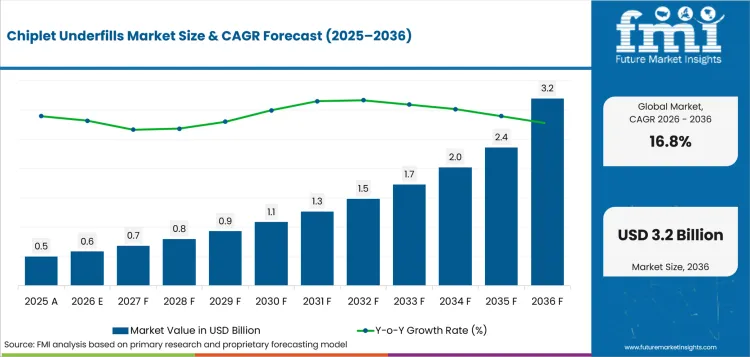
Chiplet Underfills Market Overview: Size and Forecast
- 2026 Market Size: USD 690.6 million
- 2036 Market Size: USD 3,263.3 million
- Forecast CAGR: 16.8% from 2026 to 2036
- Leading Sales Channel: Direct to OSAT / IDM
- Direct to OSAT / IDM Share in 2026: 78.0%
- Leading Chemistry: Epoxy-based
- Epoxy-based Share in 2026: 62.0%
- Fastest-growing Country: China
- China CAGR: 18.7% by 2036
Summary of the Chiplet Underfills Market
- Demand and Growth Drivers
- AI accelerator suppliers are moving toward larger interposer and chiplet layouts that need low-void underfill coverage.
- OSAT and IDM teams are tightening material approval because late package failure can affect expensive multi-die assemblies.
- HBM integration is raising demand for underfills that protect fine-pitch joints around memory and logic die.
- Product and Segment View
- Direct to OSAT / IDM is expected to represent 78.0% share in 2026, led by approved material lists staying close to package owners.
- Epoxy-based chemistries are projected to hold 62.0% share in 2026, influenced by known cure profiles and qualification history.
- Capillary Underfills are expected to secure 46.0% share in 2026, supported by post-attach flow under fine-pitch chiplet joints.
- Geography and Competitive Outlook
- China is projected to record 18.7% CAGR by 2036, backed by IC output scale and domestic package capacity.
- South Korea is expected to expand at 17.9% CAGR by 2036 through HBM leadership and memory packaging reliability needs.
- Henkel and NAMICS compete through large-body underfill evidence and advanced package material validation.
- Panasonic Industry, Shin-Etsu Chemical, Resonac, MacDermid Alpha, and Kyocera focus on resin design and package reliability support.
- Analyst Opinion
- Sudip saha, Associate Vice President at FMI, observes, “Chiplet underfills are becoming a reliability control point inside advanced packaging rather than a small material input. Buyers now evaluate whether a resin can flow under larger die without voids and cure without adding package bow. Suppliers with strong application data around low CTE behavior, thermal cycling, and package-specific flow will gain earlier access to OSAT and IDM programs.”
Advanced package qualification is becoming the main pressure point for chiplet underfills as package owners review flow speed, void control, warpage behavior, and fine-pitch bump protection before approving materials. The USA Department of Commerce announced USD 1.4 billion in final awards in January 2025 to support next-generation semiconductor advanced packaging. SEMI reported in January 2025 that 18 new semiconductor fab construction projects were expected to start in 2025, including 3 200mm and 15 300mm facilities. UCIe stated in 2025 that its 3.0 specification supports 48 GT/s and 64 GT/s data rates, giving package designers a stronger reason to align underfills with high-speed die-to-die interconnect protection.
Which factors support expansion in the chiplet underfills market?
Advanced package builds, direct qualification, and larger die areas support market value across high-reliability semiconductor assembly channels.
- Market value is supported by package-level underfill revenue before board-level reinforcement materials add adjacent sales.
- Supplier pricing reflects resin chemistry, filler control, and package-specific reliability support before distributor margins are added.
- Revenue improves as AI and HPC package volumes move from engineering builds into repeat production programs.
- Buyer trust rises as material suppliers document flow time, ionic cleanliness, warpage control, and thermal cycling performance.
Why is the chiplet underfills market growing?
AI and HPC package designs are raising underfill demand because each advanced multi-die assembly carries higher interconnect density and higher scrap risk than conventional package formats.
Growth outlook has become more structured as national packaging programs and open chiplet standards move from policy discussion into pilot-line validation. The USA Department of Commerce finalized USD 300 million in January 2025 for advanced substrates and material research across Georgia, California, and Arizona. This gives underfill suppliers additional validation points near packaging pilots. Buyers are also comparing chiplet underfills with electronic board level underfill material market requirements because package-level stress can no longer be treated as a simple board reliability question.
How is the chiplet underfills market segmented?
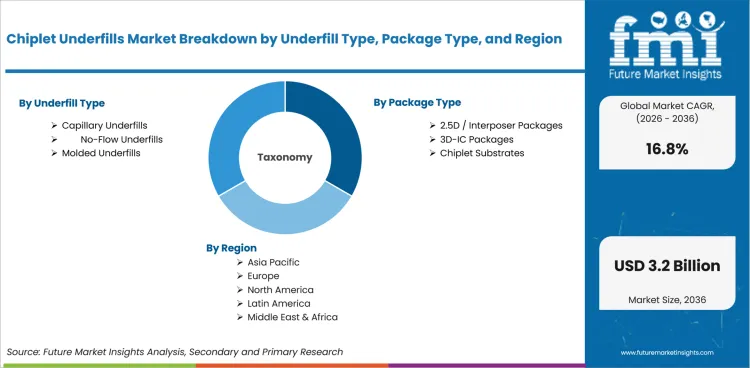
The chiplet underfills industry is segmented by underfill type, package type, chemistry, end use, and sales channel.
- Capillary Underfills are projected to secure 46.0% share in 2026, led by post-attach flow suitability for fine-pitch chiplet joints and large package bodies.
- 2.5D / Interposer Packages are expected to hold 38.0% share in 2026, supported by AI accelerator layouts that combine logic die with high-bandwidth memory.
- Epoxy-based chemistries are anticipated to capture 62.0% share in 2026, due to known cure profiles, moisture resistance, and supplier qualification history.
- AI / HPC is projected to account for 41.0% share in 2026, guided by accelerator packages carrying higher underfill value per finished assembly.
- Direct to OSAT / IDM is forecast to represent 78.0% share in 2026, shaped by approved material lists staying close to package owners and engineering teams.
Why do capillary underfills dominate the chiplet underfills market?
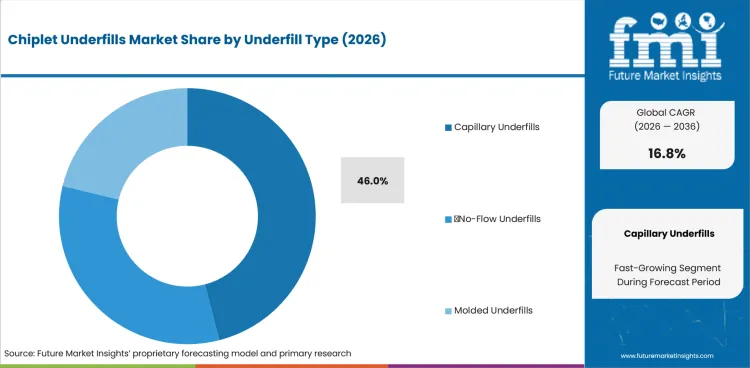
- Capillary Underfills are projected to account for 46.0% share in 2026, influenced by controlled post-die attach flow under large chiplet bodies and narrow interconnect gaps.
- No-flow underfills gain use in selected process flows, although buyers often prefer post-attach inspection flexibility for high-value advanced packages.
Which package type leads the chiplet underfills market?
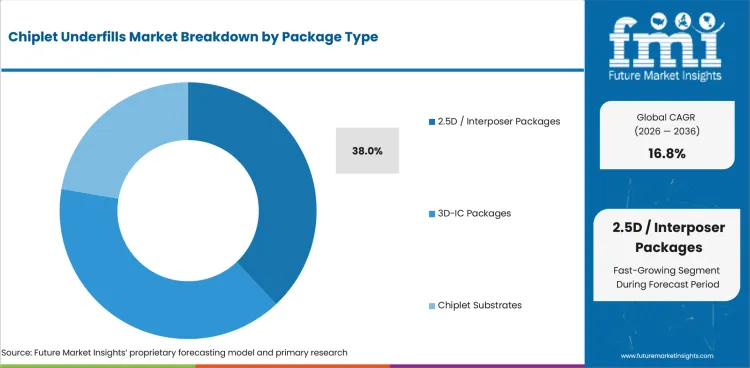
- 2.5D / Interposer Packages are expected to represent 38.0% share in 2026, reflected by AI accelerators combining logic die and high-bandwidth memory stacks.
- 3D-IC Packages gain importance as vertical integration raises thermal-mechanical stress and makes material behavior more central to package survival.
Which chemistry leads the chiplet underfills market?
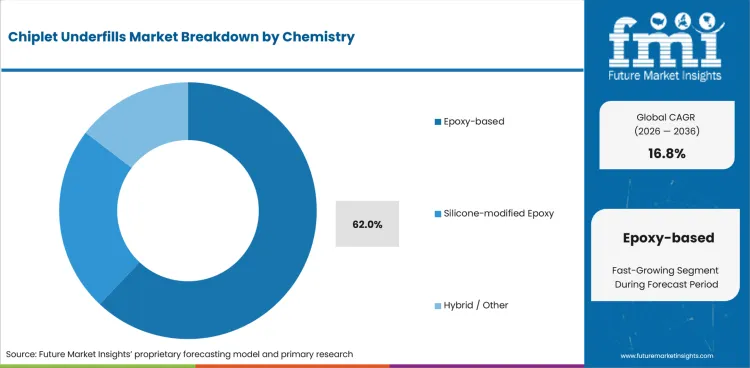
- Epoxy-based is anticipated to hold 62.0% share in 2026, through known cure behavior, broad supplier experience, and established reliability testing practice.
- Silicone-modified epoxy gains attention where package teams need a softer stress profile without losing process stability across larger die.
Which end use leads the chiplet underfills market?
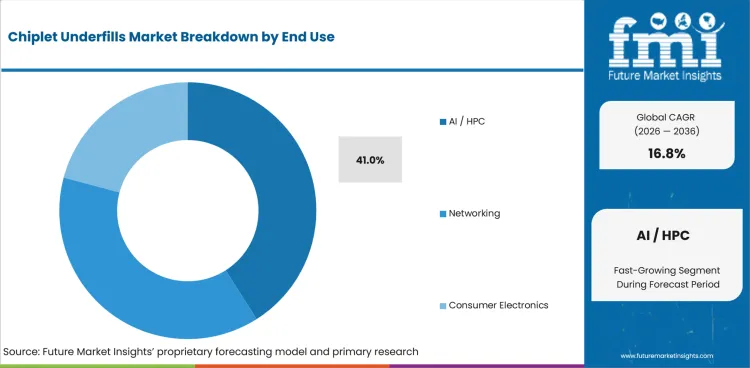
- AI / HPC is projected to account for 41.0% share in 2026, as accelerator packages need larger interposers and higher thermal cycling reliability.
- Networking demand gains value where switch ASICs and high-speed optical modules require stable package reinforcement under continuous operating load.
Which sales channel leads the chiplet underfills market?
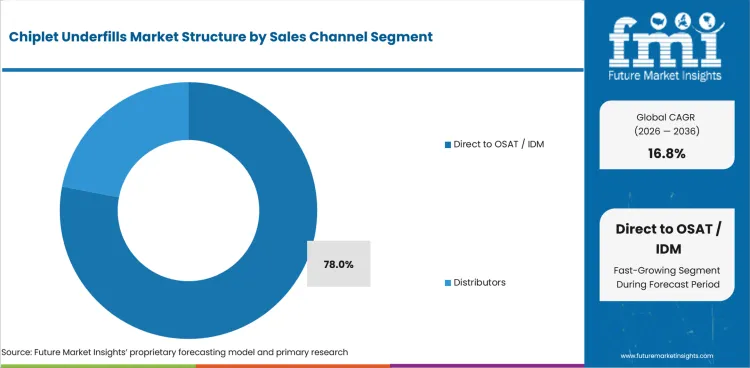
- Direct to OSAT / IDM is expected to represent 78.0% share in 2026, as package owners control approved material lists and failure-analysis expectations.
- Distributors remain useful for lower-volume programs, although high-value chiplet packages usually need direct supplier engineering and reliability support.
What are the driver, restraints, and opportunities in the chiplet underfills market?
AI package scaling supports demand while qualification risk and package stress keep supplier switching difficult.
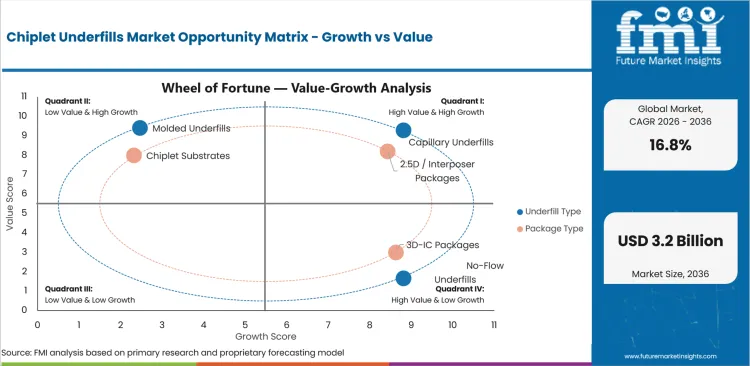
- Driver: Large-body AI packages create underfill pull as capillary flow must cover wider die without leaving voided solder joints.
- Restraint: Interposer warpage risk restrains material switching since a small chemistry change can reset package qualification.
- Opportunity: HBM stack growth creates room for underfills that balance low CTE behavior with high flow speed.
Large-Body Package Flow Demand Outlook
Large-body package flow is the core driver because chiplet assemblies are moving beyond compact consumer package formats. Henkel stated in April 2024 that Loctite Eccobond UF 9000AE demonstrated 20% faster flow versus earlier capillary underfills during internal testing on a 40 mm by 40 mm die. This shows why void-free coverage is no longer a routine assembly step for advanced AI and HPC package builds. Underfill suppliers can gain stronger buyer attention when they prove flow speed without sacrificing low shrinkage, crack resistance, or fillet control.
Interposer Warpage and Qualification Restraint Analysis
Interposer warpage and qualification control remain restraints because advanced packages require resin, filler, substrate, and cure behavior to work together. The 2026 UK Semiconductor Sectoral Analysis estimated 92% of dedicated UK semiconductor companies were SMEs and direct employment was about 16,350 in 2025, showing why smaller ecosystems can face limits in specialized validation capacity. Suppliers must therefore support package-level stress data before buyers approve material changes.
HBM Stack Protection Opportunity Analysis
HBM stack protection creates opportunity as memory and logic integration raises thermal and mechanical load near fine interconnects. The HBM4 standard released in April 2025 supports transfer speeds up to 8 Gb/s across a 2,048-bit interface, which can lift bandwidth to 2 TB/s per stack. Underfills do not define memory bandwidth, but they protect the joints and package interfaces that allow dense memory integration to survive. This opens room for suppliers with cleaner filler control, lower ionic contamination, and application support around HBM-adjacent structures.
Which countries are growing fastest in the chiplet underfills market?
China 18.7% CAGR, South Korea 17.9% CAGR, United States 17.4% CAGR, Japan 16.5% CAGR, India 15.9% CAGR, Germany 14.8% CAGR, France 13.9% CAGR, and United Kingdom 12.8% CAGR through 2036.
.webp "Top Country Growth Comparison Chiplet Underfills Market Cagr (2026 2036)")
| Country | CAGR |
|---|---|
| China | 18.7% |
| South Korea | 17.9% |
| United States | 17.4% |
| Japan | 16.5% |
| India | 15.9% |
| Germany | 14.8% |
| France | 13.9% |
| United Kingdom | 12.8% |
Source: Future Market Insights, 2026.
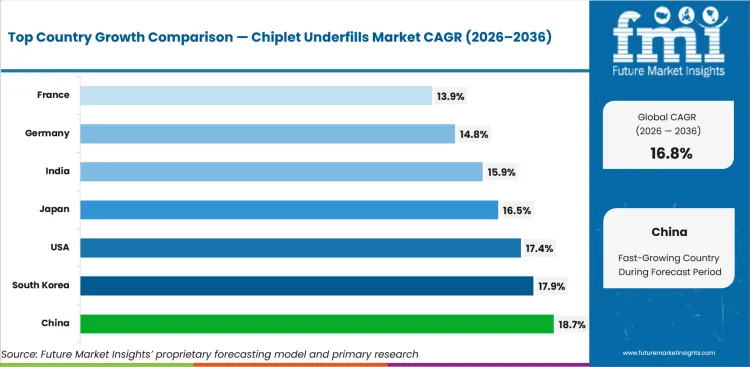
How do country-level CAGRs compare in the chiplet underfills market?
China leads country growth while the United Kingdom records the most cautious expansion outlook among profiled markets.
- China is forecast to record 18.7% CAGR by 2036 as IC output and advanced package capacity expand together.
- South Korea is expected to expand at 17.9% CAGR from 2026 to 2036 as HBM and memory packaging buyers increase reliability needs.
- The United States is projected to grow at 17.4% CAGR through 2036 as domestic advanced packaging programs add material validation routes.
- Japan is estimated to rise at 16.5% CAGR by 2036 with advanced material suppliers supporting capillary and molded underfill qualification.
- India is expected to advance at 15.9% CAGR over the forecast period as ATMP projects and materials programs move into early implementation.
- Germany is forecast to grow at 14.8% CAGR through 2036 as automotive electronics and Dresden manufacturing investment support high-reliability packages.
- France is projected to post 13.9% CAGR by 2036 as Grenoble and Crolles research networks support advanced packaging trials.
- The United Kingdom is expected to rise at 12.8% CAGR by 2036 as design-led and compound semiconductor programs create selective packaging demand.
How fast is the chiplet underfills market growing in China?
A 18.7% CAGR through 2036 reflects IC output scale and expanding domestic advanced packaging capacity.
Country Market Snapshot Table
| Parameter | Value |
|---|---|
| Market Size in 2025 (Value) | USD 155.0 million |
| Market Size in 2026 (Value) | USD 184.0 million |
| Market Forecast in 2036 (Value) | USD 1,021.7 million |
| CAGR (2026 to 2036) | 18.7% |
| Years Considered | 2021 to 2036 |
| Base Year | 2025 |
| Forecast Period | 2026 to 2036 |
| Units Considered | Value (USD million) |
| Leading Sub-Region | Yangtze River Delta and advanced packaging hubs |
China Chiplet Underfills Market Outlook
China chiplet underfill demand is influenced by local IC output, OSAT capacity, and domestic AI chip programs. Local suppliers and global material companies will compete for packages needing lower voiding and better stress control.
Advanced package buyers are expected to prioritize tested materials that support local package qualification. Suppliers with local technical service and cleaner reliability data should gain earlier acceptance.
Key Growth Drivers
- Integrated circuit scale gives underfill suppliers a broad package-volume base. China reported integrated circuit output of 484.3 billion units in 2025, up 10.9% year on year.
- Electronic information manufacturing revenue supports material purchasing depth. China reported 17.4 trillion yuan in operating revenue for major electronic information manufacturers in 2025.
- Domestic OSAT and IDM expansion improves local qualification access for capillary and molded underfills across AI and consumer electronics packages.
- Large electronics clusters make engineering support faster because material suppliers can serve packaging sites, substrate makers, and device customers within shorter travel windows.
Key Restraints
- Quality-sensitive chiplet packages can still prefer imported underfills when domestic validation history is not yet broad enough.
- Export controls and tool restrictions can slow access to some advanced packaging inputs and high-end process equipment.
- Supplier qualification remains demanding because China produced 1.27 billion smartphones in 2025, keeping reliability expectations high across dense electronics supply chains.
What makes China unique
China is unique because high IC output and local packaging scale create the largest volume signal among selected countries.
Key Companies
- JCET Group
- Tongfu Microelectronics
- Huatian Technology
- SMIC
- Huawei ecosystem suppliers
- Silan Microelectronics
- China Wafer Level CSP
Sales & Marketing Channels
- Direct OSAT procurement
- Domestic IDM sourcing
- Advanced substrate partnerships
- Electronics manufacturing clusters
- Local distributor engineering support
- Government-backed packaging programs
Country Segment Breakdown Table
| Segment | Sub-Segments |
|---|---|
| By Underfill Type | Capillary Underfills, No-Flow Underfills, Molded Underfills, Corner-Bond Underfills |
| By Package Type | 2.5D / Interposer Packages, 3D-IC Packages, Fan-Out Packages, Chiplet Substrates |
| By Chemistry | Epoxy-based, Silicone-modified Epoxy, Hybrid / Other |
| By End Use | AI / HPC, Networking, Consumer Electronics, Automotive Electronics |
| By Sales Channel | Direct to OSAT / IDM, Distributors |
| Key Sub-Regions Covered, Advanced Packaging Clusters | Shanghai, Jiangsu, Zhejiang, Guangdong, Beijing, Hubei |
Frequently Asked Questions
How fast is China chiplet underfills market growing?
Sales in China are ready to scale at 18.7% CAGR from 2026 to 2036, guided by local advanced package qualification.
Who leads China chiplet underfills market?
JCET Group, Tongfu Microelectronics, Huatian Technology, and SMIC shape local package demand and material validation.
What is driving adoption in China chiplet underfills market?
IC output scale and domestic advanced packaging programs are moving buyers toward specialized chiplet underfills.
What is the chiplet underfills market outlook in South Korea?
A 17.9% CAGR through 2036 is supported by HBM leadership and memory packaging reliability needs.
Country Market Snapshot Table
| Parameter | Value |
|---|---|
| Market Size in 2025 (Value) | USD 88.2 million |
| Market Size in 2026 (Value) | USD 104.0 million |
| Market Forecast in 2036 (Value) | USD 539.7 million |
| CAGR (2026 to 2036) | 17.9% |
| Years Considered | 2021 to 2036 |
| Base Year | 2025 |
| Forecast Period | 2026 to 2036 |
| Units Considered | Value (USD million) |
| Leading Sub-Region | Gyeonggi semiconductor cluster and memory packaging corridor |
South Korea Chiplet Underfills Market Outlook
South Korea chiplet underfill demand is shaped by memory packaging, advanced substrates, and cluster-based supplier coordination. HBM programs make underfill reliability important near fine-pitch memory and logic interfaces.
Suppliers will need strong support for low CTE behavior and clean process windows. Buyers are expected to prefer materials that can move through qualification with memory and substrate engineering teams.
Key Growth Drivers
- Mega-cluster planning strengthens materials demand. South Korea described 622 trillion won in planned private investment by 2047 for the semiconductor mega cluster.
- The cluster plan includes 16 new fabs, with 3 production fabs and 2 research fabs expected to be completed by 2027.
- HBM and advanced memory packaging create strong demand for underfills that control bump protection and thermal-mechanical stress.
- Close links among memory manufacturers, substrate makers, and equipment suppliers support faster feedback during package material trials.
Key Restraints
- Supplier switching can be slow because memory programs require long reliability proof before underfill changes reach production.
- Local packaging programs can prioritize incumbent suppliers that already support Samsung and SK hynix package engineering teams.
- The mega-cluster plan projected 7.7 million wafers per month by 2030, making material qualification pressure intense across very large process flows.
What makes South Korea unique
South Korea is unique because memory packaging and HBM programs directly connect underfill demand with high-value AI hardware.
Key Companies
- Samsung Electronics
- SK hynix
- SEMES
- Hanmi Semiconductor
- Nepes
- LG Innotek
- SFA Semicon
Sales & Marketing Channels
- Memory manufacturer qualification
- OSAT and substrate supplier engagement
- Equipment-linked material trials
- Cluster-based supplier programs
- Direct package engineering support
- HBM reliability test channels
Country Segment Breakdown Table
| Segment | Sub-Segments |
|---|---|
| By Underfill Type | Capillary Underfills, No-Flow Underfills, Molded Underfills, Corner-Bond Underfills |
| By Package Type | 2.5D / Interposer Packages, 3D-IC Packages, Fan-Out Packages, Chiplet Substrates |
| By Chemistry | Epoxy-based, Silicone-modified Epoxy, Hybrid / Other |
| By End Use | AI / HPC, Networking, Consumer Electronics, Automotive Electronics |
| By Sales Channel | Direct to OSAT / IDM, Distributors |
| Key Sub-Regions Covered, Advanced Packaging Clusters | Pyeongtaek, Hwaseong, Yongin, Icheon, Suwon, Pangyo |
Frequently Asked Questions
How fast is South Korea chiplet underfills market growing?
Demand in South Korea is ready to rise at 17.9% CAGR from 2026 to 2036 with memory packaging scale.
Who leads South Korea chiplet underfills market?
Samsung Electronics, SK hynix, SEMES, Hanmi Semiconductor, and Nepes influence package material requirements.
What is driving adoption in South Korea chiplet underfills market?
HBM package complexity and cluster-led manufacturing expansion are moving buyers toward specialized underfill materials.
What is the chiplet underfills market outlook in the United States?
A 17.4% CAGR through 2036 is supported by advanced packaging awards and AI accelerator design depth.
Country Market Snapshot Table
| Parameter | Value |
|---|---|
| Market Size in 2025 (Value) | USD 112.4 million |
| Market Size in 2026 (Value) | USD 132.0 million |
| Market Forecast in 2036 (Value) | USD 656.5 million |
| CAGR (2026 to 2036) | 17.4% |
| Years Considered | 2021 to 2036 |
| Base Year | 2025 |
| Forecast Period | 2026 to 2036 |
| Units Considered | Value (USD million) |
| Leading Sub-Region | Arizona, California, Oregon, and advanced packaging pilot networks |
United States Chiplet Underfills Market Outlook
United States chiplet underfill demand is shaped by AI accelerator design, national packaging programs, and new assembly capacity planning. Buyers focus on package reliability data before price negotiation because underfill failure can scrap high-value assemblies.
Domestic pilot lines are expected to give material suppliers more early validation points. Suppliers with application labs and failure-analysis support should be better placed for direct OSAT and IDM access.
Key Growth Drivers
- Fan-out packaging research expands domestic validation pathways. NIST lists a USD 100 million award to Arizona State University for 300mm wafer-level and 600mm panel-level manufacturing exploration.
- Digital twin investment can support package process learning. The USA Department of Commerce awarded USD 285 million to SRC in January 2025 to operate a CHIPS Manufacturing USA institute.
- AI chip designers need underfills qualified for large interposer packages and high-value accelerator assemblies.
- CHIPS-backed packaging pilots can reduce the gap between resin formulation, package process development, and material validation.
Key Restraints
- Qualification cycles can delay new underfill approval because package owners need thermal cycling, moisture, and warpage evidence before production release.
- High-volume outsourced advanced packaging capacity is still building, so material pull can trail design activity in the short term.
- Arizona State University’s CHIPS award notes that commercial 600mm panel-level manufacturing does not exist in the United States today, showing a capacity gap for some advanced formats.
What makes the United States unique
United States is unique because AI package design ownership and public packaging investment shape many reliability expectations.
Key Companies
- Henkel
- Amkor Technology
- Applied Materials
- Intel Foundry
- Micron Technology
- SkyWater Technology
- Arizona State University packaging programs
Sales & Marketing Channels
- Direct OSAT qualification
- IDM packaging engineering teams
- AI chip design house sourcing
- CHIPS-funded pilot programs
- Specialist semiconductor material distributors
- Joint failure-analysis support
Country Segment Breakdown Table
| Segment | Sub-Segments |
|---|---|
| By Underfill Type | Capillary Underfills, No-Flow Underfills, Molded Underfills, Corner-Bond Underfills |
| By Package Type | 2.5D / Interposer Packages, 3D-IC Packages, Fan-Out Packages, Chiplet Substrates |
| By Chemistry | Epoxy-based, Silicone-modified Epoxy, Hybrid / Other |
| By End Use | AI / HPC, Networking, Consumer Electronics, Automotive Electronics |
| By Sales Channel | Direct to OSAT / IDM, Distributors |
| Key Sub-Regions Covered, Advanced Packaging Clusters | Arizona, California, Oregon, New York, Idaho, Texas |
Frequently Asked Questions
How fast is United States chiplet underfills market growing?
Sector in the United States is anticipated to grow at 17.4% CAGR from 2026 to 2036 reflecting advanced packaging validation.
Who leads United States chiplet underfills market?
Henkel, Amkor Technology, Applied Materials, Intel Foundry, and Micron shape local package material demand.
What is driving adoption in United States chiplet underfills market?
AI accelerator design and CHIPS-funded packaging pilots are moving buyers toward validated chiplet underfills.
How is the chiplet underfills market performing in Japan?
A 16.5% CAGR through 2036 reflects strong material chemistry and advanced package reliability depth.
Country Market Snapshot Table
| Parameter | Value |
|---|---|
| Market Size in 2025 (Value) | USD 70.4 million |
| Market Size in 2026 (Value) | USD 82.0 million |
| Market Forecast in 2036 (Value) | USD 377.6 million |
| CAGR (2026 to 2036) | 16.5% |
| Years Considered | 2021 to 2036 |
| Base Year | 2025 |
| Forecast Period | 2026 to 2036 |
| Units Considered | Value (USD million) |
| Leading Sub-Region | Tokyo, Niigata, Osaka, Kyushu, and advanced materials clusters |
Japan Chiplet Underfills Market Outlook
Japan chiplet underfill demand is supported by specialty chemical suppliers, reliability culture, and advanced package material portfolios. Buyers value long qualification history and close supplier engineering support.
Material selection is expected to remain precise because Japanese suppliers can tune resin, filler, flow, and stress behavior across customer-specific package needs. This supports capillary and molded underfill adoption in AI and automotive electronics packages.
Key Growth Drivers
- Japan’s FY2024 AI and semiconductor budget totals 1.6 trillion yen, including major allocations for post-5G and advanced semiconductor production.
- Japan’s industrial policy materials target more than 15 trillion yen in domestic semiconductor-related sales by 2030.
- NAMICS, Resonac, Panasonic Industry, Shin-Etsu Chemical, and Kyocera give buyers direct access to specialized underfill and encapsulant expertise.
- Automotive electronics and precision packaging buyers favor long-proven reliability data before moving new chemistries into production.
Key Restraints
- Conservative qualification culture slows new supplier entry into high-value package programs.
- Higher production costs can limit price flexibility against Korean and Chinese packaging demand.
- Japan plans public support of 10 trillion yen or more for AI and semiconductors by FY2030, raising expectations for disciplined project selection.
What makes Japan unique
Japan is unique because it is the strongest material chemistry hub in the selected country group.
Key Companies
- NAMICS
- Resonac
- Panasonic Industry
- Shin-Etsu Chemical
- Kyocera
- Toray Engineering
- Sumitomo Bakelite
Sales & Marketing Channels
- Direct material supplier engineering
- IDM qualification programs
- OSAT package development
- Long-term supplier relationships
- Advanced packaging research networks
- Reliability test laboratories
Country Segment Breakdown Table
| Segment | Sub-Segments |
|---|---|
| By Underfill Type | Capillary Underfills, No-Flow Underfills, Molded Underfills, Corner-Bond Underfills |
| By Package Type | 2.5D / Interposer Packages, 3D-IC Packages, Fan-Out Packages, Chiplet Substrates |
| By Chemistry | Epoxy-based, Silicone-modified Epoxy, Hybrid / Other |
| By End Use | AI / HPC, Networking, Consumer Electronics, Automotive Electronics |
| By Sales Channel | Direct to OSAT / IDM, Distributors |
| Key Sub-Regions Covered, Advanced Packaging Clusters | Tokyo, Niigata, Osaka, Kyushu, Nagoya, Kumamoto |
Frequently Asked Questions
How fast is Japan chiplet underfills market growing?
Sector in Japan is projected at 16.5% CAGR from 2026 to 2036 as material suppliers support advanced packaging.
Who leads Japan chiplet underfills market?
NAMICS, Resonac, Panasonic Industry, Shin-Etsu Chemical, and Kyocera compete through package material depth.
What is driving adoption in Japan chiplet underfills market?
Material chemistry depth and reliability-focused qualification are supporting chiplet underfill adoption in Japan.
What is driving chiplet underfills growth in India?
A 15.9% CAGR through 2036 is supported by ATMP projects and semiconductor materials policy expansion.
Country Market Snapshot Table
| Parameter | Value |
|---|---|
| Market Size in 2025 (Value) | USD 41.4 million |
| Market Size in 2026 (Value) | USD 48.0 million |
| Market Forecast in 2036 (Value) | USD 209.9 million |
| CAGR (2026 to 2036) | 15.9% |
| Years Considered | 2021 to 2036 |
| Base Year | 2025 |
| Forecast Period | 2026 to 2036 |
| Units Considered | Value (USD million) |
| Leading Sub-Region | Gujarat, Assam, Karnataka, and Tamil Nadu semiconductor corridors |
India Chiplet Underfills Market Outlook
India chiplet underfill demand is early-stage but improving as ATMP, design, and electronics manufacturing programs expand. Package material suppliers can gain entry through pilot projects and technical service partnerships.
Local demand will depend on how quickly assembly facilities move from conventional packaging into advanced package validation. Suppliers with training, import support, and local failure-analysis capability should benefit first.
Key Growth Drivers
- India Semiconductor Mission has approved 10 projects worth about ₹1.60 lakh crore across 6 states as of December 2025.
- The Union Budget 2026-27 provides ₹1,000 crore for India Semiconductor Mission 2.0 to support equipment, materials, IP, and supply-chain development.
- ATMP and outsourced assembly projects create initial demand for underfills, temporary bonding adhesives, and process materials.
- Design-led ecosystem expansion can increase future demand for package-level reliability materials when local chip programs move into production.
Key Restraints
- Advanced chiplet underfill demand remains limited until domestic packaging sites qualify higher-end fan-out, 2.5D, and HBM-adjacent processes.
- Supplier dependence on imported specialty materials can keep lead times longer for early package validation cycles.
- India’s semiconductor market projection of USD 100 billion to USD 110 billion by 2030 highlights opportunity, but it also shows how much ecosystem scale must be built.
What makes India unique
India is unique because it combines design ambition, policy support, and early ATMP build-out rather than mature advanced package volume.
Key Companies
- Tata Electronics
- Kaynes Semicon
- CG Power
- Micron India
- SPEL Semiconductor
- Applied Materials India
- HCL Semiconductor programs
Sales & Marketing Channels
- ATMP project procurement
- Government-supported semiconductor parks
- Electronics manufacturing clusters
- Technical service partnerships
- Specialist import distributors
- Design house and OSAT collaborations
Country Segment Breakdown Table
| Segment | Sub-Segments |
|---|---|
| By Underfill Type | Capillary Underfills, No-Flow Underfills, Molded Underfills, Corner-Bond Underfills |
| By Package Type | 2.5D / Interposer Packages, 3D-IC Packages, Fan-Out Packages, Chiplet Substrates |
| By Chemistry | Epoxy-based, Silicone-modified Epoxy, Hybrid / Other |
| By End Use | AI / HPC, Networking, Consumer Electronics, Automotive Electronics |
| By Sales Channel | Direct to OSAT / IDM, Distributors |
| Key Sub-Regions Covered, Advanced Packaging Clusters | Gujarat, Assam, Karnataka, Tamil Nadu, Telangana, Maharashtra |
Frequently Asked Questions
How fast is India chiplet underfills market growing?
Demand in India is ready to rise at 15.9% CAGR from 2026 to 2036 through early ATMP expansion.
Who leads India chiplet underfills market?
Tata Electronics, Kaynes Semicon, CG Power, Micron India, and SPEL Semiconductor influence local material demand.
What is driving adoption in India chiplet underfills market?
Semiconductor mission support and early assembly projects are moving India toward specialized package materials.
How is the chiplet underfills market performing in Germany?
A 14.8% CAGR through 2036 reflects automotive electronics and reliability-focused semiconductor manufacturing.
Country Market Snapshot Table
| Parameter | Value |
|---|---|
| Market Size in 2025 (Value) | USD 37.5 million |
| Market Size in 2026 (Value) | USD 43.0 million |
| Market Forecast in 2036 (Value) | USD 171.0 million |
| CAGR (2026 to 2036) | 14.8% |
| Years Considered | 2021 to 2036 |
| Base Year | 2025 |
| Forecast Period | 2026 to 2036 |
| Units Considered | Value (USD million) |
| Leading Sub-Region | Dresden and southern automotive electronics corridors |
Germany Chiplet Underfills Market Outlook
Germany chiplet underfill demand is shaped by automotive electronics, industrial control, and Dresden semiconductor investment. Buyers ask for thermal cycling data, moisture performance, and traceable qualification documents.
The market rewards suppliers with strong application engineering and European regulatory support. Underfill selection is less about pure volume and more about quality proof for long service life packages.
Key Growth Drivers
- The European Commission approved a €920 million German State aid measure in February 2025 to support Infineon’s Dresden semiconductor facility.
- The European Chips Act targets 20% global semiconductor market share for Europe, supporting German package material evaluation within the regional supply chain.
- Automotive electronics need underfills tested for thermal cycling, vibration, and long service life.
- Fraunhofer and packaging research networks support early validation for reliability-focused materials.
Key Restraints
- Long approval timelines can slow new chemistry adoption across automotive-grade chip package programs.
- European manufacturing cost pressure can limit rapid switching toward premium underfill grades.
- Destatis reported German industrial producer prices were 2.2% higher in May 2026 than in May 2025, keeping cost review active for local manufacturing buyers.
What makes Germany unique
Germany is unique because it connects chiplet underfills with automotive-grade reliability expectations and industrial quality systems.
Key Companies
- Henkel
- Infineon Technologies
- Fraunhofer institutes
- Bosch
- X-FAB Dresden
- Semikron Danfoss
- GlobalFoundries Dresden
Sales & Marketing Channels
- Direct sales to semiconductor manufacturers
- Automotive electronics qualification programs
- Fraunhofer collaborations
- Chemical distributor support
- EU semiconductor consortia
- Industrial reliability labs
Country Segment Breakdown Table
| Segment | Sub-Segments |
|---|---|
| By Underfill Type | Capillary Underfills, No-Flow Underfills, Molded Underfills, Corner-Bond Underfills |
| By Package Type | 2.5D / Interposer Packages, 3D-IC Packages, Fan-Out Packages, Chiplet Substrates |
| By Chemistry | Epoxy-based, Silicone-modified Epoxy, Hybrid / Other |
| By End Use | AI / HPC, Networking, Consumer Electronics, Automotive Electronics |
| By Sales Channel | Direct to OSAT / IDM, Distributors |
| Key Sub-Regions Covered, Advanced Packaging Clusters | Dresden, Munich, Stuttgart, Regensburg, Saxony, North Rhine-Westphalia |
Frequently Asked Questions
How fast is Germany chiplet underfills market growing?
Industry in Germany is projected to increase at 14.8% CAGR from 2026 to 2036 through reliability-focused packaging.
Who leads Germany chiplet underfills market?
Henkel, Infineon Technologies, Fraunhofer institutes, Bosch, and X-FAB Dresden shape local validation demand.
What is driving adoption in Germany chiplet underfills market?
Automotive electronics reliability and Dresden semiconductor activity are supporting chiplet underfill demand.
What is the chiplet underfills market forecast for France?
A 13.9% CAGR through 2036 reflects Grenoble-led research and selective high-reliability electronics demand.
Country Market Snapshot Table
| Parameter | Value |
|---|---|
| Market Size in 2025 (Value) | USD 29.9 million |
| Market Size in 2026 (Value) | USD 34.0 million |
| Market Forecast in 2036 (Value) | USD 124.9 million |
| CAGR (2026 to 2036) | 13.9% |
| Years Considered | 2021 to 2036 |
| Base Year | 2025 |
| Forecast Period | 2026 to 2036 |
| Units Considered | Value (USD million) |
| Leading Sub-Region | Grenoble, Crolles, and aerospace electronics clusters |
France Chiplet Underfills Market Outlook
France chiplet underfill demand is weighted toward research programs, aerospace electronics, and automotive package validation rather than very large underfill volume. Buyers often test materials through collaborative projects and application-specific reliability needs.
The market rewards suppliers that can support Grenoble and Crolles-area trials with detailed material data. It also gives European suppliers a route to prove formulations before wider regional qualification.
Key Growth Drivers
- CEA-Leti’s 2025 LID World Summit gathered the semiconductor value chain in Grenoble over 3 days, supporting advanced package collaboration.
- European Chips Act policy supports a 20% EU global semiconductor share target, keeping French package research visible within regional strategy.
- Aerospace and industrial electronics need stable package protection under thermal and vibration stress.
- Research institute collaborations help suppliers test material behavior before full commercial packaging decisions are made.
Key Restraints
- Limited high-volume domestic OSAT activity constrains near-term underfill consumption.
- Long public research cycles can delay commercial material qualification for new underfill chemistries.
- CEA-Leti’s summit evidence reflects 3 days of technical exchange, showing France’s strength in validation before scale production.
What makes France unique
France is unique because it acts as a European validation node for advanced package reliability in industrial and aerospace electronics.
Key Companies
- STMicroelectronics
- CEA-Leti
- Soitec
- Thales
- Aledia
- Applied Materials CEA-Leti joint lab
- Lynred
Sales & Marketing Channels
- CEA-Leti research collaborations
- Aerospace electronics procurement
- Automotive electronics qualification
- Specialist distributor supply
- European semiconductor project consortia
- Pilot-line material testing
Country Segment Breakdown Table
| Segment | Sub-Segments |
|---|---|
| By Underfill Type | Capillary Underfills, No-Flow Underfills, Molded Underfills, Corner-Bond Underfills |
| By Package Type | 2.5D / Interposer Packages, 3D-IC Packages, Fan-Out Packages, Chiplet Substrates |
| By Chemistry | Epoxy-based, Silicone-modified Epoxy, Hybrid / Other |
| By End Use | AI / HPC, Networking, Consumer Electronics, Automotive Electronics |
| By Sales Channel | Direct to OSAT / IDM, Distributors |
| Key Sub-Regions Covered, Advanced Packaging Clusters | Grenoble, Crolles, Tours, Paris-Saclay, Toulouse, Sophia Antipolis |
Frequently Asked Questions
How fast is France chiplet underfills market growing?
Industry in France is projected to increase at 13.9% CAGR from 2026 to 2036 through package validation demand.
Who leads France chiplet underfills market?
STMicroelectronics, CEA-Leti, Soitec, Thales, and Applied Materials CEA-Leti programs shape local demand.
What is driving adoption in France chiplet underfills market?
Grenoble research activity and reliability-focused electronics programs are supporting chiplet underfill adoption.
How is the chiplet underfills market performing in the United Kingdom?
A 12.8% CAGR through 2036 reflects design-led and compound semiconductor package validation demand.
Country Market Snapshot Table
| Parameter | Value |
|---|---|
| Market Size in 2025 (Value) | USD 25.7 million |
| Market Size in 2026 (Value) | USD 29.0 million |
| Market Forecast in 2036 (Value) | USD 96.7 million |
| CAGR (2026 to 2036) | 12.8% |
| Years Considered | 2021 to 2036 |
| Base Year | 2025 |
| Forecast Period | 2026 to 2036 |
| Units Considered | Value (USD million) |
| Leading Sub-Region | South Wales, Cambridge, Bristol, and compound semiconductor corridors |
United Kingdom Chiplet Underfills Market Outlook
United Kingdom chiplet underfill demand is shaped by design, compound semiconductor activity, and research-linked prototypes. Volumes are smaller than East Asian packaging hubs, but validation work can influence material choices in specialized applications.
Suppliers can gain early entry through university labs, catapult programs, and funded consortia. Commercial scale will depend on converting research-led packaging activity into repeat assembly demand.
Key Growth Drivers
- The UK announced a £10 million fund in September 2025 to support up to 40 businesses developing semiconductor technologies.
- Innovate UK invested £11.5 million across 16 projects in September 2024 to improve semiconductor manufacturing and supply chains.
- Defense, telecom, and quantum chip programs need reliable package materials for harsh operating conditions.
- Compound semiconductor design activity creates selective demand for specialized packaging inputs.
Key Restraints
- Limited domestic OSAT scale reduces near-term underfill consumption volume.
- Public project cycles can slow commercial buying decisions for advanced packaging materials.
- The 2026 UK Semiconductor Sectoral Analysis estimated 92% of dedicated semiconductor companies were SMEs, limiting scale-up capacity for some package material trials.
What makes United Kingdom unique
United Kingdom is unique because it is a design validation and research gateway for underfill suppliers.
Key Companies
- Paragraf
- Pragmatic Semiconductor
- Compound Semiconductor Applications Catapult
- IQE
- CSA Catapult
- University-led packaging labs
- Plessey Semiconductors
Sales & Marketing Channels
- University research partnerships
- Innovate UK project consortia
- Prototype packaging labs
- Defense electronics procurement
- Specialist electronics material distributors
- Catapult-led validation programs
Country Segment Breakdown Table
| Segment | Sub-Segments |
|---|---|
| By Underfill Type | Capillary Underfills, No-Flow Underfills, Molded Underfills, Corner-Bond Underfills |
| By Package Type | 2.5D / Interposer Packages, 3D-IC Packages, Fan-Out Packages, Chiplet Substrates |
| By Chemistry | Epoxy-based, Silicone-modified Epoxy, Hybrid / Other |
| By End Use | AI / HPC, Networking, Consumer Electronics, Automotive Electronics |
| By Sales Channel | Direct to OSAT / IDM, Distributors |
| Key Sub-Regions Covered, Advanced Packaging Clusters | South Wales, Cambridge, Bristol, Southampton, Scotland, London |
Frequently Asked Questions
How fast is United Kingdom chiplet underfills market growing?
Industry in the United Kingdom is projected to increase at 12.8% CAGR from 2026 to 2036 through research-led validation.
Who leads United Kingdom chiplet underfills market?
Paragraf, Pragmatic Semiconductor, Compound Semiconductor Applications Catapult, IQE, and university labs shape local validation.
What is driving adoption in United Kingdom chiplet underfills market?
Compound semiconductor design and funded research programs are moving buyers toward specialized packaging materials.
Who are the leading companies in the chiplet underfills market?
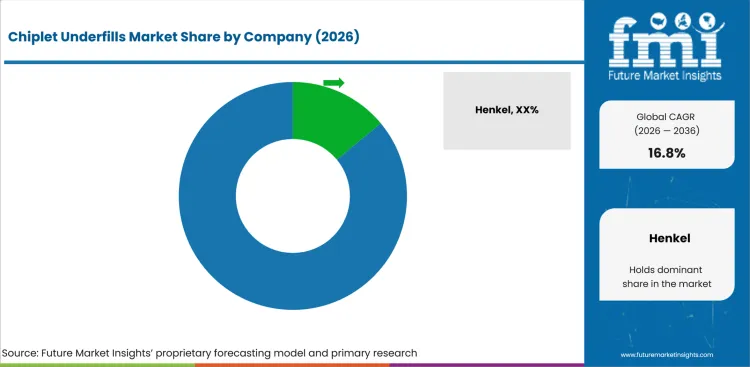
Henkel, NAMICS, Panasonic Industry, Shin-Etsu Chemical, and Resonac lead direct formulation relevance, while Kyocera, MacDermid Alpha, Master Bond, and Dow compete in adjacent packaging material positions.
- Established material suppliers hold an advantage through package-level testing, low-void flow data, and global technical service.
- Specialist companies win in custom applications where resin tuning and short feedback cycles help package engineers manage stress.
- Molded underfill suppliers gain attention where one-step gap filling and perimeter encapsulation improve assembly flow.
- Direct technical support matters more than retail channel scale because OSAT and IDM approvals decide most advanced package material choices.
Competition in chiplet underfills is defined by package risk more than catalog breadth. Henkel’s April 2024 Loctite Eccobond UF 9000AE evidence is important because it targets large-body AI and HPC packages and showed faster capillary flow during internal testing. This favors companies that can support large-die testing and customer-specific dispensing profiles.
Application support is the second competitive divide. NAMICS received a June 2024 technology award for practical application of Liquid Compression Mold Underfill, and the technology supports a one-step approach to gap filling and encapsulation. Buyers compare capillary and molded routes by process flow, package bow, and equipment fit.
Established material suppliers hold an advantage through long qualification history and customer trust. Panasonic Industry, Shin-Etsu Chemical, Resonac, MacDermid Alpha, Kyocera, Master Bond, and Dow influence buyer comparisons around epoxy systems, silicone-modified materials, and package reliability. Supplier credibility also intersects with semiconductor fabrication materials market outlook as package lines tighten contamination control.
How do top chiplet underfills companies compare?
Henkel and NAMICS score strongest on large-body flow evidence while Japanese material suppliers hold deep formulation advantages.
| Company | Relevance to Market Title | Large-Body Flow Validation | Warpage and CTE Control | OSAT / IDM Qualification Support | Geographic Footprint |
|---|---|---|---|---|---|
| Henkel | Very High | Very Strong | Strong | Very Strong | Global |
| NAMICS | Very High | Very Strong | Very Strong | Strong | Japan and global |
| Panasonic Industry | High | Strong | Strong | Strong | Asia and global |
| Shin-Etsu Chemical | High | Strong | Very Strong | Moderate | Japan and global |
| Resonac | High | Strong | Strong | Strong | Japan and global |
| Kyocera | Moderate to High | Moderate | Strong | Moderate | Japan and global |
| MacDermid Alpha | Moderate to High | Moderate | Moderate | Strong | Global |
| Master Bond | Moderate | Moderate | Moderate | Moderate | North America and global |
| Dow | Moderate | Moderate | Strong | Moderate | Global |
Source: Future Market Insights competitive analysis, 2026.
Who are the key players in the chiplet underfills market?
Henkel, NAMICS, Panasonic Industry, Shin-Etsu Chemical and Resonac are listed with Kyocera and MacDermid Alpha among other suppliers.
Key global companies leading the chiplet underfills market include:
- Henkel
- NAMICS
- Panasonic Industry
- Shin-Etsu Chemical
- Resonac
- Kyocera
- MacDermid Alpha
- Master Bond
- Dow
Key Developments in Chiplet Underfills Market
- In April 2025, TSMC stated that 9.5 reticle size CoWoS volume production is planned for 2027 and can integrate 12 HBM stacks or more in a package.
- In October 2025, Amkor Technology broke ground on its Peoria, Arizona semiconductor packaging and test facility with over 750,000 square feet of planned cleanroom manufacturing space.
- In April 2026, Resonac launched a United States R&D center dedicated to next-generation semiconductor packaging technologies and US-JOINT consortium collaboration.
Key Players in the Chiplet Underfills Market
Formulation Leaders
- Henkel
- NAMICS
- Panasonic Industry
- Shin-Etsu Chemical
- Resonac
Advanced Packaging Material Specialists
- Kyocera
- MacDermid Alpha
Adjacent Reliability Suppliers
- Master Bond
- Dow
Chiplet Underfills Market - Report Scope
| Parameter | Details |
|---|---|
| Forecast period | 2026 to 2036 |
| Historical period | 2021 to 2025 |
| Quantitative unit | Revenue in USD million |
| By underfill type | Capillary Underfills, No-Flow Underfills, Molded Underfills, Corner-Bond Underfills |
| By package type | 2.5D / Interposer Packages, 3D-IC Packages, Fan-Out Packages, Chiplet Substrates |
| By chemistry | Epoxy-based, Silicone-modified Epoxy, Hybrid / Other |
| By end use | AI / HPC, Networking, Consumer Electronics, Automotive Electronics |
| By sales channel | Direct to OSAT / IDM, Distributors |
| Regions covered | North America, Latin America, Europe, East Asia, South Asia and Pacific, Middle East and Africa |
| Countries covered | China, South Korea, United States, Japan, India, Germany, France, United Kingdom |
| Key companies profiled | Henkel, NAMICS, Panasonic Industry, Shin-Etsu Chemical, Resonac, Kyocera, MacDermid Alpha, Master Bond, Dow |
| Approach | Bottom-up product-boundary approach using package format demand, underfill consumption, chemistry pricing, qualification route, and country-level advanced packaging readiness |
Source: Future Market Insights, 2026.
Chiplet Underfills Market - Scope & Definition
| Attribute | Detail |
|---|---|
| Market Definition | Polymer underfill materials used to fill and reinforce gaps between chiplets, interposers, substrates, solder bumps, micro-bumps, and package structures inside advanced semiconductor assemblies |
| Functions Covered | Solder joint protection, stress relief, void control, moisture protection, thermal cycling support, die-edge reinforcement |
| Applications Covered | Capillary underfill, no-flow underfill, molded underfill, and corner-bond underfill uses in chiplet and advanced package builds |
| End-Use Industries | Semiconductor packaging, AI hardware, high-performance computing, networking electronics, consumer electronics, automotive electronics |
| Grades Covered | Epoxy-based, silicone-modified epoxy, and hybrid or other underfill chemistries used in package-level reliability applications |
| Inclusions | Commercial chiplet underfills used across package types, underfill formats, chemistries, end uses, direct OSAT / IDM channels, and distributor supply routes |
| Exclusions | General PCB potting compounds, conformal coatings, board-level rework underfills, thermal interface materials, lid attach adhesives, die attach films, solder fluxes, and non-chiplet encapsulants |
Chiplet Underfills Market - Research Methodology
| Method | Description |
|---|---|
| Primary Research | FMI analyst interviews with semiconductor packaging material buyers, OSAT sourcing teams, IDM package engineers, distributor specialists, and package reliability specialists across key markets |
| Desk Research | Review of official company material portfolios, government semiconductor programs, standards bodies, packaging technology releases, and trade association updates related to chiplet underfills |
| Market Sizing & Forecasting | Bottom-up product-boundary approach using package volumes, underfill consumption per package, chemistry pricing, channel qualification patterns, and country-level advanced packaging readiness |
| Data Validation | Cross-verification using advanced packaging investments, underfill product evidence, country semiconductor capacity signals, supplier portfolios, and package format adoption checks |
Chiplet Underfills Market Breakdown by Underfill Type, Package Type, Chemistry, End Use, Sales Channel, and Region
Chiplet Underfills Market Segmented by Underfill Type
- Capillary Underfills
- No-Flow Underfills
- Molded Underfills
- Corner-Bond Underfills
Chiplet Underfills Market Segmented by Package Type
- 2.5D / Interposer Packages
- 3D-IC Packages
- Fan-Out Packages
- Chiplet Substrates
Chiplet Underfills Market Segmented by Chemistry
- Epoxy-based
- Silicone-modified Epoxy
- Hybrid / Other
Chiplet Underfills Market Segmented by End Use
- AI / HPC
- Networking
- Consumer Electronics
- Automotive Electronics
Chiplet Underfills Market Segmented by Sales Channel
- Direct to OSAT / IDM
- Distributors
Chiplet Underfills Market by Region
- North America
- Latin America
- Europe
- East Asia
- South Asia and Pacific
- Middle East and Africa
Research Sources and Bibliography
- Action Group on Semiconductors, Department for Science, Innovation and Technology. (2026, June 8). UK semiconductor sectoral analysis.
- Amkor Technology. (2025, October 6). Amkor Technology breaks ground on landmark USA semiconductor packaging facility.
- CEA-Leti. (2025, May). LID World Summit 2025 at-a-glance.
- Department for Science, Innovation and Technology. (2025, September 24). New £10 million fund to support UK businesses to deliver next generation of semiconductors.
- European Commission. (2025, February 19). Commission approves €920 million German State aid measure to support Infineon in setting up a new semiconductor manufacturing facility.
- European Commission. (2025). European Chips Act.
- Federal Statistical Office of Germany. (2026, June 19). Producer prices in May 2026: +2.2% on May 2025.
- Henkel. (2024, April 5). Henkel semiconductor capillary underfill enables complex AI and HPC large body advanced packaging designs.
- Innovate UK. (2024, September 27). £11.5m to improve semiconductor manufacturing and supply chains.
- JEDEC Solid State Technology Association. (2025, April 16). JEDEC and industry leaders collaborate to release JESD270-4 HBM4 standard.
- Ministry of Economy, Trade and Industry. (2025, June 3). Reference materials for the fourth report of the Committee on New Direction of Economic and Industrial Policies.
- Ministry of Economy, Trade and Industry. (2025, June 3). Industrial structure in 2040 led by growth investment.
- Ministry of Science and ICT. (2024, January 15). Government to establish the world’s largest and most advanced mega semiconductor cluster.
- NAMICS Corporation. (2024, June 18). Received the Technology Award from the Japan Institute of Electronics Packaging.
- National Institute of Standards and Technology. (2025, January 3). USA Department of Commerce awards Semiconductor Research Corporation Manufacturing Consortium Corporation USD 285 million.
- National Institute of Standards and Technology. (2025, January 16). USA Department of Commerce announces USD 1.4 billion in final awards to support next-generation advanced packaging.
- National Institute of Standards and Technology. (2025). Arizona State University.
- Press Information Bureau. (2026, February 1). Budget 2026-27 announces the launch of India Semiconductor Mission 2.0.
- Press Information Bureau. (2026, February 7). India Semiconductor Mission 2.0.
- Resonac Holdings Corporation. (2026, April 20). Resonac launches R&D center for next-generation semiconductor packaging technologies in the United States.
- SEMI. (2025, January 7). Eighteen new semiconductor fabs to start construction in 2025.
- SEMI. (2025, October 8). SEMI reports global 300mm fab equipment spending expected to total USD 374 billion over next three years.
- Taiwan Semiconductor Manufacturing Company. (2025, April 24). TSMC unveils next-generation A14 process at North America Technology Symposium.
- The State Council of the People’s Republic of China. (2026, January 30). China’s electronic information manufacturing sector posts stable expansion in 2025.
- UCIe Consortium. (2025, August 5). UCIe Consortium releases 3.0 specification with 64 GT/s performance and enhanced manageability.
- UCIe Consortium. (2025, September 18). The UCIe 3.0 specification: Doubling bandwidth, new use cases, and enhanced manageability for scalable SiP architectures.
This bibliography is provided for reader reference and is not exhaustive. The full report contains the complete reference list and detailed citations.
This Report Answers
- Market size estimates for 2026 and forecasts through 2036 for the chiplet underfills market.
- Insights across regional and country-level markets for package-level underfill applications.
- Analysis of demand drivers, package geometry changes, HBM integration, and qualification barriers.
- Evaluation of underfill types, package formats, chemistries, end uses, and sales channels.
- Assessment of advanced packaging programs, standards activity, and material validation routes.
- Identification of opportunities across capillary, molded, and low-stress underfill chemistries.
- Evaluation of supply chain dynamics, product innovation trends, and direct qualification structures.
- Country-level growth analysis covering China, South Korea, the United States, Japan, India, Germany, France, and the United Kingdom.
- Assessment of the competitive landscape, including leading chiplet underfill suppliers and other market participants.
- Analysis of package reliability trends, material qualification patterns, and emerging growth opportunities.
- Regional outlooks across North America, Europe, East Asia, South Asia and Pacific, Latin America, and Middle East and Africa.
- Delivery of market data, forecasts, and supporting analysis in PDF and Excel formats.
Frequently Asked Questions
What is the growth prospect for chiplet underfills?
Demand for chiplet underfills is expected to rise at a considerable pace as AI, HPC, and HBM package formats scale.
Which companies are expected to shape the chiplet underfills market?
Henkel, NAMICS, Panasonic Industry, Shin-Etsu Chemical, Resonac, Kyocera, MacDermid Alpha, Master Bond, and Dow are expected to shape supplier competition.
Why are leading material suppliers investing in chiplet underfills?
Leading material suppliers are investing in chiplet underfills because large package bodies require better flow, lower voiding, and tighter warpage control.
Why are OSAT and IDM channels important in the chiplet underfills market?
OSAT and IDM channels support controlled qualification and responsible material approval across advanced semiconductor package builds.
Which product formats are gaining attention in chiplet underfills?
Capillary underfills and molded underfills are gaining attention as advanced packages require different flow and encapsulation approaches.
How do standards influence chiplet underfill demand?
Chiplet interconnect standards influence demand by encouraging more multi-die package designs that need reliable underfill protection.
Why is packaging geometry important for chiplet underfills?
Packaging geometry is important because die size, gap height, bump pitch, and interposer area determine underfill flow and stress behavior.
What role does HBM play in chiplet underfill adoption?
HBM raises underfill adoption by placing memory and logic interfaces under higher thermal-mechanical load inside AI packages.
How do country programs support chiplet underfills?
Country programs support chiplet underfills by funding packaging pilots, materials research, and semiconductor manufacturing ecosystems.
What limits faster chiplet underfill supplier switching?
Faster supplier switching is limited by package-specific qualification, rework difficulty, and the cost of failure in high-value assemblies.
Preview the report firsthand - request a free sample
Get SampleGet the brochure for pricing and purchase details.
Get PDFTable of Content
- Executive Summary
- Global Market Outlook
- Demand-side Trends
- Supply-side Trends
- Technology Roadmap Analysis
- Analysis and Recommendations
- Market Overview
- Market Coverage / Taxonomy
- Market Definition / Scope / Limitations
- Research Methodology
- Chapter Orientation
- Analytical Lens and Working Hypotheses
- Market Structure, Signals, and Trend Drivers
- Benchmarking and Cross-market Comparability
- Market Sizing, Forecasting, and Opportunity Mapping
- Research Design and Evidence Framework
- Desk Research Programme (Secondary Evidence)
- Company Annual and Sustainability Reports
- Peer-reviewed Journals and Academic Literature
- Corporate Websites, Product Literature, and Technical Notes
- Earnings Decks and Investor Briefings
- Statutory Filings and Regulatory Disclosures
- Technical White Papers and Standards Notes
- Trade Journals, Industry Magazines, and Analyst Briefs
- Conference Proceedings, Webinars, and Seminar Materials
- Government Statistics Portals and Public Data Releases
- Press Releases and Reputable Media Coverage
- Specialist Newsletters and Curated Briefings
- Sector Databases and Reference Repositories
- FMI Internal Proprietary Databases and Historical Market Datasets
- Subscription Datasets and Paid Sources
- Social Channels, Communities, and Digital Listening Inputs
- Additional Desk Sources
- Expert Input and Fieldwork (Primary Evidence)
- Primary Modes
- Qualitative Interviews and Expert Elicitation
- Quantitative Surveys and Structured Data Capture
- Blended Approach
- Why Primary Evidence is Used
- Field Techniques
- Interviews
- Surveys
- Focus Groups
- Observational and In-context Research
- Social and Community Interactions
- Stakeholder Universe Engaged
- C-suite Leaders
- Board Members
- Presidents and Vice Presidents
- R&D and Innovation Heads
- Technical Specialists
- Domain Subject-matter Experts
- Scientists
- Physicians and Other Healthcare Professionals
- Governance, Ethics, and Data Stewardship
- Research Ethics
- Data Integrity and Handling
- Primary Modes
- Tooling, Models, and Reference Databases
- Desk Research Programme (Secondary Evidence)
- Data Engineering and Model Build
- Data Acquisition and Ingestion
- Cleaning, Normalisation, and Verification
- Synthesis, Triangulation, and Analysis
- Quality Assurance and Audit Trail
- Market Background
- Market Dynamics
- Drivers
- Restraints
- Opportunity
- Trends
- Scenario Forecast
- Demand in Optimistic Scenario
- Demand in Likely Scenario
- Demand in Conservative Scenario
- Opportunity Map Analysis
- Product Life Cycle Analysis
- Supply Chain Analysis
- Investment Feasibility Matrix
- Value Chain Analysis
- PESTLE and Porter’s Analysis
- Regulatory Landscape
- Regional Parent Market Outlook
- Production and Consumption Statistics
- Import and Export Statistics
- Market Dynamics
- Global Market Analysis 2021 to 2025 and Forecast, 2026 to 2036
- Historical Market Size Value (USD Million) Analysis, 2021 to 2025
- Current and Future Market Size Value (USD Million) Projections, 2026 to 2036
- Y-o-Y Growth Trend Analysis
- Absolute $ Opportunity Analysis
- Global Market Pricing Analysis 2021 to 2025 and Forecast 2026 to 2036
- Global Market Analysis 2021 to 2025 and Forecast 2026 to 2036, By Underfill Type
- Introduction / Key Findings
- Historical Market Size Value (USD Million) Analysis By Underfill Type , 2021 to 2025
- Current and Future Market Size Value (USD Million) Analysis and Forecast By Underfill Type , 2026 to 2036
- Capillary Underfills
- No-Flow Underfills
- Molded Underfills
- Capillary Underfills
- Y-o-Y Growth Trend Analysis By Underfill Type , 2021 to 2025
- Absolute $ Opportunity Analysis By Underfill Type , 2026 to 2036
- Global Market Analysis 2021 to 2025 and Forecast 2026 to 2036, By Package Type
- Introduction / Key Findings
- Historical Market Size Value (USD Million) Analysis By Package Type, 2021 to 2025
- Current and Future Market Size Value (USD Million) Analysis and Forecast By Package Type, 2026 to 2036
- 2.5D / Interposer Packages
- 3D-IC Packages
- Chiplet Substrates
- 2.5D / Interposer Packages
- Y-o-Y Growth Trend Analysis By Package Type, 2021 to 2025
- Absolute $ Opportunity Analysis By Package Type, 2026 to 2036
- Global Market Analysis 2021 to 2025 and Forecast 2026 to 2036, By Chemistry
- Introduction / Key Findings
- Historical Market Size Value (USD Million) Analysis By Chemistry, 2021 to 2025
- Current and Future Market Size Value (USD Million) Analysis and Forecast By Chemistry, 2026 to 2036
- Epoxy-based
- Silicone-modified Epoxy
- Hybrid / Other
- Epoxy-based
- Y-o-Y Growth Trend Analysis By Chemistry, 2021 to 2025
- Absolute $ Opportunity Analysis By Chemistry, 2026 to 2036
- Global Market Analysis 2021 to 2025 and Forecast 2026 to 2036, By End Use
- Introduction / Key Findings
- Historical Market Size Value (USD Million) Analysis By End Use, 2021 to 2025
- Current and Future Market Size Value (USD Million) Analysis and Forecast By End Use, 2026 to 2036
- AI / HPC
- Networking
- Consumer Electronics
- AI / HPC
- Y-o-Y Growth Trend Analysis By End Use, 2021 to 2025
- Absolute $ Opportunity Analysis By End Use, 2026 to 2036
- Global Market Analysis 2021 to 2025 and Forecast 2026 to 2036, By Sales Channel
- Introduction / Key Findings
- Historical Market Size Value (USD Million) Analysis By Sales Channel, 2021 to 2025
- Current and Future Market Size Value (USD Million) Analysis and Forecast By Sales Channel, 2026 to 2036
- Direct to OSAT / IDM
- Distributors
- Direct to OSAT / IDM
- Y-o-Y Growth Trend Analysis By Sales Channel, 2021 to 2025
- Absolute $ Opportunity Analysis By Sales Channel, 2026 to 2036
- Global Market Analysis 2021 to 2025 and Forecast 2026 to 2036, By Region
- Introduction
- Historical Market Size Value (USD Million) Analysis By Region, 2021 to 2025
- Current Market Size Value (USD Million) Analysis and Forecast By Region, 2026 to 2036
- North America
- Latin America
- Western Europe
- Eastern Europe
- East Asia
- South Asia and Pacific
- Middle East & Africa
- Market Attractiveness Analysis By Region
- North America Market Analysis 2021 to 2025 and Forecast 2026 to 2036, By Country
- Historical Market Size Value (USD Million) Trend Analysis By Market Taxonomy, 2021 to 2025
- Market Size Value (USD Million) Forecast By Market Taxonomy, 2026 to 2036
- By Country
- USA
- Canada
- Mexico
- By Underfill Type
- By Package Type
- By Chemistry
- By End Use
- By Sales Channel
- By Country
- Market Attractiveness Analysis
- By Country
- By Underfill Type
- By Package Type
- By Chemistry
- By End Use
- By Sales Channel
- Key Takeaways
- Latin America Market Analysis 2021 to 2025 and Forecast 2026 to 2036, By Country
- Historical Market Size Value (USD Million) Trend Analysis By Market Taxonomy, 2021 to 2025
- Market Size Value (USD Million) Forecast By Market Taxonomy, 2026 to 2036
- By Country
- Brazil
- Chile
- Rest of Latin America
- By Underfill Type
- By Package Type
- By Chemistry
- By End Use
- By Sales Channel
- By Country
- Market Attractiveness Analysis
- By Country
- By Underfill Type
- By Package Type
- By Chemistry
- By End Use
- By Sales Channel
- Key Takeaways
- Western Europe Market Analysis 2021 to 2025 and Forecast 2026 to 2036, By Country
- Historical Market Size Value (USD Million) Trend Analysis By Market Taxonomy, 2021 to 2025
- Market Size Value (USD Million) Forecast By Market Taxonomy, 2026 to 2036
- By Country
- Germany
- UK
- Italy
- Spain
- France
- Nordic
- BENELUX
- Rest of Western Europe
- By Underfill Type
- By Package Type
- By Chemistry
- By End Use
- By Sales Channel
- By Country
- Market Attractiveness Analysis
- By Country
- By Underfill Type
- By Package Type
- By Chemistry
- By End Use
- By Sales Channel
- Key Takeaways
- Eastern Europe Market Analysis 2021 to 2025 and Forecast 2026 to 2036, By Country
- Historical Market Size Value (USD Million) Trend Analysis By Market Taxonomy, 2021 to 2025
- Market Size Value (USD Million) Forecast By Market Taxonomy, 2026 to 2036
- By Country
- Russia
- Poland
- Hungary
- Balkan & Baltic
- Rest of Eastern Europe
- By Underfill Type
- By Package Type
- By Chemistry
- By End Use
- By Sales Channel
- By Country
- Market Attractiveness Analysis
- By Country
- By Underfill Type
- By Package Type
- By Chemistry
- By End Use
- By Sales Channel
- Key Takeaways
- East Asia Market Analysis 2021 to 2025 and Forecast 2026 to 2036, By Country
- Historical Market Size Value (USD Million) Trend Analysis By Market Taxonomy, 2021 to 2025
- Market Size Value (USD Million) Forecast By Market Taxonomy, 2026 to 2036
- By Country
- China
- Japan
- South Korea
- By Underfill Type
- By Package Type
- By Chemistry
- By End Use
- By Sales Channel
- By Country
- Market Attractiveness Analysis
- By Country
- By Underfill Type
- By Package Type
- By Chemistry
- By End Use
- By Sales Channel
- Key Takeaways
- South Asia and Pacific Market Analysis 2021 to 2025 and Forecast 2026 to 2036, By Country
- Historical Market Size Value (USD Million) Trend Analysis By Market Taxonomy, 2021 to 2025
- Market Size Value (USD Million) Forecast By Market Taxonomy, 2026 to 2036
- By Country
- India
- ASEAN
- Australia & New Zealand
- Rest of South Asia and Pacific
- By Underfill Type
- By Package Type
- By Chemistry
- By End Use
- By Sales Channel
- By Country
- Market Attractiveness Analysis
- By Country
- By Underfill Type
- By Package Type
- By Chemistry
- By End Use
- By Sales Channel
- Key Takeaways
- Middle East & Africa Market Analysis 2021 to 2025 and Forecast 2026 to 2036, By Country
- Historical Market Size Value (USD Million) Trend Analysis By Market Taxonomy, 2021 to 2025
- Market Size Value (USD Million) Forecast By Market Taxonomy, 2026 to 2036
- By Country
- Kingdom of Saudi Arabia
- Other GCC Countries
- Turkiye
- South Africa
- Other African Union
- Rest of Middle East & Africa
- By Underfill Type
- By Package Type
- By Chemistry
- By End Use
- By Sales Channel
- By Country
- Market Attractiveness Analysis
- By Country
- By Underfill Type
- By Package Type
- By Chemistry
- By End Use
- By Sales Channel
- Key Takeaways
- Key Countries Market Analysis
- USA
- Pricing Analysis
- Market Share Analysis, 2025
- By Underfill Type
- By Package Type
- By Chemistry
- By End Use
- By Sales Channel
- Canada
- Pricing Analysis
- Market Share Analysis, 2025
- By Underfill Type
- By Package Type
- By Chemistry
- By End Use
- By Sales Channel
- Mexico
- Pricing Analysis
- Market Share Analysis, 2025
- By Underfill Type
- By Package Type
- By Chemistry
- By End Use
- By Sales Channel
- Brazil
- Pricing Analysis
- Market Share Analysis, 2025
- By Underfill Type
- By Package Type
- By Chemistry
- By End Use
- By Sales Channel
- Chile
- Pricing Analysis
- Market Share Analysis, 2025
- By Underfill Type
- By Package Type
- By Chemistry
- By End Use
- By Sales Channel
- Germany
- Pricing Analysis
- Market Share Analysis, 2025
- By Underfill Type
- By Package Type
- By Chemistry
- By End Use
- By Sales Channel
- UK
- Pricing Analysis
- Market Share Analysis, 2025
- By Underfill Type
- By Package Type
- By Chemistry
- By End Use
- By Sales Channel
- Italy
- Pricing Analysis
- Market Share Analysis, 2025
- By Underfill Type
- By Package Type
- By Chemistry
- By End Use
- By Sales Channel
- Spain
- Pricing Analysis
- Market Share Analysis, 2025
- By Underfill Type
- By Package Type
- By Chemistry
- By End Use
- By Sales Channel
- France
- Pricing Analysis
- Market Share Analysis, 2025
- By Underfill Type
- By Package Type
- By Chemistry
- By End Use
- By Sales Channel
- India
- Pricing Analysis
- Market Share Analysis, 2025
- By Underfill Type
- By Package Type
- By Chemistry
- By End Use
- By Sales Channel
- ASEAN
- Pricing Analysis
- Market Share Analysis, 2025
- By Underfill Type
- By Package Type
- By Chemistry
- By End Use
- By Sales Channel
- Australia & New Zealand
- Pricing Analysis
- Market Share Analysis, 2025
- By Underfill Type
- By Package Type
- By Chemistry
- By End Use
- By Sales Channel
- China
- Pricing Analysis
- Market Share Analysis, 2025
- By Underfill Type
- By Package Type
- By Chemistry
- By End Use
- By Sales Channel
- Japan
- Pricing Analysis
- Market Share Analysis, 2025
- By Underfill Type
- By Package Type
- By Chemistry
- By End Use
- By Sales Channel
- South Korea
- Pricing Analysis
- Market Share Analysis, 2025
- By Underfill Type
- By Package Type
- By Chemistry
- By End Use
- By Sales Channel
- Russia
- Pricing Analysis
- Market Share Analysis, 2025
- By Underfill Type
- By Package Type
- By Chemistry
- By End Use
- By Sales Channel
- Poland
- Pricing Analysis
- Market Share Analysis, 2025
- By Underfill Type
- By Package Type
- By Chemistry
- By End Use
- By Sales Channel
- Hungary
- Pricing Analysis
- Market Share Analysis, 2025
- By Underfill Type
- By Package Type
- By Chemistry
- By End Use
- By Sales Channel
- Kingdom of Saudi Arabia
- Pricing Analysis
- Market Share Analysis, 2025
- By Underfill Type
- By Package Type
- By Chemistry
- By End Use
- By Sales Channel
- Turkiye
- Pricing Analysis
- Market Share Analysis, 2025
- By Underfill Type
- By Package Type
- By Chemistry
- By End Use
- By Sales Channel
- South Africa
- Pricing Analysis
- Market Share Analysis, 2025
- By Underfill Type
- By Package Type
- By Chemistry
- By End Use
- By Sales Channel
- USA
- Market Structure Analysis
- Competition Dashboard
- Competition Benchmarking
- Market Share Analysis of Top Players
- By Regional
- By Underfill Type
- By Package Type
- By Chemistry
- By End Use
- By Sales Channel
- Competition Analysis
- Competition Deep Dive
- Henkel
- Overview
- Product Portfolio
- Profitability by Market Segments (Product/Age /Sales Channel/Region)
- Sales Footprint
- Strategy Overview
- Marketing Strategy
- Product Strategy
- Channel Strategy
- NAMICS
- Panasonic Industry
- Shin-Etsu Chemical
- Resonac
- Kyocera
- MacDermid Alpha
- Henkel
- Competition Deep Dive
- Assumptions & Acronyms Used


