

- Industry Size (2026)
- USD 360.0 Mn
- Forecast (2036)
- USD 657 Mn
- CAGR (2026 to 2036)
- 6.20%
Chlorophyll Concentration Meter Market Forecast and Outlook 2026 to 2036
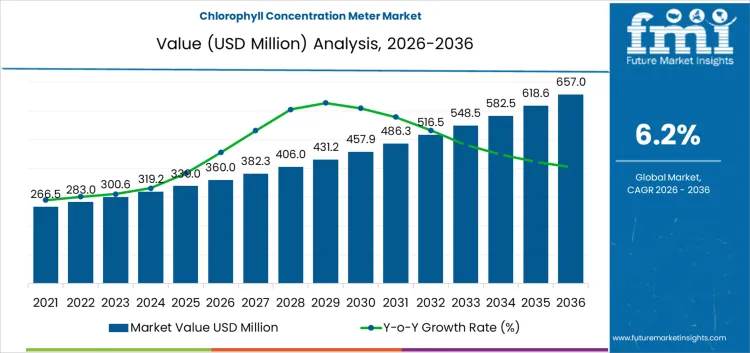
The chlorophyll concentration meter market is likely to be valued at USD 360.0 million in 2026, projected to reach USD 657 million by 2036, expanding at a 6.2% CAGR over the forecast period. Procurement outcomes are shaped less by unit price and more by confidence in measurement repeatability across crops, seasons, and operators, so purchasing is often anchored to validated models that agronomy teams already trust. Buyer risk aversion is typically reinforced by the cost of wrong nitrogen decisions-yield penalties, input waste, and credibility loss making accuracy claims, calibration stability, and service support central to vendor selection.
Vendor lock-in is created when meters are tied to proprietary data apps, licensing, or farm-management integrations that become embedded in advisory workflows and reporting. Switching costs rise further when historical SPAD baselines, decision thresholds, and training materials are built around a specific device family, reducing willingness to change even when lower-cost alternatives exist. Between 2026 and 2036, value capture concentrates with suppliers that bundle hardware with software analytics, agronomy protocols, and multi-site support contracts, while commodity handheld meters face margin pressure from price-led competition and limited differentiation.
Quick Stats for Chlorophyll Concentration Meter Market
- Chlorophyll Concentration Meter Market Value (2026): USD 360.0 Million
- Chlorophyll Concentration Meter Market Forecast Value (2036): USD 657 Million
- Chlorophyll Concentration Meter Market Forecast CAGR 2026 to 2036: 6.20%
- Leading Product Type in Chlorophyll Concentration Meter Market: Handheld SPAD Meters
- Leading End Use in Chlorophyll Concentration Meter Market: Precision Agriculture
- Key Growth Regions in Chlorophyll Concentration Meter Market: Asia Pacific, Latin America, Middle East & Africa
- Top Key Players in Chlorophyll Concentration Meter Market: Konica Minolta, Spectrum Technologies, Apogee Instruments, METER Group, Hansatech Instruments, CID Bio-Science, Opti-Sciences Inc., Force-A (Multiplex fluorometers), Delta-T Devices, Regional OEMs
Chlorophyll Concentration Meter Market Key Takeaways
| Metric | Value |
|---|---|
| Industry Value (2026) | USD 360.0 Million |
| Forecast Value (2036) | USD 657 Million |
| Forecast CAGR 2026 to 2036 | 6.20% |
How Is the Global Chlorophyll Concentration Meter Market Advancing?
The global chlorophyll concentration meter market is advancing steadily, driven by increasing adoption of precision agriculture practices and the need for real-time crop health assessment. Chlorophyll concentration meters are widely used to measure chlorophyll levels in plant leaves, helping farmers and agronomists evaluate nitrogen status, photosynthetic activity, and overall plant vigor without destructive sampling.
A key driver supporting market growth is the growing focus on optimizing fertilizer application and improving crop yield efficiency. By providing immediate feedback on plant nutrient status, chlorophyll meters enable targeted fertilizer management, reducing excess input use and improving cost efficiency. These devices are increasingly adopted across cereal crops, horticulture, and plantation farming, as well as in research and greenhouse applications.
Technological advancements are further strengthening market adoption. Improvements in sensor accuracy, portability, and digital data integration are enhancing usability and reliability in field conditions. Integration with mobile applications and farm management software allows users to store, analyze, and compare crop data over time. As agriculture continues to adopt data-driven decision-making tools to improve productivity and input efficiency, the chlorophyll concentration meter market is expected to maintain consistent growth over the forecast period.
What Is the Segment-Wise Overview of the Chlorophyll Concentration Meter Market?
The chlorophyll concentration meter market is driven by field-level crop diagnostics and data-led farming practices. Handheld SPAD meters lead with a 56% share, reflecting strong preference for portable, non-destructive tools that provide instant chlorophyll and nitrogen status readings. Their ease of use and affordability support widespread adoption across farms and research plots. On the end-use side, precision agriculture accounts for 44% of demand, as growers increasingly rely on real-time plant health data to optimize fertilizer application and improve yield outcomes.
Why Do Handheld SPAD Meters Lead the Chlorophyll Concentration Meter Market?
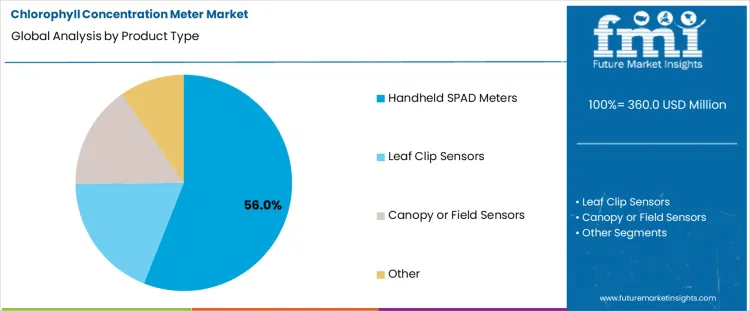
Handheld SPAD meters account for 56% of the chlorophyll concentration meter market due to their portability, ease of use, and rapid measurement capability. These devices enable instant, non-destructive assessment of leaf chlorophyll content, allowing users to make real-time decisions in the field. Farmers, agronomists, and researchers prefer handheld SPAD meters because they provide consistent readings without the need for complex calibration or laboratory analysis. Their compact design supports frequent measurements across large plots, improving nitrogen management and crop health monitoring. Handheld meters are also cost-effective compared to fixed or canopy-based systems, making them accessible to a broader user base. As precision farming practices expand and on-site decision-making becomes more critical, handheld SPAD meters continue to dominate product adoption.
Why Does Precision Agriculture Dominate End-Use Demand in the Chlorophyll Concentration Meter Market?
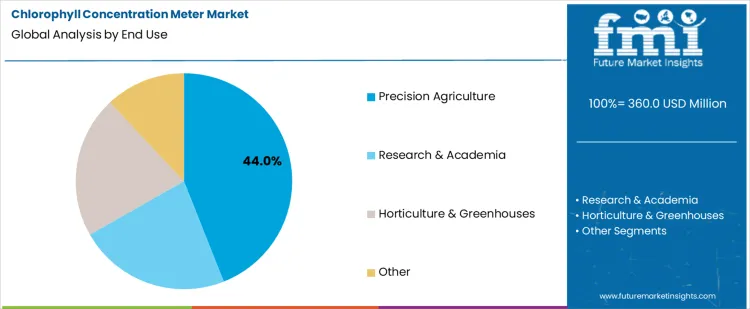
Precision agriculture represents 44% of total end-use demand, making it the largest application segment in the chlorophyll concentration meter market. Precision farming relies on accurate, data-driven insights to optimize fertilizer application, improve crop yields, and reduce input costs. Chlorophyll concentration meters play a critical role by helping growers assess plant nitrogen status and identify nutrient stress early. These measurements support variable-rate fertilization and targeted crop management strategies. Integration with broader precision agriculture tools, such as GPS mapping and farm management software, further enhances their value. As farmers increasingly adopt technology to improve efficiency and sustainability, precision agriculture remains the primary driver of demand for chlorophyll concentration measurement solutions.
What Are the Key Dynamics for the Chlorophyll Concentration Meter Market?
Chlorophyll meters, also known as leaf chlorophyll meters or SPAD meters, non-destructively measure chlorophyll content in plant leaves, enabling farmers and agronomists to assess nitrogen status and optimize fertilization. Key market dynamics include rising emphasis on yield improvement, enhanced crop quality, and cost-effective nutrient management. Technological improvements in sensor accuracy, portable handheld designs, and data connectivity allow real-time decision making on field nutrient applications. Expanding awareness of sustainable crop management practices and regulatory focus on reducing excess fertilizer use also support demand for chlorophyll concentration meters, as stakeholders adopt tools that improve resource efficiency.
Why Is the Chlorophyll Concentration Meter Market Growing?
The chlorophyll concentration meter market is growing as farmers and crop consultants increasingly prioritize data-driven crop monitoring to enhance productivity and reduce input costs. Growing complexity of agronomic decision making, driven by variable soil fertility and climate patterns, encourages use of chlorophyll meters to guide precise nutrient interventions. Advances in user interfaces, battery life, and connectivity to farm management software enhance usability for field personnel and support integration with digital agronomy platforms. Increased deployment of precision agriculture technologies such as drones and IoT sensors helps create an ecosystem where chlorophyll meters become a key component for monitoring plant health.
How Are the Key Drivers Shaping the Chlorophyll Concentration Meter Market?
Key drivers shaping the chlorophyll concentration meter market include accelerated adoption of precision agriculture solutions that improve productivity and sustainability by tailoring inputs to crop needs. Growth in agritech investments and digitization of farm operations drive demand for portable analytical tools that deliver actionable insights without destructive sampling. Integration of chlorophyll meters with comprehensive crop health monitoring systems enables synergistic use of multiple data sources, improving overall field management. Rising food demand and pressure to increase yields on limited arable land motivate farmers to adopt technologies that support plant vigor and nutrient balance.
What Is the Growth Outlook for the Chlorophyll Concentration Meter Market by Country?
| Country | CAGR (%) |
|---|---|
| India | 12.4% |
| Vietnam | 11.6% |
| Indonesia | 11.2% |
| Brazil | 10.5% |
| Mexico | 10.1% |
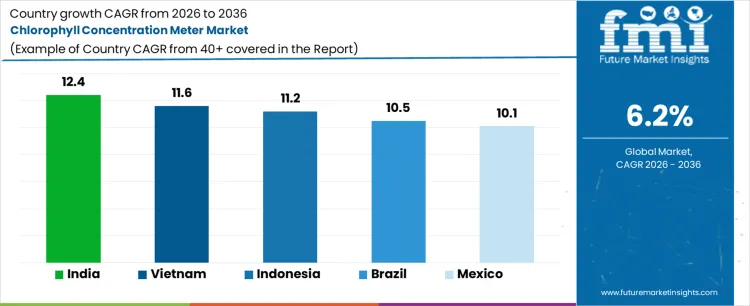
The chlorophyll concentration meter market is experiencing strong growth as farmers increasingly adopt precision agriculture tools to optimize nutrient management. India leads with a 12.4% CAGR, driven by fertilizer efficiency initiatives and modernization of farming practices. Vietnam (11.6%) and Indonesia (11.2%) follow, supported by rice-based agriculture and growing awareness of crop diagnostics. Brazil (10.5%) benefits from large-scale commercial farming and integration with precision agriculture systems, while Mexico (10.1%) shows steady growth through modernization and input cost optimization. As data-driven farming becomes more widespread, demand for chlorophyll concentration meters is expected to increase across all regions.
What Is Driving the Growth of the Chlorophyll Concentration Meter Market in India?
The chlorophyll concentration meter market in India is growing at a CAGR of 12.4%, driven by increasing adoption of precision agriculture practices and rising focus on optimizing fertilizer usage. Farmers and agronomists are increasingly using chlorophyll meters to assess crop nitrogen status, improve nutrient management, and enhance yields. Expansion of high-value crops such as rice, wheat, maize, and horticulture is supporting demand for rapid, non-destructive plant health assessment tools. Government programs promoting soil health management, balanced fertilization, and digital agriculture are further encouraging adoption. In addition, growing awareness of input cost reduction and sustainable farm productivity is influencing purchasing decisions. Availability of portable and user-friendly meters suited for field conditions supports wider uptake. As India continues to modernize agricultural practices, demand for chlorophyll concentration meters is expected to grow rapidly.
How Is the Chlorophyll Concentration Meter Market Expanding in Vietnam?
The chlorophyll concentration meter market in Vietnam is expanding at a CAGR of 11.6%, supported by increasing focus on crop productivity and nutrient efficiency. Vietnam’s rice-dominated agriculture sector is adopting chlorophyll meters to optimize nitrogen application and improve yields while reducing fertilizer waste. Expansion of export-oriented agriculture and stricter quality requirements are encouraging farmers to adopt precision monitoring tools. Government initiatives promoting modern farming techniques and sustainable crop management further support market growth. In addition, rising labor costs are driving interest in quick diagnostic tools that reduce manual crop assessment efforts. Research institutions and extension services are also promoting chlorophyll meters for field trials and advisory programs. As Vietnam continues to strengthen precision agriculture adoption, demand for chlorophyll concentration meters is expected to rise steadily.
What Is Supporting Growth of the Chlorophyll Concentration Meter Market in Indonesia?
The chlorophyll concentration meter market in Indonesia is growing at a CAGR of 11.2%, driven by increasing awareness of precision nutrient management across food and plantation crops. Farmers growing rice, maize, oil palm, and vegetables are adopting chlorophyll meters to monitor plant health and optimize fertilizer inputs. Variability in soil fertility and climate conditions makes real-time crop assessment tools particularly valuable. Government efforts to improve agricultural efficiency and reduce fertilizer subsidies are indirectly supporting adoption of nutrient monitoring devices. In addition, expansion of commercial farming and plantation agriculture is increasing demand for scalable crop monitoring solutions. Availability of rugged, portable meters suited for tropical conditions further supports uptake. As Indonesia advances toward more data-driven farming practices, demand for chlorophyll concentration meters is expected to grow consistently.
How Is the Chlorophyll Concentration Meter Market Developing in Brazil?
The chlorophyll concentration meter market in Brazil is expanding at a CAGR of 10.5%, supported by large-scale commercial agriculture and increasing use of precision farming technologies. Crop producers in soybean, maize, sugarcane, and cotton sectors are using chlorophyll meters to optimize nitrogen application and improve yield predictability. Rising input costs are encouraging adoption of tools that support efficient fertilizer management. Integration of chlorophyll meters with broader precision agriculture systems, including variable-rate application, is further enhancing their value. Research institutions and agribusiness consultants are also promoting adoption through field demonstrations and advisory services. While large farms drive early adoption, smaller producers are gradually adopting portable meters. As Brazil continues to scale precision agriculture practices, demand for chlorophyll concentration meters is expected to grow steadily.
How Is the Chlorophyll Concentration Meter Market Expanding in Mexico?
The chlorophyll concentration meter market in Mexico is growing at a CAGR of 10.1%, driven by increasing adoption of modern agronomic practices and focus on yield optimization. Farmers cultivating maize, vegetables, fruits, and export-oriented crops are adopting chlorophyll meters to improve nutrient management and crop quality. Water scarcity and rising fertilizer costs are increasing emphasis on efficient input usage, supporting demand for plant health monitoring tools. Government-supported agricultural modernization programs and extension services are also promoting awareness of precision farming technologies. In addition, growth of greenhouse and protected cultivation is increasing use of diagnostic tools for real-time crop monitoring. As Mexico continues to improve agricultural productivity and resource efficiency, demand for chlorophyll concentration meters is expected to rise steadily.
How Are Companies Competing in the Chlorophyll Concentration Meter Market?
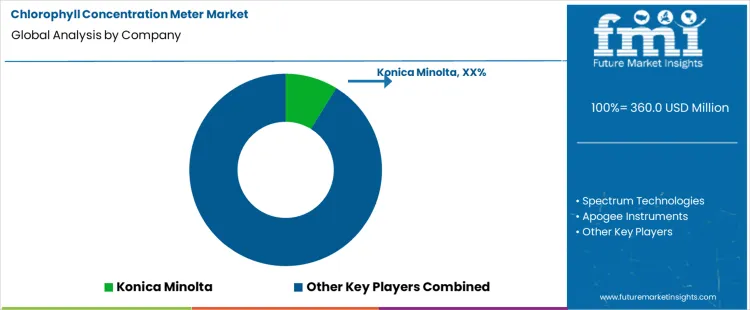
Competition in the chlorophyll concentration meter market is driven by measurement accuracy, repeatability across crop types, ease of field use, and the ability to translate chlorophyll readings into actionable agronomic insights. These instruments are widely used in precision agriculture, crop research, and plant physiology to assess plant health, nitrogen status, and photosynthetic activity. Companies compete on sensor calibration, optical measurement stability, portability, and data reliability under varying light and field conditions. Differentiation increasingly centers on digital connectivity, integration with farm management platforms, and the ability to support both research-grade and commercial farming applications.
Konica Minolta, Spectrum Technologies, Apogee Instruments, METER Group, and Hansatech Instruments lead competition through strong optical sensing expertise, validated measurement methodologies, and established use in agronomy and research. Konica Minolta differentiates with widely adopted handheld chlorophyll meters known for consistent readings and long-term calibration stability. Spectrum Technologies and Apogee focus on rugged, field-ready instruments designed for agricultural deployment. METER Group and Hansatech emphasize research-grade accuracy, offering devices suited for detailed physiological analysis and controlled experiments.
CID Bio-Science, Delta-T Devices, Opti-Sciences Inc., Force-A (Multiplex fluorometers), and regional OEMs compete through system integration, application breadth, and cost flexibility. CID Bio-Science and Delta-T target researchers with portable and versatile plant analysis tools. Topcon differentiate by embedding chlorophyll sensing into broader precision agriculture and data management ecosystems, enabling spatial analysis and decision support. Regional OEMs compete on affordability and localized support. Across the market, competitive advantage is defined by measurement reliability, usability in field conditions, data integration capability, and the ability to convert chlorophyll metrics into practical crop management decisions.
Key Players in Chlorophyll Concentration Meter Market
- Konica Minolta
- Spectrum Technologies
- Apogee Instruments
- METER Group
- Hansatech Instruments
- CID Bio-Science
- Opti-Sciences Inc.
- Force-A (Multiplex fluorometers)
- Delta-T Devices
- Regional OEMs
Scope of Report
| Attributes | Description |
|---|---|
| Quantitative Unit (2026) | USD Million |
| Product Type | Handheld SPAD Meters, Leaf Clip Sensors, Canopy or Field Sensors, Other |
| End Use | Precision Agriculture, Research & Academia, Horticulture & Greenhouses, Other |
| Regions Covered | Asia Pacific, Europe, North America, Latin America, Middle East & Africa |
| Countries Covered | China, Japan, South Korea, India, Australia & New Zealand, ASEAN, Rest of Asia Pacific, Germany, United Kingdom, France, Italy, Spain, Nordic, BENELUX, Rest of Europe, United States, Canada, Mexico, Brazil, Chile, Rest of Latin America, Kingdom of Saudi Arabia, Other GCC Countries, Turkey, South Africa, Other African Union, Rest of Middle East & Africa |
| Key Companies Profiled | Konica Minolta, Spectrum Technologies, Apogee Instruments, METER Group, Hansatech Instruments, CID Bio-Science, Opti-Sciences Inc., Force-A (Multiplex fluorometers), Delta-T Devices, Regional OEMs |
| Additional Attributes | Dollar sales by product type and end use; regional market size and forecast analysis; growth outlook across major regions; adoption trends for chlorophyll concentration measurement technologies; assessment of nutrient monitoring needs, data accuracy requirements, and demand patterns across precision farming, research institutions, and controlled-environment agriculture applications. |
Chlorophyll Concentration Meter Market by Key Segments
Product Type
- Handheld SPAD Meters
- Leaf Clip Sensors
- Canopy or Field Sensors
- Other
End Use
- Precision Agriculture
- Research & Academia
- Horticulture & Greenhouses
- Other
Region
- Asia Pacific
- China
- Japan
- South Korea
- India
- Australia & New Zealand
- ASEAN
- Rest of Asia Pacific
- Europe
- Germany
- United Kingdom
- France
- Italy
- Spain
- Nordic
- BENELUX
- Rest of Europe
- North America
- United States
- Canada
- Mexico
- Latin America
- Brazil
- Chile
- Rest of Latin America
- Middle East & Africa
- Kingdom of Saudi Arabia
- Other GCC Countries
- Turkey
- South Africa
- Other African Union
- Rest of Middle East & Africa
Bibliography
- Kulig, B., Chęcińska, K., & Wróbel, M. (2024). Comparison of chlorophyll content estimation methods in winter wheat. Journal of Water and Land Development.
- Agricultural Research Communication Centre. (2024). On-farm evaluation of leaf color chart and chlorophyll meter for nitrogen management in maize (Zea mays L.). Agricultural Science Digest.
- Cai, S., Zhao, X., & Yan, X. (2025). Towards precise nitrogen fertilizer management for sustainable agriculture. Earth Critical Zone, 2, 100026.
- European Commission, Joint Research Centre. (2023). Precision agriculture and nutrient management approaches for sustainable crop production. Publications Office of the European Union.
Frequently Asked Questions
How big is the chlorophyll concentration meter market in 2026?
The global chlorophyll concentration meter market is estimated to be valued at USD 360.0 million in 2026.
What will be the size of chlorophyll concentration meter market in 2036?
The market size for the chlorophyll concentration meter market is projected to reach USD 657.0 million by 2036.
How much will be the chlorophyll concentration meter market growth between 2026 and 2036?
The chlorophyll concentration meter market is expected to grow at a 6.2% CAGR between 2026 and 2036.
What are the key product types in the chlorophyll concentration meter market?
The key product types in chlorophyll concentration meter market are handheld spad meters, leaf clip sensors, canopy or field sensors and other.
Which end use segment to contribute significant share in the chlorophyll concentration meter market in 2026?
In terms of end use, precision agriculture segment to command 44.0% share in the chlorophyll concentration meter market in 2026.
Preview the report firsthand - request a free sample
Get SampleGet the brochure for pricing and purchase details.
Get PDFTable of Content
- Executive Summary
- Global Market Outlook
- Demand-side Trends
- Supply-side Trends
- Technology Roadmap Analysis
- Analysis and Recommendations
- Market Overview
- Market Coverage / Taxonomy
- Market Definition / Scope / Limitations
- Market Background
- Market Dynamics
- Drivers
- Restraints
- Opportunity
- Trends
- Scenario Forecast
- Demand in Optimistic Scenario
- Demand in Likely Scenario
- Demand in Conservative Scenario
- Opportunity Map Analysis
- Product Life Cycle Analysis
- Supply Chain Analysis
- Investment Feasibility Matrix
- Value Chain Analysis
- PESTLE and Porter’s Analysis
- Regulatory Landscape
- Regional Parent Market Outlook
- Production and Consumption Statistics
- Import and Export Statistics
- Market Dynamics
- Global Market Analysis 2021 to 2025 and Forecast, 2026 to 2036
- Historical Market Size Value (USD Million) Analysis, 2021 to 2025
- Current and Future Market Size Value (USD Million) Projections, 2026 to 2036
- Y-o-Y Growth Trend Analysis
- Absolute $ Opportunity Analysis
- Global Market Pricing Analysis 2021 to 2025 and Forecast 2026 to 2036
- Global Market Analysis 2021 to 2025 and Forecast 2026 to 2036, By Product Type
- Introduction / Key Findings
- Historical Market Size Value (USD Million) Analysis By Product Type , 2021 to 2025
- Current and Future Market Size Value (USD Million) Analysis and Forecast By Product Type , 2026 to 2036
- Handheld SPAD Meters
- Leaf Clip Sensors
- Canopy or Field Sensors
- Other
- Handheld SPAD Meters
- Y-o-Y Growth Trend Analysis By Product Type , 2021 to 2025
- Absolute $ Opportunity Analysis By Product Type , 2026 to 2036
- Global Market Analysis 2021 to 2025 and Forecast 2026 to 2036, By End Use
- Introduction / Key Findings
- Historical Market Size Value (USD Million) Analysis By End Use, 2021 to 2025
- Current and Future Market Size Value (USD Million) Analysis and Forecast By End Use, 2026 to 2036
- Precision Agriculture
- Research & Academia
- Horticulture & Greenhouses
- Other
- Precision Agriculture
- Y-o-Y Growth Trend Analysis By End Use, 2021 to 2025
- Absolute $ Opportunity Analysis By End Use, 2026 to 2036
- Global Market Analysis 2021 to 2025 and Forecast 2026 to 2036, By Region
- Introduction
- Historical Market Size Value (USD Million) Analysis By Region, 2021 to 2025
- Current Market Size Value (USD Million) Analysis and Forecast By Region, 2026 to 2036
- North America
- Latin America
- Western Europe
- Eastern Europe
- East Asia
- South Asia and Pacific
- Middle East & Africa
- Market Attractiveness Analysis By Region
- North America Market Analysis 2021 to 2025 and Forecast 2026 to 2036, By Country
- Historical Market Size Value (USD Million) Trend Analysis By Market Taxonomy, 2021 to 2025
- Market Size Value (USD Million) Forecast By Market Taxonomy, 2026 to 2036
- By Country
- USA
- Canada
- Mexico
- By Product Type
- By End Use
- By Country
- Market Attractiveness Analysis
- By Country
- By Product Type
- By End Use
- Key Takeaways
- Latin America Market Analysis 2021 to 2025 and Forecast 2026 to 2036, By Country
- Historical Market Size Value (USD Million) Trend Analysis By Market Taxonomy, 2021 to 2025
- Market Size Value (USD Million) Forecast By Market Taxonomy, 2026 to 2036
- By Country
- Brazil
- Chile
- Rest of Latin America
- By Product Type
- By End Use
- By Country
- Market Attractiveness Analysis
- By Country
- By Product Type
- By End Use
- Key Takeaways
- Western Europe Market Analysis 2021 to 2025 and Forecast 2026 to 2036, By Country
- Historical Market Size Value (USD Million) Trend Analysis By Market Taxonomy, 2021 to 2025
- Market Size Value (USD Million) Forecast By Market Taxonomy, 2026 to 2036
- By Country
- Germany
- UK
- Italy
- Spain
- France
- Nordic
- BENELUX
- Rest of Western Europe
- By Product Type
- By End Use
- By Country
- Market Attractiveness Analysis
- By Country
- By Product Type
- By End Use
- Key Takeaways
- Eastern Europe Market Analysis 2021 to 2025 and Forecast 2026 to 2036, By Country
- Historical Market Size Value (USD Million) Trend Analysis By Market Taxonomy, 2021 to 2025
- Market Size Value (USD Million) Forecast By Market Taxonomy, 2026 to 2036
- By Country
- Russia
- Poland
- Hungary
- Balkan & Baltic
- Rest of Eastern Europe
- By Product Type
- By End Use
- By Country
- Market Attractiveness Analysis
- By Country
- By Product Type
- By End Use
- Key Takeaways
- East Asia Market Analysis 2021 to 2025 and Forecast 2026 to 2036, By Country
- Historical Market Size Value (USD Million) Trend Analysis By Market Taxonomy, 2021 to 2025
- Market Size Value (USD Million) Forecast By Market Taxonomy, 2026 to 2036
- By Country
- China
- Japan
- South Korea
- By Product Type
- By End Use
- By Country
- Market Attractiveness Analysis
- By Country
- By Product Type
- By End Use
- Key Takeaways
- South Asia and Pacific Market Analysis 2021 to 2025 and Forecast 2026 to 2036, By Country
- Historical Market Size Value (USD Million) Trend Analysis By Market Taxonomy, 2021 to 2025
- Market Size Value (USD Million) Forecast By Market Taxonomy, 2026 to 2036
- By Country
- India
- ASEAN
- Australia & New Zealand
- Rest of South Asia and Pacific
- By Product Type
- By End Use
- By Country
- Market Attractiveness Analysis
- By Country
- By Product Type
- By End Use
- Key Takeaways
- Middle East & Africa Market Analysis 2021 to 2025 and Forecast 2026 to 2036, By Country
- Historical Market Size Value (USD Million) Trend Analysis By Market Taxonomy, 2021 to 2025
- Market Size Value (USD Million) Forecast By Market Taxonomy, 2026 to 2036
- By Country
- Kingdom of Saudi Arabia
- Other GCC Countries
- Turkiye
- South Africa
- Other African Union
- Rest of Middle East & Africa
- By Product Type
- By End Use
- By Country
- Market Attractiveness Analysis
- By Country
- By Product Type
- By End Use
- Key Takeaways
- Key Countries Market Analysis
- USA
- Pricing Analysis
- Market Share Analysis, 2025
- By Product Type
- By End Use
- Canada
- Pricing Analysis
- Market Share Analysis, 2025
- By Product Type
- By End Use
- Mexico
- Pricing Analysis
- Market Share Analysis, 2025
- By Product Type
- By End Use
- Brazil
- Pricing Analysis
- Market Share Analysis, 2025
- By Product Type
- By End Use
- Chile
- Pricing Analysis
- Market Share Analysis, 2025
- By Product Type
- By End Use
- Germany
- Pricing Analysis
- Market Share Analysis, 2025
- By Product Type
- By End Use
- UK
- Pricing Analysis
- Market Share Analysis, 2025
- By Product Type
- By End Use
- Italy
- Pricing Analysis
- Market Share Analysis, 2025
- By Product Type
- By End Use
- Spain
- Pricing Analysis
- Market Share Analysis, 2025
- By Product Type
- By End Use
- France
- Pricing Analysis
- Market Share Analysis, 2025
- By Product Type
- By End Use
- India
- Pricing Analysis
- Market Share Analysis, 2025
- By Product Type
- By End Use
- ASEAN
- Pricing Analysis
- Market Share Analysis, 2025
- By Product Type
- By End Use
- Australia & New Zealand
- Pricing Analysis
- Market Share Analysis, 2025
- By Product Type
- By End Use
- China
- Pricing Analysis
- Market Share Analysis, 2025
- By Product Type
- By End Use
- Japan
- Pricing Analysis
- Market Share Analysis, 2025
- By Product Type
- By End Use
- South Korea
- Pricing Analysis
- Market Share Analysis, 2025
- By Product Type
- By End Use
- Russia
- Pricing Analysis
- Market Share Analysis, 2025
- By Product Type
- By End Use
- Poland
- Pricing Analysis
- Market Share Analysis, 2025
- By Product Type
- By End Use
- Hungary
- Pricing Analysis
- Market Share Analysis, 2025
- By Product Type
- By End Use
- Kingdom of Saudi Arabia
- Pricing Analysis
- Market Share Analysis, 2025
- By Product Type
- By End Use
- Turkiye
- Pricing Analysis
- Market Share Analysis, 2025
- By Product Type
- By End Use
- South Africa
- Pricing Analysis
- Market Share Analysis, 2025
- By Product Type
- By End Use
- USA
- Market Structure Analysis
- Competition Dashboard
- Competition Benchmarking
- Market Share Analysis of Top Players
- By Regional
- By Product Type
- By End Use
- Competition Analysis
- Competition Deep Dive
- Konica Minolta
- Overview
- Product Portfolio
- Profitability by Market Segments (Product/Age /Sales Channel/Region)
- Sales Footprint
- Strategy Overview
- Marketing Strategy
- Product Strategy
- Channel Strategy
- Spectrum Technologies
- Apogee Instruments
- METER Group
- Hansatech Instruments
- CID Bio-Science
- Opti-Sciences Inc.
- Force-A (Multiplex fluorometers)
- Delta-T Devices
- Regional OEMs
- Konica Minolta
- Competition Deep Dive
- Assumptions & Acronyms Used
- Research Methodology


