

- Industry Size (2026)
- USD 1.5 Bn
- Forecast (2036)
- USD 2.8 Bn
- CAGR (2026 to 2036)
- 6.6%
Clay Barrier Paper Market Size, Market Forecast and Outlook By FMI
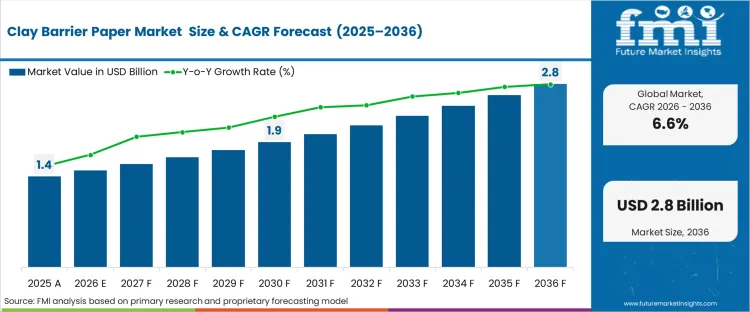
The clay barrier paper market was valued at USD 1.4 billion in 2025. The market is projected to reach USD 1.5 billion in 2026 and USD 2.8 billion by 2036, expanding at a CAGR of 6.6% during the forecast period. The Kaolin segment leads clay type with a 41.4% share in 2026. The Sachet & Flow Wrap Papers segment is projected to remain the leading product type segment with a 29.8% share in 2026. The Food & Beverage segment is expected to lead end-use demand with a 43.5% share in 2026.
Summary of Clay Barrier Paper Market
- Key Drivers
- Pore-filling economics: Clay improves barrier by reducing surface porosity with a relatively economical mineral input.
- Paper machine fit: Clay coating technology is familiar to paper producers, which lowers the scaling burden for many barrier-paper programs.
- Low-plastic demand: Applications that do not need the highest barrier are shifting toward mineral-enhanced paper rather than full laminate structures.
- Key Segments Analyzed in the Report
- Clay Type: Kaolin, Bentonite, Halloysite, Mixed-clay, and Others
- Product Type: Sachet & Flow Wrap Papers, Bag Papers, Release Liners & Interleaves, Pouch Papers, and Others
- End Use Industry: Food & Beverage, Building Materials & Minerals, Personal Care, Industrial, and Others
- Region: North America, Latin America, Europe, Asia Pacific, and Middle East & Africa
- Analyst Opinion
- Ismail Sutaria, Senior Consultant at Future Market Insights says, "Clay barrier paper is adopted highly where cost discipline matters as much as sustainability language. The market rewards formulations that use clay to tighten pores and improve grease or vapor resistance without making the paper too stiff, dusty, or difficult to run."
- Clay Barrier Paper Market Definition
- The clay barrier paper market includes paper grades coated or treated with clay-rich formulations to improve grease resistance, water vapour control, surface smoothness, and selected gas-barrier performance for packaging and industrial uses. It covers kaolin-coated papers, bentonite and halloysite-modified barrier papers, mixed-clay systems, and related functional papers used in sachets, flow wraps, bags, liners, and interleaving formats. These materials serve food packaging, industrial minerals, consumer goods, and specialty paper applications where a low-cost mineral route can strengthen barrier performance without moving to a full plastic laminate.
- Clay Barrier Paper Market Inclusions
- Clay-coated or clay-enhanced barrier paper sold into packaging and industrial paper applications.
- Revenue from base paper with functional mineral coating and converter-ready barrier paper reels or sheets.
- Demand across North America, Latin America, Europe, Asia Pacific, and the Middle East & Africa.
- Clay Barrier Paper Market Exclusions
- Standard coated printing paper except as a process benchmark.
- Finished packaged-goods revenue.
- High-barrier multi-material laminates where paper is only a minor structural layer.
- Clay Barrier Paper Market Research Methodology
- This study evaluates the clay barrier paper market across clay type, product type, end use industry, and region, using 2025 as the base year and 2026 to 2036 as the forecast period. Market value is expressed in USD billion. Evidence inputs include paper-coating technical literature, food-contact packaging regulations, company papers and press releases, industry recyclability guidance, and first-party packaging case studies. Triangulation combines end-use demand, pack conversion intensity, barrier-function value density, material substitution rates, and supplier positioning to derive the segment and regional estimates.
Key Drivers, Restraints, and Trends in Clay Barrier Paper Market
Drivers
Clay barrier paper benefits from a simple commercial truth: many packs do not need an expensive, high-barrier laminate. They need enough grease, vapor, or migration control to protect the product while preserving paper-machine economics and familiar downstream converting. Mineral systems, especially kaolin-rich coatings, help address that middle ground. Demand is strongest where pack owners want to strip out plastic layers, keep the tactile and printable advantages of paper, and avoid a major cost increase. Food wraps, sachet papers, industrial bag papers, and selected liners are therefore becoming practical landing zones for clay-based barrier upgrades.
Restraints
The barrier ceiling is the biggest constraint. Clay systems improve pore structure, but they do not automatically match the oxygen or moisture performance of advanced polymer or foil-based laminates. Dusting and coating brittleness can create runnability issues. Some end uses need stronger heat seal or wet-strength performance than clay-rich papers can provide on their own. Performance can also vary with basis weight and surface preparation. Customer qualification remains cautious when shelf life or contamination risk is commercially critical.
Trends
The market is moving toward hybrid formulations where clay is used as a cost-efficient performance booster rather than the only barrier mechanism. More suppliers are targeting specialty windows such as sachet papers, industrial sacks, and recyclable paper formats for dry or semi-sensitive goods. Technical attention is also shifting to coat-weight efficiency, because buyers want the cheapest mineral route that still delivers measurable barrier gain. The value conversation is becoming more application-specific and less generic about plastic replacement.
Segmental Analysis
Clay Barrier Paper Analysis by Clay Type
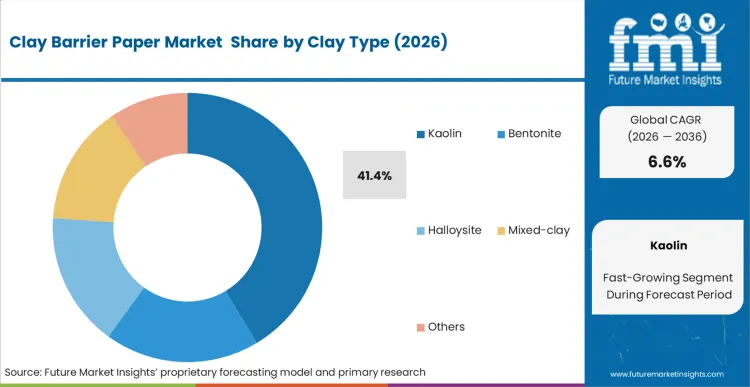
The Kaolin segment is expected to lead the clay type segment with a 41.4% share in 2026. Kaolin leads because it combines availability, plate-like particle structure, and coating familiarity. It helps create smoother, denser surfaces that reduce permeability while supporting strong print quality and commercial-scale coating operations. Technical literature and TAPPI-linked industry work on kaolin in aqueous barrier coatings show why kaolin remains the reference mineral for balancing barrier improvement and coat-cost efficiency.
Clay Barrier Paper Analysis by Product Type
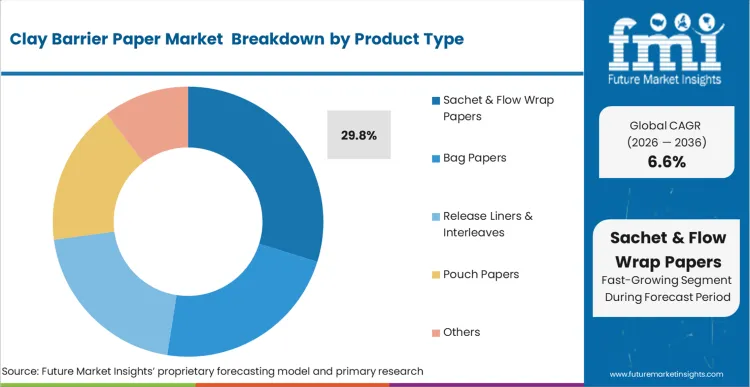
The Sachet & Flow Wrap Papers segment is expected to lead the product type segment with a 29.8% share in 2026. Sachet and flow-wrap papers lead because they consume large volumes and often require moderate rather than extreme barrier performance. In these formats, clay coatings can meaningfully improve grease and vapour resistance without pushing the structure into a more expensive laminate. Koehler Paper's packaging-paper portfolio and related barrier-paper launches reinforce how flexible paper formats are becoming an important commercial home for mineral-enhanced coatings.
Competitive Aligners for Market Players
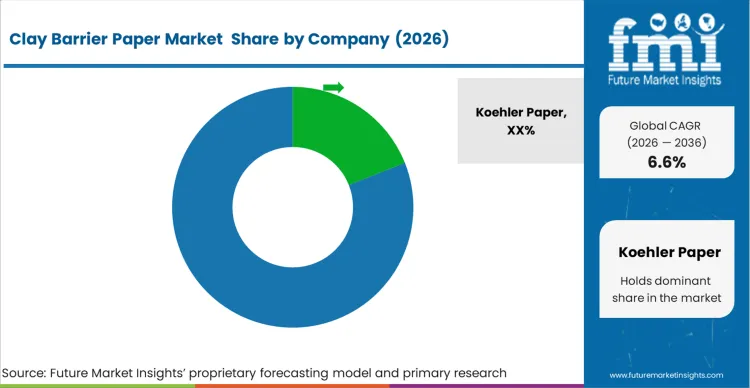
Competition in clay barrier paper is driven by coating formulation control, coat-weight efficiency, and end-use fit. Buyers do not pay premiums for clay alone. They pay for papers that run consistently, print cleanly, and deliver the required holdout at the lowest total pack cost. Koehler Paper keeps expanding barrier-paper functionality for flexible formats, while Billerud and Mondi continue to build paper-based alternatives for applications once dominated by plastic film. Suppliers that can show how clay improves performance without damaging recyclability, crack resistance, or machine speed will hold the stronger position. The rest remain exposed to price-led competition.
Key Players in Clay Barrier Paper Market
- Koehler Paper
- Billerud
- Mondi Group
- Sappi
- Munksjo
- Ahlstrom
- Stora Enso
- Lecta
- UPM Specialty Papers
- Mitsubishi HiTec Paper
Strategic Outlook by FMI on Clay Barrier Paper Market
FMI expects clay barrier paper to expand steadily in the wide middle of the packaging market where moderate barrier, low cost, and paper familiarity matter most. The most attractive growth pockets sit in wraps, sachets, bags, and liners that can accept a mineral-enhanced paper structure without extreme shelf-life demands. Market leadership will favour suppliers that treat clay as part of a tuned coating system rather than as a generic filler.
Scope of the Report

| Metric | Value |
|---|---|
| Market Value | USD 1.4 billion in 2025 to USD 2.8 billion by 2036 |
| CAGR | 6.6% from 2026 to 2036 |
| Base Year | 2025 |
| Forecast Period | 2026 to 2036 |
| Clay Type Segmentation | Kaolin, Bentonite, Halloysite, Mixed-clay, Others |
| Product Type Segmentation | Sachet & Flow Wrap Papers, Bag Papers, Release Liners & Interleaves, Pouch Papers, Others |
| End Use Industry Segmentation | Food & Beverage, Building Materials & Minerals, Personal Care, Industrial, Others |
| Regions Covered | North America, Latin America, Europe, Asia Pacific, Middle East & Africa |
Bibliography
· European Parliament and Council. 2025. Regulation (EU) 2025/40 on packaging and packaging waste.
· TAPPI. 2023. Use of kaolin clay in aqueous barrier coating applications.
· Coatings. 2023. Effect on Water, Moisture, and Grease Barrier Properties of Mineral-Containing Coatings on Paperboard.
· Koehler Paper. 2025. Packaging Innovation: High Gloss for Paper Packaging with Koehler Paper Barrier Paper.
· Billerud. Recyclable Flow Wrap.
· Mondi Group. FunctionalBarrier papers.
Frequently Asked Questions
What is the projected size of the Clay Barrier Paper market by 2036?
The clay barrier paper market is projected to reach USD 2.8 billion by 2036.
What is the CAGR of the Clay Barrier Paper market from 2026 to 2036?
The clay barrier paper market is projected to expand at a CAGR of 6.6% from 2026 to 2036.
Which clay type segment leads the Clay Barrier Paper market?
The Kaolin segment leads the clay barrier paper market with a 41.4% share in 2026.
Which product type segment dominates the Clay Barrier Paper market?
The Sachet & Flow Wrap Papers segment holds the leading position in the clay barrier paper market with a 29.8% share in 2026.
Which end use industry leads the Clay Barrier Paper market?
The Food & Beverage segment is expected to account for the largest share of the clay barrier paper market at 43.5% in 2026.
Who are the key companies in the Clay Barrier Paper market?
Key companies active in the clay barrier paper market include Koehler Paper, Billerud, Mondi Group, Sappi, Munksjo, and other packaging-material and converter specialists.
What is driving demand in the Clay Barrier Paper market?
Demand in the clay barrier paper market is being driven by packaging redesign toward better recyclability, stronger barrier performance, and improved line economics.
Preview the report firsthand - request a free sample
Get SampleGet the brochure for pricing and purchase details.
Get PDFTable of Content
- Executive Summary
- Global Market Outlook
- Demand-side Trends
- Supply-side Trends
- Technology Roadmap Analysis
- Analysis and Recommendations
- Market Overview
- Market Coverage / Taxonomy
- Market Definition / Scope / Limitations
- Research Methodology
- Chapter Orientation
- Analytical Lens and Working Hypotheses
- Market Structure, Signals, and Trend Drivers
- Benchmarking and Cross-market Comparability
- Market Sizing, Forecasting, and Opportunity Mapping
- Research Design and Evidence Framework
- Desk Research Programme (Secondary Evidence)
- Company Annual and Sustainability Reports
- Peer-reviewed Journals and Academic Literature
- Corporate Websites, Product Literature, and Technical Notes
- Earnings Decks and Investor Briefings
- Statutory Filings and Regulatory Disclosures
- Technical White Papers and Standards Notes
- Trade Journals, Industry Magazines, and Analyst Briefs
- Conference Proceedings, Webinars, and Seminar Materials
- Government Statistics Portals and Public Data Releases
- Press Releases and Reputable Media Coverage
- Specialist Newsletters and Curated Briefings
- Sector Databases and Reference Repositories
- FMI Internal Proprietary Databases and Historical Market Datasets
- Subscription Datasets and Paid Sources
- Social Channels, Communities, and Digital Listening Inputs
- Additional Desk Sources
- Expert Input and Fieldwork (Primary Evidence)
- Primary Modes
- Qualitative Interviews and Expert Elicitation
- Quantitative Surveys and Structured Data Capture
- Blended Approach
- Why Primary Evidence is Used
- Field Techniques
- Interviews
- Surveys
- Focus Groups
- Observational and In-context Research
- Social and Community Interactions
- Stakeholder Universe Engaged
- C-suite Leaders
- Board Members
- Presidents and Vice Presidents
- R&D and Innovation Heads
- Technical Specialists
- Domain Subject-matter Experts
- Scientists
- Physicians and Other Healthcare Professionals
- Governance, Ethics, and Data Stewardship
- Research Ethics
- Data Integrity and Handling
- Primary Modes
- Tooling, Models, and Reference Databases
- Desk Research Programme (Secondary Evidence)
- Data Engineering and Model Build
- Data Acquisition and Ingestion
- Cleaning, Normalisation, and Verification
- Synthesis, Triangulation, and Analysis
- Quality Assurance and Audit Trail
- Market Background
- Market Dynamics
- Drivers
- Restraints
- Opportunity
- Trends
- Scenario Forecast
- Demand in Optimistic Scenario
- Demand in Likely Scenario
- Demand in Conservative Scenario
- Opportunity Map Analysis
- Product Life Cycle Analysis
- Supply Chain Analysis
- Investment Feasibility Matrix
- Value Chain Analysis
- PESTLE and Porter’s Analysis
- Regulatory Landscape
- Regional Parent Market Outlook
- Production and Consumption Statistics
- Import and Export Statistics
- Market Dynamics
- Global Market Analysis 2021 to 2025 and Forecast, 2026 to 2036
- Historical Market Size Value (USD Million) Analysis, 2021 to 2025
- Current and Future Market Size Value (USD Million) Projections, 2026 to 2036
- Y-o-Y Growth Trend Analysis
- Absolute $ Opportunity Analysis
- Global Market Pricing Analysis 2021 to 2025 and Forecast 2026 to 2036
- Global Market Analysis 2021 to 2025 and Forecast 2026 to 2036, By Clay Type
- Introduction / Key Findings
- Historical Market Size Value (USD Million) Analysis By Clay Type , 2021 to 2025
- Current and Future Market Size Value (USD Million) Analysis and Forecast By Clay Type , 2026 to 2036
- Kaolin
- Bentonite
- Halloysite
- Mixed-clay
- Others
- Kaolin
- Y-o-Y Growth Trend Analysis By Clay Type , 2021 to 2025
- Absolute $ Opportunity Analysis By Clay Type , 2026 to 2036
- Global Market Analysis 2021 to 2025 and Forecast 2026 to 2036, By Product Type
- Introduction / Key Findings
- Historical Market Size Value (USD Million) Analysis By Product Type, 2021 to 2025
- Current and Future Market Size Value (USD Million) Analysis and Forecast By Product Type, 2026 to 2036
- Sachet & Flow Wrap Papers
- Bag Papers
- Release Liners & Interleaves
- Pouch Papers
- Others
- Sachet & Flow Wrap Papers
- Y-o-Y Growth Trend Analysis By Product Type, 2021 to 2025
- Absolute $ Opportunity Analysis By Product Type, 2026 to 2036
- Global Market Analysis 2021 to 2025 and Forecast 2026 to 2036, By Region
- Introduction
- Historical Market Size Value (USD Million) Analysis By Region, 2021 to 2025
- Current Market Size Value (USD Million) Analysis and Forecast By Region, 2026 to 2036
- North America
- Latin America
- Western Europe
- Eastern Europe
- East Asia
- South Asia and Pacific
- Middle East & Africa
- Market Attractiveness Analysis By Region
- North America Market Analysis 2021 to 2025 and Forecast 2026 to 2036, By Country
- Historical Market Size Value (USD Million) Trend Analysis By Market Taxonomy, 2021 to 2025
- Market Size Value (USD Million) Forecast By Market Taxonomy, 2026 to 2036
- By Country
- USA
- Canada
- Mexico
- By Clay Type
- By Product Type
- By Country
- Market Attractiveness Analysis
- By Country
- By Clay Type
- By Product Type
- Key Takeaways
- Latin America Market Analysis 2021 to 2025 and Forecast 2026 to 2036, By Country
- Historical Market Size Value (USD Million) Trend Analysis By Market Taxonomy, 2021 to 2025
- Market Size Value (USD Million) Forecast By Market Taxonomy, 2026 to 2036
- By Country
- Brazil
- Chile
- Rest of Latin America
- By Clay Type
- By Product Type
- By Country
- Market Attractiveness Analysis
- By Country
- By Clay Type
- By Product Type
- Key Takeaways
- Western Europe Market Analysis 2021 to 2025 and Forecast 2026 to 2036, By Country
- Historical Market Size Value (USD Million) Trend Analysis By Market Taxonomy, 2021 to 2025
- Market Size Value (USD Million) Forecast By Market Taxonomy, 2026 to 2036
- By Country
- Germany
- UK
- Italy
- Spain
- France
- Nordic
- BENELUX
- Rest of Western Europe
- By Clay Type
- By Product Type
- By Country
- Market Attractiveness Analysis
- By Country
- By Clay Type
- By Product Type
- Key Takeaways
- Eastern Europe Market Analysis 2021 to 2025 and Forecast 2026 to 2036, By Country
- Historical Market Size Value (USD Million) Trend Analysis By Market Taxonomy, 2021 to 2025
- Market Size Value (USD Million) Forecast By Market Taxonomy, 2026 to 2036
- By Country
- Russia
- Poland
- Hungary
- Balkan & Baltic
- Rest of Eastern Europe
- By Clay Type
- By Product Type
- By Country
- Market Attractiveness Analysis
- By Country
- By Clay Type
- By Product Type
- Key Takeaways
- East Asia Market Analysis 2021 to 2025 and Forecast 2026 to 2036, By Country
- Historical Market Size Value (USD Million) Trend Analysis By Market Taxonomy, 2021 to 2025
- Market Size Value (USD Million) Forecast By Market Taxonomy, 2026 to 2036
- By Country
- China
- Japan
- South Korea
- By Clay Type
- By Product Type
- By Country
- Market Attractiveness Analysis
- By Country
- By Clay Type
- By Product Type
- Key Takeaways
- South Asia and Pacific Market Analysis 2021 to 2025 and Forecast 2026 to 2036, By Country
- Historical Market Size Value (USD Million) Trend Analysis By Market Taxonomy, 2021 to 2025
- Market Size Value (USD Million) Forecast By Market Taxonomy, 2026 to 2036
- By Country
- India
- ASEAN
- Australia & New Zealand
- Rest of South Asia and Pacific
- By Clay Type
- By Product Type
- By Country
- Market Attractiveness Analysis
- By Country
- By Clay Type
- By Product Type
- Key Takeaways
- Middle East & Africa Market Analysis 2021 to 2025 and Forecast 2026 to 2036, By Country
- Historical Market Size Value (USD Million) Trend Analysis By Market Taxonomy, 2021 to 2025
- Market Size Value (USD Million) Forecast By Market Taxonomy, 2026 to 2036
- By Country
- Kingdom of Saudi Arabia
- Other GCC Countries
- Turkiye
- South Africa
- Other African Union
- Rest of Middle East & Africa
- By Clay Type
- By Product Type
- By Country
- Market Attractiveness Analysis
- By Country
- By Clay Type
- By Product Type
- Key Takeaways
- Key Countries Market Analysis
- USA
- Pricing Analysis
- Market Share Analysis, 2025
- By Clay Type
- By Product Type
- Canada
- Pricing Analysis
- Market Share Analysis, 2025
- By Clay Type
- By Product Type
- Mexico
- Pricing Analysis
- Market Share Analysis, 2025
- By Clay Type
- By Product Type
- Brazil
- Pricing Analysis
- Market Share Analysis, 2025
- By Clay Type
- By Product Type
- Chile
- Pricing Analysis
- Market Share Analysis, 2025
- By Clay Type
- By Product Type
- Germany
- Pricing Analysis
- Market Share Analysis, 2025
- By Clay Type
- By Product Type
- UK
- Pricing Analysis
- Market Share Analysis, 2025
- By Clay Type
- By Product Type
- Italy
- Pricing Analysis
- Market Share Analysis, 2025
- By Clay Type
- By Product Type
- Spain
- Pricing Analysis
- Market Share Analysis, 2025
- By Clay Type
- By Product Type
- France
- Pricing Analysis
- Market Share Analysis, 2025
- By Clay Type
- By Product Type
- India
- Pricing Analysis
- Market Share Analysis, 2025
- By Clay Type
- By Product Type
- ASEAN
- Pricing Analysis
- Market Share Analysis, 2025
- By Clay Type
- By Product Type
- Australia & New Zealand
- Pricing Analysis
- Market Share Analysis, 2025
- By Clay Type
- By Product Type
- China
- Pricing Analysis
- Market Share Analysis, 2025
- By Clay Type
- By Product Type
- Japan
- Pricing Analysis
- Market Share Analysis, 2025
- By Clay Type
- By Product Type
- South Korea
- Pricing Analysis
- Market Share Analysis, 2025
- By Clay Type
- By Product Type
- Russia
- Pricing Analysis
- Market Share Analysis, 2025
- By Clay Type
- By Product Type
- Poland
- Pricing Analysis
- Market Share Analysis, 2025
- By Clay Type
- By Product Type
- Hungary
- Pricing Analysis
- Market Share Analysis, 2025
- By Clay Type
- By Product Type
- Kingdom of Saudi Arabia
- Pricing Analysis
- Market Share Analysis, 2025
- By Clay Type
- By Product Type
- Turkiye
- Pricing Analysis
- Market Share Analysis, 2025
- By Clay Type
- By Product Type
- South Africa
- Pricing Analysis
- Market Share Analysis, 2025
- By Clay Type
- By Product Type
- USA
- Market Structure Analysis
- Competition Dashboard
- Competition Benchmarking
- Market Share Analysis of Top Players
- By Regional
- By Clay Type
- By Product Type
- Competition Analysis
- Competition Deep Dive
- Koehler Paper
- Overview
- Product Portfolio
- Profitability by Market Segments (Product/Age /Sales Channel/Region)
- Sales Footprint
- Strategy Overview
- Marketing Strategy
- Product Strategy
- Channel Strategy
- Billerud
- Mondi Group
- Sappi
- Munksjo
- Ahlstrom
- Stora Enso
- Lecta
- UPM Specialty Papers
- Mitsubishi HiTec Paper
- Koehler Paper
- Competition Deep Dive
- Assumptions & Acronyms Used


