

- Industry Size (2026)
- USD 6.3 Bn
- Forecast (2036)
- USD 9.6 Bn
- CAGR (2026 to 2036)
- 4.0%
Paper Tapes Market Size, Market Forecast and Outlook By FMI
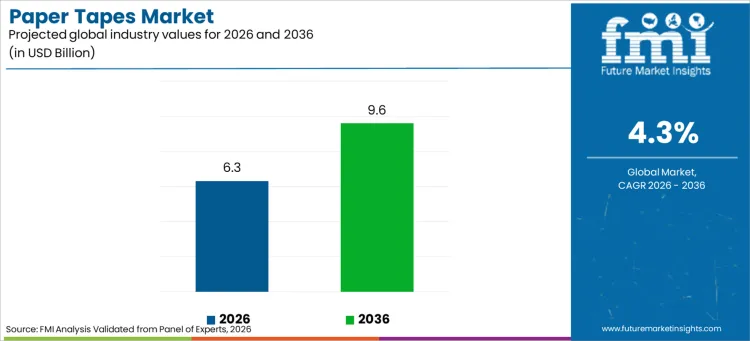
The paper tapes market is projected to expand from USD 6.3 billion in 2026 to USD 9.6 billion by 2036. The market is expected to grow at a 4.0% CAGR during the forecast period. Masking tape is expected to lead product type demand with 46.0% share, while rubber-based adhesive is projected to hold 58.0% share of adhesive type demand in 2026.
Summary of the Paper Tapes Market
- Demand and Growth Drivers
- E-commerce fulfillment growth is increasing demand for recyclable paper-based carton sealing formats.
- Packaging owners are replacing plastic-backed tapes where fiber recovery and recyclability claims matter.
- Industrial painting and finishing operations continue to support masking tape demand.
- Product and Segment View
- Masking tape remains the leading product type because it supports surface protection in painting and coating operations.
- Rubber-based adhesive leads because it delivers strong initial tack across diverse surfaces.
- Packaging tape demand is rising as carton sealing lines shift toward fiber-compatible closure materials.
- Geography and Competitive Outlook
- The USA leads listed country growth due to e-commerce packaging and industrial assembly demand.
- The UK follows closely as recyclable packaging targets support paper tape adoption.
- 3M, Nitto Denko, tesa, Shurtape, and Intertape Polymer Group remain leading suppliers.
- Analyst Opinion
- Ismail Sutaria, Principal Consultant at FMI, suggests, “Paper tapes are moving from a basic consumable role into packaging specification decisions. Suppliers that can provide reliable adhesion, clean removal, dispenser compatibility, and recyclability documentation are likely to win longer contracts with packaging and logistics buyers.”
- Paper Tapes Market Value Analysis
- The market is gaining value as brand owners standardize fiber-based packaging materials across fulfillment networks.
- Qualification depends on adhesion to recycled board, humidity resistance, and line performance.
- Once approved, tape families usually remain in service across long packaging cycles.
- Supplier selection depends on coating consistency, roll converting quality, and technical support.
Key Takeaways, Market Size, and Forecast
| Metric | Value |
|---|---|
| Market Size (2026) | USD 6.3 Billion |
| Market Size (2036) | USD 9.6 Billion |
| CAGR (2026–2036) | 4.0% |
| Incremental Opportunity | USD 3.3 Billion |
| Leading Product Type (2026) | Masking Tape |
| Masking Tape Share (2026) | 46.0% |
| Leading Adhesive Type (2026) | Rubber-Based Adhesive |
| Rubber-Based Adhesive Share (2026) | 58.0% |
| Fastest-Growing Country | USA |
| USA CAGR | 4.6% |
What is the Growth Forecast for the Paper Tapes Market through 2036?
Box closing speed, carton quality, and recyclability targets define how converters choose tape systems. The paper tapes market in 2026 stands near USD 6.3 billion, rising from USD 5.1 billion in 2021 as fulfillment centers and case sealers replace plastic backings in standard operations. Buyers judge products through adhesion to recycled board, tear resistance, unwind behavior, and performance on automatic dispensers. Line trials check seal integrity after humidity exposure and compression in transit. Platform approval fixes tape choice across many pack lines. The value path reaches USD 7.5 billion in 2030 and USD 8.5 billion in 2033, then advances to USD 9.6 billion in 2036, matching a 4% growth rate.
Operating design shapes commercial behavior in the paper tapes market. Volumes move under multi year supply agreements linked to packaging standards and equipment fleets. Stock policy favors consistent basis weight and adhesive performance across plants. Cost structure reflects paper backing supply, adhesive formulation, coating yield, and roll converting efficiency. Sites track jam rates, seal failure, and throughput impact as release gates. Annual values pass USD 7.8 billion in 2031 and USD 9.2 billion in 2035 as more networks standardize fiber based closure systems. The rise to USD 9.6 billion in 2036 comes from wider coverage across shipping categories, higher tape usage on heavier cartons, and longer contracts that lock these products into fixed packaging specifications.
Paper Tapes Market Key Takeaways
| Metric | Value |
|---|---|
| Market Value (2026) | USD 6.3 billion |
| Forecast Value (2036) | USD 9.6 billion |
| Forecast CAGR (2026-2036) | 4.0% |
How Is the Paper Tapes Market Being Used to Control Sealing Reliability, Recyclability Claims, and Line Efficiency in Packaging Operations?
Packaging operations treat the paper tapes market as part of closure system governance rather than as a simple consumable choice. Programs specify water activated paper tape systems and pressure sensitive paper packaging tapes to balance box sealing strength with fiber based recovery requirements. Qualification teams rely on carton sealing performance testing protocols and adhesive fiber tear evaluation methods to confirm that closures survive transport without blocking recycling. Engineering groups evaluate recyclable packaging closure solutions and high tack starch based adhesive technologies to keep application windows stable across humidity and temperature ranges. The focus stays on bond consistency, application speed, and fiber compatibility because a tape that seals well but contaminates the recovery stream creates compliance exposure and rework risk.
Release governance places packaging recyclability compliance documentation inside shipment approval rather than inside procurement review. Selection criteria for paper tape suppliers include adhesive stability, roll consistency, and performance across corrugated grades. Line efficiency impact analysis for carton sealing tapes is used to justify equipment settings and changeover practices. Audit readiness for fiber based packaging claims defines acceptance gates and surveillance routines. Failure analysis of box opening and edge lift issues feeds back into tape specification and board selection. Third party verification for recyclable packaging components anchors credibility and dispute resolution. This makes paper tape specification a packaging governance and risk management decision rather than a short term cost or sourcing convenience choice.
How Do Substrate Compatibility and Residue Control Requirements Shape Demand in the Paper Tapes Market by Product Type and Adhesive Type in 2026?
In the Paper Tapes Market, selection criteria are driven by surface protection needs, removal behavior, and process cleanliness rather than by roll cost alone. Users operating industrial painting operations, corrugated packaging lines, and consumer stationery supply chains require tapes that hold reliably during use while releasing without fiber tear or adhesive transfer. By product type, demand spans masking tape, packaging tape, consumer and stationery tape, and pressure sensitive tape formats. By adhesive type, usage covers rubber based adhesive, acrylic based adhesive, silicon based adhesive, and other systems. Portfolio structure reflects rework risk, surface damage exposure, and line efficiency rather than simple adhesion strength.
Why Does Masking Tape Anchor Most Volume Demand?
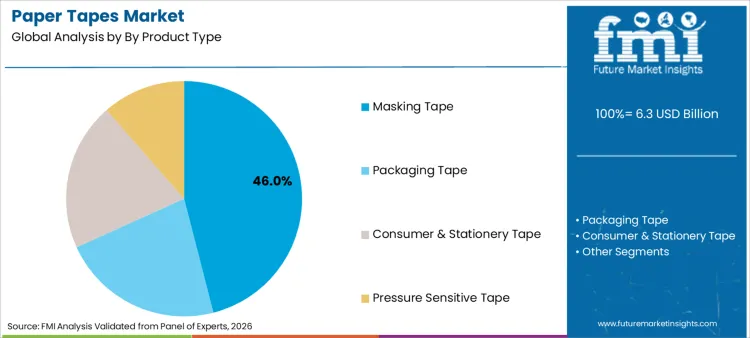
Masking tape represents about 46% share, reflecting its central role in surface protection during painting, coating, and finishing operations. In industrial painting operations, predictable peel force and clean removal protect cycle time and surface quality. Packaging tape follows, driven by carton sealing and short-term bundling needs. Consumer and stationery tape serves office and retail uses with lower performance thresholds. Pressure sensitive formats overlap multiple categories. Engineering teams evaluate product types through peel strength stability, edge bleed, and residue. Operations teams evaluate through application speed and failure rates. Quality teams evaluate through rework incidence and surface defect claims.
Application focus fixes paper backing grade, crepe structure, and release coating targets. Introducing a new use case requires new removal testing and substrate compatibility checks. Procurement aligns sourcing to maintain consistency of the approved tape family. Work instructions and quality standards follow the same application mapping. Commercial planning grows volume within the same use class rather than rotating categories. Demand therefore concentrates in masking applications where surface protection risk, labor cost, and defect visibility intersect.
Why Do Rubber-Based Adhesives Dominate Adhesive Selection?
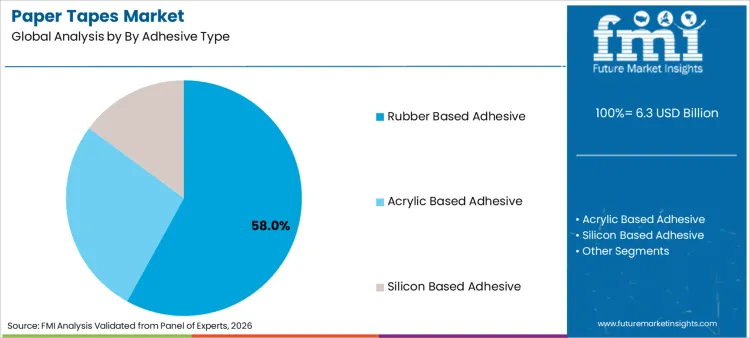
Rubber based adhesives account for about 58% share, reflecting their high initial tack and reliable bonding to a wide range of surfaces. This behavior supports quick application and short dwell times in production environments. Acrylic based adhesives serve applications that require better aging resistance and UV stability. Silicon based adhesives address extreme temperature or low-surface-energy substrates, though at higher cost and narrower volume. Other systems remain specialized. Materials teams evaluate adhesives through tack build, shear resistance, and clean peel behavior. Operations teams evaluate through run consistency and storage stability. Quality teams evaluate through residue transfer and edge lift.
Adhesive choice fixes coating weight, drying conditions, and storage limits. A change in adhesive system requires new aging tests and substrate compatibility trials. Production planning aligns slitting, winding, and inventory management to the chosen chemistry. Supplier qualification and incoming inspection follow. Field performance monitoring assumes the same adhesion profile. Growth occurs by extending approved adhesive systems across more tape formats rather than switching chemistries. Demand therefore concentrates in rubber based systems that balance immediate adhesion, easy removability, and predictable behavior across high-volume masking and general-purpose applications.
Why Are Carton Sealing and Fulfillment Operations Driving Demand for Paper Tapes?
Across distribution centers and packing lines, daily throughput depends on how corrugated box converting operations interact with case sealing equipment and e-commerce fulfillment workflows. Tapes must bond reliably to paper surfaces, hold under stacking loads, and run without stoppages on manual and automated dispensers. At the same time, warehouse operations teams and logistics handling systems require consistent unwind behavior and predictable adhesion across temperature and humidity ranges. These pressures converge in paper tapes because they must perform as both a closure system and a process material. Demand grows because packers need sealing solutions that integrate smoothly into high volume carton handling without disrupting line speed or labor efficiency.
What Is Preventing Full Standardization of Paper Tape Specifications?
Material differences in kraft paper supply chains and formulation choices in adhesive compounding operations create wide variation in tensile strength, tear behavior, and bonding performance. Requirements for heavy industrial shipping cartons differ from those for lightweight e-commerce parcels, which blocks reuse of one tape grade across applications. Approval also depends on packaging test laboratories and customer transit simulations, which extend qualification cycles. These dependencies keep tape portfolios segmented. Converters and distributors manage multiple SKUs, longer validation timelines, and limited ability to collapse specifications even when box formats and sealing equipment appear similar.
How Are Automation and Process Integration Changing Paper Tape Development?
Packaging operations are moving toward tighter coordination between end of line automation teams, packaging engineering groups, and equipment suppliers. Tape producers now design products to match specific dispenser types, sealing speeds, and carton surfaces rather than offering generic grades. Testing and validation partners are being involved earlier to confirm adhesion, shear resistance, and unwind behavior before rollouts across networks of sites. Development is shifting toward application specific tape families supported by shared performance data and defined operating windows. Competitive advantage comes from offering paper tape systems that reduce line stoppages, shorten site level trials, and maintain consistent sealing quality across large fulfillment networks.
What is the Demand for Paper Tapes by Country?
| Country | CAGR (%) |
|---|---|
| UK | 4.5% |
| Japan | 4.1% |
| South Korea | 4.0% |
| USA | 4.6% |
| Brazil | 3.9% |
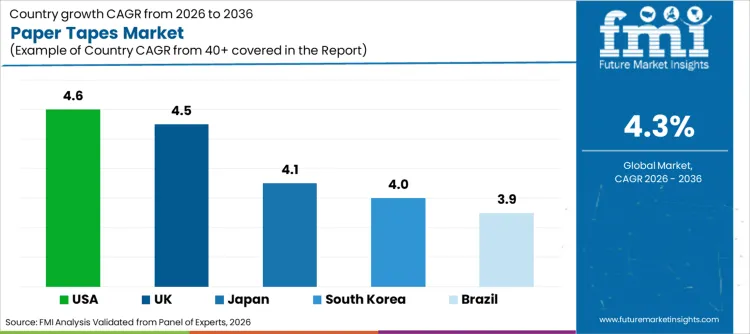
The demand for paper tapes is increasing across packaging, labeling, and industrial applications where eco-friendly and recyclable alternatives to plastic tapes are required. The USA leads at 4.6% CAGR, supported by growing adoption in e-commerce, shipping, and sustainable packaging initiatives. The UK follows at 4.5%, driven by corporate sustainability goals and regulatory emphasis on recyclable packaging materials. Germany records steady use in industrial and logistics sectors. Japan posts 4.1%, reflecting mature but stable demand for high quality paper tapes in packaging and stationery applications. South Korea and Brazil grow at 4.0% and 3.9% respectively, shaped by gradual adoption of sustainable tape alternatives across commercial and consumer applications.
How Packaging Line Efficiency Drives the Paper Tapes Market in the UK
High-speed packaging lines in the United Kingdom are supporting a 4.5% CAGR in the paper tapes market. Selection focuses on adhesive performance, tensile strength, and dimensional stability for sealing, bundling, and protective applications. Engineers evaluate adhesion consistency, moisture resistance, and compatibility with automated dispensers. Once validated, tapes are deployed across multiple production lines and packaging formats. Volume growth is linked to adoption by retail, logistics, and industrial packaging programs. Supplier participation depends on quality verification, technical support, and documentation compliance. Commercial success relies on reproducible adhesion performance, operational reliability, and consistent integration with production workflows.
How Industrial Usage Patterns Shape the Paper Tapes Market in Japan
In Japan, the paper tapes market is growing at a 4.1% CAGR due to steady demand from industrial packaging and assembly operations. Tapes are selected for tensile strength, adhesive consistency, and resistance to environmental factors like humidity. Technical evaluation includes peel strength, dimensional stability, and compatibility with high-speed application equipment. Once approved, tapes are used across multiple production lines for packaging, bundling, and sealing applications. Supplier access depends on audit compliance, certification, and technical support. Volume growth follows industrial expansion and packaging program adoption. Commercial success relies on reproducible performance, operational consistency, and reliable integration across facilities.
How Production Line Adaptability Drives the Paper Tapes Market in South Korea
South Korea’s paper tapes market is expanding at a 4% CAGR as manufacturers prioritize tapes compatible with automated and manual packaging lines. Material selection emphasizes adhesive reliability, tear resistance, and dimensional stability. Engineers assess peel strength, moisture resistance, and integration with dispensing systems. Once validated, tapes are deployed across multiple lines for retail, logistics, and industrial applications. Supplier participation requires quality verification, technical documentation, and integration support. Volume growth tracks adoption by packaging and assembly programs. Commercial success depends on consistent adhesive performance, operational reliability, and process compatibility.
How E-Commerce and Industrial Programs Influence the Paper Tapes Market in the USA
In the United States, the paper tapes market is advancing at a 4.6% CAGR due to e-commerce packaging expansion and industrial assembly requirements. Tapes are evaluated for adhesive strength, tensile consistency, and resistance to temperature and humidity variations. Engineers assess compatibility with high-speed dispensers and manual application workflows. Once validated, tapes are deployed across multiple production lines and product formats. Supplier participation depends on certification verification, technical support, and audit compliance. Volume growth is linked to large-scale retail, logistics, and industrial packaging programs. Commercial advantage relies on reproducible performance, operational reliability, and process integration.
How Material Performance Drives the Paper Tapes Market in Brazil
In Brazil, the paper tapes market is growing at a 3.9% CAGR as industrial and retail packaging programs require reliable adhesive solutions. Tapes are selected based on tensile strength, adhesive consistency, and dimensional stability under varying environmental conditions. Technical evaluation covers peel performance, tear resistance, and compatibility with dispensing systems. Once validated, tapes are implemented across multiple production lines for retail, logistics, and industrial applications. Supplier access depends on certification, audit compliance, and technical support. Volume growth follows adoption by packaging programs and industrial operations. Commercial success relies on reproducible adhesion performance, operational reliability, and consistent quality.
How Are Companies Competing in the Paper Tapes Market?
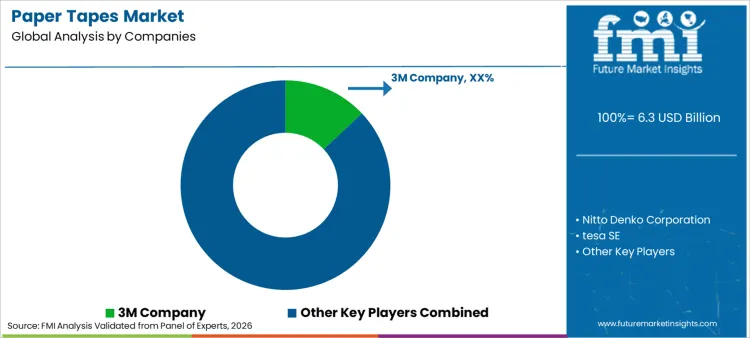
Adhesion performance, tensile strength, and backing material quality drive adoption in the Paper Tapes Market. 3M, Nitto Denko, tesa, Shurtape, and Intertape Polymer compete during pilot production trials, coating validation, and industrial line testing. Once incorporated into packaging, labeling, or industrial applications, tack consistency, ease of application, and durability anchor supplier selection. 3M emphasizes high-performance paper tapes for industrial and commercial use. Nitto Denko provides specialty tapes with precise adhesive control. tesa delivers solutions optimized for packaging and masking applications. Shurtape focuses on high-volume production and consistent coating performance. Intertape Polymer supplies paper tapes with balanced adhesion and strength for industrial applications.
Coating uniformity, production reliability, and technical support define competitive positioning in the Paper Tapes Market. Engineers assess tensile strength, adhesive transfer, release properties, and dimensional stability during validation. Suppliers capable of reproducible production, scalable output, and integration guidance gain preference. 3M secures adoption through industrial-scale validation and technical support. Nitto Denko maintains share in specialty tape applications. tesa competes in masking and packaging workflows requiring consistent adhesion. Shurtape delivers high-volume industrial solutions. Intertape Polymer focuses on balanced performance for packaging and commercial uses. Market positions vary by tape type, application, production scale, and regional adhesive regulations.
Key Players in the Paper Tapes Market
- 3M Company
- Nitto Denko Corporation
- tesa SE
- Shurtape Technologies, LLC
- Intertape Polymer Group Inc.
Scope of the Report
| Items | Values |
|---|---|
| Quantitative Units (2026) | USD billion |
| Product Type | Masking tape, packaging tape, consumer and stationery tape, pressure sensitive tape |
| Adhesive Type | Rubber based adhesive, acrylic based adhesive, silicon based adhesive |
| Application | Masking, packaging, sealing, bundling, fixing, general use, decorating, labeling, framing, tabbing and splicing |
| Feature Type | Single sided, double sided |
| End Use | Building and construction, automotive, retail and logistics, aerospace and defense, healthcare, electronics and electrical, consumer goods |
| Regions Covered | Asia Pacific, Europe, North America, Latin America, Middle East & Africa |
| Countries Covered | United States, Canada, Mexico, Germany, United Kingdom, France, Italy, Spain, Nordics, BENELUX, China, Japan, South Korea, India, Australia & New Zealand, ASEAN, Brazil, Chile, Saudi Arabia, Turkey, South Africa, and other regional markets |
| Key Companies Profiled | 3M, Nitto Denko, tesa, Shurtape Technologies, Intertape Polymer Group |
| Additional Attributes | Dollar sales by product type, adhesive type, application, feature type, and end-use, carton sealing and masking performance requirements, adhesion and clean removal benchmarks, fiber compatibility and recyclability considerations, unwind behavior and dispenser compatibility, humidity and temperature performance windows, coating weight and basis weight control, roll converting and slitting specifications, multi-year supply agreements tied to packaging standards, line efficiency impact and jam rate tracking, seal integrity and transit compression performance, and regional adoption patterns across e-commerce, retail, and industrial packaging programs |
Paper Tapes Market Segmentation
By Product Type:
- Masking Tape
- Packaging Tape
- Consumer & Stationery Tape
- Pressure Sensitive Tape
By Adhesive Type:
- Rubber Based Adhesive
- Acrylic Based Adhesive
- Silicon Based Adhesive
By Application:
- Masking
- Packaging
- Sealing
- Bundling
- Fixing
- General Use
- Decorating
- Labeling
- Framing
- Tabbing & Splicing
By Feature Type:
- Single Sided
- Double Sided
By End Use:
- Building & Construction
- Automotive
- Retail & Logistics
- Aerospace & Defense
- Healthcare
- Electronics & Electrical
- Consumer Goods
Region
- Asia Pacific
- China
- Japan
- South Korea
- India
- Australia & New Zealand
- ASEAN
- Rest of Asia Pacific
- Europe
- Germany
- United Kingdom
- France
- Italy
- Spain
- Nordic
- BENELUX
- Rest of Europe
- North America
- United States
- Canada
- Mexico
- Latin America
- Brazil
- Chile
- Rest of Latin America
- Middle East & Africa
- Kingdom of Saudi Arabia
- Other GCC Countries
- Turkey
- South Africa
- Other African Union
- Rest of Middle East & Africa
Bibliography
- National Institute of Standards and Technology. (2024, May 31). An update on the National Semiconductor Technology Center (NSTC). USA Department of Commerce.
- European Commission. (2024). Pilot Integration of 3nm Semiconductor technology (PIn3S) (Project ID: 826422). CORDIS.
- European Commission. (2024). Pilot Integration of 3nm Semiconductor technology (PIn3S): Periodic reporting information (Project ID: 826422). CORDIS.
- European Commission. (2023, December 8). Technology Advances for Pilotline of Enhanced Semiconductors for 3nm (TAPES3) (Project ID: 783247). CORDIS.
Frequently Asked Questions
What is the outlook for the paper tapes market in 2026?
The paper tapes market is projected to be valued at USD 6.3 billion in 2026.
What value is expected for the paper tapes market in 2036?
In 2036, the paper tapes market is forecast to reach USD 9.6 billion.
At what rate will the paper tapes market progress from 2026 to 2036?
The paper tapes market is expected to advance at a 4.0% CAGR from 2026 to 2036.
Which product type leads demand in the paper tapes market in 2026?
Masking tape is expected to account for a 46% share by product type in 2026.
Which adhesive type leads demand in the paper tapes market in 2026?
Rubber-based adhesive is expected to represent a 58% share by adhesive type in 2026.
Preview the report firsthand - request a free sample
Get SampleGet the brochure for pricing and purchase details.
Get PDFTable of Content
- Executive Summary
- Global Market Outlook
- Demand-side Trends
- Supply-side Trends
- Technology Roadmap Analysis
- Analysis and Recommendations
- Market Overview
- Market Coverage / Taxonomy
- Market Definition / Scope / Limitations
- Market Background
- Market Dynamics
- Drivers
- Restraints
- Opportunity
- Trends
- Scenario Forecast
- Demand in Optimistic Scenario
- Demand in Likely Scenario
- Demand in Conservative Scenario
- Opportunity Map Analysis
- Product Life Cycle Analysis
- Supply Chain Analysis
- Investment Feasibility Matrix
- Value Chain Analysis
- PESTLE and Porter’s Analysis
- Regulatory Landscape
- Regional Parent Market Outlook
- Production and Consumption Statistics
- Import and Export Statistics
- Market Dynamics
- Global Market Analysis 2021 to 2025 and Forecast, 2026 to 2036
- Historical Market Size Value (USD Million) Analysis, 2021 to 2025
- Current and Future Market Size Value (USD Million) Projections, 2026 to 2036
- Y-o-Y Growth Trend Analysis
- Absolute $ Opportunity Analysis
- Global Market Pricing Analysis 2021 to 2025 and Forecast 2026 to 2036
- Global Market Analysis 2021 to 2025 and Forecast 2026 to 2036, By By Product Type
- Introduction / Key Findings
- Historical Market Size Value (USD Million) Analysis By By Product Type , 2021 to 2025
- Current and Future Market Size Value (USD Million) Analysis and Forecast By By Product Type , 2026 to 2036
- Masking Tape
- Packaging Tape
- Consumer & Stationery Tape
- Pressure Sensitive Tape
- Masking Tape
- Y-o-Y Growth Trend Analysis By By Product Type , 2021 to 2025
- Absolute $ Opportunity Analysis By By Product Type , 2026 to 2036
- Global Market Analysis 2021 to 2025 and Forecast 2026 to 2036, By By Adhesive Type
- Introduction / Key Findings
- Historical Market Size Value (USD Million) Analysis By By Adhesive Type, 2021 to 2025
- Current and Future Market Size Value (USD Million) Analysis and Forecast By By Adhesive Type, 2026 to 2036
- Rubber Based Adhesive
- Acrylic Based Adhesive
- Silicon Based Adhesive
- Rubber Based Adhesive
- Y-o-Y Growth Trend Analysis By By Adhesive Type, 2021 to 2025
- Absolute $ Opportunity Analysis By By Adhesive Type, 2026 to 2036
- Global Market Analysis 2021 to 2025 and Forecast 2026 to 2036, By By Application
- Introduction / Key Findings
- Historical Market Size Value (USD Million) Analysis By By Application, 2021 to 2025
- Current and Future Market Size Value (USD Million) Analysis and Forecast By By Application, 2026 to 2036
- Masking
- Packaging
- Sealing
- Bundling
- Fixing
- General Use
- Decorating
- Labeling
- Framing
- Tabbing & Splicing
- Masking
- Y-o-Y Growth Trend Analysis By By Application, 2021 to 2025
- Absolute $ Opportunity Analysis By By Application, 2026 to 2036
- Global Market Analysis 2021 to 2025 and Forecast 2026 to 2036, By By Feature Type
- Introduction / Key Findings
- Historical Market Size Value (USD Million) Analysis By By Feature Type, 2021 to 2025
- Current and Future Market Size Value (USD Million) Analysis and Forecast By By Feature Type, 2026 to 2036
- Single Sided
- Double Sided
- Single Sided
- Y-o-Y Growth Trend Analysis By By Feature Type, 2021 to 2025
- Absolute $ Opportunity Analysis By By Feature Type, 2026 to 2036
- Global Market Analysis 2021 to 2025 and Forecast 2026 to 2036, By By End Use
- Introduction / Key Findings
- Historical Market Size Value (USD Million) Analysis By By End Use, 2021 to 2025
- Current and Future Market Size Value (USD Million) Analysis and Forecast By By End Use, 2026 to 2036
- Building & Construction
- Automotive
- Retail & Logistics
- Aerospace & Defense
- Healthcare
- Electronics & Electrical
- Consumer Goods
- Building & Construction
- Y-o-Y Growth Trend Analysis By By End Use, 2021 to 2025
- Absolute $ Opportunity Analysis By By End Use, 2026 to 2036
- Global Market Analysis 2021 to 2025 and Forecast 2026 to 2036, By Region
- Introduction
- Historical Market Size Value (USD Million) Analysis By Region, 2021 to 2025
- Current Market Size Value (USD Million) Analysis and Forecast By Region, 2026 to 2036
- North America
- Latin America
- Western Europe
- Eastern Europe
- East Asia
- South Asia and Pacific
- Middle East & Africa
- Market Attractiveness Analysis By Region
- North America Market Analysis 2021 to 2025 and Forecast 2026 to 2036, By Country
- Historical Market Size Value (USD Million) Trend Analysis By Market Taxonomy, 2021 to 2025
- Market Size Value (USD Million) Forecast By Market Taxonomy, 2026 to 2036
- By Country
- USA
- Canada
- Mexico
- By By Product Type
- By By Adhesive Type
- By By Application
- By By Feature Type
- By By End Use
- By Country
- Market Attractiveness Analysis
- By Country
- By By Product Type
- By By Adhesive Type
- By By Application
- By By Feature Type
- By By End Use
- Key Takeaways
- Latin America Market Analysis 2021 to 2025 and Forecast 2026 to 2036, By Country
- Historical Market Size Value (USD Million) Trend Analysis By Market Taxonomy, 2021 to 2025
- Market Size Value (USD Million) Forecast By Market Taxonomy, 2026 to 2036
- By Country
- Brazil
- Chile
- Rest of Latin America
- By By Product Type
- By By Adhesive Type
- By By Application
- By By Feature Type
- By By End Use
- By Country
- Market Attractiveness Analysis
- By Country
- By By Product Type
- By By Adhesive Type
- By By Application
- By By Feature Type
- By By End Use
- Key Takeaways
- Western Europe Market Analysis 2021 to 2025 and Forecast 2026 to 2036, By Country
- Historical Market Size Value (USD Million) Trend Analysis By Market Taxonomy, 2021 to 2025
- Market Size Value (USD Million) Forecast By Market Taxonomy, 2026 to 2036
- By Country
- Germany
- UK
- Italy
- Spain
- France
- Nordic
- BENELUX
- Rest of Western Europe
- By By Product Type
- By By Adhesive Type
- By By Application
- By By Feature Type
- By By End Use
- By Country
- Market Attractiveness Analysis
- By Country
- By By Product Type
- By By Adhesive Type
- By By Application
- By By Feature Type
- By By End Use
- Key Takeaways
- Eastern Europe Market Analysis 2021 to 2025 and Forecast 2026 to 2036, By Country
- Historical Market Size Value (USD Million) Trend Analysis By Market Taxonomy, 2021 to 2025
- Market Size Value (USD Million) Forecast By Market Taxonomy, 2026 to 2036
- By Country
- Russia
- Poland
- Hungary
- Balkan & Baltic
- Rest of Eastern Europe
- By By Product Type
- By By Adhesive Type
- By By Application
- By By Feature Type
- By By End Use
- By Country
- Market Attractiveness Analysis
- By Country
- By By Product Type
- By By Adhesive Type
- By By Application
- By By Feature Type
- By By End Use
- Key Takeaways
- East Asia Market Analysis 2021 to 2025 and Forecast 2026 to 2036, By Country
- Historical Market Size Value (USD Million) Trend Analysis By Market Taxonomy, 2021 to 2025
- Market Size Value (USD Million) Forecast By Market Taxonomy, 2026 to 2036
- By Country
- China
- Japan
- South Korea
- By By Product Type
- By By Adhesive Type
- By By Application
- By By Feature Type
- By By End Use
- By Country
- Market Attractiveness Analysis
- By Country
- By By Product Type
- By By Adhesive Type
- By By Application
- By By Feature Type
- By By End Use
- Key Takeaways
- South Asia and Pacific Market Analysis 2021 to 2025 and Forecast 2026 to 2036, By Country
- Historical Market Size Value (USD Million) Trend Analysis By Market Taxonomy, 2021 to 2025
- Market Size Value (USD Million) Forecast By Market Taxonomy, 2026 to 2036
- By Country
- India
- ASEAN
- Australia & New Zealand
- Rest of South Asia and Pacific
- By By Product Type
- By By Adhesive Type
- By By Application
- By By Feature Type
- By By End Use
- By Country
- Market Attractiveness Analysis
- By Country
- By By Product Type
- By By Adhesive Type
- By By Application
- By By Feature Type
- By By End Use
- Key Takeaways
- Middle East & Africa Market Analysis 2021 to 2025 and Forecast 2026 to 2036, By Country
- Historical Market Size Value (USD Million) Trend Analysis By Market Taxonomy, 2021 to 2025
- Market Size Value (USD Million) Forecast By Market Taxonomy, 2026 to 2036
- By Country
- Kingdom of Saudi Arabia
- Other GCC Countries
- Turkiye
- South Africa
- Other African Union
- Rest of Middle East & Africa
- By By Product Type
- By By Adhesive Type
- By By Application
- By By Feature Type
- By By End Use
- By Country
- Market Attractiveness Analysis
- By Country
- By By Product Type
- By By Adhesive Type
- By By Application
- By By Feature Type
- By By End Use
- Key Takeaways
- Key Countries Market Analysis
- USA
- Pricing Analysis
- Market Share Analysis, 2025
- By By Product Type
- By By Adhesive Type
- By By Application
- By By Feature Type
- By By End Use
- Canada
- Pricing Analysis
- Market Share Analysis, 2025
- By By Product Type
- By By Adhesive Type
- By By Application
- By By Feature Type
- By By End Use
- Mexico
- Pricing Analysis
- Market Share Analysis, 2025
- By By Product Type
- By By Adhesive Type
- By By Application
- By By Feature Type
- By By End Use
- Brazil
- Pricing Analysis
- Market Share Analysis, 2025
- By By Product Type
- By By Adhesive Type
- By By Application
- By By Feature Type
- By By End Use
- Chile
- Pricing Analysis
- Market Share Analysis, 2025
- By By Product Type
- By By Adhesive Type
- By By Application
- By By Feature Type
- By By End Use
- Germany
- Pricing Analysis
- Market Share Analysis, 2025
- By By Product Type
- By By Adhesive Type
- By By Application
- By By Feature Type
- By By End Use
- UK
- Pricing Analysis
- Market Share Analysis, 2025
- By By Product Type
- By By Adhesive Type
- By By Application
- By By Feature Type
- By By End Use
- Italy
- Pricing Analysis
- Market Share Analysis, 2025
- By By Product Type
- By By Adhesive Type
- By By Application
- By By Feature Type
- By By End Use
- Spain
- Pricing Analysis
- Market Share Analysis, 2025
- By By Product Type
- By By Adhesive Type
- By By Application
- By By Feature Type
- By By End Use
- France
- Pricing Analysis
- Market Share Analysis, 2025
- By By Product Type
- By By Adhesive Type
- By By Application
- By By Feature Type
- By By End Use
- India
- Pricing Analysis
- Market Share Analysis, 2025
- By By Product Type
- By By Adhesive Type
- By By Application
- By By Feature Type
- By By End Use
- ASEAN
- Pricing Analysis
- Market Share Analysis, 2025
- By By Product Type
- By By Adhesive Type
- By By Application
- By By Feature Type
- By By End Use
- Australia & New Zealand
- Pricing Analysis
- Market Share Analysis, 2025
- By By Product Type
- By By Adhesive Type
- By By Application
- By By Feature Type
- By By End Use
- China
- Pricing Analysis
- Market Share Analysis, 2025
- By By Product Type
- By By Adhesive Type
- By By Application
- By By Feature Type
- By By End Use
- Japan
- Pricing Analysis
- Market Share Analysis, 2025
- By By Product Type
- By By Adhesive Type
- By By Application
- By By Feature Type
- By By End Use
- South Korea
- Pricing Analysis
- Market Share Analysis, 2025
- By By Product Type
- By By Adhesive Type
- By By Application
- By By Feature Type
- By By End Use
- Russia
- Pricing Analysis
- Market Share Analysis, 2025
- By By Product Type
- By By Adhesive Type
- By By Application
- By By Feature Type
- By By End Use
- Poland
- Pricing Analysis
- Market Share Analysis, 2025
- By By Product Type
- By By Adhesive Type
- By By Application
- By By Feature Type
- By By End Use
- Hungary
- Pricing Analysis
- Market Share Analysis, 2025
- By By Product Type
- By By Adhesive Type
- By By Application
- By By Feature Type
- By By End Use
- Kingdom of Saudi Arabia
- Pricing Analysis
- Market Share Analysis, 2025
- By By Product Type
- By By Adhesive Type
- By By Application
- By By Feature Type
- By By End Use
- Turkiye
- Pricing Analysis
- Market Share Analysis, 2025
- By By Product Type
- By By Adhesive Type
- By By Application
- By By Feature Type
- By By End Use
- South Africa
- Pricing Analysis
- Market Share Analysis, 2025
- By By Product Type
- By By Adhesive Type
- By By Application
- By By Feature Type
- By By End Use
- USA
- Market Structure Analysis
- Competition Dashboard
- Competition Benchmarking
- Market Share Analysis of Top Players
- By Regional
- By By Product Type
- By By Adhesive Type
- By By Application
- By By Feature Type
- By By End Use
- Competition Analysis
- Competition Deep Dive
- 3M Company
- Overview
- Product Portfolio
- Profitability by Market Segments (Product/Age /Sales Channel/Region)
- Sales Footprint
- Strategy Overview
- Marketing Strategy
- Product Strategy
- Channel Strategy
- Nitto Denko Corporation
- tesa SE
- Shurtape Technologies, LLC
- Intertape Polymer Group Inc.
- 3M Company
- Competition Deep Dive
- Assumptions & Acronyms Used
- Research Methodology


