

- Market Size (2026)
- USD 4.4 Bn
- Forecast (2036)
- USD 9.1 Bn
- CAGR (2026 to 2036)
- 7.5%
How big is Paper Cushioning Systems Market in 2026?
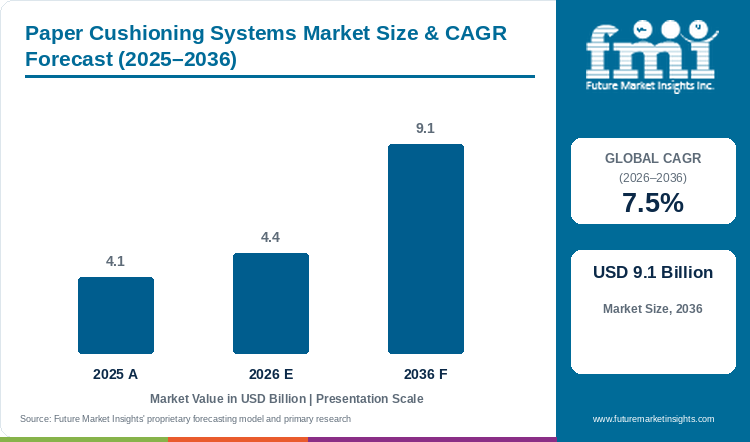
Valued at USD 4.1 Billion during 2025, worldwide paper cushioning systems sales are estimated to hit USD 4.4 Billion across 2026 before climbing toward a projected USD 9.1 Billion by 2036 on an expected 7.5% CAGR.
Crimping flat fanfold kraft sheets through counter-rotating gears at the packing bench replaces bulky pre-inflated polyethylene air pillows and eliminates single-use plastic surcharges across parcel fulfillment depots. As a result, high-velocity distribution centers convert dense paper stacks on demand to prevent interior load shifting while freeing warehouse pallet racking previously occupied by film rolls. In September 2025, EUR-Lex legal summaries of European Union Regulation (EU) 2025/40 (applying generally from August 2026) corroborated this shift by confirming a 65% packaging waste recycling target for 2025 and a 50% empty-space cap for e-commerce and transport packaging [1]. Paper pad systems are consequently projected to hold 41.2% of system type demand in 2026 because stitched multi-ply cushions absorb severe transit drops across protective packaging lines. Future Market Insights analysts estimate that global paper cushioning systems revenue moves off a USD 4.1 Billion level in 2025 to reach an anticipated USD 4.4 Billion across 2026, before surging toward a projected USD 9.1 Billion by 2036 at a 7.5% CAGR and lifting yearly market turnover by an expected USD 4.7 Billion over the 2026 baseline. Across major national markets, ten-year expansion is predicted to span 7.0% in Germany up to 7.9% in the USA, although cellulose moisture absorption in humid shipping corridors still limits heavy static metal bracing.
Key Market Trends & Insights
- By system type: Paper pad systems (41.2% projected for 2026) lead converter installations because stitched multi-ply pads absorb severe drop impacts under ISTA 3A parcel testing.
- By operation: On-demand automated units (39.3% expected for 2026) anchor pack-station upgrades through foot-pedal triggers and blade-free rotary knives that eliminate manual tearing.
- By paper source: Recycled kraft (43.0% anticipated for 2026) dominates consumable pull as post-consumer secondary fiber qualifies for reduced extended producer responsibility fee schedules.
- By end use: E-commerce (45.0% estimated for 2026) generates the largest demand share through high-velocity omnichannel fulfillment lines replacing plastic air cushions.
Regional Highlights
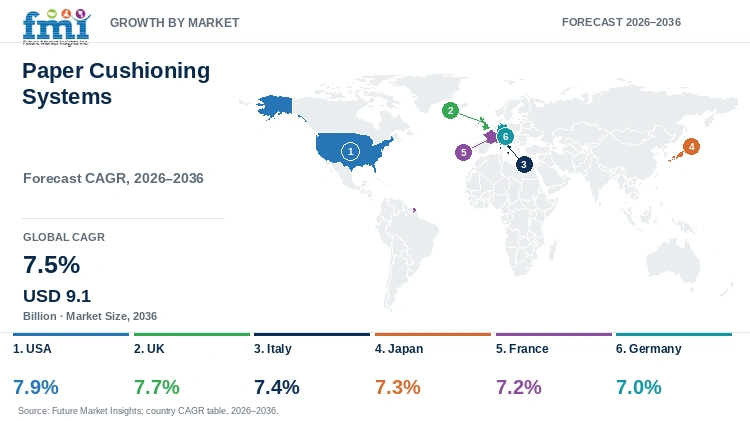
- Top national growth pace: The USA is projected to top major national markets at a 7.9% compound annual rate from 2026 to 2036 on state plastic void-fill phase-outs and third-party logistics automation.
- European and Asian expansion: British fulfillment depots are expected to advance 7.7% per year and Italian exporters are anticipated to gain 7.4% ahead of predicted Japanese demand at 7.3%, whereas French hubs are forecast to grow 7.2% and German lines are estimated to post 7.0% through 2036.
Market Size & Forecast
Table 1: Market Size and Forecast for the Paper Cushioning Systems Market (USD billion and CAGR percentage), 2025 to 2036
| Metric | Value |
|---|---|
| 2025 Market Size | USD 4.1 Billion |
| Estimated Market Size in 2026 | USD 4.4 Billion |
| Projected Market Size by 2036 | USD 9.1 Billion |
| CAGR, 2026 to 2036 | 7.5% |
| Added Revenue, 2026 to 2036 | USD 4.7 Billion |
Omnichannel distribution centers throughout North American and European fulfillment corridors face severe dock congestion from storing pre-inflated bubble rolls alongside escalating plastic waste liabilities. In its October 2025 updated Containers and Packaging page reporting 2018 baseline measurements, the U.S. Environmental Protection Agency recorded an 80.9% recycling rate for paper and paperboard packaging (33.89 million tons recycled) versus 13.6% for plastic packaging [2]. Warehouse directors are therefore replacing film inflators with on-demand fanfold void fill packaging systems to avoid extended producer responsibility penalties and free pallet racking.
Fulfillment Pack-Station Converter Fleet and Kraft Consumable Sizing
Table 2: Fulfillment Pack-Station Converter Fleet and Kraft Consumable Sizing for the Paper Cushioning Systems Market, mixed historical and forecast years from 2025 to 2036
| Metric | 2025 | 2026 | 2036 |
|---|---|---|---|
| Market size (USD Billion) | 4.1 | 4.4 | 9.1 |
| Active pack-station paper converters worldwide (thousand units) | 410 to 445 | 440 to 480 | 890 to 960 |
| Annual kraft consumable paper converted (million metric tons) | 2.3 to 2.5 | 2.5 to 2.7 | 5.1 to 5.6 |
| Annual consumable spend per active converter (USD) | 8,400 to 9,200 | 8,600 to 9,400 | 9,100 to 9,800 |
Operational note: Active converter fleet figures reflect commercial razor-and-blade installed bases across third-party logistics depots and retail fulfillment centers, assuming an annual pull of 5.5 to 5.8 metric tons of 50 gsm to 90 gsm fanfold or roll-stock paper per pack station.
Worldwide active pack-station paper converters are projected to climb off 410 to 445 thousand units during 2025 to reach an estimated 440 to 480 thousand units across 2026, before scaling toward an expected 890 to 960 thousand units by 2036. Annual kraft consumable paper converted at packing benches is concurrently anticipated to rise from 2.5 to 2.7 million metric tons for 2026 to a predicted 5.1 to 5.6 million metric tons in 2036 while yearly consumable spend per converter is forecast at USD 9,100 to 9,800.
Warehouse Storage Efficiency: Fanfold Kraft vs. Pre-Inflated Foam/Bubble
Table 3: Warehouse Storage Efficiency Indicators for the Paper Cushioning Systems Market (Cubic Meters and Ratios), mixed historical and forecast years from 2025 to 2036
| Metric | 2025 | 2026 | 2036 |
|---|---|---|---|
| Unexpanded fanfold pallet volume (cubic meters) | 1.15 | 1.15 | 1.15 |
| Expanded 3D paper pad yield per pallet (cubic meters) | 16.5 to 18.0 | 17.0 to 18.5 | 19.0 to 21.0 |
| Equivalent pre-inflated bubble truckloads replaced per trailer | 12 to 14 | 13 to 15 | 15 to 17 |
| Pack-station reload downtime per shift (minutes) | 3.5 to 4.2 | 3.2 to 3.8 | 1.8 to 2.4 |
Table 4: End-Use Sector Protective Cushioning Spend Indicators for the Paper Cushioning Systems Market (USD Billion and percentages), 2026
| Metric | Value | Basis |
|---|---|---|
| Market size, 2026 | USD 4.4 Billion | Report value |
| E-commerce sector revenue, 2026 | USD 2.0 Billion | 45.0% share |
| Paper pad systems revenue, 2026 | USD 1.8 Billion | 41.2% share |
| Recycled kraft consumable revenue, 2026 | USD 1.9 Billion | 43.0% share |
A single unexpanded fanfold pallet occupying 1.15 cubic meters yields an estimated 17.0 to 18.5 cubic meters of 3D paper pads during 2026 and is projected to produce 19.0 to 21.0 cubic meters by 2036, replacing an anticipated 15 to 17 truckloads of pre-inflated bubble film per trailer. Adhesive splice-strip bundles are also expected to cut pack-station reload downtime per shift from 3.2 to 3.8 minutes in 2026 down to a predicted 1.8 to 2.4 minutes in 2036, corroborating 2026 revenue estimates of USD 2.0 Billion in e-commerce alongside USD 1.9 Billion in recycled kraft and USD 1.8 Billion in paper pad systems.
Analyst Perspective
"Fulfillment logistics directors are removing single-use plastic air pillows from pack stations to satisfy extended producer responsibility rules. Equipment suppliers that pair splice-ready fanfold recycled kraft stacks with automated crimping converters secure multi-year consumable agreements."
- Nandini Roy Choudhury, Principal Consultant, Future Market Insights.
How is the paper cushioning systems market segmented?
The paper cushioning systems market is segmented by system type, operation, paper source, end use, and region. In 2026, paper pad systems are projected at 41.2%, on-demand automated units are expected at 39.3%, recycled kraft is anticipated at 43.0%, and e-commerce is estimated at 45.0%.
By system type: Paper pad systems, paper void-fill systems, paper wrap systems, and paper air-cushion alternatives.
By operation: On-demand automated, semi-automatic, manual, and inline integrated.
By paper source: Recycled kraft, virgin kraft, mixed fiber, and certified sustainable paper.
By end use: E-commerce, electronics, industrial components, and home & personal care.
What Supports Paper Pad Systems as a Preferred Choice in the System Type Category?
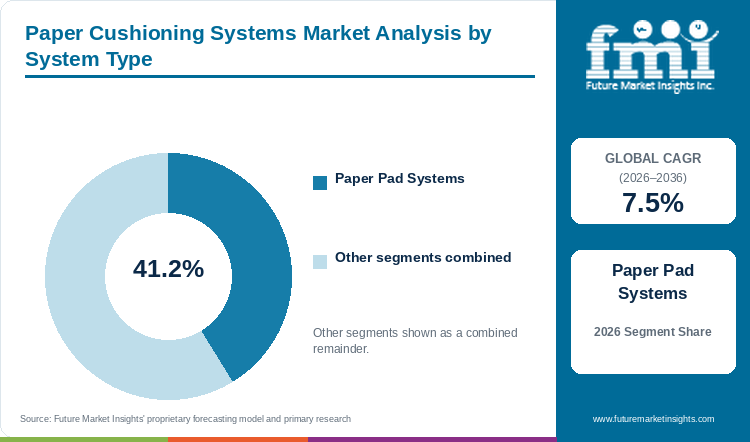
Paper pad systems are projected to capture 41.2% of the system type category in 2026, supported by multi-ply compression resistance.
Table 5: System Type Share for the Paper Cushioning Systems Market (percentage share), 2026
| System Type | Share (2026) |
|---|---|
| Paper Pad Systems | 41.2% |
| Other Segments Combined | 58.8%* |
| Total | 100.0% |
*Note: Aggregate share of paper void-fill alongside wrap and air-cushion alternative units in 2026.
Table 6: System Type Leadership and Market Growth for the Paper Cushioning Systems Market (segment and CAGR percentage), 2026 to 2036
| Metric | Value |
|---|---|
| Global CAGR (2026 to 2036) | 7.5% |
| Leading Segment | Paper Pad Systems |
Pulling two or three layers of recycled or virgin kraft through counter-rotating gears creates dense shock-absorbing dunnage packaging pads that brace heavy industrial goods. These crimped pads prevent internal load shifting and corner crushing across commercial shipping lanes. Industrial electronics and automotive parts shippers frequently pair multi-ply pads with molded fiber pulp packaging trays to absorb multi-drop transit shocks. High compression recovery under static metal loads keeps multi-ply pad converters ahead of single-ply void-fill units.
- Projections place paper pad systems at 41.2% of 2026 system type demand (USD 1.8 Billion estimated) because stitched multi-ply geometry passes ISTA 3A parcel drop protocols.
- In August 2026, the American Forest & Paper Association announced that 61% to 65% of paper and 70% to 75% of cardboard available for recovery in the U.S. were recycled in 2025 (45 million tons total, with U.S. mills consuming 31.4 million tons) [3].
Why Are Buyers Selecting On-Demand Automated Units Within the Operation Category?
On-demand automated units are expected to hold 39.3% of the operation segment in 2026, owing to blade-free rotary cutting.
Motorized converting heads mounted directly above packing benches integrate foot-pedal triggers and barcode length controls with enclosed rotary cut-off knives. Dispensing pre-measured kraft pads at speeds above 1.4 meters per second eliminates manual tearing delays and reduces operator wrist strain. High-speed automated dispensers also run alongside honeycomb packing paper wraps during peak holiday fulfillment shifts. Warehouse engineering teams specify motorized dispensers to keep pack-station conveyors moving without bottlenecks.
- Expectations assign on-demand automated converters 39.3% of 2026 operation turnover by cutting pad dispensing cycle times at multi-shift pack benches.
- In March 2026, Ranpak Holdings Corp. reported that its active installed base reached 145.8 thousand protective packaging machines at year-end 2025 (including 34.1 thousand cushioning and 88.8 thousand void-fill systems) while 2025 net revenue rose 7.1% to USD 395.0 Million [4].
Which Market Conditions Keep Recycled Kraft Relevant Within the Paper Source Category?
Recycled kraft is anticipated to command 43.0% of the paper source category in 2026, reinforced by eco-modulated fee discounts.
Secondary fiber refined from recovered corrugated board and packaging scrap between 50 gsm and 90 gsm delivers reliable flute stiffness and three-dimensional crumple memory inside forming chutes. Unbleached recovered furnish lowers raw material expenditure for converter operators when compared with virgin softwood pulp. Retail shippers favor recycled paper packaging dunnage because residential recipients can place the entire carton and interior pad into curbside recycling bins without material separation. These cost and circularity advantages keep recycled kraft as the primary consumable stock across parcel depots.
- Recycled kraft is slated to represent 43.0% of 2026 paper source volume (USD 1.9 Billion anticipated) as retail ESG scorecards mandate post-consumer fiber content.
- In October 2026, the Confederation of European Paper Industries reported in its Monitoring Report 2025 that 76.4% of all paper and board consumed in Europe was recycled in 2025, surpassing the 76% target set for 2030 [5].
How Does E-Commerce Meet Changing Application Needs Within the End Use Category?
E-commerce is predicted to secure 45.0% of the end use segment in 2026, enabled by high-speed pack-station void dispensing.
Omnichannel fulfillment centers process thousands of mixed-SKU parcels per hour, creating continuous demand for rapid interior void filling that stops item migration during courier sorting. Replacing non-recyclable polyethylene air pillows with on-demand converters and fiber based packaging pads allows online retailers to ship single-material curb-recyclable boxes. In addition to this, paper dunnage eliminates consumer complaints over disposable plastic film waste and lowers extended producer responsibility fee assessments across European and North American retail networks.
- Forecasts credit e-commerce with 45.0% of 2026 end use revenue (USD 2.0 Billion projected) through automated box-sizing and overhead void-fill dispensing lines.
- Pitney Bowes Parcel Shipping Index data showed that U.S. parcel shipping volume reached 23.1 billion shipments in 2025 (up 3.3% year-over-year, or 732 parcels per second) and is projected to hit 31 billion by 2031 [6].
What are the drivers, restraints, and opportunities in the paper cushioning systems market?
In the paper cushioning systems market, statutory plastic void-fill bans accelerate converter placements while tropical humidity softens recycled kraft fibers and vision-guided right-sizing dispensers open recurring automation contracts.
- Driver: Statutory prohibitions on single-use plastic air pillows and expanded polystyrene loose fill compel fulfillment operators to install automated paper cushioning converters.
- Restraint: Moisture absorption in tropical and unconditioned shipping corridors reduces recycled kraft fiber stiffness and compression recovery under heavy static loads.
- Opportunity: Pairing 3D carton-scanning sensors with inline die-cut kraft and paper bubble dispensers creates high-margin automation contracts across parcel hubs.
Growth Analysis and Future Potential: Qualitative Demand Catalysts
National plastic packaging taxes and empty-space limits are accelerating the removal of low-density polyethylene air pillow lines in favor of paper packaging systems across European and North American distribution centers. In its October 2025 release reporting 2023 member-state data, Eurostat confirmed that EU packaging waste totaled 79.7 million tonnes (177.8 kilograms per inhabitant), with paper and cardboard forming 40.4% (32.3 million tonnes) and overall EU packaging recycling reaching 67.5% [7]. To comply with circular recovery mandates, fulfillment operators install free-on-loan converters that crimp fanfold kraft into high-loft pads. This transition cuts warehouse storage space for packing materials and keeps outbound parcels 100% curbside recyclable.
Risk Assessment of the Paper Cushioning Systems Market: Operational and Mechanical Friction
Cellulose fiber sensitivity to ambient humidity and sorting loss for non-corrugated grades remain key operational restraints in unconditioned transit lanes. When recycled kraft paper encounters relative humidity above 75%, moisture absorption weakens hydrogen bonding between fibers and lowers crush resistance. In its October 2025 updated Material-Specific page reporting 2018 baseline measurements, the U.S. Environmental Protection Agency recorded 67.39 million tons of municipal paper and paperboard generation with 45.97 million tons recycled (68.2% recovery), whereas non-corrugated paper packaging containers achieved 20.8% recovery [8]. Furthermore, high-speed crimping gears generate cellulose dust that requires periodic cleaning of conveyor optical sensors.
Commercial Opportunity Analysis: System Differentiation and Value-Add Formats
Replacing traditional polyethylene bubble wrap packaging with tensioned 3D honeycomb kraft and tissue dispensers creates profitable growth avenues for equipment manufacturers. Die-cut kraft rolls expand on demand at the packing bench into a hexagonal three-dimensional lattice that interlocks without adhesive tape. In June 2026, Storopack Hans Reichenecker GmbH launched its PAPERwrap product in Metzingen as an alternative to air bubble film, combining single-ply or two-ply honeycomb kraft paper with interior tissue dispensed at speeds up to 98 feet per minute [9]. Rising adoption of expandable honeycomb kraft wraps helps suppliers lock in multi-year consumable agreements.
Paper Cushioning Systems Market by Country (2026 to 2036)
Future Market Insights estimates show that the USA is projected to lead major national paper cushioning systems markets with a 7.9% CAGR from 2026 to 2036, while Germany is expected to expand 7.0% per year over the decade. Regional growth differences reflect national plastic packaging tax rates and e-commerce parcel velocities alongside how effectively suppliers mitigate high-humidity fiber softening.
Table 7: Country CAGR and Primary Growth Levers for the Paper Cushioning Systems Market (CAGR percentage and operational drivers), 2026 to 2036
| Country | CAGR (2026 to 2036) | Primary Growth Lever |
|---|---|---|
| USA | 7.9% | State-level EPR plastic air-pillow phase-outs and high-speed 3PL pack-station automation |
| UK | 7.7% | UK Plastic Packaging Tax fee modulation and retail curb-recyclable parcel mandates |
| Italy | 7.4% | CONAI eco-modulated packaging fees and luxury ceramic and fashion export protection |
| Japan | 7.3% | Plastic Resource Circulation Act compliance and compact urban warehouse space optimization |
| France | 7.2% | AGEC Law single-use plastic void-fill prohibition and heavy industrial spare-parts bracing |
| Germany | 7.0% | VerpackG dual-system recycling compliance and vision-guided automotive parts dunnage |
Source: Future Market Insights analysis
USA Paper Cushioning Systems Market Outlook (2026 to 2036)
Unlike global markets governed by a single federal packaging tax, the United States is uniquely driven by state-level extended producer responsibility laws in California and Colorado alongside private carrier dimensional-weight pricing. American demand is consequently projected to expand on a 7.9% yearly path through 2036 as regional fulfillment centers automate high-speed pack stations across interstate logistics corridors. U.S. Census Bureau retail reports from August 2026 confirmed that second-quarter 2026 domestic e-commerce sales reached USD 340.2 Billion (up 12.2% year-over-year, or 17.1% of total retail trade), driving heavy procurement of protective pads and padded mailers [10]. However, warehouse operators contend with cellulose dust on conveyor photo-eyes, which Ranpak Holdings Corp. and Pregis LLC resolve through enclosed dispensers.
Key takeaway: In the USA, state extended producer responsibility statutes and nationwide plastic air-pillow removal across fulfillment hubs anchor recurring fanfold kraft consumable agreements.
UK Paper Cushioning Systems Market Outlook (2026 to 2036)
United Kingdom paper cushioning systems sales are expected to advance at a 7.7% compound annual clip through 2036 under statutory fiscal penalties on low-recycled-content plastics. What sets the British market apart from global baselines is HM Revenue & Customs enforcement of the Plastic Packaging Tax on films containing under 30% recycled polymer alongside supermarket home-delivery pledges. In August 2026, HM Revenue & Customs official statistics confirmed that the UK Plastic Packaging Tax accrued GBP 250 Million in FY 2025 to 2026 at GBP 223.69 per tonne across 5,142 registered businesses, taxing 1,107 thousand tonnes of plastic [11]. Because damp winter depot air softens unbleached kraft fibers, Smurfit Westrock and Ranpak supply high-grammage stacks with under-bench converters.
Key takeaway: In the UK, statutory Plastic Packaging Tax surcharges and modulated extended producer responsibility fees compel retail logistics depots to adopt moisture-resistant fanfold kraft converters.
Italy Paper Cushioning Systems Market Outlook (2026 to 2036)
In June 2025, Consorzio Nazionale Imballaggi (CONAI) reported that Italy recycled 76.7% of national packaging in 2024 (10.7 million tonnes out of 13.95 million tonnes) and recovered 4.605 million tonnes of paper and cardboard across nearly 7,400 municipalities [12]. Distinct from global mass-merchandise parcel hubs, Italy's on-the-ground demand centers on protecting fragile artisanal ceramics and luxury leather goods while qualifying for discounted CONAI eco-modulated fee bands. Backed by these regional export and fee modulation advantages, Italian paper cushioning systems turnover is anticipated to climb by 7.4% annually between 2026 and 2036. To prevent rigid pads from scratching polished leather and ceramic surfaces, equipment makers install foot-pedal 3D honeycomb kraft dispensers at manual packing benches.
Key takeaway: In Italy, CONAI eco-modulated packaging fee incentives and high-value ceramic and fashion export shipments drive procurement of tensioned 3D honeycomb paper wrap systems.
Japan Paper Cushioning Systems Market Outlook (2026 to 2036)
Acute multi-story warehouse space scarcity in Tokyo and Osaka alongside meticulous consumer unboxing standards differentiate Japan from Western bulk fulfillment markets. Because storing pre-inflated plastic bubble rolls consumes expensive urban floor area, Japanese logistics operators are predicted to expand paper cushioning systems spending at a 7.3% yearly pace through 2036. METI Japan survey findings released in August 2025 showed that FY2024 domestic B2C e-commerce rose 5.1% to JPY 26.1 Trillion (including JPY 15.22 Trillion in merchandise sales at a 9.78% e-commerce ratio) while B2B trade reached JPY 514.4 Trillion [13]. While domestic retail buyers reject coarse grey recycled dunnage on presentation grounds, converter manufacturers win urban accounts by supplying quiet tabletop units that form pleated white and virgin kraft pads.
Key takeaway: In Japan, tight metropolitan warehouse space constraints and strict unboxing presentation standards favor compact tabletop converters dispensing pleated white and virgin kraft pads.
France Paper Cushioning Systems Market Outlook (2026 to 2036)
French paper cushioning systems sales are forecast to rise 7.2% per year through 2036 as statutory bans eliminate flexible film pillows from domestic shipping lanes. Whereas many international markets rely on voluntary corporate pledges, France stands apart through strict Loi AGEC enforcement that mandates a 20% single-use plastic packaging reduction and complete plastic phase-out by 2040. In February 2025, the French Ministry of Ecological Transition marked five years of the anti-waste circular economy law by confirming accelerated removal of single-use plastic void fill across domestic distribution corridors [14]. Because heavy aerospace and automotive metal castings crush single-ply void fill during long-haul transit, packaging engineers at Storopack and Signode deploy dual-motor converters crimping 90-gsm two-ply kraft into structural blocking pads.
Key takeaway: In France, statutory Loi AGEC prohibitions on single-use plastic void fill and heavy automotive shipping requirements drive demand for dual-motor multi-ply kraft pad converters.
Germany Paper Cushioning Systems Market Outlook (2026 to 2036)
Compared with broader international fulfillment markets, Germany is uniquely shaped by stringent BG RCI workplace ergonomics rules banning exposed cutting knives alongside heavy automotive aftermarket export crating. In March 2026, Federal Statistical Office (Destatis) and Eurostat 2023 waste balance tables documented that Germany generated 215.2 kilograms of packaging waste per inhabitant and recycled 149.3 kilograms per inhabitant across its dual-system recovery network [15]. Backed by high plastic licensing tariffs, German paper cushioning systems demand is estimated to post a 7.0% compound annual growth rate from 2026 to 2036. To offset elevated domestic recovered-paper prices and satisfy strict German safety inspectors, Storopack and Ranpak integrate overhead 3D carton vision scanners with enclosed rotary-blade converters that eliminate kraft over-dispensing.
Key takeaway: In Germany, strict workplace ergonomics rules and high recovered-paper costs push industrial shippers toward vision-guided inline converters that minimize kraft consumable waste.
Full report country CAGRs cover: North America; Latin America; Western Europe; Eastern Europe; East Asia; South Asia and Pacific; Middle East and Africa.
Who are the notable companies in the paper cushioning systems market?
Ranpak Holdings Corp., Smurfit Westrock, International Paper, Signode Industrial Group, Sonoco Products Company, Pratt Industries, Storopack Hans Reichenecker GmbH, and Pregis LLC are the notable companies in the paper cushioning systems market.
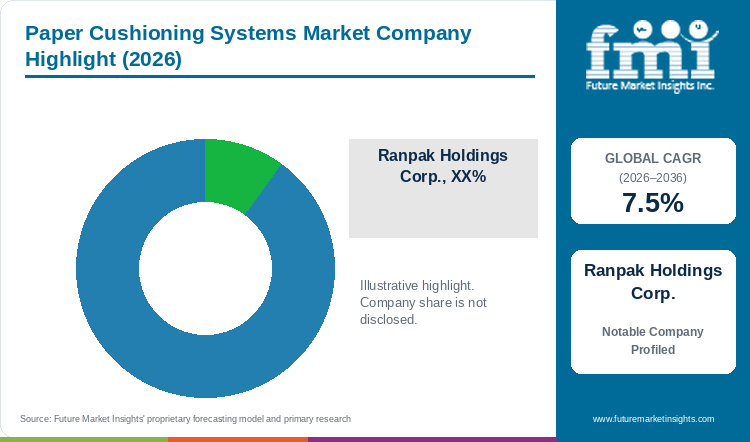
Future Market Insights projections show that commercial competition in the paper cushioning systems sector divides between dedicated converter equipment builders and backward-integrated containerboard and kraft paper mills. Equipment specialists including Ranpak Holdings Corp. and Storopack Hans Reichenecker GmbH alongside Pregis LLC engineer high-speed crimping dispensers and place them at pack stations under free-on-loan agreements tied to fanfold consumables. Meanwhile, integrated paper groups such as Smurfit Westrock and International Paper use captive pulp mills to guarantee uninterrupted kraft roll and fanfold supply. Fulfillment procurement teams select vendors based on linear dispensing speed and jam-free uptime alongside verified ISTA drop-test cushioning performance.
- Dedicated Paper Cushioning System Specialists: Ranpak Holdings Corp. and Storopack Hans Reichenecker GmbH alongside Pregis LLC engineer high-speed pad and honeycomb wrap converters paired with proprietary fanfold kraft consumables.
- Vertically Integrated Fiber and Kraft Leaders: Smurfit Westrock and International Paper together with Pratt Industries operate large recycled and virgin kraft paper mills linked to protective converting networks.
- Diversified Industrial Protective Platforms: Signode Industrial Group and Sonoco Products Company supply heavy-duty paper dunnage and engineered fiber bracing for industrial and appliance transit.
Competitive Benchmarking: Paper Cushioning Systems Market
Table 8: Competitive Benchmarking for the Paper Cushioning Systems Market (qualitative capability ratings), 2026
| Company | Automated Converter Technology | Captive Kraft Mill Integration | E-Commerce & 3PL Fleet Reach | Geographic Reach |
|---|---|---|---|---|
| Ranpak Holdings Corp. | High | Medium | High | High |
| Smurfit Westrock | High | High | High | High |
| International Paper | Medium | High | High | High |
| Signode Industrial Group | High | Medium | Medium | High |
| Sonoco Products Company | Medium | High | Medium | High |
| Pratt Industries | Medium | High | High | Medium |
| Storopack Hans Reichenecker GmbH | High | Medium | High | High |
| Pregis LLC | High | Medium | High | High |
Scoring basis: Automated Converter Technology earns a High rating where a supplier manufactures proprietary motorized pad or optical right-sizing machinery, while Medium reflects narrower dispenser lines. Captive Kraft Mill Integration is High when the manufacturer operates backward-integrated virgin or recycled paper mills and Medium when sourcing base paper externally. E-Commerce & 3PL Fleet Reach and Geographic Reach reflect installed converter fleet density across multinational parcel fulfillment hubs versus single-region industrial channels.
Key Developments in the Paper Cushioning Systems Market
- In January 2026, Pregis LLC launched the EasyPack Strata high-speed on-demand paper cushioning system, dispensing structured single-ply or dual-ply 100% recycled FSC-certified paper pads at speeds up to 60 inches per second with a movable magnetic HMI [16].
- In September 2026, Smurfit Westrock plc released a five-country European consumer recycling study across Western and Northern Europe showing up to 97% cardboard-from-plastic separation ahead of EU PPWR implementation [17].
- In September 2025, Pregis LLC opened a 477,000-square-foot zero-waste paper converting center in Elgin that produces over 1 billion curbside-recyclable paper solutions annually while diverting 33,000 tons of waste [18].
Key Players in the Paper Cushioning Systems Market
Dedicated Paper Cushioning System Specialists
- Ranpak Holdings Corp.
- Storopack Hans Reichenecker GmbH
- Pregis LLC
Vertically Integrated Fiber and Kraft Packaging Leaders
- Smurfit Westrock
- International Paper
- Pratt Industries
Diversified Industrial Protective Packaging Platforms
- Signode Industrial Group
- Sonoco Products Company
Paper Cushioning Systems Market - Report Scope
Table 9: Report Scope for the Paper Cushioning Systems Market (coverage fields and definitions), 2026 to 2036
| Coverage field | Report scope |
|---|---|
| Market breakdown | System Type; Operation; Paper Source; End Use; Region |
| Quantitative Units | USD Billion |
| Market Definition | Includes supplier revenue from paper cushioning converters, automated dispensing equipment, and dedicated fanfold and roll-stock kraft paper consumables used for protective pad, void-fill, wrap, and air-cushion alternative applications. Category Scope Note: Captures B2B equipment lease/sale and dedicated converting paper consumable turnover at pack stations, excluding outer corrugated shipping cartons, molded pulp egg trays, and polymer foam or film dunnage. |
| Regions Covered | North America; Latin America; Western Europe; Eastern Europe; East Asia; South Asia and Pacific; Middle East and Africa |
| Countries Covered | USA, UK, Italy, Japan, France, Germany, and additional countries in the full report |
| Key Companies Covered | Ranpak Holdings Corp., Smurfit Westrock, International Paper, Signode Industrial Group, Sonoco Products Company, Pratt Industries, Storopack Hans Reichenecker GmbH, Pregis LLC |
| Forecast Period | 2026 to 2036 |
| Approach | Primary and secondary research with rigorous market triangulation. |
Paper Cushioning Systems Market - Research Methodology
Table 10: Research Methodology for the Paper Cushioning Systems Market (research methods and approach), 2026 edition
| Method | Approach |
|---|---|
| Primary Research | Primary interviews were conducted with converter equipment engineers, kraft paper mill directors, third-party logistics fulfillment managers, e-commerce packaging procurement leads, and industry experts across the value chain to validate market trends, converter placement economics, consumable pull rates, and purchasing decisions. |
| Secondary Research | Secondary research included company annual reports, investor presentations, statutory packaging waste filings from the European Environment Agency and U.S. EPA, national paper recycling consortium reports, ISTA drop-test standards, trade journals, product literature, and other publicly available sources relevant to the market. |
| Market Sizing and Forecasting | Market sizing and forecasting for the 2026 to 2036 forecast period were developed using top-down and bottom-up approaches to assess active pack-station converter fleets, annual kraft consumable tonnage per unit, price points, and fulfillment automation adoption trends. |
| Data Triangulation and Validation | Data is validated against macro-economic indicators, e-commerce parcel shipment velocities, extended producer responsibility regulatory schedules, and historical trend analysis to confirm high accuracy without double counting outer corrugated cartons or plastic void fill. |
| Country Forecasting Model | Country-level CAGRs are modeled by calibrating the 7.5% global baseline against national extended producer responsibility plastic surcharges, B2C parcel shipment volumes, recovered paper furnish availability, and warehouse pack-station automation density. |
| Country Forecasting Model | Country-level CAGRs are modeled by calibrating the 7.5% global baseline against national extended producer responsibility plastic surcharges, B2C parcel shipment volumes, recovered paper furnish availability, and warehouse pack-station automation density. |
| Operational Benchmark Traceability | Operational metrics in Tables 2, 3, and 4 (active converter fleets, annual kraft consumable tonnage per station, and fanfold expansion ratios) trace to EUR-Lex PPWR and U.S. EPA packaging data, AF&PA and Cepi recycling reports, Eurostat waste records, and converter OEM disclosures. |
Paper Cushioning Systems Market by Segments
Paper Cushioning Systems Market segmented by System Type:
- Paper Pad Systems
- Paper Void-Fill Systems
- Paper Wrap Systems
- Paper Air-Cushion Alternatives
Paper Cushioning Systems Market segmented by Operation:
- On-Demand Automated
- Semi-Automatic
- Manual
- Inline Integrated
Paper Cushioning Systems Market segmented by Paper Source:
- Recycled Kraft
- Virgin Kraft
- Mixed Fiber
- Certified Sustainable Paper
Paper Cushioning Systems Market segmented by End Use:
- E-commerce
- Electronics
- Industrial Components
- Home & Personal Care
Paper Cushioning Systems Market by Region
- North America
- United States
- Canada
- Latin America
- Brazil
- Mexico
- Argentina
- Chile
- Western Europe
- Germany
- France
- United Kingdom
- Italy
- Spain
- Benelux
- Nordics
- Eastern Europe
- Poland
- Czech Republic
- Romania
- Hungary
- East Asia
- China
- Japan
- South Korea
- South Asia and Pacific
- India
- ASEAN
- Australia and New Zealand
- Middle East and Africa
- GCC Countries
- South Africa
- Türkiye
- Israel
Research Sources and Bibliography
- [1] Publications Office of the European Union. (2025, September 26). Packaging and packaging waste (from 2026) — Summary of Regulation (EU) 2025/40. EUR-Lex.
- [2] U.S. Environmental Protection Agency. (2025, October 23). Containers and Packaging: Product-Specific Data (2018 MSW Baseline Dataset). US EPA.
- [3] American Forest & Paper Association. (2026, August 28). Paper Industry Announces 2025 U.S. Paper Recycling Rates. AF&PA.
- [4] Ranpak Holdings Corp. (2026, March 5). Ranpak Holdings Corp. Reports Fourth Quarter and Full Year 2025 Financial Results. Ranpak Investor Relations.
- [5] Confederation of European Paper Industries. (2026, October 1). European Paper Recycling Council Monitoring Report 2025 for the European Declaration on Paper Recycling 2021-2030. Cepi.
- [6] Pitney Bowes Inc. (2026, April 15). Pitney Bowes Parcel Shipping Index. Pitney Bowes.
- [7] Eurostat. (2025, October 10). Packaging waste statistics. European Commission Eurostat.
- [8] U.S. Environmental Protection Agency. (2025, October 23). Paper and Paperboard: Material-Specific Data (2018 MSW Baseline Dataset). US EPA.
- [9] Storopack Hans Reichenecker GmbH. (2026, June 1). PAPERwrap: With its PAPERwrap product, Storopack is launching a smart alternative to traditional air bubble film. Storopack News & Press.
- [10] U.S. Census Bureau. (2026, August 18). Quarterly Retail E-Commerce Sales Report. U.S. Department of Commerce.
- [11] HM Revenue & Customs. (2026, August 27). Plastic Packaging Tax (PPT) statistics commentary. GOV.UK Official Statistics.
- [12] Consorzio Nazionale Imballaggi. (2025, June 25). Packaging recycling: Italy reaches 76.7%. CONAI Press Releases.
- [13] Ministry of Economy, Trade and Industry. (2025, August 26). Results of FY2024 E-Commerce Market Survey Compiled. METI Japan.
- [14] Ministere de la Transition ecologique. (2025, February 10). 5 ans de la loi anti-gaspillage pour une economie circulaire. Gouvernement de la Republique Francaise.
- [15] Statistisches Bundesamt. (2026, March 10). Brief overview waste balance. Destatis German Federal Statistical Office.
- [16] Pregis LLC. (2026, January 27). Pregis Launches EasyPack Strata, a High-Speed On-Demand Paper System Designed for Versatile Protection in Fulfillment Operations. Pregis Knowledge Hub.
- [17] Smurfit Westrock plc. (2026, September 3). New European study finds consumers are actively separating Bag-in-Box packaging for recycling. Smurfit Westrock Newsroom.
- [18] Pregis LLC. (2025, September 23). Pregis Opens New Illinois Manufacturing Facility, Creating a Paper Converting Center of Excellence. Pregis Knowledge Hub.
- [19] Pregis LLC. (2025, May 20). Pregis Expands its Curbside-Recyclable Paper Packaging Portfolio with White EasyPack GeoTerra. Pregis Knowledge Hub.
- [20] International Paper Company. (2026, April 15). 2025 Sustainability Report. International Paper.
- [21] Signode Industrial Group LLC. (2025, October 16). What are Dunnage Systems?. Signode News.
- [22] Sonoco Products Company. (2026, February 16). Sonoco Reports Fourth Quarter and Full Year 2025 Results. Sonoco Investor Relations.
This bibliography is provided for reader reference and is not exhaustive. The full report contains the complete reference list and detailed citations.
This Report Answers
- How large is the paper cushioning systems market in 2026 and what is forecast for 2036?
- Which regulatory and fulfillment automation pressures support demand for paper cushioning systems?
- What supports paper pad systems as the leading segment in the system type category?
- Why do on-demand automated converters capture a major share of the operation category?
- How do country growth rates differ across the USA, UK, Italy, Japan, France, and Germany?
- Which leading companies supply paper cushioning converters and fanfold kraft consumables today?
- What technical factors restrain paper cushioning adoption in heavy-load and humid shipping lanes?
- What should fulfillment procurement teams evaluate before selecting a paper cushioning system?
Frequently Asked Questions
How big is the paper cushioning systems market in 2026, and what is forecast for 2036?
Global paper cushioning systems turnover is estimated at USD 4.4 Billion in 2026 (up from USD 4.1 Billion in 2025) and is projected to climb to USD 9.1 Billion by 2036 as parcel shippers replace plastic air pillows with curb-recyclable kraft converters.
What is the CAGR for the paper cushioning systems market from 2026 to 2036?
Future Market Insights projects an expected 7.5% compound annual growth rate from 2026 through 2036, lifting yearly omnichannel fulfillment turnover by an anticipated USD 4.7 Billion above the 2026 level.
Which system type segment leads the paper cushioning systems market?
Paper pad systems are projected to capture 41.2% of 2026 system type demand (an estimated USD 1.8 Billion) because counter-rotating crimping gears form dense multi-ply cushions that brace heavy industrial and retail parcels.
Which paper source segment leads the paper cushioning systems market?
Recycled kraft is expected to account for 43.0% of 2026 paper source volume (an anticipated USD 1.9 Billion) as post-consumer secondary fiber lowers extended producer responsibility fee charges across European and North American retail shipments.
Which country has a strong growth outlook during the assessment period?
FMI estimates show that the USA is predicted to lead major national markets with an expected 7.9% CAGR through 2036, backed by USD 340.2 Billion in quarterly domestic e-commerce shipments and state plastic void-fill phase-outs.
Who are the key players in the market?
Major suppliers include Ranpak Holdings Corp., Smurfit Westrock, International Paper, Signode Industrial Group, Sonoco Products Company, Pratt Industries, Storopack Hans Reichenecker GmbH, and Pregis LLC, competing across automated pack-station converters and recycled fanfold kraft consumables.
Preview the report firsthand - request a free sample
Get SampleGet the brochure for pricing and purchase details.
Get PDFTable of Content
- Key Takeaways
- Market Size and CAGR
- Top Growth Driver
- Fastest Growing Segment
- Leading Region
- Key Companies
- Emerging Opportunities
- Executive Summary
- Global Market Outlook
- Demand-side Trends
- Supply-side Trends
- Technology Roadmap Analysis
- Analysis and Recommendations
- Analyst Perspective (What is happening? Why now? What should investors know?)
- Key Questions Answered
- How large is the market?
- What is the CAGR?
- What are key trends?
- Which region dominates?
- Who are the leaders?
- Market Overview
- Market Coverage / Taxonomy
- Market Definition / Scope / Limitations
- Research Methodology
- Chapter Orientation
- Analytical Lens and Working Hypotheses
- Market Structure, Signals, and Trend Drivers
- Benchmarking and Cross-market Comparability
- Market Sizing, Forecasting, and Opportunity Mapping
- Research Design and Evidence Framework
- Desk Research Programme (Secondary Evidence)
- Expert Input and Fieldwork (Primary Evidence)
- Tooling, Models, and Reference Databases
- Data Engineering and Model Build
- Quality Assurance and Audit Trail
- Market Background
- Market Dynamics (Drivers, Restraints, Opportunity, Trends)
- Scenario Forecast (Optimistic, Likely, Conservative)
- Impact Analysis
- AI Impact
- Sustainability Impact
- Regulatory Impact
- Technology Impact
- Consumer / Buyer Analysis
- Purchase Drivers
- Adoption Barriers
- Buyer Journey
- Opportunity Map Analysis
- Product Life Cycle Analysis
- Supply Chain Analysis
- Investment Feasibility Matrix
- Value Chain Analysis
- PESTLE and Porter's Analysis
- Regulatory Landscape
- Regional Parent Market Outlook
- Production and Consumption Statistics
- Import and Export Statistics
- Global Market Analysis and Forecast, 2021 to 2036
- Historical Market Size Value (USD Billion) Analysis, 2021 to 2025
- Current and Future Market Size Value (USD Billion) Projections, 2026 to 2036
- Y-o-Y Growth Trend Analysis
- Absolute $ Opportunity Analysis
- Global Market Pricing Analysis, 2021 to 2036
- Global Market Analysis and Forecast, By System Type, 2021 to 2036
- Introduction / Key Findings
- Historical Market Size Value (USD Billion) Analysis By System Type, 2021 to 2025
- Current and Future Market Size Value (USD Billion) Analysis and Forecast By System Type, 2026 to 2036
- Paper Pad Systems
- Paper Void-Fill Systems
- Paper Wrap Systems
- Paper Air-Cushion Alternatives
- Y-o-Y Growth Trend Analysis By System Type, 2021 to 2025
- Absolute $ Opportunity Analysis By System Type, 2026 to 2036
- Global Market Analysis and Forecast, By Operation, 2021 to 2036
- Introduction / Key Findings
- Historical Market Size Value (USD Billion) Analysis By Operation, 2021 to 2025
- Current and Future Market Size Value (USD Billion) Analysis and Forecast By Operation, 2026 to 2036
- On-Demand Automated
- Semi-Automatic
- Manual
- Inline Integrated
- Y-o-Y Growth Trend Analysis By Operation, 2021 to 2025
- Absolute $ Opportunity Analysis By Operation, 2026 to 2036
- Global Market Analysis and Forecast, By Paper Source, 2021 to 2036
- Introduction / Key Findings
- Historical Market Size Value (USD Billion) Analysis By Paper Source, 2021 to 2025
- Current and Future Market Size Value (USD Billion) Analysis and Forecast By Paper Source, 2026 to 2036
- Recycled Kraft
- Virgin Kraft
- Mixed Fiber
- Certified Sustainable Paper
- Y-o-Y Growth Trend Analysis By Paper Source, 2021 to 2025
- Absolute $ Opportunity Analysis By Paper Source, 2026 to 2036
- Global Market Analysis and Forecast, By End Use, 2021 to 2036
- Introduction / Key Findings
- Historical Market Size Value (USD Billion) Analysis By End Use, 2021 to 2025
- Current and Future Market Size Value (USD Billion) Analysis and Forecast By End Use, 2026 to 2036
- E-commerce
- Electronics
- Industrial Components
- Home & Personal Care
- Y-o-Y Growth Trend Analysis By End Use, 2021 to 2025
- Absolute $ Opportunity Analysis By End Use, 2026 to 2036
- Global Market Analysis and Forecast, By Region, 2021 to 2036
- Introduction
- Historical Market Size Value (USD Billion) Analysis By Region, 2021 to 2025
- Current Market Size Value (USD Billion) Analysis and Forecast By Region, 2026 to 2036
- North America
- Latin America
- Western Europe
- Eastern Europe
- East Asia
- South Asia and Pacific
- Middle East and Africa
- Market Attractiveness Analysis By Region
- North America Market Analysis and Forecast, By Country, 2021 to 2036
- Historical Market Size Value (USD Billion) Trend Analysis By Market Taxonomy, 2021 to 2025
- Market Size Value (USD Billion) Forecast By Market Taxonomy, 2026 to 2036
- By Country
- United States
- Canada
- By System Type
- By Operation
- By Paper Source
- By End Use
- By Country
- Market Attractiveness Analysis
- By Country
- By System Type
- By Operation
- By Paper Source
- By End Use
- Key Takeaways
- Latin America Market Analysis and Forecast, By Country
- Historical Market Size Value (USD Billion) Trend Analysis By Market Taxonomy, 2021 to 2025
- Market Size Value (USD Billion) Forecast By Market Taxonomy, 2026 to 2036
- By Country
- Brazil
- Mexico
- Argentina
- Chile
- By System Type
- By Operation
- By Paper Source
- By End Use
- By Country
- Market Attractiveness Analysis
- By Country
- By System Type
- By Operation
- By Paper Source
- By End Use
- Key Takeaways
- Western Europe Market Analysis and Forecast, By Country
- Historical Market Size Value (USD Billion) Trend Analysis By Market Taxonomy, 2021 to 2025
- Market Size Value (USD Billion) Forecast By Market Taxonomy, 2026 to 2036
- By Country
- Germany
- France
- United Kingdom
- Italy
- Spain
- Benelux
- Nordics
- By System Type
- By Operation
- By Paper Source
- By End Use
- By Country
- Market Attractiveness Analysis
- By Country
- By System Type
- By Operation
- By Paper Source
- By End Use
- Key Takeaways
- Eastern Europe Market Analysis and Forecast, By Country
- Historical Market Size Value (USD Billion) Trend Analysis By Market Taxonomy, 2021 to 2025
- Market Size Value (USD Billion) Forecast By Market Taxonomy, 2026 to 2036
- By Country
- Poland
- Czech Republic
- Romania
- Hungary
- By System Type
- By Operation
- By Paper Source
- By End Use
- By Country
- Market Attractiveness Analysis
- By Country
- By System Type
- By Operation
- By Paper Source
- By End Use
- Key Takeaways
- East Asia Market Analysis and Forecast, By Country
- Historical Market Size Value (USD Billion) Trend Analysis By Market Taxonomy, 2021 to 2025
- Market Size Value (USD Billion) Forecast By Market Taxonomy, 2026 to 2036
- By Country
- China
- Japan
- South Korea
- By System Type
- By Operation
- By Paper Source
- By End Use
- By Country
- Market Attractiveness Analysis
- By Country
- By System Type
- By Operation
- By Paper Source
- By End Use
- Key Takeaways
- South Asia and Pacific Market Analysis and Forecast, By Country
- Historical Market Size Value (USD Billion) Trend Analysis By Market Taxonomy, 2021 to 2025
- Market Size Value (USD Billion) Forecast By Market Taxonomy, 2026 to 2036
- By Country
- India
- ASEAN
- Australia and New Zealand
- By System Type
- By Operation
- By Paper Source
- By End Use
- By Country
- Market Attractiveness Analysis
- By Country
- By System Type
- By Operation
- By Paper Source
- By End Use
- Key Takeaways
- Middle East and Africa Market Analysis and Forecast, By Country
- Historical Market Size Value (USD Billion) Trend Analysis By Market Taxonomy, 2021 to 2025
- Market Size Value (USD Billion) Forecast By Market Taxonomy, 2026 to 2036
- By Country
- GCC Countries
- South Africa
- Türkiye
- Israel
- By System Type
- By Operation
- By Paper Source
- By End Use
- By Country
- Market Attractiveness Analysis
- By Country
- By System Type
- By Operation
- By Paper Source
- By End Use
- Key Takeaways
- Key Countries Market Analysis
- United States
- Pricing Analysis
- Market Share Analysis, 2025
- By System Type
- By Operation
- By Paper Source
- By End Use
- Canada
- Pricing Analysis
- Market Share Analysis, 2025
- By System Type
- By Operation
- By Paper Source
- By End Use
- Mexico
- Pricing Analysis
- Market Share Analysis, 2025
- By System Type
- By Operation
- By Paper Source
- By End Use
- Brazil
- Pricing Analysis
- Market Share Analysis, 2025
- By System Type
- By Operation
- By Paper Source
- By End Use
- Chile
- Pricing Analysis
- Market Share Analysis, 2025
- By System Type
- By Operation
- By Paper Source
- By End Use
- Germany
- Pricing Analysis
- Market Share Analysis, 2025
- By System Type
- By Operation
- By Paper Source
- By End Use
- United Kingdom
- Pricing Analysis
- Market Share Analysis, 2025
- By System Type
- By Operation
- By Paper Source
- By End Use
- Italy
- Pricing Analysis
- Market Share Analysis, 2025
- By System Type
- By Operation
- By Paper Source
- By End Use
- Spain
- Pricing Analysis
- Market Share Analysis, 2025
- By System Type
- By Operation
- By Paper Source
- By End Use
- France
- Pricing Analysis
- Market Share Analysis, 2025
- By System Type
- By Operation
- By Paper Source
- By End Use
- India
- Pricing Analysis
- Market Share Analysis, 2025
- By System Type
- By Operation
- By Paper Source
- By End Use
- ASEAN
- Pricing Analysis
- Market Share Analysis, 2025
- By System Type
- By Operation
- By Paper Source
- By End Use
- Australia and New Zealand
- Pricing Analysis
- Market Share Analysis, 2025
- By System Type
- By Operation
- By Paper Source
- By End Use
- China
- Pricing Analysis
- Market Share Analysis, 2025
- By System Type
- By Operation
- By Paper Source
- By End Use
- Japan
- Pricing Analysis
- Market Share Analysis, 2025
- By System Type
- By Operation
- By Paper Source
- By End Use
- South Korea
- Pricing Analysis
- Market Share Analysis, 2025
- By System Type
- By Operation
- By Paper Source
- By End Use
- Poland
- Pricing Analysis
- Market Share Analysis, 2025
- By System Type
- By Operation
- By Paper Source
- By End Use
- Hungary
- Pricing Analysis
- Market Share Analysis, 2025
- By System Type
- By Operation
- By Paper Source
- By End Use
- Türkiye
- Pricing Analysis
- Market Share Analysis, 2025
- By System Type
- By Operation
- By Paper Source
- By End Use
- South Africa
- Pricing Analysis
- Market Share Analysis, 2025
- By System Type
- By Operation
- By Paper Source
- By End Use
- United States
- Market Structure Analysis
- Competition Dashboard
- Competition Benchmarking
- Market Share Analysis of Top Players
- By Regional
- By System Type
- By Operation
- By Paper Source
- By End Use
- Emerging Startups
- Innovation Benchmarking
- Competition Analysis
- Competition Deep Dive
- Ranpak Holdings Corp.
- Overview
- Product Portfolio
- Profitability by Market Segments
- Sales Footprint
- Strategy Overview
- Marketing Strategy
- Product Strategy
- Channel Strategy
- Smurfit Westrock
- International Paper
- Signode Industrial Group
- Sonoco Products Company
- Pratt Industries
- Storopack Hans Reichenecker GmbH
- Pregis LLC
- Ranpak Holdings Corp.
- Case Studies
- Success Stories
- Recent Developments
- Competition Deep Dive
- Assumptions & Acronyms Used


