

- Market Size (2026)
- USD 9.2 Bn
- Forecast (2036)
- USD 15.0 Bn
- CAGR (2026 to 2036)
- 5.0%
How big is Paper Laminators Market in 2026?
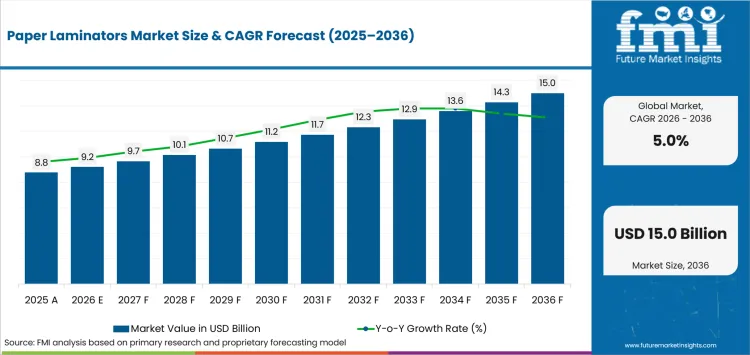
USD 9.2 billion in 2026 and USD 15.0 billion by 2036 at a 5.0% CAGR.
Sales of paper laminators are estimated to rise at 5.0% CAGR through 2036, increasing valuation from USD 9.2 billion in 2026 to USD 15.0 billion by 2036. Packaging machinery investment increasingly targets lines that can qualify new paper structures without losing barrier performance. The European Commission stated on August 11, 2026 that PPWR would apply from August 12. The rule makes packaging composition and recyclability part of routine design approval. Laminator purchases therefore depend on coat-weight control and substrate handling as much as rated line speed.
Replacement economics differ in mature converting systems. AF&PA reported in May 2026 that USA containerboard mills operated at 91.9% during 2025. That production base supports demand for laminating machines that fit existing finishing lines. Faster-growth countries can justify capacity additions sooner, while mature markets require a clearer upgrade case tied to waste reduction or newly qualified recyclable structures.
Key Takeaways
- Paper laminator demand follows packaging redesign that requires functional paper structures to retain protection, print quality and credible recovery routes.
- By laminator type, thermal laminators are estimated to hold 28.0% in 2026 owing to familiar heat-activated workflows in print finishing.
- Folding carton board is projected to hold 31.0% share in 2026 due to repeat printed-packaging volumes and controlled surface-protection requirements.
- In 2026, food packaging is expected to lead end use with 33.0% share because paper packs require grease, moisture or aroma barriers.
- Qualification can delay capital approval if adhesive choice, curl control or recovery performance fails on the packaging plant's intended paper grade.
- Some of the key players in this market include Nordmeccanica Group, BOBST, Comexi, Uteco, SOMA, Windmöller & Hölscher, Davis-Standard, Karlville, and D&K Group.
Analyst Perspective
"Paper laminators earn capital approval after the finished paper structure holds barrier performance, flatness and recovery behavior on the plant's normal grades. Once that proof is repeatable, waste during setup and service response determine how much of the rated output becomes saleable production."
- Nandini Roy Choudhury, Principal Consultant, Future Market Insights
How is the paper laminators market segmented?
The paper laminators market is segmented by laminator type, paper product, web format, end use, sales channel and region.
Laminator type covers thermal, wet, solventless, extrusion and dry bond systems. Paper products include folding carton board, paper bags, labels, decorative paper and flexible paper packaging. Web formats range from sheet-fed to narrow, mid and wide web. End uses span food packaging, consumer goods, industrial packaging, graphic arts and sustainable packaging. Sales channels include machinery OEMs, direct converter purchases, equipment distributors and aftermarket service.
Why does food packaging lead the end use category?
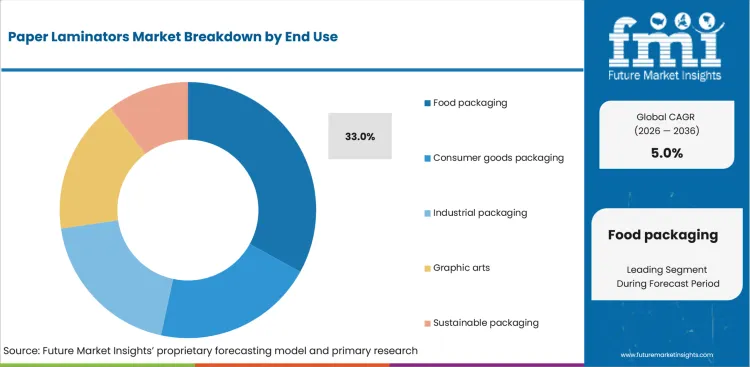
Food paper structures need grease, moisture or aroma protection without losing printability or converting performance. Nordmeccanica Group announced in May 2025 that it developed a paper and water-soluble-film laminate with Ecopol and Henkel for dry-food applications and paper-stream recycling. The work ties lamination settings directly to barrier and recovery tests.
- In 2026, food packaging is expected to lead end use with 33.0% share because functional barriers require repeated lamination on high-volume paper formats.
- Packaging plants qualify sustainable packaging structures by testing barrier performance and recovery behavior on the intended paper grade before routine production and repeat customer orders.
Why do thermal laminators lead the laminator type category?
Thermal systems suit print finishing that needs a dry bonding step and immediate handling after lamination. Shorter jobs avoid liquid-adhesive preparation and the related setup time. Karlville stated in March 2025 that lamination remained part of its converting-machinery focus after the company realigned its equipment priorities for printed paper grades.
- By laminator type, thermal laminators are estimated to hold 28.0% in 2026 owing to familiar heat-activated workflows and straightforward operator control.
- Heat and nip settings require trials on coated paper because excessive temperature can curl sheets or disturb printed surfaces during finishing and downstream cutting.
Why does folding carton board lead the paper product category?
Folding carton board needs surface protection without disturbing die-cutting geometry or print registration. Machine selection therefore turns on sheet flatness and repeatable alignment in folding carton and paperboard applications. BOBST stated in July 2026 that one MASTERFLUTE TOUCH litho-laminator had produced more than half a billion sheets during 15 years of operation under regular production loads in service.
- Folding carton board is projected to hold 31.0% share in 2026 due to repeat printed-packaging volumes and demanding surface-finish requirements.
- Long equipment life raises the value of maintainable registration controls because replacement projects often displace proven installed lines instead of adding greenfield capacity.
How does sheet-fed maintain the lead in the web format category?
Sheet-fed laminators fit carton and commercial print jobs that reach finishing as printed sheets. FOLIANT EU documented five Foliant installations at three Publisher’s Graphics plants in May 2025 after the operator compared usability and output consistency. The installations give current operating proof for paper packaging sites handling variable sheet work.
- By web format, sheet-fed is forecast to represent 28.0% in 2026 driven by mixed job queues that change paper size without reel handling.
- Commercial acceptance depends on flat sheets leaving the laminator because heater balance and curl correction determine whether output can enter cutting and folding without rework.
Why do machinery OEMs lead the sales channel category?
Capital packaging equipment needs material trials and service after installation because line approval depends on more than rated speed. SOMA appointed BP2L Consulting in France in August 2025 to represent its flexographic presses, slitters and laminators with local sales support. The appointment shows why channel access and technical response affect equipment selection.
- Machinery OEMs are set to lead the sales channel with 45.0% share in 2026 due to application engineering and lifecycle support attached to equipment orders.
- Regional support becomes decisive on engineered projects because delayed qualification or unavailable parts can erase the savings expected from a faster laminating line.
What are the drivers, restraints and opportunities in the Paper Laminators Market?
Recyclable paper structures raise demand for process flexibility, qualification uncertainty delays equipment approval, and tighter coating control gives OEMs the clearest route to replacement and expansion projects.
- Driver: Packaging redesign requires laminators that can run paper with functional layers while maintaining conversion quality and recovery compatibility.
- Restraint: Material and recyclability qualification can delay capital orders even after a machine meets mechanical throughput requirements.
- Opportunity: Multi-process coating control can reduce setup waste and broaden the range of paper structures one line can qualify.
Packaging rules turn material redesign into a machinery requirement
Paper packaging rules now reach the laminating line through composition and recovery requirements. The European Commission confirmed in February 2025 that PPWR entered into force with measures promoting recycling and lower primary-resource use. EU-facing plants therefore need repeatable paper tension and layer-weight settings before flexible packaging machinery investment becomes a defensible capital project.
Qualification uncertainty can extend the capital approval cycle
A laminator can meet speed targets yet fail the intended packaging program if the structure misses recovery or material tests. In June 2026, the European Commission issued PPWR guidance after authorities and economic operators raised implementation questions. Proposals that include material trials and recorded recipes can reduce repeat validation, but uncertainty still lengthens capital approval.
Better coating control supports lower-material paper structures
Paper structures use less functional material only if coating weight stays stable as jobs change. Uteco’s April 2025 Print4All preview introduced PRISMA as a web coating equipment and laminating platform focused on waste reduction and laminate quality. OEMs can target replacement projects by proving thinner paper coating materials on the customer’s paper grade before a line order is released.
Which country CAGRs are profiled in the Paper Laminators Market?
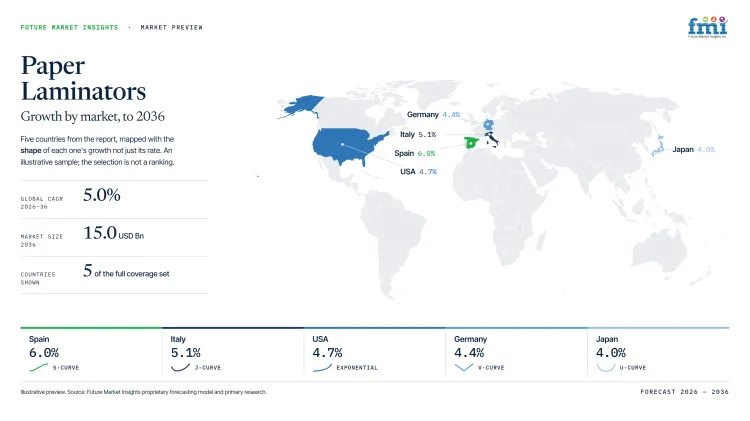
| Country | CAGR |
|---|---|
| Spain | 6.0% |
| Mexico | 5.7% |
| Brazil | 5.4% |
| Italy | 5.1% |
| United States | 4.7% |
| Germany | 4.4% |
| Japan | 4.0% |
How do country-level CAGRs compare in the Paper Laminators Market?
The country CAGRs span 2.0 percentage points from Spain at 6.0% to Japan at 4.0%. Spain, Mexico and Brazil form the upper band, with Italy between that group and the slower United States, Germany and Japan. The spread points to different capital cycles instead of a ranking of installed equipment.
- Spain concentrates packaging conversion near major industrial hubs.
- Mexico gives capacity additions greater weight than mature markets.
- Brazil faces regional variation in packaging recovery requirements.
- Italy’s installed machinery base favors retrofit-led modernization.
- United States projects face decentralized plant-level capital decisions.
- Germany emphasizes automation during replacement qualification.
- Japan rewards service continuity in mature converting plants.
Similar CAGRs can therefore produce different order values and replacement cycles. The full report provides country-level CAGR analysis across North America, Latin America, Western Europe, Eastern Europe, East Asia, South Asia and Pacific, and Middle East and Africa.
Country-wise Analysis
- Spanish packaging plants work against a high paper-recovery benchmark, so bonded layers receive close review whenever a package specification changes. Ecoembes reported in June 2026 that household paper and cardboard packaging reached an 89% recycling rate during 2025, which gives fiber formats a strong recovery route but raises the proof burden for coated structures. Demand for paper laminators in Spain is projected to expand at 6.0% CAGR through 2036 owing to recyclable fiber programs, with orders following only after barrier performance and recovery behavior hold on the plant’s actual board grades during repeat production trials for commercial runs.
- Packaging plants along Mexico City, Monterrey and the Bajío depend on local technical coverage because a delayed repair can disrupt short converting schedules and customer delivery windows. Paper laminator demand in Mexico is forecast to rise at 5.7% CAGR over the forecast period tied to packaging conversion and clearer circularity requirements that reward better material documentation. The federal government’s January 19, 2026 General Law of Circular Economy set national recovery plus extended-producer-responsibility mechanisms while smaller plants still need operator training and parts access before accepting commissioning risk on a new line serving regular packaging work without prolonged disruption.
- Long distances between converting plants make service response part of capital approval, especially for sites outside São Paulo and other major industrial centers that cannot absorb prolonged production interruptions. SINIR issued reverse-logistics reporting guidance on May 8, 2026 for 2025 results and set July 30 as the filing deadline to make packaging recovery reporting more predictable for operators. Paper laminator sales in Brazil is anticipated to advance at 5.4% CAGR through 2036 given tighter reporting discipline, though projects without regional technical teams may stall when commissioning or parts support requires travel from another state during time-sensitive commercial production periods at scale.
- Paper packaging already moves through a mature recovery system, so new functional layers must preserve performance that local mills and packaging companies have achieved in routine recovery operations. Italy is expected to register 5.1% CAGR during the forecast period aided by demand for controlled coatings on fiber-based packs that preserve downstream paper recovery performance. Comieco stated in June 2026 that paper and cardboard packaging reached a 93.1% recycling rate during 2025, giving fiber structures a clear route but raising the proof burden for composites and favoring OEMs that document thin-layer recipes during normal production trials at speed.
- Packaging plants and print finishers operate with very different run lengths, so line utilization and changeover economics vary sharply by site and customer mix. AF&PA reported in August 2026 that 70% to 75% of cardboard available for recovery was recycled during 2025, a mature base that supports replacement projects tied to efficiency and new paper structures. The United States is projected to record 4.7% CAGR through 2036 reflecting its large installed converting base, while domestic parts coverage and measured setup savings carry more weight than headline capacity in replacement decisions involving productive installed lines already in service.
- Paper and board packaging enters a mature collection system, placing recovery documentation close to the equipment qualification process for laminate structures used in repeat commercial production. Germany is expected to progress at 4.4% CAGR during the assessment period supported by replacement demand and detailed packaging compliance that increases the value of documented machine recipes. Destatis published in February 2026 that 4.291 million tonnes of paper, paperboard and carton packaging were collected or taken back during 2024, giving recovered fiber a clear route but extending project timing unless trials preserve flatness and coating control on normal commercial paper grades in routine runs.
- Municipal collection plans make compatibility with existing paper-recovery routes a practical design condition, especially after a plant changes coatings or bonded layers on established paper formats. The Ministry of the Environment stated in March 2026 that 904 municipalities planned separate collection of paper containers and packaging in fiscal 2026, giving equipment teams a visible recovery route with limited tolerance for layers that obstruct fiber separation. Japan is forecast to post 4.0% CAGR over the forecast period because collection compatibility shapes qualification, while stable domestic technical support protects repeat production and laminates that complicate recovery face a narrower acceptance window.
Who are the notable companies in the Paper Laminators Market?
Nordmeccanica Group, BOBST, Comexi, Uteco, SOMA, Windmöller & Hölscher, Davis-Standard, Karlville and D&K Group are the notable companies profiled in this market.
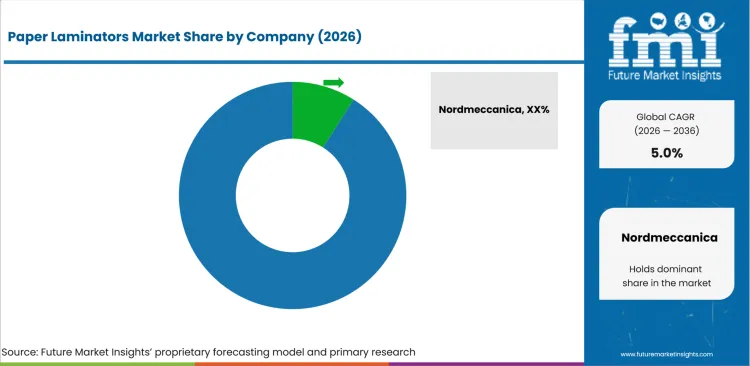
Competition separates by coating chemistry, substrate handling and the service needed to qualify a new paper structure. Large equipment groups cover several process routes while finishing specialists focus on compact machines. Entry becomes harder once converting automation and local application support enter the purchase specification because a lower machine price cannot offset prolonged trials or weak parts availability.
- Nordmeccanica Group, BOBST, Comexi and Uteco cover multi-process coating or laminating platforms for packaging converters.
- SOMA, Windmöller & Hölscher and Davis-Standard extend the field into integrated converting, laminating, extrusion coating and regional technical service.
- Karlville and D&K Group concentrate on finishing and compact laminating routes that suit shorter runs or smaller converting operations.
Competitive Benchmarking: Paper Laminators Market
| Company | Laminating Route Breadth | Converting Integration | Service & Qualification Support | Geographic Reach |
|---|---|---|---|---|
| Nordmeccanica Group | High | High | High | Global |
| BOBST | High | High | High | Global |
| Comexi | High | High | High | Europe, Americas and Asia Pacific |
| Uteco | High | High | Medium | Europe and international sales |
| SOMA | Low | High | High | Europe, Americas and Asia Pacific |
| Windmöller & Hölscher | Medium | High | High | Global |
| Davis-Standard | Medium | High | High | Americas, Europe and Asia |
| Karlville | High | Medium | Medium | Americas, Europe and Asia |
| D&K Group | Medium | Medium | Medium | North America |
Scoring basis: High laminating-route breadth requires at least three documented adhesive, coating or thermal routes. Medium requires two and Low identifies one. High converting integration requires at least three documented converting stages while Medium requires two. High service support requires multi-region technical facilities or formal application trials. Medium reflects regional support and Low identifies a narrower documented route.
Key Developments in the Paper Laminators Market
- In June 2026, D&K Group launched D&K Packaging and began building a second tandem extrusion line for new films plus pouch-laminating equipment planned for fall 2026.
- In June 2026, BOBST expanded its collaboration with Michelman on recyclable high-barrier packaging that includes paper-based FibreCycle structures and thinner functional layers.
- In March 2025, Karlville appointed new agencies for Andean, Central American and Caribbean markets to sell and support lamination machinery with solventless, solvent-based, water-based and thermal routes.
Key Players in the Paper Laminators Market
Industrial Coating and Laminating Platforms
- Nordmeccanica Group
- BOBST
- Comexi
- Uteco
Integrated Converting and Extrusion Systems
- SOMA
- Windmöller & Hölscher
- Davis-Standard
Finishing and Compact Laminating Specialists
- Karlville
- D&K Group
Paper Laminators Market - Report Scope
| Coverage field | Report scope |
|---|---|
| Market breakdown | By laminator type, paper product, web format, end use, sales channel and region. |
| Quantitative Units | USD billion. |
| Market Definition | Industrial and commercial equipment that laminates, coats or bonds paper and paperboard with films, adhesives or functional layers for finishing and packaging applications. |
| Regions Covered | North America, Latin America, Western Europe, Eastern Europe, East Asia, South Asia and Pacific, and Middle East and Africa. |
| Countries Covered | Spain, Mexico, Brazil, Italy, United States, Germany, Japan, and 30+ countries included in the full report. |
| Key Companies Profiled | Nordmeccanica Group, BOBST, Comexi, Uteco, SOMA, Windmöller & Hölscher, Davis-Standard, Karlville, D&K Group. |
| Forecast Period | 2026 to 2036. |
| Approach | Primary and secondary research with market triangulation. |
Paper Laminators Market - Research Methodology
| Method | Approach |
|---|---|
| Primary Research | FMI analysts gathered input from manufacturers, service providers, technology developers, distributors, end users, procurement teams, and subject-matter experts. Interviews examined purchasing decisions, product or service evaluation, adoption barriers, approval requirements, pricing considerations, and expectations for technical or commercial support. Respondents were also asked what evidence is required before a trial, pilot, or initial order develops into regular purchasing. |
| Desk Research | Desk research covered government statistics, regulatory publications, trade data, industry associations, technical literature, standards, company filings, product information, and official corporate announcements. Sources were reviewed for relevance, publication date, geographic coverage, and consistency with the defined market scope. Claims relating to performance, applications, approvals, capacity, investment, and commercial activity were retained only when supported by credible public evidence. |
| Market Sizing and Forecasting | The market model combined the baseline value with historical performance, segment structure, pricing and volume indicators, adoption levels, company participation, and country-level demand conditions. Forecast assumptions considered economic activity, investment trends, regulatory developments, technology adoption, purchasing cycles, supply availability, and barriers to wider market use. Segment and regional estimates were reconciled before the final market total was calculated. |
| Data Validation | Estimates were checked against multiple independent indicators, including public data, company activity, trade patterns, industry developments, and findings from primary interviews. Validation also tested whether products, services, applications, and company revenues fell within the defined market boundaries. Adjacent categories, unsupported claims, overlapping revenues, and activities without direct market relevance were excluded to reduce double counting and maintain consistency across segments and countries. |
Paper Laminators Market by Segments
Paper Laminators Market segmented by Laminator Type:
- Thermal laminators
- Wet laminators
- Solventless laminators
- Extrusion laminators
- Dry bond laminators
Paper Laminators Market segmented by Paper Product:
- Folding carton board
- Paper bags
- Labels
- Decorative paper
- Flexible paper packaging
Paper Laminators Market segmented by Web Format:
- Sheet-fed
- Narrow web
- Mid web
- Wide web
Paper Laminators Market segmented by End Use:
- Food packaging
- Consumer goods packaging
- Industrial packaging
- Graphic arts
- Sustainable packaging
Paper Laminators Market segmented by Sales Channel:
- Machinery OEMs
- Packaging converters direct
- Equipment distributors
- Aftermarket service
Paper Laminators Market by Region:
- North America
- United States
- Canada
- Latin America
- Brazil
- Mexico
- Argentina
- Chile
- Western Europe
- Germany
- France
- United Kingdom
- Italy
- Spain
- Benelux
- Nordics
- Eastern Europe
- Poland
- Czech Republic
- Romania
- Hungary
- East Asia
- China
- Japan
- South Korea
- South Asia and Pacific
- India
- ASEAN
- Australia and New Zealand
- Middle East and Africa
- GCC Countries
- South Africa
- Türkiye
- Israel
Research Sources and Bibliography
- European Commission. (2026, August 11). New EU rules on packaging enter into application.
- American Forest & Paper Association. (2026, May 29). AF&PA Releases 66th Annual Paper Industry Capacity and Fiber Consumption Survey.
- Karlville. (2025, March 26). Karlville Reaffirms Focus on Converting Machines.
- BOBST. (2026, July 16). MASTERFLUTE TOUCH delivers reliability and productivity over a lifetime of production.
- FOLIANT EU s.r.o. (n.d.). Five Foliant Laminators Power Up Production at Publisher’s Graphics. Retrieved September 3, 2026.
- Nordmeccanica Group. (2025, May 21). Pioneering Sustainable Flexible Packaging: Industry Leaders Unite for Circular Innovation.
- SOMA. (2025, August 6). SOMA partners with BP2L Consulting.
- European Commission. (2025, February 11). New rules enter into force for a more sustainable and competitive packaging economy.
- European Commission. (2026, June 10). Guidance document for Regulation (EU) 2025/40 on packaging and packaging waste.
- Uteco Converting S.p.A. (2025, April). Special Preview: Print4All.
- Ecoembes. (2026, June 4). Ecoembes recicló 2,2 millones de toneladas de envases domésticos y comerciales en 2025.
- American Forest & Paper Association. (2026, August 28). Paper Industry Announces 2025 USA Paper Recycling Rates.
- Ministry of the Environment, Japan. (2026, March 31).
- Statistisches Bundesamt. (2026, February 23). Abfallentsorgung 2024.
- Comieco. (2026, June 17). Riciclo di carta e cartone sopra il 90% anche nel 2025.
- Secretaría de Medio Ambiente y Recursos Naturales. (2026, January 19). Gobierno de México expide la Ley General de Economía Circular enfocada en impulsar la conservación del medio ambiente del país.
- Sistema Nacional de Informações sobre a Gestão dos Resíduos Sólidos. (2026, May 8). COMUNICADO LR - DGR/MMA Nº 001/2026: Orientações sobre a apresentação do relatório de resultados de logística reversa - Ano de referência 2025.
- D&K Group. (2026, June 22). D&K Launches Packaging Division.
- BOBST. (2026, June 23). BOBST and Michelman: Expanding collaboration into new regulation-ready recyclable solutions.
- Karlville. (2025, March 25). Karlville Expands with New Agencies in Latin America.
- Uteco Converting S.p.A. (2025, June 24). Uteco and ENCA Sign a Binding Equity Agreement!
- Davis-Standard. (2026, January 13). Davis-Standard Consolidates Canadian Strengths: Deacro, Brampton Engineering, and Gamma Machinery to Amalgamate as Davis-Standard Canada Inc.
- BOBST. (2025, July 1). Swanline achieves world-first by deploying BOBST Connect across a mixed equipment portfolio.
- Comexi. (2025, September 10). Comexi: Pioneering Flexible Solutions at K 2025.
- SOMA. (2026, August 28). 5th SOMA installation at FINPAK since 2023.
- SOMA. (2025, September 26). SOMA expands its presence in Japan through partnership with INTER-FLEX Co., Ltd.
- Nordmeccanica Group. (2025, May 22). Empowering Innovation and Sustainability in Packaging!
- BOBST. (2025, March 4). Drorys Packlist invests in advanced BOBST technology for flexible packaging expansion.
- Comexi. (2026, June 8). Comexi consolidates its expansion with the enlargement of its facilities in Girona.
- Uteco Converting S.p.A. (2026, January 19). UTECO strengthens its capital structure through refinancing and capital increase in support of its five-year development plan.
- Windmöller & Hölscher. (2026, July 15). W&H and Nordmeccanica strengthen presence in Indonesia.
This bibliography is provided for reader reference and is not exhaustive. The full report contains the complete reference list and detailed citations.
This Report Answers
- How large is the paper laminators market in 2026 and 2036?
- Which packaging redesign requirements support investment in paper laminating equipment?
- Why do thermal laminators hold 28.0% of laminator type demand in 2026?
- Why does folding carton board account for 31.0% of paper product demand?
- How does sheet-fed production influence paper laminator specifications?
- Why does food packaging account for 33.0% of end use demand?
- How do country growth rates differ among Spain, Mexico, Brazil, Italy, the United States, Germany and Japan?
- Which companies cover industrial coating, integrated converting and compact finishing routes?
- What qualification issues can delay paper laminator capital approval?
Frequently Asked Questions
How big is the paper laminators market in 2026?
The paper laminators market is valued at USD 9.2 billion in 2026 and is projected to reach USD 15.0 billion by 2036. Growth follows packaging redesign that requires controlled functional layers on recyclable paper structures.
What is the CAGR of the paper laminators market from 2026 to 2036?
The paper laminators market is projected to grow at a CAGR of 5.0% between 2026 and 2036. Expansion depends on equipment upgrades that improve substrate handling, coat-weight control and qualification of new paper structures.
Which laminator type leads the paper laminators market?
The thermal laminators segment is expected to hold 28.0% of the paper laminators market in 2026, driven by familiar heat-activated workflows in print finishing. Coated or curl-sensitive paper still requires controlled heat and nip settings.
Which paper product leads the paper laminators market?
The folding carton board segment is expected to hold 31.0% of the paper laminators market in 2026, supported by repeat printed-packaging volumes. Registration and sheet flatness keep litho-lamination performance central to equipment selection.
Which companies are active in the paper laminators market?
Key companies operating in the paper laminators market include Nordmeccanica Group, BOBST, Comexi, Uteco, SOMA, Windmöller & Hölscher, Davis-Standard, Karlville and D&K Group. Their positions differ by laminating route, converting integration and technical service coverage.
Preview the report firsthand - request a free sample
Get SampleGet the brochure for pricing and purchase details.
Get PDFTable of Content
- Key Takeaways
- Market Size and CAGR
- Top Growth Driver
- Fastest Growing Segment
- Leading Region
- Key Companies
- Emerging Opportunities
- Executive Summary
- Global Market Outlook
- Demand-side Trends
- Supply-side Trends
- Technology Roadmap Analysis
- Analysis and Recommendations
- Analyst Perspective (What is happening? Why now? What should investors know?)
- Key Questions Answered
- How large is the market?
- What is the CAGR?
- What are key trends?
- Which region dominates?
- Who are the leaders?
- Market Overview
- Market Coverage / Taxonomy
- Market Definition / Scope / Limitations
- Research Methodology
- Chapter Orientation
- Analytical Lens and Working Hypotheses
- Market Structure, Signals, and Trend Drivers
- Benchmarking and Cross-market Comparability
- Market Sizing, Forecasting, and Opportunity Mapping
- Research Design and Evidence Framework
- Desk Research Programme (Secondary Evidence)
- Expert Input and Fieldwork (Primary Evidence)
- Tooling, Models, and Reference Databases
- Data Engineering and Model Build
- Quality Assurance and Audit Trail
- Market Background
- Market Dynamics (Drivers, Restraints, Opportunity, Trends)
- Scenario Forecast (Optimistic, Likely, Conservative)
- Impact Analysis
- AI Impact
- Sustainability Impact
- Regulatory Impact
- Technology Impact
- Consumer / Buyer Analysis
- Purchase Drivers
- Adoption Barriers
- Buyer Journey
- Opportunity Map Analysis
- Product Life Cycle Analysis
- Supply Chain Analysis
- Investment Feasibility Matrix
- Value Chain Analysis
- PESTLE and Porter's Analysis
- Regulatory Landscape
- Regional Parent Market Outlook
- Production and Consumption Statistics
- Import and Export Statistics
- Global Market Analysis and Forecast, 2021 to 2036
- Historical Market Size Value (USD Billion) Analysis, 2021 to 2025
- Current and Future Market Size Value (USD Billion) Projections, 2026 to 2036
- Y-o-Y Growth Trend Analysis
- Absolute $ Opportunity Analysis
- Global Market Pricing Analysis, 2021 to 2036
- Global Market Analysis and Forecast, By Laminator Type, 2021 to 2036
- Introduction / Key Findings
- Historical Market Size Value (USD Billion) Analysis By Laminator Type, 2021 to 2025
- Current and Future Market Size Value (USD Billion) Analysis and Forecast By Laminator Type, 2026 to 2036
- Thermal laminators
- Wet laminators
- Solventless laminators
- Extrusion laminators
- Dry bond laminators
- Thermal laminators
- Y-o-Y Growth Trend Analysis By Laminator Type, 2021 to 2025
- Absolute $ Opportunity Analysis By Laminator Type, 2026 to 2036
- Global Market Analysis and Forecast, By Paper Product, 2021 to 2036
- Introduction / Key Findings
- Historical Market Size Value (USD Billion) Analysis By Paper Product, 2021 to 2025
- Current and Future Market Size Value (USD Billion) Analysis and Forecast By Paper Product, 2026 to 2036
- Folding carton board
- Paper bags
- Labels
- Decorative paper
- Flexible paper packaging
- Folding carton board
- Y-o-Y Growth Trend Analysis By Paper Product, 2021 to 2025
- Absolute $ Opportunity Analysis By Paper Product, 2026 to 2036
- Global Market Analysis and Forecast, By Web Format, 2021 to 2036
- Introduction / Key Findings
- Historical Market Size Value (USD Billion) Analysis By Web Format, 2021 to 2025
- Current and Future Market Size Value (USD Billion) Analysis and Forecast By Web Format, 2026 to 2036
- Sheet-fed
- Narrow web
- Mid web
- Wide web
- Sheet-fed
- Y-o-Y Growth Trend Analysis By Web Format, 2021 to 2025
- Absolute $ Opportunity Analysis By Web Format, 2026 to 2036
- Global Market Analysis and Forecast, By End Use, 2021 to 2036
- Introduction / Key Findings
- Historical Market Size Value (USD Billion) Analysis By End Use, 2021 to 2025
- Current and Future Market Size Value (USD Billion) Analysis and Forecast By End Use, 2026 to 2036
- Food packaging
- Consumer goods packaging
- Industrial packaging
- Graphic arts
- Sustainable packaging
- Food packaging
- Y-o-Y Growth Trend Analysis By End Use, 2021 to 2025
- Absolute $ Opportunity Analysis By End Use, 2026 to 2036
- Global Market Analysis and Forecast, By Sales Channel, 2021 to 2036
- Introduction / Key Findings
- Historical Market Size Value (USD Billion) Analysis By Sales Channel, 2021 to 2025
- Current and Future Market Size Value (USD Billion) Analysis and Forecast By Sales Channel, 2026 to 2036
- Machinery OEMs
- Packaging converters direct
- Equipment distributors
- Aftermarket service
- Machinery OEMs
- Y-o-Y Growth Trend Analysis By Sales Channel, 2021 to 2025
- Absolute $ Opportunity Analysis By Sales Channel, 2026 to 2036
- Global Market Analysis and Forecast, By Region, 2021 to 2036
- Introduction
- Historical Market Size Value (USD Billion) Analysis By Region, 2021 to 2025
- Current Market Size Value (USD Billion) Analysis and Forecast By Region, 2026 to 2036
- North America
- Latin America
- Western Europe
- Eastern Europe
- East Asia
- South Asia and Pacific
- Middle East & Africa
- Market Attractiveness Analysis By Region
- North America Market Analysis and Forecast, By Country, 2021 to 2036
- Historical Market Size Value (USD Billion) Trend Analysis By Market Taxonomy, 2021 to 2025
- Market Size Value (USD Billion) Forecast By Market Taxonomy, 2026 to 2036
- By Country
- USA
- Canada
- By Laminator Type
- By Paper Product
- By Web Format
- By End Use
- By Sales Channel
- By Country
- Market Attractiveness Analysis
- By Country
- By Laminator Type
- By Paper Product
- By Web Format
- By End Use
- By Sales Channel
- Key Takeaways
- Latin America Market Analysis and Forecast, By Country
- Historical Market Size Value (USD Billion) Trend Analysis By Market Taxonomy, 2021 to 2025
- Market Size Value (USD Billion) Forecast By Market Taxonomy, 2026 to 2036
- By Country
- Brazil
- Mexico
- Chile
- Rest of Latin America
- By Laminator Type
- By Paper Product
- By Web Format
- By End Use
- By Sales Channel
- By Country
- Market Attractiveness Analysis
- By Country
- By Laminator Type
- By Paper Product
- By Web Format
- By End Use
- By Sales Channel
- Key Takeaways
- Western Europe Market Analysis and Forecast, By Country
- Historical Market Size Value (USD Billion) Trend Analysis By Market Taxonomy, 2021 to 2025
- Market Size Value (USD Billion) Forecast By Market Taxonomy, 2026 to 2036
- By Country
- Germany
- UK
- Italy
- Spain
- France
- Nordic
- BENELUX
- Rest of Western Europe
- By Laminator Type
- By Paper Product
- By Web Format
- By End Use
- By Sales Channel
- By Country
- Market Attractiveness Analysis
- By Country
- By Laminator Type
- By Paper Product
- By Web Format
- By End Use
- By Sales Channel
- Key Takeaways
- Eastern Europe Market Analysis and Forecast, By Country
- Historical Market Size Value (USD Billion) Trend Analysis By Market Taxonomy, 2021 to 2025
- Market Size Value (USD Billion) Forecast By Market Taxonomy, 2026 to 2036
- By Country
- Russia
- Poland
- Hungary
- Balkan & Baltic
- Rest of Eastern Europe
- By Laminator Type
- By Paper Product
- By Web Format
- By End Use
- By Sales Channel
- By Country
- Market Attractiveness Analysis
- By Country
- By Laminator Type
- By Paper Product
- By Web Format
- By End Use
- By Sales Channel
- Key Takeaways
- East Asia Market Analysis and Forecast, By Country
- Historical Market Size Value (USD Billion) Trend Analysis By Market Taxonomy, 2021 to 2025
- Market Size Value (USD Billion) Forecast By Market Taxonomy, 2026 to 2036
- By Country
- China
- Japan
- South Korea
- By Laminator Type
- By Paper Product
- By Web Format
- By End Use
- By Sales Channel
- By Country
- Market Attractiveness Analysis
- By Country
- By Laminator Type
- By Paper Product
- By Web Format
- By End Use
- By Sales Channel
- Key Takeaways
- South Asia and Pacific Market Analysis and Forecast, By Country
- Historical Market Size Value (USD Billion) Trend Analysis By Market Taxonomy, 2021 to 2025
- Market Size Value (USD Billion) Forecast By Market Taxonomy, 2026 to 2036
- By Country
- India
- ASEAN
- Australia & New Zealand
- Rest of South Asia and Pacific
- By Laminator Type
- By Paper Product
- By Web Format
- By End Use
- By Sales Channel
- By Country
- Market Attractiveness Analysis
- By Country
- By Laminator Type
- By Paper Product
- By Web Format
- By End Use
- By Sales Channel
- Key Takeaways
- Middle East & Africa Market Analysis and Forecast, By Country
- Historical Market Size Value (USD Billion) Trend Analysis By Market Taxonomy, 2021 to 2025
- Market Size Value (USD Billion) Forecast By Market Taxonomy, 2026 to 2036
- By Country
- Kingdom of Saudi Arabia
- Other GCC Countries
- Türkiye
- South Africa
- Other African Union
- Rest of Middle East & Africa
- By Laminator Type
- By Paper Product
- By Web Format
- By End Use
- By Sales Channel
- By Country
- Market Attractiveness Analysis
- By Country
- By Laminator Type
- By Paper Product
- By Web Format
- By End Use
- By Sales Channel
- Key Takeaways
- Key Countries Market Analysis
- USA
- Pricing Analysis
- Market Share Analysis, 2025
- By Laminator Type
- By Paper Product
- By Web Format
- By End Use
- By Sales Channel
- Canada
- Pricing Analysis
- Market Share Analysis, 2025
- By Laminator Type
- By Paper Product
- By Web Format
- By End Use
- By Sales Channel
- Mexico
- Pricing Analysis
- Market Share Analysis, 2025
- By Laminator Type
- By Paper Product
- By Web Format
- By End Use
- By Sales Channel
- Brazil
- Pricing Analysis
- Market Share Analysis, 2025
- By Laminator Type
- By Paper Product
- By Web Format
- By End Use
- By Sales Channel
- Chile
- Pricing Analysis
- Market Share Analysis, 2025
- By Laminator Type
- By Paper Product
- By Web Format
- By End Use
- By Sales Channel
- Germany
- Pricing Analysis
- Market Share Analysis, 2025
- By Laminator Type
- By Paper Product
- By Web Format
- By End Use
- By Sales Channel
- UK
- Pricing Analysis
- Market Share Analysis, 2025
- By Laminator Type
- By Paper Product
- By Web Format
- By End Use
- By Sales Channel
- Italy
- Pricing Analysis
- Market Share Analysis, 2025
- By Laminator Type
- By Paper Product
- By Web Format
- By End Use
- By Sales Channel
- Spain
- Pricing Analysis
- Market Share Analysis, 2025
- By Laminator Type
- By Paper Product
- By Web Format
- By End Use
- By Sales Channel
- France
- Pricing Analysis
- Market Share Analysis, 2025
- By Laminator Type
- By Paper Product
- By Web Format
- By End Use
- By Sales Channel
- India
- Pricing Analysis
- Market Share Analysis, 2025
- By Laminator Type
- By Paper Product
- By Web Format
- By End Use
- By Sales Channel
- ASEAN
- Pricing Analysis
- Market Share Analysis, 2025
- By Laminator Type
- By Paper Product
- By Web Format
- By End Use
- By Sales Channel
- Australia & New Zealand
- Pricing Analysis
- Market Share Analysis, 2025
- By Laminator Type
- By Paper Product
- By Web Format
- By End Use
- By Sales Channel
- China
- Pricing Analysis
- Market Share Analysis, 2025
- By Laminator Type
- By Paper Product
- By Web Format
- By End Use
- By Sales Channel
- Japan
- Pricing Analysis
- Market Share Analysis, 2025
- By Laminator Type
- By Paper Product
- By Web Format
- By End Use
- By Sales Channel
- South Korea
- Pricing Analysis
- Market Share Analysis, 2025
- By Laminator Type
- By Paper Product
- By Web Format
- By End Use
- By Sales Channel
- Russia
- Pricing Analysis
- Market Share Analysis, 2025
- By Laminator Type
- By Paper Product
- By Web Format
- By End Use
- By Sales Channel
- Poland
- Pricing Analysis
- Market Share Analysis, 2025
- By Laminator Type
- By Paper Product
- By Web Format
- By End Use
- By Sales Channel
- Hungary
- Pricing Analysis
- Market Share Analysis, 2025
- By Laminator Type
- By Paper Product
- By Web Format
- By End Use
- By Sales Channel
- Kingdom of Saudi Arabia
- Pricing Analysis
- Market Share Analysis, 2025
- By Laminator Type
- By Paper Product
- By Web Format
- By End Use
- By Sales Channel
- Türkiye
- Pricing Analysis
- Market Share Analysis, 2025
- By Laminator Type
- By Paper Product
- By Web Format
- By End Use
- By Sales Channel
- South Africa
- Pricing Analysis
- Market Share Analysis, 2025
- By Laminator Type
- By Paper Product
- By Web Format
- By End Use
- By Sales Channel
- USA
- Market Structure Analysis
- Competition Dashboard
- Competition Benchmarking
- Market Share Analysis of Top Players
- By Regional
- By Laminator Type
- By Paper Product
- By Web Format
- By End Use
- By Sales Channel
- Emerging Startups
- Innovation Benchmarking
- Competition Analysis
- Competition Deep Dive
- Nordmeccanica
- Overview
- Product Portfolio
- Profitability by Market Segments
- Sales Footprint
- Strategy Overview
- Marketing Strategy
- Product Strategy
- Channel Strategy
- Bobst
- Comexi
- Uteco
- Soma Engineering
- W&H
- Miyakoshi
- Davis-Standard
- Karlville
- D&K Group
- Nordmeccanica
- Case Studies
- Success Stories
- Recent Developments
- Competition Deep Dive
- Assumptions & Acronyms Used


