

- Market Size (2026)
- USD 3 billion
- Forecast (2036)
- USD 4.4 billion
- CAGR (2026 to 2036)
- 3.9%
How big is Web Coating Equipment Market in 2026?
USD 3 billion in 2026 and USD 4.4 billion by 2036 at a 3.9% CAGR.
Sales of web coating equipment are estimated to rise at 3.9% CAGR through 2036, increasing valuation from USD 3 billion in 2026 to USD 4.4 billion by 2036. Battery electrode plants require continuous coating and drying systems that maintain film thickness across wider foils during extended production campaigns. New lithium-metal processes add another coating route that needs controlled film deposition across complete rolls. ULVAC announced in February 2025 that its EWL-030 roll-to-roll lithium deposition system was scheduled for launch in May 2025. The equipment applies ultra-thin lithium films and gives battery developers a commercial route beyond small laboratory samples. Orders for battery manufacturing machines therefore depend on repeatable thickness control and safe material handling during customer qualification.
Packaging converters need barrier and primer layers to remain uniform across thin films and changing material structures. Material redesign increases the need for flexible drying and tension control across lines that process several coating formulations. Regulatory changes now require packaging developers to test composition and recyclability across complete material structures. The European Commission stated in February 2025 that the Packaging and Packaging Waste Regulation had entered into force across the European Union. The regulation sets new requirements for flexible plastic packaging without proving that converters have ordered coating lines. Equipment investment becomes credible as representative trials confirm changeover performance and dryer requirements across the planned material mix.
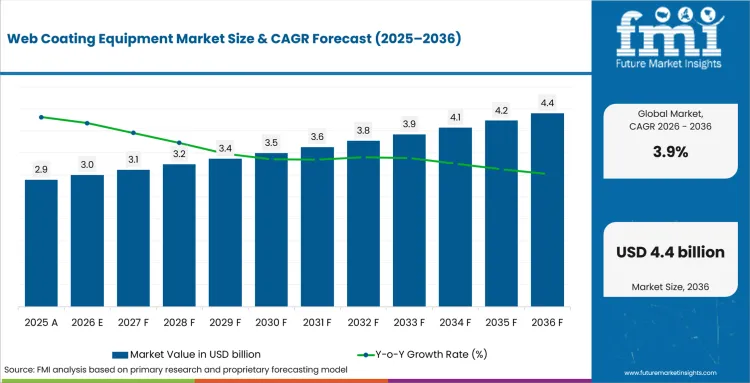
Key Takeaways of Web Coating Equipment Market
- Battery electrodes and functional films support equipment demand as qualified formulations progress from pilot trials into continuous commercial production.
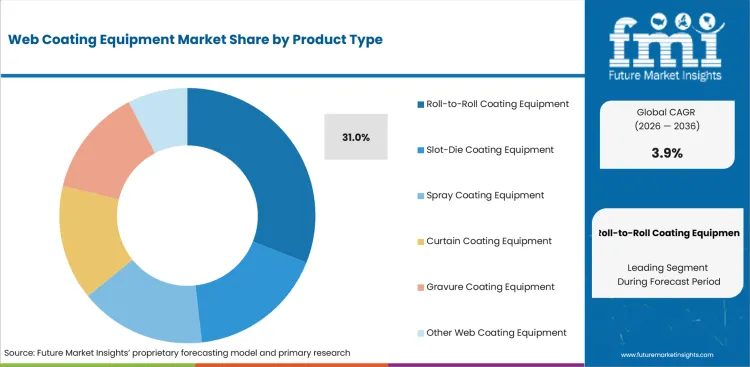
- Roll-to-roll coating equipment is projected to account for 31.0% by product type in 2026, supported by coordinated unwinding and controlled drying.
- Flexible electronics is estimated to capture 25.0% of application in 2026, reflecting precise functional layers across bendable substrates.
- Packaging manufacturers are forecast to represent 28.0% share in 2026, underpinned by recurring barrier and surface-treatment requirements.
- Production-width qualification remains a material restraint as coating uniformity and web tension must transfer beyond short laboratory samples.
- Dürr Systems AG, BOBST Group SA, Comexi, New Era Converting Machinery Inc., nextCoatema Technologies GmbH, KROENERT GmbH & Co KG, Nordmeccanica Group, and Techno Smart Corp. compete through application engineering and production-scale support.
Analyst Perspective
Web coating equipment earns investment support as a proven coating recipe remains stable across wider webs and faster production speeds. Battery electrode lines need precise thickness and controlled solvent removal throughout extended commercial qualification runs. Packaging lines require dependable tension across changing films and formulations during frequent production job changeovers. The strongest equipment case links pilot trials with clear acceptance measures and drying performance that protects saleable yield during production ramp-up.
- Nikhil Kaitwade, Principal Analyst, Future Market Insights
How is the Web Coating Equipment Market segmented?
The web coating equipment industry is segmented by product type, application, end user, distribution channel, coating technology, and region.
The market is segmented by product type, application, end user, distribution channel, coating technology, and region. Product type covers roll-to-roll systems, slot-die equipment, spray coaters, curtain coaters, gravure units, and other web platforms. Application includes flexible electronics, packaging, printed electronics, solar products, automotive uses, and specialty industrial materials. End user identifies packaging, electronics, automotive, solar, industrial, and printing organizations across commercial manufacturing settings. Distribution channel separates direct sales, industrial distributors, system integrators, OEM partnerships, and online routes used for equipment purchasing. Coating technology covers gravure, slot-die, roll, spray, curtain, and other precision methods for controlled liquid application. Regional analysis compares project activity, service access, financing conditions, and execution requirements across major manufacturing markets.
What supports roll-to-roll coating equipment within product type?
Continuous web lines carry one substrate through unwinding and coating followed by drying inspection and final rewinding. Battery developers use pilot equipment to test slurry behavior and dryer settings ahead of wider commercial specifications. UKBIC reported in February 2025 that its flexible pilot line covers electrode production from mixing through slitting. The facility gives battery teams a practical route between laboratory recipes and roll-to-roll printer orders that require stable performance across longer webs.
- Roll-to-roll coating equipment is likely to capture 31.0% share in 2026 attributable to continuous processing across films and foils. Integrated unwinding and drying control reduces material handoffs that can introduce tension changes between separate production steps. Operating continuity matters more than a lower equipment price for plants that measure saleable yield across complete rolls.
- Battery and packaging plants purchase roll-to-roll systems as pilot trials confirm thickness control across production-width substrates and planned speeds. A web-tension fault can interrupt every downstream coating and winding stage during extended commercial production runs. Plant engineers therefore assess response time and spare-part availability alongside coating accuracy during final equipment selection.
Why does flexible electronics hold its application position?
Flexible electronics relies on thin functional layers that retain electrical performance during bending and repeated handling. Development teams compare conductive and dielectric behavior across flexible substrates ahead of selecting a continuous coating route. Early trials narrow chemistry and integration choices for printed sensors and stretchable electronics during initial process design. Production qualification then tests whether those settings remain stable across longer substrates and repeated coating passes without damaging the base film.
- By application, flexible electronics is estimated to hold 25.0% in 2026 owing to precise deposition needs across conductive and dielectric layers. The segment position depends on repeatable coating quality across long flexible webs rather than isolated performance on laboratory samples. Integrated inspection protects complete device circuits by identifying coating defects early in each production pass.
- Electronics manufacturers favor modular coating systems that accommodate changing materials without rebuilding each winding and drying section. Nikon opened S3S LAB in December 2025 with roll-to-roll lithography and several coating systems for flexible device development. The facility gives development teams a shared route for prototype work and mass-production process design. Equipment demand strengthens as those teams define repeatable web handling and layer formation ahead of dedicated lines.
What supports packaging manufacturers within the end user category?
Packaging converters apply barrier and adhesive layers across high-throughput rolls that must retain printability and sealing performance. Equipment selection links coating flexibility with dryer control and practical changeover time across several material structures. Nordmeccanica and Henkel announced a strategic partnership in May 2025 for joint research and training around coating machinery and adhesive systems. The partnership gives flexible packaging paper programs a direct route for testing chemistry and equipment compatibility during commercial qualification.
- Based on end user, packaging manufacturers are projected to account for 28.0% in 2026 due to recurring barrier and surface-treatment requirements. Their position reflects repeated investment across films and paper grades serving several product formats rather than one large installation cycle. Frequent specification changes favor equipment that adjusts coat weight without replacing the complete production line.
- Packaging plants adopt flexible coating platforms that maintain stable tension across thin substrates and support quick chemistry changes. Dryer energy and solvent management remain separate operating tests across recurring packaging runs and scheduled cleaning cycles. Plant engineers compare utility demand and cleaning time across the intended material mix during platform approval for several flexible packaging structures.
Why does direct sales lead the distribution channel category?
Custom web coating lines require application trials and site engineering ahead of a purchase order that defines the complete operating scope. Direct contracts give manufacturers one accountable route across coating heads and integrated drying with commissioning support. Factory acceptance can remain with the engineering team that configured the line through final commissioning. The route has particular value in packaging projects that require coordinated responsibility from trials through production start-up.
- The distribution channel category is forecast to be led by direct sales at 38.0% share in 2026 due to project-specific engineering requirements. IPCO completed its acquisition of New Era in April 2025 and connected the business with support across 25 countries. The transaction strengthens direct project execution for custom web lines that need one route across design and long-term service.
- Large manufacturers use direct contracts to assign commissioning responsibility and performance guarantees across the complete equipment package. Smaller plants face a higher entry threshold as financing terms and service coverage require agreement during final approval. Projects progress more smoothly as engineering teams settle utilities and floor-space requirements during the trial phase.
How does gravure coating technology shape the coating technology category?
Gravure coating meters a liquid layer through an engraved roll and supports repeatable application at continuous speed. Packaging operations favor the method for stable formulations that require controlled surface coverage and predictable drying. Cylinder preparation adds an upfront setup burden that suits recurring production better than frequent short runs. Gravure therefore competes through repeatability across approved formulations rather than broad flexibility across every coating program.
- Gravure coating technology is projected to hold 24.0% share in 2026 owing to established control across thin functional layers. Its position depends on stable rheology and engraved-cell consistency across repeat jobs that require predictable coat weight at production speed. Established cylinder workflows protect repeatability during long campaigns with limited adjustment between approved production batches.
- Packaging converters adopt gravure systems for recurring jobs that need defined surface coverage across multilayer flexible packaging structures. BOBST reported in March 2025 that Drorys Packlist invested in a gravure press and multi-technology laminator. The investment ties gravure adoption to commercial output across repeated structures, but cylinder preparation remains harder to justify for frequent short runs.
What are the drivers, restraints, and opportunities in the Web Coating Equipment Market?
Battery and functional-film scale-up supports equipment demand, production-width qualification delays adoption, and hybrid drying provides a practical route to lower process energy.
- Driver: Battery programs require repeatable wide-web coating as qualified electrode recipes progress toward commercial production.
- Restraint: Production approval slows as pilot results fail to transfer across wider webs and extended operating speeds.
- Opportunity: Hybrid drying can reduce energy demand across qualified coating processes without replacing complete thermal lines.
Battery programs raise equipment demand as electrode recipes progress from development into pre-industrial production sites. Plant teams need shared lines that test coating width and drying without immediate commitment to dedicated factory equipment. The United States Department of Energy stated in January 2025 that planned funding could increase shared-access battery production lines and domestic manufacturing machinery. The funding route gives emerging battery processes a practical setting for equipment validation and customer qualification. Revenue follows as successful trials define repeatable settings for production-scale coating and drying systems during commercial ramp-up.
Scale-up remains a key restraint as laboratory coat weight does not establish stable performance across production widths and planned speeds. Longer webs expose changes in slurry behavior and drying uniformity that short samples rarely reveal. UKBIC reported in January 2026 that it installed a small-scale coater for representative roll-to-roll electrode development on its flexible pilot line. The installation reflects the additional work required between laboratory testing and commercial equipment acceptance across longer webs. Equipment approval slows as the process fails to hold thickness and tension through extended qualification runs.
Dryer energy gives equipment builders a defined route to improve operating economics across qualified battery processes. Hybrid systems can direct additional energy toward difficult drying stages without replacing the complete thermal line. Coatema reported in March 2025 that the IDEEL project reduced electrode drying time by more than 60% through combined convection and laser drying and maintained comparable quality. Commercial value depends on proving the same result across customer materials and safe production conditions. Providers that document energy use with coat-weight stability can defend equipment price and retrofit work.
Which country CAGRs are profiled in the Web Coating Equipment Market?
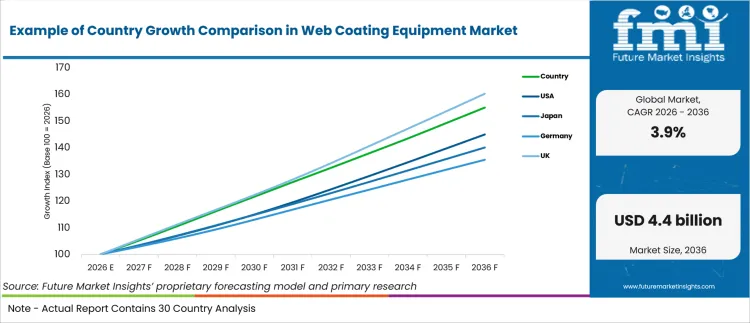
| Country | CAGR |
|---|---|
| Canada | 5.2% |
| UK | 4.8% |
| Brazil | 4.1% |
| USA | 3.8% |
| Japan | 3.4% |
| Germany | 3.1% |
| South Korea | 2.7% |
How do country-level CAGRs compare in the Web Coating Equipment Market?
The country forecasts show a gradual progression across the web coating equipment market, with growth rates distributed within a relatively narrow range rather than separated into distinct tiers. Canada and the UK form an upper group where demand is supported by ongoing investments in advanced converting, packaging and specialty materials production. Brazil creates a transition between the higher-growth markets and the more mature manufacturing economies represented by the USA, Japan and Germany. The gap between adjacent countries remains modest throughout the comparison, indicating that market momentum differs by degree rather than by fundamentally different industry conditions. This pattern reflects varying levels of expansion in flexible packaging, functional coatings, battery materials and industrial film production. Demand for web coating equipment is increasingly tied to manufacturing modernization, process efficiency and the development of high-performance coated substrates.
- Canada benefits from continued investment in advanced manufacturing and specialty material production, supporting demand for coating systems used in packaging, industrial films and engineered materials.
- The UK reflects growing adoption of high-value coating technologies across flexible packaging, labels and functional material applications where quality and process consistency remain critical.
- Brazil's outlook is supported by gradual modernization of converting and packaging operations, creating opportunities for equipment upgrades that improve coating precision and production efficiency.
- The USA continues to generate demand through established industrial, packaging and electronics manufacturing sectors that require advanced coating and laminating capabilities.
- Japan maintains steady market development through its focus on precision manufacturing and the production of specialty films, electronic materials and performance coatings.
- Germany's position is influenced by a mature industrial base where demand is increasingly linked to process optimization, automation and high-performance manufacturing applications.
- South Korea supports market growth through activity in electronics, display materials and advanced industrial coatings, although investment cycles remain closely tied to broader manufacturing trends.
Similar CAGRs do not necessarily translate into identical opportunities for web coating equipment suppliers. Differences in end-use industries, automation requirements, manufacturing scale and capital investment priorities can significantly influence equipment purchasing decisions. As a result, commercialization strategies often depend as much on local production needs as on forecast market growth. The full report provides country-level CAGR analysis across North America, Latin America, Europe, East Asia, South Asia, Oceania and the Middle East and Africa.
Country-wise Analysis
- Ontario supports battery-material projects through industrial sites that connect pilot work with commercial manufacturing operations. The Canada web coating equipment sector is projected to record 5.2% CAGR during the assessment period, supported by coated-current-collector scale-up. Natural Resources Canada listed an active project in October 2025 that applies conductive carbon coatings to battery current collectors. The project gives coating equipment a direct route into production-scale foil processing and commercial material qualification. Local engineering partnerships can shorten trial cycles across battery and specialty-film programs that need production references. Geographic service distance remains a material friction for commissioning and unplanned maintenance across dispersed industrial sites.
- United Kingdom battery projects rely on staged financing and pilot access ahead of final commercial equipment specifications. The UK web coating equipment outlook is anticipated to advance at 4.8% CAGR over the assessment period, supported by battery-line investment and pilot access. Industrial-scale projects need local process development as wider coating and drying systems enter final acceptance. UK Export Finance stated in June 2025 that its support covered an AESC battery plant with planned annual capacity of 15.8 GWh. Local development facilities can reduce technical risk across electrode trials and workforce training for planned production lines. Financing changes and delayed plant ramp-up remain material frictions across phased installation programs for equipment providers.
- Manaus combines flexible-film production with tax-supported industrial projects and service routes across considerable regional distances. By 2036, Brazil’s web coating equipment market is projected to grow at 4.1% CAGR through packaging-film capacity expansion. Suframa reported in February 2025 that Videolar-Innova was investing in construction plus machinery and equipment at its Manaus operation. The site manufactures BOPP films and other rolled plastic materials used across food grade packaging and other high-volume structures. Local production scale favors equipment that can support long converter runs across several film formats. Imported parts and specialist maintenance remain a material service friction during unplanned line stops across northern Brazil.
- Federal battery programs provide a purchasing route for equipment used in domestic material processing and pre-commercial production. The web coating equipment market in the USA is estimated to post 3.8% CAGR over the forecast period, reinforced by battery-material manufacturing support. Funding programs connect new materials with production equipment and derivative battery manufacturing across domestic facilities. The United States Department of Energy announced up to USD 500 million in March 2026 for critical materials processing and derivative battery manufacturing. Coated foils and related materials require controlled production processes throughout demanding commercial equipment qualification programs. Long approval cycles remain a material friction across new electrode formulations and production-scale process changes.
- Japanese battery manufacturers use detailed qualification and local service coordination ahead of electrode equipment changes. Web coating equipment demand in Japan is forecast to rise at 3.4% CAGR over the forecast period, influenced by advanced battery development. The Ministry of Economy Trade and Industry revised its Battery and Power Industry Strategy in June 2026. The revised strategy targets stronger domestic industrial capability and continued development across advanced battery production technologies. Local equipment partnerships provide an enabler for detailed trials and service response across established manufacturing clusters. Lengthy qualification remains a friction as material changes require documented performance across extended production runs.
- Germany combines established coating engineering with battery projects that differ widely in financing status and production maturity. Web coating equipment sales in Germany are forecast to expand at 3.1% CAGR by 2036, supported by coating expertise and active cell-production sites. The commercial route depends on equipment trials that connect local engineering capability with viable battery projects. The German Bundestag reported in March 2026 that ten battery-cell production sites were operating and five projects had stopped or paused. Engineering clusters provide practical access to trials and specialized maintenance across several established industrial regions. Project uncertainty remains a material friction and can postpone line awards despite completed pilot validation and technical support.
- South Korea operates dense battery supply chains that connect material producers with cell manufacturers and engineering centers. Web coating equipment demand in South Korea is predicted to advance at 2.7% CAGR through 2036, aided by integrated battery manufacturing clusters. The Ministry of Trade Industry and Resources announced K-Battery measures in December 2025 for next-generation technology and domestic production. Concentrated industrial clusters can shorten service travel and accelerate joint process trials across material and cell manufacturing companies. Margin pressure and changing overseas demand remain material frictions for capital commitments across battery equipment programs. Modular capacity plans can preserve technical progress without assuming every pilot program advances into a complete line.
Who are the notable companies in the Web Coating Equipment Market?
Dürr Systems AG, BOBST Group SA, Comexi, New Era Converting Machinery Inc., nextCoatema Technologies GmbH, KROENERT GmbH & Co KG, Nordmeccanica Group, and Techno Smart Corp. are notable companies shaping the web coating equipment market.
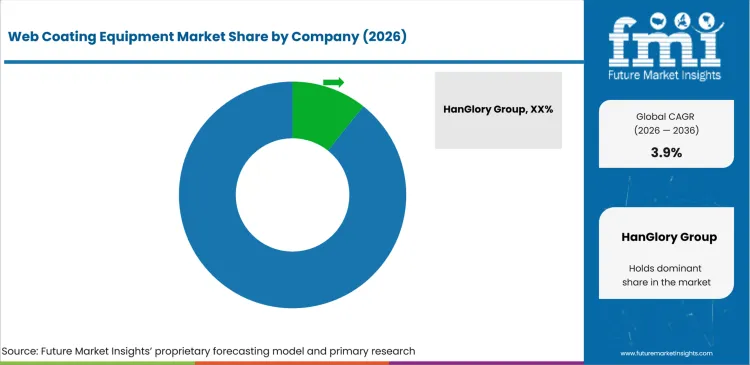
The competitive field is divided by application rather than controlled by one full-line equipment group. Dürr and Techno Smart compete most directly in battery electrode coating across large production projects. BOBST and Nordmeccanica focus heavily on packaging films and laminates that require flexible web handling. KROENERT and nextCoatema enter flexible electronics programs earlier through pilot facilities and configurable lines during technical trials. New Era serves custom engineering work for food packaging and specialty materials that need web handling and coating under one project team. Entry remains possible through a specialist coating head or regional service route, but complete-line contracts require production references and dependable commissioning support. Market concentration therefore changes by application and line scale instead of following one global hierarchy.
- Dürr Systems AG and Techno Smart compete across battery electrode lines through precision coating and integrated drying capability. Their commercial test is stable output across wider foils alongside commissioning support that resolves process deviations throughout demanding commercial production ramp-up programs.
- BOBST Group SA and Comexi compete with Nordmeccanica Group across flexible packaging applications that need coating and laminating versatility. Their positions depend on material trials and service coverage alongside practical changeover performance across recurring production structures and several approved substrate combinations.
- KROENERT GmbH & Co KG and nextCoatema Technologies GmbH support pilot-to-production development across functional films and specialty materials. New Era Converting Machinery adds custom web lines that connect application trials with production engineering and continuing regional service under one project route.
Competitive Benchmarking: Web Coating Equipment Market
| Company | Precision Web Coating | Drying and Solvent Control | Pilot-to-Production Engineering | Geographic Reach |
|---|---|---|---|---|
| Dürr Systems AG | High | High | Medium | Global |
| BOBST Group SA | High | High | Medium | Global |
| Comexi | Medium | Medium | High | Global |
| New Era Converting Machinery Inc. | Medium | Medium | Medium | North America with global IPCO support |
| nextCoatema Technologies GmbH | High | High | High | Europe and Asia |
| KROENERT GmbH & Co KG | High | High | High | Europe and international customers |
| Nordmeccanica Group | High | Medium | High | Global |
| Techno Smart Corp. | High | Medium | Medium | Japan and Europe |
Key Developments in the Web Coating Equipment Market
- In January 2025, Dürr Systems AG received an order for eight electrode coating lines from FIB in Italy. The project combines four anode lines with four cathode lines plus calenders and slitters alongside solvent recovery systems. The order demonstrates commercial demand for integrated coating packages that connect several electrode-production stages under one equipment program during commercial production ramp-up.
- In November 2025, BOBST introduced the next-generation EXPERT K5 vacuum metallizer with automated process controls and digital support functions. The platform expands continuous web treatment capability across flexible packaging and specialty-film commercial production operations. Automated controls reduce operator intervention during metallization runs that depend on stable web handling and repeatable layer formation across extended customer production campaigns.
- In February 2025, Techno Smart announced an order for a lithium-ion battery electrode coater serving a European project. The order provides dated commercial evidence for production equipment beyond laboratory development and early pilot work. The project also confirms an active European route through the company’s business alliance with Dürr Systems AG for complete electrode coating programs.
- In March 2026, Coatema announced the completed acquisition of key assets by next Machinery Group and the establishment of nextCoatema Technologies GmbH. The transaction preserved roll-to-roll coating and lab-to-fab capabilities under a newly established operating company for international customers. Customers retained an active route for pilot machinery and production systems during the ownership transition and subsequent service planning across international projects.
Web Coating Equipment Market - Report Scope
| Coverage field | Report scope |
|---|---|
| Market breakdown | Product Type, Application, End User, Distribution Channel, Coating Technology, and region. |
| Market Definition | Roll-to-roll coating, drying, curing, unwinding, winding, tension-control, metering, and inspection equipment used for continuous flexible substrates. |
| Regions Covered | North America, Latin America, Europe, East Asia, South Asia, Oceania, and Middle East and Africa. |
| Countries Covered | Canada, UK, Brazil, USA, Japan, Germany, and South Korea, alongside additional countries within the regional model. |
| Key Companies Profiled | Dürr Systems AG, BOBST Group SA, Comexi, New Era Converting Machinery Inc., nextCoatema Technologies GmbH, KROENERT GmbH & Co KG, Nordmeccanica Group, and Techno Smart Corp. |
| Forecast Period | 2026 to 2036. |
| Approach | Hybrid bottom-up and top-down market sizing supported by primary interviews and official desk research. |
Web Coating Equipment Market - Research Methodology
| Method | Approach |
|---|---|
| Primary Research | FMI analysts gathered input from manufacturers, service providers, technology developers, distributors, end users, procurement teams, and subject-matter experts. Interviews examined purchasing decisions, product or service evaluation, adoption barriers, approval requirements, pricing considerations, and expectations for technical or commercial support. Respondents were also asked what evidence is required before a trial, pilot, or initial order develops into regular purchasing. |
| Desk Research | Desk research covered government statistics, regulatory publications, trade data, industry associations, technical literature, standards, company filings, product information, and official corporate announcements. Sources were reviewed for relevance, publication date, geographic coverage, and consistency with the defined market scope. Claims relating to performance, applications, approvals, capacity, investment, and commercial activity were retained only when supported by credible public evidence. |
| Market Sizing and Forecasting | The market model combined the baseline value with historical performance, segment structure, pricing and volume indicators, adoption levels, company participation, and country-level demand conditions. Forecast assumptions considered economic activity, investment trends, regulatory developments, technology adoption, purchasing cycles, supply availability, and barriers to wider market use. Segment and regional estimates were reconciled before the final market total was calculated. |
| Data Validation | Estimates were checked against multiple independent indicators, including public data, company activity, trade patterns, industry developments, and findings from primary interviews. Validation also tested whether products, services, applications, and company revenues fell within the defined market boundaries. Adjacent categories, unsupported claims, overlapping revenues, and activities without direct market relevance were excluded to reduce double counting and maintain consistency across segments and countries. |
Web Coating Equipment Market by Segments
Web Coating Equipment Market segmented by Product Type:
- Roll-to-Roll Coating Equipment
- Slot-Die Coating Equipment
- Spray Coating Equipment
- Curtain Coating Equipment
- Gravure Coating Equipment
- Other Web Coating Equipment
Web Coating Equipment Market segmented by Application:
- Flexible Electronics
- Packaging
- Printed Electronics
- Solar and Photovoltaics
- Automotive
- Industrial and Specialty Applications
Web Coating Equipment Market segmented by End User:
- Packaging Manufacturers
- Electronics Manufacturers
- Automotive Manufacturers
- Solar and Photovoltaic Manufacturers
- Industrial Manufacturers
- Printing and Converting Companies
Web Coating Equipment Market segmented by Distribution Channel:
- Direct Sales
- Industrial Distributors
- System Integrators
- OEM Partnerships
- Online and B2B Channels
Web Coating Equipment Market segmented by Coating Technology:
- Gravure Coating Technology
- Slot-Die Coating Technology
- Roll Coating Technology
- Spray Coating Technology
- Curtain Coating Technology
- Other Precision Coating Technologies
Web Coating Equipment Market by Region:
- North America
- United States
- Canada
- Latin America
- Brazil
- Mexico
- Argentina
- Chile
- Western Europe
- Germany
- France
- United Kingdom
- Italy
- Spain
- Benelux
- Nordics
- Eastern Europe
- Poland
- Czech Republic
- Romania
- Hungary
- East Asia
- China
- Japan
- South Korea
- South Asia and Pacific
- India
- ASEAN
- Australia and New Zealand
- Middle East and Africa
- GCC Countries
- South Africa
- Türkiye
- Israel
Research Sources and Bibliography
- ULVAC, Inc. (2025, February 13).
- European Commission. (2025, February 11).
- UK Battery Industrialisation Centre. (2025, February 6).
- Nikon Corporation. (2025, December 10).
- Nordmeccanica Group. (2025, May 22).
- BOBST. (2025, March 4).
- IPCO AB. (2025, April 1).
- U.S. Department of Energy. (2025, January 10).
- UK Battery Industrialisation Centre. (2026, January 12).
- Coatema Coating Machinery GmbH. (2025, March 19).
- Natural Resources Canada. (2025, October 8).
- UK Export Finance. (2025, June 2)
- Superintendência da Zona Franca de Manaus. (2025, February 12).
- U.S. Department of Energy. (2026, March 13).
- Ministry of Economy, Trade and Industry. (2026, June 2).
- German Bundestag. (2026, March 25).
- Ministry of Trade, Industry and Resources. (2025, December 1)
- Dürr Systems AG. (2025, January 8).
- BOBST. (2025, November 11).
- Techno Smart Corp. (2025, February 18).
- Coatema Coating Machinery GmbH. (2026, March 10)
- KROENERT GmbH & Co KG. (2025, September 24)
This bibliography is provided for reader reference and is not exhaustive. The full report contains the complete reference list and detailed citations
This Report Answers
- How large is the web coating equipment market in 2026 and 2036?
- Which production requirements support investment in continuous web coating and drying systems?
- Why does Roll-to-Roll Coating Equipment account for a major Product Type share in 2026?
- How does Flexible Electronics influence coating-line specifications and process validation?
- Why do Packaging Manufacturers represent a major End User share in 2026?
- How do country growth rates differ across Canada, the UK, Brazil, the USA, Japan, Germany, and South Korea?
- Which companies provide precision coating, drying, scale-up engineering, and regional service?
- What limits commercial conversion from laboratory coating into production-width equipment?
- How can modular pilot systems reduce technical and financial risk before full-scale investment?
Frequently Asked Questions
How big is the Web Coating Equipment Market in 2026?
The web coating equipment market is valued at USD 3 billion in 2026 and is forecast to reach USD 4.4 billion by 2036. Growth is supported by battery electrode plants requiring continuous coating and drying systems that maintain film thickness across wider foils during extended production campaigns.
What is the CAGR of the Web Coating Equipment Market from 2026 to 2036?
The web coating equipment market grows at a CAGR of 3.9% between 2026 and 2036, supported by battery and functional-film programs that require repeatable wide-web coating as qualified electrode recipes progress from pilot trials into continuous commercial production.
Which product type leads the Web Coating Equipment Market?
Roll-to-roll coating equipment leads the web coating equipment market by product type, holding 31.0% share in 2026, supported by coordinated unwinding and controlled drying that reduce material handoffs across battery and packaging production lines.
How much will the Web Coating Equipment Market add between 2026 and 2036?
The web coating equipment market is set to add USD 1.4 billion between 2026 and 2036, growing from USD 3 billion to USD 4.4 billion as battery electrode scale-up and packaging modernization drive continued equipment investment across commercial production sites.
Who are the leading companies in the Web Coating Equipment Market?
Eight companies lead the web coating equipment market, including Dürr Systems AG, BOBST Group SA, Comexi, New Era Converting Machinery Inc., nextCoatema Technologies GmbH, KROENERT GmbH & Co KG, Nordmeccanica Group, and Techno Smart Corp., competing through application engineering and production-scale support.
Preview the report firsthand - request a free sample
Get SampleGet the brochure for pricing and purchase details.
Get PDFTable of Content
- Key Takeaways
- Market Size and CAGR
- Top Growth Driver
- Fastest Growing Segment
- Leading Region
- Key Companies
- Emerging Opportunities
- Executive Summary
- Global Market Outlook
- Demand-side Trends
- Supply-side Trends
- Technology Roadmap Analysis
- Analysis and Recommendations
- Analyst Perspective (What is happening? Why now? What should investors know?)
- Key Questions Answered
- How large is the market?
- What is the CAGR?
- What are key trends?
- Which region dominates?
- Who are the leaders?
- Market Overview
- Market Coverage / Taxonomy
- Market Definition / Scope / Limitations
- Research Methodology
- Chapter Orientation
- Analytical Lens and Working Hypotheses
- Market Structure, Signals, and Trend Drivers
- Benchmarking and Cross-market Comparability
- Market Sizing, Forecasting, and Opportunity Mapping
- Research Design and Evidence Framework
- Desk Research Programme (Secondary Evidence)
- Expert Input and Fieldwork (Primary Evidence)
- Tooling, Models, and Reference Databases
- Data Engineering and Model Build
- Quality Assurance and Audit Trail
- Market Background
- Market Dynamics (Drivers, Restraints, Opportunity, Trends)
- Scenario Forecast (Optimistic, Likely, Conservative)
- Impact Analysis
- AI Impact
- Sustainability Impact
- Regulatory Impact
- Technology Impact
- Consumer / Buyer Analysis
- Purchase Drivers
- Adoption Barriers
- Buyer Journey
- Opportunity Map Analysis
- Product Life Cycle Analysis
- Supply Chain Analysis
- Investment Feasibility Matrix
- Value Chain Analysis
- PESTLE and Porter's Analysis
- Regulatory Landscape
- Regional Parent Market Outlook
- Production and Consumption Statistics
- Import and Export Statistics
- Global Market Analysis and Forecast, 2021 to 2036
- Historical Market Size Value (USD billion) Analysis, 2021 to 2025
- Current and Future Market Size Value (USD billion) Projections, 2026 to 2036
- Y-o-Y Growth Trend Analysis
- Absolute $ Opportunity Analysis
- Global Market Pricing Analysis, 2021 to 2036
- Global Market Analysis and Forecast, By Product Type, 2021 to 2036
- Introduction / Key Findings
- Historical Market Size Value (USD billion) Analysis By Product Type, 2021 to 2025
- Current and Future Market Size Value (USD billion) Analysis and Forecast By Product Type, 2026 to 2036
- Roll-to-Roll Coating Equipment
- Gravure Roll Coating Systems
- Reverse Roll Coating Systems
- Slot-Die Coating Equipment
- Single-Slot Die Systems
- Multi-Slot Die Systems
- Spray Coating Equipment
- Air-Assisted Spray Systems
- Airless Spray Systems
- Curtain Coating Equipment
- Single-Layer Curtain Coaters
- Multi-Layer Curtain Coaters
- Gravure Coating Equipment
- Direct Gravure Coaters
- Reverse Gravure Coaters
- Other Web Coating Equipment
- Knife-Over-Roll Coaters
- Metering Rod Coaters
- Roll-to-Roll Coating Equipment
- Y-o-Y Growth Trend Analysis By Product Type, 2021 to 2025
- Absolute $ Opportunity Analysis By Product Type, 2026 to 2036
- Global Market Analysis and Forecast, By Application, 2021 to 2036
- Introduction / Key Findings
- Historical Market Size Value (USD billion) Analysis By Application, 2021 to 2025
- Current and Future Market Size Value (USD billion) Analysis and Forecast By Application, 2026 to 2036
- Flexible Electronics
- Flexible Displays
- Flexible Sensors
- Packaging
- Flexible Packaging
- Food and Beverage Packaging
- Printed Electronics
- Conductive Electronics
- Organic and Printed Circuits
- Solar and Photovoltaics
- Thin-Film Solar Cells
- Flexible Photovoltaic Modules
- Automotive
- Automotive Interior Films
- Battery and Functional Components
- Industrial and Specialty Applications
- Industrial Films
- Adhesive and Functional Webs
- Flexible Electronics
- Y-o-Y Growth Trend Analysis By Application, 2021 to 2025
- Absolute $ Opportunity Analysis By Application, 2026 to 2036
- Global Market Analysis and Forecast, By End User, 2021 to 2036
- Introduction / Key Findings
- Historical Market Size Value (USD billion) Analysis By End User, 2021 to 2025
- Current and Future Market Size Value (USD billion) Analysis and Forecast By End User, 2026 to 2036
- Packaging Manufacturers
- Flexible Packaging Producers
- Label and Packaging Film Manufacturers
- Electronics Manufacturers
- Consumer Electronics Producers
- Flexible Electronics Manufacturers
- Automotive Manufacturers
- Passenger Vehicle OEMs
- Commercial Vehicle OEMs
- Solar and Photovoltaic Manufacturers
- Solar Cell Producers
- Photovoltaic Module Manufacturers
- Industrial Manufacturers
- Industrial Film Producers
- Adhesive and Specialty Material Manufacturers
- Printing and Converting Companies
- Commercial Printers
- Industrial Converters
- Packaging Manufacturers
- Y-o-Y Growth Trend Analysis By End User, 2021 to 2025
- Absolute $ Opportunity Analysis By End User, 2026 to 2036
- Global Market Analysis and Forecast, By Distribution Channel, 2021 to 2036
- Introduction / Key Findings
- Historical Market Size Value (USD billion) Analysis By Distribution Channel, 2021 to 2025
- Current and Future Market Size Value (USD billion) Analysis and Forecast By Distribution Channel, 2026 to 2036
- Direct Sales
- Direct Manufacturer Sales
- Key Account and Project Contracts
- Industrial Distributors
- Regional Equipment Distributors
- Specialized Coating Equipment Distributors
- System Integrators
- Turnkey Coating Line Integrators
- Automation and Process Integration Firms
- OEM Partnerships
- Equipment OEM Partnerships
- Machinery Integration Partnerships
- Online and B2B Channels
- Industrial E-Commerce Platforms
- B2B Procurement Portals
- Direct Sales
- Y-o-Y Growth Trend Analysis By Distribution Channel, 2021 to 2025
- Absolute $ Opportunity Analysis By Distribution Channel, 2026 to 2036
- Global Market Analysis and Forecast, By Coating Technology, 2021 to 2036
- Introduction / Key Findings
- Historical Market Size Value (USD billion) Analysis By Coating Technology, 2021 to 2025
- Current and Future Market Size Value (USD billion) Analysis and Forecast By Coating Technology, 2026 to 2036
- Gravure Coating Technology
- Direct Gravure Coating
- Reverse Gravure Coating
- Slot-Die Coating Technology
- Single-Layer Slot Die
- Multi-Layer Slot Die
- Roll Coating Technology
- Reverse Roll Coating
- Metering Roll Coating
- Spray Coating Technology
- Air-Assisted Spray
- Airless Spray
- Curtain Coating Technology
- Single-Layer Curtain Coating
- Multi-Layer Curtain Coating
- Other Precision Coating Technologies
- Knife Coating
- Slot-Feed and Specialty Coating
- Gravure Coating Technology
- Y-o-Y Growth Trend Analysis By Coating Technology, 2021 to 2025
- Absolute $ Opportunity Analysis By Coating Technology, 2026 to 2036
- Global Market Analysis and Forecast, By Region, 2021 to 2036
- Introduction
- Historical Market Size Value (USD billion) Analysis By Region, 2021 to 2025
- Current Market Size Value (USD billion) Analysis and Forecast By Region, 2026 to 2036
- North America
- Latin America
- Western Europe
- Eastern Europe
- East Asia
- South Asia and Pacific
- Middle East & Africa
- Market Attractiveness Analysis By Region
- North America Market Analysis and Forecast, By Country, 2021 to 2036
- Historical Market Size Value (USD billion) Trend Analysis By Market Taxonomy, 2021 to 2025
- Market Size Value (USD billion) Forecast By Market Taxonomy, 2026 to 2036
- By Country
- USA
- Canada
- By Product Type
- By Application
- By End User
- By Distribution Channel
- By Coating Technology
- By Country
- Market Attractiveness Analysis
- By Country
- By Product Type
- By Application
- By End User
- By Distribution Channel
- By Coating Technology
- Key Takeaways
- Latin America Market Analysis and Forecast, By Country
- Historical Market Size Value (USD billion) Trend Analysis By Market Taxonomy, 2021 to 2025
- Market Size Value (USD billion) Forecast By Market Taxonomy, 2026 to 2036
- By Country
- Brazil
- Mexico
- Chile
- Rest of Latin America
- By Product Type
- By Application
- By End User
- By Distribution Channel
- By Coating Technology
- By Country
- Market Attractiveness Analysis
- By Country
- By Product Type
- By Application
- By End User
- By Distribution Channel
- By Coating Technology
- Key Takeaways
- Western Europe Market Analysis and Forecast, By Country
- Historical Market Size Value (USD billion) Trend Analysis By Market Taxonomy, 2021 to 2025
- Market Size Value (USD billion) Forecast By Market Taxonomy, 2026 to 2036
- By Country
- Germany
- UK
- Italy
- Spain
- France
- Nordic
- BENELUX
- Rest of Western Europe
- By Product Type
- By Application
- By End User
- By Distribution Channel
- By Coating Technology
- By Country
- Market Attractiveness Analysis
- By Country
- By Product Type
- By Application
- By End User
- By Distribution Channel
- By Coating Technology
- Key Takeaways
- Eastern Europe Market Analysis and Forecast, By Country
- Historical Market Size Value (USD billion) Trend Analysis By Market Taxonomy, 2021 to 2025
- Market Size Value (USD billion) Forecast By Market Taxonomy, 2026 to 2036
- By Country
- Russia
- Poland
- Hungary
- Balkan & Baltic
- Rest of Eastern Europe
- By Product Type
- By Application
- By End User
- By Distribution Channel
- By Coating Technology
- By Country
- Market Attractiveness Analysis
- By Country
- By Product Type
- By Application
- By End User
- By Distribution Channel
- By Coating Technology
- Key Takeaways
- East Asia Market Analysis and Forecast, By Country
- Historical Market Size Value (USD billion) Trend Analysis By Market Taxonomy, 2021 to 2025
- Market Size Value (USD billion) Forecast By Market Taxonomy, 2026 to 2036
- By Country
- China
- Japan
- South Korea
- By Product Type
- By Application
- By End User
- By Distribution Channel
- By Coating Technology
- By Country
- Market Attractiveness Analysis
- By Country
- By Product Type
- By Application
- By End User
- By Distribution Channel
- By Coating Technology
- Key Takeaways
- South Asia and Pacific Market Analysis and Forecast, By Country
- Historical Market Size Value (USD billion) Trend Analysis By Market Taxonomy, 2021 to 2025
- Market Size Value (USD billion) Forecast By Market Taxonomy, 2026 to 2036
- By Country
- India
- ASEAN
- Australia & New Zealand
- Rest of South Asia and Pacific
- By Product Type
- By Application
- By End User
- By Distribution Channel
- By Coating Technology
- By Country
- Market Attractiveness Analysis
- By Country
- By Product Type
- By Application
- By End User
- By Distribution Channel
- By Coating Technology
- Key Takeaways
- Middle East & Africa Market Analysis and Forecast, By Country
- Historical Market Size Value (USD billion) Trend Analysis By Market Taxonomy, 2021 to 2025
- Market Size Value (USD billion) Forecast By Market Taxonomy, 2026 to 2036
- By Country
- Kingdom of Saudi Arabia
- Other GCC Countries
- Türkiye
- South Africa
- Other African Union
- Rest of Middle East & Africa
- By Product Type
- By Application
- By End User
- By Distribution Channel
- By Coating Technology
- By Country
- Market Attractiveness Analysis
- By Country
- By Product Type
- By Application
- By End User
- By Distribution Channel
- By Coating Technology
- Key Takeaways
- Key Countries Market Analysis
- USA
- Pricing Analysis
- Market Share Analysis, 2025
- By Product Type
- By Application
- By End User
- By Distribution Channel
- By Coating Technology
- Canada
- Pricing Analysis
- Market Share Analysis, 2025
- By Product Type
- By Application
- By End User
- By Distribution Channel
- By Coating Technology
- Mexico
- Pricing Analysis
- Market Share Analysis, 2025
- By Product Type
- By Application
- By End User
- By Distribution Channel
- By Coating Technology
- Brazil
- Pricing Analysis
- Market Share Analysis, 2025
- By Product Type
- By Application
- By End User
- By Distribution Channel
- By Coating Technology
- Chile
- Pricing Analysis
- Market Share Analysis, 2025
- By Product Type
- By Application
- By End User
- By Distribution Channel
- By Coating Technology
- Germany
- Pricing Analysis
- Market Share Analysis, 2025
- By Product Type
- By Application
- By End User
- By Distribution Channel
- By Coating Technology
- UK
- Pricing Analysis
- Market Share Analysis, 2025
- By Product Type
- By Application
- By End User
- By Distribution Channel
- By Coating Technology
- Italy
- Pricing Analysis
- Market Share Analysis, 2025
- By Product Type
- By Application
- By End User
- By Distribution Channel
- By Coating Technology
- Spain
- Pricing Analysis
- Market Share Analysis, 2025
- By Product Type
- By Application
- By End User
- By Distribution Channel
- By Coating Technology
- France
- Pricing Analysis
- Market Share Analysis, 2025
- By Product Type
- By Application
- By End User
- By Distribution Channel
- By Coating Technology
- India
- Pricing Analysis
- Market Share Analysis, 2025
- By Product Type
- By Application
- By End User
- By Distribution Channel
- By Coating Technology
- ASEAN
- Pricing Analysis
- Market Share Analysis, 2025
- By Product Type
- By Application
- By End User
- By Distribution Channel
- By Coating Technology
- Australia & New Zealand
- Pricing Analysis
- Market Share Analysis, 2025
- By Product Type
- By Application
- By End User
- By Distribution Channel
- By Coating Technology
- China
- Pricing Analysis
- Market Share Analysis, 2025
- By Product Type
- By Application
- By End User
- By Distribution Channel
- By Coating Technology
- Japan
- Pricing Analysis
- Market Share Analysis, 2025
- By Product Type
- By Application
- By End User
- By Distribution Channel
- By Coating Technology
- South Korea
- Pricing Analysis
- Market Share Analysis, 2025
- By Product Type
- By Application
- By End User
- By Distribution Channel
- By Coating Technology
- Russia
- Pricing Analysis
- Market Share Analysis, 2025
- By Product Type
- By Application
- By End User
- By Distribution Channel
- By Coating Technology
- Poland
- Pricing Analysis
- Market Share Analysis, 2025
- By Product Type
- By Application
- By End User
- By Distribution Channel
- By Coating Technology
- Hungary
- Pricing Analysis
- Market Share Analysis, 2025
- By Product Type
- By Application
- By End User
- By Distribution Channel
- By Coating Technology
- Kingdom of Saudi Arabia
- Pricing Analysis
- Market Share Analysis, 2025
- By Product Type
- By Application
- By End User
- By Distribution Channel
- By Coating Technology
- Türkiye
- Pricing Analysis
- Market Share Analysis, 2025
- By Product Type
- By Application
- By End User
- By Distribution Channel
- By Coating Technology
- South Africa
- Pricing Analysis
- Market Share Analysis, 2025
- By Product Type
- By Application
- By End User
- By Distribution Channel
- By Coating Technology
- USA
- Market Structure Analysis
- Competition Dashboard
- Competition Benchmarking
- Market Share Analysis of Top Players
- By Regional
- By Product Type
- By Application
- By End User
- By Distribution Channel
- By Coating Technology
- Emerging Startups
- Innovation Benchmarking
- Competition Analysis
- Competition Deep Dive
- HanGlory Group
- Overview
- Product Portfolio
- Profitability by Market Segments
- Sales Footprint
- Strategy Overview
- Marketing Strategy
- Product Strategy
- Channel Strategy
- Dürr Systems AG
- Comexi
- Lamina System AB
- Meyer Burger Technology AG
- Davis-Standard, LLC
- Kampf Schneid- und Wickeltechnik GmbH & Co. KG
- Glenro Inc.
- Bobst Group SA
- Applied Materials, Inc.
- HanGlory Group
- Case Studies
- Success Stories
- Recent Developments
- Competition Deep Dive
- Assumptions & Acronyms Used


