

- Market Size (2026)
- USD 4360.7 Mn
- Forecast (2036)
- USD 9950.7 Mn
- CAGR (2026 to 2036)
- 8.6%
How big is the Roll To Roll Printer Market?
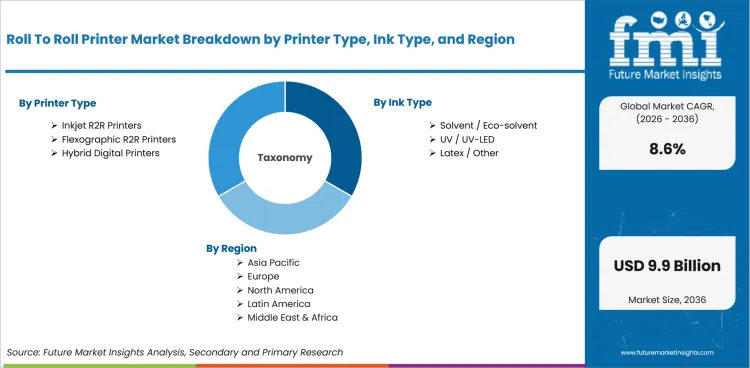
The Roll To Roll Printer Market is projected to grow from USD 4360.7 million in 2026 to USD 9950.7 million by 2036, at a CAGR of 8.6%.
The Roll To Roll Printer Market was valued at USD 4,015.38 million in 2025 and is expected to reach USD 4360.7 million in 2026. The market is projected to reach USD 9950.7 million by 2036 at a CAGR of 8.6%.
In April 2024, Agfa debuted the Anapurna Ciervo H3200 hybrid inkjet printer at ISA International Sign Expo. The system supports rigid and roll-fed sign applications. In May 2024, Canon expanded Colorado M-series UVgel capability with Packaging Factory innovations. The system paired a Colorado M5W roll-to-roll printer with jumbo roll feeding.
This moves the market away from basic equipment replacement. It makes productivity per operator and media-change speed central to printer selection.
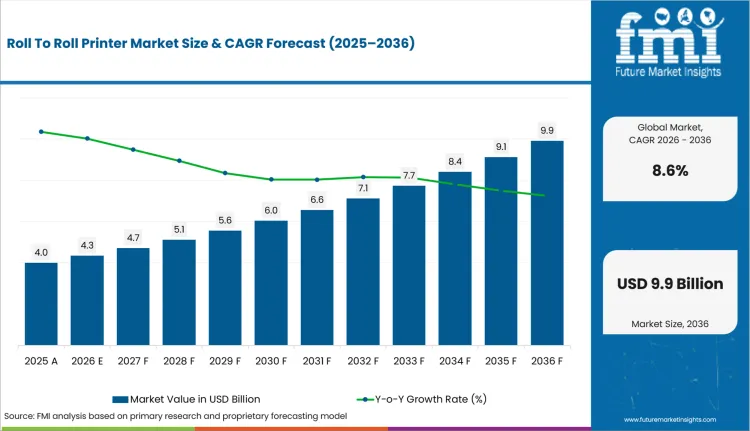
| Metric | Value |
|---|---|
| 2025 Market Size | USD 4,015.38 million |
| 2026 Market Size | USD 4360.7 million |
| 2036 Market Size | USD 9950.7 million |
| Forecast CAGR (2026-2036) | 8.6% |
| Leading Printer Type | Inkjet R2R Printers |
| Inkjet R2R Printers Share (2026) | 47.0% |
| Leading Ink Type | Solvent / Eco-solvent |
| Solvent / Eco-solvent Share (2026) | 36.0% |
| Fastest-growing Country | China |
| China CAGR by 2036 | 9.5% |
Summary of the Roll To Roll Printer Market
| Market Signal | Commercial Impact |
|---|---|
| Demand and Growth Drivers | Demand for roll-to-roll printers is increasing as print service providers seek faster production, shorter print runs, and greater flexibility across signage, textile, and packaging applications.
|
| Product and Segment View | Inkjet roll-to-roll printers, solvent/eco-solvent inks, and textile applications continue to represent the leading commercial opportunities across the market.
|
| Geography and Growth Outlook | Asia continues to lead market expansion while the United States and Japan strengthen demand through printing technology upgrades and advanced manufacturing capabilities.
|
| Competitive Landscape | Competition increasingly focuses on integrated printing platforms, advanced ink technologies, and workflow optimization.
|
| Analyst Perspective | Roll-to-roll printers are evolving from standalone printing equipment into complete production systems where workflow integration, reliability, and operating efficiency determine long-term value.
|
Why is the Roll To Roll Printer Market growing?
Buyers are moving to roll-fed digital output as short print runs make plate setup and manual changeovers less efficient. Signage providers need outdoor graphics systems that balance color durability with same-day or next-day delivery.
- Buyers are moving to roll-fed digital output as short print runs make plate setup and manual changeovers less efficient.
- Signage providers need outdoor graphics systems that balance color durability with same-day or next-day delivery.
- Textile printers use roll-to-roll systems to handle soft signage and apparel fabric without fixed screen costs.
Short-run print buying is changing the role of roll-fed printers inside print shops. Professional print award categories in 2025 covered Roll-to-Roll Solvent/Latex, Roll-to-Roll UV, and RTR Dye Sublimation on Textile as separate output classes. That structure shows how buyers now compare roll systems by substrate and ink behavior. It means OEMs must prove more than print speed. They need media handling, color stability, and finishing compatibility that match the buyer’s job mix. Textile and signage use keeps demand broad across small shops and larger production houses. CEMATEX describes ITMA as a full value-chain textile machinery event with 1,600+ exhibitors and 110,000+ visitors in its exhibition positioning.
How is the Roll To Roll Printer Market segmented?
The Roll To Roll Printer Market is segmented by printer type, ink type, substrate, end use, sales channel, and region.
- With an estimated 47.0% share in 2026, Inkjet R2R Printers is expected to lead the printer type category because variable graphics need fast setup.
- Solvent / Eco-solvent systems are projected to account for 36.0% of ink type demand in 2026 with outdoor graphics users anchoring volume.
- Textiles are anticipated to represent 33.0% of substrate demand in 2026 as fabric signage and décor use widen the addressable work.
How does Inkjet R2R Printers contribute to the printer type category?
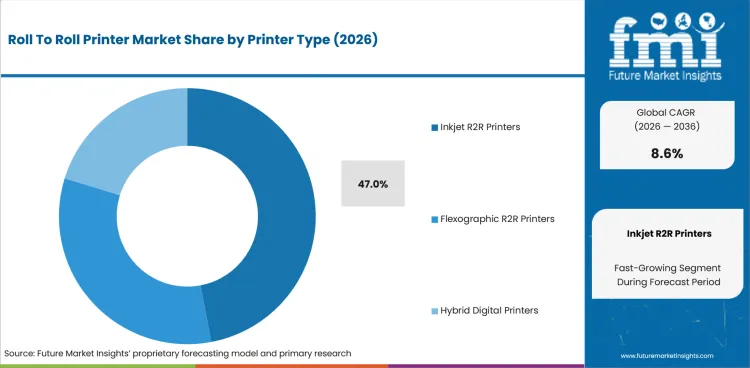
- Inkjet R2R Printers are projected to account for a 47.0% share in 2026 as variable-data signage and short textile batches need fast setup without plates.
- OEM differentiation depends on printhead uptime and color control. Buyers compare nozzle recovery, unattended run stability, and RIP integration before choosing between premium and entry machines.
What supports demand for Solvent / Eco-solvent?
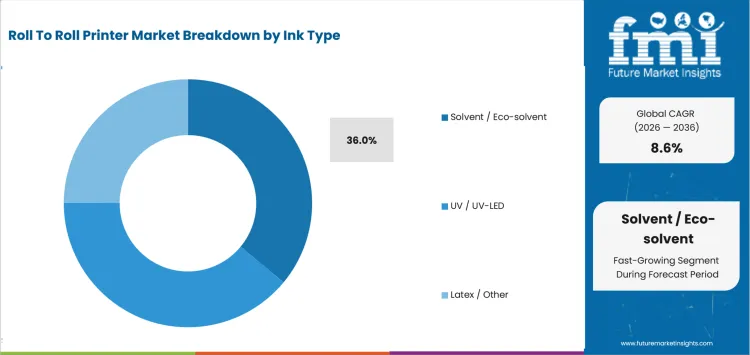
- Solvent / Eco-solvent systems are expected to represent a 36.0% share in 2026 as vehicle wraps and outdoor signage need weatherable color on vinyl media.
- Ink choice changes shop design and operating cost. UV / UV-LED curing suits rigid-flex work, while flexographic printing inks remain tied to packaging plate workflows.
How do buyers evaluate Textiles within the substrate category?
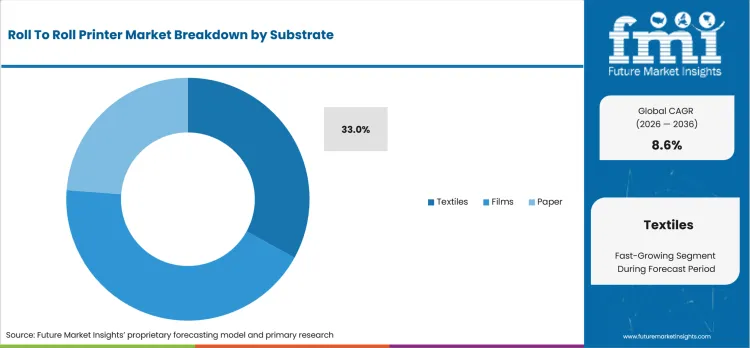
- Textiles are anticipated to hold a 33.0% share in 2026 as soft signage and décor fabric require roll handling with stable tension control.
- Fabric buyers care about stretch, coating, and color migration. This makes media profiles and heat fixation guidance more important than headline printer width.
What market factors influence demand for Signage & Graphics?
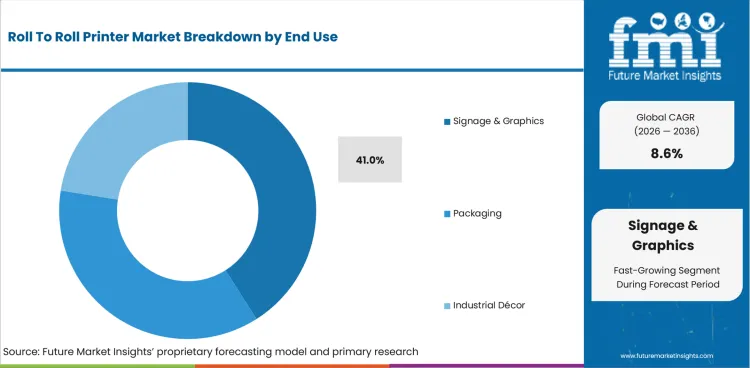
- Signage & Graphics is projected to account for a 41.0% share in 2026 as retail graphics and event banners keep order frequency high.
- Sign buyers often value turnaround over a low print cost. Same-day lamination readiness and reliable take-up matter in busy franchise and local print shops.
How does Direct OEM affect the sales channel outlook?
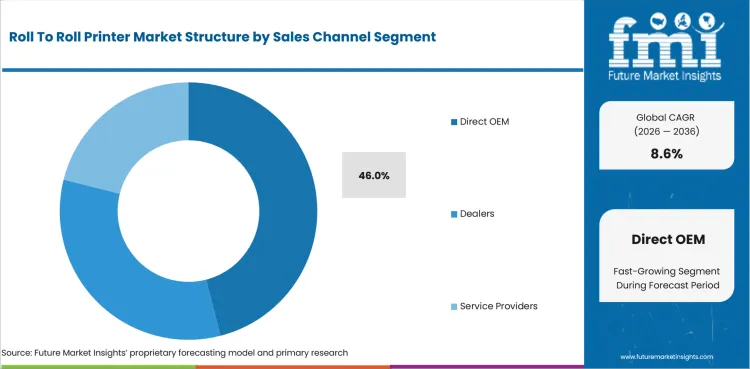
- Direct OEM is expected to hold a 46.0% share in 2026 as larger buyers want system installation and warranty accountability from one source.
- Dealer networks remain critical for smaller shops. They often decide between digital fabrication inkjet inks and bundled consumables during demonstrations.
What drives and restrains the market?
Driver: Short-run graphics work favors digital roll-fed systems as file changes replace plate changes and manual setup; restraint: High ink cost and printhead service risk restrain buyers that lack trained operators; opportunity: notable in hybrid lines that handle flexible rolls and rigid sheets in one production area.
The market reflects a balance between the identified demand driver, adoption constraints, and the supplier opportunity outlined below.
- Driver: Short-run graphics work favors digital roll-fed systems as file changes replace plate changes and manual setup.
- Restraint: High ink cost and printhead service risk restrain buyers that lack trained operators.
- Opportunity: notable in hybrid lines that handle flexible rolls and rigid sheets in one production area.
Short-Run Graphics Switching Short-run graphics are changing how print providers plan capacity. Buyers in retail and events often need many versions of the same base artwork across banners, films, and window graphics. Canon’s UVgel Packaging Factory example uses a Colorado M5W roll-to-roll printer with a jumbo roll media loader and can handle up to 2,000 meters of media in the same system. That length supports longer unattended output. It also shifts buying criteria toward workflow automation and finishing fit.
UV / UV-LED systems offer faster curing and wider media latitude, but they need careful testing for flexibility and adhesion. The growth of UV LED curable inks for direct-to-shape packaging in FMCG shows why curing speed is becoming a packaging productivity issue. Buyers need to balance energy use, odor, and post-print handling before selecting the system. Fabric Handling Bottlenecks: Fabric printing creates a different constraint from paper or vinyl work. The substrate can stretch, curl, or shift during long roll runs. This makes tension control and media profiling central to the investment case.
Which factors support expansion?
Commercial expansion is reinforced by the value, workflow, and recurring-demand factors below.
- Equipment value is rising as buyers replace separate print and finishing steps with faster roll-fed production cells.
- Premium systems gain ground as 3.2-meter and 3.5-meter printers reduce labor per square meter in busy shops.
- Ink choice is becoming a capital decision as solvent, UV, and latex systems carry different ventilation and curing costs.
Which country markets are included in the CAGR comparison?
The selected CAGR comparison covers China (9.5%), India (9.2%), South Korea (8.4%), United States (8.2%), and Japan (8.1%) through 2036.
| Country | CAGR |
|---|---|
| China | 9.5% |
| India | 9.2% |
| South Korea | 8.4% |
| United States | 8.2% |
| Japan | 8.1% |
Source: Future Market Insights analysis.
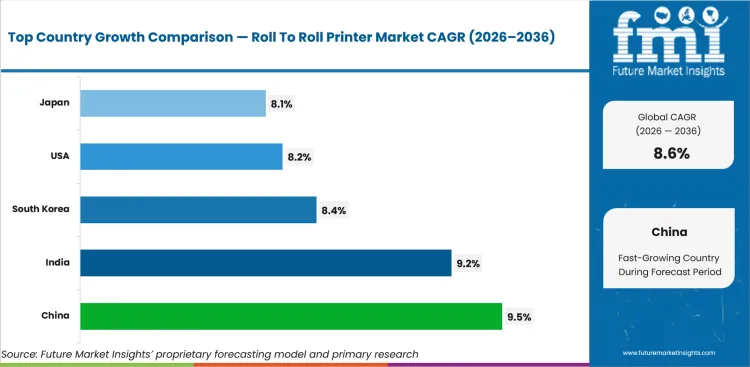
How do country-level CAGRs compare?
- China (CAGR: 9.5%): Guangdong, Zhejiang, Jiangsu, and Shanghai support textile, signage, and packaging conversion.
- India (CAGR: 9.2%): Surat, Tiruppur, Delhi NCR, Mumbai, and Bengaluru support textile and signage demand.
- South Korea (CAGR: 8.4%): Seoul, Gyeonggi, Daegu, and Busan support signage, textile, and industrial graphics work.
- United States (CAGR: 8.2%): Large-format sign shops in California, Texas, and Florida refresh equipment for retail graphics and vehicle wraps.
- Japan (CAGR: 8.1%): Nagano, Tokyo, Osaka, and Aichi connect OEM capability with sign and textile users.
The global Roll To Roll Printer Market is forecast to record a CAGR of 8.6% from 2026 to 2036. The study covers 30+ countries across the report regions.
How is the Roll To Roll Printer Market developing in China?
China is projected to record a CAGR of 9.5% through 2036. The country outlook identifies this demand signal: Guangdong, Zhejiang, Jiangsu, and Shanghai support textile, signage, and packaging conversion.
Country Market Snapshot
| Country | China |
|---|---|
| Forecast CAGR | 9.5% |
| Demand anchor | Guangdong, Zhejiang, Jiangsu, and Shanghai support textile, signage, and packaging conversion. |
| Procurement route | Buyers compare imported premium systems with local cost-focused suppliers. |
| Proof point | ITMA Asia + CITME 2026 is scheduled for Shanghai from November 20 to 24, 2026. |
| Application mix | Textile printing, display graphics, flexible packaging, and décor films support demand. |
| Restraint | Price pressure is severe in entry and mid-range systems. |
| Company context | Companies active in or serving this market include Flora Digital Printing, JHF Technology, Hanglory Group, Epson China, and Canon China. |
| Executive implication | Executive teams should compare qualification requirements, local service depth, and total implementation economics before selecting suppliers. |
Market Outlook
China is projected to record a CAGR of 9.5% through 2036 as print capacity expands across textiles and packaging. Demand is notable in production clusters that need both cost efficiency and higher variety. Buyers often weigh imported machines against domestic alternatives that offer lower upfront prices. The country’s scale makes channel strategy central. OEMs need distributor coverage, spare-parts access, and training in coastal manufacturing hubs. ITMA Asia + CITME in Shanghai gives roll-to-roll suppliers direct exposure to textile machinery buyers.
Key Growth Drivers
- Guangdong and Zhejiang textile clusters create high repeat demand for roll-fed systems.
- Shanghai trade events shorten access to textile and packaging buyers.
- Domestic signage competition pushes shops toward faster equipment and lower ink waste.
- Guangdong, Zhejiang, Jiangsu, and Shanghai support textile, signage, and packaging conversion.
Key Restraints
- Local price competition reduces margins for imported systems.
- Buyers can delay premium upgrades when domestic systems meet basic job needs.
- Price pressure is severe in entry and mid-range systems.
Country Market FAQs
What should C-suite teams prioritize in China?
C-suite teams should prioritize qualification requirements, procurement routes, local service coverage, and implementation economics before committing capital or supplier volume.
How should suppliers approach the China market?
Suppliers should align technical evidence, local channel support, and account-specific commercial terms with the buying process used by major customers in China.
What can weaken the business case in China?
Price pressure is severe in entry and mid-range systems. Executives should test this exposure during supplier, investment, and rollout reviews.
How is the Roll To Roll Printer Market developing in India?
India is projected to record a CAGR of 9.2% through 2036. The country outlook identifies this demand signal: Surat, Tiruppur, Delhi NCR, Mumbai, and Bengaluru support textile and signage demand.
Country Market Snapshot
| Country | India |
|---|---|
| Forecast CAGR | 9.2% |
| Demand anchor | Surat, Tiruppur, Delhi NCR, Mumbai, and Bengaluru support textile and signage demand. |
| Procurement route | Buyers rely on dealers for training, financing, and post-install service. |
| Proof point | WITS records India 2024 imports of HS 844390 printing machinery parts from the United Kingdom at USD 18,800.63 thousand. |
| Application mix | Textile printing, flex banners, retail signage, and décor films drive purchases. |
| Restraint | Price sensitivity makes entry systems and ink cost central to buying. |
| Company context | Companies active in or serving this market include ColorJet India, Monotech Systems, Epson India, Canon India, and HP India. |
| Executive implication | Executive teams should compare qualification requirements, local service depth, and total implementation economics before selecting suppliers. |
Market Outlook
India is expected to record a CAGR of 9.2% through 2036 as textile clusters and signage providers upgrade from older systems. Buyers in Surat and Tiruppur often look for lower setup cost and faster job changes. Signage buyers in Delhi NCR and Mumbai place more weight on speed and media availability. Dealer influence is stronger in India than in many mature markets. Buyers often need financing, operator training, and quick technician access before approving a machine.
Key Growth Drivers
- Surat and Tiruppur textile users need roll-fed output for short fabric batches.
- Delhi NCR and Mumbai signage shops refresh machines for retail and event work.
- Dealer finance widens access for small and midsize print providers.
- Surat, Tiruppur, Delhi NCR, Mumbai, and Bengaluru support textile and signage demand.
Key Restraints
- Ink cost and printhead replacement risk limit premium printer adoption.
- Service gaps outside major cities increase buyer hesitation.
- Price sensitivity makes entry systems and ink cost central to buying.
Country Market FAQs
What should C-suite teams prioritize in India?
C-suite teams should prioritize qualification requirements, procurement routes, local service coverage, and implementation economics before committing capital or supplier volume.
How should suppliers approach the India market?
Suppliers should align technical evidence, local channel support, and account-specific commercial terms with the buying process used by major customers in India.
What can weaken the business case in India?
Price sensitivity makes entry systems and ink cost central to buying. Executives should test this exposure during supplier, investment, and rollout reviews.
How is the Roll To Roll Printer Market developing in South Korea?
South Korea is projected to record a CAGR of 8.4% through 2036. The country outlook identifies this demand signal: Seoul, Gyeonggi, Daegu, and Busan support signage, textile, and industrial graphics work.
Country Market Snapshot
| Country | South Korea |
|---|---|
| Forecast CAGR | 8.4% |
| Demand anchor | Seoul, Gyeonggi, Daegu, and Busan support signage, textile, and industrial graphics work. |
| Supply route | Buyers often import key parts and systems from Japan, China, and Europe. |
| Proof point | WITS records South Korea 2024 imports of HS 844390 printing machinery parts at USD 565,832.28 thousand. |
| Application mix | Displays, soft signage, labels, and décor films shape demand. |
| Restraint | Small print shops face space and finance limits when upgrading to larger systems. |
| Company context | Companies active in or serving this market include Dilli, InkTec, Epson Korea, Canon Korea, and Roland DG. |
| Executive implication | Executive teams should compare qualification requirements, local service depth, and total implementation economics before selecting suppliers. |
Market Outlook
South Korea is forecast to grow at a CAGR of 8.4% through 2036 as graphics and display-related printing remain active. Demand is shaped by fast-turn retail work and industrial buyers that need precise color. The country’s electronics and display background makes buyers sensitive to print quality and repeatability. South Korean buyers often compare imported systems across service coverage and local dealer support. The WITS import figure shows the country’s reliance on international printing machinery parts.
Key Growth Drivers
- Seoul and Gyeonggi retail graphics support frequent short-run output.
- Display and electronics suppliers create demand for precise films and graphics.
- Import channels give buyers access to premium Japanese and European systems.
- Seoul, Gyeonggi, Daegu, and Busan support signage, textile, and industrial graphics work.
Key Restraints
- Parts dependence creates downtime risk during supply delays.
- Smaller shops avoid high-end systems if local service is not clearly available.
- Small print shops face space and finance limits when upgrading to larger systems.
Country Market FAQs
What should C-suite teams prioritize in South Korea?
C-suite teams should prioritize qualification requirements, procurement routes, local service coverage, and implementation economics before committing capital or supplier volume.
How should suppliers approach the South Korea market?
Suppliers should align technical evidence, local channel support, and account-specific commercial terms with the buying process used by major customers in South Korea.
What can weaken the business case in South Korea?
Small print shops face space and finance limits when upgrading to larger systems. Executives should test this exposure during supplier, investment, and rollout reviews.
How is the Roll To Roll Printer Market developing in the United States?
The United States is projected to record a CAGR of 8.2% through 2036. The country outlook identifies this demand signal: Large-format sign shops in California, Texas, and Florida refresh equipment for retail graphics and vehicle wraps.
Country Market Snapshot
| Country | United States |
|---|---|
| Forecast CAGR | 8.2% |
| Demand anchor | Large-format sign shops in California, Texas, and Florida refresh equipment for retail graphics and vehicle wraps. |
| Channel signal | PRINTING United and ISA Sign Expo create strong demo-led purchase routes for OEMs and dealers. |
| Proof point | WITS data show the United States as a major 2024 importer of Japanese printing machinery parts. |
| Application mix | Signage, wraps, soft signage, and event graphics drive frequent roll-fed work. |
| Restraint | Labor shortages make operator training and automated maintenance key purchase filters. |
| Company context | Companies active in or serving this market include HP, EFI, Epson America, Canon USA, and Durst North America. |
| Executive implication | Executive teams should compare qualification requirements, local service depth, and total implementation economics before selecting suppliers. |
Market Outlook
The United States is projected to record a CAGR of 8.2% through 2036 as print service providers modernize production around uptime. Demand is not centered only on new shops. A large share comes from established sign and graphics firms replacing solvent or latex systems with wider, faster, and lower-touch units. Buyers in the United States compare roll-to-roll printers by media width, ink durability, and service response. Epson’s 2025 professional printing recognition included 64-inch solvent and dye-sublimation roll systems.
Key Growth Drivers
- Fleet wrap and retail graphics demand in major metro areas supports solvent and latex printer upgrades.
- Franchise print networks prefer standardized machines that can be serviced across multiple states.
- Trade shows in Las Vegas and Orlando shorten the sales cycle for live equipment demos.
- Large-format sign shops in California, Texas, and Florida refresh equipment for retail graphics and vehicle wraps.
Key Restraints
- Smaller shops delay purchases when ink, service, and financing costs rise together.
- Rural buyers face weaker local technician coverage for high-end UV roll-to-roll systems.
- Labor shortages make operator training and automated maintenance key purchase filters.
Country Market FAQs
What should C-suite teams prioritize in the United States?
C-suite teams should prioritize qualification requirements, procurement routes, local service coverage, and implementation economics before committing capital or supplier volume.
How should suppliers approach the United States market?
Suppliers should align technical evidence, local channel support, and account-specific commercial terms with the buying process used by major customers in the United States.
What can weaken the business case in the United States?
Labor shortages make operator training and automated maintenance key purchase filters. Executives should test this exposure during supplier, investment, and rollout reviews.
How is the Roll To Roll Printer Market developing in Japan?
Japan is projected to record a CAGR of 8.1% through 2036. The country outlook identifies this demand signal: Nagano, Tokyo, Osaka, and Aichi connect OEM capability with sign and textile users.
Country Market Snapshot
| Country | Japan |
|---|---|
| Forecast CAGR | 8.1% |
| Demand anchor | Nagano, Tokyo, Osaka, and Aichi connect OEM capability with sign and textile users. |
| Supply base | Epson, Roland DG, Mimaki, Mutoh, and Konica Minolta provide strong local OEM depth. |
| Proof point | Roland DG’s 2025 TrueVIS XP-640 data show a maximum print width of 1,615 mm. |
| Application mix | Signage, textile printing, towel printing, and décor graphics support varied systems. |
| Restraint | Domestic users demand high reliability and precise service documentation. |
| Channel context | Direct OEM support and specialist dealers both shape equipment choice. |
| Company context | Companies active in or serving this market include Epson, Canon, Mimaki Engineering, Roland DG, and Mutoh Industries. |
Market Outlook
Japan is projected to grow at a CAGR of 8.1% through 2036 with OEM innovation supporting local and export demand. Local buyers often evaluate operator skill, maintenance burden, and shop fit. This favors compact 64-inch systems and textile printers designed for precise output. Japan’s supplier ecosystem gives the country a special role in this market.
Key Growth Drivers
- Domestic OEM strength keeps product refresh cycles visible to Japanese buyers.
- Textile and towel producers use inkjet systems for short-run designs.
- Compact sign shops prefer 64-inch systems that fit constrained floor plans.
- Nagano, Tokyo, Osaka, and Aichi connect OEM capability with sign and textile users.
Key Restraints
- Buyers expect high service quality and documented uptime before switching vendors.
- Aging print-shop operators can slow adoption of complex workflow software.
- Domestic users demand high reliability and precise service documentation.
Country Market FAQs
What should C-suite teams prioritize in Japan?
C-suite teams should prioritize qualification requirements, procurement routes, local service coverage, and implementation economics before committing capital or supplier volume.
How should suppliers approach the Japan market?
Suppliers should align technical evidence, local channel support, and account-specific commercial terms with the buying process used by major customers in Japan.
What can weaken the business case in Japan?
Domestic users demand high reliability and precise service documentation. Executives should test this exposure during supplier, investment, and rollout reviews.
Which companies are discussed in the Roll To Roll Printer Market?
The preview discusses HP, Epson, Canon, Roland DG, and Mimaki among the companies active in this market.
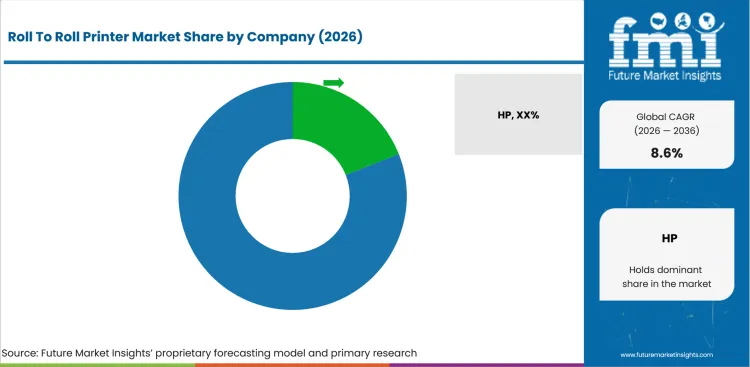
The market is moderately fragmented with global OEMs established premium systems and regional suppliers competing on price. Established companies win through ink systems, printhead reliability, software fit, and service networks. Specialist firms compete in textile, UV hybrid, and superwide niches using application-specific performance claims.
Entry barriers include color consistency, media testing, spare-parts access, and trained technician coverage. Buyers increasingly compare workflow fit as much as printer speed during purchase decisions. Competition is shaped by application breadth rather than brand name alone.
How is competition structured?
Competition reflects differences in specialization, portfolio scope, geographic reach, evidence, and customer access.
Competition is best understood by role because suppliers differ by ink platform, workflow depth, and channel reach.
- Wide-Format Digital OEMs: HP, Epson, Canon, Roland DG, Mimaki, and Mutoh compete with 64-inch and wider roll-fed systems for signage, textile transfer, and graphics users. Their strengths are media profiles, ink systems, dealer coverage, and operator training.
- Production and Superwide Specialists: Durst, EFI, and Agfa compete where buyers need higher throughput and broader substrate handling. Durst is strong in 3.5-meter UV and textile systems. EFI has VUTEk roll-to-roll and hybrid platforms for production graphics.
- Industrial Textile and Application Specialists: Konica Minolta and selected digital textile suppliers compete in fabric printing workflows that require inkjet textile know-how. Their strengths are printhead technology, fabric handling, color depth, and process support.
How do selected companies compare?
The selected companies differ in portfolio focus, geographic reach, evidence depth, and channel strength.
| Company | Competitive position |
|---|---|
| HP | HP is assessed for equipment portfolio fit, print-workflow capability, service coverage, and access to commercial users. |
| Epson | Epson is assessed for equipment portfolio fit, print-workflow capability, service coverage, and access to commercial users. |
| Canon | Canon is assessed for equipment portfolio fit, print-workflow capability, service coverage, and access to commercial users. |
| Roland DG | Roland DG is assessed for equipment portfolio fit, print-workflow capability, service coverage, and access to commercial users. |
| Mimaki Engineering | Mimaki Engineering is assessed for equipment portfolio fit, print-workflow capability, service coverage, and access to commercial users. |
What are the key developments in the Roll To Roll Printer Market?
- In April 2024, Agfa debuted the Anapurna Ciervo H3200 hybrid inkjet printer at ISA International Sign Expo. The system supports rigid and roll-fed sign applications.
- In May 2024, Canon expanded Colorado M-series UVgel capability with Packaging Factory innovations. The system paired a Colorado M5W roll-to-roll printer with jumbo roll feeding.
- In September 2024, Mimaki announced the CJV200 series roll-to-roll print-and-cut MFP with eco-solvent ink. The launch targeted entry users needing simpler operation.
Selected Companies in the Roll To Roll Printer Market
Companies referenced in this preview
- HP.
- Epson.
- Canon.
- Roland DG.
- Mimaki Engineering.
- EFI.
- Durst.
- Agfa.
Market Scope & Definition
| Metric | Value |
|---|---|
| Market definition | The Roll To Roll Printer Market covers commercial printers that print on flexible media wound on rolls. Included systems print on textiles, films, paper, labelstock, banner media, and décor substrates. The scope includes inkjet, flexographic, gravure, and hybrid digital roll-fed systems. |
| Functions covered | Inkjet R2R Printers, Flexographic R2R Printers, Gravure R2R Printers, Hybrid Digital Printers |
| Applications covered | Signage & Graphics, Packaging, Textile Printing, Industrial Décor |
| End-use industries | Signage & Graphics, Packaging, Textile Printing, Industrial Décor |
| Inclusions | Market scope covers Inkjet R2R Printers, Flexographic R2R Printers, Gravure R2R Printers, Hybrid Digital Printers, Solvent / Eco-solvent inks, UV / UV-LED inks, Water-based inks, Latex / Other inks, textile substrates, film substrates, paper substrates, label substrates, Direct OEM channels, dealer channels, service-provider channels, and global demand across 30+ countries from 2026 to 2036. |
| Exclusions | The scope excludes desktop inkjet printers, sheet-fed commercial presses, flatbed-only UV printers, office multifunction devices, 3D printers, plotter cutters without print engines, standalone drying ovens, and converting lines sold without printing capability. |
Research Methodology
| Metric | Value |
|---|---|
| Primary Research | FMI analysts reviewed printer OEMs, print service providers, textile converters, signage buyers, packaging converters, dealers, RIP software specialists, and service engineers. Interviews focused on purchase criteria, ink switching, media width choice, and post-install support. |
| Desk Research | reviewed customs classifications, association data, printer product specifications, media certification records, company release notes, and professional print award categories. Adjacent evidence from hybrid printing and roll-fed ink systems was used only to define market behavior. |
| Market Sizing and Forecasting | The model combined equipment shipment value, average selling price bands, application mix, replacement cycles, and country channel depth. The forecast used the locked 2026 value of USD 4360.7 million and the 2036 value of USD 9950.7 million. |
| Data Validation | Forecasts were checked against printer portfolios, country import signals, textile machinery events, signage application trends, and company product launches. Ink and substrate assumptions were cross-checked with water-based inks and UV system adoption patterns. |
What does the report cover?
The report covers printer type, ink type, substrate, end use, sales channel, and region across the 2026-2036 forecast period in 30+ countries.
| Metric | Value |
|---|---|
| Periods | Base year 2025; estimated year 2026; forecast period 2026-2036 |
| Quantitative units | USD 4360.7 million in 2026 to USD 9950.7 million in 2036, at a CAGR of 8.6% |
| Segment axes | printer type, ink type, substrate, end use, sales channel, and region |
| Regions | North America, Europe, East Asia, South Asia and Pacific |
| Countries | United States, United Kingdom, Germany, France, Japan, China, South Korea, India and 30+ countries |
| Companies | HP, Epson, Canon, Roland DG, Mimaki Engineering, EFI, Durst, Agfa, and others |
| Approach | Hybrid bottom-up and top-down methodology using equipment value, channel checks, application mix, and country-level adoption rates. |
Market Segmentation Analysis
Segmented by Printer Type
- Inkjet R2R Printers.
- Flexographic R2R Printers.
- Gravure R2R Printers.
- Hybrid Digital Printers.
Segmented by Ink Type
- Solvent / Eco-solvent.
- UV / UV-LED.
- Water-based.
- Latex / Other.
Segmented by Substrate
- Textiles.
- Films.
- Paper.
- Labels / Other.
Segmented by End Use
- Signage & Graphics.
- Packaging.
- Textile Printing.
- Industrial Décor.
Segmented by Sales Channel
- Direct OEM.
- Dealers.
- Service Providers.
By Region
- North America.
- United States.
- Canada.
- Mexico.
- Latin America.
- Brazil.
- Chile.
- Rest of Latin America.
- Western Europe.
- Germany.
- Italy.
- Spain.
- France.
- Nordic.
- BENELUX.
- Rest of Western Europe.
- Eastern Europe.
- Russia.
- Poland.
- Hungary.
- Balkan & Baltic.
- Rest of Eastern Europe.
- East Asia.
- China.
- Japan.
- South Korea.
- South Asia and Pacific.
- India.
- ASEAN.
- Australia & New Zealand.
- Rest of South Asia and Pacific.
- Middle East & Africa.
- Kingdom of Saudi Arabia.
- Other GCC Countries.
- Turkiye.
- South Africa.
- Other African Union.
- Rest of Middle East & Africa.
Research Sources and Bibliography
- 1. CEMATEX. (2026). About ITMA. CEMATEX.
- 2. CEMATEX. (2023, June). ITMA 2023 opens with mega showcase of innovative solutions. CEMATEX.
- 3. PRINTING United Alliance. (2025, July). Output winners gallery 2025. PRINTING United Alliance.
- 4. World Bank. (2026, April). World Integrated Trade Solution: HS 844390 printing machinery parts imports by country in 2024. World Bank.
- 5. Canon Production Printing. (2024, May 28). Canon takes capabilities of Colorado M-series UVgel printer to next level with multiple innovations. Canon Production Printing.
- 6. Mimaki Engineering Co., Ltd. (2024, September 4). Announcing the CJV200 Series of Print & Cut MFPs. Mimaki Engineering Co., Ltd.
- 7. Agfa. (2024, April 4). Agfa debuts new Anapurna Ciervo H3200 hybrid inkjet printer at ISA International Sign Expo 2024. Agfa.
- 8. Agfa. (2025, May 6). Navigate with agility with the Anapurna Ciervo family. Agfa.
- 9. HP Inc. (2025, March 18). Shaping the Future of Work: HP Amplify 2025. HP Inc.
- 10. Epson America, Inc. (2025, July 30). Epson honored with five 2025 PRINTING United Alliance Pinnacle Product Awards. Epson.
- 11. Roland DG Corporation. (2025, June 26). Roland DG releases all-new DIMENSE DA-640 dimensional surface printer. Roland DG Corporation.
- 12. Roland DG Corporation. (2026, March 4). Roland DG expands D-EA2 multi-colour ink compatibility for TrueVIS XP-640. Roland DG Corporation.
- 13. Durst Group. (2025, November 14). Durst P5 SMP - The game changer in large format printing. Durst Group.
- 14. Mutoh America Inc. (2026, February 3). MUTOH America launches HydrAton 1642 with AQUAFUZE ink technology. Mutoh America Inc.
- 15. Konica Minolta, Inc. (2026, January 27). Konica Minolta launches O’ROBE, an inline pretreatment system. Konica Minolta, Inc.
The bibliography is provided for reader reference and uses official trade body, government, and company sources.
This Report Answers
- What is the projected value of the Roll To Roll Printer Market in 2026?
- What value is forecast for the Roll To Roll Printer Market by 2036?
- What CAGR is forecast for the Roll To Roll Printer Market from 2026 to 2036?
- What 2026 share is projected for Inkjet R2R Printers within the printer type category?
- What 2026 share is projected for Solvent / Eco-solvent within the ink type category?
- Which demand factors support the Roll To Roll Printer Market outlook?
- Which restraints and opportunities affect adoption in the Roll To Roll Printer Market?
- How are country CAGR outlooks, including China at 9.5%, compared?
- Which companies and product developments are covered in the competitive analysis?
- What is included in the market scope, and how is the forecast validated?
Frequently Asked Questions
Why should executives track the Roll To Roll Printer Market?
Executives should track this market because it can affect capital allocation, supplier strategy, operating risk, and competitive positioning across commercial planning cycles.
What business problem does the Roll To Roll Printer Market address?
It helps executive teams judge where customer pain, supplier capability, compliance exposure, and implementation economics justify investment, procurement, or portfolio action.
What should procurement leaders evaluate before selecting suppliers?
Procurement leaders should assess evidence quality, integration fit, service coverage, compliance readiness, total cost of ownership, and supplier execution capability.
What can limit return on investment for buyers?
Return on investment can be limited by low utilization, integration delays, training gaps, unclear ownership, pricing pressure, or weak fit with existing workflows.
How can suppliers build executive confidence?
Suppliers can build confidence by proving implementation speed, risk reduction, support depth, reference use cases, and measurable outcomes for budget owners.
Preview the report firsthand - request a free sample
Get SampleGet the brochure for pricing and purchase details.
Get PDFTable of Content
- Key Takeaways
- Market Size and CAGR
- Top Growth Driver
- Fastest Growing Segment
- Leading Region
- Key Companies
- Emerging Opportunities
- Executive Summary
- Global Market Outlook
- Demand-side Trends
- Supply-side Trends
- Technology Roadmap Analysis
- Analysis and Recommendations
- Analyst Perspective (What is happening? Why now? What should investors know?)
- Key Questions Answered
- How large is the market?
- What is the CAGR?
- What are key trends?
- Which region dominates?
- Who are the leaders?
- Market Overview
- Market Coverage / Taxonomy
- Market Definition / Scope / Limitations
- Research Methodology
- Chapter Orientation
- Analytical Lens and Working Hypotheses
- Market Structure, Signals, and Trend Drivers
- Benchmarking and Cross-market Comparability
- Market Sizing, Forecasting, and Opportunity Mapping
- Research Design and Evidence Framework
- Desk Research Programme (Secondary Evidence)
- Expert Input and Fieldwork (Primary Evidence)
- Tooling, Models, and Reference Databases
- Data Engineering and Model Build
- Quality Assurance and Audit Trail
- Market Background
- Market Dynamics (Drivers, Restraints, Opportunity, Trends)
- Scenario Forecast (Optimistic, Likely, Conservative)
- Impact Analysis
- AI Impact
- Sustainability Impact
- Regulatory Impact
- Technology Impact
- Consumer / Buyer Analysis
- Purchase Drivers
- Adoption Barriers
- Buyer Journey
- Opportunity Map Analysis
- Product Life Cycle Analysis
- Supply Chain Analysis
- Investment Feasibility Matrix
- Value Chain Analysis
- PESTLE and Porter's Analysis
- Regulatory Landscape
- Regional Parent Market Outlook
- Production and Consumption Statistics
- Import and Export Statistics
- Global Market Analysis and Forecast, 2021 to 2036
- Historical Market Size Value (USD Billion) & Volume (Unit) Analysis, 2021 to 2025
- Current and Future Market Size Value (USD Billion) & Volume (Unit) Projections, 2026 to 2036
- Y-o-Y Growth Trend Analysis
- Absolute $ Opportunity Analysis
- Global Market Pricing Analysis, 2021 to 2036
- Global Market Analysis and Forecast, By Printer Type, 2021 to 2036
- Introduction / Key Findings
- Historical Market Size Value (USD Billion) & Volume (Unit) Analysis By Printer Type, 2021 to 2025
- Current and Future Market Size Value (USD Billion) & Volume (Unit) Analysis and Forecast By Printer Type, 2026 to 2036
- Inkjet R2R Printers
- Flexographic R2R Printers
- Hybrid Digital Printers
- Inkjet R2R Printers
- Y-o-Y Growth Trend Analysis By Printer Type, 2021 to 2025
- Absolute $ Opportunity Analysis By Printer Type, 2026 to 2036
- Global Market Analysis and Forecast, By Ink Type, 2021 to 2036
- Introduction / Key Findings
- Historical Market Size Value (USD Billion) & Volume (Unit) Analysis By Ink Type, 2021 to 2025
- Current and Future Market Size Value (USD Billion) & Volume (Unit) Analysis and Forecast By Ink Type, 2026 to 2036
- Solvent / Eco-solvent
- UV / UV-LED
- Latex / Other
- Solvent / Eco-solvent
- Y-o-Y Growth Trend Analysis By Ink Type, 2021 to 2025
- Absolute $ Opportunity Analysis By Ink Type, 2026 to 2036
- Global Market Analysis and Forecast, By Substrate, 2021 to 2036
- Introduction / Key Findings
- Historical Market Size Value (USD Billion) & Volume (Unit) Analysis By Substrate, 2021 to 2025
- Current and Future Market Size Value (USD Billion) & Volume (Unit) Analysis and Forecast By Substrate, 2026 to 2036
- Textiles
- Films
- Paper
- Textiles
- Y-o-Y Growth Trend Analysis By Substrate, 2021 to 2025
- Absolute $ Opportunity Analysis By Substrate, 2026 to 2036
- Global Market Analysis and Forecast, By End Use, 2021 to 2036
- Introduction / Key Findings
- Historical Market Size Value (USD Billion) & Volume (Unit) Analysis By End Use, 2021 to 2025
- Current and Future Market Size Value (USD Billion) & Volume (Unit) Analysis and Forecast By End Use, 2026 to 2036
- Signage & Graphics
- Packaging
- Industrial Décor
- Signage & Graphics
- Y-o-Y Growth Trend Analysis By End Use, 2021 to 2025
- Absolute $ Opportunity Analysis By End Use, 2026 to 2036
- Global Market Analysis and Forecast, By Sales Channel, 2021 to 2036
- Introduction / Key Findings
- Historical Market Size Value (USD Billion) & Volume (Unit) Analysis By Sales Channel, 2021 to 2025
- Current and Future Market Size Value (USD Billion) & Volume (Unit) Analysis and Forecast By Sales Channel, 2026 to 2036
- Direct OEM
- Dealers
- Service Providers
- Direct OEM
- Y-o-Y Growth Trend Analysis By Sales Channel, 2021 to 2025
- Absolute $ Opportunity Analysis By Sales Channel, 2026 to 2036
- Global Market Analysis and Forecast, By Region, 2021 to 2036
- Introduction
- Historical Market Size Value (USD Billion) & Volume (Unit) Analysis By Region, 2021 to 2025
- Current Market Size Value (USD Billion) & Volume (Unit) Analysis and Forecast By Region, 2026 to 2036
- North America
- Latin America
- Western Europe
- Eastern Europe
- East Asia
- South Asia and Pacific
- Middle East & Africa
- Market Attractiveness Analysis By Region
- North America Market Analysis and Forecast, By Country, 2021 to 2036
- Historical Market Size Value (USD Billion) & Volume (Unit) Trend Analysis By Market Taxonomy, 2021 to 2025
- Market Size Value (USD Billion) & Volume (Unit) Forecast By Market Taxonomy, 2026 to 2036
- By Country
- USA
- Canada
- Mexico
- By Printer Type
- By Ink Type
- By Substrate
- By End Use
- By Sales Channel
- By Country
- Market Attractiveness Analysis
- By Country
- By Printer Type
- By Ink Type
- By Substrate
- By End Use
- By Sales Channel
- Key Takeaways
- Latin America Market Analysis and Forecast, By Country
- Historical Market Size Value (USD Billion) & Volume (Unit) Trend Analysis By Market Taxonomy, 2021 to 2025
- Market Size Value (USD Billion) & Volume (Unit) Forecast By Market Taxonomy, 2026 to 2036
- By Country
- Brazil
- Chile
- Rest of Latin America
- By Printer Type
- By Ink Type
- By Substrate
- By End Use
- By Sales Channel
- By Country
- Market Attractiveness Analysis
- By Country
- By Printer Type
- By Ink Type
- By Substrate
- By End Use
- By Sales Channel
- Key Takeaways
- Western Europe Market Analysis and Forecast, By Country
- Historical Market Size Value (USD Billion) & Volume (Unit) Trend Analysis By Market Taxonomy, 2021 to 2025
- Market Size Value (USD Billion) & Volume (Unit) Forecast By Market Taxonomy, 2026 to 2036
- By Country
- Germany
- UK
- Italy
- Spain
- France
- Nordic
- BENELUX
- Rest of Western Europe
- By Printer Type
- By Ink Type
- By Substrate
- By End Use
- By Sales Channel
- By Country
- Market Attractiveness Analysis
- By Country
- By Printer Type
- By Ink Type
- By Substrate
- By End Use
- By Sales Channel
- Key Takeaways
- Eastern Europe Market Analysis and Forecast, By Country
- Historical Market Size Value (USD Billion) & Volume (Unit) Trend Analysis By Market Taxonomy, 2021 to 2025
- Market Size Value (USD Billion) & Volume (Unit) Forecast By Market Taxonomy, 2026 to 2036
- By Country
- Russia
- Poland
- Hungary
- Balkan & Baltic
- Rest of Eastern Europe
- By Printer Type
- By Ink Type
- By Substrate
- By End Use
- By Sales Channel
- By Country
- Market Attractiveness Analysis
- By Country
- By Printer Type
- By Ink Type
- By Substrate
- By End Use
- By Sales Channel
- Key Takeaways
- East Asia Market Analysis and Forecast, By Country
- Historical Market Size Value (USD Billion) & Volume (Unit) Trend Analysis By Market Taxonomy, 2021 to 2025
- Market Size Value (USD Billion) & Volume (Unit) Forecast By Market Taxonomy, 2026 to 2036
- By Country
- China
- Japan
- South Korea
- By Printer Type
- By Ink Type
- By Substrate
- By End Use
- By Sales Channel
- By Country
- Market Attractiveness Analysis
- By Country
- By Printer Type
- By Ink Type
- By Substrate
- By End Use
- By Sales Channel
- Key Takeaways
- South Asia and Pacific Market Analysis and Forecast, By Country
- Historical Market Size Value (USD Billion) & Volume (Unit) Trend Analysis By Market Taxonomy, 2021 to 2025
- Market Size Value (USD Billion) & Volume (Unit) Forecast By Market Taxonomy, 2026 to 2036
- By Country
- India
- ASEAN
- Australia & New Zealand
- Rest of South Asia and Pacific
- By Printer Type
- By Ink Type
- By Substrate
- By End Use
- By Sales Channel
- By Country
- Market Attractiveness Analysis
- By Country
- By Printer Type
- By Ink Type
- By Substrate
- By End Use
- By Sales Channel
- Key Takeaways
- Middle East & Africa Market Analysis and Forecast, By Country
- Historical Market Size Value (USD Billion) & Volume (Unit) Trend Analysis By Market Taxonomy, 2021 to 2025
- Market Size Value (USD Billion) & Volume (Unit) Forecast By Market Taxonomy, 2026 to 2036
- By Country
- Kingdom of Saudi Arabia
- Other GCC Countries
- Türkiye
- South Africa
- Other African Union
- Rest of Middle East & Africa
- By Printer Type
- By Ink Type
- By Substrate
- By End Use
- By Sales Channel
- By Country
- Market Attractiveness Analysis
- By Country
- By Printer Type
- By Ink Type
- By Substrate
- By End Use
- By Sales Channel
- Key Takeaways
- Key Countries Market Analysis
- USA
- Pricing Analysis
- Market Share Analysis, 2025
- By Printer Type
- By Ink Type
- By Substrate
- By End Use
- By Sales Channel
- Canada
- Pricing Analysis
- Market Share Analysis, 2025
- By Printer Type
- By Ink Type
- By Substrate
- By End Use
- By Sales Channel
- Mexico
- Pricing Analysis
- Market Share Analysis, 2025
- By Printer Type
- By Ink Type
- By Substrate
- By End Use
- By Sales Channel
- Brazil
- Pricing Analysis
- Market Share Analysis, 2025
- By Printer Type
- By Ink Type
- By Substrate
- By End Use
- By Sales Channel
- Chile
- Pricing Analysis
- Market Share Analysis, 2025
- By Printer Type
- By Ink Type
- By Substrate
- By End Use
- By Sales Channel
- Germany
- Pricing Analysis
- Market Share Analysis, 2025
- By Printer Type
- By Ink Type
- By Substrate
- By End Use
- By Sales Channel
- UK
- Pricing Analysis
- Market Share Analysis, 2025
- By Printer Type
- By Ink Type
- By Substrate
- By End Use
- By Sales Channel
- Italy
- Pricing Analysis
- Market Share Analysis, 2025
- By Printer Type
- By Ink Type
- By Substrate
- By End Use
- By Sales Channel
- Spain
- Pricing Analysis
- Market Share Analysis, 2025
- By Printer Type
- By Ink Type
- By Substrate
- By End Use
- By Sales Channel
- France
- Pricing Analysis
- Market Share Analysis, 2025
- By Printer Type
- By Ink Type
- By Substrate
- By End Use
- By Sales Channel
- India
- Pricing Analysis
- Market Share Analysis, 2025
- By Printer Type
- By Ink Type
- By Substrate
- By End Use
- By Sales Channel
- ASEAN
- Pricing Analysis
- Market Share Analysis, 2025
- By Printer Type
- By Ink Type
- By Substrate
- By End Use
- By Sales Channel
- Australia & New Zealand
- Pricing Analysis
- Market Share Analysis, 2025
- By Printer Type
- By Ink Type
- By Substrate
- By End Use
- By Sales Channel
- China
- Pricing Analysis
- Market Share Analysis, 2025
- By Printer Type
- By Ink Type
- By Substrate
- By End Use
- By Sales Channel
- Japan
- Pricing Analysis
- Market Share Analysis, 2025
- By Printer Type
- By Ink Type
- By Substrate
- By End Use
- By Sales Channel
- South Korea
- Pricing Analysis
- Market Share Analysis, 2025
- By Printer Type
- By Ink Type
- By Substrate
- By End Use
- By Sales Channel
- Russia
- Pricing Analysis
- Market Share Analysis, 2025
- By Printer Type
- By Ink Type
- By Substrate
- By End Use
- By Sales Channel
- Poland
- Pricing Analysis
- Market Share Analysis, 2025
- By Printer Type
- By Ink Type
- By Substrate
- By End Use
- By Sales Channel
- Hungary
- Pricing Analysis
- Market Share Analysis, 2025
- By Printer Type
- By Ink Type
- By Substrate
- By End Use
- By Sales Channel
- Kingdom of Saudi Arabia
- Pricing Analysis
- Market Share Analysis, 2025
- By Printer Type
- By Ink Type
- By Substrate
- By End Use
- By Sales Channel
- Türkiye
- Pricing Analysis
- Market Share Analysis, 2025
- By Printer Type
- By Ink Type
- By Substrate
- By End Use
- By Sales Channel
- South Africa
- Pricing Analysis
- Market Share Analysis, 2025
- By Printer Type
- By Ink Type
- By Substrate
- By End Use
- By Sales Channel
- USA
- Market Structure Analysis
- Competition Dashboard
- Competition Benchmarking
- Market Share Analysis of Top Players
- By Regional
- By Printer Type
- By Ink Type
- By Substrate
- By End Use
- By Sales Channel
- Emerging Startups
- Innovation Benchmarking
- Competition Analysis
- Competition Deep Dive
- HP
- Overview
- Product Portfolio
- Profitability by Market Segments (Product/Region/Sales Channel)
- Sales Footprint
- Strategy Overview
- Marketing Strategy
- Product Strategy
- Channel Strategy
- Epson
- Canon
- Roland DG
- Mimaki Engineering
- EFI
- Durst
- HP
- Case Studies
- Success Stories
- Recent Developments
- Competition Deep Dive
- Assumptions & Acronyms Used


