

- Market Size (2026)
- USD 215.5 Bn
- Forecast (2036)
- USD 361.2 Bn
- CAGR (2026 to 2036)
- 5.3%
How big is Folding Carton & Paperboard Packaging Market in 2026?
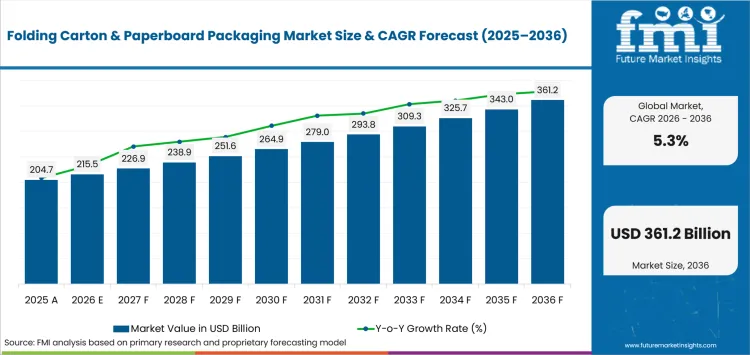
USD 215.5 billion in 2026 and USD 361.2 billion by 2036 at a 5.3% CAGR.
Sales of folding carton and paperboard packaging are projected to expand at 5.3% CAGR from 2026 to 2036. The valuation is forecast to rise from USD 215.5 billion in 2026 to USD 361.2 billion by 2036. Eurostat reported in October 2025 that paper and cardboard represented 40.4% of European Union packaging waste generated during 2023. Paper and cardboard therefore represent a large waste stream for collection and sorting across European packaging systems. Recovered fiber quality nevertheless varies with contamination and the separation practices used across local collection routes. Converters compare paperboard formats through stiffness retention and odor control with consistent printing across repeated production lots. Commercial performance improves through fiber specifications that match printing and crease requirements across several converter locations.
European carton programs now face a defined redesign timetable under the Packaging and Packaging Waste Regulation. European Commission guidance published in June 2026 confirms that the regulation generally applies from August 12, 2026. Food packaging projects must align pack efficiency with recyclability and restricted-substance controls throughout each qualification route. Barrier packaging choices add grease or moisture protection, yet coatings must preserve creasing quality and recovery compatibility. Pharmaceutical and beauty cartons add coding or appearance requirements that increase the value of disciplined board selection and line trials. Commercial redesign therefore requires specifications that connect material selection with testing across the intended filling and distribution conditions.
Key Takeaways of Folding Carton & Paperboard Packaging Market
- Growth is driven by increasing demand for sustainable and recyclable packaging solutions across food, beverage, healthcare and consumer goods industries.
- Folding cartons are expected to represent 59.3% of product in 2026, supported by efficient converting and broad consumer-packaging use.
- SBS is projected to account for 45.9% of material in 2026, reflecting its stable print surface and stiffness across premium cartons.
- Food is anticipated to capture 36.2% of end use in 2026, reinforced by recurring volumes across packaged consumer products.
- Regulatory redesign and faster packing lines support board structures that combine material efficiency with dependable release performance across recurring programs.
- Competition depends on integrated board supply and converting depth with technical support for food-contact and high-appearance carton programs.
Analyst Perspective
"Folding-carton economics depend on board grades that preserve print density and crease strength through converting and high-speed erection. Food programs require migration and barrier evidence matched to product oils and expected storage temperatures across each intended application. Beauty and healthcare cartons need tighter surface quality and coding control across repeated production at regional plants. Packaging directors should connect PPWR redesign with mill consistency and carton-plant discipline so approved specifications perform reliably across every production site."
- Nandini Roy Choudhury, Principal Consultant for Packaging, Future Market Insights
How is the folding carton & paperboard packaging market segmented?
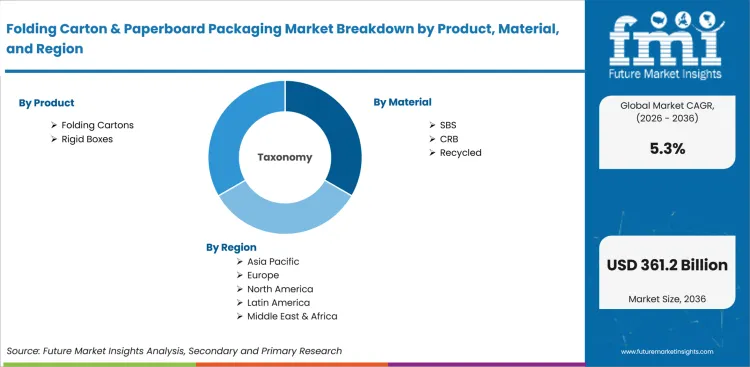
The folding carton and paperboard packaging industry is segmented by product, material, end use, and region.
The market is segmented by product, material, end use, and region to compare distinct commercial requirements. Product analysis compares folding cartons with rigid boxes through packing speed, material use, and presentation requirements. Material analysis separates SBS from CRB and recycled board through surface quality, stiffness, and fiber composition. Stora Enso introduced Ensovelvet in September 2025 as an uncoated SBS board for cosmetics, perfumes, and premium consumer goods. The launch shows how material choice changes with print finish, tactile expectations, and the intended application. End-use analysis separates food from pharmaceutical packaging through controls that differ across product risk and release workflows. Regional analysis covers food-contact rules, producer-responsibility costs, and recovery systems that shape commercial specifications across major markets.
Why do folding cartons lead the product category?
Folding cartons convert flat paperboard into protective packs through coordinated printing and cutting with controlled creasing and gluing on high-volume lines. Graphic Packaging announced in September 2025 that its drinktec program included two paperboard multipack innovations for beverage applications. The development demonstrates how pack design and converting controls determine whether folding carton systems replace heavier or less line-efficient formats. Rigid boxes retain value for presentation-led packs that tolerate slower assembly and higher material use.
- By product, folding cartons are estimated to hold 59.3% share in 2026 owing to efficient board use across repeated converting runs. Their flat supply form reduces inbound volume and supports automated erection beside the filling operation. Carton plants must control crease accuracy and joint strength so packs survive transport without adding unnecessary board weight.
- Food and beverage manufacturers favor folding cartons for formats that combine printable surfaces with dependable packing-line speed. Modular panel and closure changes avoid rebuilding the complete production route used for rigid presentation packs. Adoption slows across unusually heavy products or premium gift programs that require rigid walls and hand-finished presentation features.
How does SBS shape the material category?
SBS gives cartons a bleached surface and controlled stiffness for detailed graphics or a clean interior appearance. Its consistent fiber structure supports predictable cutting and creasing across short and long production runs. CRB and recycled grades remain practical for programs that accept different brightness and fiber-performance profiles. Price-sensitive applications favor those alternatives whenever visual consistency carries less commercial value than recycled content or lower material cost.
- By material, SBS is forecast to represent 45.9% share in 2026 driven by its stable print surface and strength-to-weight balance. Metsä Board completed the Simpele mill modernization in October 2025 and released the renewed MetsäBoard Classic FBB for customer deliveries. Curtain coating improves visual consistency across food and healthcare cartons that require repeatable print results.
- Converters select SBS for launches that place brand appearance beside measurable compression and packing-line requirements. The stable surface supports repeatable coating or foil processes across demanding beauty and pharmaceutical carton programs with exacting visual standards. Recycled paper packaging programs shift demand toward CRB whenever recycled-content targets outweigh brightness and surface-uniformity requirements.
What supports food within the end use category?
Food cartons must protect dry, chilled or frozen products without transferring unacceptable substances or losing strength during distribution. Barrier performance changes with product oils and moisture exposure throughout the intended storage period and distribution route. Pharmaceutical and beauty cartons require different coding or finish controls across regulated and presentation-led programs. E-commerce packs place greater weight on transport protection and closure integrity across fragmented delivery routes.
- In 2026, food is expected to lead the end use category with 36.2% share due to recurring branded grocery and foodservice volumes. Fresh food packaging formats require reliable moisture or grease control without disrupting printing and creasing. Large production runs reward materials that preserve filling-line output and release quality across several pack sizes.
- Food manufacturers qualify cartons through migration evidence and filling-line trials matched to the product and storage condition. Stora Enso launched Performa Nova in April 2025 for dry, frozen and chilled food packaging. The development gives food grade packaging converters a high-yield folding boxboard option, although inks and barrier coatings require application-specific validation across contact periods and temperatures.
What are the drivers, restraints, and opportunities in the Folding Carton & Paperboard Packaging Market?
Producer-responsibility fees and faster packing lines support demand for redesigned folding cartons across recurring consumer packaging programs. Coating changes and recycled-fiber variability complicate food-contact approval and crease performance across otherwise similar paperboard specifications. Glueline innovations and higher-yield boards create openings for lighter packs that preserve commercial production quality across repeated orders.
- Driver: Producer-responsibility fees directly reward carton designs that improve recyclability without weakening product protection or commercial packing-line performance.
- Restraint: Coating and recycled-fiber changes can alter migration behavior or crease strength across otherwise similar paperboard specifications.
- Opportunity: Glueline and material innovations can simplify carton erection and reduce adhesive use across qualified packing operations.
Producer-responsibility fees give brands a direct reason to redesign cartons that are difficult to recycle. PackUK published its modulated disposal-fee approach in June 2025 and linked 2026 fees to packaging recyclability. Carton programs can lower fee exposure through simpler coatings and cleaner material separation across high-volume product portfolios. The redesigned pack must preserve product protection and established filling-line output across national production sites.
A new barrier coating changes the approved food-contact system rather than merely changing carton appearance for commercial use. The United States Food and Drug Administration determined in January 2025 that 35 PFAS-related food contact notifications were no longer effective. Those notifications covered grease-proofing substances used in paper and paperboard food packaging across commercial applications. Food brands therefore need migration evidence and converting trials for replacement coatings across the intended product and storage conditions.
Simpler closure systems create a commercial opening for cartons that reduce adhesive handling without weakening packing-line reliability. Smurfit Westrock introduced its ActiBlu prototype in May 2026 for glueline-free paper packaging activated with a fine water mist. The company reported that the pilot design uses up to 60% less adhesive than traditional hot-melt gluing. Commercial trials must confirm dependable activation across line speed and humidity ranges for factories to adopt the method at scale.
Which country CAGRs are profiled in the Folding Carton & Paperboard Packaging Market?
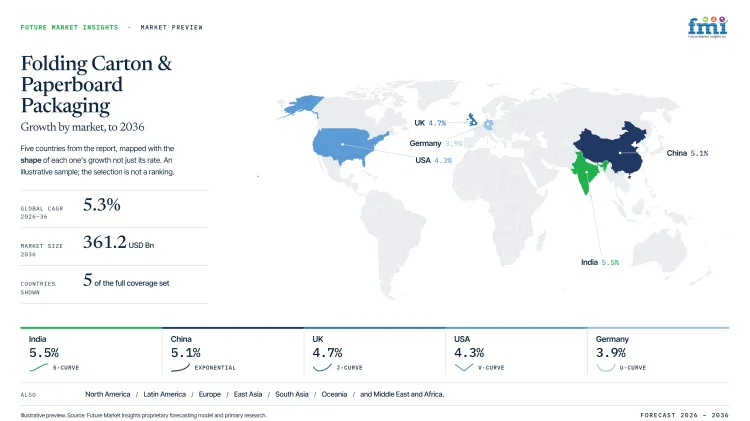
| Country | CAGR |
|---|---|
| USA | 4.3% |
| China | 5.1% |
| Germany | 3.9% |
| UK | 4.7% |
| India | 5.5% |
How do country-level CAGRs compare in theFolding Carton & Paperboard Packaging Market?
The country forecasts show a clear progression across the folding carton & paperboard packaging market, with India and China forming an upper group supported by expanding packaged food, consumer goods and e-commerce demand. The UK follows as an intermediate market and remains positioned between the higher-growth Asian markets and the more mature Western economies. The USA and Germany create a closely aligned lower pair with only 0.4 percentage points separating their forecasts. The overall spread of 1.6 percentage points indicates a relatively concentrated growth outlook despite differences in market maturity. This pattern reflects varying rates of packaging demand expansion, sustainability initiatives and conversion toward paper-based packaging formats rather than fundamental differences in packaging usage.
- India shows a notable position within the comparison as rising consumption of packaged products and continued investments in packaging manufacturing support demand for folding cartons and paperboard solutions.
- China remains closely aligned with India through strong growth in food, beverage and e-commerce packaging applications that continue to increase paperboard consumption.
- The UK represents a middle position within the comparison as sustainability targets and demand for recyclable packaging encourage greater adoption of paperboard formats across consumer markets.
- The USA maintains steady momentum through ongoing demand from foodservice, healthcare and consumer goods sectors, while packaging innovation continues to support market development.
- Germany remains close to the USA in CAGR terms yet follows a distinct path shaped by mature packaging infrastructure and continued emphasis on material efficiency and circular packaging practices.
Comparable CAGRs do not create identical market conditions across countries. Differences in consumer goods production, recycling systems, regulatory requirements and packaging conversion rates can influence demand patterns and investment priorities. Similar growth forecasts may therefore reflect different end-use drivers and competitive dynamics within the folding carton and paperboard packaging industry. The full report provides country-level CAGR analysis across North America, Latin America, Europe, East Asia, South Asia, Oceania and the Middle East and Africa.
Country-wise Analysis
- United States food and consumer-goods programs must combine federal food-contact requirements with state packaging responsibility rules. The USA folding carton and paperboard packaging sector is projected to record 4.3% CAGR during the assessment period, shaped by national brand volumes and fragmented compliance routes. Oregon’s Department of Environmental Quality reported in July 2025 that its packaging and paper producer-responsibility program had launched statewide. Domestic paperboard capacity and established converting networks support recurring carton programs across several production regions. State fee schedules and material lists create friction for brands that use one carton specification across several jurisdictions. Commercial agreements should assign responsibility for food-contact evidence and state reporting data during national rollout.
- Chinese food-carton programs require national standards that define paperboard properties and contact conditions for intended applications. The national standards platform published GB/T 36392-2025 in June 2025 for coated paper and paperboard used in food packaging. Adoption of folding carton and paperboard packaging in China is estimated to expand at 5.1% CAGR through 2036, supported by domestic board production and consumer-goods manufacturing. The standard became effective in January 2026 and gives carton plants a current technical reference for coated food-contact grades. Grade consistency and complete documentation create friction across numerous local plants serving national packaging programs. National brands need audited production controls to apply one specification across plants in several provinces.
- German carton programs operate within established collection systems and detailed packaging-registration duties across branded consumer products. Germany's folding carton and paperboard packaging outlook is anticipated to advance at 3.9% CAGR over the assessment period, linked to mature converting capacity and measured redesign cycles. Destatis reported in February 2026 that Germany disposed of 1.985 million tonnes of paper and paperboard packaging during 2024. The same table recorded 1.841 million tonnes sent to recycling within Germany during the year. Detailed documentation creates friction for coatings or composite features that complicate recyclability assessment across branded packs. Carton plants must pair complete material declarations with reliable crease and print performance across repeated production orders.
- United Kingdom brands must register packaging data and manage disposal-fee liability through the extended producer responsibility framework. Folding carton and paperboard packaging demand in the UK is forecast to rise at 4.7% CAGR over the forecast period, reinforced by food and healthcare converting activity. PackUK and the Department for Environment published liability guidance in March 2026 for obligated producers receiving scheme notices. The framework gives carton redesign a measurable cost signal across national programs and recurring reporting cycles. Fee classification creates friction for mixed coatings or unclear component reporting across complex packaging formats.
- Indian food-carton programs require material and production controls matched to the packaged product and expected contact conditions. Regional carton plants give national brands several production routes across food and household packaging programs. Folding carton and paperboard packaging sales in India are forecast to expand at 5.5% CAGR by 2036, attributable to established domestic converting capacity. ITC reported in May 2026 that its packaging and printing business recorded robust quarterly growth through its cartons portfolio. The same release described pressure from low-priced paperboard imports despite partial relief from a minimum import price.
Who are the notable companies in the Folding Carton & Paperboard Packaging Market?
Graphic Packaging Holding Company, Smurfit Westrock plc, MM Group, Rengo Co., Ltd., Stora Enso Oyj, Oji Holdings Corporation, Clearwater Paper Corporation and Metsä Board Corporation are the notable companies shaping this market.
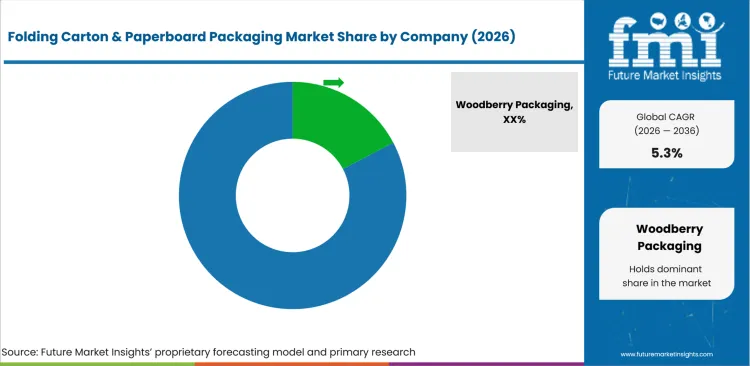
The competitive field combines integrated board and carton groups with specialist paperboard producers that support carton plants through material development. Rengo stated in May 2025 that Vision120 covers paperboard and folding cartons with overseas operations inside an integrated packaging system. Integrated groups compete through supply continuity and faster design transfer from board selection into commercial production. Specialist producers compete through SBS or folding boxboard quality and application support for beauty packaging and food programs. Packaging teams should compare verified plant capability with product-specific technical service rather than general corporate scale.
- Graphic Packaging, Smurfit Westrock and MM Group combine paperboard or converting assets with consumer-packaging design capabilities. Their integrated networks shorten material qualification across food and healthcare programs that require coordinated board supply and reliable carton production across several regions.
- Rengo and Oji Holdings operate integrated paperboard and packaging systems across major Asian markets with established regional converting networks. These groups serve food and consumer-product programs through folding-carton operations that combine regional design and manufacturing routes. The same networks support artwork control and shorter technical service distances across recurring customer programs.
- Stora Enso, Clearwater Paper and Metsä Board compete through paperboard production and technical application support. Their influence depends on board consistency and converter relationships that translate mill specifications into reliable cartons across repeated orders.
Competitive Benchmarking: Folding Carton & Paperboard Packaging Market
| Company | Paperboard Production | Folding Carton Converting | Food and Healthcare Support | Geographic Reach |
|---|---|---|---|---|
| Graphic Packaging Holding Company | High | High | High | Global |
| Smurfit Westrock plc | High | High | High | Global |
| MM Group | High | High | High | Europe and selected global markets |
| Rengo Co., Ltd. | High | High | Medium | Japan and Asia |
| Stora Enso Oyj | High | Low | High | Europe and North America |
| Oji Holdings Corporation | High | High | Medium | Asia and selected global markets |
| Clearwater Paper Corporation | High | Low | Medium | North America |
| Metsä Board Corporation | High | Low | High | Europe and North America |
Key Developments in the Folding Carton & Paperboard Packaging Market
- In March 2025, Stora Enso started production ramp-up at its new Oulu consumer packaging board line in Finland. The line is designed for folding boxboard and coated unbleached kraft with annual capacity of 750,000 tonnes. The company targeted frozen and chilled food as well as dry food and beverage multipacks across Europe and North America. The expansion increases available board supply for converters that need flexible grades and large-volume qualification.
- In November 2025, Graphic Packaging opened its new Waco recycled paperboard manufacturing facility in central Texas. The project consolidated production into a modern mill designed to improve recycled-paperboard quality and operating efficiency. Additional domestic output supports folding-carton converters serving recurring food and household packaging programs across North American networks. Customers gain a larger regional supply route, although individual carton performance requires grade-specific converting validation.
- In November 2025, Smurfit Westrock inaugurated a dedicated adherence and clinical packaging facility near Dublin Airport. The company established a 170-person team for clinical-trial and regulated pharmaceutical packaging beside related sites in China and the United States. The expansion strengthens specialist carton services that require controlled workflows and detailed patient-use information across regulated clinical programs.
- In March 2026, MM Group reported a major technological expansion at its Romanian folding-carton site. The company linked the project with flexible and efficient onboarding of new business across its food and premium packaging division. The development expands local converting capability, although weak European demand and network adjustments require packaging groups to verify service continuity.
Key Players in the Folding Carton & Paperboard Packaging Market
Integrated Paperboard and Folding Carton Groups
- Graphic Packaging Holding Company
- Smurfit Westrock plc
- MM Group
- Rengo Co., Ltd.
- Oji Holdings Corporation
Paperboard and Material Specialists
- Stora Enso Oyj
- Clearwater Paper Corporation
- Metsä Board Corporation
Folding Carton & Paperboard Packaging Market - Report Scope
| Coverage field | Report scope |
|---|---|
| Market breakdown | Product, material, end use, and region. |
| Quantitative Units | Revenue in USD Million, CAGR in %. |
| Market Definition | Folding cartons and paperboard packs converted from SBS, CRB, recycled board, and related grades for food, pharmaceutical, beauty, e-commerce, and other consumer applications. |
| Regions Covered | North America, Latin America, Europe, East Asia, South Asia, Oceania, and Middle East and Africa. |
| Countries Covered | USA, China, Germany, UK, and India. |
| Key Companies Profiled | Graphic Packaging Holding Company, Smurfit Westrock plc, MM Group, Rengo Co., Ltd., Stora Enso Oyj, Oji Holdings Corporation, Clearwater Paper Corporation, and Metsä Board Corporation |
| Forecast Period | 2026 to 2036. |
| Approach | Hybrid bottom-up and top-down market sizing supported by primary interviews and official desk research. |
Folding Carton & Paperboard Packaging Market - Research Methodology
| Method | Approach |
|---|---|
| Primary Research | FMI analysts gathered input from manufacturers, service providers, technology developers, distributors, end users, procurement teams, and subject-matter experts. Interviews examined purchasing decisions, product or service evaluation, adoption barriers, approval requirements, pricing considerations, and expectations for technical or commercial support. Respondents were also asked what evidence is required before a trial, pilot, or initial order develops into regular purchasing. |
| Desk Research | Desk research covered government statistics, regulatory publications, trade data, industry associations, technical literature, standards, company filings, product information, and official corporate announcements. Sources were reviewed for relevance, publication date, geographic coverage, and consistency with the defined market scope. Claims relating to performance, applications, approvals, capacity, investment, and commercial activity were retained only when supported by credible public evidence. |
| Market Sizing and Forecasting | The market model combined the baseline value with historical performance, segment structure, pricing and volume indicators, adoption levels, company participation, and country-level demand conditions. Forecast assumptions considered economic activity, investment trends, regulatory developments, technology adoption, purchasing cycles, supply availability, and barriers to wider market use. Segment and regional estimates were reconciled before the final market total was calculated. |
| Data Validation | Estimates were checked against multiple independent indicators, including public data, company activity, trade patterns, industry developments, and findings from primary interviews. Validation also tested whether products, services, applications, and company revenues fell within the defined market boundaries. Adjacent categories, unsupported claims, overlapping revenues, and activities without direct market relevance were excluded to reduce double counting and maintain consistency across segments and countries. |
Folding Carton & Paperboard Packaging Market by Segments
Folding Carton & Paperboard Packaging Market segmented by Product:
- Folding Cartons
- Rigid Boxes
Folding Carton & Paperboard Packaging Market segmented by Material:
- SBS
- CRB
- Recycled
Folding Carton & Paperboard Packaging Market segmented by End Use:
- Food
- Pharma
- Beauty
- E-comm
Folding Carton & Paperboard Packaging Market by Region:
- North America
- United States
- Canada
- Latin America
- Brazil
- Mexico
- Argentina
- Chile
- Western Europe
- Germany
- France
- United Kingdom
- Italy
- Spain
- Benelux
- Nordics
- Eastern Europe
- Poland
- Czech Republic
- Romania
- Hungary
- East Asia
- China
- Japan
- South Korea
- South Asia and Pacific
- India
- ASEAN
- Australia and New Zealand
- Middle East and Africa
- GCC Countries
- South Africa
- Türkiye
- Israel
Research Sources and Bibliography
- Eurostat. (2025, October 22). Plastic packaging waste in the EU: 35.3 kg per person.
- European Commission. (2026, June 10). Guidance document for Regulation (EU) 2025/40 on packaging and packaging waste.
- Stora Enso Oyj. (2025, September 25). Stora Enso introduces Ensovelvet - a new, premium uncoated paperboard for luxury packaging.
- Graphic Packaging International. (2025, September 10). Graphic Packaging debuts duo of beverage multipack innovations at drinktec 2025.
- Metsä Board Corporation. (2025, October 17). Metsä Board completes EUR 60 million modernisation at Simpele mill - Launches enhanced MetsäBoard Classic FBB.
- Stora Enso Oyj. (2025, April 29). Stora Enso launches Performa Nova, a high-yield folding boxboard for consumer packaging.
- PackUK. (2025, June 27). Extended producer responsibility for packaging: Modulated disposal fees.
- USA Food and Drug Administration. (2025, January 3). FDA determines authorization for 35 food contact notifications related to PFAS are no longer effective.
- Smurfit Westrock plc. (2026, May 5). Smurfit Westrock launches prototype of glueline-free packaging solution.
- Oregon Department of Environmental Quality. (2025, July 1). Oregon leads the nation in implementing the Plastic Pollution and Recycling Modernization Act.
- State Administration for Market Regulation. (2025, June 30). GB/T 36392-2025: Coated paper and board for food packaging.
- Statistisches Bundesamt. (2026, February 23). Abfallentsorgung 2024.
- PackUK & Department for Environment, Food & Rural Affairs. (2026, March 23). Extended producer responsibility for packaging: Notice of liability.
- ITC Limited. (2026, May 21). Media statement - Financial results for the quarter and year ended 31st March, 2026.
- Rengo Co., Ltd. (2025, May 16). Rengo formulates new medium-term vision Vision120.
- Stora Enso Oyj. (2025, March 19). Stora Enso’s new consumer board line at the Oulu site in Finland has started operations.
- Graphic Packaging International. (2025, November 5). Graphic Packaging launches advanced recycled paperboard facility in Waco, Texas.
- Smurfit Westrock plc. (2025, November 4). Smurfit Westrock unveils world’s first dedicated clinical packaging facility.
- MM Group. (2026, March 17). Annual results 2025.
- Graphic Packaging Holding Company. (2026, March 2). Annual report for the fiscal year ended December 31, 2025.
- Smurfit Westrock plc. (2026, February 27). Annual report for the fiscal year ended December 31, 2025.
- Rengo Co., Ltd. (2025, October 31). Integrated report 2025.
- Stora Enso Oyj. (2026, February 12). Stora Enso publishes its annual report and remuneration report 2025.
- Oji Holdings Corporation. (2025, December 5). Oji Group integrated report 2025.
- Clearwater Paper Corporation. (2026, February 18). Annual report for the fiscal year ended December 31, 2025.
- Metsä Board Corporation. (2026, February 19). Metsä Board’s annual review 2025 has been published.
This bibliography is provided for reader reference and is not exhaustive. The full report contains the complete reference list and detailed citations.
This Report Answers
- How large is the folding carton and paperboard packaging market in 2026 and 2036?
- Which regulatory and operating pressures support investment in folding-carton redesign?
- Why do folding cartons account for the largest product share in 2026?
- How does SBS influence printing quality and strength across converted paperboard packs?
- Why does food account for the largest end use share in 2026?
- How do country growth rates differ across India, China, the UK, the USA, and Germany?
- Which companies combine paperboard production with commercial folding-carton converting?
- What limits material substitution across food-contact and high-speed packing applications?
- How should packaging teams compare board supply with converter service and qualification support?
Frequently Asked Questions
How big is the Folding Carton and Paperboard Packaging Market in 2026?
The folding carton and paperboard packaging market is valued at USD 215.5 billion in 2026 and is forecast to reach USD 361.2 billion by 2036, reflecting growing demand for sustainable and recyclable packaging solutions across food, beverage, healthcare, and consumer goods industries alongside regulatory redesign requirements under packaging waste frameworks.
What is the CAGR of the Folding Carton and Paperboard Packaging Market from 2026 to 2036?
The folding carton and paperboard packaging market is projected to grow at a CAGR of 5.3% between 2026 and 2036, supported by producer-responsibility fees that reward recyclable carton designs and demand for board structures combining material efficiency with dependable release performance across recurring branded packaging programs.
Which end use leads the Folding Carton and Paperboard Packaging Market?
Food accounts for 36.2% of the folding carton and paperboard packaging market by end use in 2026, driven by recurring branded grocery and foodservice volumes where large production runs reward materials that preserve filling-line output and release quality across multiple pack sizes and distribution conditions.
Which country is growing fastest in the Folding Carton and Paperboard Packaging Market?
The folding carton and paperboard packaging market in India is projected to expand at a CAGR of 5.5% through 2036, ahead of China at 5.1%, the UK at 4.7%, the USA at 4.3%, and Germany at 3.9%, reflecting rising consumption of packaged products and continued investment in domestic packaging manufacturing and converting capacity.
Who are the leading companies in the Folding Carton and Paperboard Packaging Market?
Leading companies in the folding carton and paperboard packaging market include Graphic Packaging Holding Company, Smurfit Westrock plc, MM Group, Rengo Co. Ltd., Stora Enso Oyj, Oji Holdings Corporation, Clearwater Paper Corporation, and Metsä Board Corporation, spanning integrated paperboard production and folding carton converting networks alongside specialist board producers serving food, pharmaceutical, and beauty packaging programs globally.
Preview the report firsthand - request a free sample
Get SampleGet the brochure for pricing and purchase details.
Get PDFTable of Content
- Key Takeaways
- Market Size and CAGR
- Top Growth Driver
- Fastest Growing Segment
- Leading Region
- Key Companies
- Emerging Opportunities
- Executive Summary
- Global Market Outlook
- Demand-side Trends
- Supply-side Trends
- Technology Roadmap Analysis
- Analysis and Recommendations
- Analyst Perspective (What is happening? Why now? What should investors know?)
- Key Questions Answered
- How large is the market?
- What is the CAGR?
- What are key trends?
- Which region dominates?
- Who are the leaders?
- Market Overview
- Market Coverage / Taxonomy
- Market Definition / Scope / Limitations
- Research Methodology
- Chapter Orientation
- Analytical Lens and Working Hypotheses
- Market Structure, Signals, and Trend Drivers
- Benchmarking and Cross-market Comparability
- Market Sizing, Forecasting, and Opportunity Mapping
- Research Design and Evidence Framework
- Desk Research Programme (Secondary Evidence)
- Expert Input and Fieldwork (Primary Evidence)
- Tooling, Models, and Reference Databases
- Data Engineering and Model Build
- Quality Assurance and Audit Trail
- Market Background
- Market Dynamics (Drivers, Restraints, Opportunity, Trends)
- Scenario Forecast (Optimistic, Likely, Conservative)
- Impact Analysis
- AI Impact
- Sustainability Impact
- Regulatory Impact
- Technology Impact
- Consumer / Buyer Analysis
- Purchase Drivers
- Adoption Barriers
- Buyer Journey
- Opportunity Map Analysis
- Product Life Cycle Analysis
- Supply Chain Analysis
- Investment Feasibility Matrix
- Value Chain Analysis
- PESTLE and Porter's Analysis
- Regulatory Landscape
- Regional Parent Market Outlook
- Production and Consumption Statistics
- Import and Export Statistics
- Global Market Analysis and Forecast, 2021 to 2036
- Historical Market Size Value (USD Billion) Analysis, 2021 to 2025
- Current and Future Market Size Value (USD Billion) Projections, 2026 to 2036
- Y-o-Y Growth Trend Analysis
- Absolute $ Opportunity Analysis
- Global Market Pricing Analysis, 2021 to 2036
- Global Market Analysis and Forecast, By Product, 2021 to 2036
- Introduction / Key Findings
- Historical Market Size Value (USD Billion) Analysis By Product, 2021 to 2025
- Current and Future Market Size Value (USD Billion) Analysis and Forecast By Product, 2026 to 2036
- Folding Cartons
- Rigid Boxes
- Folding Cartons
- Y-o-Y Growth Trend Analysis By Product, 2021 to 2025
- Absolute $ Opportunity Analysis By Product, 2026 to 2036
- Global Market Analysis and Forecast, By Material, 2021 to 2036
- Introduction / Key Findings
- Historical Market Size Value (USD Billion) Analysis By Material, 2021 to 2025
- Current and Future Market Size Value (USD Billion) Analysis and Forecast By Material, 2026 to 2036
- SBS
- CRB
- Recycled
- SBS
- Y-o-Y Growth Trend Analysis By Material, 2021 to 2025
- Absolute $ Opportunity Analysis By Material, 2026 to 2036
- Global Market Analysis and Forecast, By End Use, 2021 to 2036
- Introduction / Key Findings
- Historical Market Size Value (USD Billion) Analysis By End Use, 2021 to 2025
- Current and Future Market Size Value (USD Billion) Analysis and Forecast By End Use, 2026 to 2036
- Food
- Pharma
- Beauty
- E-comm
- Food
- Y-o-Y Growth Trend Analysis By End Use, 2021 to 2025
- Absolute $ Opportunity Analysis By End Use, 2026 to 2036
- Global Market Analysis and Forecast, By Region, 2021 to 2036
- Introduction
- Historical Market Size Value (USD Billion) Analysis By Region, 2021 to 2025
- Current Market Size Value (USD Billion) Analysis and Forecast By Region, 2026 to 2036
- North America
- Latin America
- Western Europe
- Eastern Europe
- East Asia
- South Asia and Pacific
- Middle East & Africa
- Market Attractiveness Analysis By Region
- North America Market Analysis and Forecast, By Country, 2021 to 2036
- Historical Market Size Value (USD Billion) Trend Analysis By Market Taxonomy, 2021 to 2025
- Market Size Value (USD Billion) Forecast By Market Taxonomy, 2026 to 2036
- By Country
- USA
- Canada
- By Product
- By Material
- By End Use
- By Country
- Market Attractiveness Analysis
- By Country
- By Product
- By Material
- By End Use
- Key Takeaways
- Latin America Market Analysis and Forecast, By Country
- Historical Market Size Value (USD Billion) Trend Analysis By Market Taxonomy, 2021 to 2025
- Market Size Value (USD Billion) Forecast By Market Taxonomy, 2026 to 2036
- By Country
- Brazil
- Mexico
- Chile
- Rest of Latin America
- By Product
- By Material
- By End Use
- By Country
- Market Attractiveness Analysis
- By Country
- By Product
- By Material
- By End Use
- Key Takeaways
- Western Europe Market Analysis and Forecast, By Country
- Historical Market Size Value (USD Billion) Trend Analysis By Market Taxonomy, 2021 to 2025
- Market Size Value (USD Billion) Forecast By Market Taxonomy, 2026 to 2036
- By Country
- Germany
- UK
- Italy
- Spain
- France
- Nordic
- BENELUX
- Rest of Western Europe
- By Product
- By Material
- By End Use
- By Country
- Market Attractiveness Analysis
- By Country
- By Product
- By Material
- By End Use
- Key Takeaways
- Eastern Europe Market Analysis and Forecast, By Country
- Historical Market Size Value (USD Billion) Trend Analysis By Market Taxonomy, 2021 to 2025
- Market Size Value (USD Billion) Forecast By Market Taxonomy, 2026 to 2036
- By Country
- Russia
- Poland
- Hungary
- Balkan & Baltic
- Rest of Eastern Europe
- By Product
- By Material
- By End Use
- By Country
- Market Attractiveness Analysis
- By Country
- By Product
- By Material
- By End Use
- Key Takeaways
- East Asia Market Analysis and Forecast, By Country
- Historical Market Size Value (USD Billion) Trend Analysis By Market Taxonomy, 2021 to 2025
- Market Size Value (USD Billion) Forecast By Market Taxonomy, 2026 to 2036
- By Country
- China
- Japan
- South Korea
- By Product
- By Material
- By End Use
- By Country
- Market Attractiveness Analysis
- By Country
- By Product
- By Material
- By End Use
- Key Takeaways
- South Asia and Pacific Market Analysis and Forecast, By Country
- Historical Market Size Value (USD Billion) Trend Analysis By Market Taxonomy, 2021 to 2025
- Market Size Value (USD Billion) Forecast By Market Taxonomy, 2026 to 2036
- By Country
- India
- ASEAN
- Australia & New Zealand
- Rest of South Asia and Pacific
- By Product
- By Material
- By End Use
- By Country
- Market Attractiveness Analysis
- By Country
- By Product
- By Material
- By End Use
- Key Takeaways
- Middle East & Africa Market Analysis and Forecast, By Country
- Historical Market Size Value (USD Billion) Trend Analysis By Market Taxonomy, 2021 to 2025
- Market Size Value (USD Billion) Forecast By Market Taxonomy, 2026 to 2036
- By Country
- Kingdom of Saudi Arabia
- Other GCC Countries
- Türkiye
- South Africa
- Other African Union
- Rest of Middle East & Africa
- By Product
- By Material
- By End Use
- By Country
- Market Attractiveness Analysis
- By Country
- By Product
- By Material
- By End Use
- Key Takeaways
- Key Countries Market Analysis
- USA
- Pricing Analysis
- Market Share Analysis, 2025
- By Product
- By Material
- By End Use
- Canada
- Pricing Analysis
- Market Share Analysis, 2025
- By Product
- By Material
- By End Use
- Mexico
- Pricing Analysis
- Market Share Analysis, 2025
- By Product
- By Material
- By End Use
- Brazil
- Pricing Analysis
- Market Share Analysis, 2025
- By Product
- By Material
- By End Use
- Chile
- Pricing Analysis
- Market Share Analysis, 2025
- By Product
- By Material
- By End Use
- Germany
- Pricing Analysis
- Market Share Analysis, 2025
- By Product
- By Material
- By End Use
- UK
- Pricing Analysis
- Market Share Analysis, 2025
- By Product
- By Material
- By End Use
- Italy
- Pricing Analysis
- Market Share Analysis, 2025
- By Product
- By Material
- By End Use
- Spain
- Pricing Analysis
- Market Share Analysis, 2025
- By Product
- By Material
- By End Use
- France
- Pricing Analysis
- Market Share Analysis, 2025
- By Product
- By Material
- By End Use
- India
- Pricing Analysis
- Market Share Analysis, 2025
- By Product
- By Material
- By End Use
- ASEAN
- Pricing Analysis
- Market Share Analysis, 2025
- By Product
- By Material
- By End Use
- Australia & New Zealand
- Pricing Analysis
- Market Share Analysis, 2025
- By Product
- By Material
- By End Use
- China
- Pricing Analysis
- Market Share Analysis, 2025
- By Product
- By Material
- By End Use
- Japan
- Pricing Analysis
- Market Share Analysis, 2025
- By Product
- By Material
- By End Use
- South Korea
- Pricing Analysis
- Market Share Analysis, 2025
- By Product
- By Material
- By End Use
- Russia
- Pricing Analysis
- Market Share Analysis, 2025
- By Product
- By Material
- By End Use
- Poland
- Pricing Analysis
- Market Share Analysis, 2025
- By Product
- By Material
- By End Use
- Hungary
- Pricing Analysis
- Market Share Analysis, 2025
- By Product
- By Material
- By End Use
- Kingdom of Saudi Arabia
- Pricing Analysis
- Market Share Analysis, 2025
- By Product
- By Material
- By End Use
- Türkiye
- Pricing Analysis
- Market Share Analysis, 2025
- By Product
- By Material
- By End Use
- South Africa
- Pricing Analysis
- Market Share Analysis, 2025
- By Product
- By Material
- By End Use
- USA
- Market Structure Analysis
- Competition Dashboard
- Competition Benchmarking
- Market Share Analysis of Top Players
- By Regional
- By Product
- By Material
- By End Use
- Emerging Startups
- Innovation Benchmarking
- Competition Analysis
- Competition Deep Dive
- Woodberry Packaging
- Overview
- Product Portfolio
- Profitability by Market Segments
- Sales Footprint
- Strategy Overview
- Marketing Strategy
- Product Strategy
- Channel Strategy
- Smurfit Westrock
- Graphic Packaging
- Mondi
- International Paper
- DS Smith
- Medica
- Woodberry Packaging
- Case Studies
- Success Stories
- Recent Developments
- Competition Deep Dive
- Assumptions & Acronyms Used


