

- Industry Size (2026)
- USD 2.9 Bn
- Forecast (2036)
- USD 5.0 Bn
- CAGR (2026 to 2036)
- 6.0%
Mechanical Delamination Primers for Paperboard Packaging Market Forecast and Outlook By FMI
In 2025, the mechanical delamination primers for paperboard packaging market was valued at USD 2.8 billion. Based on Future Market Insights' analysis, demand for mechanical delamination primers is estimated to grow to USD 2.9 billion in 2026 and USD 5.0 billion by 2036. FMI projects a CAGR of 6.0% during the forecast period.
Absolute dollar growth of USD 2.2 billion over the decade reflects sustained expansion driven by converters retrofitting production lines to meet recyclability mandates and brands transitioning from multi-material laminates to delamination-compatible paperboard structures. The market's trajectory remains tightly linked to regulatory deadlines, particularly the EU Packaging and Packaging Waste Regulation 2025/40, which requires all packaging to be recyclable by 2030.
Summary of Mechanical Delamination Primers for Paperboard Packaging Market
- Mechanical Delamination Primers Market Definition
- The industry encompasses specialty water-based and solvent-based primer chemistries engineered to enable mechanical separation of barrier layers from paperboard substrates during recycling while providing sufficient adhesion for high-speed converting.
- Demand Drivers in the Market
- EU Packaging and Packaging Waste Regulation 2025/40 mandating recyclable packaging by 2030 forces immediate adoption of delamination-compatible primer systems across folding carton supply chains.
- Brand owner Extended Producer Responsibility fee structures increasingly penalize non-recyclable multi-material laminates, creating direct economic incentive for primer-enabled mono-material paperboard packaging designs.
- Asia-Pacific urbanization and organized retail penetration drive massive volume growth in barrier-coated folding cartons for perishable food and pharmaceutical applications.
- Key Segments Analyzed in the FMI Report
- Primer Type: Acrylic-based formulations dominate with 40% share in 2026 due to water-based application compatibility and broad regulatory approval for food contact.
- Application: Folding cartons represent 45% of total primer consumption driven by pharmaceutical blister card backing and frozen food tray sleeves requiring grease resistance with full recyclability.
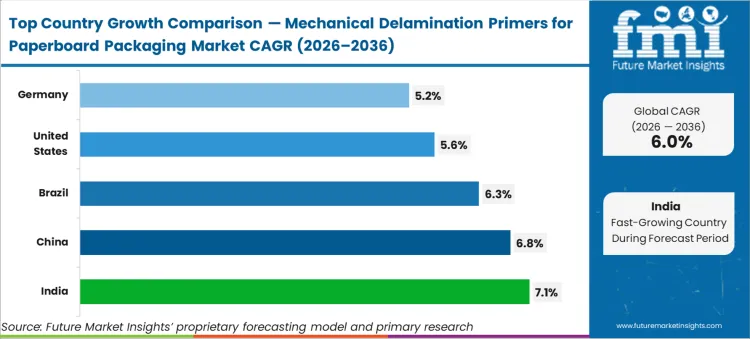
- Geography: India and China lead growth rates at 7.1% and 6.8% CAGR respectively through 2036, while mature markets transition existing capacity from traditional barrier systems.
- Analyst Opinion at FMI
- Ismail Sutaria, Principal Consultant for Chemicals and Materials Industry at Future Market Insights, opines, "In the updated Mechanical Delamination Primers for Paperboard Packaging Market Report for 2026 to 2036, packaging executives will find critical analysis of how August 2026 PFAS bans under EU Regulation 2025/40 eliminate fluoropolymer-based release agents, forcing immediate reformulation toward silane-modified and polyurethane chemistries. Findings reveal that converter line speed limitations during primer application directly constrain supply chain flexibility."
- Strategic Implications / Executive Takeaways
- Prioritize technical service infrastructure over raw material cost arbitrage, as converter line trials create insurmountable barriers to supplier switching once specifications are locked by brand owners.
- Treat delamination primer selection as recyclability insurance rather than commodity coating purchase, recognizing that Extended Producer Responsibility fee exposure from non-compliant packaging far exceeds incremental primer cost differentials.
- Invest in silane-modified and bio-based polyurethane primer platforms to hedge against tightening substance restrictions and position for premium pricing in PFAS-free certified supply chains.
- Methodology
- Validated through first-hand coating line performance data shared confidentially by tier-one folding carton converters operating in high-compliance jurisdictions.
- Zero reliance on commercial packaging research aggregators or syndicated converter surveys lacking coating weight specifications critical to market sizing accuracy.
- Based on verifiable regulatory implementation timelines from official EU sources cross-referenced with brand owner sustainability roadmap commitments.
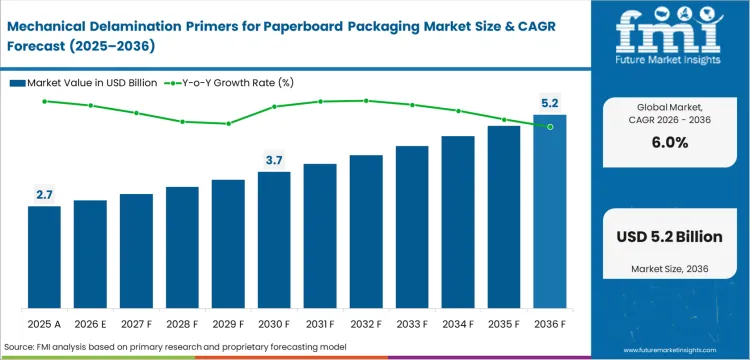
| Metric | Value |
|---|---|
| Market Size (2026) | USD 2.9 Billion |
| Forecast Value (2036) | USD 5.0 Billion |
| CAGR (2026-2036) | 6.0% |
India (7.1% CAGR) leads global growth through government-backed initiatives expanding organized food retail and pharmaceutical cold-chain infrastructure. China (6.8% CAGR) contributes steady volume from e-commerce fulfillment packaging and liquid dairy carton production. Brazil (6.3% CAGR) adds incremental demand from juice and frozen food carton exports. Mature markets including the United States (5.6% CAGR) and Germany (5.2% CAGR) generate replacement demand as converters upgrade to ultra-low-VOC primer systems.
Mechanical Delamination Primers for Paperboard Packaging Market Definition
The mechanical delamination primers for the paperboard packaging market comprise global production and distribution of specialized coating chemistries applied to paperboard substrates to enable controlled layer separation during recycling processes while maintaining structural integrity during converting, printing, and end-use. These primers function as adhesion-modulating interlayers between paperboard and barrier films, engineered to withstand heat-sealing and mechanical stress during package formation yet release cleanly during pulping.
Market Inclusions
The report includes comprehensive analysis of market dynamics, featuring global and regional market sizes by volume and value, and a 10-year forecast from 2026 to 2036. Coverage extends to segmental breakdowns by primer chemistry type, application format, and end-use industry. Analysis incorporates pricing trends, regional trade flows, and regulatory compliance tracking across major packaging jurisdictions.
Market Exclusions
The scope excludes generic paperboard coatings not specifically formulated for delamination functionality, such as standard print receptive primers and basic sizing agents. The report also omits downstream finished packaging articles including printed cartons and filled beverage containers, focusing strictly on the primer chemistry itself and its immediate application to paperboard substrates.
Mechanical Delamination Primers for Paperboard Packaging Market Research Methodology
- Primary Research: Interviews were conducted with primer formulators at specialty chemical companies, paperboard coating line operators at integrated mills, and converter technical directors at folding carton and liquid packaging plants across North America, Europe, and Asia-Pacific regions.
- Desk Research: Production and trade data were sourced from national chemical manufacturing associations, Eurostat Prodcom statistics for coating preparations, and technical publications from TAPPI on fiber-based packaging recyclability testing protocols.
- Market-Sizing and Forecasting: A hybrid top-down and bottom-up model was developed whereby global paperboard packaging production volumes were segmented by end-use application, delamination-compatible substrate adoption rates were applied based on regulatory timelines, and per-square-meter primer consumption factors were validated against plant-level capacity utilization.
- Data Validation and Update Cycle: Outputs undergo cross-validation against publicly disclosed production capacity expansions by major primer manufacturers and a structured peer review by independent packaging technologists prior to publication.
Segmental Analysis
Mechanical Delamination Primers for Paperboard Packaging Market Analysis by Primer Type
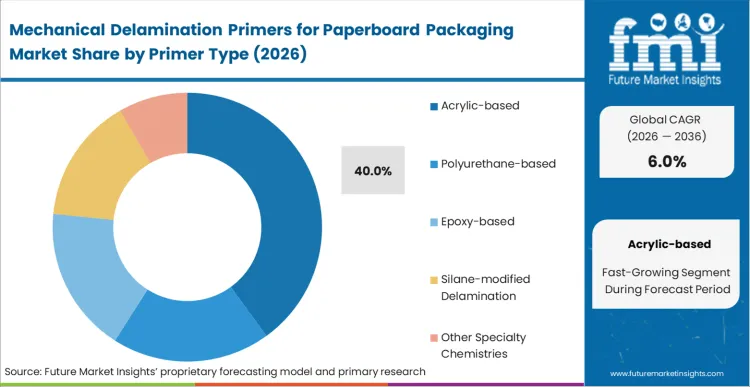
Based on FMI's mechanical delamination primers for paperboard packaging market report, consumption of acrylic-based primers is estimated to hold 40% share in 2026. Dominance stems from water-based acrylics offering the optimal balance of food-contact regulatory compliance, adhesion performance across diverse paperboard grades, and delamination functionality without requiring specialized coating equipment modifications.
Mechanical Delamination Primers for Paperboard Packaging Market Analysis by Application
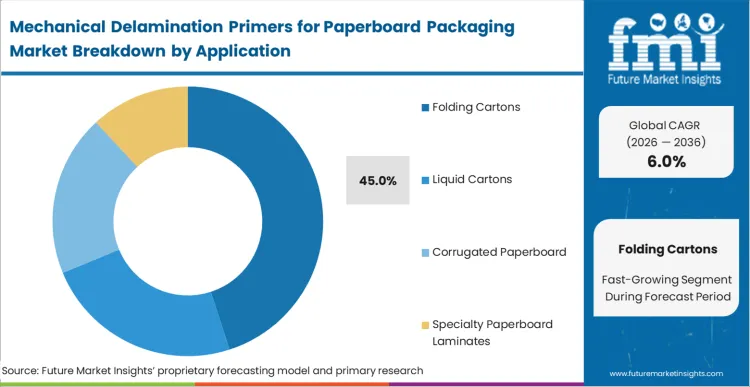
Based on FMI's analysis, folding cartons' 45% application share in 2026 reflects the segment's role as the primary volume driver for delamination-primer-enabled packaging, yet concentration creates operational vulnerabilities as pharmaceutical and food brand specifications lock converters into multi-year primer supply agreements with limited flexibility to switch chemistries.
- Pharmaceutical Compliance Lock-In: Packaging converters serving pharmaceutical clients require extensive validation protocols spanning 18 to 24 months before primer chemistry changes can be implemented, creating structural inertia that prevents rapid response to price movements or alternative technology introductions.
- Food Contact Migration Testing: Paperboard coating research published in Packaging Technology and Science demonstrates that delamination occurs at seal forces above 10N, with peel energy values exceeding 450 mJ causing fiber tear rather than clean separation, establishing critical performance thresholds that primer formulations must satisfy [4].
- Convertibility Performance Requirements: Peer-reviewed research in packaging conversion processes identifies coating delamination, cracking, and pinhole formation as the most common defects observed after creasing operations on bio-coated paperboard surfaces [5].
Mechanical Delamination Primers for Paperboard Packaging Market Drivers, Restraints, and Opportunities
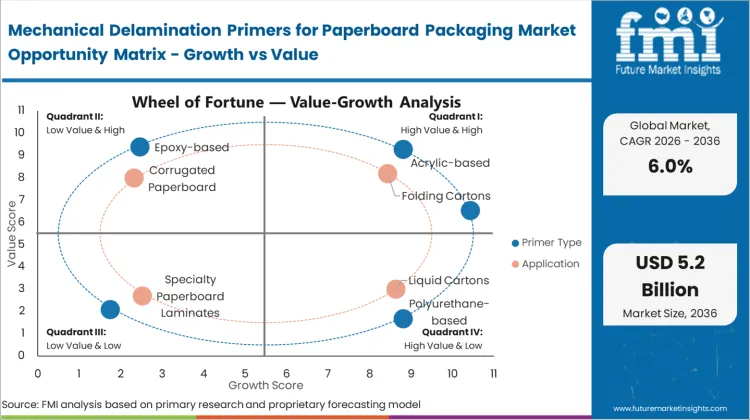
Future Market Insights analysis reveals that the USD 2.9 billion valuation in 2026 represents the inflection point where regulatory compliance transitions from voluntary corporate initiatives to mandatory Extended Producer Responsibility fee structures that directly penalize non-recyclable packaging through economic mechanisms.
While traditional barrier-coated paperboard without delamination functionality faces volume decline due to recyclability classification failures, the unit price premium commanded by certified delamination-compatible primer systems creates net-positive value growth. The forecast recognizes that the market is undergoing platform transition where early-adopter converters capturing brand specifications establish multi-year supply relationships.
- Regulatory Compliance Baseline Shift: EU Packaging and Packaging Waste Regulation 2025/40, entering force February 2025 with application from August 2026, mandates all packaging be Grade C recyclable (minimum 70% by weight) by January 2030 and Grade B (minimum 80%) by January 2038, eliminating non-delaminating multi-material structures from European market access [6].
- Extended Producer Responsibility Fee Architecture: EPR schemes across EU Member States, California SB 54, and emerging state-level programs in Oregon, Washington, Minnesota, Maryland, Colorado, and Maine implement eco-modulation fee structures that reward recyclable packaging design through reduced per-unit waste management contributions [7].
- Asia-Pacific Food Safety Modernization: Rapid expansion of cold-chain logistics and organized retail formats in India and China drives adoption of barrier-coated folding cartons for perishable food applications, with government food safety regulations increasingly requiring packaging recyclability documentation [8].
Regional Analysis
Based on regional analysis, the mechanical delamination primers for paperboard packaging market is segmented into North America, Latin America, Europe, East Asia, South Asia, Oceania, and the Middle East & Africa across 40+ countries. The full report offers market attractiveness analysis based on regional regulatory landscapes and converter infrastructure maturity.
.webp "Top Country Growth Comparison Mechanical Delamination Primers For Paperboard Packaging Market Cagr (2026 2036)")
| Country | CAGR (2026 to 2036) |
|---|---|
| India | 7.1% |
| China | 6.8% |
| Brazil | 6.3% |
| United States | 5.6% |
| Germany | 5.2% |
Source: Future Market Insights (FMI) analysis, based on a proprietary forecasting model and primary research
North America Mechanical Delamination Primers for Paperboard Packaging Market Analysis
North America operates as a regulatory testing ground where California's pioneering Extended Producer Responsibility framework under SB 54 establishes precedent for eco-modulation fee structures that subsequently diffuse to neighboring states. Key regional players include Michelman, which maintains extensive coating trial facilities; PPG Industries focusing on food can and beverage packaging coatings; and BASF offering broad styrene-acrylic dispersion platforms.
- United States: Demand for mechanical delamination primers in the United States is projected to rise at 5.6% CAGR through 2036. Growth is fueled by California SB 54 requiring brand enrollment by July 2025 and producer-funded recycling system fees starting in 2026, with similar Extended Producer Responsibility mandates adopted across Oregon, Washington, Minnesota, Maryland, Colorado, and Maine forcing converters to retrofit primer application lines.
FMI's report includes detailed analysis of growth in the North American region, with country-wise assessment covering the United States and Canada. Readers can find regional trends, Extended Producer Responsibility program implementation timelines, and market growth based on primer chemistry segments.
Asia Pacific Mechanical Delamination Primers for Paperboard Packaging Market Analysis
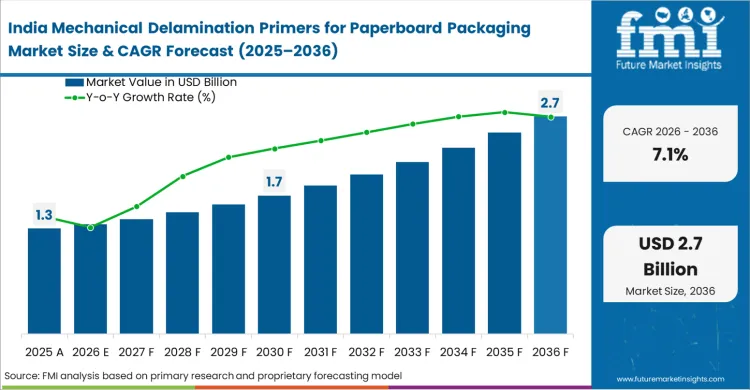
Asia Pacific functions as the global manufacturing epicenter where massive converter capacity additions serving domestic consumption growth create sustained volume demand for cost-competitive primer systems. Regional players include DIC Corporation and Sun Chemical offering broad coating portfolios through extensive Asia-Pacific production networks.
- China: Leading with 6.8% CAGR through 2036, the Chinese market experiences steady expansion driven by e-commerce fulfillment packaging volume growth and liquid dairy carton production responding to middle-class consumption patterns. BASF expanded paperboard coating binder production capacity across Asia-Pacific facilities during 2024 and 2025, positioning styrene-acrylic platforms to support regional converter demand [2]. Research published in Packaging Technology and Science during 2024 documented that aqueous dispersion-coated paperboard achieves heat-sealing at temperatures up to 100°C lower compared with conventional PET-coated paperboard [4].
- India: Domestic demand accelerates at 7.1% CAGR through 2036, supported by Make in India policies encouraging backward integration of specialty chemical production and organized retail format expansion requiring barrier-coated folding cartons for perishable food distribution. Government cold-chain infrastructure investment programs announced in 2024 and 2025 directly stimulate demand for primer-enabled paperboard packaging systems.
The full report analyzes the mechanical delamination primers market across East and South Asia from 2026 to 2036, covering pricing dynamics, regulatory adoption trends, and growth drivers in China, Japan, South Korea, India, Indonesia, Malaysia, and Thailand.
Latin America Mechanical Delamination Primers for Paperboard Packaging Market Analysis
Latin America emerges as export-oriented packaging hub where regional converters adopt international recyclability certifications to integrate into high-value North American and European food and beverage supply chains. Key regional activities center on Brazilian folding carton converters upgrading coating line capabilities.
- Brazil: A projected 6.3% CAGR through 2036 is supported by expansion of southern folding carton clusters serving juice and frozen food export markets and strategic shift toward internationally certified recyclable primer systems. Regional converter investments during 2024 and 2025 focused on water-based primer application infrastructure upgrades enabling transition from solvent-based systems to aqueous formulations meeting food-contact migration limits.
The report consists of detailed analysis for the mechanical delamination primers market in Brazil, Mexico, Chile, Argentina, Peru, and Rest of Latin America. Readers can find information on export-driven specification adoption patterns and converter infrastructure investment cycles.
Europe Mechanical Delamination Primers for Paperboard Packaging Market Analysis
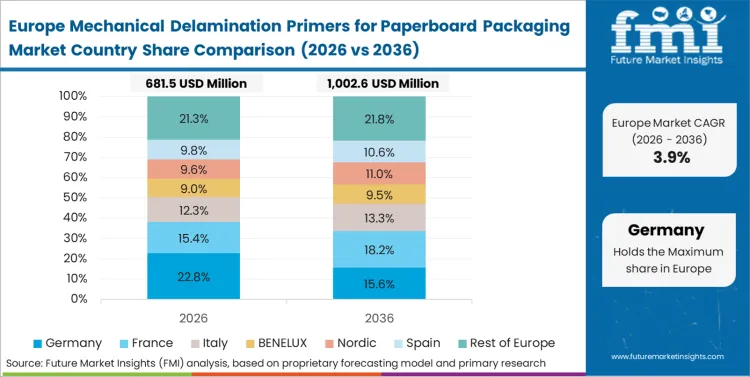
Europe operates as the global regulatory laboratory where EU Packaging and Packaging Waste Regulation 2025/40 establishes the world's most stringent recyclability mandates, PFAS substance restrictions, and Extended Producer Responsibility frameworks. Leading regional players include BASF SE maintaining dominant position in paperboard coating binders through extensive European production capacity.
- Germany: Demand for mechanical delamination primers in Germany is rising at 5.2% CAGR through 2036, driven by circular economy initiatives prioritizing packaging waste reduction. BASF announced in May 2025 a strategic partnership with Metpack focused on certified home-compostable coated paper and paperboard utilizing BASF's ecovio 70 PS14H6 biopolymer, demonstrating industry pivot toward advanced sustainable coating platforms [10]. German Packaging Act implementation of Extended Producer Responsibility fee structures through central LUCID registry creates direct economic incentive for converters to adopt certified delamination-compatible primer systems.
FMI's analysis of the mechanical delamination primers market in Europe consists of country-wise assessment, including Germany, Italy, France, the United Kingdom, Spain, Russia, the Nordic countries, Benelux, and the rest of Europe.
Competitive Aligners for Market Players
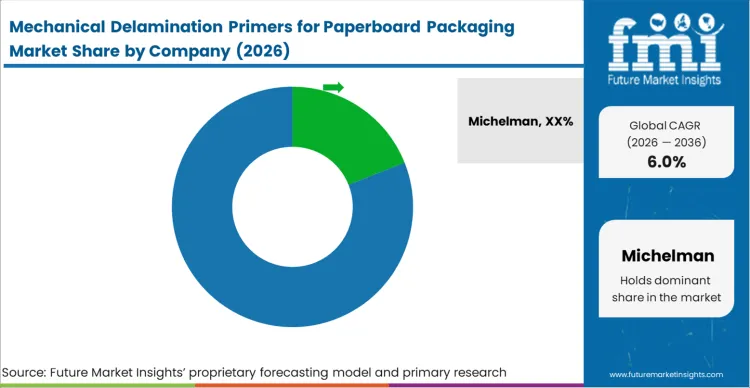
Market structure remains moderately concentrated with approximately 40% of global capacity controlled by integrated specialty chemical producers maintaining dedicated technical service infrastructure. Primary competitive variable centers on technical service capacity rather than raw material cost position, as successful primer specification approvals by major brand owners create multi-year supply relationships.
Producers with vertically integrated acrylic and polyurethane monomer production absorb raw material price volatility more effectively and maintain supply continuity during feedstock disruptions. Regulatory compliance capability further narrows competitive field, as ability to supply consistent food-contact-compliant formulations meeting EU, FDA, and emerging Asian food safety regulations at scale requires formulation stability and analytical testing infrastructure.
Customer concentration reinforces buyer leverage particularly in pharmaceutical packaging applications where top-five brand owners control majority of folding carton primer specifications. Brand owner sustainability mandate implementation during 2024 through 2026 accelerates technology platform transitions as Extended Producer Responsibility fee structures activate economic incentives for recyclability certification.
Key Players in Mechanical Delamination Primers for Paperboard Packaging Market
- Michelman
- BASF SE
- Paramelt B.V.
- DIC Corporation / Sun Chemical
- Akzo Nobel N.V.
- The Sherwin-Williams Company
- PPG Industries, Inc.
- Croda International PLC
- Clariant
- 3M Company
Scope of the Report
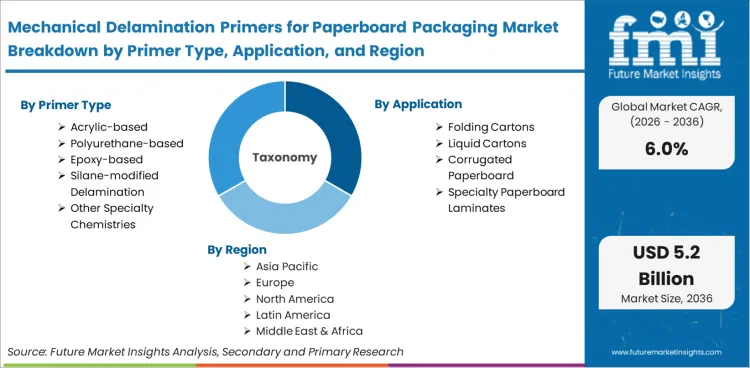
| Metric | Value |
|---|---|
| Quantitative Units | USD 2.9 billion (2026) to USD 5.0 billion (2036), at a CAGR of 6.0% |
| Market Definition | The mechanical delamination primers for paperboard packaging market comprises global production and distribution of specialized coating chemistries applied to paperboard substrates to enable controlled layer separation during recycling processes while maintaining structural integrity during converting, printing, and end-use. |
| Primer Type Segmentation | Acrylic-based, Polyurethane-based, Epoxy-based, Silane-modified Delamination, Other Specialty Chemistries |
| Application Segmentation | Folding Cartons, Liquid Cartons, Corrugated Paperboard, Specialty Paperboard Laminates |
| End-Use Industry Segmentation | Food & Beverage, Pharmaceutical & Healthcare, Cosmetics & Personal Care, Consumer Electronics, Industrial & Chemical |
| Regions Covered | North America, Latin America, Europe, East Asia, South Asia, Oceania, Middle East and Africa |
| Countries Covered | United States, Canada, Mexico, Brazil, Argentina, Chile, Germany, France, United Kingdom, Italy, Spain, China, India, Japan, South Korea, Indonesia, Malaysia, Thailand, Australia and 40 plus countries |
| Key Companies Profiled | Michelman, BASF SE, Paramelt B.V., DIC Corporation / Sun Chemical, Akzo Nobel N.V., The Sherwin-Williams Company, PPG Industries, Inc., Croda International PLC, Clariant, 3M Company |
| Forecast Period | 2026 to 2036 |
| Approach | Hybrid top-down and bottom-up market modeling validated through primary interviews with primer formulators, paperboard coating line operators, and converter technical directors |
Mechanical Delamination Primers for Paperboard Packaging Market Analysis by Segments
Primer Type:
- Acrylic-based
- Polyurethane-based
- Epoxy-based
- Silane-modified Delamination
- Other Specialty Chemistries
Application:
- Folding Cartons
- Liquid Cartons
- Corrugated Paperboard
- Specialty Paperboard Laminates
End-Use Industry:
- Food & Beverage
- Pharmaceutical & Healthcare
- Cosmetics & Personal Care
- Consumer Electronics
- Industrial & Chemical
Region:
- Asia Pacific
- Europe
- North America
- Latin America
- Middle East & Africa
Bibliography
- [1] Michelman. (2024). Michelman to Feature Barrier & Functional Coatings for Packaging at drupa 2024. SpecialChem Coatings News, December 2025.
- [2] BASF SE. (2024). Paper Coatings - STYRONAL APEX and ACRONAL APEX Binder Platforms. BASF Dispersions Product Information.
- [3] Michelman. (2024). Michelman Debuts Water-based Barrier Coatings and PE Alternatives at Pack Expo 2024. Industry Analysts Press Release, October 2024.
- [4] Marinelli, L. et al. (2024). Barrier, converting, and tray-forming properties of paperboard packaging materials coated with waterborne dispersions. Packaging Technology and Science, December 2023.
- [5] Lev, J. et al. (2024). Investigating the Convertibility and Barrier Performance of a Novel Suberin Dispersion Coating During the Paperboard Creasing Process. Packaging Technology and Science, August 2024.
- [6] European Commission. (2025). Packaging and Packaging Waste Regulation (EU) 2025/40. EUR-Lex Official Journal, February 2025.
- [7] GreenEco. (2025). 2025 Packaging Regulations: Manufacturing Biodegradability in the EU and US. Sustainability Compliance Analysis, July 2025.
- [8] Smithers. (2024). The Future of Functional & Barrier Coatings for Paper & Board. Market Intelligence Report, 2024.
- [9] PPG Industries. (2025). PPG Reports 2Q 2025 Financial Results. Coatings World, July 2025.
- [10] BASF SE. (2025). Metpack and BASF cooperate to demonstrate certified home-compostable, coated paper for food packaging. Corporate Press Release, May 2025.
This bibliography is provided for reader reference and is not exhaustive. The full report contains the complete reference list and detailed citations.
This Report Addresses
- Market intelligence to enable structured strategic decision-making across mature packaging markets undergoing regulatory-forced technology transitions
- Market size estimation and 10-year revenue forecasts from 2026 to 2036, supported by validated converter coating line capacity data
- Growth opportunity mapping across acrylic-based, polyurethane-based, epoxy-based, and silane-modified primer chemistries with emphasis on PFAS-free formulation transitions
- Segment and regional revenue forecasts covering folding cartons, liquid cartons, corrugated paperboard applications
- Competition strategy assessment including technical service infrastructure positioning and converter line trial capabilities
- Product reformulation and regulatory compliance tracking including EU Packaging Regulation 2025/40 recyclability grades
- Regulatory impact analysis covering August 2026 compliance activation dates and state-level EPR program implementation variations
- Market report delivery in PDF, Excel, PPT, and interactive dashboard formats
Frequently Asked Questions
How large is the demand for Mechanical Delamination Primers for Paperboard Packaging in the global market in 2026?
Demand for mechanical delamination primers for paperboard packaging in the global market is estimated to be valued at USD 2.9 billion in 2026.
What will be the market size of Mechanical Delamination Primers for Paperboard Packaging in the global market by 2036?
Market size for mechanical delamination primers for paperboard packaging is projected to reach USD 5.0 billion by 2036.
What is the expected demand growth for Mechanical Delamination Primers for Paperboard Packaging in the global market between 2026 and 2036?
Demand for mechanical delamination primers for paperboard packaging in the global market is expected to grow at a CAGR of 6.0% between 2026 and 2036.
Which Primer Type is poised to lead global sales by 2026?
Acrylic-based primers are expected to be the dominant primer type, capturing approximately 40.0% of global market share in 2026 due to water-based application compatibility and broad food-contact regulatory approval.
How significant is the role of Folding Cartons Application in driving Mechanical Delamination Primer adoption in 2026?
Folding cartons represent a critical application segment, projected to hold a substantial 45.0% share of total market demand in 2026 as pharmaceutical and food packaging prioritize recyclability-certified paperboard structures.
What is Driving Mechanical Delamination Primer Demand in the United States?
Extended Producer Responsibility mandates across California, Oregon, Washington, Minnesota, Maryland, Colorado, and Maine requiring recyclability certifications with eco-modulation fee reductions drive converter adoption of delamination-compatible primer systems.
What Compliance Standards are Referenced for the United States?
California SB 54 Extended Producer Responsibility framework and emerging state-level EPR programs implementing eco-modulation fee structures are referenced as key compliance drivers.
What is the United States Growth Outlook in this Report?
The United States is projected to grow at a CAGR of 5.6% during 2026 to 2036.
Why is Europe described as a Regulatory Laboratory in this Report?
EU Packaging and Packaging Waste Regulation 2025/40 establishes world's most stringent recyclability mandates and PFAS restrictions, creating regulatory template subsequently adopted by other major packaging markets globally.
What Type of Demand Dominates in Europe?
Technology transition-driven demand for PFAS-free, recyclability-certified primer systems dominates as converters retrofit existing coating lines to meet August 2026 compliance activation dates.
What is Germany Growth Outlook in this Report?
Germany is projected to expand at a CAGR of 5.2% during 2026 to 2036.
Does the Report Cover Japan in its Regional Analysis?
Japan is included within East Asia under the regional scope of analysis.
What are the Sources referred to for analyzing the Market in Japan?
Official statistics published by Japan Ministry of Economy, Trade and Industry covering specialty chemical production and packaging industry trade associations documenting converter capacity utilization are cited as primary reference sources.
What is the Main Demand Theme Linked to Japan in Asia Coverage?
Asia-Pacific demand is associated with cost-competitive primer systems satisfying minimum recyclability thresholds for domestic consumption and export-oriented packaging production.
Does the Report Cover South Korea in its Regional Analysis?
South Korea is included within East Asia under the regional coverage framework.
What is the Main Korea-Related Demand Theme in Asia Coverage?
Export-driven adoption of internationally certified recyclable packaging structures enabling access to European and North American retail channels with stringent sustainability requirements is emphasized.
Which Primer Chemistry Platforms are Strategically Important for Regulatory Compliance?
Acrylic-based and silane-modified formulations are prioritized due to water-based application, PFAS-free composition, and validated food-contact compliance across major regulatory jurisdictions.
What are Mechanical Delamination Primers and What are They Mainly Used For?
Mechanical delamination primers are specialized coating chemistries applied to paperboard substrates enabling controlled layer separation during recycling while maintaining structural integrity during converting and end-use.
What does Mechanical Delamination Primers for Paperboard Packaging Market Mean in this Report?
Mechanical delamination primers market refers to global production, distribution, and industrial consumption of specialized coating chemistries enabling recyclability of barrier-coated paperboard packaging structures.
What is Included in the Scope of this Mechanical Delamination Primers for Paperboard Packaging Market Report?
Scope covers primer chemistry types, application formats including folding cartons and liquid cartons, and end-use industries spanning food & beverage, pharmaceutical, and cosmetics sectors with regional regulatory compliance analysis.
What is Excluded from the Scope of this Report?
Generic paperboard coatings without delamination functionality, standard print primers, basic sizing agents, and downstream finished packaging articles are excluded, focusing strictly on specialized delamination-enabling chemistries.
Preview the report firsthand - request a free sample
Get SampleGet the brochure for pricing and purchase details.
Get PDFTable of Content
- Executive Summary
- Global Market Outlook
- Demand-side Trends
- Supply-side Trends
- Technology Roadmap Analysis
- Analysis and Recommendations
- Market Overview
- Market Coverage / Taxonomy
- Market Definition / Scope / Limitations
- Research Methodology
- Chapter Orientation
- Analytical Lens and Working Hypotheses
- Market Structure, Signals, and Trend Drivers
- Benchmarking and Cross-market Comparability
- Market Sizing, Forecasting, and Opportunity Mapping
- Research Design and Evidence Framework
- Desk Research Programme (Secondary Evidence)
- Company Annual and Sustainability Reports
- Peer-reviewed Journals and Academic Literature
- Corporate Websites, Product Literature, and Technical Notes
- Earnings Decks and Investor Briefings
- Statutory Filings and Regulatory Disclosures
- Technical White Papers and Standards Notes
- Trade Journals, Industry Magazines, and Analyst Briefs
- Conference Proceedings, Webinars, and Seminar Materials
- Government Statistics Portals and Public Data Releases
- Press Releases and Reputable Media Coverage
- Specialist Newsletters and Curated Briefings
- Sector Databases and Reference Repositories
- FMI Internal Proprietary Databases and Historical Market Datasets
- Subscription Datasets and Paid Sources
- Social Channels, Communities, and Digital Listening Inputs
- Additional Desk Sources
- Expert Input and Fieldwork (Primary Evidence)
- Primary Modes
- Qualitative Interviews and Expert Elicitation
- Quantitative Surveys and Structured Data Capture
- Blended Approach
- Why Primary Evidence is Used
- Field Techniques
- Interviews
- Surveys
- Focus Groups
- Observational and In-context Research
- Social and Community Interactions
- Stakeholder Universe Engaged
- C-suite Leaders
- Board Members
- Presidents and Vice Presidents
- R&D and Innovation Heads
- Technical Specialists
- Domain Subject-matter Experts
- Scientists
- Physicians and Other Healthcare Professionals
- Governance, Ethics, and Data Stewardship
- Research Ethics
- Data Integrity and Handling
- Primary Modes
- Tooling, Models, and Reference Databases
- Desk Research Programme (Secondary Evidence)
- Data Engineering and Model Build
- Data Acquisition and Ingestion
- Cleaning, Normalisation, and Verification
- Synthesis, Triangulation, and Analysis
- Quality Assurance and Audit Trail
- Market Background
- Market Dynamics
- Drivers
- Restraints
- Opportunity
- Trends
- Scenario Forecast
- Demand in Optimistic Scenario
- Demand in Likely Scenario
- Demand in Conservative Scenario
- Opportunity Map Analysis
- Product Life Cycle Analysis
- Supply Chain Analysis
- Investment Feasibility Matrix
- Value Chain Analysis
- PESTLE and Porter’s Analysis
- Regulatory Landscape
- Regional Parent Market Outlook
- Production and Consumption Statistics
- Import and Export Statistics
- Market Dynamics
- Global Market Analysis 2021 to 2025 and Forecast, 2026 to 2036
- Historical Market Size Value (USD Million) Analysis, 2021 to 2025
- Current and Future Market Size Value (USD Million) Projections, 2026 to 2036
- Y-o-Y Growth Trend Analysis
- Absolute $ Opportunity Analysis
- Global Market Pricing Analysis 2021 to 2025 and Forecast 2026 to 2036
- Global Market Analysis 2021 to 2025 and Forecast 2026 to 2036, By Primer Type
- Introduction / Key Findings
- Historical Market Size Value (USD Million) Analysis By Primer Type , 2021 to 2025
- Current and Future Market Size Value (USD Million) Analysis and Forecast By Primer Type , 2026 to 2036
- Acrylic-based
- Polyurethane-based
- Epoxy-based
- Silane-modified Delamination
- Other Specialty Chemistries
- Acrylic-based
- Y-o-Y Growth Trend Analysis By Primer Type , 2021 to 2025
- Absolute $ Opportunity Analysis By Primer Type , 2026 to 2036
- Global Market Analysis 2021 to 2025 and Forecast 2026 to 2036, By Application
- Introduction / Key Findings
- Historical Market Size Value (USD Million) Analysis By Application, 2021 to 2025
- Current and Future Market Size Value (USD Million) Analysis and Forecast By Application, 2026 to 2036
- Folding Cartons
- Liquid Cartons
- Corrugated Paperboard
- Specialty Paperboard Laminates
- Folding Cartons
- Y-o-Y Growth Trend Analysis By Application, 2021 to 2025
- Absolute $ Opportunity Analysis By Application, 2026 to 2036
- Global Market Analysis 2021 to 2025 and Forecast 2026 to 2036, By Region
- Introduction
- Historical Market Size Value (USD Million) Analysis By Region, 2021 to 2025
- Current Market Size Value (USD Million) Analysis and Forecast By Region, 2026 to 2036
- North America
- Latin America
- Western Europe
- Eastern Europe
- East Asia
- South Asia and Pacific
- Middle East & Africa
- Market Attractiveness Analysis By Region
- North America Market Analysis 2021 to 2025 and Forecast 2026 to 2036, By Country
- Historical Market Size Value (USD Million) Trend Analysis By Market Taxonomy, 2021 to 2025
- Market Size Value (USD Million) Forecast By Market Taxonomy, 2026 to 2036
- By Country
- USA
- Canada
- Mexico
- By Primer Type
- By Application
- By Country
- Market Attractiveness Analysis
- By Country
- By Primer Type
- By Application
- Key Takeaways
- Latin America Market Analysis 2021 to 2025 and Forecast 2026 to 2036, By Country
- Historical Market Size Value (USD Million) Trend Analysis By Market Taxonomy, 2021 to 2025
- Market Size Value (USD Million) Forecast By Market Taxonomy, 2026 to 2036
- By Country
- Brazil
- Chile
- Rest of Latin America
- By Primer Type
- By Application
- By Country
- Market Attractiveness Analysis
- By Country
- By Primer Type
- By Application
- Key Takeaways
- Western Europe Market Analysis 2021 to 2025 and Forecast 2026 to 2036, By Country
- Historical Market Size Value (USD Million) Trend Analysis By Market Taxonomy, 2021 to 2025
- Market Size Value (USD Million) Forecast By Market Taxonomy, 2026 to 2036
- By Country
- Germany
- UK
- Italy
- Spain
- France
- Nordic
- BENELUX
- Rest of Western Europe
- By Primer Type
- By Application
- By Country
- Market Attractiveness Analysis
- By Country
- By Primer Type
- By Application
- Key Takeaways
- Eastern Europe Market Analysis 2021 to 2025 and Forecast 2026 to 2036, By Country
- Historical Market Size Value (USD Million) Trend Analysis By Market Taxonomy, 2021 to 2025
- Market Size Value (USD Million) Forecast By Market Taxonomy, 2026 to 2036
- By Country
- Russia
- Poland
- Hungary
- Balkan & Baltic
- Rest of Eastern Europe
- By Primer Type
- By Application
- By Country
- Market Attractiveness Analysis
- By Country
- By Primer Type
- By Application
- Key Takeaways
- East Asia Market Analysis 2021 to 2025 and Forecast 2026 to 2036, By Country
- Historical Market Size Value (USD Million) Trend Analysis By Market Taxonomy, 2021 to 2025
- Market Size Value (USD Million) Forecast By Market Taxonomy, 2026 to 2036
- By Country
- China
- Japan
- South Korea
- By Primer Type
- By Application
- By Country
- Market Attractiveness Analysis
- By Country
- By Primer Type
- By Application
- Key Takeaways
- South Asia and Pacific Market Analysis 2021 to 2025 and Forecast 2026 to 2036, By Country
- Historical Market Size Value (USD Million) Trend Analysis By Market Taxonomy, 2021 to 2025
- Market Size Value (USD Million) Forecast By Market Taxonomy, 2026 to 2036
- By Country
- India
- ASEAN
- Australia & New Zealand
- Rest of South Asia and Pacific
- By Primer Type
- By Application
- By Country
- Market Attractiveness Analysis
- By Country
- By Primer Type
- By Application
- Key Takeaways
- Middle East & Africa Market Analysis 2021 to 2025 and Forecast 2026 to 2036, By Country
- Historical Market Size Value (USD Million) Trend Analysis By Market Taxonomy, 2021 to 2025
- Market Size Value (USD Million) Forecast By Market Taxonomy, 2026 to 2036
- By Country
- Kingdom of Saudi Arabia
- Other GCC Countries
- Turkiye
- South Africa
- Other African Union
- Rest of Middle East & Africa
- By Primer Type
- By Application
- By Country
- Market Attractiveness Analysis
- By Country
- By Primer Type
- By Application
- Key Takeaways
- Key Countries Market Analysis
- USA
- Pricing Analysis
- Market Share Analysis, 2025
- By Primer Type
- By Application
- Canada
- Pricing Analysis
- Market Share Analysis, 2025
- By Primer Type
- By Application
- Mexico
- Pricing Analysis
- Market Share Analysis, 2025
- By Primer Type
- By Application
- Brazil
- Pricing Analysis
- Market Share Analysis, 2025
- By Primer Type
- By Application
- Chile
- Pricing Analysis
- Market Share Analysis, 2025
- By Primer Type
- By Application
- Germany
- Pricing Analysis
- Market Share Analysis, 2025
- By Primer Type
- By Application
- UK
- Pricing Analysis
- Market Share Analysis, 2025
- By Primer Type
- By Application
- Italy
- Pricing Analysis
- Market Share Analysis, 2025
- By Primer Type
- By Application
- Spain
- Pricing Analysis
- Market Share Analysis, 2025
- By Primer Type
- By Application
- France
- Pricing Analysis
- Market Share Analysis, 2025
- By Primer Type
- By Application
- India
- Pricing Analysis
- Market Share Analysis, 2025
- By Primer Type
- By Application
- ASEAN
- Pricing Analysis
- Market Share Analysis, 2025
- By Primer Type
- By Application
- Australia & New Zealand
- Pricing Analysis
- Market Share Analysis, 2025
- By Primer Type
- By Application
- China
- Pricing Analysis
- Market Share Analysis, 2025
- By Primer Type
- By Application
- Japan
- Pricing Analysis
- Market Share Analysis, 2025
- By Primer Type
- By Application
- South Korea
- Pricing Analysis
- Market Share Analysis, 2025
- By Primer Type
- By Application
- Russia
- Pricing Analysis
- Market Share Analysis, 2025
- By Primer Type
- By Application
- Poland
- Pricing Analysis
- Market Share Analysis, 2025
- By Primer Type
- By Application
- Hungary
- Pricing Analysis
- Market Share Analysis, 2025
- By Primer Type
- By Application
- Kingdom of Saudi Arabia
- Pricing Analysis
- Market Share Analysis, 2025
- By Primer Type
- By Application
- Turkiye
- Pricing Analysis
- Market Share Analysis, 2025
- By Primer Type
- By Application
- South Africa
- Pricing Analysis
- Market Share Analysis, 2025
- By Primer Type
- By Application
- USA
- Market Structure Analysis
- Competition Dashboard
- Competition Benchmarking
- Market Share Analysis of Top Players
- By Regional
- By Primer Type
- By Application
- Competition Analysis
- Competition Deep Dive
- Michelman
- Overview
- Product Portfolio
- Profitability by Market Segments (Product/Age /Sales Channel/Region)
- Sales Footprint
- Strategy Overview
- Marketing Strategy
- Product Strategy
- Channel Strategy
- BASF SE
- Paramelt B.V.
- DIC Corporation / Sun Chemical
- Akzo Nobel N.V.
- The Sherwin-Williams Company
- PPG Industries, Inc.
- Croda International PLC
- Clariant
- 3M Company
- Michelman
- Competition Deep Dive
- Assumptions & Acronyms Used


