

- Market Size (2026)
- USD 501.7 Mn
- Forecast (2036)
- USD 1005.5 Mn
- CAGR (2026 to 2036)
- 7.2%
How big is Paper-Based Can Carriers Market in 2026?
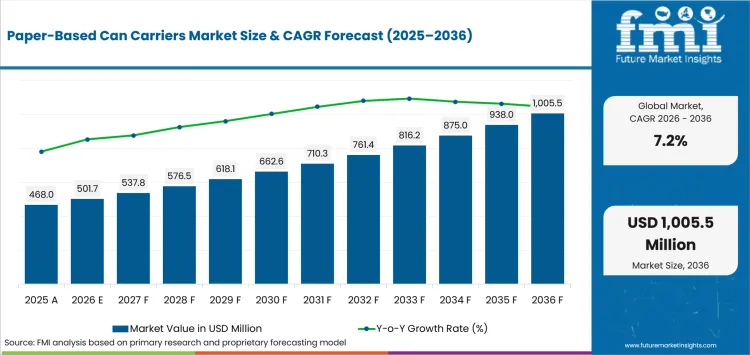
USD 501.7 million in 2026 and USD 1005.5 million by 2036 at 7.2% CAGR.
Demand for paper-based can carriers is projected to expand at 7.2% CAGR from 2026 to 2036 as beverage companies reassess plastic multipacks. Packaging engineers turn material targets into recurring paperboard carrier orders by validating retention and line speed on existing equipment. PackUK published Recyclability Assessment Methodology version 1.1 in April 2025 for large producers reporting household packaging. Its red, amber and green ratings connect package design with future fee modulation for large household-packaging producers.
Country conversion speeds differ as recyclability rules and producer obligations follow different schedules across major beverage markets. The European Commission confirmed in February 2025 that the Packaging and Packaging Waste Regulation entered into force across the EU. Germany therefore prepares under a common EU framework while the UK administers separate producer fees and the USA remains state-led. Beverage programs place paper-carrier orders at different points as local compliance and existing line qualification converge.
Key Takeaways of Paper-Based Can Carriers Market
- Packaging rules push beverage brands toward paper-based can carriers as secondary-pack material changes compliance costs.
- Based on product type, wrap carriers are projected to account for 32.0% in 2026 due to broad retention coverage.
- In 2026, recycled paperboard is expected to lead material with 52.0% share because established recovery routes fit converting.
- The pack size category is forecast to be led by 6-pack formats at 40.0% share in 2026 due to retail handling.
- Condensation resistance and line-speed trials delay conversion until fiber carriers retain cans reliably during chilled distribution.
- Graphic Packaging International, Smurfit Westrock, Atlantic Packaging, Promac, Inc., Martec Packaging Inc., International Paper, MM Packaging and Metsä Board Corporation are profiled.
Analyst Perspective
“Paper-based can carriers earn repeat programs once filling-line performance is proven and shelf advantages become secondary to operating fit. Packaging teams should compare wet retention, board yield and applicator changeover time against the total cost of each saleable multipack.”
- Nandini Roy Chaudhary, Principal Consultant, Future Market Insights
How is the Paper-Based Can Carriers Market segmented?
The paper-based can carriers market is segmented by product type, material, pack size, application, end use, sales channel and region.
Product type includes wrap carriers, clip / cluster carriers, basket carriers and top / collar carriers, while material covers recycled paperboard, virgin kraft board and coated board. Pack sizes are 6-pack, 8 to 12-pack, 4-pack and others, while applications include beer & cider, carbonated soft drinks, energy & RTD drinks and water & juices. End use covers alcoholic beverages, non-alcoholic beverages and others. Sales channels include direct / brand OEM, packaging distributors, contract packers and others.
Why does beer and cider lead demand within the application category?
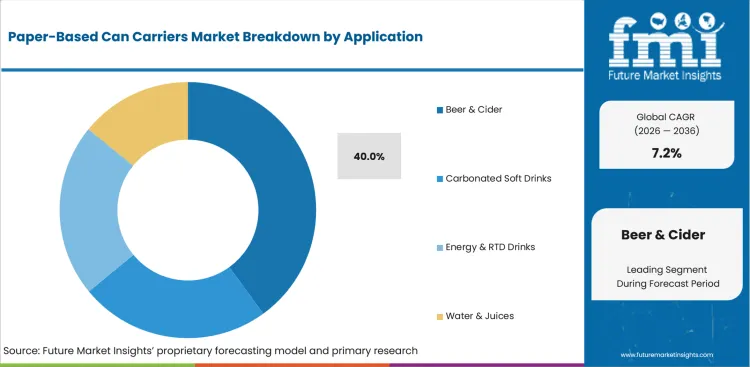
Beer and cider programs expose carriers to chilled handling while giving paperboard visible branding value at retail. Breweries test retention and line speed during qualification for one design across several pack counts.
- By application, beer and cider are forecast to represent 40.0% in 2026 driven by routine can multipacks and visible shelf-branding requirements.
- Earthrings confirmed in January 2025 that Caybrew had switched from plastic rings to paperboard can carriers, citing sustainability and structural durability as the primary drivers for the conversion. That deployment makes humidity performance a practical qualification point for brewery programs seeking recurring orders across chilled distribution networks worldwide.
Why do wrap carriers lead demand within the product type category?
At drinktec in September 2025, Graphic Packaging introduced wrap-style paperboard multipacks that run on existing high-speed Marksman equipment and maintain can orientation. That operating fit gives beverage brands broad print area and secure retention without replacing established packing machinery.
- Wrap carriers are set to lead the product type category with 32.0% share in 2026 due to coverage across common can grids.
- Beverage plants compare retention tabs and board use against clip-style alternatives during commercial line trials. The larger structure earns repeat orders in programs that require shelf communication and pack integrity across several carrier configurations.
Why does recycled paperboard lead demand within the material category?
Recycled paperboard follows collection and converting routes already used across high-volume beverage packaging programs. Plants test stiffness and die-cut accuracy during approval for repeated can-carrier production on beverage lines. Graphic Packaging opened its Waco recycled paperboard facility in November 2025 and named beverage packaging among the markets served, adding supply for programs.
- By material, recycled paperboard is estimated to hold 52.0% in 2026 owing to established recovery routes and broad converting familiarity.
- Carrier qualification tests whether recycled grades retain stiffness and die-cut accuracy during forming and refrigerated distribution. Recycled content earns repeat orders once that performance remains stable across commercial production lots and cycles.
Why do 6-pack formats lead demand within the pack size category?
Six-pack formats match familiar retail handling with repeatable applicator geometry, and Graphic Packaging presented EnviroClip Cans in that configuration at PLMA in November 2025 for cold and humid conditions.
- The 6-pack segment is likely to capture 40.0% share in 2026 attributable to familiar retail merchandising and repeatable application geometry.
- Packaging engineers standardize six-can geometry across manual and automated application steps to reduce repeated setup work during commercial qualification on existing beverage lines. Four-packs and larger bundles remain useful for premium or stock-up programs, but they require separate handling checks and carrier geometry for stable high-volume production.
What are the drivers, restraints and opportunities in the Paper-Based Can Carriers Market?
Producer-responsibility rules increase specification reviews, while chilled-performance and line-qualification requirements slow conversion and multi-format carrier programs widen the commercial route across beverage plants.
- Driver: Producer-responsibility fees make can-carrier material choice part of annual packaging cost and recyclability reviews for beverage brands.
- Restraint: Paper carriers must retain cans under condensation and run at commercial line speed as a condition for beverage plants to approve recurring production.
- Opportunity: Multi-format carrier systems let beverage plants qualify several can sizes without funding a separate application setup for every pack.
Recyclability Fees Bring Material Choice Into Annual Cost Reviews
Packaging fees turn carrier material into an annual cost question for beverage companies instead of a design preference. PackUK confirmed in June 2025 that household packaging disposal fees would be modulated from 2026 using recyclability ratings. For beverage programs already reviewing plastic reduction, a favorable rating strengthens the fee case for commercial trials during annual sourcing without assuming line-cost savings.
Cold and Humid Performance Remains a Qualification Gate
Graphic Packaging described EnviroClip Cans at PACK EXPO in September 2025 as reinforced for cold and humid handling, placing moisture performance inside commercial qualification. Beverage plants then test paperboard strength at operating speed as condensation can soften fiber structures during refrigerated distribution. Failed trials extend engineering work and postpone repeat orders until the carrier survives the full chilled distribution testing cycle.
Multi-Format Programs Broaden the Commercial Route
Beverage producers with several can sizes need carrier designs that do not require separate engineering programs for every retail pack. Common geometry reduces changeover work and lets one account qualify more formats against the same packing setup. MM Packaging reported in September 2025 that Kingsland Drinks uses paperboard cases in eight- and twelve-can formats, with the twelve-can configuration accommodating 200 ml and 250 ml cans.
Which country CAGRs are profiled in the Paper-Based Can Carriers Market?
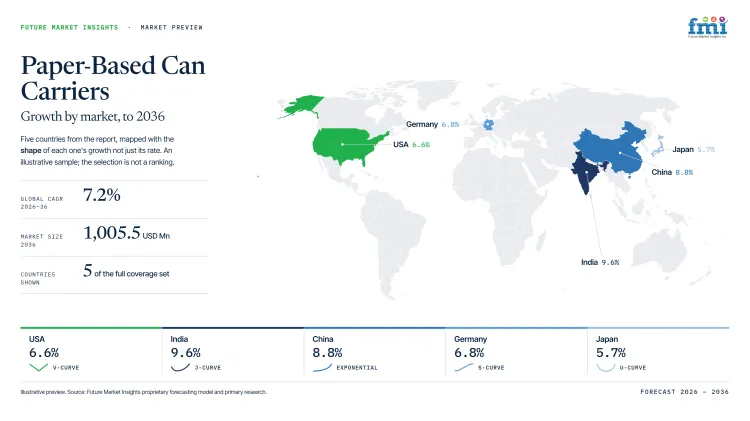
| Country | CAGR |
|---|---|
| UK | 7.6% |
| Germany | 6.8% |
| Brazil | 6.8% |
| USA | 6.6% |
| Japan | 5.7% |
How do country-level CAGRs compare in the Paper-Based Can Carriers Market?
Five profiled markets span a 1.9 percentage-point range between the UK at 7.6% CAGR and Japan at 5.7%. Germany and Brazil form the middle pair while the USA remains close under state-led packaging rules. The narrow spread reflects local compliance timing and carrier qualification differences, not current market size.
- UK producer fees connect recyclability ratings with annual household-packaging specifications for beverages.
- Germany ties pack design to sorting performance under its national minimum standard.
- Brazil applies plastic reverse logistics while mixed paper packages follow another route.
- USA state programs set different implementation dates across national beverage filling portfolios.
- Japan combines paper-container collection planning with strict chilled-retail presentation requirements for multipacks.
Comparable rates can conceal different qualification costs and entry conditions for carrier manufacturers.
The full report provides country-level CAGR analysis across North America, Latin America, Europe, East Asia, South Asia, Oceania and the Middle East and Africa.
Country-wise Analysis
- Large beverage groups in the USA qualify secondary packaging at plant level as state programs set different compliance dates across national filling networks and require separate documentation for identical multipacks. Paper-based can carrier demand in the USA is forecast to rise at 6.6% CAGR over the forecast period, reinforced by Oregon DEQ’s February 2025 approval of the producer-responsibility plan that began July 1 for packaging and paper. High-volume bottling lines provide repeat demand but fragmented state rules lengthen trials, favoring carrier companies that can validate recyclability and application settings across several plants and can-size programs without rebuilding each packing setup.
- Japan’s Ministry of the Environment reported in March 2026 that 904 municipalities planned separate collection of paper containers and packaging for fiscal 2026, giving fiber packs a defined recovery route. Adoption of paper-based can carriers in Japan is estimated to expand at 5.7% CAGR through 2036, supported by disciplined pack presentation and beverage lines that already handle several retail configurations. Chilled retail raises the qualification bar as thin paper structures must arrive clean and stable, so companies serving Japanese breweries need precise die cutting and repeatable retention data across common six-pack and other multipack programs as a prerequisite for broader national commercial expansion.
- German beverage packaging teams assess recyclability against documented sorting practice during carrier approval, and national brewery programs must reconcile coatings or mixed components with the recyclable share recorded for each commercial design. Germany is estimated to post 6.8% CAGR over the forecast period, shaped by a clear domestic assessment route and established high-volume beverage production that can sustain recurring carrier orders. The Central Agency Packaging Register’s August 2025 minimum standard introduced category-based assessment aligned with PPWR preparation, making adhesive choices and coating documentation commercial requirements for packaging manufacturers running repeated trials on high-speed brewery packing lines and distributor programs.
- UK beverage producers treat recyclability classification as part of annual packaging cost reviews as household-packaging fees vary with material ratings, coatings and other components that affect the assessed category. Paper-based can carrier sales in the United Kingdom are forecast to expand at 7.6% CAGR by 2036, while PackUK’s July 2026 RAM 2027 guidance assigns version 1.1 to 2026 reporting. The national assessment route gives paper formats a clear compliance pathway but not automatic preference, so beverage companies continue wet-retention and application-speed testing as conditions for recurring multipack supply at commercial volumes across national retail programs for beverage portfolios nationwide.
- Brazilian beverage programs cross long freight corridors and uneven recovery coverage, making local converting economics and nearby application support central to paper-carrier qualification for regional filling networks. The Brazilian paper-based can carrier sector is projected to record 6.8% CAGR during the assessment period, influenced by distributor reach and the cost of serving plants far from converting capacity. Federal Decree No. 12,688 of October 2025 created reverse logistics for plastic packaging but excluded mixed packages containing paper or paperboard and therefore fiber carriers require separate recovery planning and nearby service coverage across regional distribution routes serving distant beverage filling sites and retail networks.
Who are the notable companies in the Paper-Based Can Carriers Market?
Graphic Packaging International, Smurfit Westrock, Atlantic Packaging, Promac, Inc., Martec Packaging Inc., International Paper, MM Packaging and Metsä Board Corporation are the notable companies profiled in this market.
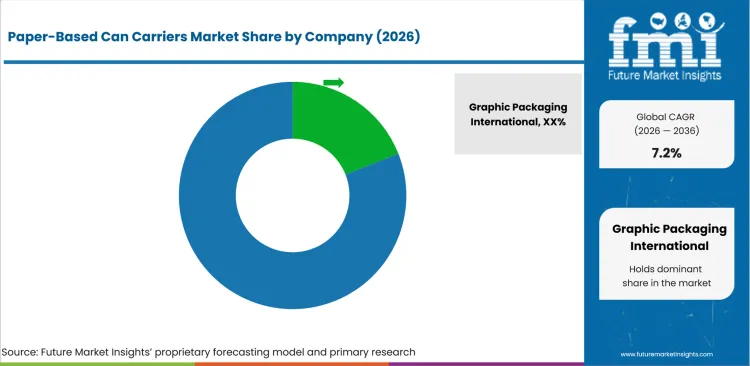
Competition is moderately concentrated among integrated paperboard groups and specialist carrier companies with different levels of application support. Beverage plants compare condensation retention, changeover effort and supported can sizes. Entry is harder without consistent converting or equipment support during qualification on existing filling lines and application settings.
- Integrated paperboard carrier businesses: Graphic Packaging International, Smurfit Westrock and Atlantic Packaging combine exact can-carrier formats with broader converting support.
- Specialist fiber can-carrier platforms: Promac, Inc. and Martec Packaging Inc. focus on plastic-ring replacement for breweries and regional beverage producers.
- Converted board participants: International Paper, MM Packaging and Metsä Board Corporation serve can multipacks with brewery carriers, cartonboard cases or customer-specific paperboard designs.
Competitive Benchmarking: Paper-Based Can Carriers Market
| Company | Carrier Architecture Breadth | Pack / Can Configuration Breadth | Commercial Evidence Depth | Geographic Reach |
|---|---|---|---|---|
| Graphic Packaging International | Medium | Medium | Low | United States and Germany |
| Smurfit Westrock | High | Medium | Medium | China |
| Atlantic Packaging | Low | Low | Medium | North America |
| Promac, Inc. | Low | High | Medium | Cayman Islands and United States |
| Martec Packaging Inc. | Low | High | Low | Canada and Germany |
| International Paper | Low | Low | Low | Sweden |
| MM Packaging | High | High | Medium | United Kingdom |
| Metsä Board Corporation | Low | Low | Medium | Finland |
Key Developments in the Paper-Based Can Carriers Market
- In July 2026, Smurfit Westrock launched paper-based World Cup packaging with Coca-Cola China that included an eight-can gift pack and other can formats.
- In December 2025, Atlantic Packaging reported that Fishbone paperboard beverage carriers were appearing on retail shelves across North America as customer adoption broadened.
- In September 2025, Metsä Board Corporation and Olutmylly launched a six-can paperboard tasting pack following co-development and testing at the Äänekoski Excellence Centre.
Key Players in the Paper-Based Can Carriers Market
Integrated Paperboard Carrier Businesses
- Graphic Packaging International
- Smurfit Westrock
- Atlantic Packaging
Specialist Fiber Can-Carrier Platforms
- Promac, Inc.
- Martec Packaging Inc.
Converted Board Can-Multipack Participants
- International Paper
- MM Packaging
- Metsä Board Corporation
Paper-Based Can Carriers Market - Report Scope
| Coverage field | Report scope |
|---|---|
| Market breakdown | By product type, material, pack size, application, end use, sales channel and region. |
| Quantitative Units | Revenue in USD million and CAGR in %. |
| Market Definition | Revenue from converted paper or paperboard carriers sold to bundle and carry canned beverages within the defined segmentation universe. |
| Regions Covered | North America, Latin America, Europe, East Asia, South Asia and Pacific and Middle East and Africa. |
| Countries Covered | United Kingdom, Germany, Brazil, United States, Japan, and 20+ countries included in the full report. |
| Key Companies Profiled | Graphic Packaging International, Smurfit Westrock, Atlantic Packaging, Promac, Inc., Martec Packaging Inc., International Paper, MM Packaging and Metsä Board Corporation. |
| Forecast Period | 2026 to 2036. |
| Approach | Primary and secondary research with market triangulation. |
Paper-Based Can Carriers Market - Research Methodology
| Method | Approach |
|---|---|
| Primary Research | FMI analysts gathered input from manufacturers, service providers, technology developers, distributors, end users, procurement teams, and subject-matter experts. Interviews examined purchasing decisions, product or service evaluation, adoption barriers, approval requirements, pricing considerations, and expectations for technical or commercial support. Respondents were also asked what evidence is required before a trial, pilot, or initial order develops into regular purchasing. |
| Desk Research | Desk research covered government statistics, regulatory publications, trade data, industry associations, technical literature, standards, company filings, product information, and official corporate announcements. Sources were reviewed for relevance, publication date, geographic coverage, and consistency with the defined market scope. Claims relating to performance, applications, approvals, capacity, investment, and commercial activity were retained only when supported by credible public evidence. |
| Market Sizing and Forecasting | The market model combined the baseline value with historical performance, segment structure, pricing and volume indicators, adoption levels, company participation, and country-level demand conditions. Forecast assumptions considered economic activity, investment trends, regulatory developments, technology adoption, purchasing cycles, supply availability, and barriers to wider market use. Segment and regional estimates were reconciled before the final market total was calculated. |
| Data Validation | Estimates were checked against multiple independent indicators, including public data, company activity, trade patterns, industry developments, and findings from primary interviews. Validation also tested whether products, services, applications, and company revenues fell within the defined market boundaries. Adjacent categories, unsupported claims, overlapping revenues, and activities without direct market relevance were excluded to reduce double counting and maintain consistency across segments and countries. |
Paper-Based Can Carriers Market by Segments
Paper-Based Can Carriers Market segmented by Product Type:
- Wrap Carriers
- Clip / Cluster Carriers
- Basket Carriers
- Top / Collar Carriers
Paper-Based Can Carriers Market segmented by Material:
- Recycled Paperboard
- Virgin Kraft Board
- Coated Board
Paper-Based Can Carriers Market segmented by Pack Size:
- 6-Pack
- 8 to 12-Pack
- 4-Pack
- Others
Paper-Based Can Carriers Market segmented by Application:
- Beer & Cider
- Carbonated Soft Drinks
- Energy & RTD Drinks
- Water & Juices
Paper-Based Can Carriers Market segmented by End Use:
- Alcoholic Beverages
- Non-Alcoholic Beverages
- Others
Paper-Based Can Carriers Market segmented by Sales Channel:
- Direct / Brand OEM
- Packaging Distributors
- Contract Packers
- Others
Paper-Based Can Carriers Market by Region:
- North America
- United States
- Canada
- Latin America
- Brazil
- Mexico
- Chile
- Rest of Latin America
- Western Europe
- Germany
- United Kingdom
- Italy
- Spain
- France
- Nordics
- Benelux
- Rest of Western Europe
- Eastern Europe
- Russia
- Poland
- Hungary
- Balkan and Baltic States
- Rest of Eastern Europe
- East Asia
- China
- Japan
- South Korea
- South Asia and Pacific
- India
- ASEAN
- Australia and New Zealand
- Rest of South Asia and Pacific
- Middle East and Africa
- Kingdom of Saudi Arabia
- Other GCC Countries
- Türkiye
- South Africa
- Other African Union Countries
- Rest of Middle East and Africa
Research Sources and Bibliography
- PackUK. (2025, April 29). Recyclability Assessment Methodology (RAM) v1.1.
- European Commission. (2025, February 11). New rules enter into force for a more sustainable and competitive packaging economy.
- Graphic Packaging International. (2025, September 10). Graphic Packaging Debuts Duo of Beverage Multipack Innovations at drinktec 2025.
- Graphic Packaging International. (2025, November 5). Graphic Packaging Launches Advanced Recycled Paperboard Facility in Waco, Texas.
- Graphic Packaging International. (2025, November 16). Discover Packaging Innovation at the PLMA 2025 Private Label Trade Show.
- Halfman, M. (2025, January 30). Caybrew and Earthrings: Partners in Sustainability. Earthrings.
- PackUK. (2025, June 27). Extended producer responsibility for packaging: modulated disposal fees.
- Graphic Packaging International. (2025, September 29). Driving Innovation For Growth: Discover Paperboard Innovation at PACK EXPO 2025.
- MM Packaging. (2025, September 10). MM Packaging’s multi-pack cartonboard solution protects Kingsland Drinks’ range of canned beverages.
- Oregon Department of Environmental Quality. (2025, February 21). DEQ approves Producer Responsibility Organization program plan, advances Plastic Pollution and Recycling Modernization Act.
- Ministry of the Environment, Japan. (2026, March 31). 容器包装リサイクル法に基づく令和8年度以降の分別収集見込量の集計結果について.
- Central Agency Packaging Register. (2025, August 29). 2025 minimum standard published - initial touchstone for companies preparing for the EU Packaging and Packaging Waste Regulation (PPWR).
- PackUK. (2026, July 1). Assess packaging recyclability: recyclability assessment methodology (RAM) 2027.
- Presidency of the Republic of Brazil. (2025, October 21). Decreto nº 12.688, de 21 de outubro de 2025.
- Smurfit Westrock. (2026, July 7). Smurfit Westrock partners with Coca-Cola on World Cup packaging to capture spike in consumer demand.
- Atlantic Packaging. (2025, December 31). Atlantic 2025 Year in Review.
- Martec Packaging Inc. (2026, March 11). Martec at Drinktec 2025: Showcasing Sustainable Can Carrier Solutions.
- International Paper. (2025, January 31). About the IP + DS Smith Combination.
- DS Smith. (2025, October). Vinst i Packnorth Award!.
- Metsä Board. (2025, September 29). V6-engine six-pack: Olutmylly’s tasting pack co-created with Metsä Board.
- Martec Packaging Inc. (2026, March 16). Full-Color Martec Can Carriers: Make Your Brand Stand Out.
- Graphic Packaging International. (n.d.). ClipCombo™ for Cans. Retrieved August 12, 2026.
- Smurfit Westrock. (n.d.). CanCollar® Portfolio. Retrieved August 12, 2026.
- Atlantic Packaging. (n.d.). Fishbone Sustainable Beverage Carriers. Retrieved August 12, 2026.
- Earthrings. (n.d.). Cardboard Can Carriers. Retrieved August 12, 2026.
- Martec Packaging. (n.d.). martec cancarriers - Eco-Friendly Can Carriers & Packaging Solutions for Wineries, Breweries, and Beverage Businesses. Retrieved August 12, 2026.
- MM Packaging. (n.d.). Beverage Multipack. Retrieved August 12, 2026.
- Metsä Board. (n.d.). 9 questions to spark fresh packaging design ideas. Retrieved August 12, 2026.
- DS Smith. (n.d.). DS Smith Sverige - Smart förpackning, hållbart papper och effektiv återvinning. Retrieved August 12, 2026.
This bibliography is provided for reader reference and is not exhaustive. The full report contains the complete reference list and detailed citations
This Report Answers
- How large is the paper-based can carriers market in 2026 and 2036?
- Which packaging rules are changing the economics of paper-based can carrier conversion?
- Why do wrap carriers account for 32.0% of product type demand in 2026?
- How does recycled paperboard influence material selection and carrier qualification?
- Why do 6-pack formats hold the leading pack size position?
- How do country growth rates differ across the USA, Germany, Japan, UK and Brazil?
- Which companies combine dedicated paper can-carrier formats, current customer deployments and beverage-specific converted multipacks?
- What wet-strength and production-line constraints can delay carrier adoption?
Frequently Asked Questions
How big is the Paper-Based Can Carriers Market in 2026?
The paper-based can carriers market is expected to be valued at USD 501.7 million in 2026. Plastic replacement becomes recurring demand once fiber carriers meet recyclability, chilled-retention and production-line requirements across commercial beverage programs.
What is the CAGR of the Paper-Based Can Carriers Market from 2026 to 2036?
The paper-based can carriers market is projected to expand at 7.2% CAGR from 2026 to 2036. Producer-responsibility rules prompt specification reviews, while carrier performance and application cost determine conversion timing across beverage lines.
Which product type segment leads the Paper-Based Can Carriers Market?
The paper-based can carriers market is estimated to have wrap carriers at 32.0% of product type demand in 2026. Broad board coverage combines secure can retention with printable shelf space across common multipack configurations.
How much will the Paper-Based Can Carriers Market add between 2026 and 2036?
The paper-based can carriers market is expected to add USD 503.8 million between 2026 and 2036. That increase represents recurring carrier orders following successful line and chilled-distribution qualification across beverage programs.
Which companies are active in the Paper-Based Can Carriers Market?
The paper-based can carriers market includes Graphic Packaging International, Smurfit Westrock, Atlantic Packaging, Promac, Inc., Martec Packaging Inc., International Paper, MM Packaging and Metsä Board Corporation. Their roles span converted carriers, customer programs and beverage-specific paperboard designs across commercial beverage applications.
Preview the report firsthand - request a free sample
Get SampleGet the brochure for pricing and purchase details.
Get PDFTable of Content
- Key Takeaways
- Market Size and CAGR
- Top Growth Driver
- Fastest Growing Segment
- Leading Region
- Key Companies
- Emerging Opportunities
- Executive Summary
- Global Market Outlook
- Demand-side Trends
- Supply-side Trends
- Technology Roadmap Analysis
- Analysis and Recommendations
- Analyst Perspective (What is happening? Why now? What should investors know?)
- Key Questions Answered
- How large is the market?
- What is the CAGR?
- What are key trends?
- Which region dominates?
- Who are the leaders?
- Market Overview
- Market Coverage / Taxonomy
- Market Definition / Scope / Limitations
- Research Methodology
- Chapter Orientation
- Analytical Lens and Working Hypotheses
- Market Structure, Signals, and Trend Drivers
- Benchmarking and Cross-market Comparability
- Market Sizing, Forecasting, and Opportunity Mapping
- Research Design and Evidence Framework
- Desk Research Programme (Secondary Evidence)
- Expert Input and Fieldwork (Primary Evidence)
- Tooling, Models, and Reference Databases
- Data Engineering and Model Build
- Quality Assurance and Audit Trail
- Market Background
- Market Dynamics (Drivers, Restraints, Opportunity, Trends)
- Scenario Forecast (Optimistic, Likely, Conservative)
- Impact Analysis
- AI Impact
- Sustainability Impact
- Regulatory Impact
- Technology Impact
- Consumer / Buyer Analysis
- Purchase Drivers
- Adoption Barriers
- Buyer Journey
- Opportunity Map Analysis
- Product Life Cycle Analysis
- Supply Chain Analysis
- Investment Feasibility Matrix
- Value Chain Analysis
- PESTLE and Porter's Analysis
- Regulatory Landscape
- Regional Parent Market Outlook
- Production and Consumption Statistics
- Import and Export Statistics
- Global Market Analysis and Forecast, 2021 to 2036
- Historical Market Size Value (USD Million) Analysis, 2021 to 2025
- Current and Future Market Size Value (USD Million) Projections, 2026 to 2036
- Y-o-Y Growth Trend Analysis
- Absolute $ Opportunity Analysis
- Global Market Pricing Analysis, 2021 to 2036
- Global Market Analysis and Forecast, By Product Type, 2021 to 2036
- Introduction / Key Findings
- Historical Market Size Value (USD Million) Analysis By Product Type, 2021 to 2025
- Current and Future Market Size Value (USD Million) Analysis and Forecast By Product Type, 2026 to 2036
- Wrap Carriers
- Clip / Cluster Carriers
- Basket Carriers
- Top / Collar Carriers
- Wrap Carriers
- Y-o-Y Growth Trend Analysis By Product Type, 2021 to 2025
- Absolute $ Opportunity Analysis By Product Type, 2026 to 2036
- Global Market Analysis and Forecast, By Material, 2021 to 2036
- Introduction / Key Findings
- Historical Market Size Value (USD Million) Analysis By Material, 2021 to 2025
- Current and Future Market Size Value (USD Million) Analysis and Forecast By Material, 2026 to 2036
- Recycled Paperboard
- Virgin Kraft Board
- Coated Board
- Recycled Paperboard
- Y-o-Y Growth Trend Analysis By Material, 2021 to 2025
- Absolute $ Opportunity Analysis By Material, 2026 to 2036
- Global Market Analysis and Forecast, By Pack Size, 2021 to 2036
- Introduction / Key Findings
- Historical Market Size Value (USD Million) Analysis By Pack Size, 2021 to 2025
- Current and Future Market Size Value (USD Million) Analysis and Forecast By Pack Size, 2026 to 2036
- 6-Pack
- 8 to 12-Pack
- 4-Pack
- Others
- 6-Pack
- Y-o-Y Growth Trend Analysis By Pack Size, 2021 to 2025
- Absolute $ Opportunity Analysis By Pack Size, 2026 to 2036
- Global Market Analysis and Forecast, By Application, 2021 to 2036
- Introduction / Key Findings
- Historical Market Size Value (USD Million) Analysis By Application, 2021 to 2025
- Current and Future Market Size Value (USD Million) Analysis and Forecast By Application, 2026 to 2036
- Beer & Cider
- Carbonated Soft Drinks
- Energy & RTD Drinks
- Water & Juices
- Beer & Cider
- Y-o-Y Growth Trend Analysis By Application, 2021 to 2025
- Absolute $ Opportunity Analysis By Application, 2026 to 2036
- Global Market Analysis and Forecast, By End Use, 2021 to 2036
- Introduction / Key Findings
- Historical Market Size Value (USD Million) Analysis By End Use, 2021 to 2025
- Current and Future Market Size Value (USD Million) Analysis and Forecast By End Use, 2026 to 2036
- Alcoholic Beverages
- Non-Alcoholic Beverages
- Others
- Alcoholic Beverages
- Y-o-Y Growth Trend Analysis By End Use, 2021 to 2025
- Absolute $ Opportunity Analysis By End Use, 2026 to 2036
- Global Market Analysis and Forecast, By Sales Channel
- Introduction / Key Findings
- Historical Market Size Value (USD Million) Analysis By Sales Channel, 2021 to 2025
- Current and Future Market Size Value (USD Million) Analysis and Forecast By Sales Channel, 2026 to 2036
- Direct / Brand OEM
- Packaging Distributors
- Contract Packers
- Others
- Direct / Brand OEM
- Y-o-Y Growth Trend Analysis By Sales Channel, 2021 to 2025
- Absolute $ Opportunity Analysis By Sales Channel, 2026 to 2036
- Global Market Analysis and Forecast, By Region, 2021 to 2036
- Introduction
- Historical Market Size Value (USD Million) Analysis By Region, 2021 to 2025
- Current Market Size Value (USD Million) Analysis and Forecast By Region, 2026 to 2036
- North America
- Latin America
- Western Europe
- Eastern Europe
- East Asia
- South Asia and Pacific
- Middle East & Africa
- Market Attractiveness Analysis By Region
- North America Market Analysis and Forecast, By Country, 2021 to 2036
- Historical Market Size Value (USD Million) Trend Analysis By Market Taxonomy, 2021 to 2025
- Market Size Value (USD Million) Forecast By Market Taxonomy, 2026 to 2036
- By Country
- USA
- Canada
- By Product Type
- By Material
- By Pack Size
- By Application
- By End Use
- By Sales Channel
- By Country
- Market Attractiveness Analysis
- By Country
- By Product Type
- By Material
- By Pack Size
- By Application
- By End Use
- By Sales Channel
- Key Takeaways
- Latin America Market Analysis and Forecast, By Country
- Historical Market Size Value (USD Million) Trend Analysis By Market Taxonomy, 2021 to 2025
- Market Size Value (USD Million) Forecast By Market Taxonomy, 2026 to 2036
- By Country
- Brazil
- Mexico
- Chile
- Rest of Latin America
- By Product Type
- By Material
- By Pack Size
- By Application
- By End Use
- By Sales Channel
- By Country
- Market Attractiveness Analysis
- By Country
- By Product Type
- By Material
- By Pack Size
- By Application
- By End Use
- By Sales Channel
- Key Takeaways
- Western Europe Market Analysis and Forecast, By Country
- Historical Market Size Value (USD Million) Trend Analysis By Market Taxonomy, 2021 to 2025
- Market Size Value (USD Million) Forecast By Market Taxonomy, 2026 to 2036
- By Country
- Germany
- UK
- Italy
- Spain
- France
- Nordic
- BENELUX
- Rest of Western Europe
- By Product Type
- By Material
- By Pack Size
- By Application
- By End Use
- By Sales Channel
- By Country
- Market Attractiveness Analysis
- By Country
- By Product Type
- By Material
- By Pack Size
- By Application
- By End Use
- By Sales Channel
- Key Takeaways
- Eastern Europe Market Analysis and Forecast, By Country
- Historical Market Size Value (USD Million) Trend Analysis By Market Taxonomy, 2021 to 2025
- Market Size Value (USD Million) Forecast By Market Taxonomy, 2026 to 2036
- By Country
- Russia
- Poland
- Hungary
- Balkan & Baltic
- Rest of Eastern Europe
- By Product Type
- By Material
- By Pack Size
- By Application
- By End Use
- By Sales Channel
- By Country
- Market Attractiveness Analysis
- By Country
- By Product Type
- By Material
- By Pack Size
- By Application
- By End Use
- By Sales Channel
- Key Takeaways
- East Asia Market Analysis and Forecast, By Country
- Historical Market Size Value (USD Million) Trend Analysis By Market Taxonomy, 2021 to 2025
- Market Size Value (USD Million) Forecast By Market Taxonomy, 2026 to 2036
- By Country
- China
- Japan
- South Korea
- By Product Type
- By Material
- By Pack Size
- By Application
- By End Use
- By Sales Channel
- By Country
- Market Attractiveness Analysis
- By Country
- By Product Type
- By Material
- By Pack Size
- By Application
- By End Use
- By Sales Channel
- Key Takeaways
- South Asia and Pacific Market Analysis and Forecast, By Country
- Historical Market Size Value (USD Million) Trend Analysis By Market Taxonomy, 2021 to 2025
- Market Size Value (USD Million) Forecast By Market Taxonomy, 2026 to 2036
- By Country
- India
- ASEAN
- Australia & New Zealand
- Rest of South Asia and Pacific
- By Product Type
- By Material
- By Pack Size
- By Application
- By End Use
- By Sales Channel
- By Country
- Market Attractiveness Analysis
- By Country
- By Product Type
- By Material
- By Pack Size
- By Application
- By End Use
- By Sales Channel
- Key Takeaways
- Middle East & Africa Market Analysis and Forecast, By Country
- Historical Market Size Value (USD Million) Trend Analysis By Market Taxonomy, 2021 to 2025
- Market Size Value (USD Million) Forecast By Market Taxonomy, 2026 to 2036
- By Country
- Kingdom of Saudi Arabia
- Other GCC Countries
- Türkiye
- South Africa
- Other African Union
- Rest of Middle East & Africa
- By Product Type
- By Material
- By Pack Size
- By Application
- By End Use
- By Sales Channel
- By Country
- Market Attractiveness Analysis
- By Country
- By Product Type
- By Material
- By Pack Size
- By Application
- By End Use
- By Sales Channel
- Key Takeaways
- Key Countries Market Analysis
- USA
- Pricing Analysis
- Market Share Analysis, 2025
- By Product Type
- By Material
- By Pack Size
- By Application
- By End Use
- By Sales Channel
- Canada
- Pricing Analysis
- Market Share Analysis, 2025
- By Product Type
- By Material
- By Pack Size
- By Application
- By End Use
- By Sales Channel
- Mexico
- Pricing Analysis
- Market Share Analysis, 2025
- By Product Type
- By Material
- By Pack Size
- By Application
- By End Use
- By Sales Channel
- Brazil
- Pricing Analysis
- Market Share Analysis, 2025
- By Product Type
- By Material
- By Pack Size
- By Application
- By End Use
- By Sales Channel
- Chile
- Pricing Analysis
- Market Share Analysis, 2025
- By Product Type
- By Material
- By Pack Size
- By Application
- By End Use
- By Sales Channel
- Germany
- Pricing Analysis
- Market Share Analysis, 2025
- By Product Type
- By Material
- By Pack Size
- By Application
- By End Use
- By Sales Channel
- UK
- Pricing Analysis
- Market Share Analysis, 2025
- By Product Type
- By Material
- By Pack Size
- By Application
- By End Use
- By Sales Channel
- Italy
- Pricing Analysis
- Market Share Analysis, 2025
- By Product Type
- By Material
- By Pack Size
- By Application
- By End Use
- By Sales Channel
- Spain
- Pricing Analysis
- Market Share Analysis, 2025
- By Product Type
- By Material
- By Pack Size
- By Application
- By End Use
- By Sales Channel
- France
- Pricing Analysis
- Market Share Analysis, 2025
- By Product Type
- By Material
- By Pack Size
- By Application
- By End Use
- By Sales Channel
- India
- Pricing Analysis
- Market Share Analysis, 2025
- By Product Type
- By Material
- By Pack Size
- By Application
- By End Use
- By Sales Channel
- ASEAN
- Pricing Analysis
- Market Share Analysis, 2025
- By Product Type
- By Material
- By Pack Size
- By Application
- By End Use
- By Sales Channel
- Australia & New Zealand
- Pricing Analysis
- Market Share Analysis, 2025
- By Product Type
- By Material
- By Pack Size
- By Application
- By End Use
- By Sales Channel
- China
- Pricing Analysis
- Market Share Analysis, 2025
- By Product Type
- By Material
- By Pack Size
- By Application
- By End Use
- By Sales Channel
- Japan
- Pricing Analysis
- Market Share Analysis, 2025
- By Product Type
- By Material
- By Pack Size
- By Application
- By End Use
- By Sales Channel
- South Korea
- Pricing Analysis
- Market Share Analysis, 2025
- By Product Type
- By Material
- By Pack Size
- By Application
- By End Use
- By Sales Channel
- Russia
- Pricing Analysis
- Market Share Analysis, 2025
- By Product Type
- By Material
- By Pack Size
- By Application
- By End Use
- By Sales Channel
- Poland
- Pricing Analysis
- Market Share Analysis, 2025
- By Product Type
- By Material
- By Pack Size
- By Application
- By End Use
- By Sales Channel
- Hungary
- Pricing Analysis
- Market Share Analysis, 2025
- By Product Type
- By Material
- By Pack Size
- By Application
- By End Use
- By Sales Channel
- Kingdom of Saudi Arabia
- Pricing Analysis
- Market Share Analysis, 2025
- By Product Type
- By Material
- By Pack Size
- By Application
- By End Use
- By Sales Channel
- Türkiye
- Pricing Analysis
- Market Share Analysis, 2025
- By Product Type
- By Material
- By Pack Size
- By Application
- By End Use
- By Sales Channel
- South Africa
- Pricing Analysis
- Market Share Analysis, 2025
- By Product Type
- By Material
- By Pack Size
- By Application
- By End Use
- By Sales Channel
- USA
- Market Structure Analysis
- Competition Dashboard
- Competition Benchmarking
- Market Share Analysis of Top Players
- By Regional
- By Product Type
- By Material
- By Pack Size
- By Application
- By End Use
- By Sales Channel
- Emerging Startups
- Innovation Benchmarking
- Competition Analysis
- Competition Deep Dive
- Graphic Packaging International
- Overview
- Product Portfolio
- Profitability by Market Segments
- Sales Footprint
- Strategy Overview
- Marketing Strategy
- Product Strategy
- Channel Strategy
- Smurfit WestRock
- Mondi Group
- DS Smith
- International Paper
- Sonoco
- Amcor
- Nampak
- Fishbone Packaging
- Stora Enso
- Graphic Packaging International
- Case Studies
- Success Stories
- Recent Developments
- Competition Deep Dive
- Assumptions & Acronyms Used


