

- Market Size (2026)
- USD 440.8 Mn
- Forecast (2036)
- USD 908.5 Mn
- CAGR (2026 to 2036)
- 7.5%
How big is Fiber-Based Can Carriers Market in 2026?
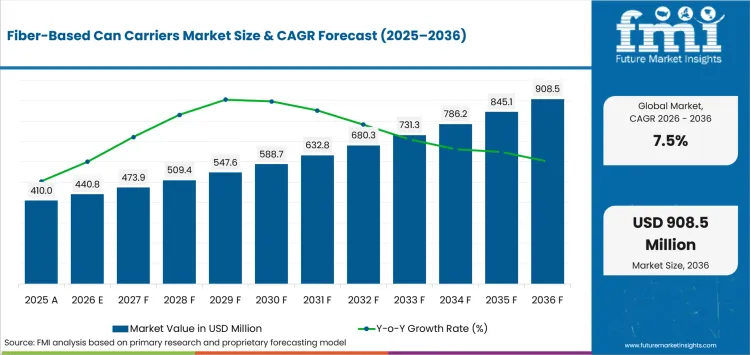
USD 440.8 million in 2026 and USD 908.5 million by 2036 at a 7.5% CAGR.
Sales of fiber-based can carriers are estimated to rise at 7.5% CAGR through 2036, increasing valuation from USD 440.8 million in 2026 to USD 908.5 million by 2036. Beverage producers can replace secondary plastic bundling with paperboard packaging without changing the metal can, which keeps qualification focused on the multipack system. CalRecycle added a compliance incentive in May 2026 by requiring producers to cut single-use plastic 25% under California's SB 54 rules. Covered packaging must become recyclable or compostable by 2032, making recovery and filling-line performance part of the same conversion decision.
The United Kingdom gives beverage brands a clearer material-cost signal than the United States because producer fees distinguish paper from plastic beverage packaging. PackUK published 2025 to 2026 base fees in June 2025 at GBP 196 per tonne for paper and card versus GBP 423 for plastic. United States beverage plants instead face state-specific recovery rules and capital cycles across production locations. Both routes require wet-strength and application-speed trials before a filling plant approves recurring carrier orders.
Key Takeaways of Fiber-Based Can Carriers Market
- Demand rises as beverage producers replace plastic bundling with fiber carriers that hold cans securely on existing filling lines.
- Based on product type, Clip - cluster carriers are projected to account for 34.0% in 2026 due to concentrated locking points that reduce board use without concealing can graphics.
- By material, recycled paperboard is estimated to hold 48.0% in 2026 owing to established converting routes that provide familiar cutting and printing performance.
- In 2026, 6-pack formats are expected to lead pack size with 42.0% share because their load profile balances portability with repeatable machine settings.
- Moisture exposure and line qualification delay conversion if fiber structures lose retention after refrigeration or cannot match required application speeds.
- Graphic Packaging International, LLC, Smurfit Westrock plc, Amcor plc, Mondi plc, International Paper Company, Stora Enso Oyj, PakCan and Atlantic Corporation of Wilmington, Inc. are some notable players.
Analyst Perspective
"Fiber can carriers should be screened first for retention after refrigeration at the intended can diameter and line speed. Beverage plants should then compare board choice with applicator settings and changeover support because qualification cost appears in downtime as well as material spend."
- Nandini Roy Choudhury, Principal Consultant, Future Market Insights
How is the Fiber-Based Can Carriers Market segmented?
Segmentation covers product type, material, pack size, application, end use, sales channel and region.
Product type includes Clip - cluster, wrap, basket and top / collar carriers. Material includes recycled paperboard, virgin kraft board, molded pulp and coated board. Pack size covers 6-pack, 8 to 12-pack, 4-pack and others. Application covers beer & cider, carbonated soft drinks, energy & RTD drinks and water & juices. End use covers alcoholic beverages, non-alcoholic beverages and others. Sales channel covers direct / brand OEM, packaging distributors, contract packers and others.
What supports demand for beer & cider within the application category?
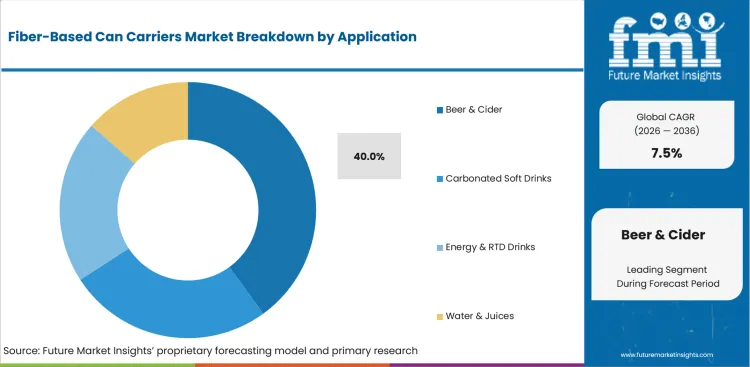
Beer and cider multipacks face frequent retail handling plus condensation across chilled distribution, so weak retention becomes visible during merchandising. The Brewers Association reported in March 2026 that aluminum cans represented 78% of packaged craft beer volume during 2025, establishing a large can base for secondary beer packaging formats.
- Beer & cider is projected to hold 40.0% share in 2026 owing to frequent multipack merchandising and demanding refrigerated distribution conditions.
- Fiber carriers compete in beer programs by preserving can graphics and pack integrity across refrigeration, retail handling and take-home transport without adding plastic rings to commercial multipacks.
What makes Clip - cluster carriers central to the product type category?
Clip - cluster carriers grip selected points around the can rim and leave primary graphics visible during retail display. Their compact geometry also fits automated drink cans handling on high-volume beverage lines.
- The product type category is forecast to be led by Clip - cluster carriers at 34.0% share in 2026 due to concentrated locking points that reduce board use.
- Carrier qualification must confirm clip stability during filling and refrigerated distribution at commercial line speed for repeated beverage-plant use. Graphic Packaging debuted paperboard multipack innovations at drinktec in September 2025, including clip-style modules designed to group loose cans or bottles on existing high-speed machinery.
How does recycled paperboard influence selection within the material category?
Recycled paperboard fits recyclable packaging programs that rely on familiar die-cutting and printing, but chilled handling makes grade consistency critical around locking points. Graphic Packaging opened its Waco recycled paperboard facility in November 2025, adding commercial consumer-packaging capacity that includes beverage applications.
- Recycled paperboard is set to lead the material category with 48.0% share in 2026 due to established supply and coated recycled paperboard converting routes.
- Packaging engineers qualify recycled grades against stiffness and tear behavior under condensation exposure as a condition for routine commercial can-carrier production and repeated retail handling on commercial beverage lines.
What role does the 6-pack play within the pack size category?
Six-packs occupy a practical midpoint between compact four-packs and heavier multi-can formats that need more board or reinforcement. Beverage teams can standardize carry weight and shelf dimensions across mainstream beer and soft-drink programs.
- By pack size, 6-pack formats are forecast to represent 42.0% in 2026 driven by a load profile that balances portability with predictable carrier geometry.
- PakCan introduced plant-fibre 4-pack and 6-pack can carriers in March 2025, giving smaller beverage producers a molded fiber packaging route for standard retail bundles. Its six-pack configuration supports trials without the board load required by heavier multi-can formats.
What are the drivers, restraints and opportunities in the Fiber-Based Can Carriers Market?
Producer-responsibility rules strengthen fiber substitution while wet-strength qualification slows conversion and broader application capacity expands addressable beverage programs.
- Driver: Producer-responsibility rules raise the compliance cost of disposable packaging and strengthen the case for fiber secondary formats that preserve existing cans.
- Restraint: Wet-strength treatments can complicate recyclability classification and delay approval if packaging engineers cannot document both retention performance and the recovery route.
- Opportunity: Wider board capacity and flexible application support can lower conversion barriers for regional beverage producers that cannot justify dedicated high-capital lines.
Producer-responsibility rules now give beverage brands a direct reason to remove plastic from secondary packaging. The European Commission reported in February 2025 that the Packaging and Packaging Waste Regulation had entered into force. Fiber can carriers address that requirement by changing the grouped pack without forcing a redesign of the metal can.
Wet-strength treatments can delay approval if they change the recyclability rating used to calculate producer fees. PackUK stated in June 2025 that recyclability assessments would determine fee modulation from the 2026 to 2027 financial year. Beverage packaging teams therefore need a carrier that holds cans under condensation and remains compatible with the documented recycling route.
Ready-to-drink packaging needs carrier board that stays rigid during cold distribution without adding unnecessary material to every pack. Billerud launched CrownBoard Carry and CrownBoard Light in September 2025 for demanding uses including beverage multipacks and moist conditions. More board choices matter commercially if packaging teams can qualify lighter structures without losing grip strength or print performance.
Which country CAGRs are profiled in the Fiber-Based Can Carriers Market?
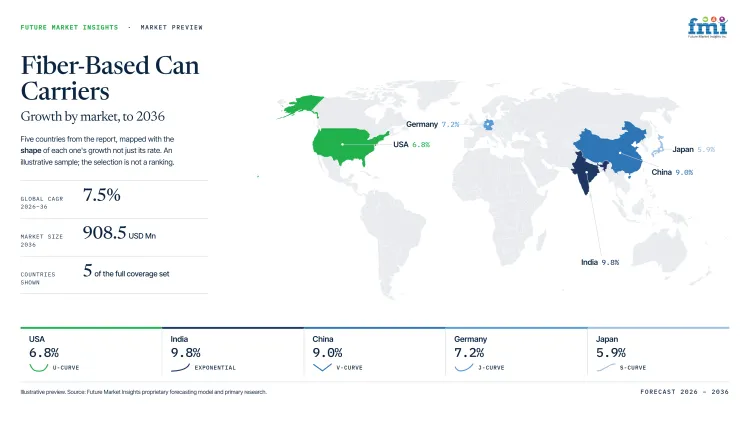
| Country | CAGR |
|---|---|
| United Kingdom | 8.0% |
| Germany | 7.2% |
| Brazil | 7.2% |
| United States | 6.8% |
| Japan | 5.9% |
How do country-level CAGRs compare in the Fiber-Based Can Carriers Market?
The 2.1-percentage-point spread forms a compact growth band without separating into groups. United Kingdom producer fees give fiber substitution a material-cost signal, while Germany and Brazil share the middle rate under different recovery conditions. United States and Japan advance more gradually as plant qualification and local collection systems govern conversion timing.
- United Kingdom producer fees reward recyclable secondary formats once plants complete technical qualification.
- Germany's recovery system raises documentation requirements for board composition and pack performance.
- Brazil pairs national reverse-logistics obligations with uneven converting depth and equipment-service coverage.
- United States state-level rules and plant capital cycles fragment national conversion timing.
- Japan's municipal sorting systems favor precise material classification and consistent chilled-pack performance.
Comparable CAGRs can still produce distinct qualification routes and market-entry requirements. The full report provides country-level CAGR analysis across North America, Latin America, Europe, East Asia, South Asia, Oceania and the Middle East and Africa.
Country-wise Analysis
- United Kingdom beverage brands work within a recovery system that gives fiber packs a documented outlet across national filling networks, and Defra reported a 74.3% paper-and-cardboard packaging recycling rate for 2024 in July 2025. The United Kingdom fiber-based can carriers outlook is anticipated to advance at 8.0% CAGR over the assessment period, supported by established paper recovery and producer fees that sharpen the cost case for plastic substitution. Coated carrier designs still need correct fee classification and chilled-retention trials, so packaging teams require clear material records plus dependable line performance before recurring orders begin across high-volume beverage programs at scale.
- German beverage plants use a mature collection system that demands precise recyclability claims and board composition records during carrier qualification on automated filling lines serving major national beverage brands across commercial filling networks nationwide. The German Environment Agency reported in January 2026 that roughly 5.5 million tonnes of dual-system packaging waste were recycled in 2024, confirming substantial recovery infrastructure for fiber formats across regulated collection streams. Adoption of fiber-based can carriers in Germany is estimated to expand at 7.2% CAGR through 2036, reinforced by recovery capacity despite moisture testing and documentation requirements that extend line approval for chilled multipack programs.
- Brazilian beverage producers work under a national plastic reverse-logistics system across beer and soft-drink production, while converting depth and equipment-service coverage remain uneven outside the largest beverage clusters across national production networks. Fiber-based can carrier demand in Brazil is forecast to rise at 7.2% CAGR over the forecast period, shaped by recovery obligations despite regional service gaps that can slow line trials and routine replenishment at scale. Brazil's Presidency enacted Decree 12,688 in October 2025 with a 32% national plastic-packaging recovery target for 2026 that raises pressure on plastic formats and the need for dependable local conversion and machine service.
- United States beverage plants qualify fiber can carriers against state recovery rules and line-specific handling requirements, which separates conversion timing across production sites with different collection systems and capital approval cycles. The American Forest & Paper Association reported in August 2025 that 60% to 64% of paper available for recovery was recycled in 2024, giving packaging programs an established domestic recovery base for commercial fiber formats. The United States fiber-based can carriers sector is projected to record 6.8% CAGR during the assessment period, supported by paper recovery while carrier manufacturers must prove local collection compatibility and plant performance for recurring orders.
- Japanese packaging programs operate within detailed municipal collection systems across premium canned-beverage retail, and those systems reward predictable material classification plus consistent pack performance during distribution across major urban markets. Japan is estimated to post 5.9% CAGR over the forecast period, influenced by established paper collection despite strict quality expectations and dispersed technical support that can lengthen approval for new carrier formats at commercial scale. Japan's Ministry of the Environment reported in March 2026 that municipalities collected 81,757 tonnes of paper containers and packaging in fiscal 2024 and documented an operating recovery route requiring sorting compatibility with local rules.
Who are the notable companies in the Fiber-Based Can Carriers Market?
Graphic Packaging International, LLC, Smurfit Westrock plc, Amcor plc, Mondi plc, International Paper Company, Stora Enso Oyj, PakCan, and Atlantic Corporation of Wilmington, Inc. are the notable companies serving this market.
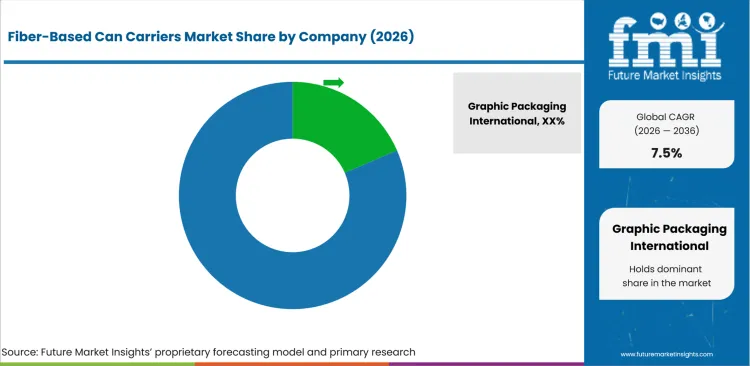
Dedicated can-carrier system developers compete with broader paperboard companies and regional packaging specialists. Integrated platforms pair grip geometry with applicator support, while board groups use molded fiber formats in smaller production runs. Entry remains difficult without chilled-distribution proof and technical support across can sizes and line settings.
- Graphic Packaging International, LLC and Smurfit Westrock plc pair can-carrier formats with application machinery for high-throughput beverage lines.
- Amcor plc, Mondi plc, International Paper Company and Stora Enso Oyj bring fiber converting or board capacity across regional packaging networks.
- PakCan and Atlantic Corporation of Wilmington, Inc. serve smaller beverage programs with flexible application support and lower order volumes.
Competitive Benchmarking: Fiber-Based Can Carriers Market
| Company | Can-Carrier Format Breadth | Application-System Integration | Qualification Evidence | Geographic Reach |
|---|---|---|---|---|
| Graphic Packaging International, LLC | High | High | High | Global |
| Smurfit Westrock plc | High | High | High | Global |
| Amcor plc | Medium | Medium | Medium | Global |
| Mondi plc | Medium | Low | Medium | Europe and international markets |
| International Paper Company | Medium | Low | Medium | North America and EMEA |
| Stora Enso Oyj | Medium | Low | High | Europe, North America and Asia |
| PakCan | Medium | Low | Medium | Australia |
| Atlantic Corporation of Wilmington, Inc. | High | High | High | North America |
Key Developments in the Fiber-Based Can Carriers Market
- In December 2025, Atlantic Corporation of Wilmington, Inc. reported Fishbone paperboard beverage carriers on North American retail shelves, confirming commercial availability beyond pilot use.
- In September 2025, Graphic Packaging International, LLC demonstrated EnviroClip can multipacks with AutoClip SC125 at PACK EXPO, pairing paperboard carriers with commercial application machinery.
- In March 2025, Stora Enso Oyj started production ramp-up at its Oulu consumer-board line, which targets beverage multi-packaging applications in Europe and North America.
Key Players in the Fiber-Based Can Carriers Market
Integrated Carrier and Application Platforms
- Graphic Packaging International, LLC
- Smurfit Westrock plc
Fiber Board and Converting Platforms
- Amcor plc
- Mondi plc
- International Paper Company
- Stora Enso Oyj"
Specialist Beverage Carrier Routes
- PakCan
- Atlantic Corporation of Wilmington, Inc.
Fiber-Based Can Carriers Market - Report Scope
| Coverage field | Report scope |
|---|---|
| Market breakdown | By product type, material, pack size, application, end use, sales channel and region. |
| Quantitative Units | Revenue in USD million and CAGR in %. |
| Market Definition | Fiber-based secondary carriers that group beverage cans for handling and retail sale using paperboard, molded fiber or other predominantly fiber-based structures. |
| Regions Covered | North America, Latin America, Europe, East Asia, South Asia and Pacific, and Middle East and Africa. |
| Countries Covered | United Kingdom, Germany, Brazil, United States, Japan, and 30+ countries included in the full report. |
| Key Companies Profiled | Graphic Packaging International, LLC, Smurfit Westrock plc, Amcor plc, Mondi plc, International Paper Company, Stora Enso Oyj, PakCan, Atlantic Corporation of Wilmington, Inc. |
| Forecast Period | 2026 to 2036. |
| Approach | Primary and secondary research with market triangulation. |
Fiber-Based Can Carriers Market - Research Methodology
| Method | Approach |
|---|---|
| Primary Research | FMI analysts gathered input from manufacturers, service providers, technology developers, distributors, end users, procurement teams, and subject-matter experts. Interviews examined purchasing decisions, product or service evaluation, adoption barriers, approval requirements, pricing considerations, and expectations for technical or commercial support. Respondents were also asked what evidence is required before a trial, pilot, or initial order develops into regular purchasing. |
| Desk Research | Desk research covered government statistics, regulatory publications, trade data, industry associations, technical literature, standards, company filings, product information, and official corporate announcements. Sources were reviewed for relevance, publication date, geographic coverage, and consistency with the defined market scope. Claims relating to performance, applications, approvals, capacity, investment, and commercial activity were retained only when supported by credible public evidence. |
| Market Sizing and Forecasting | The market model combined the baseline value with historical performance, segment structure, pricing and volume indicators, adoption levels, company participation, and country-level demand conditions. Forecast assumptions considered economic activity, investment trends, regulatory developments, technology adoption, purchasing cycles, supply availability, and barriers to wider market use. Segment and regional estimates were reconciled before the final market total was calculated. |
| Data Validation | Estimates were checked against multiple independent indicators, including public data, company activity, trade patterns, industry developments, and findings from primary interviews. Validation also tested whether products, services, applications, and company revenues fell within the defined market boundaries. Adjacent categories, unsupported claims, overlapping revenues, and activities without direct market relevance were excluded to reduce double counting and maintain consistency across segments and countries. |
Fiber-Based Can Carriers Market by Segments
Fiber-Based Can Carriers Market segmented by Product Type:
- Clip - cluster Carriers
- Wrap Carriers
- Basket Carriers
- Top / Collar Carriers
Fiber-Based Can Carriers Market segmented by Material:
- Recycled Paperboard
- Virgin Kraft Board
- Molded Pulp
- Coated Board
Fiber-Based Can Carriers Market segmented by Pack Size:
- 6-Pack
- 8 to 12-Pack
- 4-Pack
- Others
Fiber-Based Can Carriers Market segmented by Application:
- Beer & Cider
- Carbonated Soft Drinks
- Energy & RTD Drinks
- Water & Juices
Fiber-Based Can Carriers Market segmented by End Use:
- Alcoholic Beverages
- Non-Alcoholic Beverages
- Others
Fiber-Based Can Carriers Market segmented by Sales Channel:
- Direct / Brand OEM
- Packaging Distributors
- Contract Packers
- Others
Fiber-Based Can Carriers Market by Region:
- North America
- United States
- Canada
- Latin America
- Brazil
- Mexico
- Chile
- Rest of Latin America
- Western Europe
- Germany
- United Kingdom
- Italy
- Spain
- France
- Nordics
- Benelux
- Rest of Western Europe
- Eastern Europe
- Russia
- Poland
- Hungary
- Balkan and Baltic States
- Rest of Eastern Europe
- East Asia
- China
- Japan
- South Korea
- South Asia and Pacific
- India
- ASEAN
- Australia and New Zealand
- Rest of South Asia and Pacific
- Middle East and Africa
- Kingdom of Saudi Arabia
- Other GCC Countries
- Türkiye
- South Africa
- Other African Union Countries
- Rest of Middle East and Africa
Research Sources and Bibliography
- California Department of Resources Recycling and Recovery. (2026, May 1). California approves new plastic and packaging rules that put consumers first.
- PackUK. (2025, June 27). Extended Producer Responsibility for Packaging: 2025 base fees.
- Graphic Packaging International. (2025, September 10). Graphic Packaging Debuts Duo of Beverage Multipack Innovations at drinktec 2025.
- Graphic Packaging International. (2025, November 5). Graphic Packaging Launches Advanced Recycled Paperboard Facility in Waco, Texas.
- PakCan. (2025, March 24). Biodegradable can multi-pack!
- Gacioch, M. (2026, March 5). Value Quest: 2025 Packaging Trends.
- European Commission, Directorate-General for Environment. (2025, February 11). New rules enter into force for a more sustainable and competitive packaging economy.
- PackUK. (2025, June 28). PackUK extended producer responsibility (EPR) for packaging: producer disposal fees modulation statement.
- Billerud. (2025, September 8). Billerud launches recyclable cartonboards built for strength and moisture resistance.
- Department for Environment, Food & Rural Affairs. (2025, July 23). UK statistics on waste.
- German Environment Agency and Central Agency Packaging Register. (2026, January 27). Facts against myths: Packaging waste recycling in Germany is working.
- Presidency of the Republic of Brazil. (2025, October 21). DECRETO Nº 12.688, DE 21 DE OUTUBRO DE 2025.
- American Forest & Paper Association. (2025, August 12). Paper Industry Announces 2024 USA Paper Recycling Rates.
- Ministry of the Environment, Government of Japan. (2026, March 31).
- Atlantic Packaging. (2025, December 31). Atlantic 2025 Year in Review.
- Graphic Packaging International. (2025, September 29). Driving Innovation For Growth: Discover Paperboard Innovation at PACK EXPO 2025.
- Mondi plc. (2025, November 18). Mondi launches extended corrugated and solid board portfolio for the food packaging industry.
- Stora Enso Oyj. (2025, March 19). Stora Enso's new consumer board line at the Oulu site in Finland has started operations.
- Smurfit Westrock. (2026, July 7). Smurfit Westrock partners with Coca-Cola on World Cup packaging to capture spike in consumer demand.
- Krones AG. (2025, October 14). LitePac Top: a smarter way to package sustainably.
- Metsä Board. (2025, September 29). V6‑engine six‑pack: Olutmylly’s tasting pack co‑created with Metsä Board.
- Graphic Packaging Holding Company. (2026, March 2). Annual report [Section 13 and 15(d), not S-K Item 405].
- Billerud. (2025, January 22). Escanaba Mill and Wisconsin Rapids Converting Facility achieve ISO 9001 certification.
- Metsä Board. (2026, June 4). Food-safe paperboard packaging starts at the mill.
- Billerud. (2026, April 1). Billerud publishes annual report 2025.
- Krones AG. (2026, May 12). The right customer solution through partnerships.
- Stora Enso Oyj. (2026, June 1). Stora Enso's Beihai Mill marks 10 years of operations in China.
- R.A Jones. (2025, July 18). The Proven Power of R.A Jones Multipacking Solutions.
This bibliography is provided for reader reference and is not exhaustive. The full report contains the complete reference list and detailed citations
This Report Answers
- How large is the fiber-based can carriers market in 2026?
- Which operating conditions support conversion from plastic components to fiber carriers?
- Why do Clip - cluster carriers lead product type in 2026?
- How does recycled paperboard affect carrier qualification and material-recovery economics?
- Why does the 6-pack remain the leading pack-size configuration?
- How do profiled country growth rates reflect different conversion conditions?
- Which commercial factors constrain line approval and refrigerated distribution performance?
- How do active companies differ in carrier formats and application support?
Frequently Asked Questions
How big is the Fiber-Based Can Carriers Market in 2026?
The fiber-based can carriers market is expected to be valued at USD 440.8 million in 2026 and reach USD 908.5 million by 2036. Growth is supported by plastic-substitution programs that preserve the metal can while changing secondary multipack packaging.
What is the CAGR of the Fiber-Based Can Carriers Market from 2026 to 2036?
The fiber-based can carriers market is projected to grow at a 7.5% CAGR between 2026 and 2036. Expansion depends on fiber carriers passing moisture and line-speed qualification as beverage producers decide whether to approve recurring use.
Which product type is projected to account for 34.0% of the Fiber-Based Can Carriers Market?
The fiber-based can carriers market is projected to record a 34.0% share for Clip - cluster carriers by product type in 2026. Their position reflects low-material locking structures that retain cans while preserving primary-pack visibility during retail handling.
Which material segment holds a 48.0% share of the Fiber-Based Can Carriers Market in 2026?
The fiber-based can carriers market is estimated to record a 48.0% material share for recycled paperboard in 2026. Its position reflects established board-converting routes that can meet cutting and recovery requirements following mechanical qualification.
Which companies are active in the Fiber-Based Can Carriers Market?
The fiber-based can carriers market includes Graphic Packaging International, LLC, Smurfit Westrock plc, Amcor plc, Mondi plc, International Paper Company, Stora Enso Oyj, PakCan and Atlantic Corporation of Wilmington, Inc. Their roles cover can-carrier design, board conversion and application support across commercial beverage filling lines.
Preview the report firsthand - request a free sample
Get SampleGet the brochure for pricing and purchase details.
Get PDFTable of Content
- Key Takeaways
- Market Size and CAGR
- Top Growth Driver
- Fastest Growing Segment
- Leading Region
- Key Companies
- Emerging Opportunities
- Executive Summary
- Global Market Outlook
- Demand-side Trends
- Supply-side Trends
- Technology Roadmap Analysis
- Analysis and Recommendations
- Analyst Perspective (What is happening? Why now? What should investors know?)
- Key Questions Answered
- How large is the market?
- What is the CAGR?
- What are key trends?
- Which region dominates?
- Who are the leaders?
- Market Overview
- Market Coverage / Taxonomy
- Market Definition / Scope / Limitations
- Research Methodology
- Chapter Orientation
- Analytical Lens and Working Hypotheses
- Market Structure, Signals, and Trend Drivers
- Benchmarking and Cross-market Comparability
- Market Sizing, Forecasting, and Opportunity Mapping
- Research Design and Evidence Framework
- Desk Research Programme (Secondary Evidence)
- Expert Input and Fieldwork (Primary Evidence)
- Tooling, Models, and Reference Databases
- Data Engineering and Model Build
- Quality Assurance and Audit Trail
- Market Background
- Market Dynamics (Drivers, Restraints, Opportunity, Trends)
- Scenario Forecast (Optimistic, Likely, Conservative)
- Impact Analysis
- AI Impact
- Sustainability Impact
- Regulatory Impact
- Technology Impact
- Consumer / Buyer Analysis
- Purchase Drivers
- Adoption Barriers
- Buyer Journey
- Opportunity Map Analysis
- Product Life Cycle Analysis
- Supply Chain Analysis
- Investment Feasibility Matrix
- Value Chain Analysis
- PESTLE and Porter's Analysis
- Regulatory Landscape
- Regional Parent Market Outlook
- Production and Consumption Statistics
- Import and Export Statistics
- Global Market Analysis and Forecast, 2021 to 2036
- Historical Market Size Value (USD Million) Analysis, 2021 to 2025
- Current and Future Market Size Value (USD Million) Projections, 2026 to 2036
- Y-o-Y Growth Trend Analysis
- Absolute $ Opportunity Analysis
- Global Market Pricing Analysis, 2021 to 2036
- Global Market Analysis and Forecast, By Product Type, 2021 to 2036
- Introduction / Key Findings
- Historical Market Size Value (USD Million) Analysis By Product Type, 2021 to 2025
- Current and Future Market Size Value (USD Million) Analysis and Forecast By Product Type, 2026 to 2036
- Clip / Cluster Carriers
- Wrap Carriers
- Basket Carriers
- Top / Collar Carriers
- Clip / Cluster Carriers
- Y-o-Y Growth Trend Analysis By Product Type, 2021 to 2025
- Absolute $ Opportunity Analysis By Product Type, 2026 to 2036
- Global Market Analysis and Forecast, By Material, 2021 to 2036
- Introduction / Key Findings
- Historical Market Size Value (USD Million) Analysis By Material, 2021 to 2025
- Current and Future Market Size Value (USD Million) Analysis and Forecast By Material, 2026 to 2036
- Recycled Paperboard
- Virgin Kraft Board
- Molded Pulp
- Coated Board
- Recycled Paperboard
- Y-o-Y Growth Trend Analysis By Material, 2021 to 2025
- Absolute $ Opportunity Analysis By Material, 2026 to 2036
- Global Market Analysis and Forecast, By Pack Size, 2021 to 2036
- Introduction / Key Findings
- Historical Market Size Value (USD Million) Analysis By Pack Size, 2021 to 2025
- Current and Future Market Size Value (USD Million) Analysis and Forecast By Pack Size, 2026 to 2036
- 6-Pack
- 8 to 12-Pack
- 4-Pack
- Others
- 6-Pack
- Y-o-Y Growth Trend Analysis By Pack Size, 2021 to 2025
- Absolute $ Opportunity Analysis By Pack Size, 2026 to 2036
- Global Market Analysis and Forecast, By Application, 2021 to 2036
- Introduction / Key Findings
- Historical Market Size Value (USD Million) Analysis By Application, 2021 to 2025
- Current and Future Market Size Value (USD Million) Analysis and Forecast By Application, 2026 to 2036
- Beer & Cider
- Carbonated Soft Drinks
- Energy & RTD Drinks
- Water & Juices
- Beer & Cider
- Y-o-Y Growth Trend Analysis By Application, 2021 to 2025
- Absolute $ Opportunity Analysis By Application, 2026 to 2036
- Global Market Analysis and Forecast, By End Use, 2021 to 2036
- Introduction / Key Findings
- Historical Market Size Value (USD Million) Analysis By End Use, 2021 to 2025
- Current and Future Market Size Value (USD Million) Analysis and Forecast By End Use, 2026 to 2036
- Alcoholic Beverages
- Non-Alcoholic Beverages
- Others
- Alcoholic Beverages
- Y-o-Y Growth Trend Analysis By End Use, 2021 to 2025
- Absolute $ Opportunity Analysis By End Use, 2026 to 2036
- Global Market Analysis and Forecast, By Sales Channel
- Introduction / Key Findings
- Historical Market Size Value (USD Million) Analysis By Sales Channel, 2021 to 2025
- Current and Future Market Size Value (USD Million) Analysis and Forecast By Sales Channel, 2026 to 2036
- Direct / Brand OEM
- Packaging Distributors
- Contract Packers
- Others
- Direct / Brand OEM
- Y-o-Y Growth Trend Analysis By Sales Channel, 2021 to 2025
- Absolute $ Opportunity Analysis By Sales Channel, 2026 to 2036
- Global Market Analysis and Forecast, By Region, 2021 to 2036
- Introduction
- Historical Market Size Value (USD Million) Analysis By Region, 2021 to 2025
- Current Market Size Value (USD Million) Analysis and Forecast By Region, 2026 to 2036
- North America
- Latin America
- Western Europe
- Eastern Europe
- East Asia
- South Asia and Pacific
- Middle East & Africa
- Market Attractiveness Analysis By Region
- North America Market Analysis and Forecast, By Country, 2021 to 2036
- Historical Market Size Value (USD Million) Trend Analysis By Market Taxonomy, 2021 to 2025
- Market Size Value (USD Million) Forecast By Market Taxonomy, 2026 to 2036
- By Country
- USA
- Canada
- By Product Type
- By Material
- By Pack Size
- By Application
- By End Use
- By Sales Channel
- By Country
- Market Attractiveness Analysis
- By Country
- By Product Type
- By Material
- By Pack Size
- By Application
- By End Use
- By Sales Channel
- Key Takeaways
- Latin America Market Analysis and Forecast, By Country
- Historical Market Size Value (USD Million) Trend Analysis By Market Taxonomy, 2021 to 2025
- Market Size Value (USD Million) Forecast By Market Taxonomy, 2026 to 2036
- By Country
- Brazil
- Mexico
- Chile
- Rest of Latin America
- By Product Type
- By Material
- By Pack Size
- By Application
- By End Use
- By Sales Channel
- By Country
- Market Attractiveness Analysis
- By Country
- By Product Type
- By Material
- By Pack Size
- By Application
- By End Use
- By Sales Channel
- Key Takeaways
- Western Europe Market Analysis and Forecast, By Country
- Historical Market Size Value (USD Million) Trend Analysis By Market Taxonomy, 2021 to 2025
- Market Size Value (USD Million) Forecast By Market Taxonomy, 2026 to 2036
- By Country
- Germany
- UK
- Italy
- Spain
- France
- Nordic
- BENELUX
- Rest of Western Europe
- By Product Type
- By Material
- By Pack Size
- By Application
- By End Use
- By Sales Channel
- By Country
- Market Attractiveness Analysis
- By Country
- By Product Type
- By Material
- By Pack Size
- By Application
- By End Use
- By Sales Channel
- Key Takeaways
- Eastern Europe Market Analysis and Forecast, By Country
- Historical Market Size Value (USD Million) Trend Analysis By Market Taxonomy, 2021 to 2025
- Market Size Value (USD Million) Forecast By Market Taxonomy, 2026 to 2036
- By Country
- Russia
- Poland
- Hungary
- Balkan & Baltic
- Rest of Eastern Europe
- By Product Type
- By Material
- By Pack Size
- By Application
- By End Use
- By Sales Channel
- By Country
- Market Attractiveness Analysis
- By Country
- By Product Type
- By Material
- By Pack Size
- By Application
- By End Use
- By Sales Channel
- Key Takeaways
- East Asia Market Analysis and Forecast, By Country
- Historical Market Size Value (USD Million) Trend Analysis By Market Taxonomy, 2021 to 2025
- Market Size Value (USD Million) Forecast By Market Taxonomy, 2026 to 2036
- By Country
- China
- Japan
- South Korea
- By Product Type
- By Material
- By Pack Size
- By Application
- By End Use
- By Sales Channel
- By Country
- Market Attractiveness Analysis
- By Country
- By Product Type
- By Material
- By Pack Size
- By Application
- By End Use
- By Sales Channel
- Key Takeaways
- South Asia and Pacific Market Analysis and Forecast, By Country
- Historical Market Size Value (USD Million) Trend Analysis By Market Taxonomy, 2021 to 2025
- Market Size Value (USD Million) Forecast By Market Taxonomy, 2026 to 2036
- By Country
- India
- ASEAN
- Australia & New Zealand
- Rest of South Asia and Pacific
- By Product Type
- By Material
- By Pack Size
- By Application
- By End Use
- By Sales Channel
- By Country
- Market Attractiveness Analysis
- By Country
- By Product Type
- By Material
- By Pack Size
- By Application
- By End Use
- By Sales Channel
- Key Takeaways
- Middle East & Africa Market Analysis and Forecast, By Country
- Historical Market Size Value (USD Million) Trend Analysis By Market Taxonomy, 2021 to 2025
- Market Size Value (USD Million) Forecast By Market Taxonomy, 2026 to 2036
- By Country
- Kingdom of Saudi Arabia
- Other GCC Countries
- Türkiye
- South Africa
- Other African Union
- Rest of Middle East & Africa
- By Product Type
- By Material
- By Pack Size
- By Application
- By End Use
- By Sales Channel
- By Country
- Market Attractiveness Analysis
- By Country
- By Product Type
- By Material
- By Pack Size
- By Application
- By End Use
- By Sales Channel
- Key Takeaways
- Key Countries Market Analysis
- USA
- Pricing Analysis
- Market Share Analysis, 2025
- By Product Type
- By Material
- By Pack Size
- By Application
- By End Use
- By Sales Channel
- Canada
- Pricing Analysis
- Market Share Analysis, 2025
- By Product Type
- By Material
- By Pack Size
- By Application
- By End Use
- By Sales Channel
- Mexico
- Pricing Analysis
- Market Share Analysis, 2025
- By Product Type
- By Material
- By Pack Size
- By Application
- By End Use
- By Sales Channel
- Brazil
- Pricing Analysis
- Market Share Analysis, 2025
- By Product Type
- By Material
- By Pack Size
- By Application
- By End Use
- By Sales Channel
- Chile
- Pricing Analysis
- Market Share Analysis, 2025
- By Product Type
- By Material
- By Pack Size
- By Application
- By End Use
- By Sales Channel
- Germany
- Pricing Analysis
- Market Share Analysis, 2025
- By Product Type
- By Material
- By Pack Size
- By Application
- By End Use
- By Sales Channel
- UK
- Pricing Analysis
- Market Share Analysis, 2025
- By Product Type
- By Material
- By Pack Size
- By Application
- By End Use
- By Sales Channel
- Italy
- Pricing Analysis
- Market Share Analysis, 2025
- By Product Type
- By Material
- By Pack Size
- By Application
- By End Use
- By Sales Channel
- Spain
- Pricing Analysis
- Market Share Analysis, 2025
- By Product Type
- By Material
- By Pack Size
- By Application
- By End Use
- By Sales Channel
- France
- Pricing Analysis
- Market Share Analysis, 2025
- By Product Type
- By Material
- By Pack Size
- By Application
- By End Use
- By Sales Channel
- India
- Pricing Analysis
- Market Share Analysis, 2025
- By Product Type
- By Material
- By Pack Size
- By Application
- By End Use
- By Sales Channel
- ASEAN
- Pricing Analysis
- Market Share Analysis, 2025
- By Product Type
- By Material
- By Pack Size
- By Application
- By End Use
- By Sales Channel
- Australia & New Zealand
- Pricing Analysis
- Market Share Analysis, 2025
- By Product Type
- By Material
- By Pack Size
- By Application
- By End Use
- By Sales Channel
- China
- Pricing Analysis
- Market Share Analysis, 2025
- By Product Type
- By Material
- By Pack Size
- By Application
- By End Use
- By Sales Channel
- Japan
- Pricing Analysis
- Market Share Analysis, 2025
- By Product Type
- By Material
- By Pack Size
- By Application
- By End Use
- By Sales Channel
- South Korea
- Pricing Analysis
- Market Share Analysis, 2025
- By Product Type
- By Material
- By Pack Size
- By Application
- By End Use
- By Sales Channel
- Russia
- Pricing Analysis
- Market Share Analysis, 2025
- By Product Type
- By Material
- By Pack Size
- By Application
- By End Use
- By Sales Channel
- Poland
- Pricing Analysis
- Market Share Analysis, 2025
- By Product Type
- By Material
- By Pack Size
- By Application
- By End Use
- By Sales Channel
- Hungary
- Pricing Analysis
- Market Share Analysis, 2025
- By Product Type
- By Material
- By Pack Size
- By Application
- By End Use
- By Sales Channel
- Kingdom of Saudi Arabia
- Pricing Analysis
- Market Share Analysis, 2025
- By Product Type
- By Material
- By Pack Size
- By Application
- By End Use
- By Sales Channel
- Türkiye
- Pricing Analysis
- Market Share Analysis, 2025
- By Product Type
- By Material
- By Pack Size
- By Application
- By End Use
- By Sales Channel
- South Africa
- Pricing Analysis
- Market Share Analysis, 2025
- By Product Type
- By Material
- By Pack Size
- By Application
- By End Use
- By Sales Channel
- USA
- Market Structure Analysis
- Competition Dashboard
- Competition Benchmarking
- Market Share Analysis of Top Players
- By Regional
- By Product Type
- By Material
- By Pack Size
- By Application
- By End Use
- By Sales Channel
- Emerging Startups
- Innovation Benchmarking
- Competition Analysis
- Competition Deep Dive
- Graphic Packaging International
- Overview
- Product Portfolio
- Profitability by Market Segments
- Sales Footprint
- Strategy Overview
- Marketing Strategy
- Product Strategy
- Channel Strategy
- Smurfit WestRock
- Mondi Group
- DS Smith
- International Paper
- Sonoco
- Amcor
- Nampak
- Fishbone Packaging
- Stora Enso
- Graphic Packaging International
- Case Studies
- Success Stories
- Recent Developments
- Competition Deep Dive
- Assumptions & Acronyms Used


