

- Market Size (2026)
- USD 301.5 Mn
- Forecast (2036)
- USD 529.8 Mn
- CAGR (2026 to 2036)
- 5.8%
How big is Fiber-Based Bottle Dividers Market in 2026?
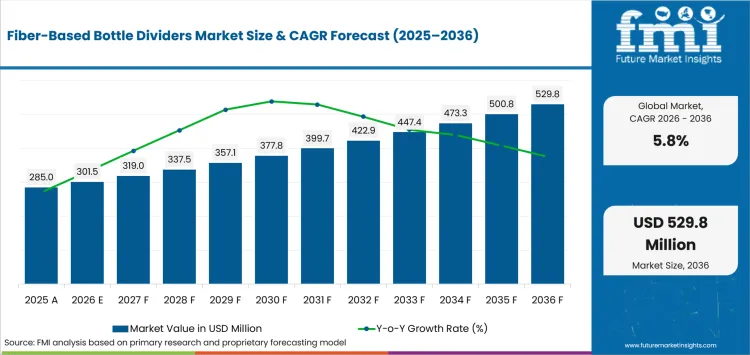
USD 301.5 million in 2026 and USD 529.8 million by 2036 at a 5.8% CAGR.
Demand for fiber-based bottle dividers is projected to expand at a 5.8% CAGR between 2026 and 2036, increasing market valuation from USD 301.5 million in 2026 to USD 529.8 million by 2036. Packaging economics are influenced by recyclability requirements and producer-responsibility obligations. PackUK confirmed in June 2025 that recyclability-based fee modulation would apply from 2026 to 2027, bringing material selection directly into recurring packaging-cost calculations. The change encourages beverage producers to evaluate fiber-based divider formats alongside alternative protective materials when reviewing packaging specifications and compliance costs.
Market adoption depends on fee structures and recovery systems that support recyclable packaging after use. The United Kingdom is forecast to grow faster than Japan because recyclability considerations are becoming more visible within packaging procurement decisions. Defra reported in April 2026 that material recovery facilities handled 543,000 tonnes of paper and card packaging for EPR cost calculations. The scale of paper recovery activity provides a clearer route for fiber-based packaging materials within beverage supply chains. Commercial adoption nevertheless continues to depend on pack qualification and compatibility with existing bottling and distribution operations.
Key Takeaways of Fiber-Based Bottle Dividers Market
- Demand rises as beverage packers seek fiber separators that protect glass bottles without slowing packing lines.
- Based on product type, Grid - cell partitions are projected to account for 48.0% in 2026 due to reliable bottle spacing.
- By material, recycled chipboard is estimated to hold 44.0% in 2026 owing to dependable slot formation.
- In 2026, 12-cell formats are expected to lead cell count with 40.0% share because they balance density and case weight.
- Moisture exposure and line qualification slow substitution as fiber stiffness and slot geometry must remain stable.
- Key companies include Smurfit Westrock, Graphic Packaging International, Sonoco, Mondi Group, International Paper, Huhtamaki, Packaging Corporation of America and VPK Group.
Analyst Perspective
"Fiber-based bottle divider repeat business depends on cell geometry that protects decorated glass without disrupting case-packing equipment. The decisive test is stable board caliper and slot geometry under humidity, distribution loads and repeated case-packing trials."
- Nandini Roy Choudhury, Principal Consultant, Future Market Insights
How is the Fiber-Based Bottle Dividers Market segmented?
product type, material, cell count, application, end use, sales channel and region.
Product type includes Grid - cell partitions, molded pulp dividers, layer pad dividers and custom inserts. Material includes recycled chipboard, corrugated fiberboard, molded pulp and solid fiberboard. Cell count includes 12-cell, 6-cell, 24-cell and custom. Application covers glass bottle separation, wine and spirits, beer and cider and other beverages. End use includes alcoholic beverages, non-alcoholic beverages, food and sauces and cosmetics and personal care. Sales channel includes direct / OEM, packaging distributors, online and others.
What supports glass bottle separation in the application category?
Cascades said in February 2026 that its Saint-Césaire plant made beverage cardboard partitions, with closure scheduled by April 17 following sustained demand decline. Glass separation remains central to glass packaging as filled bottles can strike each other inside shipping cases.
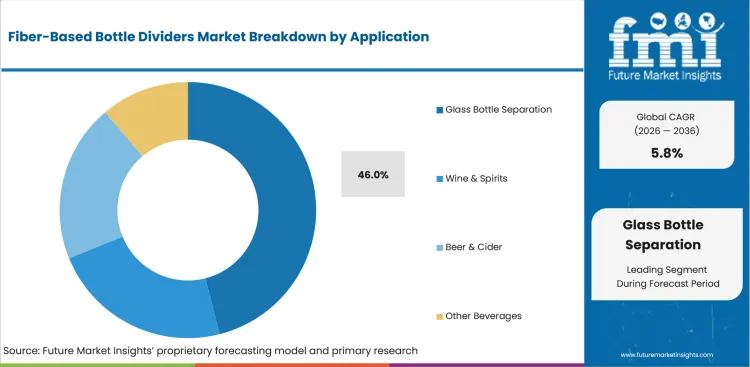
- The application category is forecast to be led by glass bottle separation at 46.0% share in 2026 due to fragile-container protection requirements.
- Wine and spirits packers need divider cells that protect decorated surfaces without complicating case erection. Released geometry must balance bottle diameter with compression so wine packaging programs do not trade protection for slower packing.
What makes Grid - cell partitions central to the product type category?
Grid - cell partitions form repeatable bottle pockets that limit container contact without requiring a molded cavity. Sonoco combined its North American paper and converted-paper operations in January 2025, bringing partitions under the same business as recycled-board production.
- Based on product type, Grid - cell partitions are projected to account for 48.0% in 2026 due to repeatable spacing that limits bottle contact.
- Bottling plants use flat-shipped grids so technicians can verify slot accuracy ahead of automated case packing. Stable board caliper helps protective packaging programs repeat geometry across bottle runs without changing the outer case.
Why does recycled chipboard lead the material category?
Recycled chipboard converts into interlocking grids with repeatable slot geometry for recurring beverage cases that need consistent cell dimensions. Established paperboard packaging recovery routes keep the material compatible with fiber-based secondary packs used in repeat distribution.
- By material, recycled chipboard is estimated to hold 44.0% in 2026 owing to controlled caliper that keeps partition cuts consistent.
- Humidity and compression determine whether a qualified board grade retains stiffness during storage and distribution. Sonoco raised converted-paperboard product prices by at least 8% in March 2025, including partitions that use the same qualified fiber base.
Why does direct / OEM lead the sales channel category?
Direct / OEM sourcing lets packaging engineers set cell dimensions against bottle geometry and case equipment ahead of production release. Corrugated board packaging programs use this route to keep prototype trials and repeat conversion under one technical contact.
- Direct / OEM is set to lead the sales channel with 46.0% share in 2026 due to bottle-specific design support and repeatable supply.
- VPK documented beer-packaging reviews in September 2025 that assessed format consistency, packing-line compatibility and chilled distribution. Divider programs face the same conditions, so bottle spacing must survive both the packing line and the route to market.
What are the drivers, restraints and opportunities in the Fiber-Based Bottle Dividers Market?
Packaging-waste rules increase pressure to reduce excess material, while board costs and line qualification slow substitution and integrated case-divider design provides a practical route to right-sizing.
- Driver: Beverage brands need lower-material separators that preserve bottle protection as recyclability rules increase scrutiny of avoidable secondary packaging.
- Restraint: Recycled-board price changes and qualification work raise switching costs for bottling plants using high-speed case-packing equipment.
- Opportunity: Integrated corrugated manufacturers can right-size divider geometry and outer cases together to reduce material without weakening distribution performance.
Packaging-Waste Rules Reward Material-Efficient Separation
Beverage brands need protective designs that reduce unused case volume without raising commercial bottle-breakage risk. Regulation (EU) 2025/40 published in January 2025 sets a 50% maximum empty-space ratio for grouped and transport packaging under Article 24. Fiber dividers concentrate material at bottle-contact points, but each finished pack still needs line and transport qualification.
Board Costs and Qualification Raise Switching Friction
Partition economics remain commercially sensitive to recycled-board cost once a replacement pack passes technical trials. Beverage plants compare material savings with transport-testing expense and line downtime during changes to established divider specifications. Sonoco increased prices for converted paperboard products including partitions by 7% in June 2026 as input costs rose.
Integrated Fiber Design Supports Right-Sizing
Wine-bottle inserts must accommodate different bottle sizes without weakening protection across ecommerce handling and distribution routes. Smurfit Westrock documented Club Cava Palacio’s recyclable corrugated pack in May 2026, using adaptive inserts for different bottle sizes and replacing shrink wrap or plastic air pillows. Repeat commercial release still depends on case and distribution qualification for each bottle configuration and case size.
Which country CAGRs are profiled in the Fiber-Based Bottle Dividers Market?
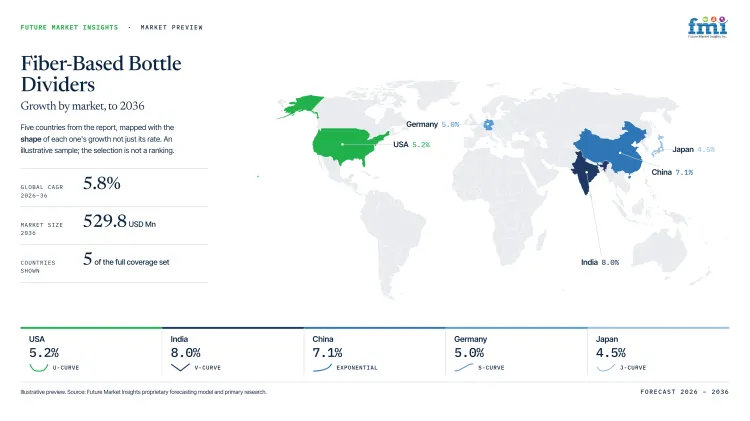
| Country | CAGR |
|---|---|
| Brazil | 6.1% |
| UK | 5.4% |
| USA | 5.2% |
| Germany | 5.0% |
| Japan | 4.5% |
How do country-level CAGRs compare in the Fiber-Based Bottle Dividers Market?
The 1.6-percentage-point spread from Brazil at 6.1% to Japan at 4.5% forms a band across five profiled markets. The UK, USA and Germany cluster near 5% yet follow qualification routes shaped by local fiber access. Brazil faces packaging rules, while Japan places more weight on dimensions during conservative format changes.
- Brazilian alcoholic drinks packaging faces humid routes that reward moisture-aware fiber separation.
- UK producer fees place packaging data inside annual material-selection and redesign decisions.
- USA programs depend on regional converting capacity and differing state recycling requirements.
- Germany combines mature recovery infrastructure with strict qualification across automated bottle-packing lines.
- Japan emphasizes dimensional consistency during changes to proven pack formats inside recovery systems.
Comparable CAGRs produce materially different commercial conditions as installed beverage capacity and pack formats vary. The full report provides country-level CAGR analysis across North America, Latin America, Europe, East Asia, South Asia, Oceania and the Middle East and Africa.
Country-wise Analysis
- Brazilian beverage distribution depends on dependable domestic fiber because long inland routes expose bottle cases to repeated handling and humid storage amid January 2025 Law 15.088 restrictions on solid-waste imports including paper derivatives. Fiber-based bottle divider demand in Brazil is forecast to rise at 6.1% CAGR over the forecast period, supported by local conversion capacity despite moisture-control and recovered-board consistency requirements that affect release timing. Regional partition plants that hold board grade and slot geometry across production runs can shorten qualification for recurring bottle programs, but variable recovered-fiber properties can extend transport testing until a national specification reaches repeat commercial orders across inland distribution routes.
- UK beverage packaging teams now connect material choice with producer reporting and disposal-fee exposure across centralized retail distribution, so fiber dividers with clear material declarations enter recurring national bottle programs with transparent cost data. By 2036, the UK is projected to grow at 5.4% CAGR, owing to stronger cost visibility despite moisture resistance and transport qualification requirements for established high-volume bottle packs. PackUK confirmed in September 2025 that obligated producers would receive first EPR invoices in October, placing packaging data inside annual cost reviews and making documented material choices more relevant during divider redesign, budget approval and final commercial qualification.
- USA beverage programs can source trials from large regional corrugated networks near major bottling centers, and Oregon became the first state to implement packaging and paper extended producer responsibility on July 1 2025. Adoption of fiber-based bottle dividers in the USA is estimated to expand at 5.2% CAGR through 2036, supported by regional conversion capacity despite state compliance differences that complicate national beverage specifications. Nearby plants can shorten prototype and repeat-run lead times for bottle programs across large distribution territories, but multistate brands must keep packaging records and divider specifications workable across different state regulatory and operating requirements at scale.
- German bottle packers operate inside a mature material-recovery system with dense regional collection infrastructure, and the German Environment Agency reported in May 2026 that 69.4% of packaging waste was recycled in 2023. Germany is estimated to post 5.0% CAGR over the forecast period, supported by established recovery infrastructure although packaging engineers require validated case performance to release lighter partitions. Documented recycled fiber can fit existing material routes and nearby conversion networks for repeat national beverage cases, but slot geometry and compression performance must remain stable on proven packing equipment for bottling plants to accept a new divider specification at scale.
- Japanese beverage packaging programs emphasize dimensional consistency and orderly municipal recovery, favoring precisely converted fiber separators that preserve bottle spacing across compact cases and controlled domestic retail distribution routines and operations. Fiber-based bottle divider sales in Japan are forecast to expand at 4.5% CAGR by 2036, influenced by established glass recovery despite conservative qualification for changes to proven slot dimensions and caliper settings. Japan’s Environment Ministry reported in March 2026 that municipalities collected 226,179 tonnes of clear glass containers during fiscal 2024, defining a large recovery stream that divider designs must enter without disrupting established regional packing and handling routines.
Who are the notable companies in the Fiber-Based Bottle Dividers Market?
Smurfit Westrock, Graphic Packaging International, Sonoco, Mondi Group, International Paper, Huhtamaki, Packaging Corporation of America and VPK Group are the notable companies evaluated across fiber-conversion and protective-packaging routes.
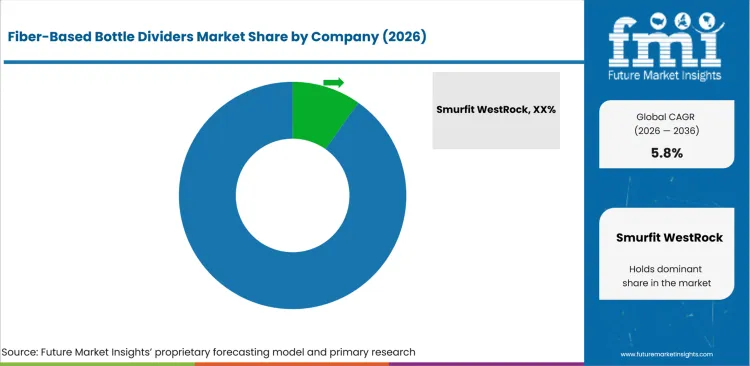
Competition in fiber-based bottle dividers remains fragmented among integrated corrugated groups, converted-paperboard specialists and molded-fiber manufacturers. Standard board supply alone does not meet automated line tolerances, so entry depends on bottle-specific geometry plus regional conversion. Molded fiber packaging adds formed-protection options for bottle shapes that can justify dedicated tooling and new pack qualification. Wet-molded fibre provides another route for applications that need precise cavities and repeatable protection during case handling.
- Smurfit Westrock, Mondi Group, International Paper, Packaging Corporation of America and VPK Group combine corrugated conversion with regional manufacturing networks for custom protective formats.
- Graphic Packaging International and Sonoco add paperboard conversion depth for beverage programs that require controlled material specifications and repeatable manufacturing support.
- Huhtamaki adds molded-fiber manufacturing for formed bottle protection in programs that justify dedicated tooling and qualification work.
Competitive Benchmarking: Fiber-Based Bottle Dividers Market
| Company | Protective Format Breadth | Fiber Conversion Control | Customer Development Depth | Geographic Reach |
|---|---|---|---|---|
| Smurfit Westrock | High | High | High | Global |
| Graphic Packaging International | Medium | High | High | North America, Europe and international markets |
| Sonoco | High | High | Medium | Global |
| Mondi Group | High | High | High | Europe and international markets |
| International Paper | Medium | High | Medium | North America and EMEA |
| Huhtamaki | Medium | Medium | Medium | Global |
| Packaging Corporation of America | Medium | High | High | North America |
| VPK Group | Medium | High | High | Europe |
Key Developments in the Fiber-Based Bottle Dividers Market
- In January 2026, Smurfit Westrock documented the Hol(e)y Tray divider for 10-liter bottles with 27% fewer handling steps and 9.1% lower packaging costs.
- In April 2025, Mondi completed the acquisition of Schumacher Packaging’s Western Europe operations and added over 1 billion square metres of packaging capacity plus solid-board production.
- In January 2025, International Paper completed its combination with DS Smith and created a packaging network spanning more than 30 countries across North America and EMEA.
Key Players in the Fiber-Based Bottle Dividers Market
Integrated Corrugated and Fiber Platforms
- Smurfit Westrock
- Mondi Group
- International Paper
- Packaging Corporation of America
- VPK Group
Converted Paperboard Specialists
- Graphic Packaging International
- Sonoco
Molded-Fiber Packaging
- Huhtamaki
Fiber-Based Bottle Dividers Market - Report Scope
| Coverage field | Report scope |
|---|---|
| Market breakdown | By product type, material, cell count, application, end use, sales channel and region. |
| Quantitative Units | Revenue in USD million and CAGR in %. |
| Market Definition | Commercial fiber-based partitions, paperboard grids and molded-fiber inserts used to separate bottles inside secondary and transport packaging. |
| Regions Covered | North America, Latin America, Europe, East Asia, South Asia and Pacific, and Middle East and Africa. |
| Countries Covered | Brazil, United Kingdom, United States, Germany, Japan, and 20+ countries included in the full report. |
| Key Companies Profiled | Smurfit Westrock, Graphic Packaging International, Sonoco, Mondi Group, International Paper, Huhtamaki, Packaging Corporation of America and VPK Group. |
| Forecast Period | 2026 to 2036. |
| Approach | Primary and secondary research with market triangulation. |
Fiber-Based Bottle Dividers Market - Research Methodology
| Method | Approach |
|---|---|
| Primary Research | FMI analysts gathered input from manufacturers, service providers, technology developers, distributors, end users, procurement teams, and subject-matter experts. Interviews examined purchasing decisions, product or service evaluation, adoption barriers, approval requirements, pricing considerations, and expectations for technical or commercial support. Respondents were also asked what evidence is required before a trial, pilot, or initial order develops into regular purchasing. |
| Desk Research | Desk research covered government statistics, regulatory publications, trade data, industry associations, technical literature, standards, company filings, product information, and official corporate announcements. Sources were reviewed for relevance, publication date, geographic coverage, and consistency with the defined market scope. Claims relating to performance, applications, approvals, capacity, investment, and commercial activity were retained only when supported by credible public evidence. |
| Market Sizing and Forecasting | The market model combined the baseline value with historical performance, segment structure, pricing and volume indicators, adoption levels, company participation, and country-level demand conditions. Forecast assumptions considered economic activity, investment trends, regulatory developments, technology adoption, purchasing cycles, supply availability, and barriers to wider market use. Segment and regional estimates were reconciled before the final market total was calculated. |
| Data Validation | Estimates were checked against multiple independent indicators, including public data, company activity, trade patterns, industry developments, and findings from primary interviews. Validation also tested whether products, services, applications, and company revenues fell within the defined market boundaries. Adjacent categories, unsupported claims, overlapping revenues, and activities without direct market relevance were excluded to reduce double counting and maintain consistency across segments and countries. |
Fiber-Based Bottle Dividers Market by Segments
Fiber-Based Bottle Dividers Market segmented by Product Type:
- Grid - cell Partitions
- Molded Pulp Dividers
- Layer Pad Dividers
- Custom Inserts
Fiber-Based Bottle Dividers Market segmented by Material:
- Recycled Chipboard
- Corrugated Fiberboard
- Molded Pulp
- Solid Fiberboard
Fiber-Based Bottle Dividers Market segmented by Cell Count:
- 12-Cell
- 6-Cell
- 24-Cell
- Custom
Fiber-Based Bottle Dividers Market segmented by Application:
- Glass Bottle Separation
- Wine & Spirits
- Beer & Cider
- Other Beverages
Fiber-Based Bottle Dividers Market segmented by End Use:
- Alcoholic Beverages
- Non-Alcoholic Beverages
- Food & Sauces
- Cosmetics & Personal Care
Fiber-Based Bottle Dividers Market segmented by Sales Channel:
- Direct / OEM
- Packaging Distributors
- Online
- Others
Fiber-Based Bottle Dividers Market by Region:
- North America
- United States
- Canada
- Latin America
- Brazil
- Mexico
- Chile
- Rest of Latin America
- Western Europe
- Germany
- United Kingdom
- Italy
- Spain
- France
- Nordics
- Benelux
- Rest of Western Europe
- Eastern Europe
- Russia
- Poland
- Hungary
- Balkan and Baltic States
- Rest of Eastern Europe
- East Asia
- China
- Japan
- South Korea
- South Asia and Pacific
- India
- ASEAN
- Australia and New Zealand
- Rest of South Asia and Pacific
- Middle East and Africa
- Kingdom of Saudi Arabia
- Other GCC Countries
- Türkiye
- South Africa
- Other African Union Countries
- Rest of Middle East and Africa
Research Sources and Bibliography
- Department for Environment, Food & Rural Affairs. (2025, June 27). Extended Producer Responsibility for Packaging: 2025 base fees.
- Department for Environment, Food & Rural Affairs. (2026, April 20). Local authority payments and material base fees: breakdown of costs and tonnages.
- Sonoco Products Company. (2025, January 6). Sonoco Announces Senior Leadership Changes for 2025.
- Sonoco Products Company. (2025, March 10). Sonoco Implementing Price Increases for Uncoated Recycled Paperboard, Converted Paperboard Products.
- Cascades Inc. (2026, February 5). Cascades Announces Exit from Honeycomb Packaging and Partition Business Segments.
- VPK Group. (2025, September 30). Smarter beer packaging starts with asking better questions...
- European Parliament and Council of the European Union. (2025, January 22). Regulation (EU) 2025/40 on packaging and packaging waste.
- Sonoco Products Company. (2026, June 8). Sonoco Implementing Price Increases for Uncoated Recycled Paperboard, Converted Paperboard Products.
- Smurfit Westrock. (2026, May 26). Club Cava Palacio Elevates Luxury Ecommerce Wine Packaging.
- Presidência da República. (2025, January 7). Lei nº 15.088, de 6 de janeiro de 2025.
- PackUK. (2025, September 9). Preparing for pEPR year 1 invoicing: key information for liable producers.
- Oregon Department of Environmental Quality. (2025, July 1). Oregon leads the nation in implementing the Plastic Pollution and Recycling Modernization Act.
- German Environment Agency. (2026, May 13). Verpackungsverbrauch 2023 gesunken, Recyclingquote gestiegen.
- Ministry of the Environment, Japan. (2026, March 31).
- Mondi. (2025, April 1). Mondi expands packaging portfolio and capacity by completing acquisition of Schumacher Packaging’s Western Europe operations.
- International Paper. (2025, January 31). About the IP + DS Smith Combination.
- Huhtamäki Oyj. (2025, February 14). Huhtamaki to separate Fiber Foodservice business segment into two distinct segments: Fiber Packaging and Foodservice Europe-Asia-Oceania.
- Packaging Corporation of America. (2025, September 17). Importance of Consistency in Secondary Beverage Packaging Across the Supply Chain.
- VPK Group. (2026, July 16). Resilient growth and continued investments in circular packaging solutions in 2025.
- Graphic Packaging International. (2025, September 17). EnviroClip™ Beam Takes the Spotlight at the World Beverage Innovation Awards 2025.
- Smurfit Westrock. (2026, January 20). Award-winning packaging for big bottles: Cutting costs and carbon.
- Smurfit Westrock. (2026, June 1). Smurfit Westrock announces €600 million investment ahead of Choose France summit.
- Green Bay Packaging Inc. (2025, June 3). Green Bay Packaging Breaks Ground on Paper Mill Expansion in Morrilton, Arkansas.
- VPK Group. (2025, October 1). New corrugator, new milestone: VPK Packaging invests in sustainable growth of corrugated board production.
This bibliography is provided for reader reference and is not exhaustive. The full report contains the complete reference list and detailed citations
This Report Answers
- How large is the fiber-based bottle dividers market in 2026 and 2036?
- Why do Grid - cell partitions account for 48.0% of product type demand in 2026?
- How do recycled chipboard costs affect material selection and commercial qualification?
- Which technical and operating constraints slow substitution across automated bottle-packing and distribution systems?
- How do commercial entry conditions differ across Brazil, the UK, USA, Germany and Japan?
- Which companies combine corrugated, paperboard or molded-fiber capabilities relevant to protective bottle packaging?
- Which capabilities differentiate current fiber-packaging competitors beyond unit price?
- Which 2025 developments changed packaging capacity, ownership or beverage-packaging technology across the competitive field?
Frequently Asked Questions
How big is the fiber-based bottle dividers market in 2026?
The fiber-based bottle dividers market is expected to be valued at USD 301.5 million in 2026. Bottle-protection requirements and closer scrutiny of packaging material use shape demand across commercial beverage packs.
What is the CAGR of the fiber-based bottle dividers market from 2026 to 2036?
The fiber-based bottle dividers market is projected to grow at a 5.8% CAGR from 2026 to 2036. Expansion depends on recyclable fiber formats that preserve bottle spacing without disrupting packing-line performance at commercial scale.
Which product type segment is projected to account for 48.0% of the fiber-based bottle dividers market?
The fiber-based bottle dividers market is expected to derive 48.0% of product type demand from Grid - cell partitions in 2026. Their interlocking cells separate bottle surfaces while preserving case density and packing flexibility during routine transport handling.
Which application segment holds the leading share in the fiber-based bottle dividers market?
The fiber-based bottle dividers market is expected to derive 46.0% of application demand from glass bottle separation in 2026. The format addresses impact and surface-contact risk across brittle or decorated bottles during commercial distribution routes.
Which companies are active in the fiber-based bottle dividers market?
The fiber-based bottle dividers market includes Smurfit Westrock, Graphic Packaging International, Sonoco, Mondi Group, International Paper, Huhtamaki, Packaging Corporation of America and VPK Group. These companies span integrated corrugated conversion, converted paperboard and molded-fiber manufacturing routes relevant to bottle protection.
Preview the report firsthand - request a free sample
Get SampleGet the brochure for pricing and purchase details.
Get PDFTable of Content
- Key Takeaways
- Market Size and CAGR
- Top Growth Driver
- Fastest Growing Segment
- Leading Region
- Key Companies
- Emerging Opportunities
- Executive Summary
- Global Market Outlook
- Demand-side Trends
- Supply-side Trends
- Technology Roadmap Analysis
- Analysis and Recommendations
- Analyst Perspective (What is happening? Why now? What should investors know?)
- Key Questions Answered
- How large is the market?
- What is the CAGR?
- What are key trends?
- Which region dominates?
- Who are the leaders?
- Market Overview
- Market Coverage / Taxonomy
- Market Definition / Scope / Limitations
- Research Methodology
- Chapter Orientation
- Analytical Lens and Working Hypotheses
- Market Structure, Signals, and Trend Drivers
- Benchmarking and Cross-market Comparability
- Market Sizing, Forecasting, and Opportunity Mapping
- Research Design and Evidence Framework
- Desk Research Programme (Secondary Evidence)
- Expert Input and Fieldwork (Primary Evidence)
- Tooling, Models, and Reference Databases
- Data Engineering and Model Build
- Quality Assurance and Audit Trail
- Market Background
- Market Dynamics (Drivers, Restraints, Opportunity, Trends)
- Scenario Forecast (Optimistic, Likely, Conservative)
- Impact Analysis
- AI Impact
- Sustainability Impact
- Regulatory Impact
- Technology Impact
- Consumer / Buyer Analysis
- Purchase Drivers
- Adoption Barriers
- Buyer Journey
- Opportunity Map Analysis
- Product Life Cycle Analysis
- Supply Chain Analysis
- Investment Feasibility Matrix
- Value Chain Analysis
- PESTLE and Porter's Analysis
- Regulatory Landscape
- Regional Parent Market Outlook
- Production and Consumption Statistics
- Import and Export Statistics
- Global Market Analysis and Forecast, 2021 to 2036
- Historical Market Size Value (USD Million) Analysis, 2021 to 2025
- Current and Future Market Size Value (USD Million) Projections, 2026 to 2036
- Y-o-Y Growth Trend Analysis
- Absolute $ Opportunity Analysis
- Global Market Pricing Analysis, 2021 to 2036
- Global Market Analysis and Forecast, By Product Type, 2021 to 2036
- Introduction / Key Findings
- Historical Market Size Value (USD Million) Analysis By Product Type, 2021 to 2025
- Current and Future Market Size Value (USD Million) Analysis and Forecast By Product Type, 2026 to 2036
- Grid / Cell Partitions
- Molded Pulp Dividers
- Layer Pad Dividers
- Custom Inserts
- Grid / Cell Partitions
- Y-o-Y Growth Trend Analysis By Product Type, 2021 to 2025
- Absolute $ Opportunity Analysis By Product Type, 2026 to 2036
- Global Market Analysis and Forecast, By Material, 2021 to 2036
- Introduction / Key Findings
- Historical Market Size Value (USD Million) Analysis By Material, 2021 to 2025
- Current and Future Market Size Value (USD Million) Analysis and Forecast By Material, 2026 to 2036
- Recycled Chipboard
- Corrugated Fiberboard
- Molded Pulp
- Solid Fiberboard
- Recycled Chipboard
- Y-o-Y Growth Trend Analysis By Material, 2021 to 2025
- Absolute $ Opportunity Analysis By Material, 2026 to 2036
- Global Market Analysis and Forecast, By Cell Count, 2021 to 2036
- Introduction / Key Findings
- Historical Market Size Value (USD Million) Analysis By Cell Count, 2021 to 2025
- Current and Future Market Size Value (USD Million) Analysis and Forecast By Cell Count, 2026 to 2036
- 12-Cell
- 6-Cell
- 24-Cell
- Custom
- 12-Cell
- Y-o-Y Growth Trend Analysis By Cell Count, 2021 to 2025
- Absolute $ Opportunity Analysis By Cell Count, 2026 to 2036
- Global Market Analysis and Forecast, By Application, 2021 to 2036
- Introduction / Key Findings
- Historical Market Size Value (USD Million) Analysis By Application, 2021 to 2025
- Current and Future Market Size Value (USD Million) Analysis and Forecast By Application, 2026 to 2036
- Glass Bottle Separation
- Wine & Spirits
- Beer & Cider
- Other Beverages
- Glass Bottle Separation
- Y-o-Y Growth Trend Analysis By Application, 2021 to 2025
- Absolute $ Opportunity Analysis By Application, 2026 to 2036
- Global Market Analysis and Forecast, By End Use, 2021 to 2036
- Introduction / Key Findings
- Historical Market Size Value (USD Million) Analysis By End Use, 2021 to 2025
- Current and Future Market Size Value (USD Million) Analysis and Forecast By End Use, 2026 to 2036
- Alcoholic Beverages
- Non-Alcoholic Beverages
- Food & Sauces
- Cosmetics & Personal Care
- Alcoholic Beverages
- Y-o-Y Growth Trend Analysis By End Use, 2021 to 2025
- Absolute $ Opportunity Analysis By End Use, 2026 to 2036
- Global Market Analysis and Forecast, By Sales Channel
- Introduction / Key Findings
- Historical Market Size Value (USD Million) Analysis By Sales Channel, 2021 to 2025
- Current and Future Market Size Value (USD Million) Analysis and Forecast By Sales Channel, 2026 to 2036
- Direct / OEM
- Packaging Distributors
- Online
- Others
- Direct / OEM
- Y-o-Y Growth Trend Analysis By Sales Channel, 2021 to 2025
- Absolute $ Opportunity Analysis By Sales Channel, 2026 to 2036
- Global Market Analysis and Forecast, By Region, 2021 to 2036
- Introduction
- Historical Market Size Value (USD Million) Analysis By Region, 2021 to 2025
- Current Market Size Value (USD Million) Analysis and Forecast By Region, 2026 to 2036
- North America
- Latin America
- Western Europe
- Eastern Europe
- East Asia
- South Asia and Pacific
- Middle East & Africa
- Market Attractiveness Analysis By Region
- North America Market Analysis and Forecast, By Country, 2021 to 2036
- Historical Market Size Value (USD Million) Trend Analysis By Market Taxonomy, 2021 to 2025
- Market Size Value (USD Million) Forecast By Market Taxonomy, 2026 to 2036
- By Country
- USA
- Canada
- By Product Type
- By Material
- By Cell Count
- By Application
- By End Use
- By Sales Channel
- By Country
- Market Attractiveness Analysis
- By Country
- By Product Type
- By Material
- By Cell Count
- By Application
- By End Use
- By Sales Channel
- Key Takeaways
- Latin America Market Analysis and Forecast, By Country
- Historical Market Size Value (USD Million) Trend Analysis By Market Taxonomy, 2021 to 2025
- Market Size Value (USD Million) Forecast By Market Taxonomy, 2026 to 2036
- By Country
- Brazil
- Mexico
- Chile
- Rest of Latin America
- By Product Type
- By Material
- By Cell Count
- By Application
- By End Use
- By Sales Channel
- By Country
- Market Attractiveness Analysis
- By Country
- By Product Type
- By Material
- By Cell Count
- By Application
- By End Use
- By Sales Channel
- Key Takeaways
- Western Europe Market Analysis and Forecast, By Country
- Historical Market Size Value (USD Million) Trend Analysis By Market Taxonomy, 2021 to 2025
- Market Size Value (USD Million) Forecast By Market Taxonomy, 2026 to 2036
- By Country
- Germany
- UK
- Italy
- Spain
- France
- Nordic
- BENELUX
- Rest of Western Europe
- By Product Type
- By Material
- By Cell Count
- By Application
- By End Use
- By Sales Channel
- By Country
- Market Attractiveness Analysis
- By Country
- By Product Type
- By Material
- By Cell Count
- By Application
- By End Use
- By Sales Channel
- Key Takeaways
- Eastern Europe Market Analysis and Forecast, By Country
- Historical Market Size Value (USD Million) Trend Analysis By Market Taxonomy, 2021 to 2025
- Market Size Value (USD Million) Forecast By Market Taxonomy, 2026 to 2036
- By Country
- Russia
- Poland
- Hungary
- Balkan & Baltic
- Rest of Eastern Europe
- By Product Type
- By Material
- By Cell Count
- By Application
- By End Use
- By Sales Channel
- By Country
- Market Attractiveness Analysis
- By Country
- By Product Type
- By Material
- By Cell Count
- By Application
- By End Use
- By Sales Channel
- Key Takeaways
- East Asia Market Analysis and Forecast, By Country
- Historical Market Size Value (USD Million) Trend Analysis By Market Taxonomy, 2021 to 2025
- Market Size Value (USD Million) Forecast By Market Taxonomy, 2026 to 2036
- By Country
- China
- Japan
- South Korea
- By Product Type
- By Material
- By Cell Count
- By Application
- By End Use
- By Sales Channel
- By Country
- Market Attractiveness Analysis
- By Country
- By Product Type
- By Material
- By Cell Count
- By Application
- By End Use
- By Sales Channel
- Key Takeaways
- South Asia and Pacific Market Analysis and Forecast, By Country
- Historical Market Size Value (USD Million) Trend Analysis By Market Taxonomy, 2021 to 2025
- Market Size Value (USD Million) Forecast By Market Taxonomy, 2026 to 2036
- By Country
- India
- ASEAN
- Australia & New Zealand
- Rest of South Asia and Pacific
- By Product Type
- By Material
- By Cell Count
- By Application
- By End Use
- By Sales Channel
- By Country
- Market Attractiveness Analysis
- By Country
- By Product Type
- By Material
- By Cell Count
- By Application
- By End Use
- By Sales Channel
- Key Takeaways
- Middle East & Africa Market Analysis and Forecast, By Country
- Historical Market Size Value (USD Million) Trend Analysis By Market Taxonomy, 2021 to 2025
- Market Size Value (USD Million) Forecast By Market Taxonomy, 2026 to 2036
- By Country
- Kingdom of Saudi Arabia
- Other GCC Countries
- Türkiye
- South Africa
- Other African Union
- Rest of Middle East & Africa
- By Product Type
- By Material
- By Cell Count
- By Application
- By End Use
- By Sales Channel
- By Country
- Market Attractiveness Analysis
- By Country
- By Product Type
- By Material
- By Cell Count
- By Application
- By End Use
- By Sales Channel
- Key Takeaways
- Key Countries Market Analysis
- USA
- Pricing Analysis
- Market Share Analysis, 2025
- By Product Type
- By Material
- By Cell Count
- By Application
- By End Use
- By Sales Channel
- Canada
- Pricing Analysis
- Market Share Analysis, 2025
- By Product Type
- By Material
- By Cell Count
- By Application
- By End Use
- By Sales Channel
- Mexico
- Pricing Analysis
- Market Share Analysis, 2025
- By Product Type
- By Material
- By Cell Count
- By Application
- By End Use
- By Sales Channel
- Brazil
- Pricing Analysis
- Market Share Analysis, 2025
- By Product Type
- By Material
- By Cell Count
- By Application
- By End Use
- By Sales Channel
- Chile
- Pricing Analysis
- Market Share Analysis, 2025
- By Product Type
- By Material
- By Cell Count
- By Application
- By End Use
- By Sales Channel
- Germany
- Pricing Analysis
- Market Share Analysis, 2025
- By Product Type
- By Material
- By Cell Count
- By Application
- By End Use
- By Sales Channel
- UK
- Pricing Analysis
- Market Share Analysis, 2025
- By Product Type
- By Material
- By Cell Count
- By Application
- By End Use
- By Sales Channel
- Italy
- Pricing Analysis
- Market Share Analysis, 2025
- By Product Type
- By Material
- By Cell Count
- By Application
- By End Use
- By Sales Channel
- Spain
- Pricing Analysis
- Market Share Analysis, 2025
- By Product Type
- By Material
- By Cell Count
- By Application
- By End Use
- By Sales Channel
- France
- Pricing Analysis
- Market Share Analysis, 2025
- By Product Type
- By Material
- By Cell Count
- By Application
- By End Use
- By Sales Channel
- India
- Pricing Analysis
- Market Share Analysis, 2025
- By Product Type
- By Material
- By Cell Count
- By Application
- By End Use
- By Sales Channel
- ASEAN
- Pricing Analysis
- Market Share Analysis, 2025
- By Product Type
- By Material
- By Cell Count
- By Application
- By End Use
- By Sales Channel
- Australia & New Zealand
- Pricing Analysis
- Market Share Analysis, 2025
- By Product Type
- By Material
- By Cell Count
- By Application
- By End Use
- By Sales Channel
- China
- Pricing Analysis
- Market Share Analysis, 2025
- By Product Type
- By Material
- By Cell Count
- By Application
- By End Use
- By Sales Channel
- Japan
- Pricing Analysis
- Market Share Analysis, 2025
- By Product Type
- By Material
- By Cell Count
- By Application
- By End Use
- By Sales Channel
- South Korea
- Pricing Analysis
- Market Share Analysis, 2025
- By Product Type
- By Material
- By Cell Count
- By Application
- By End Use
- By Sales Channel
- Russia
- Pricing Analysis
- Market Share Analysis, 2025
- By Product Type
- By Material
- By Cell Count
- By Application
- By End Use
- By Sales Channel
- Poland
- Pricing Analysis
- Market Share Analysis, 2025
- By Product Type
- By Material
- By Cell Count
- By Application
- By End Use
- By Sales Channel
- Hungary
- Pricing Analysis
- Market Share Analysis, 2025
- By Product Type
- By Material
- By Cell Count
- By Application
- By End Use
- By Sales Channel
- Kingdom of Saudi Arabia
- Pricing Analysis
- Market Share Analysis, 2025
- By Product Type
- By Material
- By Cell Count
- By Application
- By End Use
- By Sales Channel
- Türkiye
- Pricing Analysis
- Market Share Analysis, 2025
- By Product Type
- By Material
- By Cell Count
- By Application
- By End Use
- By Sales Channel
- South Africa
- Pricing Analysis
- Market Share Analysis, 2025
- By Product Type
- By Material
- By Cell Count
- By Application
- By End Use
- By Sales Channel
- USA
- Market Structure Analysis
- Competition Dashboard
- Competition Benchmarking
- Market Share Analysis of Top Players
- By Regional
- By Product Type
- By Material
- By Cell Count
- By Application
- By End Use
- By Sales Channel
- Emerging Startups
- Innovation Benchmarking
- Competition Analysis
- Competition Deep Dive
- Smurfit WestRock
- Overview
- Product Portfolio
- Profitability by Market Segments
- Sales Footprint
- Strategy Overview
- Marketing Strategy
- Product Strategy
- Channel Strategy
- Graphic Packaging International
- Sonoco
- Mondi Group
- DS Smith
- Brodrene Hartmann
- Huhtamaki
- Cascades
- Pratt Industries
- Georgia-Pacific
- Smurfit WestRock
- Case Studies
- Success Stories
- Recent Developments
- Competition Deep Dive
- Assumptions & Acronyms Used


