

- Industry Size (2025)
- USD 150.6 Mn
- Forecast (2035)
- USD 305.6 Mn
- CAGR (2025 to 2035)
- 7.3%
Coco Caprylate Market Forecast and Outlook 2025 to 2035
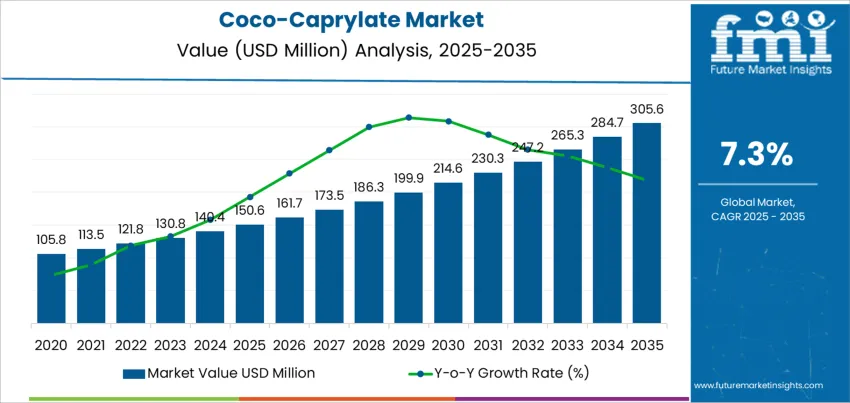
In 2025, the coco caprylate market is valued at USD 150.6 million and is projected to reach USD 305.6 million by 2035 at a CAGR of 7.3%. Early expansion is driven by steady replacement of silicone-based emollients in skin care, hair care, and color cosmetics formulations. Coco caprylate is adopted for its dry feel, fast spreadability, and compatibility with both water-based and oil-based systems.
Facial creams, lotions, makeup primers, and hair conditioners account for a large share of early demand due to texture and absorption performance. Procurement patterns are shaped by consistency in ester profile, odor control, and oxidation stability. Supply availability is closely tied to coconut oil feedstock processing and esterification capacity at specialty ingredient producers.
Quick Stats of the Coco Caprylate Market
- Coco Caprylate Market Value (2025): USD 150.6 million
- Coco Caprylate Market Forecast Value (2035): USD 305.6 million
- Coco Caprylate Market Forecast CAGR (2025 to 2035): 7.3%
- Leading Product Form in Coco Caprylate Market: Powder (17.6%)
- Key Growth Regions in Coco Caprylate Market: Asia Pacific, Europe
- Top Players in Coco Caprylate Market: BASF SE, Croda International, Evonik Industries, Symrise (incl. IFF/Givaudan actives), Dow / Dow Inc., Ashland, Clariant, Seppic / Others
What is the Growth Forecast for the Coco Caprylate Market through 2035?
From 2030 onward, market growth reflects higher formulation loading and wider professional use rather than simple product substitution. Market value rises from about USD 214.6 million in 2030 toward USD 305.6 million by 2035 as coco caprylate gains deeper penetration in sunscreens, dermocosmetic emulsions, and premium anti-aging products. Hair care usage expands through leave-in conditioners, styling creams, and scalp treatments that require lightweight emolliency without buildup. Product developers also increase use in baby and sensitive skin formulations due to low irritation profiles. Competitive emphasis centers on ester purity, batch-to-batch sensory consistency, and long-term supply reliability. Value creation in this phase is shaped by higher active loading per product and expanding use across multiple personal care categories.
The global coco caprylate market expands from USD 150.6 million in 2025 to USD 199.9 million by 2030, registering an absolute increase of USD 49.3 million in the first half of the forecast period. This phase is driven by the repositioning of coco caprylate as a primary texture and slip agent in silicone-free personal care formulations. Demand is led by skincare emulsions, facial oils, sunscreens, and lightweight makeup bases where fast-spreading, non-greasy sensory performance is required. Growth is supported by large-scale reformulation programs among mass and premium beauty brands shifting away from mineral oil and cyclomethicones. Expansion during this period remains formulation-driven, anchored in daily-use cosmetics rather than specialty or seasonal product lines.
From 2030 to 2035, the market advances from USD 199.9 million to USD 305.6 million, adding a larger USD 105.7 million in the second half of the decade. This back-weighted expansion reflects deeper penetration of coco caprylate into multifunctional beauty products, professional haircare systems, and dermatology-linked skincare where emollient stability and sensory neutrality raise value per formulation. Demand also strengthens across color cosmetics as hybrid skincare-makeup formats increase oil-phase complexity. As esterification capacity scales and cost efficiency improves, coco caprylate transitions from a silicone alternative into a structurally embedded emollient base across global personal care manufacturing, materially lifting overall market value through 2035.
Coco Caprylate Industry Key Takeaways
| Metric | Value |
|---|---|
| Industry Value (2025) | USD 150.6 million |
| Forecast Value (2035) | USD 305.6 million |
| Forecast CAGR (2025 to 2035) | 7.3% |
How Is the Coco Caprylate Market Taking Shape Across Modern Personal Care Formulations?
The coco caprylate market developed as formulators searched for plant derived emollients that could replicate the sensory performance of silicones without relying on petroleum based inputs. Derived from fatty acids found in coconut oil, coco caprylate gained early traction in natural and organic certified personal care products where ingredient origin and skin feel both carried weight. Brands used it as a spreadability enhancer in creams, serums, and sunscreens because it delivers dry touch glide and fast absorption without greasiness. Its role expanded as consumers became more attentive to skin feel alongside ingredient transparency. Over time, coco caprylate became a formulation staple in lightweight moisturizers, facial oils, and hair conditioning products where slip and softness are essential.
Future growth of the coco caprylate market will be shaped by clean label reformulation, regulatory pressure on certain synthetics, and rising consumer sensitivity to skin texture and comfort. As brands reformulate silicone heavy products into plant based alternatives, coco caprylate will gain further relevance as a direct functional substitute in both skin and hair care. Expansion is expected in color cosmetics, sun care, and hybrid skincare makeup products where light texture matters.
Barriers include dependence on tropical feedstock supply, cost exposure to coconut oil price swings, and performance limitations in very high slip applications where silicones still dominate. Long term growth will depend on how well coco caprylate balances sensory expectations, formulation stability, and sustainable raw material sourcing across global beauty manufacturing.
How Are End Use Application and Product Form Structuring the Demand for Coco Caprylate?
The demand for coco caprylate is structured by end use application and product form. Skin care represents 10.8% of total demand, followed by body care, hair care, sun care, color cosmetics, men grooming, baby and kids care, and dermocosmetic and professional care. By product form, powder accounts for 17.6% of total consumption, followed by granules and agglomerates, flakes, pellets and prills, liquid solutions, high active concentrates, dispersions and suspensions, emulsions, pastes, gels, wax or solid block formats, and oils. Demand behavior is shaped by ester purity, spreadability control, residue characteristics, oxidative resistance, and compatibility with silicone free formulation systems.
Why Does Skin Care Lead the Coco Caprylate End Use Demand?
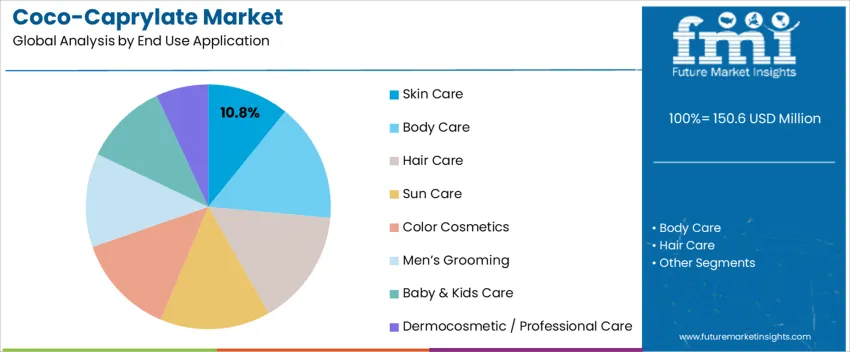
Skin care accounts for 10.8% of total coco caprylate demand due to its performance as a fast absorbing, lightweight ester that delivers a dry touch finish without oily residue. Coco caprylate is widely used as a plant derived alternative to silicones in moisturizers, facial serums, primers, and daily lotions. Its ability to enhance slip and improve sensory glide supports smooth product application without film heaviness. These properties align with formulation objectives for soft focus finishing and rapid skin feel improvement.
Skin care formulators favor coco caprylate for its compatibility with sensitive skin positioning and non occlusive behavior. It performs consistently across anti aging, hydration, and blemish control formulations where lightweight texture is critical. Its neutral odor profile preserves fragrance balance, and its clarity supports visual formulation aesthetics. These sensorial coating properties, regulatory acceptance, and texture optimization functions sustain skin care as the leading end use segment within coco caprylate demand.
Why Does Powder Lead the Coco Caprylate Product Form Demand?
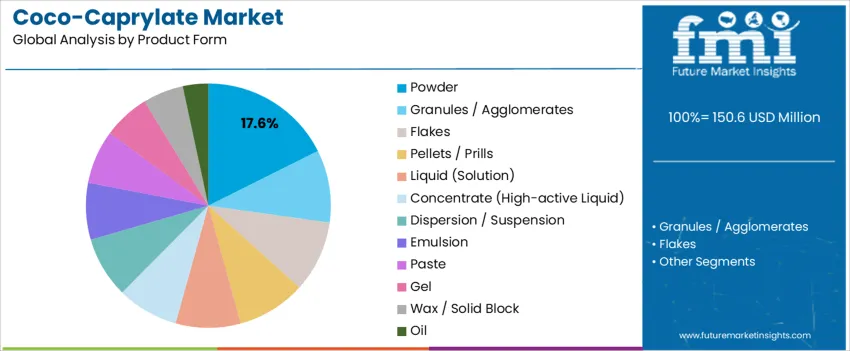
Powder accounts for 17.6% of total coco caprylate demand due to its superior stability, dosing precision, and controlled release behavior during formulation. Powdered coco caprylate enables formulators to manage ester activation at specific processing stages, which supports consistency in emulsions, gels, balms, and pressed cosmetic formats. Low moisture sensitivity improves resistance to oxidation and preserves ester integrity during extended warehousing.
Powder form also supports better dispersion uniformity across water based and anhydrous systems without phase drift or migration during cooling cycles. It allows manufacturers to fine tune slip and absorption behavior without altering viscosity architecture. Packaging in moisture barrier drums maintains free flow properties and prevents agglomeration during transport. These formulation predictability, storage durability, and batch replication advantages position powder as the leading product form within the coco caprylate demand structure.
Why Has Coco-Caprylate Become a Silent Driver of “Invisible Texture” in Modern Formulations?
Coco-caprylate demand is expanding because it enables textures that users barely feel after application. It spreads instantly, flashes off quickly, and leaves almost no surface signal, which suits the growing preference for products that disappear into skin or hair. This "invisible texture" profile is difficult to achieve with traditional plant oils or heavy esters. Formulators rely on coco-caprylate when they want actives to feel present without the carrier being noticed. Its market role is therefore tied to sensory disappearance rather than moisturization, nourishment, or shine delivery.
How Does Its Chemical Behavior Reshape Emollient Architecture Inside a Formula?
Coco-caprylate behaves more like a volatile spacer than a classical lipid. It lowers internal friction between heavier oils, powders, and polymers, allowing fluid movement inside the formula matrix. This prevents drag during application and reduces patch formation in pigmented products. It also helps maintain uniform distribution of lightweight actives without phase separation. Because of this internal "flow regulation," it is often used in low percentages for outsized tactile impact. Its value comes from how it reorganizes formula dynamics rather than from direct skin-conditioning contribution.
Why Do Cost Structures and Shelf-Life Physics Keep It Out of Commodity Products?
Coco-caprylate remains structurally incompatible with low-cost mass formulations. It oxidizes faster than many mineral-based alternatives, which forces the use of stabilizers and controlled packaging. Its ester structure also limits heat endurance in hot-fill systems. These technical requirements add indirect cost beyond the ingredient price itself. Commodity skincare, soap, and personal care lines avoid such sensitivity. As a result, coco-caprylate stays anchored in performance-oriented products where sensory precision justifies higher stability management and tighter quality control.
How Is Its Use Expanding Quietly Through Scalp Care, Soft-Matte Makeup, and Hybrid Fluids?
New demand is forming in scalp serums where residue avoidance is critical, in soft-matte makeup where oil control must coexist with glide, and in hybrid fluids that combine skincare and color. These formats require rapid spread with immediate optical smoothness and zero surface buildup. Coco-caprylate meets all three conditions without interfering with polymer networks or pigment orientation. Its expansion is not driven by brand storytelling but by internal performance necessity across emerging product categories that cannot tolerate heaviness.
What Is the Global Growth Outlook for the Coco Caprylate Industry by Country?
| Country | CAGR (%) |
|---|---|
| India | 9.9% |
| China | 9.2% |
| Japan | 8.4% |
| UK | 7.7% |
| Germany | 7% |
| USA | 6.2% |
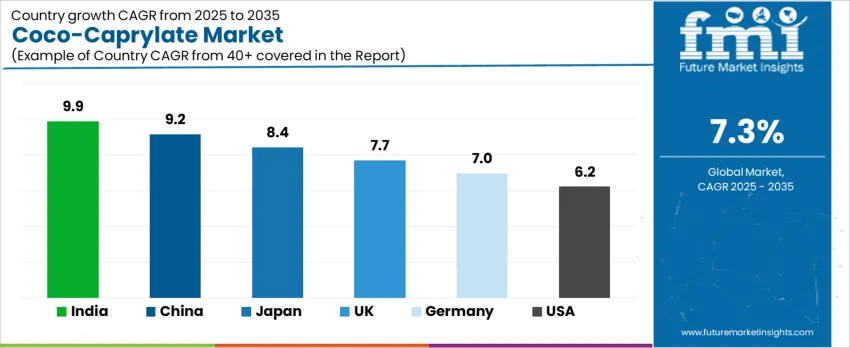
The coco caprylate industry is showing steady global expansion across key personal care and cosmetic manufacturing markets. Growth in India is supported by rising production of plant-based emollients, increasing demand for lightweight skin conditioning agents, and strong domestic formulation activity in skincare and hair care products. China follows at 9.2%, driven by large scale cosmetic ingredient manufacturing, export oriented supply chains, and growing use of silicone alternative emollients.
Japan at 8.4% reflects stable adoption in premium skincare and hybrid cosmetic formulations. The UK and Germany record 7.7% and 7% growth, supported by clean label formulation trends and demand for biodegradable cosmetic ingredients. The USA at 6.2% reflects a mature but gradually expanding market driven by premium personal care brand innovation.
What Is Supporting Coco Caprylate Growth in India?
Expansion in India is progressing at a CAGR of 9.9% through 2035 for coco caprylate demand, driven by rising clean beauty production, silicone free skincare adoption, and lightweight natural emollient formulations. Domestic cosmetic brands use coco caprylate in face oils, sunscreens, and body lotions for fast absorption and non greasy skin feel. Rising interest in plant derived ingredients strengthens its use across mass and premium beauty segments. Imports dominate supply due to limited local ester production. Demand remains formulation led and retail driven, shaped by expanding natural personal care portfolios and online beauty retail growth.
- Silicone free skincare anchors primary formulation demand
- Lightweight sunscreens support seasonal usage volume
- Import based sourcing dominates ingredient supply
- Ecommerce expansion strengthens brand level penetration
How Is China Advancing Industrial Use of Coco Caprylate?
Growth in China reflects a CAGR of 9.2% through 2035 for coco caprylate utilization, supported by large scale personal care manufacturing, rapid private label expansion, and export focused cosmetic ingredient processing. Coco caprylate appears in makeup bases, facial moisturizers, and hair styling products that require high spreadability and smooth skin finish. Domestic chemical processing capacities ensure stable output and cost efficiency. Export oriented suppliers serve international beauty brands. Demand remains production driven and volume oriented, aligned with mass cosmetic output, contract manufacturing growth, and steady integration of biodegradable emollients across personal care product categories.
- Contract cosmetics manufacturing drives bulk ingredient demand
- Makeup bases support repeat formulation usage
- Domestic processing stabilizes cost and availability
- Export supply strengthens international offtake channels
Why Does Japan Sustain Measured Coco Caprylate Adoption?
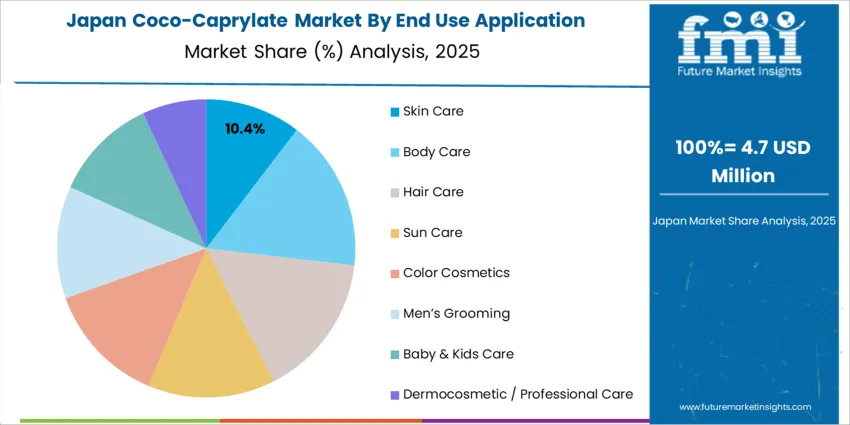
Demand in Japan is increasing at a CAGR of 8.4% through 2035 for coco caprylate usage, sustained by high purity cosmetic standards, sensitive skin formulation needs, and lightweight texture preferences. Coco caprylate is applied in emulsions, makeup removers, and daily moisturizing lotions designed for low irritation performance. Domestic refinement ensures tight quality control. Dermatology driven skincare brands favor its stable sensorial profile. Demand stays quality focused and formulation oriented, supported by aging population skincare requirements, steady dermaceutical product launches, and strong consumer trust in plant derived cosmetic emollients.
- Sensitive skin emulsions anchor regulated formulation use
- Makeup removers sustain daily product consumption
- Domestic refinement stabilizes ingredient purity
- Dermatology brands support professional grade adoption
What Is Supporting Coco Caprylate Market Expansion in the United Kingdom?
Growth in the UK is advancing at a CAGR of 7.7% through 2035 for coco caprylate demand, supported by vegan beauty product growth, silicone free haircare adoption, and clean label cosmetic development. Coco caprylate appears in conditioners, styling creams, facial oils, and hybrid skincare makeup formulations. Independent clean beauty brands and salon channels expand product penetration. Imports dominate sourcing. Demand remains retail driven and texture focused, shaped by rising consumer preference for biodegradable emollients, steady premium haircare growth, and strong online beauty retail performance.
- Vegan beauty products drive ingredient substitution demand
- Silicone free conditioners support haircare application volume
- Salon distributed brands sustain professional usage
- Imported sourcing dominates national ingredient supply
How Is Germany Integrating Coco Caprylate into Regulated Natural Cosmetics?
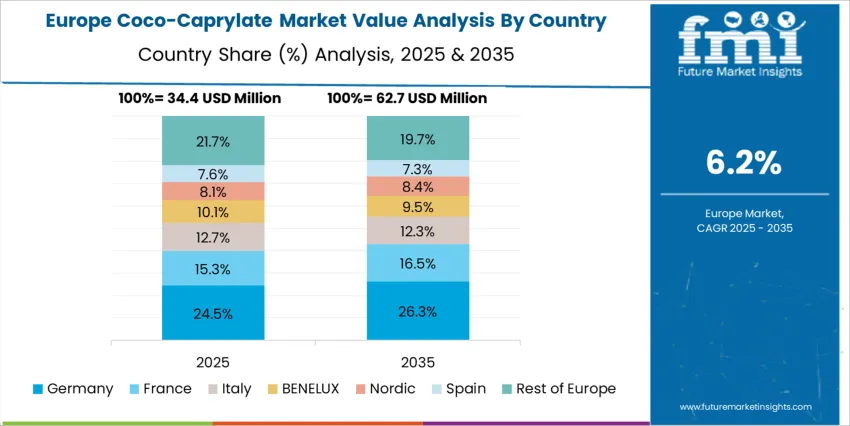
Growth in Germany reflects a CAGR of 7% through 2035 for coco caprylate consumption, driven by certified natural cosmetics, pharmacy grade personal care, and strict ingredient compliance requirements. Coco caprylate is used in facial creams, baby skincare, scalp lotions, and sensitive skin formulations. Certification standards guide sourcing, formulation, and labeling practices. Imports remain the primary supply route. Demand stays quality focused and regulation aligned, supported by preventive skin health practices, controlled cosmetic usage, and steady expansion of biodegradable emollients across pharmacy and certified organic retail networks.
- Certified natural cosmetics anchor regulated product demand
- Baby skincare supports low irritation formulation usage
- Compliance standards shape supplier qualification
- Pharmacy retail stabilizes long term product turnover
What Is Driving Moderate Coco Caprylate Growth in the United States?
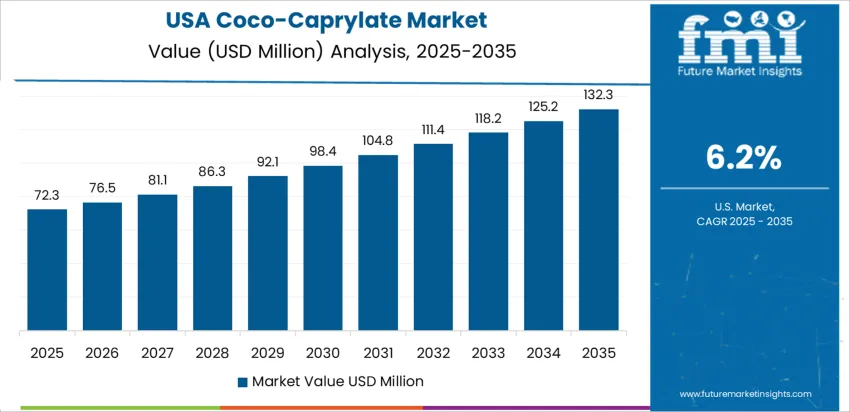
Expansion in the United States is moving at a CAGR of 6.2% through 2035 for coco caprylate demand, supported by clean beauty brand growth, silicone alternative adoption, and hybrid skincare product innovation. Coco caprylate appears in glow serums, makeup primers, lightweight body oils, and heat protection hair sprays. Coastal beauty markets lead early adoption, with steady expansion into national retail chains. Imports supply most raw material. Demand remains innovation driven and application diverse, shaped by consumer preference for biodegradable emollients and steady expansion of premium hair and skincare product pipelines.
- Glow serums and primers anchor skincare demand
- Heat protection sprays support haircare volume
- Premium clean beauty brands drive early adoption
- Import dependence dominates national ingredient sourcing
What Is Driving the Global Demand for Coco-Caprylate and Who Are the Key Suppliers Meeting It
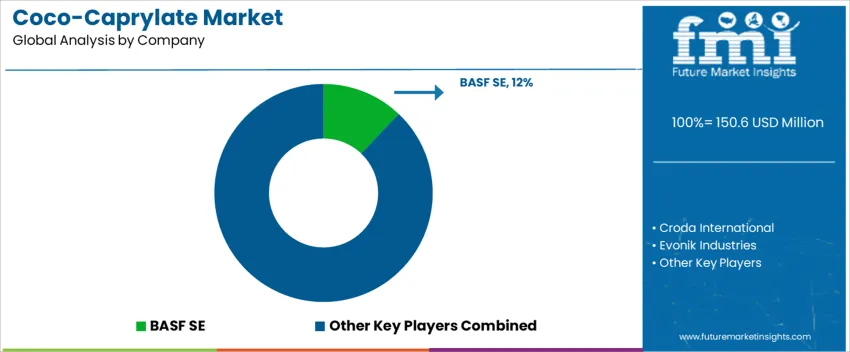
Global demand for coco-caprylate is rising as cosmetic and personal-care manufacturers seek lightweight, non-greasy emollients that deliver a silky, dry skin feel. Consumers increasingly prefer formulations that use naturally derived or plant-based ingredients. Coco-caprylate meets this demand by offering good spreadability, quick absorption, and compatibility with various skin types. The growth of skincare, sunscreen, hair care, and baby-care markets worldwide supports higher usage. Rising regulatory pressure on silicones and heavy emollients in several regions also encourages formulators to use alternatives like coco-caprylate. The trend toward minimalist "clean label" cosmetics and rising demand for vegan and eco-conscious products further boosts market growth.
Key global suppliers of coco-caprylate and related esters include BASF SE, Croda International, Evonik Industries, Symrise (with IFF/Givaudan actives), Dow Inc., Ashland, Clariant, and specialty ingredient firms such as Seppic, Lubrizol, Lonza, and Inolex. Large suppliers provide bulk quantities and standardized grades that support major cosmetic brands and mass-market formulations, ensuring supply stability and regulatory compliance. Specialty producers offer high-purity or customized grades tailored for premium skincare, haircare, or niche natural-cosmetic applications. This multi tiered supplier base enables broad adoption of coco-caprylate across global personal-care, hair-care, sunscreen, and baby-care segments.
Key Players in the Coco Caprylate Market
- BASF SE
- Croda International
- Evonik Industries
- Symrise (incl. IFF/Givaudan actives)
- Dow / Dow Inc.
- Ashland
- Clariant
- Seppic
- Others
Scope of the report
| Items | Values |
|---|---|
| Quantitative Units (2025) | USD million |
| End-Use Applications | Skin Care, Body Care, Hair Care, Sun Care, Color Cosmetics, Men’s Grooming, Baby & Kids Care, Dermocosmetic / Professional Care |
| Product Forms | Powder, Granules/Agglomerates, Flakes, Pellets/Prills, Liquid (Solution), Concentrate (High-active Liquid), Dispersion/Suspension, Emulsion, Paste, Gel, Wax / Solid Block, Oil |
| Regions Covered | Asia Pacific, Europe, North America, Latin America, Middle East & Africa |
| Countries Covered | China, Japan, South Korea, India, Australia & New Zealand, ASEAN, Germany, United Kingdom, France, Italy, Spain, Nordic, BENELUX, USA, Canada, Mexico, Brazil, Chile, Saudi Arabia, Turkey, South Africa, plus 40+ additional countries globally |
| Key Companies Profiled | BASF SE, Croda International, Evonik Industries, Symrise (incl. IFF/Givaudan actives), Dow Inc., Ashland, Clariant, Seppic, Lubrizol, Lonza, Inolex |
| Additional Attributes | Dollar by sales breakdown by region, country, end-use, and product form; global growth projections; multi-sector adoption (cosmetic, nutraceutical, functional food); extract bioactivity profiling; iodine and polyphenol standardization; contract harvesting; vertical integration; supply chain stability; regulatory compliance; sensory and bioavailability performance |
Coco Caprylate Market Segmentation
End Use Application:
- Skin Care
- Body Care
- Hair Care
- Sun Care
- Color Cosmetics
- Men’s Grooming
- Baby & Kids Care
- Dermocosmetic / Professional Care
Product Form:
- Powder
- Granules / Agglomerates
- Flakes
- Pellets / Prills
- Liquid (Solution)
- Concentrate (High-active Liquid)
- Dispersion / Suspension
- Emulsion
- Paste
- Gel
- Wax / Solid Block
- Oil
Region
-
Asia Pacific
- China
- Japan
- South Korea
- India
- Australia & New Zealand
- ASEAN
- Rest of Asia Pacific
-
Europe
- Germany
- United Kingdom
- France
- Italy
- Spain
- Nordic
- BENELUX
- Rest of Europe
-
North America
- United States
- Canada
- Mexico
-
Latin America
- Brazil
- Chile
- Rest of Latin America
-
Middle East & Africa
- Kingdom of Saudi Arabia
- Other GCC Countries
- Turkey
- South Africa
- Other African Union
- Rest of Middle East & Africa
Frequently Asked Questions
How big is the coco caprylate market in 2025?
The global coco caprylate market is estimated to be valued at USD 150.6 million in 2025.
What will be the size of coco caprylate market in 2035?
The market size for the coco caprylate market is projected to reach USD 305.6 million by 2035.
How much will be the coco caprylate market growth between 2025 and 2035?
The coco caprylate market is expected to grow at a 7.3% CAGR between 2025 and 2035.
What are the key product types in the coco caprylate market?
The key product types in coco caprylate market are skin care, body care, hair care, sun care, color cosmetics, men’s grooming, baby & kids care and dermocosmetic / professional care.
Which product form segment to contribute significant share in the coco caprylate market in 2025?
In terms of product form , powder segment to command 17.6% share in the coco caprylate market in 2025.
Preview the report firsthand - request a free sample
Get SampleGet the brochure for pricing and purchase details.
Get PDFTable of Content
- Executive Summary
- Global Market Outlook
- Demand-side Trends
- Supply-side Trends
- Technology Roadmap Analysis
- Analysis and Recommendations
- Market Overview
- Market Coverage / Taxonomy
- Market Definition / Scope / Limitations
- Market Background
- Market Dynamics
- Drivers
- Restraints
- Opportunity
- Trends
- Scenario Forecast
- Demand in Optimistic Scenario
- Demand in Likely Scenario
- Demand in Conservative Scenario
- Opportunity Map Analysis
- Product Life Cycle Analysis
- Supply Chain Analysis
- Investment Feasibility Matrix
- Value Chain Analysis
- PESTLE and Porter’s Analysis
- Regulatory Landscape
- Regional Parent Market Outlook
- Production and Consumption Statistics
- Import and Export Statistics
- Market Dynamics
- Global Market Analysis 2020 to 2024 and Forecast, 2025 to 2035
- Historical Market Size Value (USD Million) Analysis, 2020 to 2024
- Current and Future Market Size Value (USD Million) Projections, 2025 to 2035
- Y-o-Y Growth Trend Analysis
- Absolute $ Opportunity Analysis
- Global Market Pricing Analysis 2020 to 2024 and Forecast 2025 to 2035
- Global Market Analysis 2020 to 2024 and Forecast 2025 to 2035, By End Use Application
- Introduction / Key Findings
- Historical Market Size Value (USD Million) Analysis By End Use Application , 2020 to 2024
- Current and Future Market Size Value (USD Million) Analysis and Forecast By End Use Application , 2025 to 2035
- Skin Care
- Body Care
- Hair Care
- Sun Care
- Color Cosmetics
- Men’s Grooming
- Baby & Kids Care
- Dermocosmetic / Professional Care
- Y-o-Y Growth Trend Analysis By End Use Application , 2020 to 2024
- Absolute $ Opportunity Analysis By End Use Application , 2025 to 2035
- Global Market Analysis 2020 to 2024 and Forecast 2025 to 2035, By Product Form
- Introduction / Key Findings
- Historical Market Size Value (USD Million) Analysis By Product Form, 2020 to 2024
- Current and Future Market Size Value (USD Million) Analysis and Forecast By Product Form, 2025 to 2035
- Powder
- Granules / Agglomerates
- Flakes
- Pellets / Prills
- Liquid (Solution)
- Concentrate (High-active Liquid)
- Dispersion / Suspension
- Emulsion
- Paste
- Gel
- Wax / Solid Block
- Y-o-Y Growth Trend Analysis By Product Form, 2020 to 2024
- Absolute $ Opportunity Analysis By Product Form, 2025 to 2035
- Global Market Analysis 2020 to 2024 and Forecast 2025 to 2035, By Region
- Introduction
- Historical Market Size Value (USD Million) Analysis By Region, 2020 to 2024
- Current Market Size Value (USD Million) Analysis and Forecast By Region, 2025 to 2035
- North America
- Latin America
- Western Europe
- Eastern Europe
- East Asia
- South Asia and Pacific
- Middle East & Africa
- Market Attractiveness Analysis By Region
- North America Market Analysis 2020 to 2024 and Forecast 2025 to 2035, By Country
- Historical Market Size Value (USD Million) Trend Analysis By Market Taxonomy, 2020 to 2024
- Market Size Value (USD Million) Forecast By Market Taxonomy, 2025 to 2035
- By Country
- USA
- Canada
- Mexico
- By End Use Application
- By Product Form
- By Country
- Market Attractiveness Analysis
- By Country
- By End Use Application
- By Product Form
- Key Takeaways
- Latin America Market Analysis 2020 to 2024 and Forecast 2025 to 2035, By Country
- Historical Market Size Value (USD Million) Trend Analysis By Market Taxonomy, 2020 to 2024
- Market Size Value (USD Million) Forecast By Market Taxonomy, 2025 to 2035
- By Country
- Brazil
- Chile
- Rest of Latin America
- By End Use Application
- By Product Form
- By Country
- Market Attractiveness Analysis
- By Country
- By End Use Application
- By Product Form
- Key Takeaways
- Western Europe Market Analysis 2020 to 2024 and Forecast 2025 to 2035, By Country
- Historical Market Size Value (USD Million) Trend Analysis By Market Taxonomy, 2020 to 2024
- Market Size Value (USD Million) Forecast By Market Taxonomy, 2025 to 2035
- By Country
- Germany
- UK
- Italy
- Spain
- France
- Nordic
- BENELUX
- Rest of Western Europe
- By End Use Application
- By Product Form
- By Country
- Market Attractiveness Analysis
- By Country
- By End Use Application
- By Product Form
- Key Takeaways
- Eastern Europe Market Analysis 2020 to 2024 and Forecast 2025 to 2035, By Country
- Historical Market Size Value (USD Million) Trend Analysis By Market Taxonomy, 2020 to 2024
- Market Size Value (USD Million) Forecast By Market Taxonomy, 2025 to 2035
- By Country
- Russia
- Poland
- Hungary
- Balkan & Baltic
- Rest of Eastern Europe
- By End Use Application
- By Product Form
- By Country
- Market Attractiveness Analysis
- By Country
- By End Use Application
- By Product Form
- Key Takeaways
- East Asia Market Analysis 2020 to 2024 and Forecast 2025 to 2035, By Country
- Historical Market Size Value (USD Million) Trend Analysis By Market Taxonomy, 2020 to 2024
- Market Size Value (USD Million) Forecast By Market Taxonomy, 2025 to 2035
- By Country
- China
- Japan
- South Korea
- By End Use Application
- By Product Form
- By Country
- Market Attractiveness Analysis
- By Country
- By End Use Application
- By Product Form
- Key Takeaways
- South Asia and Pacific Market Analysis 2020 to 2024 and Forecast 2025 to 2035, By Country
- Historical Market Size Value (USD Million) Trend Analysis By Market Taxonomy, 2020 to 2024
- Market Size Value (USD Million) Forecast By Market Taxonomy, 2025 to 2035
- By Country
- India
- ASEAN
- Australia & New Zealand
- Rest of South Asia and Pacific
- By End Use Application
- By Product Form
- By Country
- Market Attractiveness Analysis
- By Country
- By End Use Application
- By Product Form
- Key Takeaways
- Middle East & Africa Market Analysis 2020 to 2024 and Forecast 2025 to 2035, By Country
- Historical Market Size Value (USD Million) Trend Analysis By Market Taxonomy, 2020 to 2024
- Market Size Value (USD Million) Forecast By Market Taxonomy, 2025 to 2035
- By Country
- Kingdom of Saudi Arabia
- Other GCC Countries
- Turkiye
- South Africa
- Other African Union
- Rest of Middle East & Africa
- By End Use Application
- By Product Form
- By Country
- Market Attractiveness Analysis
- By Country
- By End Use Application
- By Product Form
- Key Takeaways
- Key Countries Market Analysis
- USA
- Pricing Analysis
- Market Share Analysis, 2024
- By End Use Application
- By Product Form
- Canada
- Pricing Analysis
- Market Share Analysis, 2024
- By End Use Application
- By Product Form
- Mexico
- Pricing Analysis
- Market Share Analysis, 2024
- By End Use Application
- By Product Form
- Brazil
- Pricing Analysis
- Market Share Analysis, 2024
- By End Use Application
- By Product Form
- Chile
- Pricing Analysis
- Market Share Analysis, 2024
- By End Use Application
- By Product Form
- Germany
- Pricing Analysis
- Market Share Analysis, 2024
- By End Use Application
- By Product Form
- UK
- Pricing Analysis
- Market Share Analysis, 2024
- By End Use Application
- By Product Form
- Italy
- Pricing Analysis
- Market Share Analysis, 2024
- By End Use Application
- By Product Form
- Spain
- Pricing Analysis
- Market Share Analysis, 2024
- By End Use Application
- By Product Form
- France
- Pricing Analysis
- Market Share Analysis, 2024
- By End Use Application
- By Product Form
- India
- Pricing Analysis
- Market Share Analysis, 2024
- By End Use Application
- By Product Form
- ASEAN
- Pricing Analysis
- Market Share Analysis, 2024
- By End Use Application
- By Product Form
- Australia & New Zealand
- Pricing Analysis
- Market Share Analysis, 2024
- By End Use Application
- By Product Form
- China
- Pricing Analysis
- Market Share Analysis, 2024
- By End Use Application
- By Product Form
- Japan
- Pricing Analysis
- Market Share Analysis, 2024
- By End Use Application
- By Product Form
- South Korea
- Pricing Analysis
- Market Share Analysis, 2024
- By End Use Application
- By Product Form
- Russia
- Pricing Analysis
- Market Share Analysis, 2024
- By End Use Application
- By Product Form
- Poland
- Pricing Analysis
- Market Share Analysis, 2024
- By End Use Application
- By Product Form
- Hungary
- Pricing Analysis
- Market Share Analysis, 2024
- By End Use Application
- By Product Form
- Kingdom of Saudi Arabia
- Pricing Analysis
- Market Share Analysis, 2024
- By End Use Application
- By Product Form
- Turkiye
- Pricing Analysis
- Market Share Analysis, 2024
- By End Use Application
- By Product Form
- South Africa
- Pricing Analysis
- Market Share Analysis, 2024
- By End Use Application
- By Product Form
- USA
- Market Structure Analysis
- Competition Dashboard
- Competition Benchmarking
- Market Share Analysis of Top Players
- By Regional
- By End Use Application
- By Product Form
- Competition Analysis
- Competition Deep Dive
- BASF SE
- Overview
- Product Portfolio
- Profitability by Market Segments (Product/Age /Sales Channel/Region)
- Sales Footprint
- Strategy Overview
- Marketing Strategy
- Product Strategy
- Channel Strategy
- Croda International
- Evonik Industries
- Symrise (incl. IFF/Givaudan actives)
- Dow / Dow Inc.
- Ashland
- Clariant
- Seppic
- Others
- BASF SE
- Competition Deep Dive
- Assumptions & Acronyms Used
- Research Methodology


