

- Industry Size (2026)
- USD 327.4 Mn
- Forecast (2036)
- USD 1407.4 Mn
- CAGR (2026 to 2036)
- 15.7%
Cognitive-Performance Functional Beverage Additive Systems Market Forecast and Outlook 2026 to 2036
The cognitive-performance functional beverage additive systems market is valued at USD 327.4 million in 2026 and is forecasted to reach USD 1,407.4 million by 2036, reflecting a CAGR of 15.7%. Expansion is driven by structural changes in how cognitive support is consumed, shifting from episodic supplementation toward routine beverage-based intake integrated into work, study, and lifestyle patterns. Value creation concentrates around additive systems that deliver predictable cognitive effects while remaining stable in liquid matrices subject to heat, acidity, and extended shelf life. Pricing power accrues to suppliers capable of combining bioavailability control, sensory neutrality, and regulatory-ready documentation, since formulation errors directly affect brand credibility and repeat consumption. Growth is therefore shaped less by ingredient novelty and more by execution reliability across high-volume beverage platforms.
Quick Stats for Cognitive-Performance Functional Beverage Additive Systems Market
- Cognitive-Performance Functional Beverage Additive Systems Market Value (2026): USD 327.4 million
- Cognitive-Performance Functional Beverage Additive Systems Market Forecast Value (2036): USD 1,407.4 million
- Cognitive-Performance Functional Beverage Additive Systems Market Forecast CAGR (2026 to 2036): 15.7%
- Leading Application Segment in Global Demand: Dairy
- Fastest-Growing Countries: China, USA, Japan, Germany
- Key Players in Global Demand: DSM-Firmenich, Kerry, IFF, ADM, Givaudan, Glanbia Nutritionals
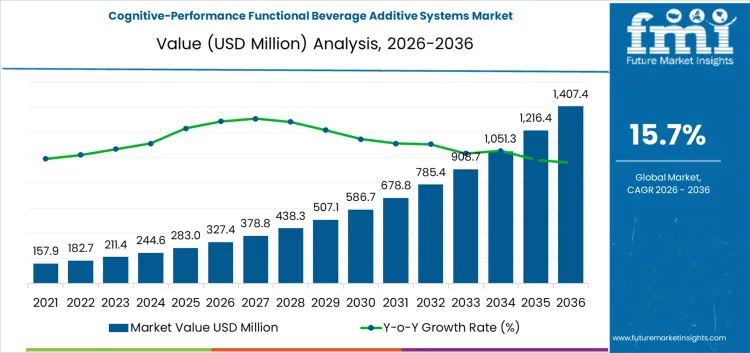
Commercial momentum favors systems that fit daily consumption cycles without overstimulation risk or regulatory exposure. Buyer behavior shows preference for modular additive architectures that allow brands to adjust cognitive positioning across focus, alertness, and stress management without reformulating entire products. Investment emphasis remains selective, targeting delivery technologies and ingredient pairings that maintain efficacy at low inclusion rates while managing cost sensitivity. Regional demand concentrates in jurisdictions where functional claims are permitted within defined frameworks, encouraging disciplined product development rather than speculative launches. Between 2026 and 2036, performance is anchored in formulation discipline, claim defensibility, and integration into established beverage routines, rather than rapid category proliferation. Long-term scalability depends on sustaining consumer trust through consistent cognitive outcomes, stable sensory profiles, and compliance alignment across multiple regulatory regimes.
Cognitive-Performance Functional Beverage Additive Systems Market Key Takeaways
| Metric | Value |
|---|---|
| Market Value (2026) | USD 327.4 million |
| Market Forecast Value (2036) | USD 1,407.4 million |
| Forecast CAGR (2026-2036) | 15.7% |
Why is the Demand for Cognitive-Performance Functional Beverage Additive Systems Market Growing Globally?
Demand for cognitive-performance functional beverage additive systems is growing globally due to escalating consumer interest in products that support mental focus, memory, alertness, and overall cognitive well-being. Busy lifestyles, increased knowledge work, and competitive academic and professional environments drive demand for beverages that provide targeted nutritional support beyond basic hydration. Functional beverage developers integrate additive systems composed of nootropics, adaptogens, botanicals, vitamins, and amino acids that have been associated with cognitive pathways and neurotransmitter support into energy drinks, ready-to-drink teas, enhanced waters, and sports nutrition beverages.
Regulatory frameworks in multiple regions require safety substantiation, permissible usage levels, and transparent ingredient labeling, which reinforces formulation discipline for cognitive-focused additives. Scientific research into brain function, stress response, and sustained attention encourages ingredient innovation and refinement of delivery technologies that maintain stability and bioavailability in aqueous systems. Retail expansion through mass market, convenience, health food, and e-commerce channels increases consumer access to functional beverages with cognitive benefits. Public health emphasis on lifestyle and preventive nutrition reinforces demand for products positioned toward mental performance and daily productivity support. Continued growth in tailored nutrition, personalization, and holistic wellness trends sustains adoption of cognitive-performance beverage additive systems in global beverage portfolios.
How Is the Global Cognitive-Performance Functional Beverage Additive Systems Market Structured?
Global demand for cognitive-performance functional beverage additive systems is shaped by rising interest in mental focus, alertness, and sustained cognitive endurance. Product development emphasizes compatibility with mainstream food and beverage matrices, controlled release of functional actives, and sensory neutrality. Manufacturers prioritize additive systems that integrate cognitive-support positioning with existing nutrition formats, ensuring stability during processing and storage. Adoption patterns reflect expansion of functional dairy drinks, fortified beverages, and hybrid food formats designed to deliver consistent cognitive-performance support across daily consumption occasions.
Which Application Segment Accounts for the Largest Share of Global Demand?
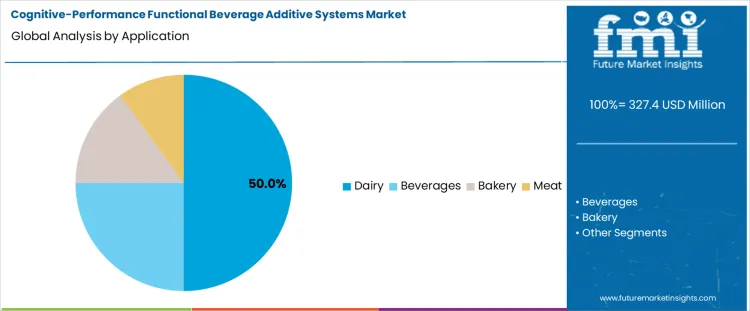
Dairy applications account for 50.0% of global demand, supported by widespread use of cognitive-performance additives in fortified milk drinks, yogurts, and cultured beverage formats. Dairy systems enable effective dispersion of functional ingredients while supporting consumer trust in nutrition-led cognitive claims. Beverage applications represent 25.0%, driven by ready-to-drink functional beverages and performance-oriented drinks requiring rapid absorption and precise dosing. Bakery applications hold a 15.0% share, where cognitive additives are incorporated into functional snacks and fortified baked goods offering extended energy release. Meat applications account for 10.0%, reflecting selective use in functional protein products and niche cognitive-support food concepts.
Key Takeaways
- Dairy leads due to nutritional credibility and formulation compatibility
- Beverage formats support fast-acting cognitive positioning
- Bakery and meat applications remain targeted and secondary
Which Product Form Is Most Widely Used in Cognitive Beverage Additive Systems?
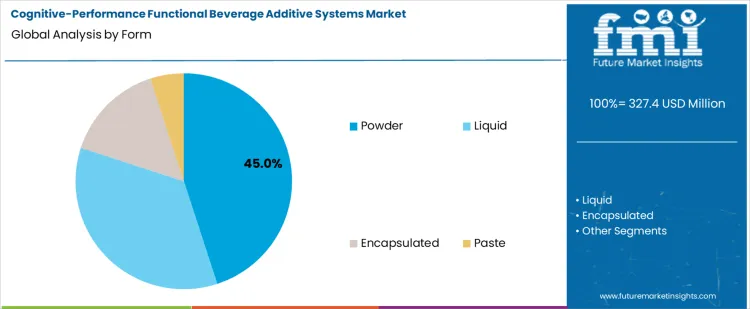
Powder forms lead with a 45.0% share, favored for ease of handling, formulation flexibility, and stability across diverse manufacturing environments. Powders allow precise dosing and simplified logistics for large-scale production. Liquid forms represent 35.0%, supporting direct integration into beverages and dairy systems where solubility and uniform dispersion are critical. Encapsulated formats account for 15.0%, used where protection of sensitive actives or controlled release is required to maintain cognitive efficacy over time. Paste forms hold 5.0%, reflecting limited use in specialized applications requiring viscosity contribution or localized incorporation.
Key Takeaways
- Powder formats dominate due to stability and dosing control
- Liquids enable seamless beverage integration
- Encapsulation supports protection of sensitive cognitive actives
Which Distribution Channel Dominates Global Supply of Cognitive Beverage Additive Systems?
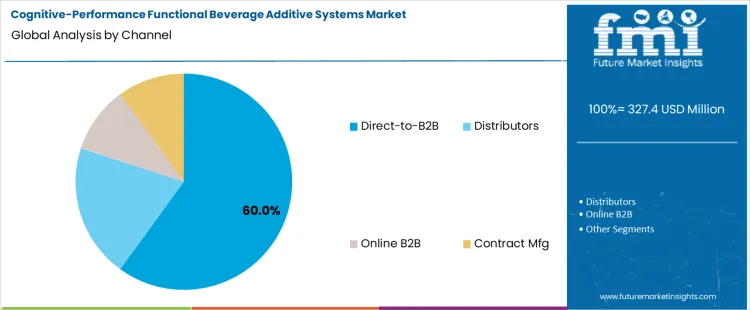
Direct-to-B2B channels account for 60.0% of global distribution, reflecting the need for close technical collaboration between additive suppliers and product developers. Direct engagement supports customization, regulatory alignment, and performance validation for cognitive claims. Distributors hold a 20.0% share, supplying standardized additive systems to regional and mid-sized manufacturers. Online B2B platforms represent 10.0%, serving pilot-scale sourcing and early-stage product development. Contract manufacturing accounts for 10.0%, where cognitive-performance additives are delivered as part of integrated premix or finished formulation solutions.
Key Takeaways
- Direct-to-B2B dominates due to formulation and validation needs
- Distributors enable broader access to standardized systems
- Contract manufacturing supports integrated functional solutions
What are the Key Dynamics in the Cognitive-Performance Functional Beverage Additive Systems Market?
Global demand rises as beverage manufacturers and functional nutrition brands adopt cognitive-performance additive systems that support mental focus, memory, alertness, and stress resilience. Additive systems include nootropic botanicals, amino acids, adaptogens, and targeted micronutrients formulated for stability in liquid matrices and compatibility with taste profiles. Adoption aligns with rising consumer interest in mental wellness, productivity support, and daily functional benefits across North America, Europe, Asia-Pacific, and Latin America. Usage spans ready-to-drink cognitive boosters, enhanced waters, energy alternatives, and sports nutrition beverages designed for students, professionals, and active adults seeking sustained cognitive support without traditional stimulant effects.
How do lifestyle trends and performance expectations shape adoption?
Consumers increasingly seek beverages that deliver measurable mental benefits in contexts such as work, study, and exercise recovery while avoiding excessive stimulation or crash effects. Beverage developers incorporate ingredient combinations backed by emerging research to influence neural signaling, neurotransmitter synthesis, and energy metabolism. Brand positioning emphasizes clarity of benefit, transparent ingredient sourcing, and clinical rationale for inclusion levels to build consumer confidence. Retailers feature cognitive-performance beverages in health and wellness aisles, and e-commerce platforms highlight benefits aligned with consumer goals such as focus enhancement and stress modulation. Performance criteria include bioavailability, sensory acceptance, and compatibility with label claims verified by emerging science.
How do formulation complexity, ingredient cost, and regulatory frameworks influence market scalability?
Cognitive-performance additive systems require careful design to ensure ingredient stability, solubility, and sensory harmony in beverage applications. Specialized ingredients often carry higher raw material costs, affecting pricing strategies and margin planning for finished products. Balancing efficacy with flavor masking and maintaining clear, appealing formulations demand iterative testing and quality control. Regulatory frameworks governing functional claims, allowable ingredient categories, and labeling of cognitive benefits differ across jurisdictions, shaping compliance planning for global distribution. Variability in accepted claims and required substantiation influences product messaging and education efforts. Long-term growth depends on continued innovation in scientifically supported additive systems, harmonized regulatory guidance, and consumer education about functional benefits in cognitive-performance beverages.
How Is Demand for Cognitive-Performance Functional Beverage Additive Systems Evolving Globally?
Demand for cognitive-performance functional beverage additive systems is increasing globally due to rising mental workload, growth of nootropic positioning, and preference for convenient delivery formats. China leads with a 16.1% CAGR, supported by expansion of functional drinks targeting focus and alertness. USA follows at 15.2%, driven by adoption of performance beverages for work, fitness, and lifestyle use. Japan records 15.0%, reflecting demand for cognitive support aligned with productivity and aging demographics. Germany posts 14.6%, shaped by regulatory discipline and evidence-based formulation. Growth reflects transition toward additive systems engineered for stability, bioavailability, and sensory neutrality in ready-to-drink cognitive beverages.
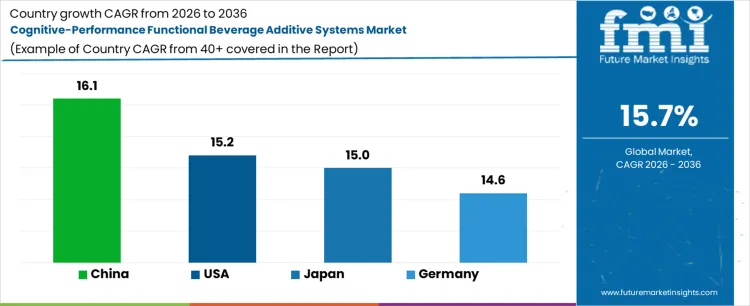
| Country | CAGR (%) |
|---|---|
| China | 16.1% |
| USA | 15.2% |
| Japan | 15.0% |
| Germany | 14.6% |
What is driving rapid adoption of cognitive-performance beverage additives in China?
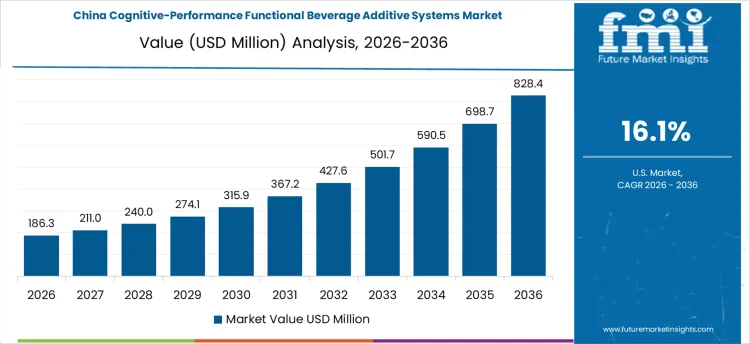
China demand is driven by increasing consumption of functional beverages positioned for focus, memory, and sustained alertness. CAGR of 16.1% reflects integration of additive systems combining amino acids, plant extracts, vitamins, and bioactives compatible with liquid formats. Urban professionals and students adopt cognitive drinks for daily performance support. Manufacturers prioritize shelf stability and flavor masking to enable mass distribution. Regulatory frameworks allow structured functional claims, supporting product launches. Domestic suppliers scale standardized additive systems for high-volume production. Growth remains scale-driven and consumption-led, aligned with lifestyle shifts and rapid expansion of functional beverage portfolios.
- Expansion of focus and alertness beverage categories
- High adoption among urban professionals and students
- Need for stable, flavor-neutral additive systems
- Scaling of domestic functional ingredient supply
How is the USA sustaining strong growth in cognitive beverage additive systems?
USA demand is shaped by popularity of nootropic beverages and convergence of wellness and performance nutrition. CAGR of 15.2% reflects adoption of additive systems delivering cognitive support without stimulatory side effects. Brands emphasize clean-label positioning, transparency, and evidence-backed ingredients. Ready-to-drink formats require additives compatible with cold processing and extended shelf life. Regulatory clarity around structure-function claims supports innovation. Ingredient suppliers develop modular additive systems for customization. Growth remains brand-led and formulation-focused, aligned with premium functional beverage consumption and lifestyle-driven demand.
- Strong demand for nootropic and wellness beverages
- Emphasis on clean-label and ingredient transparency
- Compatibility with ready-to-drink processing
- Availability of modular additive system platforms
What factors support Japan’s growth in cognitive-performance beverage additives?
Japan demand reflects cultural emphasis on productivity, mental clarity, and aging population needs. CAGR of 15.0% is supported by use of cognitive additive systems in functional teas, waters, and nutritional drinks. Consumers prefer mild, sustained cognitive support rather than intense stimulation. Manufacturers focus on safety, stability, and subtle sensory profiles. Regulatory acceptance of functional foods supports market development. Domestic brands integrate additive systems into daily consumption products. Growth remains quality-driven and application-focused, aligned with disciplined formulation standards and long-term health orientation.
- Demand for mild, sustained cognitive support
- Integration into daily-use functional beverages
- Focus on safety and sensory subtlety
- Alignment with functional food regulatory frameworks
Why is Germany showing steady expansion in cognitive beverage additive adoption?
Germany demand reflects strong regulatory oversight, consumer trust in science-backed nutrition, and cautious adoption of functional claims. CAGR of 14.6% is supported by use of additive systems with documented efficacy and safety. Manufacturers prioritize stability, dosing accuracy, and compliance with labeling requirements. Cognitive beverage products target focus and mental resilience rather than stimulation. Ingredient suppliers emphasize standardized extracts and validated compounds. Growth remains regulation-aligned and quality-focused, supported by disciplined product development and high acceptance of evidence-based functional beverages.
- Strong regulatory and labeling compliance requirements
- Preference for science-backed cognitive positioning
- Focus on dosing accuracy and stability
- Use of standardized and validated ingredients
What is the competitive landscape of demand for cognitive-performance functional beverage additive systems globally?
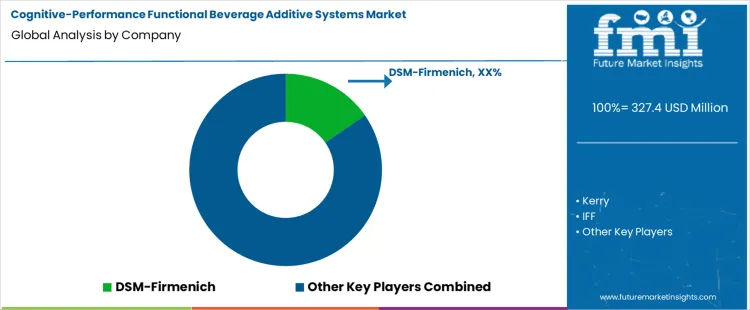
Demand for cognitive-performance functional beverage additive systems is driven by focus on mental clarity, alertness, and stress management in daily nutrition formats. Beverage developers seek ingredient systems supporting energy, focus, and mood without excessive stimulants or sensory penalties. Buyers evaluate bioavailability, onset time, stability in acidic and shelf-stable beverages, and interaction with sweeteners and proteins. Procurement teams prioritize suppliers offering clinically supported actives, regulatory-ready dossiers, and formulation support for RTD, powder, and shot formats. Trend in the global market reflects expansion of nootropic positioning, demand for sugar reduction, and preference for clean-label functional beverages with measurable cognitive benefits.
DSM-Firmenich holds leading positioning through science-backed cognitive actives and integrated flavor modulation supporting beverage stability and palatability. Kerry supports demand with functional systems combining cognition-support ingredients, taste masking, and texture management. IFF contributes cognitive-performance ingredients and beverage application expertise linked to sensory optimization. ADM supplies botanical extracts, amino acids, and delivery systems aligned with cognitive positioning in beverages. Givaudan participates through flavor-led functional systems enabling cognitive claims without compromising taste. Competitive differentiation depends on clinical substantiation, formulation robustness, sensory integration, and ability to support global beverage brand launches at scale.
Key Players in the Cognitive-Performance Functional Beverage Additive Systems Market
- DSM-Firmenich
- Kerry
- IFF
- ADM
- Givaudan
- Glanbia Nutritionals
Scope of the Report
| Items | Values |
|---|---|
| Quantitative Units | USD million |
| Application | Dairy; Beverages; Bakery; Meat |
| Form | Powder; Liquid; Encapsulated; Paste |
| Channel | Direct-to-B2B; Distributors; Online B2B; Contract Mfg |
| Regions Covered | Asia Pacific, Europe, North America, Latin America, Middle East & Africa |
| Countries Covered | China, USA, Japan, Germany, and 40+ countries |
| Key Companies Profiled | DSM-Firmenich; Kerry; IFF; ADM; Givaudan; Glanbia Nutritionals |
| Additional Attributes | Dollar sales by application and form; adoption trends for cognitive-performance additive systems in functional beverages; bioavailability, onset timing, and cognitive efficacy performance metrics; compatibility with dairy and beverage processing including UHT and aseptic filling; stability across pH, heat, and shelf-life conditions; regulatory compliance, claim substantiation, and labeling standards influencing cognitive-performance additive system selection. |
Cognitive-Performance Functional Beverage Additive Systems Market by Segment
Application:
- Dairy
- Beverages
- Bakery
- Meat
Form:
- Powder
- Liquid
- Encapsulated
- Paste
Channel:
- Direct-to-B2B
- Distributors
- Online B2B
- Contract Mfg
Region:
- Asia Pacific
- China
- Japan
- South Korea
- India
- Australia & New Zealand
- ASEAN
- Rest of Asia Pacific
- Europe
- Germany
- United Kingdom
- France
- Italy
- Spain
- Nordic
- BENELUX
- Rest of Europe
- North America
- United States
- Canada
- Mexico
- Latin America
- Brazil
- Chile
- Rest of Latin America
- Middle East & Africa
- Kingdom of Saudi Arabia
- Other GCC Countries
- Turkey
- South Africa
- Other African Union
- Rest of Middle East & Africa
Frequently Asked Questions
How big is the cognitive-performance functional beverage additive systems market in 2026?
The global cognitive-performance functional beverage additive systems market is estimated to be valued at USD 327.4 million in 2026.
What will be the size of cognitive-performance functional beverage additive systems market in 2036?
The market size for the cognitive-performance functional beverage additive systems market is projected to reach USD 1,407.4 million by 2036.
How much will be the cognitive-performance functional beverage additive systems market growth between 2026 and 2036?
The cognitive-performance functional beverage additive systems market is expected to grow at a 15.7% CAGR between 2026 and 2036.
What are the key application types in the cognitive-performance functional beverage additive systems market?
The key application types in cognitive-performance functional beverage additive systems market are dairy, beverages, bakery and meat.
Which form segment will contribute significant share in the cognitive-performance functional beverage additive systems market in 2026?
In terms of form, powder segment to command 45.0% share in the cognitive-performance functional beverage additive systems market in 2026.
Preview the report firsthand - request a free sample
Get SampleGet the brochure for pricing and purchase details.
Get PDFTable of Content
- Executive Summary
- Global Market Outlook
- Demand-side Trends
- Supply-side Trends
- Technology Roadmap Analysis
- Analysis and Recommendations
- Market Overview
- Market Coverage / Taxonomy
- Market Definition / Scope / Limitations
- Market Background
- Market Dynamics
- Drivers
- Restraints
- Opportunity
- Trends
- Scenario Forecast
- Demand in Optimistic Scenario
- Demand in Likely Scenario
- Demand in Conservative Scenario
- Opportunity Map Analysis
- Product Life Cycle Analysis
- Supply Chain Analysis
- Investment Feasibility Matrix
- Value Chain Analysis
- PESTLE and Porter’s Analysis
- Regulatory Landscape
- Regional Parent Market Outlook
- Production and Consumption Statistics
- Import and Export Statistics
- Market Dynamics
- Global Market Analysis 2021 to 2025 and Forecast, 2026 to 2036
- Historical Market Size Value (USD Million) Analysis, 2021 to 2025
- Current and Future Market Size Value (USD Million) Projections, 2026 to 2036
- Y-o-Y Growth Trend Analysis
- Absolute $ Opportunity Analysis
- Global Market Pricing Analysis 2021 to 2025 and Forecast 2026 to 2036
- Global Market Analysis 2021 to 2025 and Forecast 2026 to 2036, By Application
- Introduction / Key Findings
- Historical Market Size Value (USD Million) Analysis By Application , 2021 to 2025
- Current and Future Market Size Value (USD Million) Analysis and Forecast By Application , 2026 to 2036
- Dairy
- Beverages
- Bakery
- Meat
- Dairy
- Y-o-Y Growth Trend Analysis By Application , 2021 to 2025
- Absolute $ Opportunity Analysis By Application , 2026 to 2036
- Global Market Analysis 2021 to 2025 and Forecast 2026 to 2036, By Form
- Introduction / Key Findings
- Historical Market Size Value (USD Million) Analysis By Form, 2021 to 2025
- Current and Future Market Size Value (USD Million) Analysis and Forecast By Form, 2026 to 2036
- Powder
- Liquid
- Encapsulated
- Paste
- Powder
- Y-o-Y Growth Trend Analysis By Form, 2021 to 2025
- Absolute $ Opportunity Analysis By Form, 2026 to 2036
- Global Market Analysis 2021 to 2025 and Forecast 2026 to 2036, By Channel
- Introduction / Key Findings
- Historical Market Size Value (USD Million) Analysis By Channel, 2021 to 2025
- Current and Future Market Size Value (USD Million) Analysis and Forecast By Channel, 2026 to 2036
- Direct-to-B2B
- Distributors
- Online B2B
- Contract Mfg
- Direct-to-B2B
- Y-o-Y Growth Trend Analysis By Channel, 2021 to 2025
- Absolute $ Opportunity Analysis By Channel, 2026 to 2036
- Global Market Analysis 2021 to 2025 and Forecast 2026 to 2036, By Region
- Introduction
- Historical Market Size Value (USD Million) Analysis By Region, 2021 to 2025
- Current Market Size Value (USD Million) Analysis and Forecast By Region, 2026 to 2036
- North America
- Latin America
- Western Europe
- Eastern Europe
- East Asia
- South Asia and Pacific
- Middle East & Africa
- Market Attractiveness Analysis By Region
- North America Market Analysis 2021 to 2025 and Forecast 2026 to 2036, By Country
- Historical Market Size Value (USD Million) Trend Analysis By Market Taxonomy, 2021 to 2025
- Market Size Value (USD Million) Forecast By Market Taxonomy, 2026 to 2036
- By Country
- USA
- Canada
- Mexico
- By Application
- By Form
- By Channel
- By Country
- Market Attractiveness Analysis
- By Country
- By Application
- By Form
- By Channel
- Key Takeaways
- Latin America Market Analysis 2021 to 2025 and Forecast 2026 to 2036, By Country
- Historical Market Size Value (USD Million) Trend Analysis By Market Taxonomy, 2021 to 2025
- Market Size Value (USD Million) Forecast By Market Taxonomy, 2026 to 2036
- By Country
- Brazil
- Chile
- Rest of Latin America
- By Application
- By Form
- By Channel
- By Country
- Market Attractiveness Analysis
- By Country
- By Application
- By Form
- By Channel
- Key Takeaways
- Western Europe Market Analysis 2021 to 2025 and Forecast 2026 to 2036, By Country
- Historical Market Size Value (USD Million) Trend Analysis By Market Taxonomy, 2021 to 2025
- Market Size Value (USD Million) Forecast By Market Taxonomy, 2026 to 2036
- By Country
- Germany
- UK
- Italy
- Spain
- France
- Nordic
- BENELUX
- Rest of Western Europe
- By Application
- By Form
- By Channel
- By Country
- Market Attractiveness Analysis
- By Country
- By Application
- By Form
- By Channel
- Key Takeaways
- Eastern Europe Market Analysis 2021 to 2025 and Forecast 2026 to 2036, By Country
- Historical Market Size Value (USD Million) Trend Analysis By Market Taxonomy, 2021 to 2025
- Market Size Value (USD Million) Forecast By Market Taxonomy, 2026 to 2036
- By Country
- Russia
- Poland
- Hungary
- Balkan & Baltic
- Rest of Eastern Europe
- By Application
- By Form
- By Channel
- By Country
- Market Attractiveness Analysis
- By Country
- By Application
- By Form
- By Channel
- Key Takeaways
- East Asia Market Analysis 2021 to 2025 and Forecast 2026 to 2036, By Country
- Historical Market Size Value (USD Million) Trend Analysis By Market Taxonomy, 2021 to 2025
- Market Size Value (USD Million) Forecast By Market Taxonomy, 2026 to 2036
- By Country
- China
- Japan
- South Korea
- By Application
- By Form
- By Channel
- By Country
- Market Attractiveness Analysis
- By Country
- By Application
- By Form
- By Channel
- Key Takeaways
- South Asia and Pacific Market Analysis 2021 to 2025 and Forecast 2026 to 2036, By Country
- Historical Market Size Value (USD Million) Trend Analysis By Market Taxonomy, 2021 to 2025
- Market Size Value (USD Million) Forecast By Market Taxonomy, 2026 to 2036
- By Country
- India
- ASEAN
- Australia & New Zealand
- Rest of South Asia and Pacific
- By Application
- By Form
- By Channel
- By Country
- Market Attractiveness Analysis
- By Country
- By Application
- By Form
- By Channel
- Key Takeaways
- Middle East & Africa Market Analysis 2021 to 2025 and Forecast 2026 to 2036, By Country
- Historical Market Size Value (USD Million) Trend Analysis By Market Taxonomy, 2021 to 2025
- Market Size Value (USD Million) Forecast By Market Taxonomy, 2026 to 2036
- By Country
- Kingdom of Saudi Arabia
- Other GCC Countries
- Turkiye
- South Africa
- Other African Union
- Rest of Middle East & Africa
- By Application
- By Form
- By Channel
- By Country
- Market Attractiveness Analysis
- By Country
- By Application
- By Form
- By Channel
- Key Takeaways
- Key Countries Market Analysis
- USA
- Pricing Analysis
- Market Share Analysis, 2025
- By Application
- By Form
- By Channel
- Canada
- Pricing Analysis
- Market Share Analysis, 2025
- By Application
- By Form
- By Channel
- Mexico
- Pricing Analysis
- Market Share Analysis, 2025
- By Application
- By Form
- By Channel
- Brazil
- Pricing Analysis
- Market Share Analysis, 2025
- By Application
- By Form
- By Channel
- Chile
- Pricing Analysis
- Market Share Analysis, 2025
- By Application
- By Form
- By Channel
- Germany
- Pricing Analysis
- Market Share Analysis, 2025
- By Application
- By Form
- By Channel
- UK
- Pricing Analysis
- Market Share Analysis, 2025
- By Application
- By Form
- By Channel
- Italy
- Pricing Analysis
- Market Share Analysis, 2025
- By Application
- By Form
- By Channel
- Spain
- Pricing Analysis
- Market Share Analysis, 2025
- By Application
- By Form
- By Channel
- France
- Pricing Analysis
- Market Share Analysis, 2025
- By Application
- By Form
- By Channel
- India
- Pricing Analysis
- Market Share Analysis, 2025
- By Application
- By Form
- By Channel
- ASEAN
- Pricing Analysis
- Market Share Analysis, 2025
- By Application
- By Form
- By Channel
- Australia & New Zealand
- Pricing Analysis
- Market Share Analysis, 2025
- By Application
- By Form
- By Channel
- China
- Pricing Analysis
- Market Share Analysis, 2025
- By Application
- By Form
- By Channel
- Japan
- Pricing Analysis
- Market Share Analysis, 2025
- By Application
- By Form
- By Channel
- South Korea
- Pricing Analysis
- Market Share Analysis, 2025
- By Application
- By Form
- By Channel
- Russia
- Pricing Analysis
- Market Share Analysis, 2025
- By Application
- By Form
- By Channel
- Poland
- Pricing Analysis
- Market Share Analysis, 2025
- By Application
- By Form
- By Channel
- Hungary
- Pricing Analysis
- Market Share Analysis, 2025
- By Application
- By Form
- By Channel
- Kingdom of Saudi Arabia
- Pricing Analysis
- Market Share Analysis, 2025
- By Application
- By Form
- By Channel
- Turkiye
- Pricing Analysis
- Market Share Analysis, 2025
- By Application
- By Form
- By Channel
- South Africa
- Pricing Analysis
- Market Share Analysis, 2025
- By Application
- By Form
- By Channel
- USA
- Market Structure Analysis
- Competition Dashboard
- Competition Benchmarking
- Market Share Analysis of Top Players
- By Regional
- By Application
- By Form
- By Channel
- Competition Analysis
- Competition Deep Dive
- DSM-Firmenich
- Overview
- Product Portfolio
- Profitability by Market Segments (Product/Age /Sales Channel/Region)
- Sales Footprint
- Strategy Overview
- Marketing Strategy
- Product Strategy
- Channel Strategy
- Kerry
- IFF
- ADM
- Givaudan
- Glanbia Nutritionals
- DSM-Firmenich
- Competition Deep Dive
- Assumptions & Acronyms Used
- Research Methodology


