

- Market Size (2026)
- USD 60.0 Mn
- Forecast (2036)
- USD 155.0 Mn
- CAGR (2026 to 2036)
- 10%
How big is the cold chain biologic temperature monitoring labels market in 2026?
USD 60.0 million in 2026 and USD 155.0 million by 2036 at a 10.0% CAGR.
The cold chain biologic temperature monitoring labels industry value is forecast to grow from USD 54.5 million in 2025 to USD 155.0 million by 2036 at 10.0% CAGR as biologic distributors move from shipment-level review toward carton-level and vial-level release evidence. Monitoring applications are projected to lead with 69.0% share in 2026 as excursion detection stays the main use case. Consumables are expected to secure 54.0% share in 2026 because single-use labels fit vaccine, plasma, trial drug, and refrigerated biologic parcels. Medtech firms are estimated to hold 41.0% share in 2026 as manufacturers and device-linked distributors specify validated indicators into approved packaging workflows.
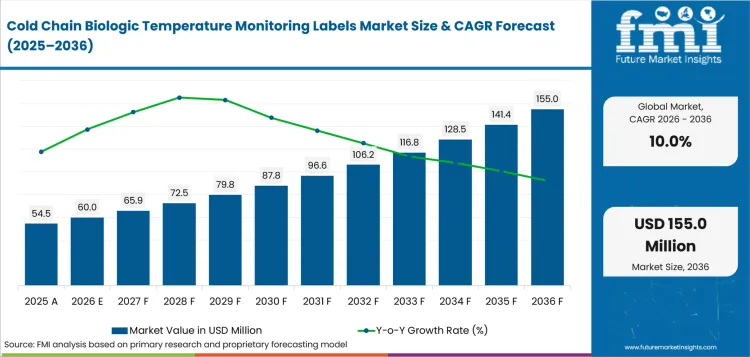
Cold Chain Biologic Temperature Monitoring Labels Market Overview: Size and Forecast
- 2026 Market Size: USD 60.0 million
- 2036 Market Size: USD 155.0 million
- Forecast CAGR: 10.0% from 2026 to 2036
- Leading Application: Monitoring
- Monitoring Share in 2026: 69.0%
- Leading Product Type: Consumables
- Consumables Share in 2026: 54.0%
- Fastest-growing Country: India
- India CAGR: 11.8% by 2036
Summary of the Cold Chain Biologic Temperature Monitoring Labels Market
- Demand and Growth Drivers
- Biologic logistics teams are adding visual indicators to release checks as shipment evidence becomes more important for specialty medicines.
- Vaccine storage teams are using label-style indicators to improve handoff clarity between central stores, transport partners, clinics, and pharmacies.
- Decentralized clinical trial supply is increasing demand for simple carton-level indicators that can be understood by non-logistics staff.
- Product and Segment View
- Monitoring is projected to lead Application with 69.0% share in 2026, supported by excursion detection remaining the core decision point at receipt.
- Consumables are expected to lead Product Type with 54.0% share in 2026, led by single-use indicators that match one-way biologic shipment cycles.
- Medtech firms are estimated to lead End User with 41.0% share in 2026, driven by manufacturer specification of validated monitoring accessories.
- Geography and Competitive Outlook
- North America is expected to hold 35.0% regional share in 2026 due to biologic approval activity and mature specialty pharmacy distribution.
- India is forecast to record 11.8% CAGR by 2036, backed by vaccine distribution scale and expanding biologic trial movement.
- Zebra Technologies, Sensitech, ELPRO, Controlant, Timestrip, TSS, DeltaTrak, and LogTag compete on validation strength, temperature range, and shipment evidence.
- Suppliers with vial-level indicators, carton-level electronic devices, and software-linked release records should gain stronger specification access.
- Analyst Opinion
- Nandini Roy Choudhury, Associate Vice President at FMI, observes, “Cold chain biologic temperature monitoring labels are becoming release-decision tools rather than simple package stickers. Buyers want proof close to the product because shipment-level data alone can miss carton-level handling concerns. The strongest suppliers will combine validated thresholds, easy receiving instructions, and digital evidence that supports quarantine or release decisions. Demand should move fastest where vaccines, specialty biologics, and decentralized trials require simple temperature proof at more handoff points.”
The cold chain biologic temperature monitoring labels market is expected to witness steady expansion through 2036, driven by vaccine handling, specialty biologic distribution, and decentralized trial supply. Market expansion is further supported by stronger demand for visible pass-or-fail indicators that help receivers decide whether a biologic product can enter stock, needs quarantine, or requires quality review.
Market outlook is supported by stronger biologic approvals, stricter vaccine storage discipline, and rising clinical-trial parcel movement. FDA’s Center for Biologics Evaluation and Research reported 17 biologics license application approvals and 26 supplement approvals in calendar year 2024, keeping new biologic shipment lanes active in regulated channels. CDC vaccine-storage guidance requires continuous digital data loggers to record at least every 30 minutes and recommends device uncertainty of ±0.5°C, strengthening the role of labels as a visible proof layer beside loggers. MHRA stated in July 2025 that it assessed more than 5,000 clinical trial applications and approved more than 2,000 medicine licences during 2024 to 2025, creating more demand for low-training shipment checks across trial and hospital endpoints.
Which factors support expansion in the cold chain biologic temperature monitoring labels market?
Finished biologic shipment evidence, validated pack monitoring, and receipt-level quarantine decisions support market value across regulated healthcare channels.
- Market value is supported by label revenue attached to vaccines, plasma products, refrigerated biologics, and clinical trial parcels.
- Supplier pricing reflects threshold accuracy, activation method, temperature range, and documentation support before software adds premium value.
- Revenue improves as buyers combine physical indicators with cold chain monitoring platforms for faster product release review.
- Procurement confidence rises when labels fit validated shipping packs used in pharmaceutical cold chain packaging.
Why is the cold chain biologic temperature monitoring labels market growing?
Vaccine and biologic receivers need a clear visual signal before products are released into clinical, pharmacy, or trial stock.
Growth outlook has become more structured as biologics move through smaller and more distributed shipment routes. MHRA stated in January 2026 that UK clinical trial applications increased by 9% from January to November 2025 compared with the same period in 2024, showing how trial activity can raise parcel-level monitoring needs. Labels support these workflows because they reduce ambiguity when a carton arrives at a site without a specialist cold chain team. They also complement temperature controlled pharmaceutical packaging solutions by giving receiving staff a fast physical check before full release documentation is reviewed.
How is the cold chain biologic temperature monitoring labels market segmented?
The cold chain biologic temperature monitoring labels industry is segmented by product type, care setting, application, end user, and region.
- Consumables are projected to secure 54.0% share in 2026, led by single-use indicators that suit one-way vaccine cartons, biologic parcels, and decentralized trial shipments.
- Hospital care settings are anticipated to hold 38.0% share in 2026, due to pharmacy receiving workflows, vaccine refrigerator checks, and quarantine decisions after temperature events.
- Monitoring applications are expected to account for 69.0% share in 2026, supported by buyers treating excursion detection as the main purpose of the label.
- Medtech firms are projected to represent 41.0% share in 2026, reflected in manufacturers specifying indicators into validated packaging and release procedures.
- North America is forecast to hold 35.0% regional share in 2026, guided by biologic approvals, specialty distribution, and inspection-ready healthcare logistics.
Why do consumables dominate the cold chain biologic temperature monitoring labels market?
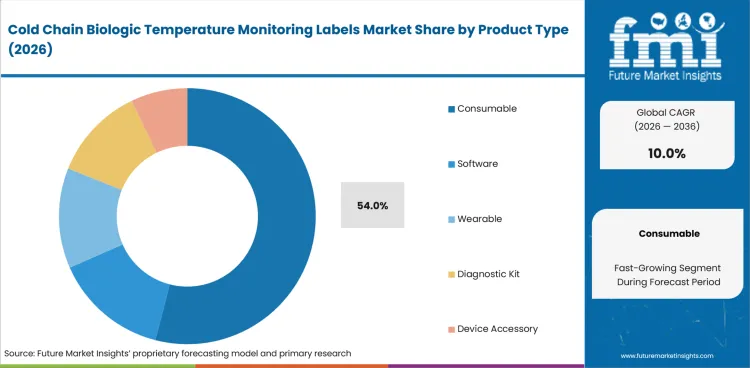
- Consumables are projected to account for 54.0% share in 2026, influenced by single-use handling that works well for biologic parcels moving from manufacturer to receiver.
- Electronic labels gain use in higher-value shipments as buyers need more detailed temperature evidence without depending only on reusable logger fleets.
Which care setting leads the cold chain biologic temperature monitoring labels market?
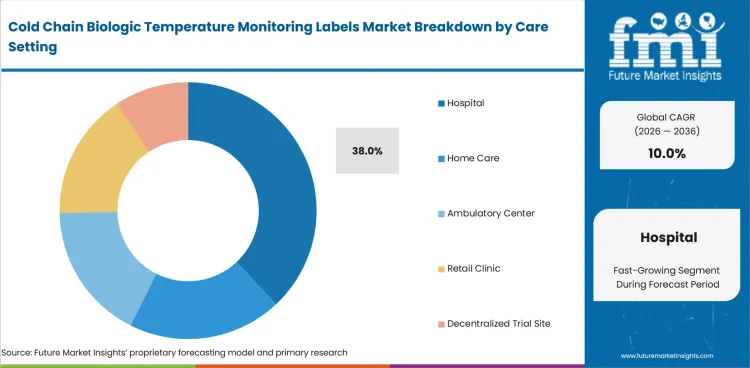
- Hospital settings are expected to hold 38.0% share in 2026, supported by vaccine clinics and hospital pharmacies needing quick release or quarantine guidance.
- Decentralized trial sites gain importance as sponsors move refrigerated biologics into smaller site networks requiring low-training monitoring formats.
Which application leads the cold chain biologic temperature monitoring labels market?
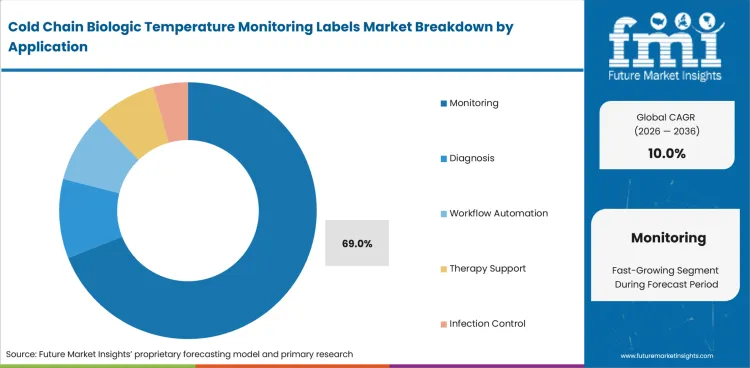
- Monitoring is forecast to secure 69.0% share in 2026, reflected by the need to confirm whether products crossed approved temperature limits.
- Workflow automation expands where labels connect to release records and deviation management systems for cold chain logistics.
Which end user leads the cold chain biologic temperature monitoring labels market?
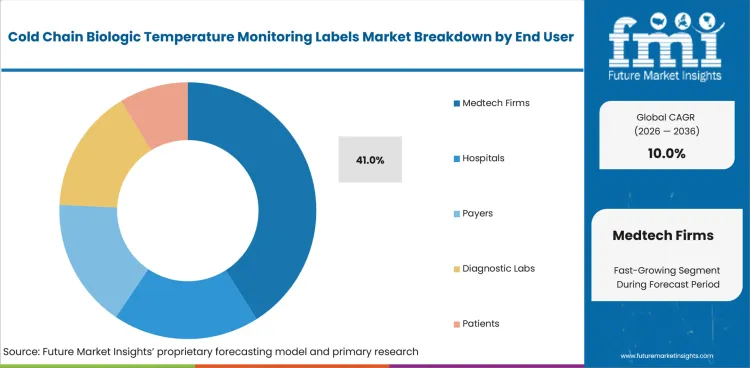
- Medtech firms are estimated to account for 41.0% share in 2026, led by manufacturer and distributor specification of validated label formats.
- Hospitals continue using labels as practical receiving tools when biologics pass through pharmacy, vaccine storage, and specialty-care channels.
Which region leads the cold chain biologic temperature monitoring labels market?
- North America is projected to hold 35.0% share in 2026, shaped by biologic approval depth and mature specialty pharmacy distribution.
- South Asia records faster expansion as vaccine networks and biologic supply chains create new demand for pack-level indicators.
What are the driver, restraints, and opportunities in the cold chain biologic temperature monitoring labels market?
Pack-level release decisions support growth while public-channel cost pressure and validation burden limit wider premium adoption.
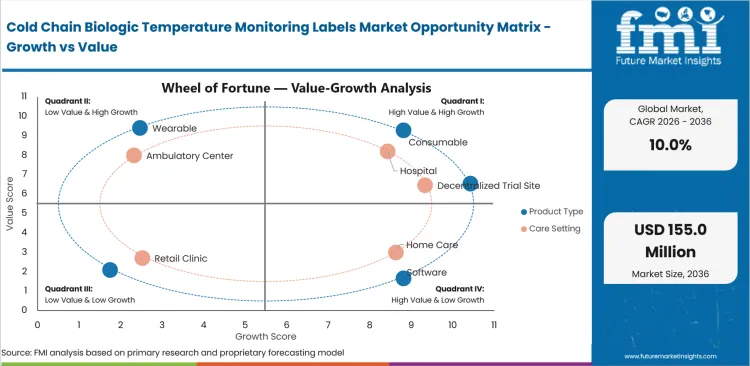
- Driver: Biologic receivers need quick label evidence before accepting high-value refrigerated products into clinical or pharmacy stock.
- Restraint: Public vaccine programs can limit premium label use when one-time indicators compete against tight distribution budgets.
- Opportunity: Connected indicators can link visual alerts with digital records for faster release and deviation review.
Cold Chain Biologic Temperature Monitoring Labels Market Demand Outlook
Demand outlook is moving toward item-level and carton-level proof as buyers seek more precise evidence than shipment-level records alone. FDA’s Oncology Center of Excellence reported 89 oncology drug and biologic approvals in its 2024 annual report, including new entities, new indications, and biosimilar activity that can create high-value temperature-controlled movement. This supports label adoption where biologics need clear receipt checks before release. Suppliers that combine physical signals with real-time temperature and location monitoring platforms should gain preference in specialty logistics.
Cold Chain Biologic Temperature Monitoring Labels Market Restraint Outlook
Cost pressure remains a practical restraint because validated healthcare supply chains require documentation, qualification, and supplier control before new indicators can be accepted. FDA listed the FY 2026 medical device establishment registration fee at USD 11,423, showing how regulated suppliers face recurring compliance costs while selling into price-sensitive healthcare channels. Basic visual labels will therefore retain demand in public tenders, while premium connected indicators must prove release-time savings and waste reduction.
Cold Chain Biologic Temperature Monitoring Labels Market Opportunity Outlook
Opportunity is strongest in workflows that turn label evidence into faster quality decisions. FDA’s real-world evidence submissions table showed 15 protocols, 2 NDA/BLA submissions, and 5 final study reports under CBER in FY 2024, reflecting a regulatory environment where structured evidence records are increasingly important. Connected labels and small indicators can support this direction when they help quality teams document temperature exposure, quarantine decisions, and release outcomes.
Which countries are growing fastest in the cold chain biologic temperature monitoring labels market?
India 11.8% CAGR, China 11.4% CAGR, South Korea 10.6% CAGR, United States 9.8% CAGR, Germany 9.5% CAGR, United Kingdom 9.3% CAGR, France 9.2% CAGR, and Japan 8.8% CAGR through 2036.
.webp "Top Country Growth Comparison Cold Chain Biologic Temperature Monitoring Labels Market Cagr (2026 2036)")
| Country | CAGR |
|---|---|
| India | 11.8% |
| China | 11.4% |
| South Korea | 10.6% |
| United States | 9.8% |
| Germany | 9.5% |
| United Kingdom | 9.3% |
| France | 9.2% |
| Japan | 8.8% |
Source: Future Market Insights, 2026.
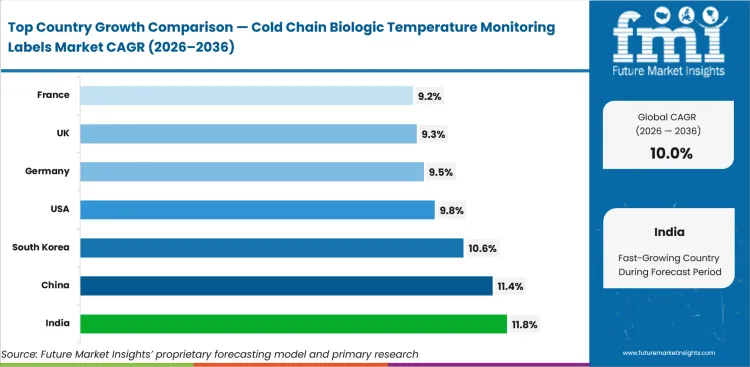
How do country-level CAGRs compare in the cold chain biologic temperature monitoring labels market?
India leads country growth while Japan records the most cautious expansion outlook among profiled markets.
- India is forecast to record 11.8% CAGR by 2036 as vaccine networks and biologic distribution scale.
- China is expected to expand at 11.4% CAGR from 2026 to 2036 due to domestic biologic trials and vaccine logistics.
- South Korea is projected to grow at 10.6% CAGR through 2036 as biosimilar exports and vaccine lot-release systems support monitoring.
- The United States is estimated to rise at 9.8% CAGR by 2036 with specialty pharmacy shipments and biologic approvals.
- Germany is forecast to post 9.5% CAGR through 2036 as strict quality systems support validated cold chain evidence.
- The United Kingdom is projected to increase at 9.3% CAGR by 2036 through trial reform and NHS medicine handling.
- France is expected to advance at 9.2% CAGR through 2036 as hospital research and European logistics sustain label use.
- Japan is forecast to grow at 8.8% CAGR by 2036 as mature quality systems support premium but gradual adoption.
How fast is the cold chain biologic temperature monitoring labels market growing in India?
An 11.8% CAGR through 2036 reflects vaccine cold chain scale and expanding biologic logistics across public and private channels.
Country Market Snapshot Table
| Parameter | Value |
|---|---|
| Market Size in 2025 (Value) | USD 4.6 million |
| Market Size in 2026 (Value) | USD 5.1 million |
| Market Forecast in 2036 (Value) | USD 15.6 million |
| CAGR (2026 to 2036) | 11.8% |
| Years Considered | 2021 to 2036 |
| Base Year | 2025 |
| Forecast Period | 2026 to 2036 |
| Units Considered | Value (USD million) |
| Leading Sub-Region | Western and southern vaccine-biologic corridors |
India Cold Chain Biologic Temperature Monitoring Labels Market Outlook
- India demand is shaped by vaccine distribution depth, biologic logistics expansion, and rising clinical trial supply needs. Labels support low-training receiving decisions in public facilities, private hospitals, specialty pharmacies, and trial sites.
- Suppliers must balance affordability with validation because many shipments move through high-volume channels. Products with clear activation steps and durable carton-level evidence should gain stronger acceptance.
Key Growth Drivers
- India’s vaccine network supports label demand because government communication in March 2026 described nearly 30,000 cold chain points across the national immunization system.
- CDSCO’s vaccine records include Form 10 import-license and Form 41 registration-certificate updates through Q1 2026, keeping vaccine compliance documentation active for monitored shipments.
- Private biologic logistics providers need low-cost visual checks as specialty medicine deliveries expand beyond large hospital depots.
- Trial sites gain value from labels because staff can screen a biologic parcel quickly before escalation to a quality team.
Key Restraints
- CDSCO’s biologics scope covers 7 product groups including vaccines, blood products, allergenic extracts, tissues, gene therapies, cellular therapies, and donor screening tests, creating complex threshold requirements for label suppliers.
- Tender-led vaccine programs can restrict premium electronic indicator adoption when budgets prioritize broad coverage.
- Last-mile variability can make standard label activation and interpretation more difficult outside major urban logistics corridors.
What makes India unique
India is unique due to its large public vaccine network and increasing biologic movement across private healthcare channels.
Key Companies
- Zebra Technologies
- Sensitech
- ELPRO
- DeltaTrak
- LogTag Recorders
- Controlant
- TSS
Sales & Marketing Channels
- Public vaccine procurement routes
- Hospital pharmacy procurement
- Biologic logistics providers
- Clinical trial supply partners
- Packaging validation consultants
- Specialty pharmacy distributors
Country Segment Breakdown Table
| Segment | Sub-Segments |
|---|---|
| By Product Type | Software · Wearable · Diagnostic Kit · Consumable · Device Accessory |
| By Care Setting | Hospital · Home Care · Ambulatory Center · Retail Clinic · Decentralized Trial Site |
| By Application | Monitoring · Diagnosis · Workflow Automation · Therapy Support · Infection Control |
| By End User | Hospitals · Payers · Diagnostic Labs · Medtech Firms · Patients |
| By Region | North America · Europe · East Asia · South Asia · Latin America |
| Key Sub-Regions Covered, Biologic and Vaccine Logistics Corridors | Mumbai · Pune · Hyderabad · Bengaluru · Delhi NCR · Ahmedabad |
Frequently Asked Questions
How fast is India cold chain biologic temperature monitoring labels market growing?
Sales in India are ready to scale at 11.8% CAGR from 2026 to 2036, guided by vaccine logistics and biologic distribution.
Who leads India cold chain biologic temperature monitoring labels market?
Zebra Technologies, Sensitech, ELPRO, DeltaTrak, LogTag, Controlant, and TSS compete based on validation support and channel access.
What is driving adoption in India cold chain biologic temperature monitoring labels market?
Vaccine network scale and biologic trial supply are moving buyers toward low-training carton-level temperature evidence.
What is the cold chain biologic temperature monitoring labels market outlook in China?
An 11.4% CAGR through 2036 is supported by biologic trial acceleration and large vaccine distribution routes.
Country Market Snapshot Table
| Parameter | Value |
|---|---|
| Market Size in 2025 (Value) | USD 9.4 million |
| Market Size in 2026 (Value) | USD 10.5 million |
| Market Forecast in 2036 (Value) | USD 30.9 million |
| CAGR (2026 to 2036) | 11.4% |
| Years Considered | 2021 to 2036 |
| Base Year | 2025 |
| Forecast Period | 2026 to 2036 |
| Units Considered | Value (USD million) |
| Leading Sub-Region | Yangtze River Delta and Greater Bay Area biologic corridors |
China Cold Chain Biologic Temperature Monitoring Labels Market Outlook
- China demand is influenced by domestic biologic innovation, vaccine distribution scale, and cross-provincial healthcare logistics. Temperature labels help receivers evaluate cartons moving through large distributor networks.
- Procurement remains price-sensitive in public channels. Suppliers with local partners and cost-efficient electronic formats should gain stronger access.
Key Growth Drivers
- NMPA announced a 30-day IND pathway in October 2025 for eligible Class I innovative drugs including biological products, increasing pressure on clinical supply readiness.
- NMPA policy interpretation noted that average review time had been reduced to about 50 working days, supporting faster movement of innovative drug programs.
- Provincial vaccine networks need simple label checks that can support receiving decisions across long domestic routes.
- Local temperature-monitoring suppliers can improve adoption by offering lower-cost devices and domestic service support.
Key Restraints
- China’s 2025 policy reduced registration and batch-release testing sample requirements from 3 times the full-test amount to 2, yet biologic testing and documentation remain demanding for new monitoring formats.
- Provincial tenders can compress margins for suppliers selling premium connected indicators into public programs.
- Uneven cold-chain maturity outside leading clusters can delay consistent label specification across distributors.
What makes China unique
China is unique because large vaccine logistics and fast biologic trial activity create both scale and price pressure.
Key Companies
- Haier Biomedical
- TempSen Electronics
- Zebra Technologies
- Sensitech
- DeltaTrak
- ELPRO
- Controlant
Sales & Marketing Channels
- Provincial public tenders
- Biologic manufacturers
- Pharma distributor networks
- Clinical trial logistics providers
- Local packaging integrators
- Hospital procurement channels
Country Segment Breakdown Table
| Segment | Sub-Segments |
|---|---|
| By Product Type | Software · Wearable · Diagnostic Kit · Consumable · Device Accessory |
| By Care Setting | Hospital · Home Care · Ambulatory Center · Retail Clinic · Decentralized Trial Site |
| By Application | Monitoring · Diagnosis · Workflow Automation · Therapy Support · Infection Control |
| By End User | Hospitals · Payers · Diagnostic Labs · Medtech Firms · Patients |
| By Region | North America · Europe · East Asia · South Asia · Latin America |
| Key Sub-Regions Covered, Biologic and Vaccine Logistics Corridors | Shanghai · Suzhou · Beijing · Guangzhou · Shenzhen · Chengdu |
Frequently Asked Questions
How fast is China cold chain biologic temperature monitoring labels market growing?
Demand in China is anticipated to grow at 11.4% CAGR from 2026 to 2036, supported by biologic trials and vaccine distribution.
Who leads China cold chain biologic temperature monitoring labels market?
Haier Biomedical, TempSen, Zebra Technologies, Sensitech, DeltaTrak, ELPRO, and Controlant compete through local access and validation support.
What is driving adoption in China cold chain biologic temperature monitoring labels market?
Innovative biologics and cross-provincial vaccine logistics are moving buyers toward carton-level monitoring labels.
How is the cold chain biologic temperature monitoring labels market performing in South Korea?
A 10.6% CAGR through 2036 reflects biosimilar exports, vaccine lot-release discipline, and biologic quality control.
Country Market Snapshot Table
| Parameter | Value |
|---|---|
| Market Size in 2025 (Value) | USD 2.6 million |
| Market Size in 2026 (Value) | USD 2.9 million |
| Market Forecast in 2036 (Value) | USD 7.9 million |
| CAGR (2026 to 2036) | 10.6% |
| Years Considered | 2021 to 2036 |
| Base Year | 2025 |
| Forecast Period | 2026 to 2036 |
| Units Considered | Value (USD million) |
| Leading Sub-Region | Seoul-Incheon and biopharma export corridors |
South Korea Cold Chain Biologic Temperature Monitoring Labels Market Outlook
- South Korea demand is shaped by biologic manufacturing, biosimilar export logistics, and vaccine lot-release quality systems. Labels support release decisions when biologics move from manufacturing sites into export and hospital channels.
- Buyers often prefer full logger records for export shipments. Labels gain value when they provide an additional carton-level signal without slowing quality review.
Key Growth Drivers
- MFDS published its 2024 National Lot Release Annual Report in July 2025, covering vaccines and plasma-derived medicinal products that require controlled release evidence.
- MFDS communication in May 2026 referenced a 240-day approval target, supporting faster regulatory handling for products moving through Korea’s life-science system.
- Biosimilar export routes increase demand for monitoring formats that support distributor and receiver confidence.
- Hospital tenders can support label use when suppliers provide Korean documentation and clear handling instructions.
Key Restraints
- The MFDS 2024 lot-release report covers 4 operating areas including regulation updates, partnerships, international collaboration, and quality-management research.
- Export-focused buyers may prefer full electronic logger records when shipment value is high and release decisions need detailed audit evidence.
- Supplier qualification can take time because biologic manufacturers require validation files before adding new indicators.
What makes South Korea unique
South Korea is unique due to biosimilar manufacturing depth and vaccine lot-release discipline across export-oriented healthcare logistics.
Key Companies
- TSS
- Sensitech
- ELPRO
- Controlant
- LogTag Recorders
- DeltaTrak
- Zebra Technologies
Sales & Marketing Channels
- Biopharma export logistics providers
- Hospital procurement routes
- Vaccine lot-release support channels
- Clinical trial supply partners
- Packaging validation firms
- Direct biopharma quality sales
Country Segment Breakdown Table
| Segment | Sub-Segments |
|---|---|
| By Product Type | Software · Wearable · Diagnostic Kit · Consumable · Device Accessory |
| By Care Setting | Hospital · Home Care · Ambulatory Center · Retail Clinic · Decentralized Trial Site |
| By Application | Monitoring · Diagnosis · Workflow Automation · Therapy Support · Infection Control |
| By End User | Hospitals · Payers · Diagnostic Labs · Medtech Firms · Patients |
| By Region | North America · Europe · East Asia · South Asia · Latin America |
| Key Sub-Regions Covered, Biologic and Vaccine Logistics Corridors | Seoul · Incheon · Songdo · Daejeon · Osong · Busan |
Frequently Asked Questions
How fast is South Korea cold chain biologic temperature monitoring labels market growing?
Sector in South Korea is projected to grow at 10.6% CAGR from 2026 to 2036 through biosimilar and vaccine logistics.
Who leads South Korea cold chain biologic temperature monitoring labels market?
TSS, Sensitech, ELPRO, Controlant, LogTag, DeltaTrak, and Zebra Technologies compete through monitoring capability and validation support.
What is driving adoption in South Korea cold chain biologic temperature monitoring labels market?
Biosimilar exports and vaccine lot-release systems are moving buyers toward stronger carton-level excursion evidence.
What is the cold chain biologic temperature monitoring labels market forecast for the United States?
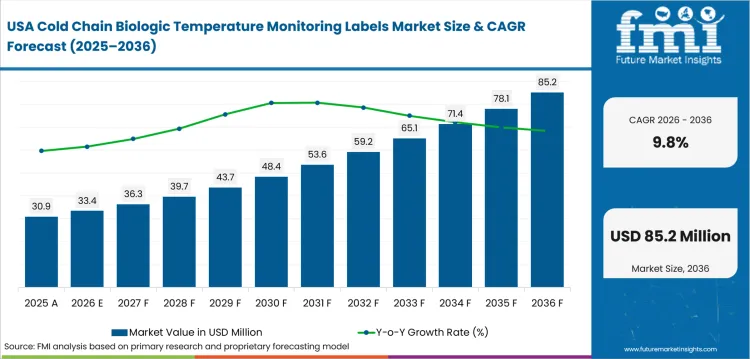
A 9.8% CAGR through 2036 is supported by biologic approvals, specialty pharmacy logistics, and vaccine storage discipline.
Country Market Snapshot Table
| Parameter | Value |
|---|---|
| Market Size in 2025 (Value) | USD 19.1 million |
| Market Size in 2026 (Value) | USD 21.0 million |
| Market Forecast in 2036 (Value) | USD 53.4 million |
| CAGR (2026 to 2036) | 9.8% |
| Years Considered | 2021 to 2036 |
| Base Year | 2025 |
| Forecast Period | 2026 to 2036 |
| Units Considered | Value (USD million) |
| Leading Sub-Region | Northeast and specialty pharmacy logistics networks |
United States Cold Chain Biologic Temperature Monitoring Labels Market Outlook
- United States demand is shaped by biologic launch depth and strict healthcare distribution checks. Labels serve as low-cost receipt evidence before release review in specialty pharmacies, hospitals, and trial depots.
- Premium formats gain acceptance where shipment value is high. Suppliers must provide calibration evidence, clear instructions, and workflow fit for regulated healthcare buyers.
Key Growth Drivers
- FDA’s biologics center reported 17 biologics license application approvals and 26 supplement approvals in calendar year 2024, keeping shipment qualification active across new biologic programs.
- CDC guidance recommends digital data loggers recording at least every 30 minutes, which supports labels as a visible proof layer beside continuous storage records.
- Specialty pharmacy shipment routes create recurring use cases for carton-level pass-or-fail labels.
- Hospital biologic pharmacies need labels for receiving workflows and quarantine decisions after temperature events.
Key Restraints
- FDA listed the FY 2026 medical device establishment registration fee at USD 11,423, adding compliance cost pressure for regulated monitoring suppliers.
- Public immunization channels can resist higher-priced electronic indicators when broad coverage is prioritized.
- Fragmented last-mile delivery partners can slow uniform label specification across specialty drug networks.
What makes United States unique
The United States has a strong link between biologic approvals and specialty distribution routes, making it a premium label specification market.
Key Companies
- Sensitech
- Zebra Technologies
- DeltaTrak
- LogTag Recorders
- SpotSee
- Controlant
- TSS
Sales & Marketing Channels
- Direct sales to biopharma quality teams
- Specialty pharmacy distribution channels
- Hospital procurement groups
- Clinical trial logistics providers
- Packaging integrator partnerships
- Vaccine storage supply channels
Country Segment Breakdown Table
| Segment | Sub-Segments |
|---|---|
| By Product Type | Software · Wearable · Diagnostic Kit · Consumable · Device Accessory |
| By Care Setting | Hospital · Home Care · Ambulatory Center · Retail Clinic · Decentralized Trial Site |
| By Application | Monitoring · Diagnosis · Workflow Automation · Therapy Support · Infection Control |
| By End User | Hospitals · Payers · Diagnostic Labs · Medtech Firms · Patients |
| By Region | North America · Europe · East Asia · South Asia · Latin America |
| Key Sub-Regions Covered, Biologic and Vaccine Logistics Corridors | Northeast · Midwest · California · Texas · Southeast · Pacific Northwest |
Frequently Asked Questions
How fast is United States cold chain biologic temperature monitoring labels market growing?
Demand in the United States is ready to rise at 9.8% CAGR from 2026 to 2036 with specialty biologic logistics.
Who leads United States cold chain biologic temperature monitoring labels market?
Sensitech, Zebra Technologies, DeltaTrak, LogTag, SpotSee, Controlant, and TSS compete based on validation and monitoring depth.
What is driving adoption in United States cold chain biologic temperature monitoring labels market?
Biologic approvals and specialty pharmacy shipment workflows are moving buyers toward pack-level monitoring labels.
What is driving cold chain biologic temperature monitoring labels growth in Germany?
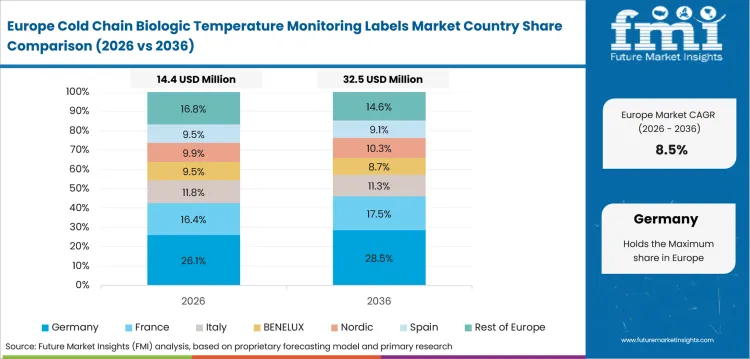
A 9.5% CAGR through 2036 is supported by biopharma manufacturing, EU quality systems, and documented shipment release needs.
Country Market Snapshot Table
| Parameter | Value |
|---|---|
| Market Size in 2025 (Value) | USD 5.8 million |
| Market Size in 2026 (Value) | USD 6.4 million |
| Market Forecast in 2036 (Value) | USD 15.9 million |
| CAGR (2026 to 2036) | 9.5% |
| Years Considered | 2021 to 2036 |
| Base Year | 2025 |
| Forecast Period | 2026 to 2036 |
| Units Considered | Value (USD million) |
| Leading Sub-Region | North Rhine-Westphalia and Bavaria pharma logistics corridors |
Germany Cold Chain Biologic Temperature Monitoring Labels Market Outlook
- Germany demand is quality-led and tied to pharmaceutical manufacturing, hospital pharmacy controls, and EU distribution lanes. Labels gain value when they support deviation review and batch release evidence.
- Buyers place high weight on validation files and supplier quality systems. This favors providers that can support audits and integrate label evidence into temperature sensor ecosystems.
Key Growth Drivers
- Paul-Ehrlich-Institut reported 392 new clinical trial approval applications in 2025, creating trial supply movement that can require controlled temperature checks.
- EMA confirmed that the European Shortages Monitoring Platform became mandatory for marketing authorization holders and national authorities on February 2, 2025, strengthening supply-condition visibility.
- Biopharma exporters need validated cold chain evidence for cross-border biologic shipments.
- Hospital pharmacy controls support labels for receipt checks and product quarantine decisions.
Key Restraints
- EMA’s 2025 annual report stated that 5,088 clinical trials moved from EudraCT under the Clinical Trials Regulation transition, adding documentation pressure across EU trial operations.
- Strict validation demands can slow approval of low-cost labels without sufficient supplier files.
- Competition from full data logger systems can limit purely visual indicator use in high-value shipments.
What makes Germany unique
Germany is a quality-driven specification market where labels must fit wider GMP, GDP, and clinical trial documentation systems.
Key Companies
- ELPRO
- Sensitech
- Berlinger
- LogTag Recorders
- TSS
- Controlant
- Zebra Technologies
Sales & Marketing Channels
- Biopharma quality assurance teams
- Hospital pharmacy procurement
- GDP logistics providers
- Packaging qualification consultants
- European distributor networks
- Clinical trial supply partners
Country Segment Breakdown Table
| Segment | Sub-Segments |
|---|---|
| By Product Type | Software · Wearable · Diagnostic Kit · Consumable · Device Accessory |
| By Care Setting | Hospital · Home Care · Ambulatory Center · Retail Clinic · Decentralized Trial Site |
| By Application | Monitoring · Diagnosis · Workflow Automation · Therapy Support · Infection Control |
| By End User | Hospitals · Payers · Diagnostic Labs · Medtech Firms · Patients |
| By Region | North America · Europe · East Asia · South Asia · Latin America |
| Key Sub-Regions Covered, Biologic and Vaccine Logistics Corridors | North Rhine-Westphalia · Bavaria · Baden-Württemberg · Hesse · Berlin · Hamburg |
Frequently Asked Questions
How fast is Germany cold chain biologic temperature monitoring labels market growing?
Industry in Germany is projected to increase at 9.5% CAGR from 2026 to 2036 through biologic quality systems.
Who leads Germany cold chain biologic temperature monitoring labels market?
ELPRO, Sensitech, Berlinger, LogTag, TSS, Controlant, and Zebra Technologies compete through validation and European channel access.
What is driving adoption in Germany cold chain biologic temperature monitoring labels market?
Biopharma export lanes and EU quality requirements are moving buyers toward validated carton-level temperature evidence.
How is the cold chain biologic temperature monitoring labels market performing in the United Kingdom?
A 9.3% CAGR through 2036 reflects clinical trial reform, NHS medicine handling, and specialty biologic distribution.
Country Market Snapshot Table
| Parameter | Value |
|---|---|
| Market Size in 2025 (Value) | USD 3.9 million |
| Market Size in 2026 (Value) | USD 4.3 million |
| Market Forecast in 2036 (Value) | USD 10.5 million |
| CAGR (2026 to 2036) | 9.3% |
| Years Considered | 2021 to 2036 |
| Base Year | 2025 |
| Forecast Period | 2026 to 2036 |
| Units Considered | Value (USD million) |
| Leading Sub-Region | London-Cambridge-Oxford clinical trial triangle |
United Kingdom Cold Chain Biologic Temperature Monitoring Labels Market Outlook
- United Kingdom demand is driven by NHS medicines handling, clinical trial routes, and specialty pharmacy movement. Labels fit the market when they support simple acceptance and quarantine decisions.
- Buyers compare price with documentation clarity. Suppliers therefore need clean instructions, batch evidence, and channel support for cold chain logistics users.
Key Growth Drivers
- MHRA stated in July 2025 that it assessed more than 5,000 clinical trial applications during 2024 to 2025, creating recurring trial parcel control needs.
- MHRA reported in January 2026 that clinical trial applications increased by 9% during January to November 2025 compared with the same period in 2024.
- NHS hospital pharmacy routes create steady demand for shipment receipt checks and quarantine decisions.
- UK-based indicator suppliers support local access to visual and electronic monitoring formats.
Key Restraints
- MHRA listed 2026 clinical trial assessment fees of GBP 4,656 for a substantial amendment and GBP 343 for a notification, which can add cost pressure to trial logistics planning.
- NHS budget scrutiny limits broad use of premium connected indicators in routine distribution.
- Tender cycles can slow conversion from manual checks to label-based release workflows.
What makes United Kingdom unique
The United Kingdom links clinical trial reform with centralized healthcare procurement, which favors low-training products with strong documentation.
Key Companies
- Timestrip
- Sensitech
- ELPRO
- TSS
- Controlant
- LogTag Recorders
- DeltaTrak
Sales & Marketing Channels
- NHS procurement frameworks
- Clinical trial supply service providers
- Direct biopharma quality sales
- Pharmacy wholesaler channels
- Packaging validation partners
- Specialty distribution partners
Country Segment Breakdown Table
| Segment | Sub-Segments |
|---|---|
| By Product Type | Software · Wearable · Diagnostic Kit · Consumable · Device Accessory |
| By Care Setting | Hospital · Home Care · Ambulatory Center · Retail Clinic · Decentralized Trial Site |
| By Application | Monitoring · Diagnosis · Workflow Automation · Therapy Support · Infection Control |
| By End User | Hospitals · Payers · Diagnostic Labs · Medtech Firms · Patients |
| By Region | North America · Europe · East Asia · South Asia · Latin America |
| Key Sub-Regions Covered, Biologic and Vaccine Logistics Corridors | London · Cambridge · Oxford · Manchester · Birmingham · Glasgow |
Frequently Asked Questions
How fast is United Kingdom cold chain biologic temperature monitoring labels market growing?
Sector in the United Kingdom is projected to increase at 9.3% CAGR from 2026 to 2036 through trial and hospital channels.
Who leads United Kingdom cold chain biologic temperature monitoring labels market?
Timestrip, Sensitech, ELPRO, TSS, Controlant, LogTag, and DeltaTrak compete through visual indicators and validated monitoring products.
What is driving adoption in United Kingdom cold chain biologic temperature monitoring labels market?
Clinical trial reform and NHS biologic handling are moving buyers toward low-training temperature evidence.
What is the cold chain biologic temperature monitoring labels market outlook in France?
A 9.2% CAGR through 2036 is supported by hospital research, European biologic logistics, and controlled healthcare procurement.
Country Market Snapshot Table
| Parameter | Value |
|---|---|
| Market Size in 2025 (Value) | USD 3.2 million |
| Market Size in 2026 (Value) | USD 3.5 million |
| Market Forecast in 2036 (Value) | USD 8.4 million |
| CAGR (2026 to 2036) | 9.2% |
| Years Considered | 2021 to 2036 |
| Base Year | 2025 |
| Forecast Period | 2026 to 2036 |
| Units Considered | Value (USD million) |
| Leading Sub-Region | Île-de-France and Auvergne-Rhône-Alpes hospital research corridors |
France Cold Chain Biologic Temperature Monitoring Labels Market Outlook
- France demand reflects hospital-based research, vaccine channels, and European drug distribution. Labels are useful when they reduce uncertainty at the receiving site.
- Suppliers need documentation compatible with hospital tenders and EU audit formats. Products with simple visual proof and validated packaging support should gain stronger acceptance.
Key Growth Drivers
- EMA’s 2024 annual report stated that ACT EU launched 2 new advice pilots in 2024, supporting clinical trial planning across EU markets including France.
- ANSM’s medicine authorization guidance describes 4 marketing authorization procedures, giving suppliers a structured regulatory setting for healthcare product oversight.
- Research hospital networks need controlled biologic shipment checks for oncology, immunology, and vaccine-related studies.
- European logistics lanes raise use of carton-level monitoring as biologics move through cross-border distribution.
Key Restraints
- ANSM’s clinical-trial framework separates research into 3 categories, which can add procedural complexity for trial supply and monitoring documentation.
- Visual-only labels face competition from connected data loggers when buyers need detailed temperature curves.
- Hospital tender timelines can slow supplier switching even when labels improve release decisions.
What makes France unique
France combines hospital research demand with public health procurement, which rewards simple but well-documented label formats.
Key Companies
- Sensitech
- ELPRO
- Berlinger
- Timestrip
- Controlant
- TSS
- LogTag Recorders
Sales & Marketing Channels
- Hospital tender channels
- Clinical trial depots
- Biopharma logistics providers
- Pharmacy wholesaler networks
- Packaging service integrators
- Direct quality assurance sales
Country Segment Breakdown Table
| Segment | Sub-Segments |
|---|---|
| By Product Type | Software · Wearable · Diagnostic Kit · Consumable · Device Accessory |
| By Care Setting | Hospital · Home Care · Ambulatory Center · Retail Clinic · Decentralized Trial Site |
| By Application | Monitoring · Diagnosis · Workflow Automation · Therapy Support · Infection Control |
| By End User | Hospitals · Payers · Diagnostic Labs · Medtech Firms · Patients |
| By Region | North America · Europe · East Asia · South Asia · Latin America |
| Key Sub-Regions Covered, Biologic and Vaccine Logistics Corridors | Paris · Lyon · Marseille · Lille · Toulouse · Strasbourg |
Frequently Asked Questions
How fast is France cold chain biologic temperature monitoring labels market growing?
Industry in France is anticipated to grow at 9.2% CAGR from 2026 to 2036 through hospital and clinical trial channels.
Who leads France cold chain biologic temperature monitoring labels market?
Sensitech, ELPRO, Berlinger, Timestrip, Controlant, TSS, and LogTag compete through European monitoring coverage and validation support.
What is driving adoption in France cold chain biologic temperature monitoring labels market?
Hospital research networks and European biologic logistics are moving buyers toward documented package-level temperature checks.
What is the cold chain biologic temperature monitoring labels market forecast for Japan?
An 8.8% CAGR through 2036 reflects advanced therapy logistics, strict inspection systems, and mature healthcare distribution.
Country Market Snapshot Table
| Parameter | Value |
|---|---|
| Market Size in 2025 (Value) | USD 4.1 million |
| Market Size in 2026 (Value) | USD 4.5 million |
| Market Forecast in 2036 (Value) | USD 10.5 million |
| CAGR (2026 to 2036) | 8.8% |
| Years Considered | 2021 to 2036 |
| Base Year | 2025 |
| Forecast Period | 2026 to 2036 |
| Units Considered | Value (USD million) |
| Leading Sub-Region | Tokyo-Osaka biologic distribution corridors |
Japan Cold Chain Biologic Temperature Monitoring Labels Market Outlook
- Japan demand is quality-led and tied to validated workflows for biologics, vaccines, and regenerative medicines. Labels gain acceptance when they support audit-ready release decisions.
- Buyers value precision and reliability over low price. This keeps expansion steady while premium formats with strong documentation gain preference.
Key Growth Drivers
- PMDA’s FY 2024 GMP and GCTP annual report listed 2,175 GMP inspections for drug manufacturing sites, supporting documented handling evidence across regulated supply chains.
- FDA’s December 2025 interview with Japanese regulators stated that PMDA recorded a 290-day median approval time in 2024, showing an efficient approval environment for regulated medicines.
- Regenerative medicine logistics require strict temperature evidence across high-value shipment routes.
- Hospital pharmacy workflows favor clear acceptance and quarantine signals during biologic receiving.
Key Restraints
- PMDA inspection guidance identifies 3 high-risk product groups including new drugs, biological products, and biotechnological products, increasing validation expectations for monitoring suppliers.
- Supplier qualification can take longer due to strong documentation and distributor review requirements.
- Mature logistics practices reduce replacement urgency for basic labels in established healthcare channels.
What makes Japan unique
Japan’s advanced therapy quality framework makes it a premium but slower-converting label market.
Key Companies
- ELPRO
- Sensitech
- LogTag Recorders
- DeltaTrak
- Zebra Technologies
- TSS
- Controlant
Sales & Marketing Channels
- Pharma distributor networks
- Hospital pharmacy procurement
- Clinical trial logistics firms
- Quality validation consultants
- Direct biopharma sales
- Packaging qualification partners
Country Segment Breakdown Table
| Segment | Sub-Segments |
|---|---|
| By Product Type | Software · Wearable · Diagnostic Kit · Consumable · Device Accessory |
| By Care Setting | Hospital · Home Care · Ambulatory Center · Retail Clinic · Decentralized Trial Site |
| By Application | Monitoring · Diagnosis · Workflow Automation · Therapy Support · Infection Control |
| By End User | Hospitals · Payers · Diagnostic Labs · Medtech Firms · Patients |
| Key Sub-Regions Covered, Biologic and Vaccine Logistics Corridors | Tokyo · Osaka · Yokohama · Nagoya · Kobe · Fukuoka |
Frequently Asked Questions
How fast is Japan cold chain biologic temperature monitoring labels market growing?
Sector in Japan is projected at 8.8% CAGR from 2026 to 2036 as advanced biologic logistics support label demand.
Who leads Japan cold chain biologic temperature monitoring labels market?
ELPRO, Sensitech, LogTag, DeltaTrak, Zebra Technologies, TSS, and Controlant compete through validation and premium monitoring support.
What is driving adoption in Japan cold chain biologic temperature monitoring labels market?
Advanced therapy quality systems and hospital pharmacy workflows are moving buyers toward reliable package-level excursion proof.
Who are the leading companies in the cold chain biologic temperature monitoring labels market?
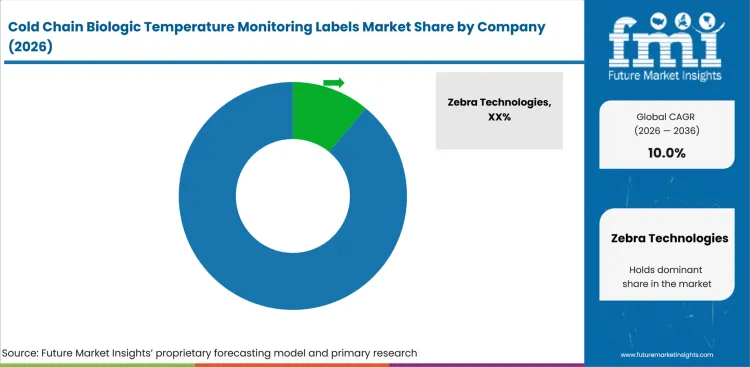
Zebra Technologies, Sensitech, ELPRO, Controlant, Timestrip, TSS, DeltaTrak, LogTag Recorders, Berlinger, and SpotSee are the leading suppliers in this market.
- Established temperature-monitoring suppliers hold an advantage through validation history and biologic shipment experience.
- Specialist label and indicator companies gain space by offering simple visual proof and low-training activation steps.
- Connected monitoring providers gain better acceptance where release decisions require digital shipment evidence and exception records.
- Packaging-ready products support adoption through clear temperature thresholds, serial traceability, and validated carton placement instructions.
Cold chain biologic temperature monitoring label suppliers compete by combining temperature threshold accuracy with documented healthcare logistics performance. Zebra Technologies has a strong vaccine vial monitor position through WHO-prequalified immunization indicators. Sensitech and ELPRO compete through pharmaceutical release workflows, real-time data integration, and validated monitoring records. Controlant and TSS bring connected monitoring depth for specialty shipments, while Timestrip and DeltaTrak support practical label and indicator formats for wider receiving teams.
Validation depth has become a major competitive separator because biologic buyers need evidence before adding a label into shipping protocols. Suppliers that provide calibration records, stability-threshold matching, batch traceability, and quality documentation gain stronger access to biopharma procurement. Basic visual labels remain relevant for public vaccine channels, but premium adoption shifts toward devices that shorten product release review and support deviation management.
Regional and specialist companies can win when they meet local procurement requirements and offer practical support for hospitals, vaccine programs, and clinical trial depots. Haier Biomedical and TempSen have stronger relevance in China-facing cold chain routes, while Berlinger and LogTag support broader shipment-monitoring needs. Companies best positioned to win will combine low-friction receiving checks with audit-ready evidence for biologic release decisions.
How do top cold chain biologic temperature monitoring labels companies compare?
Zebra Technologies leads on vaccine indicator relevance while Sensitech, ELPRO, Controlant, and TSS score stronger on connected release evidence.
| Company | Relevance to Market Title | Validation Depth | Label/Indicator Portfolio | Digital Evidence Capability | Channel Reach | Geographic Footprint |
|---|---|---|---|---|---|---|
| Zebra Technologies | Very High | Very Strong | Very Strong | Moderate | Very Strong | Global |
| Sensitech | Very High | Very Strong | Strong | Very Strong | Very Strong | Global |
| ELPRO | Very High | Very Strong | Strong | Very Strong | Strong | Global |
| Controlant | High | Strong | Moderate | Very Strong | Strong | Global |
| TSS | High | Very Strong | Moderate | Very Strong | Strong | Global |
| Timestrip | High | Strong | Very Strong | Moderate | Moderate | International |
| DeltaTrak | Moderate to High | Moderate | Strong | Moderate | Strong | Global |
| LogTag Recorders | Moderate to High | Moderate | Strong | Moderate | Strong | Global |
| Berlinger | High | Strong | Strong | Strong | Moderate | Europe and global channels |
| SpotSee | Moderate to High | Moderate | Strong | Moderate | Moderate | Global |
Source: Future Market Insights competitive analysis, 2026.
Who are the key players in the cold chain biologic temperature monitoring labels market?
Zebra Technologies, Sensitech, ELPRO, Controlant, Timestrip, TSS, DeltaTrak, LogTag Recorders, Berlinger, SpotSee, TempSen Electronics, and Haier Biomedical are listed among key suppliers.
Key global companies leading the cold chain biologic temperature monitoring labels market include:
- Zebra Technologies
- Sensitech
- ELPRO
- Controlant
- Timestrip
- TSS
- DeltaTrak
- LogTag Recorders
- Berlinger
- SpotSee
Key Developments in Cold Chain Biologic Temperature Monitoring Labels Market
- In March 2025, Sensitech launched Lynx FacTOR, a pharmaceutical release-evaluation workflow designed to reduce product release assessment from days to minutes.
- In March 2026, ELPRO advanced liberoMANAGER 3.0 as a validated cloud system combining USB, Bluetooth, and IoT real-time temperature data in one environment.
- In October 2025, Controlant introduced Controlant Go to simplify real-time shipment monitoring for pharma logistics users seeking easier shipment visibility.
Key Players in the Cold Chain Biologic Temperature Monitoring Labels Market
Global Monitoring and Logistics Evidence uppliers
- Sensitech
- ELPRO
- Controlant
- TSS
- DeltaTrak
Label and Visual Indicator Specialists
- Zebra Technologies
- Timestrip
- Berlinger
- LogTag Recorders
- SpotSee
Regional and Healthcare Cold Chain Companies
- TempSen Electronics
- Haier Biomedical
- Cryopak
- DGP Intelsius
- Omega Engineering
Cold Chain Biologic Temperature Monitoring Labels Market - Scope & Definition
| Attribute | Detail |
|---|---|
| Market Definition | Single-use and small electronic labels or indicators attached to vials, cartons, shippers, and biologic parcels to show whether refrigerated or frozen biologics crossed approved temperature limits |
| Functions Covered | Excursion detection, release support, quarantine support, temperature threshold confirmation, visual evidence, digital shipment evidence |
| Applications Covered | Monitoring, diagnosis support, workflow automation, therapy support, infection control support, and cold chain quality review |
| End-Use Industries | Biopharmaceutical manufacturing, vaccine distribution, specialty pharmacy, hospital pharmacy, clinical trial supply, medtech logistics |
| Grades Covered | Visual chemical indicators, irreversible electronic indicators, threshold labels, freeze indicators, heat indicators, software-linked accessories |
| Inclusions | All commercially available temperature monitoring labels and compact indicators used for biologic, vaccine, plasma product, clinical trial drug, and specialty medicine shipments |
| Exclusions | Full warehouse monitoring systems, refrigerated vehicles, bulk cold rooms, insulated packaging alone, food freshness indicators, and non-biologic industrial temperature labels |
Cold Chain Biologic Temperature Monitoring Labels Market - Research Methodology
| Method | Description |
|---|---|
| Primary Research | FMI analyst interviews with biologic logistics users, vaccine storage teams, clinical trial supply managers, specialty pharmacy buyers, packaging suppliers, and quality assurance participants |
| Desk Research | Review of regulator guidance, immunization device lists, biologic approval activity, company product data, clinical trial updates, and pharmaceutical cold chain logistics evidence |
| Market Sizing & Forecasting | Bottom-up product-boundary approach using estimated label volumes, shipment-level use rates, average selling prices, country logistics maturity, and biologic channel adoption |
| Data Validation | Cross-verification using public regulator data, WHO-prequalified temperature monitoring products, company disclosures, hospital storage guidance, and country-level healthcare logistics indicators |
Cold Chain Biologic Temperature Monitoring Labels Market - Report Scope
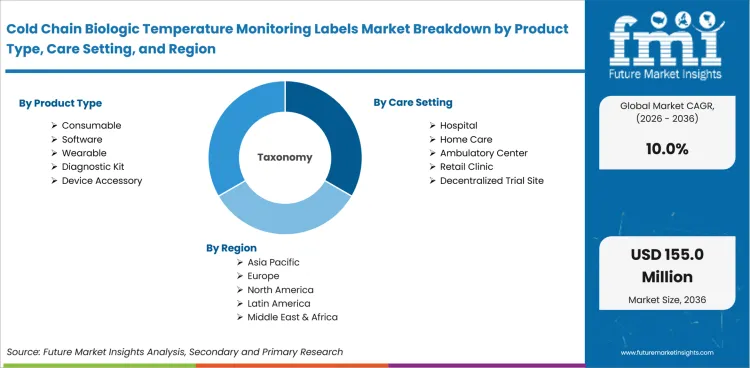
| Item | Value |
|---|---|
| Market size by 2036 | USD 155.0 million |
| Growth rate | 10.0% CAGR from 2026 to 2036 |
| Forecast period | 2026 to 2036 |
| Base year value (2025) | USD 54.5 million |
| By product type | Software, wearable, diagnostic kit, consumable, device accessory |
| By care setting | Hospital, home care, ambulatory center, retail clinic, decentralized trial site |
| By application | Monitoring, diagnosis, workflow automation, therapy support, infection control |
| By end user | Hospitals, payers, diagnostic labs, medtech firms, patients |
| Regions covered | North America, Europe, East Asia, South Asia, Latin America |
| Countries covered | India, China, South Korea, United States, Germany, United Kingdom, France, Japan |
| Key companies profiled | Zebra Technologies, Sensitech, ELPRO, Controlant, Timestrip, TSS, DeltaTrak, LogTag Recorders |
| Units considered | Value in USD million |
| Approach | Bottom-up product-boundary approach using eligible label revenue, shipment exposure, healthcare channel presence, product validation, and country-level adoption |
Source: Future Market Insights, 2026.
Cold Chain Biologic Temperature Monitoring Labels Market Breakdown by Product Type, Care Setting, Application, End User, and Region
Cold Chain Biologic Temperature Monitoring Labels Market Segmented by Product Type
- Software
- Wearable
- Diagnostic Kit
- Consumable
- Device Accessory
Cold Chain Biologic Temperature Monitoring Labels Market Segmented by Care Setting
- Hospital
- Home Care
- Ambulatory Center
- Retail Clinic
- Decentralized Trial Site
Cold Chain Biologic Temperature Monitoring Labels Market Segmented by Application
- Monitoring
- Diagnosis
- Workflow Automation
- Therapy Support
- Infection Control
Cold Chain Biologic Temperature Monitoring Labels Market Segmented by End User
- Hospitals
- Payers
- Diagnostic Labs
- Medtech Firms
- Patients
Cold Chain Biologic Temperature Monitoring Labels Market by Region
- North America
- Europe
- East Asia
- South Asia
- Latin America
Research Sources and Bibliography
- Centers for Disease Control and Prevention. (2024, April 3). Chapter 5: Vaccine storage and handling. USA Department of Health and Human Services.
- Central Drugs Standard Control Organisation. (2026). Biologicals. Ministry of Health and Family Welfare, Government of India.
- Central Drugs Standard Control Organisation. (2026). Vaccines. Ministry of Health and Family Welfare, Government of India.
- Controlant. (2025, October). Controlant Go launch and real-time shipment monitoring update.
- ELPRO. (2026, March 11). Beyond monitoring: Smarter data use across pharma logistics.
- European Medicines Agency. (2025, January 29). European Shortages Monitoring Platform fully operational.
- European Medicines Agency. (2025, June 10). EMA annual report 2024.
- European Medicines Agency. (2026, June 9). EMA annual report 2025.
- Medicines and Healthcare products Regulatory Agency. (2025, July 21). MHRA 2024 to 2025 annual report and accounts.
- Medicines and Healthcare products Regulatory Agency. (2026, January 13). Patients to benefit sooner through faster clinical trial approvals.
- Medicines and Healthcare products Regulatory Agency. (2026, April 21). Clinical trial fees from 1 April 2026.
- Ministry of Food and Drug Safety. (2025, July 29). 2024 Annual Report of National Lot Release. Republic of Korea.
- Ministry of Health and Family Welfare. (2026, March 17). Celebrating the power of vaccines. Press Information Bureau, Government of India.
- National Medical Products Administration. (2025, March 25). Opinions of the State Council on reforming drug and medical device review and approval. People’s Republic of China.
- National Medical Products Administration. (2025, October 14). Announcement on optimizing the review and approval of clinical trials for innovative drugs. People’s Republic of China.
- National Medical Products Administration. (2025, October 14). Policy interpretation on pilot reform for innovative drug clinical trial review and approval. People’s Republic of China.
- Paul-Ehrlich-Institut. (2026, March 6). Processing statistics for applications for clinical trials with medicinal products. Federal Institute for Vaccines and Biomedicines.
- Pharmaceuticals and Medical Devices Agency. (2025, September 5). FY 2024 GMP/GCTP Annual Report. Japan.
- Sensitech. (2025, March 18). Carrier launches Lynx FacTOR to automate pharmaceutical product release evaluations.
- USA Food and Drug Administration. (2025, January 17). CY 2024 report from the director. Center for Biologics Evaluation and Research.
- USA Food and Drug Administration. (2025, December 2). What Japan is doing to encourage drug product submissions.
- USA Food and Drug Administration. (2026). Submissions containing real-world evidence. Center for Biologics Evaluation and Research.
- World Health Organization. (2026, June 9). Catalogue of prequalified immunization devices: E006 temperature monitoring devices.
This bibliography is provided for reader reference and is not exhaustive. The full report contains the complete reference list and detailed citations.
This Report Answers
- Market size estimates for 2026 and forecasts through 2036 for the cold chain biologic temperature monitoring labels market.
- Insights across more than 30 regional and country-level markets.
- Analysis of demand drivers, biologic logistics patterns, vaccine handling requirements, and cold chain release workflows.
- Evaluation of product types and care settings including consumables, hospitals, decentralized trial sites, and software-linked monitoring.
- Assessment of regulatory frameworks, storage guidance, clinical trial movement, and biologic approval trends affecting label adoption.
- Identification of growth opportunities across product types, applications, healthcare channels, and country-level logistics corridors.
- Evaluation of supply chain dynamics, label validation requirements, and temperature-monitoring technology trends.
- Country-level growth analysis covering India, China, South Korea, United States, Germany, United Kingdom, France, and Japan.
- Assessment of the competitive landscape including leading temperature monitoring label suppliers and connected monitoring providers.
- Analysis of buyer preferences, threshold validation needs, and emerging opportunities in carton-level and vial-level temperature proof.
- Regional outlooks across North America, Europe, East Asia, South Asia, and Latin America.
- Delivery of market data, forecasts, and supporting analysis in PDF and Excel formats.
Frequently Asked Questions
What is the cold chain biologic temperature monitoring labels market size in 2026?
The cold chain biologic temperature monitoring labels market size is anticipated to cross USD 60.0 million in 2026.
What is the cold chain biologic temperature monitoring labels market forecast for 2036?
The cold chain biologic temperature monitoring labels industry revenue is predicted to reach USD 155.0 million by 2036 as pack-level monitoring becomes more common.
What is the cold chain biologic temperature monitoring labels market CAGR?
The cold chain biologic temperature monitoring labels sector is projected to expand at 10.0% CAGR from 2026 to 2036.
What segment leads the cold chain biologic temperature monitoring labels market?
Monitoring applications are likely to capture 69.0% share in 2026 because excursion detection is the primary use case.
What country grows fastest in the cold chain biologic temperature monitoring labels market?
India is set to record 11.8% CAGR by 2036, driven by vaccine cold chain scale and biologic logistics expansion.
Preview the report firsthand - request a free sample
Get SampleGet the brochure for pricing and purchase details.
Get PDFTable of Content
- Executive Summary
- Global Market Outlook
- Demand to side Trends
- Supply to side Trends
- Technology Roadmap Analysis
- Analysis and Recommendations
- Market Overview
- Market Coverage / Taxonomy
- Market Definition / Scope / Limitations
- Research Methodology
- Chapter Orientation
- Analytical Lens and Working Hypotheses
- Market Structure, Signals, and Trend Drivers
- Benchmarking and Cross-market Comparability
- Market Sizing, Forecasting, and Opportunity Mapping
- Research Design and Evidence Framework
- Desk Research Programme (Secondary Evidence)
- Company Annual and Sustainability Reports
- Peer-reviewed Journals and Academic Literature
- Corporate Websites, Product Literature, and Technical Notes
- Earnings Decks and Investor Briefings
- Statutory Filings and Regulatory Disclosures
- Technical White Papers and Standards Notes
- Trade Journals, Industry Magazines, and Analyst Briefs
- Conference Proceedings, Webinars, and Seminar Materials
- Government Statistics Portals and Public Data Releases
- Press Releases and Reputable Media Coverage
- Specialist Newsletters and Curated Briefings
- Sector Databases and Reference Repositories
- FMI Internal Proprietary Databases and Historical Market Datasets
- Subscription Datasets and Paid Sources
- Social Channels, Communities, and Digital Listening Inputs
- Additional Desk Sources
- Expert Input and Fieldwork (Primary Evidence)
- Primary Modes
- Qualitative Interviews and Expert Elicitation
- Quantitative Surveys and Structured Data Capture
- Blended Approach
- Why Primary Evidence is Used
- Field Techniques
- Interviews
- Surveys
- Physicians and Other Healthcare Professionals
- Governance, Ethics, and Data Stewardship
- Research Ethics
- Data Integrity and Handling
- Primary Modes
- Tooling, Models, and Reference Databases
- Desk Research Programme (Secondary Evidence)
- Data Engineering and Model Build
- Data Acquisition and Ingestion
- Cleaning, Normalisation, and Verification
- Synthesis, Triangulation, and Analysis
- Quality Assurance and Audit Trail
- Market Background
- Market Dynamics
- Drivers
- Restraints
- Opportunity
- Trends
- Scenario Forecast
- Demand in Optimistic Scenario
- Demand in Likely Scenario
- Demand in Conservative Scenario
- Opportunity Map Analysis
- Product Life Cycle Analysis
- Supply Chain Analysis
- Investment Feasibility Matrix
- Value Chain Analysis
- PESTLE and Porter’s Analysis
- Regulatory Landscape
- Regional Parent Market Outlook
- Production and Consumption Statistics
- Import and Export Statistics
- Market Dynamics
- Global Market Analysis 2021 to 2025 and Forecast, 2026 to 2036
- Historical Market Size Value (USD Million) Analysis, 2021 to 2025
- Current and Future Market Size Value (USD Million) Projections, 2026 to 2036
- Y to o to Y Growth Trend Analysis
- Absolute $ Opportunity Analysis
- Global Market Pricing Analysis 2021 to 2025 and Forecast 2026 to 2036
- Global Market Analysis 2021 to 2025 and Forecast 2026 to 2036, By Product Type
- Introduction / Key Findings
- Historical Market Size Value (USD Million) Analysis By Product Type , 2021 to 2025
- Current and Future Market Size Value (USD Million) Analysis and Forecast By Product Type , 2026 to 2036
- Consumable
- Software
- Wearable
- Diagnostic Kit
- Device Accessory
- Consumable
- Y to o to Y Growth Trend Analysis By Product Type , 2021 to 2025
- Absolute $ Opportunity Analysis By Product Type , 2026 to 2036
- Global Market Analysis 2021 to 2025 and Forecast 2026 to 2036, By Care Setting
- Introduction / Key Findings
- Historical Market Size Value (USD Million) Analysis By Care Setting, 2021 to 2025
- Current and Future Market Size Value (USD Million) Analysis and Forecast By Care Setting, 2026 to 2036
- Hospital
- Home Care
- Ambulatory Center
- Retail Clinic
- Decentralized Trial Site
- Hospital
- Y to o to Y Growth Trend Analysis By Care Setting, 2021 to 2025
- Absolute $ Opportunity Analysis By Care Setting, 2026 to 2036
- Global Market Analysis 2021 to 2025 and Forecast 2026 to 2036, By Application
- Introduction / Key Findings
- Historical Market Size Value (USD Million) Analysis By Application, 2021 to 2025
- Current and Future Market Size Value (USD Million) Analysis and Forecast By Application, 2026 to 2036
- Monitoring
- Diagnosis
- Workflow Automation
- Therapy Support
- Infection Control
- Monitoring
- Y to o to Y Growth Trend Analysis By Application, 2021 to 2025
- Absolute $ Opportunity Analysis By Application, 2026 to 2036
- Global Market Analysis 2021 to 2025 and Forecast 2026 to 2036, By End User
- Introduction / Key Findings
- Historical Market Size Value (USD Million) Analysis By End User, 2021 to 2025
- Current and Future Market Size Value (USD Million) Analysis and Forecast By End User, 2026 to 2036
- Medtech Firms
- Hospitals
- Payers
- Diagnostic Labs
- Patients
- Medtech Firms
- Y to o to Y Growth Trend Analysis By End User, 2021 to 2025
- Absolute $ Opportunity Analysis By End User, 2026 to 2036
- Global Market Analysis 2021 to 2025 and Forecast 2026 to 2036, By Region
- Introduction
- Historical Market Size Value (USD Million) Analysis By Region, 2021 to 2025
- Current Market Size Value (USD Million) Analysis and Forecast By Region, 2026 to 2036
- North America
- Latin America
- Western Europe
- Eastern Europe
- East Asia
- South Asia and Pacific
- Middle East & Africa
- Market Attractiveness Analysis By Region
- North America Market Analysis 2021 to 2025 and Forecast 2026 to 2036, By Country
- Historical Market Size Value (USD Million) Trend Analysis By Market Taxonomy, 2021 to 2025
- Market Size Value (USD Million) Forecast By Market Taxonomy, 2026 to 2036
- By Country
- USA
- Canada
- Mexico
- By Product Type
- By Care Setting
- By Application
- By End User
- By Country
- Market Attractiveness Analysis
- By Country
- By Product Type
- By Care Setting
- By Application
- By End User
- Key Takeaways
- Latin America Market Analysis 2021 to 2025 and Forecast 2026 to 2036, By Country
- Historical Market Size Value (USD Million) Trend Analysis By Market Taxonomy, 2021 to 2025
- Market Size Value (USD Million) Forecast By Market Taxonomy, 2026 to 2036
- By Country
- Brazil
- Chile
- Rest of Latin America
- By Product Type
- By Care Setting
- By Application
- By End User
- By Country
- Market Attractiveness Analysis
- By Country
- By Product Type
- By Care Setting
- By Application
- By End User
- Key Takeaways
- Western Europe Market Analysis 2021 to 2025 and Forecast 2026 to 2036, By Country
- Historical Market Size Value (USD Million) Trend Analysis By Market Taxonomy, 2021 to 2025
- Market Size Value (USD Million) Forecast By Market Taxonomy, 2026 to 2036
- By Country
- Germany
- UK
- Italy
- Spain
- France
- Nordic
- BENELUX
- Rest of Western Europe
- By Product Type
- By Care Setting
- By Application
- By End User
- By Country
- Market Attractiveness Analysis
- By Country
- By Product Type
- By Care Setting
- By Application
- By End User
- Key Takeaways
- Eastern Europe Market Analysis 2021 to 2025 and Forecast 2026 to 2036, By Country
- Historical Market Size Value (USD Million) Trend Analysis By Market Taxonomy, 2021 to 2025
- Market Size Value (USD Million) Forecast By Market Taxonomy, 2026 to 2036
- By Country
- Russia
- Poland
- Hungary
- Balkan & Baltic
- Rest of Eastern Europe
- By Product Type
- By Care Setting
- By Application
- By End User
- By Country
- Market Attractiveness Analysis
- By Country
- By Product Type
- By Care Setting
- By Application
- By End User
- Key Takeaways
- East Asia Market Analysis 2021 to 2025 and Forecast 2026 to 2036, By Country
- Historical Market Size Value (USD Million) Trend Analysis By Market Taxonomy, 2021 to 2025
- Market Size Value (USD Million) Forecast By Market Taxonomy, 2026 to 2036
- By Country
- China
- Japan
- South Korea
- By Product Type
- By Care Setting
- By Application
- By End User
- By Country
- Market Attractiveness Analysis
- By Country
- By Product Type
- By Care Setting
- By Application
- By End User
- Key Takeaways
- South Asia and Pacific Market Analysis 2021 to 2025 and Forecast 2026 to 2036, By Country
- Historical Market Size Value (USD Million) Trend Analysis By Market Taxonomy, 2021 to 2025
- Market Size Value (USD Million) Forecast By Market Taxonomy, 2026 to 2036
- By Country
- India
- ASEAN
- Australia & New Zealand
- Rest of South Asia and Pacific
- By Product Type
- By Care Setting
- By Application
- By End User
- By Country
- Market Attractiveness Analysis
- By Country
- By Product Type
- By Care Setting
- By Application
- By End User
- Key Takeaways
- Middle East & Africa Market Analysis 2021 to 2025 and Forecast 2026 to 2036, By Country
- Historical Market Size Value (USD Million) Trend Analysis By Market Taxonomy, 2021 to 2025
- Market Size Value (USD Million) Forecast By Market Taxonomy, 2026 to 2036
- By Country
- Kingdom of Saudi Arabia
- Other GCC Countries
- Turkiye
- South Africa
- Other African Union
- Rest of Middle East & Africa
- By Product Type
- By Care Setting
- By Application
- By End User
- By Country
- Market Attractiveness Analysis
- By Country
- By Product Type
- By Care Setting
- By Application
- By End User
- Key Takeaways
- Key Countries Market Analysis
- USA
- Pricing Analysis
- Market Share Analysis, 2025
- By Product Type
- By Care Setting
- By Application
- By End User
- Canada
- Pricing Analysis
- Market Share Analysis, 2025
- By Product Type
- By Care Setting
- By Application
- By End User
- Mexico
- Pricing Analysis
- Market Share Analysis, 2025
- By Product Type
- By Care Setting
- By Application
- By End User
- Brazil
- Pricing Analysis
- Market Share Analysis, 2025
- By Product Type
- By Care Setting
- By Application
- By End User
- Chile
- Pricing Analysis
- Market Share Analysis, 2025
- By Product Type
- By Care Setting
- By Application
- By End User
- Germany
- Pricing Analysis
- Market Share Analysis, 2025
- By Product Type
- By Care Setting
- By Application
- By End User
- UK
- Pricing Analysis
- Market Share Analysis, 2025
- By Product Type
- By Care Setting
- By Application
- By End User
- Italy
- Pricing Analysis
- Market Share Analysis, 2025
- By Product Type
- By Care Setting
- By Application
- By End User
- Spain
- Pricing Analysis
- Market Share Analysis, 2025
- By Product Type
- By Care Setting
- By Application
- By End User
- France
- Pricing Analysis
- Market Share Analysis, 2025
- By Product Type
- By Care Setting
- By Application
- By End User
- India
- Pricing Analysis
- Market Share Analysis, 2025
- By Product Type
- By Care Setting
- By Application
- By End User
- ASEAN
- Pricing Analysis
- Market Share Analysis, 2025
- By Product Type
- By Care Setting
- By Application
- By End User
- Australia & New Zealand
- Pricing Analysis
- Market Share Analysis, 2025
- By Product Type
- By Care Setting
- By Application
- By End User
- China
- Pricing Analysis
- Market Share Analysis, 2025
- By Product Type
- By Care Setting
- By Application
- By End User
- Japan
- Pricing Analysis
- Market Share Analysis, 2025
- By Product Type
- By Care Setting
- By Application
- By End User
- South Korea
- Pricing Analysis
- Market Share Analysis, 2025
- By Product Type
- By Care Setting
- By Application
- By End User
- Russia
- Pricing Analysis
- Market Share Analysis, 2025
- By Product Type
- By Care Setting
- By Application
- By End User
- Poland
- Pricing Analysis
- Market Share Analysis, 2025
- By Product Type
- By Care Setting
- By Application
- By End User
- Hungary
- Pricing Analysis
- Market Share Analysis, 2025
- By Product Type
- By Care Setting
- By Application
- By End User
- Kingdom of Saudi Arabia
- Pricing Analysis
- Market Share Analysis, 2025
- By Product Type
- By Care Setting
- By Application
- By End User
- Turkiye
- Pricing Analysis
- Market Share Analysis, 2025
- By Product Type
- By Care Setting
- By Application
- By End User
- South Africa
- Pricing Analysis
- Market Share Analysis, 2025
- By Product Type
- By Care Setting
- By Application
- By End User
- USA
- Market Structure Analysis
- Competition Dashboard
- Competition Benchmarking
- Market Share Analysis of Top Players
- By Regional
- By Product Type
- By Care Setting
- By Application
- By End User
- Competition Analysis
- Competition Deep Dive
- Zebra Technologies
- Overview
- Product Portfolio
- Profitability by Market Segments (Product/Age /Sales Channel/Region)
- Sales Footprint
- Strategy Overview
- Marketing Strategy
- Product Strategy
- Channel Strategy
- Sensitech
- ELPRO
- Controlant
- TSS
- Timestrip
- DeltaTrak
- LogTag Recorders
- Berlinger
- SpotSee
- Zebra Technologies
- Competition Deep Dive
- Assumptions & Acronyms Used


