

- Industry Size (2026)
- USD 5068.8 Mn
- Forecast (2036)
- USD 8740.7 Mn
- CAGR (2026 to 2036)
- 5.60%
Tamper-Evident Pharma Serialization Labels Market Size, Market Forecast and Outlook By FMI
The tamper-evident pharma serialization labels market crossed a valuation of USD 4800.0 million in 2025. Industry is poised to cross USD 5068.8 million in 2026 at a CAGR of 5.60% during the forecast. Demand outlook carries the market valuation to USD 8740.7 million through 2036 as precision-timing economics reach mid-market discrete manufacturing tiers that previously deferred upgrades and regulatory bodies mandate strict unit-level physical authentication frameworks globally.
The transition from batch-level tracking to item-level authentication forces contract manufacturing organizations to overhaul their secondary packaging lines. Facilities delaying this integration lose access to high-value international supply contracts that legally require multi-layered supply chain visibility. This architectural pivot embeds permanent security requirements into everyday drug production, ensuring consistent procurement volumes regardless of broader economic conditions.
Summary of Tamper-Evident Pharma Serialization Labels Market
- Tamper-Evident Pharma Serialization Labels Market Definition:
- Tamper-evident pharma serialization labels are security markers that combine unique digital identifiers with physical destruction mechanisms. They secure drug integrity by ensuring any unauthorized access leaves irreversible visible evidence while enabling global tracking.
- Demand Drivers in the Market:
- National health authorities mandate strict item-level tracking, forcing pharmaceutical companies to adopt integrated pharmaceutical traceability systems secured by physical markers.
- The rise of temperature-sensitive biologic therapies compels packaging engineers to specify advanced label substrates capable of surviving deep-freeze conditions without shattering.
- Increasing global counterfeit drug incidents require brand protection directors to deploy multi-layered physical and digital authentication barriers across vulnerable distribution nodes.
- Key Segments Analyzed in the FMI Report:
- Polymer Film: 62.0% share in 2026, driven by superior durability and moisture resistance during global cold-chain transit.
- RFID/NFC: 45.0% share in 2026, reflecting the massive transition toward automated, touchless inventory verification at major hospital receiving docks.
- China: 8.5% compound growth driven by greenfield manufacturing facilities deploying unified serialization topologies to capture Western export contracts.
- Analyst Opinion at FMI:
- Ismail Sutaria, Principal Consultant for Packaging, opines, "In my analysis, I have observed that the true operational challenge lies not in printing unique codes, but in adhering them at high speeds without triggering false tamper alerts. Facilities operating older application hardware face severe bottlenecking when switching to modern void-reveal films. Packaging line directors who fail to validate adhesive curing times against new serialization formats will experience catastrophic line slowdowns during critical commercial launch windows."
- Strategic Implications / Executive Takeaways:
- Label substrate converters must develop robust cold-chain adhesive formulations to capture the accelerating biologics transit sector.
- Contract packaging organizations should standardize their application hardware to seamlessly handle varied tamper-evident designs without extensive downtime.
- Brand protection managers must integrate responsive labels that provide instant mobile authentication for end-users and clinic administrators.
- Methodology:
- Primary Research: FMI conducted detailed technical interviews with principal packaging architects, industrial network engineers, and quality assurance directors across 40 countries to validate adoption timelines.
- Desk Research: Analysts aggregated public standards documentation from regulatory registries, corporate hardware launch sheets, and national supply chain security programs.
- Market-Sizing and Forecasting: The model applies a bottom-up methodology starting with global installed base metrics for compliance hardware and projecting the conversion rate to advanced security standards.
- Data Validation and Update Cycle: Segment forecasts undergo cross-validation against quarterly shipment volumes for specialized industrial adhesive and film products.
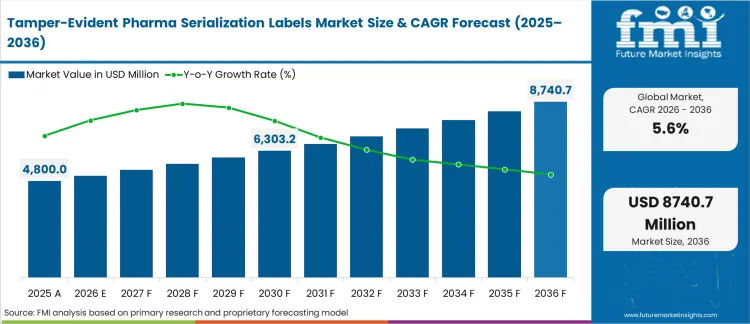
The inflection point for this industry materializes when contract manufacturing organizations abandon bolt-on compliance processes and fully integrate digital-physical authentication into native packaging workflows. Facility directors overseeing production scaling must validate cold-cure adhesives against new high-speed serialization machinery before critical commercial export windows close. Operations mastering this specific environmental resilience secure the most lucrative, high-margin biologic supply contracts across the forecast decade.
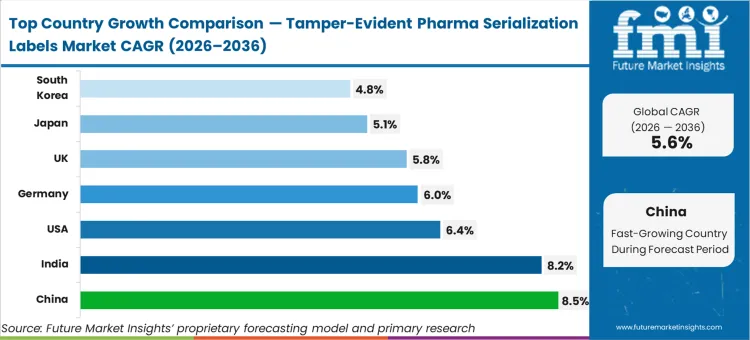
China advances at an 8.5% compound rate to 2036 as local manufacturers scale production to meet stringent global export standards. India records an 8.2% expansion, driven by immense generic drug manufacturing volumes requiring verified physical security. The United States grows at 6.4% as federal supply chain security acts reach full enforcement maturity. Germany tracks a 6.0% trajectory while the UK expands at 5.8%, reflecting established compliance ecosystems. Japan follows with a 5.1% rate, and South Korea posts a 4.8% growth profile. This geographic dispersion remains structural as diverse national health ministries independently enact parallel serialization laws.
Tamper-Evident Pharma Serialization Labels Market Key Takeaways
| Metric | Details |
|---|---|
| Industry Size (2026) | USD 5068.8 million |
| Industry Value (2036) | USD 8740.7 million |
| CAGR (2026-2036) | 5.60% |
Source: Future Market Insights (FMI) analysis, based on proprietary forecasting model and primary research
Tamper-Evident Pharma Serialization Labels Market Definition
Tamper-evident pharma serialization labels represent specialized physical markers applied to drug packaging that provide irreversible visual proof of interference while housing unique digital identification codes. These products fuse structural security mechanisms with variable data printing to guarantee both the authenticity and the physical integrity of medical products across the supply chain.
Tamper-Evident Pharma Serialization Labels Market Inclusions
The market scope encompasses destructible polymer films, void-reveal adhesives, integrated RFID tags, and serialized seals designed specifically for medical containers. Components enabling secure pharmaceutical packaging solutions directly at the primary and secondary carton levels fall within the defined boundaries. Hardware-encoded NFC inlays and temperature-sensitive indicator tags linked to unique item-level identifiers are fully incorporated.
Tamper-Evident Pharma Serialization Labels Market Exclusions
Standard commercial barcode stickers lacking physical tamper-evidence mechanisms are excluded. Purely decorative secondary packaging, unprinted sealing tapes, and software systems managing track-and-trace databases fall outside the valuation. General logistics labels not directly fulfilling regulatory pharmaceutical authentication mandates are explicitly omitted from the analysis.
Tamper-Evident Pharma Serialization Labels Market Research Methodology
- Primary Research: Analysts engaged with packaging qualification engineers, biologic supply chain directors, and pharmaceutical contract manufacturing leads to map the specific decision gates triggering protocol upgrades.
- Desk Research: The data collection phase aggregated compliance roadmaps from global health ministries, anti-counterfeiting task forces, and major serialization integration guidelines.
- Market-Sizing and Forecasting: The baseline value derives from a bottom-up aggregation of specialized medical label shipments, applying region-specific modernization curves to project future adoption velocity.
- Data Validation and Update Cycle: Projections are rigorously tested against publicly reported capital expenditure guidance from the leading contract.
Segment Analysis
Tamper-Evident Pharma Serialization Labels Market Analysis by Material Type
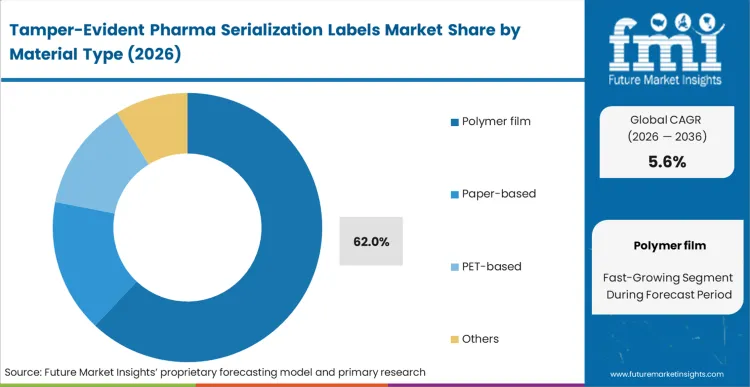
Polymer film commands a massive 62.0% share in 2026, establishing the performance baseline for modern biological supply chains. Cold-chain logistics directors transporting high-value immunotherapies require substrates that resist moisture degradation and cryogenic shattering. Based on FMI's assessment, traditional paper labels fail catastrophically under these thermal stresses, forcing immediate adoption of specialized security labels engineered from synthetic compounds. Procurement specialists evaluating packaging integrity reject materials that cannot maintain absolute physical adhesion across the entire transit lifecycle.
- Moisture Resilience: Synthetic films block condensation from compromising the printed serial data during thawing phases, allowing transit managers to eliminate unreadable scanning errors.
- Destructible Performance: Engineered layers fracture predictably upon unauthorized peeling to leave unmistakable void patterns, empowering quality assurance teams to verify safe dispensing.
- Adhesive Compatibility: Advanced polymers bond seamlessly with permanent cryogenic glues used in complex tamper-evident packaging arrays, helping facility administrators secure vital inventory permanently.
Tamper-Evident Pharma Serialization Labels Market Analysis by Technology
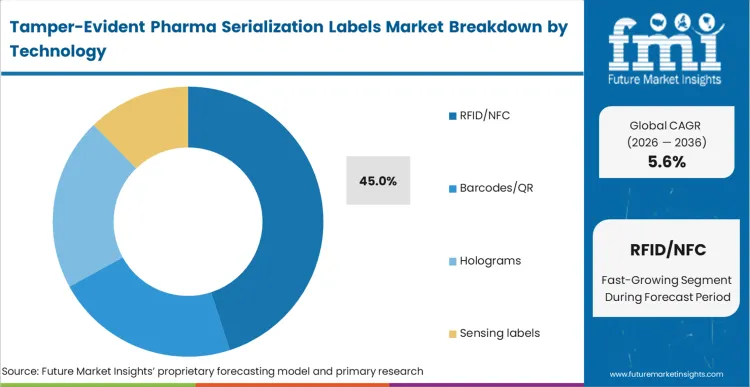
Legacy printed formats prove increasingly vulnerable to sophisticated replication, driving an organized transition toward secure digital alternatives. RFID/NFC platforms capture 45.0% share in 2026 as automated inventory validation becomes mandatory for high-throughput distribution centers. Supply chain architects implementing these technologies dramatically reduce manual scanning bottlenecks during bulk receiving operations. FMI analysts opine that integrating RFID and NFC tracking tags directly into the tamper-seal accelerates processing timelines exponentially. Pharmacy directors implementing touchless receiving protocols avoid severe labor shortages while securing critical medication.
- Automated Reconciliation: Readers capture pallet-level serial data instantly without requiring direct line-of-sight, allowing logistics coordinators to eliminate hours of manual intake.
- Cryptographic Authentication: Smart chips generate dynamic security responses via near-field communication systems, helping brand protection officers intercept falsified products before retail integration.
- Temperature Logging: Advanced active tags record environmental conditions directly alongside the unique identifier, enabling clinical trial managers to continuously validate protocol compliance.
Tamper-Evident Pharma Serialization Labels Market Analysis by End-use Format
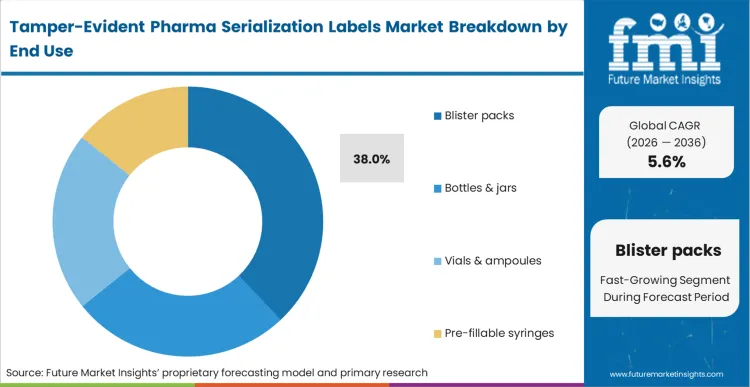
The requirement for strict unit-dose integrity has firmly established specialized packaging constraints as a critical security perimeter. Blister packs represent 38.0% share in 2026, driven by the absolute necessity of protecting individual capsules from moisture and contamination until the moment of consumption. Applying specialized void-reveal seals across these multi-cavity formats prevents undetectable pilferage in institutional healthcare settings. In FMI's view, incorporating blister pack arrays with advanced serialized lidding foil represents the ultimate standard for oral solid dose protection. Retail pharmacy operators demanding irrefutable proof of safety reject shipments lacking these integrated secondary barriers.
- Foil Integration: Specialized adhesives bond aggressively to aluminum lidding without compromising extraction mechanics, ensuring formulation scientists maintain patient accessibility alongside rigorous tamper evidence.
- Micro-Text Printing: High-resolution presses embed microscopic regulatory codes directly onto narrow seams of medical glass vials, allowing production engineers to satisfy rules on minimal surface areas.
- Carton Sealing: Overt destruction markers permanently bridge the primary blister and the outer folding carton, helping regulatory inspectors verify a continuous full-package chain of custody.
Tamper-Evident Pharma Serialization Labels Market Analysis by Application
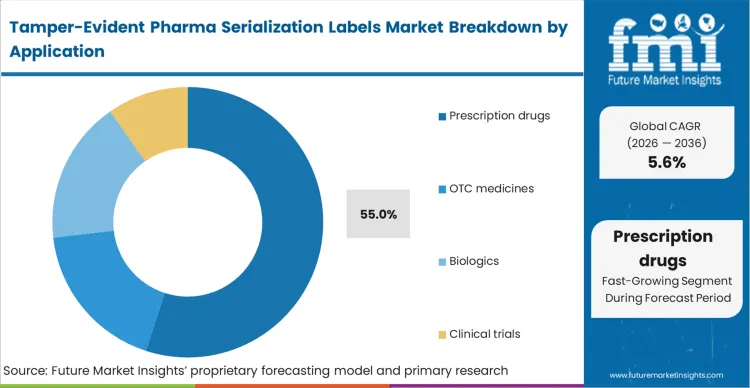
Every prescription drug manufacturer currently faces an escalating matrix of mandatory digital tracking laws to retain their distribution licenses. Prescription drugs secure 55.0% share in 2026 because compliance with national verification systems is a non-negotiable prerequisite for market access. High-value specialized therapeutics uniquely attract sophisticated counterfeit networks, necessitating advanced layered security utilizing biologics containment formats. FMI's research confirms that integrating physical destruction markers with serialized databases creates an impenetrable closed-loop authentication environment. Chief compliance officers failing to implement these synchronized safeguards trigger immediate commercial blockades from federal health agencies.
- Database Synchronization: Printed identifiers correspond directly to centralized governmental tracking repositories, forcing IT infrastructure leads to orchestrate massive daily data exchanges.
- Consumer Verification: Mobile-readable interfaces utilizing pharmaceutical tracking labels empower patients to authenticate specific batches instantly, helping healthcare marketers build unshakeable brand trust.
- Recall Precision: Item-level data allows the targeted withdrawal of specific defective units rather than sweeping general recalls, enabling risk management directors to minimize financial exposure.
Tamper-Evident Pharma Serialization Labels Market Drivers, Restraints, and Opportunities
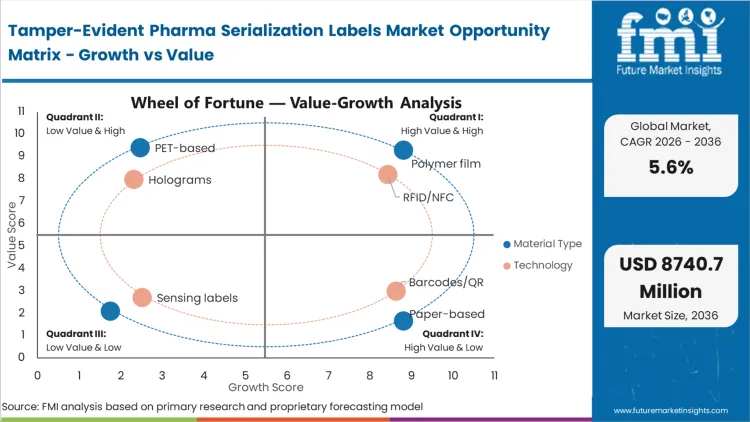
Global legislative mandates requiring complete unit-level tracking fundamentally reshape the commercial packaging environment. Pharmaceutical brand owners facing complex regulatory frameworks must deploy unique identifiers secured by physical tamper-evidence to prevent product diversion. This regulatory trigger forces packaging architects to abandon generic cartons in favor of highly specialized anti-counterfeit technologies. Manufacturers who delay this integration lose the legal right to distribute their medical products in major economies, ensuring continuous label procurement regardless of economic downturns.
Applying intricate void-reveal labels at high speeds introduces significant mechanical friction into modern production lines. Quality control directors utilizing advanced machinery face severe downtime when complex adhesives fail to cure instantly under rapid application, exposing the limits of standard barcode identification stickers. This operational gap limits throughput and elevates manufacturing costs significantly. Facility managers must constantly calibrate equipment tension and heat settings, restricting overall production velocity to accommodate delicate security materials.
Opportunities in the Tamper-Evident Pharma Serialization Labels Market
- Interactive Patient Engagement: Incorporating integrated microchips transforms a passive security marker into a digital communication portal utilizing interactive smart packaging. Marketing directors leverage these smart tags to deliver multimedia dosage instructions directly to patient smartphones.
- Cold-Chain Verification: Specialized biologics demand continuous temperature monitoring alongside robust physical security. Logistics providers integrating thermal-indicator inks into cold chain transit systems command premium pricing from complex oncology drug producers.
- Sustainable Security Substrates: Strict environmental regulations compel packaging designers to abandon problematic mixed-plastic structures. Material scientists who engineer fully recyclable tamper-evident films capture massive contracts from sustainability-focused pharmaceutical giants.
Regional Analysis
Based on the regional analysis, the Tamper-Evident Pharma Serialization Labels market is segmented into North America, Latin America, Europe, East Asia, South Asia, Oceania and Middle East & Africa across 40 plus countries.
.webp "Top Country Growth Comparison Tamper Evident Pharma Serialization Labels Market Cagr (2026 2036)")
| Country | CAGR (2026 to 2036) |
|---|---|
| China | 8.5% |
| India | 8.2% |
| USA | 6.4% |
| Germany | 6.0% |
| UK | 5.8% |
| Japan | 5.1% |
| South Korea | 4.8% |
Source: Future Market Insights (FMI) analysis, based on proprietary forecasting model and primary research
North America Tamper-Evident Pharma Serialization Labels Market Analysis
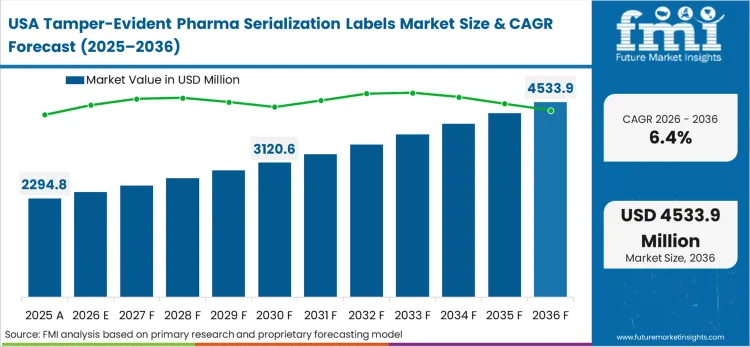
Industrial modernization mandates across North America target the systematic eradication of isolated and vulnerable operational distribution networks. Supply chain architects redesigning legacy distribution frameworks must integrate interoperable digital identifiers protected by overt physical security mechanisms. The concentration of high-value biologic and specialty drug development creates an unparalleled demand for premium, multi-functional label constructions. FMI analysts observe that this environment heavily rewards substrate converters capable of delivering extreme reliability and seamless integration with track and trace database networks.
- USA: The United States pharmaceutical sector enforces strict unit-level tracking through the Drug Supply Chain Security Act. Regulatory compliance officers replacing aging proprietary control systems must deploy converged architectures capable of supporting secure telemetry extraction. Federal infrastructure initiatives actively mandate the replacement of vulnerable basic packaging with standardized, resilient security backbones. The USA's 6.4% compound rate across the forecast decade reflects this mandatory maturation. Logistics directors lacking interoperable serialized security face massive financial penalties and immediate quarantine of critical inventory.
FMI's report includes comprehensive evaluation of the Canadian and Mexican pharmaceutical packaging sectors. The integration of cross-border manufacturing requires standardized security protocols to coordinate complex regional distribution networks efficiently.
Europe Tamper-Evident Pharma Serialization Labels Market Analysis
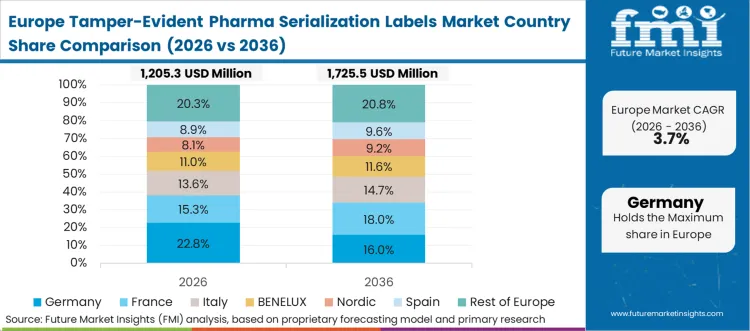
European industrial policy actively dictates the exact structural parameters of secondary packaging security across the entire continent. Pharmaceutical directors face continuous compliance audits verifying the presence and functionality of tamper-evident seals on every prescribed medication. This unified regulatory requirement forces packaging manufacturers to adopt traffic-shaping protocols guaranteeing control stability while utilizing smart label platforms. High consumer awareness regarding medication authenticity amplifies the necessity for flawless physical implementation.
- Germany: Germany's advanced pharmaceutical engineering sector pioneers the integration of complex multi-part labels on highly confined packaging surfaces. Packaging line managers must demonstrate perfect high-speed application of serialized void seals before receiving final production authorization. The national machine tool export sector operates under rigorous safety certifications that mandate unified diagnostic layers, creating a recurring compliance cycle. Germany advances at a 6.0% compound rate as these complex multi-layer security mechanisms proliferate. Label converters failing to supply sustainably sourced, compliant substrates lose priority status in major domestic procurement cycles.
- UK: Post-Brexit regulatory independence in the United Kingdom requires highly adaptable serialization solutions to manage dual-market compliance scenarios seamlessly. Supply chain planners deploy highly flexible digital printing technologies to meet rapidly changing legislative text requirements dynamically. The National Health Service aggressively pursues counterfeit prevention through strict public procurement standards. This continuous legislative adaptation drives a 5.8% annual expansion rate as regulatory conditions evolve structurally. Compliance officers unable to guarantee real-time serialization updates forfeit crucial institutional healthcare contracts.
FMI's report includes thorough investigation of the broader European label manufacturing ecosystem. The mandatory shift toward circular economy principles forces suppliers to invent security markers that do not disrupt the recycling streams of glass and plastic containers.
Asia Pacific Tamper-Evident Pharma Serialization Labels Market Analysis
The aggressive expansion of generic pharmaceutical manufacturing capabilities defines this region's structural demand for advanced packaging security and verification frameworks. National export initiatives force local facilities to preemptively adopt the strictest international serialization standards to ensure global market access is never compromised. The necessity of meeting Western compliance frameworks accelerates the complete replacement of basic paper labels with advanced serialized holographic seals. This dynamic creates a massive, immediate requirement for scalable, high-speed security application technologies across the region.
- China: China's contract manufacturing sector utilizes highly automated production lines demanding robust, tear-resistant security markers for massive output volumes. Greenfield facility architects bypass legacy printing protocols entirely, specifying native deterministic security endpoints for all new packaging contracts. The sheer volume of new factory construction establishes a massive installed base of interoperable communication infrastructure across the eastern industrial corridor. This regulatory mechanism anchors China's 8.5% compound expansion to 2036. Contract packagers who fail to implement zero-defect tamper evidence forfeit lucrative biologic export contracts immediately.
- India: India's pharmaceutical export sector operates under rigorous international pre-approval inspection frameworks requiring immutable physical and electronic batch records. Facility administrators deploy sophisticated track-and-trace security labels to prevent devastating product diversion during global transit operations. The national push to dominate the global generics supply chain triggers widespread packaging modernization across all major production tiers. This intensive compliance pressure drives an 8.2% CAGR for the market in India. Quality assurance directors lacking validated security protocols face total disqualification from crucial Western market tenders.
- Japan: Stringent domestic healthcare regulations in Japan mandate absolute perfection in dosage packaging integrity across all commercial channels. Domestic brand protection leads specify ultra-premium security formats to safeguard high-value therapeutic innovations from sophisticated counterfeiting. Continuous investment in robotic dispensing requires labels that guarantee flawless machine readability under all clinical conditions. This mechanization imperative anchors Japan's 5.1% compound trajectory to 2036 as precision automation scales. Vendor qualification specialists reject labeling suppliers unable to demonstrate perfect multi-year adhesive stability profiles.
- South Korea: Rapid advancement in South Korea's biosimilar production necessitates specialized cold-chain security labeling to protect fragile protein structures. Production engineers deploy extreme-temperature void films to secure temperature-sensitive oncology treatments throughout the delivery lifecycle. Regulatory authorities actively enforce rigorous tracking parameters across the completely modernized domestic supply network. The domestic market expands at a 4.8% CAGR as this strict enforcement mechanism stabilizes into a permanent operational baseline. Procurement officers utilizing substandard adhesives trigger catastrophic batch rejections during automated cold-storage auditing.
FMI's report includes extensive analysis of the emerging Southeast Asian pharmaceutical hubs. Increasing cross-border regulatory harmonization drives coordinated adoption of serialized security formats across ASEAN nations.
Competitive Aligners for Market Players
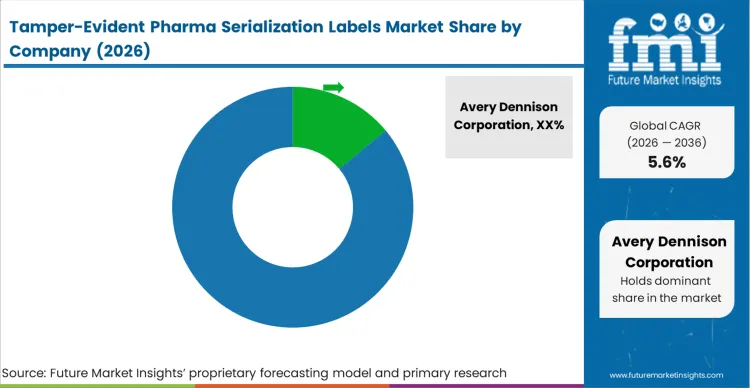
The global pharmaceutical label market remains moderately consolidated among highly specialized multinational material science corporations commanding vast global networks. Supplying global pharmaceutical brands requires massive capital investment in specialized cleanroom manufacturing, strict ISO certifications, and multi-continent distribution capabilities. Companies like Avery Dennison Corporation, CCL Industries Inc., and 3M Company dominate by offering universally compliant material portfolios scaled for international deployment. Procurement teams utilize global supply reliability and demonstrated adherence to strict low-migration ink standards as the primary variables to distinguish qualified from unqualified label converters.
Leading players possess an overwhelming structural advantage through their proprietary adhesive formulations and deep integration with global medical device tracking labels hardware providers. Building a portfolio of FDA-compliant adhesives that cure instantly without bleeding into the packaging substrate requires decades of specialized chemical engineering. Deploying advanced labels tailored for prefilled syringe configurations guarantees seamless integration with automated high-speed application machinery. Challengers must invest heavily in specialized polymer research to replicate this performance, severely limiting successful market entry to exceptionally well-capitalized material science firms.
Large pharmaceutical buyers aggressively prevent vendor lock-in by rigorously qualifying multiple label suppliers for every major global drug program. Procurement teams demand open-architecture security designs that can be printed and applied using standard industry hardware across diverse global sites. This multi-vendor qualification strategy structurally limits the pricing power of dominant label manufacturers, despite the inherently high barriers to entry in developing temperature-controlled shipping formats. Top-tier converters will increasingly acquire specialized technology startups to integrate RFID and digital authentication features, shifting the competitive trajectory toward complete smart-packaging ecosystems over the forecast period.
Key Players in Tamper-Evident Pharma Serialization Labels Market
- Avery Dennison Corporation
- 3M Company
- CCL Industries Inc.
- UPM Raflatac
- Schreiner Group
- Brady Corporation
- Flexcon Company, Inc.
- Essentra plc
Scope of the Report
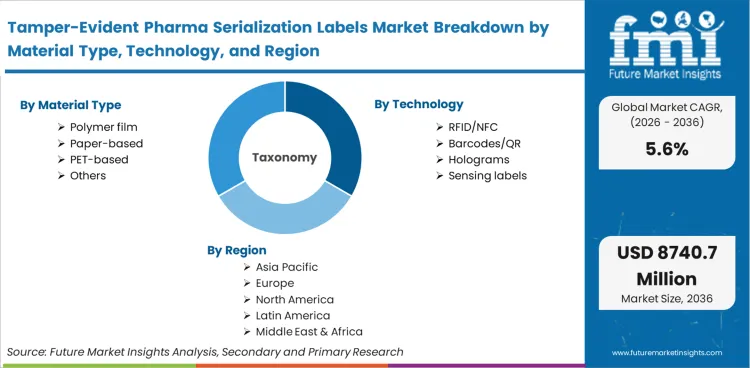
| Metric | Value |
|---|---|
| Quantitative Units | USD 5068.8 million to USD 8740.7 million, at a CAGR of 5.60% |
| Market Definition | Tamper-evident pharma serialization labels are security markers that combine unique digital identifiers with physical destruction mechanisms to secure drug integrity. |
| Material Type Segmentation | Polymer film, Paper-based, PET-based, Others |
| Technology Segmentation | RFID/NFC, Barcodes/QR, Holograms, Sensing labels |
| End-use Format Segmentation | Blister packs, Bottles & jars, Vials & ampoules, Pre-fillable syringes |
| Application Segmentation | Prescription drugs, OTC medicines, Biologics, Clinical trials |
| Regions Covered | North America, Latin America, Europe, East Asia, South Asia, Oceania, Middle East & Africa |
| Countries Covered | China, India, USA, Germany, UK, Japan, South Korea, and 40 plus countries |
| Key Companies Profiled | Avery Dennison Corporation, 3M Company, CCL Industries Inc., UPM Raflatac, Schreiner Group, Brady Corporation, Flexcon Company, Inc., Essentra plc |
| Forecast Period | 2026 to 2036 |
| Approach | Primary interviews with packaging qualification engineers anchor the research. The baseline value derives from a bottom-up aggregation of specialized medical label shipments, projecting adoption against regulatory enforcement dates. Segment forecasts undergo cross-validation against quarterly procurement guidance. |
Source: Future Market Insights (FMI) analysis, based on proprietary forecasting model and primary research
Tamper-Evident Pharma Serialization Labels Market Analysis by Segments
Material Type:
- Polymer film
- Paper-based
- PET-based
- Others
Technology:
- RFID/NFC
- Barcodes/QR
- Holograms
- Sensing labels
End-use Format:
- Blister packs
- Bottles & jars
- Vials & ampoules
- Pre-fillable syringes
Application:
- Prescription drugs
- OTC medicines
- Biologics
- Clinical trials
Region:
- Asia Pacific
- India
- China
- Japan
- South Korea
- Indonesia
- Australia & New Zealand
- ASEAN
- Rest of Asia Pacific
- Europe
- Germany
- Italy
- France
- United Kingdom
- Spain
- Benelux
- Nordics
- Central & Eastern Europe
- Rest of Europe
- North America
- United States
- Canada
- Mexico
- Latin America
- Brazil
- Argentina
- Chile
- Rest of Latin America
- Middle East & Africa
- Kingdom of Saudi Arabia
- United Arab Emirates
- South Africa
- Turkey
- Rest of Middle East & Africa
Bibliography
- USA Food and Drug Administration. (2025). Drug Supply Chain Security Act (DSCSA).
- Medicines and Healthcare products Regulatory Agency. (2024). Windsor Framework explainer.
- GS1 USA (2025). Implementation Guideline for RFID in Healthcare Manufacturing - Using GS1 Standard to Enable Visibility and Efficiency.
- European Union Intellectual Property Office, & Europol. (2024). Uncovering the ecosystem of intellectual property crime.
- Organization for Economic Co-operation and Development, & European Union Intellectual Property Office. (2024). Illicit Trade in Fakes under the COVID-19. OECD Publishing.
- Press Information Bureau, Government of India. (2025). DGFT streamlines export regulations in alignment with the evolving regulatory framework of MoH&FW.
This bibliography is provided for reader reference. The full FMI report contains the complete reference list with primary source documentation.
This Report Addresses
- Market sizing and quantitative forecast metrics detailing the commercial demand for tamper-evident pharma serialization labels across pharmaceutical packaging ecosystems through 2036.
- Segmentation analysis mapping adoption patterns across material types, authentication technologies, end-use formats, and therapeutic applications driving label specification upgrades.
- Regional deployment intelligence comparing export-led serialization expansion in Asia Pacific with compliance-driven packaging modernization across North America and Europe.
- Regulatory compliance assessment analyzing how unit-level traceability laws, anti-counterfeiting mandates, and drug integrity requirements are accelerating demand for irreversible physical authentication markers.
- Competitive posture evaluation tracking how global label converters differentiate through adhesive performance, cold-chain durability, RFID integration, and scalable pharmaceutical-grade manufacturing capabilities.
- Packaging line strategic guidance defining the substrate, curing, adhesion, and machine-application requirements needed to support high-speed serialization without false tamper alerts.
- Supply chain vulnerability analysis identifying the mechanical, material, and qualification bottlenecks that can delay packaging line conversions and restrict biologic export readiness.
- Custom data delivery formats encompassing interactive dashboards, raw Excel datasets, and comprehensive PDF narrative reports.
Frequently Asked Questions
How large is the demand for Tamper-Evident Pharma Serialization Labels in the global market in 2026?
Demand for Tamper-Evident Pharma Serialization Labels in the global market is estimated to be valued at USD 5068.8 million in 2026.
What will be the market size of Tamper-Evident Pharma Serialization Labels in the global market by 2036?
Market size for Tamper-Evident Pharma Serialization Labels is projected to reach USD 8740.7 million by 2036.
What is the expected demand growth for Tamper-Evident Pharma Serialization Labels in the global market between 2026 and 2036?
Demand for Tamper-Evident Pharma Serialization Labels is expected to grow at a CAGR of 5.60% between 2026 and 2036.
Which Material Type is poised to lead global sales by 2026?
Polymer film accounts for 62.0% in 2026 as cold-chain logistics directors require substrates that resist moisture degradation and cryogenic shattering.
How significant is the role of RFID/NFC in driving Tamper-Evident Pharma Serialization Labels adoption in 2026?
RFID/NFC represents 45.0% of segment share as high-throughput distribution centers shift toward automated and touchless inventory verification.
What is driving demand in China?
China's contract manufacturing sector utilizes highly automated production lines demanding robust and tear-resistant security markers to satisfy stringent export compliance requirements.
What compliance standards or regulations are referenced for Germany?
Germany's pharmaceutical packaging environment is shaped by strict compliance audits and recurring quality control requirements for high-speed application of serialized void seals.
What is the China growth outlook in this report?
China is projected to grow at a CAGR of 8.5% during 2026 to 2036.
Why is North America described as a priority region in this report?
The North American pharmaceutical sector prioritizes secure and interoperable item-level tracking systems to strengthen biologic supply chains and eliminate distribution vulnerabilities.
What type of demand dominates in North America?
Demand heavily focuses on premium multifunctional label constructions that combine overt physical tamper evidence with seamless track-and-trace integration.
What is India's growth outlook in this report?
India is projected to expand at a CAGR of 8.2% during 2026 to 2036.
Does the report cover USA in its regional analysis?
Yes, USA is included within North America under the regional scope of analysis.
What are the sources referred to for analyzing USA?
Federal supply chain security acts, public compliance programs, and pharmaceutical packaging modernization frameworks form the analytical basis.
What is the main demand theme linked to USA in its region coverage?
Strict unit-level traceability under the Drug Supply Chain Security Act forces the deployment of converged digital and physical security architectures.
Does the report cover Germany in its regional analysis?
Yes, Germany is included within Europe under the regional coverage framework.
What is the main Germany related demand theme in its region coverage?
Perfect high-speed application of serialized void seals on highly confined packaging surfaces defines the central demand theme in Germany.
Which product formats or configurations are strategically important for Asia Pacific supply chains?
Serialized holographic seals, tear-resistant security markers, and high-speed track-and-trace label application technologies are strategically important for Asia Pacific supply chains.
What is Tamper-Evident Pharma Serialization Labels and what is it mainly used for?
Tamper-Evident Pharma Serialization Labels are specialized security markers that combine irreversible physical tamper evidence with unique digital identifiers and are mainly used to secure drug authenticity and integrity across the supply chain.
What does Tamper-Evident Pharma Serialization Labels mean in this report?
The scope encompasses physical security labels that fuse structural tamper mechanisms with variable data printing to enable item-level pharmaceutical authentication.
What is included in the scope of this Tamper-Evident Pharma Serialization Labels report?
The market covers destructible polymer films, void-reveal adhesives, integrated RFID tags, serialized seals, hardware-encoded NFC inlays, and temperature-sensitive indicator tags designed for pharmaceutical packaging.
What is excluded from the scope of this report?
Standard commercial barcode stickers without tamper-evidence, decorative secondary packaging, unprinted sealing tapes, software track-and-trace systems, and general logistics labels are explicitly excluded.
What does market forecast mean on this page?
The market forecast represents a model-based projection built on regulatory enforcement timelines, packaging modernization curves, and adoption of advanced pharmaceutical authentication systems for strategic planning purposes.
How does FMI build and validate the Tamper-Evident Pharma Serialization Labels forecast?
The model applies a bottom-up methodology starting with specialized medical label shipments and installed compliance hardware metrics, then cross-validates projections against capital expenditure guidance and quarterly procurement data.
What does zero reliance on speculative third-party market research mean here?
Primary interviews, public regulatory documentation, anti-counterfeiting roadmaps, and verified shipment and procurement data are used instead of unverified syndicated estimates.
Preview the report firsthand - request a free sample
Get SampleGet the brochure for pricing and purchase details.
Get PDFTable of Content
- Executive Summary
- Global Market Outlook
- Demand-side Trends
- Supply-side Trends
- Technology Roadmap Analysis
- Analysis and Recommendations
- Market Overview
- Market Coverage / Taxonomy
- Market Definition / Scope / Limitations
- Research Methodology
- Chapter Orientation
- Analytical Lens and Working Hypotheses
- Market Structure, Signals, and Trend Drivers
- Benchmarking and Cross-market Comparability
- Market Sizing, Forecasting, and Opportunity Mapping
- Research Design and Evidence Framework
- Desk Research Programme (Secondary Evidence)
- Company Annual and Sustainability Reports
- Peer-reviewed Journals and Academic Literature
- Corporate Websites, Product Literature, and Technical Notes
- Earnings Decks and Investor Briefings
- Statutory Filings and Regulatory Disclosures
- Technical White Papers and Standards Notes
- Trade Journals, Industry Magazines, and Analyst Briefs
- Conference Proceedings, Webinars, and Seminar Materials
- Government Statistics Portals and Public Data Releases
- Press Releases and Reputable Media Coverage
- Specialist Newsletters and Curated Briefings
- Sector Databases and Reference Repositories
- FMI Internal Proprietary Databases and Historical Market Datasets
- Subscription Datasets and Paid Sources
- Social Channels, Communities, and Digital Listening Inputs
- Additional Desk Sources
- Expert Input and Fieldwork (Primary Evidence)
- Primary Modes
- Qualitative Interviews and Expert Elicitation
- Quantitative Surveys and Structured Data Capture
- Blended Approach
- Why Primary Evidence is Used
- Field Techniques
- Interviews
- Surveys
- Focus Groups
- Observational and In-context Research
- Social and Community Interactions
- Stakeholder Universe Engaged
- C-suite Leaders
- Board Members
- Presidents and Vice Presidents
- R&D and Innovation Heads
- Technical Specialists
- Domain Subject-matter Experts
- Scientists
- Physicians and Other Healthcare Professionals
- Governance, Ethics, and Data Stewardship
- Research Ethics
- Data Integrity and Handling
- Primary Modes
- Tooling, Models, and Reference Databases
- Desk Research Programme (Secondary Evidence)
- Data Engineering and Model Build
- Data Acquisition and Ingestion
- Cleaning, Normalisation, and Verification
- Synthesis, Triangulation, and Analysis
- Quality Assurance and Audit Trail
- Market Background
- Market Dynamics
- Drivers
- Restraints
- Opportunity
- Trends
- Scenario Forecast
- Demand in Optimistic Scenario
- Demand in Likely Scenario
- Demand in Conservative Scenario
- Opportunity Map Analysis
- Product Life Cycle Analysis
- Supply Chain Analysis
- Investment Feasibility Matrix
- Value Chain Analysis
- PESTLE and Porter’s Analysis
- Regulatory Landscape
- Regional Parent Market Outlook
- Production and Consumption Statistics
- Import and Export Statistics
- Market Dynamics
- Global Market Analysis 2021 to 2025 and Forecast, 2026 to 2036
- Historical Market Size Value (USD Million) Analysis, 2021 to 2025
- Current and Future Market Size Value (USD Million) Projections, 2026 to 2036
- Y-o-Y Growth Trend Analysis
- Absolute $ Opportunity Analysis
- Global Market Pricing Analysis 2021 to 2025 and Forecast 2026 to 2036
- Global Market Analysis 2021 to 2025 and Forecast 2026 to 2036, By Material Type
- Introduction / Key Findings
- Historical Market Size Value (USD Million) Analysis By Material Type , 2021 to 2025
- Current and Future Market Size Value (USD Million) Analysis and Forecast By Material Type , 2026 to 2036
- Polymer film
- Paper-based
- PET-based
- Others
- Polymer film
- Y-o-Y Growth Trend Analysis By Material Type , 2021 to 2025
- Absolute $ Opportunity Analysis By Material Type , 2026 to 2036
- Global Market Analysis 2021 to 2025 and Forecast 2026 to 2036, By Technology
- Introduction / Key Findings
- Historical Market Size Value (USD Million) Analysis By Technology, 2021 to 2025
- Current and Future Market Size Value (USD Million) Analysis and Forecast By Technology, 2026 to 2036
- RFID/NFC
- Barcodes/QR
- Holograms
- Sensing labels
- RFID/NFC
- Y-o-Y Growth Trend Analysis By Technology, 2021 to 2025
- Absolute $ Opportunity Analysis By Technology, 2026 to 2036
- Global Market Analysis 2021 to 2025 and Forecast 2026 to 2036, By End Use
- Introduction / Key Findings
- Historical Market Size Value (USD Million) Analysis By End Use, 2021 to 2025
- Current and Future Market Size Value (USD Million) Analysis and Forecast By End Use, 2026 to 2036
- Blister packs
- Bottles & jars
- Vials & ampoules
- Pre-fillable syringes
- Blister packs
- Y-o-Y Growth Trend Analysis By End Use, 2021 to 2025
- Absolute $ Opportunity Analysis By End Use, 2026 to 2036
- Global Market Analysis 2021 to 2025 and Forecast 2026 to 2036, By Application
- Introduction / Key Findings
- Historical Market Size Value (USD Million) Analysis By Application, 2021 to 2025
- Current and Future Market Size Value (USD Million) Analysis and Forecast By Application, 2026 to 2036
- Prescription drugs
- OTC medicines
- Biologics
- Clinical trials
- Prescription drugs
- Y-o-Y Growth Trend Analysis By Application, 2021 to 2025
- Absolute $ Opportunity Analysis By Application, 2026 to 2036
- Global Market Analysis 2021 to 2025 and Forecast 2026 to 2036, By Region
- Introduction
- Historical Market Size Value (USD Million) Analysis By Region, 2021 to 2025
- Current Market Size Value (USD Million) Analysis and Forecast By Region, 2026 to 2036
- North America
- Latin America
- Western Europe
- Eastern Europe
- East Asia
- South Asia and Pacific
- Middle East & Africa
- Market Attractiveness Analysis By Region
- North America Market Analysis 2021 to 2025 and Forecast 2026 to 2036, By Country
- Historical Market Size Value (USD Million) Trend Analysis By Market Taxonomy, 2021 to 2025
- Market Size Value (USD Million) Forecast By Market Taxonomy, 2026 to 2036
- By Country
- USA
- Canada
- Mexico
- By Material Type
- By Technology
- By End Use
- By Application
- By Country
- Market Attractiveness Analysis
- By Country
- By Material Type
- By Technology
- By End Use
- By Application
- Key Takeaways
- Latin America Market Analysis 2021 to 2025 and Forecast 2026 to 2036, By Country
- Historical Market Size Value (USD Million) Trend Analysis By Market Taxonomy, 2021 to 2025
- Market Size Value (USD Million) Forecast By Market Taxonomy, 2026 to 2036
- By Country
- Brazil
- Chile
- Rest of Latin America
- By Material Type
- By Technology
- By End Use
- By Application
- By Country
- Market Attractiveness Analysis
- By Country
- By Material Type
- By Technology
- By End Use
- By Application
- Key Takeaways
- Western Europe Market Analysis 2021 to 2025 and Forecast 2026 to 2036, By Country
- Historical Market Size Value (USD Million) Trend Analysis By Market Taxonomy, 2021 to 2025
- Market Size Value (USD Million) Forecast By Market Taxonomy, 2026 to 2036
- By Country
- Germany
- UK
- Italy
- Spain
- France
- Nordic
- BENELUX
- Rest of Western Europe
- By Material Type
- By Technology
- By End Use
- By Application
- By Country
- Market Attractiveness Analysis
- By Country
- By Material Type
- By Technology
- By End Use
- By Application
- Key Takeaways
- Eastern Europe Market Analysis 2021 to 2025 and Forecast 2026 to 2036, By Country
- Historical Market Size Value (USD Million) Trend Analysis By Market Taxonomy, 2021 to 2025
- Market Size Value (USD Million) Forecast By Market Taxonomy, 2026 to 2036
- By Country
- Russia
- Poland
- Hungary
- Balkan & Baltic
- Rest of Eastern Europe
- By Material Type
- By Technology
- By End Use
- By Application
- By Country
- Market Attractiveness Analysis
- By Country
- By Material Type
- By Technology
- By End Use
- By Application
- Key Takeaways
- East Asia Market Analysis 2021 to 2025 and Forecast 2026 to 2036, By Country
- Historical Market Size Value (USD Million) Trend Analysis By Market Taxonomy, 2021 to 2025
- Market Size Value (USD Million) Forecast By Market Taxonomy, 2026 to 2036
- By Country
- China
- Japan
- South Korea
- By Material Type
- By Technology
- By End Use
- By Application
- By Country
- Market Attractiveness Analysis
- By Country
- By Material Type
- By Technology
- By End Use
- By Application
- Key Takeaways
- South Asia and Pacific Market Analysis 2021 to 2025 and Forecast 2026 to 2036, By Country
- Historical Market Size Value (USD Million) Trend Analysis By Market Taxonomy, 2021 to 2025
- Market Size Value (USD Million) Forecast By Market Taxonomy, 2026 to 2036
- By Country
- India
- ASEAN
- Australia & New Zealand
- Rest of South Asia and Pacific
- By Material Type
- By Technology
- By End Use
- By Application
- By Country
- Market Attractiveness Analysis
- By Country
- By Material Type
- By Technology
- By End Use
- By Application
- Key Takeaways
- Middle East & Africa Market Analysis 2021 to 2025 and Forecast 2026 to 2036, By Country
- Historical Market Size Value (USD Million) Trend Analysis By Market Taxonomy, 2021 to 2025
- Market Size Value (USD Million) Forecast By Market Taxonomy, 2026 to 2036
- By Country
- Kingdom of Saudi Arabia
- Other GCC Countries
- Turkiye
- South Africa
- Other African Union
- Rest of Middle East & Africa
- By Material Type
- By Technology
- By End Use
- By Application
- By Country
- Market Attractiveness Analysis
- By Country
- By Material Type
- By Technology
- By End Use
- By Application
- Key Takeaways
- Key Countries Market Analysis
- USA
- Pricing Analysis
- Market Share Analysis, 2025
- By Material Type
- By Technology
- By End Use
- By Application
- Canada
- Pricing Analysis
- Market Share Analysis, 2025
- By Material Type
- By Technology
- By End Use
- By Application
- Mexico
- Pricing Analysis
- Market Share Analysis, 2025
- By Material Type
- By Technology
- By End Use
- By Application
- Brazil
- Pricing Analysis
- Market Share Analysis, 2025
- By Material Type
- By Technology
- By End Use
- By Application
- Chile
- Pricing Analysis
- Market Share Analysis, 2025
- By Material Type
- By Technology
- By End Use
- By Application
- Germany
- Pricing Analysis
- Market Share Analysis, 2025
- By Material Type
- By Technology
- By End Use
- By Application
- UK
- Pricing Analysis
- Market Share Analysis, 2025
- By Material Type
- By Technology
- By End Use
- By Application
- Italy
- Pricing Analysis
- Market Share Analysis, 2025
- By Material Type
- By Technology
- By End Use
- By Application
- Spain
- Pricing Analysis
- Market Share Analysis, 2025
- By Material Type
- By Technology
- By End Use
- By Application
- France
- Pricing Analysis
- Market Share Analysis, 2025
- By Material Type
- By Technology
- By End Use
- By Application
- India
- Pricing Analysis
- Market Share Analysis, 2025
- By Material Type
- By Technology
- By End Use
- By Application
- ASEAN
- Pricing Analysis
- Market Share Analysis, 2025
- By Material Type
- By Technology
- By End Use
- By Application
- Australia & New Zealand
- Pricing Analysis
- Market Share Analysis, 2025
- By Material Type
- By Technology
- By End Use
- By Application
- China
- Pricing Analysis
- Market Share Analysis, 2025
- By Material Type
- By Technology
- By End Use
- By Application
- Japan
- Pricing Analysis
- Market Share Analysis, 2025
- By Material Type
- By Technology
- By End Use
- By Application
- South Korea
- Pricing Analysis
- Market Share Analysis, 2025
- By Material Type
- By Technology
- By End Use
- By Application
- Russia
- Pricing Analysis
- Market Share Analysis, 2025
- By Material Type
- By Technology
- By End Use
- By Application
- Poland
- Pricing Analysis
- Market Share Analysis, 2025
- By Material Type
- By Technology
- By End Use
- By Application
- Hungary
- Pricing Analysis
- Market Share Analysis, 2025
- By Material Type
- By Technology
- By End Use
- By Application
- Kingdom of Saudi Arabia
- Pricing Analysis
- Market Share Analysis, 2025
- By Material Type
- By Technology
- By End Use
- By Application
- Turkiye
- Pricing Analysis
- Market Share Analysis, 2025
- By Material Type
- By Technology
- By End Use
- By Application
- South Africa
- Pricing Analysis
- Market Share Analysis, 2025
- By Material Type
- By Technology
- By End Use
- By Application
- USA
- Market Structure Analysis
- Competition Dashboard
- Competition Benchmarking
- Market Share Analysis of Top Players
- By Regional
- By Material Type
- By Technology
- By End Use
- By Application
- Competition Analysis
- Competition Deep Dive
- Avery Dennison Corporation
- Overview
- Product Portfolio
- Profitability by Market Segments (Product/Age /Sales Channel/Region)
- Sales Footprint
- Strategy Overview
- Marketing Strategy
- Product Strategy
- Channel Strategy
- 3M Company
- CCL Industries Inc.
- UPM Raflatac
- Schreiner Group
- Brady Corporation
- Flexcon Company, Inc.
- Essentra plc
- Avery Dennison Corporation
- Competition Deep Dive
- Assumptions & Acronyms Used


