

- Market Size (2026)
- USD 0.8 Bn
- Forecast (2036)
- USD 1.7 Bn
- CAGR (2026 to 2036)
- 7.8%
Cold Disposable Biopsy Forceps Market Size, Market Forecast and Outlook By FMI
The cold disposable biopsy forceps market was valued at USD 0.7 billion in 2025. The market is set to reach USD 0.8 billion by 2026-end and grow at a CAGR of 7.8% between 2026-2036 to reach USD 1.7 billion by 2036. Cup Biopsy Forceps will dominate with a 64.0% share, while Small Diameter will lead with a 57.0% share.
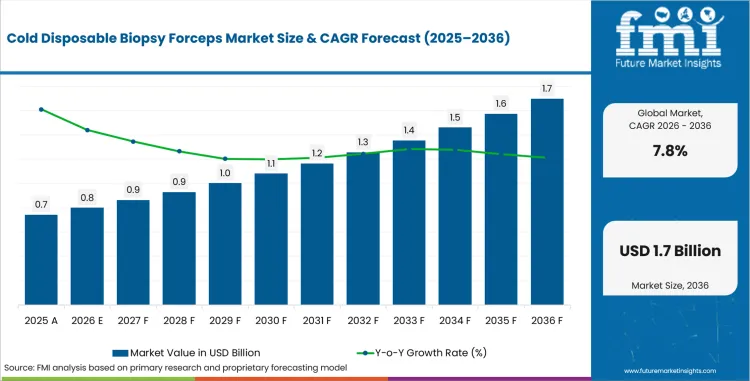
Cold Disposable Biopsy Forceps Market Overview: Size and Forecast
- Cold Disposable Biopsy Forceps Market Value (2026): USD 0.8 Bn
- Cold Disposable Biopsy Forceps Market Forecast Value (2036): USD 1.7 Bn
- Cold Disposable Biopsy Forceps Market Forecast CAGR (2026 to 2036): 7.8%
- Cold Disposable Biopsy Forceps Market Leading Product: Cup Biopsy Forceps (64.0%)
- Cold Disposable Biopsy Forceps Market Key Growth Regions: USA, UK, EU, Japan, South Korea
- Cold Disposable Biopsy Forceps Market Key Players: Boston Scientific Corporation, Olympus Corporation, Cook Medical, ConMed Corporation, Medline Industries, Inc.
| Parameter | Details |
|---|---|
| Market Size in 2026 (Value) | USD 0.8 Bn |
| Market Forecast in 2036 (Value) | USD 1.7 Bn |
| CAGR (2026 to 2036) | 7.8% |
| Years Considered | 2021 to 2036 |
| Base Year | 2025 |
| Forecast Period | 2026 to 2036 |
| Units Considered | Value (USD Bn) |
| Leading Sub-Region | USA |
Summary of the Cold Disposable Biopsy Forceps Market
- Demand and Growth Drivers
- Regulatory compliance requirements and hospital procurement cycles are expected to sustain demand for cold disposable biopsy forceps products as healthcare facilities upgrade equipment to meet updated standards.
- Aging population demographics across North America, Europe, and East Asia are projected to support steady adoption rates through the forecast period.
- Cost containment pressure in institutional healthcare settings is shifting procurement toward products that reduce per-procedure costs and improve clinical throughput.
- Product and Segment View
- Cup Biopsy Forceps is expected to account for 64.0% of the product segment in 2026, supported by established procurement patterns and end-use demand across commercial and institutional applications.
- Needle Biopsy Forceps is projected to gain share during the forecast period as clinical applications expand across emerging markets and specialized use cases.
- By length, Short Length is expected to remain the primary demand driver, reflecting established consumption patterns and supply chain structures.
- Geography and Competitive Outlook
- USA is projected to lead growth at 4.2% through 2036, supported by expanding healthcare infrastructure and regulatory frameworks.
- Japan at 3.9% reflects strong institutional demand and regulatory compliance culture during the forecast period.
- Companies with established manufacturing footprints and direct procurement relationships across high-growth regions are positioned to capture incremental volume during the forecast period.
- Analyst Opinion
- Anurag Sharma, Principal Consultant at FMI says, 'Companies that can align product portfolios with evolving regulatory requirements and institutional procurement standards are expected to strengthen market positioning through 2036.'
- The cold disposable biopsy forceps market is transitioning from a volume-driven phase into a value-driven phase where product performance, compliance readiness, and total cost of ownership are becoming primary procurement criteria.
- Adoption is increasing due to regulatory tightening, end-use sector expansion, and the replacement of legacy systems and products that no longer meet updated specifications.
- Demand is further supported by procurement consolidation among large-scale buyers and growing preference for suppliers with integrated manufacturing and distribution capabilities.
Cold Disposable Biopsy Forceps Market Definition
The cold disposable biopsy forceps market encompasses products, solutions, and services used across clinical, institutional, and commercial healthcare applications. The market covers all commercially traded cold disposable biopsy forceps products classified by product, diameter, length, application, end use, distribution channel, serving end-use sectors that require standardized performance, regulatory compliance, and supply reliability.
Cold Disposable Biopsy Forceps Market Inclusions
Market scope encompasses all commercially traded cold disposable biopsy forceps products categorized by product (Cup Biopsy Forceps, Needle Biopsy Forceps), diameter (Small Diameter, Medium Diameter, Large Diameter), length (Short Length, Medium Length, Long Length), application (Gastrointestinal Endoscopy, Small Bowel Endoscopy, Pulmonary Endoscopy), end use (Hospitals, Ambulatory Surgical Centers, Specialty Clinics, Diagnostic Laboratories, Research Institutes), distribution channel (Direct Sales, Distributor Sales, Online Sales). Revenue estimates cover the period from 2026 to 2036 across all regions and distribution channels.
Cold Disposable Biopsy Forceps Market Exclusions
The scope does not include custom-engineered or one-off products outside standard commercial distribution, raw materials sold as unprocessed inputs, or services not directly tied to cold disposable biopsy forceps product procurement and deployment.
Cold Disposable Biopsy Forceps Market Research Methodology
- Primary Research: FMI analysts conducted interviews with manufacturers, distributors, procurement specialists and end-use operators in key markets to validate market demand patterns and pricing structures.
- Desk Research: Established baseline market parameters using trade statistics, regulatory filings, industry associations’ publications and manufacturers’ disclosures.
- Market Sizing & Forecasting: Bottom-up aggregation by product, diameter and regional adoption curves, triangulated against top-down macro indicators.
- Data Validation: Quarterly cross-check with production statistics, trade flow data and manufacturer revenue disclosures.
Why is the Cold Disposable Biopsy Forceps Market Growing?
- Regulatory compliance upgrades and aging population demographics are driving sustained procurement demand for cold disposable biopsy forceps products across established and emerging markets.
- USA is the leading country in terms of growth at 4.2% owing to growing institutional healthcare capacity and device procurement during the forecast period.
- Cup Biopsy Forceps leads the product segment with a 64.0% share, driven by robust demand patterns and widespread commercial applicability in clinical settings.
The cold disposable biopsy forceps market is expected to be valued at USD 0.8 Bn in 2026 and is expected to reach USD 1.7 Bn by 2036, at a CAGR of 7.8% during the forecast period. The growth is driven by the increasing healthcare infrastructure, rising regulatory requirements, and growing adoption of standardized medical products in institutional settings. The incremental opportunity of USD 0.9 Bn between 2026 and 2036 is the cumulative impact of replacement cycles, capacity additions and geographic expansion of procurement networks.
The largest product category is Cup Biopsy Forceps, with a market share of 64.0% in 2026. In this segment demand is concentrated in hospital, clinic and laboratory settings where standardized product performance and regulatory approval are prerequisites for procurement. Needle Biopsy Forceps are identified as a secondary growth category, gaining share as the end-use applications are proliferated into specialized and emerging use cases.
Geographically, USA leads the market at 4.2% with a regulatory pathway of FDA and 510(k) clearances. Japan (3.9%) includes PMDA regulatory pathways and Shonin approval processes. Demand continues supported through replacement cycles, regulatory upgrades and institutional buying in established markets of North America and Western Europe.
Market Segmentation Analysis
- Cup Biopsy Forceps leads the product segment at 64.0% in 2026, reflecting established procurement patterns across clinical and institutional applications.
- By diameter, Small Diameter is the primary demand category, supported by broad applicability across end-use sectors.
- Length structures reflect procurement channel preferences, with direct supply relationships dominating high-volume institutional demand.
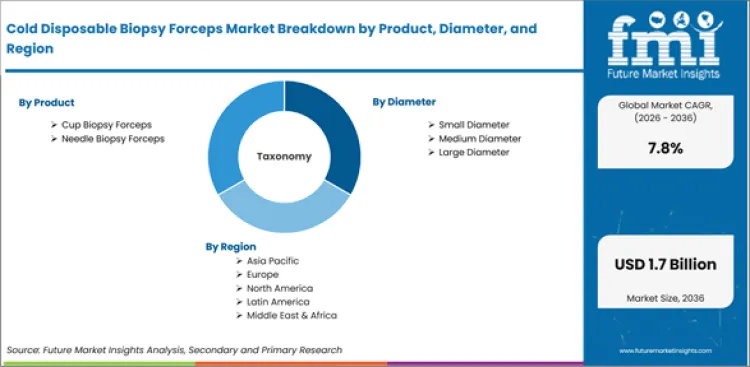
The cold disposable biopsy forceps market is segmented by product, diameter, length, application, end use, distribution channel. Product segmentation reflects the product taxonomy used in commercial procurement, with Cup Biopsy Forceps, Needle Biopsy Forceps as the primary categories. Diameter segmentation captures differentiated demand across Small Diameter, Medium Diameter, Large Diameter.
Insights into the Cup Biopsy Forceps Segment
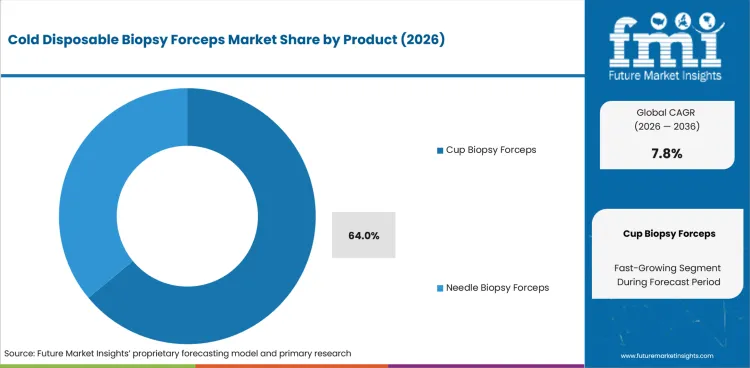
Cup Biopsy Forceps is the largest segment in 2026 with a market share of 64.0%. Demand for Cup Biopsy Forceps is well established across hospitals, clinics and diagnostic centers. Major sub-categories are Oval Cup, Smooth Edge, Serrated Edge to cater to different end use requirements.
Cup biopsy forceps, Procurement patterns depend on clinical protocol requirements, reimbursement structures and institutional purchasing cycles. The forecast period is expected to witness reflective growth in replacement demand in the established markets as well as capacity additions in the emerging regions.
Insights into the Needle Biopsy Forceps Segment
Product segment is positioned as a growth category with expanding applications in specialized clinical and diagnostic settings supported by the needle biopsy forceps. Sub-categories include Oval Cup with Needle, Single Action Needle, Double Action Needle to address differentiated performance and compliance requirements.
The increasing number of clinical protocols, regulatory updates and need for precision-oriented products are driving the demand for needle biopsy forceps. The segment is expected to grow on the back of the new installations and upgrades of existing systems during the forecast period.
Cold Disposable Biopsy Forceps Market Drivers, Restraints, and Opportunities
- Regulatory compliance, hospital modernization, and aging demographics are the primary structural drivers supporting demand through 2036.
- Reimbursement constraints and pricing pressure in institutional procurement represent the main demand-side restraints during the forecast period.
- Emerging market healthcare expansion and point-of-care adoption are expected to create incremental procurement opportunities.
The cold disposable biopsy forceps market is supported by a combination of structural demand drivers, regulatory mandates, and end-use sector expansion that together create a sustained procurement environment through 2036. Restraints include input cost pressures, supply chain concentration risks, and regulatory compliance costs that constrain adoption in price-sensitive market segments.
Regulatory and Compliance-Driven Procurement
Demand is being driven by evolving regulatory requirements across the FDA, EU MDR and regional medical device frameworks. Procurement cycles are recurrent as manufacturers and healthcare facilities comply with updated standards (e.g. product specification updates, labeling requirements, post-market surveillance mandates).
Institutional Replacement and Modernization Cycles
Growth reflects aging installed bases in hospitals and laboratories in North America, Europe and East Asia. During the forecast period, demand is being generated by facilities replacing legacy systems and products to meet updated safety, efficiency, and interoperability standards.
Emerging Market Healthcare Expansion
Investment in healthcare infrastructure in China, India and Southeast Asia is driving growth in adoption. Standardized medical products and devices are finding new procurement channels thanks to government programs, private hospital expansion and growing insurance coverage.
Analysis of Cold Disposable Biopsy Forceps Market By Key Countries
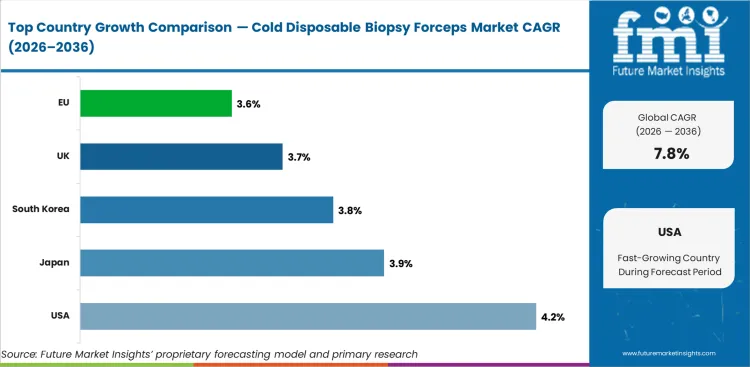
.webp "Top Country Growth Comparison Cold Disposable Biopsy Forceps Market Cagr (2026 2036)")
| Country | CAGR |
|---|---|
| USA | 4.2% |
| Japan | 3.9% |
| South Korea | 3.8% |
| UK | 3.7% |
| EU | 3.6% |
- USA at 4.2% reflects FDA regulatory pathways and 510(k) clearances.
- Japan at 3.9% reflects aging population driving sustained device demand.
- South Korea at 3.8% reflects domestic OEM positions in precision manufacturing.
- UK at 3.7% reflects hospital modernization and digital health integration.
The global cold disposable biopsy forceps market is projected to expand at 7.8% from 2026 to 2036. The study covers more than 30 countries, and the primary markets are listed below.
Demand Outlook for Cold Disposable Biopsy Forceps Market in USA
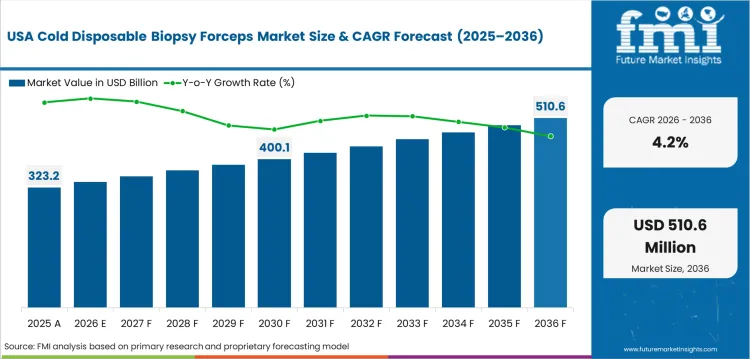
Demand for cold disposable biopsy forceps in USA is concentrated in institutional healthcare and diagnostic applications, with the market projected to grow at 4.2% through 2036. Growth is attributable to FDA regulatory pathways and 510(k) clearances and antibiotic stewardship mandates and hospital procurement protocols.
- FDA regulatory pathways and 510(k) clearances is generating procurement demand for cup biopsy forceps across clinical and institutional channels.
- Antibiotic stewardship mandates and hospital procurement protocols supports adoption of needle biopsy forceps as end-use requirements expand.
- Medicare and Medicaid reimbursement structures is expected to create incremental volume for small diameter applications during the forecast period.
Future Outlook for Cold Disposable Biopsy Forceps Market in Japan
PMDA regulatory pathways and Shonin approval processes in Japan is creating sustained procurement demand for cold disposable biopsy forceps, with the market expanding at 3.9% through 2036. Aging population driving sustained device demand further support adoption across end-use sectors.
- PMDA regulatory pathways and Shonin approval processes is generating procurement demand for cup biopsy forceps across clinical and institutional channels.
- Aging population driving sustained device demand supports adoption of needle biopsy forceps as end-use requirements expand.
- Hospital automation and precision care investment is expected to create incremental volume for small diameter applications during the forecast period.
Opportunity Analysis of Cold Disposable Biopsy Forceps Market in South Korea
South Korea's healthcare infrastructure supports a growth rate of 3.8% through 2036. Procurement patterns reflect MFDS regulatory pathways for medical devices and domestic OEM positions in precision manufacturing.
- MFDS regulatory pathways for medical devices is generating procurement demand for cup biopsy forceps across clinical and institutional channels.
- Advanced hospital infrastructure and high device adoption supports adoption of needle biopsy forceps as end-use requirements expand.
- Domestic OEM positions in precision manufacturing is expected to create incremental volume for small diameter applications during the forecast period.
In-depth Analysis of Cold Disposable Biopsy Forceps Market in UK
Regulatory requirements in UK are shaping procurement demand for cold disposable biopsy forceps, with the market growing at 3.7% through 2036. Post-Brexit regulatory alignment with MHRA pathways and aging population demographics driving device demand are the primary demand-side factors.
- NHS procurement frameworks and NICE assessments is generating procurement demand for cup biopsy forceps across clinical and institutional channels.
- Post-Brexit regulatory alignment with MHRA pathways supports adoption of needle biopsy forceps as end-use requirements expand.
- Aging population demographics driving device demand is expected to create incremental volume for small diameter applications during the forecast period.
Sales Analysis of Cold Disposable Biopsy Forceps Market in EU
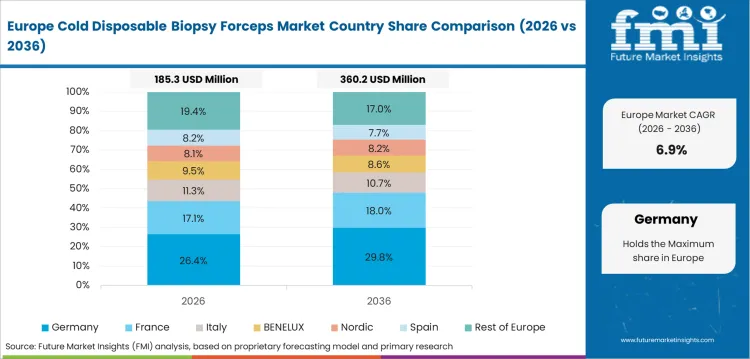
Infrastructure investment in EU is supporting cold disposable biopsy forceps demand at 3.6% through 2036. Growth is led by EU MDR regulatory transition driving device re-certification and centralized procurement across member state hospital systems.
- EU MDR regulatory transition driving device re-certification are generating procurement demand for cup biopsy forceps across clinical and institutional channels.
- Centralized procurement across member state hospital systems support adoption of needle biopsy forceps as end-use requirements expand.
- Strong regulatory compliance culture increasing adoption costs are expected to create incremental volume for small diameter applications during the forecast period.
Competitive Landscape and Strategic Positioning
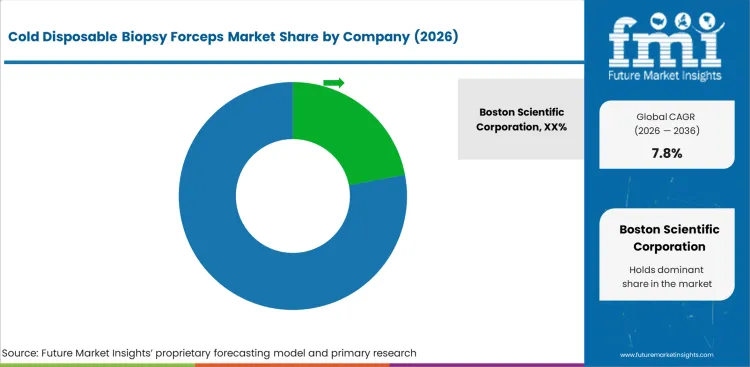
- Boston Scientific Corporation leads the market with established manufacturing and regulatory approval infrastructure across key regions.
- Olympus Corporation, Cook Medical, ConMed Corporation maintain competitive positions through product portfolio breadth and clinical validation capabilities.
- Emerging players are focusing on specialized clinical applications and point-of-care segments to gain market entry.
Boston Scientific Corporation leads the cold disposable biopsy forceps market through broad product portfolios, regulatory approvals across multiple jurisdictions, and established relationships with hospital and laboratory procurement. Olympus Corporation maintains a competitive position through clinical product specialization and diagnostic technology capabilities.
Cook Medical and ConMed Corporation compete on product performance, regulatory compliance, and clinical evidence. Competitive barriers include regulatory approval timelines, clinical validation requirements, and established GPO relationships.
Strategic priorities include expanding product portfolios into adjacent clinical applications, securing regulatory approvals in emerging markets, and improving manufacturing cost structures.
Key Companies in the Cold Disposable Biopsy Forceps Market
Key global companies leading the cold disposable biopsy forceps market include:
- Boston Scientific Corporation, Olympus Corporation, Cook Medical, ConMed Corporation, Medline Industries, Inc. maintain leading positions through established manufacturing infrastructure, broad product portfolios, and direct procurement relationships across global markets.
- Others have built competitive positions in regional markets through specialized product capabilities and focused distribution networks.
Competitive Benchmarking: Cold Disposable Biopsy Forceps Market
| Company | Product Portfolio | Regulatory Coverage | Clinical Evidence | Geographic Reach |
|---|---|---|---|---|
| Boston Scientific Corporation | High | High | Strong | Global |
| Olympus Corporation | High | High | Strong | Global |
| Cook Medical | Medium | Medium | Moderate | Regional |
| ConMed Corporation | Medium | Medium | Moderate | Regional |
| Medline Industries, Inc. | Medium | Medium | Moderate | Regional |
| Others | Medium | Medium | Low | Regional |
Source: Future Market Insights competitive analysis, 2026.
Key Developments in Cold Disposable Biopsy Forceps Market
- In 2025, Boston Scientific Corporation expanded its cold disposable biopsy forceps product portfolio to address updated regulatory requirements and clinical demand across North America and Europe.
- In 2025, Olympus Corporation secured regulatory clearance for a new cup biopsy forceps configuration targeting institutional healthcare applications in high-growth markets.
Key Players in the Cold Disposable Biopsy Forceps Market
Major Global Players
- Boston Scientific Corporation
- Olympus Corporation
- Cook Medical
- ConMed Corporation
- Others
Emerging Players/Startups
- Micro-Tech Endoscopy
- Medi-Globe GmbH
- Endo-Flex GmbH
- US Endoscopy
- Creo Medical
Report Scope and Coverage
Cold Disposable Biopsy Forceps Market - Research Methodology
| Method | Description |
|---|---|
| Primary Research | FMI analysts conducted interviews with manufacturers, distributors, procurement specialists and end-use operators in key markets to validate market demand patterns and pricing structures. |
| Desk Research | Established baseline market parameters using trade statistics, regulatory filings, industry associations’ publications and manufacturers’ disclosures. |
| Market Sizing & Forecasting | Bottom-up aggregation by product, diameter and regional adoption curves, triangulated against top-down macro indicators. |
| Data Validation | Quarterly cross-check with production statistics, trade flow data and manufacturer revenue disclosures. |
| Parameter | Details |
|---|---|
| Market size by 2036 | USD 1.7 Bn |
| Growth rate | 7.8% CAGR (2026 to 2036) |
| Forecast period | 2026 to 2036 |
| Base year value (2025) | USD 0.7 Bn |
| Key Segment Covered | Product, Diameter, Length, Application, End Use, Distribution Channel |
| Regions covered | North America, Latin America, Western Europe, Eastern Europe, East Asia, South Asia and Pacific, Middle East and Africa |
| Countries covered | USA, Japan, South Korea, UK, 30 plus countries |
| Key companies profiled | Boston Scientific Corporation, Olympus Corporation, Cook Medical, ConMed Corporation, Medline Industries, Inc., Others |
Market Segmentation Analysis
Cold Disposable Biopsy Forceps Market Segmented by Product:
- Cup Biopsy Forceps
- Oval Cup
- Smooth Edge
- Serrated Edge
- Alligator Jaw
- Standard Jaw
- Fenestrated Jaw
- Oval Cup
- Needle Biopsy Forceps
- Oval Cup with Needle
- Single Action Needle
- Double Action Needle
- Alligator Jaw with Needle
- Standard Needle Tip
- Reinforced Needle Tip
- Oval Cup with Needle
Cold Disposable Biopsy Forceps Market Segmented by Diameter:
- Small Diameter
- 1.0 mm to 1.5 mm
- 1.2 mm
- 1.3 mm
- 1.0 mm to 1.5 mm
- Medium Diameter
- 1.6 mm to 2.5 mm
- 1.8 mm
- 2.0 mm
- 2.4 mm
- 1.6 mm to 2.5 mm
- Large Diameter
- 2.6 mm to 4.0 mm
- 2.8 mm
- 3.7 mm
- 4.0 mm
- 2.6 mm to 4.0 mm
Cold Disposable Biopsy Forceps Market Segmented by Length:
- Short Length
- 1100 mm to 1300 mm
- 1150 mm
- 1200 mm
- 1100 mm to 1300 mm
- Medium Length
- 1400 mm to 1800 mm
- 1550 mm
- 1600 mm
- 1400 mm to 1800 mm
- Long Length
- 2000 mm to 2400 mm
- 2200 mm
- 2300 mm
- 2000 mm to 2400 mm
Cold Disposable Biopsy Forceps Market Segmented by Application:
- Gastrointestinal Endoscopy
- Upper Gastrointestinal Endoscopy
- Esophagogastroduodenoscopy
- Duodenal Biopsy
- Lower Gastrointestinal Endoscopy
- Colonoscopy
- Sigmoidoscopy
- Upper Gastrointestinal Endoscopy
- Small Bowel Endoscopy
- Enteroscopy
- Double Balloon Enteroscopy
- Single Balloon Enteroscopy
- Enteroscopy
- Pulmonary Endoscopy
- Bronchoscopy
- Flexible Bronchoscopy
- Interventional Bronchoscopy
- Bronchoscopy
- Pharmaceutical Companies
- Branded Drug Manufacturers
- Innovator Companies
- Specialty Pharma
- Generic Drug Manufacturers
- Large Scale Generics
- Contract Manufacturers
- Branded Drug Manufacturers
- Biotechnology Companies
- Biologics Manufacturers
- Monoclonal Antibodies
- Vaccines
- Cell and Gene Therapy Companies
- Advanced Therapies
- Personalized Medicine
- Biologics Manufacturers
- Contract Manufacturing Organizations
- Fill and Finish Services
- Aseptic Filling
- Sterile Packaging
- Packaging Services
- Primary Packaging
- Secondary Packaging
- Fill and Finish Services
- Healthcare Providers
- Hospitals
- Inpatient Care
- Outpatient Care
- Clinics
- Specialty Clinics
- Primary Care Centers
- Hospitals
Cold Disposable Biopsy Forceps Market Segmented by End Use:
- Hospitals
- Public Hospitals
- Private Hospitals
- Ambulatory Surgical Centers
- Standalone Centers
- Hospital Affiliated Centers
- Specialty Clinics
- Gastroenterology Clinics
- Pulmonology Clinics
- Diagnostic Laboratories
- Pathology Laboratories
- Advanced Diagnostic Centers
- Research Institutes
- Cancer Research Institutes
- Academic Research Institutes
- Distribution Channel
- Manufacturer Direct Supply
- Bulk Procurement Contracts
- Long Term Agreements
- Distributor Sales
- Medical Distributors
- Regional Distributors
- National Distributors
- Medical Distributors
- Online Sales
- Digital Procurement Platforms
- Hospital Procurement Systems
- E Marketplace Platforms
- Digital Procurement Platforms
Cold Disposable Biopsy Forceps Market Segmented by Distribution Channel:
- Direct Sales
- Manufacturer Direct Sales
- Contract Sales Teams
- Distributor Sales
- Medical Device Distributors
- Regional Distributors
- Online Sales
- E Procurement Platforms
- Third Party Marketplaces
Cold Disposable Biopsy Forceps Market by Region:
- North America
- USA
- Canada
- Mexico
- Latin America
- Brazil
- Chile
- Rest of Latin America
- Western Europe
- Germany
- UK
- Italy
- Spain
- France
- Nordic
- BENELUX
- Rest of Western Europe
- Eastern Europe
- Russia
- Poland
- Hungary
- Balkan & Baltic
- Rest of Eastern Europe
- East Asia
- China
- Japan
- South Korea
- South Asia and Pacific
- India
- ASEAN
- Australia & New Zealand
- Rest of South Asia and Pacific
- Middle East & Africa
- Kingdom of Saudi Arabia
- Other GCC Countries
- Türkiye
- South Africa
- Other African Union
- Rest of Middle East & Africa
Research Sources and Bibliography
- 1. World Health Organization. (2025). WHO Global Report on Medical Device Procurement and Access. WHO.
- 2. USA Food and Drug Administration. (2025). FDA Medical Device Approvals and Clearances Database. FDA.
- 3. European Medicines Agency. (2025). EMA Annual Report on Medical Device Regulation. EMA.
- 4. International Medical Device Regulators Forum. (2025). IMDRF Guidance on Device Classification and Market Access. IMDRF.
- 5. Organisation for Economic Co-operation and Development. (2025). OECD Health Statistics: Medical Technology Indicators. OECD.
This bibliography is provided for reader reference.
This Report Answers
- Estimating the size of the cold disposable biopsy forceps market and revenue projections from 2026 to 2036.
- Segmentation by product, diameter, length, application, end use, distribution channel.
- Insights across more than 30 regional and country-level markets.
- Analysis of clinical adoption, regulatory landscape, and institutional procurement patterns.
- Assessment of the competitive landscape and company benchmarking.
- Identification of growth opportunities across product and diameter segments.
- Evaluation of supply chain dynamics and distribution channel structures.
- Delivery of data in PDF and Excel formats.
Frequently Asked Questions
How big is the cold disposable biopsy forceps market in 2026?
The global cold disposable biopsy forceps market is estimated to be valued at USD 0.8 billion in 2026.
What will be the size of the cold disposable biopsy forceps market in 2036?
The market size for the cold disposable biopsy forceps market is projected to reach USD 1.7 billion by 2036.
How much will the cold disposable biopsy forceps market grow between 2026 and 2036?
The cold disposable biopsy forceps market is expected to grow at a 7.8% CAGR between 2026 and 2036.
What are the key products in the cold disposable biopsy forceps market?
The key products in the cold disposable biopsy forceps market are Cup Biopsy Forceps and Needle Biopsy Forceps.
Which diameter segment is expected to contribute a significant share in the cold disposable biopsy forceps market in 2026?
In terms of diameter, the small diameter segment is expected to command 57.0% share in the cold disposable biopsy forceps market in 2026.
Preview the report firsthand - request a free sample
Get SampleGet the brochure for pricing and purchase details.
Get PDFTable of Content
- Key Takeaways
- Market Size and CAGR
- Top Growth Driver
- Fastest Growing Segment
- Leading Region
- Key Companies
- Emerging Opportunities
- Executive Summary
- Global Market Outlook
- Demand-side Trends
- Supply-side Trends
- Technology Roadmap Analysis
- Analysis and Recommendations
- Analyst Perspective (What is happening? Why now? What should investors know?)
- Key Questions Answered
- How large is the market?
- What is the CAGR?
- What are key trends?
- Which region dominates?
- Who are the leaders?
- Market Overview
- Market Coverage / Taxonomy
- Market Definition / Scope / Limitations
- Research Methodology
- Chapter Orientation
- Analytical Lens and Working Hypotheses
- Market Structure, Signals, and Trend Drivers
- Benchmarking and Cross-market Comparability
- Market Sizing, Forecasting, and Opportunity Mapping
- Research Design and Evidence Framework
- Desk Research Programme (Secondary Evidence)
- Expert Input and Fieldwork (Primary Evidence)
- Tooling, Models, and Reference Databases
- Data Engineering and Model Build
- Quality Assurance and Audit Trail
- Market Background
- Market Dynamics (Drivers, Restraints, Opportunity, Trends)
- Scenario Forecast (Optimistic, Likely, Conservative)
- Impact Analysis
- AI Impact
- Sustainability Impact
- Regulatory Impact
- Technology Impact
- Consumer / Buyer Analysis
- Purchase Drivers
- Adoption Barriers
- Buyer Journey
- Opportunity Map Analysis
- Product Life Cycle Analysis
- Supply Chain Analysis
- Investment Feasibility Matrix
- Value Chain Analysis
- PESTLE and Porter's Analysis
- Regulatory Landscape
- Regional Parent Market Outlook
- Production and Consumption Statistics
- Import and Export Statistics
- Global Market Analysis and Forecast, 2021 to 2036
- Historical Market Size Value (USD Million) Analysis, 2021 to 2025
- Current and Future Market Size Value (USD Million) Projections, 2026 to 2036
- Y-o-Y Growth Trend Analysis
- Absolute $ Opportunity Analysis
- Global Market Pricing Analysis, 2021 to 2036
- Global Market Analysis and Forecast, By Product, 2021 to 2036
- Introduction / Key Findings
- Historical Market Size Value (USD Million) Analysis By Product, 2021 to 2025
- Current and Future Market Size Value (USD Million) Analysis and Forecast By Product, 2026 to 2036
- Cup Biopsy Forceps
- Oval Cup
- Alligator Jaw
- Needle Biopsy Forceps
- Oval Cup with Needle
- Alligator Jaw with Needle
- Cup Biopsy Forceps
- Y-o-Y Growth Trend Analysis By Product, 2021 to 2025
- Absolute $ Opportunity Analysis By Product, 2026 to 2036
- Global Market Analysis and Forecast, By Diameter, 2021 to 2036
- Introduction / Key Findings
- Historical Market Size Value (USD Million) Analysis By Diameter, 2021 to 2025
- Current and Future Market Size Value (USD Million) Analysis and Forecast By Diameter, 2026 to 2036
- Small Diameter
- 1.0 mm to 1.5 mm
- Medium Diameter
- 1.6 mm to 2.5 mm
- Large Diameter
- 2.6 mm to 4.0 mm
- Small Diameter
- Y-o-Y Growth Trend Analysis By Diameter, 2021 to 2025
- Absolute $ Opportunity Analysis By Diameter, 2026 to 2036
- Global Market Analysis and Forecast, By Length, 2021 to 2036
- Introduction / Key Findings
- Historical Market Size Value (USD Million) Analysis By Length, 2021 to 2025
- Current and Future Market Size Value (USD Million) Analysis and Forecast By Length, 2026 to 2036
- Short Length
- 1100 mm to 1300 mm
- Medium Length
- 1400 mm to 1800 mm
- Long Length
- 2000 mm to 2400 mm
- Short Length
- Y-o-Y Growth Trend Analysis By Length, 2021 to 2025
- Absolute $ Opportunity Analysis By Length, 2026 to 2036
- Global Market Analysis and Forecast, By Application, 2021 to 2036
- Introduction / Key Findings
- Historical Market Size Value (USD Million) Analysis By Application, 2021 to 2025
- Current and Future Market Size Value (USD Million) Analysis and Forecast By Application, 2026 to 2036
- Gastrointestinal Endoscopy
- Upper Gastrointestinal Endoscopy
- Lower Gastrointestinal Endoscopy
- Small Bowel Endoscopy
- Enteroscopy
- Pulmonary Endoscopy
- Bronchoscopy
- Gastrointestinal Endoscopy
- Y-o-Y Growth Trend Analysis By Application, 2021 to 2025
- Absolute $ Opportunity Analysis By Application, 2026 to 2036
- Global Market Analysis and Forecast, By End Use, 2021 to 2036
- Introduction / Key Findings
- Historical Market Size Value (USD Million) Analysis By End Use, 2021 to 2025
- Current and Future Market Size Value (USD Million) Analysis and Forecast By End Use, 2026 to 2036
- Hospitals
- Public Hospitals
- Private Hospitals
- Ambulatory Surgical Centers
- Standalone Centers
- Hospital Affiliated Centers
- Specialty Clinics
- Gastroenterology Clinics
- Pulmonology Clinics
- Diagnostic Laboratories
- Pathology Laboratories
- Advanced Diagnostic Centers
- Research Institutes
- Cancer Research Institutes
- Academic Research Institutes
- Hospitals
- Y-o-Y Growth Trend Analysis By End Use, 2021 to 2025
- Absolute $ Opportunity Analysis By End Use, 2026 to 2036
- Global Market Analysis and Forecast, By Distribution Channel
- Introduction / Key Findings
- Historical Market Size Value (USD Million) Analysis By Distribution Channel, 2021 to 2025
- Current and Future Market Size Value (USD Million) Analysis and Forecast By Distribution Channel, 2026 to 2036
- Direct Sales
- Manufacturer Direct Sales
- Contract Sales Teams
- Distributor Sales
- Medical Device Distributors
- Regional Distributors
- Online Sales
- E Procurement Platforms
- Third Party Marketplaces
- Direct Sales
- Y-o-Y Growth Trend Analysis By Distribution Channel, 2021 to 2025
- Absolute $ Opportunity Analysis By Distribution Channel, 2026 to 2036
- Global Market Analysis and Forecast, By Region, 2021 to 2036
- Introduction
- Historical Market Size Value (USD Million) Analysis By Region, 2021 to 2025
- Current Market Size Value (USD Million) Analysis and Forecast By Region, 2026 to 2036
- North America
- Latin America
- Western Europe
- Eastern Europe
- East Asia
- South Asia and Pacific
- Middle East & Africa
- Market Attractiveness Analysis By Region
- North America Market Analysis and Forecast, By Country, 2021 to 2036
- Historical Market Size Value (USD Million) Trend Analysis By Market Taxonomy, 2021 to 2025
- Market Size Value (USD Million) Forecast By Market Taxonomy, 2026 to 2036
- By Country
- USA
- Canada
- Mexico
- By Product
- By Diameter
- By Length
- By Application
- By End Use
- By Distribution Channel
- By Country
- Market Attractiveness Analysis
- By Country
- By Product
- By Diameter
- By Length
- By Application
- By End Use
- By Distribution Channel
- Key Takeaways
- Latin America Market Analysis and Forecast, By Country
- Historical Market Size Value (USD Million) Trend Analysis By Market Taxonomy, 2021 to 2025
- Market Size Value (USD Million) Forecast By Market Taxonomy, 2026 to 2036
- By Country
- Brazil
- Chile
- Rest of Latin America
- By Product
- By Diameter
- By Length
- By Application
- By End Use
- By Distribution Channel
- By Country
- Market Attractiveness Analysis
- By Country
- By Product
- By Diameter
- By Length
- By Application
- By End Use
- By Distribution Channel
- Key Takeaways
- Western Europe Market Analysis and Forecast, By Country
- Historical Market Size Value (USD Million) Trend Analysis By Market Taxonomy, 2021 to 2025
- Market Size Value (USD Million) Forecast By Market Taxonomy, 2026 to 2036
- By Country
- Germany
- UK
- Italy
- Spain
- France
- Nordic
- BENELUX
- Rest of Western Europe
- By Product
- By Diameter
- By Length
- By Application
- By End Use
- By Distribution Channel
- By Country
- Market Attractiveness Analysis
- By Country
- By Product
- By Diameter
- By Length
- By Application
- By End Use
- By Distribution Channel
- Key Takeaways
- Eastern Europe Market Analysis and Forecast, By Country
- Historical Market Size Value (USD Million) Trend Analysis By Market Taxonomy, 2021 to 2025
- Market Size Value (USD Million) Forecast By Market Taxonomy, 2026 to 2036
- By Country
- Russia
- Poland
- Hungary
- Balkan & Baltic
- Rest of Eastern Europe
- By Product
- By Diameter
- By Length
- By Application
- By End Use
- By Distribution Channel
- By Country
- Market Attractiveness Analysis
- By Country
- By Product
- By Diameter
- By Length
- By Application
- By End Use
- By Distribution Channel
- Key Takeaways
- East Asia Market Analysis and Forecast, By Country
- Historical Market Size Value (USD Million) Trend Analysis By Market Taxonomy, 2021 to 2025
- Market Size Value (USD Million) Forecast By Market Taxonomy, 2026 to 2036
- By Country
- China
- Japan
- South Korea
- By Product
- By Diameter
- By Length
- By Application
- By End Use
- By Distribution Channel
- By Country
- Market Attractiveness Analysis
- By Country
- By Product
- By Diameter
- By Length
- By Application
- By End Use
- By Distribution Channel
- Key Takeaways
- South Asia and Pacific Market Analysis and Forecast, By Country
- Historical Market Size Value (USD Million) Trend Analysis By Market Taxonomy, 2021 to 2025
- Market Size Value (USD Million) Forecast By Market Taxonomy, 2026 to 2036
- By Country
- India
- ASEAN
- Australia & New Zealand
- Rest of South Asia and Pacific
- By Product
- By Diameter
- By Length
- By Application
- By End Use
- By Distribution Channel
- By Country
- Market Attractiveness Analysis
- By Country
- By Product
- By Diameter
- By Length
- By Application
- By End Use
- By Distribution Channel
- Key Takeaways
- Middle East & Africa Market Analysis and Forecast, By Country
- Historical Market Size Value (USD Million) Trend Analysis By Market Taxonomy, 2021 to 2025
- Market Size Value (USD Million) Forecast By Market Taxonomy, 2026 to 2036
- By Country
- Kingdom of Saudi Arabia
- Other GCC Countries
- Türkiye
- South Africa
- Other African Union
- Rest of Middle East & Africa
- By Product
- By Diameter
- By Length
- By Application
- By End Use
- By Distribution Channel
- By Country
- Market Attractiveness Analysis
- By Country
- By Product
- By Diameter
- By Length
- By Application
- By End Use
- By Distribution Channel
- Key Takeaways
- Key Countries Market Analysis
- USA
- Pricing Analysis
- Market Share Analysis, 2025
- By Product
- By Diameter
- By Length
- By Application
- By End Use
- By Distribution Channel
- Canada
- Pricing Analysis
- Market Share Analysis, 2025
- By Product
- By Diameter
- By Length
- By Application
- By End Use
- By Distribution Channel
- Mexico
- Pricing Analysis
- Market Share Analysis, 2025
- By Product
- By Diameter
- By Length
- By Application
- By End Use
- By Distribution Channel
- Brazil
- Pricing Analysis
- Market Share Analysis, 2025
- By Product
- By Diameter
- By Length
- By Application
- By End Use
- By Distribution Channel
- Chile
- Pricing Analysis
- Market Share Analysis, 2025
- By Product
- By Diameter
- By Length
- By Application
- By End Use
- By Distribution Channel
- Germany
- Pricing Analysis
- Market Share Analysis, 2025
- By Product
- By Diameter
- By Length
- By Application
- By End Use
- By Distribution Channel
- UK
- Pricing Analysis
- Market Share Analysis, 2025
- By Product
- By Diameter
- By Length
- By Application
- By End Use
- By Distribution Channel
- Italy
- Pricing Analysis
- Market Share Analysis, 2025
- By Product
- By Diameter
- By Length
- By Application
- By End Use
- By Distribution Channel
- Spain
- Pricing Analysis
- Market Share Analysis, 2025
- By Product
- By Diameter
- By Length
- By Application
- By End Use
- By Distribution Channel
- France
- Pricing Analysis
- Market Share Analysis, 2025
- By Product
- By Diameter
- By Length
- By Application
- By End Use
- By Distribution Channel
- India
- Pricing Analysis
- Market Share Analysis, 2025
- By Product
- By Diameter
- By Length
- By Application
- By End Use
- By Distribution Channel
- ASEAN
- Pricing Analysis
- Market Share Analysis, 2025
- By Product
- By Diameter
- By Length
- By Application
- By End Use
- By Distribution Channel
- Australia & New Zealand
- Pricing Analysis
- Market Share Analysis, 2025
- By Product
- By Diameter
- By Length
- By Application
- By End Use
- By Distribution Channel
- China
- Pricing Analysis
- Market Share Analysis, 2025
- By Product
- By Diameter
- By Length
- By Application
- By End Use
- By Distribution Channel
- Japan
- Pricing Analysis
- Market Share Analysis, 2025
- By Product
- By Diameter
- By Length
- By Application
- By End Use
- By Distribution Channel
- South Korea
- Pricing Analysis
- Market Share Analysis, 2025
- By Product
- By Diameter
- By Length
- By Application
- By End Use
- By Distribution Channel
- Russia
- Pricing Analysis
- Market Share Analysis, 2025
- By Product
- By Diameter
- By Length
- By Application
- By End Use
- By Distribution Channel
- Poland
- Pricing Analysis
- Market Share Analysis, 2025
- By Product
- By Diameter
- By Length
- By Application
- By End Use
- By Distribution Channel
- Hungary
- Pricing Analysis
- Market Share Analysis, 2025
- By Product
- By Diameter
- By Length
- By Application
- By End Use
- By Distribution Channel
- Kingdom of Saudi Arabia
- Pricing Analysis
- Market Share Analysis, 2025
- By Product
- By Diameter
- By Length
- By Application
- By End Use
- By Distribution Channel
- Türkiye
- Pricing Analysis
- Market Share Analysis, 2025
- By Product
- By Diameter
- By Length
- By Application
- By End Use
- By Distribution Channel
- South Africa
- Pricing Analysis
- Market Share Analysis, 2025
- By Product
- By Diameter
- By Length
- By Application
- By End Use
- By Distribution Channel
- USA
- Market Structure Analysis
- Competition Dashboard
- Competition Benchmarking
- Market Share Analysis of Top Players
- By Regional
- By Product
- By Diameter
- By Length
- By Application
- By End Use
- By Distribution Channel
- Emerging Startups
- Innovation Benchmarking
- Competition Analysis
- Competition Deep Dive
- Boston Scientific Corporation
- Overview
- Product Portfolio
- Profitability by Market Segments (Product/Region/Sales Channel)
- Sales Footprint
- Strategy Overview
- Marketing Strategy
- Product Strategy
- Channel Strategy
- Olympus Corporation
- Cook Medical
- ConMed Corporation
- Medline Industries, Inc.
- Others
- Boston Scientific Corporation
- Case Studies
- Success Stories
- Recent Developments
- Competition Deep Dive
- Assumptions & Acronyms Used


