

- Market Size (2026)
- USD 980.6 Mn
- Forecast (2036)
- USD 1840.7 Mn
- CAGR (2026 to 2036)
- 6.5%
How big is the Confined Space Blowers Market size?
USD 980.6 million in 2026 and USD 1,840.7 million by 2036 at a 6.5% CAGR.
Demand for confined space blowers is projected to expand at 6.5% CAGR between 2026 and 2036, increasing valuation from USD 980.6 million in 2026 to USD 1,840.7 million by 2036. Safety managers and utility crews are anticipated to need blower systems linked to atmospheric control and repeatable air exchange before confined-space work begins. USA Bureau of Labor Statistics reported in its February 19, 2026 release 5,070 fatal work injuries recorded in 2024, supporting closer buyer review of worksite safety equipment and documented control procedures.
India and China accounts are projected to favor local supply access and rental-ready blower kits for infrastructure and utility work. Australia and United Kingdom buyers are likely to review field support depth before shifting approved ventilation suppliers. Germany and Japan engineering teams are expected to place greater weight on documentation packs and long-cycle supplier qualification. Press Information Bureau reported in its March 15, 2026 release India metro network reached 1,095 km by 2025, adding underground and utility-facing work activity supporting demand for airflow equipment and site-ready ventilation kits.
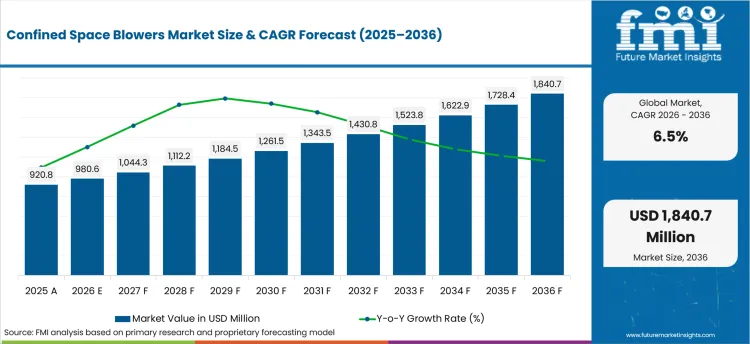
| Metric | Value |
|---|---|
| 2025 Market Size | USD 920.8 million |
| 2026 Market Size | USD 980.6 million |
| 2036 Market Size | USD 1,840.7 million |
| Forecast CAGR (2026-2036) | 6.5% |
| Power Source Focus | Electric |
| Electric Share (2026) | 49.0% |
| Airflow Capacity Focus | 1,000-2,500 CFM |
| 1,000-2,500 CFM Share (2026) | 47.0% |
| Sales Channel Focus | Safety Equipment Distributors |
| Safety Equipment Distributors Share (2026) | 36.8% |
Summary of the Confined Space Blowers Market
| Market Signal | Commercial Impact |
|---|---|
| Demand and Growth Drivers | Purchases are expected to rise as confined-space entry programs connect ventilation proof with worker safety and permit control. Account decisions are projected to reflect airflow testing and repeat-use reliability across industrial and maintenance settings.
|
| Product and Segment View | Segment demand is led by electric power source followed by 1,000-2,500 CFM airflow capacity, and safety equipment distributors for field ventilation tasks. Specification work is anticipated to concentrate on equipment balancing air movement and support files across recurring confined-space projects.
|
| Geography and Growth Outlook | Country demand is expected to reflect infrastructure work and supplier support. Buyer gains are likely to favor vendors combining compliant product files with practical training and local service access.
|
| Competitive View | Competition is likely to focus on ventilation performance and field support. Account wins are expected to favor suppliers with clear blower selection files and dependable service depth.
|
| Analyst Perspective | Confined space blowers are developing into a safety-led equipment segment linked to ventilation proof and permit readiness. Supplier progress is projected to improve due to product files and distributor support aligned with industrial and utility work needs.
|
How is the confined space blowers market segmented?
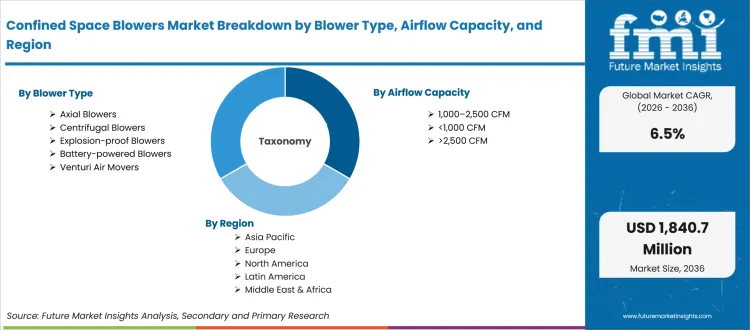
The confined space blowers market is segmented by blower type, airflow capacity, power source, application, sales channel, and region.
Confined space blowers industry is segmented by blower type, airflow capacity, power source, application, sales channel, and region. Blower type coverage includes axial blowers, centrifugal blowers, explosion-proof blowers, battery-powered blowers, and venturi air movers. Airflow capacity coverage includes below 1,000 CFM, 1,000-2,500 CFM, and above 2,500 CFM. Power source coverage includes electric, pneumatic, battery, and gasoline / engine-driven. Application coverage includes manholes / sewers, tanks & vessels, trenches / excavations, utility vaults, and industrial maintenance. Sales channel coverage includes safety equipment distributors, rental providers, direct OEM, and industrial catalog. Regional coverage includes North America, Latin America, Europe, East Asia, South Asia, Oceania, and Middle East and Africa.
What supports demand for axial blowers within blower type?
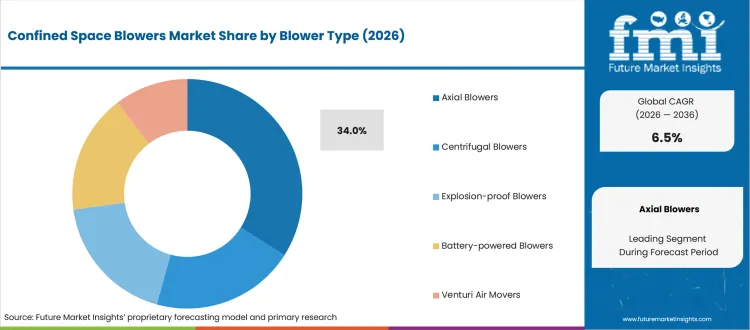
Axial blowers are expected to provide portable air movement and duct support across confined-space work programs. Safety managers and contractors use axial formats for routine ventilation tasks before entry and during post-task clearance checks. Air Systems International stated in its 2024 explosion-proof axial fan sheet its 8-inch 60 Hz explosion-proof axial fan provides 987 CFM free air with 730 CFM through one bend and 648 CFM through two bends, helping buyers compare compact fan output under ducted conditions.
- Axial blowers are anticipated to capture 34.0% share in 2026, led by portability and common use across tanks and utility vaults. Suppliers gain account approval once blower performance and duct compatibility meet site review needs.
- Centrifugal and explosion-proof units serve different operating profiles. Axial formats gain attention as buyers compare handling ease against airflow output and field readiness.
How is 1,000-2,500 CFM positioned within airflow capacity?
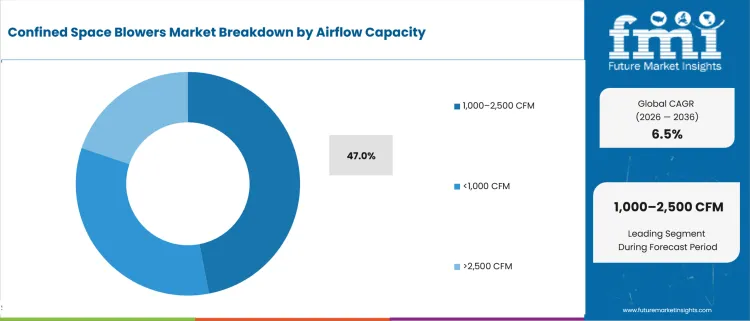
1,000-2,500 CFM airflow capacity is estimated to shape purchasing as teams need practical ventilation coverage for tanks and industrial maintenance jobs. Buyers use airflow ratings to compare blower output and jobsite constraints before approval. Air Systems International stated in its 2024 hazardous-location blower sheet its 60 Hz explosion-proof electric blower provides 1,570 CFM free air followed by 1,047 CFM with 25 ft duct and one bend, and 873 CFM with two bends, helping buyers judge airflow loss before field use.
- 1,000-2,500 CFM is forecast to hold 47.0% share in 2026, reflected by common site dimensions and recurring utility ventilation tasks. Buyers prefer airflow ranges balancing ventilation performance with portability and storage.
- Below 1,000 CFM and above 2,500 CFM serve narrower use cases. Mid-range airflow gains selection preference once contractors need one equipment class for varied entry projects.
What drives electric demand within power source?
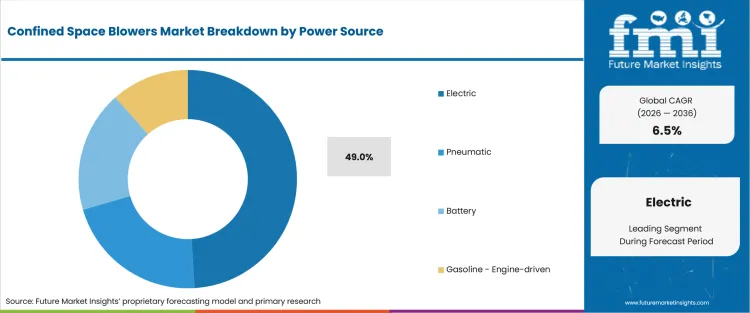
Electric power source is anticipated to support adoption as facilities and utility crews need blower formats simplifying setup and align with repeat maintenance work. Buyers compare electric blowers against pneumatic and engine-driven formats based on noise exposure. Pelsue stated in its April 7, 2026 confined-space blower guidance electric 1-speed and electric 2-speed blower options serve confined-space ventilation, influencing buyer selection across facility and utility tasks needing powered airflow without fuel handling.
- Electric is projected to account for 49.0% share in 2026, aided by routine use across facility maintenance and utility work. Account teams prefer electric formats once available power and ducting conditions support planned air exchange.
- Pneumatic and engine-driven units serve different field needs. Electric formats gain attention once buyers require simpler handling and dependable equipment availability during recurring work.
How do manholes / sewers influence application demand?
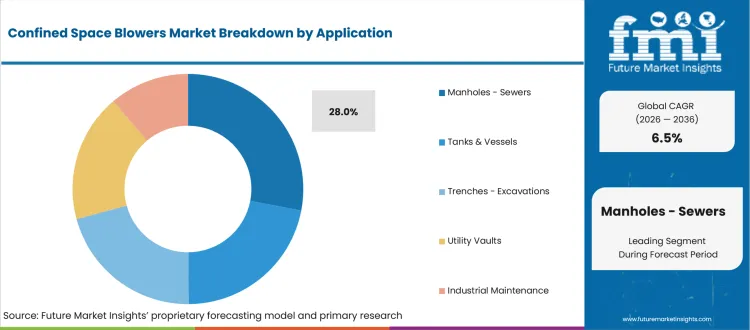
Manholes / sewers are projected to support demand as municipal and utility crews require portable ventilation before underground access work. Entry teams review blower placement and gas-check coordination before assigning equipment to field crews. Underground Infrastructure Conference stated in its March 19-21, 2024 confined-space testing material 333 CFM effective blower capacity for 1,000 cu ft supports 20 air exchanges per hour, making airflow calculation central to manhole and sewer ventilation planning.
- Manholes / sewers are estimated to account for 28.0% share in 2026, backed by recurring access needs and jobsite safety review. Buyers prefer blower systems supporting fast setup and repeatable air movement in constrained entries.
- Tanks & vessels and industrial maintenance require different blower setups. Manholes / sewers gain review priority once field crews need dependable equipment across daily municipal service tasks.
How do safety equipment distributors support sales channel demand?
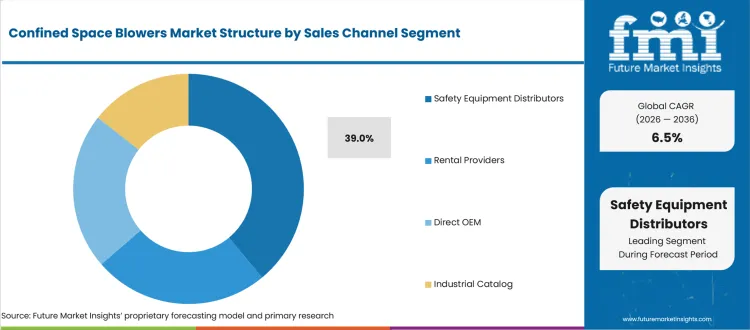
Safety equipment distributors are anticipated to support purchasing as buyers need product availability and local guidance during jobsite planning. Distributors help match blower type and accessories to work conditions before recurring orders. Pelsue stated in its April 7, 2026 confined-space blower guidance its lineup includes electric 1-speed, electric 2-speed and explosion-resistant blower options, giving distributors a clearer selection ladder for varied field conditions.
- Safety equipment distributors are projected to account for 39.0% share in 2026, backed by local inventory and buyer access to support files. Account teams prefer distributor involvement once service response and accessory availability affect field schedules.
- Rental providers and direct OEM supply remain useful for specific projects. Distributor-led sales gain preference once buyers need recurring replenishment and quick product support.
What are the drivers, restraints, and opportunities in the confined space blowers market?
Near-term purchases are shaped by ventilation proof, safety documentation, and service-led adoption routes outlined below.
- Driver: Worksite safety programs are replacing ad hoc ventilation practices with documented blower kits for trench and utility vault entry.
- Restraint: Account conversion slows if alarm coordination and service responsibility are incomplete during site review.
- Opportunity: Suppliers pairing blower selection support with rental-ready kits gain account access across construction and industrial maintenance buyers.
Demand is expected to rise as work crews face greater scrutiny around excavation and confined-space preparation. OSHA reported in its June 28, 2025 release 11 trench-related fatalities during 2025, giving safety buyers a practical reason to review ventilation equipment and documented jobsite controls before recurring assignments.
Restraints are anticipated to stay linked to complex approval and incomplete safety documentation. HSE reported in its July 1, 2026 fatal-injury release 126 worker deaths in work-related incidents across Great Britain in 2025/26, keeping buyer attention on formal task planning and verified equipment suitability before supplier changes.
Opportunities are projected to improve for suppliers converting product selection into a repeatable purchasing workflow. Safe Work Australia stated in its November 2024 confined-spaces code worker instruction should cover 5 areas including entry permits and emergency procedures, supporting supplier programs combining blower supply with training-ready documentation.
What country CAGRs are profiled in the confined space blowers market?
.webp "Top Country Growth Comparison Confined Space Blowers Market Cagr (2026 2036)")
| Country | CAGR |
|---|---|
| India | 8.4% |
| China | 7.6% |
| Australia | 6.2% |
| United Kingdom | 5.9% |
| United States | 5.5% |
| Germany | 5.1% |
| Japan | 4.8% |
Source: Future Market Insights, 2026.
How do country-level CAGRs compare in the confined space blowers market?
Country demand in confined space blowers is expected to follow industrial safety review and distributor support depth. India and China are likely to connect demand with utility expansion and local contractor needs. Australia and United Kingdom are anticipated to support adoption through worksite safety control and rental availability. United States, Germany, and Japan buyers are expected to screen technical files and supplier service depth before account changes.
- India confined space blower sector is projected to grow at 8.4% CAGR between 2026 and 2036, influenced by urban infrastructure activity and formalized equipment sourcing. Press Information Bureau reported on March 15, 2026 metro coverage reached 26 cities by 2025, creating more underground access and utility maintenance points needing ventilation planning.
- China safety managers are expected to review blower kits around industrial site risk and urban utility work. Demand in China is forecast to expand at 7.6% CAGR by 2036, shaped by factory safety reviews and local equipment access. Xinhua reported on January 15, 2026 China recorded 19,884 workplace safety accidents nationwide during 2025, keeping industrial operators attentive to ventilation and hazard-control equipment.
- Australia buyers are expected to prioritize rugged products and service-backed rental support across utilities, mining-adjacent work, and construction maintenance. Demand in Australia is projected to rise at 6.2% CAGR through 2036, supported by remote-site work and rental equipment availability. Safe Work Australia reported on October 16, 2025 Queensland recorded 53 worker fatalities in 2024, keeping contractor controls and field equipment review active.
- United Kingdom purchasing is anticipated to reflect construction controls and distributor accountability. Demand in United Kingdom is projected to advance at 5.9% CAGR from 2026 to 2036, aided by contractor documentation needs and distributor-led product support. HSE reported in its July 22, 2025 construction update 35 fatal injuries occurred in construction during April 2024 to March 2025.
- United States demand is estimated to grow at 5.5% CAGR during the forecast period, guided by trench safety enforcement and rental fleet accountability. USA Bureau of Labor Statistics reported on February 19, 2026 transportation and material moving occupations recorded 1,391 fatal work injuries in 2024, giving municipal and contractor buyers a safety-led basis for equipment review.
- Germany account teams are anticipated to keep technical approval and accident reporting close to supplier review. Germany is expected to expand at 5.1% CAGR during the study period, backed by strict equipment documentation and public-sector approval checks. German Social Accident Insurance reported in 2026 9,923 serious accidents at work were recorded in 2024, reinforcing demand for documented equipment support across industrial and public-sector work sites.
- Japan confined space blower demand is influenced by long supplier qualification and safety education needs. Japan is forecast to grow at 4.8% CAGR by 2036, shaped by careful vendor approval, constrained jobsite layouts, and structured training requirements. Business & Human Rights Resource Centre stated on November 30, 2025, citing Japan Ministry of Health, Labour and Welfare, 1,165 foreign workers were killed or injured in construction during 2024, supporting more structured safety training and equipment selection.
Who are the notable companies in the confined space blowers market?
Allegro Industries, RAMFAN, Pelsue, Euramco Safety, Air Systems International, Tempest Technology, Dräger, Honeywell, Schauenburg, and Schaefer Ventilation are expected to shape confined space blower competition.
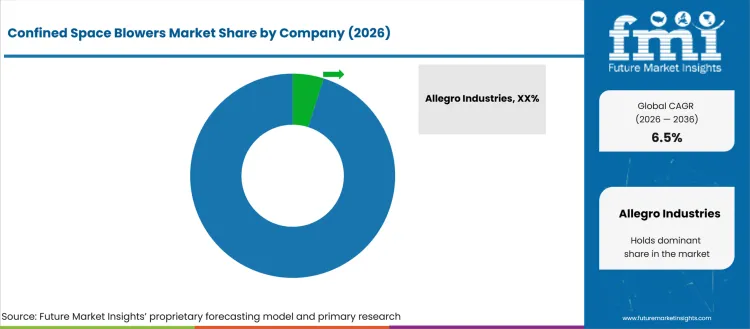
Competition in confined space blowers is anticipated to center on ventilation performance and field support. Account teams are likely to compare suppliers based on blower selection guidance and product evidence for confined-space work. Allegro Industries, RAMFAN, and Pelsue are expected to receive review attention due to portable blower portfolios and confined-space safety experience. Euramco Safety, Air Systems International, and Tempest Technology are projected to compete driven by application support and field-focused ventilation products. Dräger, Honeywell, Schauenburg, and Schaefer Ventilation are estimated to support account demand due to industrial channels and ventilation knowledge.
- Allegro Industries, RAMFAN, and Pelsue are expected to gain account attention based on portable blower portfolios and confined-space safety experience. Role is projected to improve as buyers request clear equipment files and repeatable air movement performance.
- Euramco Safety, Air Systems International, and Tempest Technology are anticipated to compete based on application support and field-focused ventilation products. Supplier access is likely to improve as contractors and distributors request practical guidance for airflow selection and ducting setup.
- Dräger and Honeywell are forecast to support demand depending on gas detection and safety-equipment depth. Safety portfolios are expected to improve buyer review once accounts compare ventilation equipment with atmospheric monitoring needs.
- Schauenburg and Schaefer Ventilation are estimated to gain review strength depending on industrial safety channels and ventilation knowledge. Position is likely to improve as customers require local support and application-specific equipment guidance.
Competitive Benchmarking: Confined Space Blowers Market
| Company | Portfolio Match | Segment Match | Application Support | Service Reach |
|---|---|---|---|---|
| Allegro Industries | High | High | High | Global |
| RAMFAN | High | High | High | Global |
| Pelsue | High | High | High | Global |
| Euramco Safety | High | High | High | Global |
| Air Systems International | High | High | High | Regional |
| Tempest Technology | Medium | High | Medium | Regional |
| Dräger | Medium | Medium | High | Global |
| Honeywell | Medium | Medium | High | Global |
| Schauenburg | Medium | Medium | High | Global |
| Schaefer Ventilation | Medium | Medium | Medium | Regional |
Source: Future Market Insights competitive analysis, 2026.
Key Developments in the Confined Space Blowers Market
- In January 2025, Air Systems International introduced its 2025 catalog in print and digital formats. Air Systems stated on January 28, 2025 that the catalog featured Saddle Vent confined-space ventilation kits, helping distributors present ventilation equipment with clearer confined-entry application support.
- In March 2026, Honeywell introduced an infrared gas sensor for industrial safety applications linked to hazardous atmosphere monitoring. Honeywell stated on March 23, 2026, its NDIR Hydrocarbon Gas Sensor detects methane and butane in industrial settings, improving buyer review of ventilation programs paired with gas-detection checks.
- In April 2026, Pelsue issued confined-space blower and heater guidance for field teams managing cold or difficult ventilation tasks. Pelsue stated on April 7, 2026, centrifugal blowers suit confined-space applications needing higher CFM output, helping buyers match blower class with site severity before ordering.
Key Players in the Confined Space Blowers Market
Portable ventilation and confined-space equipment suppliers
- Allegro Industries
- RAMFAN
- Pelsue
- Euramco Safety
- Air Systems International
- Tempest Technology
Safety monitoring and industrial equipment suppliers
- Dräger
- Honeywell
- Schauenburg
Ventilation and regional equipment partners
- Schaefer Ventilation
Confined Space Blowers Market - Report Scope
| Coverage Field | Report Scope |
|---|---|
| Market breakdown | Confined Space Blowers Market Breakdown By Blower Type, Airflow Capacity, Power Source, Application, Sales Channel, and Region |
| Market Definition | Confined space blowers refer to portable or fixed ventilation equipment used to supply fresh air or remove hazardous air from confined spaces, including manholes, tanks, utility vaults, trenches, sewers, and industrial maintenance areas. |
| Regions Covered | North America, Latin America, Europe, East Asia, South Asia, Oceania, and Middle East and Africa |
| Countries Covered | United States, China, Germany, Japan, India, United Kingdom, Australia, and 25+ countries |
| Key Companies Profiled | Allegro Industries, RAMFAN, Pelsue, Euramco Safety, Air Systems International, Tempest Technology, Dräger, Honeywell, Schauenburg, Schaefer Ventilation |
| Forecast Period | 2026 to 2036 |
| Approach | Hybrid bottom-up and top-down methodology using installed safety equipment base, confined-space activity, blower replacement cycles, rental channel review, contractor purchasing paths, and industrial ventilation demand signals. |
Source: Future Market Insights analysis, 2026.
Confined Space Blowers Market - Research Methodology
| Method | Approach |
|---|---|
| Primary Research | FMI analysts reviewed inputs from safety managers, utility crews, facility operators, rental providers, and confined-space contractors. Interviews focused on demand triggers, blower selection, application needs, service responsibility, replacement behavior, and approval barriers. |
| Desk Research | Desk research covered company product pages, public-agency safety references, standards materials, and industry statistics. Product alignment was checked against atmospheric hazard control, airflow capacity, ducting support, and field-readiness requirements. |
| Market Sizing and Forecasting | Market sizing used a hybrid top-down and bottom-up model. Inputs included the 2025 backcast, 2026 base value, 2036 forecast value, segment-share mix, country CAGRs, sales-channel assumptions, and industrial ventilation with confined-space safety equipment demand. |
| Data Validation | Forecasts were checked against company portfolio reviews, segment-share alignment, country-level demand signals, and service-channel exposure. Company profiles were reviewed to avoid counting adjacent businesses without clear confined-space blower exposure. |
Confined Space Blowers Market by Segments
Confined Space Blowers Market segmented by Blower Type:
- Axial Blowers
- Centrifugal Blowers
- Explosion-proof Blowers
- Battery-powered Blowers
- Venturi Air Movers
Confined Space Blowers Market segmented by Airflow Capacity:
- Below 1,000 CFM
- 1,000-2,500 CFM
- Above 2,500 CFM
Confined Space Blowers Market segmented by Power Source:
- Electric
- Pneumatic
- Battery
- Gasoline / Engine-driven
Confined Space Blowers Market segmented by Application:
- Manholes / Sewers
- Tanks & Vessels
- Trenches / Excavations
- Utility Vaults
- Industrial Maintenance
Confined Space Blowers Market segmented by Sales Channel:
- Safety Equipment Distributors
- Rental Providers
- Direct OEM
- Industrial Catalog
Confined Space Blowers Market by Region:
- North America
- United States
- Canada
- Latin America
- Brazil
- Mexico
- Argentina
- Europe
- Germany
- United Kingdom
- France
- Italy
- Spain
- East Asia
- China
- Japan
- South Korea
- South Asia and Pacific
- India
- Thailand
- Indonesia
- Oceania
- Australia
- New Zealand
- Middle East and Africa
- GCC countries
- South Africa
- Türkiye
Research Sources and Bibliography
- Air Systems International. (2024). 8 inch centrifugal blowers hazardous locations product recommendation sheet.
- Air Systems International. (2024). 8 inch CVF explosion-proof axial fan product recommendation sheet.
- Allegro Industries. (2024, February 26). Enhancing workplace safety: OSHA confined space standard and Allegro Industries ventilation blowers.
- Business & Human Rights Resource Centre. (2025, November 30). Japan: Number of work-related injuries and deaths among foreign workers exceeds 6,000 for the first time in 2024.
- German Social Accident Insurance. (2026). Accident occurrence.
- Health and Safety Executive. (2025, July 22). Construction: July 2025 news and updates.
- Health and Safety Executive. (2026, July 1). Latest annual work-related fatalities published.
- Honeywell. (2026, March 23). Honeywell launches new infrared gas sensor to help keep industrial workers safe.
- Occupational Safety and Health Administration. (2025, June 28). USA Department of Labor urges safe practices during trench and excavation work.
- Pelsue. (2026, April 7). Blowers and heaters for confined spaces.
- Press Information Bureau. (2026, March 15). Metro Rail: A catalyst for sustainable urban growth and financial resilience.
- Safe Work Australia. (2024, November). Model code of practice: Confined spaces.
- Safe Work Australia. (2025, October 16). Key Work Health and Safety Statistics Australia 2025.
- Underground Infrastructure Conference. (2024, March 19-21). Confined space testing and ventilation.
- USA Bureau of Labor Statistics. (2026, February 19). National Census of Fatal Occupational Injuries in 2024.
- Xinhua. (2026, January 15). China reports decline in workplace fatalities, enhanced disaster resilience in 2025.
- Air Systems International. (2025, January). 2025 catalog.
This bibliography is provided for reader reference and is not exhaustive. The full report contains the complete reference list and detailed citations.
This Report Answers
- What segments shape demand across blower type, airflow capacity, power source, application, and sales channel?
- How do safety managers evaluate confined space blowers before supplier approval?
- How do country CAGRs differ across profiled markets?
- What companies compete through ventilation depth and field support?
- How does FMI validate forecasts using a hybrid bottom-up and top-down approach?
- What factors should account teams address before larger account expansion?
- How do airflow files and service response affect supplier selection?
- What limits return on investment for buyers adding blower systems to field programs?
- How do distributor availability and rental support influence account approval?
- What supplier capabilities improve long-term account confidence?
Frequently Asked Questions
What is supporting demand in the confined space blowers market?
Demand is likely to be supported by safety managers and industrial maintenance teams needing ventilation systems for manholes and vaults. Account teams are expected to prefer blower suppliers combining duct support and field guidance.
Who are the key players in the confined space blowers market?
Key companies are anticipated to include Allegro Industries, RAMFAN, Pelsue, Euramco Safety, Air Systems International, Tempest Technology, Dräger, Honeywell, Schauenburg, and Schaefer Ventilation. Competition is likely to be based on product depth and service reach.
What is a restraint in the confined space blowers market?
A main restraint is the approval burden created by unclear ducting proof and weak service responsibility during site review. Account adoption slows once buyers cannot confirm blower performance across permitted entry tasks and recurring field conditions.
Why should executives track the confined space blowers market?
Executives are expected to track the market as blower selection affects worker safety and project continuity. Factors such as field readiness and service response shape buyer reviews.
What business problem does the confined space blowers market address?
Market demand addresses a practical ventilation gap faced by utility crews and facility teams managing hazardous air before confined-space entry. Buyers need blower systems supporting air exchange control and repeatable worksite readiness.
What should account teams evaluate before selecting suppliers?
Account teams are likely to evaluate airflow range and accessory availability before supplier approval. Documentation depth and local support are expected to guide final supplier review.
What limits return on investment for purchasing teams?
Return on investment weakens if products lack reliable airflow performance or service support. Delays from incomplete approval files reduce expected purchasing value.
How do suppliers build long-term account confidence?
Suppliers build account confidence by providing blower selection guidance and repeatable field support. Service availability and clear technical files are expected to influence recurring orders.
Preview the report firsthand - request a free sample
Get SampleGet the brochure for pricing and purchase details.
Get PDFTable of Content
- Key Takeaways
- Market Size and CAGR
- Top Growth Driver
- Fastest Growing Segment
- Leading Region
- Key Companies
- Emerging Opportunities
- Executive Summary
- Global Market Outlook
- Demand-side Trends
- Supply-side Trends
- Technology Roadmap Analysis
- Analysis and Recommendations
- Analyst Perspective (What is happening? Why now? What should investors know?)
- Key Questions Answered
- How large is the market?
- What is the CAGR?
- What are key trends?
- Which region dominates?
- Who are the leaders?
- Market Overview
- Market Coverage / Taxonomy
- Market Definition / Scope / Limitations
- Research Methodology
- Chapter Orientation
- Analytical Lens and Working Hypotheses
- Market Structure, Signals, and Trend Drivers
- Benchmarking and Cross-market Comparability
- Market Sizing, Forecasting, and Opportunity Mapping
- Research Design and Evidence Framework
- Desk Research Programme (Secondary Evidence)
- Expert Input and Fieldwork (Primary Evidence)
- Tooling, Models, and Reference Databases
- Data Engineering and Model Build
- Quality Assurance and Audit Trail
- Market Background
- Market Dynamics (Drivers, Restraints, Opportunity, Trends)
- Scenario Forecast (Optimistic, Likely, Conservative)
- Impact Analysis
- AI Impact
- Sustainability Impact
- Regulatory Impact
- Technology Impact
- Consumer / Buyer Analysis
- Purchase Drivers
- Adoption Barriers
- Buyer Journey
- Opportunity Map Analysis
- Product Life Cycle Analysis
- Supply Chain Analysis
- Investment Feasibility Matrix
- Value Chain Analysis
- PESTLE and Porter's Analysis
- Regulatory Landscape
- Regional Parent Market Outlook
- Production and Consumption Statistics
- Import and Export Statistics
- Global Market Analysis and Forecast, 2021 to 2036
- Historical Market Size Value (USD Million) & Volume (Unit) Analysis, 2021 to 2025
- Current and Future Market Size Value (USD Million) & Volume (Unit) Projections, 2026 to 2036
- Y-o-Y Growth Trend Analysis
- Absolute $ Opportunity Analysis
- Global Market Pricing Analysis, 2021 to 2036
- Global Market Analysis and Forecast, By Blower Type, 2021 to 2036
- Introduction / Key Findings
- Historical Market Size Value (USD Million) & Volume (Unit) Analysis By Blower Type, 2021 to 2025
- Current and Future Market Size Value (USD Million) & Volume (Unit) Analysis and Forecast By Blower Type, 2026 to 2036
- Axial Blowers
- Centrifugal Blowers
- Explosion-proof Blowers
- Battery-powered Blowers
- Venturi Air Movers
- Axial Blowers
- Y-o-Y Growth Trend Analysis By Blower Type, 2021 to 2025
- Absolute $ Opportunity Analysis By Blower Type, 2026 to 2036
- Global Market Analysis and Forecast, By Airflow Capacity, 2021 to 2036
- Introduction / Key Findings
- Historical Market Size Value (USD Million) & Volume (Unit) Analysis By Airflow Capacity, 2021 to 2025
- Current and Future Market Size Value (USD Million) & Volume (Unit) Analysis and Forecast By Airflow Capacity, 2026 to 2036
- 1,000-2,500 CFM
- <1,000 CFM
- >2,500 CFM
- 1,000-2,500 CFM
- Y-o-Y Growth Trend Analysis By Airflow Capacity, 2021 to 2025
- Absolute $ Opportunity Analysis By Airflow Capacity, 2026 to 2036
- Global Market Analysis and Forecast, By Power Source, 2021 to 2036
- Introduction / Key Findings
- Historical Market Size Value (USD Million) & Volume (Unit) Analysis By Power Source, 2021 to 2025
- Current and Future Market Size Value (USD Million) & Volume (Unit) Analysis and Forecast By Power Source, 2026 to 2036
- Electric
- Pneumatic
- Battery
- Gasoline - Engine-driven
- Electric
- Y-o-Y Growth Trend Analysis By Power Source, 2021 to 2025
- Absolute $ Opportunity Analysis By Power Source, 2026 to 2036
- Global Market Analysis and Forecast, By Application, 2021 to 2036
- Introduction / Key Findings
- Historical Market Size Value (USD Million) & Volume (Unit) Analysis By Application, 2021 to 2025
- Current and Future Market Size Value (USD Million) & Volume (Unit) Analysis and Forecast By Application, 2026 to 2036
- Manholes - Sewers
- Tanks & Vessels
- Trenches - Excavations
- Utility Vaults
- Industrial Maintenance
- Manholes - Sewers
- Y-o-Y Growth Trend Analysis By Application, 2021 to 2025
- Absolute $ Opportunity Analysis By Application, 2026 to 2036
- Global Market Analysis and Forecast, By Sales Channel, 2021 to 2036
- Introduction / Key Findings
- Historical Market Size Value (USD Million) & Volume (Unit) Analysis By Sales Channel, 2021 to 2025
- Current and Future Market Size Value (USD Million) & Volume (Unit) Analysis and Forecast By Sales Channel, 2026 to 2036
- Safety Equipment Distributors
- Rental Providers
- Direct OEM
- Industrial Catalog
- Safety Equipment Distributors
- Y-o-Y Growth Trend Analysis By Sales Channel, 2021 to 2025
- Absolute $ Opportunity Analysis By Sales Channel, 2026 to 2036
- Global Market Analysis and Forecast, By Region, 2021 to 2036
- Introduction
- Historical Market Size Value (USD Million) & Volume (Unit) Analysis By Region, 2021 to 2025
- Current Market Size Value (USD Million) & Volume (Unit) Analysis and Forecast By Region, 2026 to 2036
- North America
- Latin America
- Europe
- East Asia
- South Asia and Pacific
- Oceania
- Middle East and Africa
- Market Attractiveness Analysis By Region
- North America Market Analysis and Forecast, By Country, 2021 to 2036
- Historical Market Size Value (USD Million) & Volume (Unit) Trend Analysis By Market Taxonomy, 2021 to 2025
- Market Size Value (USD Million) & Volume (Unit) Forecast By Market Taxonomy, 2026 to 2036
- By Country
- United States
- Canada
- By Blower Type
- By Airflow Capacity
- By Power Source
- By Application
- By Sales Channel
- By Country
- Market Attractiveness Analysis
- By Country
- By Blower Type
- By Airflow Capacity
- By Power Source
- By Application
- By Sales Channel
- Key Takeaways
- Latin America Market Analysis and Forecast, By Country
- Historical Market Size Value (USD Million) & Volume (Unit) Trend Analysis By Market Taxonomy, 2021 to 2025
- Market Size Value (USD Million) & Volume (Unit) Forecast By Market Taxonomy, 2026 to 2036
- By Country
- Brazil
- Mexico
- Argentina
- By Blower Type
- By Airflow Capacity
- By Power Source
- By Application
- By Sales Channel
- By Country
- Market Attractiveness Analysis
- By Country
- By Blower Type
- By Airflow Capacity
- By Power Source
- By Application
- By Sales Channel
- Key Takeaways
- Europe Market Analysis and Forecast, By Country
- Historical Market Size Value (USD Million) & Volume (Unit) Trend Analysis By Market Taxonomy, 2021 to 2025
- Market Size Value (USD Million) & Volume (Unit) Forecast By Market Taxonomy, 2026 to 2036
- By Country
- Germany
- United Kingdom
- France
- Italy
- Spain
- By Blower Type
- By Airflow Capacity
- By Power Source
- By Application
- By Sales Channel
- By Country
- Market Attractiveness Analysis
- By Country
- By Blower Type
- By Airflow Capacity
- By Power Source
- By Application
- By Sales Channel
- Key Takeaways
- East Asia Market Analysis and Forecast, By Country
- Historical Market Size Value (USD Million) & Volume (Unit) Trend Analysis By Market Taxonomy, 2021 to 2025
- Market Size Value (USD Million) & Volume (Unit) Forecast By Market Taxonomy, 2026 to 2036
- By Country
- China
- Japan
- South Korea
- By Blower Type
- By Airflow Capacity
- By Power Source
- By Application
- By Sales Channel
- By Country
- Market Attractiveness Analysis
- By Country
- By Blower Type
- By Airflow Capacity
- By Power Source
- By Application
- By Sales Channel
- Key Takeaways
- South Asia and Pacific Market Analysis and Forecast, By Country
- Historical Market Size Value (USD Million) & Volume (Unit) Trend Analysis By Market Taxonomy, 2021 to 2025
- Market Size Value (USD Million) & Volume (Unit) Forecast By Market Taxonomy, 2026 to 2036
- By Country
- India
- Thailand
- Indonesia
- By Blower Type
- By Airflow Capacity
- By Power Source
- By Application
- By Sales Channel
- By Country
- Market Attractiveness Analysis
- By Country
- By Blower Type
- By Airflow Capacity
- By Power Source
- By Application
- By Sales Channel
- Key Takeaways
- Oceania Market Analysis and Forecast, By Country
- Historical Market Size Value (USD Million) & Volume (Unit) Trend Analysis By Market Taxonomy, 2021 to 2025
- Market Size Value (USD Million) & Volume (Unit) Forecast By Market Taxonomy, 2026 to 2036
- By Country
- Australia
- New Zealand
- By Blower Type
- By Airflow Capacity
- By Power Source
- By Application
- By Sales Channel
- By Country
- Market Attractiveness Analysis
- By Country
- By Blower Type
- By Airflow Capacity
- By Power Source
- By Application
- By Sales Channel
- Key Takeaways
- Middle East and Africa Market Analysis and Forecast, By Country
- Historical Market Size Value (USD Million) & Volume (Unit) Trend Analysis By Market Taxonomy, 2021 to 2025
- Market Size Value (USD Million) & Volume (Unit) Forecast By Market Taxonomy, 2026 to 2036
- By Country
- GCC countries
- South Africa
- Türkiye
- By Blower Type
- By Airflow Capacity
- By Power Source
- By Application
- By Sales Channel
- By Country
- Market Attractiveness Analysis
- By Country
- By Blower Type
- By Airflow Capacity
- By Power Source
- By Application
- By Sales Channel
- Key Takeaways
- Key Countries Market Analysis
- India
- Pricing Analysis
- Market Share Analysis, 2025
- By Blower Type
- By Airflow Capacity
- By Power Source
- By Application
- By Sales Channel
- China
- Pricing Analysis
- Market Share Analysis, 2025
- By Blower Type
- By Airflow Capacity
- By Power Source
- By Application
- By Sales Channel
- Australia
- Pricing Analysis
- Market Share Analysis, 2025
- By Blower Type
- By Airflow Capacity
- By Power Source
- By Application
- By Sales Channel
- United Kingdom
- Pricing Analysis
- Market Share Analysis, 2025
- By Blower Type
- By Airflow Capacity
- By Power Source
- By Application
- By Sales Channel
- United States
- Pricing Analysis
- Market Share Analysis, 2025
- By Blower Type
- By Airflow Capacity
- By Power Source
- By Application
- By Sales Channel
- Germany
- Pricing Analysis
- Market Share Analysis, 2025
- By Blower Type
- By Airflow Capacity
- By Power Source
- By Application
- By Sales Channel
- Japan
- Pricing Analysis
- Market Share Analysis, 2025
- By Blower Type
- By Airflow Capacity
- By Power Source
- By Application
- By Sales Channel
- India
- Market Structure Analysis
- Competition Dashboard
- Competition Benchmarking
- Market Share Analysis of Top Players
- By Regional
- By Blower Type
- By Airflow Capacity
- By Power Source
- By Application
- By Sales Channel
- Emerging Startups
- Innovation Benchmarking
- Competition Analysis
- Competition Deep Dive
- Allegro Industries
- Overview
- Product Portfolio
- Profitability by Market Segments (Product/Region/Sales Channel)
- Sales Footprint
- Strategy Overview
- Marketing Strategy
- Product Strategy
- Channel Strategy
- RAMFAN
- Pelsue
- Euramco Safety
- Air Systems International
- Tempest Technology
- Dräger
- Honeywell
- Schauenburg
- Schaefer Ventilation
- Allegro Industries
- Case Studies
- Success Stories
- Recent Developments
- Competition Deep Dive
- Assumptions & Acronyms Used


