

- Industry Size (2026)
- USD 6.45 Bn
- Forecast (2036)
- USD 11.22 Bn
- CAGR (2026 to 2036)
- 5.7%
Residential Space Heater Market Size, Market Forecast and Outlook By FMI

The residential space heater market was valued at USD 6.1 billion in 2025, projected to reach USD 6.45 billion in 2026, and is forecast to expand to USD 11.22 billion by 2036 at a 5.7% CAGR. Rising household energy costs are driving consumers toward zone-heating strategies that use portable electric heaters to warm occupied rooms rather than heating entire dwellings. Electric heaters command 73.0% of energy source share as households prioritize plug-and-play convenience, indoor air quality, and elimination of combustion venting requirements.
Summary of Residential Space Heater Market
- Market Snapshot:
- The residential space heater market is valued at USD 6.1 billion in 2025 and is projected to reach USD 11.22 billion by 2036.
- The industry is expected to grow at a 5.7% CAGR from 2026 to 2036, creating an incremental opportunity of USD 4.77 billion.
- The market is a seasonally influenced consumer appliance category where heating technology, energy efficiency, and portable convenience define competitive positioning across cold-climate and transitional-season markets.
- Demand and Growth Drivers:
- Rising household energy costs are driving zone-heating strategies where consumers use portable electric heaters to warm occupied rooms rather than running whole-home central heating.
- Electric heater adoption is accelerating as households prioritize indoor air quality, elimination of combustion venting requirements, and plug-and-play installation convenience.
- Expanding remote work arrangements have increased demand for home office zone heating during transitional seasons when central heating activation is cost-prohibitive.
- Among key countries, China at 7.7%, India at 7.1%, Germany at 6.6%, France at 6.0%, UK at 5.4%, USA at 4.8%, Brazil at 4.3%.
- Product and Segment View:
- The market includes fan heaters, convection heaters, ceramic heaters, radiant and infrared heaters, and oil-filled radiators in portable and surface-mounted configurations.
- Fan Heater leads by Product with 29% share in 2026.
- Portable leads by Technology with 64% share in 2026.
- Electric leads by Energy Source with 73% share in 2026.
- Scope includes market scope includes portable fan heaters, convection heaters, ceramic heaters, radiant and infrared heaters, oil-filled radiators, and surface-mounted panel heaters. Central heating boilers, heat pumps, and whole-home HVAC systems are excluded.
- Geography and Competitive Outlook:
- China and India are the fastest-growing markets at 7.7% and 7.1% CAGR respectively, driven by expanding supplemental heating demand and zone-heating economics.
- USA represents a mature demand base where winter storm preparedness and home office zone-heating demand sustain portable electric heater adoption.
- Competition is shaped by heating technology, energy efficiency ratings, safety certifications, and retail distribution coverage, with key players including DeLonghi Appliances Srl, Crane - USA, DAIKIN INDUSTRIES, Ltd., Domu Brands, Dr. Infrared Heater, Duraflame, Inc., Dyson.
- Analyst Opinion at FMI:
- Nikhil Kaitwade, Principal Consultant for Home & Consumer, opines: 'In my analysis, I have observed that zone-heating economics are permanently elevating portable electric heater demand as households manage rising energy costs by heating occupied spaces rather than entire dwellings. Appliance manufacturers maintaining product portfolios concentrated in oil-filled and basic fan heater categories face market share erosion as ceramic and infrared technologies gain consumer preference. Retailers that fail to expand floor space for energy-efficient portable heater categories will lose seasonal revenue to online competitors offering broader product selection.'
- Strategic Implications / Executive Takeaways:
- Heater manufacturers must accelerate product development in ceramic and infrared heating categories to match the consumer preference shift away from conventional fan and oil-filled technologies.
- Retailers should expand portable electric heater floor space and online product selection to capture growing zone-heating demand driven by remote work arrangements and energy cost management.
- Product engineers must integrate smart thermostat and Wi-Fi connectivity features into portable heater designs to compete with connected home ecosystem integration expectations.
Residential Space Heater Market Key Takeaways
| Metric | Details |
|---|---|
| Industry Size (2026) | USD 6.45 billion |
| Industry Value (2036) | USD 11.22 billion |
| CAGR (2026-2036) | 5.7% |
Source: Future Market Insights, 2026
The incremental opportunity of USD 4.77 billion over the forecast period reflects steady growth in cold-climate supplemental heating demand and the expansion of portable heater adoption in transitional-season and mild-climate markets. Fan heaters lead product share at 29.0% due to their rapid heat output, compact form factor, and competitive price point. Portable units command 64.0% of technology share as consumers prioritize mobility and the ability to direct heat to occupied spaces.
China leads at 7.7 CAGR, driven by growing demand for supplemental heating in central and southern residential zones where district heating infrastructure is absent. India follows at 7.1, propelled by winter heating demand in northern states and the growing middle-class preference for electric room heaters over traditional kerosene and wood-burning alternatives. Germany registers 6.6, anchored by zone-heating strategies adopted by cost-conscious households managing rising natural gas prices through targeted electric supplemental heating.
France advances at 6.0, supported by the transition from oil-fired central heating to electric supplemental and primary heating in rural residential properties. The United Kingdom posts 5.4, driven by supplemental heating demand during transitional seasons and growing adoption of energy-efficient ceramic and infrared heater technologies. The United States expands at 4.8, supported by winter storm preparedness in the Northeast and Midwest and growing adoption of portable electric heaters for home office zone heating. Brazil records 4.3 growth as winter heating demand in the southern states of Rio Grande do Sul, Santa Catarina, and Parana drives portable electric heater adoption.
Residential Space Heater Market Definition
The residential space heater market covers portable and surface-mounted heating appliances designed to provide supplemental or primary space heating in residential rooms and living areas. Products include fan heaters, convection heaters, ceramic heaters, radiant and infrared heaters, and oil-filled radiators powered by electric or gas energy sources for deployment in single-family and multi-family residential settings.
Residential Space Heater Market Inclusions
Market scope includes portable fan heaters, convection heaters, ceramic heaters, radiant and infrared heaters, oil-filled radiators, and surface-mounted panel heaters. Electric and gas-powered residential space heating appliances are covered across all product types.
Residential Space Heater Market Exclusions
Central heating boilers, heat pumps, and whole-home HVAC systems are excluded. The scope omits commercial and industrial space heating equipment, fireplace inserts, and wood-burning stoves. Heating system controls and thermostats sold separately from heater units fall outside analytical parameters.
Residential Space Heater Market Research Methodology
- Primary Research: Analysts engaged with home appliance retailers, HVAC distributors, and residential energy consultants to map seasonal purchasing patterns and technology preference trends.
- Desk Research: Data collection phases aggregated household appliance trade statistics, residential energy consumption surveys, building heating code databases, and seasonal heater sales indices.
- Market-Sizing and Forecasting: Baseline values derive from a bottom-up aggregation of installation and procurement tracking data, applying region-specific adoption curves to project future deployment velocity.
- Data Validation and Update Cycle: Projections are tested against publicly reported expenditure guidance from leading industry participants and cross-referenced with regulatory filing data.
Why is the Residential Space Heater Market Growing?
The residential space heater market is growing steadily, driven by the need for efficient indoor heating solutions across temperate and colder climates. Rising demand for cost-effective supplemental heating, particularly during winter peaks or in off-grid locations, is boosting the adoption of compact and portable systems.
Government energy efficiency regulations, consumer focus on power savings, and technological advancements in thermostat controls are further supporting market expansion. Additionally, the shift toward electric-based systems-enabled by smart home integrations and renewable energy compatibility-is reinforcing this trend.
Manufacturers are also investing in safety-enhanced designs and flame-retardant materials to address concerns related to prolonged use in enclosed spaces.
Segmental Analysis
The residential space heater market is segmented by product, technology, energy source, and geographic regions. The residential space heater market is divided into Fan Heater, Convection Heater, Ceramic Heater, Radiant & Infrared Heater, oil-filled heater, and Others. The residential space heater market is classified into Portable and Surface-Mounted Types. The residential space heater market is segmented based on energy source into Electric and Gas. Regionally, the residential space heater industry is classified into North America, Latin America, Western Europe, Eastern Europe, Balkan & Baltic Countries, Russia & Belarus, Central Asia, East Asia, South Asia & Pacific, and the Middle East & Africa.
Insights into the Fan Heater Product Segment

Fan heaters are expected to capture 29.0% of the residential space heater market share in 2025, making them the leading product type. Their popularity stems from fast heating capability, affordability, and wide availability through both online and offline channels.
These devices combine heating elements with fan blowers to distribute warm air evenly, making them ideal for small to mid-sized rooms. As users seek quick heating for occasional use or supplemental warmth, fan heaters offer a balanced solution between performance and price.
Recent designs with ceramic elements and overheat protection features have improved both efficiency and safety, further boosting their appeal in residential settings.
Insights into the Portable Technology Segment

Portable heaters are projected to dominate the technology segment with a 64.0% share in 2025. Their ease of movement, plug-and-play usability, and minimal installation requirements make them ideal for short-term or zone-specific heating.
Consumers favor portable units for their versatility, particularly in apartments, dorms, or multi-room households where heating needs vary. Manufacturers have responded with slim, lightweight, and noise-reduced models that integrate digital controls and eco-modes.
The affordability and energy flexibility of portable systems have helped them outperform fixed units in urban and rental environments, where permanent heating modifications are often restricted.
Insights into the Electric Energy Source Segment

Electric heaters are projected to account for 73.0% of the residential space heater market by 2025, making electricity the leading energy source. This is driven by the widespread availability of electric power, growing energy efficiency standards, and consumer demand for clean, flame-free heating options.
Electric heaters are perceived as safer than gas alternatives, particularly in enclosed or low-ventilation areas. Moreover, integration with smart thermostats and programmable timers has improved user control and optimized energy consumption.
As renewable energy penetration increases in residential electricity grids, electric space heaters are further positioned as a sustainable choice for modern homes.
What are the Drivers, Restraints, and Key Trends of the Residential Space Heater Market?
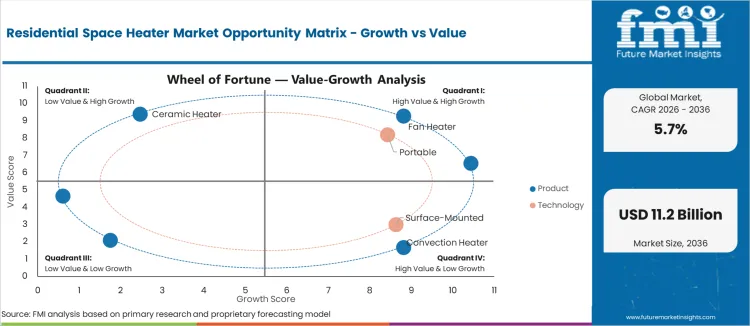
The residential space heater market is expanding due to increased consumer focus on personal comfort and supplemental heating. Compact, energy-conscious devices are preferred for room-specific heating in homes, apartments, and cabins. Seasonal demand, especially in colder regions, contributes to consistent sales. Portability, ease of use, and safety improvements influence purchase decisions. Consumers value convenience and control, prompting growth in models with timers and remote operation. Manufacturers offer varied heater types convection, radiant, fan-forced to meet diverse household preferences and space requirements.
Demand for Personalized and Portable Heating Solutions Drives Market
The rising desire for targeted, cost-effective heating in living spaces is a key driver for the residential space heater market. Homeowners and renters increasingly seek alternatives to central heating, especially for short-term or room-specific needs. Space heaters offer portability and faster heating for areas such as bedrooms, home offices, or basements. This convenience supports flexible home use and individual comfort without relying on the entire heating system. Different heating technologies allow consumers to choose based on noise levels, speed, or air distribution preferences. Additionally, compact models appeal to small living spaces and urban dwellings where energy management is a priority. Many consumers also appreciate the ability to store heaters when not in use. The combination of affordability, personal control, and installation-free usage contributes to steady demand. As working from home becomes more common, the appeal of personal climate control continues to strengthen the adoption of residential space heaters.
Product Safety and Fire Risk Concerns Challenge Market Growth
Safety remains a critical concern in the residential space heater market. Improper usage, product defects, or poor placement can increase the risk of overheating and fire hazards, especially in households with children or pets. Space heaters have historically been associated with accidents when used near flammable materials or left unattended. Despite improved designs, consumer misuse still presents challenges. Buyers are cautious and often prioritize models with advanced safety features such as tip-over protection, automatic shut-off, and overheat sensors. Regulatory bodies and consumer protection agencies closely monitor product quality and frequently issue warnings or recalls. Inconsistent adherence to safety standards across brands creates further skepticism. Additionally, low-cost units without proper certification may underperform or pose safety threats. Manufacturers are under pressure to comply with evolving guidelines while educating consumers about responsible heater use. Addressing these safety challenges is crucial for building trust and sustaining long-term market credibility.
Product Diversification and Smart Control Features Present Opportunities
The residential space heater market offers growing opportunities through diversification in design, control features, and use-case adaptability. Consumers are drawn to heaters that combine aesthetics with performance, encouraging manufacturers to create visually appealing models suitable for various home interiors. Integration of user-friendly control panels, remote operation, and app-based access provides greater flexibility and personalization. Timers, thermostats, and oscillation features enhance energy efficiency and user satisfaction. Compact, wall-mounted, and baseboard designs also gain traction as consumers look for space-saving options. Expanding distribution through online retail channels enables niche and specialized models to reach a broader audience. Additionally, there’s an opportunity to cater to health-conscious consumers by offering heaters with quiet operation, air filtration features, or low-emission performance. Brands that prioritize product versatility and usage convenience-such as dual-use for summer fan function-can tap into multipurpose expectations. Product bundling and seasonal promotions further expand customer reach and repeat purchases.
Energy Usage Concerns and Operating Costs Limit Frequent Usage
Despite their convenience, residential space heaters are often associated with high electricity consumption, leading many consumers to limit their usage to short periods or only during colder months. Concerns over increased utility bills discourage long-term or widespread use in larger areas. Space heaters are primarily viewed as supplementary sources rather than primary heating solutions. In households with fixed income or energy-conscious residents, these devices may be seen as cost-intensive. Additionally, in warmer regions with mild winters, space heaters are purchased infrequently and used sparingly, restricting overall market saturation. Bulkier models or those lacking energy control settings face further criticism. Without visible savings or efficiency benefits, consumers may choose to rely on alternative heating methods or layered clothing. This perceived inefficiency remains a restraint on broader market adoption, prompting a need for clearer energy ratings, cost estimators, and transparent product messaging that justifies both performance and cost-efficiency.
Analysis of Residential Space Heater Market By Key Countries

| Country | CAGR |
|---|---|
| China | 7.7% |
| India | 7.1% |
| Germany | 6.6% |
| France | 6.0% |
| UK | 5.4% |
| USA | 4.8% |
| Brazil | 4.3% |
.webp "Top Country Growth Comparison Residential Space Heater Market Cagr (2026 2036)")
The global residential space heater market is expanding at a CAGR of 5.7%, driven by rising energy efficiency demands, climate variability, and smart home integration. China leads with 7.7% growth, supported by large-scale manufacturing and increasing adoption in colder regions. India follows at 7.1%, fueled by growing urbanization and the need for cost-effective heating solutions. Germany reports 6.6% growth, reflecting demand for high-performance, eco-friendly heating systems. The United Kingdom shows steady growth at 5.4%, focusing on compact, energy-efficient designs aligned with sustainability goals. The United States, growing at 4.8%, represents a mature market shaped by safety standards, smart heating technologies, and regulatory compliance. Market dynamics are influenced by energy source preferences, portability features, and emission norms. This report includes insights on 40+ countries; the top countries are shown here for reference.
Residential Space Heater Market Expansion in China
The residential space heater market in China has registered a growth rate of 7.7% CAGR, driven by the widespread demand for winter heating in northern provinces and increased urban housing projects. Compact electric heaters are seeing popularity due to easy installation and rapid heating performance, particularly in apartments and small living spaces. With energy costs in focus, demand for energy-efficient infrared and ceramic heaters has surged. Manufacturers have launched smart-enabled models featuring remote control and programmable thermostats, appealing to younger urban households. E-commerce platforms are major distribution channels, promoting seasonal discount campaigns that boost volume sales. Rising concerns about air quality during winter have also contributed to increased preference for closed heating systems over open-flame solutions.
- Infrared and ceramic models favored for energy savings
- Urban apartments used compact heaters for room-specific warmth
- Smart-enabled products gained traction through online platforms
Residential Space Heater Market Growth Path in India
Residential space heater market is expanding at a 7.1% CAGR, driven by seasonal demand in northern and northeastern regions where winter temperatures can be severe. Consumers are opting for affordable and portable electric heaters, especially fan and halogen types, due to quick heat output and ease of use. Middle-income households favor locally manufactured models for price advantage, while upper segments show rising interest in oil-filled radiators for better heat retention. Regional brands are targeting Tier 2 and Tier 3 cities with energy-efficient offerings suited for single-room heating. Demand spikes during festival season and winter months have made space heaters a popular household item, prompting retailers to maintain larger seasonal inventories.
- Fan and halogen heaters popular for quick and affordable warmth
- Oil-filled models attracted premium buyers in colder regions
- Tier 2 cities showed seasonal demand spikes for portable units
Residential Space Heater Market Outlook in Germany
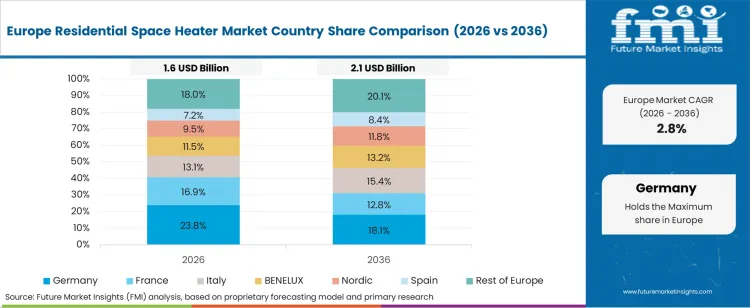
Germany’s residential space heater market has grown at a 6.6% CAGR, shaped by the need for supplemental heating solutions and retrofitting older buildings. Homeowners and tenants alike use portable heaters to improve comfort in isolated rooms without centralized heating. Energy-efficient convection and oil-filled radiators are particularly favored in multi-family housing. The market is witnessing higher demand for thermostatic controls and timer-based units that allow better heat management. With a significant portion of homes built before the 1990s, space heaters are often used during transitional seasons before central systems are fully activated. Local suppliers are aligning their offerings with national energy policies, encouraging products that use less electricity and provide zoned heating.
- Convection and oil-filled radiators preferred in older buildings
- Users adopted programmable heaters for efficient energy use
- Transitional seasons saw increased use of supplemental heating
Residential Space Heater Market Overview in the United Kingdom
The residential space heater market in the United Kingdom is advancing at a 5.4% CAGR, mainly due to demand in older housing stock and multi-occupancy dwellings. Electric fan heaters and panel heaters are common choices for renters and homeowners looking for fast-acting warmth. Increased energy tariffs have made households more conscious of zonal heating, where portable heaters are used in high-occupancy rooms to reduce central heating use. Retailers are offering a broad range of models with digital controls and eco modes that balance performance with lower power consumption. The market also benefits from high seasonal turnover during autumn and winter sales. Government emphasis on energy labeling has influenced consumer preferences toward A-rated appliances.
- Fan and panel heaters supported zonal heating strategies
- Rising electricity costs increased demand for eco modes
- Digital controls added value in compact heater segments
Residential Space Heater Market Trends in the United States

The residential space heater market in the United States has recorded a CAGR of 4.8%, driven by demand in colder states across the Midwest and Northeast. Space heaters are widely used for supplemental heating in bedrooms, basements, and garages, especially in older homes with uneven insulation. Oil-filled radiators and ceramic tower heaters are gaining traction due to safety features and quiet operation. Consumers are increasingly buying products with tip-over protection, automatic shut-off, and programmable timers, particularly in homes with children or pets. Retailers see spikes in heater sales during cold fronts and winter storms, often prompting out-of-stock situations. Online platforms are preferred for purchasing larger models, while compact variants are widely available in home improvement stores.
- Supplemental heating used in rooms with poor insulation
- Buyers prioritized safety features in family households
- Winter weather drove seasonal spikes in online purchases
Competitive Landscape of Residential Space Heater Market

The residential space heater market caters to households seeking efficient, portable heating solutions, especially in regions with seasonal or moderately cold climates. Demand tends to rise during winter months and in areas where central heating is either unavailable or too costly. Leading this market are well-established brands offering a range of electric, infrared, ceramic, and oil-filled models to suit varying user needs. DeLonghi Appliances Srl, Dyson, and Honeywell dominate the premium segment with sleek, high-efficiency heaters offering safety features and digital controls. Dyson, in particular, is known for its bladeless heater-fan combos that appeal to design-conscious consumers. Lasko Products, LLC, Dr. Infrared Heater, and Duraflame, Inc. are key players in the mid-range category, known for dependable performance and wide product assortments.
DAIKIN INDUSTRIES, Ltd. and Rinnai Corporation provide higher-capacity or wall-mounted systems, often favored in small apartments or for zoned heating. The market also features a range of budget-friendly and niche brands such as OPOLAR, Pelonis, and Optimus Enterprise, Inc., which serve cost-conscious consumers. Online retail platforms like Wayfair LLC and household product providers like Newell Brands and Sunbeam Products, Inc. offer wide distribution, making space heaters accessible year-round. Brands like Mill, Havells India Ltd., and Midea are gaining traction globally with modern designs and energy-conscious solutions. As consumers continue to prioritize space efficiency and plug-and-play options, compact and smart-enabled models are seeing growing interest.
Scope of the Report
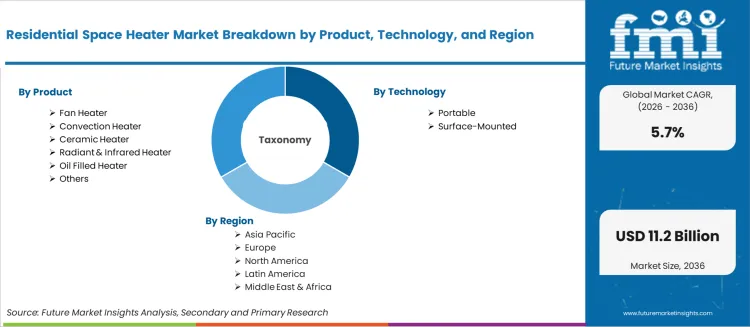
| Metric | Value |
|---|---|
| Quantitative Units | USD 6.45 billion to USD 11.22 billion, at a CAGR of 5.7% |
| Market Definition | The residential space heater market covers portable and surface-mounted heating appliances designed to provide supplemental or primary space heating in residential rooms and living areas. Products inc... |
| Segmentation | Product: Fan Heater, Convection Heater, Ceramic Heater, Radiant & Infrared Heater, Oil Filled Heater, Others; Technology: Portable, Surface-Mounted; Energy Source: Electric, Gas |
| Regions Covered | North America, Latin America, Europe, East Asia, South Asia, Oceania, Middle East & Africa |
| Countries Covered | China, India, Germany, France, UK, USA, Brazil, and 40 plus countries |
| Key Companies Profiled | DeLonghi Appliances Srl, Crane - USA, DAIKIN INDUSTRIES, Ltd., Domu Brands, Dr. Infrared Heater, Duraflame, Inc., Dyson, Energy Wise Solutions, Havells India Ltd., Honeywell, Lasko Products, LLC, Midea, Mill, Newell Brands, OPOLAR, Optimus Enterprise, Inc., Pelonis, Rinnai Corporation, Vornado Air, LLC |
| Forecast Period | 2026 to 2036 |
| Approach | Forecasting models apply a bottom-up methodology starting with installation and procurement tracking data and projecting adoption rates using region-specific deployment curves. |
Residential Space Heater Market by Segments
Product:
- Fan Heater
- Convection Heater
- Ceramic Heater
- Radiant & Infrared Heater
- Oil Filled Heater
- Others
Technology:
- Portable
- Surface-Mounted
Energy Source:
- Electric
- Gas
Region:
- North America
- USA
- Canada
- Mexico
- Latin America
- Brazil
- Chile
- Rest of Latin America
- Western Europe
- Germany
- UK
- Italy
- Spain
- France
- Nordic
- BENELUX
- Rest of Western Europe
- Eastern Europe
- Russia
- Poland
- Hungary
- Balkan & Baltic
- Rest of Eastern Europe
- East Asia
- China
- Japan
- South Korea
- South Asia and Pacific
- India
- ASEAN
- Australia & New Zealand
- Rest of South Asia and Pacific
- Middle East & Africa
- Kingdom of Saudi Arabia
- Other GCC Countries
- Turkiye
- South Africa
- Other African Union
- Rest of Middle East & Africa
Bibliography
- International Energy Agency. (2024). Energy efficiency in buildings: Space heating technology trends. IEA.
- European Commission. (2024). Ecodesign Directive: Lot 20 local space heaters regulatory update. European Commission.
- USA Department of Energy. (2024). Residential portable electric heater energy efficiency standards. DOE.
- Bureau of Indian Standards. (2024). IS 8866: Portable electric room heaters specification revision. BIS.
- UK Department for Energy Security and Net Zero. (2024). Heating and buildings strategy progress report. DESNZ.
This bibliography is provided for reader reference. The full Future Market Insights report contains the complete reference list with primary research documentation.
Frequently Asked Questions
How large is the demand for Residential Space Heater Market in the global market in 2026?
Demand for residential space heater in the global market is estimated to be valued at USD 6.45 billion in 2026.
What will be the market size of Residential Space Heater Market in the global market by 2036?
Market size for residential space heater is projected to reach USD 11.22 billion by 2036.
What is the expected demand growth for Residential Space Heater Market between 2026 and 2036?
Demand for residential space heater is expected to grow at a CAGR of 5.7% between 2026 and 2036.
Which Product is poised to lead global sales by 2026?
Fan Heater accounts for 29% share in 2026 as fan heaters deliver rapid heat output in compact form factors at competitive price points that appeal to cost-conscious consumers.
How is the role of Portable in driving Residential Space Heater Market adoption in 2026?
Portable represents 64% of Technology share in 2026 as portable units provide mobility and the ability to direct heat to occupied spaces, matching zone-heating preferences.
What is driving demand in China?
China is projected to grow at a CAGR of 7.7% during 2026 to 2036, driven by growing supplemental heating demand in central and southern residential zones where district heating infrastructure is absent.
What is Residential Space Heater and what is it mainly used for?
Residential space heaters are portable and surface-mounted heating appliances providing supplemental or primary space heating in residential rooms. They include fan, convection, ceramic, infrared, and oil-filled heater types powered by electric or gas energy sources.
How does FMI build and validate the Residential Space Heater Market forecast?
Forecasting models apply a bottom-up methodology starting with procurement and installation tracking data and cross-validate projections against publicly reported expenditure data from leading industry participants.
Preview the report firsthand - request a free sample
Get SampleGet the brochure for pricing and purchase details.
Get PDFTable of Content
- Executive Summary
- Global Market Outlook
- Demand-side Trends
- Supply-side Trends
- Technology Roadmap Analysis
- Analysis and Recommendations
- Market Overview
- Market Coverage / Taxonomy
- Market Definition / Scope / Limitations
- Research Methodology
- Chapter Orientation
- Analytical Lens and Working Hypotheses
- Market Structure, Signals, and Trend Drivers
- Benchmarking and Cross-market Comparability
- Market Sizing, Forecasting, and Opportunity Mapping
- Research Design and Evidence Framework
- Desk Research Programme (Secondary Evidence)
- Company Annual and Sustainability Reports
- Peer-reviewed Journals and Academic Literature
- Corporate Websites, Product Literature, and Technical Notes
- Earnings Decks and Investor Briefings
- Statutory Filings and Regulatory Disclosures
- Technical White Papers and Standards Notes
- Trade Journals, Industry Magazines, and Analyst Briefs
- Conference Proceedings, Webinars, and Seminar Materials
- Government Statistics Portals and Public Data Releases
- Press Releases and Reputable Media Coverage
- Specialist Newsletters and Curated Briefings
- Sector Databases and Reference Repositories
- FMI Internal Proprietary Databases and Historical Market Datasets
- Subscription Datasets and Paid Sources
- Social Channels, Communities, and Digital Listening Inputs
- Additional Desk Sources
- Expert Input and Fieldwork (Primary Evidence)
- Primary Modes
- Qualitative Interviews and Expert Elicitation
- Quantitative Surveys and Structured Data Capture
- Blended Approach
- Why Primary Evidence is Used
- Field Techniques
- Interviews
- Surveys
- Focus Groups
- Observational and In-context Research
- Social and Community Interactions
- Stakeholder Universe Engaged
- C-suite Leaders
- Board Members
- Presidents and Vice Presidents
- R&D and Innovation Heads
- Technical Specialists
- Domain Subject-matter Experts
- Scientists
- Physicians and Other Healthcare Professionals
- Governance, Ethics, and Data Stewardship
- Research Ethics
- Data Integrity and Handling
- Primary Modes
- Tooling, Models, and Reference Databases
- Desk Research Programme (Secondary Evidence)
- Data Engineering and Model Build
- Data Acquisition and Ingestion
- Cleaning, Normalisation, and Verification
- Synthesis, Triangulation, and Analysis
- Quality Assurance and Audit Trail
- Market Background
- Market Dynamics
- Drivers
- Restraints
- Opportunity
- Trends
- Scenario Forecast
- Demand in Optimistic Scenario
- Demand in Likely Scenario
- Demand in Conservative Scenario
- Opportunity Map Analysis
- Product Life Cycle Analysis
- Supply Chain Analysis
- Investment Feasibility Matrix
- Value Chain Analysis
- PESTLE and Porter’s Analysis
- Regulatory Landscape
- Regional Parent Market Outlook
- Production and Consumption Statistics
- Import and Export Statistics
- Market Dynamics
- Global Market Analysis 2021 to 2025 and Forecast, 2026 to 2036
- Historical Market Size Value (USD Million) Analysis, 2021 to 2025
- Current and Future Market Size Value (USD Million) Projections, 2026 to 2036
- Y-o-Y Growth Trend Analysis
- Absolute $ Opportunity Analysis
- Global Market Pricing Analysis 2021 to 2025 and Forecast 2026 to 2036
- Global Market Analysis 2021 to 2025 and Forecast 2026 to 2036, By Product
- Introduction / Key Findings
- Historical Market Size Value (USD Million) Analysis By Product , 2021 to 2025
- Current and Future Market Size Value (USD Million) Analysis and Forecast By Product , 2026 to 2036
- Fan Heater
- Convection Heater
- Ceramic Heater
- Radiant & Infrared Heater
- Oil Filled Heater
- Others
- Fan Heater
- Y-o-Y Growth Trend Analysis By Product , 2021 to 2025
- Absolute $ Opportunity Analysis By Product , 2026 to 2036
- Global Market Analysis 2021 to 2025 and Forecast 2026 to 2036, By Technology
- Introduction / Key Findings
- Historical Market Size Value (USD Million) Analysis By Technology, 2021 to 2025
- Current and Future Market Size Value (USD Million) Analysis and Forecast By Technology, 2026 to 2036
- Portable
- Surface-Mounted
- Portable
- Y-o-Y Growth Trend Analysis By Technology, 2021 to 2025
- Absolute $ Opportunity Analysis By Technology, 2026 to 2036
- Global Market Analysis 2021 to 2025 and Forecast 2026 to 2036, By Energy Source
- Introduction / Key Findings
- Historical Market Size Value (USD Million) Analysis By Energy Source, 2021 to 2025
- Current and Future Market Size Value (USD Million) Analysis and Forecast By Energy Source, 2026 to 2036
- Electric
- Gas
- Electric
- Y-o-Y Growth Trend Analysis By Energy Source, 2021 to 2025
- Absolute $ Opportunity Analysis By Energy Source, 2026 to 2036
- Global Market Analysis 2021 to 2025 and Forecast 2026 to 2036, By Region
- Introduction
- Historical Market Size Value (USD Million) Analysis By Region, 2021 to 2025
- Current Market Size Value (USD Million) Analysis and Forecast By Region, 2026 to 2036
- North America
- Latin America
- Western Europe
- Eastern Europe
- East Asia
- South Asia and Pacific
- Middle East & Africa
- Market Attractiveness Analysis By Region
- North America Market Analysis 2021 to 2025 and Forecast 2026 to 2036, By Country
- Historical Market Size Value (USD Million) Trend Analysis By Market Taxonomy, 2021 to 2025
- Market Size Value (USD Million) Forecast By Market Taxonomy, 2026 to 2036
- By Country
- USA
- Canada
- Mexico
- By Product
- By Technology
- By Energy Source
- By Country
- Market Attractiveness Analysis
- By Country
- By Product
- By Technology
- By Energy Source
- Key Takeaways
- Latin America Market Analysis 2021 to 2025 and Forecast 2026 to 2036, By Country
- Historical Market Size Value (USD Million) Trend Analysis By Market Taxonomy, 2021 to 2025
- Market Size Value (USD Million) Forecast By Market Taxonomy, 2026 to 2036
- By Country
- Brazil
- Chile
- Rest of Latin America
- By Product
- By Technology
- By Energy Source
- By Country
- Market Attractiveness Analysis
- By Country
- By Product
- By Technology
- By Energy Source
- Key Takeaways
- Western Europe Market Analysis 2021 to 2025 and Forecast 2026 to 2036, By Country
- Historical Market Size Value (USD Million) Trend Analysis By Market Taxonomy, 2021 to 2025
- Market Size Value (USD Million) Forecast By Market Taxonomy, 2026 to 2036
- By Country
- Germany
- UK
- Italy
- Spain
- France
- Nordic
- BENELUX
- Rest of Western Europe
- By Product
- By Technology
- By Energy Source
- By Country
- Market Attractiveness Analysis
- By Country
- By Product
- By Technology
- By Energy Source
- Key Takeaways
- Eastern Europe Market Analysis 2021 to 2025 and Forecast 2026 to 2036, By Country
- Historical Market Size Value (USD Million) Trend Analysis By Market Taxonomy, 2021 to 2025
- Market Size Value (USD Million) Forecast By Market Taxonomy, 2026 to 2036
- By Country
- Russia
- Poland
- Hungary
- Balkan & Baltic
- Rest of Eastern Europe
- By Product
- By Technology
- By Energy Source
- By Country
- Market Attractiveness Analysis
- By Country
- By Product
- By Technology
- By Energy Source
- Key Takeaways
- East Asia Market Analysis 2021 to 2025 and Forecast 2026 to 2036, By Country
- Historical Market Size Value (USD Million) Trend Analysis By Market Taxonomy, 2021 to 2025
- Market Size Value (USD Million) Forecast By Market Taxonomy, 2026 to 2036
- By Country
- China
- Japan
- South Korea
- By Product
- By Technology
- By Energy Source
- By Country
- Market Attractiveness Analysis
- By Country
- By Product
- By Technology
- By Energy Source
- Key Takeaways
- South Asia and Pacific Market Analysis 2021 to 2025 and Forecast 2026 to 2036, By Country
- Historical Market Size Value (USD Million) Trend Analysis By Market Taxonomy, 2021 to 2025
- Market Size Value (USD Million) Forecast By Market Taxonomy, 2026 to 2036
- By Country
- India
- ASEAN
- Australia & New Zealand
- Rest of South Asia and Pacific
- By Product
- By Technology
- By Energy Source
- By Country
- Market Attractiveness Analysis
- By Country
- By Product
- By Technology
- By Energy Source
- Key Takeaways
- Middle East & Africa Market Analysis 2021 to 2025 and Forecast 2026 to 2036, By Country
- Historical Market Size Value (USD Million) Trend Analysis By Market Taxonomy, 2021 to 2025
- Market Size Value (USD Million) Forecast By Market Taxonomy, 2026 to 2036
- By Country
- Kingdom of Saudi Arabia
- Other GCC Countries
- Turkiye
- South Africa
- Other African Union
- Rest of Middle East & Africa
- By Product
- By Technology
- By Energy Source
- By Country
- Market Attractiveness Analysis
- By Country
- By Product
- By Technology
- By Energy Source
- Key Takeaways
- Key Countries Market Analysis
- USA
- Pricing Analysis
- Market Share Analysis, 2025
- By Product
- By Technology
- By Energy Source
- Canada
- Pricing Analysis
- Market Share Analysis, 2025
- By Product
- By Technology
- By Energy Source
- Mexico
- Pricing Analysis
- Market Share Analysis, 2025
- By Product
- By Technology
- By Energy Source
- Brazil
- Pricing Analysis
- Market Share Analysis, 2025
- By Product
- By Technology
- By Energy Source
- Chile
- Pricing Analysis
- Market Share Analysis, 2025
- By Product
- By Technology
- By Energy Source
- Germany
- Pricing Analysis
- Market Share Analysis, 2025
- By Product
- By Technology
- By Energy Source
- UK
- Pricing Analysis
- Market Share Analysis, 2025
- By Product
- By Technology
- By Energy Source
- Italy
- Pricing Analysis
- Market Share Analysis, 2025
- By Product
- By Technology
- By Energy Source
- Spain
- Pricing Analysis
- Market Share Analysis, 2025
- By Product
- By Technology
- By Energy Source
- France
- Pricing Analysis
- Market Share Analysis, 2025
- By Product
- By Technology
- By Energy Source
- India
- Pricing Analysis
- Market Share Analysis, 2025
- By Product
- By Technology
- By Energy Source
- ASEAN
- Pricing Analysis
- Market Share Analysis, 2025
- By Product
- By Technology
- By Energy Source
- Australia & New Zealand
- Pricing Analysis
- Market Share Analysis, 2025
- By Product
- By Technology
- By Energy Source
- China
- Pricing Analysis
- Market Share Analysis, 2025
- By Product
- By Technology
- By Energy Source
- Japan
- Pricing Analysis
- Market Share Analysis, 2025
- By Product
- By Technology
- By Energy Source
- South Korea
- Pricing Analysis
- Market Share Analysis, 2025
- By Product
- By Technology
- By Energy Source
- Russia
- Pricing Analysis
- Market Share Analysis, 2025
- By Product
- By Technology
- By Energy Source
- Poland
- Pricing Analysis
- Market Share Analysis, 2025
- By Product
- By Technology
- By Energy Source
- Hungary
- Pricing Analysis
- Market Share Analysis, 2025
- By Product
- By Technology
- By Energy Source
- Kingdom of Saudi Arabia
- Pricing Analysis
- Market Share Analysis, 2025
- By Product
- By Technology
- By Energy Source
- Turkiye
- Pricing Analysis
- Market Share Analysis, 2025
- By Product
- By Technology
- By Energy Source
- South Africa
- Pricing Analysis
- Market Share Analysis, 2025
- By Product
- By Technology
- By Energy Source
- USA
- Market Structure Analysis
- Competition Dashboard
- Competition Benchmarking
- Market Share Analysis of Top Players
- By Regional
- By Product
- By Technology
- By Energy Source
- Competition Analysis
- Competition Deep Dive
- DeLonghi Appliances Srl
- Overview
- Product Portfolio
- Profitability by Market Segments (Product/Age /Sales Channel/Region)
- Sales Footprint
- Strategy Overview
- Marketing Strategy
- Product Strategy
- Channel Strategy
- Crane - USA
- DAIKIN INDUSTRIES, Ltd.
- Domu Brands
- Dr. Infrared Heater
- Duraflame, Inc.
- Dyson
- Energy Wise Solutions
- Havells India Ltd.
- Honeywell
- Lasko Products, LLC
- Midea
- Mill
- Newell Brands
- OPOLAR
- Optimus Enterprise, Inc.
- Pelonis
- Rinnai Corporation
- SquareTrade
- Sunbeam Products, Inc.
- DeLonghi Appliances Srl
- Competition Deep Dive
- Assumptions & Acronyms Used


