

- Market Size (2026)
- USD 30.7 Bn
- Forecast (2036)
- USD 43.3 Bn
- CAGR (2026 to 2036)
- 3.5%
How big is Space Heating Boilers Market in 2026?
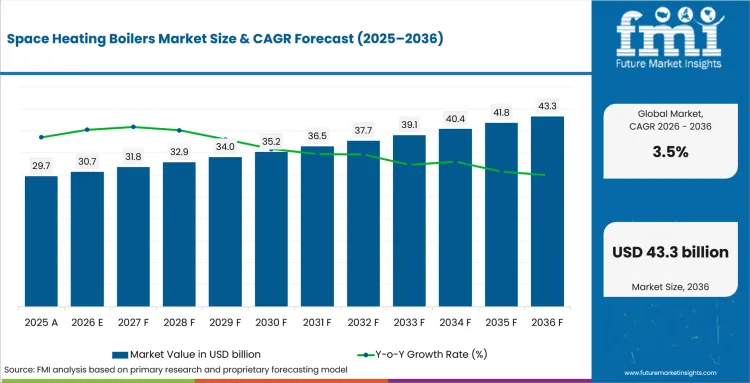
USD 30.7 billion in 2026 and USD 43.3 billion by 2036 at a 3.5% CAGR.
Sales of space heating boilers are estimated to rise at 3.5% CAGR through 2036, increasing valuation from USD 30.7 billion in 2026 to USD 43.3 billion by 2036. Existing hydronic buildings require dependable winter heat during equipment failure or planned renovation across occupied residential and commercial properties. Radiator circuits and serviceable pipework allow a replacement boiler to restore heat without extensive interior reconstruction. The International Energy Agency reported in November 2025 that buildings accounted for around 30% of global energy demand. Space and water heating represented about 70% of household energy use in advanced economies during the same assessment. The operating burden supports boiler technology investment across existing systems, although contractors must prove seasonal performance against electric and hybrid alternatives.
European replacement projects increasingly compare condensing boilers with heat pump systems and hybrid configurations across the same building. Emitter temperature and electrical capacity can influence the final route more than rated equipment efficiency alone. Existing radiator circuits can favor a boiler or hybrid solution across properties that cannot absorb extensive electrical work. Bosch Home Comfort Group reported in February 2026 that the German heating market contracted 14% during 2025 while heat-pump demand rose 47%. The divergence raises the evidence standard for another boiler installation across planned renovation work in mature markets. High-temperature systems may retain a boiler route, but better-insulated properties can support deeper electrification through lower operating temperatures. Successful proposals need accurate load calculations and hydraulic balancing supported by service coverage that protects performance throughout the system life.
Key Takeaways of Space Heating Boilers Market
- Equipment failure and renovation cycles sustain replacement demand across buildings that already use hydronic distribution for dependable winter heating.
- By product, gas-fired space heating boilers are forecast to represent 48.0% share in 2026 through established fuel connections and familiar hydronic service practices.
- In 2026, residential is expected to lead application with 55.0% share due to individual household replacement decisions across a large installed building base.
- Condensing boilers are projected to hold 44.0% share of type in 2026 owing to lower exhaust losses across balanced low-temperature systems.
- Heat-pump incentives and uncertain fuel rules can extend planned decisions, while installer shortages raise commissioning risk across complex renovation projects.
- Bosch Home Comfort Group, Viessmann Climate Solutions, Vaillant Group, and BDR Thermea Group combine broad European portfolios. Ariston Holding N.V., Rheem Manufacturing Company, A. O. Smith Corporation, and Noritz Corporation add regional and commercial boiler depth.
Analyst Perspective
"Space heating boiler demand remains durable across buildings that cannot replace hydronic distribution without major construction or electrical upgrades. Rated efficiency alone does not determine the commercial result across an occupied building during real operation. Manufacturers must combine accurate load calculation and hydraulic balancing with service support that preserves seasonal performance. A boiler or hybrid system earns repeat business through dependable winter operation and measurable fuel use across the complete equipment life."
- Nikhil Kaitwade, Principal Analyst, Future Market Insights
How is the Space Heating Boilers Market segmented?
The Space Heating Boilers market is assessed by Product, Application, Type, End User, Distribution Channel, and Region. Each category reflects a distinct replacement trigger and installation route.
The segmentation separates fuel technology from building use and purchasing responsibility across distinct replacement and installation decisions. Product distinguishes gas-fired and electric systems from oil-fired, biomass, and hydrogen-ready configurations across established fuel and service networks. Application identifies residential and commercial buildings alongside institutional, public, and mixed-use properties with different operating schedules. Type separates condensing and non-condensing equipment from combi configurations that combine space heating with domestic hot water. End user identifies the household or organization that controls capital approval and assumes ongoing service responsibility. Distribution channel records whether equipment reaches projects through HVAC distributors, direct manufacturer sales, qualified heating contractors, retail channels, or online business platforms.
Why do gas-fired space heating boilers lead the product category?
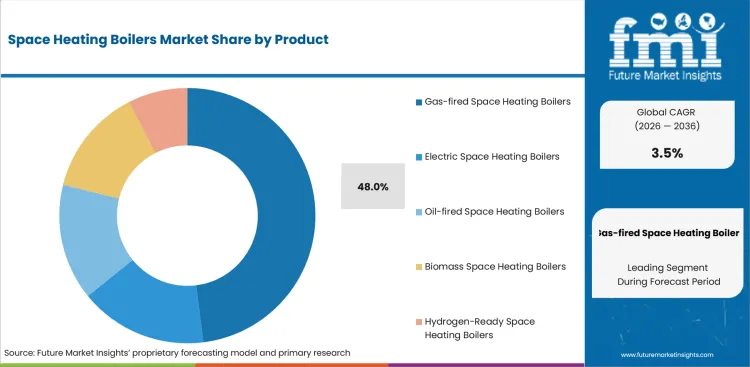
Gas-fired systems suit buildings connected to fuel networks and hydronic distribution across residential and commercial properties. Heating contractors can retain existing pipework and radiators across many replacements, which limits construction work and reduces disruption for occupants. The USA Energy Information Administration reported in October 2025 that natural gas heated 47% of American homes while electricity heated 42%. The split confirms an established gas base alongside a strong electric alternative across American household heating. Local fuel prices and policy shape each gas-fired boiler proposal across service territories with different network conditions.
- By product, gas-fired space heating boilers are forecast to represent 48.0% in 2026 driven by established fuel connections across hydronic buildings. Existing pipework allows heating contractors to replace failed equipment without rebuilding radiator circuits across occupied rooms and common areas. Effective condensing operation and correct sizing remain necessary to protect fuel savings throughout normal operation.
- Urgent winter failures draw demand for gas-fired boilers from properties with existing distribution pipework and limited tolerance for heating downtime. Installation teams must verify flue conditions and return-water temperatures to prevent cycling losses and protect expected fuel savings. Limited service access can extend repair periods across cold-weather territories during peak winter demand and equipment failure.
How does residential shape demand in the application category?
Residential replacement demand develops through equipment failure and household renovation budgets rather than speculative construction. Owners compare installation disruption and electrical capacity alongside expected operating costs throughout each complete household replacement decision. Homes with suitable emitters can retain condensing or hybrid equipment without a complete electrical conversion. Natural Resources Canada reported in April 2026 that federal programs had supported 286,778 heat pump installations since 2020. The installed total establishes a substantial competing route for residential boiler replacements across federally supported household programs.
- Residential is projected to hold 55.0% share in 2026 owing to the number of homes that already depend on central hydronic heating. Each order usually involves one property and one household budget during a limited purchase period. Manufacturers need local contractor coverage and clear installation pricing across service areas during winter failure peaks.
- Households favor residential boilers across homes that can retain familiar radiators and avoid broad electrical upgrades. Improved controls can lower operating temperatures across existing circuits, but financing can postpone work on functional systems during planned renovation. Unexpected failure forces an urgent decision window for contractors with suitable equipment and dependable service capacity.
What keeps condensing boilers ahead within type?
Condensing boilers recover exhaust heat most effectively across balanced hydronic systems with low return-water temperatures. The commercial value depends on the efficiency gap between the new unit and the boiler it replaces. The Department for Energy Security and Net Zero reported in June 2026 that newer condensing-boiler installations continued to reduce gas use, although typical savings had narrowed over successive installation years. The evidence makes system design and commissioning decisive across replacement projects rather than optional installation tasks.
- Condensing boilers are likely to capture 44.0% share in 2026 attributable to lower exhaust losses across suitable hydronic systems. Projects that include controls and hydraulic balancing reinforce the segment’s position across planned building renovation programs. Seasonal performance depends on stable low-temperature operation rather than rated efficiency, since improper return temperatures can prevent sustained condensing throughout normal operation.
- Commercial and residential properties are increasingly purchasing condensing boilers as part of planned system upgrades rather than replacements that address equipment alone. Lower return temperatures improve heat recovery across balanced circuits, while clear control logic prevents short cycling during mild weather. Contractors need commissioning instruments to verify the complete hydronic system throughout setup and final performance testing. Service teams must preserve those commissioned settings throughout later maintenance visits and seasonal operating changes.
Which buying mechanism supports homeowners in the end user category?
Homeowners control replacement timing and usually carry equipment costs through household budgets, while emergency failures favor systems that fit existing pipework. Ofgem reported in July 2026 that the Boiler Upgrade Scheme had received 135,500 homeowner applications. The same update recorded 87,266 redeemed vouchers through the supported heat-pump route for households. The funded route strengthens competition against boiler replacement, so proposals need clear installation costs and credible service coverage supported by smart thermostat controls.
- Homeowners are set to lead the end user category with 48.0% share in 2026 due to direct responsibility for heating comfort and replacement timing. The segment includes planned efficiency upgrades and emergency purchases, so households favor proposals that clearly explain installation disruption and service coverage beside equipment price and expected operating costs throughout ownership.
- Homeowners are increasingly purchasing boilers through installers who inspect emitters and explain operating costs during the first site visit. A fixed quotation should cover controls and commissioning alongside expected service response rather than the boiler box alone. Financing and fuel-policy uncertainty can postpone discretionary replacements, but sudden failure favors local contractors with available equipment and parts.
What supports HVAC and heating equipment distributors within the distribution channel category?
HVAC distributors connect manufacturers with contractors who need local inventory and technical support during seasonal replacement peaks. Mixed-technology portfolios require regional channel partners to pair stock with practical training across boilers and HVAC control systems. Ariston Group opened the 4,500-square-meter WOLF Campus in January 2026 as a training and knowledge center for HVAC professionals. The facility gives trade partners practical access to modern heating systems and practical guidance on controls. Distributor value therefore depends on parts availability and training access that reduce installation errors during urgent replacement work.
- By distribution channel, HVAC and heating equipment distributors are estimated to hold 34.0% in 2026 owing to their position between manufacturers and local contractors. Regional stock supports urgent replacements across territories with limited manufacturer warehouses and long delivery routes during winter demand peaks. Technical desks help installers select compatible controls and avoid incorrect orders that cause repeat site visits during winter peaks.
- Distributors are drawing demand from contractors that need rapid access to pumps and control components across regional service territories. Practical training and parts availability support repeat business more effectively than broad catalog coverage for local contractors. Mild winters can leave seasonal inventory unsold, so accurate local planning determines whether service levels remain commercially sustainable across each heating season.
What are the drivers, restraints, and opportunities in the Space Heating Boilers Market?
Replacement work supports boiler sales across established hydronic buildings. Electrification and fuel-policy uncertainty constrain planned decisions. Integrated retrofit packages provide a credible route through controls, commissioning, and service.
- Driver: Aging installed systems sustain recurring replacement work across buildings that cannot tolerate long heating interruptions during winter operation.
- Restraint: Heat-pump incentives and changing fuel rules extend comparison periods for planned combustion-based replacements across residential and commercial properties.
- Opportunity: Controls and hydraulic balancing can improve seasonal boiler performance without replacing every emitter across an existing hydronic building.
A large installed base supports replacement work across occupied buildings that cannot tolerate long heating interruptions. Existing hydronic circuits reduce construction scope and help contractors restore service without rebuilding every emitter. The Federal Statistical Office of Germany reported in June 2026 that gas heated 53.9% of existing residential buildings and oil heated another 24.7%. The installed equipment base sustains commercial boiler upgrades and household replacement work across familiar hydronic systems and service networks. Revenue quality depends on correct sizing and balanced water flow that preserve expected seasonal efficiency throughout operation.
Electrification lengthens planned replacement decisions as property owners compare boilers with heat pumps and electric heating. The review now includes building fabric and electrical capacity beside equipment price and service requirements. The International Energy Agency reported in October 2025 that electric heaters, boilers, and heat pumps were expanding renewable heat use in buildings. Boiler proposals therefore face broader technical evaluation and greater policy uncertainty across planned building renovation budgets. Contractors must document operating fit and lifetime cost to prevent an existing fuel connection from becoming the sole justification.
Whole-system retrofit packages allow boiler providers to improve seasonal performance without replacing every radiator circuit. A single installation scope can combine equipment, controls, hydraulic balancing, and long-term service responsibility within one contract. KfW updated its residential heating support in July 2026 and required optimization of the complete distribution system for eligible projects. Eligible projects therefore reward proposals that include commissioning across the complete hydronic circuit rather than equipment installation alone. Integrated retrofit proposals can position boiler or hybrid equipment against district heating connections, provided operating comparisons reflect actual building conditions.
Which country CAGRs are profiled in the Space Heating Boilers Market?
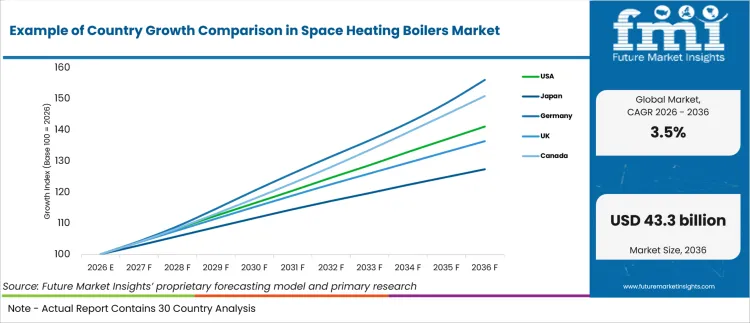
| Country | CAGR |
|---|---|
| Germany | 4.5% |
| Canada | 4.2% |
| South Korea | 3.9% |
| USA | 3.5% |
| UK | 3.1% |
| Australia | 2.8% |
| Japan | 2.5% |
How do country-level CAGRs compare in the Space Heating Boilers Market?
The country forecasts form a gradual progression across a narrow 2.0-point range rather than separate growth tiers. Germany and Canada remain closely aligned through cold-weather replacement demand and extensive legacy heating systems. South Korea and the USA follow different operating routes that pair dense gas infrastructure or large state-level building stocks with expanding electrification pressure. The UK and Australia face greater policy or climate limits, while Japan’s efficiency rules favor controlled replacement over broad volume expansion. Similar growth rates therefore conceal different routes to revenue as installer coverage and fuel policy shape completed boiler work.
- Germany combines a deep gas and oil heating base with technology-neutral replacement rules, yet changing incentives can alter household timing despite continued legal access to several equipment routes.
- Canada’s cold winters support dependable heating investment across oil-heated and gas-heated homes, although provincial incentives and long service distances make local contractor coverage commercially decisive.
- South Korea has a dense apartment networks with public support for high-efficiency replacements, while building-management approvals make compact equipment and coordinated service routes essential for installation capacity.
- The USA combines stable federal boiler standards with state-specific codes and rebate structures, so manufacturers need local product strategies across fragmented utility territories.
- The UK retains a large boiler service network across older housing, but heat-pump grants redirect planned upgrades toward properties with difficult building fabric and higher conversion costs.
- Australian demand concentrates in colder southern regions and specialized hydronic homes, while state electrification rules and dispersed service territories narrow new gas opportunities.
- Japan’s Top Runner standard supports efficient gas heating replacements across established urban networks, yet population decline and strong electric alternatives limit broader volume expansion.
Comparable CAGRs can produce different commercial outcomes across countries with distinct fuel rules and service economics. Manufacturers should test installer reach and project-level operating costs while using the forecast rate to prioritize market entry. The full report provides country-level CAGR analysis across North America, Latin America, Europe, East Asia, South Asia, Oceania and the Middle East and Africa.
Country-wise Analysis
- Germany’s replacement market now operates under a technology-neutral framework that permits several heating routes across existing buildings. The Federal Government reported in July 2026 that the Gebäudemodernisierungsgesetz removed the uniform 65% renewable-energy requirement for new and existing properties. The Germany space heating boilers sector is projected to record 4.5% CAGR during the assessment period, supported by an extensive gas and oil installed base. Legal choice supports replacement boilers across hydronic properties that cannot justify immediate electrical conversion projects. Revised incentives and future fuel requirements remain a material friction for household lifetime-cost calculations during planned upgrades. Manufacturers need clear installer guidance and transparent fuel assumptions to convert household inquiries into approved equipment orders.
- Canadian heating projects operate through province-specific incentives and service networks that cover widely separated communities. Space heating boiler sales in Canada are forecast to expand at 4.2% CAGR by 2036, aided by replacement needs across oil-heated and gas-heated homes. Cold winters support dependable heating investment and urgent repair work across homes located outside major urban service hubs. Natural Resources Canada reported in April 2026 that the Oil to Heat Pump Affordability program had supported 30,349 installations. The program directs eligible oil-heated households toward electrification and reduces the addressable boiler replacement base. Long travel distances remain a material friction that can weaken customer confidence during winter failures. Manufacturers therefore need local maintenance partners and clear regional pricing across each province during distribution expansion.
- South Korean apartment networks support compact boiler replacements through dense gas infrastructure and coordinated building-service routes. The Government of the Republic of Korea reported in May 2025 that its program funded 25,000 residential condensing-boiler replacements for vulnerable households. The program links verified equipment efficiency with affordability through a direct urban replacement route for eligible homes. South Korea's space heating boilers market outlook is anticipated to advance at 3.9% CAGR over the assessment period, reinforced by recurring apartment replacement work. Concentrated housing improves technician productivity across nearby sites, but building-management approvals can restrict access and delay installation schedules. Manufacturers need compact equipment and coordinated service arrangements that fit apartment maintenance windows and building-access rules.
- United States boiler replacements operate under federal efficiency standards alongside state codes and utility incentives across residential markets. Space heating boiler demand in the USA is forecast to rise at 3.5% CAGR over the forecast period, influenced by a large installed heating base. The Department of Energy withdrew proposed amended energy-conservation standards for consumer boilers in January 2025, leaving existing federal requirements as the national compliance baseline. Stable federal testing rules support product planning, but state electrification rebates and building codes establish materially different local conditions. Manufacturers need state-specific equipment strategies and dependable contractor coverage across fragmented utility territories during national expansion.
- United Kingdom households rely on established gas-boiler service networks that support urgent repairs across varied housing types. Adoption of space heating boilers in the UK is estimated to expand at 3.1% CAGR through 2036, supported by unavoidable failures across a large condensing-boiler installed base. Replacement purchases remain concentrated in properties that can reuse established gas distribution and radiator circuits. The Ministry of Housing, Communities and Local Government reported in January 2026 that 19% of English dwellings had condensing boilers and 63% had condensing-combination boilers in 2024. The installed base sustains replacement work across familiar hydronic systems, although heat-pump grants and future gas-policy uncertainty delay planned purchases. Manufacturers need practical retrofit options that fit local property constraints and preserve existing heating distribution systems.
- Australian boiler demand concentrates in colder southern states and specialized hydronic homes rather than the national housing stock. Victoria’s Gas Substitution Roadmap reported in July 2026 that more than two million Victorians used gas across homes and businesses. The same policy requires new gas customers to pay full connection costs, which narrows the route for new combustion-based installations. In Australia, space heating boiler demand is predicted to advance at 2.8% CAGR through 2036, influenced by renovation work across established heating regions. Existing gas users preserve a replacement base, but residential electric boilers gain relevance across new connections and end-of-life decisions. Dispersed service territories increase travel costs for specialist contractors across colder regional markets and scheduled maintenance routes. Manufacturers should focus on installer partnerships and suitable hydronic buildings with recurring service demand through regional distribution.
- Japan applies equipment-efficiency standards through established gas utilities that support urban replacement work and regular maintenance routes. Efficiency targets influence product selection across urban replacements that retain familiar gas distribution and service arrangements. By 2036, Japan's space heating boilers market is projected to grow at 2.5% CAGR, sustained by compliant replacements across urban gas networks. The Ministry of Economy, Trade and Industry reported in April 2025 that fiscal 2028 standards set a 91.3% target for gas water heaters used in space heating. The standard favors engineered condensing products and complete installation records, but population decline and electric alternatives restrict broader unit expansion. Manufacturers need local service capability and clear compliance documentation across regulated urban buildings with demanding maintenance expectations.
Who are the notable companies in the Space Heating Boilers Market?
Bosch Home Comfort Group, Viessmann Climate Solutions, Vaillant Group, BDR Thermea Group, Ariston Holding N.V., Rheem Manufacturing Company, A. O. Smith Corporation, and Noritz Corporation are notable participants in the Space Heating Boilers market.
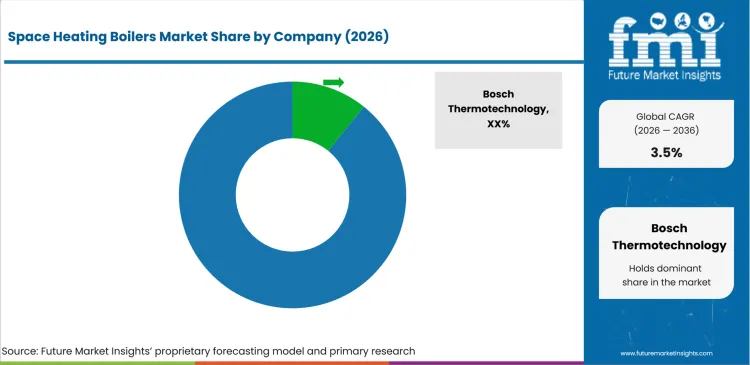
The competitive field is concentrated around established heating groups that combine boiler engineering with local installer and service networks. European platforms compete across gas condensing systems, heat pumps, hybrid controls, and country-specific brands throughout mature heating markets. North American participants emphasize contractor channels and commercial hydronic equipment across regional replacement markets and service territories. Entry remains practical through a focused commercial range or a regional service model that solves difficult retrofit conditions. A new participant must secure parts availability and commissioning support across each launch territory during commercial expansion. Portfolio breadth becomes valuable through local engineers who can design and maintain complete heating systems with commercial condensing expertise.
- Bosch Home Comfort Group and Viessmann Climate Solutions combine residential boilers with heat pumps and hybrid controls across several national markets. Vaillant Group adds gas-heating systems and digital service tools through established installer relationships across several national markets. Their advantage depends on integrated design support and dependable technical service across mixed-technology renovation projects.
- BDR Thermea Group and Ariston Holding N.V. compete through multi-brand portfolios spanning domestic condensing systems and commercial heating applications. National brands support established contractor relationships across distinct regulations and service models within several national markets. Their commercial strength depends on consistent parts access and training rather than a single standardized route across every country.
- Rheem Manufacturing Company and A. O. Smith Corporation provide North American residential and commercial hydronic capabilities through contractor channels. Noritz Corporation follows a focused residential combination-boiler route across selected applications and regional service networks. These companies compete through compact equipment and training depth, while their geographic boiler coverage remains narrower than several European platforms.
Competitive Benchmarking: Space Heating Boilers Market
| Company | Residential Boiler Portfolio | Commercial Boiler Portfolio | Installer and Service Support | Geographic Reach |
|---|---|---|---|---|
| Bosch Home Comfort Group | High | High | High | Global |
| Viessmann Climate Solutions | High | High | High | Multi-country |
| Vaillant Group | High | High | High | Multi-country |
| BDR Thermea Group | High | High | High | Multi-country |
| Ariston Holding N.V. | High | Medium | High | Multi-country |
| Rheem Manufacturing Company | Medium | Medium | High | Multi-country |
| A. O. Smith Corporation | Medium | High | High | Multi-country |
| Noritz Corporation | Medium | Low | Medium | Regional |
Key Developments in the Space Heating Boilers Market
- In July 2025, Rheem Manufacturing Company launched the FT Series condensing boiler line for residential and commercial space heating. The units provide up to 95% AFUE and integrated four-zone control within a compact design. The launch expands Rheem’s hydronic portfolio through established contractor channels across buildings that require boiler-based heating. Integrated zoning can reduce separate control purchases and simplify configuration during planned replacement projects across occupied buildings.
- In May 2025, Viessmann Climate Solutions introduced a compact hybrid system that connects an air-to-water heat pump with Vitodens gas condensing boilers. Hybrid controls allocate base heating to electricity and retain boiler capacity for peak loads during cold periods. The arrangement gives renovation projects a practical route to preserve existing hydronic distribution during gradual electrification. Simplified hydraulic connections reduce coordination risk for installers managing two heat sources within one project.
- In July 2025, Bosch completed the acquisition of Johnson Controls’ residential and light commercial HVAC business and the Johnson Controls-Hitachi Air Conditioning joint venture. The transaction almost doubled the Home Comfort division and expanded its presence across the Americas and Asia Pacific. The enlarged platform connects boiler expertise with wider heating and cooling technologies through regional installer networks. Contractors can access a broader system range through the expanded organization during complex mixed-technology projects.
- In May 2025, Lochinvar launched the Centrus air-to-water hydronic heat pump for residential space heating and cooling. The unit supplies water up to 149°F and includes backup-boiler control for cold-weather operation. The launch gives hydronic contractors an electrification route that can preserve familiar water-based distribution across existing buildings. Installers can pair the heat pump with a boiler for peak conditions instead of replacing the complete heating concept during one renovation.
Space Heating Boilers Market - Report Scope
| Coverage field | Report scope |
|---|---|
| Market breakdown | Product, Application, Type, End User, Distribution Channel, and Region. |
| Quantitative Units | Revenue in USD Billion, CAGR in %. |
| Market Definition | Gas, oil, electric, biomass, and hydrogen-ready boilers used primarily for residential and commercial space heating, including condensing systems, controls, installation, and service. |
| Regions Covered | North America, Latin America, Europe, East Asia, South Asia and Pacific, and Middle East and Africa. |
| Countries Covered | Germany, Canada, South Korea, USA, UK, Australia, and Japan. |
| Key Companies Profiled | Bosch Home Comfort Group, Viessmann Climate Solutions, Vaillant Group, BDR Thermea Group, Ariston Holding N.V., Rheem Manufacturing Company, A. O. Smith Corporation, and Noritz Corporation. |
| Forecast Period | 2026 to 2036. |
| Approach | Hybrid bottom-up and top-down market sizing supported by primary interviews and official desk research. |
Space Heating Boilers Market - Research Methodology
| Method | Approach |
|---|---|
| Primary Research | FMI analysts gathered input from manufacturers, service providers, technology developers, distributors, end users, procurement teams, and subject-matter experts. Interviews examined purchasing decisions, product or service evaluation, adoption barriers, approval requirements, pricing considerations, and expectations for technical or commercial support. Respondents were also asked what evidence is required before a trial, pilot, or initial order develops into regular purchasing. |
| Desk Research | Desk research covered government statistics, regulatory publications, trade data, industry associations, technical literature, standards, company filings, product information, and official corporate announcements. Sources were reviewed for relevance, publication date, geographic coverage, and consistency with the defined market scope. Claims relating to performance, applications, approvals, capacity, investment, and commercial activity were retained only when supported by credible public evidence. |
| Market Sizing and Forecasting | The market model combined the baseline value with historical performance, segment structure, pricing and volume indicators, adoption levels, company participation, and country-level demand conditions. Forecast assumptions considered economic activity, investment trends, regulatory developments, technology adoption, purchasing cycles, supply availability, and barriers to wider market use. Segment and regional estimates were reconciled before the final market total was calculated. |
| Data Validation | Estimates were checked against multiple independent indicators, including public data, company activity, trade patterns, industry developments, and findings from primary interviews. Validation also tested whether products, services, applications, and company revenues fell within the defined market boundaries. Adjacent categories, unsupported claims, overlapping revenues, and activities without direct market relevance were excluded to reduce double counting and maintain consistency across segments and countries. |
Space Heating Boilers Market by Segments
Space Heating Boilers Market segmented by Product:
- Gas-fired Space Heating Boilers
- Natural Gas Boilers
- Propane Gas Boilers
- Electric Space Heating Boilers
- Electric Resistance Boilers
- Electrode Boilers
- Oil-fired Space Heating Boilers
- Light Oil Boilers
- Heavy Oil Boilers
- Biomass Space Heating Boilers
- Wood Pellet Boilers
- Wood Chip Boilers
- Hydrogen-Ready Space Heating Boilers
- Hydrogen-Ready Gas Boilers
- Hydrogen Blended-Fuel Boilers
Space Heating Boilers Market segmented by Application:
- Residential
- Single-Family Homes
- Multi-Family Residential Buildings
- Commercial
- Office Buildings
- Hotels and Hospitality Facilities
- Institutional
- Schools and Universities
- Hospitals and Healthcare Facilities
- Public Buildings
- Government Buildings
- Transport Infrastructure
- Mixed-Use Buildings
- Residential-Commercial Complexes
- Retail and Residential Complexes
Space Heating Boilers Market segmented by Type:
- Condensing Boilers
- Wall-Hung Condensing Boilers
- Floor-Standing Condensing Boilers
- Non-Condensing Boilers
- Standard Atmospheric Boilers
- Conventional Forced-Draft Boilers
- Combi Boilers
- Gas Combi Boilers
- Electric Combi Boilers
- System Boilers
- Sealed System Boilers
- High-Efficiency System Boilers
- Regular Boilers
- Conventional Regular Boilers
- High-Efficiency Regular Boilers
Space Heating Boilers Market segmented by End User:
- Homeowners
- Single-Family Homeowners
- Multi-Family Property Owners
- Commercial Property Owners
- Office and Retail Property Owners
- Hospitality Property Owners
- Building Contractors and Developers
- Residential Developers
- Commercial Building Contractors
- Property Management Companies
- Residential Property Managers
- Commercial Property Managers
- Public and Institutional Organizations
- Government Facilities
- Educational and Healthcare Institutions
Space Heating Boilers Market segmented by Distribution Channel:
- HVAC and Heating Equipment Distributors
- Regional HVAC Distributors
- Specialized Heating Equipment Distributors
- Direct Sales
- Direct Manufacturer Sales
- Key Account and Project Contracts
- Plumbing and Heating Contractors
- Independent Heating Contractors
- Large HVAC Installation Contractors
- Home Improvement and Retail Channels
- Home Improvement Stores
- Specialized Heating Retailers
- Online and B2B Channels
- Online HVAC Marketplaces
- B2B Procurement Platforms
Space Heating Boilers Market by Region:
- North America
- United States
- Canada
- Europe
- Germany
- United Kingdom
- France
- Italy
- Spain
- Asia Pacific
- India
- China
- Japan
- South Korea
- Australia
- Latin America
- Brazil
- Argentina
- Mexico
- Chile
- Middle East & Africa
- UAE
- Saudi Arabia
- South Africa
Research Sources and Bibliography
- International Energy Agency. (2025, November 20). Buildings.
- Bosch Home Comfort Group. (2026, February 2). Bosch Home Comfort Group 2025.
- USA Energy Information Administration. (2025, October 10). Electricity use is becoming more common for residential heating.
- Natural Resources Canada. (2026, April 16). Heat pumps uptake at a glance.
- Department for Energy Security and Net Zero. (2026, June 11). National Energy Efficiency Data Framework (NEED) report: Summary of analysis 2026.
- Ofgem. (2026, July 10). BUS monthly scheme update.
- Ariston Group. (2026, January 29). THE NEW WOLF CAMPUS OPENS IN MAINBURG.
- Federal Statistical Office of Germany. (2026, June 10). Rund drei Viertel der im Jahr 2025 errichteten Wohngebäude heizen mit Wärmepumpen.
- International Energy Agency. (2025, October 7). Renewable heat.
- KfW. (2026, July 21). Heizungsförderung für Privatpersonen - Wohngebäude (458).
- Federal Government of Germany. (2026, July 10). Neues Gebäudemodernisierungsgesetz.
- Natural Resources Canada. (2026, April 16). Oil to Heat Pump Affordability program at a glance.
- Government of the Republic of Korea. (2025, May
- USA Department of Energy. (2025, January 17). Energy Conservation Program: Energy Conservation Standards for Consumer Boilers.
- Ministry of Housing, Communities and Local Government. (2026, January 29). Chapter 2: Energy efficiency.
- State Government of Victoria. (2026, July 10). Victoria’s Gas Substitution Roadmap.
- Ministry of Economy, Trade and Industry. (2025, April 18). Report Compiled on New Energy Efficiency Standards for Gas Water Heaters.
- Rheem Manufacturing Company. (2025, July 8). Rheem launches boiler series with super high efficiency condensing technology.
- Viessmann Climate Solutions. (2025, May 12). Innovative and space-saving hybrid heating systems with high efficiency.
- Bosch. (2025, August 1). Bosch wants to grow significantly faster than the market in the heating, ventilation, and cooling sector.
- Lochinvar. (2025, May 5). Lochinvar Launches Centrus Space Heating and Cooling Air to Water Hydronic Heat Pump.
This bibliography is provided for reader reference and is not exhaustive. The full report contains the complete reference list and detailed citations
This Report Answers
- How large is the Space Heating Boilers market in 2026 and 2036?
- Which replacement conditions support demand for space heating boilers across established building stocks?
- Why does the gas-fired space heating boiler segment account for the largest product share in 2026?
- How does the residential segment influence installation timing and purchasing responsibility across the application category?
- Why do condensing boilers represent the largest type share during 2026?
- How do country growth rates differ across Germany, Canada, South Korea, the USA, the UK, Australia, and Japan?
- Which companies provide residential boilers, commercial hydronic systems, controls, and installer support?
- What limits boiler adoption as heat pumps and electric heating gain policy support?
- How can controls and commissioning improve seasonal performance across replacement projects?
Frequently Asked Questions
How big is the Space Heating Boilers Market in 2026?
The space heating boilers market is valued at USD 30.7 billion in 2026 and is forecast to reach USD 43.3 billion by 2036. Growth is supported by existing hydronic buildings requiring dependable winter heat during equipment failure or planned renovation across occupied residential and commercial properties with established radiator circuits and serviceable pipework.
What is the CAGR of the Space Heating Boilers Market from 2026 to 2036?
The space heating boilers market grows at a CAGR of 3.5% between 2026 and 2036, supported by heating contractors adopting condensing boiler and hybrid systems once those installations demonstrate accurate load calculations, dependable hydraulic balancing, and service coverage that protects seasonal performance throughout the equipment life.
Which product leads the Space Heating Boilers Market?
Gas-fired space heating boilers account for 48.0% of the space heating boilers market by product in 2026, driven by established fuel connections across hydronic buildings that let heating contractors replace failed equipment without rebuilding radiator circuits across occupied rooms and common areas during urgent winter replacement work.
How much will the Space Heating Boilers Market add between 2026 and 2036?
The space heating boilers market is set to add USD 12.6 billion between 2026 and 2036, growing from USD 30.7 billion to USD 43.3 billion as condensing boilers, hybrid heat pump configurations, and integrated retrofit packages enter funded replacement pathways across a widening base of residential and commercial hydronic building programs worldwide.
Who are the leading companies in the Space Heating Boilers Market?
Five companies lead the space heating boilers market, including Bosch Home Comfort Group, Viessmann Climate Solutions, Vaillant Group, BDR Thermea Group, and Ariston Holding, competing through broad residential and commercial boiler portfolios, hybrid heat pump controls, condensing system engineering, and multi-country installer and service networks across established heating markets worldwide.
Preview the report firsthand - request a free sample
Get SampleGet the brochure for pricing and purchase details.
Get PDFTable of Content
- Key Takeaways
- Market Size and CAGR
- Top Growth Driver
- Fastest Growing Segment
- Leading Region
- Key Companies
- Emerging Opportunities
- Executive Summary
- Global Market Outlook
- Demand-side Trends
- Supply-side Trends
- Technology Roadmap Analysis
- Analysis and Recommendations
- Analyst Perspective (What is happening? Why now? What should investors know?)
- Key Questions Answered
- How large is the market?
- What is the CAGR?
- What are key trends?
- Which region dominates?
- Who are the leaders?
- Market Overview
- Market Coverage / Taxonomy
- Market Definition / Scope / Limitations
- Research Methodology
- Chapter Orientation
- Analytical Lens and Working Hypotheses
- Market Structure, Signals, and Trend Drivers
- Benchmarking and Cross-market Comparability
- Market Sizing, Forecasting, and Opportunity Mapping
- Research Design and Evidence Framework
- Desk Research Programme (Secondary Evidence)
- Expert Input and Fieldwork (Primary Evidence)
- Tooling, Models, and Reference Databases
- Data Engineering and Model Build
- Quality Assurance and Audit Trail
- Market Background
- Market Dynamics (Drivers, Restraints, Opportunity, Trends)
- Scenario Forecast (Optimistic, Likely, Conservative)
- Impact Analysis
- AI Impact
- Sustainability Impact
- Regulatory Impact
- Technology Impact
- Consumer / Buyer Analysis
- Purchase Drivers
- Adoption Barriers
- Buyer Journey
- Opportunity Map Analysis
- Product Life Cycle Analysis
- Supply Chain Analysis
- Investment Feasibility Matrix
- Value Chain Analysis
- PESTLE and Porter's Analysis
- Regulatory Landscape
- Regional Parent Market Outlook
- Production and Consumption Statistics
- Import and Export Statistics
- Global Market Analysis and Forecast, 2021 to 2036
- Historical Market Size Value (USD billion) Analysis, 2021 to 2025
- Current and Future Market Size Value (USD billion) Projections, 2026 to 2036
- Y-o-Y Growth Trend Analysis
- Absolute $ Opportunity Analysis
- Global Market Pricing Analysis, 2021 to 2036
- Global Market Analysis and Forecast, By Product, 2021 to 2036
- Introduction / Key Findings
- Historical Market Size Value (USD billion) Analysis By Product, 2021 to 2025
- Current and Future Market Size Value (USD billion) Analysis and Forecast By Product, 2026 to 2036
- Gas-fired Space Heating Boilers
- Natural Gas Boilers
- Propane Gas Boilers
- Electric Space Heating Boilers
- Electric Resistance Boilers
- Electrode Boilers
- Oil-fired Space Heating Boilers
- Light Oil Boilers
- Heavy Oil Boilers
- Biomass Space Heating Boilers
- Wood Pellet Boilers
- Wood Chip Boilers
- Hydrogen-Ready Space Heating Boilers
- Hydrogen-Ready Gas Boilers
- Hydrogen Blended-Fuel Boilers
- Gas-fired Space Heating Boilers
- Y-o-Y Growth Trend Analysis By Product, 2021 to 2025
- Absolute $ Opportunity Analysis By Product, 2026 to 2036
- Global Market Analysis and Forecast, By Application, 2021 to 2036
- Introduction / Key Findings
- Historical Market Size Value (USD billion) Analysis By Application, 2021 to 2025
- Current and Future Market Size Value (USD billion) Analysis and Forecast By Application, 2026 to 2036
- Residential
- Single-Family Homes
- Multi-Family Residential Buildings
- Commercial
- Office Buildings
- Hotels and Hospitality Facilities
- Institutional
- Schools and Universities
- Hospitals and Healthcare Facilities
- Public Buildings
- Government Buildings
- Transport Infrastructure
- Mixed-Use Buildings
- Residential-Commercial Complexes
- Retail and Residential Complexes
- Residential
- Y-o-Y Growth Trend Analysis By Application, 2021 to 2025
- Absolute $ Opportunity Analysis By Application, 2026 to 2036
- Global Market Analysis and Forecast, By Type, 2021 to 2036
- Introduction / Key Findings
- Historical Market Size Value (USD billion) Analysis By Type, 2021 to 2025
- Current and Future Market Size Value (USD billion) Analysis and Forecast By Type, 2026 to 2036
- Condensing Boilers
- Wall-Hung Condensing Boilers
- Floor-Standing Condensing Boilers
- Non-Condensing Boilers
- Standard Atmospheric Boilers
- Conventional Forced-Draft Boilers
- Combi Boilers
- Gas Combi Boilers
- Electric Combi Boilers
- System Boilers
- Sealed System Boilers
- High-Efficiency System Boilers
- Regular Boilers
- Conventional Regular Boilers
- High-Efficiency Regular Boilers
- Condensing Boilers
- Y-o-Y Growth Trend Analysis By Type, 2021 to 2025
- Absolute $ Opportunity Analysis By Type, 2026 to 2036
- Global Market Analysis and Forecast, By End User, 2021 to 2036
- Introduction / Key Findings
- Historical Market Size Value (USD billion) Analysis By End User, 2021 to 2025
- Current and Future Market Size Value (USD billion) Analysis and Forecast By End User, 2026 to 2036
- Homeowners
- Single-Family Homeowners
- Multi-Family Property Owners
- Commercial Property Owners
- Office and Retail Property Owners
- Hospitality Property Owners
- Building Contractors and Developers
- Residential Developers
- Commercial Building Contractors
- Property Management Companies
- Residential Property Managers
- Commercial Property Managers
- Public and Institutional Organizations
- Government Facilities
- Educational and Healthcare Institutions
- Homeowners
- Y-o-Y Growth Trend Analysis By End User, 2021 to 2025
- Absolute $ Opportunity Analysis By End User, 2026 to 2036
- Global Market Analysis and Forecast, By Distribution Channel, 2021 to 2036
- Introduction / Key Findings
- Historical Market Size Value (USD billion) Analysis By Distribution Channel, 2021 to 2025
- Current and Future Market Size Value (USD billion) Analysis and Forecast By Distribution Channel, 2026 to 2036
- HVAC and Heating Equipment Distributors
- Regional HVAC Distributors
- Specialized Heating Equipment Distributors
- Direct Sales
- Direct Manufacturer Sales
- Key Account and Project Contracts
- Plumbing and Heating Contractors
- Independent Heating Contractors
- Large HVAC Installation Contractors
- Home Improvement and Retail Channels
- Home Improvement Stores
- Specialized Heating Retailers
- Online and B2B Channels
- Online HVAC Marketplaces
- B2B Procurement Platforms
- HVAC and Heating Equipment Distributors
- Y-o-Y Growth Trend Analysis By Distribution Channel, 2021 to 2025
- Absolute $ Opportunity Analysis By Distribution Channel, 2026 to 2036
- Global Market Analysis and Forecast, By Region, 2021 to 2036
- Introduction
- Historical Market Size Value (USD billion) Analysis By Region, 2021 to 2025
- Current Market Size Value (USD billion) Analysis and Forecast By Region, 2026 to 2036
- North America
- Latin America
- Western Europe
- Eastern Europe
- East Asia
- South Asia and Pacific
- Middle East & Africa
- Market Attractiveness Analysis By Region
- North America Market Analysis and Forecast, By Country, 2021 to 2036
- Historical Market Size Value (USD billion) Trend Analysis By Market Taxonomy, 2021 to 2025
- Market Size Value (USD billion) Forecast By Market Taxonomy, 2026 to 2036
- By Country
- USA
- Canada
- By Product
- By Application
- By Type
- By End User
- By Distribution Channel
- By Country
- Market Attractiveness Analysis
- By Country
- By Product
- By Application
- By Type
- By End User
- By Distribution Channel
- Key Takeaways
- Latin America Market Analysis and Forecast, By Country
- Historical Market Size Value (USD billion) Trend Analysis By Market Taxonomy, 2021 to 2025
- Market Size Value (USD billion) Forecast By Market Taxonomy, 2026 to 2036
- By Country
- Brazil
- Mexico
- Chile
- Rest of Latin America
- By Product
- By Application
- By Type
- By End User
- By Distribution Channel
- By Country
- Market Attractiveness Analysis
- By Country
- By Product
- By Application
- By Type
- By End User
- By Distribution Channel
- Key Takeaways
- Western Europe Market Analysis and Forecast, By Country
- Historical Market Size Value (USD billion) Trend Analysis By Market Taxonomy, 2021 to 2025
- Market Size Value (USD billion) Forecast By Market Taxonomy, 2026 to 2036
- By Country
- Germany
- UK
- Italy
- Spain
- France
- Nordic
- BENELUX
- Rest of Western Europe
- By Product
- By Application
- By Type
- By End User
- By Distribution Channel
- By Country
- Market Attractiveness Analysis
- By Country
- By Product
- By Application
- By Type
- By End User
- By Distribution Channel
- Key Takeaways
- Eastern Europe Market Analysis and Forecast, By Country
- Historical Market Size Value (USD billion) Trend Analysis By Market Taxonomy, 2021 to 2025
- Market Size Value (USD billion) Forecast By Market Taxonomy, 2026 to 2036
- By Country
- Russia
- Poland
- Hungary
- Balkan & Baltic
- Rest of Eastern Europe
- By Product
- By Application
- By Type
- By End User
- By Distribution Channel
- By Country
- Market Attractiveness Analysis
- By Country
- By Product
- By Application
- By Type
- By End User
- By Distribution Channel
- Key Takeaways
- East Asia Market Analysis and Forecast, By Country
- Historical Market Size Value (USD billion) Trend Analysis By Market Taxonomy, 2021 to 2025
- Market Size Value (USD billion) Forecast By Market Taxonomy, 2026 to 2036
- By Country
- China
- Japan
- South Korea
- By Product
- By Application
- By Type
- By End User
- By Distribution Channel
- By Country
- Market Attractiveness Analysis
- By Country
- By Product
- By Application
- By Type
- By End User
- By Distribution Channel
- Key Takeaways
- South Asia and Pacific Market Analysis and Forecast, By Country
- Historical Market Size Value (USD billion) Trend Analysis By Market Taxonomy, 2021 to 2025
- Market Size Value (USD billion) Forecast By Market Taxonomy, 2026 to 2036
- By Country
- India
- ASEAN
- Australia & New Zealand
- Rest of South Asia and Pacific
- By Product
- By Application
- By Type
- By End User
- By Distribution Channel
- By Country
- Market Attractiveness Analysis
- By Country
- By Product
- By Application
- By Type
- By End User
- By Distribution Channel
- Key Takeaways
- Middle East & Africa Market Analysis and Forecast, By Country
- Historical Market Size Value (USD billion) Trend Analysis By Market Taxonomy, 2021 to 2025
- Market Size Value (USD billion) Forecast By Market Taxonomy, 2026 to 2036
- By Country
- Kingdom of Saudi Arabia
- Other GCC Countries
- Türkiye
- South Africa
- Other African Union
- Rest of Middle East & Africa
- By Product
- By Application
- By Type
- By End User
- By Distribution Channel
- By Country
- Market Attractiveness Analysis
- By Country
- By Product
- By Application
- By Type
- By End User
- By Distribution Channel
- Key Takeaways
- Key Countries Market Analysis
- USA
- Pricing Analysis
- Market Share Analysis, 2025
- By Product
- By Application
- By Type
- By End User
- By Distribution Channel
- Canada
- Pricing Analysis
- Market Share Analysis, 2025
- By Product
- By Application
- By Type
- By End User
- By Distribution Channel
- Mexico
- Pricing Analysis
- Market Share Analysis, 2025
- By Product
- By Application
- By Type
- By End User
- By Distribution Channel
- Brazil
- Pricing Analysis
- Market Share Analysis, 2025
- By Product
- By Application
- By Type
- By End User
- By Distribution Channel
- Chile
- Pricing Analysis
- Market Share Analysis, 2025
- By Product
- By Application
- By Type
- By End User
- By Distribution Channel
- Germany
- Pricing Analysis
- Market Share Analysis, 2025
- By Product
- By Application
- By Type
- By End User
- By Distribution Channel
- UK
- Pricing Analysis
- Market Share Analysis, 2025
- By Product
- By Application
- By Type
- By End User
- By Distribution Channel
- Italy
- Pricing Analysis
- Market Share Analysis, 2025
- By Product
- By Application
- By Type
- By End User
- By Distribution Channel
- Spain
- Pricing Analysis
- Market Share Analysis, 2025
- By Product
- By Application
- By Type
- By End User
- By Distribution Channel
- France
- Pricing Analysis
- Market Share Analysis, 2025
- By Product
- By Application
- By Type
- By End User
- By Distribution Channel
- India
- Pricing Analysis
- Market Share Analysis, 2025
- By Product
- By Application
- By Type
- By End User
- By Distribution Channel
- ASEAN
- Pricing Analysis
- Market Share Analysis, 2025
- By Product
- By Application
- By Type
- By End User
- By Distribution Channel
- Australia & New Zealand
- Pricing Analysis
- Market Share Analysis, 2025
- By Product
- By Application
- By Type
- By End User
- By Distribution Channel
- China
- Pricing Analysis
- Market Share Analysis, 2025
- By Product
- By Application
- By Type
- By End User
- By Distribution Channel
- Japan
- Pricing Analysis
- Market Share Analysis, 2025
- By Product
- By Application
- By Type
- By End User
- By Distribution Channel
- South Korea
- Pricing Analysis
- Market Share Analysis, 2025
- By Product
- By Application
- By Type
- By End User
- By Distribution Channel
- Russia
- Pricing Analysis
- Market Share Analysis, 2025
- By Product
- By Application
- By Type
- By End User
- By Distribution Channel
- Poland
- Pricing Analysis
- Market Share Analysis, 2025
- By Product
- By Application
- By Type
- By End User
- By Distribution Channel
- Hungary
- Pricing Analysis
- Market Share Analysis, 2025
- By Product
- By Application
- By Type
- By End User
- By Distribution Channel
- Kingdom of Saudi Arabia
- Pricing Analysis
- Market Share Analysis, 2025
- By Product
- By Application
- By Type
- By End User
- By Distribution Channel
- Türkiye
- Pricing Analysis
- Market Share Analysis, 2025
- By Product
- By Application
- By Type
- By End User
- By Distribution Channel
- South Africa
- Pricing Analysis
- Market Share Analysis, 2025
- By Product
- By Application
- By Type
- By End User
- By Distribution Channel
- USA
- Market Structure Analysis
- Competition Dashboard
- Competition Benchmarking
- Market Share Analysis of Top Players
- By Regional
- By Product
- By Application
- By Type
- By End User
- By Distribution Channel
- Emerging Startups
- Innovation Benchmarking
- Competition Analysis
- Competition Deep Dive
- Bosch Thermotechnology
- Overview
- Product Portfolio
- Profitability by Market Segments
- Sales Footprint
- Strategy Overview
- Marketing Strategy
- Product Strategy
- Channel Strategy
- Viessmann Climate Solutions
- Vaillant Group
- BDR Thermea Group
- Ariston Holding N.V.
- Carrier Global Corporation
- Trane Technologies plc
- Rheem Manufacturing Company
- A.O. Smith Corporation
- Noritz Corporation
- Bosch Thermotechnology
- Case Studies
- Success Stories
- Recent Developments
- Competition Deep Dive
- Assumptions & Acronyms Used


