

- Industry Size (2026)
- USD 39.02 Bn
- Forecast (2036)
- USD 55.04 Bn
- CAGR (2026 to 2036)
- 3.50%
Copper Tube Market Size, Market Forecast and Outlook By FMI
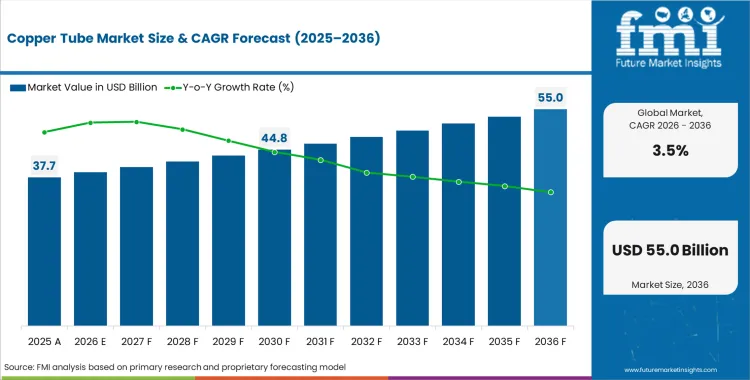
The copper tube market was valued at USD 37.70 billion in 2025, projected to reach USD 39.02 billion in 2026, and is forecast to expand to USD 55.04 billion by 2036 at a 3.50% CAGR. As per FMI, the incremental opportunity across the forecast period amounts to USD 16.02 billion, reflecting a steady expansion trajectory shaped by evolving end-use requirements, tightening regulatory frameworks, and shifting procurement patterns across global supply chains.
Summary of Copper Tube Market
- Market Snapshot
- The copper tube market is valued at USD 37.70 billion in 2025 and is projected to reach USD 55.04 billion by 2036.
- The industry is expected to grow at a 3.50% CAGR from 2026 to 2036, creating an incremental opportunity of USD 16.02 billion.
- The market is a construction and HVAC infrastructure-linked category, where refrigerant specification compliance, medical gas piping standards, and plumbing code requirements define procurement decisions.
- Demand and Growth Drivers
- Demand is driven by accelerating HVAC system installations and refrigerant line standardization across residential and commercial construction.
- Medical gas distribution piping upgrades and potable water infrastructure modernization programs sustain procurement volumes in mature and developing markets.
- Transition toward low-GWP refrigerants is compelling specification upgrades to tighter dimensional tolerances and cleaner tube interior finishes.
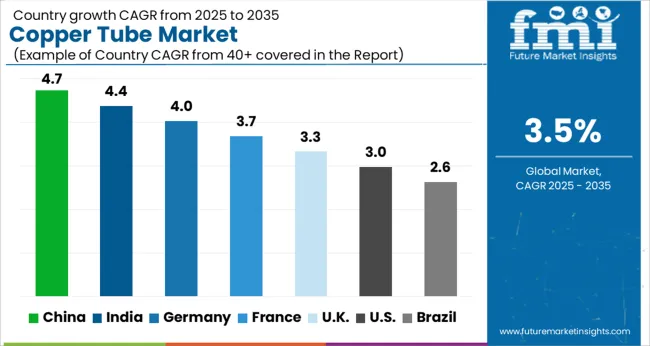
- Among key countries, China leads at 4.7% CAGR, followed by India at 4.4%, Germany at 4.0%, France at 3.7%, UK at 3.3%, USA at 3.0%, and Brazil at 2.6%.
- Product and Segment View
- The market includes seamless, welded, and capillary copper tubes across multiple finish types including bright annealed, dark annealed, and lacquered formats.
- Applications span plumbing, HVAC refrigerant lines, medical gas distribution, industrial heat exchange, and electrical bus bar conductors.
- Seamless copper tubes leads by Product Type with 47.3% share in 2026.
- Bright annealed copper tubes leads by Finish Type with 38.6% share in 2026.
- The scope includes drawn and extruded copper tubes for building services and industrial use, while excluding copper-clad aluminum tubes, copper alloy condenser tubes, and copper pipe fittings sold separately.
- Geography and Competitive Outlook
- China and India are the fastest-growing markets driven by large-scale HVAC and water infrastructure programs, while North America and Europe sustain value through specification-grade medical and refrigeration tube procurement.
- Competition is shaped by alloy purity certification, dimensional precision, and supply chain integration with OEM fabricators, with key players including Mueller Industries, Inc., Wieland Group, Kobe Steel, Ltd., KME (KME Group), Cerro Flow Products, LLC.
- Analyst Opinion at FMI
- Nikhil Kaitwade, Principal Consultant, opines: 'In my analysis, I have observed that the copper tube market is experiencing a specification-driven upgrade cycle where legacy ACR tube grades are being displaced by internally cleaned, dehydrated formats mandated for low-GWP refrigerant systems. Facility managers continuing to specify standard tube grades for new HVAC installations face compliance gaps as refrigerant transition deadlines approach across multiple jurisdictions.'
- Strategic Implications / Executive Takeaways
- HVAC OEMs must specify internally cleaned, dehydrated copper tube grades for all new refrigerant system installations to meet upcoming low-GWP compliance deadlines.
- Building services specification teams should mandate bright annealed tube formats for medical gas and potable water piping to meet tightening health and safety standards.
- Fabrication facility operators must invest in precision drawing and finishing equipment to meet tighter dimensional tolerance requirements across refrigerant and medical tube grades.
Accelerating global construction activity and refrigerant line standardization requirements across HVAC system installations are sustaining procurement volumes for seamless and welded copper tube formats. Medical gas distribution piping, potable water infrastructure upgrades, and district cooling network expansions in high-growth urban centers are anchoring the demand base. FMI is of the opinion that the transition toward low-GWP refrigerants is requiring tighter dimensional tolerances and cleaner interior surfaces, compelling specification upgrades across fabrication facilities.
Global copper tube deployment parameters vary by regional construction and HVAC infrastructure maturity. China at 4.7% CAGR, India at 4.4% CAGR, Germany at 4.0% CAGR, France at 3.7% CAGR, UK at 3.3% CAGR, USA at 3.0% CAGR, Brazil at 2.6% CAGR. China leads on the strength of massive residential and commercial HVAC installation programs, while India sustains high growth through urban water distribution network modernization and hospital medical gas piping requirements. Germany and France maintain solid trajectories through district heating retrofit mandates and industrial refrigeration upgrades. The United Kingdom tracks growth through building services specification tightening. The United States advances through residential heat pump adoption and commercial plumbing code revisions. Brazil registers steady growth driven by mining sector process cooling infrastructure expansion.
Copper Tube Market Key Takeaways
| Metric | Details |
|---|---|
| Industry Size (2026) | USD 39.02 Billion |
| Industry Value (2036) | USD 55.04 Billion |
| CAGR (2026-2036) | 3.50% |
Source: Future Market Insights, 2026
As per FMI, the copper tube market is expected to create an incremental opportunity of USD 16.02 billion between 2026 and 2036. FMI analysts project that end-use procurement patterns, regulatory compliance cycles, and regional supply chain dynamics will shape the distribution of this opportunity across segments and geographies.
Copper Tube Market Definition
Copper tubes are hollow cylindrical conductors manufactured from high-purity copper alloys through seamless drawing, welding, or extrusion processes. They serve as the primary conveyance medium for refrigerant gases in HVAC systems, potable water in plumbing installations, medical gases in healthcare facilities, and heat transfer fluids in industrial process equipment. The market covers the full range of dimensional specifications, wall thicknesses, and surface finishes required by building services, refrigeration, medical, and industrial piping codes.
Based on FMI's report, the market definition captures the complete addressable consumption base across all major producing and consuming regions, covering the forecast period from 2026 to 2036.
Copper Tube Market Inclusions
Market scope includes seamless drawn, welded, and capillary copper tubes across bright annealed, dark annealed, and lacquered finish types for plumbing, HVAC, medical, industrial, and electrical applications. The assessment covers global and regional market sizes, forecast period 2026 to 2036, and segment breakdowns by product type, finish type, application, and region.
Copper Tube Market Exclusions
The scope excludes copper-clad aluminum tubes, copper alloy condenser tubes (brass, bronze), and copper pipe fittings sold as separate product categories. Pre-insulated copper tube assemblies marketed as complete HVAC line sets are also excluded unless the tube component is separately valued.
Copper Tube Market Research Methodology
- Primary Research: Analysts engaged with procurement managers, production engineers, regulatory affairs specialists, and distribution channel executives to map the decision gates and compliance thresholds shaping product adoption.
- Desk Research: Data collection aggregated regulatory filings, trade body publications, standards body documentation, and company financial disclosures across all major producing and consuming regions.
- Market-Sizing and Forecasting: Baseline values derive from a bottom-up aggregation of producer shipment volumes and trade flow data, applying region-specific demand growth curves to project adoption velocity through 2036.
- Data Validation and Update Cycle: Projections are tested against publicly reported industry statistics, trade data, and company guidance. The model is updated quarterly to reflect regulatory and market structure changes.
Why is the Copper Tube Market Growing?
The copper tube market is experiencing sustained growth, supported by increasing demand from construction, HVAC, and industrial sectors for efficient thermal and fluid conductivity solutions. Shifts toward energy-efficient infrastructure, clean water systems, and green buildings have reinforced copper’s position as a preferred material for plumbing and refrigeration applications.
Regulatory standards related to recyclable materials and antimicrobial piping have also accelerated substitution from plastic and steel to copper in critical applications. Investments in advanced manufacturing technologies and alloy development have improved tube performance under high-pressure and corrosive environments.
Looking ahead, urbanization, retrofitting projects, and industrial automation are expected to drive the adoption of copper tubes, particularly in sectors requiring durability, longevity, and high heat-transfer efficiency.
Segmental Analysis
The copper tube market is segmented by product type, finish type, application, and geographic regions. By product type, the copper tube market is divided into Seamless copper tubes, Welded copper tubes, Capillary tubes, and Others. The copper tube market is classified by finish type into Bright annealed copper tubes, Dark annealed copper tubes, Lacquered copper tubes, and Others. Based on application of the copper tube market is segmented into Plumbing, (HVAC), Industrial, Electrical, and Others. Regionally, the copper tube industry is classified into North America, Latin America, Western Europe, Eastern Europe, Balkan & Baltic Countries, Russia & Belarus, Central Asia, East Asia, South Asia & Pacific, and the Middle East & Africa.
Insights into the Seamless Copper Tubes Product Type Segment
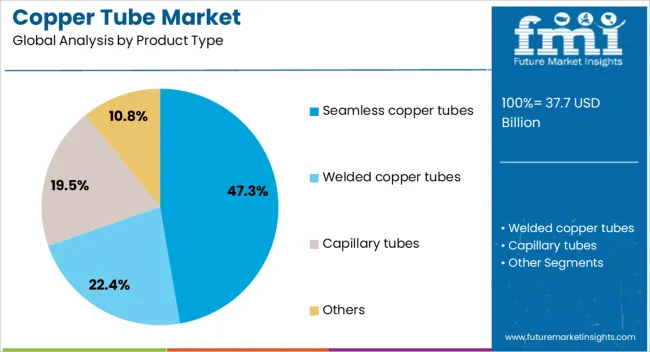
Seamless copper tubes are projected to account for 47.30% of the total revenue in the copper tube market in 2026, making them the leading product type. This dominance is being driven by the superior mechanical strength, pressure resistance, and leak-proof performance associated with seamless construction.
These characteristics are particularly valued in HVAC, medical gas, and critical plumbing applications where reliability is non-negotiable. Seamless tubes also enable precise bending and shaping without compromising structural integrity, allowing for easier installation in compact or concealed spaces.
Their compatibility with brazing and high-temperature operations further enhances their suitability across diverse end-use environments. As demand increases for long-lasting and low-maintenance piping systems, seamless copper tubes remain the material of choice for both industrial and residential deployments.
Insights into the Bright Annealed Copper Tubes Finish Type Segment
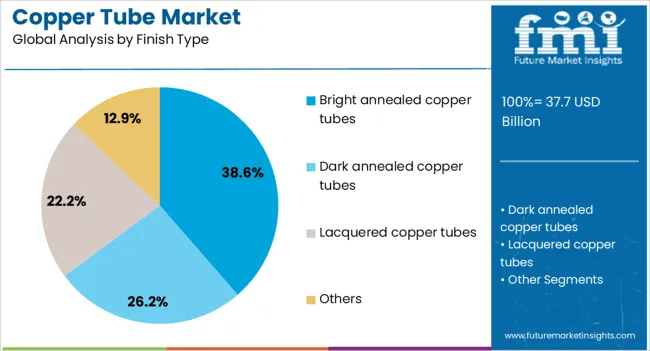
Bright annealed copper tubes are anticipated to hold 38.60% of the market share by 2026, ranking as the top finish type in the copper tube market. Their rise in prominence is being attributed to the enhanced surface quality, corrosion resistance, and aesthetic appeal achieved through controlled atmospheric annealing.
These tubes are widely favored in applications where both appearance and performance are critical, such as exposed piping, HVAC coils, and medical systems. The bright annealing process ensures uniform metallurgical properties, which improve ductility and workability during fabrication and installation.
Their high cleanliness level and minimal oxidation also support sterilization standards, making them suitable for pharmaceutical and food-grade use. As product life-cycle performance and visual quality gain more importance in engineering and architectural applications, bright annealed copper tubes continue to attract increasing preference.
Insights into the Plumbing Application Segment
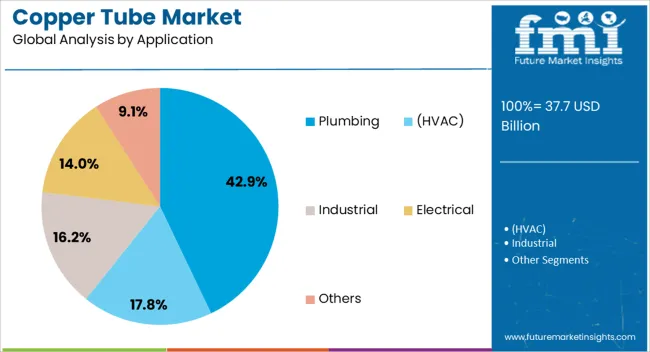
Plumbing is expected to represent 42.90% of the total market revenue in 2026, establishing it as the leading application segment for copper tubes. This dominance is being reinforced by copper’s proven record in delivering safe, durable, and corrosion-resistant piping solutions for residential and commercial water systems.
The inherent antimicrobial properties of copper support improved water quality and hygiene, a growing concern in densely populated and aging urban infrastructure. Its fire-resistant and pressure-tolerant nature also makes it suitable for high-rise and industrial plumbing systems.
Adoption is further supported by national plumbing codes and green building certifications that prioritize sustainable, recyclable materials. As smart city initiatives and real estate investments continue to expand across emerging and developed regions, plumbing remains a cornerstone use case driving copper tube demand.
What are the Drivers, Restraints, and Key Trends of the Copper Tube Market?
The copper tube market is growing steadily, driven by the increasing demand in construction, automotive, and HVAC applications. In 2025 and 2026, growth drivers include the expanding construction sector, particularly in emerging economies, and the shift toward energy-efficient systems. Opportunities are arising in the refrigeration and air conditioning industries. Emerging trends involve the use of copper in renewable energy applications. However, market restraints such as fluctuating copper prices and competition from alternative materials may hinder growth.
Expanding Demand in Construction and HVAC Applications
The major growth drivers for the copper tube market include expanding demand in construction and HVAC systems. In 2026, rapid urbanization and industrialization in emerging economies led to increased demand for copper tubes in plumbing and air conditioning systems. Additionally, the adoption of energy-efficient HVAC systems boosted the demand for copper tubes due to their excellent heat transfer properties. As building and infrastructure projects expand, copper tube use for plumbing, heating, and cooling systems is expected to rise.
Opportunities in Refrigeration and Air Conditioning Industries
Opportunities in the copper tube market lie in the refrigeration and air conditioning industries. In 2026, the need for energy-efficient refrigeration solutions, driven by rising global temperatures and the growing food preservation industry, created a demand for copper tubes. Additionally, copper's excellent thermal conductivity made it an ideal choice for air conditioning systems, further driving demand. The shift toward eco-friendly refrigerants and energy-efficient designs presents an opportunity for copper tube manufacturers to develop specialized products for these growing sectors.
Renewable Energy Applications Driving Emerging Trends
Emerging trends in the copper tube market include increasing use in renewable energy applications. In 2026, copper tubes found growing applications in solar and geothermal energy systems. These systems utilize copper's excellent heat-conducting properties to optimize energy efficiency. As renewable energy adoption accelerates globally, the demand for copper tubes in these applications is expected to grow. This trend, along with rising awareness of the benefits of copper in energy-efficient systems, is likely to drive the market in the coming years.
Fluctuating Copper Prices and Material Substitution
The key market restraints for copper tubes include fluctuating copper prices and competition from alternative materials. In 2025 and 2026, volatile copper prices posed challenges for manufacturers, making cost management difficult, particularly in regions dependent on imported copper. Additionally, the increasing use of alternative materials, such as plastic and aluminum, in HVAC and plumbing systems has created competition for copper tubes. These barriers must be overcome by manufacturers to maintain competitiveness and market growth.
Analysis of Copper Tube Market By Key Countries
.webp "Top Country Growth Comparison Copper Tube Market Cagr (2026 2036)")
The global copper tube market is projected to grow at 3.5% CAGR from 2026 to 2036. China leads with 4.7% CAGR, driven by strong demand in the construction, automotive, and HVAC industries. India follows at 4.4%, supported by the country’s expanding industrial base and rising demand for copper tubes in plumbing, refrigeration, and air conditioning systems. Germany records 4.0% CAGR, reflecting strong demand in the construction, electrical, and renewable energy sectors. The United Kingdom grows at 3.3%, while the United States posts 3.0%, reflecting steady demand in mature markets with a focus on advanced applications in construction and industrial systems. Asia-Pacific leads the market growth, while Europe and North America focus on innovation and sustainability in copper tube applications.
Demand Forecast for Copper Tube Market in China
The copper tube market in China is forecasted to grow at 4.7% CAGR, driven by the rapid expansion of construction, automotive, and HVAC industries. China’s booming construction sector, along with increasing demand for copper tubes in refrigeration and air conditioning systems, accelerates market growth. Additionally, the growing demand for copper tubes in electrical and renewable energy sectors strengthens the adoption of copper tubes for industrial applications.
- Rapid expansion of construction, automotive, and HVAC industries drives the demand for copper tubes in China.
- Increasing adoption of copper tubes in refrigeration, air conditioning, and renewable energy applications boosts market growth.
- Strong government investments in infrastructure and industrial development support the growth of the copper tube market.
Copper Tube Market Growth Outlook in India
The copper tube market in India is projected to grow at 4.4% CAGR, supported by rising demand for copper tubes in plumbing, refrigeration, and air conditioning systems. India’s expanding construction sector and the growing use of copper tubes in industrial applications drive market growth. The country’s focus on expanding HVAC and refrigeration technologies, along with increased urbanization, further accelerates the adoption of copper tubes.
- Growing demand for copper tubes in plumbing, refrigeration, and HVAC systems strengthens the market in India.
- Expansion of the construction sector and increasing industrial applications drive market growth.
- Rising urbanization and the adoption of advanced refrigeration and HVAC technologies further accelerate market adoption.
Future Outlook for Copper Tube Market in Germany
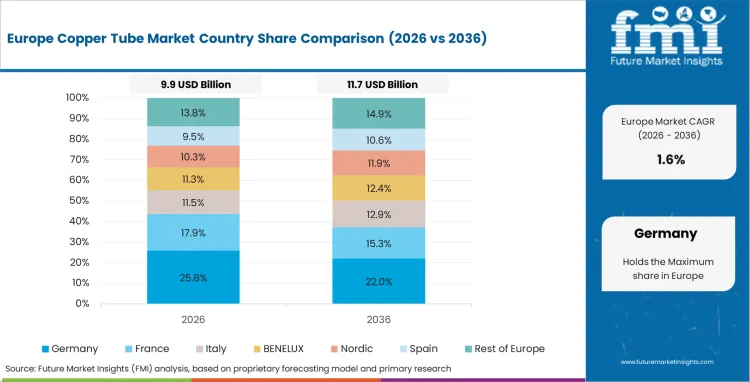
The copper tube market in Germany is expected to grow at 4.0% CAGR, driven by the increasing demand for copper tubes in the construction, electrical, and renewable energy sectors. Germany’s strong focus on sustainability and energy-efficient systems in construction and industrial applications further accelerates market growth. The growing adoption of copper tubes for heat exchangers, solar energy applications, and electrical wiring also boosts demand in the market.
- Increasing demand for copper tubes in the construction, electrical, and renewable energy sectors drives market growth in Germany.
- Adoption of energy-efficient and sustainable technologies in construction and industry strengthens demand for copper tubes.
- Growing use of copper tubes in solar energy applications and heat exchangers further fuels the market growth in Germany.
Analysis of Copper Tube Market in United Kingdom
The copper tube market in the United Kingdom is projected to grow at 3.3% CAGR, supported by steady demand in the construction, plumbing, and HVAC industries. The increasing adoption of copper tubes in renewable energy systems and HVAC systems for energy-efficient buildings drives market growth. Additionally, government regulations and incentives for sustainable construction further accelerate the use of copper tubes in residential and commercial projects.
- Demand for copper tubes in the construction, plumbing, and HVAC industries strengthens the market in the UK.
- Government regulations promoting energy-efficient systems and sustainable construction drive the adoption of copper tubes.
- Growing adoption of copper tubes in renewable energy applications and energy-efficient building systems further boosts the market in the UK.
Growth Analysis of Copper Tube Market in the United States
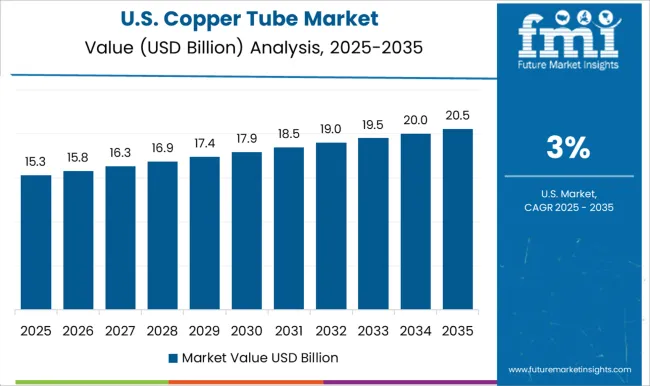
The copper tube market in the United States is projected to grow at 3.0% CAGR, driven by steady demand for copper tubes in construction, automotive, and HVAC applications. The rising focus on energy efficiency, coupled with advancements in industrial applications, strengthens the market for copper tubes. Additionally, the increasing adoption of copper tubes in plumbing, refrigeration, and electrical systems contributes to the market growth.
- Steady demand from construction, automotive, and HVAC industries strengthens the copper tube market in the USA
- Focus on energy efficiency and sustainability in construction drives the adoption of copper tubes.
- Increasing demand for copper tubes in refrigeration, electrical, and industrial applications fuels market growth in the USA
Competitive Landscape of Copper Tube Market
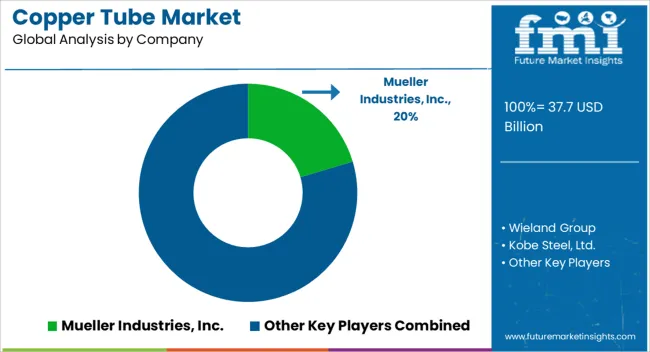
The copper tube market is dominated by Mueller Industries, Inc., which leads with a comprehensive portfolio of copper tube products used in various applications such as HVAC systems, plumbing, and industrial processes. Mueller Industries’ dominance is supported by its strong manufacturing capabilities, extensive distribution network, and consistent product quality.
Key players such as Wieland Group, Kobe Steel, Ltd., and KME (KME Group) maintain significant market shares by providing high-performance copper tubes designed for superior corrosion resistance, thermal conductivity, and durability. These companies focus on delivering versatile, high-quality copper tube solutions for commercial, industrial, and residential markets, driving demand in sectors such as construction, automotive, and renewable energy.
Emerging players like Cerro Flow Products, LLC are expanding their market presence by offering cost-effective copper tube solutions with specialized coatings and features aimed at enhancing efficiency in refrigeration and plumbing applications. Their strategies include improving production processes, increasing product range, and targeting regional markets with tailored offerings. Market growth is driven by rising demand for energy-efficient systems, increased construction activity, and the ongoing need for reliable infrastructure materials. Innovations in copper alloy formulations, enhanced recycling processes, and the development of eco-friendly applications are expected to further shape competitive dynamics and drive growth in the global copper tube market.
Key Developments in Copper Tube Market
Companies are investing in the innovation of copper tube manufacturing processes, including the development of extrusion and drawing technologies to improve tube production efficiency. Advanced technologies allow for the production of tubes with more precise dimensions, better surface finish, and enhanced strength properties to meet the growing demand from industrial and commercial sectors.
Scope of the Report
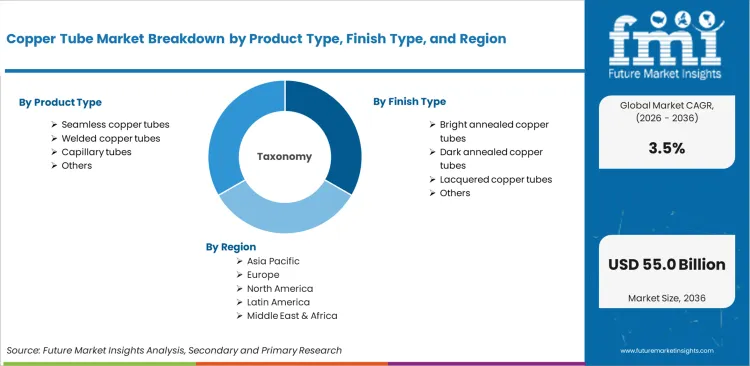
| Metric | Value |
|---|---|
| Quantitative Units | USD 39.02 Billion to USD 55.04 Billion, at a CAGR of 3.50% |
| Market Definition | Copper tubes are hollow cylindrical conductors manufactured from high-purity copper alloys through seamless drawing, welding, or extrusion processes. They serve as the primary conveyance medium for refrigerant gases in HVAC systems, potable water in plumbing installations, medical gases in healthcare facilities, and heat transfer fluids in industrial process equipment. |
| Segmentation | Product Type: Seamless copper tubes, Welded copper tubes, Capillary tubes, Others; Finish Type: Bright annealed copper tubes, Dark annealed copper tubes, Lacquered copper tubes, Others; Application: Plumbing, Industrial, Electrical, Others |
| Regions Covered | North America, Latin America, Europe, East Asia, South Asia, Oceania, Middle East & Africa |
| Countries Covered | China, India, Germany, France, UK, USA, Brazil, and 40 plus countries |
| Key Companies Profiled | Mueller Industries, Inc., Wieland Group, Kobe Steel, Ltd., KME (KME Group), Cerro Flow Products, LLC |
| Forecast Period | 2026 to 2036 |
| Approach | Forecasting models apply a bottom-up methodology starting with regional production and trade metrics and projecting adoption rates against demand drivers and regulatory compliance timelines. |
Copper Tube Market by Segments
Product Type:
- Seamless copper tubes
- Welded copper tubes
- Capillary tubes
- Others
Finish Type:
- Bright annealed copper tubes
- Dark annealed copper tubes
- Lacquered copper tubes
- Others
Application:
- Plumbing
- (HVAC)
- Industrial
- Electrical
- Others
Region:
- North America
- USA
- Canada
- Mexico
- Latin America
- Brazil
- Chile
- Rest of Latin America
- Western Europe
- Germany
- UK
- Italy
- Spain
- France
- Nordic
- BENELUX
- Rest of Western Europe
- Eastern Europe
- Russia
- Poland
- Hungary
- Balkan & Baltic
- Rest of Eastern Europe
- East Asia
- China
- Japan
- South Korea
- South Asia and Pacific
- India
- ASEAN
- Australia & New Zealand
- Rest of South Asia and Pacific
- Middle East & Africa
- Kingdom of Saudi Arabia
- Other GCC Countries
- Turkiye
- South Africa
- Other African Union
- Rest of Middle East & Africa
Bibliography
- International Copper Association. (2025). Copper Tube and Fittings Market Report. ICA.
- ASTM International. (2025). ASTM B88 Standard Specification for Seamless Copper Water Tube. ASTM.
- European Commission. (2025). F-Gas Regulation (EU) 2025/573. European Commission.
- USA Environmental Protection Agency. (2025). SNAP Program: Acceptable Substitutes for Refrigerant Alternatives. EPA.
- Mueller Industries, Inc. (2025). Annual Report 2025. Mueller Industries.
This bibliography is provided for reader reference. The full Future Market Insights report contains the complete reference list with primary research documentation.
Frequently Asked Questions
How large is the demand for Copper Tube in the global market in 2026?
Demand for Copper Tube in the global market is estimated to be valued at USD 39.02 billion in 2026.
What will be the market size of Copper Tube in the global market by 2036?
Market size for Copper Tube is projected to reach USD 55.04 billion by 2036.
What is the expected demand growth for Copper Tube in the global market between 2026 and 2036?
Demand for Copper Tube is expected to grow at a CAGR of 3.50% between 2026 and 2036.
Which Product Type is poised to lead global sales by 2026?
Seamless copper tubes accounts for 47.3% share in 2026 based on structural demand factors and procurement concentration patterns.
What is driving demand in China?
China leads growth at 4.7% CAGR through 2036, driven by expanding domestic production capacity and end-use procurement volumes.
What is India's growth outlook in this report?
India is projected to grow at a CAGR of 4.4% during 2026 to 2036.
What is Copper Tube and what is it mainly used for?
Copper tubes are hollow cylindrical conductors manufactured from high-purity copper alloys through seamless drawing, welding, or extrusion processes. They serve as the primary conveyance medium for refrigerant gases in HVAC systems, potable water in plumbing installations, medical gases in healthcare facilities, and heat transfer fluids in industrial process equipment.
How does FMI build and validate the Copper Tube forecast?
Forecasting models apply a bottom-up methodology starting with regional production and trade metrics and cross-validate projections against industry statistics and company guidance.
Preview the report firsthand - request a free sample
Get SampleGet the brochure for pricing and purchase details.
Get PDFTable of Content
- Executive Summary
- Global Market Outlook
- Demand-side Trends
- Supply-side Trends
- Technology Roadmap Analysis
- Analysis and Recommendations
- Market Overview
- Market Coverage / Taxonomy
- Market Definition / Scope / Limitations
- Research Methodology
- Chapter Orientation
- Analytical Lens and Working Hypotheses
- Market Structure, Signals, and Trend Drivers
- Benchmarking and Cross-market Comparability
- Market Sizing, Forecasting, and Opportunity Mapping
- Research Design and Evidence Framework
- Desk Research Programme (Secondary Evidence)
- Company Annual and Sustainability Reports
- Peer-reviewed Journals and Academic Literature
- Corporate Websites, Product Literature, and Technical Notes
- Earnings Decks and Investor Briefings
- Statutory Filings and Regulatory Disclosures
- Technical White Papers and Standards Notes
- Trade Journals, Industry Magazines, and Analyst Briefs
- Conference Proceedings, Webinars, and Seminar Materials
- Government Statistics Portals and Public Data Releases
- Press Releases and Reputable Media Coverage
- Specialist Newsletters and Curated Briefings
- Sector Databases and Reference Repositories
- FMI Internal Proprietary Databases and Historical Market Datasets
- Subscription Datasets and Paid Sources
- Social Channels, Communities, and Digital Listening Inputs
- Additional Desk Sources
- Expert Input and Fieldwork (Primary Evidence)
- Primary Modes
- Qualitative Interviews and Expert Elicitation
- Quantitative Surveys and Structured Data Capture
- Blended Approach
- Why Primary Evidence is Used
- Field Techniques
- Interviews
- Surveys
- Focus Groups
- Observational and In-context Research
- Social and Community Interactions
- Stakeholder Universe Engaged
- C-suite Leaders
- Board Members
- Presidents and Vice Presidents
- R&D and Innovation Heads
- Technical Specialists
- Domain Subject-matter Experts
- Scientists
- Physicians and Other Healthcare Professionals
- Governance, Ethics, and Data Stewardship
- Research Ethics
- Data Integrity and Handling
- Primary Modes
- Tooling, Models, and Reference Databases
- Desk Research Programme (Secondary Evidence)
- Data Engineering and Model Build
- Data Acquisition and Ingestion
- Cleaning, Normalisation, and Verification
- Synthesis, Triangulation, and Analysis
- Quality Assurance and Audit Trail
- Market Background
- Market Dynamics
- Drivers
- Restraints
- Opportunity
- Trends
- Scenario Forecast
- Demand in Optimistic Scenario
- Demand in Likely Scenario
- Demand in Conservative Scenario
- Opportunity Map Analysis
- Product Life Cycle Analysis
- Supply Chain Analysis
- Investment Feasibility Matrix
- Value Chain Analysis
- PESTLE and Porter’s Analysis
- Regulatory Landscape
- Regional Parent Market Outlook
- Production and Consumption Statistics
- Import and Export Statistics
- Market Dynamics
- Global Market Analysis 2021 to 2025 and Forecast, 2026 to 2036
- Historical Market Size Value (USD Million) Analysis, 2021 to 2025
- Current and Future Market Size Value (USD Million) Projections, 2026 to 2036
- Y-o-Y Growth Trend Analysis
- Absolute $ Opportunity Analysis
- Global Market Pricing Analysis 2021 to 2025 and Forecast 2026 to 2036
- Global Market Analysis 2021 to 2025 and Forecast 2026 to 2036, By Product Type
- Introduction / Key Findings
- Historical Market Size Value (USD Million) Analysis By Product Type , 2021 to 2025
- Current and Future Market Size Value (USD Million) Analysis and Forecast By Product Type , 2026 to 2036
- Seamless copper tubes
- Welded copper tubes
- Capillary tubes
- Others
- Seamless copper tubes
- Y-o-Y Growth Trend Analysis By Product Type , 2021 to 2025
- Absolute $ Opportunity Analysis By Product Type , 2026 to 2036
- Global Market Analysis 2021 to 2025 and Forecast 2026 to 2036, By Finish Type
- Introduction / Key Findings
- Historical Market Size Value (USD Million) Analysis By Finish Type, 2021 to 2025
- Current and Future Market Size Value (USD Million) Analysis and Forecast By Finish Type, 2026 to 2036
- Bright annealed copper tubes
- Dark annealed copper tubes
- Lacquered copper tubes
- Others
- Bright annealed copper tubes
- Y-o-Y Growth Trend Analysis By Finish Type, 2021 to 2025
- Absolute $ Opportunity Analysis By Finish Type, 2026 to 2036
- Global Market Analysis 2021 to 2025 and Forecast 2026 to 2036, By Application
- Introduction / Key Findings
- Historical Market Size Value (USD Million) Analysis By Application, 2021 to 2025
- Current and Future Market Size Value (USD Million) Analysis and Forecast By Application, 2026 to 2036
- Plumbing
- Plumbing
- Y-o-Y Growth Trend Analysis By Application, 2021 to 2025
- Absolute $ Opportunity Analysis By Application, 2026 to 2036
- Global Market Analysis 2021 to 2025 and Forecast 2026 to 2036, By Region
- Introduction
- Historical Market Size Value (USD Million) Analysis By Region, 2021 to 2025
- Current Market Size Value (USD Million) Analysis and Forecast By Region, 2026 to 2036
- North America
- Latin America
- Western Europe
- Eastern Europe
- East Asia
- South Asia and Pacific
- Middle East & Africa
- Market Attractiveness Analysis By Region
- North America Market Analysis 2021 to 2025 and Forecast 2026 to 2036, By Country
- Historical Market Size Value (USD Million) Trend Analysis By Market Taxonomy, 2021 to 2025
- Market Size Value (USD Million) Forecast By Market Taxonomy, 2026 to 2036
- By Country
- USA
- Canada
- Mexico
- By Product Type
- By Finish Type
- By Application
- By Country
- Market Attractiveness Analysis
- By Country
- By Product Type
- By Finish Type
- By Application
- Key Takeaways
- Latin America Market Analysis 2021 to 2025 and Forecast 2026 to 2036, By Country
- Historical Market Size Value (USD Million) Trend Analysis By Market Taxonomy, 2021 to 2025
- Market Size Value (USD Million) Forecast By Market Taxonomy, 2026 to 2036
- By Country
- Brazil
- Chile
- Rest of Latin America
- By Product Type
- By Finish Type
- By Application
- By Country
- Market Attractiveness Analysis
- By Country
- By Product Type
- By Finish Type
- By Application
- Key Takeaways
- Western Europe Market Analysis 2021 to 2025 and Forecast 2026 to 2036, By Country
- Historical Market Size Value (USD Million) Trend Analysis By Market Taxonomy, 2021 to 2025
- Market Size Value (USD Million) Forecast By Market Taxonomy, 2026 to 2036
- By Country
- Germany
- UK
- Italy
- Spain
- France
- Nordic
- BENELUX
- Rest of Western Europe
- By Product Type
- By Finish Type
- By Application
- By Country
- Market Attractiveness Analysis
- By Country
- By Product Type
- By Finish Type
- By Application
- Key Takeaways
- Eastern Europe Market Analysis 2021 to 2025 and Forecast 2026 to 2036, By Country
- Historical Market Size Value (USD Million) Trend Analysis By Market Taxonomy, 2021 to 2025
- Market Size Value (USD Million) Forecast By Market Taxonomy, 2026 to 2036
- By Country
- Russia
- Poland
- Hungary
- Balkan & Baltic
- Rest of Eastern Europe
- By Product Type
- By Finish Type
- By Application
- By Country
- Market Attractiveness Analysis
- By Country
- By Product Type
- By Finish Type
- By Application
- Key Takeaways
- East Asia Market Analysis 2021 to 2025 and Forecast 2026 to 2036, By Country
- Historical Market Size Value (USD Million) Trend Analysis By Market Taxonomy, 2021 to 2025
- Market Size Value (USD Million) Forecast By Market Taxonomy, 2026 to 2036
- By Country
- China
- Japan
- South Korea
- By Product Type
- By Finish Type
- By Application
- By Country
- Market Attractiveness Analysis
- By Country
- By Product Type
- By Finish Type
- By Application
- Key Takeaways
- South Asia and Pacific Market Analysis 2021 to 2025 and Forecast 2026 to 2036, By Country
- Historical Market Size Value (USD Million) Trend Analysis By Market Taxonomy, 2021 to 2025
- Market Size Value (USD Million) Forecast By Market Taxonomy, 2026 to 2036
- By Country
- India
- ASEAN
- Australia & New Zealand
- Rest of South Asia and Pacific
- By Product Type
- By Finish Type
- By Application
- By Country
- Market Attractiveness Analysis
- By Country
- By Product Type
- By Finish Type
- By Application
- Key Takeaways
- Middle East & Africa Market Analysis 2021 to 2025 and Forecast 2026 to 2036, By Country
- Historical Market Size Value (USD Million) Trend Analysis By Market Taxonomy, 2021 to 2025
- Market Size Value (USD Million) Forecast By Market Taxonomy, 2026 to 2036
- By Country
- Kingdom of Saudi Arabia
- Other GCC Countries
- Turkiye
- South Africa
- Other African Union
- Rest of Middle East & Africa
- By Product Type
- By Finish Type
- By Application
- By Country
- Market Attractiveness Analysis
- By Country
- By Product Type
- By Finish Type
- By Application
- Key Takeaways
- Key Countries Market Analysis
- USA
- Pricing Analysis
- Market Share Analysis, 2025
- By Product Type
- By Finish Type
- By Application
- Canada
- Pricing Analysis
- Market Share Analysis, 2025
- By Product Type
- By Finish Type
- By Application
- Mexico
- Pricing Analysis
- Market Share Analysis, 2025
- By Product Type
- By Finish Type
- By Application
- Brazil
- Pricing Analysis
- Market Share Analysis, 2025
- By Product Type
- By Finish Type
- By Application
- Chile
- Pricing Analysis
- Market Share Analysis, 2025
- By Product Type
- By Finish Type
- By Application
- Germany
- Pricing Analysis
- Market Share Analysis, 2025
- By Product Type
- By Finish Type
- By Application
- UK
- Pricing Analysis
- Market Share Analysis, 2025
- By Product Type
- By Finish Type
- By Application
- Italy
- Pricing Analysis
- Market Share Analysis, 2025
- By Product Type
- By Finish Type
- By Application
- Spain
- Pricing Analysis
- Market Share Analysis, 2025
- By Product Type
- By Finish Type
- By Application
- France
- Pricing Analysis
- Market Share Analysis, 2025
- By Product Type
- By Finish Type
- By Application
- India
- Pricing Analysis
- Market Share Analysis, 2025
- By Product Type
- By Finish Type
- By Application
- ASEAN
- Pricing Analysis
- Market Share Analysis, 2025
- By Product Type
- By Finish Type
- By Application
- Australia & New Zealand
- Pricing Analysis
- Market Share Analysis, 2025
- By Product Type
- By Finish Type
- By Application
- China
- Pricing Analysis
- Market Share Analysis, 2025
- By Product Type
- By Finish Type
- By Application
- Japan
- Pricing Analysis
- Market Share Analysis, 2025
- By Product Type
- By Finish Type
- By Application
- South Korea
- Pricing Analysis
- Market Share Analysis, 2025
- By Product Type
- By Finish Type
- By Application
- Russia
- Pricing Analysis
- Market Share Analysis, 2025
- By Product Type
- By Finish Type
- By Application
- Poland
- Pricing Analysis
- Market Share Analysis, 2025
- By Product Type
- By Finish Type
- By Application
- Hungary
- Pricing Analysis
- Market Share Analysis, 2025
- By Product Type
- By Finish Type
- By Application
- Kingdom of Saudi Arabia
- Pricing Analysis
- Market Share Analysis, 2025
- By Product Type
- By Finish Type
- By Application
- Turkiye
- Pricing Analysis
- Market Share Analysis, 2025
- By Product Type
- By Finish Type
- By Application
- South Africa
- Pricing Analysis
- Market Share Analysis, 2025
- By Product Type
- By Finish Type
- By Application
- USA
- Market Structure Analysis
- Competition Dashboard
- Competition Benchmarking
- Market Share Analysis of Top Players
- By Regional
- By Product Type
- By Finish Type
- By Application
- Competition Analysis
- Competition Deep Dive
- Mueller Industries, Inc.
- Overview
- Product Portfolio
- Profitability by Market Segments (Product/Age /Sales Channel/Region)
- Sales Footprint
- Strategy Overview
- Marketing Strategy
- Product Strategy
- Channel Strategy
- Wieland Group
- Kobe Steel, Ltd.
- KME (KME Group)
- Cerro Flow Products, LLC
- Mueller Industries, Inc.
- Competition Deep Dive
- Assumptions & Acronyms Used


