

- Market Size (2026)
- USD 383.4 Mn
- Forecast (2036)
- USD 686.6 Mn
- CAGR (2026 to 2036)
- 6.0%
How Big is the Cosmetic Ceramide Blends Market in 2026?
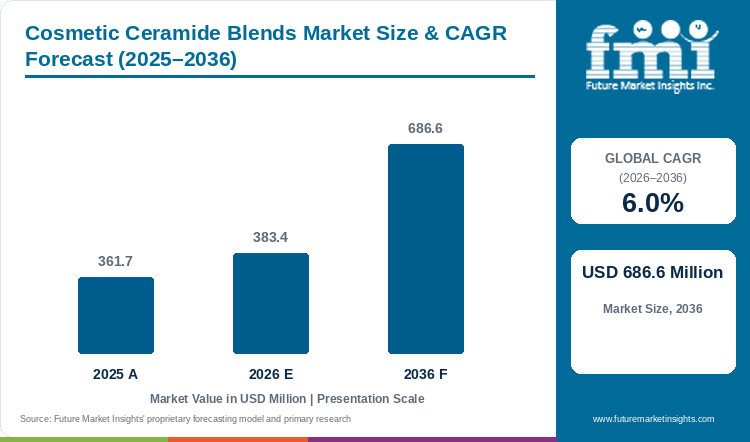
Sales of cosmetic ceramide blends are valued at USD 383.4 Million in 2026, up from an estimated USD 361.7 Million in 2025.
The global cosmetic ceramide blends market is expected to grow to USD 686.6 Million by 2036, at a 6.0% CAGR between 2026-2036. This demand is tied to how ceramides act as structural lipids for the skin barrier and the growing shift toward skincare and scalp care. A 2024 review of skin lipid biology describes ceramides as the largest lipid class in the outermost layer of the skin. [1] Because of this, ingredient buyers look at both the biological benefits and whether a supplier can provide a system that is ready to be formulated.
Analysts at FMI track the ceramide skincare market and the ceramide NP (3) market separately. Commercial conditions change by country since cosmetic ingredient programs have to meet different finished-product compliance rules. For instance, In the USA, the Modernization of Cosmetics Regulation Act (MoCRA) has expanded requirements for facility registration, product listing, and safety proof. European buyers operate under the EU cosmetics framework and its safety rules. Meanwhile, Japan and South Korea have their own distinct standards and pathways for functional claims. These differences reward suppliers who provide stable International Nomenclature of Cosmetic Ingredients (INCI) documentation, technical dossiers, and local application support.
Key Takeaways
- Barrier repair and healthy aging are driving demand, so formulation-ready ceramide systems are becoming more relevant
- By product type, standard grade are likely to hold nearly 38.0% of demand in 2026.
- By function, anti-aging is expected to hold 31.0% of demand in 2026 as brands combine barrier support with visible aging claims.
- Facial skincare is projected to represent 36.0% of application demand in 2026.
- Formulation and qualification remain the main roadblocks for manufacturers as ceramides are hard to disperse or stabilize, and buyers need claim support and regulatory documentation for specific markets.
- Ashland, BASF, IFF, Givaudan, Evonik, Lubrizol, DSM-Firmenich, Croda, Symrise, and Clariant are some of the notable companies profiled by FMI.
Analyst Perspective
"Growth turns into actual ingredient revenue when suppliers make ceramide systems easy to formulate and easy to qualify across the markets a brand plans to serve."
- Rahul Pandita, Principal Consultant, Future Market Insights
How is the Cosmetic Ceramide Blends Market Segmented?
FMI segments the cosmetic ceramide blends market by product type, function, application, grade, sales channel, and region.
By product type, the market is broken down into standard grade, high-purity or clinical grade, natural and certified grade, and customized systems. Function includes anti-aging, hydration and barrier, brightening, soothing and sensitive, and UV and protection. Application covers facial skincare, body care, haircare, color cosmetics, and suncare. Grade includes standard cosmetic grade, COSMOS or natural certified, pharma and clinical grade, and organic certified. The sales channel comprises direct to brands, specialty distributors, contract manufacturers, and online B2B. Regional coverage spans seven regions.
Why Does Standard Grade Lead the Product Type Category?
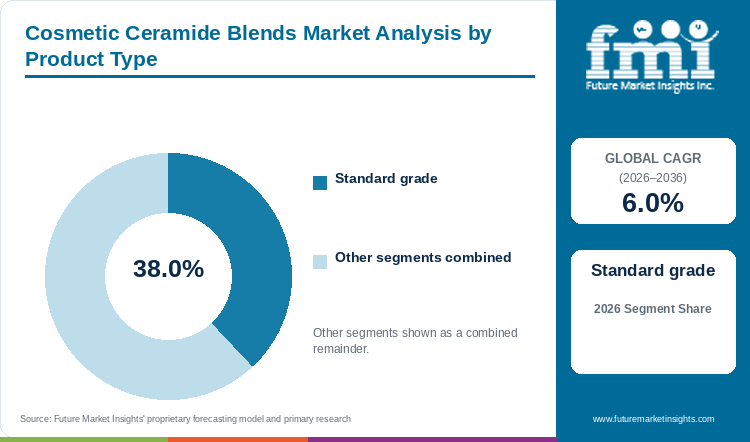
Standard grade is expected to reach 38.0% market share in 2026.
Standard grade addresses the largest pool of conventional cosmetic briefs because it balances efficacy, cost, documentation, and manufacturing practicality. Formulators need ceramides in a usable carrier or lipid system. Brands that offer pre-dispersed or easy-to-process formats will speed up laboratory work and make the grade suitable for repeat launches across established facial and body-care bases.
- Standard grade will hold 38.0% of product type revenue in 2026.
- Evonik documents Ceramide III EP MB as an easy-to-process ceramide blend, while Croda describes pre-dispersed and lipid-system formats in its SphingoCare portfolio. These examples show why formulation convenience supports standard-grade purchasing.
Why Does Anti-aging Lead the Function Category?
Anti-aging is projected to record 31.0% of function demand in 2026.
Anti-aging programs treat barrier quality as part of visible skin condition rather than just a separate moisturization claim. Ceramide-containing systems fit this logic because barrier lipids influence water retention and resilience. They can also be paired with retinoids, peptides, or hyaluronic-acid platforms. This creates a path to differentiated aging formulas where tolerance and barrier recovery are part of the product brief.
- Anti-aging will account for 31.0% of function demand in 2026.
- In March 2026, Evonik launched SPHINOX Vively with claims around skin rejuvenation and increases in Ceramide AP and EOP. This example shows how sphingolipid science is being connected directly to anti-aging positioning.
Why Does Facial Skincare Anchor the Application Category?
Facial skincare is expected to account for 36.0% of application demand in 2026.
Facial skincare provides the most direct commercial fit because leave-on creams and serums can support barrier, hydration, and healthy-aging claims all in one format. Facial formulas also face high expectations for how they feel on the skin. This increases the value of ceramide systems that disperse cleanly and remain stable. Consumer demand and formulation work therefore concentrate in the same application. Finished moisturizers are tracked separately in the ceramide-infused moisturizers market.
- Facial skincare will account for 36.0% of application demand in 2026.
- In April 2025, Evonik introduced SKINLIPIX HydraShield as a ceramide-based skin-barrier system for personal care. This launch highlights supplier investment in ready-to-use lipid concepts aimed at facial and broader skincare formulation.
What Keeps Standard Cosmetic Grade Ahead in the Grade Category?
Standard cosmetic grade will hold 46.0% of grade demand in 2026.
Standard cosmetic grade leads owing to the fact most mass and premium beauty products do not require pharmaceutical specifications. Buyers instead focus on cosmetic compliance and reproducible quality within a dossier that fits their target markets. Natural or organic certifications can be decisive for selected brands, while clinical-grade positioning can justify tighter purity controls for narrower applications. Standard cosmetic grade captures the wider middle of those requirements.
- Standard cosmetic grade will hold 46.0% of grade revenue in 2026.
- BASF lists Ceressence 3 as a biotechnology-derived skin-identical Ceramide NP ingredient for use across skin, scalp, and hair applications. This portfolio example shows how cosmetic-grade ceramide platforms are being built around broad formulation utility.
Why Does Direct to Brands Lead the Sales Channel Category?
Direct to brands is expected to account for 50.0% of sales channel demand in 2026.
Ceramide selection is often paired with formulation trials, stability work, and claim review. A supplier that supports an R&D team through prototype development has a better chance of moving from a sample request to a regular order. Specialty distributors remain important for reach and local service. Contract manufacturers influence specifications for outsourced brands, while online B2B channels suit discovery and smaller orders.
- Direct to brands will represent 50.0% of sales channel demand in 2026.
- In March 2026, Ashland announced an exclusive US distribution partnership with IMCD for its personal and home care ingredients. This move shows why technical distribution remains a complementary route when suppliers need broader customer coverage.
What are the Drivers, Restraints, and Opportunities in the Cosmetic Ceramide Blends Market?
Barrier-focused skincare and healthy-aging formulation are expanding demand, while ceramide dispersion and qualification requirements slow adoption. Easier-to-use multi-application systems create the clearest opportunity.
- Driver: Brand briefs increasingly connect hydration, barrier recovery, and healthy aging, which raises demand for biomimetic lipid systems that support several claims in one formula.
- Restraint: Ceramides are technically demanding ingredients, and poor solubility or unstable lipid architecture adds development cycles before a buyer is ready to commercialize.
- Opportunity: Water-dispersible, transparent, and pre-balanced ceramide systems will lower formulation friction and extend use into scalp care, sensitive skin, body care, and multifunctional products.
Barrier health is becoming part of broader beauty positioning because the outermost skin lipid matrix controls water loss and exposure to external stress. A 2024 skin-lipid review identifies ceramides as a dominant component of this matrix. [2] That evidence gives formulators a clear biological basis for barrier-oriented products. Commercially, the effect is strongest when brands connect the mechanism to hydration, comfort, or healthy-aging concepts rather than just selling ceramides as a standalone technical story. Demand therefore shifts toward systems that combine ceramides with complementary lipids or carriers.
Peer-reviewed clinical trials from 2025 show that ceramide NP blended with Centella asiatica extract and panthenol reduces water loss through the skin and facial redness. Supply is therefore moving toward pre-formulated soothing blends built on these actives for the sensitive skin market.
Ceramide chemistry creates a practical bottleneck between ingredient interest and finished-product launch. Pure ceramides are highly crystalline and lipophilic, so suppliers rarely sell them as raw powders. Academic reviews of topical ceramides have also noted that formulation architecture influences performance. Buyers consequently need stability work and process guidance along with evidence that a proposed system fits the target base. That raises switching costs for established formulas. It can delay adoption when a less complex emollient or humectant satisfies a simpler brief.
The compliance load is heaviest in high-income markets. Based on 2025 IMF and World Bank projections, the top eight countries by GDP per capita are Liechtenstein, Singapore, Luxembourg, Ireland, Qatar, Norway, Switzerland, and the USA.
In the EU, Regulation (EU) 2025/877 applies new prohibitions from 1 September 2025, while Regulation (EU) 2024/1328 limits D5 and D6 siloxanes to 0.1% in rinse-off products from 6 June 2026. Blends built on cyclic siloxane carriers will need linear silicones or alternative volatile emollients. Qatar requires verified plant-based or bio-fermented origin for imported blends to meet Halal standards. Singapore requires product notification with the Health Sciences Authority (HSA) under the ASEAN Cosmetic Directive.
The largest opening is to convert ceramide science into platforms that remove steps from formulation. Evonik's April 2026 SPHINOHANCE Clear launch targeted transparent aqueous and surfactant systems for skin, hair, and scalp. Croda also markets pre-dispersed ceramide formats and expanded its hair-care ceramide activity after acquiring Solus Biotech. These moves point toward application breadth rather than just adding one more facial cream ingredient. Suppliers that pair processability with certification options and market-specific documentation are positioned to capture briefs in sensitive skin, scalp care, and multifunctional products.
Supply has moved away from animal extraction. Industrial ceramides are now synthesized through bio-fermentation, where yeast or bacteria produce a sphingoid base such as phytosphingosine that is then acylated with specific fatty acids. Suppliers combine these ceramides with cholesterol, free fatty acids, and panthenol in multi-lamellar emulsions that mimic the natural lipid ratio of the skin. Formulators can add these systems to water-based serums and creams without handling crystalline powders. Sun care applications are tracked separately in the ceramide sunscreen market.
Which Country CAGRs are Profiled in the Cosmetic Ceramide Blends Market?
| Country | CAGR, 2026 to 2036 |
|---|---|
| Saudi Arabia | 7.3% |
| UAE | 7.0% |
| South Korea | 6.7% |
| USA | 6.4% |
| France | 6.0% |
| UK | 5.7% |
| Germany | 5.4% |
| Japan | 5.1% |
How Do Country-level CAGRs Compare in the Cosmetic Ceramide Blends Market?
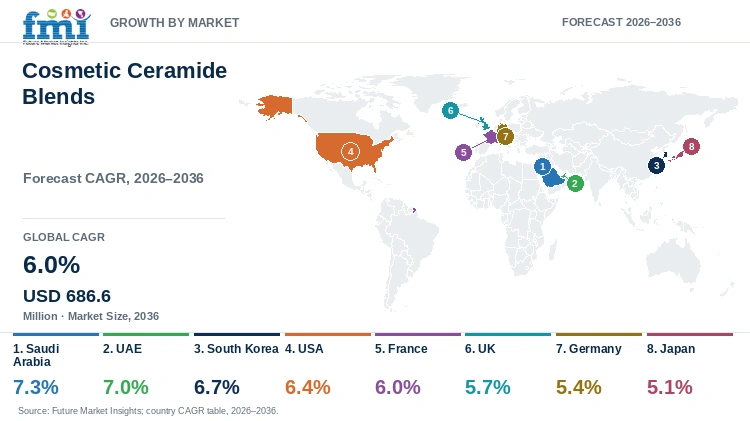
Profiled country CAGRs span 2.2 percentage points through 2036. Saudi Arabia is profiled at 7.3% and Japan at 5.1%.
Cosmetic ceramide blends market growth across the eight profiled countries will span 2.2 percentage points till 2036. Saudi Arabia will lead at 7.3%, followed by the UAE at 7.0% and South Korea at 6.7%. The USA and France sit close to the overall market rate at 6.4% and 6.0%. The UK will grow at 5.7%, while Germany and Japan will grow at 5.4% and 5.1%. Product notification rules and regulatory documentation will account for much of the difference. These are growth-rate comparisons rather than market-size rankings. A faster CAGR does not imply a larger absolute country market.
- Saudi Arabia will record a 7.3% CAGR. Product notification and ingredient documentation make regulatory readiness a prerequisite for converting premium-beauty demand into ingredient orders.
- The UAE will follow at 7.0%, just 0.3 points behind. Dubai's Montaji system and active product-safety testing support a trade-oriented beauty market where registration efficiency matters to launch timing.
- South Korea at 6.7% sits 0.3 points behind the UAE. Functional-cosmetics review pathways and a dense beauty innovation ecosystem favor technically differentiated barrier and anti-aging ingredients.
- The USA at 6.4% is 0.3 points behind South Korea. MoCRA raises the value of traceable ingredient information and safety support as brands manage expanded federal cosmetics obligations.
- France at 6.0% sits 0.4 points behind the USA. A large export-oriented cosmetics base keeps ingredient innovation commercially relevant even as 2025 export growth weakened.
- The UK at 5.7% is 0.3 points behind France. Responsible Person duties and product information requirements with notification create demand for well-documented ingredient systems.
- Germany at 5.4% is 0.3 points behind the UK. A resilient domestic beauty sector and established specialty-chemical manufacturing support steady formulation activity rather than frontier growth.
- Japan at 5.1% is 2.2 points behind Saudi Arabia. Mature formulation standards and quasi-drug pathways reward consistent quality and technical evidence with careful claim positioning.
Country Outlook
- Sales of cosmetic ceramide blends in Saudi Arabia will grow at a 7.3% CAGR through 2036. The opportunity is tied to premium beauty development and ingredient systems that move efficiently through local product-notification processes. Saudi Food and Drug Authority (SFDA) guidance requires cosmetic notification with supporting product information, and its listing service asks for ingredient details and product artwork. Ceramide suppliers can therefore differentiate through documentation quality and formulation support rather than chemistry alone. Local distributors and technical partners will reduce friction when global ingredient portfolios are adapted to Saudi launch requirements.
- Demand for cosmetic ceramide blends in the UAE is expected to rise at a 7.0% CAGR through 2036. Dubai Municipality highlighted Montaji+ at Beautyworld Middle East in October 2025 and described oversight spanning product evaluation and registration through release and post-market monitoring. The municipality also emphasized laboratory testing of cosmetics for allergens, preservatives, and toxic substances. Suppliers with accurate ingredient documentation and responsive technical files will move faster through this system. The UAE also functions as a regional commercial hub, so a successful ingredient program may support wider Gulf brand activity.
- South Korea is projected to record a 6.7% CAGR from 2026 to 2036. The Ministry of Food and Drug Safety (MFDS) lists wrinkle improvement, ultraviolet protection, and alleviation of atopic-prone dryness among functional-cosmetics categories with defined evaluation requirements. Croda's 2023 acquisition of Solus Biotech added Korean ceramide manufacturing and biotechnology R&D. This combination supports demand for barrier, anti-aging, and scalp concepts, but buyers still expect strong efficacy packages. Local application science and manufacturing support will shorten formulation and claim-development cycles.
- Growth of the cosmetic ceramide blends market in the USA is likely to reach a 6.4% CAGR through 2036. MoCRA gives the U.S. Food and Drug Administration (FDA) broader authority over cosmetics, including facility registration, product listing, and safety-substantiation requirements. Ingredient suppliers do not carry every finished-product obligation, but brand customers increasingly value traceable composition and defensible safety information. Claims must stay cosmetic since a blend marketed to treat eczema or cure dermatitis is classified as an unapproved new drug. Technical distributors will remain important where suppliers want reach beyond the largest direct brand accounts.
- France is expected to grow at a 6.0% CAGR from 2026 to 2036. Its advantage is the scale and export orientation of the national cosmetics industry rather than a permissive regulatory environment. FEBEA reported French cosmetics exports of EUR 22.4 billion in 2025 after a 0.1% decline and said EU destinations increased. That base sustains demand for differentiated active and functional ingredients. The EU limit on D5 and D6 siloxanes in rinse-off products from June 2026 will push blends toward linear silicones. Commercial success depends on fitting high-throughput development pipelines without compromising safety-file requirements.
- Sales in the UK are set to expand at a 5.7% CAGR through 2036. Great Britain requires a UK Responsible Person, product notification, and a product information file before cosmetics are placed on the market. Claims also need evidentiary support. For ceramide blend suppliers, those obligations translate into demand for stable ingredient specifications and clear safety documentation. Growth is therefore less about regulatory novelty and more about how efficiently ingredient systems enter brand and contract-manufacturer workflows. Suppliers with local technical service or strong distributor partners will help smaller brands manage formulation and documentation.
- Germany is projected to grow at a 5.4% CAGR over 2026 to 2036. IKW reported that skin and facial care turnover grew in 2025 even as the broader consumer environment remained cautious. The same association noted rising regulatory and cost burdens for manufacturers. Brands still invest in skincare while procurement teams scrutinize cost and complexity. BASF opened a new specialty-emollients plant in Düsseldorf in July 2026 for skin and sun-care applications. Ceramide suppliers will compete inside sophisticated formulation ecosystems where processability and cost-in-use decide adoption.
- Japan is anticipated to record a 5.1% CAGR from 2026 to 2036 and grow slowest among the profiled countries. The market operates within established cosmetic standards and a distinct quasi-drug framework for eligible claims and ingredients. That maturity favors documented performance and consistent specifications over rapid ingredient churn. BASF lists Ceressence 3 as suitable for Japanese cosmetics and notes Japanese quasi-drug approval, which shows the value of country-specific regulatory readiness. Openings exist in barrier care, sensitive-skin products, and scalp applications, but development programs must match local formulation expectations. Qualification depth will matter more than first-time category adoption.
Who are the Notable Companies in the Cosmetic Ceramide Blends Market?
Ashland, BASF, IFF, Givaudan, Evonik, Lubrizol, DSM-Firmenich, Croda, Symrise, and Clariant are the notable companies profiled in this market.
FMI groups profiled companies into three strategy cohorts. Competition separates by the depth of direct ceramide capability and by how much formulation work a supplier removes for the buyer. Evonik and Croda document broad ceramide and sphingolipid platforms with ready-to-use systems. BASF and Givaudan show direct ceramide ingredients or ceramide-containing solutions within wider active-ingredient portfolios. Ashland, IFF, Lubrizol, and DSM-Firmenich compete more broadly through barrier actives and formulation technologies. Symrise contributes a wide cosmetic-ingredient platform and global application reach. Clariant is strong in formulation and delivery technologies, including a Ceramide 3-containing carrier.
- Ceramide-system specialists: Evonik, Croda, BASF, and Givaudan combine direct ceramide evidence with formulation or application technologies relevant to barrier-focused products.
- Barrier and formulation-enablement suppliers: Ashland, IFF, Lubrizol, and DSM-Firmenich provide skin-barrier actives, biofunctionals, or formulation support that compete for the same brand development budgets.
- Broad cosmetic-ingredient and delivery participants: Symrise and Clariant offer wider active or functional platforms. Their public documentation supports adjacent formulation roles more clearly than dedicated ceramide-system depth.
Competitive Benchmarking: Cosmetic Ceramide Blends Market
| Company | Ceramide System Depth | Formulation Enablement | Barrier Application Breadth | Geographic Reach |
|---|---|---|---|---|
| Ashland | Low | Medium | Medium | United States with region-specific personal-care support |
| BASF | Medium | Medium | High | Europe and global personal-care markets |
| IFF | Low | Medium | Medium | Global beauty and personal-care markets |
| Givaudan | Medium | Medium | Medium | Global Active Beauty markets |
| Evonik | High | High | High | More than 100 countries through Evonik operations |
| Lubrizol | Low | Medium | High | Global personal-care markets with regional R&D |
| DSM-Firmenich | Low | Medium | High | Global Beauty Care distributor network |
| Croda | High | High | High | Global Beauty Care network with Asian ceramide manufacturing |
| Symrise | Low | Medium | High | Global cosmetic-ingredients markets |
| Clariant | Low | Medium | Medium | Global Care Chemicals markets |
Scoring basis: Ceramide System Depth is High where public evidence shows multiple direct ceramide or sphingolipid systems and Medium for a narrower documented direct offering. Formulation Enablement rates documented pre-dispersion or solubilization capability and delivery or application support. Barrier Application Breadth reflects documented use across skin and hair applications plus scalp and sun care. High indicates broad evidence and Medium indicates credible but narrower coverage. Low indicates limited public documentation for the criterion.
Key Developments in the Cosmetic Ceramide Blends Market
- In July 2023, Croda completed the acquisition of Solus Biotech after receiving South Korean regulatory clearance. The transaction added biotechnology-derived ceramide and phospholipid technologies plus a Korean manufacturing and R&D base. It gave Croda a direct platform for expanding from ceramide powders into formulated ceramide systems and Asian beauty programs.
- In April 2025, Evonik introduced SKINLIPIX HydraShield at in-cosmetics Global. The company describes the ingredient as a ceramide-stabilizing system that combines plant-oil-based ceramides with moisturizers and simplifies formulation. The launch directly targets a core buyer friction by packaging barrier lipids into a more practical cosmetic ingredient system.
- In March 2026, Evonik launched SPHINOX Vively at PCHi 2026. The designer sphingolipid was positioned for anti-aging and barrier support with company data describing increased Ceramide AP and EOP. The launch extends ceramide-related competition from replacement lipids toward multifunctional bioactives that brands can use in healthy-aging programs.
Key Players in the Cosmetic Ceramide Blends Market
Direct ceramide and sphingolipid platform suppliers
- Evonik
- Croda
- BASF
- Givaudan
Barrier-actives and formulation-enablement suppliers
- Ashland
- IFF
- Lubrizol
- DSM-Firmenich
Broad cosmetic-ingredient and delivery-system participants
- Symrise
- Clariant
Cosmetic Ceramide Blends Market - Report Scope
| Coverage field | Report scope |
|---|---|
| Market breakdown | Product Type, Function, Application, Grade, Sales Channel and Region |
| Quantitative Units | USD Million |
| Market Definition | Revenue includes B2B sales of cosmetic ceramide blends and ceramide-containing ingredient systems sold within the stated segmentation. It excludes downstream finished-product revenue, pharmaceutical drug revenue and revenue from adjacent or substitute actives that do not include a ceramide component. |
| Regions Covered | North America; Latin America; Western Europe; Eastern Europe; East Asia; South Asia and Pacific; Middle East and Africa |
| Countries Covered | USA, Germany, France, UK, Saudi Arabia, UAE, Japan and South Korea |
| Key Companies Profiled | Ashland, BASF, IFF, Givaudan, Evonik, Lubrizol, DSM-Firmenich, Croda, Symrise and Clariant |
| Forecast Period | 2026 to 2036 |
| Approach | Primary and secondary research with market triangulation. |
Cosmetic Ceramide Blends Market - Research Methodology
| Method | Approach |
|---|---|
| Primary Research | FMI analysts gathered input from manufacturers, service providers, technology developers, distributors, end users, procurement teams and subject-matter experts. Interviews examined purchasing decisions, product or service evaluation, adoption barriers, approval requirements, pricing considerations and expectations for technical or commercial support. Respondents were also asked what evidence is required before a trial, pilot, or initial order develops into regular purchasing. |
| Desk Research | Desk research covered government statistics, regulatory publications, trade data, industry associations, technical literature, standards, company filings, product information and official corporate announcements. Sources were reviewed for relevance, publication date, geographic coverage and consistency with the defined market scope. Claims relating to performance, applications, approvals, capacity, investment and commercial activity were retained only when supported by credible public evidence. |
| Market Sizing and Forecasting | The market model combined the baseline value with historical performance, segment structure, pricing and volume indicators, adoption levels, company participation and country-level demand conditions. Forecast assumptions considered economic activity, investment trends, regulatory developments, technology adoption, purchasing cycles, supply availability and barriers to wider market use. Segment and regional estimates were reconciled before the final market total was calculated. |
| Data Validation | Estimates were checked against multiple independent indicators, including public data, company activity, trade patterns, industry developments and findings from primary interviews. Validation also tested whether products, services, applications and company revenues fell within the defined market boundaries. Adjacent categories, unsupported claims, overlapping revenues and activities without direct market relevance were excluded to reduce double counting and maintain consistency across segments and countries. |
Cosmetic Ceramide Blends Market by Segments
Cosmetic Ceramide Blends Market segmented by Product Type:
- Standard grade
- High-purity / clinical grade
- Natural & certified grade
- Customized systems
Cosmetic Ceramide Blends Market segmented by Function:
- Anti-aging
- Hydration & barrier
- Brightening
- Soothing & sensitive
- UV & protection
Cosmetic Ceramide Blends Market segmented by Application:
- Facial skincare
- Body care
- Haircare
- Color cosmetics
- Suncare
Cosmetic Ceramide Blends Market segmented by Grade:
- Standard cosmetic grade
- COSMOS / natural certified
- Pharma & clinical grade
- Organic certified
Cosmetic Ceramide Blends Market segmented by Sales Channel:
- Direct to brands
- Specialty distributors
- Contract manufacturers
- Online B2B
Cosmetic Ceramide Blends Market by Region:
- North America
- United States
- Canada
- Latin America
- Brazil
- Mexico
- Argentina
- Chile
- Western Europe
- Germany
- France
- United Kingdom
- Italy
- Spain
- Benelux
- Nordics
- Eastern Europe
- Poland
- Czech Republic
- Romania
- Hungary
- East Asia
- China
- Japan
- South Korea
- South Asia and Pacific
- India
- ASEAN
- Australia and New Zealand
- Middle East and Africa
- GCC Countries
- South Africa
- Türkiye
- Israel
Research Sources and Bibliography
- Feingold and Elias (2024, July 11). The role of ceramides in the disruption of the cutaneous permeability barrier, a common manifestation of skin disorders.
- Berdyshev (2024, September 2). Skin Lipid Barrier: Structure, Function and Metabolism.
- MDPI Cosmetics (2026, January 1). Multi-Target Strategies for Enhancing Ceramide Production: A Review of Bioactive Ingredients in Cosmetic Science.
- U.S. Food and Drug Administration (2026, May 4). Modernization of Cosmetics Regulation Act of 2022 (MoCRA).
- European Commission (n.d.). Cosmetics legislation.
- European Commission (2024, May 16). Commission Regulation (EU) 2024/1328 restricting D4, D5 and D6 siloxanes.
- European Commission (2025, May 12). Commission Regulation (EU) 2025/877 (Omnibus VII amendments to Regulation (EC) No 1223/2009).
- Government of the United Kingdom (2021, October 4). Making cosmetic products available to consumers in Great Britain.
- Saudi Food and Drug Authority (2025, March 11). Guidance and Requirements of Cosmetic Product Notification.
- Dubai Municipality (2025, October 27). Product safety at Beautyworld Middle East 2025.
- Ministry of Health, Labour and Welfare, Japan (n.d.). Cosmetics and Quasi-drugs Home Page.
- Ministry of Food and Drug Safety, Republic of Korea (n.d.). Cosmetics Approval Process.
- IKW (n.d.). Economy.
- FEBEA (2026, February 6). Coup de frein sur les exportations de cosmétiques français en 2025 : le secteur demeure deuxième contributeur à la balance commerciale malgré un repli sur le marché américain.
- International Monetary Fund and World Bank (2025). GDP per capita projections, 2025.
- BASF (2026, July 16). BASF inaugurates new production plant in Düsseldorf, Germany.
- BASF (n.d.). Ceressence™ 3 BC10244.
- Evonik (2025, April 8). in-cosmetics global 2025: Evonik meets growing customer demand for high-performance, eco-friendly solutions.
- Evonik (2026, March 18). Evonik launches new ceramide SPHINOX Vively at PCHi 2026.
- Evonik (2026, April 8). in-cosmetics Global 2026: Evonik brings new beauty identity to life with fairy tale innovation world.
- Evonik (n.d.). Ceramides portfolio.
- Evonik (n.d.). Ceramide III EP MB.
- Croda Beauty (2025, April 11). Croda Beauty at in-cosmetics Global 2025: a century of expertise inspiring the future of beauty and personal care.
- Croda (2023, July 4). Croda successfully completes acquisition of Solus Biotech.
- Croda (n.d.). What is SphingoCare?
- Givaudan (2026, April 1). Givaudan Active Beauty introduces PrimalHyal 300.
- Givaudan (n.d.). Uniblend 2G.
- Ashland (2026, March 12). Ashland announces strategic partnership with IMCD for the exclusive distribution of personal and home care ingredients in the United States.
- Ashland (2026, April 8). Ashland Technology Platforms and new personal care ingredients open differentiated growth opportunities for formulators at in-cosmetics Global.
- Lubrizol (2026, March 17). Lubrizol inaugurates its Beauty Research Institute in Brazil, Reinforcing the Country’s Position as a Global Beauty Innovation Hub.
- IFF (n.d.). Skin Care Solutions.
- DSM-Firmenich (n.d.). Niacinamide PC.
- DSM-Firmenich (n.d.). Beauty Care distributor network.
- Symrise (n.d.). Cosmetic Ingredients.
- Clariant (2026, June 17). VitiSpheres R8.
This bibliography is provided for reader reference and is not exhaustive. The full FMI report contains the complete reference list and detailed citations.
This Report Answers
- How large is the Cosmetic Ceramide Blends Market in 2026 and what value is forecast by 2036?
- Which skin-barrier and beauty-industry pressures are supporting demand for cosmetic ceramide blends?
- Why does Standard grade hold the leading position within Product Type?
- Why does Anti-aging hold the leading position within Function?
- How do the profiled country growth rates differ from Saudi Arabia through Japan?
- Which profiled companies supply direct ceramide systems or adjacent barrier and formulation capabilities?
- What technical and qualification frictions can delay adoption or supplier switching?
- What should buyers evaluate before selecting a cosmetic ceramide blend supplier?
Frequently Asked Questions
How Big is the Cosmetic Ceramide Blends Market in 2026, and What is Forecast for 2036?
As per FMI, the cosmetic ceramide blends market is valued at USD 383.4 Million in 2026 and is forecast to reach USD 686.6 Million by 2036. Growth reflects wider use of ceramide systems in barrier-focused skincare and adjacent personal-care applications where formulation-ready systems shorten development work for brand and contract-manufacturing teams.
What is the CAGR of the Cosmetic Ceramide Blends Market from 2026 to 2036?
The cosmetic ceramide blends market grows at a 6.0% CAGR from 2026 to 2036, moving from USD 383.4 Million to USD 686.6 Million. Realized growth depends on suppliers converting barrier science into stable and compliant formulation-ready systems that clear brand qualification and market-specific regulatory review across the countries a brand plans to serve.
Which Product Type Segment Leads the Cosmetic Ceramide Blends Market?
Standard grade accounts for 38.0% of the cosmetic ceramide blends market by product type in 2026, driven by broad cosmetic compatibility and manageable cost that serve conventional briefs where processability and cost-in-use are central buying criteria for repeat facial and body-care launches across established formulation bases.
Which Function Segment Leads the Cosmetic Ceramide Blends Market?
Anti-aging holds 31.0% of the cosmetic ceramide blends market by function in 2026 as brands link barrier quality with visible-aging claims and tolerance-focused routines that pair ceramides with retinoids, peptides and hyaluronic-acid platforms inside healthy-aging formulations for facial skincare and adjacent applications.
Which Profiled Countries Have the Highest Growth Rates in the Cosmetic Ceramide Blends Market?
As per FMI, the cosmetic ceramide blends market in Saudi Arabia is profiled at a 7.3% CAGR from 2026 to 2036, followed by the UAE at 7.0% and South Korea at 6.7%. These are growth-rate comparisons and do not indicate absolute country market size or ease of supply.
Which Companies are Active in the Cosmetic Ceramide Blends Market?
Ten companies including Ashland, BASF, IFF, Givaudan, Evonik, Lubrizol, DSM-Firmenich, Croda, Symrise and Clariant are profiled in the cosmetic ceramide blends market. Public evidence shows varying depth, with some offering direct ceramide platforms and others competing through barrier actives or formulation technologies.
Preview the report firsthand - request a free sample
Get SampleGet the brochure for pricing and purchase details.
Get PDFTable of Content
- Key Takeaways
- Market Size and CAGR
- Top Growth Driver
- Fastest Growing Segment
- Leading Region
- Key Companies
- Emerging Opportunities
- Executive Summary
- Global Market Outlook
- Demand-side Trends
- Supply-side Trends
- Technology Roadmap Analysis
- Analysis and Recommendations
- Analyst Perspective (What is happening? Why now? What should investors know?)
- Key Questions Answered
- How large is the market?
- What is the CAGR?
- What are key trends?
- Which region dominates?
- Who are the leaders?
- Market Overview
- Market Coverage / Taxonomy
- Market Definition / Scope / Limitations
- Research Methodology
- Chapter Orientation
- Analytical Lens and Working Hypotheses
- Market Structure, Signals, and Trend Drivers
- Benchmarking and Cross-market Comparability
- Market Sizing, Forecasting, and Opportunity Mapping
- Research Design and Evidence Framework
- Desk Research Programme (Secondary Evidence)
- Expert Input and Fieldwork (Primary Evidence)
- Tooling, Models, and Reference Databases
- Data Engineering and Model Build
- Quality Assurance and Audit Trail
- Market Background
- Market Dynamics (Drivers, Restraints, Opportunity, Trends)
- Scenario Forecast (Optimistic, Likely, Conservative)
- Impact Analysis
- AI Impact
- Sustainability Impact
- Regulatory Impact
- Technology Impact
- Consumer / Buyer Analysis
- Purchase Drivers
- Adoption Barriers
- Buyer Journey
- Opportunity Map Analysis
- Product Life Cycle Analysis
- Supply Chain Analysis
- Investment Feasibility Matrix
- Value Chain Analysis
- PESTLE and Porter's Analysis
- Regulatory Landscape
- Regional Parent Market Outlook
- Production and Consumption Statistics
- Import and Export Statistics
- Global Market Analysis and Forecast, 2021 to 2036
- Historical Market Size Value (USD Million) Analysis, 2021 to 2025
- Current and Future Market Size Value (USD Million) Projections, 2026 to 2036
- Y-o-Y Growth Trend Analysis
- Absolute $ Opportunity Analysis
- Global Market Pricing Analysis, 2021 to 2036
- Global Market Analysis and Forecast, By Product Type, 2021 to 2036
- Introduction / Key Findings
- Historical Market Size Value (USD Million) Analysis By Product Type, 2021 to 2025
- Current and Future Market Size Value (USD Million) Analysis and Forecast By Product Type, 2026 to 2036
- Standard grade
- High-purity / clinical grade
- Natural & certified grade
- Customized systems
- Y-o-Y Growth Trend Analysis By Product Type, 2021 to 2025
- Absolute $ Opportunity Analysis By Product Type, 2026 to 2036
- Global Market Analysis and Forecast, By Function, 2021 to 2036
- Introduction / Key Findings
- Historical Market Size Value (USD Million) Analysis By Function, 2021 to 2025
- Current and Future Market Size Value (USD Million) Analysis and Forecast By Function, 2026 to 2036
- Anti-aging
- Hydration & barrier
- Brightening
- Soothing & sensitive
- UV & protection
- Y-o-Y Growth Trend Analysis By Function, 2021 to 2025
- Absolute $ Opportunity Analysis By Function, 2026 to 2036
- Global Market Analysis and Forecast, By Application, 2021 to 2036
- Introduction / Key Findings
- Historical Market Size Value (USD Million) Analysis By Application, 2021 to 2025
- Current and Future Market Size Value (USD Million) Analysis and Forecast By Application, 2026 to 2036
- Facial skincare
- Body care
- Haircare
- Color cosmetics
- Suncare
- Y-o-Y Growth Trend Analysis By Application, 2021 to 2025
- Absolute $ Opportunity Analysis By Application, 2026 to 2036
- Global Market Analysis and Forecast, By Grade, 2021 to 2036
- Introduction / Key Findings
- Historical Market Size Value (USD Million) Analysis By Grade, 2021 to 2025
- Current and Future Market Size Value (USD Million) Analysis and Forecast By Grade, 2026 to 2036
- Standard cosmetic grade
- COSMOS / natural certified
- Pharma & clinical grade
- Organic certified
- Y-o-Y Growth Trend Analysis By Grade, 2021 to 2025
- Absolute $ Opportunity Analysis By Grade, 2026 to 2036
- Global Market Analysis and Forecast, By Sales Channel, 2021 to 2036
- Introduction / Key Findings
- Historical Market Size Value (USD Million) Analysis By Sales Channel, 2021 to 2025
- Current and Future Market Size Value (USD Million) Analysis and Forecast By Sales Channel, 2026 to 2036
- Direct to brands
- Specialty distributors
- Contract manufacturers
- Online B2B
- Y-o-Y Growth Trend Analysis By Sales Channel, 2021 to 2025
- Absolute $ Opportunity Analysis By Sales Channel, 2026 to 2036
- Global Market Analysis and Forecast, By Region, 2021 to 2036
- Introduction
- Historical Market Size Value (USD Million) Analysis By Region, 2021 to 2025
- Current Market Size Value (USD Million) Analysis and Forecast By Region, 2026 to 2036
- North America
- Latin America
- Western Europe
- Eastern Europe
- East Asia
- South Asia and Pacific
- Middle East and Africa
- Market Attractiveness Analysis By Region
- North America Market Analysis and Forecast, By Country, 2021 to 2036
- Historical Market Size Value (USD Million) Trend Analysis By Market Taxonomy, 2021 to 2025
- Market Size Value (USD Million) Forecast By Market Taxonomy, 2026 to 2036
- By Country
- United States
- Canada
- By Product Type
- By Function
- By Application
- By Grade
- By Sales Channel
- By Country
- Market Attractiveness Analysis
- By Country
- By Product Type
- By Function
- By Application
- By Grade
- By Sales Channel
- Key Takeaways
- Latin America Market Analysis and Forecast, By Country
- Historical Market Size Value (USD Million) Trend Analysis By Market Taxonomy, 2021 to 2025
- Market Size Value (USD Million) Forecast By Market Taxonomy, 2026 to 2036
- By Country
- Brazil
- Mexico
- Argentina
- Chile
- By Product Type
- By Function
- By Application
- By Grade
- By Sales Channel
- By Country
- Market Attractiveness Analysis
- By Country
- By Product Type
- By Function
- By Application
- By Grade
- By Sales Channel
- Key Takeaways
- Western Europe Market Analysis and Forecast, By Country
- Historical Market Size Value (USD Million) Trend Analysis By Market Taxonomy, 2021 to 2025
- Market Size Value (USD Million) Forecast By Market Taxonomy, 2026 to 2036
- By Country
- Germany
- France
- United Kingdom
- Italy
- Spain
- Benelux
- Nordics
- By Product Type
- By Function
- By Application
- By Grade
- By Sales Channel
- By Country
- Market Attractiveness Analysis
- By Country
- By Product Type
- By Function
- By Application
- By Grade
- By Sales Channel
- Key Takeaways
- Eastern Europe Market Analysis and Forecast, By Country
- Historical Market Size Value (USD Million) Trend Analysis By Market Taxonomy, 2021 to 2025
- Market Size Value (USD Million) Forecast By Market Taxonomy, 2026 to 2036
- By Country
- Poland
- Czech Republic
- Romania
- Hungary
- By Product Type
- By Function
- By Application
- By Grade
- By Sales Channel
- By Country
- Market Attractiveness Analysis
- By Country
- By Product Type
- By Function
- By Application
- By Grade
- By Sales Channel
- Key Takeaways
- East Asia Market Analysis and Forecast, By Country
- Historical Market Size Value (USD Million) Trend Analysis By Market Taxonomy, 2021 to 2025
- Market Size Value (USD Million) Forecast By Market Taxonomy, 2026 to 2036
- By Country
- China
- Japan
- South Korea
- By Product Type
- By Function
- By Application
- By Grade
- By Sales Channel
- By Country
- Market Attractiveness Analysis
- By Country
- By Product Type
- By Function
- By Application
- By Grade
- By Sales Channel
- Key Takeaways
- South Asia and Pacific Market Analysis and Forecast, By Country
- Historical Market Size Value (USD Million) Trend Analysis By Market Taxonomy, 2021 to 2025
- Market Size Value (USD Million) Forecast By Market Taxonomy, 2026 to 2036
- By Country
- India
- ASEAN
- Australia and New Zealand
- By Product Type
- By Function
- By Application
- By Grade
- By Sales Channel
- By Country
- Market Attractiveness Analysis
- By Country
- By Product Type
- By Function
- By Application
- By Grade
- By Sales Channel
- Key Takeaways
- Middle East and Africa Market Analysis and Forecast, By Country
- Historical Market Size Value (USD Million) Trend Analysis By Market Taxonomy, 2021 to 2025
- Market Size Value (USD Million) Forecast By Market Taxonomy, 2026 to 2036
- By Country
- GCC Countries
- South Africa
- Türkiye
- Israel
- By Product Type
- By Function
- By Application
- By Grade
- By Sales Channel
- By Country
- Market Attractiveness Analysis
- By Country
- By Product Type
- By Function
- By Application
- By Grade
- By Sales Channel
- Key Takeaways
- Key Countries Market Analysis
- United States
- Pricing Analysis
- Market Share Analysis, 2025
- By Product Type
- By Function
- By Application
- By Grade
- By Sales Channel
- Canada
- Pricing Analysis
- Market Share Analysis, 2025
- By Product Type
- By Function
- By Application
- By Grade
- By Sales Channel
- Mexico
- Pricing Analysis
- Market Share Analysis, 2025
- By Product Type
- By Function
- By Application
- By Grade
- By Sales Channel
- Brazil
- Pricing Analysis
- Market Share Analysis, 2025
- By Product Type
- By Function
- By Application
- By Grade
- By Sales Channel
- Chile
- Pricing Analysis
- Market Share Analysis, 2025
- By Product Type
- By Function
- By Application
- By Grade
- By Sales Channel
- Germany
- Pricing Analysis
- Market Share Analysis, 2025
- By Product Type
- By Function
- By Application
- By Grade
- By Sales Channel
- United Kingdom
- Pricing Analysis
- Market Share Analysis, 2025
- By Product Type
- By Function
- By Application
- By Grade
- By Sales Channel
- Italy
- Pricing Analysis
- Market Share Analysis, 2025
- By Product Type
- By Function
- By Application
- By Grade
- By Sales Channel
- Spain
- Pricing Analysis
- Market Share Analysis, 2025
- By Product Type
- By Function
- By Application
- By Grade
- By Sales Channel
- France
- Pricing Analysis
- Market Share Analysis, 2025
- By Product Type
- By Function
- By Application
- By Grade
- By Sales Channel
- India
- Pricing Analysis
- Market Share Analysis, 2025
- By Product Type
- By Function
- By Application
- By Grade
- By Sales Channel
- ASEAN
- Pricing Analysis
- Market Share Analysis, 2025
- By Product Type
- By Function
- By Application
- By Grade
- By Sales Channel
- Australia and New Zealand
- Pricing Analysis
- Market Share Analysis, 2025
- By Product Type
- By Function
- By Application
- By Grade
- By Sales Channel
- China
- Pricing Analysis
- Market Share Analysis, 2025
- By Product Type
- By Function
- By Application
- By Grade
- By Sales Channel
- Japan
- Pricing Analysis
- Market Share Analysis, 2025
- By Product Type
- By Function
- By Application
- By Grade
- By Sales Channel
- South Korea
- Pricing Analysis
- Market Share Analysis, 2025
- By Product Type
- By Function
- By Application
- By Grade
- By Sales Channel
- Poland
- Pricing Analysis
- Market Share Analysis, 2025
- By Product Type
- By Function
- By Application
- By Grade
- By Sales Channel
- Hungary
- Pricing Analysis
- Market Share Analysis, 2025
- By Product Type
- By Function
- By Application
- By Grade
- By Sales Channel
- Türkiye
- Pricing Analysis
- Market Share Analysis, 2025
- By Product Type
- By Function
- By Application
- By Grade
- By Sales Channel
- South Africa
- Pricing Analysis
- Market Share Analysis, 2025
- By Product Type
- By Function
- By Application
- By Grade
- By Sales Channel
- Saudi Arabia
- Pricing Analysis
- Market Share Analysis, 2025
- By Product Type
- By Function
- By Application
- By Grade
- By Sales Channel
- UAE
- Pricing Analysis
- Market Share Analysis, 2025
- By Product Type
- By Function
- By Application
- By Grade
- By Sales Channel
- United States
- Market Structure Analysis
- Competition Dashboard
- Competition Benchmarking
- Market Share Analysis of Top Players
- By Regional
- By Product Type
- By Function
- By Application
- By Grade
- By Sales Channel
- Emerging Startups
- Innovation Benchmarking
- Competition Analysis
- Competition Deep Dive
- Ashland
- Overview
- Product Portfolio
- Profitability by Market Segments
- Sales Footprint
- Strategy Overview
- Marketing Strategy
- Product Strategy
- Channel Strategy
- BASF
- IFF
- Givaudan
- Evonik
- Lubrizol
- DSM-Firmenich
- Croda
- Symrise
- Clariant
- Ashland
- Case Studies
- Success Stories
- Recent Developments
- Competition Deep Dive
- Assumptions & Acronyms Used


