

- Industry Size (2025)
- USD 13.5 Bn
- Forecast (2035)
- USD 56.1 Bn
- CAGR (2025 to 2035)
- 15.3%
Cyclin-Dependent Kinase Inhibitor Market Size and Share Forecast Outlook 2025 to 2035
The Cyclin-Dependent Kinase Inhibitor Market is estimated to be valued at USD 13.5 billion in 2025 and is projected to reach USD 56.1 billion by 2035, registering a compound annual growth rate (CAGR) of 15.3% over the forecast period.
Quick Stats for Cyclin-Dependent Kinase Inhibitor Market
- Cyclin-Dependent Kinase Inhibitor Market Value (2025): USD 13.5 billion
- Cyclin-Dependent Kinase Inhibitor Market Forecast Value (2035): USD 56.1 billion
- Cyclin-Dependent Kinase Inhibitor Market Forecast CAGR: 15.3%
- Leading Segment in Cyclin-Dependent Kinase Inhibitor Market in 2025: Broad CDK Inhibitors (45.0%)
- Key Growth Regions in Cyclin-Dependent Kinase Inhibitor Market: North America, Asia-Pacific, Europe
- Top Key Players in Cyclin-Dependent Kinase Inhibitor Market: Eli Lilly and Company, Novartis AG, Pfizer Inc., Merck & Co., Inc., AstraZeneca PLC, Roche Holding AG, Bristol-Myers Squibb
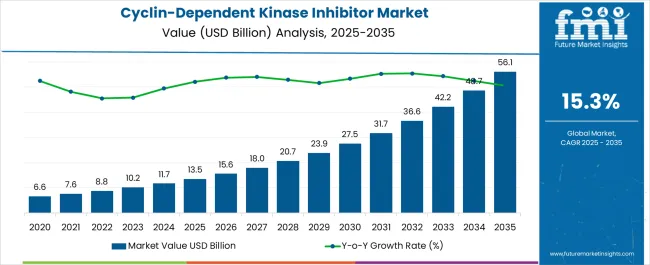
Cyclin-Dependent Kinase Inhibitor Market Key Takeaways
| Metric | Value |
|---|---|
| Cyclin-Dependent Kinase Inhibitor Market Estimated Value in (2025 E) | USD 13.5 billion |
| Cyclin-Dependent Kinase Inhibitor Market Forecast Value in (2035 F) | USD 56.1 billion |
| Forecast CAGR (2025 to 2035) | 15.3% |
Why is the Cyclin-Dependent Kinase Inhibitor Market Growing?
The Cyclin-Dependent Kinase Inhibitor market is experiencing steady expansion, driven by its critical role in targeted cancer therapy and growing demand across developed and emerging regions. The market landscape is influenced by rising incidences of cancers where CDK pathways are dysregulated, increased adoption of personalized medicine approaches, and heightened awareness among clinicians regarding novel therapeutic options. Investments in clinical research, combination therapies, and development of next-generation inhibitors are facilitating the introduction of broad-spectrum and selective agents, enhancing treatment flexibility.
Regulatory approvals and expanding reimbursement frameworks in key markets are also contributing to market growth. Additionally, ongoing innovation in drug delivery systems and formulation optimization supports improved bioavailability, safety, and patient compliance.
The aging population, coupled with a rising prevalence of hormone receptor-positive cancers and other malignancies, is further fueling demand Overall, the market trajectory is being shaped by the increasing integration of Cyclin-Dependent Kinase Inhibitors into standard treatment regimens and the growing interest in combination therapies to overcome resistance, thereby offering sustained growth potential in global oncology therapeutics.
Segmental Analysis
The cyclin-dependent kinase inhibitor market is segmented by spectrum, formulation, and geographic regions. By spectrum, cyclin-dependent kinase inhibitor market is divided into Broad CDK Inhibitors, Specific CDK Inhibitors, and Multiple Target Inhibitors. In terms of formulation, cyclin-dependent kinase inhibitor market is classified into Tablet, Inhaled, Liquid, and Injectable. Regionally, the cyclin-dependent kinase inhibitor industry is classified into North America, Latin America, Western Europe, Eastern Europe, Balkan & Baltic Countries, Russia & Belarus, Central Asia, East Asia, South Asia & Pacific, and the Middle East & Africa.
Insights into the Broad CDK Inhibitors Segment
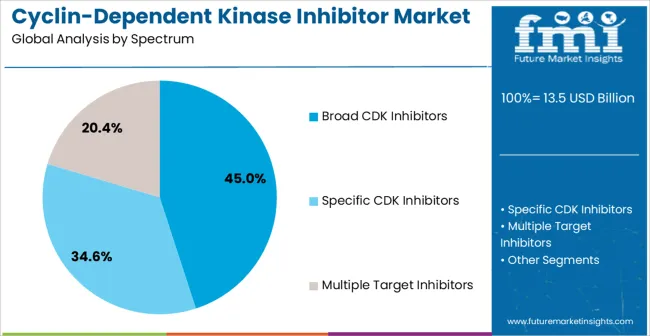
The Broad CDK Inhibitors spectrum is projected to hold 45.0% of the Cyclin-Dependent Kinase Inhibitor market revenue share in 2025, making it the leading spectrum segment. This position is being attributed to their wide therapeutic applicability across multiple cancer types and ability to target various CDK isoforms, providing clinicians with flexible treatment options. The adoption of broad inhibitors has been driven by their proven efficacy in reducing tumor proliferation and improving patient survival rates in complex malignancies.
Additionally, their use in combination regimens with other targeted therapies or standard chemotherapies has enhanced clinical outcomes, further supporting their market leadership. The development of newer molecules with improved selectivity, safety profiles, and manageable adverse effects has encouraged broader adoption.
Market growth has also been facilitated by increasing physician awareness and the integration of broad CDK inhibitors into treatment protocols for patients with resistance to conventional therapies The versatility and demonstrated clinical benefits of broad inhibitors are expected to continue driving this segment’s dominance.
Insights into the Tablet Formulation Segment
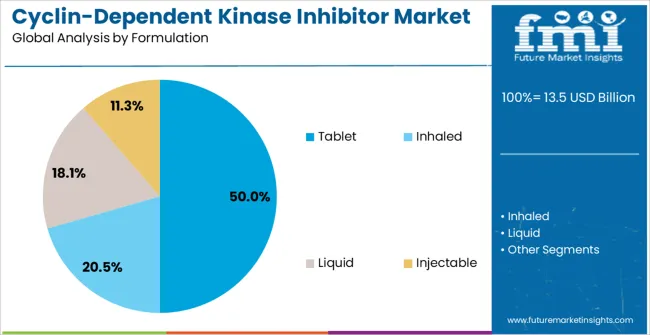
The Tablet formulation is expected to account for 50.0% of the Cyclin-Dependent Kinase Inhibitor market revenue share in 2025, emerging as the leading formulation segment. This predominance is being attributed to its ease of administration, patient compliance, and suitability for long-term treatment regimens. Tablets offer precise dosing, controlled release options, and stability advantages that are critical in oncology therapeutics.
The widespread availability of tablet-based CDK inhibitors has simplified treatment logistics for healthcare providers and patients alike, reducing the need for frequent hospital visits for parenteral administration. Furthermore, tablets allow integration with fixed-dose combination strategies, improving therapeutic adherence and convenience.
Manufacturing scalability and cost-effectiveness of tablet formulations have also played a key role in their adoption, particularly in regions with high treatment demand As clinical research continues to optimize oral CDK inhibitor therapy, the tablet segment is expected to maintain its leadership position, supported by patient-centric care models and the growing trend of oral targeted oncology therapies.
Market Overview
Cyclin-Dependent Kinase Inhibitor Market Introduction
Cyclin-dependent kinase inhibitor function as tumor suppressor proteins by inhibiting the enzyme cyclin-dependent kinase. The enzyme cyclin-dependent kinase controls cell cycle progression, transcription, mRNA processing, and differentiation.
Cyclin-dependent kinase inhibitor arrest cell cycle at the G1 phase leading to mitosis. Cyclin-dependent kinase inhibitors are employed in the treatment of cancers by preventing over proliferation of cancer cells. Cyclin-dependent kinase are very active in most cancers which is rational to the use of cyclin-dependent kinase inhibitor as anti-cancer agents.
Analysis of Cyclin-Dependent Kinase Inhibitor Market By Key Countries
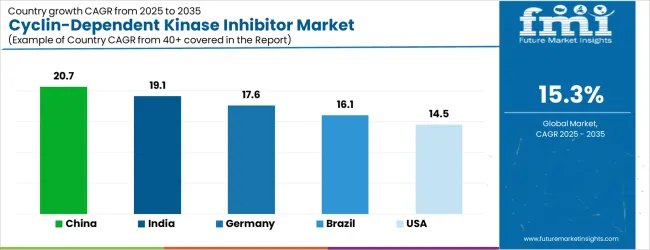
| Country | CAGR |
|---|---|
| China | 20.7% |
| India | 19.1% |
| Germany | 17.6% |
| Brazil | 16.1% |
| USA | 14.5% |
| UK | 13.0% |
| Japan | 11.5% |
Country-wise Analysis
The Cyclin-Dependent Kinase Inhibitor Market is expected to register a CAGR of 15.3% during the forecast period, exhibiting varied country level momentum. China leads with the highest CAGR of 20.7%, followed by India at 19.1%. Developed markets such as Germany, France, and the UK continue to expand steadily, while the USA is likely to grow at consistent rates. Japan posts the lowest CAGR at 11.5%, yet still underscores a broadly positive trajectory for the global Cyclin-Dependent Kinase Inhibitor Market. In 2024, Germany held a dominant revenue in the Western Europe market and is expected to grow with a CAGR of 17.6%. The USA Cyclin-Dependent Kinase Inhibitor Market is estimated to be valued at USD 5.0 billion in 2025 and is anticipated to reach a valuation of USD 5.0 billion by 2035. Sales are projected to rise at a CAGR of 0.0% over the forecast period between 2025 and 2035. While Japan and South Korea markets are estimated to be valued at USD 616.5 million and USD 468.1 million respectively in 2025.
Key Players in the Cyclin-Dependent Kinase Inhibitor Market
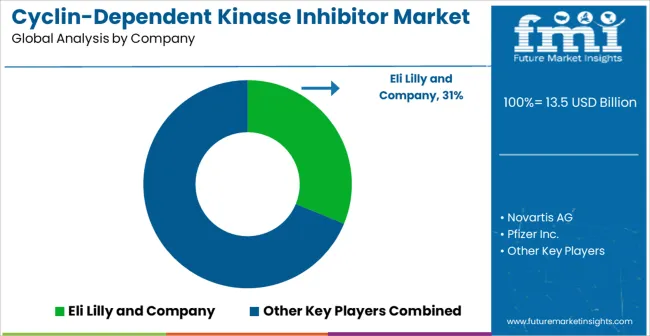
- Eli Lilly and Company
- Novartis AG
- Pfizer Inc.
- Merck & Co., Inc.
- AstraZeneca PLC
- Roche Holding AG
- Bristol-Myers Squibb
Scope of the Report
| Item | Value |
|---|---|
| Quantitative Units | USD 13.5 Billion |
| Spectrum | Broad CDK Inhibitors, Specific CDK Inhibitors, and Multiple Target Inhibitors |
| Formulation | Tablet, Inhaled, Liquid, and Injectable |
| Regions Covered | North America, Europe, Asia-Pacific, Latin America, Middle East & Africa |
| Country Covered | United States, Canada, Germany, France, United Kingdom, China, Japan, India, Brazil, South Africa |
| Key Companies Profiled | Eli Lilly and Company, Novartis AG, Pfizer Inc., Merck & Co., Inc., AstraZeneca PLC, Roche Holding AG, and Bristol-Myers Squibb |
Cyclin-Dependent Kinase Inhibitor Market by Segments
Spectrum:
- Broad CDK Inhibitors
- Specific CDK Inhibitors
- Multiple Target Inhibitors
Formulation:
- Tablet
- Inhaled
- Liquid
- Injectable
Region:
- North America
- USA
- Canada
- Mexico
- Latin America
- Brazil
- Chile
- Rest of Latin America
- Western Europe
- Germany
- UK
- Italy
- Spain
- France
- Nordic
- BENELUX
- Rest of Western Europe
- Eastern Europe
- Russia
- Poland
- Hungary
- Balkan & Baltic
- Rest of Eastern Europe
- East Asia
- China
- Japan
- South Korea
- South Asia and Pacific
- India
- ASEAN
- Australia & New Zealand
- Rest of South Asia and Pacific
- Middle East & Africa
- Kingdom of Saudi Arabia
- Other GCC Countries
- Turkiye
- South Africa
- Other African Union
- Rest of Middle East & Africa
Frequently Asked Questions
How big is the cyclin-dependent kinase inhibitor market in 2025?
The global cyclin-dependent kinase inhibitor market is estimated to be valued at USD 13.5 billion in 2025.
What will be the size of cyclin-dependent kinase inhibitor market in 2035?
The market size for the cyclin-dependent kinase inhibitor market is projected to reach USD 56.1 billion by 2035.
How much will be the cyclin-dependent kinase inhibitor market growth between 2025 and 2035?
The cyclin-dependent kinase inhibitor market is expected to grow at a 15.3% CAGR between 2025 and 2035.
What are the key product types in the cyclin-dependent kinase inhibitor market?
The key product types in cyclin-dependent kinase inhibitor market are broad cdk inhibitors, specific cdk inhibitors and multiple target inhibitors.
Which formulation segment to contribute significant share in the cyclin-dependent kinase inhibitor market in 2025?
In terms of formulation, tablet segment to command 50.0% share in the cyclin-dependent kinase inhibitor market in 2025.
Preview the report firsthand - request a free sample
Get SampleGet the brochure for pricing and purchase details.
Get PDFTable of Content
- Executive Summary
- Global Market Outlook
- Demand-side Trends
- Supply-side Trends
- Technology Roadmap Analysis
- Analysis and Recommendations
- Market Overview
- Market Coverage / Taxonomy
- Market Definition / Scope / Limitations
- Market Background
- Market Dynamics
- Drivers
- Restraints
- Opportunity
- Trends
- Scenario Forecast
- Demand in Optimistic Scenario
- Demand in Likely Scenario
- Demand in Conservative Scenario
- Opportunity Map Analysis
- Product Life Cycle Analysis
- Supply Chain Analysis
- Investment Feasibility Matrix
- Value Chain Analysis
- PESTLE and Porter’s Analysis
- Regulatory Landscape
- Regional Parent Market Outlook
- Production and Consumption Statistics
- Import and Export Statistics
- Market Dynamics
- Global Market Analysis 2020 to 2024 and Forecast, 2025 to 2035
- Historical Market Size Value (USD Million) Analysis, 2020 to 2024
- Current and Future Market Size Value (USD Million) Projections, 2025 to 2035
- Y-o-Y Growth Trend Analysis
- Absolute $ Opportunity Analysis
- Global Market Pricing Analysis 2020 to 2024 and Forecast 2025 to 2035
- Global Market Analysis 2020 to 2024 and Forecast 2025 to 2035, By Spectrum
- Introduction / Key Findings
- Historical Market Size Value (USD Million) Analysis By Spectrum , 2020 to 2024
- Current and Future Market Size Value (USD Million) Analysis and Forecast By Spectrum , 2025 to 2035
- Broad CDK Inhibitors
- Specific CDK Inhibitors
- Multiple Target Inhibitors
- Y-o-Y Growth Trend Analysis By Spectrum , 2020 to 2024
- Absolute $ Opportunity Analysis By Spectrum , 2025 to 2035
- Global Market Analysis 2020 to 2024 and Forecast 2025 to 2035, By Formulation
- Introduction / Key Findings
- Historical Market Size Value (USD Million) Analysis By Formulation, 2020 to 2024
- Current and Future Market Size Value (USD Million) Analysis and Forecast By Formulation, 2025 to 2035
- Tablet
- Inhaled
- Liquid
- Injectable
- Y-o-Y Growth Trend Analysis By Formulation, 2020 to 2024
- Absolute $ Opportunity Analysis By Formulation, 2025 to 2035
- Global Market Analysis 2020 to 2024 and Forecast 2025 to 2035, By Region
- Introduction
- Historical Market Size Value (USD Million) Analysis By Region, 2020 to 2024
- Current Market Size Value (USD Million) Analysis and Forecast By Region, 2025 to 2035
- North America
- Latin America
- Western Europe
- Eastern Europe
- East Asia
- South Asia and Pacific
- Middle East & Africa
- Market Attractiveness Analysis By Region
- North America Market Analysis 2020 to 2024 and Forecast 2025 to 2035, By Country
- Historical Market Size Value (USD Million) Trend Analysis By Market Taxonomy, 2020 to 2024
- Market Size Value (USD Million) Forecast By Market Taxonomy, 2025 to 2035
- By Country
- USA
- Canada
- Mexico
- By Spectrum
- By Formulation
- By Country
- Market Attractiveness Analysis
- By Country
- By Spectrum
- By Formulation
- Key Takeaways
- Latin America Market Analysis 2020 to 2024 and Forecast 2025 to 2035, By Country
- Historical Market Size Value (USD Million) Trend Analysis By Market Taxonomy, 2020 to 2024
- Market Size Value (USD Million) Forecast By Market Taxonomy, 2025 to 2035
- By Country
- Brazil
- Chile
- Rest of Latin America
- By Spectrum
- By Formulation
- By Country
- Market Attractiveness Analysis
- By Country
- By Spectrum
- By Formulation
- Key Takeaways
- Western Europe Market Analysis 2020 to 2024 and Forecast 2025 to 2035, By Country
- Historical Market Size Value (USD Million) Trend Analysis By Market Taxonomy, 2020 to 2024
- Market Size Value (USD Million) Forecast By Market Taxonomy, 2025 to 2035
- By Country
- Germany
- UK
- Italy
- Spain
- France
- Nordic
- BENELUX
- Rest of Western Europe
- By Spectrum
- By Formulation
- By Country
- Market Attractiveness Analysis
- By Country
- By Spectrum
- By Formulation
- Key Takeaways
- Eastern Europe Market Analysis 2020 to 2024 and Forecast 2025 to 2035, By Country
- Historical Market Size Value (USD Million) Trend Analysis By Market Taxonomy, 2020 to 2024
- Market Size Value (USD Million) Forecast By Market Taxonomy, 2025 to 2035
- By Country
- Russia
- Poland
- Hungary
- Balkan & Baltic
- Rest of Eastern Europe
- By Spectrum
- By Formulation
- By Country
- Market Attractiveness Analysis
- By Country
- By Spectrum
- By Formulation
- Key Takeaways
- East Asia Market Analysis 2020 to 2024 and Forecast 2025 to 2035, By Country
- Historical Market Size Value (USD Million) Trend Analysis By Market Taxonomy, 2020 to 2024
- Market Size Value (USD Million) Forecast By Market Taxonomy, 2025 to 2035
- By Country
- China
- Japan
- South Korea
- By Spectrum
- By Formulation
- By Country
- Market Attractiveness Analysis
- By Country
- By Spectrum
- By Formulation
- Key Takeaways
- South Asia and Pacific Market Analysis 2020 to 2024 and Forecast 2025 to 2035, By Country
- Historical Market Size Value (USD Million) Trend Analysis By Market Taxonomy, 2020 to 2024
- Market Size Value (USD Million) Forecast By Market Taxonomy, 2025 to 2035
- By Country
- India
- ASEAN
- Australia & New Zealand
- Rest of South Asia and Pacific
- By Spectrum
- By Formulation
- By Country
- Market Attractiveness Analysis
- By Country
- By Spectrum
- By Formulation
- Key Takeaways
- Middle East & Africa Market Analysis 2020 to 2024 and Forecast 2025 to 2035, By Country
- Historical Market Size Value (USD Million) Trend Analysis By Market Taxonomy, 2020 to 2024
- Market Size Value (USD Million) Forecast By Market Taxonomy, 2025 to 2035
- By Country
- Kingdom of Saudi Arabia
- Other GCC Countries
- Turkiye
- South Africa
- Other African Union
- Rest of Middle East & Africa
- By Spectrum
- By Formulation
- By Country
- Market Attractiveness Analysis
- By Country
- By Spectrum
- By Formulation
- Key Takeaways
- Key Countries Market Analysis
- USA
- Pricing Analysis
- Market Share Analysis, 2024
- By Spectrum
- By Formulation
- Canada
- Pricing Analysis
- Market Share Analysis, 2024
- By Spectrum
- By Formulation
- Mexico
- Pricing Analysis
- Market Share Analysis, 2024
- By Spectrum
- By Formulation
- Brazil
- Pricing Analysis
- Market Share Analysis, 2024
- By Spectrum
- By Formulation
- Chile
- Pricing Analysis
- Market Share Analysis, 2024
- By Spectrum
- By Formulation
- Germany
- Pricing Analysis
- Market Share Analysis, 2024
- By Spectrum
- By Formulation
- UK
- Pricing Analysis
- Market Share Analysis, 2024
- By Spectrum
- By Formulation
- Italy
- Pricing Analysis
- Market Share Analysis, 2024
- By Spectrum
- By Formulation
- Spain
- Pricing Analysis
- Market Share Analysis, 2024
- By Spectrum
- By Formulation
- France
- Pricing Analysis
- Market Share Analysis, 2024
- By Spectrum
- By Formulation
- India
- Pricing Analysis
- Market Share Analysis, 2024
- By Spectrum
- By Formulation
- ASEAN
- Pricing Analysis
- Market Share Analysis, 2024
- By Spectrum
- By Formulation
- Australia & New Zealand
- Pricing Analysis
- Market Share Analysis, 2024
- By Spectrum
- By Formulation
- China
- Pricing Analysis
- Market Share Analysis, 2024
- By Spectrum
- By Formulation
- Japan
- Pricing Analysis
- Market Share Analysis, 2024
- By Spectrum
- By Formulation
- South Korea
- Pricing Analysis
- Market Share Analysis, 2024
- By Spectrum
- By Formulation
- Russia
- Pricing Analysis
- Market Share Analysis, 2024
- By Spectrum
- By Formulation
- Poland
- Pricing Analysis
- Market Share Analysis, 2024
- By Spectrum
- By Formulation
- Hungary
- Pricing Analysis
- Market Share Analysis, 2024
- By Spectrum
- By Formulation
- Kingdom of Saudi Arabia
- Pricing Analysis
- Market Share Analysis, 2024
- By Spectrum
- By Formulation
- Turkiye
- Pricing Analysis
- Market Share Analysis, 2024
- By Spectrum
- By Formulation
- South Africa
- Pricing Analysis
- Market Share Analysis, 2024
- By Spectrum
- By Formulation
- USA
- Market Structure Analysis
- Competition Dashboard
- Competition Benchmarking
- Market Share Analysis of Top Players
- By Regional
- By Spectrum
- By Formulation
- Competition Analysis
- Competition Deep Dive
- Eli Lilly and Company
- Overview
- Product Portfolio
- Profitability by Market Segments (Product/Age /Sales Channel/Region)
- Sales Footprint
- Strategy Overview
- Marketing Strategy
- Product Strategy
- Channel Strategy
- Novartis AG
- Pfizer Inc.
- Merck & Co., Inc.
- AstraZeneca PLC
- Roche Holding AG
- Bristol-Myers Squibb
- Eli Lilly and Company
- Competition Deep Dive
- Assumptions & Acronyms Used
- Research Methodology


